Vol.50, n. 4 : pp. 713-718 July 2007
ISSN 1516-8913 Printed in Brazil BRAZILIAN ARCHIVES OF
BIOLOGY AND TECHNOLOGY
A N I N T E R N A T I O N A L J O U R N A L
Response Surface Methodology to Evaluation the Recovery
of Amylases by Hollow Fiber Membrane
João Baptista Severo Júnior1, Laura Sampaio de Sá Oliveira1, Fernanda Silva Sardeiro1, Roberto Rodrigues de Souza1, Francisco Luiz Gumes Lopes2, José Carlos Curvelo Santana2 and Elias Basile Tambourgi2*
1
Departamento de Engenharia Química; Universidade Federal de Sergipe; Cidade Universitária “Prof. José Aloísio de Campos”; Av. Marechal Rondon, s/n; Rosa Elze; 49100-000; São Cristóvão - SE - Brasil. 2Departamento de Engenharia de Sistemas Químicos; Faculdade de Engenharia Química; Universidade Estadual de Campinas; Cidade Universitária “Zeferino Vaz”; Av. Albert Einstein, 500; C.P. 6066; Barão Geraldo; [email protected]; 13083-970; Campinas - SP - Brasil
ABSTRACT
This work aimed to study the pH and the transmembrane pressure effects during the recovery of α and β amylases enzymes from corn malt (Zea mays) by hollow fiber membrane. The optimal condition was obtained for a statistical model, established by response surface methodology (RSM). The response surface analysis showed that the best operation condition for amylolitics enzymes recovery by hollow fiber membrane was 0.05 bar and pH 5.00, while the enzymes were purified about of 26 times.
Key words: Hollow fiber membrane, corn malt, α and β amylase, RSM
*
Author for correspondence INTRODUCTION
Of late, the use of enzymes in feeding, pharmaceutics, textile and others industries is increased for being economically viable. They are also used in the manufacture of alcoholic drinks, detergent, biosensors, and diagnostic kits and in the management of environment polluents (Jesus, 2002). α and β - amylases are commercial enzymes used its many applications, mainly in the starch hydrolyses (Fogarty and Kelly, 1979; Wiseman, 1987). They are obtained commonly from barley malt or microorganisms.
α-amylase (EC 3.3.1.1; α - 1,4 glucan, 4 - glucanhydroxilase) is extracellulas enzyme that hydrolyses of the α - 1,4 bonds, of the amylose, amylopectin, glycogen and dextrin molecules, but
can not hydrolyses a-1,6 bonds. It has molecular weight about 50 kDa, with isoelectric point 5.4, very good enzymatic activity about pH 4.7 and 75 °C (properties enzymes depends from source) (Reguly, 1996; Wiseman, 1987).
β-amylase (EC 3.2.1.1, α-1,4, glucanmalthydrolase) is a extracellular enzyme that hydrolyses of amylopectin and glycogen, breaking each second α - 1,4 bond. It has molecular weight about 50 kDa, with isoelectric point 5.4, very good enzymatic activity about pH 4.5-6.5 and 55-57 °C, it is inactive after temperatures above of 60 °C (Reguly, 1996; Wiseman, 1987).
alternative among separation processes that it has been more used in recent years. A membrane is defined as a barrier to separate two phases and total restricting or presented various chemical species partial transporting into phase. The membrane controls the species transporting relative rate and, as all separation, furnishes one exit current that is poor in certain components and another, rich in these components (Cheryan, 1986; Noble and Way, 1993).
Cross flow filtration occurs when to solution or suspension flow runs parallel to the membrane and perpendicular to the permeate flow. The processes that involve cross flow filtration are used to recovery, to concentrate or to purify solutions. One of the principal membrane modules utilized in cross flow filtration is the flat membranes of plates and blocks (Santos, 1996).
Processes with membranes become viable in an industrial scale with the adequate choice of membranes to the processing of each determined product (Basseti, 2002).
Response surface methodology (RSM) is a tool very used in process optimization, due to be easily application and fast response. The analysis of variance (ANOVA) is employed for the determination of significant variables. ANOVA consists of classifying and cross-classifying statistical results and was tested by the means of a specified classification difference, which was carried out by Fisher’s statistical test (F-test). The F-value is defined as the ratio of the mean square of regression (MRR) to the error (MRe) (F=MRR/MRe), representing the significance of each controlled variable on the tested model. The regression equations were also submitted to the
F-Maize malt obtaining
The maize seeds were selected, their weight was measured, washed, the seeds were carried to water absorption until 40- 45 % (w/w) and germinated in laboratory. The germination time was between 4 – 5 days. The maize malt was dried at 55 °C (Biazus et al., 2005; Malavasi et al., 2004; Santana, 2003).
Enzyme activity
Amylase was assayed according to Milles laboratory method Nirmala and Muralikrishna (2003), Reguly (1996). 20 mL of 2 % soluble starch at pH 4.8 (0.1 M acetate buffer) were hydrolyzed by 500µL of enzyme sample in 10 min at 37 °C. One unit of enzyme activity was defined as µmol of glucose released for min under the assay conditions. The specific activity was calculated as activity for mg protein.
Total protein content
It was determined according to the dye binding method of Bradford (1976) with bovine serum albumin as protein standard.
Membrane module
Figure 1 - Experimental MMHF-01 Microfiltration Unit.
Where: 1 – feed flow, 2 – pump, 3 – manometer, 4 – permeate, 5 – concentrate, 6 – hollow fiber membrane.
Experimental design
The influence of transmembrane pressure (P) and of pH on purification factor (PF) of α and β amylases enzymes from corn malt (Zea mays) were studied by 22 experimental planning with hexagon design (showed in Table 1), and response surface methodology (RSM) was used for optimization of recovering process. The least square method was used to estimate the model parameters, and the model fitting was made by analysis of variance methodology (ANOVA), all showed in Barros Neto et al. (1995 and 2001). The following variables codifications were used:
6
1=
pH
−
x
(1)05
.
0
10
.
0
2−
=
P
x
(2)RESULTS AND DISCUSSION
Experimental results obtained in this work are shown in Table 1, which describes the assays carried out to optimize the recovery of α and β amylases enzymes.
Table 2 is contained the results of the statistical analysis of model validity by the analysis of variance methodology (ANOVA) to obtain the optimal empirical model for describing the system behavior studied Barros Neto et al., (1995 and 2001).
Table 1 - Planning matrix of the experiments with the optimal model data.
Assays x1 x2 pH P (bar) PF exp. PF pred
1 -1 -1 5.00 0.05 26.2488 25.9385
2 1 -1 7.00 0.05 4.3314 4.6417
3 -1 1 5.00 0.15 1.9514 1.6411
4 1 1 7.00 0.15 3.7225 4.0327
5 0 0 6.00 0.10 3.5204 4.9195
6 0 0 6.00 0.10 5.2900 4.9195
7 0 0 6.00 0.10 5.9480 4.9195
8 -1.41 0 4.59 0.10 13.8103 14.2491
% explainig variance = 98.763
% maximum explaning variance = 99.677
Determination coefficient (R2) = 0.9876
Results of the F test, whole the first test (Fcalc/Ftab) indicated that the model was
statistical significant and the predict data were approaching the experimental data. The second test (Ftab/Fcalc) indicated that the data were
fitting and they were statically representing the response surface. For the F tests are statistical considerate the rate much be equal or more that 4 (Barros Neto et al. 1995). According to Barros Neto et al. (1995) bout F test must be > 4 for the model is statistical significant and predictive.
Results showed that the model was statically significant and that the data get to describe well the response surface.
Equation 3 gives purification factor (PF) as a function of factors x1 (pH) and x2 (P,
transmembrane pressure) as a square empirical model obtained by quadratic regression. This empirical model shows responses on individual and multiple effects of the factors Barros Neto et al., (1995 and 2001).
( ) ( )
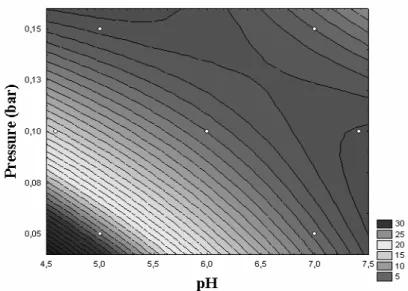
2 2 3168 . 1125 3308 . 1 ... ... 4425 . 118 2499 . 1060 5471 . 32 0011 . 176 P pH P pH P pH PF + + + ⋅ + − − = (3)In Figs. 2 and 3 the response surface and contour lines generated by data plotting of the optimal curve (Equation 2) for purification factor (PF) as a function of the factors are shown.
The increase of transmembrane pressure can to provoke a modification in the structure conformational of the enzymes, through of the passage by membrane pores, decreasing the specific enzymatic activity of amylolitics enzymes during the separation process, verified by the loss of activity (seen Figures 2 and 3). Behavior similar it was obtained in Lopes et al. (2004 and 2005), during the recovery of bromelain enzymes from pineapple by membranes.
Figure 2 - 2D response surface for understanding the purification factor dependency with the pH and transmembrane pressure during the microfiltration of α e β amylases from corn malt.
Figure 2 - 3D response surface for understanding the purification factor dependency with the pH and transmembrane pressure during the microfiltration of α e β amylases from corn malt.
CONCLUSIONS
Under the conditions adopted for this research, and based on the results obtained, the following conclusions can be reached:
• The variance analysis (ANOVA) showed that the best fitting model introduced a square
dependency of the purification factor, with the pH and the transmembrane pressure.
membranas de fibras ocas foi 0,05 bar e pH 5,00; onde as enzimas foram purificadas cerca de 26 vezes.
REFERENCES
Asenjo, J. A. (1990) Separation process. Selection of operation process. In: Separation Process in Biotechnology; Asenjo, J. A. (ed.); Marcel Dekker: New York - EUA, 3-16.
Barros Neto, B.; Scarminio, I. S. and Bruns, R. E. (1995) Planejamento e Otimização de Experimentos. Campinas : EDUNICAMP, pp. 302.
Barros Neto, B.; Scarminio, I. S. and Bruns, R. E. (2001), Como Fazer Experimentos: Pesquisa e Desenvolvimento na Ciência e na Indústria. Campinas: EDUNICAMP, pp. 406.
Bassetti, F. J. (2002) Preparação, caracterização e aplicação de membranas poliméricas microporosas assimétricas. Doctoral Thesis. Campinas, SP, Brasil, FEQ/UNICAMP.
Biazus, J. P. M.: Souza, A. G.; Santana, J. C. C. Souza, R. R.; Tambourgi, E. B. (2005), Optimization of drying process of Zea mays malt to use as alternative source of amylolytics enzymes. Brazilian Archive of Biology and Technology, v.48, Special n.6: 185-190. Borzani,W.; Aquarone, E.; Lima, U. A.; Schmidell, W;
(2001) Biotecnologia Industrial: Fundamentos, Vol. 1, 1ª Edição, Editora Edgard Blucher Ltda, São Paulo – Brasil, pp.254.
Bradford, M. M., A Rapid and Sensitive Method for the Quantitation of Microgram Quantities of Protein. Utilizing the Principle of Protein-Dye Binding. Anal. Biochem., 72, 1976, 248-254.
Cheryan, M. (1986) Ultrafiltration Handbook, Lancaster, Technomic Publishing Company, Inc. Forgaty, W. M. and Kelly, C. T. (1979) Topics in
Enzyme and Fermentation. Biotechnolog. J. Wiley and Sons. v. 3.
(2004) Obtenção da condição ótima de operação para a recuperação da bromelina, do Ananas comosus, utilizando sistema de membranas planas. In: (CD) Anais do XV Congresso Brasileiro de Engenharia Química, Curitiba, EDUFPR.
Lopes, F. L. G.; Severo Júnior, J. B.; Correia E. C. O.; Santana, J. C. C.; Tambourgi, E. B.; Souza, R. R. (2005) Recuperação de enzimas bromelinas presentes no suco do Ananas comosus utilizando membranas de fibras ocas. In: Xv Simpósio Nacional das Fermentações, Recife, Produzido pela UFPE.
Malavasi, U. C. and Malavasi, M. M. (2004), Dormancy breaking and germination of Enterolobium contortisiliquum (Vell.) morong seed. Brazilian Archives of Biology and Technology, v.47, n.6: 851-854.
Nirmala, M. and Muralikrishna, G. (2003) Three α-amylase from malted finger millet (Ragi, Eleusine coracana, Indaf-15) - Purification and partial characterization. Phytochemistry 62, 21-23.
Noble, R. D. and Way, J. D. (1993) Description of facilitated transport and enviromental applications. Membrane processes in separation and purification.
London, Kluwer Academic Publishers. 1993, (Nato ASI Series, v. 272).
Reguly, J. C., Biotecnologia dos Processos Fermentativos. EDUFPel. 1996, v. 1.
Santana, J. C. C. (2003) Recuperação das Enzimas a e (-amilases em Sistema Bifásico Aquoso PEG/ CaCl2
para Uso como Biocatalizador de Amiláceos. MSc Thesis, Campinas -SP, FEQ/ UNICAMP. pp. 232. Santos JAL (1996) Estudo de separação de uma
proteína recombinante por processos de membranas. Doctoral Thesis. Lisboa, Portugal: IST.
Wiseman, A. (1987), Handbook of Enzyme Biotechnology. 2. ed. New York, EUA: John Wiley Sons.