Vol.55, n. 5: pp.741-750, September-October 2012
ISSN 1516-8913 Printed in Brazil BRAZILIAN ARCHIVES OF
BIOLOGY AND TECHNOLOGY
A N I N T E R N A T I O N A L J O U R N A L
Fresh Pasta Production Enriched with
Spirulina platensis
Biomass
Ailton Cesar Lemes
1, Katiuchia Pereira Takeuchi
2, João Carlos Monteiro de Carvalho
3and Eliane Dalva Godoy Danesi
4*1Escola de Química e Alimentos; Universidade Federal do Rio Grande; Rua Engenheiro Alfredo Huch, 475;
96201-900; Rio Grande - RS - Brasil. 2Escola de Agronomia e Engenharia de Alimentos; Universidade Federal de Goiás; Rod. Goiânia/Nova Veneza, km 0; 74001-970; Goiânia - GO - Brasil. 3Departamento de Tecnologia
Bioquímico-Farmacêutica; Universidade de São Paulo; Av. Lineu Prestes, 580; 05315-970; São Paulo - SP - Brasil.
4Departamento de Tecnologia; Universidade Estadual de Maringá; Av. Ângelo Moreira da Fonseca, 1800;
87506-570; Umuarama - PR - Brasil
ABSTRACT
The aim of this work was to study the enrichment of Spirulina platensis in wheat flour to prepare fresh pasta to evaluate the green color and nutritional enrichment in addition to functional properties due to the presence of the bioactive compounds in the cyanobacterium. The pastas were evaluated for the centesimal composition, microbiological contamination, sensorial acceptance and technological characteristics such as cooking time, water absorption, volume displacement and loss of solids. The superior protein contents and the satisfactory technological and sensorial attributes compared with the control with no cyanobacterium showed the usefulness of incorporating S. platensis biomass in the fresh pastas. The microbiological quality was in compliance with the legislation in force. The sensorial quality was considered satisfactory (“liked very much”) and purchase intention high (“probably would buy”).
Key words:bioactive compounds, enriched fresh pasta, sensorial acceptance, technological parameters
*Author for correspondence: [email protected]
INTRODUCTION
Food supply, nowadays, follows the growing industrialization trend that increases the availability with the reduction of loss and easy distribution, but results in different intensities of nutritional and sensorial changes in the products. To minimize the undesirable effect and assure a satisfactory sensorial acceptance, several types of additives are used, including the colorants that are substances that provide or intensify the food coloring. Pigments such as chlorophylls and carotenoids in addition to providing coloring are important as they have anti-oxidant properties.
Among the cyanobacteria, the interest in the commercial production of Spirulina sp. has increased due to some specific properties such as high protein content (60-70% dry basis), high digestibility due to mucopolysaccharide cell wall, low concentration of nucleic acids and amino acid profile, similar to the one recommended by the Food and Agricultural Organization (FAO). In addition, it presents in its composition considerable proportions of other bioactive compounds such as carotenoids, phycocyanin, chlorophyll, vitamins and polyunsaturated fatty acids, including the gamma-linolenic and linoleic acids (Branger et al. 2003; Ciferri and Tiboni 1985; Jiménez et al. 2003; Morist et al. 2001; Shimamatsu 2004). From the technological point of view, it presents advantages due to the low nutritional demand, low cost of compound extraction and dry biomass (Dillon et al. 1995; Durand-Chastel 1980).
The conventional sources of chlorophyll are spinach and alf-afa, with approximately 0.5% (w/v) chlorophyll. However, the Spirulina
platensis biomass can be an alternative source, as it has approximately 1.15% (w/v) (Henrikson 1989; Taylor 1984), the major levels of this pigment in the nature, representing an aggregated high value product. It also presents the possibility of using the sub-products obtained in the extraction process in food enrichment or usage of the integral biomass with nutritional enrichment of the product.
Several therapeutic properties of the Spirulina sp. have been reported. They produce an accelerated scarring of wounds; the phycocyanin can stimulate the immunological system and the gamma-linolenic acid stimulates the prostaglandin synthesis, which are involved in regulation of the blood pressure. It is also beneficial in the treatment of specific eczemas and eases the pre-menstrual syndrome; helps in the production of good cholesterol (HDL) and in the removal of bad cholesterol (LDL) excess from the bloodstream. It also helps in reducing the coronary and obesity diseases as it contains considerable quantities of phenylalanine that reduces the hunger. High contents of intact A vitamin reduce the risks of cancer (Henrickson 1989; Richmond 1988). An antioxidant and antimutagenic effect of the chlorophyll and some of its derivates such as chlorophyllin have also been reported (Azizan and Blevins 1995, Higashi and Okai 1998; Kumar et al. 1999; Ong et al. 1986; Tutour et al. 1998).
The use of S. platensis as food has already been reported since the records of the Spanish colonization in Mexico, and has recently been stated in the expeditions in the African deserts. Several Spirulina sp. based foods and supplements have been found in the markets, subsidized by the Food and Drugs Administration (FDA), and classified as GRAS (generally recognized as safe) (Belay 2008; Henrikson 1989; Iyer et al. 2008). The increase in global population and the prediction of insufficient protein supplement have directed to the search of alternative sources of protein. Spirulina platensis could be useful in this regard (Spolaore et al. 2006). The incorporation of its biomass in nourishment may convey, in addition of the basic nutrients, important bioactive functional products (Anupama 2000; Iyer et al. 2008).
The nutritional enrichment of foods, in addition to improving the quality of nourishment, results in new marketing appeals. The addition of protein in the industrialized foods presents several technological advantages such as increase in humidity retention, improvement of texture, elasticity, cohesion, final yield and nutritional value for soya proteins. Thus, the need to evaluate other sources of protein for the enrichment of the food such as the S. platensis biomass could be duly justified. As the sensorial characteristics of foods are of significant importance in their acceptance, their modifications, resulting from the addition or subtraction of components, should be carefully studied in order to check the consumer reaction due to possible changes in product taste, texture, color or odor.
The pastas are ideal food to incorporate additional due to their simple manufacturing process, low cost, nutritive value and finally due to their high acceptance, including the green color. A market survey on the consumption of pastas, in which 100 individuals were interviewed, indicated that the pastas were frequently consumed by 97% of the persons that were interviewed (Silveira and Badiale-Furlong 1998).
of large acceptance, using integral wheat flour may stimulate the ingestion of a greater quantity of fibers by the population.
The texture and appearance of the pastas during and after cooking is the most important quality parameter for the consumers. In addition to the flavor and the odor, the following are included in these parameters: cooking time, quantification of water absorbed rheological properties of the pasta (firmness, chewiness and elasticity) and the surface characteristics (viscosity, disintegration and loss of soluble solids). According to Miskelly (1993), the firmness and lack of viscosity after cooking as well as the color and the resistance during mastication are the most important quality parameters.
In this work, a study on the application of S.
platensis biomass was undertaken through the preparation of fresh pastas with integral and special wheat flour, eggs, salts and different percentages of S. platensis additions, aiming the nutritional enrichment, green color and technological properties.
MATERIALS AND METHODS
The microorganism used in cultivation was the
Spirulina (Arthrospira) platensis UTEX 1926 originated from UTEX (The Culture Collection of Algae of the University of Texas at Austin –USA). The culture was maintained in a liquid medium as reported by Paolleti et al.(1975) at 30ºC, 100 rpm and 42 µmol.photons.m-2s-1 of light intensity for 7 days. The biomass was filtered and used as inoculum with cell concentration as 50 mg.L-1 (Pelizer et al. 2002).
The cultivation was performed in open ponds with 180 rpm agitation. In addition to the cultivation with KNO3 (Paoletti et al. 1975), urea was used
which was added in batch. A peristaltic pump MILAN® BP-600.04 (Colombo, Brazil) was used for this, with flows exponentially increasing, incorporated in the water used to correct the evaporation and maintain the cultivation volume constantly in 5 L (600 mL.day-1). The total quantity of urea added was 2.5 g.L-1 distributed during 14 days (Danesi et al. 2002; Rangel-Yagui et al. 2004). The cell growth was measured as optical density and when the maximum growth was observed, the biomass was separated by filtering in nylon filters and pasteurized at 65ºC for 15 min.
The fresh pastas were processed based on three formulations with special wheat flour or integral wheat flour:
1 - 5% fresh biomass of S. platensis, 15% eggs, 0.5% salt, 65% wheat flour and 14.5% water; 2 -10% fresh biomass of S. platensis, 15% eggs, 0.5% salt, 65% wheat flour and 9.5% water; 3 - control without S. platensis.
All the mixtures were homogenized and then the pastas were made in an extruder G. PANIZ MF 05 (Caxias do Sul, Brazil) and submitted to centesimal analyses according to the official methods. The biomass used was also evaluated for the composition analysis (AOAC, 1984). The carbohydrate contents were calculated by the difference and caloric value was calculated based on the composition, using the Atwater conversion factors of 4 kcal/g for protein, 9 kcal/g for lipids and 4 kcal/g carbohydrates (Pereira et al. 2005). The technological evaluation was performed using the parameters such as cooking time, water absorption, volume displacement and loss of solids according to the methodology of Silveira and Badiale-Furlong (1998). The samples were analyzed in triplicate. The microbiological analyses were performed according to the RDC nº 12 (Brazil 2007). The samples were analyzed in triplicate.
The influence of the addition of S. platensis biomass in the texture properties was analyzed for the cooked fresh pastas. For the evaluation of the mechanical properties the texture analyzer TA.XTIIi – Stable Micro Systems (Surrey, United Kingdom) was used to measure the shear force attribute (“cut” or “rupture”). The rupture force, using a speed of 1 mm/s, was defined with rectangular steel blade (Warner Bratzler HDP/WB) cutting stripes of pastas com approximately 7 cm in the middle, placed horizontally on a perforated platform to allow full cut. The samples were analyzed five times.
al. 2008; Meilgaard et al., 1999). This project was approved by the University of Maringa Ethics Research Committee (CAAE n. 0477.0.093.000-10) and was carried out in the same Institution. The results were evaluated by the Tukey test, taking into consideration a descriptive level (p) of 0.05, with the use of the software Statistica for Windows 5.5 (Statsoft Inc, 2000).
RESULTS AND DISCUSSION
The centesimal composition of the S. platensis biomass obtained in the cultivation using urea or KNO3 is shown in Table 1. The substitution of
KNO3 by urea was advantageous as resulted
higher contents of proteins and did not influence the chlorophyll biosynthesis, thus, reduced the cost
cultivation, Urea procurement is easier than KNO3
which is controlled by the Ministry of Defense. Thus, the pastas were prepared with a biomass cultivated with urea (Danesi et al. 2002).
Table 2 shows the centesimal composition of ready-to-eat fresh pastas. The enrichment with S.
platensis showed 10% higher contents of proteins and lipids. The centesimal composition of pasta prepared with wheat showed approximately 6.73% proteins, 1.16% ether extract, 4.34% raw fiber, 1.16% ashes and 85.61% extract free of nitrogen (Casagrandi et al. 1999). The contents of proteins in the pastas with the incorporation of 10% of biomass evaluated in the present study reached 14.5% on wet basis, thus configuring a food with excellent nutritional value in terms of proteins, as confirmed the Tukey test.
Table 1 - Results of analyses covering centesimal composition of biomasses obtained in cultivations of Spirulina
platensis with urea and KNO3 as sources of nitrogen.
Parameters (%) KNO3 Urea
Humidity 5.72 ± 0.76 5.49 ± 0.66
Proteins 40.60 ± 2.17 49.07 ± 2.31
Ashes 5.40 ± 0.74 4.96 ± 0.6
Fibers 3.80 ± 0.46 4.30 ± 0.22
Lipids 10.00 ± 1.47 10.77 ± 1.22
Chlorophyll 1.10 ± 0.22 1.97 ± 0.13
Table 2 - Results of analyses covering centesimal composition of fresh pastas with special wheat flour and addition of Spirulina platensis biomass cultivated with urea as source of nitrogen.
Standard Spirulina (5%) Spirulina (10%)
Humidity (25.09±0.83)a (26.60±0.99)a (25.76±0.79)a
Ashes (3.00±0.32)a (3.44±0.49)a (3.72±0.40)a
Proteins (8.91±0.33)b (10.32±0.76)b (14.50±1.02)a
Lipids (6.00±1.45)c (11.90±1.37)b (17.00 ±1.32)a
Fibers (5.67±0.56)b (5.80±0.43)b (7.87±0.61)a
Carbohydrates 52.33 43.64 29.15
Caloric Value 298.96 322.94 327.60
The statistical analysis of the averages used the Tukey test, whereas different letters on the lines for the same type of flour represents significant differences at the significance level of 5%.
The differences observed in the centesimal compositions were not in general significant, showing the order of magnitude of the variation coefficients, but the differences could have resulted from the lack of homogenization during the processing and analytical inaccuracies, as ingredients of the same lot were used.
However, protein and fiber values, for both kinds of flour, showed higher nutritional enrichment due to S. platensis biomass addition (Tables 2 and 3). The presence of 10% biomass caused a significant
content food. So, fresh pastas could be considered as the food rich of fiber besides its functionality indications when considering the many bioactive
components present in the S. platensis biomass, which provided it therapeutic properties (Iyer et al. 2008).
Table 3 - Results of analyses covering centesimal composition of fresh pastas with integral wheat flour and addition of Spirulina platensis biomass cultivated with urea as source of nitrogen.
Standard Spirulina (5%) Spirulina (10%)
Humidity (28.91±1.09)a (26.13±0.76)ab (24.42±1.34)b
Ashes (3.45±0.77)a (4.19±0.56)a (3.91±0.51)a
Proteins (9.08±0.46)b (9.80±0.37)b (12.31±0.99)a
Lipids (4.80±1.61)b (10.80±1.01)a (12.80±0.98)a
Fibers (7.14±0.56)b (9.80±0.99)a (11.60±0.78)a
Carbohydrates 46.62 39.28 34.96
Caloric Value 322.88 293.52 304.33
The statistical analysis of the averages used the Tukey test, whereas different letters on the lines for the same type of flour represents significant differences at the significance level of 5%.
The preparation of pastas with the use of integral wheat flour could be an interesting possibility, as it contained a higher percentage of fibers and the technological profiles of these pastas, and were not so different. The products obtained presented a satisfactory aspect, characteristics of fresh pastas, in addition to be attractive in appearance due to intense green color. From the economic and nutritional point of view, the S. platensis biomass could be advantageous when compared with the conventional manner to check the green coloring by spinach, as the Spirulina presents only chlorophyll a in its constitution, which is more stable in the thermal processes than the chlorophyll b of the vegetables, including spinach (Gross 1991; Hendry 1996). Considering the importance of polyunsaturated fatty acids contained in the biomass and the profile of the
amino acids and the low contents of nucleic acids, the incorporation of S. platensis in food seemed interesting (Becker 1981; Ciferri and Tiboni 1985; Hirano 1990).
The technological parameters in general did not present significant differences between the samples (p<0.05). Results shown in the Tables 4 and 5 indicated that the pastas with the addition of
S. platensis presented a behavior similar to the controls, as was the case of pastas prepared with special wheat flour as well as in formulations with integral wheat flour. The incorporation of S.
platensis did not interfere in its acceptability by the consumers. The comparison of this data with technological standards already defined was difficult, as the values found in the literature referred to the studies with the dehydrated pastas, and were not valid for the fresh pastas.
Table 4 - Results of technologic tests of fresh pastas prepared with special wheat flour enriched with Spirulina platensis biomass.
Technologic Parameters Standard Spirulina platensis 5% Spirulinaplatensis 10%
Cooking time (min) (5.68 ± 0.07)a (5.85 ± 0.09)a (5.65 ± 0.31)a Water retention capacity (%) (18.08 ± 0.26)a (16.82 ± 0.39)a (18.71 ± 0.22)a
Volume displacement (%) (15.00 ± 0.31)a (20.00 ± 0.42)a (16.25 ± 0.59)a Loss of solids (%) (16.4 ± 1.02)a (14.45 ± 0.45)c (22.20 ± 1.19)a Loss of proteins (%) (1.99 ± 0.37)a (1.25 ± 0.41)a (0.90 ± 0.57)c Water absorption (%) (80.18 ± 0.33)a (70.79 ± 1.09)a (80.16 ± 0.37)a
Table 5 - Results of technologic tests of fresh pastas prepared with integral wheat flour enriched with Spirulina
platensis biomass.
Parameters Standard S. platensis (5%) S. platensis (10%)
Cooking time (min) (6.97 ± 0.07)c (7.07 ± 0.11)a (7.23 ± 0.09)a Water retention capacity (%) (24.8 ± 0.45)c (26.85 ± 0.34)b (28.03 ± 0.51)a
Volume displacement (%) (16.50 ± 0.52)b (18.00 ± 0.76)a (17.00 ± 0.39)a,b Loss of solids (%) (20.32 ± 0.97)a (17.83 ± 1.08)b (17.71 ± 1.16)b Loss of proteins (%) (4.95 ± 0.31)a (2.70 ± 0.51)c (4.50 ± 0.49)b Water absorption (%) (74.95 ± 1.09)c (104.02 ± 2.56)a (91.33 ± 1.34)b The results express averages of 2 repetitions. Means within rows followed by the same letter are not significantly different (Tukey, p < 0.05).
It is important to highlight a small loss of proteins in the cooking liquid, which was important nutritional parameter. The small loss of solids also provided the product with a more firm aspect after cooking; in the case of loss of starch could affect the viscosity, which could be, highly undesirable affecting also the pasta quality (Ormenese et al. 2004).
The use of protein concentrates usually result in an improvement in the cooking quality, especially if they have a higher content of soluble proteins and low temperature of coagulation (Silveira et al. 2000).
Drying interferes in the pastas nutritional value, as the Maillard reaction promoted by the increase of
temperature reduces the availability of the lysine (Ormenese et al. 1998). In the case of fresh pastas, in spite of the reduced shelf life, and refrigeration need, this occurrence was minimized. In addition, the use of fresh biomass of S. platensis also contributed to the increment of the nutritional value, as several studies have reported the effect of the drying methods on the nutritional value of this source of proteins (Chronakis et al. 2000; Durand-Chastel 1980; Morist et al. 2001).
The microbiological evaluation of the product indicated that the product was safe within the limits defined by the legislation (Table 6) (RDC nº 12, 2001).
Table 6 - Results of microbiologic tests covering fresh pastas with special flown and addition of 10% of Spirulina platensis, based on RDC 12 (, 2001).
Microorganisms Results Reference : RDC nº 12 - ANVISA
Coliforms 45ºC/g < 3 NMP/g 102 NMP/g
Coagulase-positive Staphylococcus/g < 3 CFU/g 5 103 CFU/g
Salmonella sp/ 25g Absent in 25g Absent in 25g
In general, the mass formulations produced with special wheat flour presented the sensorial acceptance of assessed attributes numerically higher than those produced with the integral flour (Tables 7 and 8). The sensorial attributes of purchase intention and texture for the pastas containing special wheat flour, did not present differences (p<0.05) when compared to the standard formulations containing 5 and 10% of S.
platensis biomass addition. For the taste and odor attributes, the standard formulation did not present any difference (p<0.05) between the formulations containing 10% of biomass and no differences were noted between the addition of 5 and 10% of biomass. In addition, no difference was noted
(p<0.05) when compared with the global appearance attribute between the standard formulations and with 5% of biomass and between the formulations containing 5 or 10% of biomass addition (Tables 7 and 8).
Table 7 - Average of sensorial attributes evaluated through affective test of formulations of cooked fresh pastas with special wheat flour containing 5% and 10% of Spirulina platensis biomass.
Attributes Standard S. platensis (5%) S. platensis (10%)
Taste 7.39a 6.73b 7.06ab
Odor 7.45a 6.85b 7.06ab
Global Appearance 7.52a 7.03ab 6.70b
Texture 7.33a 6.76a 7.21a
Purchase 4.09a 3.76a 3.94a
The statistical analysis of the averages used the Tukey test, whereas different letters on the lines for the same type of flour represents significant differences at the significance level of 5%.
Table 8 - Average of sensorial attributes evaluated through affective test of formulations of cooked fresh pastas with integral wheat flour containing 5% and 10% of Spirulina platensis biomass.
Attributes Standard S. platensis (5%) S. platensis (10%)
Taste 5.79a 5.36a 5.55a
Odor 6.76a 6.48ab 6.18b
Global Appearance 5.88a 5.79a 5.39a
Texture 5.91a 5.42ab 5.33b
Purchase 3.12a 2.97a 2.85a
The statistical analysis of the averages used the Tukey test, whereas different letters on the lines for the same type of flour represents significant differences at the significance level of 5%.
The small differences of the pastas incorporated with S. platensis biomass with the standard pasta when the use of integral wheat flour could have been the result of the fact that the fresh pastas prepared with integral wheat flout presented stronger initial coloring and odors when compared with those of the fresh pastas prepared with special wheat flour.
The fresh pastas formulations produced with the special wheat flour showed high acceptance (p<0.05), approximately 7-8, which implied in “I like moderately” and “I like a lot”, respectively. The purchase intention of the products was high, approximately 4, which implied that the tasters judged that “would possibly buy” the evaluated products (Table 6).
The fresh pastas formulations produced with the integral wheat flour presented a sensorial acceptance (p<0.05), approximately 5-7, which implied in “I did not like nor disliked” and “I like moderately”, respectively. The purchase intention of the products was of approximately 4, which implied that the tasters judged that “they may or not buy” the evaluated products (Table 6).
Comparing the purchase intention results in Tables 7 and 8, it was possible to conclude that the consumers' purchase preference would be influenced only by the flour type used in the preparation of the pastas and not by the fact of
incorporating or not the S. platensis biomass in the formulation.
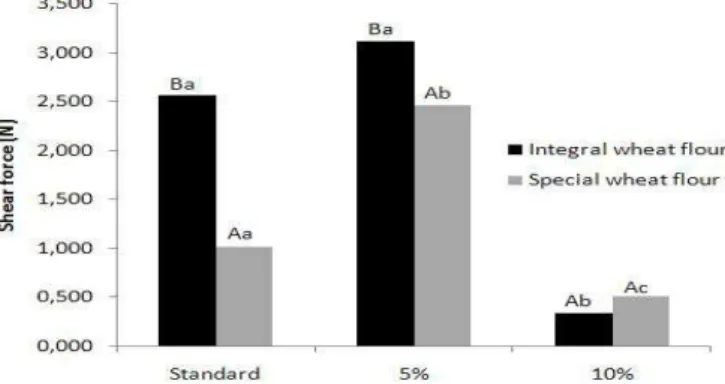
highest elasticity value was observed for the sample containing 5% of biomass, indicating that the addition of biomass in 5% favored the formation of elastic network that probably incorporated and promoted the interaction of the formulation ingredients. The highest biomass concentration (10%) resulted in a reduction in pasta's elasticity. The elasticity of the standard integral sample was slightly lower than the sample
containing 10% of biomass (p<0.05). The high content of proteins in the formulation of the pastas containing 10% of biomass could have generated network structure heterogeneity, due to the affinity of the proteins among themselves and the competition for the hydration water with the other components of the formulation, resulting in a lower elasticity of the network and minor resistance to the cut.
Figure 1 - Variation of sheer force values for fresh pastas cooked in relation to addition of Spirulina platensis biomass (5 to 10%).
ACKNOWLEDGMENTS
The authors wish to acknowledge the support of the Fundação Araucária for their support of this work.
REFERENCES
Anupama RP. Value-added food: single cell protein. Biotechnol Adv. 2000; , 18(6): 459-79.
AOAC. Association of Official Analytical Chemistis. Official methods of analysis. 14th edition. Arlington: AOAC; 1984.
APHA. American Public Health Association. Compendium of methods for the microbiological examination of foods. 4th edition. Washington, D.C.: High Wire Press – Stanford University Libraries; 1992.
Azizan A, Blevins RD. Mutagenicity and antimutagenicity testing of six chemicals associated with the pungent properties of specific spices as revealed by the Ames Salmonella/microssomal assay. Arch Environ Con Tox. 1995; 2(8): 248-58.
Becker EW. Algae mass cultivation – Production and utilization. Process Biochem. 1981; 16(5): 10-4.
Belay A. Spirulina (Arthrospira): production and quality assurance. In: Gershwin ME, Amha EB, editor. Spirulina in human nutrition and health. London: CRC Press; 2008. pp. 2-23.
Borowitzka MA. Microalgae as sources of pharmaceuticals and other biologically active compounds. J Appl Phycol. 1995; 7: 3-15.
Branger B, Cadudal JL, Delobeel M, Ouoba H, Yameogo P, Quedraogo D, Guerin D, Valea A, Zombre C, Ancel P. Spirulina as a food supplement in case of infant malnutrition in Burkina Faso. Arch Pédiatr. 2003; 10(5): 424-31.
Brazil. (1998), Regulation - RDC n.12, january 2, 2001. Technical Regulation microbiological standards for foods. Official daily of federative republic of Brazil,
Brasília, DF, 10 jan. 2001. Available: <http://www.anvisa.gov.br/legis/resol/12_01rdc.htm> Accessed: 01 March. 2007.
Brazil. (1998), Regulation SVS/MS n. 27, january 13. Official daily of federative republic of Brazil, Brasília, DF, 16 jan. 1998. Available: < http://www.anvisa.gov.br/alimentos/informes/36_270 608.htm> Acessed: 06 jun.
Chronakis IS, Galatanu AN, Nylander T, Lindman B. The behaviour of protein preparations from blue-green algae (Spirulina platensis strain Pacifica) at the air\water interface. Colloids Surf. 2000; 173: 181-92. Ciferri O, Tiboni O. The biochemistry and industrial
potential of Spirulina. Ann Rev Microbiol. 1985; 39: 503-26.
Danesi EDG, Rangel-Yagui CO, Carvalho JCM, Sato S. Effect of reducing the light intensity in the growth and production of chlorophyll by S. platensis. Biomass Bioenerg. 2004; 26: 329-35.
Danesi EDG, Rangel-Yagui CO, Carvalho JCM, Sato S. An investigation of effect of replacing nitrate by urea in the growth and production of chlorophyll by Spirulina platensis. Biomass Bionerg. 2002; 23: 261-69.
D-chastel H. Production and use of Spirulina in Mexico. In: Shele G, Soeder CJ, editor. Algae Biomass. Amsterdam: Elsevier/North Holland Biomedical; 1980. p. 51–64.
Dillon JC, Phuc AP, Dubacq JP. Nutritional value of the alga Spirulina. Plants in Hum Nutr. 1995; 77: 32-46.
Gomes RC, Maranhão HS, Pedrosa LC, Morais MB. Consumo de fibra alimentar e de macronutrientes por crianças com constipação crônica funcional. Arq Gastroenterol. 2003; 40(3): 181-87.
Gross J. Chlorophylls. In: Reinhold VN, editor. Pigments in vegetables - chlorophylls and carotenoids. New York; 1991. p. 351.
Hasler CM. Functional food: their role in disease prevention and health promotion. Food Technol. 1998; 52(11): 63-70.
Hendry GAF. Chlorophylls and chlorophyll derivatives. In: Hendry GAF, Houghton JD, editor. Natural food colorants. London: Blackil Academic Professional; 1996. p. 131-155.
Henrikson R. Earth Food Spirulina. California: Ronore Enterprises Inc; 1989.
Higashi OK, Okai Y. Potent supressive activity of chlorophyll a and b from green tea (Camellia sinensis) against tumor promotion in mouse skin. J Uoeh. 1998; 20(3): 181-88.
Hirano M. Gamma-linolenic acid production by microalgae. Appl Microbiol Biotechnol. 1990; 24: 183-91.
Iyer UM, Dhruv SA, Mani IU. Spirulina and its terapeutic implications as a food product. In: Gershwin ME, Belay A, editor. Spirulina in human nutrition and health. London: Taylor and Francis; 2008. p. 51-70.
Jiménez C, Cossío BR, Labella D, Niell FX. The feasibility of industrial production of Spirulina (Arthrospira) in Southern Spain. Aquaculture. 2003; 217(1-4): 179-90.
Johnson EA, Schroeder WA. Microbial carotenoids. Adv Biochem Eng Biotechnol. 1996; 53: 119-78. Kumar SS, Chaubey RC, Devasagayam TPA,
Priyadarsini KI, Chauhan PS. Inhibition of radiation-induced DNA damage in plasmid pBR322 by chlorophyllin and posible mechanisms of action. Mutat Res. 1999; 425(1): 71-9.
Meilgaard M, Civille GV, Thomas-Car B. Sensory evaluation techniques. 2nd ed. Boca Raton: CRC Press; 1998.
Miskelly DM. Noodles: a new look at an old food. Food Aust. 1993; 45(10): 496-500.
Morist A, Montesinos JL, Cusidó JAL, Gódia F. Recovery and treatmente of Spirulina platensis cells cultured in a continuous photobioreactor to be used as food. Process Biochem. 2001; 37(5): 535-47.
O’Callaghan MC. Biotechnology in natural food colours: The role of bioprocessing. In: Hendry GAF, Houghton JD, editor. Natural food colorants. London: Blackil Academic Professional; 1996. p. 80-108. Ong T, Whong WZ, Stewart J, Brockman HE.
Chlrophyllin: a potent antimutagen against environmental and dietary complex mixtures. Mutat Res Lett. 1986; 173(2): 111-15.
Ormenese RCSC, Leitão RFF, Silveira NFA, Baldini VLS. Influência da secagem à alta temperatura nas características das massas com ovos. Ciência Tecnol Aliment. 1998; 18: 7-12.
Ormenese RCSC, Misuni L, Zambrano F, Faria EV. Influência do uso de ovo líquido pasteurizado e ovo desidratado nas características da massa alimentícia. Ciência Tecnol Alime. 2004; 24: 255-260.
Paoletti C, Pushparaj B, Tomaselli L. Ricerche sulla nutrizione minerale di Spirulina platensis. In: XVII Congresso Nazionale della Società Italiana di Microbiologia. Padova; 1975. v. 2. p. 845-853. Pelizer LH, Danesi EDG, Rangel CO, Sassano CEN,
Carvalho JCM, Sato S, Moraes IO. Influence of inoculum age and concentration in Spirulina platensis cultivation. J Food Eng. 2002; 56: 371-75.
Pereira J, Silva RPG, Nery FC, Vilela ER. Comparação entre a composição química determinada e a declarada na embalagem de diferentes marcas de pão de queijo. Cienc Agrotec. 2005; 29(3): 623-28. Rangel-Yagui CO, Danesi EDG, Carvalho JCM, Sato S.
Spirulina platensis cultivation with urea addition by fed-batch process for chlorophyll production. Bioresource Technol. 2004; 92: 133-141.
Shimamatsu H. Mass production of Spirulina, an edible microalga. Hydrobiologia. 2004; 512: 39-44.
Silveira AEVG, Souza-Soares LA, Badiale-Furlong E. Avaliação nutricional de uma massa alimentícia seca à base de plasma bovino. Alim Nutr. 2000; 11: 51-65. Silveira EVG, Badiale-Furlong E. Formulação de uma massa alimentícia alternativa: enriquecimento com plasma bovino. Alim Nutr. 1998; 9: 27-38.
Spolaore P, Joannis-Cassan C, Duran E, Esambert A. Commercial applications of microalgae. J Biosc Bioeng. 2006; 101(2): 87-96.
Taylor AJ. Natural colours in food. In: Walford J, editor. Developments in food colours. Manchester: Elsevier Applied Science Publishers; 1984. p. 159-206.
Tutour BL, Benslimane F, Gouleau MP, Gouygou JP, Saadan B, Quemeneur F. Antioxidant and pro-oxidant activities of the brown algae, Laminaria digitata, Himanthalia elongata, Fucus vesticulosus, Fucus serratus and Ascophyllum nodosum. Journal Appl Phycol. 1998; 10(2): 121-29.