Dezembro de 2011
Sara Vanessa Afonso Reis Teixeira
Development of a sensoring device for
environmental estrogens in wastewater
UMinho|20 11 Sara V anessa Afonso R eis T eix eira De velopment of a sensoring de
vice for environment
al es trogens in w as te w ater
Dissertação de Mestrado em Micro e Nano Tecnologias
Trabalho realizado sob a orientação da
Doutora Graça Minas
e do
Doutor Klaus Kühn
Dezembro de 2011
Sara Vanessa Afonso Reis Teixeira
Development of a sensoring device for
environmental estrogens in wastewater
Universidade do Minho, ___/___/______
iii
ACKNOWLEDGEMENTS
This project would not have been possible unless for Prof. Gianaurelio Cuniberti having given me the opportunity to take part in his scientific group as a guest and Prof. Wolfgang Pompe giving the ingenious idea about the project's theme.
The exchange program at Technische Universität Dresden was a truly good experience and I am very thankful to Erasmus.
I am greatly thankful to my supervisors Graça Minas, Klaus Kühn and Bettina Soltmann whose encouragement, guidance and support from the initial to the conclusion of this project enabled me to develop an understanding of the subject as also to Martin Mkandawire.
I am very grateful to Prof. Gerhard Rödel, from the Institute of Genetics, TUD, for allowing me to use their equipment and the opportunity to improve my knowledge in genetics. I would also like to thank all the people at the Institute for strongly providing me the insight needed to conduct part of my experiments, in particular to Kai Ostermann, Astrid Schuller, Msau Mkandawire, Nuriye Korkmaz and Katja Zoschke that strongly provided me the insight need to conduct some of my experiments.
I owe my deepest gratitude to Prof. Jungbauer/Dr. Svjetlana Medjakovic (University of Natural Resources and Life Sciences, Vienna) who kindly provided the recombinant
Saccharomyces cerevisiae.
I am indescribably indebted to my parents for providing me with the opportunity to be where I am. Without them none of this would even be possible.
I offer my best regards to many of my colleagues for supporting me, mainly Liliana Melro and Marisa Rio.
I wish to thank my many student colleagues and other researchers at the Institut für Werkstoffwissenschaft for providing a stimulating and fun environment in which to learn and grow. I am especially grateful to Mahipal Ganji, Laila Ladhani, "Nacho" Gonzalez, Gerhard Lackner, Stanislav Advoshenko, Li Wu and Thomas Brumme. Lastly, I offer my regards to all of those who supported me in any respect during the completion of this thesis.
v
ABSTRACT
There is an increasing public concern about the possible adverse consequences at both human health and wildlife, arising from the release of estrogens into the environment. These endocrine disrupting chemicals include a variety of chemical classes, such as natural and synthetic hormones, plant constituents (phytoestrogens), pesticides, compounds used in the plastics industry, among other industrial by-products and pollutants. They are frequently widely dispersed in the environment. Some can be persistent and can be transported through long distances. Others are rapidly degraded. For these reasons it is necessary to proceed to the environment monitoring of these compounds.
Green Fluorescent Protein has been employed as a reporter protein in whole-cell sensing systems based on stress induction. This is a new developed method of reporting systems since it can substitute the assay that frequently has been used, the β-galactosidase as a reporter gene, which is a time-consuming procedure and since it requires cells disruption it increases the errors.
Thus, this work aimed to construct a biosensor based on a genetically modified yeast cells expressing the Green Fluorescent Protein (GFP) upon exposition to estrogenic compounds on wastewater. In order to test the operation of the sensor it was measured the transmittance and fluorescence of slides with alginate and FluoSpheres plotted in three immobilization layouts: 'separated dots', 'dots together' and dip coated. The transmittance and the fluorescence signals were detected by a CMOS optical sensor. FluoSpheres beads were used instead of the yeast cells due to legal issues, it was not possible to bring the genetically modified yeast cells to Portugal
The results showed that the transmittance is affected by the thickness of the alginate layer, which scatters the light, therefore the dip coated slides present lower transmittance values. The 'dots together' layout is the most effective in fluorescence detection. High concentrations of FluoSpheres beads presented lower values of fluorescence.
vii
águas residuais
RESUMO
A preocupação pública tem vindo a aumentar relativamente às consequências adversas na sua saúde e nos habitats devido à libertação de compostos estrogénicos no ambiente. Estes disrutores endócrinos incluem uma diversidade de classes químicas como as hormonas naturais e sintéticas, fitoestrogénios (estrogénios presentes nas plantas), pesticidas, químicos usados na indústria dos plásticos, entre outros subprodutos industriais e poluentes. São facilmente dispersos no ambiente e enquanto uns podem ser persistentes e transportados até longas distâncias, outros são rapidamente degradados. Desta forma, é necessário proceder à monitorização ambiental destes compostos.
A Proteína Verde Fluorescente (GFP) tem vindo a ser usada como uma proteína repórter em biosistemas através da indução de stresse. Este é um novo método desenvolvido para sistemas repórter uma vez que pode substituir o teste que tem sido usado frequentemente, o de β-galactosidase como gene repórter, que é um procedimento moroso e requerer a desintegração celular.
Assim, este trabalho visa a construção de um biossensor baseado em células de leveduras geneticamente modificadas que expressam GFP aquando da exposição a compostos estrogénicos em água. De forma a testar o funcionamento do sensor foi medida a transmitância e a fluorescência usando-se lâminas com alginato e FluoSpheres imobilizados em três layouts diferentes: "separated dots", "dots together" e dip coated. Os sinais de transmitância e fluorescência foram detectados com um sensor óptico
CMOS. Usaram-se as FluoSpheres em alternativa às células das leveduras devido a
questões legais, uma vez que não era possível trazer as leveduras geneticamente modificadas para Portugal.
Os resultados obtidos demonstraram que a transmitância é afectada pela espessura da camada de alginato que dispersa a luz. Por conseguinte as lâminas dip coated apresentaram menores valores. O layout "dots together" foi o mais efetivo na deteção de fluorescência. Elevadas concentrações de FluoSpheres apresentaram menores valores de fluorescência.
ix
Acknowledgements ... iii
Abstract ... v
Table of acronyms ...xi
Table of figures ... xiii
1. Introduction ... 1 1.1 Context ... 1 1.1.1 Endocrine system ... 3 1.2 Objective ... 6 1.3 Motivation ... 6 1.4 Work description ... 7 1.5 Thesis organization ... 8 2. Biosensor ... 9 2.1 Whole-cell biosensors ... 10 2.2 Immobilization techniques ... 15 2.3 Electronic device ... 16 2.3.1 Photodiode ... 18
2.3.2 Home-made spectrophotometer and its components ... 21
2.3.3 Beer-Lambert's law ... 22
2.4 Pollutants... 24
2.4.1 Bisphenol A ... 25
2.4.2 4-Nonylphenol ... 26
2.4.3 17β-Estradiol ... 27
3. Materials and Methods ... 29
3.1 Chemicals ... 29
3.1.1 Testing the modified yeast cells... 29
3.1.2 Using FluoSpheres beads for testing the electronic device ... 29
3.2 Detection of expressed GFP from the genetically modified Saccharomyces cerevisiae 30 3.3 Immobilization ... 30
3.3.1 Dip coating ... 31
3.3.2 Nanoplotting ... 32
3.4 Activation process of the yeast cells ... 33
3.5 Experimental conditions while testing the FluoSpheres beads with the sensor ... 34
4. Results and Discussion ... 41
x
4.1.2 Induction with Bisphenol ... 42
4.1.3 Induction with 4-Nonylphenol ... 44
4.2 Microplate test ... 45
4.3 FluoSpheres Beads ... 49
4.3.1 Macro Sensor readings of the FluoSpheres beads ... 50
5. Conclusions and further work ... 57
xi
BHA - Butylated hydroxyanisole BPA - Bisphenol A
CAS - Chemical Abstracts Service CSM - Complete Supplement Mixture
CMOS - Complementary Metal-Oxide Semiconductor DDT - Dichlorodiphenyltrichloroethane
DMSO - Dimethylsulfoxide DVD - Digital Versatile Disc
EDC - Endocrine-disrupting compound GFP - Green Fluorescent Protein No. - Number
TRP - Tryptophane URA - Uracil UV - Ultraviolet
xiii
Figure 1 - Routes of exposure to endocrine disruptors. Adapted from (World Health
Organization 2002) ... 2
Figure 2 - Endocrine System (American Medical Association n.d.) ... 4
Figure 3 - Basic principle of whole-cell-based sensor using recombinant DNA technology. Microorganisms receive extracellular signs through the receptor, and the signal-mediated activation of the response element (RE) induces the transcription of the reporter gene. The reporter protein exhibits a detectable signal as fluorescence. Adapted from (Yagi 2006) ... 10
Figure 4 - Jablonski Energy Diagram (Fluorescence). Red line represents the absorption of light and the blue one represents the fluorescence light. Adapted from (Lakowicz 2006) ... 12
Figure 5 - X-ray crystal structure of green fluorescent protein (GFP) pictured from the side(left) and the top (right) (Daunert, et al. 2000) ... 12
Figure 6 - The excitation and emission spectrum of GFP (Institute of Structural and Molecular Biology n.d.) ... 13
Figure 7 - Reporter gene scheme. Green Fluorescent Protein is given as an example (Berthold Technologies 2008) ... 14
Figure 8 - GFP Spectra on the left (University of London - Institute of Structural and Molecular Biology 1996). Green line corresponds to the emission spectrum of green light (peak at 509 and a small shoulder at 540 nm) and the blue line corresponds to the absorption of blue light (peak at 395 nm and a minor peak at 475 nm). On the right, FluoSpheres spectra in water (Invitrogen 2011) . The blue line corresponds to the absorption (peak at 505 nm) and emission is represented by the red light (peak at 515 nm) ... 17
Figure 9 - FluoSpheres' Stoke's shift is 10 nm. Adapted from (Invitrogen 2011) ... 18
Figure 10 - Loss of energy during molecular vibration. Adapted from (Lakowicz 2006) ... 18
Figure 11 - Symbol of a photodiode (McComb and Boysen 2005) ... 19
Figure 12 - Scheme of a P-N junction ... 19
Figure 13 - Depletion region scheme ... 20
Figure 14 - P-N junction in reverse bias ... 20
Figure 15 - P-N junction n+/p-epi (Coura, Salles e Monteiro 2011) ... 21
Figure 16 -Components of the spectrophotometer. Adapted from (Thomas 1996) ... 22
Figure 17 - Beer-Lambert absorption diagram of a light traveling through a sample of width l. Adapted from (The Hebrew University of Jerusalem - Faculty of Agriculture, Food and Environment 2009) ... 23
Figure 18 - Molecular structure of Bisphenol A (Staples, et al. 1998) ... 25
xiv
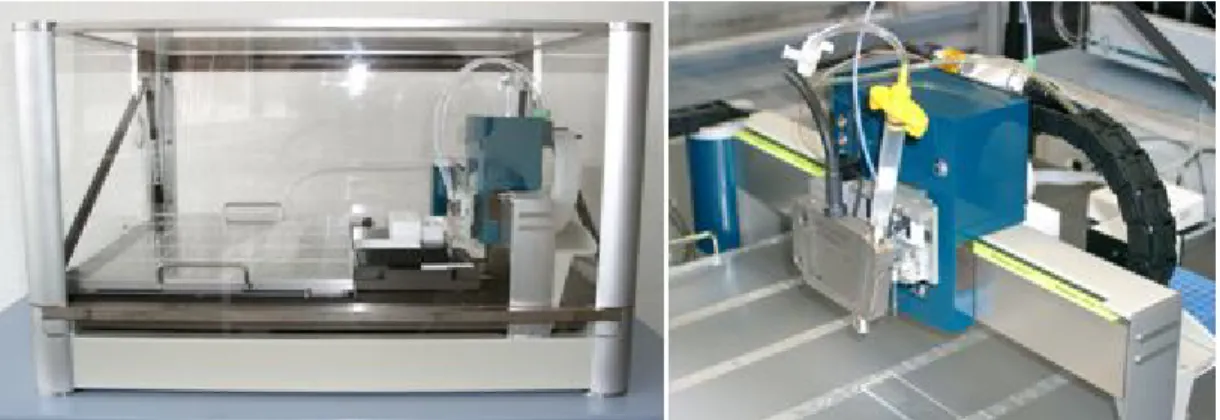
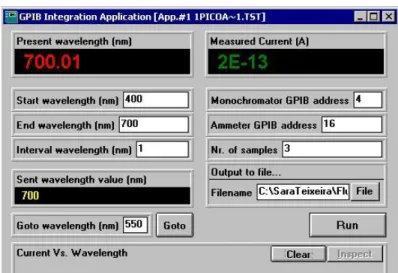
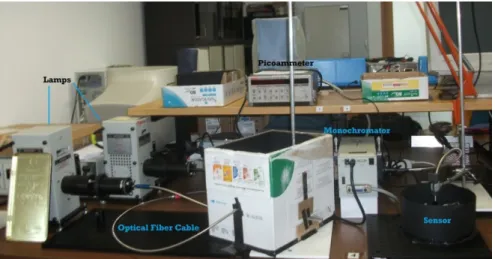
Figure 21 - Dip coating scheme to dip coat with yeast and FluoSpheres ... 32 Figure 22 - Different layouts of nanoplotting 5 x 5 in a 26 x 76 mm slide. Each spot on the left slide (separated spots) has 17 nL of the solution and the spots on the right slide (dots together) have 85 nL of solution ... 32 Figure 23 - Nano Plotter 2.1. Image on the right is a sub-microliter piezoelectric pipette (GeSiM n.d.) ... 33 Figure 24 - Example of a Test Point setup. Fluorescence measurements testing in a range of 400 nm to 700 nm in an interval wavelength of 1 nm ... 35 Figure 25 - Home-made spectrophotometer ... 36 Figure 26 - Optical fiber cable and sensor in a front-surface geometry to procedure to fluorescence in a macrodevice testing (the blue box is the sensor) ... 37 Figure 27 - Fluorescence measurements using a 550 nm filter (the round object), macrodevice 37 Figure 28 - Transmittance measurements using a 550 nm filter, microdevice (Ferreira, et al. 2011) ... 38 Figure 29 - Measurements using a filter of 550 nm ... 38 Figure 30 - Photodiode L-Edit image. a) A zoom in showing the contacts part of the b) all photodiode image... 39 Figure 31 - S. cerevisiae nanoplotted (strain 188 R1), induced with Estradiol (10-5 M). Visualization of 4 spots in a) bright field, b) fluorescence and c) overlap the bright field and fluorescence, zoom 40x ... 41 Figure 32 - S. cerevisiae nanoplotted (strain 188 R1) induced with Estradiol (10-5 M). Visualization of a single spot in a) bright field, b) fluorescence and c) overlap the bright field and fluorescence, zoom 200x ... 42 Figure 33 - S. cerevisiae (strain 188 R1), with Estradiol (10-5 M). Visualization of the 'dots together' layout in a) bright field, b) fluorescence and c) overlap the bright field and fluorescence, zoom 40x ... 42 Figure 34 - S. cerevisiae nanoplotted, induced with Bisphenol (10-5 M). Visualization of 4 spots in a) bright field, b) fluorescence and c) overlap the bright field and fluorescence, zoom 40x... 43 Figure 35 - S. cerevisiae nanoplotted, induced with Bisphenol (10-5 M). Visualization of a single spot in a) bright field, b) fluorescence, zoom 200x ... 43 Figure 36 - S. cerevisiae nanoplotted in a different layout, 'dots together', induced with Bisphenol... 44 Figure 37 - S. cerevisiae nanoplotted, in a 'separated spots' layout, induced with 4-Nonylphenol (10-6 M). Visualization in a) bright field, b) fluorescence and c) overlap the bright field and fluorescence, zoom 40x ... 44
xv
single spot in fluorescence field, zoom 200x ... 45 Figure 39 - Microplate test scheme ... 46 Figure 40 - Induction of the cells with Estradiol. On the left side the cells are suspended in medium, on the right side the cells are entrapped in alginate ... 47 Figure 41 - Induction of the cells with 4-Nonylphenol. On the left side the cells are suspended in medium, on the right side the cells are entrapped in alginate ... 48 Figure 42 - Induction of the cells with Bisphenol A. On the left side the cells are suspended in medium, on the right side the cells are entrapped in alginate ... 48 Figure 43 - Dip coated FluoSpheres beads, zoom 200x. The scalebar corresponds to 30 µm .... 49 Figure 44 - FluoSpheres beads in suspension solution, 200x ... 49 Figure 45 - Nanoplotted FluoSpheres beads. Bright field (upper) and fluorescence (lower). Images on the left represent the layout 'dots together' (zoom 40x), the image on the right represents one single spot (zoom 200x). In the left lower image the FluoSpheres are the little dots, big dots might be some waste or noise. ... 50 Figure 46 - Transmittance comparison of a new unused slide to the blank ... 51 Figure 47 - FluoSpheres beads' transmittance assay ... 51 Figure 48 - Fluorescence assay by non-using the 550 nm longpass filter. Normalized values in relation to 'dots together' ... 52 Figure 49 - Fluorescence assay by using the 550 nm longpass filter. Normalized values in relation to 'dots together' from figure 48 ... 53 Figure 50 - Fluorescence raw data using a longpass 550 nm filter ... 54
1
1. INTRODUCTION
Nowadays, there is considerable concern related to the soil and groundwater contamination by pollutants. The increasing levels of environmental pollutants gain importance due to its possible adverse effects on environmental and human health. One of these effects is related to the reproductive capabilities of humans and animals, impairing fertility in a wide range of wildlife species (Stahlschmidt-Allner, et al. 1997), (Daunert, et al. 2000), (Kostrzynska, et al. 2002).
Therefore, specific measures are required to determine the presence of these pollutants. Faster, portable and cost-effective environmental screening and monitoring methods are needed regarding pollutants determination (Rogers 1995).
1.1 Context
According to the National Institute of Environmental Health Science endocrine disruptors are chemicals that interfere with the endocrine system by mimicking hormones and lead to negative effects on reproduction and development, as well as with the nervous and immune systems in humans and fauna once they disrupt the physiological functions of hormones.
Various substances, both natural and those produced by man, are considered to cause endocrine disruption, such as estrogen (National Institute of Environmental Health Sciences n.d.).
Estrogen is a steroid hormone with effect in the estrous cycle and hence it is the one of the hormones that controls the reproduction in vertebrates. Natural estrogens might be found in high amounts in soy plants and others. However, one observes to the increasing number of man-made compounds mimicking the effects of this hormone (Harries, et al. 1996), (Gabet, et al. 2007), (Ahmed 2000).
Xenoestrogens or environmental estrogens may be man-made or natural compounds that mimic the action of estrogen hormones by binding to the estrogen receptor in the organism and inducing negative effects (Corrieri, et al. 2007), (Vethaak, et al. 2005). These xenoestrogens include pharmaceuticals (e.g., birth control pills and hormone replacement therapy), pesticides, plasticizers such as Bisphenol A, BPA, a known estrogenic chemical used in plastic (e.g. bottles), butylated hydroxyanisole, BHA, a common food preservative, parabens, used as preservatives in cosmetics (e.g. the well
2
known para-hydroxybenzoic acid), among others. It has been speculated that these compounds may be responsible for the increasing incidence of reproductive disorders associated with male infertility and increasing incidence of breast cancer. It is known that exposure to endocrine disruptors during prenatal and early postnatal development may pose the greatest risk since it is by that time that organs and neural systems are formed (National Institute of Environmental Health Sciences n.d.), (O’Connor 2003), (Harries, et al. 1996), (Stahlschmidt-Allner, et al. 1997), (Li 1998).
Many of the xenoestrogens are released into rivers via sewage systems, once they are excreted by human bodies and other point-discharge and diffuse sources. However, domestic wastewaters are believed to be the main source of estrogenic contamination. The consequences of the presence of endocrine disruptors in the aquatic environment are still not well-known, but some negative impacts have been reported such as toxicological effects on wildlife and feminization of fish. In fact, some studies have demonstrated that sewage effluents are estrogenic to trout (Harries, et al. 1996), (Gabet, et al. 2007), (Stahlschmidt-Allner, et al. 1997), (Oishi 2010).
There are various sources and pathways of xenoestrogen uptake: inhalation (i.e., from indoor air), dermal contact (i.e., from personal care products or occupational exposition), and ingestion of food (i.e., chemicals that migrate from packaging material into edibles), see figure 1 (World Health Organization 2002).
Figure 1 - Routes of exposure to endocrine disruptors. Adapted from (World Health Organization 2002)
3
In order to prevent public and occupational exposure to chemicals, they have to be detected in the environment. Therefore sensing systems have been developed. These sensing systems based on the cell metabolism in response to factors, such as toxicity, growth, and other cellular events, are being widely explored. It can be achieved by measuring cellular pH, oxygen consumption, carbon dioxide production, lactate production, or redox potential (Bousse 1996), (Daunert, et al. 2000).
This way, a biosensor is a measurement gadget or system in which a biological element is used as the recognition element. This element recognizes a chemical or physical change, coupled to a transducing element that produces a measurable signal in response to environmental changes. There are various biological components: macromolecules, lipid bilayers and liposomes, whole-cells, intact organs or tissue. In the past few years, whole-cells have been used as that recognition element (Bousse 1996), (Daunert, et al. 2000).
These whole-cell biosensors are a long-desired system once it enables to interface living cell responses on a microfabricated device. Progresses were made by incorporation of microfabrication technology and gene-modified engineering into cell-based assay systems (Bartlett 2008).
Through progress in genetic engineering, cell-based systems can be designed to afford high specificity and selectivity for the substance to analyze and are stable in various environmental conditions (Daunert, et al. 2000).
Biosensors have a multiplicity of applications in environmental monitoring, clinical diagnosis, food technology, industrial and military, among others (Gupta and Chaudhury 2007), (Su, et al. 2010). When used for environmental applications, a further potential advantage is their capability of continuous monitoring, and it can be made small enough to use in the field rather than in the laboratory. The main potential disadvantage is the handling and lifetime of the living component (Bousse 1996).
1.1.1 Endocrine system
The endocrine system is a system of glands, also called the hormone system, and it is present in all mammals, birds, reptiles and fish. The name derives from the Greek words "endo" that signifies inside and "krin" that means secrete.
4
It is constituted by (U.S. Environmental Protection Agency 2010): Glands, see figure 2;
Hormones that are produced by the glands and released into the bloodstream or the fluid surrounding cells;
Receptors, that recognize and respond to the hormones, present in some organs and tissues.
Figure 2 - Endocrine System (American Medical Association n.d.)
Hormones are released by glands to the bloodstream so they can reach the diverse organs and be attached to target tissues that contain cells with matching receptors-proteins. Despite hormones reaching all parts of the body, only target cells with compatible receptors are equipped to respond, this way, hormones need to find compatible receptors to bind properly (K. Beck 2001), (U.S. Environmental Protection Agency 2010).
The endocrine system regulates all biological processes including mood, growth and development, metabolism and blood sugar levels (U.S. Environmental Protection Agency 2010).
5
Estrogens are a group of compounds that act as the primary female sex hormone. They are mostly produced by the ovaries and in small amounts by the adrenal glands (U.S. Environmental Protection Agency 2010).
Some environmental chemicals have the potential to alter the normal functioning of the endocrine system of humans and wildlife. These chemicals are called endocrine disruptors. They are known to mimic natural hormones, leading the body to:
over-respond to the stimulus;
respond at inappropriate times (e.g., producing insulin when it is not needed); block the effects of a hormone from its receptor;
inhibit the endocrine system directly, leading to overproduction or underproduction of hormones;
accumulate in fatty tissues therefore they may persist in the body providing a chronic reservoir of estrogenic chemicals (Liehr, Somasunderam and Roy 1998), (Ahmed 2000).
Birth control pills are used to intentionally cause some of these effects (U.S. Environmental Protection Agency 2010), (World Health Organization n.d.). In 2001 according to a survey carried out by the Dutch Central Bureau of Statistics 43 % of Dutch females were using birth control pills and it was estimated that the total human excretion of estrogen from oral contraceptives via urine was approximately 1 % in The Netherlands. Therefore, it is suggested that estrogen-like chemicals enter into the environment from other sources, cited in (Wise, O'Brien and Woodruff 2011).
The environmental exposure to some pollutants might lead to diseases of the endocrine system. A variety of chemicals have been found to disrupt the endocrine systems. Studies with laboratory animals associates chemical exposure to xenoestrogens and abnormal development and reproductive effects (U.S. Environmental Protection Agency 2010).
One example of the consequences of the exposure to endocrine disruptors dates back to the early 1970's, when doctors in order to prevent spontaneous miscarriage and promote fetal development prescribed diethylstilbestrol, a synthetic estrogen, to pregnant women. Later it was discovered, when children faced puberty, that this compound affected the reproductive system development and could have been a cause of vaginal cancer (U.S. Environmental Protection Agency 2010).
6
1.2 Objective
This work aimed to construct a biosensor based on genetically modified yeast cells expressing the Green Fluorescent Protein (GFP) upon exposition to estrogenic compounds on wastewater. Induction with Bisphenol A, β-Estradiol and 4-Nonylphenol (estrogenic compounds) at different concentrations led to the expression of the reporter molecule, the GFP.
The fluorescence is detected by an optical sensor, which is basically a P-N junction photodiode, projected using the L-Edit software program and fabricated in a CMOS foundry. Various immobilization layouts were tested for transmittance and fluorescence.
1.3 Motivation
Concern about soil and groundwater contamination by pollutants has increased nowadays due to the negative effects on environmental and human health.
Endocinre-disrupting compounds are chemicals that may disturb the functions of the endocrine system and cause reproductive disorders.
Estrogens and estrogen-like chemicals belong to this class of chemicals. Bisphenol A, 4-Nonylphenol and Estradiol are three estrogen-like compounds that mimic the action of the estrogen hormones produced by the organism.
These chemicals might be found in plastic bottles, detergents, lubricants, pesticides, among other daily products. It is also believed that animal agriculture can be the main source of Estradiol. It is of great concert since this chemical is believed to be widespread into the soil and therefore contaminate vegetables, plants, fruits that we all eat a posteriori.
One of these adverse effects associated to estrogen-like chemicals is related to the reproductive capabilities of humans and animals, impairing fertility in a wide range of wildlife species. Furthermore, the incidence of cancer has increased in the last years and since these pollutants acts at the endocrine system they might improve the probability of cancer development.
Environmental monitoring includes steps such as sampling, sample handling, and sample transportation to specialized laboratories. The call for environmental monitoring
7
in loco requires new devices featuring precision, sensitivity, specificity, rapidity, and
ease of handling to detect concentrations of pollutants.
For these reasons it is of great importance to monitor the presence of these contaminants in order to diminish the exposition to these chemicals. And the production of a device that allows an in loco monitoring system would be also of great importance since one would spend less time consuming and it would decrease the price of the samples testing.
1.4 Work description
For the previous reasons, the present work focus on the development of a sensoring device capable to detect the presence of endocrine-disruptors chemicals in water by using genetically modified yeast cells that will fluoresce in presence of these contaminants.
An assay has been developed in a whole-cell sensor where an expression plasmid YEpE12 expressing estrogen receptor alpha (ER α) and a reporter plasmid YRpE2-GFP were introduced into yeast cells (Saccharomyces cerevisiae, strain 188 R1) responding to estrogen-like acting compounds.
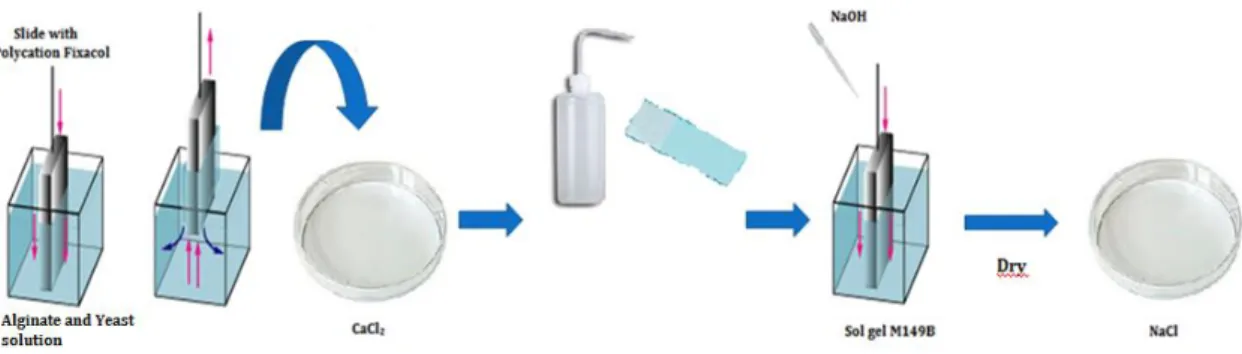
In order to test the influence of these compounds at the yeast cells, one tested two different immobilization schemes: dip coated the slides with alginate and sol-gel and nanoplotted the yeast cells in two different layouts.
After incubation, yeast induction with β-Estradiol, a natural estrogen, Bisphenol A and 4-Nonylphenol both xenoestrogens, at different concentrations led to the expression of the reporter Green Fluorescent Protein (GFP), visualized by fluorescence microscopy. Also, a microplate test was performed to test the yeast cells entrapped in alginate and suspended in medium. This assay was performed in order to compare the induction of the cells in these two different matrices to the testing compounds.
These experiments were conducted at the Institute of Genetics and at the Institut für Werkstoffwissenschaft (both at Technische Universität Dresden).
The sensor was projected by using the L-Edit software program. It was projected a n+/p-epilayer P-N junction photodiode.
For testing the sensor one used FluoSpheres beads (polystyrene microspheres filled up with a yellow-green fluorescent dye, Fluorescein) due to legal issues, it was not possible to bring the genetically modified yeast cells to Portugal. These FluoSpheres beads have
8
similar excitation and emission spectrum as GFP and they are easier to manipulate than the yeast cells.
One immobilized and nanoplotted the FluoSpheres beads' slides as done for the yeast cells. The immobilization layouts were tested for transmittance and fluorescence.
These experiments were conducted at the Institut für Werkstoffwissenschaft (Technische Universität Dresden) and at University of Minho.
1.5 Thesis organization
Chapter 1 presents the context of this thesis, its objectives, what motivated the writing of this thesis, a brief description of the work that has been done, a description of the endocrine system and the impact of the exposition to endocrine disruptors and the organization of the thesis.
In chapter 2 a general description about the biosensor and immobilization techniques of the biological element is exposed. The photodiode used in the experiments and a description of the related elements necessary to perform these experiments is also described. Also, the chemicals that have been used to induce the yeast cells are described in this chapter.
Chapter 3 describes the materials and methods, e.g., the immobilization techniques, the experimental conditions, among others.
Along the chapter 4 the results of the yeast cells induction, the microplate tests and the detection tests using the sensor are shown and discussed.
Chapter 5 provides a general overview about the results and discussion of the all experiments and outlines direction for further work.
9
2. BIOSENSOR
Ecosystems and human health protection is a priority issue these days and requires rapid and precise sensors capable of detecting pollutants. However, identifying chemical substances that may cause negative effects under wildlife conditions is difficult and demands specific instrumentation since the substances usually occur at low concentrations (Stahlschmidt-Allner, et al. 1997).
Improvements in technology have led to more accurate, more rapid, less costly and more sensitive sensors. Nowadays, due to these improvements, one may detect pollutants in situ and they can be used for real-time continuous monitoring (Theodore 2005).
One may consider a biosensor as an analytical device where a biological recognition element coupled to a physical transducer integrates a microelectronic system in order to enable rapid, accurate, low-level detection of a substance (Kissinger 2005), (Su, et al. 2010), (Belkin 2003).
The biological sensing element answers to specific compounds and the transducer converts the biological response into a detectable signal that can be measured electronically, and then correlated to its concentration (Su, et al. 2010).
Biological elements are extremely specific. This represents an advantage regarding their use as recognition elements (Belkin 2003). The worst problem in developing this biosensor is the incorporation of sensing molecules in a suitable matrix and monitoring/quantifying the interactions between the analyzed substance and these molecules (Gupta and Chaudhury 2007).
Diverse biological recognition elements, such as enzymes, antibodies, microorganisms, and tissues, have been used in biosensor production. Enzymes, due to their unique specificity and sensitivity are widely used as recognition elements. However, their purification is costly, time-consuming and, due to in vitro operating environment, the enzyme activity is decreased. Therefore, bacteria, yeast and algae offer an alternative in the fabrication of biosensors since they are easy to produce, and they can be more easily manipulated and have better viability and stability in vitro when compared to other cells from higher organisms such as plants and animals. For these reasons yeast, bacterial and algae cells can greatly simplify the fabrication process and enhance the performance of biosensors (Bousse 1996).
10
2.1 Whole-cell biosensors
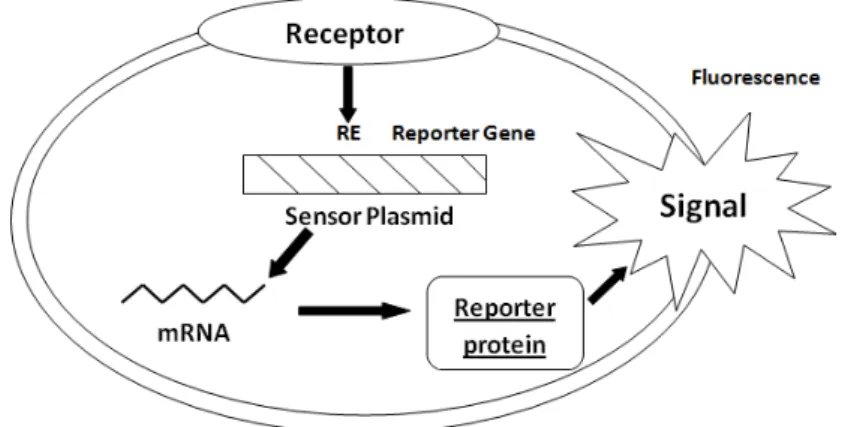
A biosensor with immobilized bacteria, yeast or other cells instead of purified enzyme is the basic principle of whole-cell sensing, see figure 3. This kind of whole-cell sensor has a microorganism or cells as a sensing element that specifically recognizes an analyte of interest (Bartlett 2008).
Figure 3 - Basic principle of whole-cell-based sensor using recombinant DNA technology. Microorganisms receive extracellular signs through the receptor, and the signal-mediated activation of the response element (RE) induces the transcription of the reporter gene. The reporter protein exhibits a detectable signal as fluorescence. Adapted from (Yagi 2006)
Sensors using microorganisms as a sensing element are inexpensive and easy to prepare due to their lack of need for enzyme purification and still allow sufficient sensitivity and stability, comparable to those of enzyme biosensors. However, their selectivity is frequently lower because it involves several reaction pathways (Bartlett 2008).
One critical point concerning the development of cell-based biosensors, is the cellular conditions of the immobilized cells on the devices and their lifetime, which is usually more limited than the ones with enzymes (Bartlett 2008), (Bousse 1996).
Most whole-cell biosensors are based on bacterial cells, though there are some disadvantages in their use since bacterial cells may be quite fragile in the sensor environment (Baronian 2004).
King et al. (1990), on the detection of naphthalene, was one of the first cases of how genetic engineering can be used to turn bacteria into living sensors. This was achieved by fusing an expression promoter induced by naphthalene with a bacterial bioluminescence gene (IuxCDABE from Vibrio harveyi), and inserting the fusion into
11
Pseudomonas fluorescens. This work has led to a fiber optic biosensor for naphthalene
and salicylate using immobilized bacteria, cited in (Bousse 1996).
Since yeasts are eukaryotes they can provide relevant information to other eukaryotes that prokaryotic cells cannot. Hence, the use of eukaryotic cells as a detection element is preferable since their response to pollutants more precisely predicts the response in plant and animal cells than the prokaryote. Further reasons to use yeast rather than bacteria in sensing applications are that yeasts have more physical robustness and superior pH, temperature and osmolarity/ionic strength tolerances in comparison to bacteria, they are easier to manipulate, they have rapid growth, and they grow on a broad range of substrates, once yeast and filamentous fungi occupy a wide range of environmental niches, one may expect they will collectively respond to a wide range of substrates. There are some yeasts capable of metabolizing several substrates, e.g. Arxula
adeninivorans is even capable of catabolizing aromatic compounds (Baronian 2004).
Recently, the employment of genetically modified yeast as the sensing element in biosensors is being reported with increasing frequency. Many of the current yeast sensors are used for genotoxicity and they are based on modified Saccharomyces
cerevisiae (Baronian 2004). This yeast is the most intensively studied eukaryotic model
organism due to its characteristics.
In order to detect specific classes of pollutants, bioluminescence has served as reporter, with a few examples of β-galactosidase activity and, more recently, Green Fluorescent Protein (GFP). Conjugating the previous characteristics, some genetically modified microorganisms have been used as indicators of environmental toxicity once they exhibit luminescence (Belkin 2003), (Su, et al. 2010).
Autofluorescence is the primary advantage of GFP as a reporter protein, and therefore, its use does not require the addition of cofactors or exogenous substrates to light emission (Chalfie and Kain 2006), (Daunert, et al. 2000). Furthermore, GFP has as an advantage the possibility of in-situ measuring and it is a noninvansive marker to living cells.
Fluorescence is the reaction that certain molecules exhibit when upon absorbing light of a certain wavelength, they become therefore excited to a higher state of energy. However, this excited state cannot be sustained for long which results in a decrease of the energy and consequent emission of light at a longer wavelength than the original light absorbed, see figure 4 (Nill 2002), (Lakowicz 2006).
12
Figure 4 - Jablonski Energy Diagram (Fluorescence). Red line represents the absorption of light and the blue one represents the fluorescence light. Adapted from (Lakowicz 2006)
The Jablonski-Energy diagram illustrates the process that occurs between the absorption and emission of light. When a fluorophore (fluorescent substance) absorbs light it is usually excited to a higher energy and vibrational level, S1. There are multiple excited states that the fluorophore can reach, depending on the energy and wavelength of the absorbed light. However, this excited state is unstable and therefore the molecules rapidly relax to the lowest vibrational level which is the lowest-energy excited state but still semi-stable and generally completed prior to emission. When the electron returns to the ground state (S0) a photon is emitted. The average time between the excitation and the return to the ground state is the lifetime of a fluorophore that is typically near 10 ns (Lakowicz 2006).
Green Fluorescent Protein (GFP) is a common natural fluorescent protein isolated from the jellyfish Aequorea victoria, see figure 5. Variants of GFP have also been cloned from the sea pansy, Renilla reniformis (Daunert, et al. 2000). Using recombinant DNA techniques the GFP gene can be introduced into living cultured cells. These cells will express GFP and thus emit a green fluorescence when irradiated (Lodish, et al. 2000), (Kostrzynska, et al. 2002).
Figure 5 - X-ray crystal structure of green fluorescent protein (GFP) pictured from the side(left) and the top (right) (Daunert, et al. 2000)
13
The excitation spectrum of GFP wild type (from A. victoria) absorbs blue light (it has two excitation maxima; one at 395 nm and a minor peak at 475 nm) and emits green light (the fluorescent emission maxima occurs at 509 nm with a small shoulder at 540 nm), see figure 6 (Daunert, et al. 2000), (Lam, et al. 2009), (Kostrzynska, et al. 2002).
Figure 6 - The excitation and emission spectrum of GFP (Institute of Structural and Molecular Biology n.d.)
GFP is an ideal reporter protein due to its characteristics. It has high stability and the ability to alter its stability and spectral properties through structural modifications of the native protein is a particularly useful aspect of GFP as a reporter (Daunert, et al. 2000). Moreover, normally, GFP is non-toxic and can be expressed with low effects on physiology in different organisms (The Royal Swedish Academy of Sciences 2008). Additional advantages of GFP include assay simplicity and high pH stability (Daunert, et al. 2000).
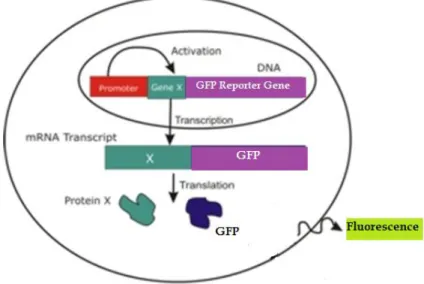
In a study, the green fluorescent protein reporter gene was incorporated into a plasmid, yeast-Enhanced Green Fluorescent Protein, to optimize its expression in S. cerevisiae (Baronian 2004). A reporter gene is a particular gene inserted into the DNA of a cell so when a signal transduction occurs in that cell, it will “report” it (Nill 2002). A gene is made of two parts: one is a specific DNA-sequence that regulates the transcription of the gene (promoter) and the other part is a DNA-sequence that possess the information about the protein that is produced (in this case GFP), see figure 7 (Berthold Technologies 2008). Therefore, the cell receives a signal through a receptor which induces the transcription of the reporter gene. The reporter protein (GFP) possesses a specific fluorescence as the detectable signal (Yagi 2006).
14
Figure 7 - Reporter gene scheme. Green Fluorescent Protein is given as an example (Berthold Technologies 2008)
These reporter gene assays as a noninvansive marker in living cells permit numerous applications such as to study gene regulation, promoter structure and signaling pathways (Yang, Moss and Phillips 1997), (Promega n.d.).
However, other fluorescent molecules found in certain biological systems may compromise the GFP sensitivity. Furthermore, in contrast to other reports, GFP is toxic to some mammalian cell types. Despite these disadvantages, the unique characteristics of GFP have led to its successful application as a reporter protein (Daunert, et al. 2000). Some of the main advantages of protein expression in yeasts is due to the fact that yeasts are genetically well characterized and they are known to perform many post-translational modifications (a chemical modification of a protein after its translation); they grow quickly in defined medium; they are easy and less expensive to work with compared to mammalian cells, and they can be adapted to fermentation (Invitrogen n.d.). Standard analytical chemical techniques might provide more sensitive, accurate detection and quantification of specific pollutants than the microbial reporters. However, microbial reporters can only sense the bioavailable fraction of the detected chemical, allowing this way differentiation from the non-available fraction. This is very important for risk assessment and for the selection of suitable remediation options (Belkin 2003).
15
2.2 Immobilization techniques
An efficient immobilization of the cells into the sensor is one important parameter in the development of whole-cell biosensors. The immobilization technique should maintain the cells’ viability by immobilizing the cells on matrixes that represent nontoxicity and allow nutrients access. Additionally, the matrixes need to be permeable to the target analyte being sensed and they should be homogeneous (Daunert, et al. 2000).
Immobilization techniques require adjustments that mainly concern the material used for the confinement. It ideally should possess mechanical stability, but allowing long-term/continuous process leakage in order for the diffusion of molecules to and from the immobilized cells, biocompatibility and non-toxicity to happen (Baronian 2004), (Callone, et al. 2008).
One of the most significant advantages of solid sensing elements compared to suspended cell cultures is their compatibility with continuous monitoring schemes (Premkumar, et al. 2001).
There are various immobilization techniques used in yeast biosensors (Gupta and Chaudhury 2007), (Baronian 2004). Adsorption, encapsulation, entrapment, covalent binding and cross-linking are some traditional methods for microorganism immobilization (Su, et al. 2010). One may utilize adsorption on membranes, entrapment in agar/agarose, in alginate, in polyacrylamide and in sol-gels, physical entrapment behind dialysis membranes and immobilization using porous glass beads (Daunert, et al. 2000).
Adsorption techniques are easy to perform, in general, but the bonding is often weak causing leaching and biocatalyst lack the degree of stabilization, which is possible by covalent attachment and entrapment. The covalent techniques often require several chemical steps (Gupta and Chaudhury 2007).
A better way of immobilization is to use sol-gel glass, immobilizing the molecules within its porous optically transparent matrix and it has demonstrated functional activity of encapsulated biomolecules (Gupta and Chaudhury 2007).
Polymers have been used to entrap yeast cells. Although biopolymers such as calcium alginate are permeable and non-toxic to cells, they appear to have poor mechanical stability, once they are very sensitive to abrasion and may be degraded by some organisms, under nonsterile conditions (Baronian 2004).
16
Sol-gel derived glasses can be a potential host matrix for chemical sensing and biosensing (Gupta and Chaudhury 2007). Their products may present suitable porosity avoiding mass transport restrictions, good stiffness in order to hold the designed geometry, minimal interference with bioactivity, viability of immobilized biomasses and easy processing for engineering of the method (Boninsegna, Toso and Monte 2003). Due to the porous nature of the sol-gel network, entrapped species remain accessible and can interact with analytes.
However sol-gel based sensors may suffer from some disadvantages once the entrapment may change chemical and biological properties of the entrapped species (Gupta and Chaudhury 2007).
Yeast and filamentous fungi are often used in suspension as sensor components. Yeast, however, has been demonstrated to be possible to be immobilized on membranes, in hydrogel and in pastes (Baronian 2004).
Immobilized organisms have several advantages over free-living micro-organisms. These advantages include protection from environmental conditions, such as temperature, chemicals, pH, among others. Moreover the immobilization allows its re-use (Pereira and Millar 2005). Although immobilization prevents leaching, it frequently can present problems associated with loss of activity and stability due to the interference of molecules within the cell and nutrients in the media (Gupta and Chaudhury 2007), (Daunert, et al. 2000).
2.3 Electronic device
Environmental monitoring is vital to protect the environment and the public health from various contaminants released into the water, air and soil. Therefore, there is a need to create accurate, portable, inexpensive, operated in situ sensors able to procedure long-term monitoring of environmental contaminants (Ho, et al. 2005).
In the biosensor, the interaction between the microorganisms and the target compounds can be detected by a number of techniques. Among these techniques, electrochemical and optical are most widely used in the development of biosensors (Su, et al. 2010). The biological recognition element responds to the target compounds and the transducer converts the biological response into a detectable signal, which can be electronically measured and then correlated with the analyte concentration (Su, et al. 2010).
17
For detecting the fluorescent signal, FluoSpheres beads were immobilized since they are easier to manipulate than the yeast cells and have similar emission and absorption spectrums as GFP, see figure 8. This FluoSpheres beads are 10 µm polystyrene microspheres filled up with a yellow-green fluorescent dye (Fluorescein).
Figure 8 - GFP Spectra on the left (University of London - Institute of Structural and Molecular Biology 1996). Green line corresponds to the emission spectrum of green light (peak at 509 and a small shoulder at 540 nm) and the blue line corresponds to the absorption of blue light (peak at 395 nm and a minor peak at 475 nm). On the right, FluoSpheres spectra in water (Invitrogen 2011) . The blue line corresponds to the absorption (peak at 505 nm) and emission is represented by the red light (peak at 515 nm)
By looking at the emission and excitation spectrums diagrams, see figure 8, one may visualize that the emission maximum occurs at a longer wavelength than the excitation maximum. This gap between the two peaks is called the Stoke's shift, see figure 9 (Lakowicz 2006), (Nikon n.d.).
18
Figure 9 - FluoSpheres' Stoke's shift is 10 nm. Adapted from (Invitrogen 2011)
This Stoke's shift occurs due to the loss of energy of the excited fluorophore through molecular vibration. This energy is dissipated as heat to the immediate environment, see figure 10 (Lakowicz 2006), (Nikon n.d.).
Figure 10 - Loss of energy during molecular vibration. Adapted from (Lakowicz 2006)
2.3.1 Photodiode
Photodiodes are semiconductor light sensors used to detect light, see figure 11. They consist of a reverse biased active P-N junction operated under the photoelectric effect. By absorption of photons or charged particles, a current which is proportional to the intensity of light is generated (Georgia State University - Department of Physics and Astronomy n.d.), (OSI Optoelectronics n.d.).
The photoelectric effect is a result of the absorption of energy from electromagnetic radiation, as visible or ultraviolet light, whereby a photon with higher energy than the
19
bandgap energy hits a surface of the material and ejects a single electron out of it, creating a hole (Stanford University 2009).
Figure 11 - Symbol of a photodiode (McComb and Boysen 2005)
Photodiodes can be classified by their function (detection of the intensity, position, color and presence of light) and structure (Hamamatsu 2008), (Hamamatsu n.d.):
P-N photodiode; PIN photodiode;
Schottky type photodiode; APD (Avalanche photodiode).
Due to photoelectric effect, an electron from the valence band is excited to the conduction band leaving a hole behind. Generally the electrons from the conduction band recombine themselves with the holes on the valence band, therefore it is necessary to remove the electrons from this conduction band in order to prevent this association, forming a reverse biased P-N junction (International Union of Pure and Applied Chemistry 1997), (OSI Optoelectronics n.d.), (Minas 2004).
This P-N junction is the limit of two different semi conductive materials: N-type (excess of electrons) and P-type (excess of holes), see figure 12.
20
Since an electron leaves the N-type region, it leaves its atom as a positive donor ion and likewise the hole leaves on the P-type region a negative acceptor ion, in a region with no free carriers, the depletion region, see figure 13 (International Union of Pure and Applied Chemistry 1997), (OSI Optoelectronics n.d.), (Minas 2004).
Figure 13 - Depletion region scheme
Since a photodiode consists of a P-N junction operated in a reverse bias the P-type region is connected to a negative terminal (anode) of the power supply and the N-type region is connected to the positive terminal (cathode), see figure 14. Therefore, the electrons ejected due to the absorption of a photon near or inside the depletion region are then pulled away from the junction to the N-type region (positive terminal of the power supply). Likewise, the holes are dislocated to the P-type region (negative terminal).
Figure 14 - P-N junction in reverse bias
Therefore, the depletion region increases its width as the reverse bias voltage increases. This increases the voltage barrier causing a high resistance. The strength of the depletion region's electric field increases as the reverse bias voltage increases. When the intensity of the electric field exceeds a critical level, the P-N junction depletion region breaks-down and current begins to flow (OSI Optoelectronics n.d.).
21
This mechanism originates an electric current proportional to the intensity of the incident light (International Union of Pure and Applied Chemistry 1997), (OSI Optoelectronics n.d.), (Minas 2004).
Among the vertical P-N junction photodiodes available in Complementary Metal-Oxide-Semiconductor (CMOS) technology, it was chosen the n+/p-epilayer type, see figure 15. This photodiode was chosen since literature states that it shows higher quantum efficiency for the studied wavelengths (450 - 650 nm) (Minas 2004).
Figure 15 - P-N junction n+/p-epi (Coura, Salles e Monteiro 2011)
Nowadays more than 95 % of integrated circuits are fabricated in CMOS due to its characteristics (Baker 2010):
CMOS devices have high noise immunity;
They have low power consumption while operating in high speeds (consequently CMOS devices do not produce as much waste heat as other forms of logic);
They can be made in small areas, recommended for portable devices; They can be fabricated with few defects and it is a low cost technology.
2.3.2 Home-made spectrophotometer and its components
The instruments used to measure several optical properties of a material, e.g., the absorption, transmission or fluorescence, as a function of wavelength is a spectrophotometer.
This home-made spectrophotometer has components that are the same as the commercial spectrophotometers, see figure 16.
22
Figure 16 -Components of the spectrophotometer. Adapted from (Thomas 1996)
The lamps represent the radiation source and they should cover the required wavelengths' band. Beer - Lambert's law presumes that one uses monochromatic radiation for absorption measurements. Nevertheless, in reality monochromatic radiation is not possible to obtain by using white light. It is necessary to filter the desired wavelengths required for excitation. It can be done by using optical filters or monochromators once they block out undesirable wavelengths while selectively allow light of one wavelength with a certain band width to pass. This way, a monochromator was used in order to select the narrow range of wavelengths (Thomas 1996).
The sample cell compartment is required for holding the cells containing the sample and the blank. The container, e.g. a cuvette or a slide, must be made of a material which is transparent to the radiation concerned (Thomas 1996).
The detector measuring system consists of a n+/p-epilayer photodiode. It is capable to measure the intensity of the radiation beam transmitted through the optical fiber cable to the sample responding to the radiation falling on its surface and therefore produces an electrical signal which is proportional to the intensity of the radiation.
After the previous step it is necessary to record the measurements through a display or output device, the computer (Thomas 1996).
2.3.3 Beer-Lambert's law
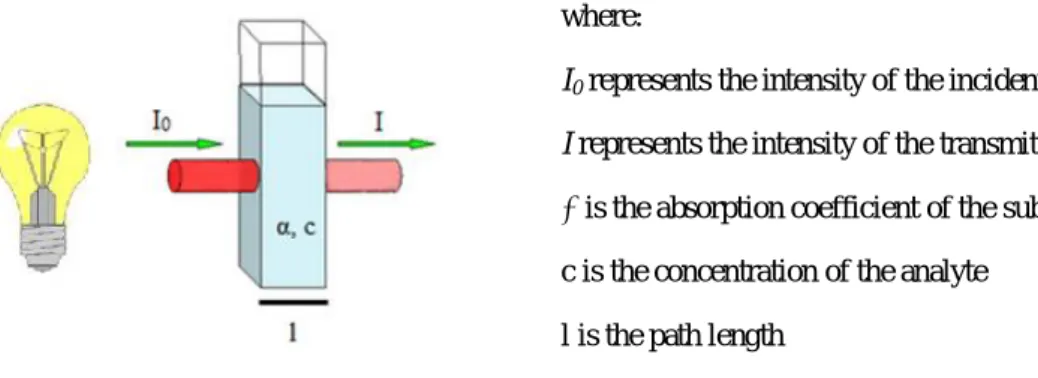
The Beer - Lambert's law states that there is a logarithmic dependence between the transmission of incident light through the analyte, i.e., its transmissivity, T, and the product of the absorption coefficient of the substance, α, and the distance the light travels through the material, the path length, ℓ, see figure 17 (Thomas 1996), (The Hebrew University of Jerusalem - Faculty of Agriculture, Food and Environment 2009).
Radiation Source Monochromator Sample Cell Compartment Detector Measuring System Display Chart Recorder
23
where:
I0 represents the intensity of the incident light
I represents the intensity of the transmitted light
α is the absorption coefficient of the substance
c is the concentration of the analyte
l is the path length
Figure 17 - Beer-Lambert absorption diagram of a light traveling through a sample of width l. Adapted from (The Hebrew University of Jerusalem - Faculty of Agriculture, Food and Environment 2009)
The transmittance (T) is the ratio of the incident light at a certain wavelength that passes through a sample. However, the quantity of radiation transmitted is affected by the concentration of the sample. As concentration increases the absorbance increases and the transmitted light diminishes. Absorbance (A) is the negative decade logarithm of transmittance (Thomas 1996).
Hence, the Beer-Lambert's Law is given by these two equations:
Transmittance Absorbance T = I/I0 Equation 1 A = log10 (I0/I) Equation 2 A = εlc Equation 3 where
I0 = intensity of the incident beam I = intensity of the transmitted light ε is the molar absorbtivity (L/mol/cm) l is the path length of the sample (cm)
c is the concentration of the compound in solution (mol/L)
In reality the absorbance and transmittance are not precisely like the Beer-Lambert's law states since neither I0 nor I can be directly measured. This happens because the studied solution must be held in a container and interactions may occur between the radiation
24
and the wall of the container, resulting in a loss of intensity due to reflection or absorption (Thomas 1996).
2.4 Pollutants
When related to environmental sensing, micro and nano sensors are able to operate as a monitoring system since they are miniaturized, rapid and portable. Sensor systems may measure particulate matter, inorganic aerosol constituents, and tracers, and they are able to determine spatial and temporal distribution of the pollutants (Jokerst and Jones n.d.). The use of genetically engineered cells in sensors to express a reporter protein in the presence of an analyte has a lot of advantages as a sensing system. In these systems, different strains are engineered to contain the desired genes. Toxics-sensitive nonspecific biosensing systems employ a promoterless reporter protein (e.g., GFP, luciferase, β-galactosidase) fused downstream of the gene corresponding to the stress promoter of interest. These sensing systems can be compared to an environmental switch which is turned on when critical amounts of the toxics are present. Although they do not provide any information on the type of present toxicant they are used to detect any compound that is toxic to the cells (Daunert, et al. 2000).
The use of cells for environmental applications has the advantage to allow the measurement of the total bioavailability of a given analyte (Bousse 1996), i.e., it permits to obtain relevant data relative to the response of the cells to an analyte and to measure the bioavailability of the analyte (Daunert, et al. 2000).
It has been shown that the normal hormonal levels of aquatic species exposed to estrogenic compounds have been altered. The presence of multiple compounds in water can potentiate the additive or synergistic toxic effects, even with compounds of different modes of action (Kolpin, et al. 2002).
Bisphenol A, 4-Nonylphenol and 17β-Estradiol are known to be estrogen receptor agonists. Estrogen agonists are chemicals that bind to an estrogen receptor of a cell and trigger a response, mimicking the action of estrogen C18H24O2 (World Health Organization n.d.).
Nevertheless, there is a limitation to draw conclusions about endocrine disruptor chemicals, since there are not sufficient epidemiological or wildlife studies to measure the exposure. Therefore this issue is especially relevant for those endocrine disrupting
25
chemicals that are rapidly degraded, like Bisphenol A. This implies that the exposure that might have caused an adverse outcome is not detectable at the same time as clinical manifestations. Hence, most of the chemicals that are used to describe cause-and-effect relationships are those that are biologically and ecologically persistent, e.g., DDT, dioxins (World Health Organization 2002).
2.4.1 Bisphenol A
Bisphenol A (CAS No. 80-05-7), figure 18, is an industrial chemical used to make epoxy resins, polycarbonate plastic and flame retardants.
Figure 18 - Molecular structure of Bisphenol A (Staples, et al. 1998)
It is used in DVDs, thermal and carbonless paper coatings, optical lenses, toys, and others (U.S. Environmental Protection Agency 2010), (Centers for Disease Control and Prevention n.d.). It is also a component of resin used in dentistry (Ahmed 2000). It is known to have estrogenic properties capable to bind to estrogen receptors (Okada, et al. 2008).
It has low volatility at room temperature and is rapidly degraded by sunlight: however, low levels might be released to the environment (American Chemistry Council n.d.), (U.S. Environmental Protection Agency 2010).
There are some routes of Bisphenol A to entry into the environment. Low levels of Bisphenol A are directly released to surface waters and to the atmosphere at manufacturing and during its use and while processing and handling it despite its control by good practicing at workplaces (Staples, et al. 1998).
The U.S. National Toxicology Program of the Department of Health and Human Services conducted a carcinogenesis bioassay in rats and mice exposed to Bisphenol A. Under the conditions of this bioassay, the authors considered that "there was not convincing evidence that Bisphenol A was carcinogenic for rats or mice of either sex".
26
Although it may not be considered carcinogenic another study demonstrated that 2 and 20 μg/kg/d of Bisphenol A increased prostate weight in mice (World Health Organization 2002).
It has been knowledge that Bisphenol A, even at low doses, acts as an endocrine disruptor. Nevertheless, its bindings to estrogen receptor is particularly weak, and thus these low-dose effects are rather intangible (Okada, et al. 2008).
The U.S. Environmental Protection Agency (EPA) estimates that annually more than 453 tons of Bisphenol A are released to the environment.
The U.S. Geological Survey held an assay in water resources detecting the presence of pharmaceuticals, hormones, and other organic water contaminants, like Bisphenol A, β-Estradiol, and 4-Nonylphenol. In this survey it was chosen as sampling sites, areas considered susceptible to contamination from human, industrial, and agricultural wastewater. It was tested 139 samples during the years of 1999 and 2000. In this survey the median concentration of Bisphenol A was 0,1 µg/L (Kolpin, et al. 2002). In 2006, the European Food Safety Authority set a Tolerable Daily Intake of Bisphenol A of 50 µg/kg of body weight.
2.4.2 4-Nonylphenol
Nonylphenol (CAS No. 104-40-5), figure 19, is an industrial chemical with endocrine effects. It is an organic compound used to produce anionic detergents, lubricants, antistatic agents, antioxidants for rubber manufacture, high performance textile scouring agents, emulsifiers for agrichemicals, among others (U.S. Environmental Protection Agency 2004).
Figure 19- Molecular structure of 4-Nonylphenol (Sigma Aldrich n.d.)
It binds to the estrogen receptors and initiates the expression of estrogen controlled genes. However, its affinity to the receptor is lower than Estradiol, the natural ligand. Nonylphenol is accumulated in aquatic organisms, resulting in high body concentrations
27
so that effects on the estrogen receptors can be expected with environmentally relevant concentrations (0,3 - 15 µg/L) (Stahlschmidt-Allner, et al. 1997).
In the U.S. Geological Survey, mentioned previously in Bisphenol A section, 139 water samples were tested during the years of 1999 and 2000 and the median concentration of this compound found in water was 0,8 µg/L (Kolpin, et al. 2002). As said before, the median concentration of Bisphenol A was 0,1 µg/L which means that Nonylphenol is quite persistent in the environment and less degraded when compared to Bisphenol A. Concentrations of 0,8 mg/kg/d resulted in a reduction of rat testis, epididymis, seminal vesicle and prostate weight and at 8 mg/kg/d one noticed a reduced anogenital distance, poor differentiation of seminiferous tubules, sperm count, motility and reduced fertility (World Health Organization 2002), (O’Connor 2003). In female rats, a dietary exposure of 200, 650 and 2000 ppm to Nonylphenol led to an acceleration of puberty, alterations in the estrous cycle, lowered fertility and lowered ovary weight (O’Connor 2003).
2.4.3 17β-Estradiol
17β-Estradiol (CAS No. 50-28-2), figure 20, represents the major estrogen in humans and it is a reproductive hormone. It is the predominant sex hormone present in females and it represents the major estrogen in humans. This hormone is very important either for the reproductive and sexual function but also to some other organs, including bones.
Figure 20 - Molecular structure of 17β-Estradiol (Gabet, et al. 2007)
The presence of this compound has been detected in the environment and it is believed that animal agriculture may be the main source. It is also believed that 17β-Estradiol is widespread into the soil (Schuh, et al. 2010).
A study with male rats showed that at a concentration of 10 and 50 mg/kg/d, 17β-Estradiol caused a reduction of testis and epididymides weight, testis and epididymides atrophy, seminiferous tubule degeneration, reduced sperm numbers and motility (World Health Organization 2002).
28
According to the U.S. Geological Survey it was estimated a median concentration of 0,16 µg/L for this compound during the years 1999 and 2000 (Kolpin, et al. 2002). 17β-Estradiol is not expected to show long-term persistence in the aquatic environment. It is predicted a half life of 5 days for this compound (Bowman, Readman and Zhou 2003).
29
3. MATERIALS AND METHODS
Along this chapter it is possible to read about the materials used to carry out the experiments and the methods performed.
3.1 Chemicals
3.1.1 Testing the modified yeast cells
Dimethylsulfoxide (DMSO) was purchased from Merck (Darmstadt, Germany). For yeast media preparation, yeast nitrogen base without amino acids was obtained from Difco (Franklin Lakes, NJ), CSM-TRP-URA was purchased from MoBiTec (Göttingen, Germany) and the glucose was obtained from Sigma Aldrich (St. Louis, MO).
The FluoSpheres polystyrene yellow-green microspheres, 10 µm, were purchased from Invitrogen (Darmstadt, Germany). Alginic acid sodium salt (medium viscosity A2033), 17β-Estradiol, 4-Nonylphenol and Bisphenol A were obtained from Sigma Aldrich (St. Louis, MO).
Stock solutions of Bisphenol A (4,51 x 10⁻¹ M), 17β-Estradiol (4,51 x 10⁻⁴ M) and 4-Nonylphenol (4,51 x 10⁻¹ M) were prepared in DMSO before each experiment and were filtered through a 0,20 µm filter (Sartorius stedim, Aubagne, France). For testing, serial dilutions of the substances were made with sterile water.
Copper sulfate (CuSO4) was added in every well with a final concentration of 10 µM in order to induce the expression of estrogen receptor α.
3.1.2 Using FluoSpheres beads for testing the electronic device
As said previously one used the FluoSpheres for testing the electronic device since it was not possible to bring the modified yeast cells from Germany due to legal issues. Sol-gel M149B, for the immobilization, was kindly provided by GMBU e.V. (Dresden, Germany) and the slides pretreated with Fixacol, provided by Mandy Koitsch (GMBU e.V., Dresden, Germany).
The sodium chloride was purchased from José Vaz Pereira, S.A (Benavente, Portugal). The sodium hydroxide was obtained from Vencilab (Sermonde, Portugal) and the calcium chloride came from Panreac (Barcelona, Spain).