Introduction
High exposures to screen time are associated with greater risks for the development of obesity, cardio-vascular diseases1,2, as well as problems of hyperactivity
and attention deficit in children and adolescents3. Esti-mates of excessive screen time in leisure among youth4 also justify interventions to reduce this behavior in the young population5.
Copyright: This is an open-access article distributed under the terms of the Creative Commons Attribution License®, which permits unrestricted use, distribution, and reproduction in any medium, provided that the original author and source are credited.
Effect of a multicomponent intervention on
variables related to screen time in adolescents:
a cluster-randomized controlled trial
Efeito de uma intervenção multicomponente sobre variáveis relacionadas ao tempo de
tela em adolescentes: ensaio randomizado controlado por conglomerado
AUTHOR’S
Alexsandra da Silva Bandeira¹ Kelly Samara da Silva¹ Soraya Anita Mendes de Sá¹ Paulo Henrique Guerra2, 3
Jorge Mota4
Valter Cordeiro Barbosa Filho5
1 Federal University of Santa Catarina, Department of Physical Education, Florianopolis, Santa Catarina, Brazil.
2 Federal University of Fronteira Sul, Chapeco, Santa Catarina, Brazil.
3 University of São Paulo, School of Arts, Sciences and Humanities, São Paulo, São Paulo, Brazil 4 University of Porto, Faculty of Sport, Porto, Portugal.
5 Federal Institute of Education, Science and Technology of Ceara, Boa Viagem Campus, Boa Viagem, Ceara, Brazil.
CORRESPONDING Alexsandra da Silva Bandeira
Campus Universitário Reitor João David Ferreira Lima, Centro de Desportos, Florianópolis, Santa Catarina, Brazil. CEP: 88040-900.
DOI
10.12820/rbafs.23e0005
ABSTRACT
The aim of this study was to evaluate the effect of an intervention on screen time and on psychoso-cial factors (Attitude, self-efficacy, support of family and school members) associated with reduced screen time in students. A cluster-randomized controlled trial was conducted in three schools in the intervention group (n = 548) and three in the control group (n = 537). The intervention focused on teacher training, opportunities for practicing physical activity at school and reducing screen time, as well as health education. The questionnaire (applied in July and December 2014) included questions about time using TV and computer / video game on weekdays and weekend days (Combined in full-screen time). The psychosocial factors were obtained through scales. The control variables were school and income. The analysis included binary logistic regression models and generalized linear models. The effect size was calculated with analyzes stratified by sex and age (p < 0.05). The intervention group reduced TV (boys: OR = 2.86; CI95%: 1.06-7.71) time and computer/video game (girls: OR = 3.34; CI95%: 1.14-9.84; 11 to 13 years: OR = 3.08; CI95%: 1.17-8.08) for < 2 hours / day (p < 0.05). Positive effects of the intervention were observed on attitude (among girls and adolescents of both age groups) and school support (all subgroups), with effect sizes ranging from 0.21 to 0.54. We concluded that the intervention caused improvements in certain components of the screen time, as well as attitude and school support. Interventions in the school context can help reduce screen time in the young population.
Keywords: Clinical trial; Sedentary lifestyle; School health; Brazil. RESUMO
O objetivo desse estudo foi avaliar o efeito de uma intervenção sobre tempo de tela e em fatores psicossociais (atitude, autoeficácia, suporte da família e dos membros da escola) associados à redução do tempo de tela em escolares. Ensaio randomizado controlado por conglomerado realizado em três escolas no grupo intervenção (n = 548) e três no grupo controle (n = 537). A intervenção focou na capacitação de professores, oportuni-dades para prática de atividade física na escola e redução do tempo de tela, bem como educação em saúde. O questionário (aplicado em julho e dezembro de 2014) incluiu questões sobre tempo usando TV e computador/ videogame em dias de semana e fim de semana (combinados em tempo de tela total). Os fatores psicossociais foram obtidos por meio de escalas. As variáveis de controle foram escola e classe econômica. A análise incluiu modelos de regressão logística binária e modelos lineares generalizados. O tamanho do efeito foi calculado, com análises estratificadas por sexo e faixa etária (p < 0,05). Após o acompanhamento, escolares da inter-venção tiveram maiores chances de reduzir o tempo de TV (rapazes: OR = 2,86; IC95%: 1,06-7,71) e computador/videogame (moças: OR = 3,34; IC95%: 1,14-9,84; 11 a 13 anos: OR = 3,08; IC95%: 1,17-8,08) para < 2 horas/dia (p < 0,05). Efeitos positivos da intervenção ocorreram sobre atitude (entre moças e adolescentes de ambas as faixas etárias) e suporte escolar (todos subgrupos), com tamanhos de efeito variando de 0.21 a 0.54. Conclui-se que a intervenção ocasionou melhoras em determinados componentes do tempo de tela, assim como na atitude e no suporte escolar. Intervenções no contexto escolar podem colaborar para a redução do tempo de tela na população jovem.
A meta-analysis of school-based interventions, de-veloped in high-income countries, mainly the United States, found an average reduction of 15 minutes/day of screen time6. In the Brazilian scenario, in an in-tervention developed with the purpose of preventing obesity in girls, there was a significant reduction of 38 minutes/day in computer use at the weekend7. On the other hand, an intervention aimed at the promotion of physical activity was not able to significantly reduce the screen time of schoolchildren8.
In addition to the reduction of screen time, re-searches have been developed with the purpose of ad-vancing the discussion about the psychosocial aspects that are related to this behavior9. Some theories, such as Socioecological and Social Cognitive, emphasize that psychosocial aspects may be associated to the adoption of healthy behaviors10. Besides that, evidence indicates that the attitude (determinant of the individ-ual’s intention to perform the behavior), the self-ef-ficacy (belief in the ability to perform certain tasks), and the social norms are related to the screen time of children and adolescents9,11. However, interventions that identify the effect on these psychosocial variables are scarce11. Therefore, it is necessary to delineate inter-ventions that seek to change the different psychosocial aspects that interfere in the choice and behavior of the young person in using screens in the free time. More-over, considering that the psychosocial factors and the screen behaviors may differ between some subgroups12, it is necessary to evaluate them according to the sex and age group of the adolescents.
Thus, the objective of this study was to evaluate the effect of an intervention on screen time and on psycho-social factors associated with the reduction of screen time in Fortaleza students, according to gender and age group.
Methods
The design, methods, and flowchart of this study partici-pants are described in previous publications13,14. Briefly, the “Fortaleça sua Saúde” (“Strengthen Your Health”) was an intervention, held in the city of Fortaleza, whose purpose was to promote PA and reduce screen time du-ring the second semester of 2014. For this, a school-ba-sed cluster randomized controlled trial was conducted.
All adolescents, enrolled in the 7th to 9th grade classes of the six full-time schools in Fortaleza, Ceará, were considered eligible (n = 1,272). Human Develop-ment Index (HDI) of the neighborhoods where full-time schools were located ranged from 0.170 to 0.49113.
A total of 1,182 students participated in the base-line collections (92.0% and 93.8% of eligible students in the intervention and control schools, respectively) and 1,085 presented complete data at the end of the study (response rate of 93.2% and 90.4% in the in-tervention and control groups, respectively). The final sample has a statistical power to identify effect siz-es equal to or greater than 0.09 in continuous data scores (or odds ratios equal to or greater than 2.0) in the condition comparison (intervention and control) vs. time (baseline and post-intervention). The analyz-es were performed in GPower 3.1 software (http:// www.gpower.hhu.de/), considering statistical pow-er of 80% or highpow-er, and 5% of significance level for two-tailed tests.
Among the six full-time schools, three comprised the intervention group (with the actions developed from August to November 2014), while the other three represented the control group (with the conventional curriculum of a full-time school).
The actions of intervention “Fortaleça sua Saúde” (“Strengthen Your Health”) were designed based on the Socioecological and Social Cognitive theories10, as well as on the model of Health Promoting Schools15. The in-tervention was developed through four components: (I and II) continuing education (developed in three stages: in-class course on the relationship among school, health and academic performance [4 hours], distance learn-ing [32 hours], and face-to-face discussion of the im-plementation of the activities [4 hours]) and planning (during the whole semester) joint for the performance of the teachers of the general disciplines and Physical Edu-cation; (III) opportunities for PA in the school environ-ment (for example, supply of materials, modification of spaces and games) and (IV) health education (for exam-ple, production of health messages, banners and distri-bution of pamphlets to students/parents). The messages were also addressed to intrapersonal factors (for example, self-efficacy and attitude), interpersonal factors (such as social and family support) and environmental factors (for example, school and family environment)13,14.
The pieces of information about screen behaviors were based on the Youth Risk Behavior Survey Ques-tionnaire4,16, previously validated for the Brazilian pop-ulation17. Two questions turned to TV time and two more to time in computer/video game (I do not use...; < 1; 1; 2; 3; 4; and ≥ 5 hours/day), both on weekdays and on weekends. The intraclass correlation coefficients (ICC) of these measures were 0.57 (95%CI: 0.25-0.76)
(weekend TV use) to 0.80 (95%CI: 0.56-0.91) (use of computer/video game in the week).
For the measurement of the psychosocial determi-nants (attitude, self-efficacy, family and school mem-bers support associated to the reduction of screen time) a questionnaire was constructed based on previous instruments11,12. This instrument was built together with specialists in the subject (validity of content) and school (analysis of clarity of the issues). In the self-ef-ficacy scales (11 items), family support (5 items) and school members support (4 items), the participants had four options (Likert scale) for each item, ranging from 1 (strongly disagree) to 4 (agree too much). For the at-titude scale (3 items), responses varied among bipolar adjectives (Likert scale of 4 points): unimportant - im-portant; boring - fun; healthy - harmful. At all scales, lower scores are related to the greater favoring of screen time. The internal consistency and reproducibility of the scales presented adequate values (a of Cronbach: from 0.64 [attitude] to 0.85 [school members support]); ICC: from 0.63 [self-efficacy] to 0.71 [attitude]).
The following control variables were considered, measured at the baseline: socioeconomic status (A1 [richest], A2, B1, B2, C1, C2, D and E [poorer])20, school, screen time and its components, as well as the psychosocial determinants.
In questions about screen behaviors (TV and com-puter/video game), students had seven choices of re-sponses that were transformed into a linear scale21. Subsequently, the average time in each behavior was calculated taking into account the days of the week and the weekend, considering the following equa-tion: [(TV week*5) + (TV weekend*2)/7]12. Finally, the screen time was obtained by summing the time of use of TV and computer/video game. The cutoff point of two hours or more per day was adopted22. As for the psychosocial variables (self-efficacy, attitude, fami-ly support and school members support), the items of each scale were added, generating a continuous score for each psychosocial aspect.
The differences between the control and interven-tion groups for baseline measurements were assessed using the Chi-square test and Student’s t-test for in-dependent samples. The normality of the continuous data was verified through the evaluation of kurtosis and skewness (high when ± 2). All continuous varia-bles were within the range of + 2.
The McNemar test was used in the comparison of pre- and post-intervention of screen time, TV and
computer/video game. In addition, binary logistic re-gression model was used to calculate the odds ratio (odds ratio - OR) of an adolescent of the intervention group, compared with that of the control group, to stop using screen equipment for two or more hours daily.
The effect of intervention on psychosocial factors was assessed using generalized linear models to identify the differences intra (post-intervention vs. baseline) and intergroup (intervention vs. control). The effect size was calculated by the mean standardized difference between the two groups, considering effect very small ( < 0.20), small (0.20-0.49), intermediate (0.50-0.79) or big ( > 0.80) 23, using Review Manager software (version 5.3).
The analyzes of the effect of the intervention were stratified by sex (boys and girls) and age group (11-13 years and 14-17 years) and adjusted by school, socio-economic status and baseline variable. The following statistical programs were used: Stata® Standard Edi-tion, version 13.0 (StataCorp LP, United States) and IMB SPSS® v.23.0 (SPSS IBM Inc., Chicago, United States) for Microsoft® Windows™. The level of signif-icance was set at 5%.
Results
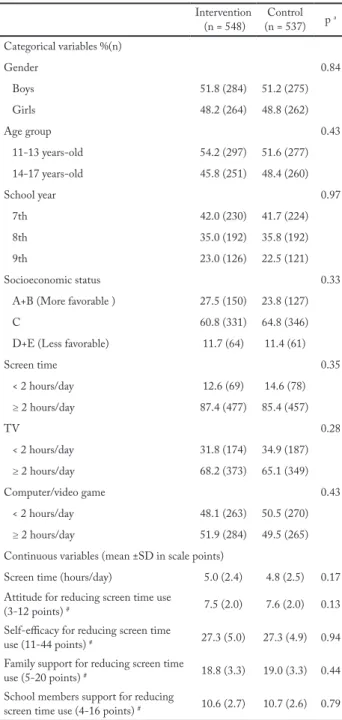
Among the adolescents who completed the study (n = 1,085), the majority were male (intervention: 51.8%; control: 51.2%), aged from 11 to 13 years old (inter-vention: 54.2%; control: 51.6%), from families of so-cioeconomic status “C” (intervention: 60.8%, control: 64.8%) and reported exposures of ≥ 2h/day in screen time (intervention: 87.4%; control: 85.4%), TV (inter-vention: 68.2%, control: 65.1%) and computer/video game (intervention: 51.9%). Further information can be found in Table 1.
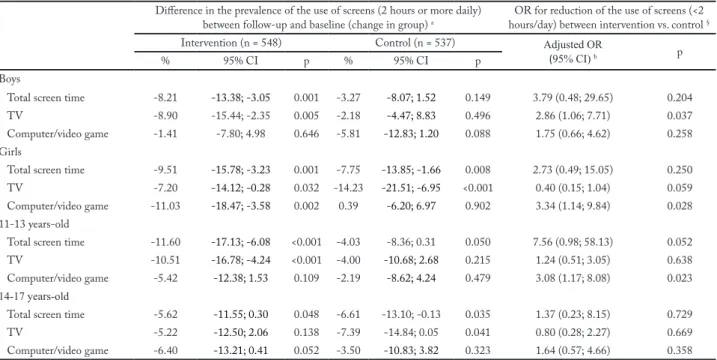
In the intervention group, there was a reduction in the prevalence of boys and girls exposed ≥ 2h/day in screen time (-8.2% and -9.5%, respectively) and tel-evision (-8.9% and -7.2, respectively). By age group, reductions in the proportion of students exposed ≥ 2h/ day in screen time (-11.6%) and television (-10.5%) were observed in the 11-13 year-old stratum (Table 2). After adjusting for confounding variables, boys in the intervention group had a greater chance of reduc-ing TV use to < 2h/day after follow-up (OR = 2.86; 95%CI: 1.06-7.71) compared to their peers in the control group. In addition, girls and adolescents aged from 11 to 13 years old in the intervention group had a higher OR to reduce computer/video game use to < 2h/day (OR = 3.34; 95%CI: 1.14-9.84; OR = 3.08;
95%CI: 1.17-8.08, respectively) when compared to their peers (table 2).
Table 1 – Students’ characteristics at baseline among intervention and control students of the Fortaleça sua Saúde program study, Fortaleza, Ceará (2014). Intervention (n = 548) (n = 537)Control p a Categorical variables %(n) Gender 0.84 Boys 51.8 (284) 51.2 (275) Girls 48.2 (264) 48.8 (262) Age group 0.43 11-13 years-old 54.2 (297) 51.6 (277) 14-17 years-old 45.8 (251) 48.4 (260) School year 0.97 7th 42.0 (230) 41.7 (224) 8th 35.0 (192) 35.8 (192) 9th 23.0 (126) 22.5 (121) Socioeconomic status 0.33
A+B (More favorable ) 27.5 (150) 23.8 (127) C 60.8 (331) 64.8 (346) D+E (Less favorable) 11.7 (64) 11.4 (61)
Screen time 0.35 < 2 hours/day 12.6 (69) 14.6 (78) ≥ 2 hours/day 87.4 (477) 85.4 (457) TV 0.28 < 2 hours/day 31.8 (174) 34.9 (187) ≥ 2 hours/day 68.2 (373) 65.1 (349) Computer/video game 0.43 < 2 hours/day 48.1 (263) 50.5 (270) ≥ 2 hours/day 51.9 (284) 49.5 (265) Continuous variables (mean ±SD in scale points)
Screen time (hours/day) 5.0 (2.4) 4.8 (2.5) 0.17 Attitude for reducing screen time use
(3-12 points) # 7.5 (2.0) 7.6 (2.0) 0.13
Self-efficacy for reducing screen time
use (11-44 points) # 27.3 (5.0) 27.3 (4.9) 0.94
Family support for reducing screen time
use (5-20 points) # 18.8 (3.3) 19.0 (3.3) 0.44
School members support for reducing
screen time use (4-16 points) # 10.6 (2.7) 10.7 (2.6) 0.79
a p-values obtained using the Chi-square tests (categorical variables)
and independent t-test (continuous variables). # Lower scores are related to the greater favoring of screen time use.
Regarding the effect of the intervention on psy-chosocial factors, in the intragroup analysis (Table 3), there was an increase after the follow-up on the atti-tude scale in all subgroups of the intervention (changes
ranging from 0.39 to 0.76 point in the scale; boys: p = 0.041; girls: p < 0.001; 11-13 years: p = 0.011; 14-17 years: p < 0.001). Also, there was an increase in the school support scale for boys (0.69 point; p = 0.012) and adolescents aged 11-13 years old (0.56 point; p = 0.035) in the intervention group.
When the intervention and control groups were confronted, there was a positive and significant effect of the intervention on the attitude scale for girls (1.46 points; effect size: 0.48; p < 0.001) and adolescents from both age groups (11-13 years old: 0.67 point; ef-fect size: 0.21; p = 0.045; 14-17 years old: 1.11 points; effect size: 0.34; p = 0.003) (Table 3). In addition, a positive effect of intervention on school support for all subgroups was observed (effect size ranging from 0.27 to 0.54; boys: p < 0.001; girls: p = 0.015; 11-13 years: p < 0.001; 14-17 years: p = 0.004).
Discussion
The study found that boys in the intervention group had a better chance of reducing TV time to < 2h/day, while younger girls and adolescents (11-13 years old) had a better chance of reducing computer/video game use when compared to their peers of the control group. In addition, the intervention had a positive and signifi-cant effect on attitude (girls and adolescents from both age groups) and school support to reduce screen time (all subgroups).
The intervention had an effect to reduce the use of TV to less than 2 hours daily only in the boys. There are distinct aspects that are associated with the components of screen time24. For example, while television time has been associated with interpersonal variables, such as the family environment, computer and video game time has been associated with intrapersonal variables, such as preference for this behavior24. Thus, it can be speculated that the intervention was effective in reducing TV use among boys due to greater independence of the family bond in this subgroup, that is, boys are more likely to perform activities of an individual character.
On the other hand, girls and younger schoolchil-dren in the intervention group had a greater chance of reducing excessive computer/video game time. These findings corroborate with a study that evaluated the effect of an intervention on different components of screen time in girls from São Paulo7. After six months of intervention, the authors verified that there was a significant reduction in computer time spent at the weekend7. In general, the use of these components of
Table 2 – Effect of intervention on the proportion of students using screens (TV, computer / video game, total screen time) for 2 hours or more per day. Fortaleza, Ceará (2014).
Difference in the prevalence of the use of screens (2 hours or more daily)
between follow-up and baseline (change in group) a hours/day) between intervention vs. control OR for reduction of the use of screens (<2 §
Intervention (n = 548) Control (n = 537) Adjusted OR
(95% CI) b p
% 95% CI p % 95% CI p
Boys
Total screen time -8.21 -13.38; -3.05 0.001 -3.27 -8.07; 1.52 0.149 3.79 (0.48; 29.65) 0.204 TV -8.90 -15.44; -2.35 0.005 -2.18 -4.47; 8.83 0.496 2.86 (1.06; 7.71) 0.037 Computer/video game -1.41 -7.80; 4.98 0.646 -5.81 -12.83; 1.20 0.088 1.75 (0.66; 4.62) 0.258 Girls
Total screen time -9.51 -15.78; -3.23 0.001 -7.75 -13.85; -1.66 0.008 2.73 (0.49; 15.05) 0.250 TV -7.20 -14.12; -0.28 0.032 -14.23 -21.51; -6.95 <0.001 0.40 (0.15; 1.04) 0.059 Computer/video game -11.03 -18.47; -3.58 0.002 0.39 -6.20; 6.97 0.902 3.34 (1.14; 9.84) 0.028 11-13 years-old
Total screen time -11.60 -17.13; -6.08 <0.001 -4.03 -8.36; 0.31 0.050 7.56 (0.98; 58.13) 0.052 TV -10.51 -16.78; -4.24 <0.001 -4.00 -10.68; 2.68 0.215 1.24 (0.51; 3.05) 0.638 Computer/video game -5.42 -12.38; 1.53 0.109 -2.19 -8.62; 4.24 0.479 3.08 (1.17; 8.08) 0.023 14-17 years-old
Total screen time -5.62 -11.55; 0.30 0.048 -6.61 -13.10; -0.13 0.035 1.37 (0.23; 8.15) 0.729 TV -5.22 -12.50; 2.06 0.138 -7.39 -14.84; 0.05 0.041 0.80 (0.28; 2.27) 0.669 Computer/video game -6.40 -13.21; 0.41 0.052 -3.50 -10.83; 3.82 0.323 1.64 (0.57; 4.66) 0.358
OR: odds ratio. 95% CI: 95% confidence interval. Values in bold indicate statistical significance (p < 0.05). a p-values obtained using the McNemar test for comparison of paired proportions. Negative intragroup prevalence values indicate a reduction in the proportion of use for 2 hours or more after follow-up, while positive values indicate an increase in use. b Odds ratio and 95% confidence intervals obtained using logistic regression adjusted for school, Socioeconomic status and baseline outcome.
Table 3 – Effect of the intervention on potential mediators of screen time according to gender and age group, Fortaleza, Ceará (2014).
Potential screen time mediators Mean difference between follow up vs. baseline (95% CI)
a,b Mean difference adjusted
intervention vs. control (95% CI) a,b
Intervention
(n = 548) p (n = 537)Control p Difference (95% CI) p a,b Effect size Boys
Attitude for reducing screen time use 0.39 (0.02; 0.77) 0.041 0.02 (-0.37; 0.41) 0.907 0.37 (-0.32; 1.06) 0.294 0.11 Self-efficacy for reducing screen time use 0.25 (-0.76; 1.28) 0.631 0.07 (-1.02; 1.16) 0.899 0.18 (-1.73; 2.09) 0.852 0.02 Family support for reducing screen time use -1.58 (-2.17; -0.99) <0.001 -0.77 (-1.37; -0.16) 0.013 -0.82 (-1.89; 0.26) 0.136 -0.16 School members support for reducing screen time use 0.69 (0.15; 1.23) 0.012 -1.82 (-2.38; -1.26) <0.001 2.51 (1.52; 3.50) <0.001 0.54 Girls
Attitude for reducing screen time use 0.76 (0.39; 1.13) <0.001 -0.70 (-1.07; -0.33) <0.001 1.46 (0.79; 2.13) <0.001 0.48 Self-efficacy for reducing screen time use 0.59 (-0.43; 1.61) 0.256 -1.05 (-2.08; -0.03) 0.044 1.64 (-0.21; 3.49) 0.082 0.20 Family support for reducing screen time use -1.13 (-1.70; -0.57) <0.001 -0.96 (-1.54; -0.38) <0.001 -0.17 (-1.21; 0.86) 0.741 -0.04 School members support for reducing screen time use 0.18 (-0.38; 0.75) 0.522 -1.08 (-1.65; -0.52) <0.001 1.27 (0.24; 2.29) 0.015 0.27 11-13 years
Attitude for reducing screen time use 0.46 (0.10; 0.81) 0.011 -0.22 (-0.59; 0.16) 0.256 0.67 (0.02; 1.33) 0.045 0.21 Self-efficacy for reducing screen time use 0.18 (-0.81; 1.17) 0.724 -0.97 (-2.03; 0.09) 0.073 1.15 (- 0.70; 3.00) 0.224 0.13 Family support for reducing screen time use -1.47 (-2.03; -0.90) <0.001 -1.05 (-1.65; -0.44) <0.001 -0.42 (-1.48; 0.64) 0.435 -0.08 School members support for reducing screen time use 0.56 (0.04; 1.07) 0.035 -1.50 (-2.05; -0.95) <0.001 2.05 (1.09; 3.01) <0.001 0.45 14-17 years
Attitude for reducing screen time use 0.69 (0.29; 1.10) <0.001 -0.42 (-0.82; -0.03) 0.037 1.11 (0.39; 1.84) 0.003 0.34 Self-efficacy for reducing screen time use 0.57 (-0.49; 1.63) 0.290 0.12 (-0.94; 1.18) 0.822 0.45 (-1.48; 2.38) 0.648 0.05 Family support for reducing screen time use -1.27 (-1.86; -0.69) <0.001 -0.61 (-1.19; -0.04) 0.037 -0.66 (-1.72; 0.40) 0.221 -0.14 School members support for reducing screen time use 0.24 (-0.35; 0.83) 0.428 -1.35 (1.93; -0.77) 1.60 (0.52; 2.66) 0.004 0.34
95% CI: 95% confidence interval. Values in bold indicate statistical significance (p < 0.05). a Adjusted values for school, socioeconomic status, baseline variable, as well as gender and age group. b Intra-group analyzes: negative values indicate a reduction in outcome after follow-up, while positive values indicate an increase in outcome. Comparison intervention vs. control: negative values indicate greater changes in the control group, while positive values indicate greater changes in the intervention group.
the screen time (computer/video game) is performed in an individualized way by the adolescent, for example, without the presence of family members. Given that girls and younger adolescents have behaviors that are more dependent on the family environment, interven-tions aimed at reducing activities of a more individual character can have effects for these subgroups.
Some studies were designed to synthesize the effect of interventions to reduce screen time5,25,26. A recent systematic review, linked to the Centers for Disease Control and Prevention (CDC), has shown that there is strong evidence that interventions aimed at reduc-ing screen time influence reducreduc-ing such behavior in schoolchildren until the age of 13 years old5. On the other hand, Wahi and colleagues25 found that evi-dence of the effect of interventions focused on reduc-ing screen time in preschool children ( < 6 years old) is inconclusive. Thus, the present study adds evidence of how school-based and multicomponent interven-tion may have been an important factor in providing a reduction in screen time in schoolchildren. Possibly, the use of different strategies in the intervention (for example, educational, environmental and teacher train-ing) provided this reduction, being potentiated by the insertion of different levels of influence of behavior, from the individual to the environmental.
The intervention also had a positive effect on the attitude among girls and schoolchildren of both age groups. Although the scientific literature is scarce when it refers to the effect of interventions on psycho-social factors related to screen time9,11, a study present-ed similar results when analyzing the sample of Eu-ropean children aged 10-12 years old, of both sexes27. In assessing the effect of an intervention on individual and social determinants (for example, attitude and so-cial environment), the study found significant effects on the attitude related to the use of TV and DVD in children of two (Hungary and Norway) of the five Eu-ropean countries analyzed27.
Attitude is a fundamental construct for determin-ing an individual’s intention to perform behavior10, for example, when the child or adolescent has a positive attitude towards reducing screen time, it is likely that this reduction will occur effectively. In the intervention of the present study, different components (education-al, environmental and personal training) included the theme of reduction of screen time among adolescents. For example, in the educational materials (pamphlets and posters) messages were inserted on the importance
of reducing screen time for the health of the young. Also, in school-built games, young people were en-couraged to reduce time spent on TV, computer and video games during leisure time13. These types of strat-egies may have contributed to the adolescents realizing a greater importance of reducing screen time, both per-sonally and health-related.
There was also an improvement in the school support scale in all subgroups. In this construct, the adolescents judged how much the members of the school (friends, teachers or coordinators) supported them to reduce the time spent with screens. Probably, the positive effect of intervention on this scale was a reflection of the types of strategies developed in the school context. In addi-tion to educaaddi-tional materials and games provided in schools with messages about the importance of screen time reduction mentioned above, teacher training may also have contributed significantly to the improvement of this construct. For example, all teachers, both Phys-ical Education and other disciplines, were encouraged to work with the theme of reducing screen time simul-taneously with the contents of their disciplines.
Socioecological theory emphasizes that the behav-ior is influenced by the interaction of factors distributed at different levels (from individual to environmental)10. However, no significant effects of intervention on the self-efficacy and family support scales were observed to reduce screen time. It is possible to reflect that the types of strategies used in the present study were not sufficient for the modification of these constructs.
Evidence has presented the importance of self-ef-ficacy for reducing children’s screen time11. Two main ways of modifying it are through experience of dom-inance and verbal persuasion10. The first is related to allowing the participant to succeed in performing certain tasks, and the second refers to the encourage-ment that must be passed to the person regarding the performance of the behavior. Therefore, goal setting and self-monitoring to reduce screen time may be ef-fective strategies to improve this construct28. In spite of dealing with intrapersonal aspects in the actions13, the strategies used in this intervention were limited to generate changes on this construct.
Regarding to family support, educational strategies were used for family involvement, for example, pam-phlets with messages about the importance of reducing screen time for schoolchildren’s health. However, evalu-ation data of program implementevalu-ation pointed to a low reach of educational material to the parents of
school-children14. Buchanan and collaborators5 highlight the importance of family support for the reduction of screen time in children and adolescents. In view of these pieces of information, new strategies (for example, meetings with family members to discuss strategies) should be designed for family involvement, mainly because they are considered agents that can enhance the effect of interventions. Nevertheless, it must be recognized that parental/family involvement in large-scale intervention strategies is as important as it is challenging.
Some aspects that value the present study should be highlighted. First, most interventions are carried out in high-income countries5, this study represents an important advance since it provides results for a mid-dle-income country. In addition to having a large and representative sample of the investigated population, it reached students aged over 13 years old5. In Brazil, up to the present time, this is the first study to consider psychosocial factors aimed at reducing screen time in schoolchildren, evaluating variables of different levels of influence on screen time, such as the attitude and family support related to reduce this behavior.
On the other hand, some limitations should be pointed out: In the school support scale different subjects are classified as school members, i.e. friends, teachers and coordinators. It is important to consider that, according to the subgroup analyzed, friends and teachers or coordinators can influence in a different way the behavior of the students. In view of this, it is sug-gested that new studies work separately the support of friends and teachers/coordinators. Moreover, the dura-tion of the intervendura-tion for approximately four months, as well as the lack of maintenance assessment should be weighed considering the findings of the present study.
The “Fortaleça sua Saúde” program had a signifi-cant effect on reducing the proportion of adolescents who used certain components of screen time for two hours or more daily. Among the boys, there was re-duction for TV assistance, while for girls and younger adolescents (11 to 13 years old) there was reduction for the use of computer/video games. The intervention also influenced psychosocial factors related to the re-duction of screen time, including aspects of intraper-sonal and interperintraper-sonal order. The attitude to reduce screen time showed a significant improvement among girls and adolescents of both age groups. In addition, there was improvement in the school support scale to reduce screen time in all subgroups analyzed.
Conflict of interest
The authors declare no conflict of interest.
Funding
There was no financial support for the study. Individual grants for VCBF (N. 10737/2014-6) from the Coordenação de Aper-feiçoamento de Pessoal de Nível Superior (CAPES), ASL (N. 303012/2013-7) and ASB (N. 131114/2015-8) from the Conse-lho Nacional de Ciência e Tecnologia (CNPQ). The funding agen-cies had no participation in the interpretation, analysis, writing and approval of this manuscript.
Contribution of the authors
Bandeira AS, Silva KS, Sá SAM and Barbosa Filho VC partici-pated in the planning, implementation and supervision stages of the intervention. Bandeira AS analyzed the data and drafted the first version of the manuscript, while all other authors (Silva KS, Sá SAM, Guerra PH, Mota J and Barbosa Filho VC) participated in the analysis and interpretation of data, as well as critical review of the article. All authors approved the final version of the manuscript.
Acknowledgements
We thank the Municipal Education Department of Fortaleza for the authorization and support to carry out the study. We thank all members of the school community (principals, teachers, parents and students) and the “Fortaleça sua Saúde” Working Group.
Management team: Lopes AS, Lima AB, Souza EA, Gubert FA, Silva KS, Vieira NFC, Trompieri Filho N, Araújo TS and Barbosa Filho VC.
Executing Team: Caetano AG, Bandeira AS, Sousa AE, Fal-cão DO, Brito DTF, Lopes IE, Martins JS, Alves JM, Pinheiro NS, Pinto RT, Paulino SC, Sá SA, Nascimento TP and Pereira VS.
References
1. Tremblay MS, LeBlanc AG, Kho ME, Saunders TJ, Larouche
R, Colley RC, et al. Systematic review of sedentary behaviour and health indicators in school-aged children and youth. Int J Behav Nutr Phys Act. 2011;8(1):98.
2. Fletcher E, Leech R, McNaughton SA, Dunstan DW, Lacy
KE, Salmon J. Is the relationship between sedentary behaviour and cardiometabolic health in adolescents independent of dietary intake? A systematic review: Sitting and diet. Obes Rev. 2015;16(9):795–805.
3. Suchert V, Hanewinkel R, Isensee B. Sedentary behavior
and indicators of mental health in school-aged children and adolescents: A systematic review. Prev Med. 2015;76:48–57.
4. Guthold R, Cowan MJ, Autenrieth CS, Kann L, Riley
LM. Physical activity and sedentary behavior among schoolchildren: a 34-country comparison. J Pediatr. 2010;157(1):43–49.e1.
5. Buchanan L, Rooks-Peck CR, Finnie RKC, Wethington
HR, Jacob V, Fulton JE, et al. Reducing recreational sedentary screen time. Am J Prev Med. 2016;50(3):402–15.
Quote this article as:
Bandeira AS, Silva KS, Sá SAM, Guerra PH, Mota J, Barbosa Filho VC. Effect of a multicomponent intervention on variables related to screen time in adolescents: A Cluster-Randomized Controlled Trial. Rev Bras Ati Fis Saúde. 2018;23:e0005. DOI: 10.12820/rbafs.23e0005
6. Friedrich RR, Polet JP, Schuch I, Wagner MB. Effect of
intervention programs in schools to reduce screen time: a meta-analysis. J Pediatr (Rio J). 2014;90(3):232–41.
7. Leme ACB, Lubans DR, Guerra PH, Dewar D, Toassa EC,
Philippi ST. Preventing obesity among Brazilian adolescent girls: Six-month outcomes of the Healthy Habits, Healthy Girls? Brazil school-based randomized controlled trial. Prev Med. 2016;86:77–83.
8. Hardman CM, Barros MVG, Lopes AS, Lima RA, Bezerra
J, Nahas MV. Efetividade de uma intervenção de base escolar sobre o tempo de tela em estudantes do ensino médio. Rev Bras Cineantropom e Desempenho Hum. 2014;16(0):25-35.
9. Van Stralen MM, de Meij J, Te Velde SJ, Van der Wal MF,
Van Mechelen W, Knol DL, et al. Mediators of the effect of the JUMP-in intervention on physical activity and sedentary behavior in Dutch primary schoolchildren from disadvantaged neighborhoods. Int J Behav Nutr Phys Act. 2012;9(1):131.
10. Glanz K, Rimer BK, Viswanath K. Health behavior and health
education: theory, research, and practice. San Francisco: John Wiley & Sons, 2008.
11. Van Stralen MM, Yildirim M, te Velde SJ, Brug J, van
Mechelen W, Chinapaw MJ. What works in school-based energy balance behaviour interventions and what does not? A systematic review of mediating mechanisms. Int J Obes. 2011;35(10):1251–65.
12. Silva KS, Silva Lopes A, Dumith SC, Garcia LMT,
Bezerra J, Nahas MV. Changes in television vie wing and computers/videogames use among high school students in Southern Brazil between 2001 and 2011. Int J Public Health. 2014;59(1):77–86.
13. Barbosa Filho VC, Lopes AS, Lima AB, de Souza EA,
Gubert F do A, Silva KS, et al. Rationale and methods of a cluster-randomized controlled trial to promote active and healthy lifestyles among Brazilian students: the “Fortaleça sua Saúde” program. BMC Public Health. 2015;15:1212.
14. Barbosa Filho VC, Silva KS, Mota J, Beck C, Silva Lopes A.
A physical activity intervention for brazilian students from low human development index areas: a cluster-randomized controlled trial. J Phys Act Health. 2016;13(11):1174–82.
15. Brazil. Escolas promotoras de saúde: experiências no Brasil.
1a. ed., 1a. reimpressão. Brasília, DF: Editora MS; 2007. 302 p. (Série B--Textos básicos de saúde). [cited 2017 Jun 17]. Available from: http://bvsms.saude.gov.br/bvs/publicacoes/ escolas_promotoras_saude_experiencias_brasil_p1.pdf.
16. Malta DC, Sardinha LMV, Mendes I, Barreto SM, Giatti L,
Castro IRR, et al. Prevalence of risk health behavior among adolescents: results from the 2009 National Adolescent School-based Health Survey (PeNSE). Ciênc Amp Saúde Coletiva. 2010;15:3009–19.
17. Guedes DP, Lopes CC. Validation of the brazilian version
of the 2007 Youth Risk Behavior Survey. Rev Saúde Pública. 2010;44(5):840–50.
18. Norman GJ, Vaughn AA, Roesch SC, Sallis JF, Calfas KJ,
Patrick K. Development of decisional balance and self-efficacy measures for adolescent sedentary behaviors. Psychol Health. 2004;19(5):561–75.
19. Jago R, Baranowski T, Watson K, Bachman C, Baranowsi
JC, Thompson D, et al. Development of new physical activity and sedentary behavior change self-efficacy questionnaires using item response modeling. Int J Behav Nutr Phys Act. 2009;6(1):20.
20. Brasil. Critério de Classificação Econômica Brasil. Assoc
Bras Empres Pesqui ABEP [Internet]. 2008. [cited 2017 Jun 17]. Available from: https://xa.yimg.com/kq/ groups/17751174/2115296965/name/Criterio_Brasil_2008. pdf
21. Bucksch J, Sigmundova D, Hamrik Z, Troped PJ, Melkevik
O, Ahluwalia N, et al. International trends in adolescent screen-time behaviors from 2002 to 2010. J Adolesc Health. 2016;58(4):417–25.
22. Tremblay MS, LeBlanc AG, Janssen I, Kho ME, Hicks
A, Murumets K, et al. Canadian sedentary behaviour guidelines for children and youth. Appl Physiol Nutr Metab. 2011;36(1):59–64.
23. Cohen J. Statistical Power Analysis for the Behavioral
Sciences [Internet]. 2nd ed. Routledge; 1988. [cited 2017 Jun 17]. Available from: http://gen.lib.rus.ec/book/index. php?md5 = aaa90371cd9c588dc5530cfeb909f3f2.
24. Verloigne M, Van Lippevelde W, Bere E, Manios,Y, Kovács É,
Grillenberger M, et al. Individual and family environmental correlates of television and computer time in 10- to 12-year-old European children: the ENERGY-project. BMC Public Health. 2015;15(1):912.
25. Wahi G. Effectiveness of interventions aimed at reducing
screen time in children: a systematic review and meta-analysis of randomized controlled trials. Arch Pediatr Adolesc Med. 2011;165(11):979.
26. Maniccia DM, Davison KK, Marshall SJ, Manganello
JA, Dennison BA. A meta-analysis of interventions that target children’s screen time for reduction. pediatrics. 2011;128(1):e193–210.
27. Vik FN, Lien N, Berntsen S, De Bourdeaudhuij I,
Grillenberger M, Manios Y, et al. Evaluation of the UP4FUN intervention: a cluster randomized trial to reduce and break up sitting time in European 10-12-year-old children. PloS One. 2015;10(3):e0122612.
28. Community preventive services task force. reducing
children`s recreational sedentary screen time. Am J Prev Med. 2016;50(3):416–8.
Recebido: 29/06/2017 Aprovado: 18/09/2017