Repositório ISCTE-IUL
Deposited in Repositório ISCTE-IUL:2019-11-19
Deposited version:
Post-print
Peer-review status of attached file:
Peer-reviewed
Citation for published item:
Simaens, A. (2019). Pursuing the mission of third sector organizations in the context of interorganizational networks: implications to strategy. In European Academy of Management Conference, EURAM 2019. Lisboa
Further information on publisher's website:
http://www.euram-online.org/annual-conference-2019.html
Publisher's copyright statement:
This is the peer reviewed version of the following article: Simaens, A. (2019). Pursuing the mission of third sector organizations in the context of interorganizational networks: implications to strategy. In European Academy of Management Conference, EURAM 2019. Lisboa. This article may be used for non-commercial purposes in accordance with the Publisher's Terms and Conditions for self-archiving.
Use policy
Creative Commons CC BY 4.0
The full-text may be used and/or reproduced, and given to third parties in any format or medium, without prior permission or charge, for personal research or study, educational, or not-for-profit purposes provided that:
• a full bibliographic reference is made to the original source • a link is made to the metadata record in the Repository • the full-text is not changed in any way
The full-text must not be sold in any format or medium without the formal permission of the copyright holders.
Serviços de Informação e Documentação, Instituto Universitário de Lisboa (ISCTE-IUL) Av. das Forças Armadas, Edifício II, 1649-026 Lisboa Portugal
Phone: +(351) 217 903 024 | e-mail: [email protected] https://repositorio.iscte-iul.pt
1 Pursuing the mission of third sector organizations in the context of
interorganizational networks: implications to strategy
Abstract
Third Sector Organizations (TSOs) face multiple sources of complexity in the pursuit of their missions. These include the institutional, problem, strategic, and operational complexities explored in this paper. There are increasing demands on TSOs to fill the gaps in social provision arising as sections of society face ever more difficult economic and financial conditions. However, the TSOs themselves are also faced with growing challenges, particularly in terms of access to resources. Funding sources have less available to disperse due to the demands of austerity, and the competition among TSOs for that diminishing pool of resources is increasing. The increasing complexity faced by TSOs has demanded new forms of cooperation and interorganizational coordination. It is in the context of multiple networks of relationships, both serendipitous and goal-directed, that this paper explores a systems approach to mission pursuit. Based on an empirical study with twenty-three TSOs belonging to an interorganizational network, we explore not only the environmental interconnectedness and complexity they face, but also the role of interorganizational relationships within the boundaries of the network for mission pursuit. The findings suggest that these TSOs face multiple enablers and barriers in the pursuit of their missions, related to a set of interorganizational relationships both within and outside the borders of the goal-directed network. The mechanisms of competition and cooperation detected are also explored.
2 1. INTRODUCTION
“Starting with the mission and its requirements may be the first lesson business can learn from successful nonprofits” (Drucker, 1989, p. 89). This classic quote from Peter Drucker portrays the importance of mission in the context of nonprofit organizations – organizations included in that set between the market, the state, and the community, also known as Third Sector Organizations (TSOs) (Pestoff, 1998). Indeed, mission or “psychological and emotional logic that drives an organization”, is seen as “perhaps the defining feature of a nonprofit organization”, which distinguishes them from the private-sector (Phills, 2005, chapter 1, para. 1, italics in the original). Mission in TSOs is very important to their management in general (Drucker, 1989, 1990) and to their strategic management in particular (Bryson, 2011), for the simple reason that a mission creates discipline: it directs the organization to action, and helps define the courses of action required for goal attainment (Drucker, 1989).
The operational domains wherein nonprofit organizations act are important in setting the boundaries of the social concerns they addressed (Brown, 2015). This ability to define their operating context helps nonprofit managers identify the entities most likely to influence performance or success (Brown, 2015). Nonprofits typically operate in two domains: public benefit and resource; but the organizations need to further define their operating focus in each one (Brown, 2015).
However, obtaining a consensus with regard to domain-setting is not an easy task (Hasenfeld, 1983). This can result in interlocked operations among the organizations in a system, leading to operational complexity arising from the multiple services provided by the multiple organizations (Agranoff, 2014).
Mission ‘statements’ can be helpful in defining how the organization describes itself (Brown, 2015). These statements are important in all types of organization, and nonprofits are no exception (Ireland & Hitt, 1992). In general, mission statements are key to shaping strategic
3 planning (Boyd & Reuning-Elliott, 1998), because they delineate the organization’s aims, its target markets and the underlying philosophy for its actions (Ireland & Hitt, 1992). In the specific case of TSOs, mission has a particularly important role in ensuring efficacy in resource allocation (Drucker, 1989). By focusing on the mission, these organizations can ensure that they concentrate their typically limited resources “on a very small number of productive efforts” rather than “on things that are ‘interesting’ or look ‘profitable’” (Drucker, 1989, p. 89). Indeed, several benefits have been attributed to mission statements in organizations. For instance, in a study of Flemish nonprofit healthcare organizations, (Vandijck, Desmidt, & Buelens, 2007, p. 131) found that the mission statement was considered by managers as “an energy source, a guide to decision-making and to influence the managers’ behaviour”. In line with these findings, another study on hospitals found that nonprofit organizations’ missions impacted their innovation processes (McDonald, 2007). Another example was noted by (Bart & Tabone, 1998) who observed that in the health sector, the alignment of the organization with the mission statement was crucial to the success of both the mission and the hospital itself. Similar findings come from the public sector. For instance, in his study on public service, (Wright, 2007) found out that having an organizational mission increased employee work motivation in the public sector.
Despite the importance of the mission statement as a guide to an organizations’ strategy, course of action and activities, the pursuit of mission is used in this paper as a ‘process of putting in place the purpose of the organization in its daily operations’. This goes beyond the mission as an instrumental tool (mission statement), but does not necessarily account for its outcomes (mission accomplishment). Hence, rather than focusing on the existence of a mission statement, or on the extent to which the mission is accomplished or not, this paper directs its attention on ‘mission pursuit’ by TSOs.
4 In this mission pursuit, TSOs are exposed to multiple sources of complexity, namely problem complexity (e.g. Ackoff, 1974), institutional complexity (e.g. Stone, 1996), strategic complexity (Klijn & Koppenjan, 2014), and operational complexity (Klijn & Koppenjan, 2014). Failure to recognize and respond to such complexities can jeopardize the TSOs’ ability to deliver on their organizational mission. As noted by (Klijn & Koppenjan, 2014), trying to manage complexity does not necessarily mean solving wicked problems (they are unsolvable by nature anyway); instead, coping with complexity sets the conditions for wicked problems to be dealt with.
Some authors have suggested that the increasing complexity has demanded new forms of collaboration and interorganizational coordination (e.g. Ackoff, 1974; Roome, 2001; Trist, 1983). TSOs are involved in multiple interorganizational networks, both of an emergent and structured nature, which have to be managed in order to enhance the capacity of individual TSOs to pursue their mission. The result is an inevitable increase in complexity, as managers find themselves in effect operating within a larger system, composed of several different (and inter-connected) networks (Mandell, 1988).
Furthermore, mission pursuit, as the process of reflecting the purpose of the organization’s existence in its day-to-day operations, is also carried out in a context of potentially interlocked operations. This may results in more pressure on TSOs for both competition and cooperation (Brown, 2015). In this paper, we examine the mechanisms of competition and cooperation (Bunge, 2004) in place when TSOs are pursuing their mission in the context of interorganizational relationships. Specifically, we deal with the impact of goal-directed and serendipitous networks, as responses to institutional and problem complexity, on the way organizations perceive their mission pursuit.
Despite its importance, the influence of networks of relationships and interorganizational ties on the mission of TSOs (be it missions statement, pursuit or accomplishment) has received
5 sparse attention in the literature, exceptions notwithstanding. These include a recent study by (Koch, Galaskiewicz, & Pierson, 2014), which found that although the services and clientele of TSOs were in line with their mission statements, those statements were subject to change over time, in light of the activities and beneficiary groups considered important to the organization’s partners and network ties. In their study of Irish housing organizations, (Rhodes & Keogan, 2005) also found evidence of the perceived importance of networks. Several of the organizations in their study felt they were lacking in terms of networking, and that this was hampering their ability to accomplish proposed goals. Findings from (Rhodes & Keogan, 2005) also revealed the importance of the network of nonprofit organizations as a whole, and its ‘fit’ in the formulation of nonprofit strategy. Nevertheless, the authors conclude that this is “a topic worthy of more focused research efforts” (Rhodes & Keogan, 2005, p. 132), which is where the current paper aims to contribute, through empirical evidence on the role of interorganizational networks and ties in the strategic management of TSOs. It thus addresses the following overarching research question: How do TSOs pursue their mission in the context of
interorganizational networks where they face both cooperation and competition?
In order to address this research question, this paper presents a qualitative empirical study involving 23 Portuguese TSOs providing various services to underprivileged groups of the population. These organizations were selected because they belonged to an interorganizational, goal-directed network, working towards social issues in a delimited geographical area of Portugal.
The findings indicate that in pursuing their missions, these organizations faced various enabling factors and various barriers to action, related to a set of interorganizational relationships both within and outside the borders of the network. The paper is organized as follows. In the next section, we set out a theoretical contextualization, drawing on ideas about environmental interconnectedness and complexity as they apply to problems faced and addressed by TSOs.
6 After, we present the methodology used in the empirical study and then outline its main findings. The paper ends with a discussion of the findings and conclusions.
2. THEORETICAL CONTEXTUALIZATION
2.1 Environmental interconnectedness and complexity
Environmental interconnectedness refers to the extent to which environmental factors are interrelated, and to the density of interorganizational relations among the occupants of an organizational field (based on Emery & Trist, 1965; Oliver, 1991; Pfeffer & Salancik, 2003). The complexity faced by organizations can take on various forms. Here, we focus on specific four types: problem complexity, institutional complexity, strategic complexity and operational complexity.
Problem complexity arises because issues like ‘health’, ‘poverty’, and ‘polluted environments’ are classified as interdependent problem-sets made up of connected problems, i.e., ‘metaproblems’ (Cartwright, 1973; Chevalier & Cartwright, 1966), ‘messes’ (Ackoff, 1974) or ‘wicked problems’ (Rittel & Webber, 1973). The idea behind the notion of problem complexity is related to so-called ‘substantive complexity’, which relates to the content of the problem addressed and the nature of the solutions under consideration (Klijn & Koppenjan, 2014). This is in line with the characteristics of wicked problems, where complexity is rooted more in different perceptions of the nature of the problems and their solutions, than in a lack of information about them. That is, the “complexity is not caused by information shortage, but by the lack of a joint frame of reference and shared meaning among actors” (Klijn & Koppenjan, 2014, p. 63). This brings us to the next type of complexity.
‘Institutional complexity’ arises from organizations’ exposure to conflicting principles, coming from different institutional logics (e.g. Reay & Hinings, 2009). When in conflict, these logics that provide guidelines on how to interpret reality and behave appropriately in social situations,
7 can result in institutional complexity (Greenwood, Raynard, Kodeih, Micelotta, & Lounsbury, 2011). Applied to network settings, institutional complexity can also reflect the fact that the actors in a given network come from various institutional backgrounds, with different logics and rules, such as the public, private and nonprofit sectors; and may belong to various networks, each with its own set of rules and characteristics (Klijn & Koppenjan, 2014).
‘Strategic complexity’ refers to the fact that each actor can autonomously choose its individual strategy, which can result in conflicting sets of strategies aimed at addressing the same complex problem as well as conflicting responses from other actors (Klijn & Koppenjan, 2014). Indeed, “it is difficult to predict what strategies actors will choose, how strategies will evolve during the process, and how the interactions of these strategies will influence the process of problem-solving” (Klijn & Koppenjan, 2014, p. 63).
Finally, operational complexity refers to the fact that there are multiple services provided by multiple organizations, which may result in interlocked operations among the organizations in the system (Agranoff, 2014, p. 55).
Settings facing these types of complexity require a high degree of interorganizational coordination and collaboration, often taking place through formal structures that bring organizations together in forums or platforms or through networks (Ackoff, 1974; Roome, 2001; Trist, 1983). This constitutes a system problem whose significance for strategy only increases with the complexity TSOs encounter (Paarlberg & Bielefeld, 2009; Roome, 2001). In the next section, we explore TSO mission pursuit through a systems approach to strategy, which lends a useful theoretical lens for understanding the interactions in place.
2.2 Mission pursuit in a systems approach to strategy
The pursuit of mission goes beyond the mission statement as a strategic management tool, in the sense that it concerns how organizations develop their activities in order to (eventually) accomplish their mission. Nevertheless, mission pursuit does not necessarily account for its
8 outcomes; the extent to which the organization eliminates homelessness, for instance, if that were its mission. Hence, even if mission accomplishment is a way to appraise organizational performance (Brown, 2015; Herman & Renz, 2008), and arguably a particularly suitable approach in the nonprofit sector at that (Sheehan, 1996), our focus here is on how TSOs pursue their mission, rather than the extent to which they fulfil their social purpose.
As previously noted by (Koch et al., 2014), changes to the services provided by TSOs and the clientele they serve as specified in their mission statements can be affected not only by the resource streams available to them, but also by their network ties; i.e. the mission statements of peer organizations can help predict future changes in a focal organizations’ mission statement. This observation lends support to the idea that their interorganizational ties can greatly influence nonprofits’ future activities and client base (Koch et al., 2014). In other words, networks of relationships can affect the way TSOs pursue their mission. In fact, (Rhodes & Keogan, 2005) found that the existence of quality relationships with other organizations, namely other TSOs, local authorities, or other government entities, works as an enabler of the TSOs’ activities.
Acknowledging the importance of networks of relationships to mission pursuit brings us back to the various types of complexity presented above, to the extent that the domains addressed by TSOs often contain problem complexity. Furthermore, when TSOs independently choose their strategies, offering the services they believe to be important to audiences they think matter, both strategic and operational complexity are likely to increase. Hence, strategy making and its operationalization in the face of complexity should begin with the recognition that it is partly shaped by the interorganizational relationships between TSOs and other actors, while also taking into account the interconnectedness of social issues in the problem domain.
The literature on interorganizational networks in the context of the public sector lends further support to this argument. Mobilization behaviour in a given setting requires viewing the
9 strategic whole and recognizing the strategic interdependence among organizations. That is, organizations need to be aware that their behaviours and actions will depend on those of their competitors; and managers’ actions in such settings should reflect an understanding of their organization’s position within the collective of organizations surrounding it (Mandell, 1988). Turning back to TSOs, the importance of coordination among actors in the system and of individual TSO strategies seems clear. However, the traditional literature on strategic management in TSOs (for reviews please see Domański, 2011; Stone, Bigelow, & Crittenden, 1999; Stone & Crittenden, 1993) provides little insight into how to deal with these complex interactions, particularly when compared to the contributions from complexity science (Paarlberg & Bielefeld, 2009). This implies that a systems approach to the way TSOs pursue their missions is particularly relevant, and that TSOs should formulate and then implement strategy in ways that do not separate them from the system in which they operate. This acknowledges that the system is partly created and enacted through relationships between TSOs, other organizations, and their clients – and through their strategies and actions. And by ‘system’ we understand a set of interrelated elements, where the system as a whole cannot be divided into independent elements (Ackoff, 1974).
The research problem is thus centred on the way TSOs decide and address social problems within the context of multiple networks of relations. In this study, we specifically address the combination of serendipitous and goal-directed networks (Kilduff & Tsai, 2003). In order to understand the dynamics of these two types of networks in mission pursuit, this study explores this overarching research question: “How do TSOs pursue their mission in the context of
interorganizational networks where they face both cooperation and competition?”, through
the following more specific research questions: 1) What is the role of interorganizational networks in mission pursuit?; 2) What are the enablers and barriers to mission pursuit?; 3)
10 How do these enablers and barriers to mission pursuit relate to the network of relationships to which the TSO belongs?
In this study, the “principle of the system boundary” is key, in that it determines that “the interactions that must be examined are those most important to the issue at hand, regardless of the parochial organization boundaries” (Senge, 2006, p. 68). The starting point is that in order to pursue their missions, TSOs develop multiple relationships that are either emergent, or develop within structured networks that can exist at different levels (such as at the geographical level). Hence, in this paper we will look at the importance TSOs attribute to other network organizations in their mission pursuit; the tie between them being the acknowledgement of that importance.
3. METHODOLOGY
3.1 Research method
The empirical study set out to explore how TSOs pursue their missions in the context of networks of relationships. The empirical research was in line with complexity theory, in deploying qualitative, field-based methods of inquiry (Anderson, 1999). The research method was the case study, which is particularly appropriate in addressing “why” and “how” questions, particularly when the researcher has little or no control over the events, and the study focuses on contemporary phenomena (Creswell, 2006; Yin, 2009).
The case included a sample of twenty-three TSOs belonging to a local interorganizational network in Portugal, aimed at social intervention at the local level, called Rede Social da Amadora. The Rede Social Amadora was part of a larger set of networks distributed at the municipal level in Portugal, named “Rede Social”. This broader network started in 1997 as a public recognition of already existing, informal networks at the local level. Later, in 2002, the
11 wider network became a program (IESE, 2012), through a new legislative document1 which put forward the action model of the Rede Social. With this, the focus of the networks shifted from social action to the “strategic planning of social intervention” (IESE, 2012, p. 12). This shift marked a move toward a more holistic approach to poverty eradication, then further amplified into the “promotion of social development” (IESE, 2012, p. 12). The “Programa Rede Social” became an instrument of planning and execution through participative public policies, which was wider than the forum of actors involved in social intervention initially conceived (IESE, 2012). The process of institutionalization of this network was strengthened in 2006, with legislation2 that transformed the “Rede Social” into an organic structure with a specific bylaw. Rede Social Amadora is one of the local networks in this structure, and the TSOs explored in this paper belonged to it. In addition to TSOs, the network also comprises of local government partners from the municipal and parish levels, as well as public and private entities that voluntarily adhere to it.
The complete set of TSOs belonging to Rede Social Amadora at the time of data collection – January to June 2011 - consisted of forty-one TSOs, which were all invited to participate in this study. Of these, twenty- three TSOs accepted, three declined, three showed interest but did not participate, and eleven did not react, despite further attempts to involve them (a second round of e-mails was sent one month after the first, to those TSOs that had not answered to the first call). The one remaining TSO corresponded to a case where the same person represented two organizations in the same interview. For the purposes of the empirical research, this respondent was allocated to the TSO where the interview took place, as this was the focus of the interview. In the end, thirty-one people were interviewed, in representation of twenty-three case TSOs included in the study.
1 DN Nº 8/2002 (Legislative Order 8/2002)
12
3.2 Data collection and analysis
The data plan included the collection of both primary and secondary data, which enhanced the possibility of triangulation of sources and information (Yin, 2009), although only in terms of facts, not perceptions. Primary data included interviews, while the secondary data was based on document collection and analysis.
Because the universe of organizations and entities was determined a priori, there were no sampling issues. Prior to the interviews, desk research about the organizations was conducted, and an interview guide with open-ended questions developed. All the interviewees were provided with information about the study and signed a consent form. The total amount of interview time spent with the TSOs was about 18 hours, but this study was part of a larger research project and the interviews embraced the whole project. All the interviews were conducted in Portuguese.
Document analysis included information about each of the twenty-three TSOs – e.g. reports and plans available online, or provided by the interviewee; but also included official documents from the Rede Social Amadora, such as minutes from the Executive Board meetings and plenary sessions of the ‘Local Social Work Council’3(hereafter ‘Local Council’), as well as planning tools and Reports. These tools included Social Diagnoses, Social Development Plans, as well as Annual Plans at the municipality and parish levels.
In this study, the twenty-three recorded interviews were transcribed and coded together with the secondary data. The codification process was partially based on the literature, with some codes established a priory; while others were created throughout the process, as new themes emerged. Given the exploratory nature of the study, the themes related to the enablers and barriers to mission pursuit were entirely generated from the interviews, following an inductive
3 Corresponds to the Portuguese ‘Conselho Local de Ação Social’, known by the acronym CLAS. This is composed
of the group of the organizations belonging to the network at the municipal level. In the plenary sessions, the organizations come together and take decisions on various issues related to the network.
13 approach. This specific analysis was based solely on the interpretation of participants’ perceptions, as the actors directly involved in the pursuit of organizational mission. To comply with the anonymity agreement, TSOs are identified here with capital letters (e.g. A, B, Z). In order to ensure the quality of the research design, several criteria were considered. First, a case study protocol and databases were developed in order to increase reliability (Silverman, 2005; Yin, 2009). The specific concepts used in the study were defined according the literature prior to data collection, and multiple sources were used as a way to ensure construct validity (Yin, 2009). Internal validity was not a concern as the study was exploratory in nature (Yin, 2009). Finally, qualitative studies seek to be generalized to some broader theory, not statistical generalization (Yin, 2009). Hence, the study was informed by a replication logic that could be developed in the future.
4. ANALYSIS OF THE FINDINGS
4.1 Environmental interconnectedness and complexity
Environmental interconnectedness refers to the extent to which environmental factors are interrelated, and to the density of interorganizational relations among those in the field. There is evidence of awareness of this environmental interconnectedness in three main subthemes generated in the data analysis: the holistic view; the link between regional and local policies; and the link between European and national policies and legislation.
First, we found the notion of a holistic view of the activities of the network and of the actors themselves among respondents. For instance, one of the partners in a meeting noted that the concept of social exclusion could not be restrictive, as “there must be a holistic perspective of social reality, including all the other areas that can promote citizenship, namely Culture and Sports” (‘Local Council’, Feb 2008). In the same line of thought, the Social Development Plans underlined that Rede Social intended to “conjugate policies in the diverse sectors: Education,
14 Employment, Health, Housing and Social Protection, to allow an integrated planning and take full advantage of existing resources” (SDP, 2005-07; SDP, 2009-11). According to the document analysis, this orientation had been followed in the implementation of the Rede Social Amadora, which was grounded on a logic of systemic intervention, the first phase of which was to consolidate and revitalize the partnerships, through meetings to inform and clarify the project to potential partners (SDP, 2005-2007).
This environmental interconnectedness was acknowledged in multiple meetings and interviews, as were its impacts on the interorganizational relations among the actors. For instance, one partner recognized a trend towards integrated and global services, provided by TSOs to the whole municipality rather than only to the parishes where they were located; because “only then does social intervention makes sense” (‘Local Council’, July 2006). Furthermore, it became apparent that a lack of awareness of this interconnectedness could result in unsuccessful strategic initiatives by the TSOs. There were examples of projects that received a negative statement when submitted to the network for evaluation, because they lacked knowledge about the social reality of the territory, as well as the facilities and partners already in the field (‘Local Council’, Jan 2009).
Second, we found latent in the documents a link between the regional and local policies and the activity of the network and of the TSO themselves. References to this link included, for instance, tools such as: the Social Diagnosis; Municipal Plans, in specific areas such as education, health (‘Local Council’, Oct 2008), equal opportunities (EB, May 2011) or the fight against domestic violence (e.g. EB, Jan 2011); the impacts of Municipality Plans, namely in terms of investment policies and budget constraints (‘Local Council’, Dec 2010); the Municipal strategy for the integration of homeless people (EB, Apr 2010; EB, May 2010; ‘Local Council’, Feb 2011; EB, Jun 2011); and the Municipal strategy for work with vulnerable groups (EB, Dec 2010).
15 Finally, the links between these tools existed at a higher level of abstraction, through the links made with European and national policies and legislation. For instance, the EU strategy for fighting poverty and social exclusion was the framework used for the development of the PNAI – National Action Plan on Social Inclusion defined and updated in Portugal during the European process for social inclusion. The articulation of the plans at the Rede Social level with the PNAI was continually mentioned in the meetings (e.g. ‘Local Council’, April 2004; ‘Local Council’, April 2005; ‘Local Council’, Sept 2006; EB, Jan 2008; EB, April 2008; EB, Sept 2008; ‘Local Council’, Oct 2008; EB, Nov 2008). In a similar way, the Social Development Plan for 2009-2011 also referred to the external coherence of that plan with national plans and measures, as well as to articulation with the local plans and measures (SDP, 2009-2011). An example of such interconnectedness of policies at the different levels, and their interaction with the Rede Social Amadora, was the Plan Against Domestic Violence at the national level, and later the Municipal Plan Against Domestic Violence, which was based on a project already in place at Rede Social Amadora (EB, Jan 2011; ‘Local Council’, Feb 2011; EB, April 2011). The Municipal strategy for the integration of homeless people also drew on the corresponding National strategy. After its presentation at ‘Local Council’ meeting, a working group from within the network was formed (‘Local Council’, Dec 2009) to consider its link with one of the strategic axis of the network – Territories and Vulnerable Groups (EB, Dec 2009). As noted by one of the partners, “I think that even the strategies for the community… of the ‘Local Council’ also, whether we want it or not, have to be directly associated to the strategies at the European Union” (Interview, TSO O).
In terms of forms of legislation with implication for the Rede Social Amadora, examples included the legislation on the Rede Social at the national level (‘Local Council’, Sept 2006; ‘Local Council’, Dec 2006) which influenced the way this network was organized and governed; legislation on nationality (‘Local Council’, Sept 2006), which implied the work of
16 several actors, because the town had large number of immigrants; legislation on areas such as education and social facilities for children (‘Local Council’, July 2007); or even legislation on financial support for TSOs (‘Local Council’, July 2008), which had a major impact in the provision of services in the municipality.
4.1.1 Institutional complexity
From the beginning of Rede Social’s experimental phase, the TSOs in the various municipalities were confronted with contradictory logics. On the one hand, there was a strong, dominant, culture based on competition; on the other, there was a more recent, emerging, culture of interorganizational cooperation (Castro et al., 2009). Over time, these institutional pressures resulted in changes in the paradigm of social action in Portugal (Castro et al., 2009). From a more competitive and closed approach, the TSOs in the country have progressively been moving towards more of a partnership approach, with organizations and entities from the various sectors.
This shift notwithstanding, there were also accounts in the data of ‘bad’ competition still being in place: “that is a problem (…) when the organizations, even in the same municipality, working in the same area (…) there is a tendency to create competition, not in the good sense… competition in the bad sense (…)” (Interview, TSO D). As noted by (Castro et al., 2009, p. 101) in the report about the challenges of the Rede Social program, “local development must be perceived as an integrated planning project, not just from an economic standpoint but also as a result of the relationship of conflict, competition, cooperation, negotiation, partnership and reciprocity between the various actors involved.”
4.1.2 Problem complexity
The co-existence of problems in the same geographical area increases the potential for problem complexity. This seemed to happen, at least at the network level. The data showed that, in the
17 plenary sessions of the Rede Social Amadora, it was argued that the social diagnosis of these issues - where the social issues were identified at the parish and municipal levels - should be worked on as a global document, making a stronger link between the various problems identified (‘Local Council’, Sept 2004). For instance, in the process of the development of the new Social Diagnosis of 2011, the significance of the transversality of the problems identified by the various Parishes was clearly detected (‘Local Council’, May 2011).
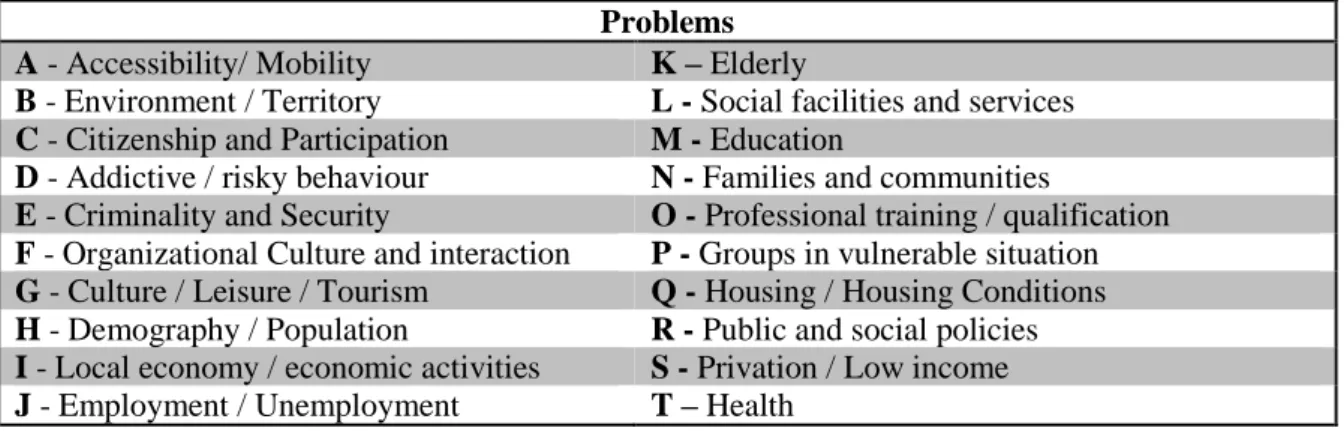
In order to capture the extent of this problem complexity at the municipal level – i.e. the environment faced by all the TSOs in the network -, we explored the multiple ties among problems identified in two social diagnoses. Considering the difficulty in delineating the boundaries of problems, in this study we used a codification that had been prepared independently from this research, based on the understanding of the people involved in the Rede Social. The list of problems in Table 1 was prepared based on the information from the database of Rede Social at the national level4.
It is worth noting that these problems differed in nature. Some of them referred to specific targets (e.g. the Elderly, Groups in vulnerable situations, Families, the Community), while other were issue-based (e.g. Accessibility and mobility, Environment and territory, Employment and unemployment, Education, Health).
Table 1 around here
Using the list of problems above, we analysed the social diagnoses at the municipality level prepared in 2004 and 2008, and identified the problems that were mentioned jointly in these documents. Considering the paragraph as the unit of analysis, every time two problems were referred to simultaneously, they were coded as such. For instance, the description of unemployment issues came often together with education issues, or vulnerable groups in the
18 community. This simultaneity in the discourse was used as a proxy for the relationship between the problems. From this analysis, we built a network of problems in the problem set as presented on Figure 1. Although this network only illustrates the existence (or absence) of links between the problems without weighting these links, it clearly shows that these problems are intertwined. A more detailed analysis indicated stronger relationships for the problems ‘Groups in a vulnerable situation’ with: 1) Social services and facilities; 2) Aging; 3) Privation and low income; 4) Criminality and security; 5) Education; 6) Employment and unemployment; and 7) Health. In addition to these stronger links, other links are worth noting. These include the relationship of ‘Aging’ with: 1) Social services and facilities; and 2) Privation and low income; as well as the relationship of ‘Employment and unemployment’ with: 1) Professional Training; 2) Education; and 3) Privation and low income.
The results thus showed a clear crossing between the problems. The targets apparently requiring the most attention were those in a vulnerable situation (e.g.: immigrants, young mothers, disabled people, addicts, and so on), and elderly people. Among the issues that appeared as overlapping the most with these target groups were social services and facilities; privation and low income; criminality and security, education; employment and unemployment; professional training; and health.
Figure 1 around here
4.1.3 Strategic complexity
The analysis of institutional and social complexity provided an overview of the potential interconnectedness of the major concerns of the Rede Social Amadora and of the City Council, Parishes, public entities, and TSOs in this town. This suggests a potential overlap in organizational interests, goals, responsibilities, and actions when trying to address these issues, likely to increase strategic complexity, as discussed above.
19 The network level planning mechanisms, however, should theoretically reduce this strategic complexity by aligning actor strategies with the network level strategy. Even if each TSO can autonomously choose its individual strategy, those strategic mechanisms should reduce the potential for conflict among the strategies aimed at addressing the same complex problem and consequent responses from the other actors.
If we revisit the network of problems at the municipal level presented earlier, many of those relationships and interdependences were also present in these strategic response axes. These axes were the strategic focus of the partners at the municipal level as depicted in the Social Development Plan, and partners at the parish level defined the Annual Plan for the local network based on these axes. Hence, the cascade approach underlying the Rede Social program would ultimately affect the ways and means by which the network and the network actors pursue their missions, reducing strategic complexity and providing an answer to social problems in a coordinated way.
4.1.4 Operational complexity
Networks seemed to play an important role in the way TSOs operated to address problems. The data suggests four main types of coordination, both within and outside the structured network, carried out to address the problems faced in the municipality: a) coordination of partners within the Rede Social Amadora; b) coordination with public and nonprofit organizations outside the Rede Social Amadora; c) coordination with companies and d) coordination with the community. This coordination was expected to reduce operational complexity.
First, the coordination among the partners within Rede Social Amadora appeared to be crucial. The increasing awareness of the importance of the collective approach by the partners was recurrent in their meetings, as well as in the interviews. Partners provided several specific examples of projects, activities, or even solutions to specific problems, which had required articulation with other partners in the network. This articulation also helped prevent the
20 duplication of efforts, and promoted the rationalization of resources. As noted by a partner “if there is not a concerted action it looks like we give clothes every day, we give food every day in a disorganized way… today I give, tomorrow you give, tomorrow the other gives and hence there is no concerted action” (Interview, TSO D).
Second, the coordination between public and nonprofit organizations outside the Rede Social Amadora also seemed important. There were often presentations in the plenary sessions by entities and organizations that addressed specific issues such as legislation, certain diseases, or specific targets, for instance. Besides the important information that was shared in such presentations, they were sometimes able to serve as a starting point for further partner connections with those external to the network.
Third, the need to increase coordination with companies was often mentioned; and in fact, it had led to a specific project created under the Rede Social Amadora to promote corporate social responsibility initiatives, by facilitating company links with local TSOs. In line with this, it is worth noting that when asked who they would like to see belong to the network, almost half of the TSOs referred to companies, mainly due to the resources they could provide. The companies, however, despite their positive contact with local TSOs and their interest in supporting these organizations, appeared reluctant to adhere to the ‘Local Council’ (EB, March 2010).
Finally, we found evidence of coordination with the community - not only with the population in general, but also with the users of the services in particular. For instance, the population’s involvement in TSO events and initiatives, and their involvement in responding to surveys, were considered important to the way the network and the organizations within it pursued their mission.
21
4.2 Mission pursuit in a systems approach to strategy
4.2.1 The role of interorganizational relationships in the network for mission pursuit
The TSOs were specifically asked to identify the actors most important to them in pursuing their missions. This resulted in a double entry of organizations that referred other actors, and organizations that were referred to by other actors. Figure 2 represents the network of cross references.
Figure 2 shows the interorganizational ties, with the ties symbolized by directed arrows representing the direction of the reference. The dotted circle represents the limits of the Rede Social Amadora. Actors referred to with imprecise names, such as companies, schools or unions, were not considered for the analysis, as they would not allow the cross-reference analysis.
From the figure, we can conclude that among the most mission-critical actors mentioned by the twenty-three TSOs, twenty-five were from within the Rede Social Amadora, and forty-two did not belong to this specific network.
Among the total of sixty-seven different actors mentioned by the interviewees, the ones mentioned most often belonged to the Rede Social Amadora: 1) the local government (IN17 - 20 references), 2) the institute for social security (IN 19 - 12 references); and 3) the institute for employment and professional training (IN18 - 7 references). The local government was specific to the location of Rede Social Amadora; while the other two were public institutes with national coverage, but with local branches also represented in the network, and as such, considered as belonging to it.
Among the actors external to the Rede Social Amadora, the three most referred ones were: 1) the public institute dealing with immigration and intercultural dialogue (OUT2 - 4 references); 2) a private foundation that supported science and culture (OUT29 - 3 references); and 3) an
22 official institution in the area of protection of children and youth (OUT24 - 3 references). This suggests that in addition to the high importance of actors internal to the network, actors important to the mission of TSOs were also spread outside Rede Social Amadora.
When we isolated the cross-references among TSOs alone, we found those interviewed referred to 16 TSOs that belonged to the network (six of which were interviewed). Of these, only four were mentioned by more than one organization, while the other twelve only received a single reference. The interviewees also referred ten more TSOs that were outside Rede Social Amadora.
When asked about the reason why these actors were important to their mission pursuit, the motive most often mentioned by the TSOs was related to resources (54 references), such as monetary funds or goods. The second most commonly cited reason, mentioned in half of the cases, was the complementarity of the services provided (27 references). This was followed by motives related to education and training (14 references) and geographical reasons (10 references), such as proximity.
Again, if we isolate the cross-references among TSOs alone, in nine out of sixteen cases, importance to the pursuit of mission was based on complementarity of services, followed by geographical reasons. From the ten TSOs outside the network, eight of them were considered important for the resources they provided to the organizations interviewed. Despite the reduced number of organizations overall, there appears to be clear a pattern in terms of the responses. That is to say, TSOs identified organizations within the network as being important for operational reasons based on providing complementary services, while TSOs outside the network were mainly important as resources providers.
23 4.2.2 Enablers and barriers to mission pursuit
Organizations were asked about the organizational and institutional (or external) enablers and barriers to the fulfilment of the goals that followed from their missions as a way to explore further the factors affecting their mission pursuit.
In terms of enablers to mission pursuit, i.e. what organizations perceived as promoting their own pursuit of mission, the most commonly mentioned factors (those mentioned by at least three organizations) were: a) interorganizational relationships, including coordination with partners inside and outside the Rede Social Amadora; b) internal resources, including human, financial, or physical resources; c) managerial issues, including the relationship with the Board or coordination within the organization; d) scope of the activities, including the diversity of services, geographical scope and target populations; and f) external legitimacy, i.e. recognition by peers and the population in general.
In terms of interorganizational relationships, there were signs that they facilitated the way TSOs pursued their missions on a day-to-day basis. For instance, one respondent referred to creating “linkages as much as possible with other institutions (…) that is what allows us to work… better” (Interview, TSO G). The importance of referrals between organizations was specifically identified:
“it is really this linkage, for instance if we have unemployed mums and we know that there is an institution that prepares CVs and that has its own space to answer to job advertisements and so on, we immediately redirect them there (…) this coordination enhances our work” (Interview, TSO Z)
The improved acquaintance with other partners, and increased awareness of the resources available in the Rede Social also seemed to facilitate the coordination of work in the field. As one TSO referred,
24 “and the knowledge that we also have inside the network of the resources that exist in the town allows us to, when we cannot do it inside the organization with our services inside the organization, we are able to make the linkage with institutions that will fill those gaps that we are not able to attend” (Interview, TSO R).
Interorganizational relationships with public authorities were also highlighted. As an example, “then all the relationships that we have with the exterior… the good relationship we have with the social security institute, with the Municipality, with the various entities” (Interview, TSO R).
Several TSOs also referred to human, financial, and physical resources as great internal enablers, particularly in the context of the network. For instance, one partner referred that,
“on the other hand, it is an enabler the fact that we are in this network of partners [Rede Social], isn’t it? Because we have a lot of resources at our disposal and we can share and make the best use of them… no doubt, this is a very important factor” (…) (Interview, TSO H).
Interviewees were also asked to identify barriers to mission pursuit. This resulted in twice as much coded text in comparison with the text dealing with enabling factors. Among the factors that inhibited mission pursuit, the most commonly mentioned (i.e., mentioned at least by three organizations) were: 1) internal resources, including financial, physical, or human; 2) macro-level issues, such as bureaucracy and legislation, the financial/economic conjuncture, or the social and educational policy; 3) micro-level issues, such as competition or coordination with the social security institution; and 4) reductions in public support.
Organizational resources were referred to as the most important constraint to the way the TSOs developed their activities. As mentioned by one of the organizations: “No doubt, the financial [resources]… they are our big obstacle... whoever has more money does more things….” (Interview, TSO Z). Another one account highlights the perceived impact of financial
25 constraints, “What happens a lot is the barriers we often find... above all the financial issues, isn’t it? It inhibits us from developing as many activities as we would like or from reaching the excellence level that we would like…” (Interview, TSO H).
Physical resources were also considered a barrier to their daily operations, particularly as TSOs become larger. For example: “Barriers… we have two. The one that represents 90% is the physical space. This is the biggest barrier that we have” (Interview, TSO P), or “What we need is more space, because this is getting very small for everything we have… when we came here it looked huge, in fact, but now it is getting small... we need a larger building” (Interview, TSO L).
Another category of barriers appears at the macro level, including issues such as bureaucracy and legislation, the economic conjuncture, or social and educational policies. One of the TSOs noted that “because it all depends on the context that… mainly economic, the social area is also linked to the economic part, if we go through a crisis…” (Interview, TSO O), leaving in the air the impacts of the economic conjuncture in aggravating social problems and causing more constraints to organizational activities. This could be related not only to the increasing number of people relying on the support by these TSOs, but also to the financial constraints that come from reductions in the pool of funding resources from public and private sources. Finally, it is also worth highlight the perception of competition as a barrier to mission pursuit. The same TSO that commented above on the economic crisis, touched on a sensitive issue relating to the reduced pool of resources: “Then it is also the competition. People do not think there is competition, but in the end there is competition (…)” (Interview, TSO O). Furthermore, this competition was not only with other TSOs, but also with public sector institutions providing similar services.
To a much less extent than other barriers, another source of friction identified in the data referred to the relationships with the social security authority. As noted by one of them,
26 “Unfortunately, the competent entity [the social security institute] is in many cases a barrier, because we are facilitating a job that, in fact is mainly from the State, or it should be… that depends on the perspective and politics of each person. (…) Often the competent entity is the big barrier for us to solve the problems of people, because they ask for this, and that, (…) and things that are often not fundamental for the answer to be provided” (Interview, TSO J).
Nevertheless, there were signs that things were getting better, as new protocols were being put in place to facilitate processes:
“Another barrier is… not so much now because we have this protocol, but before when we did not have, the follow-up of the families was not done, and because… most of the financial resources where in the social security, we could not coordinate with the colleagues [at social security], because the colleagues have 500 cases and they do not follow up people…” (Interview, TSO M).
The fact that most of the enablers were related to internal factors, while the barriers mostly referred to external factors can be regarded as a self-serving bias. Such biases are “judgments or interpretations of oneself, one’s behavior, and the behavior of others in ways that are favorable to the self, without requiring that such judgments be accurate according to some objective standard” (Blaine & Crocker, 1993, p. 55). However, for the purpose of this study, because subjective perceptions, in contrast to objective measures, are valued, this is not a concern.
4.2.3 Enablers and barriers to mission pursuit and the network of relationships The last research question related to the way enablers and barriers relate to the networks of relationships; both networks of an emergent nature and the goal-directed network Rede Social Amadora.
27 The findings showed that the most often identified enablers were interorganizational relationships, and internal resources; while the most commonly cited barriers were related to resources and macro level issues. And as explored above, the availability of resources (or lack thereof) played a strong, determinant role in mission pursuit. Resources were often identified by the same TSOs as both enablers (when they were available to support the mission pursuit) and barriers (when those resources were scarce). As one interviewee referred,
“[Financial resources] this is an enabler factor and a barrier at the same time… I think that the funding…, the agreements with the social security and with other projects such as the national institute for rehabilitation are enablers (…) they help us to provide an answer and intervene in the field… because if we did not have the funds, we would not be able to have the technicians, would not be able to have an adapted van, would not be able to have the people, the resources… and this helps our mission” (Interview, TSO G).
But, as the interview continued,
“funding is good because it allows us to do the work, but it can also be too little (…) for instance we are not able to have a full time technician… the social assistant is here not full time, nor is the psychologist (…) we have no resources for that. (Interview, TSO G).
This may explain the fact that, when asked about whom would they bring to the Rede Social Amadora network, the most common answer was companies, motivated by the view that their participation would provide more resources for the TSOs in the network.
The findings on the role of interorganizational relationships in the network in terms of mission pursuit also showed that in addition to internal actors, actors important to the mission of TSOs were also spread outside the Rede Social Amadora. Moreover, the cited reason most often to
28 consider these actors as critical was resource related. Two questions can thus be raised: a) can the enablers be found in the Rede Social Amadora and other TSOs’ networks of relationships?; and b) can the barriers be reduced by belonging to the Rede Social Amadora or other TSOs’ networks of relationships?
On the one hand, our findings suggest that the enablers can indeed be found within networks: “then we can always count on the other organizations… we are permanently
in contact with other organizations, other NGOs from the city… either because we have users in common, or because there is a service that we do not have but they do, and vice-versa. The ‘E’ is asked by other organizations to make several interventions, namely in the area of training (…), awareness campaigns that other organizations may feel the need for, they have our support and we are always happy to collaborate (…) there is a constant and much needed sharing among ‘E’, the Municipality, other NGOs, parishes… there is a good coordination” (Interview, TSO E).
And:
“then here the partnerships are essential because having a... systemic approach (…) it is impossible to answer all the needs of the kids and their families alone, in an isolated manner... so here the partnerships are essential (…) the partnerships are enablers… it is one of the added values that we have” (Interview, TSO V)
Increasingly, the TSOs seemed to be coming together, to cooperate, and work consistently, in order to accomplish their overlapping missions in the context of problem complexity within which they had to operate.
In terms of the barriers, belonging to a network seemed to partially reduce them. By belonging to the Rede Social Amadora, for instance, TSOs were able to be closer to many of the actors
29 that were considered critical in terms of resource availability, such as the Municipality or the local social security entity.
Other micro-level issues restrained TSOs from pursuing their missions, however, and these include not only the difficulty of coordinating their needs and concerns with the social security organization, but also the competition between TSOs for funding and resources. Indeed, there were multiple competitive relations in the system, resulting from the fact that it contained many TSOs, but limited sources of resources – whether funds, physical spaces, or volunteers. The Rede Social Amadora thus combined both co-operative and competitive relationships within it. A final issue is the fact that many of the barriers that were identified were of a macro-level nature, which made them more difficult for a TSO or even the Rede Social Amadora to influence.
5. DISCUSSION
The findings presented here point to a high level of environmental interconnectedness, as well as to institutional, social, strategic, and operational complexities. These were detected in multiple ways. First, in the links between the TSOs and Rede Social Amadora and European, national, regional, and local policies; as well as in legislation that affected the way the network and the organizations acted. Second, the changes in institutional logics in terms of the way organizations should perceive social intervention. Third, in terms of the interrelationships among the problems (i.e. the problem complexity) faced by the Rede Social Amadora and its constituent TSOs. Finally, in the way strategic and operational complexities were reduced by the coordination in the interorganizational network.
It is particularly interesting to compare the network of problems, and how they are intertwined in the discourse of the Social Diagnoses, with the network of actors identified in the interviews as being important for mission pursuit of the TSOs. For instance, in terms of social complexity
30 we have detected that among the problems perceived to be most interconnected were: i) population targets, such as elderly people and the groups in vulnerable situation; and ii) issues, such as a lack or insufficiency of social services and facilities, privation and low income, criminality and security, education, employment and unemployment, professional training, and health. Some of these links among problems matched the relationships considered most important. For example, one of the problems most often related to other problems was unemployment and professional training; and one of the most cited actors was the national entity that addresses this problem, which was represented in the Rede Social Amadora.
The existence of institutional and problem complexity seemed to be a driving force for the establishment of the interorganizational network, which if well-oiled could permit a reduction in the strategic and operational complexity faced by TSOs. Indeed, one of the major enablers of mission pursuit identified was the existence of interorganizational relationships, both within and outside the Rede Social Amadora. On the other hand, resources, while also seen as an important enabler, were simultaneously perceived as a major barrier to mission pursuit. This is related to the fact that resources are limited and TSOs have to work hard, and in competition with other network TSOs, to get them. As such, multiple cooperative, as well as competitive, relations operating simultaneously could be depicted as existing in the network of TSO now formalised through the Rede Social Amadora.
Cooperation and competition mechanisms
As noted above, the findings pointed to the co-existence of cooperation and competition mechanisms put in place by TSOs for organizational mission pursuit. This is one of the paradoxes of interorganizational arrangements: that of competition vs. collaboration. As noted by (Brown, 2015), managers have to consider whether their actions are in the self-interest of the organization (e.g. learning, access to resources, or cost efficiency) or in the interest of the collective (e.g. achieve social impact). This balance between competition and cooperation is
31 crucial. Even if TSOs are able to minimize competitive tendencies (Brown, 2015), they still have to compete for various resources – not only with other TSOs but with the private sector as well (for instance, in the search for public contracts).
Nonprofits compete for resources such as funds, locations, employees, volunteers (Post, Preston, & Sachs, 2002); for clients; as well as for public recognition and media attention (La Piana & Hayes, 2005). And in addition to this competition among TSOs, TSOs in Portugal also face increasing competition from the business sector. Data at the national level (GEP/MSESS, 2013) shows a transformation in the panorama of social intervention in the country from 2000-2013, with an 86% increase in the number of for-profit organizations with social facilities. By 2013, these enterprises represented 30% of all organizations with social facilities. In terms of the facilities themselves, between 2000 and 2013, the number of social facilities from private for profit entities increased by 80%, compared to an increase of 29% in the nonprofit social sector. Although these specific effects are beyond the scope of this paper, it is clear that these developments have impacted (and will continue to do so) the ways TSOs manage the competition-collaboration paradox.
Competition can have unpredictable effects on the system as a whole. Ultimately, the fact that each individual organization may be trying to solve its “part” of the complex interconnected problem set, while connected and competing with other organizations for resources, can be detrimental to the interests of the problem set as a whole, and to other organizations. The interactions between the actions of organizations can also destabilize the system, even when there is no such intent. The policies and actions of one actor have the potential to impact the policies and actions of other actors, and this can potentially result in a worsening of the situation. This arises from ‘turbulence’, where the interaction between the actions of actors interact with the stability of the domain itself (Emery & Trist, 1965).
32 These comments on the cooperation and competition mechanisms put in place by TSOs imply that in the long-run, the co-existence of organizations serving the interests (or mission pursuit) of actors in a given problem-set or domain requires a blend of co-operation and competition. This affects the work of all the actors and the set of actors as a whole, and is central to the work of the Rede Social Amadora as a formal network. It implies the need for a form of strategic cooperation that provides for both competition and cooperation.
As organizations compete more intensively with one another for resources, and as their actions begin to interact, these effects need to be better understood and better coordinated, in order for responses to the problems in the problem-set to be found. This is paradoxical – increased competition, especially in the face of turbulence, leads to the need for greater cooperation. That is, the need for a strategic framework, and a commitment to the processes that foster a cooperative approach to the system and its actors. This is particularly important in the context of the type of problems address by the network TSOs. They have to keep looking for ways to cooperate because they are dependent on resources that are often dependent on cooperation (e.g. funds and contracts that require cooperation among actors so as to rationalize resources). TSOs thus serve markets where cooperation seems not only appropriate, but also necessary (Brown, 2015). However, it is neither easy nor without costs (Klijn & Koppenjan, 2014). A response at the other end of the spectrum is strategic denial – operating by choosing to ignore the actions of others, or the effects of one’s own actions on others. Ignorance, although different from denial, leads to the same outcome – a likely sub-optimal performance in terms of the complex problem set as a whole. As noted by (Klijn & Koppenjan, 2014), go-alone strategies in networks tend to be negative for problem-solving, as they tend to be sub-optimal. In fact, although several TSOs in this study as well as the principles of the Rede Social recognized the need for a more holistic view of the problem set, there were still actors that seemed to prefer to dismiss or ignore this perspective.
33 The systems approach used in this paper helped understand the interactions between the TSOs and the network in pursuit of their individual organizational missions, in the sense that it provides a holistic view of the activities of the network and the actors themselves, as well as the links in the problem-set they face. Problem complexity requires that the strategy of individual TSOs be shaped through some ‘collective’ assessment of the problem-set that makes up the system. Indeed, the policies and actions that operate on parts of the problem-set should be evaluated by other organizational actors; and the search for, and evaluation of new actions should also involve multiple actors.
Based on the theoretical contextualization and data analysis, we propose a model of mission pursuit using a systems approach to strategy as a new style of management of TSOs. This exercise provided a systems perspective on the potential impacts of strategic decisions taken in the context of these problem-sets, not only at the organizational level, but also at the network or system level. In this context, sharing experiences and making use of limited resources in a coordinated way by the multiple actors that address these related issues seems appropriate. But first, organizations need to become aware of the need for that, i.e., they need to make sense of the system together with the other actors – not only TSOs - in the system. Therefore, the model includes the following intertwined processes that require the cooperation of others in the system:
a) Acknowledging environmental interconnectedness
As noted before, environmental interconnectedness refers to the extent to which environmental factors are interrelated and the density of interorganizational relations among the organizations in the field. This is the first step in making sense of the systems wherein the organizations are embedded.