Rights: an Analysis of Online
Platform Contracts
Jamila Venturini
Luiza Louzada
Marilia Maciel
Nicolo Zingales
Konstantinos Stylianou
Luca Belli
Editora Revan
No part of this book may be produced in any manner, by mechanic or elec-tronic media or by photocopy, without previous written permission from the
publisher.
Coordination and Revision:
Jamila Venturini, Nicolo Zingales and Luca Belli
Translation
Flávio Jardim and Cibeli Hirsch
Book Cover
Mariana Vianna Abramo
Printing
(On off-set 75g paper, after eletronic paging in Bembo ITC, c. 11/13) Divisão Gráfi ca da Editora Revan
Cip-Brazil. Cataloguing-in-source National Union of Book Publishers
The authors wish to acknowledge Eduardo Magrani for his substantial contribution to the technical revision of this book.
T298
Terms of service and human rights: an analysis of online platform contracts / Jamila Venturini, Luiza Louzada, Marilia Maciel, Nicolo Zingales, Konstantinos Stylianou and Luca Belli. - 1. ed. - Rio de Janeiro : Revan, 2016.
152 p. ; 21 cm.
Translation of: Termos de uso e direitos humanos: uma
análise dos contratos das plataformas online Includes bibliography and index
ISBN 978-85-7106-574-1
1. Communication and technology-social aspects. 2. Information technology. I. Venturini, Jamila; Louzada, Luiza; Maciel, Marilia; Zingales, Nicolo; Stylianou, Konstantinos; Belli, Luca. II. Terms of Service and Human Rights: an Analysis of Online Platform Contracts. 16-37692 CDD: 079
CDU: 07 09/11/2016 10/11/2016
List of tables...8
Preface...11
Introduction...13
Background...17
1. The role of internet intermediaries...19
2. The role of Terms of Service in online platforms...22
Methodology...27
1. Criteria for the analysis of the Terms of Service...29
1.1 Freedom of expression...29
1.2 Privacy...33
1.3 Due process...39
2. Analysis...44
2.1 Identifi cation and storage of Terms of Service and related documents...44
2.2 Terms of Service analysis and codifi cation...46
2.3 Crossing results and assigning weights to each answer...47
2.4 Statistical analysis and computation of the level of agreement ...49
Results...53
1. Freedom of expression...53
1.1 Content monitoring, blocking, fi ltering and removal...53
1.2 Information on reporting inappropriate or abusive content....56
1.3 Notifi cation and right to be heard in case of content removal...58
1.4 Notifi cation and possibility of questioning individual account termination ...59
1.5 Anonymity and the use of pseudonyms...60
2. Privacy...61
2.1 Minimization of data collection ...61
2.2 Viewing and copying personal data available on the platform...63
2.3 Editing and deletion of personal data ...63
2.4 Permanent account deletion ...65
2.5 Permanent deletion of personal data ...65
2.6 Scanning of private communications ...66
2.7 Tracking users’ activities on other websites ...67
2.8 Third-party tracking ...69
2.9 Data retention ...71
2.10 Data aggregation from diff erent services ...73
2.11 Data aggregation from diff erent devices ...74
2.12 Data sharing for commercial reasons ...75
2.13 Data sharing for processing or technical reasons ...76
2.14 Data sharing for other purposes ...77
2.15 License on shared content ...79
2.16 Encryption ...80
2.17 Data sharing with government or law enforcement authorities ...82
3. Due process ...83
3.1 Notifi cation requirements for changes in the Terms of Service ...83
3.2 Notifi cation requirements before termination of services ....84
3.3 Availability of earlier versions of contracts ...85
3.5 Confl ict resolution between users and platforms ...87
3.6 Right to present a class action ...87
3.7 Mandatory arbitration for dispute resolution ...88
3.8 Imposition of specifi c jurisdiction for dispute resolution ...90
3.9 Other limitations on the access to justice ...91
Final remarks...93
1. General remarks on plataform Terms of Service ...93
2. Specifi c remarks ...96 2.1 Freedom of expression ...96 2.2 Privacy ...100 2.3 Due process ...103 Conclusion ...107 References ...108 News...112
Annex I - Related projects and civil society initiatives ..113
Annex II - Analyzed platforms and documents ...117
Annex III - Recomendations on Terms of Service and Human Rights ...127
Table 1 - Criteria for the analysis of freedom of expression and specifi c
references on international human rights documents - P. 31
Table 2 - Criteria for the analysis of privacy and specifi c references on
international human rights documents - P. 35
Table 3 - Criteria for the analysis of due process and specifi c references
on international human rights documents - P. 41
Table 4 - Reference table for crossing responses of three independent
coders and their assigned weight - P. 48
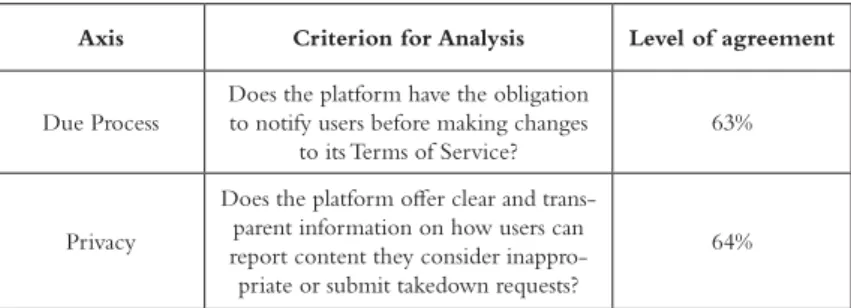
Table 5 - Level of agreement of the three coders by analysis criterion - P. 49 Table 6 - Aggregated results and level of agreement regarding content
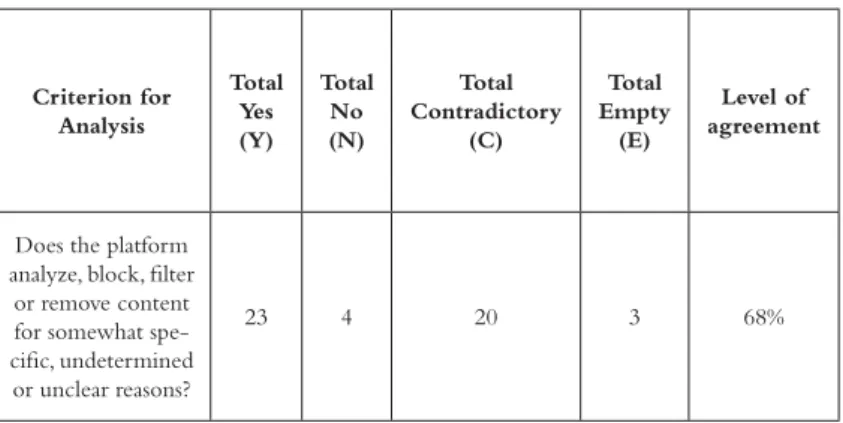
analysis, blocking, fi ltering or removal - P. 54
Table 7 - Aggregated results and level of agreement regarding the
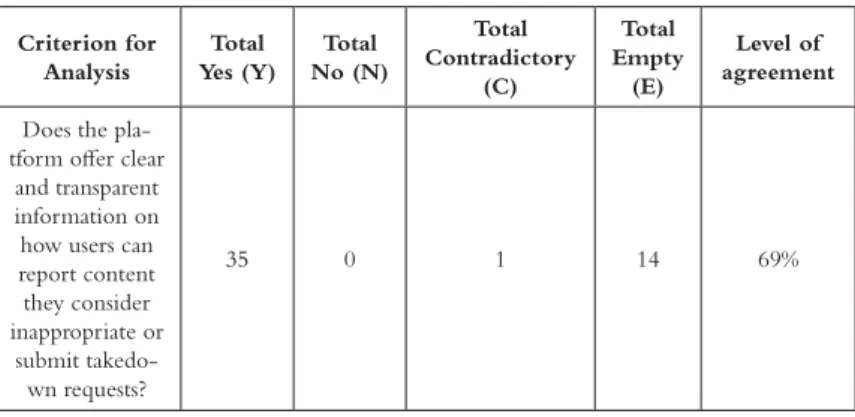
existence of clear information on how to report inappropriate or abusive content - P. 57
Table 8 - Aggregated results and level of agreement regarding notice and
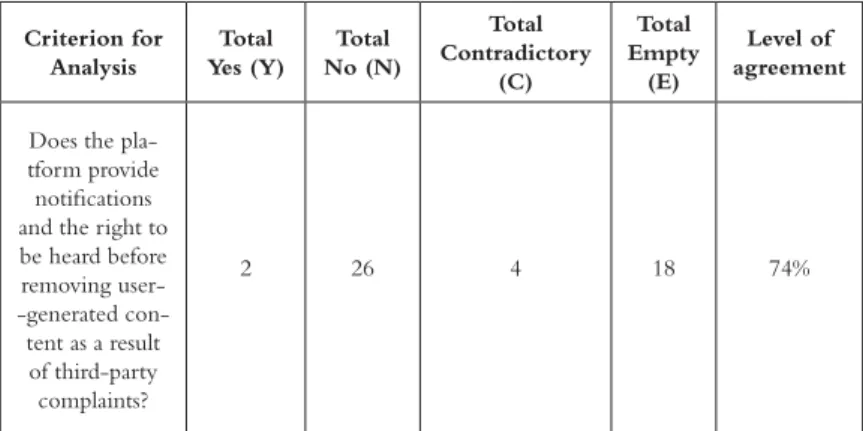
right to be heard in case of content removal - P. 58
Table 9 - Aggregated results and level of agreement regarding notice and
possibility of questioning individual account termination - P. 59
Table 10 - Aggregated results and level of agreement regarding anonymity
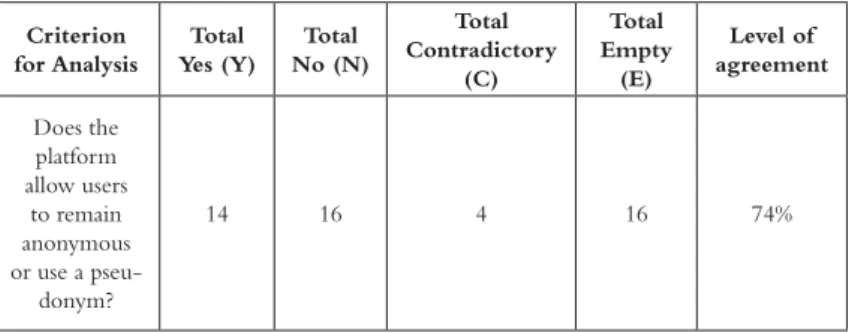
or the use of pseudonyms - P. 60
Table 11 - Aggregated results and level of agreement regarding data
collection minimization - P. 61
Table 12 - Aggregated results and level of agreement regarding the
possibility of viewing and copying personal data available - P. 63
Table 13 - Aggregated results and level of agreement regarding the
Table 14 - Aggregated results and level of agreement regarding the
possibility of permanent account deletion - P. 65
Table 15 - Aggregated results and level of agreement regarding the
possibility of permanent deletion of personal data - P. 66
Table 16 - Aggregated results and level of agreement regarding the
scanning of private communications - P. 66
Table 17 - Aggregated results and level of agreement regarding the
tracking of user activities in other websites - P. 68
Table 18 - Aggregated results and level of agreement regarding
third-party tracking - P. 69
Table 19 - Aggregated results and level of agreement regarding data
retention - P. 72
Table 20 - Aggregated results and level of agreement regarding data
aggregation from diff erent services - P. 74
Table 21 - Aggregated results and level of agreement regarding data
aggregation from diff erent devices - P. 74
Table 22 - Aggregated results and level of agreement regarding data
sharing for commercial reasons - P. 76
Table 23 - Aggregated results and level of agreement regarding data
sharing for processing or technical reasons - P. 77
Table 24 - Aggregated results and level of agreement regarding data
sharing for other purposes - P. 78
Table 25 - Aggregated results and level of agreement regarding the
imposition of broad licenses on shared content - P. 80
Table 26 - Aggregated results and level of agreement regarding the
encryption of transmitted information - P. 81
Table 27 - Aggregated results and level of agreement regarding the
Table 28 - Aggregated results and level of agreement regarding data sharing
with government and/or law enforcement authorities - P. 83
Table 29 - Aggregated results and level of agreement regarding the need
of notifi cation before changing terms - P. 84
Table 30 - Aggregated results and level of agreement regarding the need
of notifi cation upon termination of services - P. 85
Table 31 - Aggregated results and level of agreement regarding the
availability of previous versions of contracts - P. 85
Table 32 - Aggregated results and level of agreement regarding the
existence of alternative mechanisms for dispute resolution among users - P. 86
Table 33 - Aggregated results and level of agreement regarding the
existence of alternative mechanisms for dispute resolution between users and platforms - P. 87
Table 34 - Aggregated results and level of agreement regarding the
possibility to start a class action - P. 88
Table 35 - Aggregated results and level of agreement regarding
mandatory arbitration - P. 88
Table 36 - Aggregated results and level of agreement regarding the
imposition of specifi c jurisdiction for dispute resolution - P. 90
Table 37 - Aggregated results and level of agreement regarding the
F
or many years, the Council of Europe has been developing instruments which address the challenges of the Internet with the underlying premise that human rights prevail over the general terms and conditions imposed on Internet users by companies.The fi ndings of this report, partly based on the Council of Europe’s Guide to Human Rights for Internet Users, demonstrate just how diffi cult it can be for Internet users to understand and thereby consent to the terms of service of online platforms in order to make fully informed decisions on issues which aff ect their human rights such as content restriction policies and the processing of personal data.
The report is therefore a valuable source of reference for the Council of Europe’s human rights work on intermediary liability, algorithms, and the development of standards for the blocking, fi ltering and takedown of illegal Internet content.
Dialogue and co-operation with the private sector is becoming ever more important when dealing with the fast pace of technological change. In line with the UN’s Guiding Principles on Business and Human Rights, the Council of Europe is establishing partnerships with Internet companies to promote respect for human rights and the rule of law online.
Moreover, the importance of close co-operation with research and academic communities in the fi eld of the information society can hardly be overstated. These and other multi-stakeholder partnerships are essential for the implementation of the Council of Europe’s Internet Governance Strategy 2016-2019.
Jan Kleijssen
Director of Information Society and Action against Crime Directorate General of Human Rights and Rule of Law, Council of Europe
T
his report presents the results of the research carried out for the “Terms of Service and Human Rights” project developed by the Center for Technology and Society of Fundação Getulio Vargas Rio de Janeiro Law School (CTS/FGV). Founded in 2003, CTS/FGV aims to study the legal, social and cultural implications arising from the advancement of information and communication technologies. It focuses on academic research and science dissemi-nation that may impact the creation of public policies committed to democracy, fundamental rights and the protection of public interests regarding technological progress.The project was developed between September 2014 and March 2016, and analyzed the Terms of Service of 50 online pla-tforms, by assessing how they deal with the human rights to, fre-edom of expression, privacy, and due process. The goals of the project were to (i) prompt international debate on the role of pla-tforms as regulators in the online environment and their responsi-bility to respect human rights; (ii) produce evidence of the impact of Terms of Service on the human rights of Internet users; (iii) encourage the responsibility of platforms through competition, based on the respect for international human rights standards; (iv) encourage governance mechanisms based on respect for freedom of speech, privacy and due process, and (v) trigger the creation of a community devoted to discussing and developing projects on corporate responsibility in the information and communication technologies (ICT) sector.
The research originated from a partnership with the Dynamic Coalition on Platform Responsibility (DCPR) of the United Na-tions’ Internet Governance Forum, which is multistakeholder group aimed to discuss the notion of responsibility of online platforms, in
particular with respect to internationally recognized human rights. In parallel with the development of this project, the DCPR pro-duced a set of recommendations on Terms of Service and Human Rights1, 2, which promote the adoption of “responsible” Terms of Service as a means for online platforms to ensure respect for the rights to freedom of expression, privacy and due process.
The following steps were taken to conduct the project “Ter-ms of Service and Human Rights”: (i) elaboration of an analysis methodology based on international human rights documents; (ii) analysis of the Terms of Service of 50 online platforms by three independent analysts3; (iii) crossing the results of the three analyses and statistical treatment; (iv) development of conclusions and re-commendations. The project analyzed the Terms of Service’s im-pact on users’ rights to freedom of expression, privacy and due process and the corporate responsibility of platforms to respect and protect human rights.
Preliminary research results were discussed in several national and international events such as the conference for the Internatio-nal Human Rights Day held by the Council of Europe in Brussels in December 2014; the seminar “Human Rights in the Digital Environment: Perspectives on Terms of Service”4, held at FGV
1 See DCPR (2015) Recommendations on the Terms of Service
and Human Rights. Presented at the 10th United Nations Internet Governance Forum: <http://review.intgovforum.org/igf-2015/ dynamic-coalitions/dynamic-coalition-on-platform-responsibili-ty-dc-pr/>.
2 Translator’s note: excerpts of documents written in British English
were maintained in their original form throughout the translation.
3 In addition to researchers from CTS/FGV, two analysts at Tilburg
University, working independently, participated in the Terms of Ser-vice analysis under the coordination of researcher Nicolo Zingales.
4 More information about the event can be found at:
<http://direito- rio.fgv.br/eventos/direitos-humanos-no-ambiente-digital-perspec-tivas-sobre-termos-de-uso>. To watch the full seminar, access FGV Rio de Janeiro Law School’s channel on YouTube: <https://youtu. be/Jy_uqjgdFPo>.
Rio de Janeiro Law School, in December 2014 and the World Forum for Democracy, promoted by the Council of Europe and the European Parliament in Strasbourg, in November 2015. The project called for the attention of representatives of Internet com-panies, civil society and government representatives.
This book is structured as follows: (i) introduction, which discusses the role of intermediaries in providing Internet services and how their Terms of Service infl uence users’ activities; (ii) me-thodology, which describes the basis for understanding the rights to freedom of expression, privacy and due process in an online context; (iii) results, which map trends identifi ed in the Terms of Service of analyzed online platforms; and (iv) fi nal remarks and conclusion.
A
s acknowledged by the Guiding Principles on Business and Human Rights, endorsed by the United Nations Human Rights Council in June 20115, the activities of companies canhave an impact on virtually the entire international human rights spectrum. Therefore, companies are responsible for respecting and protecting these rights, that is, “to refrain from infringing human rights and addressing the negative impacts on human rights in which they have some involvement”.
Such responsibility should be taken through political com-mitments, voluntary initiatives of private players and appropriate procedures, to show that a company is considering the potential impacts of its activities on human rights, is committed to mini-mizing them, and is providing redress mechanisms in the event of abuses or violations. Moreover, the principles state that companies must comply with applicable laws and with internationally recog-nized human rights wherever they operate, and in all contexts, seek ways to honor human rights when faced with confl icting requirements, while considering the risks of causing human rights violations as part of legal compliance.6
5 The document “Guiding Principles on Business and Human Rights”
can be found at: <http://www.ohchr.org/Documents/Publications/ GuidingPrinciplesBusinessHR_EN.pdf>.
6 The document states that “23. In all contexts, business enterprises
should: (a) Comply with all applicable laws and respect internation-ally recognized human rights, wherever they operate; (b) Seek ways to honor the principles of internationally recognized human rights when faced with confl icting requirements; (c) Treat the risk of caus-ing or contributcaus-ing to gross human rights abuses as a legal compli-ance issue wherever they operate”.
A number of initiatives and projects developed by the civil society and governmental organizations highlighted the role of the private sector in protecting and respecting human rights wi-thin the online environment (see Annex I), once private agents are responsible for conveying information on the Internet by pro-viding access, hosting, transmitting and indexing content. In the A/HRC/17/277 report, the UN Special Rapporteur on Freedom of Opinion and Expression stressed that, despite their freedom of initiative, companies providing online services have a corpo-rate responsibility to respect human rights8 and recommends that they (i) only implement restrictions to the rights to freedom of expression and privacy after judicial intervention; (ii) are transpa-rent about the measures taken; (iii) minimize the impact of any
7 The document was based on consultations carried out with several
coun-tries between 2010 and 2011 and its main concern was the increasing threats to the exercise of freedom of expression on the Internet around the world. Although the recommendations of the UN Special Rappor-teur on Freedom of Opinion and Expression do not have a binding nature, both Member States and national and international courts are expected to consider its reports and suggestions when dealing with cases related to the right to freedom of expression (Zingales, 2013).
8 This understanding is enshrined in the Brazilian doctrine and
case--law precedents by the theory of horizontal effi ciency of fundamental rights, which recognizes that fundamental rights must be respected and protected not only in public law, but also in private law relations. As argued by Sarmento and Gomes (2011), “it seems undisputed that, if oppression and violence against a person come not only from the State, but from multiple private actors present in spheres such as the market, family, civil society and companies, the incidence of funda-mental rights in the sphere of relations among individuals becomes an unavoidable imperative. This need is even more urgent in social contexts characterized by severe social inequality and power asym-metry, such as in Brazil. In scenarios such as ours, the exclusion of private relations from the fundamental rights impact radius mean the serious mutilation of these rights, reducing their ability to protect and promote dignity of human beings”.
restrictions only to the relevant content and, where possible, (iv) notify users before implementing restrictive measures. Similarly, the Guide to Human Rights for Internet Users of the Council of Europe determines that, to ensure that existing human rights are equally applied both offl ine and online, States should encourage the private sector to exercise their corporate responsibility, in par-ticular with regard to transparency and accountability9.
Next, a brief description of the peculiarities of the digital environment will be presented, highlighting the role of private in-termediaries in communications, and how Terms of Service regu-late the use of online platforms. In addition, the concept of online platforms and how they can impact freedom of expression rights, privacy and due process will be discussed.
1. T
HER
OLE OFI
NTERNETI
NTERMEDIARIESThe prominence of private intermediation in the Internet envi-ronment is remarkable. Data traffi c between senders and receivers requires the existence of a number of private agents in
infrastructu-9 Recommendation CM/Rec(2014)6 of the Council of Europe on
the Guide to Human Rights for Internet Users extends to the online environment the obligation of Member States to guarantee human rights and fundamental freedoms in their jurisdictions and to respect the conventions and instruments of the Council of Europe on the right to freedom of expression, access to information, freedom of association, protection against cybercrime, privacy and personal data protection in the online environment. Other international organi-zations have drawn attention to the same point. In the American sphere, the Special Rapporteur on Freedom of Expression of the Inter-American Commission on Human Rights of the Organization of American States (OAS) published, in 2013, the report “Freedom of Expression and the Internet” which includes principles to guarantee human rights, especially freedom of expression and privacy, in the online environment.
ral, logic and content layers10. Thus, they are largely responsible for the full exercise of freedom of expression, that is, the right to seek, receive and share information and ideas over the Internet11.
From the late 1990s to early 2000s, the Internet was consi-dered as a tool able to directly connect users to providers, buyers to sellers, the public to authors, thereby eliminating a number of traditional intermediaries in a phenomenon identifi ed then as “di-sintermediation”. However, it seems more correct to say that the Internet does not determine disintermediation, but that it encou-rages the emergence of new intermediaries, which replace some of the agents who played essential roles before the Internet era (OECD, 2010; OECD, 2011). What can be observed is what some authors have called a phenomenon of “hypermediation”12, with the emergence of a wide range of particularly powerful priva-te entities with the ability to regulapriva-te access and dissemination of information through private agreements, and to collect large amounts of personal information about users and their activities.
According to the Organization for Economic Co-operation and Development (OECD), the role of intermediaries is key for the digital infrastructure. They off er signifi cant social and econo-mic benefi ts, by providing Internet access, allowing online com-merce, and facilitating communication through social networks,
10 The Internet is made up of three main layers: (i) a physical
infra-structure, consisting of the set of electronic networks that allow com-munication; (ii) a logic layer, i.e., protocols and applications, which allows searching, sharing and accessing information and ideas, and; (iii) a content layer, i.e., the set of information and ideas that are avail-able online. See: Y. Benkler, “From Consumers to Users: Shifting the Deeper Structures of Regulation Toward Sustainable Commons and User Access”, Federal Communications Law Journal, vol. 52, 2000.
11 See: R. MacKinnon, E. Hickock, A. Bar, H. Lim, “Fostering
Free-dom Online: The Role of Internet Intermediaries” (UNESCO Publication, 2014). Available at: <http://unesdoc.unesco.org/ images/0023/002311/231162e.pdf>.
12 See: N. Carr (2009). “Googler in the Middle”. Rough Type. Available
participatory networks and various web services13, thereby con-tributing to the economic growth and facilitating transactions among third parties on the Internet14. Similarly, the UN Special Rapporteur on Freedom of Opinion and Expression highlighted the key role that the private sector plays, acting as a facilitator of freedom of expression and strengthening the individual participa-tion in the economic, social, cultural and political spheres. Howe-ver, despite such benefi ts, intermediates can also use technology to restrict human rights, by setting the Internet’s infrastructure in such a way as to allow censorship, mass surveillance and even state intrusion.15
Besides facilitating communication among users, interme-diaries also play the role of Internet gatekeepers16, exerting a form of sovereignty over networks and platforms, through their logic architecture (codes or algorithms) and rules that are set and con-trolled exclusively by them (Lessig, 1999; MacKinnon, 2012; Belli,
13 See: OECD (2011) The Role of Internet Intermediaries in
Advanc-ing Public Policy Objectives DSTI/ICCP(2010)11/FINAL. Avail-able at: <http://www.oecd.org/internet/ieconomy/48685066.pdf>.
14 OECD. (2010). The Economic and Social Role of Internet
Inter-mediaries. Available at: <http://www.oecd.org/internet/iecono-my/44949023.pdf>.
15 La Rue, F. 17 April 2013. “Report of the Special Rapporteur on the
promotion and protection of the right to freedom of opinion and expression”. Offi ce of the United Nations High Commissioner for Human Rights. (A/HRC/23/40). pp. 19-20. Available at: <www. ohchr.org/Documents/HRBodies/HRCouncil/RegularSession/ Session23/A.HRC.23.40_EN.pdf>.
16 See: Zittrain. J. (2006). “A History of Online Gatekeeping”. Harvard
Journal of Law & Technology. Vol. 19, No. 2, pp. 253-98. Available at: <http://jolt.law.harvard.edu/articles/pdf/v19/19HarvJLTech253. pdf>. E Pasquale F.A. (2010). “Beyond Innovation and Competition: The Need for Qualifi ed Transparency in Internet Intermediaries”. Northwestern University Law Review. Vol. 104, No. 1, p. 105. Avail-able at: <www.law.northwestern.edu/lawreview/v104/n1/105/LR 104n1Pasquale.pdf>.
2016). Contractual conditions governing the relationship between online services and their users are defi ned by Terms of Service, which can be considered as the actual “law of the platform” (Belli & De Filippi 2012; Belli 2016), defi ned and implemented unila-terally by service providers. Such contractual rules can limit the spread of certain types of content and condition the participation of users to provide a range of information about their activities.
2. T
HE ROLE OFT
ERMS OFS
ERVICE INO
NLINEP
LATFORMSDiff erent organizations and players use various terms to refer to the so-called online platforms, depending on the subject area wi-thin which these platforms are discussed. In an economic sense, for example, a platform is the entity that allows or facilitates the inte-raction between two sides in a market17. According to the Europe-an Commission, “[o]nline platforms cEurope-an be described as software--based facilities off ering two-or even multi-sided markets where providers and users of content, goods and services can meet. As such, the term can cover a wide range of diff erent types of platform, whose functions and characteristics can diff er considerably. Examples of types of platforms include: communications and social media platforms; operating systems and app stores; audiovisual and music platforms; e-commerce platforms; content platforms, which may include content aggregators as well as software/hardware solu-tions; and search engines. [...] Since the value of these platforms to consumers increases with their size (network eff ects), they may in
17 “A market is two-sided if at any point in time there are: i) two distinct groups
of users; ii) the value obtained by one type of user increases with the number or with the “quality” of the other kind of user; and iii) an intermediary plat-form is necessary to internalize the externalities created by one group for the other group. Examples include Internet search engines and portals composed of advertisers and users; retail e-commerce platforms composed of buyers and sellers; and payment networks composed of cardholders and merchants”. See:
some cases become very large and act as key players for the wider Internet18. To make an analogy, an online platform is an application that allows users to search, receive and disseminate information and ideas through the Internet19.
Any person attempting to register in any online platform will probably be faced with the need to agree to the following statement: “I have read and accept the Terms of Service”. “Terms of Use” or “Terms of Service” are the agreements governing the relationship between users and service providers in the online en-vironment20. They are usually accompanied by other documents
such as privacy policies, cookies policy, community standards, among others.
Terms of Service are standardized contracts, defi ned unilate-rally and off ered indiscriminately on equal terms to any user. Since users do not have the choice to negotiate, but only accept or re-ject these terms, Terms of Service are part of the legal category of adhesion agreements. In fact, these agreements establish a kind of “take it or leave it” relationship, replacing the traditional concept of bargained clauses among contracting parties (Lemley, 2006).
Once a user accepts the terms, and in line with the civil law principle that a contract must be respected by the parties (pacta
sunt servanda), both are obliged to fulfi ll what is agreed therein
and the company’s policies are binding upon the user. Even in cases when an explicitly agreement with the Terms of Service is not required, the relationship between users and service provi-ders will be governed by such a standardized contract, considering the interpretation that, by using the services, users agree with the
18 See European Commission. (2015). A Digital Single Market Strategy
for Europe - Analysis and Evidence, COM (2015) 192, p. 52.
19 See DCPR (2015).
20 As stated by Bygrave (2015), the use of contracts to regulate Internet
activities refers to the very origins of the network and the infl u-ence of research funding agencies in the United States.According to the author, contracts have become popular because they are easy to elaborate and distribute to a large number of anonymous users.
company’s policies, even if they have not expressly stated so (tacit consent). Similarly, there are instances in which Terms of Service explicitly state that the mere use of the service constitutes accep-tance of the contract (consent by performance).
Since such terms are generally long, dense and formulated in language that is hard to be understood by anyone who does not have legal training (Bygrave, 2015), people hardly ever read these contracts (Loren, 2004). When they do, they fi nd them diffi cult to understand (Bakos, Marotta-Wurgler & Trossen, 2013). This sce-nario is even more problematic in the online environment, both because these contracts are written in fi ne-print in an environ-ment in which color pictures stand out over texts (Kim, 2012) and because the situations in which customers come across with contracts of this sort became increasingly abundant21, 22.
This scenario seems to point to a market failure characteri-zed by the fact that potential customers do not take into account contractual terms to make their decisions. This dynamic would incentivize vendors and service providers to commit to no more than the minimum required by law, and draw up terms with “anti-social” standards (Bygrave, 2015, p. 31), biased against users, (Bakos, Marotta-Wurgler & Trossen, 2013) and failing to meet their legi-timate expectations.
Some theories, guided by free-market principles, seek to re-ject such concerns on the basis that a minority of users who actu-ally read and understand Terms of Service could ensure a control against any unfair terms. When drafting Terms of Service, compa-nies would take into account this informed minority, thus raising their quality. One can criticize the lack of empirical evidence of
21 According to a study carried out by the Carnegie Mellon University,
in the United States, a user would have to set aside eight daily hours during 76 days only to read the privacy policies of an average of 1,462 pages visited in one year (McDonald & Cranor, 2008).
22 The web campaign called The biggest lie draws attention to the
unsus-tainability of this contract model in the Internet. Visit: <http://www. biggestlie.com> for more information.
this theory, especially in the face of a study that found, based on a signifi cant sample, that in the online software purchase and sale market, very few consumers – between 0.5% and 0.22% – read adhesion contracts, the so-called End User License Agreements or
EULAs (Bakos, Marotta-Wurgler & Trossen, 2013). The
conclu-sion is that even if the validity of the theory of informed minority is taken into consideration, such a small group of users would be insuffi cient to control the clauses unilaterally established by the platforms and infl uence the terms of these agreements, which reinforces the concern with this type of regulation.
The scenario becomes more complex in the case of online platforms, once Terms of Service lay down the rules to publish and share content and the methods of collecting and processing per-sonal data. Thus, more than regulating consumer relations, these contracts now have concrete implications on the implementation of human rights.
In Brazil the eff ect of unfair terms is mitigated by a restricti-ve interpretation of the principle of autonomy23, incorporated in the Brazilian Consumer Protection Act (art. 51, Law 8078/1990), in case of any breaches resulting from the implementation of un-fair terms, the aggrieved party should seek the recognition of his rights in court, which may be too costly for the user.
International organizations have expressed their opinions on the Terms of Service of online platforms. The UN Special
Rap-23 The horizontal eff ect of fundamental rights in Brazilian doctrine and
court precedents diverges from the American doctrine of state ac-tion, in which the autonomy of will is treated completely diff erently. While in Brazil fundamental rights enshrined in the Constitution guide the whole application of private law, in the US, fundamental rights are enforceable only to public authorities, based on the under-standing that, conversely, freedom of association and the autonomy of independent states would be impaired, to the extent that the federal government, under the pretext of implementing the Constitution, could interfere in matters assigned to federal states, undermining their autonomy (Sarmento & Gomes, 2011).
porteur on Freedom of Opinion and Expression, for example, re-commends that such terms should be clear and aligned with inter-national human rights standards. In contrast, the Guide to Human Rights for Internet Users of the Council of Europe reaffi rms that human rights prevail over the terms and conditions imposed on Internet users by any private agent and stresses that States have the obligation to respect, protect and promote human rights, as well as to supervise the private sector.
The methodology of the “Terms of Service and Human Rights” project arises from the recommendations of various in-ternational documents, notably the Guide to Human Rights for Internet Users of the Council of Europe. The following section will detail the parameters established by international human ri-ghts standards regarding freedom of expression, privacy and due process and how they were converted into a methodology for analyzing Terms of Service. In addition, the following section des-cribes the process for analyzing Terms of Service and extracting results.
T
he methodology of the “Terms of Service and Human Ri-ghts” departed from the challenge of developing specifi c pa-rameters that could assess the adequacy of the Terms of Service of online platforms regarding human rights. A number of docu-ments developed by international organizations served as the basis for developing analysis criteria. These include treaties such as the Universal Declaration of Human Rights24 and the InternationalCovenant on Civil and Political Rights,25 the American
Conven-tion on Human Rights (Pact of San José, Costa Rica)26 and the
Chapultepec Declaration.27
In addition, criteria were based on the structure of the Guide to Human Rights for Internet Users, elaborated by the Council of Europe, which not only consolidates a set of rights and freedoms already enshrined in the European context28, but also refl ects the principles present in the main international human rights instru-ments. The Guide has an important role in translating the provisions
24 Adopted and proclaimed by Resolution 217 A (III) of the United
Nations General Assembly on December 10, 1948 and signed by Brazil on the same date.
25 Incorporated into the Brazilian legal framework by the Decree n.
592/1992.
26 Incorporated into the Brazilian legal framework by the Decree n.
678/1992.
27 Signed by President Fernando Henrique Cardoso in 1996 and by
President Luiz Inácio Lula da Silva in 2006.
28 The Guide is based on the European Convention on Human Rights
and other conventions and instruments of the Council of Europe, such as the Convention on Cybercrime (Budapest Convention), the Convention on Protection of Children against Sexual Exploitation and Sexual Abuse (Lanzarote Convention) and the Convention for the Protection of Individuals with regard to Automatic Processing of Personal Data (Convention 108).
of international treaties to the online environment, in an easier and accessible language to the user. In this sense, the infl uence of the Guide goes beyond the 47 member states of the Council of Europe. Finally, criteria for the analysis were drawn from statements by the Special Rapporteur on Freedom of Expression of the Inter--American Commission on Human Rights of the Organization of American States (OAS) and by the UN Special Rapporteur on Freedom of Opinion and Expression, on the ground that they specifi cally deal with the implementation of human rights in the online environment.
Although the way human rights are interpreted and imple-mented on the Internet varies according to the norms of each country, the fi rst phase of project “Terms of Service and Human Rights” focused on the compliance with international human ri-ghts standards. As a result, national or regional rules on consumer protection or the protection of personal data, for example, were not considered relevant for this review. Similarly, the analysis did not focus on local versions of the Terms of Service where a pla-tform operated, but rather on the international one (if any) or, al-ternatively, the English version of the Terms of Service off ered on the country of origin of the platform29. For next phases or versions
of the project, the methodology can be adapted to analyze Terms of Service compliance with local laws.
The analysis focused on the rights to freedom of expression, privacy and due process. Below are the details on the criteria for the analysis in each of these axes and the process of analysis, con-ducted by three independent analysts.
29 The policies of online platforms should presumably adapt to local
laws; however, the analysis conducted by this project on the Terms of Service of 50 platforms indicated that, in many cases, there was not even a version of the contract in the language of the country where the service is off ered. According to an analysis carried out in February 2016, less than half the sample (21) off ers all of its policies in Portuguese. The other part of the sample presents their terms fully or partially in English.
1. C
RITERIA FOR THEA
NALYSIS OF THET
ERMS OFS
ERVICE1.1. Freedom of Expression
According to the Universal Declaration of Human Rights, the ri-ght to freedom of expression includes the freedom to seek, receive and impart information and ideas through any media, regardless of frontiers (art. 19).30 Freedom of expression includes both speeches understood as favorable or inoff ensive, as those that may off end, shock or disturb.
Like other human rights, freedom of expression is not absolute and is subject to restrictions in the case of confl icts with other rights. Under international human rights standards, any limitation to the ri-ght to freedom of expression must pass the following three-part test:31
1. It shall be provided for by laws which, in turn, shall be clear and accessible;
2. It shall serve to protect a legitimate interest recognized under paragraph 3, of Article 19, of the International Covenant on Civil and Political Rights,32 i.e., protect
30 United Nations (1948). “Universal Declaration of Human Rights”.
Available at: <http://www.ohchr.org/EN/UDHR/Documents/ UDHR_Translations/por.pdf> (accessed on April 5, 2015).
31 The three-part test derives from Paragraph 3 of Article 19 of the
International Covenant on Civil and Political Rights and has been established by international doctrine and case law. The mechanism was reaffi rmed as applicable in the A/HRC/17/27 report (paragraph 24) by the UN Special Rapporteur on Freedom of Opinion and Ex-pression and the Joint Declaration on Freedom of ExEx-pression and the Internet. Available at: <http://www.oas.org /en/iachr/expression/ showarticle.asp?artID=848> (accessed on February 17, 2016) as ap-plicable in the context of the Internet.
32 Available at: <http://www.planalto.gov.br/ccivil_03/decreto/1990-
the rights or reputations of others or protect national security, order, health and morals;
3. It shall prove necessary and the least restrictive to achieve its goal, taking into account the principles of necessity and proportionality.
According to A/HRC/17/27 report of the UN Special Rap-porteur on Freedom of Opinion and Expression, censorship measu-res should never be delegated to private agents. It is known, however, that active monitoring measures and content blocking can occur within the Internet environment, where the transmission of infor-mation is mediated by private agents, either as a result of domestic laws, the pressure that liability for publishing certain content exerts on intermediaries, or for other reasons, such as compliance with rules of conduct set out in platform Terms of Service. In addition, some platforms implement mechanisms that allow users to report content they deem inappropriate because they violate their rights (such as privacy), local legislation (e.g., child pornography, racism, etc.) or the platform’s Terms of Service. In this case, the company is responsible for deciding what can and cannot stay online. These me-chanisms are known internationally as “Notice & Takedown” and are inspired by the model established by US copyright law33.
Following the above-mentioned three-part test, Report A/ HRC/17/27 recognizes that information which may be legitimately restricted includes: (i) child pornography; (ii) hate speech; (iii) defa-mation and (iv) incitement to violence (including genocide, discrimi-nation and hostility toward racial and religious groups) (paragraph 25). In addition, it recommends intermediaries to notify users in advance when implementing any content restriction measure (paragraph 47).
The Guide to Human Rights for Internet Users reaffi rms the right to freedom of expression and access to information and
33 Especially the so-called Digital Millennium Copyright Act (DMCA), of
1998, which establishes a mechanism to remove content protected by copyrights if the author notifi es platform hosting such content of the presumed violation.
opinions of others in the online environment and determines that users should be informed about possible restrictions on freedom of expression, so that they can make informed decisions about their content. It also reinforces the need for mechanisms to res-pond to demands and complaints from users.
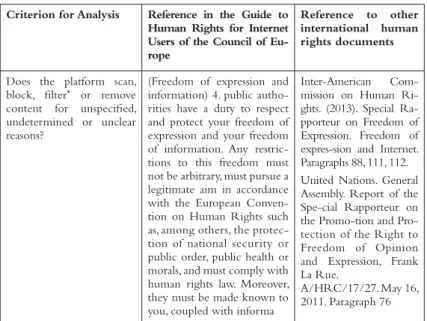
Based on those principles, the following criteria have been developed to identify how platforms act in relation to monitoring content, handling user reports and terminating accounts:
TABLE 1: Criteria for the analysis of freedom of expression and specifi c references on international
human rights documents
Criterion for Analysis Reference in the Guide to Human Rights for Internet Users of the Council of Eu-rope
Reference to other international human rights documents
Does the platform scan, block, fi lter* or remove
content for unspecifi ed, undetermined or unclear reasons?
(Freedom of expression and information) 4. public autho-rities have a duty to respect and protect your freedom of expression and your freedom of information. Any restric-tions to this freedom must not be arbitrary, must pursue a legitimate aim in accordance with the European Conven-tion on Human Rights such as, among others, the protec-tion of naprotec-tional security or public order, public health or morals, and must comply with human rights law. Moreover, they must be made known to you, coupled with informa
Inter-American Com-mission on Human Ri-ghts. (2013). Special Ra-pporteur on Freedom of Expression. Freedom of expres-sion and Internet. Paragraphs 88, 111, 112. United Nations. General Assembly. Report of the Spe-cial Rapporteur on the Promo-tion and Pro-tection of the Right to Freedom of Opinion and Expression, Frank La Rue.
A/HRC/17/27. May 16, 2011. Paragraph 76
* Even though platforms are advised to only restrict the right to freedom
of expression after judicial intervention (see report A/HRC/17/27 of the UN Special Rapporteur on Freedom of Opinion and Expression), it is known that platforms actually implement content fi ltering or blocking measures to prevent the dissemination of spam and child pornography materials, for example.
Does the platform off er clear and transparent infor-mation on how users can report content they consi-der inappropriate or submit takedown requests?
and redress, and not be broa-der or maintained for longer than is strictly necessary to achieve a legitimate aim; (Freedom of expression and information) 5. your Inter-net service provider and your provider of online content and services have corpora-te responsibilities to respect your human rights and pro-vide mechanisms to respond to your claims. You should be aware, however, that on-line service providers, such as social networks, may restrict certain types of content and behavior due to their content policies. You should be infor-med of possible restrictions so that you are able to take an in-formed decision as to whether to use the service or not. This includes specifi c information on what the online service provider considers as illegal or inappropriate content and behavior when using the ser-vice and how it is dealt with by the provider;
(Eff ective Remedies) 1.1. your Internet service provi-der, providers of access to on-line content and services, or other company and/or public authority should inform you about your rights, freedoms and possible remedies and how to obtain them. This in-cludes easily accessible infor-mation on how to report and complain about interferences with your rights and how to seek redress;
United Nations. Ge-neral Assembly. Report of the Special Rappor-teur on the Promotion and Protection of the Right to Freedom of Opinion and Expres-sion, Frank La Rue. A/ HRC/17/27. May 16, 2011. Paragraph 68. Does the platform off er
no-tifi cation and the right to be heard before removing user--generated content as a result of a third-party complaint?
Inter-American Com-mission on Human Ri-ghts. (2013). Special Ra-pporteur on Freedom of Expression. Freedom of expression and internet. Paragraphs 107, 108. United Nations. Ge-neral Assembly. Report of the Special Rappor-teur on the Promotion and Protection of the Right to Freedom of Opinion and Expres-sion, Frank La Rue. A/ HRC/17/27. May 16, 2011. Paragraphs 42, 47 and 76.
Does the platform provide notice and ability to chal-lenge the decision when terminating the account of a particular user?
United Nations. Ge-neral Assembly. Report of the Special Rappor-teur on the Promotion and Protection of the Right to Freedom of Opinion and Expres-sion, Frank La Rue. A/ HRC/17/27. May 16, 2011. Paragraph 4
Does the platform allow users to remain anonymous or use a pseudonym?
(Freedom of expression and information) 6. You may cho-ose not to disclcho-ose your identi-ty online, for instance by using a pseudonym. However, you should be aware that measures can be taken, by national au-thorities, which might lead to your identity being revealed.
La Rue, Frank. (2013). Report of the Special Rapporteur on the pro-motion and protection of the right to freedom of opinion and expression, A/HRC/23/40. Paragra-phs 23, 48 and 49. United Nations. Human Rights Council. Report of the Special Rappor-teur on the Promotion and Protection of the Right to Freedom of Opinion and Expres-sion, David Kaye. A/ HRC/29/32. May 22, 2015. Paragraphs 61, 62, 63.
1.2. Privacy
According to the Universal Declaration of Human Rights, “[n]o one shall be subjected to arbitrary interference with his privacy, fa-mily, home or correspondence, nor to attacks upon his honor and reputation. Everyone has the right to the protection of the law against such interference or attacks”.34 Other documents reiterate
privacy protection, such as the International Covenant on Civil and Political Rights, the American Convention on Human Rights and the European Convention on Human Rights, adding that
there shall be no interference by a public authority with the exercise of this right except such as is in accordance with the law and is necessary in a democratic society in the interests of national security, public safety or the economic well-being of the country, for the prevention of disorder or crime, for the
pro-34 United Nations (1948). “Universal Declaration of Human Rights”.
Available at: <http://www.un.org/en/universal-declaration-human-rights/> (accessed on June 6, 2016).
tection of health or morals, or for the protection of the rights and freedoms of others.35
Considering the impact that the automated processing of personal data can have on the right to privacy, the Guide to Hu-man Rights for Internet Users sets out some privacy protection principles.36 In particular, the document recommends public
au-thorities and private enterprises to respect specifi c rules and pro-cedures when processing users’ personal data. According to the document, such data can only be subject to processing as provided by law or under users’ consent.37 Furthermore, users should be
off ered clear information on which data are processed or
transfer-35 Council of Europe (1950). “European Convention on Human Rights”.
Available at: <http://www.oas.org/es/cidh/expresion/showarticle. asp?artID=536&lID=4> (accessed on February 17, 2016).
36 It is worth noting that Europe recognizes the right to personal data
protection as a fundamental and independent right. The Council of Europe’s Convention for the Protection of Individuals with regard to Automatic Processing of Personal Data (Convention 108) was the fi rst legally binding international document on data protection. For a de-tailed history of the evolution of the concept of data protection in the legal systems of diff erent countries, see DONEDA, Danilo. “Da priva-cidade à proteção de dados pessoais”. Rio de Janeiro: Renovar. 2006.
37 The idea of consent stems from the understanding that only data
subjects can authorize the processing of their personal data and it is considered an essential condition to allow individuals to fully enjoy their right to self-determination. Its goal is to give people control over their data and the ability to make decisions about its process-ing, considering related costs and benefi ts (Solove, 2013). In Europe, under the current 95/46/EC Directive, and in Brazil, under the Civil Rights Framework for the Internet (Law 12,965/2014), con-sent is a condition that legitimizes personal data processing, which should be free (i.e. not forced), informed (the individual must be provided with all the information in a clear and intelligible form) and specifi c (in relation to a particular purpose). In the US, the idea that individuals have a number of rights which allow them to manage their personal data has prevailed since the 1970s, including notifi cation and consent.
red to third parties, when, by whom and for what purpose. Finally, users should exercise control over their personal data, which in-cludes the ability to verify whether they are accurate and request corrections or their permanent exclusion.38
As for surveillance and interception measures promoted by the State, the Guide states that interferences with the right to pri-vacy can only occur in exceptional circumstances defi ned by law and that the user must know clearly and precisely which laws and policies apply accordingly.
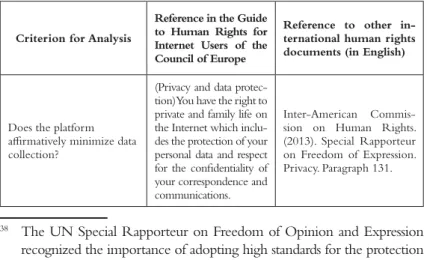
Based on these principles, the following criteria for the analysis of Terms of Service were defi ned:
TABLE 2: Criteria for the analysis of privacy and specifi c references on international human rights documents
Criterion for Analysis
Reference in the Guide to Human Rights for Internet Users of the Council of Europe
Reference to other in-ternational human rights documents (in English)
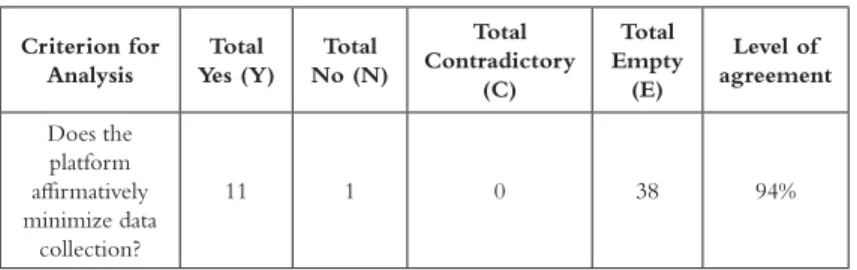
Does the platform affi rmatively minimize data collection?
(Privacy and data protec-tion) You have the right to private and family life on the Internet which inclu-des the protection of your personal data and respect for the confi dentiality of your correspondence and communications.
Inter-American Commis-sion on Human Rights. (2013). Special Rapporteur on Freedom of Expression. Privacy. Paragraph 131.
38 The UN Special Rapporteur on Freedom of Opinion and Expression
recognized the importance of adopting high standards for the protection of personal information, considering the increase in the collection and processing of personal data (including communication data or metadata) in connection with online communications and the impact this may have on the privacy of individuals. See the report A/HRC/23/40 of the UN Special Rapporteur on Freedom of Opinion and Expression on commu-nication surveillance in the exercise of human rights to privacy and free-dom of opinion and expression at: <http://daccess-dds-ny.un.org/doc/ UNDOC/GEN/G13/133/03/PDF/G1313303.pdf?OpenElement> (accessed on February 17, 2016).
Is the user allowed to view and copy all the personal data available on the platfor m?
(Privacy and data pro-tection) 3. your per-sonal data should only be processed when laid down by law or when you have consented to it. You should be infor-med of what personal data are processed and/ or transferred to third parties, when, by whom and for what purpose. Generally, you should be able to exercise con-trol over your personal data (check its accuracy, request a correction, a deletion or that personal data is kept for no longer than necessary);
Inter-American Commis-sion on Human Rights. (2013). Special Rapporteur on Freedom of Expression. Privacy. Paragraph 138 Declaration of Principles on Freedom of Expression of the Inter-American Com-mission on Human Rights (2000). Principles 3 and 8. United Nations. General Assembly. Report of the Special Rapporteur on the Promotion and Protection of the Right to Freedom of Opinion and Expres-sion, Frank La Rue. A/ HRC/17/27. Monday, May 16, 2011. Paragraph 58.
Is the user allowed to edit and delete all the personal data available on the platfor m?
Declaration of Principles on Freedom of Expression of the Inter-American Com-mission on Human Rights (2000). Principle 3. United Nations. General As-sembly. Report of the Special Rapporteur on the Promo-tion and ProtecPromo-tion of the Right to Freedom of Opi-nion and Expression, Frank La Rue. A/HRC/17/27. May 16, 2011. Paragraph 58. Does the platform allow
full and permanent account deletion?
Does the platform allow the removal of all personal data generated by the user within a reasonable period after account deletion?
Does the platform allow third party tracking?
(Privacy and data pro-tection) You have the right to private and fa-mily life on the Internet which includes the pro-tection of your personal data and respect for the confi dentiality of your correspondence and communications.
(Privacy and data pro-tection) 4. you must not be subjected to general surveillance or inter-ception measures. In ex-ceptional circumstances, which are prescribed by law, your privacy with regard to your personal data may be interfered with, such as for a crimi-nal investigation.
Inter-American Commis-sion on Human Rights. (2013). Special Rapporteur on Freedom of Expression. Privacy. Paragraph 131. La Rue, Frank. (2013). Re-port of the Special Rap-porteur on the promotion and protection of the right to freedom of opinion and expression, A/HRC/23/40. Paragraph 22.
United Nations. General As-sembly. Report of the Special Rapporteur on the Promo-tion and ProtecPromo-tion of the Right to Freedom of Opi-nion and Expression, Frank La Rue. A/HRC/17/27. May 16, 2011. Paragraph 58. Does the platform scan user
content that is not publicly available (e.g., emails, private messages, etc.)?
Does the platform track users in other websites? Does the platform store user data for longer than neces-sary for its operation, or as required by law?
(Privacy and data pro-tection) 3. your per-sonal data should only be processed when laid down by law or when you have consented to it. You should be infor-med of what personal data are processed and/ or transferred to third parties, when, by whom and for what purpose. Generally, you should be able to exercise con-trol over your personal data (check its accuracy, request a correction, a deletion or that personal data is kept for no longer than necessary); Does the platform aggregate
data from diff erent services? United Nations. General As-sembly. Report of the Special Rapporteur on the Promo-tion and ProtecPromo-tion of the Right to Freedom of Opi-nion and Expression, Frank La Rue. A/HRC/17/27. May 16, 2011. Paragraph 58. La Rue, Frank. (2013). Re-port of the Special Rap-porteur on the promotion and protection of the right to freedom of opinion and expression, A/HRC/23/40. Paragraph 22
Does the platform aggregate data across devices?
Does the platform share data with third parties beyond what is specifi cally required by law, for commercial purposes?
(Privacy and data pro-tection) 3. your per-sonal data should only be processed when laid down by law or when you have consented to it. You should be infor-med of what personal data are processed and/ or transferred to third parties, when, by whom and for what purpose. Generally, you should be able to exercise con-trol over your personal data (check its accuracy, request a correction, a deletion or that personal data is kept for no longer than necessary);
Inter-American Commis-sion on Human Rights. (2013). Special Rapporteur on Freedom of Expression. Surveillance of communi-cations on the Internet and freedom of expression. Para-graphs 131 and 162. United Nations. General As-sembly. Report of the Special Rapporteur on the Promo-tion and ProtecPromo-tion of the Right to Freedom of Opi-nion and Expression, Frank La Rue. A/HRC/17/27. May 16, 2011. Paragraph 58. La Rue, Frank. (2013). Re-port of the Special Rap-porteur on the promotion and protection of the right to freedom of opinion and expression, A/HRC/23/40. Paragraph 22
Does the platform share data with third parties beyond what is specifi cally required by law, for processing or technical purposes?
Does the platform share data with third parties beyond what is specifi cally required by law, for other than commercial and technical purposes?
Does the platform ask for a license on user content for other purposes than the ones for which it was originally shared?
Inter-American Commis-sion on Human Rights. (2013). Special Rapporteur on Freedom of Expression. Privacy. Paragraph 131. Does the platform encrypt
or allow encryption of trans-mitted personal information or content?
Inter-American Commis-sion on Human Rights. (2013). Special Rapporteur on Freedom of Expression. Privacy. Paragraph 116
La Rue, Frank. (2013). Re-port of the Special Rap-porteur on the promotion and protection of the right to freedom of opinion and expression, A/HRC/23/40. Paragraphs 23, 48 and 49. United Nations. Human Rights Council. Report of the Special Rapporteur on the Promotion and Pro-tection of the Right to Freedom of Opinion and Expression, David Kaye. A/ HRC/29/32. Friday, May 22, 2015. Paragraphs 61, 62, 63.
Does the platform encrypt or allow encryption of sto-red personal information or content?
Does the platform disclose data to law enforcement or for judicial purposes only following a specifi c legal process?
4. you must not be subjected to general surveillance or interception measures. In exceptional circumstances, which are prescribed by law, your privacy with regard to your personal data may be interfered with, such as for a criminal investigation. Accessible, clear and precise information about the relevant law or policy and your rights in this regard should be made available to you;
United Nations. General Assembly. Report of the Special Rapporteur on the Promotion and Protection of the Right to Freedom of Opinion and Expression, Frank La Rue. A/ HRC/17/27. May 16, 2011. Paragraph 75
La Rue, Frank. (2013). Report of the Special Rapporteur on the promotion and protection of the right to freedom of opinion and expression, A/ HRC/23/40. Paragraph 29 Special Rapporteur on Freedom of Expression.
Surveillance of communications on the
Internet and freedom of expression. Paragraph 162
1.3. Due Process
The key elements of the right to a due process include the rights to access to justice, to the equality of the parties, to be heard, to contradictory clauses and to full defense. Considered an important complement of the substantive law, due process was elevated to the category of a human right in documents such as the Universal Declaration of Human Rights (art. 10) and the Pact of San José, Costa Rica (art. 8).
According to a report produced by former United Nations Secretary-General Kofi Annan, the rule of law and its principles must be respected and promoted by all “persons, as well as public and private institutions and entities”39. Online platforms are thus
private players with an obligation to comply with due process.
39 The rule of law and transitional justice in confl ict and post-confl ict
The analysis of due process compliance in the context of online platforms included two elements: contract amendments and termination and confl ict resolution. In this respect, platforms have a negative responsibility: they should refrain from imposing any impediment to a user’s right to a fair trial by a competent authority.
The Guide to Human Rights for Internet Users addresses this issue in its section on eff ective remedies. According to the document, “[t]he avenues for seeking remedies should be available, known, accessible, aff ordable and capable of providing appropriate redress” when human rights or fundamental freedoms are violated. According to the Guide, such appeals should not be restricted to the judicial sphere, and may include alternative mechanisms, for instance, in the platform itself, as long as they do not impact users’ option to seek judicial relief. The adoption of alternative confl ict resolution mechanisms within the platform structure can be con-sidered positive, given that they consist of an alternative way to balance interests. However, parties cannot be forced to participate in this type of process and they will only remain bound to such a procedure while they believe it brings better results than other means.
The Guide to Human Rights for Internet Users also asserts that the State and online service providers should provide users with clear information about their rights and freedoms existing resources in the event of violations and ways to access such infor-mation and resources.
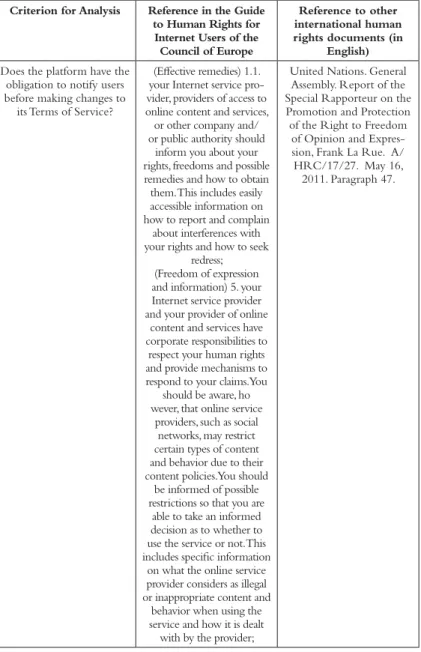
Based on these principles, the following criteria for the analysis of Terms of Service were defi ned:
TABLE 3: Criteria for the analysis of due process and specifi c references on international human rights documents
Criterion for Analysis Reference in the Guide to Human Rights for
Internet Users of the Council of Europe
Reference to other international human rights documents (in
English)
Does the platform have the obligation to notify users before making changes to
its Terms of Service?
(Eff ective remedies) 1.1. your Internet service pro-vider, providers of access to online content and services, or other company and/ or public authority should
inform you about your rights, freedoms and possible remedies and how to obtain them. This includes easily accessible information on how to report and complain
about interferences with your rights and how to seek
redress; (Freedom of expression and information) 5. your Internet service provider and your provider of online
content and services have corporate responsibilities to
respect your human rights and provide mechanisms to respond to your claims. You
should be aware, ho wever, that online service
providers, such as social networks, may restrict certain types of content and behavior due to their content policies. You should
be informed of possible restrictions so that you are
able to take an informed decision as to whether to use the service or not. This includes specifi c information
on what the online service provider considers as illegal or inappropriate content and
behavior when using the service and how it is dealt with by the provider;
United Nations. General Assembly. Report of the Special Rapporteur on the Promotion and Protection of the Right to Freedom
of Opinion and Expres-sion, Frank La Rue. A/ HRC/17/27. May 16, 2011. Paragraph 47.
Is the platform allowed to terminate its services to all users without a signifi cant
notice? Are users allowed to access
the Terms of Service they originally agreed with when creating their
account?
(Eff ective remedies) 1.1. your Internet service pro-vider, providers of access to online content and services, or other company and/ or public authority should inform you about your ri-ghts, freedoms and possible remedies and how to obtain them. This includes easily accessible information on how to report and com-plain about interferences with your rights and how
to seek redress; (Freedom of expression and information) 5. your Internet service provider and your provider of online
content and services have corporate responsibilities to
respect your human rights and provide mechanisms to respond to your claims. You should be aware, ho-wever, that online service providers, such as social
networks, may restrict certain types of content and behavior due to their content policies. You should
be informed of possible restrictions so that you are
able to take an informed decision as to whether to use the service or not. This
includes specifi c informa-tion on what the online service provider considers
as illegal or inappropriate content and behavior when
using the service and how it is dealt with by the