UNIVERSIDADE DE LISBOA FACULDADE DE LETRAS
A Design Proposal of an Online Corpus-Driven Dictionary of
Portuguese for University Students
Tanara Zingano Kuhn
Orientadores: Prof.ª Doutora Margarita Maria Correia Ferreira
Prof. Doutor Carlos Alberto Marques Gouveia
Tese especialmente elaborada para obtenção do grau de Doutor no ramo de Linguística, na especialidade de Linguística Aplicada
UNIVERSIDADE DE LISBOA FACULDADE DE LETRAS
A Design Proposal of an Online Corpus-Driven Dictionary of Portuguese for University Students
Tanara Zingano Kuhn
Tese especialmente elaborada para obtenção do grau de Doutor no ramo de Linguística, na especialidade de Linguística Aplicada
Orientadores: Prof.ª Doutora Margarita Maria Correia Ferreira
Prof. Doutor Carlos Alberto Marques Gouveia
Júri:
Presidente: Prof.ª Doutora Maria Inês Pedrosa da Silva Duarte, Professora Catedrática e Membro do Conselho Científico da Faculdade de Letras da Universidade de Lisboa
Vogais:
- Doutora Ana Lúcia Frankenberg-Garcia, Reader School of Literature and Languages, University of Surrey, U.K.;
- Doutor Iztok Kosem, Assistant with a Ph. D Faculty of Arts, University of Ljubljana, Slovenia;
- Doutora Maria Joana de Almeida Vieira Santos, Professora Auxiliar Faculdade de Letras da Universidade de Coimbra;
- Doutora Margarita Maria Correia Ferreira, Professora Auxiliar Faculdade de Letras da Universidade de Lisboa, orientadora;
- Doutora Maria Amália Pereira Mendes, Investigadora Auxiliar Centro de Linguística da Faculdade de Letras da Universidade de Lisboa;
- Doutora Sandra Maria Brito Pereira, Bolseira de Pós-Doutoramento (FCT) Centro de Linguística da Faculdade de Letras da Universidade de Lisboa.
Coordenação de Aperfeiçoamento de Pessoal de Ensino Superior (Capes) Processo número 0973/13-0
Acknowledgments
I would like to thank my supervisor, Margarita Correia, for all her guidance, support and belief in me. In many difficult moments, she would give me a word of comfort and reassurance. Her encouragement was essential in this moment of my life; without her supervision and constant help, this thesis would not have been possible. I cannot thank her enough for everything that she has done for me.
I wish to thank my co-supervisor, Carlos Gouveia, for our talks, especially for some apparently simple questions that would have me thinking for a long time. His course on academic writing contributed greatly to enriching my thesis. Moreover, his kindness and encouragement were very important in this phase of my life.
I would like to express my most profound gratitude to Iztok Kosem. First and foremost, for receiving me at the University of Ljubljana for a Short-term Scientific Mission (ENeL/COST Action), during which I had the unparalleled opportunity to learn about the state-of-the-art methods, tools, and resources for e-lexicography. Moreover, his attention, true interest in my project, and valuable advice contributed greatly to the development of my PhD research. Undoubtedly, this was a crucial moment in my PhD and I am truly thankful for everything that he has done for me.
Special thanks are due to José Pedro Ferreira for helping me with the computational part of the compilation of my corpus, for our enlightening conversations on corpora design and for always making himself available in case I needed help.
I would like to thank Maria José Bocorny Finatto for introducing me to lexicography and making me fall in love with it. She first gave me the exciting opportunity to take part in her research and later co-supervised me when I was in the Netherlands. I am also deeply indebted to her for her insightful suggestions for my PhD project. Maria José has always been an inspiration and I cannot thank her enough for everything that she has done for me.
Another fundamental person in my transitioning into lexicography was Paul Bogaards (in memoriam). His careful attention and interest in my project, together with his constant encouragement, were fundamental for my development in the area. Paul was
not only an excellent supervisor but also an extremely kind person, who was always concerned about my well-being in the Netherlands. It was a great honour and a privilege to have been close to Paul.
I am also deeply indebted to Robert Lew for his generosity. Besides kindly making his work available to me and patiently answering my (many) questions, he thoughtfully informed me about the European Network of e-Lexicography when it had just been launched. Given that this network gave me the opportunity to go to Slovenia for the scientific mission with Iztok, I cannot thank Robert enough for ultimately having made all this possible.
I wish to present my warmest thanks to a very special person: Valdir do Nascimento Flores. Words are not enough to express how grateful I am for having had the invaluable opportunity to do research with him for so many years, and how lucky I am for having him as a friend. He has always been a role model for me and I would not be who I am if our lives had not crossed.
I would also like to thank my dear friend Letícia Soares Bortolini for always being there for me. We have experienced a lot together and this time was no different. Her unconditional support and encouragement were essential for me to go through this challenging time of my life.
I am also very thankful to my dear friend Yulya Mysyuk for all her kindness and care. She always made sure that I had some breaks and arranged the nicest things for us to do. Our talks were (and are) very dear to me – a conversation with her and stress would become much more manageable.
I am truly thankful to my husband Miguel, who has supported me unconditionally during this entire period. His attention and encouragement were fundamental for making me keep going.
I would also like to thank my parents, Egídio and Elisabeth, and my sister, Ananda, for their full support in everything I do. It was very reassuring to know they were always cheering for me.
I also thank my mother-in-law, Tila, and father-in-law, Zé António, for their attention, support and care.
Special thanks go to Andrew Swearingen for proofreading the manuscript.
Last but not least, I would like to express my sincere appreciation to the Coordenação de Aperfeiçoamento de Pessoal de Nível Superior (Capes-Brazil) for the PhD scholarship, to CELGA-ILTEC (University of Coimbra) for funding essential elements of my PhD research, such as scripts, to the European Cooperation for Science and Technology (COST) through the European Network of e-Lexicography (ENeL) Action for a Short-Term Scientific Mission, and to the University of Ljubljana for granting me licence to use the tools required for developing my PhD research.
Abstract
University students are expected to read and write academic texts as part of typical literacy practices in higher education settings. Hyland (2009, p. viii-ix) states that meeting these literacy demands involves “learning to use language in new ways”. In order to support the mastery of written academic Portuguese, the primary aim of this PhD research was to propose a design of an online corpus-driven dictionary of Portuguese for university students (DOPU) attending Portuguese-medium institutions, speakers of Brazilian Portuguese (BP) and European Portuguese (EP), either as a mother tongue or as an additional language.
The semi-automated approach to dictionary-making (Gantar et al., 2016), which is the latest method for dictionary compilation and had never been employed for Portuguese, was tested as a means of provision of lexical content that would serve as a basis for compiling entries of DOPU. It consists of automatic extraction of data from the corpus and import into dictionary writing system, where lexicographers then analyse, validate and edit the information. Thus, evaluation of this method for designing DOPU was a secondary goal of this research.
The procedure was performed on the Sketch Engine (Kilgarriff et al., 2004) corpus tool and the dictionary writing system used was iLex (Erlandsen, 2010). A number of new resources and tools were created especially for the extraction, given the unsuitability of the existing ones. These were: a 40 million-word corpus of academic texts (CoPEP), balanced between BP and EP and covering six areas of knowledge, a sketch grammar, and GDEX configurations for academic Portuguese.
Evaluation of the adoption of the semi-automated approach in the context of the DOPU design indicated that although further development of these brand-new resources and tools, as well as the procedure itself, would greatly contribute to increasing the quality of DOPU’s lexical content, the extracted data can already be used as a basis for entry writing. The positive results of the experiment also suggest that this approach should be highly beneficial to other lexicographic projects of Portuguese as well.
Keywords: academic Portuguese, automated lexicography, corpus, dictionary, tools
Resumo
No ensino superior, espera-se que estudantes participem, em maior ou menor extensão, em atividades de leitura e escrita de textos que tipicamente circulam no contexto universitário, como artigos, livros, exames, ensaios, monografias, projetos, trabalhos de conclusão de curso, dissertações, teses, entre outros. Contudo, essas práticas costumam se apresentar como verdadeiros desafios aos alunos, que não estão familiarizados com esses novos gêneros discursivos. Conforme Hyland (2009, p. viii-ix), a condição para se ter sucesso nessas práticas é “aprender a usar a língua de novas maneiras”.
A linguagem acadêmica é objeto de pesquisa há muitos anos, sendo especialmente desenvolvida no âmbito da língua inglesa. Se por um lado, durante um longo período todas as atenções estavam voltadas para o English for Academic Purposes (EAP) (inglês para fins acadêmicos), tendo em vista o incomparável apelo comercial dessa área, mais recentemente tem-se entendido que falantes de inglês como língua materna também precisam aprender inglês acadêmico, pois, como dito acima, trata-se de uma nova maneira de usar a língua, que os estudantes universitários desconhecem. Nesse sentido, é natural que a grande maioria de matérias pedagógicos como livros, manuais, gramáticas, listas de palavras e dicionários, por exemplo, sejam produzidos para o contexto de uso da língua inglesa.
Assim como o inglês e tantas outras línguas, o português também é usado em universidades como língua na e pela qual se constrói conhecimento. Aliás, nos últimos 15 anos, temos vivenciado um fenômeno de expansão do acesso ao ensino universitário no Brasil, paralelamente a um grande aumento da presença de alunos estrangeiros fazendo ensino superior no Brasil e em Portugal, o que reforça a natureza do português como língua de construção e difusão científica. É de se saudar os esforços e as medidas de política linguística da Comunidade dos Países de Língua Portuguesa (CPLP) para apoiar e fomentar o português como língua da ciência.
Apesar dessa clara importância do português acadêmico, sabemos que sua presença como objeto de estudo de uma área específica ainda é bastante restrita. Tem-se observado algum crescimento no que diz respeito à abordagem discursiva da linguagem acadêmica; contudo, descrições ao nível léxico-gramatical ainda são bastante escassas.
Em especial, no que concerne recursos lexicográficos como auxiliares pedagógicos, a existência de um dicionário de português acadêmico especialmente criado para atender as necessidades de estudantes universitários é desconhecida.
Nesse sentido, tendo em vista a demanda apresentada acima e a lacuna nos estudos atuais, a presente pesquisa de doutorado buscou colaborar tanto com o campo dos recursos ao ensino de português acadêmico quanto com o de elaboração de recursos lexicográficos através da proposta de desenho de um dicionário online corpus-driven de português para estudantes universitários (DOPU). Baseando-se em uma perspectiva de português como língua pluricêntrica, este dicionário contempla as variedades português brasileiro (PB) e europeu (PE). Além disso, o público-alvo se constitui por falantes de português como língua materna e como língua adicional.
Para a construção do desenho, adotou-se a mais moderna abordagem de compilação de dicionários atualmente existente, qual seja, a semi-automated approach to dictionary-making (Gantar et al., 2016). Esse método consiste na extração automática de dados de um corpus e importação para um sistema de escrita de dicionários, no qual lexicógrafos analisam, editam e validam as informações que foram automaticamente pré-organizadas nos campos da entrada conforme definições previamente estabelecidas. Esta abordagem é revolucionária no sentido em que o ponto de partida da análise lexical do corpus não mais se dá na ferramenta de análise de corpus, mas sim diretamente no sistema de escrita de dicionários. Experimentar essa abordagem no desenvolvimento do desenho do DOPU constitui-se em um objetivo secundário desta pesquisa de doutorado, uma vez que tal método nunca foi aplicado para a construção de dicionários de português.
Os programas utilizados para a aplicação do procedimento de extração foram o Sketch Engine (SkE) (Kilgarriff et al., 2004), provavelmente a mais sofisticada ferramenta de criação, análise e manutenção de corpus da atualidade, e o iLex (Erlandsen, 2010), um sistema de escrita de dicionários bastante flexível e com alta capacidade de processamento de dados.
Para a implementação da abordagem, são necessários: um corpus anotado com classes de palavra; uma sketch grammar (trata-se de um arquivo com relações gramaticais e diretivas de processamento para o sistema do SkE computar diferentes
tipos de relações através de cálculos estáticos); uma configuração de GDEX, isto é, Good Dictionary Examples – bons exemplos para dicionários (trata-se de uma configuração com classificadores para avaliar frases e atribuir pontuações conforme os critérios estabelecidos); e definições de parâmetros (frequência mínima dos colocados e das relações gramaticais). Tendo em vista a inadequação de corpora de português, bem como da sketch grammar e do GDEX existentes para o português, em função do propósito dessa extração de dados, qual seja, a compilação de entradas para o DOPU, foi necessário elaborar novos recursos.
Foi compilado o Corpus de Português Escrito em Periódicos (CoPEP), com 40 milhões de palavras, equilibrado entre as variedades PB e PE, e que cobre seis áreas de conhecimento. Os metadados do corpus foram detalhadamente anotados, permitindo fazer pesquisas avançadas. É o primeiro corpus internacional de português acadêmico de que temos notícia. De forma a padronizar a análise lexical e diminuir desequilíbrios na contagem estatística, o CoPEP foi pós-processado com o conversor Lince de forma a atualizar as ortografias de cada variedade conforme a determinação do Acordo Ortográfico da Língua Portuguesa, de 1990.
Uma sketch grammar foi especialmente elaborada para o CoPEP, e, nesse sentido, pode ser aplicada a outros corpora de português anotados pelo mesmo anotador. Optou-se por usar o anotador oferecido por padrão no SkE, qual seja, o Freeling v3. Criou-se uma sketch grammar com mais e mais precisas relações gramaticais do que aquela oferecida por padrão pelo SkE. Assim, usuários trabalhando com corpora de português anotados com Freeling no SkE poderão usar a minha versão, que já está disponível no Sketch Engine.
Uma configuração de GDEX havia sido produzida para fornecer exemplos para a compilação do Oxford Portuguese Dicionary (2015). No entanto, por ser bastante geral, elaborada para um corpus Web e por buscar selecionar exemplos para um dicionário bilíngue português-inglês/inglês-português, julgou-se mais apropriado criar uma configuração completamente nova. Assim, desenvolvi tal recurso, tendo em vista as características de uso da língua como apresentadas no CoPEP e o perfil do usuário do DOPU.
O procedimento de extração automática de dados do CoPEP e importação para o iLex tomou como base o procedimento usado para a criação de dicionários de esloveno (criadores desse método), fazendo-se adaptações. Acrescentaram-se dois elementos ao processo de extração: o longest-commonest match (LCM), que mostra a realização mais comum do par keyword e colocado, ajudando a entender o uso mais típico das colocações; e sugestões para atribuição de etiquetas com variedade típica, tanto para a keyword quanto para o colocado.
A avaliação do processo de escrita de entradas-piloto indicou que o método de extração de dados do CoPEP e importação para o iLex foi extremamente positivo, dado que a análise lexical pôde ser bastante sofisticada sem demandar o tempo rotineiro necessário quando se parte das linhas de concordância para elaboração de entradas. Alguns dados que nesta pesquisa não foram extraídos automaticamente e que tiveram que ser analisados manualmente na ferramenta de corpus poderão ser incluídos numa próxima versão do procedimento. Análise do processo de criação dos recursos necessários indicou que aprimoramentos podem ser feitos, assim aumentando a acurácia da extração.
Espera-se que o desenho de dicionário online corpus-driven de português para estudantes universitários proposto por esta pesquisa de doutorado sirva como base para o desenvolvimento de outras pesquisas relacionadas de forma que a sustentar a elaboração do DOPU.
Palavras-chave: corpus, desenvolvimento de recursos, dicionários, lexicografia
Contents
Introduction ... 1
Part I ... CALL FOR AN ONLINE CORPUS-DRIVEN DICTIONARY OF PORTUGUESE FOR UNIVERSITY STUDENTS ... 7
Introduction to Part I... 9
Chapter 1 On the need for a dictionary of academic Portuguese ... 11
Expansion of access to higher education ... 11
Internationalization of Portuguese ... 17
Portuguese as a Pluricentric language ... 19
Alignment with CPLP linguistic policy... 22
Summary ... 25
Chapter 2 Academic language ... 27
What is academic language? ... 27
Objects of study in academic language ... 32
Academic Portuguese ... 38
Academic Portuguese studies ... 39
2.4.1 Academic Portuguese studies in Brazil ... 41
2.4.2 Academic Portuguese studies in Portugal ... 55
Academic vocabulary ... 61
Summary ... 68
Chapter 3 Corpora and dictionary-making ... 69
Corpus linguistics ... 69
3.1.1 Brief history of corpus linguistics ... 70
3.1.2 Status of corpus linguistics ... 73
3.1.3 Applications of corpus linguistics ... 75
3.1.4 Corpus characteristics ... 75
3.1.4.1 Corpus design ... 76
3.1.4.2 Corpus analysis: corpus-based X corpus-driven approach ... 78
Corpora and lexicography: the electronic revolution ... 80
3.2.1 A revolutionary dictionary ... 82
3.2.3 Automation begins ... 85
3.2.4 e-Lexicography ... 87
3.2.5 A new era ... 89
Corpora, NLP tools and Lexicography of the Portuguese language ... 93
3.3.1 Corpora of Portuguese with academic texts ... 102
Concluding remarks ... 105
Chapter 4 Planning the Dicionário de português para estudantes universitários (DOPU) –Dictionary of Portuguese for university students ... 107
Pre-compilation definitions ... 108
4.1.1 Type of dictionary ... 109
4.1.2 User Profile ... 110
4.1.2.1 Types of user ... 111
4.1.2.2 Research on dictionary users ... 114
Lexicographic evidence acquisition ... 117
4.2.1 The semi-automated approach to dictionary-making ... 117
4.2.1.1 Software ... 118
4.2.1.2 Corpus ... 120
4.2.1.3 Sketch grammar ... 122
4.2.1.4 Good Dictionary Examples configurations ... 123
4.2.1.5 Extraction... 124
Candidate headword list building ... 125
4.3.1 Delimitation of vocabulary ... 126 4.3.2 Lexical entries ... 129 Entry compilation ... 131 4.4.1 Microstructure ... 132 4.4.2 Lexical analysis ... 133 4.4.3 Sources ... 134 End-user interface ... 136 Concluding remarks ... 138 Part II ... SET-UP FOR SEMI-AUTOMATED LEXICOGRAPHY ... 139
Chapter 5 Software ... 143
The Sketch Engine ... 143
5.1.1 Search ... 145
5.1.1.1 Refining search results ... 149
5.1.1.2 Generating frequency lists with the Search function ... 156
5.1.2 Word list ... 158
5.1.2.1 Lempos list ... 159
5.1.2.1.1 N-grams list ... 161
5.1.2.1.2 Average reduced frequency ... 163
5.1.2.2 Comparing corpora ... 164
5.1.3 Word Sketch ... 166
5.1.3.1 Advanced options – Tickbox Lexicography ... 172
5.1.3.2 Sketch Grammar ... 175
5.1.4 Thesaurus and Sketch Diff ... 175
5.1.4.1 Sketch Diff ... 177
iLex ... 180
5.2.1 Opening a project ... 180
Summary ... 183
Chapter 6 The Corpus de Português Escrito em Periódicos (CoPEP) ... 185
CoPEP design ... 186
6.1.1 SciELO as the source of texts ... 186
Compilation process description ... 190
6.2.1 Getting to know my sources ... 190
6.2.2 Building the corpus ... 193
6.2.2.1 XML extraction ... 193
6.2.2.2 HTML extraction ... 200
6.2.2.2.1 Second HTML extraction ... 204
6.2.2.2.2 PDF conversion ... 205
6.2.2.2.3 Corpus building final phase ... 207
Sorting out the subcorpora texts ... 207
File renaming ... 210
The Corpus de Português Escrito em Periódicos -CoPEP ... 213
Post-processing CoPEP ... 215
6.4.1 Problems with annotation of CoPEP ... 217
6.4.2 Corpus annotation workaround ... 218
Summary ... 220
Chapter 7 Sketch grammar for academic Portuguese ... 221
Sketch grammar ... 221
Sketch grammars for Portuguese ... 222
7.2.1 Evaluation of FreelingSkG and PalavrasSkG ... 224
7.2.1.1 Evaluation of FreelingSkG ... 226
7.2.1.2 Evaluation of PalavrasSkG ... 227
Devising a new sketch grammar for academic Portuguese ... 230
7.3.1 Phase 1: writing ... 233
7.3.2 Phase 2: Evaluation of AcadPortSkG on the CoPEP corpus (40 million words) 236 7.3.3 Improving AcadPortSkG ... 238
7.3.4 AcadPort_v3-SkG ... 246
Concluding remarks ... 250
Chapter 8 Good Dictionary Examples – GDEX for Academic Portuguese .... 251
Contextualization ... 252
First configuration development ... 253
Preparation phase ... 257
8.3.1 CoPEP statistics calculations ... 257
8.3.2 Word Sketch Corpus Query Language Searches ... 260
Writing GDEX configuration for CoPEP ... 261
Concluding remarks ... 266
Part III ... THE DICTIONARY DESIGN PROPOSAL ... 267
Introduction to Part III ... 269
Chapter 9 Automatic data extraction ... 271
The experiment ... 272
9.1.1.1 Parameters settings ... 273
9.1.1.2 Dealing with coexistence of language varieties in one corpus ... 278
9.1.2 Extraction process ... 281
9.1.3 Evaluation ... 284
9.1.3.1 Sketch grammar ... 285
9.1.3.2 GDEX ... 286
9.1.3.3 Language variety ... 287
9.1.3.4 General appraisal of the procedure ... 289
Second extraction ... 289
Summary ... 292
Chapter 10 Macrostructure ... 293
The headword list ... 293
10.1.1 Delimitation of vocabulary ... 293
10.1.1.1 Corpus frequency ... 294
10.1.1.2 The official vocabulary of Portuguese (VOC) ... 296
10.1.2 Lexical entries ... 298
10.1.2.1 Type of words ... 298
10.1.2.1.1 Common words ... 298
10.1.2.1.2 Homonymy X polysemy ... 300
10.1.2.1.3 Variant forms ... 303
10.1.2.1.4 Loan words and miscellaneous ... 304
10.1.3 Additional features ... 304 Supplementary materials ... 306 Summary ... 307 Chapter 11 Microstructure ... 309 Presentation ... 309 11.1.1 Sense differentiation ... 309 11.1.2 Order of senses ... 310 Data type ... 311
11.2.1 Data internal to the headword ... 311
11.2.1.1 Form ... 313
11.2.1.1.2 Orthographic information ... 313 11.2.1.1.3 Phonetic information ... 313 11.2.1.1.4 Lexical form ... 314 11.2.1.2 Content ... 314 11.2.1.2.1 Dictionary sense ... 314 11.2.1.2.2 Meaning explanations ... 318
11.2.2 Data external to the headword ... 320
11.2.2.1 Etymology ... 321
11.2.2.2 Informative data ... 321
Additional information ... 322
Chapter 12 Discussions ... 323
Review of the semi-automated approach ... 323
12.1.1 CoPEP ... 324
12.1.2 Sketch grammar ... 324
12.1.3 GDEX... 326
12.1.4 Automatic extraction of data procedure ... 329
Review of DOPU ... 331
12.2.1 Advantages of DOPU... 331
12.2.2 Suggestions for enhancement... 332
12.2.3 Potential publication ... 333
Contributions of this research ... 334
Future work... 337 Conclusions ... 339 Looking ahead ... 341 References... 343 Appendix A ... 383 Appendix B ... 386 Appendix C ... 391 Appendix E ... 395
List of Figures
Figure 1-1 Number of Higher Education Institutions per location (capital and
countryside) and administrative category in Brazil in 2000 and in 2015. (Inep) ... 13
Figure 1-2 Number of enrolments per type of administrative category (public, private) in Brazil, 2015 (Inep)... 13
Figure 1-3 Total number of enrolments and by education sub-system in Portugal from 1978 to 1990. (PorData) ... 14
Figure 1-4 Total number of enrolments and by education sub-system in Portugal from 1999 to 2016. (PorData) ... 15
Figure 2-1 Reproduction of Quadro 1: Relação de Universidades, Centros de Escrita e seus líderes (Cristovão & Vieira, 2016, p. 214) ... 42
Figure 3-1 Automated lexicographic tasks in projects across Europe (Tiberius, Heylen, & Krek, 2015) ... 90
Figure 4-1 Partial word sketch of the noun análise (‘analysis’) in the Corpus de Português Escrito em Periódicos (CoPEP) ... 119
Figure 5-1 Initial screen in Sketch Engine ... 144
Figure 5-2 Background job processing ... 145
Figure 5-3 CQL builder ... 145
Figure 5-4 Advanced search with context filter ... 146
Figure 5-5 Search results screen ... 147
Figure 5-6 Text type advanced search ... 148
Figure 5-7 Result screen for a lemma search (metodologia) ... 149
Figure 5-8 Result screen for lemma search (metodologia) with left menu ... 150
Figure 5-9 Distribution of the occurrence of metodologia according to areas of knowledge ... 150
Figure 5-10 Distribution of node form of metodologia ... 151
Figure 5-11 Multilevel frequency distribution concordance sorting (metodologia) .... 152
Figure 5-12 Different option for concordance multilevel frequency distribution filter 152 Figure 5-13 Word class of word one to the left of the keyword (metodologia) sorted by frequency ... 153
Figure 5-14 List of word classes anticipating the keyword, ordered by name tag ... 154
Figure 5-16 Left sorting concordance lines ... 155
Figure 5-17 Occurrences of participial adjectives in pre-nominal position (keyword=metodologia) ... 155
Figure 5-18 Concordances lines for the construction participle forms + metodologia 156 Figure 5-19 CQL search for complex prepositions ... 157
Figure 5-20 Complex prepositions in CoPEP ... 157
Figure 5-21 Complex prepositions sorted by frequency ... 158
Figure 5-22 Making a lempos list ... 159
Figure 5-23 Regular expression filter for lempos list making ... 160
Figure 5-24 Lempos list ... 160
Figure 5-25 Lempos list- nouns ... 160
Figure 5-26 Creating a n-gram word list ... 161
Figure 5-27 4-word lexical bundles in CoPEP ... 162
Figure 5-28 Trigrams in CoPEP excluding complex prepositions ... 162
Figure 5-29 Word list creation using Blacklist filter ... 162
Figure 5-30 Creating a lempos frequency list with ARF output ... 163
Figure 5-31 Lemma list-frequency ordered ... 164
Figure 5-32 Lemma list - ARF ordered ... 164
Figure 5-33 Comparison between EP corpus (focus) and BP (reference). ... 165
Figure 5-34 Using keyword output option for comparing (sub)corpora ... 165
Figure 5-35 Comparison between BP corpus (focus) and EP (reference) ... 166
Figure 5-36 Generating a word sketch search. POS: auto ... 167
Figure 5-37 Generating a word sketch search. Defined POS ... 167
Figure 5-38 Partial word sketch for político, "auto" ... 167
Figure 5-39 Partial view for grammatical relation noun modified by adjective, lemma político ... 168
Figure 5-40 Concordance lines for partido (noun) político (adjective) ... 169
Figure 5-41 Multi word sketch partido político + ... 170
Figure 5-42 Word sketch for gramrel adjective modifying partido ... 170
Figure 5-43 Concordances of a multi word sketch, principal partido político ... 171
Figure 5-44Additional options on lower-half part of the left menu ... 171
Figure 5-46 Advanced features, uploading a GDEX configuration ... 173
Figure 5-47 Word sketch with activated TBL ... 174
Figure 5-48 TBL with GDEX ... 174
Figure 5-49 XML file of example selected with TBL ... 175
Figure 5-50 Partial view of sketch grammar AcadPortSkG ... 175
Figure 5-51 Thesaurus search with display of advanced options ... 176
Figure 5-52 Thesaurus search result with list and word cloud visualization ... 176
Figure 5-53 Sketch Diff result screen ... 178
Figure 5-54 Word sketch differences search (oiço, ouço) ... 179
Figure 5-55 Sketch Diff search result (oiço, ouço) ... 180
Figure 5-56 Design tab in iLex ... 181
Figure 5-57 Look up tab in iLex ... 181
Figure 5-58 Partial view of an entry document in iLex (ciclo, ‘cicle’) ... 182
Figure 5-59 Entry with additional sense element and complete indicators ... 182
Figure 5-60 XML entry view... 182
Figure 6-1 School of Exact, Technological and Multidisciplinary Sciences ... 191
Figure 6-2 School of Life Sciences ... 191
Figure 6-3 School of Humanities ... 192
Figure 6-4 Files for selection ... 198
Figure 6-5 Example of the result of an XML extraction after clean-up ... 200
Figure 6-6 Part of a text with header from CoPEP ... 212
Figure 6-7 Documents distribution by great areas in SciELO-Br ... 214
Figure 6-8 Documents distribution by great areas in SciELO-Pt ... 214
Figure 6-9 Part of a concordance line in the Sketch Engine ... 217
Figure 7-1 Partial results of word sketch for estudo ... 231
Figure 7-2 Partial word sketch results for estudo ('study', noun) ... 237
Figure 7-3 Part I of AcadPortSkG_v3 ... 247
Figure 7-4 Part II of AcadPortSkG_v3 ... 248
Figure 7-5 Part III of AcadPortSkG_v3 ... 249
Figure 8-1 GDEX for Portuguese in the Sketch Engine ... 253
Figure 8-2 TickBox Lexicography for GDEX configuration development ... 256
Figure 8-4 AcadPort-4_GDEX configuration ... 264
Figure 9-1 Partial word sketch result of consertar (verb) ... 274
Figure 9-2 Cluster values testing ... 278
Figure 9-3 Variety label assignment ... 280
Figure 9-4 Typical variety label assignment ... 280
Figure 9-5 Entry view in iLex ... 282
Figure 9-6 XML view in iLex ... 283
Figure 9-7 Collocates of carreira in iLex. Gramrel: %w de+o N ... 285
Figure 9-8 False collocate of carreira. ... 285
Figure 9-9 Multi-sentenced good dictionary example candidate ... 287
Figure 9-10 Carreira contributiva. Collocation used in European Portuguese. ... 288
Figure 9-11 Carreira contributiva concordance lines with metadata in the file names. ... 289
Figure 9-12 Examples of the collocation carreira + começar. Extraction experiment. ... 290
Figure 9-13 Examples of the collocation carreira + começar. Second extraction. ... 290
Figure 9-14 Symmetric relation e|ou (keyword= começar; collocates= terminar and acabar). ... 291
Figure 10-1 Text types frequency of sequenciamento in CoPEP_AO90 ... 297
Figure 10-2 Abbreviations in CoPEP ... 299
Figure 10-3 Distribution of abbreviations across areas of knowledge of CoPEP ... 299
Figure 10-4 Menu for ‘bat’ (focus on noun) in Vocabulary.com ... 302
Figure 10-5 Menu for ‘bat’ (focus on verb) in Vocabulary.com ... 302
Figure 10-6 Page disposition of alphabetical word list in the electronic versions of Houaiss (2009) and Aurélio (2010) ... 305
Figure 10-7 Partial view of the entry 'bat' in MacMillan online ... 306
Figure 11-1Partial view of the entry document for candidato in iLex ... 315
Figure 11-2 Collocations under gramrel candidato a+det Noun in CoPEP ... 316
Figure 11-3 Collocates grouped by sense ... 316
Figure 11-4 Sense and subsenses of candidato in iLex entry... 317
Figure 11-5 Mouse-hover feature in Infopédia... 319
Figure 12-2 Collocations in one text only. ... 331
Figure 12-3 Reproduction of the visualization of a computer- lexicographical process for a corpus-based online dictionary under construction proposed by Klosa (2013, p. 520) ... 334
Figure 13 1 Number of scientific publications per year and per country (Observatório da Língua Portuguesa)………383
Figure 13 2 Scientific publications indexed in Scopus, per year and per country (Observatório da Língua Portuguesa) ... 384
Figure 13 3 Percentage of publication from CPPL countries, per language of publication (Observatório da Língua Portuguesa) ... 385
Figure 13 4 CEPRIL ... 386
Figure 13 5 CLUL ... 387
Figure 13 6 Linguateca ... 388
Figure 13 7 LX-Center ... 389
Figure 13 8 NILC ... 390
Figure 13 9 Tagset for Portuguese Freeling v3 ... 394
List of Tables
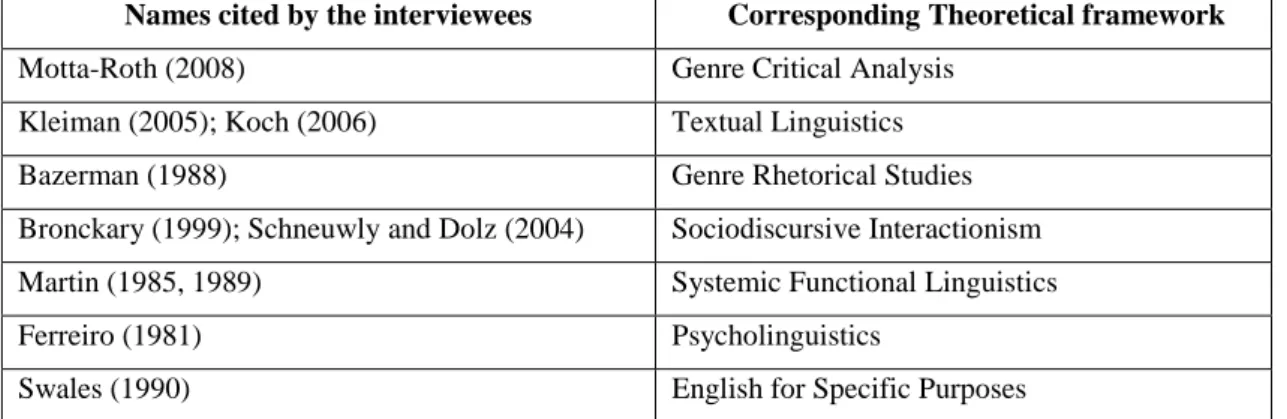
Table 2.1 Bhatia’s categorization of discourse analysis frameworks and focuses (Source: Bhatia, 2004, p. 3) ... 40Table 2.2 Referential researchers cited by interviewees and the corresponding theoretical framework (Source: Cristovão et al, 2015, p. 89)... 41
Table 2.3 Verbal processes: top five verbs, verb forms taken and pattern of message realization (Source: Barbara&Macêdo, 2011) ... 47
Table 2.4 Results of Finatto and Huang’s (2005) study on use of adjectives in medicine and chemistry texts (Source: Finatto and Huang, 2005) ... 50
Table 2.5 Conclusions of Kilian and Longuercio’s (2015) study. (Source: Kilian & Longuercio, 2015, pp.263-264) ... 52
Table 2.6 Bundles and their frequency in the academic articles genre of CBVR. (Source: Sardinha et al., 2015, p. 45) ... 54
Table 2.7 Genres used in academic literacy practices at a course of Textile Engineering. (Source: Fischer, 2011, pp.43-44) ... 56 Table 2.8 Bennett’s Distinguishing Discourse Features (Source: Bennett, 2008, 2010a) ... 60 Table 3.1 Inventory of the main actions for dictionary creation (Source: Rundell and Kilgarrif, 2011, p. 261) ... 81 Table 3.2 Changes in lexicography due to computational technology. (Source: Granger, 2012, pp. 3-5) ... 88 Table 3.3 Pioneering work on computer-based lexical statistics. (Source: Biderman, 1978, pp. 64-67) ... 94 Table 3.4 Suitability analysis of Portuguese corpora with academic texts ... 104 Table 4.1 Development of DOPU’s design ... 107 Table 4.2 DOPU characterization ... 110 Table 4.3 Dictionary user's research findings ... 116 Table 4.4 Criteria for corpus building ... 121 Table 4.5 Key concepts ... 126 Table 6.1 Illustration of the process of correspondence search ... 194 Table 6.2 Schools and Great Areas of knowledge in CoPEP ... 195 Table 6.3 Number of files per language variety subcorpora and great areas of knowledge ... 198 Table 6.4 Files in Excel spreadsheet ... 199 Table 6.5 Codes created for HTML extraction results qualitative analysis ... 202 Table 6.6 Failed symbols conversion ... 203 Table 6.7 Number of tokens per language variety subcorpus and great area of knowledge ... 204 Table 6.8 number of texts and words in CoPEP ... 211 Table 6.9 Statistical information on CoPEP ... 213 Table 6.10 Different spelling norms in CoPEP ... 216 Table 6.11 Examples of annotation problems in CoPEP... 217 Table 7.1Numbers of gramrels for the five most frequent lemmas in each word class 232 Table 7.2 Process of adjustment of the symmetric relation e_ou ... 245 Table 8.1 Alternative versions of GDEX Portuguese v1... 255
Table 8.2 Partial results of statistics on CoPEP ... 260 Table 9.1 Kinds of orthographic variations selected for the experiment and some examples ... 275 Table 9.2 Procedure of automatic extraction ... 281 Table 10.1 Minimum cut-off values and the number of lempos in CoPEP_AO90, broken down into word classes ... 295 Table 10.2 Total number of hapax legomena in CoPEP_AO90, broken down into word classes ... 295 Table 10.3 Decisions concerning headword status ... 298 Table 11.1 Lexically relevant data internal to the headword (Source: Atkins, 2008 [1992/3]) ... 312 Table 11.2 Different senses of devido a in CoPEP... 314 Table 12.1 Rank of sentence initial tags in CoPEP and Portuguese Web 2011 ... 326 Table 13.1 Word sketch corpus query language (CQL) searches ... 395
List of Abbreviations
AO45 – Acordo Ortográfico da Língua Portuguesa de 1945 (‘The Portuguese
Language Orthographic Agreement of 1945’)
AO90 – Acordo Ortográfico da Língua Portuguesa de 1990 (‘The Portuguese
Language Orthographic Agreement of 1990’)
BP – Brazilian Portuguese
Capes – Coordenação de Aperfeiçoamento de Pessoal de Ensino Superior
(‘Coordination for the Improvement of Higher Education Personnel’)
Celpe-Bras – Certificação de Proficiência em Língua Portuguesa para Estrangeiros
(‘Certificate of Proficiency in Portuguese for Foreigners’)
CL – Corpus Linguistics
CoPEP – Corpus de Português Escrito em Periódicos (‘Corpus of Portuguese from
Academic Journals’)
CPLP – Comunidade dos Países de Língua Portuguesa (‘Community of
Portuguese-speaking Countries’)
CQL – Corpus Query Language CQS – Corpus Query System
CUTe – Corpus of Undergraduate Students
DGEEC- Direção Geral de Estatísticas da Educação e Ciência (‘Directorate-General
for Education and Science Statistics’)
DOPU – Dicionário online de português para estudantes universitários (‘Online
Dictionary of Portuguese for university students’)
DTD – Dictionary Type Documentation DWS – Dictionary Writing System EAP – English for Academic Purposes
ENeL – European Network of e-Lexicography EP – European Portuguese
ESP – English for Specific Purposes
FO43 – Formulário Ortográfico de 1943 (‘The Orthographic Reform of 1943’) GDEX – Good Dictionary Examples
HEI – Higher Education Institution
IILP – Instituto Internacional da Língua Portuguesa (‘International Institute of the
Portuguese Language’)
IsF – Idiomas sem Fronteiras (‘Language without Borders’) LCM – Longest Commonest Match
PAL – Portuguese as an Additional Language
PALis – Plano de Ação de Lisboa (‘Action Plan of Lisbon’) POS – Part of speech
SFL – Systemic-Functional Linguistics SkE – Sketch Engine
SLA – Second Language Acquisition
VOC – Vocabulário Ortográfico Comum da Língua Portuguesa (‘Common
1
Introduction
University students are expected to read and write academic texts as part of typical literacy practices in higher education settings. The magnitude of these tasks should not be underestimated, as one of the conditions for students to engage in these routine activities involves “learning to use language in new ways” (Hyland, 2009, p. viii-ix).
Such particular way of language use in academic (oral or written) texts has been traditionally called academic language and has its own characteristics, as demonstrated by a number of studies based on various theoretical frameworks (e.g. Biber, 1996, 2006; Biber & Conrad, 2009; Biber, Johansson, Leech, Conrad, & Finegan,1999; Hyland, 2009; Hyland & Bondi, 2006; Swales, 1990; to name but a few). It seems sensible to conclude that university students need to learn this new language in order to participate in higher education literacy activities.
Indeed, Swales (1990) calls for the explicit teaching of academic language. Nonetheless, the appeal most often referred to foreign students. Hyland (2006, p.2) shows that this view was later broadened, with the acknowledgement that academic language (in this case, English) must be taught to university students irrespective of their language status background:
(…) there is growing awareness that students, including native English-speakers, have to take on new roles and engage with knowledge in new ways when they enter university. They find that they need to write and read unfamiliar genres and participate in novel speech events.
The recognition of the importance of teaching/learning academic language resulted in a number of studies and the development of pedagogical material by researchers of many languages. Among them, it is not surprising that the most attention has been given to English due to its dominance as the academic lingua franca around the world. Therefore, teachers and students dealing with academic English have at their disposal a plethora of textbooks, manuals, word lists, grammars, and dictionaries. Nevertheless, other languages also need resources for teaching and learning their own academic languages. One such language is Portuguese.
2
This call is further supported by the fact that currently, there is a very large community of users of academic Portuguese all over the world. Such high numbers are a result of at least two well-known phenomena: expansion of access to higher education in Brazil (in the 2000s) and Portugal (in the 1990s); and the internationalization of Portuguese. These university students are: speakers of Portuguese as a mother tongue studying at universities in Brazil, Portugal, Angola, for example, and speakers of Portuguese as an additional language (henceforth PAL) studying either at universities in Brazil, Portugal, Mozambique, etc., or in non-Portuguese speaking countries where Portuguese is offered as a major/minor or graduate course.
One of the consequences in the context of pedagogical practices is that the use of academic Portuguese can no longer be taken for granted. After all, the academic routine of this massive population of university students (more than 7 million people in Brazil and Portugal together, according to recent censuses) involves activities like reading and/or writing exams, monographs, articles, textbooks, abstracts, MA dissertations, among others, in Portuguese.
Taken together, the points raised above clearly suggest that research on academic Portuguese to support the production of pedagogical materials is of utmost importance. On a positive note, it seems that this call is starting to be heard, as an increased interest in literacy practices in higher education has been recently observed (cf. Carvalho, 2013; Cristóvão, Bork &Vieira, 2015), along with the first attempts at descriptions of academic Portuguese (cf. Molsing & Perna, 2014; Nunes & Perna, 2015). Nevertheless, research on academic Portuguese producing a solid body of studies is still rather incipient in Brazil and Portugal. This means research-informed teaching and learning resources for academic literacy in Portuguese are scarce. Among resources that students studying in Portuguese are lacking is a dictionary of academic Portuguese.
In view of this scarcity, the aim of my PhD research is to help to bridge this gap by proposing a design of a corpus-driven online dictionary of Portuguese for university students (henceforth DOPU). The target users of the proposed dictionary are tertiary level students, speakers of both Brazilian and European Portuguese, either as a mother-tongue or as an additional language.
3
Drawing on Kosem (2010), I claim that a fully-equipped dictionary of academic Portuguese should: 1) account for the characteristics of the Portuguese language used in academic texts; and 2) attend to university students’ needs – independently of their language status (background and variety) or discipline of study. This call for a special dictionary is in line with Correia (2008, s.p.):
Current good-quality dictionaries represent clearly delimited stretches of a language’s lexicon and clear-cut frequency-based vocabulary sets according to the interests of dictionaries’ target-users.1 (my translation).
In order to comply with the above-mentioned criteria, it was decided to follow the corpus-driven approach, by which the corpus is used as the source of all information in the dictionary, from the headword list to the content of the entry. Concerning the need to accommodate different user profiles in terms of the physical tool, DOPU can benefit the most from customizability as a digitally-born dictionary created from scratch. That means that display of content can be adapted to meet each user’s needs.
A key part of the proposal of DOPU design was the adoption of the semi-automated approach to dictionary-making, as originally proposed by Rundell and Kilgarriff (2011) and first implemented into lexicographic practice by Gantar, Kosem and Krek (2016). In this highly innovative approach, lexical data are automatically extracted from the corpus according to predetermined criteria and transferred to the dictionary writing system (henceforth DWS), where lexicographers then analyse, validate and edit the data to shape them into the final database entry. Such advanced methods stem from an ingenious combination of state-of-the-art technology in lexicography and computational linguistics.
So far, automatic extraction of data from the corpus and import into DWS has been successfully applied for making different types of dictionaries of Slovene (cf. Gorjanc, Gantar, Kosem, & Krek, 2017; Kosem, Gantar, Logar, & Krek, 2014; Kosem, Gantar, & Krek, 2013). As for dictionaries of Portuguese, to this author’s knowledge,
1 “Os bons dicionários de hoje são representativos de fatias bem delimitadas do léxico de uma língua, de vocabulários claramente delimitados em função de critérios como a frequência de ocorrência das palavras e o seu interesse para o público-alvo visado pelo dicionário”.
4
no attempts have been made to employ this technique. For this reason, a significant part of this research is dedicated to the development of new resources and tools.
At this point, special attention should be drawn to the fact that throughout this thesis, the term design will be used as defined in Hartmann and James’ Dictionary of Lexicography (1998):
design. The overall principles that govern the production of
efficient REFERENCE WORKS, taking into account not only features of content (INFORMATION CATEGORIES) and presentation (ARRANGEMENT), but also the reference needs and skills of the USER.
In other words, the reader should bear in mind that, rather than a prototype, the design of DOPU that is proposed here consists of an organised plan with a number of guidelines that have been determined through the association of theory with a hands-on approach.
The overall structure of the thesis takes the form of three Parts, followed by Discussions (Chapter 12) and Conclusions.
Part I – CALL FOR A CORPUS-DRIVEN DICTIONARY OF PORTUGUESE FOR UNIVERSITY STUDENTS – consists of a literature review,
beginning with the presentation of further arguments for the compilation of a dictionary of Portuguese for university students (Chapter 1). Chapter 2 discusses the concept of academic language, providing a review of studies on central topics. I argue here for the adoption of the term “academic Portuguese” and present significant research that has been developed in Brazil and Portugal. Corpus and dictionary-making is the subject covered in Chapter 3. Firstly, corpus linguistics is reviewed. Special emphasis is given to the impact of the advances of computational technologies in lexicography. Thereafter, the relationship between corpora and Portuguese lexicography is accounted for, together with an evaluation of existing corpora of Portuguese with academic texts. Part I finishes with Chapter 4, where I set out a detailed plan for DOPU, presenting points of decision concerning fundamental aspects of dictionary-making that should structure the design.
Part II – SET-UP FOR SEMI-AUTOMATED LEXICOGRAPHY – presents
semi-5
automated approach to dictionary compilation. Chapter 5 introduces the Sketch Engine (Kilgarriff, Rychlý, Smrz, & Tugwell, 2004), which is probably the most sophisticated corpus tool currently available, showing in detail how the main functions that I used in this thesis work. Among them, the key function for the methodology applied in my PhD research was the word sketch– “a one-page, corpus-based summary of a word’s grammatical and collocational behaviour” (Kilgarriff et al., 2004, p.105); iLex (Erlandsen, 2010) was the dictionary writing system that was adopted and is also presented.
The unsuitability of existing corpora of Portuguese with academic texts for the purposes of my PhD research led me to compile a new corpus. Chapter 6 gives a comprehensive account of the process of compilation of the Corpus de Português Escrito em Periódicos - CoPEP (‘Corpus of Portuguese from Academic Journals’), which contains 40 million words balanced between BP and EP, covering six areas of knowledge.
Chapter 7 describes in the detail the devising of a new sketch grammar for Portuguese developed especially for CoPEP. Sketch grammar is a file with grammatical relations and processing directives for the Sketch Engine system to compute different types of relations through statistical calculations. The data obtained from these computations then form the basis of the word sketch feature in the Sketch Engine, which is the heart of the process of automatic extraction of data from the corpus.
The last chapter of Part II concerns the development of GDEX configurations (Kilgarriff, Husák, Mcadam, Rundell, & Rychlý, 2008) especially for CoPEP for automatic examples selection. GDEX stands for Good Dictionary Examples and is a function in the Sketch Engine tool that, based on pre-defined criteria, identifies example sentences in the corpus, placing the best ones at the top of the list of concordance lines in order to facilitate the lexicographer’s process of example selection.
Part III – THE DICTIONARY DESIGN PROPOSAL – comprises three
chapters. Chapter 9 describes in detail the preparation for the procedure of automatic extraction of data from CoPEP and import into iLex, with a careful definition of steps. Two processes are described: the extraction experiment; and the second extraction, and the different phases are presented and explained. Chapter 10 accounts for the
6
macrostructure of DOPU, focussing on the definition of principles for the creation of candidate headword lists. Finally, the microstructure is covered in Chapter 11. Constituent elements of entries are presented and justification is given for such choices, including the illustration of some of the components.
Careful reflection on the development and results of this project is addressed in Chapter 12 – Discussions. I review the method of automatic data extraction and import into DWS, passing through each of the developed custom-tailored resources and tools, namely, CoPEP, Sketch Grammar, GDEX configurations and the extraction procedure. I also suggest enhancements to be applied to the design and highlight the contribution of my research to lexicography, linguistics, language teaching and linguistics policy. I end with the presentation of relevant pointers for future work.
In the Conclusions, I review some shortcomings of the design and propose venues for opening a debate about what to expect from future advancements in lexicography in general, and in lexicography of the Portuguese language in particular.
7
Part I
CALL FOR AN ONLINE CORPUS-DRIVEN DICTIONARY OF PORTUGUESE FOR UNIVERSITY STUDENTS
9
Introduction to Part I
The first part of this thesis provides arguments to support the call for an online corpus-driven dictionary of Portuguese for university students (DOPU). Moreover, it demonstrates that creating such a dictionary is entirely feasible.
I begin with the presentation of the socio-political context of such a call, encompassing key facts about the status of higher education in Brazil and Portugal, the recent phenomenon of the internationalization of the Portuguese language, the condition of Portuguese as a pluricentric language, and the role of the Community of Portuguese-speaking Countries (CPLP) in the context of linguistic policy. It becomes apparent that DOPU is not only a fundamental literacy tool, but also a political one.
In Chapter 2, I refer to a large body of studies on academic language to demonstrate that this register is different from other registers and that students are not familiar with it. Knowing how to use academic language is thus challenging and research-informed pedagogical material should be developed to help students in higher education. It is apparent that a series of issues concerning the lexicogrammatical level of academic Portuguese needs to be addressed, and the dictionary is the optimal tool to do so.
The history of the relationship between corpora and dictionary-making is addressed in Chapter 3 to show how it has evolved together with (or due to) computational technology to a point where dictionary creation is no longer a decades-long project. Access to state-of-the-art tools and resources has been proven to enable a streamlined lexicographical process. It is thus perfectly feasible to develop DOPU.
Part I finishes with Chapter 4, where a detailed plan of DOPU is described. All major factors contributing to the creation of DOPU are discussed, with a number of decisions made regarding the most fundamental parts of the project. In the end, this chapter provides a clear set of guidelines ready to be employed in a DOPU lexicographical project.
11
Chapter 1
On the need for a dictionary of academic
Portuguese
This chapter calls for the creation of a dictionary of Portuguese targeted especially at university students. There are a number of reasons for this call, as will be shown in the next subsections. The topics that will be addressed include the phenomena of expansion of access to higher education in Brazil and Portugal and the internationalization of Portuguese. I also argue that the time is ripe for the development of a dictionary of academic Portuguese as a pedagogical resource for tertiary education because of the current repositioning of the Community of Portuguese-speaking Countries (CPLP) regarding matters of linguistic policy.
Expansion of access to higher education
Significant growth in higher education systems in Portugal and Brazil in recent decades has led to an increased number of students attending university (Almeida, Marinho-Araújo, Amaral, & Dias, 2012; Barros, 2015; Dias, 2015; Jezine, Chaves, & Cabrito, 2011).
Entry into tertiary education has grown exponentially in Brazil in the last 15 years. According to the Higher Education Census carried out annually by the Instituto Nacional de Estudos e Pesquisas Educacionais Anísio Teixeira (Inep2), in 20003 there were 2,695,927 enrolments; in 2015,4 that figure jumped to 8,027,297– a growth of 297%.
This rapid growth is a direct consequence of political measures5 which mainly
focus on improving social conditions through the advancement of education.
2 The National Institute for Educational Studies and Research "Anísio Teixeira" or Inep, is a special research agency linked to the Ministry of Education. For further information, see http://www.inep.gov.br. 3 http://download.inep.gov.br/download/censo/2000/Superior/sinopse_superior-2000.pdf
4 http://portal.inep.gov.br/web/guest/sinopses-estatisticas-da-educacao-superior
5 Barros (2015) points out four main public political measures that have been taken in order to foster expansion and democratization of tertiary level education in Brazil: extension of financing private sector students through a scholarship programme (PROUNI) and bank loans (FIES); greater number of vacancies in public institutions through the opening of new educational establishments and the remodelling of existing ones, within the federal programme Reuni; incentives for distance learning education; and a policy of affirmative action quotas that establishes a 50% share of vacancies at public universities for students who attended public secondary school and come from low-income families.
12
Concerning future achievements, the National Plan for Education (PNE), which was passed by the Law Nº 13.005, from 25 June of 2014, aims at increasing that growth, alongside a series of other goals referring to all Brazilian educational levels, in the period of a decade – between 2014-2024. One of the objectives within Meta 12 (‘Aim 12’) is to ensure the expansion of enrolment rate up to at least 40% in public higher education institutions.6
As it can be seen, this goal stems from the fact that, currently, expansion in tertiary education in Brazil has mostly happened by means of the private sector (Barros, 2015; Jezine et al., 2011; Nunes, 2007). Figure 1-1 shows the dramatic rise in the number of private institutions in a period of 15 years. In 2000, there were 1,180 Higher Education Institutions (HEI hereafter) in Brazil, of which 176 public and 1,004 private. Fifteen years later, of the total of 2,364 HEIs, 295 are public, while 2,609 are private. The private sector inflation becomes even more visible when the number of enrolments per sub-system is considered, as seen in Figure 1-2.
Within this group, vacancies are also calculated with regards to each state’s percentage of black, mixed-race and indigenous population. Barros draws attention to the fact that, despite their good intentions, such measures have been controversial.
6 In Brazil, public education is free. However, entry into public higher education institutions requires high level scores in national exams, favouring students with solid educational backgrounds who usually come from private primary and secondary schools, in detriment to students who lacked access to qualified basic education due to their attendance public primary schools, which, unfortunately, have suffered from neglect.
13
It has been argued that the phenomenon of privatization of higher education has advantages and drawbacks. On the one hand, private institutions have given opportunities to students who would not otherwise attend tertiary level institutions, like full-time workers with families, who are offered after working hours’ courses, or students who lacked access to the same qualified basic education as students entering
7 http://portal.inep.gov.br/web/guest/sinopses-estatisticas-da-educacao-superior 8 http://portal.inep.gov.br/web/guest/sinopses-estatisticas-da-educacao-superior
Figure 1-1 Number of Higher Education Institutions per location (capital and countryside) and administrative category in Brazil in 2000 and in 2015. (Inep7)
Figure 1-2 Number of enrolments per type of administrative category (public, private) in Brazil, 2015 (Inep8)
14
public institutions (Britto, Silva, Castilho, & Abreu, 2008; Almeida, et al. 2012). On the other hand, the vast majority of private sector institutions have adopted a profit-driven business-oriented model, which favours profits at the expense of quality, thus providing limited educational conditions to students (Barros, 2015; Jezine et al., 2011).
In Portugal, while in 1974 only around 7% of the population attended tertiary level institutions, popular demand for equal educational opportunities following the Carnation Revolution (Revolução dos Cravos) and the requirement of alignment with European standards have resulted in a growth of 105.8% in 1990 (Almeida et al., 2012; Dias, 2015). The accommodation of such an impressive increase in attendance was possible due to the creation of public polytechnics and the opening of private institutions. The evolution of the number of enrolments in higher education in this period is represented in Figure 1-3.
9http://www.pordata.pt/Portugal/Alunos+matriculados+no+ensino+superior+total+e+por+subsistema+de +ensino-1017.
Figure 1-3 Total number of enrolments and by education sub-system in Portugal from 1978 to 1990. (PorData9)
15
The steep rise in the number of the population of Portugal enrolled in tertiary education took place in the 1990’s. At the beginning of the decade, there were 157,869 students in higher education. In 1999, enrolments reached the notable figure of 356,790.
Gradual growth continued at the beginning of the 21st century, with the number of enrolments reaching a peak (400,083) in 2003. A steady decline marked the following years until 2007, when this trend changed with participation in higher education increasing again. As of 2011, another shift took place, revealing a drop in the number of enrolments. In 2015, higher education attendance reached its lowest value since 1998. However, the promising slight increase seen in 2016 might suggest a new trend. The fluctuation in the number of enrolments in Portugal from 1999 to 2016 can be seen in more details in Figure 1-4.
10http://www.pordata.pt/Portugal/Alunos+matriculados+no+ensino+superior+total+e+por+subsistema+de +ensino-1017.
Figure 1-4 Total number of enrolments and by education sub-system in Portugal from 1999 to 2016. (PorData10)
16
Researchers indicate that such variance in the number of enrolments in the last 15 years is due to a number of factors. For instance, on the one hand, the reduction of birth rates, which contributed to a decrease in the number of the population enrolled in tertiary education. On the other hand, change in legislation that facilitated access to higher education for adults over 23 years old, together with an important reduction in dropouts from secondary school, resulted in an increase in the population attending higher education (Almeida et al., 2012; Dias, 2015).
Notwithstanding important context-based differences, the significant rise in the number of higher education students in both Brazil and Portugal is a result of the same phenomenon, that of “the ‘massification’ of higher education”. This “is associated to greater democratisation of attendance by students from social and cultural backgrounds with fewer opportunities and less family tradition of academic education” (Almeida et al. 2012, p. 899).
From a pedagogical viewpoint, this massification reveals an increased demand for students’ engagement in new literacy practices, namely, production and comprehension of texts such as essays, reports, articles, dissertations, theses, among others, in Portuguese, by an enormous university population.
If at any time in the past the justification for not investing in auxiliary resources of Portuguese for academic purposes, such as dictionaries, glossaries, and manuals, stemmed from an alleged “low demand”, then at present, with approximately 8.5 million university students, Brazilian and Portuguese researchers can no longer ignore this usually forgotten sector of the education system.
Furthermore, in addition to the quantity factor, the demand for academic Portuguese material lies with the undeniable and crucial role of Portuguese in students’ academic life. Acquisition of the academic knowledge that is required to complete a degree from first-year students to bachelors (and from bachelors to masters, to doctors, to post-doctors) takes place through the use of Portuguese.
Accordingly, I understand that it is our role as teachers, linguists and researchers of the Portuguese language, to do our best to guarantee that more students not only have access to a university education, but also that the education provided to them is highly qualified.