M
ESTRADO
ECONOMETRIA
APLICADA
E
PREVISÃO
T
RABALHO
F
INAL DE
M
ESTRADO
Dissertação
S
TRUCTURAL CHANGES IN DURATION OF BULL AND BEAR MARKETS
AND THEIR CONNECTION WITH BUSINESS CYCLES
J
OÃO
A
NTÓNIO
M
ENDES DA
C
RUZ
M
ESTRADO
ECONOMETRIA
APLICADA
E
PREVISÃO
T
RABALHO
F
INAL DE
M
ESTRADO
Dissertação
S
TRUCTURAL CHANGES IN DURATION OF BULL AND BEAR MARKETS
AND THEIR CONNECTION WITH BUSINESS CYCLES
J
OÃO
A
NTÓNIO
M
ENDES DA
C
RUZ
O
RIENTAÇÃO:
P
ROFESSORD
OUTORJ
OÃOC
ARLOSH
ENRIQUES DAC
OSTAN
ICOLAUi
Structural Changes in Duration of Bull and Bear Markets and their Connection with Business Cycles
João Cruz
M.Sc.: Applied Econometrics and Forecasting Supervisor: João Nicolau
Abstract
The present work analyses relations between finance and
macroeconomics, aiming to answer how structural changes in duration of bull
and bear markets are connected with business cycles. In order to do so, we
review the structural change test proposed by Nicolau (2016) and introduce
two similar alternatives, which through a Monte Carlo simulation study, show
less over-rejection for some data generating processes, proving to be useful
in obtaining robust results.
We apply the tests to a database consisting on adjusted market
capitalization stock market indexes of 38 developed and emerging markets,
constructed by Morgan Stanley Capital International. In our results we find
several structural changes that seem to be linked to macroeconomic events,
furthermore, there is statistical evidence that decreases in duration of bull
market cycles anticipate the peak of business cycles.
Keywords: Bull and Bear Markets, Business Cycles, Duration of Bull and
Bear Market Cycles, Economic Crisis, MSCI, Structural Change Test.
ii
Structural Changes in Duration of Bull and Bear Markets and their Connection with Business Cycles
João Cruz
Mestrado: Econometria Aplicada e Previsão Orientação: João Nicolau
Resumo
O presente trabalho analisa relações entre finanças e macroeconomia,
procurando responder a como quebras de estrutura na duração dos
mercados bull e bear estão ligadas aos ciclos económicos. Para tal, é revisto
o teste de quebras de estrutura proposto por Nicolau (2016) e são
introduzidos dois testes alternativos, que através de um estudo de simulação
Monte Carlo, evidenciam menos sobre-rejeição para alguns processos
geradores de dados, provando ser úteis na obtenção de resultados robustos.
Aplicamos os testes a uma base de dados composta por índices
bolsistas de 38 mercados desenvolvidos e em emersão, ajustados à
capitalização de mercado, construídos pela Morgan Stanley Capital
International. Nos resultados obtidos encontramos várias quebras de
estrutura que revelam estar ligadas a eventos macroeconómicos, além disso,
existe evidência estatística de que decréscimos na duração dos ciclos de
mercado bull antecedem o pico dos ciclos económicos.
Palavras-Chave: Ciclos Económicos, Crises Económicas, Duração de Ciclos
de Mercados Bull e Bear, Mercados Bull e Bear, MSCI, Teste de Quebra de
Estrutura.
iii
Acknowledgements
Os meus agradecimentos vão para todos os que direta ou indiretamente
contribuíram para a elaboração deste trabalho, bem como para o meu
percurso académico e pessoal.
Em primeiro lugar agradeço aos professores do Mestrado em
Econometria Aplicada e Previsão, em especial ao meu orientador Professor
Doutor João Nicolau, por ter acompanhado a realização deste trabalho e por
ter prestado um valioso auxílioem qualquer questão decorrente do mesmo.
Agradeço também aos meus amigos e colegas, bem como aos meus
chefes no estágio que realizei na Autoridade Nacional de Comunicações
(ANACOM).
Por fim, um especial agradecimento à minha família e à Sofia pelo apoio
iv
Contents
1 – Introduction ... 1
2 – Preliminary Concepts on BB Markets ... 3
3 – Identification of BB Markets in a Time Series ... 5
4 – Structural Change Tests in Duration of BB Markets ... 7
4.1 – A Revision on Structural Change Tests in Duration of BB Markets .. 7
4.2 – Alternative Structural Change Tests in Duration of BB Markets ... 13
4.3 – Monte Carlo Simulation Study ... 14
4.3.1 – Procedure and Design ... 14
4.3.2 – Discussion and Results ... 17
5 – How Are Structural Changes in Duration of Bull and Bear Markets Connected with the Business Cycle ... 20
5.1 – Data and Methodology ... 22
5.2 – Results ... 25
6 – Extensions and Further Research ... 32
7 – Conclusions ... 33
References ... 35
A – Annex ... 38
A.1 – Figures ... 38
v
List of Figures
Figure 1 – Structural changes in duration of bull and bear markets associated
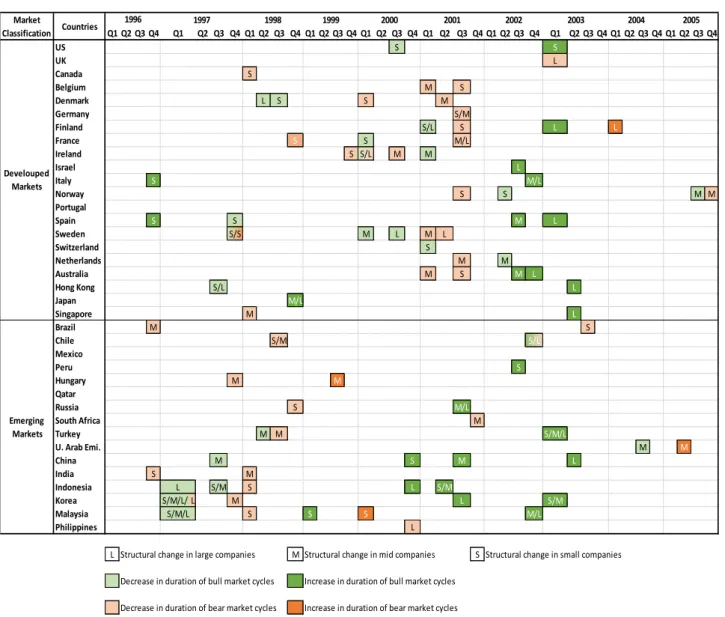
with large, mid and small companies (1996 – 2005) ... 38
Figure 2 – Structural changes in duration of bull and bear markets associated
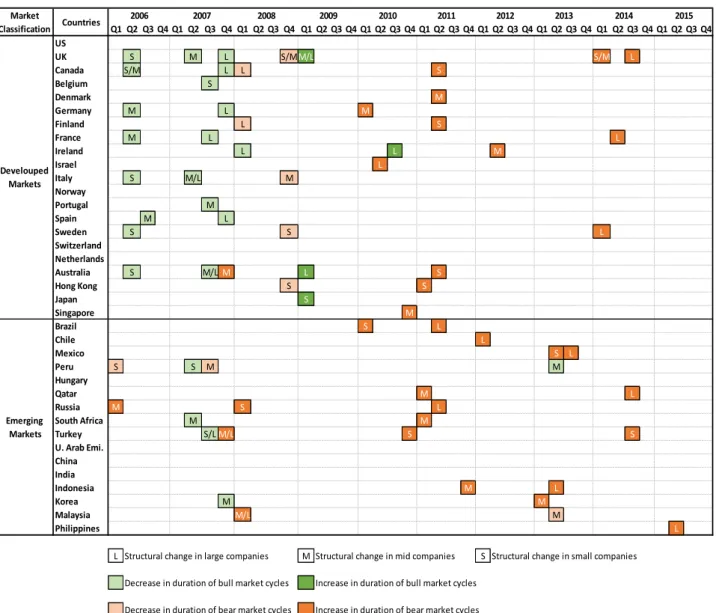
with large, mid and small companies (2006 – 2015) ... 39
List of Tables
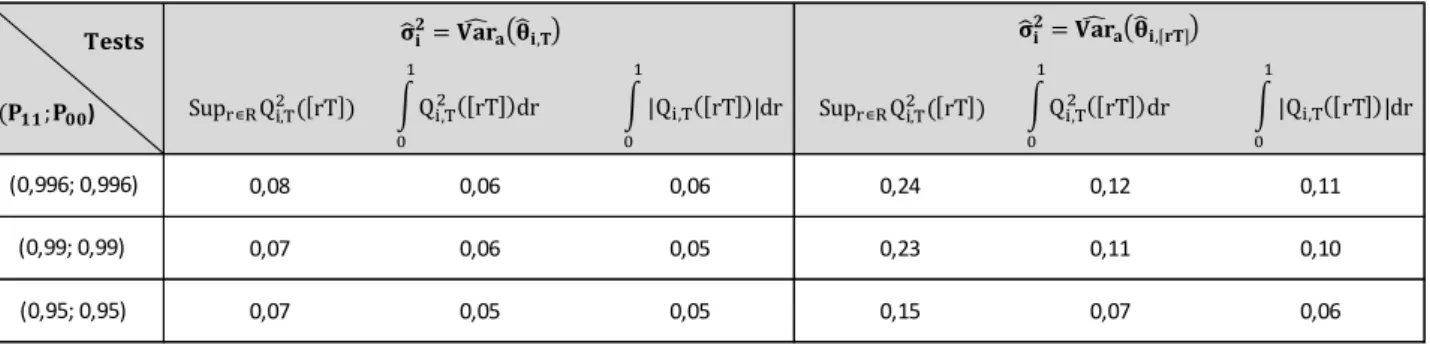
Table 1 – Real dimension associated with the structural change tests in
function of transition probabilities and choice of σ̂i2 (T = 3000) ... 40
Table 2 – Real dimension associated with the structural change tests in
function of transition probabilities and choice of σ̂i2 (T = 6000) ... 40
Table 3 – Real dimension associated with the structural change tests in
function of transition probabilities and choice of σ̂i2 (T = 15000) ... 40
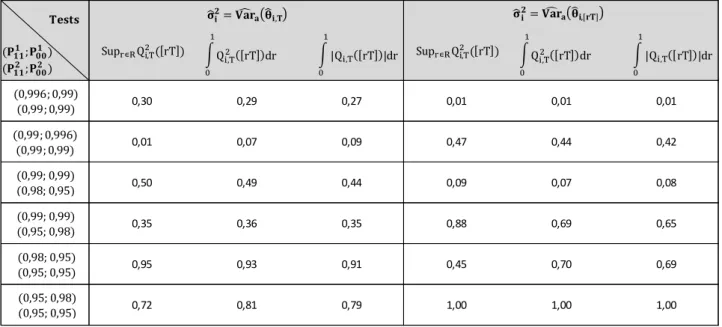
Table 4 – Power associated with the structural change tests in function of
transition probabilities and choice of σ̂i2 (T = 3000 and breakpoint at the 50th
percentile of the sample) ... 41
Table 5 – Power associated with the structural change tests in function of
transition probabilities and choice of σ̂i2 (T = 3000 and breakpoint at the 80th
percentile of the sample) ... 41
Table 6 – Power associated with the structural change tests in function of
transition probabilities and choice of σ̂i2 (T = 6000 and breakpoint at the 50th
vi
Table 7– Power associated with the structural change tests in function of
transition probabilities and choice of σ̂i2 (T = 6000 breakpoint at the 80th
percentile of the sample) ... 42
Table 8 – Power associated with the structural change tests in function of
transition probabilities and choice of σ̂i2 (T = 15000 and breakpoint at the
50th percentile of the sample) ... 43
Table 9 – Power associated with the structural change tests in function of
transition probabilities and choice of σ̂i2 (T = 15000 breakpoint at the 80th
percentile of the sample) ... 43
Table 10 – Data availability for developed markets ... 44
Table 11 – Data availability for emerging markets ... 45
Table 12 – Business cycles of markets with statistical evidence of DDBC .... 46
Table 13 – Application of the Binomial test for evidence of dependence
1
1
–
Introduction
One can characterize the financial markets’ behaviour as bull and bear
(henceforth BB) markets: When studying a financial time series, it is possible
to recognize prolonged periods of time where an underlying trend seems to
be involved, these periods are related with the BB markets.
Although this feature has been quite studied by academics, there is not a
clear definition for it, nevertheless, the descriptions provided by Chauvet &
Potter (2000) and Sperandeo (1990) are useful for their simplicity and insight.
The former describe bullish (bearish) markets as periods of generally
increasing (decreasing) market prices, while the latter uses a similar
description, yet more precise, by defining a bull market as “a long-term (...)
upward price movement characterized by a series of higher intermediate (...)
highs interrupted by a series of higher intermediate lows”, and a bear market
as a “long-term downtrend characterized by lower intermediate lows
interrupted by lower intermediate highs”.
One of the main reasons for the popularity of BB markets in the last
years is its importance in analysing and predicting financial markets, in this
sense, a great amount of work has been developed in identifying, modelling
and predicting BB markets. Lunde & Timmermann (2004), Maheu et al.
(2012), and Kole & Van Dijk (2017) are just some examples of the research
made in this area.
Less work has been achieved in analysing the BB markets duration, and
2
directly linked with the applications of BB markets as key components of
stock markets: If a structural change in the cycle duration is wrongly left
unconsidered, then an analysis based on BB markets will most likely be
compromised. For testing these structural changes only the test proposed by
Nicolau (2016) is known to date. Throughout the current work, this statistical
test is introduced, along with two simple alternatives derived from the former,
with a Monte Carlo simulation study being additionally carried out in order to
analyze the statistical properties of these tests.
This work’s empirical application intends to be a valid contribution in the
study of links between finance and macroeconomics, a field of research that
became especially active after the crisis of 2008 that affected economies
worldwide. To achieve so, the present work focuses in the analysis of the
connections between structural changes in the duration of BB markets and
the business cycles.
The upper mentioned statistical tests are applied to a database
consisting on adjusted market capitalization stock market indexes of 38
developed and emerging markets, and the breakpoints found are then
compared with the peaks and troughs verified in the business cycles as well
as periods of other global macroeconomic events. In this comparison, the
structural changes are then explained and justified considering both financial
and macroeconomic frameworks.
The remainder of this work is organized as follows: Section 2 introduces
some preliminary concepts on BB markets, specifically stationary first order
3
state. Section 3 presents several methods for the identification of BB markets.
Section 4 revises the existent structural change test in duration of BB markets
and presents two alternative tests. Additionally a simulation study is carried
out in this section, in order to ascertain the empirical size and power of these
tests, along with the critical values of the alternatives. Section 5 introduces
the empirical study where the tests are applied to adjusted market
capitalization stock market indexes and the connections between structural
changes in duration of BB markets and the business cycles are analyzed.
Section 6 presents extensions and possible further research to this work.
Section 7 revises the obtained results and concludes.
2
–
Preliminary Concepts on BB Markets
BB markets conveniently suit the probabilistic model proposed by Andrey
Markov. Let {St} be an indicator variable, which verifies St = 1 if the stock
market is in a bull state and St = 0 if the stock market is in a bear state at
period t. The evolution of St is assumed throughout this work to be governed
by a stationary and ergodic first order Markov Chain Process. The transition
probabilities capture the temporal dependence of BB markets and are
presented as:
P(St = j|It−1) = P(St= j|St−1 = i) = pij ∀i, j = 0, 1 (2.1)
Where It−1 is the σ-algebra generated by the available information at t −
4
Since the transition probabilities are constant over time given {St}
stationary, the following one step probability transition matrix completely
describes the Markov Chain Process:
𝐒 ≔ [PP(S(St = 1|St−1= 1) P(St = 0|St−1= 1)
t = 1|St−1= 0) P(St = 0|St−1= 0)] (2.2)
In order to introduce the concept of BB market durations, it is pertinent to
consider the following random variables:
TBull ≔ min(t > 0: St = 0|S0 = 1) ; TBear≔ min(t > 0: St = 1|S0 = 0) (2.3)
The variable TBull represent the time of first passage to the bear state
given that the market started at a bull state, TBear has an analogous
interpretation. Since the Markov chain is assumed to be stationary, the
expected value of the variables mentioned above is constant and given by:
θ1 ≔ E(TBull) =1 − p1
11; θ0 ≔ E(TBear) =
1
1 − p00 (2.4)
See, for example, Taylor & Karlin (1998). Equation (2.4) shows the
expected time of permanency in the BB states related to a certain series, that
is, the duration of the BB market cycles. Intuitively, to test the hypothesis of
whether the BB market durations are constant over time or not, is to test if the
equality θi,t = θi holds for all t. Such is a major focus of this current work, as
5
3
–
Identification of BB Markets in a Time Series
Before introducing the structural change tests in duration of BB markets
and their applications, it is first necessary to present methods for the
identification of bullish and bearish states. To do so, there are two
distinguishable main approaches, one nonparametric and other based on a
parametric statistical model. The latter uses regime-switching models (see,
for example, Maheu et al. (2012)) which have their own advantages since
they give more depth into the process under study and allow a direct
statistical inference. However, these models and their results are dependent
on a correct specification, which is something not desirable in the present
work. It is preferred the use of a transparent and robust method of
identification, that solely reflects the tendency of the market. Such leads to
the use of nonparametric rules-based methods.
The two main algorithms in the literature are presented by Pagan &
Sossounov (2003) and Lunde & Timmerman (2004). The former’s approach is
based on the algorithm developed by Bry & Boschan (1971) for dating
business cycles and consists in the identification of peaks and troughs as well
as the adoption of duration censoring rules that restrict the minimal lengths of
any phase. Seeing that the method proposed by Lunde & Timmerman (2004)
does not impose such restrictions in the cycle’s durations, it will be selected
throughout this work for the identification of BB markets since it is preferred
6
To identify bullish (St= 1) and bearish (St = 0) states, the chosen
method uses two parameters, λ1 and λ2, as a way of measuring the
dimension of a rise (drop) in the time series to be considered a peak (trough).
Let the stock market be in a bullish state at t = t0, with PtMax0 equal to its
value at that period (Pt0) and consider the stopping time variables τMax and
τMin defined by:
τMax = inf{t0+ τ: Pt0+τ≥ PtMax0 }
τMin = inf{t0+ τ: Pt0+τ < (1 − λ2)PtMax0 }
(3.1)
If τMax < τMin , then set PtMax0+τMax = P
t0+τMax and St = 1,∀ t ∈ {t0 +
1, … , t0+ τMax }, otherwise set PtMin0+τMin = Pt0+τMin and St = 0,∀ t ∈ {t0+
1, … , t0+ τMin }.
Similarly, with the stock market in a bearish state at t = t0, the stopping
time variables τMax and τMin are defined by:
τMin = inf{t0+ τ: Pt0+τ ≤ PtMin0 }
τMax = inf{t0+ τ: Pt0+τ > (1 + λ1)PtMin0
(3.2)
If τMin < τMax , then set PtMin0+τMin = P
t0+τMin and St= 0,∀ t ∈ {t0+
1, … , t0+ τMin}, otherwise set PtMax0+τMax = Pt0+τMax and St = 1,∀ t ∈ {t0+
1, … , t0+ τMax }.
By repeating the above set of rules the BB states are identified. Notice
that the algorithm simply defines bullish cycles as the movements of a time
series between two local maximums without significant drops in the middle, or
7
no duration restrictions are implied. The bearish cycles are analogously
defined.
The identification of BB markets through this algorithm depends on the
choice of (λ1; λ2). If this parameters are set too low, then small downward
(upward) movements during a bull (bear) cycle are considered a sign of a
transition to a bear (bull) state. Moreover, it is intended that the upward drift in
stock prices is considered, this is achievable by setting λ1 > λ2. Knowing this
concerns, throughout this work the values (0,20; 0,15) are chosen for these
parameters.
4
–
Structural Change Tests in Duration of BB Markets
4.1
–
A Revision on Structural Change Tests in Duration of BB
Markets
In this section, the structural change test introduced by Nicolau (2016) is
presented.
This test aims to detect differences in the duration of BB markets
between two subsamples, that is, if the transition probabilities inherent to the
BB states have changed from one period to another.
When applied to the stock market, evidence of a structural change in a
specific date may prove that some sort of phenomenon led to an increase or
8
applications in understanding the relations linking some economical or
financial events and the stock market in study.
The test compares the estimated duration of the bull (bear) market cycle
using all T observations, with the estimated durations using the first t ∈]w, T[
observations, where w is a start-up value to be explained during this section
and T the sample size. This way, a great deviation between durations
represents an evidence of a structural change in the stability of the bull (bear)
cycle.
To estimate the duration of these cycles, consider the already presented
equation (2.4), with the transition probabilities pii ∀i = 0, 1 replaced by their
maximum likelihood estimates p̂ii:
θ̂1 =1 − p̂1
11; θ̂0 =
1
1 − p̂00 (4.1.1)
Therefore, given the functional invariance propriety, θ̂i is the maximum
likelihood estimate of θi, i ∈ {0, 1}.
To obtain p̂ii, first consider the following initial probabilities:
pu(0): = P(S0 = u), u ∈ {0,1} (4.1.2)
With 𝐒𝐓+𝟏 = {S0, S1, … , ST} a realization of length T + 1 of the stochastic
process {St}, the likelihood function based on 𝐒𝐓+𝟏 is specified by:
L = pu(0)∏ pSk−1Sk
T
k=1
= pu(0)∏ pijnij 1
i,j=0
9
Where nij is the number of times that a transition from i to j is verified in
the sample. The log-likelihood function is given by:
log(L) = log(pu(0)) + ∑ nij 1
i,j=0
log(pij) (4.1.4)
The maximum likelihood estimator of the transition probability p11 is
obtained through:
𝜕 log 𝐿𝜕p
11 = 0 ⇔
n11
p̂11−
n10
1 − p̂11= 0 ⇔
n11− n1p̂11
p̂11(1 − p̂11) = 0 ⇔ p̂11 =
n11
n1 (4.1.5)
Notice that n1 = n11+ n10, which is the number of 1’s found in the
realization 𝐒𝐓+𝟏. In general, the estimates of p̂ij can analogously be obtained
by p̂ij =nij
ni, i, j ∈ {0, 1}. Consequently, equation (4.1.1) can be written as:
θ̂1 =n n1
1− n11; θ̂0 =
n0
n0− n00 (4.1.6)
Under the stationary hypothesis specified in Section 2, and given that θ̂i
is the maximum likelihood estimator of θi, its asymptotic behavior for i ∈ {0, 1}
is:
θ̂i
….p….
→ θi (4.1.7)
√T(θ̂i− θi)
….d….
→ N (0,(1 − ppii
ii)3πi) (4.1.8)
Where 0 < pii < 1 and πi: = P(St= i). To prove equation (4.1.8) notice
that √T(p̂ii− pii)….→ N (0,d…. pii(1−pii)
10
As mentioned before, the goal is to test whether the durations of the BB
markets are constant over time or if its structure has changed. To do so, let
θ1,t and θ0,t be the durations of a bull cycle and bear cycle at t, respectively,
and focus on observations t = ⌊rT⌋, for r ∈ R, a pre-specified compact subset
of (0, 1), where [x] is the integer part of x.
To test H0: θi,⌊rT⌋ = θi ∀r ∈ R (i.e. parameter constancy) against its
alternative H1: θi,⌊rT⌋ ≠ θi for some r ∈ R, the following statistic is crucial:
Qi,T(⌊rT⌋) = √⌊rT⌋ − wT − w ∗⌊rT⌋σ̂ i
2 ∗ (θ̂i,⌊rT⌋− θ̂i,T) (4.1.9)
For i ∈ {0, 1}, with σ̂i2 the maximum likelihood estimate of Var
a(θ̂i,T) =
pii
(1−pii)3πi. For the computation of Qi,T(⌊rT⌋) it will also be considered the case
where σ̂i2 is the maximum likelihood estimate of Var
a(θ̂i,⌊rT⌋) (the asymptotic
variance of the estimated duration using the first ⌊rT⌋ elements in the sample),
with its results compared to the previous situation1. For the distribution of
Qi,T(⌊rT⌋) let:
Zi,t= (1 − θi)St+ θiStSt−1
√Vara(θ̂i,T)πi(1 − pii)
(4.1.10)
Then, under the stationary assumption mentioned at the beginning of
Section 2, one can prove (see Nicolau (2016)):
1 Differences should occur only for finite samples, given that asymptotically the use of Var̂
a(θ̂i,T) and
11
Xi,T(1) = 1
√T∑ Zi,t
T
t=1
….d….
→ W(1) (4.1.11)
Xi,T(r) = 1
√T∑ Zi,t
⌊rT⌋
t=1
….d….
→ W(r) (4.1.12)
Finally, the distribution of Qi,T(⌊rT⌋) is given by:
Qi,T(⌊rT⌋) Xi,T(r) − rXi,T(1)
….d….
→ W(r) − rW(1) (4.1.13)
The test statistic and respective asymptotic distribution are obtained
through the application of the continuous mapping theorem to equation
(4.1.13). This theorem states that for a function g: ℝm→ ℝp continuous in its
domain and independent of T, the following applies:
XT
….d….
→ X ⇒ g(XT)
….d….
→ g(X) (4.1.14)
Therefore, equation (4.1.13) can be transformed as:
Supr∈RQ2i,T(⌊rT⌋)….→ Supd…. r∈R[W(r) − rW(1)]2 (4.1.15)
Which holds under H0. To test for possible structural changes in the BB
markets stability, consider the result in equation (4.1.15).
The implementation of this test is straightforward: First, one needs the
series of 1’s and 0’s relative to the BB states inherent to the series in study
(consider the Lunde & Timmerman (2004) rules-based method, already
discussed in Section 3). The statistics Q2
i,T([rT]) for r ∈ R are obtained from
12
leads to the question of what value for w should be chosen. While a small
value is associated with the impossibility of obtaining the statistics Q2
i,T([rT])
for some r ∈ R, for a large value of w the breakpoint may be missed. The
choice of w suggested is one that allows for the sample {1, … w} to have at
least two state transitions as a way of avoiding the impossibility to calculate
the statistics Q2
i,T(w), and the subsequent to it. With w chosen, obtain
{θ̂i,w, θ̂i,w+1, … , θ̂i,T} using the subsamples {1, … , w}, {1, … , w + 1},… , {1, … , T},
respectively. σ̂i2 can be estimated either one time, using the whole sample,
yielding σ̂i2 = Var̂
a(θ̂i,T) or multiple times using the above subsamples,
yielding σ̂i2 = Var̂
a(θ̂i,⌊rT⌋). Finally, after the computation of {Q2i,T(w), Q2i,T(w +
1), … , Q2
i,T(T)}, the maximum value of this sequence is compared to the
corresponding critical value and in case H0: θi,⌊rT⌋ = θi ∀r ∈ R is rejected, the
estimate for the breakpoint is given by the period in which Q2
i,T(⌊rT⌋) achieves
its maximum.
The critical values obtained through simulation are 1,46, 1,78 and 2,54,
for test sizes of 10%, 5% and 1%, respectively.
The tests to be introduced in the next section are based on equation
(4.1.13) and are also obtained through the continuous mapping theorem,
being very similar to the one previously presented. These tests essentially
differ from each other in the application of the theorem, which yields different
13
4.2
–
Alternative Structural Change Tests in Duration of BB
Markets
The test presented previously uses the supremum squared value of
Qi,T(⌊rT⌋) as its test statistic, analogously, other test statistics can be obtained
from Qi,T(⌊rT⌋) to test H0: θi,⌊rT⌋ = θi ∀r ∈ R, against its alternative H1: θi,⌊rT⌋ ≠
θi for some r ∈ R.
In this section two alternatives are presented: Based on the mean-score
test of Andrews & Ploberger (1994), instead of using the supremum value of
Q2
i,T(⌊rT⌋), one may use an integral instead. Furthermore, in place of using
the squared Qi,T(⌊rT⌋), the absolute value of this statistic will also be studied.
To obtain the alternative test statistics notice that Qi,T(⌊rT⌋) is a step
function:
∫ Q2
i,T(⌊rT⌋) 1
0 dr = ∑ Q
2 i,T(j) T−1
j=w+1
∗1
T (4.2.1)
∫ |Qi,T(⌊rT⌋)| 1
0 dr = ∑ |Qi,T(j)|
T−1
j=w+1
∗1T (4.2.2)
Given the result s expressed in equation (4.1.13), through the continuous
mapping theorem the asymptotic distributions associated with the previously
mentioned test statistics follow:
∫ Q2
i,T(⌊rT⌋) 1
0 dr
….d….
→ ∫ [W(r) − rW(1)]1 2
14
∫ |Q|i,T(⌊rT⌋) 1
0 dr
….d….
→ ∫ |W(r) − rW(1)| dr 1
0 (4.2.4)
The implementation of the alternative tests is again, similar to the one
discussed in the previous section. The greatest difference is that one does
not use the supremum values of Q2
i,T(⌊rT⌋) or |Q|i,T(⌊rT⌋), but instead its sum,
consequently it is not possible to give an estimate for the breakpoint directly.
The critical values are obtained through Monte Carlo simulation, which
takes place in the next section, alongside with a simulation of the three
structural change tests’ real size and statistical power.
4.3
–
Monte Carlo Simulation Study
4.3.1 – Procedure and Design
In this section, the main goals are to determine the real size and
statistical power of the structural change tests in duration of BB markets2. In
addition, the simulation study will also aim to find the asymptotic critical
values associated with the alternative tests.
Throughout the simulation study, the number of replications used is N =
10000 and the tests’ statistical properties are obtained by taking into account
a nominal test size of 0,05.
For the alternative tests’ asymptotic critical values, consider the following
data generating process (henceforth DGP) specified for the variable indicator
of the BB markets, St:
15
{pp11≔ P(St= 1|St−1= 1) = 0,95; t = {1,2, … , T}
00 ≔ P(St = 0|St−1= 0) = 0,95; t = {1,2, … , T} (4.3.1)
Where the sample size considered is T = 25000 and σ̂i2 = Var̂
a(θ̂i,T).
Notice that the results using σ̂i2 = Var̂a(θ̂i,T) or σ̂i2 = Var̂a(θ̂i,⌊rT⌋) should be
asymptotically equivalent.
To develop the simulation study applied to the statistical properties
inherent to the three structural change tests, it is highly important to realize
that the statistical tests depend on a series of factors, including the DGP
selected3, the number of observations and whether to use Var̂
a(θ̂i,T) or
Var̂a(θ̂i,⌊rT⌋), for that reason, it is pertinent to perform multiple simulations
followed by a comparison of results.
In order to simulate the real size, consider:
{pp11≔ P(St= 1|St−1 = 1) = α; t = {1,2, … , T}
00≔ P(St = 0|St−1= 0) = β; t = {1,2, … , T} (4.3.2)
The choices for (α; β) are: (0,996; 0,996), (0,99; 0,99) and (0,95, 0,95),
three sample sizes are used, T = 3000, T = 6000 and T = 15 000, as well
as both σ̂i2 = Var̂
a(θ̂i,T) and σ̂i2 = Var̂a(θ̂i,⌊rT⌋).
To simulate the statistical power of the three tests, consider the DGP’s:
{
p111 ≔ P(St = 1|St−1= 1) = γ; t = {1,2, … , Tbreak− 1}
p001 ≔ P(St = 0|St−1= 0) = δ; t = {1,2, … , Tbreak− 1}
p112 ≔ P(St= 1|St−1 = 1) = λ; t = {Tbreak, Tbreak+ 1, … , T}
p002 ≔ P(St= 0|St−1 = 0) = ψ; t = {Tbreak, Tbreak+ 1, … , T}
(4.3.3)
16
The choices for (γ; δ; λ; ψ) are: (0,996; 0,99; 0,99; 0,99),
(0,99; 0,99; 0,996; 0,99), (0,99; 0,98; 0,99; 0,95), (0,99; 0,95; 0,99; 0,98),
(0,98; 0,95; 0,95; 0,95) and (0,95; 0,95; 0,98; 0,95). Again, three sample
sizes are used, T = 3000, T = 6000 and T = 15 000, as well as both
σ̂i2 = Var̂a(θ̂i,T) and σ̂i2 = Var̂a(θ̂i,⌊rT⌋). Additionally, the breakpoint at Tbreak is
set on the 50th and 80th percentiles of the sample.
To develop the Monte Carlo simulations, examine the following steps,
which are identical among the applications here presented:
1. Generate a sample with size equal to T, related to the continuous
variable U~Uniforme(0, 1).
2. Initialize the process {St} with regard to the initial probabilities
specified, taking into account that:
{p1
(1) ≔ P(S
1 = 1) =1 − (pp01 11− p01)
p0(1) ≔ P(S1 = 0) =1 − (pp10 00− p10)
(4.3.4)
And:
{S1 = 1 if U1 ≤ p1(1) S1 = 0 if U1 > p1(1)
(4.3.5)
3. Considering the specified transition probabilities, generate {S2,S3, … , ST}
through:
{SSt= 1 if (St−1= 1 ∧ Ut≤ p11) ∨ (St−1= 0 ∧ Ut> p00)
17
4. With knowledge of {S1,S2, … , ST}, obtain the statistics4 n
i and nii ∀t ∈
{w, w + 1, … , T}, which allow the computation of σ̂i2 and θ̂i,⌊rT⌋ ∀r ∈ R. Then, proceed to assemble {Qi,T(w), Qi,T(w + 1), … , Qi,T(T)}.
5. Calculate the test statistic.
6. Repeat the previous steps for every one of the N replications.
A final step that differs between the simulation of the critical values and the
statistical properties must be introduced. For the former:
7A. After obtaining the N test statistics associated with a given test, sort
them in ascending order. The 90th, 95th and 99th percentiles give the
critical values for test sizes of 10%, 5% and 1%, respectively.
And for the latter:
7B. After obtaining the N test statistics associated with a given test, count
the number of rejections of H0: θi,⌊rT⌋ = θi ∀r ∈ R, considering the
specified nominal test size. The arithmetic mean of the number of
rejection yields the empirical size/power of the test (depending on
whether H0: θi,⌊rT⌋= θi ∀r ∈ R holds or not).
4.3.2 – Discussion and Results
The results derived from the Monte Carlo experiments are presented
during this section. Essentially, the simulation study is divided in the
computation of asymptotic critical values related to the alternative tests and
4 In order to obtain the critical values associated with the alternative tests, through the given DGP there
18
analysis of the real size and power of the structural change tests in duration
of BB markets.
Through the Monte Carlo simulation study, the critical values obtained
considering test sizes of 90%, 95% and 99% are respectively 0,34, 0,45 and
0,75, for the test associated with equation (4.2.3) and 0,49, 0,58 and 0,76 for
(4.2.4).
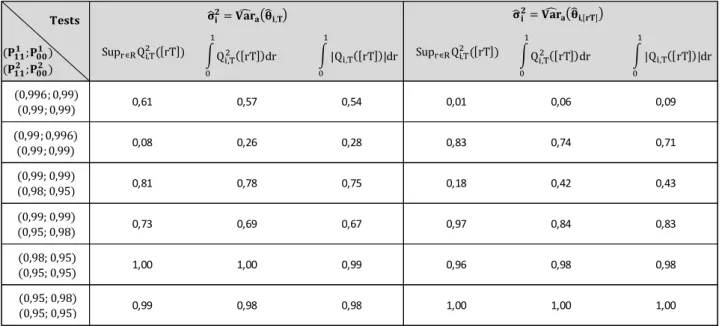
Tables 1 – 3 gather the information relative to the simulation results of
the tests’ empirical size. It is observable that the test size is influenced in
multiple extents, whether it is the sample size, the usage of σ̂i2 = Var̂ a(θ̂i,T)
against σ̂i2 = Var̂
a(θ̂i,⌊rT⌋) or the transition probabilities specified in the DGP.
It seems that the choice of σ̂i2 is quite significant, noticing that σ̂ i 2 =
Var̂a(θ̂i,⌊rT⌋) is associated with size distortions up to four times the nominal
size for the test introduced by Nicolau (2016), and two times for the
alternative tests. These distortions are mitigated considering σ̂i2 = Var̂a(θ̂i,T),
with the real size fairly approximating the nominal.
The sample size and DGP also play an important role in the tests’ real
size, with less over-rejection being detected for smaller transition probabilities
(p11; p00) and larger sample sizes. Therefore, one may extrapolate that the
number of state transitions influences the size properties of the given tests,
with these exhibiting less over-rejection the more state transitions verified in
the sample.
Overall, the alternative tests show less over-rejection, comparing with the
19
Likewise the previous case, the statistical power of the tests is influenced
by the same extents, with addition to the characteristics of the structural
change considered.
Through tables 4 – 9 it is clear that the sample size and transition
probabilities affect the statistical power in a way that the more state
transitions (larger sample sizes and smaller transition probabilities, p11 and
p00) the more statistical power.
As it should be expected, the tests evidence more statistical power when
the structural change is in the middle of the sample, comparatively to a more
extreme position (say, in the 80th percentile). Such yields the difficulty for the
tests to detect structural changes in duration of BB markets when these are
verified at the beginning or at the end of the sample.
A rather interesting outcome is obtained when comparing the results for
σ̂i2 = Var̂a(θ̂i,T) against σ̂i2 = Var̂a(θ̂i,⌊rT⌋). It seems that the tests using
σ̂i2 = Var̂a(θ̂i,T) have strictly better power when the structural change is
associated with a decrease in the duration of the cycles, and conversely, the
tests using σ̂i2 = Var̂
a(θ̂i,⌊rT⌋) show more power when there is an increase in
duration of the cycles. This justifies the use of both σ̂i2 = Var̂
a(θ̂i,T) and
σ̂i2 = Var̂a(θ̂i,⌊rT⌋) when applying the structural change tests, since for finite
samples, one is suitable for the detection of increases and the other of
decreases in duration of BB markets.
Comparing the three tests’ statistical power, one verifies that the test
20
alternatives. Such power may be alarmingly low when working with small
samples sizes and high duration BB markets but reaches admissible values
otherwise, with the tests appearing to be consistent.
In sum, the tests’ statistical properties improve in function of larger
sample sizes and lower transition probabilities which translate in more state
transitions, with the alternative tests showing less problems of size distortion
but also less power in the simulation experiments. The usage of σ̂i2 =
Var̂a(θ̂i,⌊rT⌋) is justified by its better results in detection of increases in duration
of BB cycles, while σ̂i2 = Var̂
a(θ̂i,T) show better results in detection of
decreases in duration of BB cycles.
5
–
How Are Structural Changes in Duration of Bull
and Bear Markets Connected with the Business Cycle
“[Economists] will have to do their best to incorporate the realities of finance into macroeconomics”
Paul Krugman in New York Times Magazine, 2 September 2009
The links between macroeconomics and finance became an active field
of research especially after the crisis of 2008 that affected economies
worldwide, as economic recessions seem to be accompanied by several
financial disruptions.
Claessens et al. (2009) show that recessions regularly coincide with
21
moreover, recessions linked with credit crunches and house price busts are
deeper and last longer in comparison with other recessions.
Other authors such as Estrella & Mishkin (1998) and Avouyi-Dovi &
Matheron (2005) had previously tried to relate finance and macroeconomics.
While the former conclude that financial variables such as stock prices have
predictive power over economical recessions in the United States, the latter
show that the stock market cycle and the business cycle verify a significant
concordance in that country, with the start of stock market contractions
preceding contractions in real GDP.
Claessens et al. (2012) addressed the question of “how does the nature
of business cycles vary across different phases of financial cycles?” having
concluded the presence of strong interactions and synchronization among
these cycles, with the financial cycles affecting the duration and strength of
recessions and recoveries in the economy.
The present study aims to be a valid contribution to further
understanding the links between finance and macroeconomics, by exploring
the possible relations of structural changes in duration of BB markets and the
business cycle, a research field never considered to date.
To analyze the connections between structural changes in duration of BB
markets and the business cycle, the statistical tests presented are applied to
adjusted market capitalization stock market indexes of several countries and
the information regarding breakpoints crossed with the peaks and troughs
verified in business cycles and further macroeconomic events. In this sense,
22
where statistical evidence of structural changes is common among countries
and to perceive how these increases and decreases in duration of BB cycles
are connected with the business cycles.
5.1
–
Data and Methodology
The database comprises adjusted market capitalization stock market
indexes of 37 developed and emerging markets, constructed by Morgan
Stanley Capital International (MSCI) and downloaded from DataStream.
The classification of the market follows three essential criteria: Economic
development, market accessibility and size/liquidity5. The adjusted market
capitalization stock market indexes are derived from the equity universe,
precisely the investable market index. This index is then divided by the size
of the companies with respect to their full market capitalization, resulting in
the large, mid and small cap indexes6. For each market (country) considered,
the structural change tests are applied to the bull and bear markets identified
from the three size indexes.
From the 37 markets considered, 21 are classified as developed and 16
as emerging markets. The developed markets are: Canada and United States
of America from the Americas; Belgium, Denmark, Germany, Finland, France,
Ireland, Israel, Italy, Netherlands, Norway, Portugal, Spain, Sweden,
Switzerland and United Kingdom from Europe and Middle East; Australia,
Hong Kong, Japan and Singapore from the Pacific. The emerging markets
5 See:
www.msci.com/documents/1296102/1330218/MSCI_Market_Classification_Framework+2017.pdf/21f36 0a0-930c-4ca6-9864-d981820dfa0a.
23
are: Brazil, Chile, Mexico and Peru from the Americas; Hungary, Russia,
South Africa, Turkey, Qatar and United Arab Emirates from Europe, Middle
East and Africa; China, India, Indonesia, Korea, Malaysia and Philippines
from Asia.
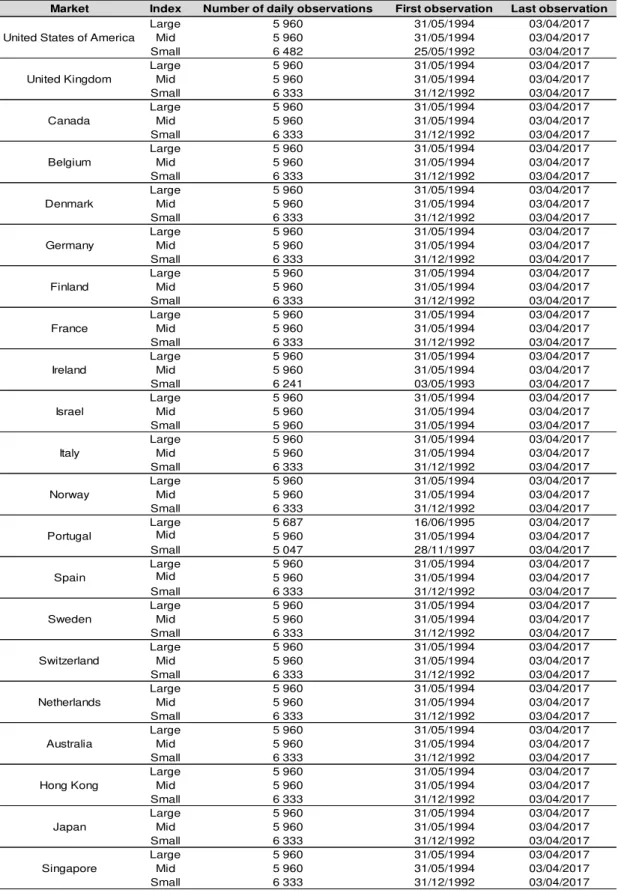
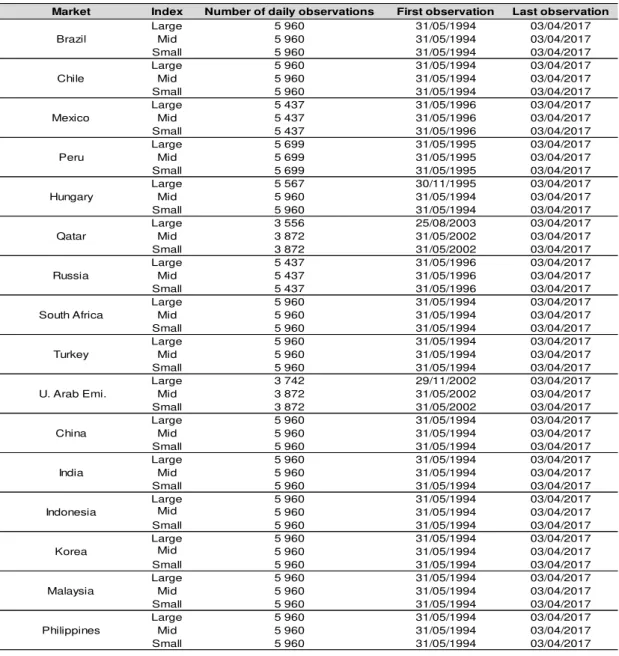
The sample size varies from 3 556 to 6 482 for the daily index prices,
due to restrictions in the availability of its source (DataStream), nevertheless,
the vast majority of the index prices considered have more then 5 900 daily
observations and only for two markets the sample size is less than 5 000. The
last observed period is identical among the elements of the database
considered and it corresponds to the 3rd of April 2017 (see tables 10 and 11).
After the identification of the BB markets inherent to the large, mid and
small cap indexes considered for each country, through the algorithm
suggested by Lunde & Timmerman (2004), the application of the structural
change tests follows. During the course of this analysis, it is admitted that the
estimated dates of breakpoint given by the structural change tests are
consistent. This assumption is supported by Bai (2000) since as specified in
Section 2, the bull and bear markets are assumed to be governed by a
stationary and ergodic first order Markov Chain Process, which has a first
order vector autoregressive representation holding the same asymptotic
proprieties.
The application of the tests is rather simple, yet two remarks arise, the
first one, concerning what start-up values to be used, the choice of w
24
strategy where the chosen value is the one that allows for the sample {1, … w}
to have at least two state transitions. Secondly, regarding σ̂i2 being the
maximum likelihood estimate of Vara(θ̂i,T) or Vara(θ̂i,⌊rT⌋), both cases are
considered, since as seen previously, the former provides better statistical
power when there is a decrease in duration of bull/bear markets, while the
latter when there is an increase in its duration.
In terms of recognizing statistical evidence of structural changes, the
following set of rules is considered:
a) Since the simulation study performed gave support that the test using
the result in equation (4.1.15) with σ̂i2 = Var̂
a(θ̂i,T) presents few
over-rejection problems and more power than the respective tests that use
(4.2.3) and (4.2.4), then if there is statistical evidence for the rejection
of H0 using (4.1.15) at a nominal test size of 0,05, a structural change
associated with a decrease in the cycles is recognized.
b) Since the simulation study performed gave support that the test using
the result in equation (4.1.15) with σ̂i2 = Var̂
a(θ̂i,⌊rT⌋) presents
considerable over-rejection but more power than the respective tests
that use (4.2.3) and (4.2.4), a more cautious approach is taken: If there
is statistical evidence for the rejection of H0 using (4.1.15) at a nominal
test size of 0,05, and using at least one of the tests associated with
(4.2.3) and (4.2.4), at a nominal test size of 0,10, then a structural
25
c) Since the tests that use the results in equations (4.2.3) and (4.2.4)
have less over-rejection but also less power than the test that uses
(4.1.15), then if there is statistical evidence for rejecting H0 using
(4.2.3) or (4.2.4) at a nominal test size of 0,05, a structural change
associated with an increase or decrease in the cycles is recognized
(depending on σ̂i2).
It is also admissible that there might be more than one structural change
in the duration of bull or bear markets in a given index. In this sense, after the
application of the tests considering the whole sample, in case there is
statistical evidence of a structural change in a given period, the tests are
applied again using the two subsamples corresponding to the periods before
and after the breakpoint. This simple process allows for the detection of
multiple structural changes.
5.2
–
Results
The current section focuses on presenting the results obtained from the
application of the structural change tests in duration of BB markets to the
database consisting on large, mid and small cap indexes constructed by
MSCI.
This application led to the results evidenced in figures 1 and 2. A first
analysis to the figures allows the identification of several structural changes in
duration of BB markets in the periods summarized between 1996 and 2015.
26
some interesting patterns among the different markets. Consider the following
phases regarding the mentioned patterns:
1. 1996 – 2001 (for developed markets) / 1996 – 1998 (for emerging
markets): Period characterized by an increase in the cyclicity of BB
markets, with decreases in the duration of these cycles registered in
several markets.
2. 2002 – 2003 (for developed markets) / 1999 – 2003 (for emerging
markets: Period with several increases in the duration of bull cycles
associated with the given indexes.
3. 2004 – 2008: Numerous structural changes relative to decreases in the
duration of bull cycles (henceforth DDBC) are observed, for both
developed and emerging markets, especially during the period of 2006
– 2007. It is also noticeable that for some developed markets these
structural changes are also accompanied by decreases in duration of
bear markets. Interestingly, the DDBC usually occur first for the
indexes associated with smaller companies and then for the larger.
4. 2009 – 2015: Increases in duration of bear markets are the main
feature perceptible during these periods, with these structural changes
noticeable for several developed and emerging markets.
Given these four phases, it is now intended to compare each one to the
business cycle’s behavior verified in the respective period and further
macroeconomic events7.
7 For an extensive chronology of business cycles peaks and troughs presented by the Economic Cycle
www.businesscycle.com/ecri-business-cycles/international-business-27
Starting with the first phase perceived, one can observe that the bursting
of the tech bubble, the global recession verified at the beginning of the XXI
century and a gradual increase in the interest rates8, which restrains the
access of credit by companies, match this period of higher volatility with
decreases of both BB markets’ duration.
The increases verified during the second phase are easily explained by
the expansionist period registered in worldwide economies and relatively low
interest rates during that period.
Through the third phase, it is recognizable that the DDBC not only occur
first for the indexes associated with smaller companies, but also seem to
anticipate the recession period confirmed in business cycles worldwide.
These two observations also happen during the first phase, although on a
smaller scale.
To explain the pattern verified between smaller and larger companies,
notice that Kim & Burnie (2002) show that smaller companies are more
vulnerable to adverse changes in economic conditions given their lower
productivity and higher financial leverage. Additionally, Ehrmann (2010)
points that a monetary policy tightening, which leads to restricted access to
credit for companies, is more likely to affect the smaller ones given the higher
amount of collateral they have to pledge and their difficulties to access other
forms of external finance, comparing with larger companies.
cycle-dates-chronologies or see Fushing et al. (2010). For a detailed record of events that made an influence in global macroeconomics see www.businesscycle.com/ecri-about/track-record.
8 See www.tradingeconomics.com/country-list/interest-rate for a detailed record of benchmark interest
28
Noticing that a monetary policy tightening actually happened during the
third phase, with a progressive increase in interest rates worldwide during the
period before the crisis, one concludes that the structural changes detected
are therefore a combination between the vulnerability of smaller companies
and the conditions verified throughout the pre-crisis period.
To explain the several increases in bear markets duration noticed in the
fourth phase, consider the slowdown in the economic growth and the
industrial slowdown, which provide evidence that although the crisis of 2008
is over, its effects are still present in the economy and in the financial
markets.
One of the most interesting connections detected between structural
changes in duration of BB markets and the business cycle was the fact that
DDBC seem to anticipate periods of economic recession. Beside the use of
visual inspection that allows for such conclusion, it is also desirable to
perceive if there is statistical evidence that supports this statement. To this
end, consider:
Ii(m) = Max {Iismall, Iimedium, Iilarge} (5.2.1)
Where
Iismall = {1 if A(m) 0 otherwise (5.2.2)
With A(m) the event where, for the i-th market, a DDBC in small
companies occurs m months or less before a peak in the business cycle.
29
If Ii(m) = 0, then either no structural changes/economic crisis were
detected during the sample period, or the structural changes did not occur s ≤
m months before the crisis. In order to conduct this statistical application the
first scenario is excluded, in this sense, only the markets where there is
evidence in the sample of at least one DDBC and one economic crisis are
included.
Under the H0 stating that DDBC do not anticipate crisis in business
cycles, {Ii(m)} is a sequence of i.i.d random variables with Bernoulli
distribution of parameter p ≔ P(Ii(m) = 1), which is the probability of at least
one DDBC occurring m months or less before an economic crisis, for a given
market, with both events independent from each other. Then, the statistic that
allows to test if these structural changes indeed anticipate periods of
economic recession (H1) is given by:
T(m) = ∑ Ii(m)~Binomial(n, p) n
i=1
(5.2.3)
Where n is the number of markets in the sample verifying statistical
evidence of DDBC and economic crisis. With T(m) the sum of markets in the
sample which verify at least one DDBC in less than m months before a crisis,
then clearly the greater the T(m), the greater the likelihood that DDBC
anticipate economic crisis.
30
p̂ = ∑ ∑ P(x = J ∩ y = L) ∗ [1 − (T − L ∗ m ∗ 250T 12)
J
]
∞
L=1 k
J=1
(5.2.4)
x being a random variable relative to the total number of DDBC
associated with the small, mid and large indexes of a given market, y a
random variable relative to the number of economic crisis experienced in that
market during 1996 − 2017, and k = T
m∗25012. In this sense, [1 − (
T−L∗m∗25012
T )
J
]
represents the probability of at least one of the J DDBC found in the size
indexes of a given market anticipates in m months one of its L economic
crisis. The estimation of P(x = J ∩ y = L) is done using the markets
considered in the sample, by:
P̂(x = J ∩ y = L) = #Markets veryfying DDBC and economic crisis (5.2.5)#Markets verifying J DDBC and L crisis
The number of markets in the database verifying statistical evidence of
DDBC is 26. The following problem arises: The sample size T is
heterogeneous among markets and among the indexes. This way, the United
Arab Emirates are removed from this analysis since its indexes’ sample size
is reasonably smaller comparing to the other markets. From the 25 left, the
sample sizes are fairly similar, between 5 900 and 6 500 observations, with
the majority verifying T = 5960. In this sense, for the present analysis the
31
To do the confrontation concerning the structural changes and the
economic crisis’ dates, one needs to have the information regarding both. The
former were obtained directly from the application of the statistical tests, while
the latter by considering the dates presented by ECRI9 if available, and
through Fushing et al (2010) otherwise10. Information regarding the business
cycles of Hong Kong, Indonesia, Malaysia, Peru and Turkey was not found,
while China evidenced no economic crisis during the period of 1996 – 2017.
In this sense, the number of n markets considered is 19 (see table 12).
Table 13 presents the results concerning the application of this statistical
test considering two values for p, one estimated through the method
discussed above and the other an overestimate of P(Ii(m) = 1), p = 0,5, more
favorable to the null hypothesis of no connection between DDBC and
economic crisis.
The estimated probabilities inherent to the event in which DDBC occur m
months or less before an economic crisis, with both events independent are
0,19 and 0,35 for m = 12 and m = 24, respectively. One concludes that for
the 19 markets considered which show statistical evidence of at least one
DDBC and one economic crisis, 14 have at least one DDBC preceding an
economic recession in 12 months. The same number rises to 18 if the
number of months considered is 24.
9See www.businesscycle.com/ecri-business-cycles/international-business-cycle-dates-chronologies. 10These two sources produce practical results that are relatively similar to each other, yet Fushing et al
32
Such result points to a strong statistical evidence that DDBC indeed
anticipate economic crisis in the respective countries. It seems that most
markets considered have at least one DDBC preceding an economic crisis.
The P-Values obtained are significantly small even when using the
overestimate p = 0,5, with the rejection of H0: {DDBC do not anticipate
economic crisis in the business cycle} verified for all the scenarios
considered, for a test size of 0,01.
In summary, the results obtained allow to distinguish several patterns of
structural changes in duration of BB markets, in the countries and indexes
considered. Such structural changes seem to follow certain events occurred
in the macroeconomic cycles, specifically, DDBC seem to anticipate
economic crisis with those structural changes typically being first verified for
smaller companies and then for larger. This way, monitoring the financial
markets with respect to the duration of bull and bear markets may contribute
to the identification and prevention of periods of economic recession.
6
–
Extensions and Further Research
The application of the structural change tests in duration of BB markets
to the database considered led to a better compression of the relation
between the financial markets, specifically, structural changes in duration of
its BB markets, and the business cycle. As mentioned during this work, such
relation had never been studied to date, which makes this contribution a new
approach in understanding the connections between finance and
33
area: It would be interesting and relevant, for example, to apply the same
tests to other databases consisting on financial time series and see if the
conclusions of this work still hold, or to detect other possible relations worth of
interest.
Furthermore, since the present work only intends to evidence the
relations between the structural changes in duration of BB markets and the
business cycle, such as DDBC anticipating economic crisis, it is still critical
that one detects promptly these structural changes in order to anticipate
relevant economic events, that is, the financial markets should be into close
inspection for decreases and increases in duration of its BB markets and the
investigation regarding BB markets duration should evolve in direction of
providing methodologies to predict these structural changes.
7
–
Conclusions
This work focused on the study and application of the structural change
test in duration of BB markets proposed by Nicolau (2016) and two alternative
tests computed from the former. These alternatives showed less size
distortions but also less power than the existing test, which yield a great value
in obtaining robust results when applied together with the first test.
The application of the studied tests to a database composed by large,
mid and small cap indexes constructed by MSCI led to the detection of
several relations between the BB markets and the business cycle, as several
breakpoints seemed to be associated with the behavior verified in the
34
Such relations shed more light in the association between macroeconomics
and finance, an active field of research that gained a new impetus since the
crisis of 2008.
The main breakthrough achieved during this work was the detection of a
relation between DDBC and economic crisis. From inspection, one concludes
that for 14 out of the 19 markets with evidence of both DDBC and economic
crisis during 1996 – 2017, DDBC anticipate at least one economic recession
in 12 months. The same number rises to 18 if an anticipation of 24 months is
considered. Statistically, there is strong evidence that this structural changes
do not happen independently from economic crisis, which provides the
conclusion that DDBC effectively seem to anticipate such macroeconomic
events.
It is suggested that the duration of BB markets should be closely
analyzed in the future, in order to detect possible changes that may be
connected to macroeconomic events, such as the beginning of recession
35
References
1. Andrews, D. W. K., Ploberger, W. (1994). Tests for Parameter Stability
and Structural Change with Unknown Change Point. Econometrica 62, 1383
– 1414.
2. Avouyi – Dovi, S., Matheron, J. (2005). Interactions between Business
Cycles, Financial Cycles and Monetary Policy: Stylised Facts.BIS Papers22,
273 – 298.
3. Bai, J. (2000). Vector Autoregressive Models with Structural Changes
in Regression Coefficients and in Variance-Covariance Matrices. Annals of
Economics and Finance 1(2), 303 – 339.
4. Basawa, I.V., Rao, P. (1980). Statistical Inferences for Stochastic
Processes: Theory and Methods. Academic Press, London.
5. Bry, G., Boschan, C. (1971). Cyclical Analysis of Time Series: Selected
Procedures and Computed Programs. NBER: New York.
6. Chauvet, M., Potter, S. (2000). Coincident and Leading Indicators of
the Stock Market. Journal of Empirical Finance 7, 87 – 111.
7. Claessens, S., Kose, M. A., Terrones, M. E. (2009). What Happens
During Recessions, Crunches and Busts?.Economic Policy24 (60), 653 –
700.
8. Claessens, S., Kose, M. A., Terrones, M. E. (2012). How do Business
and Financial Cycles Interact?.Journal of International Economics87 (1), 178