J. res.: fundam. care. online 2014. out./dez. 6(4):1610-1621
1610
INTEGRATIVE REVIEW OF THE LITERATURE
Occupational risks and health of nursing workers – seeking evidences Riscos ocupacionais e a saúde do trabalhador de enfermagem – buscando evidências Riegos laborales y la salud del trabajador de enfermería – la búsqueda de evidencias
Marli Maria Loro 1 , Regina Célia Gollner Zeitoune 2 , Laura de Azevedo Guido 3 , Rosângela Marion da Silva 4 , Adriane Cristina Bernat Kolankiewicz 5
Objective: Identify scientific production national and international about occupational risks of nursing team that act in the hospital. Method: Study type integrative literature review. The bibliographic survey occurred by Virtual Health Library, in database BIREME, Lilacs, Scielo, Cochrane Library and Medline. The descriptors used were “nursing team” or “nursing” and “occupational risks” or “occupational risks” and “work accident”. Results: 204 articles were identified and the end sample was composed by 30 scientific articles developed by nursing or with your participation, published in national or international territory. Conclusion: From the search of the produced was revealed the need to implement moments of continuing education, focusing reflexives practices, because the field of occupational health, sometimes centers on punctual training, when the worker receive instructions on how to proceed/behave. Descriptors: Nursing, Occupational health, Occupational risk.
Objetivo: Identificar a produção científica nacional e internacional acerca dos riscos ocupacionais da equipe de enfermagem que atua no âmbito hospitalar. Método: O tipo do estudo foi de Revisão integrativa da literatura. O levantamento bibliográfico foi realizado pela Biblioteca Virtual em Saúde, nas bases de dados BIREME, Lilacs, Scielo, Biblioteca Cochrane e Medline. Foram utilizados os descritores equipe de enfermagem or "enfermagem" and riscos ocupacionais or "riscos ocupacionais and “acidente de trabalho”. Resultados: Identificou-se 204 artigos e a amostra final foi composta por 30 artigos científicos produzidos pela enfermagem ou com sua participação, publicados em território nacional e internacional. Conclusão: A partir da busca do produzido evidenciou-se a necessidade de implementar momentos de educação permanente, focando práticas reflexivas, pois o campo da Saúde do Trabalhador, por vezes, centraliza-se em treinamentos pontuais, em que o trabalhador recebe instruções de como proceder/portar-se. Descritores: Enfermagem, Saúde do trabalhador, Risco ocupacional.
Objetivo: Identificar la producción científica nacional e internacional sobre los riesgos laborales del equipo de enfermería que trabaja en hospitales. Método: Estudio del tipo revisión integrada de la literatura. La búsqueda bibliográfica se produjo por la Biblioteca Virtual en Salud en las bases de datos BIREME, Lilacs, Scielo, Biblioteca Cochrane y Medline. Fueron utilizados los descriptores “equipo enfermería” or “enfermería” and “riesgos laborales” and “accidente de trabajo”. Resultados: Fueron identificados 204 artículos y la muestra final fue composta por 30 artículos científicos producidos por la enfermería o con su participación, publicados en territorio nacional e internacional. Conclusión: De la búsqueda del producido se observó la necesidad de implementar momentos de educación continua, enfocando prácticas reflexivas, porque el campo de la salud del trabajador, a veces, se centra en la formación puntual, en que el trabajador recebe instrucciones sobre cómo proceder/comportarse. Descriptores: Enfermería, Salud laboral, Riesgo laboral.
1Occupational Nurse, Master of Science Education. Doctor of Science. Professor at the Departament of Live Sciences at the
Universidade Regional do Noroeste do Estado do Rio Grande do Sul - UNIJUI. E-mail: [email protected]. 2Enfermeira. Doctor
in Nursing. Professor at the Public Health Nursing Departartamento at the Escola de Enfermagem Anna Nery- EEAN-UFRJ. Researcher at the Núcleo de Pesquisa Enfermagem e Saúde do Trabalhador/DESP/EEAN/UFRJ. 3Doctor in Nursing. Associated
Professor at the Universidade Federal de Santa Maria - UFSM. E-mail:[email protected]. 4Nurse at the Santa Maria
University Hospital. Rio Grande do Sul, Brasil. Master of Nursing. Doctor of Science. E-mail:[email protected]. 5Nurse.
Master of Collective Health. Doctor of Science. Professor at the Departament of Live Sciences at the UNIJUÍ. E-mail: [email protected].
ABSTRACT
RESUMEN RESUMO
J. res.: fundam. care. online 2014. out./dez. 6(4):1610-1621
1611
T
he healthcare worker working in a hospital environment is dailyexposed to numerous occupational risks. This stems from the fact that the hospitals are considered unhealthy environments, in so far as that they provide exposure to numerous and varied risks.1 Of all the professionals of the health staff, the nursing personnel
represent the category most exposed to varied risks, because they remain for more time with their patients and are in direct and continuing with contact them. This comes from the professional routine and the responsibility of these professionals, who perform 60% of the health actions by consequence exposing themselves to the risk of diseases and occupational accidents.2
For staying more time in unhealthy environments and performing the majority of procedures in direct contact with the patient, the nursing staff is more frequently exposed to existing occupational risks. Especially in hospitals, risks arise from direct care health professionals provide to patients with various degrees of severity. This assistance implies the handling of various equipment and vein perforating and/or sharp materials, sometimes contaminated by blood or body fluids. Other factors are the disposing of contaminated materials, interpersonal relations of work and production, service in shifts, low wages, and emotional tension originated from the conviviality with the pain, the suffering, and the loss of life, among others.2
In Brazilian legislation, the occupational risks are classified as physical, chemical and biological agents present in the work environment that, depending on the nature, concentration or intensity and exposure time, are capable of causing damage to the health of workers.3
In this understanding, for staying in the hospital for long days of work and because they are susceptible to a wide range of risks, the nursing workers in particular deserve attention as to their safety and well-being at work.
For that, these professionals need to acquire a secure posture in relation to the occupational risk through the adoption of security measures, as well as the use of Personal Protective Equipment (PPE) in the implementation of procedures to ensure the maximum protection to themselves, the team and the patient.4
The PPE recommended for professional work in a hospital environment are: gloves, masks, protection of eyes, nose and mouth, and overcoat/balaclava when in direct contact with blood or bodily fluids. Moreover, they are part of the recommendations of precautionary measures-standards, i.e. the use of disinfectants in the cleaning of areas with blood or other biological materials; specific care in handling biological samples, the transport of contaminated materials in waterproof containers and resistant, among others.5
INTRODUCTION
J. res.: fundam. care. online 2014. out./dez. 6(4):1610-1621
1612
METHOD
Thus, under the understanding that occupational risk interfere with worker health, this study aimed to identify the national and international scientific production on occupational hazards to nursing staff operating in a hospital environment.
Contemporary nursing is constantly challenged to seek scientific knowledge with views to qualify the care to the patient. This knowledge is obtained from the use of the results of surveys on health care, developed at different levels of attention, which adds to the importance of research in clinical practice. This is the critical evaluation and synthesis of available evidence of the subject to be investigated that may be performed by means of the integrative review.6
The integrative review is developed judiciously and possesses the same prototype of a primary research in relation to items like clarity and scientific rigor. It is a methodological strategy appropriate to highlight situations where there are not enough studies on the researched topic so a meta-analysis research is performed.7
Thus, to reach the goal proposed for the study, it was decided to perform an integrative review of literature, with the purpose to synthesize the pre-existing knowledge on the proposed theme seeking evidence.
This also enables the synthesis of multiple published studies and makes it possible to know the results in respect of a particular area of study.8 This is realized by means of
distinct stages. Primarily identification of the theme and selecting the hypothesis or research question for the elaboration of the integrative review. Secondly the establishment of criteria for inclusion and exclusion of studies/literature for searching or sampling. Third step is the definition of information to be extracted from selected studies / categorization of studies. The fourth step is the evaluation of the studies included in the integrative review. Fifth: the interpretation of results.9
Therefore, the guiding question of this study of integrative review consisted in the question: What is the national and international scientific production on the occupational risks to nursing staff acting in a hospital environment?
The bibliographic survey was conducted over the Internet, Virtual Health Library (VHL), in databases BIREME, Latin Literature - American and Caribbean Health Sciences (Lilacs), Scientific Electronic Library online (Scielo), Cochrane Library and Mediline. Descriptors were “nursing team” or "nursing" and “occupational risks” or "occupational risks and "work accident".
The criteria used for the selection of the sample were articles published in national and international journals; having as subject nursing staff operating within a hospital environment; articles published independent of used search method. Excluded from the study were books, theses and dissertations. The articles found in more than one database, were considered only once.
J. res.: fundam. care. online 2014. out./dez. 6(4):1610-1621
1613
RESULTS AND DISCUSSION
We identified 204 articles in temporal clipping from 2000 to 2011. So studies published before 2000 were excluded, resulting in a final sample of 30 scientific articles produced by nursing or with their participation, published in national and international territory.
For data collection a specific form was drawn up in accordance with the proposed objectives for this integrative analysis and in order to ensure the extraction of relevant data, being completed for each article selected for the study. To test the feasibility of the instrument pilot testing was conducted, thus ensuring that the proposed objectives would be achieved.
The instrument of data collection allowed us to obtain information about the characteristics of journals (title of the journal, year of publication); the authors (training, titration and profession); article title and objectives of the study; the methodology (study type, location of research, subject, data collection instrument, type of treatment of data) and the results of the studies of article given the evidence.
By means of the proposed method, we sought to know the results related to occupational risks to nursing staff operating in a hospital environment. This in order to use the results to gather and synthesize results of researches on the theme in a systematic and orderly manner, and subsequently discuss proposals for strategies with a view to use the gained knowledge and propose interventions to meet the health of the nursing worker confronting occupational risks in their working practice.
It was thus, that complete articles that dealt with the occupational risks in professional nursing team in national and international context were analyzed, as shown in Table 1.
Table 1 - Distribution of articles on occupational risks in nursing According to the data base. (IjuÃ/ 2011)
Databases Source Scielo 21 4 Lilacs 103 22 Cochrane 2 0 Medline 78 4 TOTAL 204 30
Characterization of knowledge production:
In relation to the year of publication we emphasize that the year of greater publication was 2009 (30 %) followed by 2002 (13.33, % ), 2010 and 2006 (10 %) with the
J. res.: fundam. care. online 2014. out./dez. 6(4):1610-1621
1614
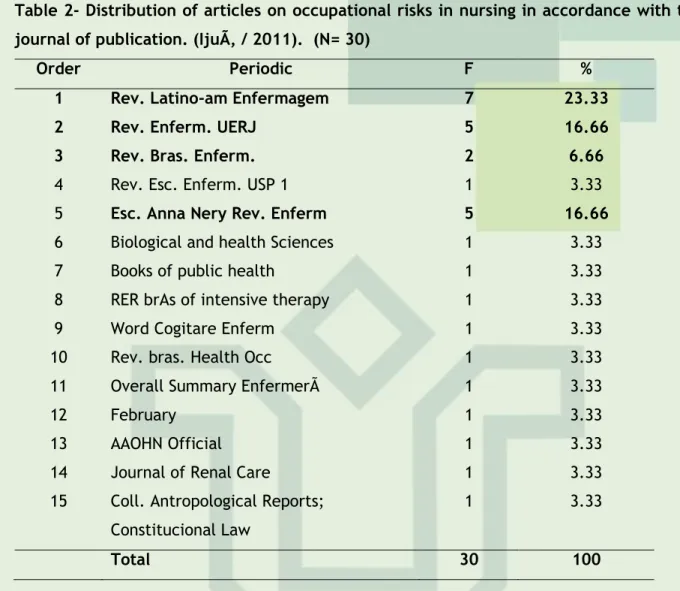
same percentage. The publication in these respective years may be related to the increaseof studies about the problems related to the health of the worker on account of the Public Policy on Worker's Health. Contemplating another question of the integrative review on the periodic publication is presented in the table below.
Table 2- Distribution of articles on occupational risks in nursing in accordance with the journal of publication. (IjuÃ, / 2011). (N= 30)
Order Periodic F %
1 Rev. Latino-am Enfermagem 7 23.33
2 Rev. Enferm. UERJ 5 16.66
3 Rev. Bras. Enferm. 2 6.66
4 Rev. Esc. Enferm. USP 1 1 3.33
5 Esc. Anna Nery Rev. Enferm 5 16.66
6 Biological and health Sciences 1 3.33
7 Books of public health 1 3.33
8 RER brAs of intensive therapy 1 3.33
9 Word Cogitare Enferm 1 3.33
10 Rev. bras. Health Occ 1 3.33
11 Overall Summary Enfermerà 1 3.33
12 February 1 3.33
13 AAOHN Official 1 3.33
14 Journal of Renal Care 1 3.33
15 Coll. Antropological Reports; Constitucional Law
1 3.33
Total 30 100
Table 2 provides evidence that the articles published in journals 7 compose the
highest percentage ( 23.33 %) published by Revista Latino-Americana de Enfermagem, followed in equal percentages by ( 16.66 %) nursing journals Journal of UERJ and School Anna Nery Nursing Journal , magazines of Qualis A2 and B1, respectively. This fact is related to the possibility of the authors having links to programs of post-graduation published in journals with QUALIS CAPES to score higher with views to qualify the productions of emerging research.
In relation to 77 authors of articles revealed that 71 are nurses, being that 23 are teachers and doctors. Among the other professional categories are distinguished doctors, technicians in hospital management, biologist, and physiotherapists and undergraduates in nursing.
Table 3 presents the steps of methodological studies with regard to the type of study, scenario and subject.
Table 3 - Distribution of articles according to the methodological steps pertaining to the type of study, scenario, subjects/sample. (IjuÃ/ 2011)
J. res.: fundam. care. online 2014. out./dez. 6(4):1610-1621
1615
The results show that the majority of studies are descriptive (63.33 %) with quantitative approach (5.33 %). In relation to the locations of the studies involved, general hospitals represent the highest percentage (4 6.66 %), followed by university hospitals (30 %), and public hospitals (13.33 %). As to the sector in which they were carried out, the highest percentage was in all sectors the hospital (26.66 %), followed by the emergency sector (16.66 %) and Centers of Intensive Treatment (13.33 %) of those surveyed institutions. It is noteworthy that regardless of the sector of work, the hospital environment exposes the worker to nursing risks. But the emergency sector by being the port of entry of customers to hospital services and, in their majority, do not have a definite diagnosis, is of greater risk for nursing workers.
In relation to profession, the study shows that from the total of articles analyzed 70% were performed with the nursing team and 16.66% with nurses and in equal percentage studies had as subject nursing assistants and technicians. The high percentage of studies conducted with the nursing team can be related to the fact that the greater exposure and occupational accidents affect technicians and nursing assistants, and for being greater in number of professionals in health care institutions.
Results of studies Indication of articles
Higher rate of work-related accidents (TA) with nursing assistants and technicians
1, 2, 5, 10, 12, 14, 16.17, 18.21, 24
Indicative Responses F %
Study type Exploratory 19 63.33
Descriptive 8 26.66
Documentary 3 10
Research Site General Hospital 14 46.66
University Hospital 9 30
Public Hospital 4 13.33
Approach Quantitative 16 5.33
Qualitative 3 10
Quanti-qualitative 1 3.33
Sector of study CTI 4 13.33
Emergency Unit 5 16.66 Medical Clinic 2 6.66 Nephrology Unit 1 3.33 Maternity Unit 1 3.33 Hospitalization 3 10 All sectors 8 26.66 Subject/sample Nursing Staff 5 16,66 Assistants 5 16,66
Auxiliary Nurse and Technician of enf.
5 16.66
J. res.: fundam. care. online 2014. out./dez. 6(4):1610-1621
1616
Workers of female sex 1, 2, 5, 8, 10, 12, 14, 19
Need for constant attention in tasks 5, 11, 16, 18, 19, 21 Immunization for hepatitis B and dT and exposure
to hep B and HIV
2, 4, 7, 8, 11, 13, 15, 16, 26
Emergency Unit higher index of TA 5, 14, 15
Activities focused only on 7, 22
Conditions of work. Favor TA 1, 3, 5, 11, 14, 15, 16
TA had happened between nursing workers
With age ranging from 40 to 59 years old (experienced) - 50%
1, 2
Absentees and occupational risks 1, 14, 16,
Greater exposure AT work with less time to work less than 5 years old
8, 21, 23
Accident involving biological material 2, 3, 4, 5, 6, 7, 8, 13.15, 16, 18, 19, 21, 22, 24, 26, 27
Needle injury 2, 5, 8, 10, 12, 14, 15, 16, 17,
18, 19, 21, 24
Working Conditions inadequate 3, 5, 14, 16, 19, 20,
Agent responsible for TA: ignorance about the risks; 3, 5, 6, 10, 14
Risk related to the task performed 5, 9, 14, 15, 19, 21, 24, 26, 27 Chemical Hazard: manipulation of mutagenic
and/or carcinogenic; inhalation; exposure of skin and eyes
3, 19, 21, 26, 27
Improper use of labels in pans 3, 10
Ignorance of the NR 32 - BIOSSEG 3, 15
Activity performed at the time of the accident: venous puncture, intravenous drug administration
5, 12, 20, 21, 23
Recapped 2, 10, 12, 15, 17, 18.20
Do not use PPE 6, 8, 13, 15, 19, 20, 21, 23, 26,
27
Ignorance of proper PPE to risk 3, 6, 13, 15
Underreporting 1, 17, 21, 24
Lack of knowledge about the administrative procedures post TA
1, 13 Ergonomic Risk: inadequate distribution of personal
and/or team; awkward postures of the body; inadequate space for the realization of the activities; furniture insufficient, inappropriate storage of materials, repetitiveness of tasks, pace of work overload, excessive / insufficiency of staff
3, 5.7, 11.16, 18, 19, 20, 21, 26, 27
Incorporate educational actions in daily 6, 10, 13, 15, 17, 19, 26
Need for greater attention in tasks 5, 11, 18, 21
J. res.: fundam. care. online 2014. out./dez. 6(4):1610-1621
1617
Lighting for deficient procedures favoring thepredisposition to TAA, and I promise the quality of assistance
3, 7, 19
Physical Hazard: noise, shock 9, 16, 19, 26
TABLE I - Distribution of more mentioned results. (IjuÃ/ 2011)
Parting from this production it is possible to derive that there is a higher frequency of exposure to environmental risks and, by consequence, Work Accident (TA) among nursing workers, i.e. nurses, technicians and nursing assistants, when compared to other professional categories in the area of health care. This stems from the complexity of the nursing work process, the constant presence of occupational risks, and by the fact that this professional category remains the largest time beside the patient, as well as by the type of procedures performed by the nursing staff.10-11
With regard to occupational risks of greater exposure of nursing staff, both the national and the international literature, there is a predominance of exposure to biological risk by means of contact to human body fluids and in female workers.12-3
Another evidence of the research is that nursing is a professional category that consists, basically, of women.
As to the professional category that is most exposed to environmental risks of inadequate manner and thus is the victim of an accident at work, are the nursing auxiliaries, which contributed with 81% of the OA, the nurses with 13% and the nursing technicians with 6%.12,14-5 It is worth noting, that among the components of the nursing staff
assistants are an extinguished group of professionals, according to the National Council of Nursing and among the nursing team are the group of lower professional qualification.
Studies evaluated the accidents suffered by nurses noted that these occurred within the first few hours of work, which is explained by the type of activity carried out by the professional at the beginning of the On-Call.15
In relation to the age-range with greater frequency of exposure to various environmental risks of health services and the consequent work accident occurs between the professionals of 31 years of age to 50 years of age who have experience, dexterity and time of service in the institution between 6 to 10 years or more.14
It is inferred that workers with such experience, sometimes, do not meet the rigors required to obviate against the possible accidents, when carrying out their tasks. Apart from all this, the scarcity of training in hospitals does not contribute to the requalification regarding job security.10
The studies demonstrate also that the risk involving biological material mostly affects the professional category and relates to the predominance of injuries from piercing.12
This follows from the fact of being the professional category that most manipulates the biological material.11
Moreover, among the risk factors for exposure of the nursing team, evidences point to work overload experienced by this professional category as a facilitator of exposure to environmental risks.12,16
Moreover, the lack of human and material resources contribute to the exposure of this professional category.17
Together with this, appropriate work conditions are fundamental in view of avoiding exposures of the nursing worker to risks, still that the nursing profession is considered a high-risk occupation.18
J. res.: fundam. care. online 2014. out./dez. 6(4):1610-1621
1618
CONCLUSION
In this understanding, authors point to situations related to working conditions that may expose the health of the nursing worker to the risk of acquiring pathologies. And that may facilitate errors in the assistance provided to customers, such as: insufficient or inadequate safety devices, inadequate preventive maintenance, insufficient or inadequate safety instructions, inappropriate use of personal protective equipment, danger of accidents caused by shocks or cuts against objects property; architectural drawing inappropriate of jobs in general; reduced area of work for the task; inadequate lighting, among others.10-2 -4-9 20-1-2
Such findings allude to thoughts about exposures that may relate to lapses in knowledge or even awareness of worker.12
In this manner, health problems of workers are fruits of a social context, which needs rethinking, assessed in order to enhance the human capital essential to the success of organizations.14
Among the factors that facilitate exposure to occupational risk is a practice, still very much used by nursing staff, in spite of being aware that it should not be performed, is re-use of needles.11-5-9, 23-4 -5-6-7 Being a practice that meets the standards of biosecurity actions
and which need to be implemented and respected by all health professionals, with emphasis on the basic rules of precaution such as the use of Personal Protective Equipment that are aimed at reducing the exposure of the professional to agents of risk20. However, several
studies still show lacking of habit, resistance or even use of PPE.10-7, 22
Research shows that at the time of an accident, 40% of workers were using PPEs and 60% were not.25
It was observed that the employees evaluate the procedure and feel the need to use the PPE, not valuing the real importance of its use for the prevention of diseases of occupational origin. In this respect, the worker adopts this posture, disregards the real risk and the recommended legislation which determines that the activities in which the occupational risk exists use of protective measures are necessary and mandatory.3
With this in mind, it is important to implement spaces for collective reflection, in addition to training sessions, which provide learning, as well as to allow the worker to exercise their citizenship and discuss topics related to their work process. In this respect, it is essential for the nursing workers to assume a subjected position towards the working process, aiming to maintain health and physical integrity.
The search to identify national and international scientific production on occupational hazards of the nursing staff operating in a hospital environment resulted in a selection of 30 articles, the majority being published in the year 2009, having as scenario general hospitals and involving the nursing team.
Studies that seek the production of knowledge allow you to reach the evidence and from there it is possible to think in proposals for interventions with a view to promotion of health and prevention of accidents and diseases of nursing professionals.
J. res.: fundam. care. online 2014. out./dez. 6(4):1610-1621
1619
REFERENCES
The product of this research has led to the proposal of the thesis that aims interventions related to occupational risks in nursing professionals from hospitals in a city in southern Brazil.
The results show that injuries resulting from the presence of environmental risk in health services affect in a higher percentage the nursing staff, there is a predominance of exposure due to biological risk.
Evidence shows that even with knowledge of the constant presence of risks involved with nursing work, with mandatory usage of personal protective equipment, the nursing staff does not adhere to measures, and so emphasizes the knowledge gap and the weaknesses of educational actions of a permanent nature. Another highlight is that there is a shortage of professionals operating in the work areas, leading to an overload of work and imposture of an excessive working pace.
The above demonstrated proves the need to implement moments of permanent education, focusing on reflective practice, because the field of Worker Health sometimes focuses on specific trainings where the worker receives instructions on how to proceed and behave.
1. Felli V. Study of work accidents related to human body fluids Exposure among health workers at a university hospital. Rev Latino-Am. Enfermagem. 2006; 14: 346-53. Disponível em: http://www.scielo.br/scielo.php?pid=s0104-11692006000300007&script=sci_arttext 2. Cavalcante CAA, Endes BC, Menezes RMP, Medeiros SM. Riscos ocupacionais do trabalho em enfermagem. Ciência, Cuidado e Saúde. 2006; 5(1):88-97. Disponível em: http://pt.scribd.com/doc/71822710/Riscos-Ocupacionais-No-Trabalho-de-Enfermagem 3. Brasil, Ministério do Trabalho. Normas regulamentadoras: segurança e medicina do trabalho. ed. Atlas, São Paulo, Atlas. 2011.
4. Souza ACS, Silva CF, Tipple AFV, Santos SLV, Neves HCC. O uso de equipamentos de proteção individual entre graduandos de cursos da área da saúde e a contribuição das instituições formadoras. Cienc Cuid Saúde. 2008 jan/mar; 7(1):27-36. Disponível em: br/ojs/index.php/CiencCuidSaude/article/.../3206
5. Silva JA, Paula VS, Almeida AJ, Villar LM. Investigação de acidentes biológicos entre profissionais de saúde. Esc Anna Nery Rev Enferm. 2009 jul-set; 13(3):508-16. Disponível em: www.scielo.br/scielo.php?pid=S1414-81452009000300008...sci
6. Whittemore R, Knafl K. The integrative review: updated methodology. J Adv Nurs. 2005 dec; 52(5):546-53.
7. Beyea SC, Nicoll LH. Writing an integrative review. AORN. 1998 april; 67(4):877-80. 8. Bahcecik N; Ozturk H The occupational safety and health in hospitals from the point of nurses. Coll Antropol. 2009 dec;33(4):1205-14.
9. Mendes KDS, Silveira RCCP, Galvão CM. Revisão integrativa: método de pesquisa para a incorporação de evidências na saúde e na enfermagem. Texto Contexto Enferm. 2008
oct-J. res.: fundam. care. online 2014. out./dez. 6(4):1610-1621
1620
dec; 17(4):758-64.Disponível em:www.scielo.br/scielo.php?pid=S0104-07072008000400018...sci
10. Ribeiro EJG, Shimizu HE. Acidentes de trabalho com trabalhadores de enfermagem. Rev
Bras Enferm. 2007 set-out; 60(5):535-40. Disponível em:
www.scielo.br/pdf/reben/v60n5/v60n5a10.pd
11. Canini SRMS, Gir E, Hayashida M, Machado AA. Needlestick injuries among nursing staff members at a university hospital in the interior of são paulo state.2002 março-abril; 10(2): 172-8. Disponível em: www.scielo.br/scielo.php?pid=S0104-11692002000200008...sci.
12. Balsamo AC, Felli VEA. Study of work accidents related to human body fluids exposure among health workers at a university hospital. Rev Latino-am Enfermagem. 2006 maio-junho; 14(3):346-53. Disponível em: www.scielo.br/scielo.php?pid=s0104-11692006000300007...sci
13. Oliveira BAC, Kluthcovsky ACGC, Kluthcovsky FA. Estudo sobre a ocorrência de acidentes de trabalho com material biológico em profissionais de enfermagem de um hospital.
Cogitare Enferm. 2008 jan/mar; 13(2):194-205. Disponível em:
cascavel.ufsm.br/revistas/ojs-2.2.2/index.php/revistasaude/.../2060
14. Giomo DB, Freitas FCT, Alves LA, Robazzi MLCC. Acidentes de trabalho, riscos ocupacionais e absenteísmo entre trabalhadores de enfermagem hospitalar. Rer enferm UERJ. 2009 jan/mar; 17(1):24-9. Disponível em: www.scielo.br/scielo.php?pid=S0080-62342012000200019...sci
15. Nishide VM, Benatti MCC, Alexandre NMC. Ocorrência de acidente do trabalho em uma unidade de terapia intensiva. Rer Latino-am Enfermagem. 2004 março-abril; 12(2):204-11. Disponível em: sigplanet.sytes.net/nova_plataforma/monografias/8656.pdf
16. Marziale MHP, Rodrigues CM. The scientific production on occupational accidents with needlestick materials among members of the nursing team. Rev Latino-am Enfermagem.
2002 julho-agosto; 10(4):571-7. Disponível em:
www.scielo.br/scielo.php?script=sci...pid...11692002000400015
17. Miranda ÉJP, Stancato K. Riscos à saúde da equipe de enfermagem em unidade de terapia intensiva: proposta de abordagem integral da saúde. Revista Brasileira de Terapia Intensiva. 2008; 20(1). Disponível em: www.scielo.br/scielo.php?pid=S0103-507X2008000100011..
18. Almeida ANG, Tipple AFV, Souza ACS, Brasileiro ME. Risco biológico entre os trabalhadores de enfermagem. Rev. enferm UERJ. 2009 out/dez; 17(4):595-00. Disponível em: www.facenf.uerj.br/v17n4/v17n4a24.pdf
19. Lima FA, Pinheiro PNC, Vieira NFC. Acidentes com material perfurocortante: conhecendo os sentimentos e as emoções dos profissionais de enfermagem. Esc Anna Nery R
Enferm. 2007 jun; 11 (2): 205-11. Disponível em:
www.scielo.br/pdf/ean/v11n2/v11n2a04.pd
20. Alves SSM, Passos JP, Tocantins FR. Acidentes com perfurocortantes em trabalhadores de enfermagem: uma questão de biossegurança. Rev enferm UERJ. 2009 jul/set; 17(3):373-7. Disponível em: www.facenf.uerj.br/v17n3/v17n3a13.pdf
21. Duarte NS, Mauro MYC. Análise dos fatores de riscos ocupacionais do trabalho de enfermagem sob a ótica dos enfermeiros. Rev bras Saúde ocup. 2010; 35 (121):157-67. Disponível em: www.scielo.br/scielo.php?pid=S0303-76572010000100017...sci
J. res.: fundam. care. online 2014. out./dez. 6(4):1610-1621
1621
22. Simão SAF, Soares CRG, Souza V, Borges RAA, Cortez EA. Acidentes de trabalho commaterial perfurocortante envolvendo profissionais de enfermagem de unidade de emergência hospitalar. Rev enferm UERJ. 2010 jul/set; 18(3):400-4. Disponível em: www.facenf.uerj.br/v18n3/v18n3a11.pdf
23. Caetano JÁ, Soares E, Braquehais AR, Rolim KAC. Acidentes de trabalho com material biológico no cotidiano da enfermagem em unidade de alta complexidade. Enfermería Global. 2006; 9:1-12. Disponível em: revistas.um.es/eglobal/article/view/371/363
24. Nishide VM, Benatti MCC. Riscos ocupacionais entre trabalhadores de enfermagem de uma unidade de terapia intensiva. Rev Esc Enferm. 2004; 38(4): 406-14. Disponível em: www.scielo.br/scielo.php?script=sci...pid...62342004000400006
25. Moura ECC, Moreira MFS, Fonseca SM. Performance of nursing auxiliaries and technicians in managing piercing Cutting material: a necessary study. Rev Latino-am Enfermagem. 2009 maio-junho; 17(3). Disponível em: www.scielo.br/scielo.php?pid=S0104-11692009000300007.
26. Silva JA, Paula VS, Almeida AJ, Villar LM. Acidentes biológicos entre profissionais de saúde. Esc Anna Nery Rev Enferm. 2009 jul-set; 13 (3): 508-16. Disponível em: www.scielo.br/scielo.php?pid=S1414-81452009000300008...sci..
27. Lima LM, Oliveira CC, Rodrigues KMR. Exposição ocupacional por material biológico no hospital santa casa de Pelotas - 2004 a 2008. Esc Anna Nery. 2011 jan-mar; 15 (1):96-102. Disponível em: www.scielo.br/scielo.php?script=sci...pid...81452011000100014
Received on: 18/05/2014 Required for review: 03/07/2014 Approved on: 01/09/2014 Published on: 01/10/2014
Contact of the corresponding author:
Marli Maria Loro Rua 24 de fevereiro, 1498, Bairro São José CEP: 98700000 ― Ijuí (RS), Brasil. Email: [email protected]