Repositório ISCTE-IUL
Deposited in Repositório ISCTE-IUL: 2018-10-17
Deposited version: Post-print
Peer-review status of attached file: Peer-reviewed
Citation for published item:
Silva, C. S. & Calheiros, M. M. (2018). Stop yelling: interparental conflict and adolescents’ self-representations as mediated by their perceived relationships with parents. Journal of Family Issues. 39 (7), 2174-2204
Further information on publisher's website: 10.1177/0192513X17741176
Publisher's copyright statement:
This is the peer reviewed version of the following article: Silva, C. S. & Calheiros, M. M. (2018). Stop yelling: interparental conflict and adolescents’ self-representations as mediated by their perceived relationships with parents. Journal of Family Issues. 39 (7), 2174-2204, which has been published in final form at https://dx.doi.org/10.1177/0192513X17741176. This article may be used for non-commercial purposes in accordance with the Publisher's Terms and Conditions for self-archiving.
Use policy
Creative Commons CC BY 4.0
The full-text may be used and/or reproduced, and given to third parties in any format or medium, without prior permission or charge, for personal research or study, educational, or not-for-profit purposes provided that:
• a full bibliographic reference is made to the original source • a link is made to the metadata record in the Repository • the full-text is not changed in any way
The full-text must not be sold in any format or medium without the formal permission of the copyright holders.
Serviços de Informação e Documentação, Instituto Universitário de Lisboa (ISCTE-IUL) Av. das Forças Armadas, Edifício II, 1649-026 Lisboa Portugal
Phone: +(351) 217 903 024 | e-mail: [email protected] https://repositorio.iscte-iul.pt
Stop Yelling: Interparental conflict and adolescents’ self-representations as mediated by their perceived relationships with parents
Carla Sofia Silva1 and Maria Manuela Calheiros1
1 Instituto Universitário de Lisboa (ISCTE-IUL), Centro de Investigação e Intervenção
Social (CIS-IUL), Lisboa, Portugal
Author note:
Carla Sofia Silva and Maria Manuela Calheiros, Instituto Universitário de Lisboa (ISCTE-IUL), Centro de Investigação e Intervenção Social (CIS-IUL), Lisboa, Portugal; Av. das Forças Armadas, 1649-026 Lisboa, Portugal.
This research was supported by Portuguese Foundation for Science and Technology Doctoral Grant SFRH/BD/90354/2012, awarded to Carla Sofia Silva. We thank the schools for approving this study and are grateful to the adolescents for agreeing to participate.
Correspondence concerning this article should be addressed to Carla Sofia Silva, Instituto Universitário de Lisboa (ISCTE-IUL), Centro de Investigação e Intervenção Social (CIS-IUL), Av. das Forças Armadas, 1649-026 Lisboa, Portugal. E-mail:
Stop Yelling: Interparental conflict and adolescents’ self-representations as mediated by their perceived relationships with parents
Abstract
Adolescents’ perceptions of their relationship with both parents were examined as mediators linking interparental conflict to their self-representations (SR). Portuguese adolescents (N=214; 58.4% girls), aged 10-16 years old (M=13.39), attending public elementary and secondary schools, filled out self-report measures. Multi mediator path analysis models revealed that interparental conflict predicted less favorable SR in most evaluated domains. This association was mediated by adolescents’ perceptions of: 1) support in the mother-adolescent relationship, related to instrumental, social, emotional, physical appearance, and intelligence SR; 2) negative interactions in the mother-adolescent relationship related to instrumental and physical appearance SR; 3) support in the father-adolescent relationship, related to social and physical appearance SR; and 4) negative interactions in the father-adolescent relationship related to instrumental SR. This study emphasizes the relevance interparental conflict and adolescents’ perceptions of their relationship with both parents in their SR construction. Practical applications point to promoting constructive conflict and improving parent-adolescent relationships.
Keywords: Interparental conflict; Parent-adolescent relationships;
Stop Yelling: Interparental conflict and adolescents’ self-representations as mediated by their perceived relationships with parents
Witnessing destructive interparental conflict has consistently correlated to a wide range of problematic outcomes in children and adolescents (e.g., Buehler, Lange, & Franck, 2007). This line of research has started to include self-related variables as outcomes, given that the self has an important role in life satisfaction (Myers & Diener, 1995) and additionally it is prominent in organizing behavior and predicting adjustment (e.g., Boden, Fergusson, & Horwood, 2008; Jacobs, Bleeker, & Constantino, 2003; Orth, Robins, & Roberts, 2008).
Self-concept and, more specifically, self-representations (SR) are social constructions that develop through experiences and interactions with close significant others, especially caregivers (Bowlby, 1969; Bretherton & Munholland, 2008; Cooley, 1902). This social nature of the self was emphasized by the symbolic interactionism perspective (Cooley, 1902; Mead, 1934), in which self-representations are viewed as being constructed within social interactions with significant others and the broader social context, through linguistic exchanges (i.e., symbolic interactions). From this perspective, through these interactions, individuals gradually develop a sense of self by perceiving a reflection of themselves in the responses of other to their behaviour. Cooley (1902) designated this process as the “looking-glass self” and defended the prevalence significant others’ influence in the construction of self-representations, given that in close relationships with significant others, frequent communication and interaction are more likely (Cook & Douglas, 1998). Thus, significant others would function like a looking-glass self, in which adolescents’ interpretations of the responses of significant others to their actions are gradually internalized in their self-representations (Openshaw & Thomas, 1990). Particularly, interactional patterns with parents/caregivers are considered as the building blocks for self-construction (Carmichael, Tsai, Smith, Caprariello, & Reis, 2007), given that, from
birth on, they are progressively assimilated and accommodated, forming the organizing principles of the self (Deason & Randoplh, 1998).
Being the self so inextricably relational, understanding the self must take into account the relationship context in which the self exists (Carmichael et al., 2007). Therefore, it is important to consider children’s and adolescents’ experiences with interparental conflict in the study of self-construction, because of its potential to influence their representational patterns and, consequently, their SR. Indeed, although still sparse, a few studies have demonstrated associations between exposure to destructive interparental conflict and negative overall child self-perceptions (e.g., Grych, Harold, & Miles, 2003) with an emphasis in specific domains, such as academic and social competence (e.g., Isabella & Diener, 2010).
One of the main theories focusing on the effects of interparental conflict on youth’s outcomes is the emotional security theory (EST) (Cummings & Davies, 2010). This theory posits that exposure to destructive interparental conflict increases the risk of negative child/adolescent outcomes through two main pathways: 1) by increasing their emotional insecurity in the interparental relationship - i.e., heightened emotional reactivity, negative representations of interparental conflict, and excessive regulation of exposure to the conflict, and 2) by undermining features of the parent-child relationship. Therefore, EST is consistent with attachment theory (Bowlby, 1969) holding that children’s and adolescents’ ability to resort to their parents as sources of security have important implications for their adjustment, and that the harmful effects of those relational experiences occur through pathways involving both the interparental and the parent-child subsystems.
Previous research has provided consistent support for the first main pathway, that is, for the mediating role of emotional insecurity in associations between interparental conflict and multiple child and adolescent outcomes, including self-related ones such as self-esteem problems (e.g., Rhoades, 2008). However, research is lacking on the analysis of those
associations through the second main pathway, that is, on examining the intervening role of dimensions of the parent-adolescent relationship. In effect, according to the spillover hypothesis (Erel & Burman, 1995), positive parent-child relationships are likely to be hindered in the presence interparental conflict. The term spillover refers to a transfer of mood, affect, or behavior from one setting or relationship to another (Repetti, 1987). Applied to the family system, this process involves that feelings that were instigated in the marital subsystem are expressed in the parent-child subsystem (Easterbrooks & Emde, 1988). This can occur through four main mechanisms: 1) “detouring", whereby the negative feelings experienced in the marital relationship are expressed in relation to the child/adolescent; 2) modeling, in which dysfunctional interactions between parents elicit or exacerbate similar interactions in the parent-child relationship; 3) socialization, wherewith parents experiencing marital conflict tend to adopt less optimal parenting techniques; and 4) family stress and role strain, whence parents under marital stress are less emotionally available to responsively monitor and respond to their children’s needs (for a review, see Erel & Burman, 1995).
Thus, the spillover hypothesis posits that the negative emotions and overall stress stemming from marital problems spillover to the parent-child relationship, weakens parents’ ability to maintain adequate and positive relationships with their children through adequate supervision, warmth, support, open communication and structure, which in turn can have a harmful impact on child/adolescent outcomes (Cummings & Davies, 2010). The direction of these effects between interparental conflict and various aspects of the parent-child
relationship (e.g., relationship quality; warmth) have been consistently supported by various longitudinal studies (Krishnakumar & Buehler, 2000).
From early adolescence on, this issue gains particular relevance, given that, starting at this phase, parents and adolescents need to adjust their relationship due to the normative increase in adolescent striving for a sense of autonomy, control, competence and mastery in
this developmental period (Zimmer-Gembeck & Collins, 2003). The negotiation process of emancipation often leads to an increase in parent-adolescent conflict experiences (Collins & Laursen, 2004). Throughout this process, adolescents are also faced with a broad range of developmental changes, at the cognitive, social and physical levels (Harter, 2015), and an increase in normative stressors (e.g., school transitions) (e.g., Jacobs et al., 2003), at the same time as parental support and guidance decreases (Laursen & Collins, 2009). Therefore, parents’ ability to successfully manage the balance between adolescents’ increasing strives for autonomy and simultaneous need of parental support and guidance are determinant to the maintenance of adaptive parent-adolescents relationships and, thus, to adolescents’ healthy and secure emancipation (Soenens et al., 2007). Interparental conflict may hinder the achievement of such balance, by undermining parents’ ability to interact adequately with adolescents, which potentially reduces adolescents’ perceptions of support provided by the parent-adolescent relationship (Forehand, Biggar, Kotchick, 1998).
All these developmental and parent-adolescent relationship challenges taken together may increase adolescents’ vulnerability to the harmful effects of interparental conflict (Cummings, George, McCoy, & Davies, 2012), and significantly affect their self-representation construction process. Indeed, the formation of an enduring sense of self is a core developmental task for adolescents, stimulated and shaped by the multiple
developmental changes occurring at the biological, social and cognitive level (i.e., formal abstract reasoning) (Lerner & Steinberg, 2009). Particularly, the development of new cognitive abilities, especially the greater capacity to think abstractly, are pivotal in the
formation of a more coherent, sophisticated and abstract sense of self (Steinberg, 2013). As a result, as adolescents mature, their self-knowledge progressively takes the form of
abstractions derived from their behaviors and experiences (e.g., Fisher & Bidell, 2006; McConnell, 2011). In this socio-cognitive perspective, self-concept is conceived as a
multifaceted and hierarchical system, comprising sets of domain-specific self-representations, that become increasingly differentiated as individuals develop (e.g., Baumeister, 1998; Fiske & Taylor, 1991; Linville & Carlston, 1994; Oosterwegel & Oppenheimer, 2002).
The relational contexts that parents provide their children have a fundamental
influence on their self-development (Dusek & McIntyre, 2003) given that they can stimulate adolescents’ exploration of self-options and encourage meaningful commitments and identity choices (Scabini & Manzi, 2011). Research has highlighted the importance of children’s and adolescents’ perception of their relationship with their parents in shaping their SR, in which more negative perceptions of the relationship with the primary figures are associated with more negative SR (e.g., Putnick et al., 2008; Plunkett, Henry, Robinson, Behnke, & Falcon, 2007). Consistent with the symbolic interactionism perspective described above, adolescents who perceive their parents as supportive are likely to think that their parents have positive representations of them (Openshaw & Thomas, 1990). In contrast, adolescents who perceive their parents as highly critical or low in support are likely to perceive and internalize negative symbolic meanings of themselves (Conger, Conger, & Scaramella, 1997) and thus develop more negative SR.
Yet, to our knowledge, only two studies focused on examining facets of parent-adolescent relationships as mediators of the link between interparental conflict and self-related outcomes, such as self-esteem and perceptions of scholastic competence (e.g., Siffert, Schwarz, & Stutz, 2012). These studies have considered dimensions of parenting style or quality (e.g., psychological control; behavioral control; warmth; authoritarian parenting; supervision), but research is lacking on the mediating role of other relevant dimensions of the parent-adolescent relationship such as adolescents perceptions of support (e.g.,
companionship, affection, intimacy), and of negative interactions (e.g., conflict, antagonism), which are key dimensions of parent-adolescent relationships, especially given that in this
developmental stage both parents and adolescents need to adjust their relationship due to the normative process of adolescents’ individuation from parents and increasing autonomy (De Goede, Branje, & Meeus, 2009).
Certainly, support from parents in the form of shared activities, emotional ties and intimacy (Furman & Buhrmester, 1985) provide a secure base to adolescents’ exploration of the world outside the family and engagement in new social relationships (Collins & Laursen, 2004), and has been found to predict positive self-perceptions of competence and self-esteem (e.g., Peixoto, 2012). Conflict is also a fundamental aspect in parent-adolescent relationships, given the need to integrate different objectives and expectations in the process of adolescents’ separation-individuation process (Zimmer-Gembeck & Collins, 2003). Given that
self-development often occurs concomitantly with parent-adolescent conflict (Missotten, Luyckx, Branje, Vanhalst, & Goossens, 2011), difficulties in conflict managing may be detrimental to adolescents’ self-construction. Indeed, negative interactions in parent-adolescent relationship (e.g., conflict, criticism) have been found to be associated to worse academic self-concept in adolescence (Putnick et al., 2008).
However, several relevant domains of adolescents’ SR have remained absent from this line of research. Given that self-concept is a multidimensional system (Harter, 2015), which becomes increasingly differentiated in adolescence (Harter, 2006a), and since adolescents SR in different domains are conceptually and statistically independent (e.g., Harter, 1988; McConnel, 2011), focusing predominantly on academic self-concept or
measuring only global self-concept or global self-esteem ignores important variations in other important self-concept domains (e.g., social, emotional, physical appearance) (Putnick et al., 2008). Indeed, along with cognitive-developmental advances mentioned above, a number of other stage-salient biological and social changes shape the construction and organization of adolescents’ SR (Meeus, 2011). The marked changes in the body make physical appearance
SR very salient in adolescence (e.g., Harter, 2015). In addition, along with the progressive emancipation from parents and increased engagement in new social contexts, adolescents are confronted with a multiplicity of different expectations and possibilities in defining who they are in the behavioral, social and emotional domains (Jacobs et al., 2003). Namely during school transitions, adolescents may experience dips in academic performance, changes in their social circles, lower satisfaction with physical appearance, and increased behavioral problems (Steinberg, 2013). Thus, assessing several relevant SR domains is important in order to obtain a clearer picture of the specific associations among interparental conflict, adolescents’ perception of their relationship with their parents and their SR.
This line of research has typically focused on the mother-child relationship or has collapsed mothers and fathers into a parent-child relationship variable (Siffert et al., 2012). However, research has documented differences between mothers’ and fathers’ roles in the life of their adolescent children (Day & Padilla-Walker, 2009). Therefore, the nature of
adolescents’ perception of their relationship with their mothers and fathers may differ (Marceau et al., 2015). For example, research suggests that mother-child relationships are typically more intimate, while father-child relationships are more playful and involve more leisure activities (Videon, 2005). Also, several studies have suggested that mothers are closer to adolescents and more important support providers than fathers (Seiffge-Krenke, Overbeek, & Vermulst, 2010). However, little is known of whether discrepancies in the
mother-adolescent and father-mother-adolescent relationships may be differentially associated with adolescents’ SR, and no study so far has examined the mediating role of adolescents’ perceptions of their relationship with both parents in the link between interparental conflict and their domain-specific SR.
In addition, the few available studies analyzing adolescents’ relationship with both parents report that mother’s and father’s roles on adolescent outcomes are often dependent
upon the gender of the adolescent (Day & Padilla-Walker, 2009). Regarding self-related outcomes, some research has shown that associations between parent-adolescent relationships with self-related issues may be different for adolescent girls and boys (e.g., Plunkett et al., 2007), whereas other research has shown that the pattern of those associations hold across gender groups (e.g., Crocetti, Branje, Rubini, Koot, & Meeus, 2017; Luyckx, Soenens, Vansteenkiste, Goossens, & Berzonsky, 2007). Be that as it may, previous research has shown gender differences in adolescents’ perceptions of their relationship with their parents (e.g., Furman & Buhrmester, 1992), and self-concept measures have also indicated consistent sex differences in adolescents’ self-representations - girls typically evaluate their social and language abilities as higher than boys, while boys rate evaluate their physical and
mathematical abilities, as well as their appearance more positively than girls (e.g., Harter, 2015). Although self-concept researchers note that the amount of variance may be small (Marsh, 1989), adolescents’ gender may be important to consider as a potential moderator of associations between and among interparental conflict, perceived relationship with both mother and father and adolescent self-representations.
In this paper, as part of a larger study, and as a complement to a previous analysis regarding the association between interparental conflict and adolescents’ SR through signs of emotional insecurity [Anonymous, 2016], we intend to address the gaps in the literature by analyzing early and middle adolescents’ perception of their relationships with their parents, in terms of negative interactions and support, as mediators linking interparental conflict to their SR. In addition, this study extends existing literature on this issue by considering,
simultaneously, different relevant specific SR domains – instrumental, social, emotional, intelligence, physical appearance, and opposition – as evaluated through a self-representation measure for adolescents. Based on the theoretical background described above, it is expected that interparental conflict will predict lower levels of perception of support and higher levels
of negative interactions in both the mother-adolescent and father-adolescent relationship, which, in turn, would be associated to less favorable SR in different domains. Furthermore, based on the existing evidence on the differences between the role of mothers and fathers (Videon, 2005) we included both parents in the study and examined adolescents’ perception of the mother-adolescent and father-adolescent relationships as mediators of the link between interparental conflict and adolescents’ SR in separate models. Given that many studies have documented that adolescents typically have a closer relationship with their mother than with their father (Seiffge-Krenke et al., 2010), we expected to find a more prominent role (i.e., more unique contributions) of the dimensions of the mother-adolescent relationship as compared to father-adolescent relationship. In addition, based on existing evidence of gender differences in perceptions of parent-adolescent relationships and SR domains, we tested whether associations between interparental conflict and adolescents’ self-representations through their perceptions of their relationship with both parents were moderated by adolescent gender.
Method Participants
The data included in this report was drawn from a larger study focused on analyzing the processes that explain the link between interparental conflict and adolescents’ domain specific self-representations. Participants were recruited from six public schools: 360 adolescents, fifth to ninth graders, were invited to participate in the study. Of those, 276 (76.7%) had their parents’ informed consent and agreed to participate. Of these, 21 (7.6%) were excluded from the analyses due to non-cohabitating with both mother and father, or substitute mother and father figure, for at least two years. Another 12 (4.3%), aged more than 16 years old (i.e., 5 were 17 and 3 were 18) were also excluded from the analyses in order to reduce the age range and, therefore, minimize the variety of possible age-specific
phenomena. In addition, 29 participants (10.5%) were also excluded from the analyses because they had returned at least one entire measure unfilled. Thus, the final sample included in the analyses was composed of 214 adolescents (58.4% girls), aged between 10 and 16 years old (M age = 13.39 years, SD = 1.45), of which 92.41% are 11 to 15-year olds. The majority (197) lived with both biological parents (92.1%); 12 (5.6%) were living with their mother and a stepfather/mother’s boyfriend/partner for more than 2 years; 3 (1.4%) with their father and a stepmother/father’s girlfriend/partner for more than two years; and 2 (0.9%) lived with substitute parenting figures (aunt and uncle; godparents). Most participants were Caucasian (94.4%; n = 202), 4.2% (n = 9) were Hispanic-descendants, and 1.4% (n = 3) Afro-descendants.
Measures
Interparental conflict. The Conflict Properties Scale (CPS) from the Children’s Perceptions of Interparental Conflict Questionnaire (CPIC) (Grych, Seid, & Fincham, 1992; Sani, 1996) was used to assess adolescents’ exposure to interparental conflict. This scale consists of 19 items, answered on a 3-point scale (0-false, 1-sort of true; and 2-true). Given our theoretical focus on assessing the participants’ exposure to destructive conflict, and following the procedure used in several previous studies developed by some of the authors of this scale (e.g., Fosco & Grych, 2008), the 19 items were summed up to form a composite. Scores on the CPS could range from 0 to 38. Higher values indicate more frequent, intense, and poorly resolved conflict. The Conflict Properties subscale has shown good test – retest reliability (Grych et al., 1992). In previous studies using this scale, internal consistency has ranged from .87 to .91 (e.g., [Anonymous, 2016]; DeBoard-Lucas, Fosco, Raynor, & Grych, 2010; Fosco & Grych, 2008; Simon & Furman, 2010). Internal reliability of the 19 items in the present sample was good (Cronbach’s Alpha = .92).
Self-representations. SR were measured with the Self-Representation Questionnaire for Adolescents (SRQA) (Martins, 2013; Silva et al., 2016), through 18 attributes (10 positive - e.g., happy, intelligent; and 8 negative - e.g., sad, lazy). The SRQA was developed using two distinct procedures for the attribute identification: word frequency lists (e.g., school book’s word frequency) and an open-ended questionnaire. Additionally, to select the attributes, two criteria were adopted: 1) frequency, that is, the selection of attributes more often mentioned, and 2) identification of an equivalent number of positive and negative attributes, followed by the analysis of the attributes’ relevance and valence. Adolescents were asked to rate themselves regarding those attributes on a 5-point scale, from 1 (I am not at all like this) to 5 (I am exactly like this). SRQA is composed of six factors: instrumental (5 items; e.g., responsible); social (4 items; e.g., nice); emotional (3 items; e.g., angry); physical appearance (2 items; e.g., pretty); intelligence (2 items; e.g., intelligent); and opposition (2 items; e.g., stubborn). The negative attributes are reverse-scored so that higher scores in each dimension indicate more positive SR. This scale has presented good psychometric properties, both in terms of reliability and of construct validity in previous research ([Anonymous, 2016]; Martins, 2016; Silva et al., 2016). Reliability was assessed through Cronbach’s Alpha for the dimensions with more than three items and was acceptable: instrumental (α = .66) and social (α = .76). For the dimensions with three and two items, following the recommendation of Clark and Watson (1995), the mean inter-item correlations were calculated and were above the .15 threshold: emotional (mean inter-item correlation = .29), physical appearance (mean inter-item correlation = .62); intelligence (mean inter-item correlation = .67); and opposition (mean inter-item correlation = .44). A CFA with this sample, using AMOS (v. 20; Arbuckle, 2011) supported the original structure, providing a good model fit (Hu & Bentler, 1999; Schreiber, Nora, Stage, Barlow, & King, 2006): 2 (119) = 211.766, p < .001; 2/df = 1.765; CFI = .91; RMSEA = .06; SRMR =.06.
Parent-child relationship perception. Adolescents’ perceptions of their relationship with their parents were measured with the Network of Relationship Inventory (NRI) – Social Provisions Version (NRI – SPV) (Furman & Buhrmester, 1985), which measures children’s and adolescents’ perceptions of their close relationships, namely with their parents.
Participants rated their relationships with their mother and father (or their substitute parenting figures) based on 27 items, using a 5-point Likert scale, from 1 (none/not at all) to 5 (very much, almost always). The 27 items form nine conceptually distinct first-order factors (each composed by three items) that further load onto two second-order factors: (a) Support (composed by the Affection, Reliable Alliance, Enhancement of Worth, Intimacy, Instrumental Help, Companionship, and Nurturance first other factors) and (b) Negative Interactions (composed by the Conflict and Antagonism first other factors). The NRI has been used with youths from second graders to college students in several countries (e.g., USA, Brazil, Costa Rica). Both factors have shown good internal consistency (M α = .81) (e.g., Connolly & Konarski, 1994; Furman & Buhrmester, 1992; Van Horn & Marques, 2000), and good test-retest reliability with correlations after a month ranging between 66 and .70 (Connolly & Konarski, 1994). Internal reliability of the support and negative interaction factors in the present sample was good (respectively, α = .93 and α = .86 for the mother-adolescent relationship, and α = .94 and α = .90 for the father-mother-adolescent relationship). A CFA, with the present sample, using AMOS (v. 20) (Arbuckle, 2011) supported the original structure, providing a good model fit (Hu & Bentler, 1999; Schreiber et al., 2006) in both the mother-adolescent [(2 (314) = 601.444, p < .001; 2/df = 1.915; CFI = .91; RMSEA = .07; SRMR = .06)] and father-adolescent [(2 (310) = 601.102, p < .001; 2/df = 1.939; CFI = .92; RMSEA = .07; SRMR = .07)] relationship models.
This study was approved by the ethics commission of University Institute of Lisbon and by the Education Ministry (Madeira Regional Direction of Education). A request for permission to conduct the study was made to all the district’s schools comprising 5th to 9th grades. Six schools (31.6%) agreed to collaborate in the study. Then, in each school, a set of classes was randomly selected to participate. Teachers collaborated in the data collection process by making their classroom available, and consent forms were sent to all parents, asking permission for their sons/daughters to participate in a study about the influence of everyday family life and conflict on the way adolescents think of themselves, via a sealed letter that was subsequently delivered at the school. Most parents (76.7%) gave their consent for their sons/daughters’ participation in the study. Questionnaires were group administered in a classroom setting. At the start of the assessment, adolescents under 12 years old gave their informed assent, and adolescents aged 12 and older were asked to sign a consent form. All adolescents with parental consent provided informed assent/consent. They were told that their participation was voluntary and that they could choose not to participate if they desired. Participant anonymity was guaranteed, and they were assured that information would be used only for research purposes.
Plan of Analysis
First, using IBM SPSS v20 (IBM Corp., 2011), missing data were analyzed. The amount of missing data across the study measures ranged from 0 to .9% for the CPS, and from 0 to .5% for the SRQA, which is considered small (Widaman, 2006). The NRI subscales had no missing values. Missing estimations were run using an estimating method [CPS: Little’s MCAR test chi-square = 117.692, DF = 72, p<.05; normed chi-square = 1.63 (so <2); SRQA: Little’s MCAR test chi-square = 249.647, DF = 151, p<.001; normed chi-square = 1.65 (so <2)] that led to the conclusion that missing data were most likely at random (MAR) (Ullman, 2001). Therefore, for each measure (i.e., CPS and SRQA), the expectation
maximization algorithm was used to impute missing data using all information available from observations on the other variables. Next, the pattern of associations between the study variables was analyzed through a correlation analysis.
Then, to test our mediation hypothesis, due to theoretical assumptions, two separate models – one for adolescents’ perceptions of their relationship with their mother, and another for their perceptions of their relationship with their father, as mediators of the link between interparental conflict and their domain-specific self-representations – were analyzed. The proposed mediation models were tested using path analysis, performed with AMOS (v. 20) (Arbuckle, 2011) with bootstrap estimation.
According to the procedure used in several studies using the CPIC scale (e.g., DeBoard-Lucas et al., 2010; Fosco & Grych, 2008; Simon & Furman, 2010), interparental conflict was a composite variable computed by summing up the 19 items of the CPS. Following the NRI scoring instructions, adolescents’ perceptions of their relationship with their parents were four composite scores derived by averaging the items of the scales composing each factor of the NRI for the mother-adolescent and father-adolescent relationships: Support (Mother), Negative Interactions (Mother), Support (Father) and Negative Interactions (Father). Adolescents’ SR consisted of 6 composite variables, parcels of the respective items that compose each dimension.
Path analysis was used to test the indirect effects of interparental conflict on
adolescents’ SR, through their perceived relationships with both their mother and with their father in terms of support and negative interactions. Given previous research has shown significant age differences in adolescents’ self-representations (see Harter, 2015), participants’ age was included in these models as a covariate. Based on theoretical
assumptions and on the correlation analysis results, in each model, the error terms of the two dimensions of adolescents’ perception their relationship with their parents, and of the
self-representation domains that were shown to be highly significantly (i.e., p < .001) inter-correlated, were allowed to correlate.
As recommended by MacKinnon, Lockwood, and Williams (2004), to test the mediation hypothesis, a bootstrap approach (Shrout & Bolger, 2002) was used, through performing a nonparametric resampling method (bias-corrected bootstrap) (Preacher & Hayes, 2004) with 10000 resamples drawn with replacement from the original sample to derive the 95% confidence interval for the indirect effects. To evaluate model fit, the following fit indexes and criteria were used: the relative 2 index (2/df) values ≤ 2 (Arbuckle, 2011), the comparative fit index (CFI) > .95, the root mean square error of approximation (RMSEA) < .05 and the standardized root mean residual (SRMR) < .08 suggest a good fit (Hu & Bentler, 1999; Schreiber et al., 2006).
Finally, to test adolescent gender as a moderator of the hypothesized mediational pathways, moderated mediation analyses conducted separately for the mother-adolescent and father-adolescent, performed through multiple group model test, were conducted with AMOS (v. 20) (Arbuckle, 2011) with bootstrap estimation. In each analysis, an unconstrained
multiple group model (i.e., with all path models allowed to vary by gender) was compared to a model where all model paths were constrained to be equivalent for boys and girls.
Results Descriptive analyses
Table 1 presents the means, standard deviations, and inter-correlations among the all variables included in the models. Generally, the correlations were in line with the
theoretically expected pattern of relationships: interparental conflict showed significant negative correlations with adolescents’ perceptions of support in their relationship with both their mother and father, significant positive correlations with adolescents’ perceptions of negative interactions in their relationship with both their mother and father, and significant
negative correlations with all the evaluated domains of adolescents’ SR. Adolescents’ perceptions of support in both relationships showed significant positive correlations with all SR domains, with the exception of the correlations between perception of support in the mother-adolescent relationship and opposition SR. Adolescents’ perceptions of negative interactions in both relationships were significantly and negatively associated with most SR domains. Finally, adolescents’ age was significantly negatively correlated only with
perceived support in the mother-adolescent relationship and with opposition self-representations, although these correlations were fairly low.
[INSERT TABLE 1]
Interparental conflict and adolescents’ self-representations: the intervening role of their perception of their relationship with their parents
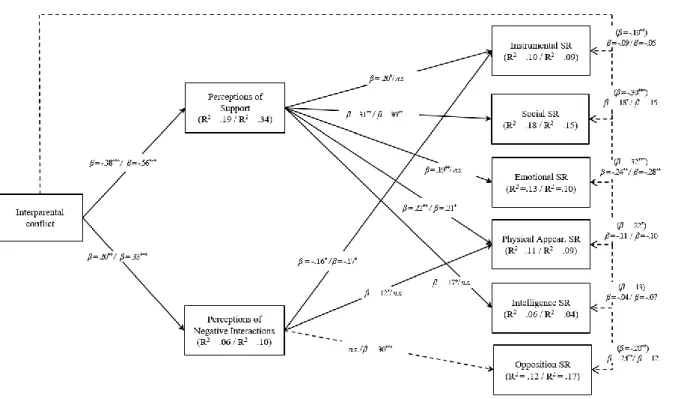
Figure 1 presents the results of the two models estimated to examine adolescents’ perceptions of their relationship with their parents (i.e., perceived support and negative interactions in both adolescent-mother and adolescent-father relationships) as intervening mechanisms linking interparental conflict to adolescent’s domain specific SR. The theoretical models presented a very good fit to the data – mother-adolescent relationship model: (2 (7) = 10.462, p = .164 (n.s.); 2/df = 1.495; CFI = .99; GFI = .99; RMSEA = .05, 90% CI [.00 to .11]; SRMR = .03); father-adolescent relationship model: (2 (10) = 6.448, p = .375 (n.s.); 2/df = 1.075; CFI = .99; GFI = .99; RMSEA = .02, 90% CI [.00 to .09]; SRMR = .03). Figure 1 depicts the standardized bootstrap parameter estimates of the two path analysis models.
[INSERT FIGURE 1]
Controlling for the potential effect of adolescents’ age, results of the mother-adolescent relationship mediation model revealed significant global indirect effects of interparental conflict on adolescents’: 1) instrumental SR ( = -.11, p = .002, 95% CI [-.19
,-.04]), through adolescents’ perceptions of support and negative interactions; 2) social SR ( = .12, p < .001, 95% CI [.20 , .06]), 3) emotional SR ( = .08, p = .008, 95% CI [.17 , -.02]), and 4) Intelligence SR ( = -.08, p = .007, 95% CI [-.19 , -.03]), through adolescents’ perceptions of support; and 5) physical appearance SR ( = .11, p = .001, 95% CI [.16 , -.05]), through adolescents’ perceptions of support and negative interactions. Adolescents who reported higher levels of interparental conflict also reported: 1) lower levels of perception of support in their relationships with their mother, which in turn predicted worse instrumental, social, emotional, intelligence and physical appearance SR; and 2) higher levels of negative interactions in that relationship, which in turn predicted worse instrumental and physical appearance SR.
Interparental conflict had a significant direct effect only on adolescents’ social ( = -.18; p = .021) and emotional SR ( = -.24; p = .003). Given that the direct effects of
interparental conflict on adolescents’ SR were not significant on the instrumental ( = -.09), intelligence ( = -.04), and physical appearance ( = -.11) domains, results revealed full mediation of: 1) perceptions of support and negative interactions in the mother-adolescent relationship in associations between interparental conflict and adolescents’ instrumental and physical appearance SR; and 2) perceptions of support in the mother-adolescent relationship in associations between interparental conflict and adolescents’ intelligence SR.
As for the adolescent-father relationship model, also controlling for the potential effect of adolescents’ age, results revealed significant global indirect effects of interparental conflict on adolescents’: 1) instrumental SR ( = -.14, p = .007, 95% CI [-.27 ,-.04]), through adolescents’ perceptions of negative interactions; and 2) social SR ( = -.15, p < .002, 95% CI [-.27 , -.05]), and 3) physical appearance SR ( = -.12, p = .007, 95% CI [-.23 , -.03]), through adolescents’ perceptions of support. Thus, adolescents who reported higher levels of
interparental conflict also reported: 1) lower levels of perception of support in their
relationship with their father, which in turn predicted worse social and physical appearance SR; and 2) higher levels of negative interactions in that relationship, which in turn predicted worse instrumental and physical appearance SR.
Interparental conflict had a significant direct effect only on adolescents’ emotional ( = -.28; p = .002). Since the direct effects of interparental conflict on adolescents’ SR were not significant on the instrumental ( = -.05) and physical appearance ( = -.02) domains, results revealed full mediation of: 1) perceptions of support in the father-adolescent relationship in associations between interparental conflict and adolescents’ social and physical appearance SR; and 2) perceptions of negative interactions in that relationship in the association between interparental conflict and adolescents’ instrumental SR.
Analysis of adolescent gender as a moderator. Finally, the multiple group model tests to analyze adolescent gender as a moderator of both mediation models, showed that the chi-square difference was not significant in both models [mother-adolescent relationship: Δχ2 (28) = 36.60, p = .128; father-adolescent relationship: Δχ2 (28) = 40.952, p = .054)],
indicating that both models did not significantly differ between boys and girls. In other words, results showed that adolescent gender did not significantly moderate the hypothesized mediational pathways.
Discussion
As part of a larger study about the processes explaining the associations between interparental conflict and adolescents’ domain-specific SR, the present paper reports an analysis of the mediating role of adolescents’ perceptions of their relationship with their mothers and with their fathers, in terms of support and negative interactions, in the
broadens the range of adolescent outcomes in the literature about the role of parent-adolescent relationship in the effects of interparental conflict on children and parent-adolescents.
In this study, interparental conflict was associated with adolescents’ perceptions of lower levels of support and higher levels of negative interactions in their relationship with their mothers and their fathers. Perceived support and negative interactions in both the mother-adolescent and father-adolescent relationships were, in turn, also linked with worse adolescent SR in several domains. These findings support the premises of the symbolic interactionism framework (Cooley, 1902) regarding the relevance of significant others in the construction of adolescents’ SR, and are in line with previous research accounting
specifically for the importance of parent-adolescent relationships in this process (Crocetti et al., 2017; Plunkett et al., 2007; Scabini & Manzi, 2011). Results also support the spillover hypothesis about the link between interparental conflict and child/adolescent outcomes (Erel & Burman, 1995). Thus, this study contributes to advance the existing knowledge on the intervening role of parenting in associations between interparental conflict and adolescent self-representations.
More specifically, the results revealed that the relation between interparental conflict and adolescents’ domain specific SR was mediated by adolescents’ perceptions of: 1) support
in the mother-adolescent relationship, related to instrumental, social, emotional, physical
appearance, and intelligence SR - that is, adolescents reporting higher levels of interparental conflict perceived lower levels of support in their relationships with their mother, and, consecutively, tended to represent themselves as, for example, less responsible and hardworking (i.e., instrumental SR); less helpful and nice (i.e., social SR); as sadder and lonelier (i.e., emotional SR); less pretty (i.e., physical appearance SR); and less smart (i.e., intelligence SR); 2) support in the father-adolescent relationship, related to social and physical appearance SR - that is, adolescents reporting higher levels of interparental conflict
perceived lower levels of support in their relationships with their father, and, consecutively, tended to represent themselves as, for example, less helpful, nice, and pretty; 3) negative
interactions in mother-adolescent relationship, related to instrumental and physical
appearance SR - that is, adolescents reporting higher levels of interparental conflict perceived higher levels of negative interactions in their relationships with their mother, and,
consecutively, tended to represent themselves as, for example, less responsible, hardworking, and pretty; and 4) negative interactions in father-adolescent relationship, related to
instrumental SR – that is, adolescents reporting higher levels of interparental conflict perceived higher levels of negative interactions in their relationships with their father, and, consecutively, tended to represent themselves as, for example, less responsible and
hardworking.
Taken together, these findings suggest that difficulties in the interparental relationship spillover to the parent-adolescent relationship with negative consequences for adolescents’ SR construction. Adolescents with worse perceptions of their relationships with their mothers and fathers in terms of support and negative interactions may lack a secure base due to a poor-functioning interparental relationship, and may feel less supported in their day-to-day functioning and less confident about themselves (Cummings & Davies, 2010). Such diminished perceived support and confidence may reflect on more negative SR. These findings are consistent with the symbolic interactionism framework (Cooley, 1902; Burr, Leigh, Day, & Constantine, 1979) by showing that adolescents’ self-representations are associated with their interactions with significant others (i.e., their parents). This suggests that as adolescents observe and interpret the reactions of their parents to their behavior, they progressively internalize those responses in their self-knowledge. So, the results suggest that, in the context of greater interparental conflict, adolescents’ perceptions of less support and more negative interactions in their relationships with their parents may symbolize to them
less positive appraisals of them. Thus, these adolescents may also come to appraise themselves more negatively.
Interestingly, the pathways from interparental conflict to adolescents’ different SR domains, through adolescents’ perceptions of their relationship with their parents varied not only across the support and negative interactions dimensions, but also between the two relationships considered (i.e., mother-adolescent and father-adolescent) and across the
different SR domains as well. These different patterns may reflect specificities of dimensions of the parent-adolescent relationships, of the mother-adolescent and father-adolescent
relationships, and also of the different SR domains, that are worth discussing in more detail. On the one hand, these differences suggest that the two general parent-adolescent relationship aspects are indeed distinct and somewhat complementary. While support is conceived more as a social provision, negative interactions are more indexes of the structural nature of the interpersonal relationship (Furman & Buhrmester, 1985). For example, the positive associations between adolescents’ perceptions of support in the mother-adolescent relationship and most domains of their SR do not imply that perceptions of negative
interactions in that same relationship significantly predict worse SR in all those domains. This supports the notion that support and negative interactions are not bipolar opposites of a
continuum but can coexist and be interlinked in the process towards more equal parent– adolescent relationships (Brody, 1998; De Goede et al., 2009). Actually, this is in line with the separation-individuation theory (Blos, 1967) which posits that conflict with parents stimulate adolescents to distance themselves from parents, develop autonomy and become more independent; although connectedness to parents remains important (De Goede et al., 2009; Zimmer-Gembeck & Collins, 2003).
On the other hand, the different mediational pathways found might also reflect differences in the characteristics of relationship between the adolescents and both parents
(Marceau et al., 2015). Considering the potential role of adolescents’ perceptions of both relationships, the results found in this study provide a greater emphasis of the intervening role of adolescents’ perception of their relationship with their mother than with their father: although perceptions of support in the mother-adolescent relationship functioned as an explaining mechanism in the associations between interparental conflict and almost all dimensions of SR, adolescents’ perceptions of support in their relationships with their fathers were shown to intervene in only two SR domains (i.e., social and physical appearance). Likewise, perceived negative interactions in the adolescent-mother relationship were shown to intervene in associations between interparental conflict and adolescents’ instrumental and physical appearance SR, while for the father-adolescent relationship this was only the case for instrumental SR. The preponderance of the mother-adolescent relationship with their mother is in line with several studies that have demonstrated that mothers are closer to, and more important support providers than fathers (Seiffge-Krenke et al., 2010). Indeed, previous studies have suggested a lower level of proximity between adolescents and their fathers (Claes, 1998; Claes et al., 2011). Adolescents typically perceive less support in their
relationship with their father than with their mother (Van Horn & Marques, 2000), and spend less time having intimate conversations with their father (Claes, 1998).
Still further, results also showed different patterns of associations across both parent-adolescent relationships and domains of SR. Regarding the instrumental SR, although both parents seem to be relevant, the prevalence of the role of the mother-adolescent relationship stands out given that both dimensions of adolescents’ perspective of that relationship emerged as intervening mechanisms linking interparental conflict to those SR. A possible explanation might be that mothers typically have a greater involvement in everyday parenting (e.g., McKinney & Renk, 2008) which is more likely to relate to the everyday instrumental aspects of their children’s lives. Adolescents’ perceptions of their relationship with both parents have
been associated with adolescents’ self-perceptions in the instrumental domain (e.g., Putnick et al., 2008), but father-adolescent interactions are less likely than mother-adolescent
interactions to be concerned with caregiving and intimate exchanges, and more likely to emphasize achievement, mastery, skill development and norm compliance issues (Collins & Russell, 1991; Lamb, 2004). Thus, in the context of greater interparental conflict, combining intensified negative interactions (i.e., conflict, antagonism) between adolescents and both parents with the mothers’ undermined ability to provide support (i.e., companionship) to their children, may hamper adolescents’ SR in these domains.
The prevalence of the mother was also observed in associations between interparental conflict and physical appearance SR. Although these findings are in agreement with previous research showing that both maternal and paternal support are central to body satisfaction (e.g., Salafia, Schaefer, & Haugen, 2014), they are also in line with other studies showing that the mother-adolescent more than the father-adolescent relationship is central do body satisfaction (e.g., Li, Bunke, & Psouni, 2016; Sira & White, 2010).
Social SR seem to be equally vulnerable to difficulties in both the mother-adolescent and father-adolescent relationship, in the context of diminished perceived support. Indeed, the link between a supportive and affectional bond with both parents and social competence and self-valuations across both childhood and adolescence has been well established in the literature (Erel, Oberman, & Yirmiya, 2000; Yu & Gamble, 2009).
As for emotional and intelligence SR, only perceived support in the mother-adolescent relationship emerged as relevant in the link between interparental conflict and those SR. Regarding emotional SR, these findings are in agreement with previous rsearch showing that the quality of the support in the mother-adolescent relationship is associated with emotional functioning in adolescents (e.g., Helsen, Vollebergh, & Meeus, 2000;
as the main source of understanding and intimacy (Seiffge-Krenke et al., 2010). At the same time, as mentioned previously, father-adolescent interactions are less likely than mother-adolescent interactions to include caregiving and intimate exchanges (Marceau et al., 2015), which may be underlying the lack of a significant role of perceptions of father-adolescent relationship in associations between interparental conflict and these emotional SR.
Concerning intelligence SR, the exclusive role of the mother-adolescent relationship may be related with the typical greater involvement of mothers in everyday aspects of adolescents’ lives (e.g., McKinney & Renk, 2008), namely aspects related to academic performance. Thus, there may be more opportunities feedback communication regarding intelligence SR in mother-adolescent relationship than father-adolescent relationship.
Finally, opposition SR were exclusively associated with adolescents’ perceptions of the father-adolescent relationship, specifically regarding perceived negative interactions. This may be due to the fact that fathers, more than mothers, are more likely to emphasize norm compliance issues in their interactions with their adolescent children (Collins & Russell, 1991; Lamb, 2004)
Overall, the magnitude of the effect sizes of the analysis reported in the present sample suggest that other constructs may be relevant in explaining how interparental conflict is associated with adolescents’ self-representations. More specifically, results of the present analyses, taken together with previous findings [Anonymous, 2016], support the assumption that the two pathways proposed by EST (Cummings & Davies, 2010), through which
interparental conflict affects multiple developmental outcomes in children and adolescents, may be viewed as complementary. Indeed, the intervening role of several emotional
insecurity dimensions on different SR dimensions has been supported, thus supporting the first EST mediational pathway outlined above [Anonymous, 2016]. In the present analysis, the link between interparental conflict and adolescents’ SR was examined in light of the other
mediational pathway proposed by EST, that is, through dimensions of the parent-adolescent relationship. Results of both analyses emerge as complementary, by suggesting that features of both constructs – emotional insecurity and perceived parents-adolescent relationships – mediate the link between interparental conflict and several domains of adolescents’ SR.
Comparing the relative effect sizes across dimensions of SR, results suggest that adolescents’ instrumental, social, emotional, physical appearance and opposition SR seem to be the most dependent on family relationships both in the interparental as well as the parent-adolescent subsystems. However, regarding the opposition SR, although perceived negative interactions in the father-adolescent predict more negative SR in this domain, it may be that the normative increase in differences of opinion and questioning of parent authority in the process of separation-individuation (e.g., De Goede et al., 2009) may overrule most parent-adolescent relationship dimensions in predicting parent-adolescents’ opposition SR (i.e., stubborn and grouchy). The comparatively smaller effect size obtained for the intelligence SR suggest that this SR domain may be even more dependent of other factors, such as adolescents’ school achievement, classroom motivation, teacher ratings’ of academic performance and classroom educational practices (e.g., Ryan & Deci, 2009; Harter, 2006b).
In sum, in line with past model tests (e.g., Siffert et al., 2012) the findings here
reported support the importance of parent-adolescent relationship factors, namely dimensions of support (i.e., companionship, instrumental aid, intimate disclosure) and negative
interactions (i.e., conflict, antagonism), as explanatory mechanisms linking interparental conflict to adolescents’ SR. In addition, these findings support the expectation that both mothers and fathers are important for adolescents’ SR, in line with previous studies on the relationship between parent-adolescents relationships and self-esteem (Bulanda & Majumdar 2009; Milevsky, Schlechter, Netter, & Keehn, 2007).
Given the scarcity of previous process-oriented research on the link between interparental conflict and adolescents’ SR, through dimensions of the parent-adolescent relationship, these findings must be interpreted bearing in mind the study’s limitations. First, this study does not eliminate the possibility of shared method and informant variance in the findings, since reliance exclusively on adolescents’ reports may have inflated the
relationships between interparental conflict, adolescents’ perceptions of their relationship with their mother and father, and SR. Regarding the perceptions parent-adolescent
relationships, parents and adolescents reports tend to differ (Vierhaus & Lohaus 2008). However, research has suggested that adolescents are more accurate than parents in reporting their relationships, especially regarding unpleasant aspects such as conflict and antagonism (Collins & Laursen, 2004). Still, an important step for future research would be to replicate these results with multi-informant questionnaires and multiple methods (e.g., observations of interparental conflict interactions and parent-adolescent interactions), which could give more information on the nature of these relationships.
In addition, this was a cross-sectional study, which can provide support for a meditational model but precludes an analysis of the temporal relationships among the variables, and therefore limits inferences about the causal relationships between them. Both cross-sectional and longitudinal studies have supported the direction of effects from
interparental conflict to dimensions of the parent-adolescent relationship, and from these to multiple child and adolescent outcomes, including esteem and several features of self-concept (e.g., Missotten et al., 2011; Siffert et al., 2012; Wijsbroek, Hale, Raaijmakers, & Meeus, 2011). However, at least part of these relations may actually be bi-directional. Therefore, the use of longitudinal designs in future research would provide stronger support for the direction of effects assumed in this study, and advance existing knowledge of the
pathways among interparental conflict, adolescents’ perceptions of parent-adolescent relationships and their domain specific SR.
Implications for research and practice
Despite the limitations this study has built on previous work and has made a
significant advance in understanding of adolescents’ SR by being the first empirical effort to address the role of adolescents’ perception of their relationship with both their mothers and fathers; linking interparental conflict and adolescents’ domain specific SR. Given the importance of SR in predicting behavior and psychosocial adjustment in the long term
development (e.g., Boden et al., 2008; Jacobs et al., 2003; Orth et al., 2008), the present study adds knowledge to the role of dysfunctional family processes on SR construction during the developmentally vulnerable period of adolescence. Future studies should complement this chain of associations, by analyzing the implications of adolescents’ domain specific SR on their psychosocial and academic functioning.
Examining the unique contributions of adolescents’ perceptions of relationships with their mother and father in separate models is a methodological strength of the study that allows addressing the problem of shared predictive ability that arises when using the approach of identifying the unique contributions of both perceptions in the same model. Although such an approach would allow assessing whether mother-adolescent or father-adolescent relationships have a higher explanatory power than its counterpart, it would ignore the predictive ability shared with the perceptions of the relationship with the other parent, stemming from the often moderate to high correlations between the perceptions of both relationships (Stolz, Barber, & Olsen, 2005). This offers the possibility of assessing specific combinations of associations among interparental conflict, features of both relationships and each domain of adolescents SR, and thus a better understanding of the differences between
the roles of the proposed mediators and between the role of mothers and fathers on the different SR domains.
Moreover, our sample is a community one, with low to moderate levels of conflict. Interparental conflict, conceptualized as any dispute, disagreement or expression of
unpleasant emotions regarding everyday interparental matters, is a normal and inevitable occurrence in interparental relationships (Cummings & Davies, 2010). Thus, studies with normative samples can be important contributions to the understanding of how the parent-adolescent relationship operates in associations between interparental conflict and
adolescents’ SR, with important practical implications. Namely, such studies can provide important clues for promoting the early detection of the harmful influence of interparental conflict, reducing the risk of harmed adolescent SR and its negative consequences on several adjustment outcomes in community samples, such as internalizing and externalizing
problems (e.g., Boden et al., 2008; Orth et al., 2008). These studies have also the potential to inform the development of more sound interventions to help parents handle conflict in a more constructive way and maintain adequately supportive relationships with their teenage
children. Considering that the quality of parent-adolescent relationships substantially contributes to adolescents’ SR (e.g., Putnick et al., 2008), the findings and conclusions of such studies can have a significant prevention value.
This study’s findings may also have important clinical implications. Given that
adolescents’ SR are important predictors of their psychosocial and academic adjustment (e.g., Boden et al., 2008; Jacobs et al., 2003; Orth et al., 2008), practitioners should invest in interventions aimed at preventing the deleterious effects of interparental conflict on adolescents’ SR. Therefore, when working with adolescents, practitioners should focus on promoting better relationship with parents, for example, by fostering companionship, adequate disclosure and better conflict management strategies. Not less importantly, given
the potential specific implications of different SR domains for adolescents’ psychosocial and academic functioning, interventions should also target those specific domains, through promoting competence in different areas of importance. Among the interventions aimed at enhancing facets of self-concept, those emphasizing the appropriate use of praise and/or feedback, utilizing attributional feedback, goal feedback and/or contingent praise have been found to be the most effective, and can be combined with other strategies, such as practice and training of certain skills (O'Mara, Marsh, Craven, & Debus, 2006). In addition, given that the different mediational pathways found suggest that different SR domains are constructed through different relationship mechanisms, practitioners should refine their interventions by taking into account the relative importance of different facets of parent-adolescent
relationships with both parents to different SR domains.
The present study showed that even low to moderate levels of interparental conflict predicted worse SR in most assessed domains. Therefore, in order to prevent the spillover of difficulties in the interparental relationship to the parent-adolescent subsystem and its potential deleterious effects on adolescent SR both in clinical and normative population, the reduction of frequent, intense and poorly resolved interparental conflict is an intervention priority. Thus, when working with parents, practitioners should aim at promoting more constructive conflict tactics, such as assertive communication, calm discussion, problem solving, listening skills, support, and physical and verbal affection (e.g., Cummings & Schatz, 2012; Miga, Gdula, & Allen, 2012). Findings of this study may also be a useful tool for practitioners to increase parents’ consciousness of the interdependence of the marital and parental subsystems. This, in turn, may allow a better understanding of how difficulties in managing interparental conflict may be detrimental to their teenage children’s SR, and how damages in different domains of self-concept may lead do adjustment problems. In addition, interventions aimed at promoting better parent-adolescent relationships would help break the
negative associations between interparental conflict and adolescents’ SR. Given the strong associations between parent-adolescent relationships and interparental interactions, in such interventions practitioners must have into consideration the interparental subsystem as well.
References
[Anonymous 2016] Details omitted for double-blind reviewing.
Arbuckle, J. L. (2011). Amos 20 User's Guide. Chicago, IL.: SPSS Inc Development Corporation, SPSS Inc.
Baumeister, R.F. (1998). The self. In D.T. Gilbert, S.T. Fiske, & G. Lindzey Eds.), Handbook
of social psychology (4th ed.; pp. 680–740). New York: McGraw-Hill.
Blos, P. (1967). The second individuation process of adolescence. Psychoanalytic Study of
the Child, 22, 162–186.
Boden, J. M., Fergusson, D. M., & Horwood, L. J. (2008). Does adolescent self-esteem predict later life outcomes? A test of the causal role of self-esteem. Development and
psychopathology, 20(01), 319–339.
Bowlby, J. (1969). Attachment and loss: Volume 1. Attachment. New York: Basic Books. Bretherton, I., & Munholland, K. A. (2008). Internal working models in attachment
relationships: A construct revisited. In J. Cassidy & P. R. Shaver (Eds.), Handbook of
attachment: Theory, research and clinical applications (pp. 89–114). New York:
Guilford Press.
Brody, G. H. (1998). Sibling relationship quality: Its causes and consequences. Annual
review of psychology, 49(1), 1–24.
Buehler, C., Lange, G., & Franck, K. L. (2007). Adolescents' cognitive and emotional responses to marital hostility. Child Development, 78(3), 775–789.
Bulanda, R. E., & Majumdar, D. (2009). Perceived parent–child relations and adolescent self-esteem. Journal of Child and Family Studies, 18(2), 203–212.
Burr,W. R., Leigh, G. K., Day, R. D., & Constantine, J. (1979). Symbolic interaction and the family. InW. R. Burr, R. Hill, F. I. Nye, & I. L. Reiss (Eds.), Contemporary theories
about the family (Vol. 2, pp. 42–111). New York: Free Press.
Carmichael, C. L., Tsai, F., Smith, S. M., Caprariello, P. A., & Reis, H. T. (2007). The self and intimate relationships. The self, 285–309.
Claes, M. (1998). Adolescents' closeness with parents, siblings, and friends in three countries: Canada, Belgium, and Italy. Journal of Youth and Adolescence, 27(2), 165–184. Claes, M., Perchec, C., Miranda, D., Benoit, A., Bariaud, F., Lanz, M., ... & Lacourse, É.
(2011). Adolescents’ perceptions of parental practices: A cross-national comparison of Canada, France, and Italy. Journal of Adolescence, 34(2), 225–238.
Clark, L. A., & Watson, D. (1995). Constructing validity: Basic issues in objective scale development. Psychological assessment, 7(3), 309–319.
Collins, W. A., & Laursen, B. (2004). Parent–adolescent relationships and influences. In R. M. Lerner & L. Steinberg (Eds.), Handbook of adolescent psychology (pp. 331–361). Hoboken, NJ: Wiley.
Collins, W. A., & Russell, G. (1991). Mother-child and father-child relationships in middle childhood and adolescence: A developmental analysis. Developmental Review, 11(2), 99–136.
Conger, K., Conger, R. D., & Scaramella, L. V. (1997). Parents, siblings, psychological control, and adolescent adjustment. Journal of Adolescent Research, 12, 113–138. Connolly, J. A., & Konarski, R. (1994). Peer self-concept in adolescence: Analysis of factor
structure and of associations with peer experience. Journal of research on
Adolescence, 4(3), 385–403.
Cook, W. L., & Douglas, E. M. (1998). The looking-glass self in family context: A social relations analysis. Journal of Family Psychology, 12(3), 299–309.
Cooley, C. H. (1902). Human Nature and social order. New York: Schribner’s.
Crocetti, E., Branje, S., Rubini, M., Koot, H. M., & Meeus, W. (2017). Identity Processes and Parent–Child and Sibling Relationships in Adolescence: A Five‐Wave Multi‐
Informant Longitudinal Study. Child development, 88(1), 210-228.
Cummings, E. M. & Davies, P. T. (2010). Marital conflict and children: An emotional
security perspective. New York: Guilford.
Cummings, E. M., & Schatz, J. N. (2012). Family conflict, emotional security, and child development: Translating research findings into a prevention program for community families. Clinical Child and Family Psychology Review, 15(1), 14–27.
Cummings, E. M., George, M. R., McCoy, K. P., & Davies, P. T. (2012). Interparental conflict in kindergarten and adolescent adjustment: Prospective investigation of emotional security as an explanatory mechanism. Child development, 83(5), 1703– 1715.
Day, R. D., & Padilla-Walker, L. M. (2009). Mother and father connectedness and involvement during early adolescence. Journal of Family Psychology, 23(6), 900– 904.
De Goede, I. H., Branje, S. J., & Meeus, W. H. (2009). Developmental changes in adolescents’ perceptions of relationships with their parents. Journal of Youth and
Adolescence, 38(1), 75–88.
Deason, D. M., & Randolph, D. L. (1998). A systematic look at the self: The relationship between family organization, interpersonal attachment, and identity. Journal of Social
Behavior and Personality, 13(3), 465–478.
DeBoard-Lucas, R. L., Fosco, G. M., Raynor, S. R., & Grych, J. H. (2010). Interparental conflict in context: Exploring relations between parenting processes and children's