Series (TLII – Working Paper Series)
Variability in Micro-level Innovation Performance in Natural
Resource-processing Industries in the Context of Emerging Economies: Firm-level
Evidence from Forestry, Pulp and Paper Firms in Brazil
By
Paulo N. Figueiredo
Brazilian School of Public and Business Administration (EBAPE), Getulio Vargas Foundation (FGV), Brazil
Praia de Botafogo 190 22250-900 Rio de Janeiro RJ Brazil
Tel.: +55 21 3799 5742 Fax: +55 21 3799 5710 Email: [email protected]
www.ebape.fgv.br
2008
TLII – Working Paper Series WPS – 2008
http:// ppgi.ebape.fgv.br/technological-learning-and-industrial-innovation-working-paper-series
Variability in Micro-level Innovation Performance in
Natural Resource-processing Industries in the Context of
Emerging Economies: Firm-level Evidence from Forestry,
Pulp and Paper Firms in Brazil
Paulo N. Figueiredo
Brazilian School of Public and Business Administration (EBAPE), Getulio Vargas Foundation (FGV), Brazil
Praia de Botafogo 190 22250-900 Rio de Janeiro RJ Brazil
Tel.: +55 21 3799 5742 Fax: +55 21 3799 5710 Email: [email protected]
www.ebape.fgv.br
Abstract
This paper explores the relationship between micro-level innovation performance, changes in institutional frameworks and the mediating role of strategy embeddedness in the context of firms from emerging economies (known as latecomer firms). The paper is based on a multiple case-study design that draws on first-hand longitudinal evidence gathered during a three-year fieldwork campaign centered on 13 firms from the forestry, pulp and paper industries in Brazil (1950-2009). The results suggest that variability in the firms’ innovation performance, proxied as capability levels, across changing institutional frameworks was mediated by degrees of strategy embeddedness. Specifically, the following applied to firms that pursued proactive strategy embeddedness: (i) their innovation performance was significantly higher over time than firms that pursued active and/or reactive strategy embeddedness; (ii) they faced whatever discontinuities with progressively higher levels of innovation performance than firms that pursued an active and/or reactive strategy embeddedness; (iii) they sought to shape their institutional frameworks to overcome hurdles inherent to their latecomer condition and negotiate their transitions into world-leading technological and commercial positions. Although macro- and meso-level institutional frameworks are necessary for industrial growth, innovation and competitiveness, these achievements largely depend on the nature and dynamics of firms’ own strategic choices and related innovation efforts. Policymaking should therefore involve coordinated efforts between government and firms. Based on a novel theoretical framework and rich empirical assessment, this paper contributes to advancing our understanding of factors affecting the innovation performance of latecomer firms, especially in natural-resource processing industries.
Key words: Catch-up; capability building; latecomer firms; natural resource-processing
1. Introduction
During the mid-1970s a programme of studies led by Jorge Katz in Latin America gave rise to the research field of innovation capability building in firms from developing and emerging economies, known as latecomer firms as they (Bell, 2006): (i) emphasised the dynamics of the micro-level paths of capability accumulation; (ii) explored the role of learning mechanisms underlying those paths; and (iii) investigated the interactions of those capability building paths with the meso and macro-level institutional frameworks. After a period of absence of these kinds of studies, there has been, since the early-1990s, increasing research interest in producing explanations for the causes and consequences of the nature of capability-building paths taken by latecomer firms.
By the early 1990s Sanjaya Lall (Lall, 1992) provided us with an explanatory framework centred on the development of firm-level technological capabilities. As he noted, by accumulating their innovation capabilities, latecomer firms could narrow the technological gaps between them and firms in the industrialised world, achieve industrial growth and even technological and market leadership. He emphasised that the primary driving force for this development was the investments undertaken by firms to accumulate their innovation capability.1
Lall viewed such capability building efforts as a response to external and internal stimuli. This led him to distinguish between firm-specific factors, which affect micro-level differences in capability development, and factors that are common to countries and involve their policy regimes, skill endowments and incentives (p. 169). Although Lall recognised the importance of micro-level factors and industry-specific institutions to firms’ innovation performance, he did not explore much of these variables.
Subsequent to the development of Lall’s (1992) framework, a new generation of studies began to advance explanations, from both intra- and inter-firm perspectives, about the role of learning processes in influencing innovation performance in latecomer firms (e.g., Hobday, 1995; Kim, 1998; Dutrénit, 2000; Figueiredo, 2003; Marcelle, 2004; Dantas and Bell, 2009). However, our understanding of the role of factors, other than learning, on variability in terms of innovation performance across latecomer firms remains limited. This, in turn, constrains the quality of the recommendations generated by researchers to decision makers involved in actions on industrial innovation performance. Over the past few years, there have been efforts to explain how factors, other than learning, affect innovation performance in latecomer firms. However, these seem to have focused either on a narrow range of variables or to have been based on discrepant evidence, as briefly reviewed below.
In relation to studies based on micro/meso-level designs, some explore the correlation between firm-specific factors, such as age, size, ownership, and market orientation as well as innovation capabilities (e.g. Wignaraja, 2002; Rasiah, 2006; Quadros and Consoni, 2009). However, the variability found across firms in terms of innovation performance is poorly explained. Other studies explore a combination of firm-level and industry-level factors and their implications for firms’ innovative or catch-up performance (Lee and Lim, 2001; Park and Lee, 2006). However, they shed limited light on the accumulation of capabilities at the earlier stages. They cut across the East Asian catch-up story only after the shift from structures in which governments played the dominant role in funding and even performing R&D to one where firms played the dominant role.
Another stream of work examines firms’ performance in terms of ‘intra-national’ and ‘global’ catching-up (Jung and Lee, 2010; Iacovone and Crespi, 2010). However, their findings appear to be contradictory. Based on evidence from Korean and Japanese firms, Jung and Lee (2010)
suggest that sector-level variables only affect international TFP catch-up, whereas firm-level variables, among them ‘innovation capabilities’, only determine intra-national catch-up. Based on evidence from Mexican firms, Iacavone and Crespi (2010) conclude that firms that make greater efforts to build their technological capabilities catch up much faster with the global frontier, while this effort does not really affect how fast they can catch up with the domestic frontier. The problem is that the design of these studies does not allow them to capture the role of other micro-level factors that may influence firms’ innovative performance. Considering that innovation-capability building depends on deliberate efforts, these can be conditioned by the nature of the firm’s innovation-related strategy (Scott-Kemmis and Chitravas, 2007).
In terms of studies addressing latecomer firms’ innovative performance from a macro-level perspective, since the early 2000s, following the decline of the Washington Consensus perspective, there has been a growing interest in understanding the role of institutions in influencing industrial innovation (e.g., Nelson and Sampat, 2001; Rodrik, 2004, 2006; Cimoli et al., 2009; Lee and Mathews, 2010). As argued in Rodrik (2004), institutions have been supporting many successful stories leading to industrial development. However, as pointed out in Nelson (2008, p. 1), in relation to concrete empirical analysis, “there remains a significant gap between aspirations and achievements”. Such gaps are even wider in latecomer contexts, especially in terms of micro- and intra-industry standpoints.2 There are, however, notable
exceptions – e.g., Evans’s (1995) ‘public-private symbiosis’ approach applied to the information technology (IT) industry in Brazil, India and Korea.3 Indeed, there is a need for empirical
analysis of the relationship between changing institutional frameworks and micro-level innovation performance, especially in the latecomer natural resource-rich settings.
2 Nearly 20 years ago R Nelson made a call for researchers to take the interaction between firms and environmental
factors more seriously for progress to be made in research on industrial leadership (see Nelson, 1996).
3 Although industries and firms from contemporary latecomer economies are not addressed, Murmann (2003)
develops a careful and insightful analysis of the role of institutions in explaining why Germany overtook Britain and the US in terms of technological leadership in the synthetic dye industry before World War I.
For instance, in the context of East Asia, where the bulk of our recent understanding about long-term technological development has been generated, there is a consensus of the important role played by macro-level institutions in the successful industrial innovation in that region (e.g., Amsden, 1989; Wade, 1990). One striking feature of this technological development process is that the successful micro-level paths of innovation capability building, most of them related to assembled-product industries, researched in the 1990s (e.g., Hobday, 1995; Kim, 1997; Mathews, 1999) and the 2000s (Mu and Lee, 2005; Choung et al., 2006) have evolved continually and smoothly across relatively stable and fairly continuous macro-level institutional frameworks. Even after the Asian crisis in 1997 several Korean industries were returning to their development mode based on technological innovation as a result of industrial policy measures and firms’ innovative efforts (e.g., Woo and Sul, 2000).4 Consequently, these studies reveal little
about the implications of discontinuous institutional frameworks for innovation performance in latecomer firms and industries.
As opposed to East Asian contexts, Latin American natural-resource-rich countries have experienced disruptions in their institutional frameworks, with apparently different kinds of impacts on their industrial-capability building. Some studies argue that the structural reforms of the early 1990s, which replaced the import-substituting industrialisation (ISI) regime with new conditions based on open economy and global competition, imposed a discontinuity to capability accumulation, perhaps at a lower level of capability than that set by the preceding ISI regime. They argue that such reforms have pushed Latin American economies into a ‘low development trap’, in which the growing relevance of natural resources industries in Argentina, Chile and Brazil is deemed as a ‘negative’ consequence of that macro-level discontinuity and an obstacle to deepening innovative capabilities (e.g., Katz, 2000; Reinhardt & Peres, 2000; Ocampo, 2001; 4 Other studies have sought to tackle East Asian firms’ transition into leading innovation (e.g., Amsden and Tschang, 2003; Hobday et al., 2004). However, these studies do not scrutinise qualitative discontinuities in firms’ capability-building paths under discontinuous institutional environments.
Cimoli and Katz, 2003). It is evident that such reforms have caused serious disruptions to industries across Latin America. Considering that such studies were based on data that did not cover beyond the mid-1990s, during which time the bulk of those discontinuities occurred, it seems reasonable that their findings would lead to such conclusions. However, the same kind of argument has been held during the 2000s, as in Cimoli and Correa (2005), and more recently in Castaldi et al. (2009):
“In terms of specialization patterns, following the trade reforms, many Latin American economies increased their share of production in (i) natural resources and natural resource processing industries (such as pulp and paper, iron and steel, vegetable oil, etc)…[…] The last couple of decades have been particularly disappointing. […] The end result is a widening dualism whereby an increasing share of the whole economy is composed of activities typically characterised by a low knowledge content and low opportunities for technological and organisational learning.” (pp. 64-5).
This is a whimpering view of the industrial reality, which generates very little (if any) explanatory contribution.5 First, by addressing such issues from a macro-level perspective, based
on highly aggregated secondary data, these studies ignore intra-industry and micro-level variability and nuances of innovation performance across changing institutional frameworks. Second, they do not develop more sophisticated analytical frameworks to capture the dynamics of the industrial innovation process over time. Third, there is a common view on the ‘Latin America experience’, on the one hand, and on natural resources industries, on the other. The latter is reduced, without any effort of definition or distinction, to ‘low-tech’ sectors with low knowledge intensity. However, hidden behind their average ‘low-medium tech’ characteristics, such sectors include firms with considerable innovation capabilities and that undertake new-to-market and new-to-world types of innovation (von Tunzelmann and Acha, 2005; Smith, 2005).
5 Such a view appears to revert to a ‘Prebischian’ and ‘dependence theory’ kind of approach. Just as there is in this
argument an unconditional belief in the ISI regime, there is also, in an opposite research stream, a belief in the Washington Consensus-type of policy. Thus the research field is left with is a scarcity of comprehensive perspectives (Figueiredo, 2008).
In sum, nearly 20 years after Lall’s framework, explanations about variability across latecomer firms in terms of innovation performance are still limited. The review undertaken above suggests that research should urgently be directed to the understanding of the interaction between firms’ innovation performance and changes in their institutional environments, as well as the role of micro-level attributes in mediating that interaction. This is precisely the intention of this paper.
The first type of attribute refers to the changing institutions at the meso and macro levels. Instead of considering the firm’s institutional environment as ‘given’, ‘background conditions’ or a ‘source of evidence’ for strategy formulation, this paper considers the manner in which certain components of the institutional environment interact with the firm’s innovation efforts. The second type of attribute resides within the firm. The first is the firm’s innovation performance, which, different from most innovation studies, is proxied herein based on progressively higher levels of innovation-capability building. The second refers to the firm’s strategy. Different from most studies, this paper emphasises a contextual or embeddedness approach to strategy. Specifically, the paper explores the role of capability-building strategy embeddedness, hereafter referred to as strategy embeddedness, in mediating the relationship between the changing meso- and micro-level institutional frameworks and variability in firms’ innovation performance over time. Strategy embeddedness is defined herein as the relationships between the firm’s strategy-making process, related to innovation capability-building, and its institutional framework over time. It is operationalised in terms of levels: pro-active, active and reactive. The paper explores the role of strategy embeddedness in mediating variability in firms’ innovative performance and changing institutional frameworks.
This set of relationships is examined based on first-hand longitudinal evidence from 13 firms of the forestry, pulp and paper industries in Brazil (1950-2009). The remainder of this paper is structured as follows. Section 2 outlines the paper’s analytical framework, while Sections 3 and
4 contains the empirical setting and research methods, respectively. Section 5 presents the empirical findings followed by discussions of findings in Section 6. Section 7 contains the paper’s concluding discussions.
2. Analytical Framework
This section presents the framework used in this paper to analyse the relationship between micro-level innovation performance, institutional frameworks and the mediating role of strategy embeddedness (Sections 2.1 to 2.3) and the operationalisation of such constructs (Section 2.4).
2.1 Innovation performance in latecomer firms
In this paper, firms’ innovation performance reflects the accumulation of progressively higher levels of innovation capabilities. Firms’ capabilities involve a stock of resources consisting of two broad dimensions: ‘human resources’ (e.g., skills, and knowledge bases) and ‘organisational’ – e.g., different forms of internal and external arrangements (Lall, 1992; Bell and Pavitt, 1993; Kim, 1997, 1998; Dutrénit, 2000). Specifically, the manner and the speed at which firms’ capability-building paths proceed over time determine the types and levels of innovative activities that they are able to undertake, that is, the firm’s innovation performance. Such innovation performance reflects the extent to which latecomer firms’ catch up with or even overtake global technological leaders.
However, in latecomer parlance, the term ‘catch-up’ tends to suggest a single pathway, with different firms distributed along it, and a clearly defined ‘frontier’6. Specifically, the notion of a
frontier tends to be associated with that of all firms following the same specific technological path (towards the same end-point) as that previously followed by global technological leaders7.
In reality, the process of technological development of latecomers cannot be represented using
6 Richard Nelson, 2008, personal communication. 7 Martin Bell, 2008, personal communication.
the analogy of a race along a fixed track because of the possibility of successful overtaking by latecomers moving in new directions, and the emergence of radical discontinuities that open up opportunities for them (Perez and Soete, 1988; Lee and Lim, 2001; Figueiredo, 2010).
By such means, latecomer firms may accumulate capabilities by which they may pursue significantly new directions of innovation that depart from the trajectories previously mapped out by earlier innovators, thus opening up qualitatively different segments of the international innovation frontier8. Rather than deeming the technological frontier an end-point or even a
moving target, this paper considers it a fluid area or horizon to be explored. Thus the notion of catch-up herein also encompasses so-called ‘overtaking’. Latecomer firms can explore such fluidity to create new segments in the technological frontier (Lee and Lim, 2001; Figueiredo, 2010)
However, firms differ in the manner and speed at which they engage in efforts to create their capabilities (Dosi, 1988; Bell and Pavitt, 1993; Pavitt, 1998), leading to differences in the kinds of innovative activities they undertake or their innovation performance (e.g., ‘new-to-the-firm’ or ‘new-to-the-world). Such innovation performance in latecomer firms may provide the resources for corporate growth through diversification (Amsden and Hikino, 1994), thus contributing to meeting the current challenges of industrial diversification (Hausmann and Rodrik, 2006), global competition and sustainability.
2.2Firms’ innovation performance and institutional frameworks
This section begins by clarifying the meaning of ‘institutions’. Over the past two decades, there have been remarkable contributions from economics (North, 1990; Rodrik, 2004, 2006), institutional theory in sociology and organisation theory (Powell and DiMaggio, 1991; Scott, 2001) and innovation studies (Nelson and Sampat, 2001) on the role of institutions with respect to the
innovative and competitive performance of firms and industries. Such a view has also been held in the research body about innovation capabilities in latecomer firms (e.g., Bell, et al., 1982; Lall, 1992; Bell and Pavitt, 1993).
According to North (1990) institutions ‘consist of both informal constraints and formal rules’. Nelson and Sampat’s (2001) notion of ‘social technology’ is in line with North’s (1990) ‘rules of the game’ or ‘institutional arrangements’. Although, by definition, ‘institutions’ denote stability, they are subject to change processes, both incremental and discontinuous (Scott, 2001). Institutional frameworks can be addressed from different perspectives such as broad policy regimes (e.g., North, 1990; Lall, 1992; Rodrik, 2004, 2006; Cimoli et al., 2009), industry-level frameworks (Murmann, 2003), public-private relationships (Evans, 1995) and knowledge related institutes and organisations (e.g., Malerba and Mani, 2009; Lundval et al., 2009).
Building on these concepts and on insights from previous empirical research (e.g., Murmann, 2003; Evans, 1995) this paper defines ‘institutional frameworks’ as a set of norms in the form of laws, policies regulations, and incentive systems and knowledge-related bodies that shape and are shaped by firms’ innovation-related strategic choices. Differently from North’s (1990) view of firms as ‘players in the game’ but in line with Murmann (2003), this paper considers that firms and industries can also shape institutional frameworks as they pursue leading innovative performance. Following Scott (2001) this paper views institutional frameworks as dynamic (Scott, 2001). In addition, firms differ in the manner in which they respond to industrial policy and government expectations (Hillman and Hitt, 1999) with different consequences for their technological behaviour (Bell et al., 1982) and competitive performance (Gulati, 1998).
2.3 Strategy embeddedness: mediating the interaction between firms’ innovative performance and institutional frameworks
Influential approaches to firms’ competitive performance – e.g., the ‘Chandlerian view’, the ‘transaction cost view’, the ‘industry-view’ and the ‘resource-based view’ – examine firms from an acontextual angle and consider ‘institutional frameworks’ to be ‘background conditions’ (Peng, 2002; Murmann, 2003; Peng et al., 2008).
These ‘atomist-type’ of approaches have generated many relevant contributions, but they provide only partial explanations about firms’ competitive performance (Baum and Button, 1996). It is well known, but not always operationalised in existing studies, that managers do not react or adapt automatically to intractable contingencies imposed by the environment. They can proactively make ‘strategic choices’ about what will be relevant, what will be constraints and pursue their course of actions (Child, 1972; Astley, 1984; Baum and Button, 1997). Such a view is recognised in works addressing technology and innovation strategy (e.g., Goodman and Lawless, 1994; Dodgson et al., 2008). As noted by Granovetter (1985) firms do not behave or decide as atoms outside of a social context, but their attempts at purposive action are instead embedded in concrete ongoing systems.
Since the 1980s, and especially from the 1990s, there has been a growing awareness of the importance of an institutional embeddednesss approach to firm strategy (Baum and Dutton, 1996; Hoskinsson et al, 2000). This view is in line with Peng’s (2002) ‘institution-based view of business strategy’ and the notion of embeddedness as a part of firms’ strategic asset-seeking efforts (Dacin et al., 1999; Meyer et al., 2011). Indeed, firms rarely work alone in the process of building their strategic assets but rather in interaction with other actors of the environment in which they operate (Gulati, 1998). In their pursuit of knowledge to achieve distinguished competitive performance, firms become embedded in a variety of interactions with different actors in their environment (McEvily and Zaheer, 1999). Such embeddedness denotes the notion that the achievement of firms’ competitive performance can be facilitated by the attachments they create
with several actors in their environment (Granovetter, 1985). As suggested in Nelson and Sampat (2001), such embeddedness may help firms to understand better the intricacies of their institutional frameworks. It may also help firms to cross discontinuities in their institutional frameworks.
These approaches need to be tempered by the intricacies of the process of innovation-related strategies within firms. As noted in Pavitt (1990), technology and innovation strategies involve many organisational areas, different types of expertise, battles, political debate and advocacy within the firm. They emerge out of long trial-and-error processes (Pascale, 1984) and responses to crises (Mintzberg, 1994) and can be constrained by the firm’s core rigidities (Leonard-Barton, 1995), resulting in truncated innovation performance (Druténit, 2000). They can also be persistently pursued the firm’s entrepreneurs (Teece, 2007), the firm’s dominant group (Kim, 1997), as they can be stimulated or constrained by the leadership’s behaviour (Figueiredo, 2001).
To examine the role of the firm’s strategy in mediating the interaction between changes in the firm’s institutional frameworks and its innovation performance, this paper focuses on the capability-building strategy embeddedness of firms, or strategy embeddedness. Strategy embeddedness is defined herein as the relationships between the firm’s strategy-making process, related to innovation capability building, and its institutional framework over time. This paper examines the relationship between these issues in a set of forestry and pulp and paper firms in Brazil over the period 1950-2009 by asking:
(1) To what extent did these firms differ in terms of the manner and speed at which they achieved innovation performance across changing institutional frameworks during the 1950-2009 period?
(2) What was the role of strategy embeddedness in mediating the interaction between the changing institutional frameworks and innovation performance of these firms across that period?
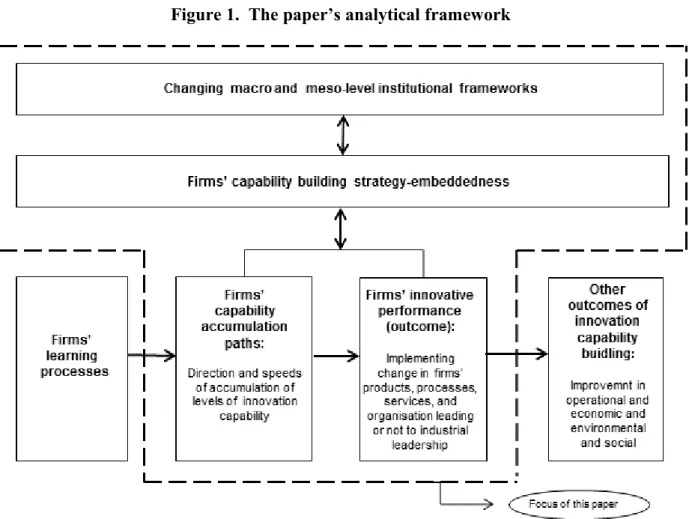
The relationship between the issues addressed in the research question constitutes the analytical framework underpinning this paper, as represented in Figure 1.
Figure 1. The paper’s analytical framework
2.4 Operationalising the constructs
2.4.1 Firms’ innovation performance
There are different proxies to examine firms’ innovative performance such as the introduction of inventions into the market (Freeman and Soete, 1997) or R&D intensity and expenditures and patent counts/citations (Hagedoorn and Cloodt, 2003).However, these indicators capture only a fraction of the innovative activities in latecomer firms (Lall, 1992; Bell and Pavitt, 1993; Bell, 2006), especially for pulp and paper industries (Laestadius, 1998). This paper adopts a nuanced view of innovation that involves increasing degrees of novelty and complexity in terms of processes, products and organisation, in line with the Oslo Manual (OECD, 2005).
Consequently, this paper draws on a modified version of the Lall/Bell and Pavitt typology (Lall, 1992; Bell and Pavitt, 1995; Figueiredo, 2001): it identifies ‘levels’ of innovative capabilities ranging from ‘basic’ to ‘world leading’, consistent with the Oslo Manual. Such a typology has been used successfully in empirical studies, with slight variations in terminology (e.g., Figueiredo, 2003, 2010; Ariffin and Figueiredo, 2004; Hobday et al., 2004; Tsekouras, 2006; Iammarino et al., 2008; Dantas and Bell, 2009). Rather than identify capabilities in terms of specific resources, they have identified levels of innovative activity and then inferred that different levels of capability lie behind the patterns of innovation performance. Table 1 contains a condensed version of that framework. The first column shows four levels of innovative performance, ranging from ‘basic’ to ‘world leading’; the second column provides some illustrative examples of these levels of capability.9
Although this framework emphasises capabilities that are internal to the firm, it also recognises that a substantial part of a firm’s innovation capability lies in other organisations (e.g., research institutes, universities). Consequently, the building of innovation capability is not necessarily confined to firm boundaries, but may involve several interdependencies. For the firm to develop such interactions, it has to build up substantial in-house expertise (Mowery, 1983) or absorptive capacity (Cohen and Levinthal, 1990) and demand for local R&D outputs (Bell and Pavitt, 1993).
Table 1. Typology to assess firms’ innovation performance (condensed version)
Levels of innovative
performance Illustrative examples of these levels of innovation performance
9 The original framework applied during fieldwork and analysis involved three individually tailored matrixes for forestry, pulp and paper. The application of this framework in this study was achieved after approximately six months of work, and involved several consultations with experts in forestry and pulp and paper industries for validation.
World leading (frontier pushing)
Undertaking cutting-edge innovation that provides the firm with a world-leading technological and market position in forestry, pulp or paper (e.g., R&D for the introduction of new-to-the-world forestry development processes along new technological trajectories based on R&D in genomics and proteomics; playing leading roles in world-leading research networks; development of new production processes based on R&D and engineering; intellectual property system).
Advanced
Closing in on global leaders in terms of introducing innovations based on fast-follower kind of strategy thus achieving a competitive position in local and export markets, but not as leader (e.g., R&D projects for the introduction of new feedstock processes implemented by innovation leaders; forest management based on sophisticated international certification (e.g. FSC);R&D for the introduction of new production processes following leaders)
Intermediate
Implementation of relatively complex modifications to forestry techniques and to pulp and paper making processes and products. These permit the firm to achieve and sustain a competitive performance within the local national or niche markets (e.g. development of resources for forest installation, attendance and recovering and alternative processes and resources for disease and pests control; engineering efforts to adapt and improve production processes and equipment systems; Basic
Implementation of basic levels of innovations which are novel to the firm and allow the firm to sustain a competitive performance in a regional market (e.g. implementation of resources for forest and agricultural installation, attendance and recovering; quality tests and features evaluation for seed and seedling production).
2.4.2 Firms’ strategy embeddedness
In line with previous research (Dacin et al., 1999; Figueiredo, 2011) this paper considers that firms’ levels of strategy embeddedness, as part of firms’ strategic-asset building efforts, vary. Thus, building on Goodman and Lawless (1994) and Scott-Kemmis and Chitravas, (2007) strategy embeddedness is herein operationalised in terms of three levels: pro-active, active and reactive (Table 2). Additionally, the typology identifies macro- and meso levels institutional frameworks. The latter is opened up in two sub-levels. The second component of the meso-level institutional framework (knowledge-related institutes) is equivalent to what is examined in Malerba and Mani (2009) and Lundval et al. (2009) and will be addressed here only very superficially.
Table 2. Typology for assessing strategy embeddedness
Macro-level
Complex macro regimes of interconnected segments of implemented public policy within which firms operate: a set of laws, policies, incentives and industrial development policies, plans and programmes at the national level.
C om po ne nt s an d pl ay er s o f in st itu ti on al f ra m ew or ks Meso-level
regime. Sector-level organisational structures and pressure groups (e.g. industry associations) acting to influence government policy. Aspects of political and bureaucratic public-private interactions related to specific industrial sectors underpinning particular kind of policy regime.
Knowledge-related institutes and organisations surrounding latecomer firms and concerned with education, training, standards, research, and so forth.
L ev el s of s tr at eg y em be dd en es s Pro-active
Very high awareness of the role of innovation capability in the firm’s competitive performance. Pioneer and ambitious engagement in innovation activities. Initiative to provoke and interact with components of the meso- and macro level institutional frameworks. Firms tend to pursue and hold a position of innovation ‘leaders’. Active
High awareness of the role of innovation capability in the firm’s competitive performance. Relatively conservative and/or follower approach to engagement in innovation activities. Follower approach to interacting with meso- and macro level components of the institutional frameworks. Firms tend to pursue and hold a position of innovation ‘followers’.
Reactive Low or absent awareness of the role of innovation capability in the firm’s competitive performance. Arm’s length and/or indifferent to interactions with components of the meso- and macro level institutional frameworks. Firms tend to hold a position of very slow innovation followers or laggards
Firms’ innovation performance levels
3. Brazil’s Eucalyptus forestry and pulp and paper: a leading competitive position
The pulp and paper industries are highly intensive in capital, processes and scale (Pavitt, 1984), while forestry itself is also increasingly science-based. The paper-making process involves the conversion of wood chips into pulp, which is processed to create paper. Pulp, the main raw material for papermaking, is obtained from trees such as pine (long-fibre or softwood) or eucalyptus (short-fibre or hardwood).
Planted forests are renewable resources for diverse industries based on raw materials from fibres and lignocelluloses, especially the pulp and paper industries. As explained in Assis (2001),
Grattapaglia (2004) and Grattapaglia and Kirst (2008), since the early 1990s, it has been realised that trees that yield more cellulose generate gains across the entire production chain in the form of savings from tree harvesting and transportation thus minimising the expansion of forests and reducing effluent waste. Consequently, by realising that the ‘pulp factory’ is the tree (Grattapaglia and Kirst, 2008), pulp and paper firms have shifted the focus of their efforts from volume growth to wood quality. The objective is to reduce the amount of wood in cubic meters necessary to produce one ton of pulp, i.e., to decrease the wood-specific consumption (WSC) (Grattapaglia and Kirst, 2008). During the 1980s, first-generation clonal forestry of eucalyptus reduced WSC by 20%. A further 20% reduction was achieved subsequently, based on second-generation clones derived from eucalyptus hybridisation (Ikemori et al., 2005 and Assis et al., 2005 apud Grattapaglia and Kirst , 2008)
Historically, the world’s main producers and innovators in the forestry, pulp and paper industries were the Norscan countries (Canada, US and Nordic countries Sweden, Finland and Norway). However, between the 1960s and 1970s, a major breakthrough in eucalyptus-based forestry technology was achieved, especially in Brazil.10 This led to the planting of the first large-scale
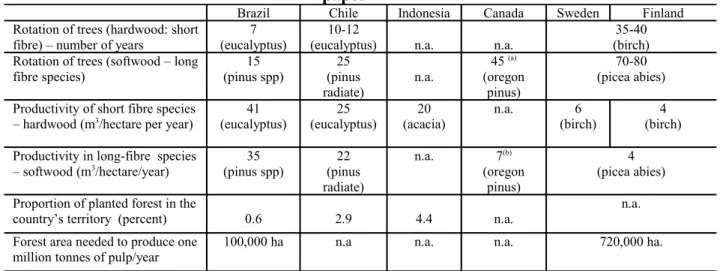
commercial stands of selected clones derived from hardwood cuttings. These and subsequent advances resulted in exceptional genetic gains for growth and adaptability to tropical conditions and wood with higher pulp yield (Grattapaglia and Kirst, 2008). This technological development contributed to the achievement by Brazil of an internationally leading position in that field (see Table 3).
10 For details of that breakthrough innovation see Figueiredo (2010). For technical details see Grattapaglia and Kirst
Table 3. Some indicators reflecting Brazil’s leading performance in forestry for pulp and paper
Brazil Chile Indonesia Canada Sweden Finland Rotation of trees (hardwood: short
fibre) – number of years (eucalyptus)7 (eucalyptus)10-12 n.a. n.a. (birch)35-40 Rotation of trees (softwood – long
fibre species) 15 (pinus spp) 25 (pinus radiate) n.a. 45 (a) (oregon pinus) 70-80 (picea abies) Productivity of short fibre species
– hardwood (m3/hectare per year) (eucalyptus)41 (eucalyptus)25 (acacia)20 n.a. (birch)6 (birch)4
Productivity in long-fibre species
– softwood (m3/hectare/year) (pinus spp)35 (pinus 22
radiate) n.a. 7(b) (oregon pinus) 4 (picea abies) Proportion of planted forest in the
country’s territory (percent) 0.6 2.9 4.4 n.a.
n.a. Forest area needed to produce one
million tonnes of pulp/year 100,000 ha n.a n.a. n.a. 720,000 ha.
Sources: Elaborated on the basis of data from FAO/Bracelpa (2008). Note: (a) and (b) = Coastal area.
The technological advance achieved by Brazilian firms was reflected in the commercial performance (or market catch-up, Lee and Lim, 2001) achieved by Brazil. Table 4 shows that from 1970 to 2009, Brazil’s exports of pulp and paper increased, respectively, by 14.2% and 22.3% annually on average, while the average growth rates of Norscan countries were 0.18% (pulp) and 2.1% (paper) during that period. Brazil also achieved a superior export growth rate of pulp and paper exports in relation to other developing economies. Furthermore, from 2001 to 2009, the export value of Brazil’s pulp and paper exports grew, respectively, 10.7% and 23.8% annually on average, whereas the annual growth rates of Norscan countries were 0.18% (pulp) and 2.1% (paper) during that period.11
Table 4. Evolution of pulp/paper exports: Norscan countries vs. Brazil and other developing economies (000 tonnes)
(a) Period related to 1968-70; (b) Period related to 1990-2009
PAPER
1970 Growth rate (1961-70) 1980 Growth rate (1971-80) 1990 Growth rate (1981-90) 2000 Growth rate (1991-2000) 2009 Growth rate (2001-2009) Growth rate (1970-2009)
Canada 8,073 3.6 9,555 2.2 11,874 2.4 15,613 3.0 9,526 − 4.5 0.4 Finland 3,559 6.8 4,867 3.3 7,633 5.0 11,642 5.0 9,690 − 1.3 2.6 Norway 1,018 7.9 1,048 0.9 1,476 4.2 1,981 3.4 1,296 − 4.9 0.6 Sweden 2,939 8.7 4,626 5.1 6,613 3.8 9,031 3.9 9,867 1.8 3.2 USA 2,424 10.9 4,186 5.0 5,388 4.6 9,139 4.1 11,277 3.4 4.0 Brazil 1 39.0 (c) 198 59.9 840 10.7 585 − 6.2 2,591 16.0 22.3 Chile 96 12.4 87 1.01 131 8.0 313 10.7 586 6.0 4.7 China 122 8.9 193 4.0 1,364 22.7 3,686 7.4 4,850 4.8 9.9 Indonesia 0 0 7 0 166 39.9 2.717 25.1 3,574 4.9 24 (d)
Source: FAOSTAT, http://faostat.fao.org/
(c ) Related to period 1962-70; (d) Period related to 1980- 2009
PULP
1970 Growth rate (1961-70) 1980 Growth rate (1971-80) 1990 Growth rate (1981-90) 2000 Growth rate (1991-2000) 2009 Growth rate (2001-2009) Growth rate (1970-2009)
Canada 4,762 40.9 7,009 4.2 7,652 1.8 11,652 3.5 6,757 − 5.3 0.9 Finland 1,805 30.9 1,7612 3.6 1,363 − 1.2 1,681 2.8 1,456 − 1.7 − 0.5 Norway 912 7.5 406 − 6.0 479 1.5 408 − 0.9 387 − 2.8 − 2.2 Sweden 3,488 26.7 2,97 − 0.4 2,767 − 0.2 2,974 0.8 3,124 0.8 − 0.3 USA 2,062 103.1 2,828 9.1 4,783 6.4 5,583 0.9 6,496 1.8 3.0 Brazil 39 66.5 890 44.4 1,035 0.9 2,917 8.7 7,056 8.9 14.2 Chile 105 −5.61 (a) 415 16 581 6.8 1,835 12.3 4,061 7.2 9.8 China 42 26.6 45 − 3.7 101 8.8 47 5.2 99 11.3 2.2 Indonesia 0 0 0 0 130 0 1,352 29.9 2,621 4.94 17.1 (b)
In 2009, Brazil ranked as the world’s fourth-largest pulp producer (all types), first as a producer of hardwood pulp (‘eucapulp’), and ninth-largest paper producer. One hundred percent of all pulp and paper produced in Brazil is derived from planted forests. Although the pulp and paper industries in Brazil consist of 222 firms, about 88% of the total output derives from about 10 large firms. From 2001 to 2005, the average share of the pulp and paper industries in Brazil’s manufacturing value added (MVA) was 3.9%. Thus, over the past decades, Brazil has been holding a stronger leading market position in these industries, largely due to the innovation performance achieved by leading firms (Section 5).
4. Methods
4.1 Research design and cases selection
This paper derives from an empirical study based on a three-year fieldwork campaign (2006-08 with a follow-up in 2009) involving exploratory, pilot, and main fieldwork phases. In line with the research questions and considering that they required an in-depth study with an analytical generalisation, this study was designed using long-term and first-hand evidence from multiple cases. The adoption of such a design permitted a more detailed investigation of the research questions than that afforded by other methods (Eisenhardt, 1989; Yin, 2003)
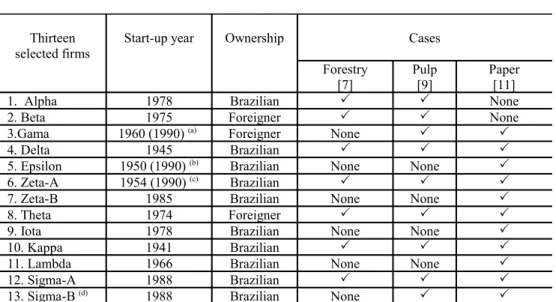
The cases to be studied were selected using the following criteria: (i) the firms account for nearly 85% of the pulp and paper output in Brazil; (ii) they are large exporters and domestic market suppliers; (iii) some of them are top players in the world market; and (iv) they illustrate different levels of innovative performance with varied strategies and diverse interactions with institutional frameworks. This process led to selection of 13 firms and their particular business lines: forestry, pulp and paper (Table 5). This number permitted the research implementation without amassing an unmanageable volume of information (Eisenhardt, 1989).
Table 5. The selected cases
Thirteen
selected firms Start-up year Ownership Cases Forestry [7] Pulp [9] Paper [11]
1. Alpha 1978 Brazilian None
2. Beta 1975 Foreigner None
3.Gama 1960 (1990) (a) Foreigner None
4. Delta 1945 Brazilian
5. Epsilon 1950 (1990) (b) Brazilian None None
6. Zeta-A 1954 (1990) (c) Brazilian
7. Zeta-B 1985 Brazilian None None
8. Theta 1974 Foreigner
9. Iota 1978 Brazilian None None
10. Kappa 1941 Brazilian
11. Lambda 1966 Brazilian None None
12. Sigma-A 1988 Brazilian
13. Sigma-B (d) 1988 Brazilian None
Notes: (a)-(c): Their coverage in this study is from 1990; (d) Sigma-B does have forestry operations, but this business line
is not covered in this study.
4.2 Evidence gathering and analysis processes
Following Jick (1979), Eisenhardt (1989), and Yin (2003), this study drew on a triangulation methodology to achieve robust internal validity and reliability. It was based on a combination of extensive fieldwork and follow-up questionnaires. During the pilot and main fieldwork, the evidence collection involved 155 formal and 44 informal interviews (from one to three hours in length), direct observations, and several consultations of firms’ and industry associations’ archival records. Twelve interviews were conducted with local universities, research institutes, industry associations and government bodies to verify the nature of their relationships with the case firms.
The information-gathering process began by contacting the chief executive of each firm to clarify the purpose of this research and to negotiate access to evidence. With their approval it was possible to tap into various sources of information (e.g., industrial directors, managers, engineers, researchers, technicians, consultants, human resources and engineering departments, R&D units, labs, retired staff and archival records). Open-ended interviews were conducted using an interview guide that was constructed in light of the study’s typologies. Double and triple checks of specific events were made via e-mail and/or phone calls. The extensive use of
triangulation made it possible to gather evidence from a range of different sources to substantiate the results of the analysis.
Because the study sought to examine historical changes in the capability accumulation of the firms, special efforts were made to collect sufficient evidence to substantiate the reconstruction of the technological pathways taken by each firm. This was undertaken by scrutinising the firms’ technological milestones, provided by different interviewees (including retired staff), internal presentations and records, annual reports and independent news reports. Even so, it is difficult to obtain a complete accuracy regarding past events. This is one of the limitations of this study. Nevertheless, the extensive use of triangulation allowed for gathering evidence from a range of different sources to substantiate the study.
After the main fieldwork, follow-up questionnaires were sent to target informants. Because most of them were aware of the study, a 95% response rate was achieved. The application of the questionnaire sought to expand the findings, and particularly, to systematise and code evidence of the issues examined herein over the period covered by the study. The questionnaire, in the form of a matrix, derived from the frameworks in Tables 1 and 2.
During the fieldwork, the researcher built up some associations between the firms’ innovative activities and the ways in which they pursued their strategy embeddedness to improve their innovation performance across different institutional frameworks. Formal analyses involved the following techniques: (i) harmonisation and combination of the evidence from the interviews and observations with those from the follow-up questionnaires; (ii) tabulation of the frequency and types of observations over time and building systematic and successive ‘cross-company display tables’ based on a ‘data reduction’ procedure (Miles and Huberman, 1994). This was essential to reduce the sheer volume of information into a manageable size and to track main stages in the
study’s constructs in a coherent manner; and (iii) systematic matching of different pieces of evidence from the cases with the study’s analytical frameworks (and Tables 1 and 2) to achieve solid construct validity (Campbell, 1975).
Additionally, rather than reducing all qualitative data to quantitative observations, both types of evidence were used to form the study’s dataset, to run some statistical tests and to enrich the empirical analysis. For instance, qualitative evidence from the application of the innovation performance typology (Table 1) was transformed into quantitative observations to allow the speed of capability accumulation to be calculated. The capability levels accumulated for these activities by each firm were then aggregated into a single index to represent the overall capability level of each firm in the three business lines (forestry, pulp and paper) over time. Evidence of the types of strategy embeddedness of firms (Table 2) was coded to test its association with innovation performance over time. Finally, the qualitative evidence described in Section 5.2, in the form of narratives, contributes to both strengthening the arguments and establishing causal relationships (Dougherty, 2002).
5. Empirical Findings
Section 5.1 provides a brief overview of the association between the case firms’ innovation performance and their strategy embeddedness across changing institutional frameworks (1950-2009). Based on qualitative evidence, Section 5.2 examines the evolution of that relationship during that period. The presentation of the evidence is organised mainly around three periods: (i) the ISI policy regime (1950-1960s and 1970-1980s); (ii) the transition into an open economy regime (1990s); and (iii) the open economy and globalised competition regime (2000s).12
12 Considering that the 1990s involved changes that were deep and far reaching in the Brazil’s economy and industry, their implementation and assimilation by the industry took several years. As a result, the whole decade can be deemed as a transition from ISI regime into a regime based on open economy and globalised competition.
5.1 Firms’ innovation performance and strategy embeddedness across different institutional frameworks: an overview
The findings indicate that since the 1950s leading firms from the forestry, pulp and paper industries in Brazil have engaged in a kind of ‘path-creating’ capability accumulation. They began to diverge from the existing technological trajectory at an early stage of the development of their innovation capabilities. Just after World War II, these firms began to make pulp and paper from eucalyptus trees, and to engage in activities that firms in the Norscan countries were not engaged in. This meant that relatively early on, they could not simply copy the recognised global leaders but were instead forced to develop technologies more suited to their own somewhat different operations. They could not simply imitate because they were developing along a different trajectory. This involved the use of different raw materials (eucapulp), and to develop an effective means to do this, they had to innovate in their downstream pulp and papermaking processes because of the innovations developed in the upstream forestry.
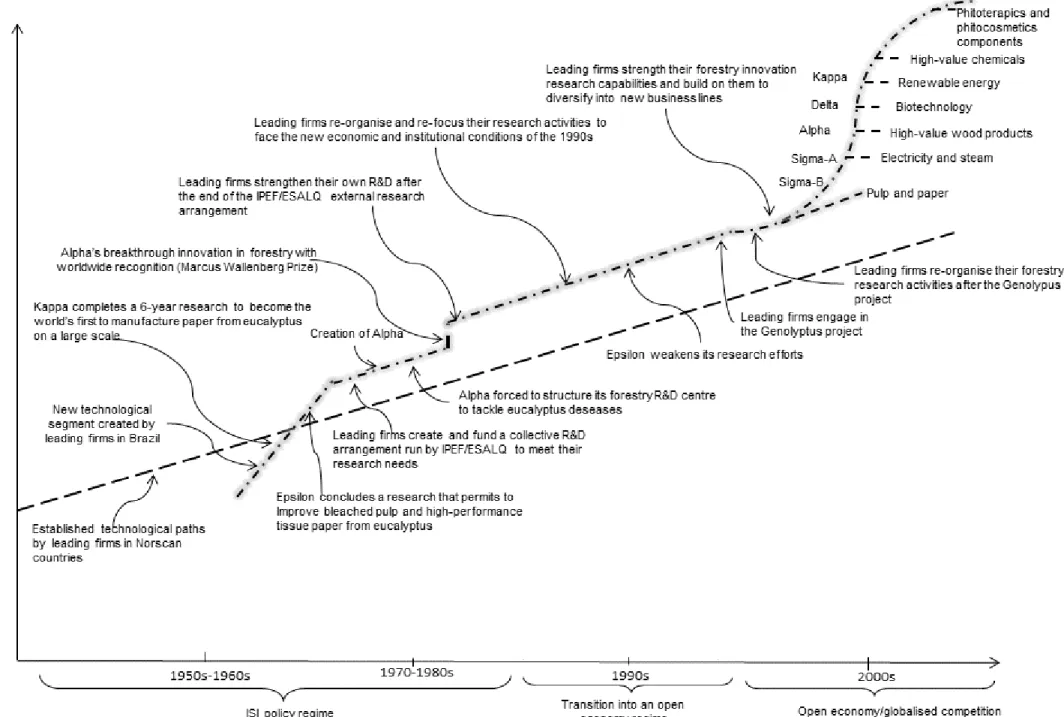
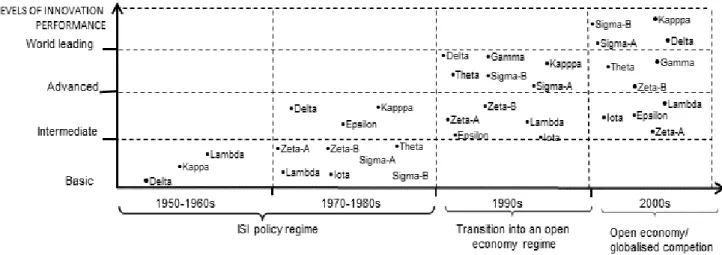
Specifically, the firms took a different direction of technological development from those already pursued by the global industry leaders. By so doing, they opened up a qualitatively different segment at the international technological frontier. This pathway contrasts with the majority of case studies reported in the literature: it involved a qualitative discontinuity from the established technological trajectory at an early stage in the development of their capabilities (see Figure 2).13
As illustrated in Figure 2, from the mid-2000s those firms that had achieved world-leading innovation performance, especially in the forestry area, began to draw on their accumulated capabilities to diversify into different business lines.
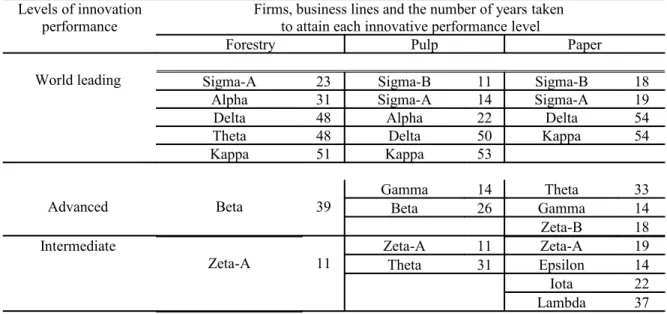
However, the process of innovation-capability building of these firms along the new technological segment was characterised by a high degree of variability in terms of the levels and speeds of capability accumulation (Table 6 and Figures 3 to 5).
Table 6. Innovation performance of the case firms (2009) Levels of innovation
performance Firms, business lines and the number of years taken to attain each innovative performance level
Forestry Pulp Paper
World leading Sigma-A 23 Sigma-B 11 Sigma-B 18
Alpha 31 Sigma-A 14 Sigma-A 19
Delta 48 Alpha 22 Delta 54
Theta 48 Delta 50 Kappa 54
Kappa 51 Kappa 53 Advanced Beta 39 Gamma 14 Theta 33 Beta 26 Gamma 14 Zeta-B 18 Intermediate
Zeta-A 11 Zeta-ATheta 1131 EpsilonZeta-A 1914
Iota 22
Lambda 37
Source: Derived from the empirical study.
Figure 3. Evolution of firms in terms of capability accumulation along the eucalyptus-based trajectory: forestry
Figure 4. Evolution of firms in terms of capability accumulation along the eucalyptus-based trajectory: pulp
Figure 5. Evolution of firms in terms of capability accumulation along the eucalyptus-based trajectory: paper
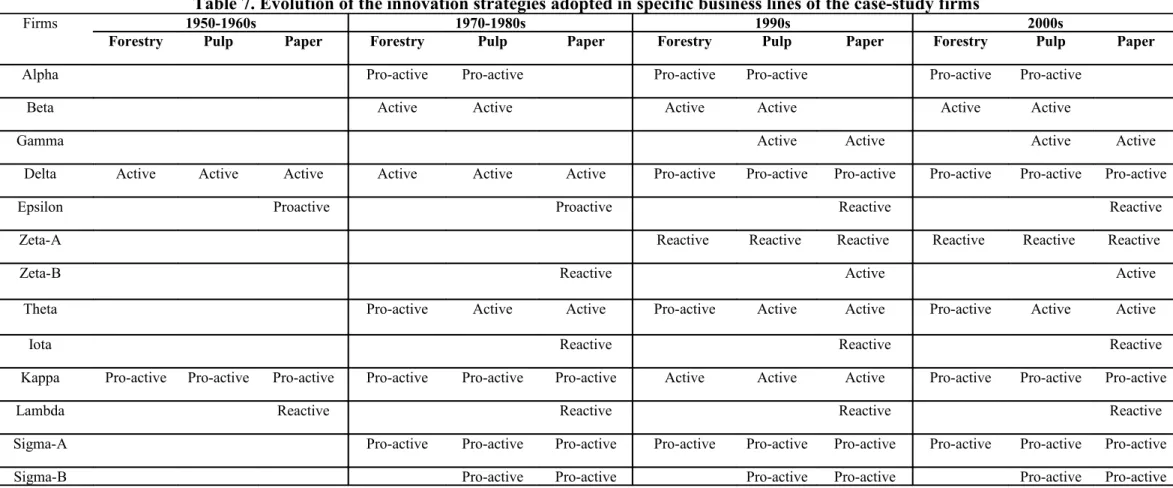
In addition to these differences in innovation performance, the study also found differences across these firms and their business lines in terms of the type of strategy embeddedness that they pursued over time (Table 7). The results show that firms that obtained the highest innovation performance were those that pursued pro-active strategy embeddedness (Table 8). Specifically, Table 9 shows the results from the non-parametric Kruskal-Wallis test, which indicates a positive and significant association between the firms’ levels of innovation performance and the prevailing types of strategy embeddedness that they pursued during the period of study: forestry (p<0.05), pulp (p<0.01), and paper (p<0.10). The following section provides a qualification to this evidence.
Table 7. Evolution of the innovation strategies adopted in specific business lines of the case-study firms
Firms 1950-1960s 1970-1980s 1990s 2000s
Forestry Pulp Paper Forestry Pulp Paper Forestry Pulp Paper Forestry Pulp Paper
Alpha Pro-active Pro-active Pro-active Pro-active Pro-active Pro-active
Beta Active Active Active Active Active Active
Gamma Active Active Active Active
Delta Active Active Active Active Active Active Pro-active Pro-active Pro-active Pro-active Pro-active Pro-active
Epsilon Proactive Proactive Reactive Reactive
Zeta-A Reactive Reactive Reactive Reactive Reactive Reactive
Zeta-B Reactive Active Active
Theta Pro-active Active Active Pro-active Active Active Pro-active Active Active
Iota Reactive Reactive Reactive
Kappa Pro-active Pro-active Pro-active Pro-active Pro-active Pro-active Active Active Active Pro-active Pro-active Pro-active
Lambda Reactive Reactive Reactive Reactive
Sigma-A Pro-active Pro-active Pro-active Pro-active Pro-active Pro-active Pro-active Pro-active Pro-active
Sigma-B Pro-active Pro-active Pro-active Pro-active Pro-active Pro-active
Table 8. Types of strategies and levels of innovative performance in specific business lines
Business lines Type of strategy performance (mean)Level of innovative
Forestry Pro-active 3 Active 2.11 Pulp Pro-active 3.18 Active 2.23 Paper Pro-active 2.67 Active 2 Reactive 1.43
Table 9. Kruskal-Wallis test for firms’ innovation strategies and levels of innovation performance
Notes: (*) Association significant at the 0.10 level; (**) Association significant at the 0.05 level (***) Association significant at
the 0.01 level
5.2 Evolution of firms’ innovation performance and strategy embeddedness across changing institutional frameworks14
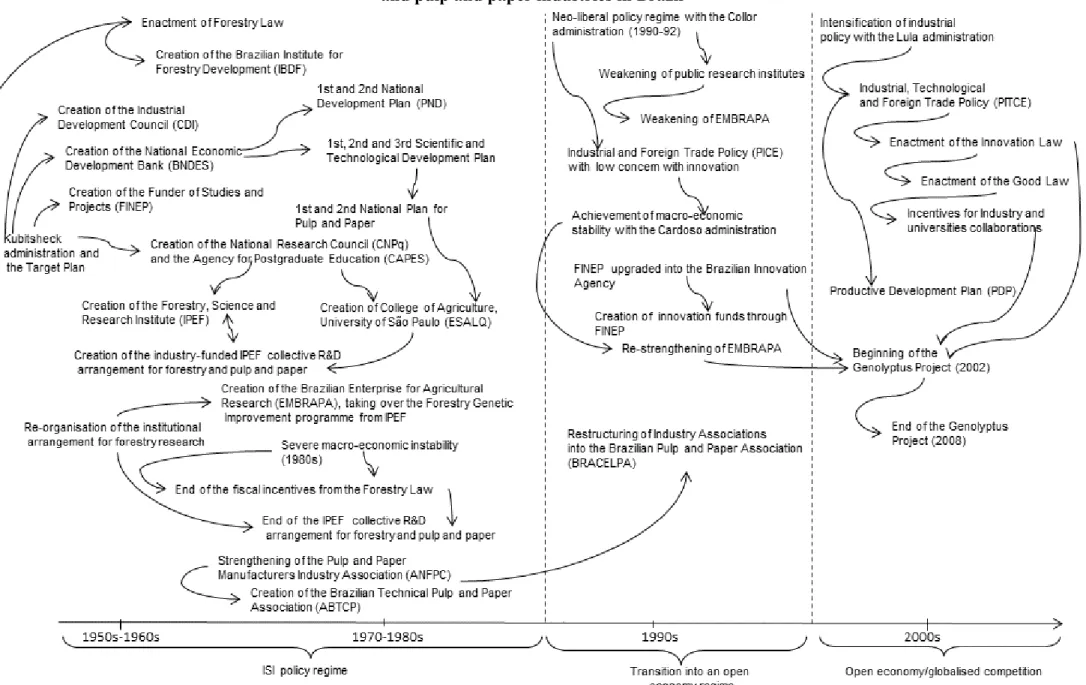
Figure 6 provides a brief representation of the evolution of some of the main changes in the macro- and meso-level institutional frameworks over the periods examined in this section.
14 This section does not intend to provide a clear-cut description of the evolution of these three constructs. In some
parts, the description is blurred.
Innovation strategies vs. innovative performance levels
Forestry Pulp Paper
Chi-Square 4.758 6.879 5.917
df 1 1 2
Figure 6. Representation of the evolution of some of the features of the institutional frameworks related to the forestry and pulp and paper industries in Brazil
5.2.1 The ISI policy regime: the 1950-1960s and 1970-1980s
5.2.1.1 Main changes in the macro- and meso-level institutional frameworks: 1950-1960s Building on the second Vargas’ government (1951-54), the Kubitschek administration (1956-60) created the Targets Plan to accelerate Brazil’s industrialisation process, by intensifying the ISI policy. Strong emphasis was given to basic industries and inputs, among them forestry and pulp and paper. Under this state-led large-scale industrialisation, the National Bank for Economic and Social Development (BNDES)15 became not only the main funder of industrial
projects but also became responsible for Brazil’s industrial policy. This framework involved the creation of state-owned enterprises and agencies to support the development agenda, e.g., the National Research Council (CNPq), the Agency for Post-graduate Training (CAPES) and later, the Funder of Studies and Projects (FINEP).16
Three important factors related to that government agenda, had implications for firms’ expansion of their forestry activities and engagement in innovative activities. First, the enforcement of the Forestry Law (of 1966), which provided tax incentives for firms that developed planted forestry based on eucalyptus, contributed to the expansion of the forest bases needed for new pulp and paper mills. This policy was implemented by the Brazilian Institute for Forestry Development (IBDF), created in 1967. To obtain funding from BNDES firms had to have their own supply of wood derived from planted forests.
Second, considering that the pulp and paper industries in Brazil emerged spontaneously as a response to constraints on import of raw materials (e.g., WW2, Korean War), from the early 1950s, there was a proliferation of inefficient, small-scale pulp and paper mills. By the late-1960s, some industrial leaders (some of them from Kappa and Delta), through the Pulp and
15 Created in 1952 as the BNDE (National Bank for Economic Development), it became Brazil’s first institution
dedicated to the long-term funding of infrastructure and industrial development.
Paper Manufacturers National Association (ANFPC), provoked the BNDES to assess the feasibility of the existing pulp and paper mills in Brazil.17 This action reflected the pro-active
strategy embeddedness of some firms to change industrial policy. Following that study, the BNDES and Industrial Development Council imposed new conditions for funding based on the increase of scale and of productivity of mills.
Third, the emergence of research facilities and suppliers of human capital proved essential for the technological advance of forestry and pulp and paper firms. Supported by CNPq and CAPES, the College of Agriculture of the São Paulo University (ESALQ) began to offer degree courses in forestry (from undergraduate to PhDs), as it expanded its post-graduate programmes and laboratories for pilot production of eucalyptus-based pulp and paper.
5.2.1.2 Firms’ strategy embeddedness and innovation performance: 1950-1960s
Firms such as Kappa and Delta responded positively to the incentives generated by the Forestry Law by expanding their planted forests. However, reflecting a proactive strategy, Kappa engaged in research activities. As Brazil lacked proper research facilities, Kappa developed a partnership with the Florida University in the US to use its laboratories to test the use of eucalyptus for large-scale pulp and paper production. After six years of systematic research efforts, by the late 1960s Kappa was manufacturing paper from eucalyptus pulp on a large scale.
Similarly, the firm Epsilon, also pursuing a proactive strategy, intensified its innovative efforts which had begun in the 1940s: it engaged in research to obtain improved bleached pulp and high-performance tissue paper from eucalyptus. However, Brazil’s weak forestry research
17 The ANFPC evolved from the National Papermakers Centre, created in 1925 to represent the interests of the
capability was a constraint for further innovative activities. Two important strategic actions taken by industrial entrepreneurs contributed decisively to overcoming this hurdle. First, firms such as Kappa, Delta and Epsilon began to provoke and create research demands for government bodies (e.g., IBDF) and government-led education and research institutions (ESALQ). This led to the creation, in the mid-1960s, of an external/collective R&D arrangement at the Forestry Science and Research Institute (IPEF), funded by the industry, but run by the public sector. Such collaboration arrangement permitted these firms to innovate successfully and lower the risks involved in this kind of path-creating innovation.18
Second, by the mid-1960s, the creation of Alpha by a group of 12 entrepreneurs represented a decisive thrust for the commercial success of the eucalyptus-based technological trajectory.19
The initial idea to explore timber evolved into the building of a large export pulp firm. To speed up the project, their strategy was to draw on eucalyptus seeds that had been developed earlier in Brazil. However, Alpha’s eucalyptus plantations were marred by uncontrolled hybridisation and high variability in growth rates and diseases, reflecting the poor quality of seeds. Consequently, Alpha was forced to change its initial strategy and, as early as 1968, Alpha structured its own research centre to tackle to such problems. By doing so, Alpha moved from vegetative propagation, based on seeds, to tree improvement and clonal programmes (Campinhos, 1999; Evans and Turnbull, 2004). Although some shareholders were sceptical about such research investments, Alpha’s dominant group intensified its emphasis on research to achieve technological and market leadership.20 To facilitate its exports, Alpha negotiated
with the federal government for permission to build its own harbour next to the mill.
18 I thank one reviewer for suggesting me to refer to this point.
19 This group involved visionary Brazilian entrepreneurs, among them one of the creators of Vale, a Brazilian
mining company and a Norwegian businessman.
5.2.1.3 Main changes in the macro- and meso-level institutional frameworks: 1970-1980s While the first National Development Plan (PND-I, 1972-74) focused on infrastructure projects, the PND-II (1974-79) emphasised the expansion of basic industries and inputs, among them pulp and paper, as a means of increasing exports to face up to the energy crisis. Within that framework, a review by BNDES of Brazil’s forestry and pulp and paper industries led to the First National Pulp and Paper Plan, which stimulated forestry research, forest-manufacturing integration and environment-related innovations. While such measures were well received by firms committed to innovative forestry activities (e.g., Alpha, Kappa, Delta), some firms responded indifferently or negatively to such measures.
The Second National Pulp and Paper Plan was issued in the late-1980s by a joint efforts between the BNDES and the Industrial Development Council with an active participation of industrial leaders through the ANFPC, reflecting the pro-active strategy embeddedness of firms such as Alpha, Delta, Kappa and Epsilon. It established new targets for the 1990s such as an increase of exports and stimuli to initial public offerings (IPOs). The start-up of operations of large mills of firms such as Alpha and Beta in the 1970s and of Sigma-A and Sigma-B in the 1980s, consolidated not only Brazil’s self-sufficiency in pulp and paper. It also demonstrated a successful outcome of the public-private symbiosis and bold efforts of industrial entrepreneurs and government to develop and strengthen the eucalyptus-based technology for pulp and paper.
During the early 1980s, there was a change in the division of labour related to the institutional framework for forestry research. The state-owned Brazilian Enterprise for Agricultural Research (EMBRAPA), created in 1973, took up the responsibility for the National Programme of Forestry Research, including genetic improvement, while IPEF became dedicated to new research methods based on forestry handling and exploitation. Such changes
in meso-level institutions with the macro-level weakening of the ISI policy and the severe economic crises of the 1980s, led to the discontinuity of the tax incentives for re-forestation and of firms’ collective R&D arrangement for forestry research within ESALQ through IPEF.
5.2.1.4 Firms’ strategy embeddedness and innovation performance: 1970-1980s
Some firms responded to such discontinuities by creating and/or expanding their internal R&D facilities. For example, in addition to its forestry research centre, which had been created in the late 1960s, in 1983, Alpha structured an R&D centre dedicated to industrial pulp and paper activities. Firms that had started up in the 1980s (e.g., Sigma-A and Sigma-B) and established firms (Delta, Beta and Theta) also structured their own forestry research centres. These firms began to interact with other local universities (e.g., the Federal University of Lavras (UFL) and the Federal University of Viçosa (UFV)). In contrast, other firms (e.g., Lambda and Iota) opted to not engage in the creation or strengthening of their own research facilities.
Alpha’s proactive strategy was reflected in its massive investments in forestry research. In the early 1980s Alpha introduced a breakthrough innovation based on mass production of clonally propagated planting stock. In 1984, nearly 17 years after having initiated its research activities, Alpha achieved worldwide recognition by being awarded the Marcus Wallenberg Prize from Sweden.21 Alpha’s achievement of such world-leading innovation consolidated the new
technological segment opened up by Brazil’s forestry for pulp and paper firms in the international technological frontier.
Building on these achievements, firms such as Alpha, Kappa and Theta sought to reach export markets. However, as latecomers, they were confronted with an obvious hurdle: a lack of
21 Established in 1980 in Sweden, under the Marcus Wallenberg Foundation, this highly respected prize seeks to
encourage and stimulate path-breaking scientific achievements that contribute significantly to a broadening of knowledge and to technical development within fields important to the forestry, pulp and paper industries.
international market and technical credibility, especially related to eucalyptus pulp efficacy. To overcome this barrier, these firms took actions that reflected, according to the typology of this study, typical pro-active strategy embeddedness. They began to build up, re-organise and draw on meso-level institutions to help them overcome these hurdles. For example, the Pulp and Paper Technical Centre at the University of São Paulo was created to promote the eucalyptus fibre in the world market. To strengthen the industry’s capacity for commercial and political lobbying, the Pulp and Paper Manufacturers Association (ANFPC) and the Brazilian Association Pulp Exporters were merged into the Brazilian Pulp and Paper Association (BRACELPA). The Brazilian Technical Pulp and Paper Association (ABTCP) was strengthened to train human resources and to promote manufacturing technical advances.
5.2.2 The transition into an open economy regime: the 1990s period
5.2.2.1 Main changes in the macro- and meso-level institutional frameworks
March 1990 marked the formal end of the state-led industrialisation policy in Brazil. In line with measures adopted in other developing economies, the Collor administration implemented a substantial reduction of trade barriers, an abrupt opening-up of the economy to foreign competition with a greater attraction of FDI, de-regulation of the economy and privatisation of several state-owned companies. As a result, several firms were swept away from the market, as they were unable to face international competition.
The BNDES began to emphasise financial and market mechanisms to allow the Brazilian economy to compete globally. To that end, in the early 1990s, BNDES implemented the Industrial and Foreign Trade Policy (PICE), which sought to stimulate the development of industrial capabilities. This policy sought to disseminate new management and production organisation techniques and the creation and upgrading of organisations for manufacturing