AGFORWARD (Grant Agreement N° 613520) is co-funded by the European
Commission, Directorate General for Research & Innovation, within the 7th
Framework Programme of RTD. The views and opinions expressed in this report
are purely those of the writers and may not in any circumstances be regarded as
Identification of Agroforestry Systems
and Practices to Model
Project name
AGFORWARD (613520)
Work-package 6: Field- and Farm-scale Evaluation of Innovations
Milestone
Milestone 27 (6.2): Identification of Agroforestry Systems and Practices to Model
Date of report 20 June 2015 (updated 25 September 2015)
Authors
João Palma, Anil Graves, Josep Crous-Duran, Joana A Paulo, Matthew Upson,
Christian Dupraz, Marie Gosme, Isabelle Lecomte, Haythem Ben Touhami, Delphine
Mézière, and Paul Burgess
Contact
[email protected]
Reviewed
Anil Graves and Paul Burgess
Contents
1
Context ... 2
2
Methodology ... 2
3
Description of the agroforestry systems ... 3
4
Innovations to model ... 10
5
Synthesis ... 18
6
Innovations not to be modelled ... 22
7
Acknowledgements ... 30
8
References ... 31
Annex A. Stakeholder meetings reports covering four land use sectors ... 32
Annex B. Example of fact sheet ... 36
1
Context
The aim of the AGFORWARD project (January 2014-December 2017) is to promote agroforestry
practices in Europe that will advance sustainable rural development. Within the project there are
four objectives:
1. to understand the context and extent of agroforestry in Europe,
2. to identify, develop and field-test innovations (through participatory research) to improve the
benefits and viability of agroforestry systems in Europe,
3. to evaluate innovative agroforestry designs and practices at a field-, farm- and landscape scale,
and
4. to promote the wider adoption of appropriate agroforestry systems in Europe through policy
development and dissemination.
This report is an output from work-package 6 which contributes to the third objective.
Work-package 6 focuses on the field- and farm-scale evaluation of innovation research that have arisen
from about 40 agroforestry stakeholder groups created across Europe. Some research, for example
tree protection options, are best determined by technical evaluations in the field. However some
research questions require a modelling approach to predict, for example, the financial and economic
impact of a new practice over a number of years. This report seeks to identify those agroforestry
systems and practices which could be usefully assessed using biophysical agroforestry models such
as Yield-SAFE (van der Werf et al., 2007) and Hi-sAFe (Talbot, 2011), or bio-economic models such as
Farm-SAFE (Graves et al., 2011).
2
Methodology
The AGFORWARD project has categorised agroforestry practices in relation to four key land use
sectors: existing agroforestry systems of high nature and cultural value (HNCV) (covered by
work-package 2), integrating livestock and crops into high value tree systems (covered by work-work-package
3), agroforestry for arable systems (covered by work-package 4) and agroforestry for livestock
systems (covered by work-package 5).
During 2014, the partners within the AGFORWARD project facilitated about 40 stakeholder groups
across Europe, each resulting in an initial stakeholder reports (Annex A). These stakeholder reports,
and four synthesis reports on the innovations to be evaluated (Hermansen et al. 2015; Mirck et al.
2015; Moreno et al. 2015; Pantera et al. 2015), were used to determine the 1) agroforestry practices
being considered, and 2) the research and innovations that has been proposed.
1. Agroforestry practices are being described in various ways in the project. This report collates an
initial description of the practices being studied by each stakeholder group. During the project, more
detailed descriptions of the practices will be developed (for example Milestone 28) are being
developed using the template described in Annex B. The contacts for each group are described in
Annex C.
2. Whereas some research questions can be addressed by modelling, some cannot. This report
attempts to categorise those research questions that are amenable to being resolve with the
support of modelling, and those that are not. For example some research questions are knowledge
gaps which could be tackled through literature research.
3
Description of the agroforestry systems
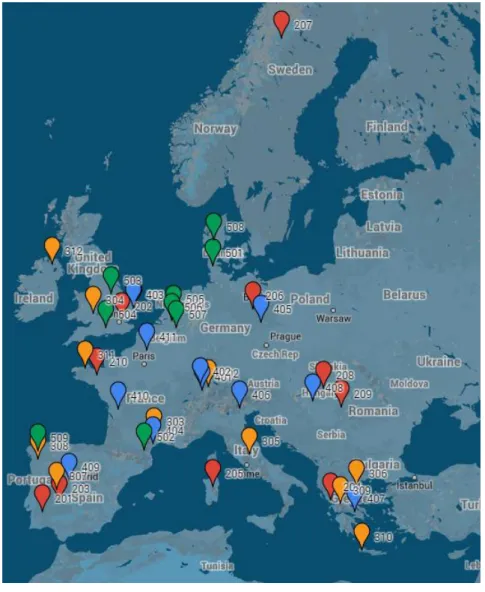
The stakeholder meetings organised by the AGFORWARD project has led to the
identification of 10 agroforestry systems which are recognised for their high cultural and
natural value (Table 1), which are indicated in red in Figure 1. There were also 13 systems
focused on the intercropping or grazing of high value trees such as orchards or olive grove
(Table 2), indicated in orange in Figure 1. There were 12 systems focused on agroforestry
for arable farmers (Table 3) and 11 systems focused on agroforestry for livestock farmers.
High Natural and Cultural Value Agroforestry Agroforestry for High Value Tree Systems Agroforestry for arable systems Agroforestry for livestock systems
Figure 1. Location of the agroforestry systems
11
This map is available at:
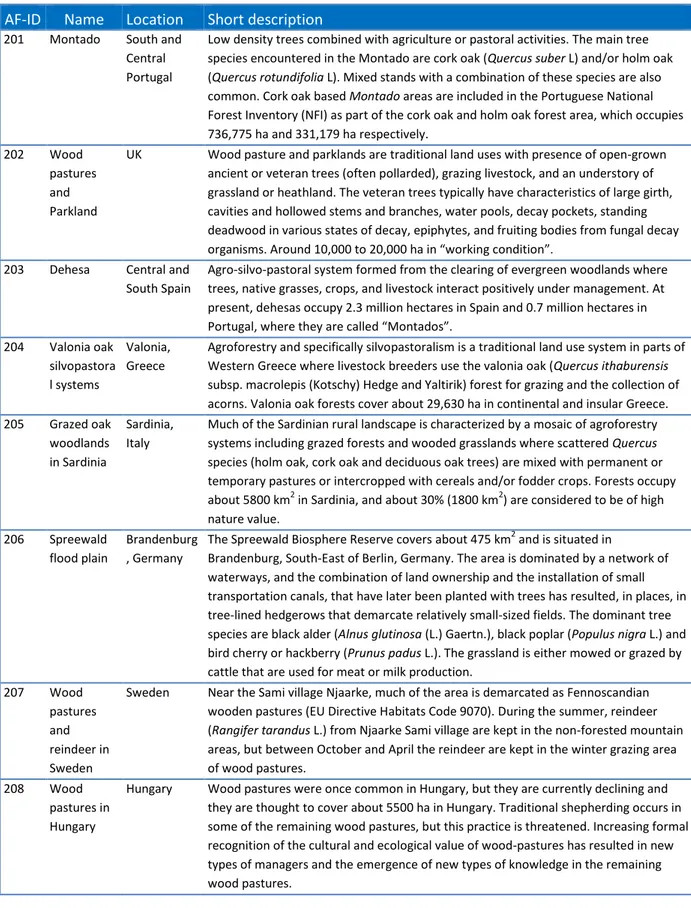
Table 1. Agroforestry systems of high nature and cultural value: the name, location and
short description of the selected agroforestry systems
AF-ID
Name
Location
Short description
201 Montado South andCentral Portugal
Low density trees combined with agriculture or pastoral activities. The main tree species encountered in the Montado are cork oak (Quercus suber L) and/or holm oak (Quercus rotundifolia L). Mixed stands with a combination of these species are also common. Cork oak based Montado areas are included in the Portuguese National Forest Inventory (NFI) as part of the cork oak and holm oak forest area, which occupies 736,775 ha and 331,179 ha respectively.
202 Wood pastures and Parkland
UK Wood pasture and parklands are traditional land uses with presence of open-grown ancient or veteran trees (often pollarded), grazing livestock, and an understory of grassland or heathland. The veteran trees typically have characteristics of large girth, cavities and hollowed stems and branches, water pools, decay pockets, standing deadwood in various states of decay, epiphytes, and fruiting bodies from fungal decay organisms. Around 10,000 to 20,000 ha in “working condition”.
203 Dehesa Central and South Spain
Agro-silvo-pastoral system formed from the clearing of evergreen woodlands where trees, native grasses, crops, and livestock interact positively under management. At present, dehesas occupy 2.3 million hectares in Spain and 0.7 million hectares in Portugal, where they are called “Montados”.
204 Valonia oak silvopastora l systems
Valonia, Greece
Agroforestry and specifically silvopastoralism is a traditional land use system in parts of Western Greece where livestock breeders use the valonia oak (Quercus ithaburensis subsp. macrolepis (Kotschy) Hedge and Yaltirik) forest for grazing and the collection of acorns. Valonia oak forests cover about 29,630 ha in continental and insular Greece. 205 Grazed oak
woodlands in Sardinia
Sardinia, Italy
Much of the Sardinian rural landscape is characterized by a mosaic of agroforestry systems including grazed forests and wooded grasslands where scattered Quercus species (holm oak, cork oak and deciduous oak trees) are mixed with permanent or temporary pastures or intercropped with cereals and/or fodder crops. Forests occupy about 5800 km2 in Sardinia, and about 30% (1800 km2) are considered to be of high nature value.
206 Spreewald flood plain
Brandenburg , Germany
The Spreewald Biosphere Reserve covers about 475 km2 and is situated in
Brandenburg, South-East of Berlin, Germany. The area is dominated by a network of waterways, and the combination of land ownership and the installation of small transportation canals, that have later been planted with trees has resulted, in places, in tree-lined hedgerows that demarcate relatively small-sized fields. The dominant tree species are black alder (Alnus glutinosa (L.) Gaertn.), black poplar (Populus nigra L.) and bird cherry or hackberry (Prunus padus L.). The grassland is either mowed or grazed by cattle that are used for meat or milk production.
207 Wood pastures and reindeer in Sweden
Sweden Near the Sami village Njaarke, much of the area is demarcated as Fennoscandian wooden pastures (EU Directive Habitats Code 9070). During the summer, reindeer (Rangifer tarandus L.) from Njaarke Sami village are kept in the non-forested mountain areas, but between October and April the reindeer are kept in the winter grazing area of wood pastures.
208 Wood pastures in Hungary
Hungary Wood pastures were once common in Hungary, but they are currently declining and they are thought to cover about 5500 ha in Hungary. Traditional shepherding occurs in some of the remaining wood pastures, but this practice is threatened. Increasing formal recognition of the cultural and ecological value of wood-pastures has resulted in new types of managers and the emergence of new types of knowledge in the remaining wood pastures.
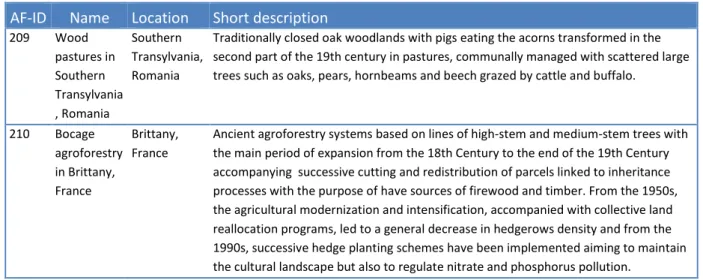
AF-ID
Name
Location
Short description
209 Wood pastures in Southern Transylvania , Romania Southern Transylvania, RomaniaTraditionally closed oak woodlands with pigs eating the acorns transformed in the second part of the 19th century in pastures, communally managed with scattered large trees such as oaks, pears, hornbeams and beech grazed by cattle and buffalo.
210 Bocage agroforestry in Brittany, France Brittany, France
Ancient agroforestry systems based on lines of high-stem and medium-stem trees with the main period of expansion from the 18th Century to the end of the 19th Century accompanying successive cutting and redistribution of parcels linked to inheritance processes with the purpose of have sources of firewood and timber. From the 1950s, the agricultural modernization and intensification, accompanied with collective land reallocation programs, led to a general decrease in hedgerows density and from the 1990s, successive hedge planting schemes have been implemented aiming to maintain the cultural landscape but also to regulate nitrate and phosphorus pollution.
Table 2. Intercropping and grazing of high value tree systems: the name, location and short
description of the selected agroforestry systems
AF-ID Name
Location
Short description
301 Apple trees withorganic vegetables in UK Experimental sites in Suffolk, Gloucestershi re and Devon, UK.
Wakelyns Agroforestry, Suffolk: replicated blocks of 7 tree species (apple, lime, hornbeam, cherry, Italian alder, ash, oak and sycamore) with 12m crop alleys between tree rows. Organic arable rotation.
Duchy Home Farm, Gloucestershire: very diverse apple system with a national collection of apple varieties, and organic vegetables grown in the alleys. Shillingford Organics, Devon: organic vegetables and arable production in 15 m wide alleys and apple trees.
302 Cherry trees alley cropping in Switzerland
Möhlin, NW Switzerland
16 hectares with 80 cherry trees with rosehip (Rosa rugosa), sea buckthorn sanddorn (Hippophae sp.) and cornelian cherry (Cornus mas) are planted to produce wild berry juice.
303 Wild cherry pastures in France Aude Department, France
Different tree species planted in 1988 associated with pastures. Two trees densities: 100 trees /ha and 400 trees /ha are compared. A sole crop control and a forestry control were settled. The elevation is 570 m a.s.l., field on a hillside.
304 Timber wood trees with cereals in France Hérault Department, France
Different tree species, planted in 1995, associated with cereal. Trees in row (13 x 8 m). The main culture is winter durum wheat in rotation with winter protein pea. Sole crop and forestry controls are available. No block design, but large plots are compared. Tree growth and crop yield are monitored each year.
305 Grazed cider orchards in the UK
Hereford-shire, UK.
There are 25,350 ha of 'traditional orchards' in England and Wales, however Defra (2013) suggest that the total commercial orchard area in England and Wales in 2012 was 17,600 hectares. Defra (2013) report that there are about 7000 hectares of commercial cider orchards; approximately a quarter are 'traditional orchards' and three-quarters are 'bush orchards'. Traditional orchards typically have open-grown trees (tree density of less than 150 trees per hectare), whilst bush orchards can have 600 trees/ha. Both types of orchard have grass understoreys which need to be kept short to enable apple harvest. Grazing is practiced in some traditional
orchards, but the use of animals in mature bush orchards is less common. 306 Intercropping
and grazing olive orchards in Italy
Italy Over one million ha of olive orchards (Olea europea) risk abandonment in Italy, since the low price of olive oil and the de-coupling of subsidies from production have reduced profitability and removing trees is illegal. The particular focus of this system is the intercropping of wild asparagus (Asparagus acutifolius), which naturally tends to grow in abandoned olive orchards. Grazing animals, particularly chickens, are proposed as an additional source of income while providing weed
AF-ID Name
Location
Short description
control and fertilization, thus lowering costs and impact of the orchard management. 307 Intercropping of olive orchards in Greece (2 groups) Mostly in Macedonia, N. Greece and Central Greece
The combination of olive orchards with arable crops (cereals) in the same field is a traditional land use system in Greece. The combination of olives and cereals can stabilize the economic return in the context of variable weather conditions. 13,000 ha in Chalkidiki (North Greece) and in coastal areas around the country and in the inland of west and south Greece (Epirus, Aitoloakarnania, Peloponnese, Crete and in most islands of Ionian and Aegean sea).
308 Grazing and intercropping of plantation trees in Spain
Spain Olive, almond and carob orchards in Spain were traditionally either grazed or intercropped. However, these traditional agroforestry systems have become marginal and new agroforestry practices, based on plantations of quality timber trees such as cherry and walnuts on agricultural land are developing. These are often managed with high levels of inputs. The adoption of grazing and intercropping in such systems has the potential to create economic and environmental benefits. However, there generally is a lack of knowledge and information on appropriate agroforestry management practices and the benefits, what is constraining the adoption of agroforestry schemes to manage these new afforested farmlands. 309 Chestnut
systems in Galicia, Spain
Galicia, Spain Chestnut (Castanaea sativa Mille) agroforestry is a traditional land use system in O Courel, Galicia (NW Spain). The chestnuts are recognized under the label of Protected Geographical Indication (PGI), and are exported to markets in Europe. 310 Intercropping of walnut trees in Greece Eurytania, Central Greece
In Eurytania in central Greece, farmers have historically integrated agriculture with high value species such as walnut and chestnut trees on the same plot.
311 Intercropping of orange groves with arable crops in Greece Mostly in Western, Central and South Greece and Crete.
Citrus groves of orange, tangerine and lemon trees are a characteristic land use system in Chania, Crete, Greece. In the past, farmers used to cultivate crops in between citrus trees after pollarding them to change varieties. They also used cypress trees as hedgerows to protect citrus trees from winds (as windbreaks). However nowadays they prefer to cut the cypress trees from the hedgerows or to uproot citrus trees and switch to avocado monoculture for higher profit. Only a few farmers still practice agroforestry as citrus trees with intercrops ensuring a steady economic return every year irrespectively of weather conditions or other type of hazards until tree crown fully develops to exclude any form of intercropping. Most of the intercrops are vegetables. After crown development intercrops are replaced by chickens grazing.
In Crete, citrus cultivation covers about 4500 ha. For many years, farmers in the Chania area of Crete have cultivated crops between their citrus trees from pollarding until the trees achieve a full canopy. Farmers also use cypress trees as windbreaks to protect the citrus trees from wind.
312 Grazed orchards in France Normandy, Brittany and the north of the Loire river, France.
Meadow orchards in France were estimated to cover about 600,000 ha in 1950, but the current total is about 150,000 ha. It is estimated that 43% of French pre-orchards are "cider" apple pre-orchards located in Normandy, Brittany and the north of the Loire river (Table 1). One of the new features being attempted by some growers is the grazing of “low-stem orchards” by Shropshire sheep, as the experience of some growers is that the Shropshire breed do not eat the bark of apple trees. 313 Grazed orchards
in Northern Ireland, UK
Northern Ireland, UK
The apple industry in Northern Ireland has 223 independent growers farming 1506 ha of orchards, with a typical field size of 1.5 to 4 ha. The grass strips between trees are generally mowed. Between May and the end of July, the apple trees are also typically sprayed every 10-14 days with a fungicide to prevent apple scab (Venturia
inaequalis). Grazing the orchard with sheep may provide a means of reducing
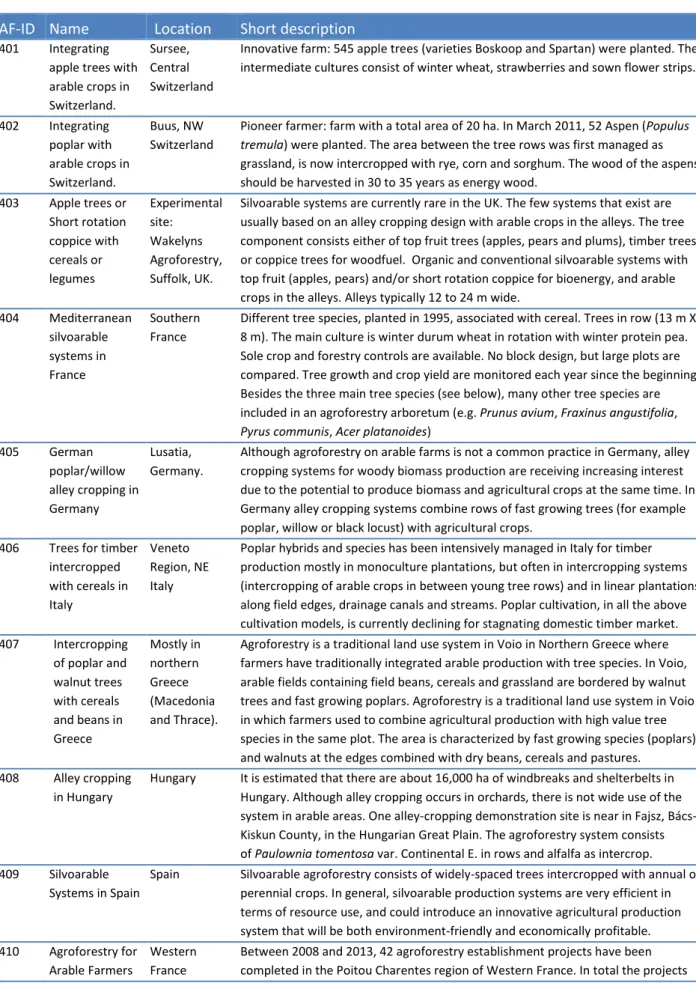
Table 3. Agroforestry for arable farms: the name, location and short description of the
selected systems
AF-ID Name
Location
Short description
401 Integratingapple trees with arable crops in Switzerland.
Sursee, Central Switzerland
Innovative farm: 545 apple trees (varieties Boskoop and Spartan) were planted. The intermediate cultures consist of winter wheat, strawberries and sown flower strips.
402 Integrating poplar with arable crops in Switzerland. Buus, NW Switzerland
Pioneer farmer: farm with a total area of 20 ha. In March 2011, 52 Aspen (Populus
tremula) were planted. The area between the tree rows was first managed as
grassland, is now intercropped with rye, corn and sorghum. The wood of the aspens should be harvested in 30 to 35 years as energy wood.
403 Apple trees or Short rotation coppice with cereals or legumes Experimental site: Wakelyns Agroforestry, Suffolk, UK.
Silvoarable systems are currently rare in the UK. The few systems that exist are usually based on an alley cropping design with arable crops in the alleys. The tree component consists either of top fruit trees (apples, pears and plums), timber trees, or coppice trees for woodfuel. Organic and conventional silvoarable systems with top fruit (apples, pears) and/or short rotation coppice for bioenergy, and arable crops in the alleys. Alleys typically 12 to 24 m wide.
404 Mediterranean silvoarable systems in France Southern France
Different tree species, planted in 1995, associated with cereal. Trees in row (13 m X 8 m). The main culture is winter durum wheat in rotation with winter protein pea. Sole crop and forestry controls are available. No block design, but large plots are compared. Tree growth and crop yield are monitored each year since the beginning. Besides the three main tree species (see below), many other tree species are included in an agroforestry arboretum (e.g. Prunus avium, Fraxinus angustifolia,
Pyrus communis, Acer platanoides)
405 German poplar/willow alley cropping in Germany Lusatia, Germany.
Although agroforestry on arable farms is not a common practice in Germany, alley cropping systems for woody biomass production are receiving increasing interest due to the potential to produce biomass and agricultural crops at the same time. In Germany alley cropping systems combine rows of fast growing trees (for example poplar, willow or black locust) with agricultural crops.
406 Trees for timber intercropped with cereals in Italy Veneto Region, NE Italy
Poplar hybrids and species has been intensively managed in Italy for timber production mostly in monoculture plantations, but often in intercropping systems (intercropping of arable crops in between young tree rows) and in linear plantations along field edges, drainage canals and streams. Poplar cultivation, in all the above cultivation models, is currently declining for stagnating domestic timber market. 407 Intercropping of poplar and walnut trees with cereals and beans in Greece Mostly in northern Greece (Macedonia and Thrace).
Agroforestry is a traditional land use system in Voio in Northern Greece where farmers have traditionally integrated arable production with tree species. In Voio, arable fields containing field beans, cereals and grassland are bordered by walnut trees and fast growing poplars. Agroforestry is a traditional land use system in Voio in which farmers used to combine agricultural production with high value tree species in the same plot. The area is characterized by fast growing species (poplars) and walnuts at the edges combined with dry beans, cereals and pastures.
408 Alley cropping in Hungary
Hungary It is estimated that there are about 16,000 ha of windbreaks and shelterbelts in Hungary. Although alley cropping occurs in orchards, there is not wide use of the system in arable areas. One alley-cropping demonstration site is near in Fajsz, Bács-Kiskun County, in the Hungarian Great Plain. The agroforestry system consists of Paulownia tomentosa var. Continental E. in rows and alfalfa as intercrop. 409 Silvoarable
Systems in Spain
Spain Silvoarable agroforestry consists of widely-spaced trees intercropped with annual or perennial crops. In general, silvoarable production systems are very efficient in terms of resource use, and could introduce an innovative agricultural production system that will be both environment-friendly and economically profitable. 410 Agroforestry for
Arable Farmers
Western France
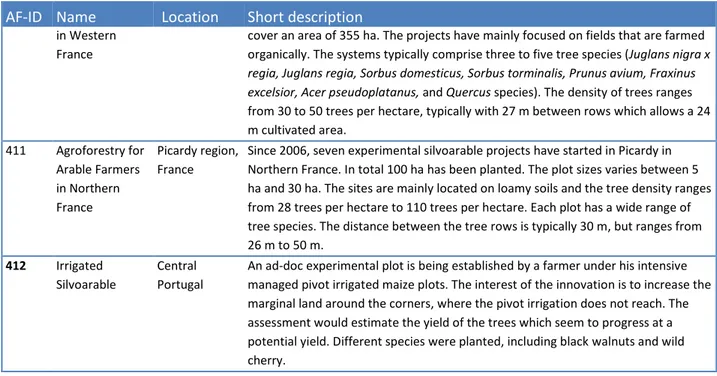
Between 2008 and 2013, 42 agroforestry establishment projects have been completed in the Poitou Charentes region of Western France. In total the projects
AF-ID Name
Location
Short description
in WesternFrance
cover an area of 355 ha. The projects have mainly focused on fields that are farmed organically. The systems typically comprise three to five tree species (Juglans nigra x
regia, Juglans regia, Sorbus domesticus, Sorbus torminalis, Prunus avium, Fraxinus excelsior, Acer pseudoplatanus, and Quercus species). The density of trees ranges
from 30 to 50 trees per hectare, typically with 27 m between rows which allows a 24 m cultivated area. 411 Agroforestry for Arable Farmers in Northern France Picardy region, France
Since 2006, seven experimental silvoarable projects have started in Picardy in Northern France. In total 100 ha has been planted. The plot sizes varies between 5 ha and 30 ha. The sites are mainly located on loamy soils and the tree density ranges from 28 trees per hectare to 110 trees per hectare. Each plot has a wide range of tree species. The distance between the tree rows is typically 30 m, but ranges from 26 m to 50 m.
412 Irrigated Silvoarable
Central Portugal
An ad-doc experimental plot is being established by a farmer under his intensive managed pivot irrigated maize plots. The interest of the innovation is to increase the marginal land around the corners, where the pivot irrigation does not reach. The assessment would estimate the yield of the trees which seem to progress at a potential yield. Different species were planted, including black walnuts and wild cherry.
Table 4. Agroforestry for livestock farms: the name, location and short description of the
selected systems
AF-ID Name
Location
Short description
501 Pigs in energycrops in Denmark
Jutland, DK Integrated production of free-range pigs and energy crops. The energy crops are willow and/or poplar. The energy crops are established in paddocks with lactating sows and piglets. The paddocks are organised so that they include two or more rows of poplar/willow in addition to an area with grass clover.
502 Wild cherry pastures in France Aude Department France
Different tree species planted in 1988 associated with pasture. Two trees densities: 100 trees /ha and 400 trees /ha were compared. A sole crop control and a forestry control were settled. Elevation = 570 m, field on a hillside
503 Woodland Eggs in the UK
UK Some of the eggs produced by hens with access to areas of trees are marketed as “woodland eggs”. To qualify as ‘woodland eggs’, the UK Woodland Trust, which adds its logo to the woodland eggs sold by Sainsbury’s plc (a major UK retailer), specifies 20% cover in the free range area with some trees within a 20 m distance from the shed. In 2013, the Woodland Trust reported the sale of about 400 million “woodland eggs” through Sainsbury’s, equivalent to about 3.4% of the UK market (Burgess et al., 2014). Other retailers also sell woodland eggs
504 Woodland poultry in the UK
UK Poultry meat: the output of meat from poultry in the UK (£2.3 billion in 2013) is second only to cattle. The proportion of chickens and other poultry with access to trees is not known.
505 Fodder trees for cattle and goats in the Netherlands
Duinboeren region , NL
Several dairy cow and goat farmers in the Duinboeren region of the Netherlands were participants of the Farms’ Network for Fodder Trees and Multifunctional Land Use (2012-2014). During that project four test sites with fodder trees were planted on four farms. Within the original project dairy goats and cows were allowed to browse on fodder trees such as willow (Salix spp).
506 Cherries and chickens in the Netherlands
NL There are approximately 2,300 hectares used for free-range poultry in the
Netherlands. However it is only since 1999, that farmers have looked at combinations of poultry with trees. In farmers’ network ‘Trees for chickens’ four poultry farmers have planted fruit trees. In another project, two poultry farmers have planted willow plantations. Independent from these projects, several other organic and free-range poultry farmers have planted walnut trees, fruit trees, Christmas trees, and willows in
AF-ID Name
Location
Short description
their free range areas. 507 Agroforestry for poultry in the Netherlands Netherlands No description 508 Agroforestry for organic poultry and pig production in DenmarkDenmark Velfærdsdelikatesser® (welfare delicacies) is a new initiative within organic meat production in Denmark. The initiative is seeking to promote natural and diverse livestock production (including the use of local breeds) on small organic farms. The meat is then sold directly to consumers in distinctive. The initiative offers potential for agroforestry systems where pigs and poultry are combined with fruit and vegetable production. 509 Agroforestry with pigs in Galicia, Spain Galicia, Spain
Celtic pigs are an autochthonous pig breed of Galicia. The breed is believed to derive from northern-central European pig breeds. They are usually farmed in semi-extensive or extensive conditions in forest areas where chestnut (Castanea sativa Miller) and oak (Quercus robur L.) trees are dominant.
510 Agroforestry resistant to seedling browsing in Portugal Alentejo, Portugal
Honey Locust (Gleditsia triacanthos) is leguminous tree, having a deep taproot growing down 3-6 m deep and few lateral roots that make it suitable for agroforestry systems. Furthermore, in young plants, stems bear very large, flat thorns and the young trees form very dense thorny thickets, providing defence to animal browsing, where coppice regrowth and pods are a valuable fodder. It begins bearing pods 3 years after planting and it can produce 20-75 kg pods/tree within 8 years. However this system is underutilized.
511 Agroforestry with Eucalyptus Portugal Ribatejo, Portugal
Eucalyptus is a typical forest species. However, there is interest to evaluate what would be the yield of Eucalyptus under lower plantation densities as that could provide a grass complement to enable grazing. This is a systems practiced in e.g. Brazil, but an evaluation is needed under temperate/Mediterranean climates.
4
Innovations to model
At the stakeholder meetings (Annex A), about 130 potential innovations were identified. Within the
AGFORWARD consortium, there is experience with working three agroforestry models (Table 5).
Table 5. Brief description of three agroforestry models
Model name
Brief model description
Yield-SAFE
A “parameter-sparse” mechanistic bio-physical model than run of a daily time-step
that describes tree and crop growth in response to changes in solar radiation,
temperature, and rainfall (van der Werf et al. 2007)
Farm-SAFE
A bio-economic model, that works on an annual time-step, that links the outputs
from Yield-SAFE with information on labour and input use, and financial values
(such as arable crop and tree revenues and together with grants) to predict the net
present value of systems at a plot- or at a farm-level (Graves et al., 2010)
Hi-sAFe
A 3-D agroforestry model that describes tree and crop interactions using “voxels”
(Talbot, 2011).
Each innovation was reviewed to determine if there was an opportunity to use one of the above
three models to help answer the questions raised. It was considered that 60 innovations (out of 130)
could potentially be helped by at least one of the models (see Tables 6, 7, 8 and 9). Most of the
model-related questions were related to “System design and Management” (Figure 2). Hence from
this initial scoping study, models could potentially help in about 50% of these questions. The
research questions which cannot be effectively answered by using bio-economic models are
discussed in Section 6.
Figure 2. Number of questions from areas of innovation where three agroforestry models
(Yield-SAFE, Farm-SAFE, Hi-sAFe) are able or unable to help answer research questions
-2 3 8 13 18 23 28 Farm Profitability
System design and management
Tree protection and regeneration Pasture / Grazing Animal production Extension/Policy Environmental conservation Plant Production Socio-economic
Table 6. High natural and cultural value agroforestry: the capacity of 28 innovations
identified in agroforestry systems of to be addressed (Y = yes; N = no) by three agroforestry
models (Y: Yield-SAFE; F: Farm-SAFE; H: Hi-sAFe).
Area
Proposed research
Part-ner
Model
Comment
Y
F
H
Farm profitability Branding HNCV agroforestry product. Trademark. Valuing productDehesa trademark UEX N Y N Farm-SAFE could help to assign a value to a Dehesa system product
Product diversification. New products (tannins, dyes, aromatic, medicinal,
New acorn-derived products
ISA UEX
Y Y N Can quantify the availability of new products, but not finding novel products. mushrooms, firewood, biomass) Promote knowledge on human consumption of acorns in different products
ISA Y Y N Yield-SAFE/Farm-SAFE could estimate economic viability to promote knowledge. Could quantify the availability of acorns.
Green Accounting System. economical evaluation of ecosystem services (ES)
Comparison of ES between agriculture, agroforestry and forestry
ISA Y Y N Ecosystem services will be quantified and linked to Yield-SAFE
System design and management Design and management of the systems to (new) multiple purposes. Synergies among three components (tree, pasture/crop and livestock)
Consultative process between Sami and foresters for the long-term planning
EFI-SLU
Y? Y? Y Yield-SAFE could provide biomass estimations for animal husbandry capacity. Hi-sAFe could predict grass production for various tree
density/design/management Adaptive design of
hedgerows
Shift from single model of novel hedgerow to modular models and progressive management techniques.
INRA N N Y Yield-SAFE does not account for spatial details. Hi-sAFe can model hedgerows by turning off the toric symmetry in one direction Development of appropriate management frameworks for silvopastoral systems aimed at promoting synergies between grazing animals, pasture and trees
CNR Y? Y? Y Yield-SAFE/Farm-SAFE could contribute for the system design for management options. Hi-sAFe can model hedgerows by turning off the toric symmetry in one direction
Tree layer management Innovative [tree] species able to resist to livestock
ISA Y? Y? Y Yield-SAFE does not model mortality. But could calibrate/validate tree species (spiky) if there are data available. Hi-sAFe can predict the size of the trees, and threshold on the size may be used to determine when the trees are livestock-safe
Three dimensional design and management (layers, width, spatial connections)
Windbreaks rejuvenation BTU N N Y YS does not account for spatial designs. Hi-sAFe does, but dies not predict the climate mitigation by a windbreak. It can only predict tree
Area
Proposed research
Part-ner
Model
Comment
Y
F
H
growth and the impact of the windbreak on the crops ignoring wind modification (only shade and root competition for water and nitrogen) Livestock management Appropriate stocking
rate. Stocking rate matching to forage resources and to CAP
TEI UBB
Y Y Y YS will estimate livestock capacity according to productivity
Tree protection and regeneration Reconciling grazing with
trees (cost-efficient protection of saplings)
Dead branch - Deadwood shelters
ISA UEX BTU
N Y N Could be included in a single evaluation of tree protection measures: cost benefit analysis Artificial thorny
protectors
UEX NYME
N Y N
Tree guards, e.g. Tubex NYME N Y N
Thorny and/or Nursery Shrubs UEX UBB NYME N Y N Chemical organic repellents UEX N Y N Planting of new structures BTU N Y N Grazing management/exclusion TEI UBB N Y N Periodical grazing UBB N Y N
Fencing (cost-efficient structures)
NYME BTU
N Y N Pasture quality and fodder autonomy
Overcome strong seasonality of “natural” forage resources
Fodder crops: cereal varieties adapted to shade and tree competition
UEX Y Y Y YS could help improve rotation efficiency, including shade tolerant varieties (by changing radiation use efficiency parameter)
Retaken of pruning trees for acorn production & fodder
TEI Y Y Y YS could be parametrized to estimate % of thinning/pruning biomass for animal usage. Yield-SAFE can do this. Already done by the dehesa Increase pasture
productivity and quality
Pastures rich in legumes adapted to oak shade and grazing pressure
UEX Y Y N YS can compare different radiation use efficiency between pasture species (data is needed to validate). We could assume grass production and link it to different ME. Adapted silviculture for
grazing. Need of early thinnning
UBB EFI-SLU
Y Y Y YS could run on different thinning regimes to estimate pasture production. About timing. could consider dif times for thinnings
Area
Proposed research
Part-ner
Model
Comment
Y
F
H
Grazing schemes and cost-effective herding
Livestock species Cattle and buffalo instead of sheep in wood-pastures.
UBB Y Y N YS could estimate pasture productivity under forest and estimate animal capacity. Animal production
Diversification (Geese, turkeys, red deer …)
Extensive turkey production under montado.
ISA Y Y N Animals will be referred to Forage Units. Prices and costs can be adjusted to economic model Nature conservation
Soil protection; stocking rate matching to forage resources and to CAP
Rotational herding UEX UBB
Y Y N YS can estimate productivity and estimate animal capacity and Farm-SAFE can relate that with different CAP policy support (incentives) Organic matter and soil
carbon sequestration
Ramial wood chips and other organic mulch
UEX INRA
Y Y N YS can estimate thinning and pruning biomass and incorporated in soil and estimate carbon sequestration. Farm-SAFE can link to chipping costs (or other mulching costs)
Policy and governance Specific measures and grants, and long term regulations
Payment for historical landscapes
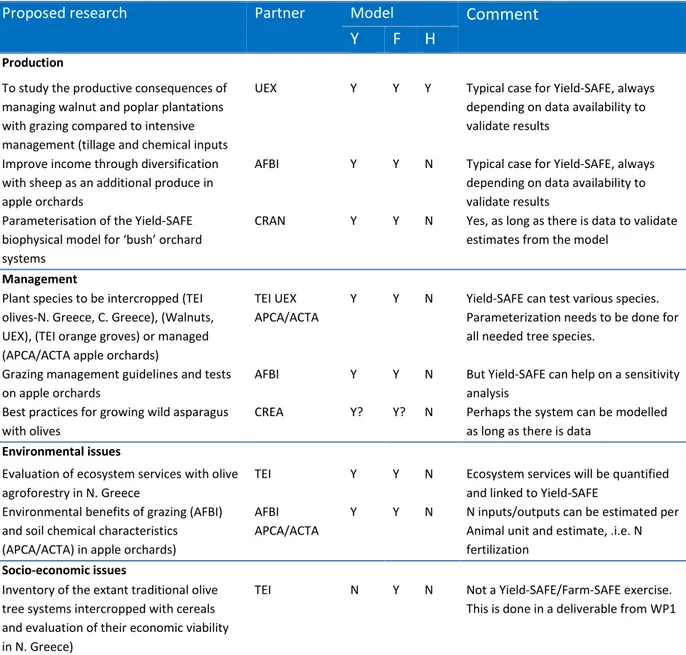
Table 7. Intercropping and grazing of high tree value systems: the capacity to address nine
research questions (Y: yes; N: no) using three agroforestry models (Y: Yield-SAFE; F:
Farm-SAFE; H: Hi-sAFe).
Proposed research
Partner
Model
Comment
Y
F
H
Production
To study the productive consequences of managing walnut and poplar plantations with grazing compared to intensive management (tillage and chemical inputs
UEX Y Y Y Typical case for Yield-SAFE, always depending on data availability to validate results
Improve income through diversification with sheep as an additional produce in apple orchards
AFBI Y Y N Typical case for Yield-SAFE, always depending on data availability to validate results
Parameterisation of the Yield-SAFE biophysical model for ‘bush’ orchard systems
CRAN Y Y N Yes, as long as there is data to validate estimates from the model
Management
Plant species to be intercropped (TEI olives-N. Greece, C. Greece), (Walnuts, UEX), (TEI orange groves) or managed (APCA/ACTA apple orchards)
TEI UEX APCA/ACTA
Y Y N Yield-SAFE can test various species. Parameterization needs to be done for all needed tree species.
Grazing management guidelines and tests on apple orchards
AFBI Y Y N But Yield-SAFE can help on a sensitivity analysis
Best practices for growing wild asparagus with olives
CREA Y? Y? N Perhaps the system can be modelled as long as there is data
Environmental issues
Evaluation of ecosystem services with olive agroforestry in N. Greece
TEI Y Y N Ecosystem services will be quantified and linked to Yield-SAFE
Environmental benefits of grazing (AFBI) and soil chemical characteristics (APCA/ACTA) in apple orchards)
AFBI APCA/ACTA
Y Y N N inputs/outputs can be estimated per Animal unit and estimate, .i.e. N fertilization
Socio-economic issues
Inventory of the extant traditional olive tree systems intercropped with cereals and evaluation of their economic viability in N. Greece)
TEI N Y N Not a Yield-SAFE/Farm-SAFE exercise. This is done in a deliverable from WP1
Table 8. Agroforestry for arable farms: the capacity to address 16 research questions (Y: yes;
N: no) using three agroforestry models (Y: Yield-SAFE; F: Farm-SAFE; H: Hi-sAFe)
Area
Proposed Research
Partner
Model
Comment
Y
F
H
Design How to breed agroforestry-adapted crops?
Breed for shade tolerant or agroforestry adapted crops
INRA, ORC N N Y This needs to be parameterized with for example, higher radiation use efficiency. If data from crops available this could be done What are the best
tree-crop combinations and what are their interactions?
Assess physiological behaviour, root competition of cereals with trees
USC, TEI, INRA, BTU, Uex, EVD, APCA-CH, APCA-P
N N Y Typical Hi-sAFe assessement
What is best spatial design that minimizes competition for light and nutrients?
Optimize alley width, tree line orientation and use cultivar diversification, shade tolerant varieties close to trees.
TEI, INRA, BTU, Uex, EVD, APCA-CH, APCA-P
N N Y Alley with can be estimated but Hi-sAFe is better for this matter
How to design efficient agroforestry systems? How can harvest of crops and trees be synchronized?
Reconsider crop and tree species to synchronize harvest
EVD Y Y Y Yield-SAFE could help improve rotation efficiency
How can new crops serve a purpose in agroforestry systems?
Study how new crop species (aromatic plants, cut flowers, berries) can improve product diversity
USC, TEI, ORC Y? Y? N Perhaps productivity of new crop species could be estimated, providing yield data for calibration/validation How can trees species
choice be improved?
Study how multiple tree species can improve product diversity
TEI, ORC, CNR/ VEN
N N Y Yield-SAFE does not model multiple tree species. With Hi-sAFe, it is possible to explore the behaviour of new tree species (real or theoretical). Can soil depth be a
limiting factor?
Compare establishment on deep/shallow soils
TEI, INRA Y Y Y Yield-SAFE can perform a sensitivity analysis on soil depths
Can trees be added in irrigated plots with pivot systems
Estimate gross margin including the trees grown in the corners of the pivot systems
ISA Y Y N Yield-SAFE can estimate non limited tree growth and Farm-SAFE can estimate the gross margin of the plot
Management How can agroforestry systems best be managed and mechanized (e.g. pruning, harvesting times/cycles)? Establish methods to improve management efficiencies of agroforestry systems EVD, CNR/VEN, APCA-PI N N Y Not a Yield-SAFE/Farm-SAFE exercise. Typical Hi-sAFe exercise
How can nitrogen fixing trees influence crops?
Assess the potentials of nitrogen fixing trees
ORC N N Y Yield-SAFE does not have an N model influencing the crop growth. This could be assessed by Hi-sAFe, but the reverse is easier to model : impact of fixing crops on non-fixing trees
Area
Proposed Research
Partner
Model
Comment
Y
F
H
How do trees influence crop yields?
Compare using Land Equivalency Ratio
ORC, BTU, UEX Y Y Y LER could be present in all assessments
Environmental impacts What are the
biodiversity benefits?
Assess biodiversity of agroforestry systems and how this can be
maximized
USC, TEI, ORC Y Y N Not a Yield-SAFE/Farm-SAFE exercise. But satellite ES assessments can do this How much carbon is
fixed and how to maximize this?
Assess carbon
sequestration potential over agroforestry systems life span
USC, ORC, EVD Y Y Y RothC model was incorporated in Yield-SAFE and can estimate soil carbon sequestration, in addition to the above ground assimilated carbon
Can trees protect the crops from heat exhaustion?
Use models and experiments to predict heat protection potential
(TEI), INRA N N Y Yield-SAFE does not have heat models affecting crops Can trees reduce soil
erosion and improve soil health?
Assess effect of
agroforestry on soil health and micro-climate
BTU, Uex, APCA_PI
N N Y Depends on definition for soil health. Hi-sAFe can predict soil temperature and humidity in 3D Can trees improve
water regulation?
Use agroforestry to increase water use and irrigation efficiency
INRA, BTU Y Y Y Yield-SAFE can compare productivity with irrigation schedules
Table 9. Agroforestry for livestock farms: the capacity to address 16 research questions (Y:
yes; N: no) using three agroforestry models (Y: Yield-SAFE; F: Farm-SAFE; H: Hi-sAFe)
Proposed research
Part-ner
Model
Comment
Y
F
H
Design
System design: How many trees do you need to optimize the mineral uptake by dairy cows, and to maximise yields of trees and pasture?
LBI Y Y Y YS can estimate biomass and convert it to metabolizable energy
Use of fast growing species such as willow or poplar
Ven Y Y Y Productivity of new species could be estimated, providing yield data for calibration/validation
Introduction of new crops on farms (Mulberry) USC Y Y N Productivity of new crop species could be estimated, providing yield data for calibration/validation
Management
Can trees contribute to mineral uptake? LBI N N Y YS does not have a nutrient model influencing the tree growth. This could be assessed by Hi-sAFe, but only for Nitrogen How much labour is needed per tree
species/plantation type?
LBI N Y N Farm-SAFE could help with labour requirements. Data would be needed What are the nutritional (and medicinal) value
of trees and shrubs? What place can ligneous forages take in the diet of cows?
IDELE/ INRA
Y Y N YS could relate energy from fruits/crops to act as sources for animal production (animal capacity). Data is needed. A high interest in knowing the potential of
native shrubby, herbaceous and tree species as nutritional resources for Celtic Pig
USC Y Y N YS could relate energy from fruits/crops to act as sources for animal production (animal capacity). Data is needed. Gleditsia could be an interesting tree species
as it is spiky in earlier stages, preventing browsing. It would be interesting to estimate its growth an energy content as feedstock, and the equivalent added monetary value
ISA Y Y N YS can be calibrated to this specie if data/literature is available and Farm-SAFE could estimate the equivalent value in terms of feedstock equivalences Eucalyptus is the tree species with more are in
Portugal and farmers are interested to explore the potential of this species with lower densities and provide pasture for grazing
ISA Y Y N YS, can be calibrated for eucalyptus, and an assessment on light and water competition can be made to explore the threshold on tree density that allows silvopasture. Comparison of forest and silvopasture can be explored with Yield-SAFE and Farm-SAFE Socio-economic
Look for profitable combinations LBI Y Y N Farm-SAFE can help with the economic viability of the systems
5
Synthesis
5.1 Identifying the appropriate model
It is apparent in Section 4 that the potential suitability of the agroforestry model depends on the
research question. While Yield-SAFE and Farm-SAFE are designed for long-term assessments, the
more detailed Hi-sAFe model can be used for detailed short-term assessments. All three of the
models can be used for some common issues, for example: exploring various designs of agroforestry
plantations (e.g. tree density, choice of crops), various tree and crop management options, the
potential impact of climate change, and the calculation of land equivalent ratios.
The parameter-sparse Yield-SAFE is probably best suited to allow the determination of the animal
carrying capacity of different agroforestry designs, by modelling the impact of the trees on, for
example, grass growth. Hi-sAFe has been developed to determine nitrogen budgets. The
bio-economic Farm-SAFE model is most appropriate for bio-economic analyses.
5.2 Tree, crop and livestock species currently modelled
Some innovations will require more parameterisation of the model for new tree species, new crops,
hedgerows, and in the case of Yield-SAFE and Farm-SAFE, livestock. A resume of tree, crop and
livestock species identified in the innovations and the current state of models’ calibration is shown in
Table 10, 11, and 12.
5.3 Research questions for modelling
At present, the research questions still need to be refined before modelling can begin in earnest.
Questionnaires along with data collection forms are under development and will be provided to the
partners to help clarify what results can be expected from the models depending on the availability
of measured data (e.g. from field protocols). Based on discussions, the use of the models can remain
solely the preserve of the modelling team (Modelling team), or it can be a co-operative approach. If
the models are only used by a small modelling team, the stakeholder groups will need to provide the
data, the modellers will provide the simulations, and the two parties will help analyse the results. In
the co-operative approach, the modellers will train others to use Yield-SAFE, Farm-SAFE or Hi-sAFe.
The visiting person will run the simulations and modellers provide assistance in case of any problem,
and help to analyse the outputs. Cooperation is the preferred method because it tends to be faster
and, will increase the number of future experts on using the model. During the project, four
modelling workshops are intended to gather interested researchers willing to participate in the
modelling of the innovations/systems for WP2-WP5.
Table 10. Tree species identified in the innovations and the current extent of calibration
Common name
Latin name
Yield-SAFE calibration
Hi-sAFe calibration
Norway maple Acer platanoïdes L.Sycamore Acer pseudoplatanus
Italian alder Alnus cordata
Red Alder Alnus rubra
Siver birch Betula alba
Hornbeam Carpinus betulus
Orange tree Citrus sinensis
Cornelian cherry Cornus mas
Hazel Corylus avellana
Ash Fraxinus excelsior
Honey locust Gleditsia triacanthus
Sea buckthorn Hippophae rhamnoides
Common walnut Juglans regia Yes
Hybrid walnut Juglans regia X Juglans nigra Yes
Apple tree Malus domestica Yes
Olive tree Olea europea
Empress tree Paulownia tormentosa
Stone pine Pinus pinea Yes
Monterey pine Pinus radiata Yes
Poplar hybrids Populus x canadensis
White poplar Populus alba Yes
Black poplar Populus nigra Yes
Poplar Populus spp Yes Yes
Aspen Populus tremula Yes Yes
Wild cherry Prunus avium Yes
Valonian oak Quercus ithaburensis subs. macrolepis
Sessile oak Quercus petraea
Holm oak Quercus rotundifolia Yes
Cork oak Quercus suber Yes
Black locust Robinia pseudoacacia
Rosehip Rosa rugosa
Willow Salix viminalis
Pagoda tree Sophora japonica
Service tree Sorbus domestica L.
Table 11. Crop species identified in research questions and the current extent of calibration
Common name
Latin name
Yield-SAFE
Hi-sAFe
2Alfalfa Medicago sativa Yes
Aromatic plants
Barley Hordeum vulgare Yes
Common bean Phaseolus vulgaris Yes
Common vetch Vicia sativa
Durum wheat (winter) Triticum turgidum L. subsp. Durum Yes
Fallow Yes
Grass (improved) Yes
Grass (natural pastures) Yes
Grass (sown mixtures)
Lupins Lupinus spp.
Maize Zea mays Yes Yes
Oats Avena sativa Yes
Oilseed rape Brassuca napus Yes Yes
Potatoes Solanum tuberosum L Yes
Protein pea (winter) Pisum sativum L cv Blizzard
Rhubarb Rheum rhabarbarum
Rye (perennial) Secale multicaule
Rye (winter) Secale cereale
Salads (lettuce) Lactuca sativa
Sown flowers
Soybean Glycine max Yes
Squashes (courgette or pumpkin) Cucurbita pepo
Strawberry Fragaria × ananassa
Sugar beet Beta vulgaris Yes
Sunflower Helianthus annuus. Yes Yes
Wheat (spring and winter) Triticum spp. Yes Yes
White, red and crimson clovers Trifolium spp
2
Table 12. Livestock identified in the research question and the current state of calibration
Livestock Breed
Agroforestry system
Yield-SAFE
calibration
Cattle Exotic Limousine, Charolês; NativeAlentejana, Mertolenga
Montado There is a Livestock Metabolisable Energy Requirement (LMER) for a Livestock Unit which will be used as default value. Other references can support the change of this value for specific livestock. Chicken Unspecified Intercropping of orange groves with
arable crops in Greece
Goat Unspecified Valonia oak silvopastoral systems Goat Serpentina, Charnequeira Montado
Horses Lusitano, Sorraia Montado Pigs Black Iberian pig races Caldeira,
Ervideira, Loira
Montado Pigs Modern crossbreed Danish Landrace
x Yorkshire x Duroc
Pigs in energy crops in Denmark Sheep Galician breed Agroforestry with sheep in Galicia,
Spain
Sheep Bizet breed Wild cherry pastures in France Sheep White Merino, Black Merino Montado
Sheep Shropshire breed -UK Grazed orchards in the UK Sheep Unspecified Valonia oak silvopastoral systems,
Chalkidiki, Molos and Intercropping poplar and walnut trees with cereals and beans in Greece
6
Innovations not to be modelled
The participants at the workshop (20
thApril 2015 – 30
thApril 2015) in Monchique, Portugal also
examined how, if at all, the non-modelling research questions should be tackled. From the initial
analysis, and with a consultation with all the modelling partners, six research approaches were
identified
Table 13. Six research approaches have been suggested to address the research questions
raised by the stakeholder groups
Code
Principal research approach
Description
M
Modelling
Primarily questions associated with biophysical or
economic issues
S
Social science methods
Issues related to adoption and farmer responses to
agroforestry
P
Policy analysis
F
Field-based methods
Trials and demonstrations
E
Experiment
For example laboratory-based analyses
L
Literature
Literature review
Tables 14, 15, 16 and 17 provide an initial description of those research questions which are
probably best addressed using a non-modelling method. It is assumed that literature review is an
appropriate technique in each method.
Table 14. High natural and cultural value agroforestry: research questions which are
probably best addressed through a non-modelling approach such as social science (S), policy
analysis (P), field-based work (F), or experiment (E)
Area
Proposed research /
Innovation
Part-er
Comment
Approach
(see table 13) Farm profitability Branding HNCV agroforestry product. Trademark. Valuing productCertification of animal husbandry products
TEI Result from Yield-SAFE/Farm-SAFE/Hi-sAFe could reinforce the concept, but not model it directly. Evidence provision from results to help with certification.
S
Improved knowledge of customer and tax payer interest (Questionnaires: protocol ready)
UEX NYME
Not a model exercise S
Product diversification. New products
Phlomis fruticosa as
understorey crop
TEI Could be modelled if data is available, unclear what the purpose of the ground-bed is.
S
Quality of tree products (e.g. cork quality vs management)
Assessment of cork quality respect to management practices: debarking intensity, height
ISA There are no models readily available for strengthening Yield-SAFE in this aspect
S
System design and management Three dimensional design and management (layers, width, spatial connections)
Renewing encroach-abandoned wood pastures
NYME Landscape level. Not for Yield-SAFE. F
Open young stands that enable reindeer movements and herd control
EFI-SLU
This is a landscape architecture exercise. Yield-SAFE is not sufficiently spatial.
F
Rebuilding connections between hedgerows and scattered farms across the landscape. Anchoring new plantations on remnants of old hedgerows. Linking the design of ground structure and vegetation layers; use of forest plough to facilitate bank making if necessary.
INRA This is a landscape architecture exercise. Yield-SAFE is not sufficiently spatial
F
Infrastructures for livestock transport. Transhumance
? P
Tree protection and regeneration Reconciling grazing with
trees (cost-efficient protection of saplings)
Invisible Fencing for livestock exclusion
CRAN Not a Yield-SAFE exercise, but Farm-SAFE could compare estimates for costs
F
Area
Proposed research /
Innovation
Part-er
Comment
Approach
(see table 13)species species. NYME
Avoidance of exotic tree species as e.g. Pinus
contorta.
EFI-SLU
Not a Yield-SAFE exercise F
Tree decay (pests, diseases and wildfire), and fruit losses
An adequate silvo-environmental
management practices for pests and diseases control
UEX Yield-SAFE does not account for pests and diseases
F
Pasture quality and fodder autonomy Overcome strong seasonality of “natural” forage resources
Forest grazing and pannage
NYME Yield-SAFE could estimate pasture productivity under forest and estimate animal capacity. However pannage by pigs involve other understorey nutrient sources (e.g. Truffles, worms) that Yield-SAFE does estimate
F
Restoration of degraded pastures / disturbed areas
Equipment for re-establishment of lichens at the disturbed area harmful
EFI-SLU
Lichens are not a crop, not even a plant. It would be necessary to estimate with a different model with different parameters
F
Grazing scheme and cost effective herding More efficient and even use
of extensive forage resources Fast-intensive rotational grazing UEX UBB F
Best practice and solution of forest grazing and pannage
TEI Yield-SAFE could estimate pasture productivity under forest and estimate animal capacity. However pannage by pigs involve other understorey nutrient sources (e.g. Truffles, worms) that Yield-SAFE does estimate
F
Grazing regulation ?? P
Cost-efficient herding. Technology
Facilities location UEX UBB
Not a Yield-SAFE exercise, possibly a Farm-SAFE exercise L GPS herding UEX CRAN EFI-SLU Not a Yield-SAFE/Farm-SAFE/HS L
Virtual/Invisible fencing UEX CRAN EFI-SLU
Not a Yield-SAFE exercise, possibly a Farm-SAFE exercise
L
Grazing and herding technology
NYME EFI-SLU
Not a Yield-SAFE exercise, possibly a Farm-SAFE exercise
L
Animal production Genetic selection. Docility & Browsing behaviour. Local races
Not elaborated ? Not a Yield-SAFE/Farm-SAFE exercise
Area
Proposed research /
Innovation
Part-er
Comment
Approach
(see table 13)Livestock health (water quality, reinfection from wild fauna, sheltering …)
GPS collars. Control of access to water point and supplementary food. Control of animal health. Monitoring herd position
UEX EFI-SLU
Not a Yield-SAFE exercise, possibly a Farm-SAFE exercise
L
Design of the structure and location of novel hedgerows for enhancing sheltering.
INRA Yield-SAFE is not spatial L
Control of predators Not elaborated ? ?? L
Extension
Open school; maintenance of local knowledge
Pilot Farms (economically healthy)
ISA Not a Yield-SAFE/Farm-SAFE exercise
F Open school; maintenance
of local knowledge
Favouring the design (and diffusion) of a model of “cooperative of skills and machines pool” for re-developing bocage agroforestry.
INRA Not a Yield-SAFE/Farm-SAFE exercise
L;S;P
Nature conservation Soil protection; stocking rate matching to forage
resources and to CAP
Combining crop rotation management, pasture management and 3 dimensional design and management of hedgerows to avoid soil erosion.
INRA Typical Hi-sAFe exercise but no erosion in Hi-sAFe
L
Fire control Effect of grazing exclusion on the wildfire behaviour.
CNR-ISPAA M
Yield-SAFE can estimate biomass that can be converted to fuel and assess the impact of the grazing for reducing fire hazard
L
Fire control Low input techniques of firebreaks management
? Yield-SAFE is not spatial, and this research needs spatial relations
Table 15. Intercropping and grazing of high tree value systems: : research questions which are
probably best addressed through a non-modelling approach such as social science (S), policy
analysis (P), field-based work (F), or experiment (E)
Area and proposed research/innovation
Partner
Comment
Approach
Policy and governanceSpecific measures and grants, and long term regulations: Proposals for a specific status of the hedgerows of high and medium stem trees in the 2nd but also 1st pillar of the CAP to support their maintenance.
INRA Not a Yield-SAFE exercise but could be eventually accounted by Farm-SAFE
P
Production
Quality assessment of products (TEI olives, C. Greece) TEI Yield-SAFE estimates productivity but not quality
L Techniques to increase mushroom production
(Chestnuts, USC)
USC Yield-SAFE does not model mushroom
F To study the interactions of Shropshire sheep and
apple trees (CRAN, grazed orchards)
CRAN Yield-SAFE can estimate pasture productivity and animal capacity and FM can estimate economic interactions with sheep varieties
F
Management
Animal species (olives CRA-OLI) (CRAN, apple orchards) – breed used (AFBI, apple orchards) and effect on pests and diseases (APCA/ACTA apple orchards)
CRA CRAN AFBI APCA/ACT A
Yield-SAFE can estimate animal capacity in the orchards, but not effects on diseases
F;L
Techniques to increase mushroom production (Chestnuts, USC)
USC Yield-SAFE does not model mushrooms
F;L Graft production of selected varieties of chestnuts
(Chestnuts, USC)
USC Yield-SAFE can estimate the productivity but parameterisation of a grafted tree should be considered as a new "specie" with different parameters, that could be linked to Farm-SAFE costs of grafting and early revenues from the tree
Table 16. Agroforestry for arable farms: : research questions which are probably best
addressed through a non-modelling approach such as social science (S), policy analysis (P),
field-based work (F), or experiment (E)
Area and proposed research
Partner
Comment
Approach
Socio-economic issues
Propose high
marketability products and test (this could fit in the management as well)
CRA Result from Yield-SAFE/Farm-SAFE/Hi-sAFe could reinforce the concept, but not modelling it directly
S
Design Need to see agroforestry
Develop show case farms USC APCA-PI Not a Yield-SAFE/Farm-SAFE/HS exercise. F Management How do agroforestry systems influence crop disease? How can their influence be prevented?
Assess how crop and tree interaction changes the presence of diseases.
INRA CNR/VEN NymE
Yield-SAFE does not model disease effects. However crude analysis could be done on effects of some diseases affecting leaf area (improving radiation interception by crops)
L
How can crop and tree products (fruits/nuts) harvest be
synchronized?
Establish efficient harvest methods for agroforestry systems
EVD Not a Yield-SAFE/Farm-SAFE exercise. This is not directly done by Yield-SAFE, but rather a calendar analysis for optimizing efficiency of production could be done
L;F
How can trees in agroforestry systems best be protected against domestic animals and wildlife?
Design cost effective wildlife protection system using either natural or artificial products USC INRA ORC EVD NymE APCA-CH APCA-P
Not a Yield-SAFE/Farm-SAFE exercise. L;F
How can old agroforestry systems best be renewed?
Establish methods for renewal at end of life
TEI ORC Not a Yield-SAFE/Farm-SAFE exercise. L;F
How do agroforestry systems affect the presence of weeds? What innovative weed management methods can be developed?
Use natural sources or plants (aromatic plants) to protect against weeds and function as pollinator resource TEI INRA ORC BTU Uex EVD CNR/VEN NymE APCA-CH APCA-P
Not a Yield-SAFE/Farm-SAFE exercise. F;L
How can the application of chemicals best be managed in
agroforestry systems?
Study legal constraints regarding use of chemicals
USC EVD Not a Yield-SAFE/Farm-SAFE exercise. P
Regulation and policies How can the
administrative burden/bureaucracy be reduced? Simplification of grant process for establishment of agroforestry TEI ORC BTU Uex NymE APCA-CH APCA-P
Area and proposed research
Partner
Comment
Approach
How can CAP reformsresult in clear and long-term funding for agroforestry? How can regulators and
technicians be educated about agroforestry?
Improve agroforestry representation in Brussels and member states USC TEI INRA ORC BTU Uex EVD CNR/VEN NymE APCA-CH APCA-P Not a Yield-SAFE/Farm-SAFE/HS exercise. However results from Yield-SAFE/Farm-SAFE/Hi-sAFe can support representation by interested parties
P
Socio-economic How can information about agroforestry systems be more accessible?
Establish an online portal for agroforestry and establish
reference farms that can be visited
TEI ORC NymE APCA-CH
Not a Yield-SAFE/Farm-SAFE exercise. This is a deliverable from WP9. (map)
P;S
Are people willing to pay more for
agroforestry products?
Improve marketing and branding of agroforestry products (e.g. woodland eggs)
INRA ORC BTU Uex
Not a Yield-SAFE/Farm-SAFE exercise. S
Can business opportunities be created through participatory breeding? Involve agrifood industry stakeholders from the onset of the project
INRA Not a Yield-SAFE/Farm-SAFE exercise. S
How can long-term investments/funding be guaranteed?
Conduct a cost benefit analysis
BTU Uex APCA_PI
Yield-SAFE/Farm-SAFE can help on this assessment, including ES approach
P
How can land tenure become more flexible to allow agroforestry establishment?
Educate landowners of agroforestry benefits and increase flexibility of land tenure
TEI ORC BTU APCA_PI
Not a Yield-SAFE/Farm-SAFE exercise. P
How can we improve knowledge and value of agroforestry products?
Evaluate timber quality in agroforestry systems and the value of wood thinnings
TEI ORC UEX CNR/VEN
Yield-SAFE/Farm-SAFE can estimate the production and value of wood thinnings