JOANA MIRA NUNES SEIXAS VEIGA
RELATÓRIO DE ACTIVIDADE PROFISSIONAL
UNIVERSIDADE DO ALGARVE
Faculdade de Ciências e Tecnologia
2017
2017 R EL A TÓRIO D E A TIVID A D E PR O F IS SI ONA L JOA N A M IR A N U N ES SE IX A S VEIG AJOANA MIRA NUNES SEIXAS VEIGA
RELATÓRIO DE ACTIVIDADE PROFISSIONAL
Mestrado em Biologia Marinha
Trabalho efetuado sob a orientação de:
Professora Alexandra Teodósio
UNIVERSIDADE DO ALGARVE
Faculdade de Ciências e Tecnologia
RELATÓRIO DE ACTIVIDADE PROFISSIONAL
Declaração de autoria
Declaro ser a autora deste trabalho, que é original e inédito. Autores e trabalhos consultados estão devidamente citados no texto e referenciados.
© Joana Mira Nunes Seixas Veiga
A Universidade do Algarve reserva para si o direito, em conformidade com o disposto no Código do Direito de Autor e dos Direitos Conexos, de arquivar, reproduzir e publicar a obra, independentemente do meio utilizado, bem como de a divulgar através de repositórios científicos e de admitir a sua cópia e distribuição para fins meramente educacionais ou de investigação e não comerciais, conquanto seja dado o devido crédito ao autor e editor respetivo
ABSTRACT
This report aims at describing my professional experience and demonstrating the competences developed between 2008 and 2016, after conclusion of the degree in Marine Biology and Fisheries from the University of Algarve, in order to obtain the Master Degree in Marine Biology (“Despacho reitoral 033/2011: Licenciados Pré-Bolonha").
For almost 8 years, I have been employed by the Coastal & Marine Union (EUCC), in the Netherlands, one of the largest international associations dedicated to coastal and marine conservation and sustainable management. During this period, I gained extensive experience on project design, management and implementation but also communication activities and participatory approaches. I worked specifically on topics such as sustainable tourism, Integrated Coastal Zone Management and adaptation to Climate Change. In the last 5 years I built solid expertise on the issue of marine litter, in the fields of European policy development and implementation, societal awareness and stakeholder engagement.
The report sustains my contribution to an improved position of European society in dealing with marine litter, in particular through a better integration of science in society and policies. This includes my participation in an expert group, contribution to 2 studies commissioned by the European Commission, contribution to the setup and implementation of the European projects MARLISCO and CleanSea.
Between 2009 and 2016, I published 2 papers in peer-reviewed journals (including one as first author); was an oral speaker in 7 international conferences and co-author in 2 other oral presentations; had 3 summaries published in the Conference Proceedings; was co-author in 4 technical reports published by the European Joint Research Centre (including lead author in one of them); co-author in 2 studies commissioned by the European Commission; co-author in 2 brochures on marine litter for policy-makers.
RESUMO
O presente relatório visa demonstrar a minha experiência profissional e competências adquiridas entre 2008 e 2016, a fim de substituir as unidades curriculares “Projecto de Tese” e “Dissertação” e, de acordo com o Despacho Reitoral 033/2011: Licenciados pré-Bolonha, obter o grau de Mestre em Biologia Marinha.
O percurso profissional aqui descrito, corresponde ao período em que trabalhei para a Coastal & Marine Union (EUCC), uma associação internacional dedicada à conservação e gestão sustentáveis dos recursos costeiros e marinhos na Europa. A EUCC é uma organização não-governamental fundada em 1989 e que, desde então, se tornou numa das maiores redes Europeias de peritos e organizações que operam ao nível da gestão costeira e do território marinho. A associação tem membros em 35 países diferentes e escritórios estabelecidos na Holanda, Alemanha, Lituânia, Espanha e Malta, estando a EUCC Internacional sediada em Leiden, na Holanda.
Após ter terminado a licenciatura em Biologia Marinha e Pescas, em dezembro de 2007, candidatei-me a uma bolsa do programa Leonardo da Vinci e completei um estágio professional de 5 meses na EUCC Internacional (setembro, 2008 – janeiro, 2009), à qual fiquei posteriormente vinculada, até agosto de 2016.
Ao longo de 8 anos, obtive experiência numa variedade de áreas temáticas e desenvolvi diversas competências profissionais, em resultado da preparação e implementação de projectos internacionais, a maioria co-financiada pela União Europeia, bem como das actividades de comunicação e financiamento da organização.
Entre 2009 e 2011, integrei a Unidade de Políticas da EUCC, de que destaco os seguintes projetos e responsabilidades:
- Turismo sustentável: programa QualityCoast – uma iniciativa da EUCC que pretende avaliar destinos costeiros turísticos e atribuir galardões de acordo com a sua performance a nível de sustentabilidade de todo o território do município ou região. Esta avaliação tem como base a informação sobre mais de 100 indicadores, que é fornecida pelas autoridades locais durante a candidatura aos galardões. Estes indicadores refletem o nível de qualidade e as políticas relacionadas com preservação da Natureza, gestão do ambiente e promoção da identidade local. No QualityCoast, integrei a equipa do secretariado, na qual contribuí para a revisão anual dos critérios e
indicadores do programa, a produção do material de apoio aos territórios candidatos, a promoção do programa junto de potenciais candidatos, avaliações das candidaturas (em particular das candidaturas de municípios Portugueses), disseminação dos resultados (e.g. em brochuras) e organização de eventos do programa;
- Bem-estar de golfinhos em Delfinários: coordenação de auditorias – uma inciativa da EUCC, em parceria com as agências turísticas TUI-Netherlands e Travelife, que teve como objectivo avaliar as condições de confinamento e manuseamento de golfinhos em determinados delfinários, de acordo com critérios de bem-estar específicos. A iniciativa pretendia informar estes agentes turísticos dos standards destes delfinários, bem como verificar se os golfinhos tinham sido indevidamente obtidos, i.e. capturados no meio selvagem. Neste projeto fui responsável pelo recrutamento de auditores, coordenação das visitas a 13 instalações no México, República Dominicana e Turquia e revisão dos relatórios das auditorias para os parceiros de projeto;
- Gestão Integrada de Zonas Costeiras: projeto OURCOAST – uma iniciativa da Comissão Europeia, que teve como principal objetivo facilitar a troca de experiências e boas práticas a nível de planeamento e gestão costeira na Europa. A EUCC foi responsável por produzir o conteúdo de uma vasta base de 350 estudos de caso e por toda a componente de comunicação do projeto. Durante os 3 anos em que este decorreu, contribuí activamente para o desenvolvimento da estrutura da base de dados e para a produção dos sumários dos estudos de caso, bem como para as actividades de comunicação do projeto e organização do evento de stakeholders em Riga (Letónia), que envolveu mais de 150 participantes;
- Adaptação às alterações climáticas: projeto IMCORE – um projecto Interreg da Região Nordeste Atlântica que desenvolveu estratégias locais de adaptação às alterações climáticas, como resultado de colaborações entre investigadores e autoridades locais, em 9 localidades do Reino Unido, Irlanda, França e Bélgica. Neste projeto, fui responsável por avaliar o processo de interação no seio destas colaborações e por produzir recomendações para melhorar a comunicação e colaboração entre ciência e decisores/gestores do território. Desta actividade resultou um módulo dentro de uma ferramenta de aprendizagem online, produzida pelo projeto, e o relatório The collaboration process between researchers and authorities - Guidelines to support a developing working relationship and insight into the collaboration process of IMCORE’s ECNs (2011), do qual fui autora;
- Gestão marinha baseada nos ecossistemas: projeto KnowSeas – um projeto científico do 7° Programa Quadro, que pretendeu desenvolver ferramentas de apoio a uma gestão baseada nos ecosistemas dos mares regionais da Europa. Neste projeto, contribuí principalmente para um estudo de perceções de stakeholders face a um conjunto de problemas ambientais marinhos e para o mapeamento das políticas Europeias e internacionais que vigoram sobre esses problemas. Desta actividade resultou o relatório Managing Europe’s Seas – A Scoping Study on Issues, Actors and Policies (2010), do qual fui coautora.
Em meados de 2010, comecei a trabalhar no tópico do lixo marinho, uma das maiores ameaças atuais ao funcionamento saudável dos ecossistemas marinhos e com consideráveis impactos sociais e económicos. O lixo marinho é um dos 11 “descritores” contemplados na Diretiva Quadro da Estratégia Marinha (2008/56/EC) da Comissão Europeia, transposta para legislação nacional em 2010, despoletando um ímpeto político marcado e a promoção de várias iniciativas no período seguinte para responder a este problema. O meu envolvimento no tema inciou-se com a elaboração de uma candidatura de um projeto a financiamento dentro do 7° Programa Quadro “Science in Society”, em que fui a principal coordenadora, tanto da parte técnica, como administrativa. Esta proposta foi aprovada em 2011 e, como resultado, surgiu uma série de outras oportunidades de projectos e iniciativas, dos quais se destacam alguns, abaixo descritos.
- Integração no Tecnical Group on Marine Litter: um grupo de peritos designados, estabelecido no final de 2010 pela Comissão Europeia, que tem como mandato fornecer apoio técnico e orientações aos Estados-membros, relativamente à monitorização do descritor “Lixo Marinho”, como parte do processo de implementação da Estratégia Marinha. Desde 2010, participei ativamente nas actividades do grupo, que incluíam reuniões bi-anuais e produção de documentos técnicos. De entre estes, salientam-se os relatórios Marine Litter Technical Recommendations for the Implementation of MSFD Requirements (2011), Guidance on Monitoring of Marine Litter in European Seas (2013), Harm Caused by Marine Litter (publicação prevista para o início de 2017), nos quais fui coautora e Identifying Sources of Marine Litter (2016, disponível em breve), no qual fui a autora principal; - Consciencialização da sociedade Europeia sobre o problema do lixo marinho: projeto
MARLISCO – uma colaboração entre 20 organizações que desenvolveram ferramentas educacionais e implementaram actividades em 15 países Europeus, a fim de
sensibilizar a população em geral e envolver actores específicos na procura de soluções para o problema do lixo marinho. Entre estas actividades destaca-se: a exposição em mais de 80 localidades na Europa, um concurso de video que envolveu 2100 estudantes, eventos participatórios nacionais que envolveram mais de 1500 stakeholders, incluíndo indústria de plásticos, autoridades, organizações não-governamentais e sectores marítimos. Para além de ter tido um papel primordial na conceção e coordenação da proposta, fui responsável por liderar um dos pacotes de trabalho do projeto (concurso de video Europeu) e gerir a equipa da EUCC na implementação de todas as actividades do projeto na Holanda. Em 2016, juntamente com vários colegas do projeto, publiquei o artigo Enhancing public awareness and promoting co-responsibility for marine litter in Europe: The challenge of MARLISCO no jornal Marine Polluttion Bulletin, no qual fui a primeira autora.
- Contratos de serviços/estudos sobre o lixo marinho para a Comissão Europeia – um projeto piloto implementado em 2012, que pretendeu determinar a origem do lixo marinho e medidas de prevenção em 4 locais de estudo na Europa e um estudo para propôr uma meta de redução do lixo marinho para a Europa, para os quais contribuí como perita subcontratada da EUCC;
- Contribuição para um melhor conhecimento científico sobre o lixo marinho. Nesta vertente, destacam-se: a minha integração na equipa da EUCC como um dos parceiros do projeto científico CleanSea, que investigou determinados aspectos sobre o impacto biológico e económico do lixo marinho e produziu recomendações para decisores politicos; a participação em discussões iniciais com a Agência Espacial Europeia sobre o potencial de deteção remota do lixo marinho (por exemplo, via satélite) para melhorar a sua monitorização, que posteriormente deu origem ao projeto RESMALI. Em conclusão, para além da experiência e competências desenvolvidas durante o meu percurso profissional, julgo que contribuí ativamente para um posicionamento melhorado da sociedade Europeia face à problemática do lixo marinho, particularmente a nível da integração das esferas científica e de políticas.
A minha contribuição manifestou-se em várias frentes: numa vertente mais política, com os 2 estudos produzidos para a Comissão Europeia e os relatórios que resultaram do grupo de peritos sobre o lixo marinho e que são documentos de referência a nivel da implementação da estratégia marinha; numa vertente mais científica, com a participação no projecto de investigação CleanSea, e contributo para a monitorização sistemática do lixo marinho, no qual
se destaca a iniciação do estudo sobre deteção remota, da Agência Espacial Europeia; e finalmente numa vertente mais social, com a conceção e implementação do projeto MARLISCO, que desenvolveu recursos multi-linguísticos e implementou mecanismos para a consciencialização da sociedade Europeia, que alcançaram (e continuam a alcançar) uma vasta audiência.
Entre 2009 e 2016, publiquei 2 artigos em revistas de arbitragem científica (sendo primeira autora num deles), fui coautora em 4 relatórios técnicos publicados pelo European Joint Research Centre (sendo a autora principal num deles), coautora em 2 estudos encomendados pela Comissão Europeia e fui coautora de duas brochuras para decisores políticos. Em termos de comunicações, fui oradora em 7 conferências e seminários internacionais de cariz científico ou mais político, tendo sido igualmente coautora de 2 outras apresentações e de 2 posters.
Table of Contents
1. Introduction ... 1
1.1 The Coastal & Marine Union (EUCC) ... 1
1.2 Chronology of main activities and projects carried ... 2
1.3 Overview of publications between 2010 – 2016 ... 3
2. Leonardo da Vinci Traineeship (09/2008 – 01/2009) ... 4
2.1 Development of QualityCoast Programme ... 5
2.2 Dissemination activities and participation in European events ... 5
3. Promoting sustainable coastal tourism and welfare in dolphinaria (2009-2012) ... 7
3.1 Sustainable Tourism – QualityCoast Programme (2009-2012) ... 7
3.2 Audits of Dolphinaria worldwide (2009-2010) ... 9
4. Facilitating integrated coastal and marine management based on scientific knowledge (2009-2012) ... 11
4.1 Integrated Coastal Zone Management – OURCOAST (2009 – 2011) ... 11
4.2 Adaptation to Climate Change - Interreg IVB Project IMCORE (2009 – 2011) ... 14
4.3 Knowledge-based management of Seas - KnowSeas (2009 – 2012) ... 17
5. Addressing the issue of Marine Litter (2009 – 2016) ... 20
5.1 Supporting European Policies on Marine Litter (2009-2016) ... 20
5.1.1 Technical Group on Marine Litter (TGML) ... 21
5.1.2 Pilot Project: Case-studies on marine litter (2012) ... 24
5.1.3 Study to support establishment of a European reduction target for Marine Litter (2014)…. ... 27
5.2 Engaging Society through the project MARLISCO (2012 – 2015) ... 29
5.2.1 Proposal preparation and negotiation ... 29
5.2.2 Running of Project (2012-2015) ... 30
5.2.3 Beyond the project period ... 36
5.3 Improving research about Marine Litter through CleanSea (2013 – 2015) ... 37
5.4 Fostering other initiatives on Marine Litter ... 40
5.4.1 Assessing potential for remote sensing of Marine Litter with the European Space Agency (ESA) ... 40
5.4.2 Project proposals to Interreg Europe ... 40
6. Other Activities within EUCC ... 41
6.1 Dissemination Activities – Coastal & Marine magazine... 41
7. Detailed Curriculum Vitae ... 44
7.1 Education and training ... 44
7.2 Work Experience ... 45
7.3 Publications ... 47
LIST OF TABLES
Table 1 - Chronology of projects I was involved while working for EUCC ... 2 Table 2- Publications of peer-reviewed papers and technical reports where I am co-author .... 3 Table 3 - Overview of European events and International Conferences with attendance or contributions ... 42
LIST OF FIGURES
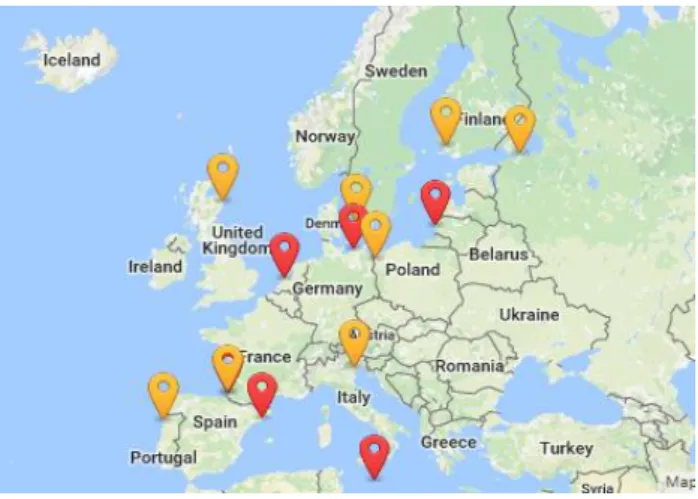
Figure 1 – Location of EUCC’s international offices (red) and national branches (orange) ... 2 Figure 2 - Presentation of European Commission’s Initiative “OURCOAST” at
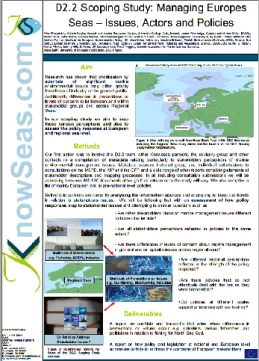
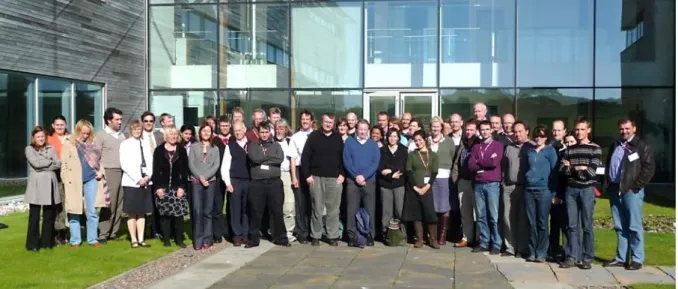
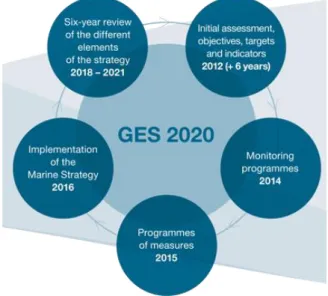
MEDCOAST’09 Conference (Socchi, 2009) ... 12 Figure 3 – Poster about KnowSeas deliverable D 2.2 presented during the 1st KnowSeas Scientific Workshop in Palma de Mallorca, April, 2010. ... 18 Figure 4 - Representatives of the 31 partner organisations of the FP 7 Project KnowSeas at the Kickoff meeting (Oban, Scotland, May 2009) ... 19 Figure 5 - MSFD implementation cycle (Source: European Commission) ... 20 Figure 6 – DG ENV Pilot project on marine litter - Stakeholder workshop in Barcelona (May, 2012) ... 26 Figure 7 - MARLISCO Forum in the Netherlands (Amsterdam, April 2015) ... 32 Figure 8 – (top) DG MARE Commissioner Maria Damanaki presenting the certificates to the 14 winning teams of MARLISCO Video Competition, at the 7th European Maritime Days Ceremony; (bottom) 80 students from 14 countries that participated in the 2-day programme in Bremen (18-19th May, 2014) ... 33 Figure 9 – Some of MARLISCO awareness and engagement activities in the Netherlands: public bilingual exhibition about marine litter in The Hague and facilitating workshops with children to build sea creatures with marine litter. ... 34 Figure 10 - Representatives of 4 organisations responsible for hosting the exhibition “Out-to-Sea” in Egypt, Morocco, Lebanon and Jordan, together with the promoters of the project (Drosos Foundation and Museum für Gestaltung Zürich) ... 36 Figure 11 – Representatives from the 17 partner organisations of the FP7 Project CleanSea, during one of the project meetings ... 37 Figure 12 – Brochure produced within the FP 7 Project CleanSea with policy options to tackle marine litter in Europe ... 38 Figure 13 - EUCC Magazine "Coastal & Marine" Vol. 20, 2011 ... 41
LIST OF ABBREVIATIONS
CFP Common Fisheries Policy
EC European Commission
ECN Expert Couplet Node (IMCORE Project) EMDC European Maritime Days Ceremony ESA European Space Agency
ESTEC European Space Research and Technology Centre
EU European Union
EUCC Coastal & Marine Union, previously European Union for Coastal Conservation
FP7 Seventh Framework Programme for Research and Technological Development ICGML OSPAR’s Intersessional Correspondence Group on Marine Litter
DG ENV Directorate-General Environment of the European Commission
DG MARE Directorate-General for Maritime Affairs and Fisheries of the European Commission
ICZM Integrated Coastal Zone Management MSFD Marine Strategy Framework Directive NGO Non-Governmental Organisation
OSPAR Convention for the Protection of the Marine Environment of the North-East Atlantic)
TGML MSFD Technical Group on Marine Litter
UN United Nations
UNEP United Nations Environmental Programme
1
1. Introduction
This report describes my professional activity since the conclusion of the 5-years degree in Marine Biology and Fisheries, from the University of Algarve, in December 2007. It aims at demonstrating the professional competences I have developed in the last 8 years, in order to obtain the Master Degree in Marine Biology (“Despacho reitoral 033/2011: Licenciados Pré-Bolonha”).
The activities described here correspond to the work I conducted at the Coastal & Marine Union (EUCC – originally called European Union for Coastal Conservation), a European non-profit association based in the Netherlands, where I started as a trainee for 5 months in 2008 and then worked as staff until August 2016. As an international organisation, with staff from the Netherlands, UK, Portugal, Bulgaria, Italy, Servia, Poland and Spain, the work was almost all conducted in English, which became my day-to-day language. Hence the choice of presenting this report in English.
My 8 years of work experience at EUCC have been a journey of immense learning, fantastic opportunities (e.g. dealing with high-level European Commission, frequent traveling in Europe) and above all a meaningful path dedicated to a good cause. As it will be visible in this report, the activities I performed were very diverse and eclectic, not only in terms of topics but also type of tasks and responsibilities. These included hands-on activities of project implementation, communication activities, participatory events, project coordination and reporting, writing proposals for funding and supervising internships. EUCC team was fairly reduced, contrary to the amount and quality of work we delivered. The work was often very intensive, with overlapping commitments and imminent deadlines and intercalated by regular missions abroad. Nevertheless, EUCC provided also the opportunity to develop my own interests, such as initiating and running projects on marine litter, which became one of the key working topics of the organisation in recent years.
1.1 The Coastal & Marine Union (EUCC)
EUCC is an association with members in 35 countries, both particulars and organizations/institutions. It was founded in 1989 with the aim of promoting a European approach to coastal conservation by bridging the gap between scientists, environmentalists, site managers, planners and policy makers. Since then it has grown into the largest network of coastal practitioners and experts in Europe and neighbouring area, with 5 international offices
2 and national branches in 10 countries (Fig. 1). EUCC International Secretariat is based in the Netherlands, and shares the same office as the Dutch Office. In 2008 it was composed by two Units – the Policy Unit and the Communication & Information Unit, which have been restructured into one single “International Programme” a few years ago.
EUCC's mission is to promote coastal and marine management that integrates biodiversity conservation with those forms of development that sustain the integrity of landscapes, the cultural heritage and the social fabric of our coast. EUCC advocates best practice by developing coastal and marine policies, mobilising experts and stakeholders, and providing advice and information. EUCC´s activities range from policy advice to involvement in initiatives that improve the access to coastal information, and field projects combining coastal and marine biodiversity conservation and sustainable development.
1.2 Chronology of main activities and projects carried
Table 1 presents the chronology and time frame of the key projects I have been involved in during the 8 years at EUCC, from the traineeship in September 2008 to August 2016. Projects related to topic of marine litter are indicated in shades of blue and other topics in green.
Table 1 - Chronology of projects I was involved while working for EUCC
2008 2009 2010 2011 2012 2013 2014 2015 2016 QualityCoast
CoastLearn
Dolphinaria
FP7 KnowSeas
OURCOAST
IMCORE
TGML
FP7 MARLISCO
ML Case-studies
Reduction Target
FP7 CleanSea
Interreg Proposal
Figure 1 – Location of EUCC’s international offices
3
1.3 Overview of publications between 2010 – 2016
Table 2- Publications of peer-reviewed papers and technical reports where I am co-author
TITLE Publication # Co-authors Impact
Marine Litter Technical Recommendations for the Implementation of MSFD Requirements
2011 - Joint Research Centre
25
141 reads and 1 citations (Source: Research Gate, data retrieved on 21 January 2017)
Guidance on Monitoring of Marine Litter in European Seas (2013)
2013 - Joint Research Centre
19
315 reads and 9 citations (Source: Research Gate, data retrieved on 21 January 2017)
Study to support the establishment of an initial quantitative headline reduction target for marine litter - final report to the European Commission
2014 - ARCADIS 8
47 reads and 2 citations (Source: Research Gate, data retrieved on 21 January 2017)
Comments on Marine Litter in Oceans, Seas and Beaches: Characteristics and Impacts. 2015 - Annals of Marine Biology and Research 12
47 reads (Source: Research Gate, data retrieved on 21 January 2017
Enhancing public awareness and promoting co-responsibility for marine litter in Europe: The challenge of MARLISCO
2016 - Marine Pollution Bulletin
(First author) 10
134 reads and 5 citations (Source: Research Gate, data retrieved on 21 January 2017)
715 views, 24 readers and 1 citation (Source: Mendeley, data retrieved 21 January 2017)
Identifying Sources of Marine Litter 2016 - Joint Research Centre (First author) 11
(report not yet available)
Harm caused by marine litter
2017 - Joint
Research Centre 11
4
2. Leonardo da Vinci Traineeship (09/2008 – 01/2009)
In April 2008, I received a Leonardo da Vinci Grant under the European Commission’s Vocational Training Programme, to fund a traineeship at the EUCC (at the time called EUCC - The Coastal Union).
The traineeship had a duration of 5 months (September 2008 to January 2009) and was supervised by Ms. Maria Ferreira, at the time Head of the
Information & Communication Unit of EUCC International. During this period, I have supported both the Policy and Information & Communication Units in the ongoing activities of the organisation, namely:
Assisting in the definition and development of objectives, contents and partnerships of potential Integrated Coastal Zone Management (ICZM) related projects (e.g. QualityCoast Programme);
Support communication activities development (i.e. e-newsletters, CoastLine magazine and EU Platform Coastal and Marine, etc);
Attend and assist EUCC staff during EUCC international conference and meetings (e.g. LITTORAL Conference, a biannual international conference organised by EUCC);
Assisting development of specific initiatives in ICZM, such as: compiling information on marine protected areas, reviewing an Interreg proposal
being prepared by EUCC, updating information and links of the English version of CoastLearn – Box 1).
Box 1 - CoastLearn
CoastLearn is an internet, based training package on Integrated Coastal Zone Management (ICZM). It was developed by EUCC, after the need identified by 18 governmental bodies from the Baltic, Mediterranean and Caspian Seas on the topic. CoastLearn is available in 13 languages and aims to train coastal practitioners (e.g. planners, managers) in target countries and to create broad-based, horizontal, national and international networks of ICM experts and trainers.
5
2.1 Development of QualityCoast Programme
A considerable part of my traineeship at EUCC consisted in supporting the ongoing development and fine-tuning of the programme QualityCoast (Box 2), which had just been launched that year with a few pilot destinations.
In preparation for the promotion and running of the programme in 2009, the criteria and specific indicators used in the pilot phase had to be revised considering: their applicability to very different coastal territories in Europe and their clarity to communicate sustainability to visitors. Furthermore, being the first time the programme was being launched beyond the pilot phase, it was necessary to communicate and promote the programme and engage participating destinations.
Specific tasks that I conducted within the work for QualityCoast included:
Contribution to the fine-tuning of the QualityCoast Programme, including revision of criteria and specific indicators;
Draft of the Guide for Entrants 2009;
Draft presentations about QualityCoast programme to be used in international meetings by senior staff;
Translation to Portuguese of QualityCoast promotional material, including the Guide for Entrants 2009, website texts and brochures;
Identification the most sustainable Portuguese coastal municipalities and initiate engagement to participate in the programme.
2.2 Dissemination activities and participation in European events
My traineeship included supporting the regular communication and dissemination activities of EUCC towards their members and general public (e.g. periodic electronic newsletters), namely:
Drafting of December’s newsletter of EUCC Mediterranean Centre;
Production of short texts about relevant news related to coastal and marine conservation in Europe for the EUCC e-Newsletters distributed to its subscribers.
6
Furthermore, I had the chance to participate in European events, such as:
The 9th LITTORAL Conference - A Changing Coast: Challenge for the Environmental Policies, a biannual conference organised by EUCC, that took place in Venice, Italy (November 25-28, 2008) and to which I provided some organisational support and video-reported some of the sessions;
Seminar from EUROPARC Federation “Linking Tourism and Biodiversity” on behalf of EUCC (Brussels, 9th December 2008), where I represented EUCC and reported back to the staff.
7
3. Promoting sustainable coastal tourism and welfare in dolphinaria
(2009-2012)
3.1 Sustainable Tourism – QualityCoast Programme (2009-2012)
During the first two years of contract with EUCC (2009-2010), I continued working on the emerging QualityCoast initiative, as one of the key members of the QualityCoast Secretariat. In the subsequent years, due to increasing load of other activities, my involvement in the programme was substantially reduced but I remained available to step in as needed, in particular to liaise with Portuguese participants in our native language.
QualityCoast Programme (Box 2) had a specific timeline that included the phase where municipalities were preparing the submission of their applications for the QualityCoast Awards, after which these applications where assessed internally by the Secretariat and external experts that composed the Jury. Finally, the results were announced around May, usually in an international ceremony organised in one of the QualityCoast destinations, where the mayors or representatives from the local authorities were present to receive the QualityCoast award and the Jury reports, containing recommendations for improvements of the sustainability performance of their towns.
Awarded destinations were entitled to hoist QualityCoast flags and banners throughout their territories for two years. EUCC was responsible for running and maintaining a
Box 2 - QualityCoast
QualityCoast is a sustainability award and certification programme for coastal destinations, aiming at promoting sustainable development in tourist destinations and inform visitors about the performance of the municipality. It resulted from the Interreg IIIC Project CoPraNet (2004-2006) and runs since 2008 under the management of EUCC. QualityCoast uses over 100 indicators, divided in 20 criteria, that reflect the quality and policies of the destination on
Nature (e.g. nature protection policies,
access and information to visitors);
Environment (e.g. water and waste
management, sustainable energy); Identity
& Culture (e.g. policies to protect and
promote cultural heritage, community participation); Tourism & Business (e.g. involvement of business in sustainability issues); and Community & Safety (e.g. community participation, freedom and justice).
Depending on the score, QualityCoast awards range from Bronze, Silver, Gold and Platinum.
8
QualityCoast website to inform the general public and producing a yearly brochure about the programme, both to increase public visibility and promote the efforts of participating destinations on issues of sustainability.
Specifically, my tasks included:
Revision of list of criteria and indicators, before the launching of each new season;
Collaboration in the production of the Application Form and drafting/revision of the Guide for Entrants for each new season;
Promotion of the programme among Portuguese municipalities (e.g. Torres Vedras, Aveiro, Lagos, Azores, Sintra, Cascais, West Region) and liaison with Portuguese applicants as needed (e.g. workshop for support of application preparation of OESTE CIM, at Caldas da Rainha, in September 2012);
Integrating QualityCoast assessment team and leading assessment of Portuguese applications;
Drafting of texts for promotional material (website, brochures) and co-editor of the QualityCoast brochures (see Key Ouputs below);
Supporting the organisation of the annual QualityCoast events, in particular the International 2009 and 2012 Award Ceremonies in Noordwijk (Netherlands) and Torres Vedras (Portugal), respectively, and a QualityCoast national event in Lagos (November, 2011). KEY OUTPUTS QualityCoast Brochures: 2009-10: http://www.eucc.net/coastalandmarine/qc2009.pdf 2011: http://www.eucc.net/coastalandmarine/qc2011.pdf 2012: http://www.eucc.net/coastalandmarine/qc2012.pdf 2013: http://www.qualitycoast.info/wp-content/uploads/2013/05/QualityCoast_brochure_2013.pdf
9
3.2 Audits of Dolphinaria worldwide (2009-2010)
The year of 2007 was declared the Year of the Dolphin by the United Nations and EUCC, as partner of this initiative, created a dedicated fund-raising mechanism (Dolphin Fund) to support actions for the protection and wellbeing of dolphins. These included a project in the Netherlands, in close cooperation with fishermen, to reduce by-catch of dolphins in fisheries through the use of “pingers” and a project on aquatic facilities that exhibited dolphins to the public (dolphinaria), in cooperation with TUI-NL and Travelife. In this last project, dolphinaria of less developed countries would be evaluated on educational aspects, animal welfare and whether or not dolphins have been captured in the wild for recreational purposes, which is no longer acceptable now-a-days.
In September 2009, I was appointed to take over the coordination of the Dolphinaria project and reach the project objectives that EUCC had agreed with the financing partners. The aim of this project was to audit specific dolphinaria in popular tourist destinations (e.g. Mexico, Dominican Republic and Turkey), in relation to international regulations such as CITES1 and IUCN 2and fulfilling standards of dolphins’ welfare. As part of their sustainability strategy, the large tourist operator TUI, intended to work only with dolphinaria whose animal were not obtained from the wild but born in captivity. As an independent entity, EUCC was responsible to conduct these audits, using a checklist developed by Travelife and report on selected facilities.
This represented the first project that I fully coordinated on behalf of EUCC. The running of the project included the following actions:
1. Preparatory activities and Action Plan – transference of the project from previous coordinator, liaising with partners and acquaintance with project details and approach; development of a Plan of Action and timeframe to conclude project;
2. Recruitment of local auditors – 40 relevant organisations and experts were screened and contacted in the process of search for adequate auditors. 6 individuals were selected;
1 CITES - Convention on International Trade in Endangered Species of Wild Fauna and Flora is an international
agreement that sets guidelines on the traffic and transport of wild live animals to avoid exploitation
2
10
3. Capacity building of selected auditors on the guidelines and checklist to be used in the audits, including verification of specific documentation and records from the facilities;
4. Communication with dolphinaria and scheduling of visits;
5. Quality control on the audit reports, to ensure clarity and sufficient level of detail about facilities’ performance, which required intense communication with auditors and several revisions of reports;
6. Report back to partners, including final report about the project.
The project was successfully concluded and in total, 13 dolphinaria were audited and reported to TUI-NL and Travelife: 9 in Cancun, 2 in Turkey and 2 in Dominican Republic. The worse situations were found in Turkey, with inadequate size of the pools and water temperature. Furthermore, most of the dolphins kept in these facilities originated form wild populations caught in the Black Sea, Mediterranean and Japan. Several of the facilities audited, showed a poor educational strategy, with activities mostly focused on performances and interactions with dolphins that are questionable in terms of their educational value.
11
4. Facilitating integrated coastal and marine management based on
scientific knowledge (2009-2012)
4.1 Integrated Coastal Zone Management – OURCOAST (2009 – 2011)
OURCOAST (Box 3) was the first project directly commissioned by the EC that I have worked on and was also the first time that I participated in internal meetings with the EC. The service had been awarded to the team composed by the consultancy company ARCADIS (lead partner) and EUCC and begun in 2009.
Given its extensive and important background on the development of ICZM policies, EUCC had an important role on the project, i.e. to produce the content of a large data-base of experiences and practices on ICZM throughout Europe, which that could inspire and facilitate broader implementation of similar approaches. Furthermore, EUCC was responsible for the communication component of the project, including the organisation of a final conference for stakeholders.
Since the very beginning of the project, I have integrated the team of 5 EUCC staff that worked on OURCOAST to work on these 2 main project components. The Policy Unit was responsible for the collection of cases-studies of ICZM in Europe (led by Dr. Alan Pickaver) and the communication activities were coordinated and implemented by the Information & Communication Unit (led by Ms. Maria Ferreira). My involvement in OURCOAST and the work in these project components are summarised below.
Box 3 - OURCOAST
OURCOAST was a 3-year project commissioned by the Directorate General Environment of the European Commission to support the exchange of experiences and best practices in coastal planning and management.
One of the key outcomes of OUCOAST was a data-base of 350 case-studies in Europe on ICZM, that EUCC was responsible for producing, and is made available on a multilingual portal. This database presents experiences in a wide range of topics such as:- adaptation to risks regarding climate change, natural and human-made hazards, sustainable use of resources, sustainable economic growth regarding sustainable development of the seas as well as improving competitiveness.
OURCOAST produced also a series of brochures and organised a large stakeholder conference on ICZM, under the coordination of EUCC.
http://ec.europa.eu/environment/icz m/ourcoast.htm
12 Development of data-base of ICZM case-studies
1. Collaboration in the development of the case study summaries template to be used in the project, including definition of the search options for the data-base;
2. Collection and production of case-studies summaries in English; Liaison with appropriate experts for the validation of the case-studies and edition of summaries accordingly. A few of these examples selected resulted from the knowledge gained during my course at the University of Algarve, while others were advised by Professors (e.g. Prof. Luis Cancela da Fonseca). The 7 summaries that I have produced, mainly case-studies from Portugal, are since then available online, together with source documents (see Key Ouputs below);
3. Edition of dozens of other case-studies summaries produced for the project, which have been mainly produced by my colleague Alan Pickaver.
Communication and dissemination Activities
4. Contribution for the development of the website, in particular in drafting website text; 5. Contribution for the dissemination materials (Brochures, leaflets);
6. Contribution to production and maintenance of mailing list of stakeholders;
7. Presentation of OURCOAST at 2 occasions: MEDCOAST’09 Conference (Socchi, Russia, Nov. 2009) and OSPAR-MASH meeting (Germany, Nov. 2009);
8. Support the organisation of OURCOAST Stakeholder Conference in Riga (27-28 October 2011), with over 150 participants.
OURCOAST meetings and events attended:
Regular internal meetings at EUCC and with project Partners ARCADIS;
OURCOAST Steering meeting with the EU Commission (DG Environment and representatives of other Directorates such as DG MARE) to discuss Inception Report (Brussels, 6th May 2009);
OURCOAST Final Conference (Riga, Latvia, 27-28 October 2011), as part of the organisation team.
Figure 2 - Presentation of European
Commission’s Initiative “OURCOAST” at MEDCOAST’09 Conference (Socchi, 2009)
13
KEY OUTPUTS
OURCOAST Data-base: http://ec.europa.eu/ourcoast/index.cfm?menuID=4
Case-studies:
1. Establishment of a Marine Park and its ecological restoration – PT
http://ec.europa.eu/ourcoast/index.cfm?menuID=6&articleID=80
2. Management scenarios and integrated information tools applied to Ria Formosa Lagoon – PT
http://ec.europa.eu/ourcoast/index.cfm?menuID=6&articleID=125
3. Recovery and promotion of traditional salt production and restoration of salt pans, Castro Marim – PT
http://ec.europa.eu/ourcoast/index.cfm?menuID=6&articleID=131
4. Reduction of pollution in a coastal lagoon and its impact on adjacent coastal beaches - Barrinha do Esmoriz – PT
http://ec.europa.eu/ourcoast/index.cfm?menuID=6&articleID=159
5. Working with Nature - soft protection interventions in a barrier-island lagoon - Ria Formosa – PT http://ec.europa.eu/ourcoast/index.cfm?menuID=6&articleID=88
6. Towards a more balanced management of a harbour through a Local Authority-Academic Couplet, Cork – IE
http://ec.europa.eu/ourcoast/index.cfm?menuID=6&articleID=6
7. Ecological Compensatory Measures during Le Havre port development in a Natura 2000 estuary – FR
14
4.2 Adaptation to Climate Change - Interreg IVB Project IMCORE (2009 – 2011)
In 2009 I was appointed as the main staff to take over EUCC activities within the project IMCORE (Box 4), which had begun in May
2008, supervised and assisted by the Head of Unit. The project intended to deliver climate adaptation strategies for 9 locations, developed by partnerships between local authorities and researchers. These partnerships were named Expert Couplet Nodes (ECN) during the a previous Interreg project called COREPOINT and were further formalised and developed during IMCORE. Each of the 9 ECNs established in coastal areas of the UK, Ireland, Belgium and France were addressing particular local issues and developing strategies to adapt to climate change at a local scale. At the same time, the project was developing and testing tools that could aid the development of this type of strategies. Those include stakeholder mapping and developing future scenarios of potential climate change impacts, whose value could then be shown and made available to other local and regional authorities.
EUCC had responsibilities on a couple of tasks within 2 Work Packages (WP), in particular for assessing the engagement and interaction process within the ECNs, defining guidelines and recommendations to improve science-management collaboration and develop indicators to monitor this process.
Box 4 - IMCORE
IMCORE – Innovative Management for
Europe’s Changing Coastal Resource
(2008-2011) was a €6M Interreg IVB project, led by the Coastal and Marine Resources Centre, University College Cork, and gathering 16 other partners from the North East Atlantic region.
IMCORE aimed at promoting an innovative and sustainable approach to reduce the ecological, social and economic impacts of climate change on the coastal resources of NW Europe. This approach was based on the association between research and local authorities, working together to achieve more integrated solutions to local management in areas of the UK, Ireland, France and Belgium.
The main output of the project was a Multimedia Distance Learning Tool, a comprehensive resource of information and tools designed to help coastal managers planning for climate change impacts in their coastal areas.
www.imcore.eu
15
This task was developed throughout the project duration and ended in the production of a report and a related module in the Distance Learning Tool, the main legacy of IMCORE. The different stages of my work in the project are summarised below:
1. Acquaintance with project and ECNs – as I took over the responsibilities of a former colleague, I needed to get familiarise with the project, project partners and role of EUCC;
2. Description of each of the 9 ECNs – Partners from research and local authorities that composed each partnership, local themes tackled within the project and background of the collaboration;
3. Development of questionnaires about the ECN process, internal interaction, strengths and weaknesses, challenges and opportunities, to be filled independently by the research and authority partner of each ECN, in different stages of the project;
4. Definition of a set of indicators reflecting the most important aspects of the collaboration at 3 functional stages of the partnership: a pre-engagement; an initial phase during which the partners are making the necessary arrangements to start the collaboration; and a subsequent phase where work is already ongoing and it may be relevant to start assessing the efficiency of the collaboration;
5. Production of a report that included the set of indicators, guidelines and recommendations to strengthen and improve an effective collaboration between scientists and managers, and examples of IMCORE’s partnerships;
6. Assisting the translation of the indicators and guidelines into an online module within the final Distance Learning Tool of IMCORE.
7. Support the organisation of IMCORE’s International Conference Adapting to Coastal Change: local perspectives
8. Production of articles about the project and activities of EUCC for the periodic EUCC magazine (see section 6.1).
Other activities were related to project administration and management, such as participation in project meetings where the progress of the work was presented and discussed with other partners and periodic technical reporting to the Lead Partner. Furthermore, I supported the organisation of an International Conference in The Hague, to present the project’s progress to a wider audience and a conduct participatory workshop on development of scenarios of climate change.
16 Meetings and events attended:
2nd Project Progress Meetings: October, 2009 in Newcastle, UK
3rd Progress Meeting: May 2010, in Auray, France
4th Progress Meeting: May, 2011 in Sefton (UK)
International Conference: Adapting to Coastal Change: local perspectives: September, 2011 in The Hague
IMCORE Workshop: June, 2011 in Cork, Ireland
KEY OUTPUTS
Report: The collaboration process between researchers and authorities - Guidelines to
support a developing working relationship and insight into the collaboration process of IMCORE’s ECNs. Veiga, J.M., 2011, IMCORE Project Deliverable. DOI: 10.13140/RG.2.2.32708.42884
Content of Learning Module:
17
4.3 Knowledge-based management of Seas - KnowSeas (2009 – 2012)
As part of my set of tasks during the 1st year of contract, I was appointed to be the main staff working on the recently approved FP 7 Project KnowSeas (Box 5). The main objective of the project was to assist the implementation of the MSFD and required Ecosystem-based approach. It brought together social and natural scientists that worked on integrating ecological, economic and social data in a way that the costs & benefits of ecosystem services and the effectiveness of a certain management is clearer to policy-makers and managers.
EUCC’s role in the project was mainly to make use of the organisation’s vast European network for dissemination of the project’s outcomes but also contribute to one of the Work Packages on policy framework.
The main task I undertook within KnowSeas was related to one of the deliverables of the project, a scoping study on marine environmental issues and related policies and key actors. In close collaboration with staff from the Coastal and Marine Resources Centre (Ireland), we have compiled and analysed stakeholders perceptions on environmental issues in the European regional seas (mainly resulting from submissions to the MSFD and CFP public consultations) and assessed the extent that these issues are addressed by European and other international policies.
Box 5 - KnowSeas
KnowSeas - Knowledge-based
Sustainable Management for
Europe's Seas was a €7.5M FP7
Project (2009-2012) led by the Scottish Association for Marine Science and involving other 30 organisations from 15 different European countries.
The project aimed to strengthen the science base for the use of Ecosystem-approach in the European regional seas, to develop practical tools and test them for policy implementation.
18
For the 1st KnowSeas Scientific Workshop, we have produced 1 poster to inform the consortium and advisory panel on the development of this task (Fig. 3). The study resulted in the report Managing Europe’s Seas – A Scoping Study on Issues, Actors and Policies.
Other activities were related to project administration and management of the activities on behalf of EUCC, such as participation in project meetings and periodic technical reporting to the Lead Partner and EC.
Figure 3 – Poster about KnowSeas deliverable D 2.2 presented during the 1st
19 KnowSeas meetings and events attended:
Project Kick-off / Inception meeting at the Scottish Association for Marine Science, Oban, Scotland, May 2009
KnowSeas WP2 meeting: Brussels, December 2009
1st Scientific Workshop and Project Meeting: Palma de Mallorca, April 2010
2nd Scientific Workshop and Project Meeting, Istanbul, March 2011
Figure 4 - Representatives of the 31 partner organisations of the FP 7 Project KnowSeas at the Kickoff meeting
(Oban, Scotland, May 2009)
KEY OUTPUTS
Fitzpatrick, M. (Mira Veiga, J.) et al. “Managing Europe’s Seas – A Scoping Study on
Issues, Actors and Policies” (2010) FP 7 KnowSeas - Project Deliverable.
20
5. Addressing the issue of Marine Litter (2009 – 2016)
5.1 Supporting European Policies on Marine Litter (2009-2016)
In 2008, the Marine Strategy Framework Directive (MSFD) was adopted by the European Parliament and Council (2008/56/EC). The MSFD is seen as the environmental pillar of the EU Maritime Policy and its overall objective is to preserve the marine ecosystems and promote the sustainable use of the seas. For this purpose, the MSFD sets eleven “quality descriptors” for which Member States need to define targets and implement national policies to achieve Good Environmental Status (GES) of their marine environment in 2020. EUCC has been following the cycle of implementation of the MSFD (Fig. 5) since its early stage, e.g. by participating, since 2009, as an observer organisation in the discussions of EC Working Groups on GES and taking active part in Technical Groups that were set up to support Member States on specific descriptors as Descriptor 10 – Marine Litter.
Figure 5 - MSFD implementation cycle (Source: European Commission3)
Furthermore, most of the projects I have been involved and responsible for developing in the last 5 years of work at EUCC, were related to the topic of marine litter and had a direct link with a stage of implementation of the MSFD, from monitoring of the problem to the design and implementation of measures to prevent or reduce it.
3
21
5.1.1 Technical Group on Marine Litter (TGML)
In 2010, two Technical Groups were set up for Marine Litter (MSFD Descriptor 10) and Underwater Noise (MSFD Descriptor 11). The groups were formed by appointed experts by the EU Member States on the topics and representatives from a few NGOs. The mandate of these groups was to provide guidance to Member States on standardised monitoring methodologies to support the implementation of the MSFD on these two descriptors.
EUCC was one of the few NGOs that was invited to integrate these groups. Given my recent involvement in the setup of a large marine litter FP 7 project proposal (MARLISCO), my application to integrate the Technical Group on Marine Litter (TGML) was approved. Since then, I have participated in most of the meetings of the TGML (one or twice/year) and contributed to the elaboration of guidance and recommendations that the TGML was responsible for producing.
The first two reports published (2011 and 2013) intended to provide guidance on standardised monitoring methodologies for marine litter in the different “compartments” (e.g. beach litter, floating litter, litter on the sea floor and ingested litter by marine animals), to foster common monitoring approaches taken by Member States and comparability across geographic areas. In the 2nd report from the TGML, apart from contributing to the content, I have also worked on the design, layout and edition of the final report, together with drafting its Executive Summary, as part of a contract that EUCC had with the EC to provide logistic and administrative assistance to both Technical Groups on Marine Litter and Underwater Noise. For the period of 2013-2016, the group was requested to provide further clarification and recommendations on 3 other topics: identification of sources of marine litter, harmful impacts of marine litter and litter entering the sea through rivers.
In the TGML meeting in Lisbon (December, 2013), I presented the methodology that had been used in the Pilot Project of Case-studies on marine litter in 2012 (see next section 5.1.2) and I offered to lead the drafting of the report on “Identification of Sources of Marine Litter”. During the next few years, the scope and content of the report took shape. Together with a few members from the TGML, we have reviewed and discussed different approaches that are able to provide information on the origin of marine litter, in such a way that can inform the design of measures to prevent it. From all reviewed methods, the approach taken in the Pilot Project was considered to be the most adequate. Apart from drafting key sections of the
22
report, I was also responsible for defining the structure and coordinating inputs and revisions from all other contributors.
Finally, I have also contributed to the report on “Harm caused by Marine Litter”, in particular the Socio-Economic section. My work in these two reports was partially funded by the Dutch Ministry of Environment and Infrastructures, which was also represented in the TGML.
TGML Meetings attended:
1st TGML Meeting, Copenhagen, 3-4 November 2010
2nd TGML Meeting, Calvi, Corsica, April 2011
6th TGML Meeting, Hamburg, 14-16 May 2013
7th TGML Meeting, Lisbon, 11-13 December 2013
8th TGML Meeting, Riga, 11-13 June 2014
9th TGML Meeting, Dublin, 29 June- 1 July 2015
Technical workshop of the TGML on harm of marine litter, Berlin, 6-7 February 2015
23
KEY OUTPUTS
Piha, H., Hanke, G., Galgani, F., Werner, S., Alcaro, L., Matiddi, M., Fleet, D., Kamizoulis, G., Maes, T., Osterbaan, L., Thompson, R., van Franeker, J., Mouat, J., Meacle, M., Carrol, C., Detloff, K., Kinsey, S., Nilsson, P., Sheavly, S., Svärd, B., Veiga, J., Morison, S., Katsanevakis, S., Lopez-Lopez, L., Palatinus, A., Scoullos, M. (2011).
Marine Litter Technical Recommendations for the Implementation of MSFD Requirements. MSFD GES Technical Subgroup on Marine Litter. EUR 25009 EN – 2011.
European Commission, Joint Research Centre, Institute for Environment and
Sustainability. 66p. doi: 10.2788/92438.
http://publications.jrc.ec.europa.eu/repository/handle/111111111/22826
Galgani, F., Hanke, G., Werner, S., Oosterbaan, L., Nilsson, P., Fleet, D., Kinsey, S., Thompson, R., van Franeker, J., Vlachogianni, T., Scoullos, M., Veiga, J., Palatinus, A., Matiddi, M., Mase, T., Korpinen, S., Budziak, A., Leslie, H., Gago, J., Liebezeit, G. (2013). “Guidance on Monitoring of Marine Litter in European Seas”. EU Publications
Office. 128p. doi: 10.2788/99475
http://publications.jrc.ec.europa.eu/repository/handle/111111111/30681
Executive Summary of the Guidance on Monitoring of Marine Litter in European Seas.
https://circabc.europa.eu/sd/a/6d5b3529-ddd5-4124-96fe-def055477c73/MSCG-11_2013_10b%20Executive%20Summary%20MSFD%20Guidance%20on%20Monitoring %20Marine%20Litter.pdf
Mira Veiga, J., Fleet, D., Kinsey, S., Nilsson, P., Vlachogianni, T., Werner, S., Galgani,
F., Thompson, R.C., Dagevos, J., Gago, J. Sobral, P. and Cronin, R. (2016). Identifying
Sources of Marine Litter. MSFD GES TG Marine Litter – Thematic Report. Joint
Research Centre, 37p. doi: 10.2788/018068
Werner, S., Budziak, A., van Franeker, J., Galgani, F., Maes, T., Matiddi, M., Nilsson, P., Oosterbaan, L., Priestland, E., Thompson, R., Veiga, J., Vlachogianni, T. (2016). Harm
caused by marine litter. MSFD GES TG Marine Litter – Thematic Report. Joint Research
24
5.1.2 Pilot Project: Case-studies on marine litter (2012)
In 2011, I worked closely with ARCADIS (with whom we were concluding work in the service contract “OURCOAST” for DG ENV) in the preparation of project proposals for two of the pilot studies that the EC was commissioning.
One of this studies, “Plastic recycling cycle and marine environmental impact: Case studies on the plastic cycle and its loopholes in the four European regional seas areas” (Box 6), was attributed to our consortium.
Given my direct involvement in the recently approved FP7 project MARLISCO and in the TGML, I became responsible for contextualising, elaborating and drafting the approach on selection of study sites and identification of sources of marine litter for selected sites.
The pilot project lasted approximately 1 year. The initial tasks, which I was responsible for coordinating, foreseen selecting one study-site in each of the 4 European regional seas and indicating practices that were contributing to marine litter in those areas. In order to identify specific sources of marine litter, it was crucial that detailed data on marine litter was available for those sites. Thus the specific activities that I have coordinated and conducted in this project included:
Selection of study-sites: Developing a multi-criteria analysis approach and coordinate the process of assessing and select the most appropriate sites by the regional partners, based on some specific requirements set in the Terms of Reference of the contract (e.g. large coastal city, nearby a river and including a
Box 6 – DG ENV Pilot
Project on case-studies
of marine litter
In 2012, the EC launched 3 study contracts to gather information, help implement the MSFD requirements on marine litter and further develop the policy framework for marine litter. One of this study was commissioned to a team of EUCC and other organisations and led by ARCADIS.
The main objective of this Pilot Project was to pinpoint the major sources of marine litter in 4 study-sites, in each of the four European seas: Riga (Latvia- Baltic Sea), Oostende (Belgium-North Sea), Barcelona (Spain-Mediterranean) and Constanta (Romania-Black Sea). These areas include river discharge, commercial ports and important coastal cities.
The case-studies indicated what economic sectors or actors are the main sources of marine litter and indicated the main loopholes in the local material and waste cycles. Furthermore, the study provided an adequate mixture of measures and strategies, targeting different key sectors and life-cycle levels. The feasibility of these measures was assessed and its economic, administrative and institutional implications evaluated.
25
major port). Most importantly, the availability and access to detailed monitoring data that could provide a robust insight into the most predominant types of marine litter found in these coastal sites. At the time, the most comprehensive monitoring programme in Europe was the beach litter monitoring coordinated by OSPAR, which recorded over 100 categories of types of litter and was carried on beaches of the North East Atlantic consistently for over a decade. The 4 proposed selected sites resulting from the analysis (Riga, Oostende, Barcelona and Constanta) were presented to the EC for approval.
Local data on marine litter: The 4 regional partners responsible for the local activities in this project had to obtain data on marine litter in the vicinity of the selected sites. For some sites like for Belgium and Barcelona, this required asking permission to obtain and use data to the data-owners. For all 4 sites, we decided to conduct beach surveys to complement the existing data and I was responsible for coordinating and providing methodological protocols for the surveys (based on UNEP-OSPAR beach surveys of 100m).
Identification of sources of marine litter: For this subsequent task, I have conducted a literature review on methodologies to determine sources of marine litter. Most of the methods used in survey programmes (e.g.by OSPAR or NGOs) were based on attribution of 1 category of items to an economic activity (e.g. fishing nets to fisheries) or to a very broad category of use (e.g. plastic drink bottles to recreation and tourism). There was, however, another approach that considered the possibility that 1 type of item originates from multiple activities or practices, which is a more realistic approximation. In this pilot project, we have applied the Matrix Score Technique developed by Tudor & Williams in 20044 to determine the human activities that were likely contributing to the litter recorded in the study-sites. Additionally, I have promoted the definition of additional parameters that could characterise marine litter. The methodology developed and applied in this project is part of the recommendations made in a report on identification of sources of marine litter, produced by the TGML in 2016 (section 5.1.1).
4 Tudor, D. and Williams, A. (2004). Development of a ‘Matrix Scoring Technique’ to determine litter sources at
26
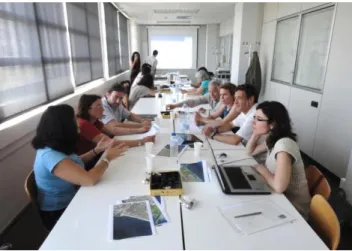
Stakeholder workshops: a regional stakeholder workshop was organised in the 4 regions by the regional partners, to bring in the views of stakeholders (e.g. from fishing sector, port authorities, waste management entities, etc.), help identify dysfunctionalities in human activities that could be generating marine litter and help define the likelihoods of contributing sources of marine litter. I have led the design of a common scope and format for all 4 workshops and was helped organising and facilitating the Oostende and Barcelona events (Fig. 6).
Figure 6 – DG ENV Pilot project on marine litter - Stakeholder workshop in Barcelona (May, 2012)
The subsequent activities of the project, i.e. the design of a set of measures to tackle the issues identified and evaluate their feasibility, were conducted by the other organisations of the consortium – ARCADIS and MILIEU. I was asked in several occasions to review and comment the approach and results. Finally, I contributed to the drafting of the inception, interim and final reports to the EC and participated in internal meetings and teleconferences with other partners.
KEY OUTPUTS