ACOUSTICAL CHARACTERIZATION
OF PORTUGUESE LIBRARIES
António P. O. Carvalho, and António E. B. Costa
Laboratory of Acoustics, Faculty of Engineering, University of Porto, R. Dr. Roberto Frias 4200-465 Porto, Portugal
e-mail: [email protected]
This paper presents the acoustical characterization of the main reading room of 28 public li-braries in Portugal. In situ measurements were held regarding the interior sound pressure lev-els (background noise, with and without the HVAC equipment working), the Noise Criteria and Noise Rating values (NC/NR), the objective speech intelligibility using the Rapid Speech Transmission Index (RASTI) and Reverberation Time (125 to 4k Hz). Two groups of librar-ies were formed (Classic and Modern librarlibrar-ies) regarding their interior layout and date of construction and differences were checked. Regression models among the architectural and acoustical parameters were established. The acoustical performance of these spaces concern-ing the current Portuguese legislation is analyzed and a short set of design goals are presented to help acoustical consultants to achieve a good environment in this type of building.
1. Introduction
The main reading rooms of public libraries are special places where the acoustics can be a very important matter. Low noise is a must. These spaces are characterized by a large open area, sometimes with a tall ceiling, and with walls and floor made with very sound reflective materials.
The goal of this work was to check the overall acoustic conditions of these spaces by the use of objective acoustic parameters concerning their interior conditions: Reverberation Time (RT), Rapid Speech Transmission Index (RASTI), background sound levels and sound pressure levels of their HVAC equipment (and NC/NR noise curves).
The among-room variations of acoustic objective parameters can be viewed as differences that result from the architectural proprieties of the rooms that experience shows actually exist. The hy-pothesis that Modern libraries have an acoustically different behavior than the older Classic librar-ies was tested.
2. Method
2.1 The sample
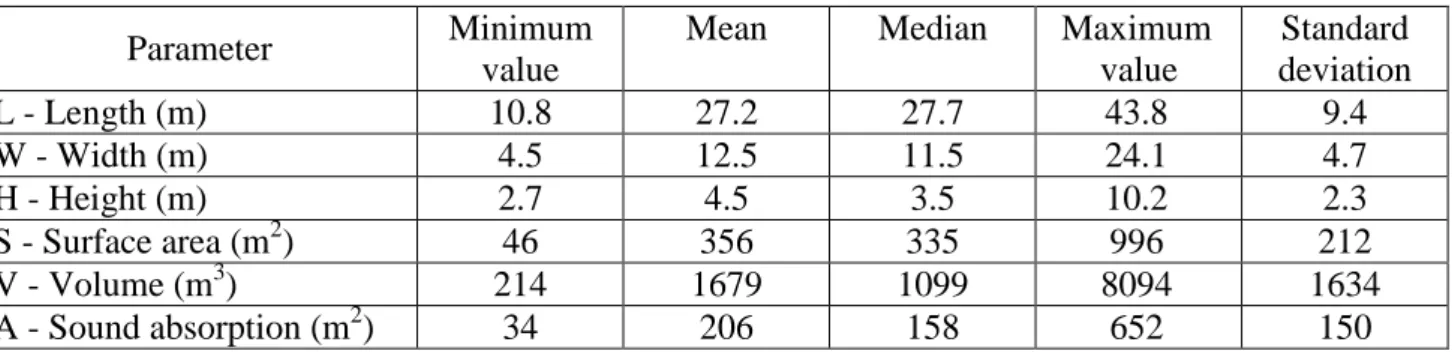
The investigation is focused on public libraries of Portugal that can be considered a represen-tative example of similar rooms in the world. This study reports on acoustical field measurements done in a major survey of 28 libraries1 that were selected to represent the different styles and lay-outs found throughout Portugal and to represent this type of construction. The sample is listed in Table 1 and the statistical summary of their main architectural characteristics is shown in Table 2.
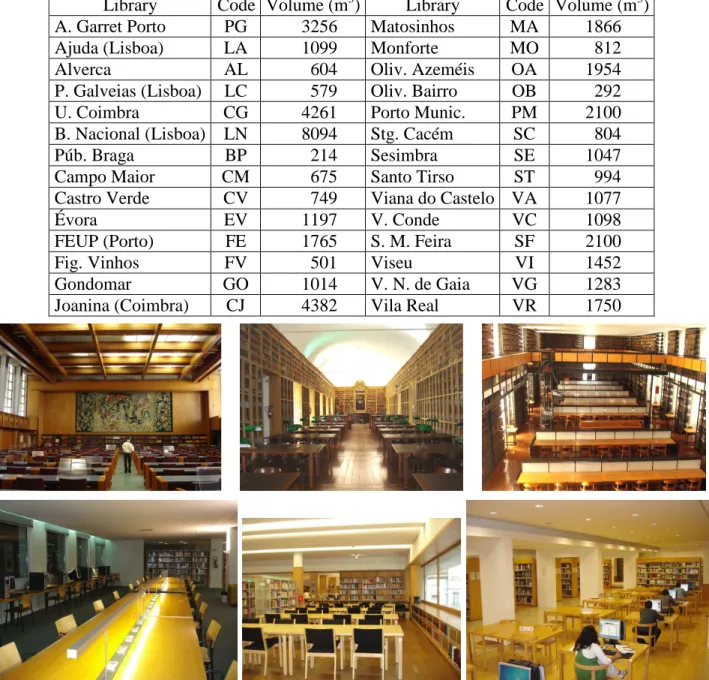
The sample was also divided in two groups of libraries (named Classic and Modern) regard-ing their interior layout and date of construction, to check for possible acoustic differences (Table 3). The Modern libraries have on average, a smaller volume (about half) than the Classic and they are usually longer and wider but with a smaller ceiling height. Figures 1 to 6 show some of the li-braries tested (three of each group).
Table 1. List of the sample of 28 libraries tested.
Library Code Volume (m3) Library Code Volume (m3)
A. Garret Porto PG 3256 Matosinhos MA 1866
Ajuda (Lisboa) LA 1099 Monforte MO 812
Alverca AL 604 Oliv. Azeméis OA 1954
P. Galveias (Lisboa) LC 579 Oliv. Bairro OB 292
U. Coimbra CG 4261 Porto Munic. PM 2100
B. Nacional (Lisboa) LN 8094 Stg. Cacém SC 804
Púb. Braga BP 214 Sesimbra SE 1047
Campo Maior CM 675 Santo Tirso ST 994
Castro Verde CV 749 Viana do Castelo VA 1077
Évora EV 1197 V. Conde VC 1098
FEUP (Porto) FE 1765 S. M. Feira SF 2100
Fig. Vinhos FV 501 Viseu VI 1452
Gondomar GO 1014 V. N. de Gaia VG 1283
Joanina (Coimbra) CJ 4382 Vila Real VR 1750
Figures 1 to 6. Six of the 28 libraries tested (above, Classic libraries: Lisboa-LN, Évora-EV, and Porto-PM;
Table 2 - Simple statistics of the main architectural characteristics of the entire sample of 28 libraries.
Parameter Minimum
value
Mean Median Maximum
value Standard deviation L - Length (m) 10.8 27.2 27.7 43.8 9.4 W - Width (m) 4.5 12.5 11.5 24.1 4.7 H - Height (m) 2.7 4.5 3.5 10.2 2.3 S - Surface area (m2) 46 356 335 996 212 V - Volume (m3) 214 1679 1099 8094 1634 A - Sound absorption (m2) 34 206 158 652 150
Table 3 - Main architectural characteristics of the two groups of libraries (Classic and Modern).
Architectural parameters (avg. values) Group of libraries number of
libraries L (m) W (m) H (m) S (m2) V (m3) A (m2)
Classic 8 25.9 11.1 7.4 322 2741 273
Modern 20 27.7 13.0 3.4 369 1255 179
∆ (= Classic-Modern) - -1.8 -1.9 4.0 47 1486 94
2.2 Methodology and equipment
In each library (main reading room), several measuring points were used for each parameter. For the Reverberation Time analyses, nine measure points were used (with two measurements at each position) and one sound source position at each main reading room. All room average RT values are the mean of 18 measures. Octave band results from 125 to 4k Hz were used. The average of the 500, 1k and 2k octave bands results was also used because this is the parameter employed in the Portuguese legislation2.
For the RASTI measurements, nine measure positions (with five measurements at each posi-tion) and one sound source location were used. All room average RASTI values are the mean of 45 measures.
For the characterization of the background noise (with and without the HVAC equipment on), three measure positions were used. The parameters measured were SPL (31 to 8k Hz) and LAeq.
The equipment used was a sound level meter B&K 2260, a microphone B&K 1/2", a sound source B&K 4224, and a RASTI set B&K 3361.
3. Results and Analysis
3.1 Reverberation time
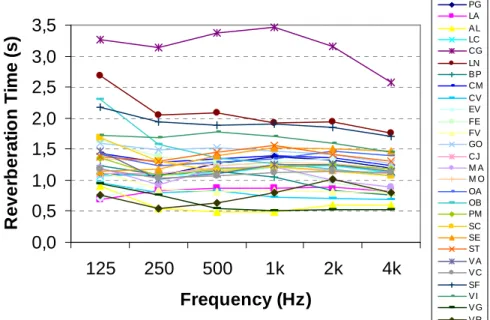
Table 4 and Figure 7 show the main results for the Reverberation Time measurements. Figure 8 shows the average RT spectra for the overall sample and controlling for the two types of libraries (Classic and Modern). On average the Modern libraries have slightly lower RTs than the Classic.
Table 4 - Simple statistics of the Reverberation Time results for the entire sample of 28 libraries (re-garding 28 averaged values).
Reverberation Time (s) Parameter 125 250 500 1k 2k 4k (500+1k+2k)/3 Minimum value 0.69 0.54 0.49 0.48 0.53 0.52 0.5 Mean 1.41 1.24 1.28 1.30 1.26 1.15 1.3 Median 1.29 1.10 1.21 1.24 1.24 1.14 1.2 Maximum value 3.27 3.14 3.38 3.47 3.15 2.57 3.3 Standard error 0.59 0.52 0.55 0.55 0.50 0.41 0.5
0,0 0,5 1,0 1,5 2,0 2,5 3,0 3,5 125 250 500 1k 2k 4k Frequency (Hz) R e v e rb e ra ti o n T im e ( s ) PG LA A L LC CG LN B P CM CV EV FE FV GO CJ M A M O OA OB PM SC SE ST V A V C SF V I V G V R
Figure 7. Reverberation Time spectra for the entire set of 28 libraries.
0,0 0,5 1,0 1,5 2,0 2,5 3,0 125 250 500 1000 2000 4000 Frequency (Hz) R T ( s ) Average-Classic Average-Modern Average-All Libraries
Figure 8. Mean RT spectra, overall results and controlling for the type of libraries (Classic and Modern). 3.2 RASTI
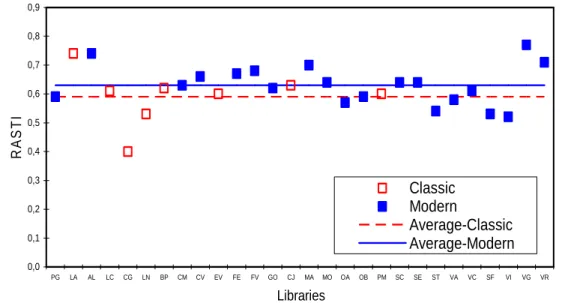
Table 6 shows the general results for the RASTI measurements and Table 5 the conversion for the related speech intelligibility. Table 6 and Figure 9 show the RASTI main data controlling for the two groups of libraries. On average the Modern libraries have a higher (and better) RASTI value (a 0.04 average difference).
Table 5 - RASTI conversion table.
RASTI score [0-0.30[ [0.30-0.45[ [0.45-0.60[ [0.60-0.75[ [0.75-1.00]
Speech intelligibility Bad Poor Fair Good Excellent
Table 6 - RASTI general results for the entire sample (regarding 28 averaged values) and controlling for the two groups of libraries (Modern and Classic).
RASTI Parameter
Entire sample Classic libraries Modern libraries ∆ (= Classic-Modern)
Minimum value 0.40 0.40 0.52 -0.12
Mean value 0.62 0.59 0.63 -0.04
Median 0.62 0.61 0.64 -0.03
Maximum value 0.77 0.74 0.77 -0.03
0,0 0,1 0,2 0,3 0,4 0,5 0,6 0,7 0,8 0,9 PG LA AL LC CG LN BP CM CV EV FE FV GO CJ MA MO OA OB PM SC SE ST VA VC SF VI VG VR Libraries R A S T I Classic Modern Average-Classic Average-Modern
Figure 9. RASTI mean value for each library controlling for the group of libraries (Modern and Classic).
3.3 Background noise
Table 7 shows the main data for the sound level measurements regarding the background noise (bn). Figure 10 shows the LAeq general results for the entire sample with the average mean values for both groups (Classic and Modern). Modern libraries have, on average, a higher back-ground noise of about 3 dB(A). This can be the result of a higher glass area and lower airborne sound insulation of the facades. Nevertheless differences up to 18 dB(A) were found in the LAeq(bn) among the 28 libraries due to their location.
Table 7 - LAeq(bn) general results for the entire sample (28 libraries) and controlling for the Clas-sic/Modern groups.
LAeq(bn) dB Minimum value Mean Median Maximum value Standard error
Entire sample (28 libr.) 22.0 32.0 32.3 39.7 3.3
Classic libraries (8 libr.) 22.0 29.8 31.3 34.6 4.4
Modern libraries (20 libr.) 28.6 32.9 32.6 39.7 2.4
∆ (= Classic-Modern) -6.6 -3.1 -1.3 -5.1 2.0 20 24 28 32 36 40 44 48 52 56 60 64 PG LA AL LC CG LN BP CM CV EV FE FV GO CJ MA MO OA OB PM SC SE ST VA VC SF VI VG VR Libraries L A e q ( b n ) d B Classic Modern Average-Classic Average-Modern
Figure 10. LAeq(bn) general results for the entire sample (28 libraries) with the average mean values
3.4 HVAC noise
Table 8 and Figure 11 show the main data for the sound level measurements regarding the ambient noise with the HVAC equipment working (LAeqHVAC). Only 20 libraries had HVAC systems.
LAeq values from 35 to 57 dB were measured that demonstrate very different acoustic envi-ronments.
Modern libraries have generally a sound level with the HVAC system on, about 4 dB(A) lower than the Classic.
The HVAC system noise increases, on average, about 11 dB(A) the background sound level (bn) within the libraries. However the increase is higher in the Classic libraries (on average about 15 dBA) than on the Modern libraries (about 10 dBA) mainly due to lower background noise.
Table 8 - LAeq(HVAC) and ∆LAeq general results for the entire sample and controlling for
Clas-sic/Modern groups.
LAeq(HVAC) (dB) ∆LAeq (dB) (=LHVACon - LHVACoff) Parameter
Entire sample Classic Modern Entire sample Classic Modern
Minimum value 34.7 45.3 34.7 3.9 12.5 3.9 Mean 43.0 46.4 42.4 10.5 15.1 9.6 Median 41.8 46.3 40.8 9.4 13.1 8.2 Maximum value 57.2 47.7 57.2 22.6 19.8 22.6 Standard error 6.0 1.2 6.3 5.6 4.1 5.6 20 24 28 32 36 40 44 48 52 56 60 64 PG LA AL LC CG LN BP CM CV EV FE FV GO CJ MA MO OA OB PM SC SE ST VA VC SF VI VG VR Libraries L A e q ( H V A C ) d B Classic Modern Average-Classic Average-Modern
Figure 11. LAeq(HVAC) general results for the entire sample (20 libraries) with the average mean
values for both groups (Classic and Modern).
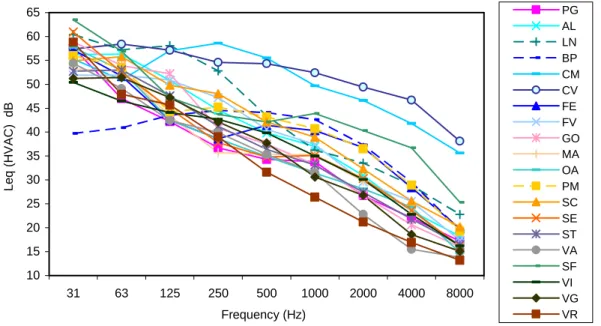
Figure 12 shows all the HVAC noise spectra where differences up to 25-30 dB are found among the libraries. If using the A filter the higher SPL values are found in the 500 and 1000 Hz frequency bands. Figure 13 shows the average spectra controlling for the group of library, where higher SPLs for the Classic libraries (about 3 to 5 dB on average) can be seen.
10 15 20 25 30 35 40 45 50 55 60 65 31 63 125 250 500 1000 2000 4000 8000 Frequency (Hz) L e q ( H V A C ) d B PG AL LN BP CM CV FE FV GO MA OA PM SC SE ST VA SF VI VG VR
Figure 12. SPL spectra for the HVAC equipment noise for the entire sample (20 libraries).
15 20 25 30 35 40 45 50 55 60 31 63 125 250 500 1000 2000 4000 8000 Frequency (Hz) L e q ( H V A C ) d B Average-Classic Average-Modern Average-All Libraries
Figure 13. Average SPL spectra for the HVAC equipment noise for the entire sample and controlling for the
type of libraries (Classic and Modern).
3.5 Noise curves (NC/NR)
Table 9 shows the Noise Criteria / Noise Rating (NC/NR) main data (HVAC noise) for the entire sample and controlling for the two groups of libraries. In general the Classic libraries have a higher NC/NR rating (6 dB on average). However, the maximum NC/NR values (51 / 52) were found in Modern libraries.
Table 9 - NC and NR main results.
Parameter Entire sample Classic libraries Modern libraries ∆ (= Classic-Modern)
NC / NR average 37 / 38 42 / 43 36 / 37 6 / 6
NC / NR minimum 27 / 29 40 / 41 27 / 29 13 / 12
NC / NR maximum 51 / 52 43 / 44 51 / 52 8 / 8
3.6 Relationships among parameters
Regression models between the architectural parameters and among the architectural and acoustical parameters were established (Table 10).
Table 10 - Best regression models among parameters.
Best regression models among the acoustical parameters R2
RASTI = 0,8288 e -0,2347[RT500,2k] 0.84
RASTI = 0.81756 - 0,00096 LAeq(bn) – 0,13011 [RT avg 500,1k,2k] 0.77
Best regression models between the acoustical and the architectural parameters
RT(avg 500,2k) = -2.08E-08V2 + 3.27E-04V + 0.8355 0.33
RASTI = 0.6532 e -3,59E-05V 0.20
4. Law and design rules
The Portuguese legislation2 states that the average RT (500, 1k and 2k Hz) should not be higher than 0.15V 1/3. Applying this rule to the 28 libraries tested it was found that 96% fulfilled that requirement even if, in many cases, the average RT is very high (up to 3.0 s if the Volume reaches 8000 m3 as one of the libraries does). This rule is very permissive because it is based in the room volume. For this reason a short set of enhanced design goals are presented (Table 11) to help acous-tical consultants to achieve a good environment in this type of building.
Table 11 - Proposed design rules.
Parameter Libraries main reading rooms
Average Reverberation Time - RT(500,1k,2k) ≤ 1.0 s
Sound level (HVAC) – LAeq ≤ 30 dB
Noise Curves NR “noise rating” and NC “noise criteria” ≤ 35
5. Conclusion
This work was centered in a selected 28-room sample and confirmed that the libraries have distinct characteristics. The results show that, on average, the tested libraries have a RT (1 kHz) of 1.3 ± 0.6 s, a RASTI of 0.62 ± 0.08, a LAeq (background noise, without HVAC) of 32.0 ± 3.3 dB and a LAeq (HVAC noise) of 43 ± 6 dB.
It was verified that 80% of the HVAC systems did not fulfill the ideal acoustical requirements and 50% of the libraries with HVAC, had NR or NC values higher than the recommended.
Classic libraries seem to have slightly higher RT values, lower RASTI (≈0.04), lower LAeq(background noise) (≈3 dB), higher LAeq(HVAC) (≈4 dB), higher NC/NR (≈6 dB). However, no strong statistical evidence was found to support the hypothesis that Classic libraries behave acoustically better than the Modern.
A set of ideal goal values for objective acoustic parameters was proposed that can be useful in the design of new libraries.
[Project partially supported by CEC – Centro de Estudos da Construção (FEUP).]
REFERENCES
[1] A.E.B. Costa, Caracterização Acústica de Bibliotecas em Portugal e Análise de Influência na Reabilitação
Acústi-ca, (in Portuguese), M.Sc. thesis, Faculty of Engineering, U. Porto, 2009.
[2] Law, Regulamento dos Requisitos Acústicos dos Edifícios RRAE (in Portuguese) (Noise Code: Acoustical