UNIVERSIDADE DO ALGARVE
Using proteomic technologies to understand the impact of stress
and nutritional factors on fish metabolism, welfare and quality
Tomé Pereira de Azevedo Santos Silva
Tese
Doutoramento em Ciências da Vida, do Mar, da Terra e do Ambiente Ramo de Ciências Biológicas
(Especialidade em Biologia Molecular)
Trabalho efetuado sob a orientação de:
Professor Doutor Pedro Miguel Leal Rodrigues, Faculdade de Ciências e Tecnologia, Universidade do Algarve, Faro, Portugal.
Doutor Jorge Proença Dias, Centro de Ciências do Mar do Algarve (CCMAR), Faro, Portugal.
Doutor Flemming Jessen, DTU Fødevareinstituttet (DTU Food), Kgs. Lyngby, Dinamarca.
UNIVERSIDADE DO ALGARVE
Using proteomic technologies to understand the impact of stress
and nutritional factors on fish metabolism, welfare and quality
Tomé Pereira de Azevedo Santos Silva
Tese
Doutoramento em Ciências da Vida, do Mar, da Terra e do Ambiente Ramo de Ciências Biológicas
(Especialidade em Biologia Molecular)
Trabalho efetuado sob a orientação de:
Professor Doutor Pedro Miguel Leal Rodrigues, Faculdade de Ciências e Tecnologia, Universidade do Algarve, Faro, Portugal.
Doutor Jorge Proença Dias, Centro de Ciências do Mar do Algarve (CCMAR), Faro, Portugal.
Doutor Flemming Jessen, DTU Fødevareinstituttet (DTU Food), Kgs. Lyngby, Dinamarca.
1
Using proteomic technologies to understand the impact of stress
and nutritional factors on fish metabolism, welfare and quality
Declaração de autoria do trabalho
Declaro ser o autor deste trabalho, que é original e inédito. Autores e trabalhos consultados estão devidamente citados no texto e constam da listagem de referências incluída.
Copyright © 2013 por Tomé Santos Silva. Todos os direitos reservados.
A Universidade do Algarve tem o direito, perpétuo e sem limites geográficos, de arquivar e publicitar este trabalho através de exemplares impressos reproduzidos em papel ou de forma digital, ou por qualquer outro meio conhecido ou que venha a ser inventado, de o divulgar através de repositórios científicos e de admitir a sua cópia e distribuição com objetivos educacionais ou de investigação, não comerciais, desde que seja dado crédito ao autor e editor.
2
3
Acknowledgements
I would like to thank all the people who made this dissertation possible. First and foremost, my supervisors, Pedro Rodrigues, Jorge Dias and Flemming Jesson, who provided much needed guidance and insight throughout these last few years. Also essential was the role of several of my colleagues and co-authors, not only for their help, but also for the many interesting (and sometimes bizarre) discussions: Odete Cordeiro, Elisabete Matos, Ricardo Alves, Tune Wulff, Nadège Richard, Mahaut de Vareilles and Luís Conceição, to name a few. To all of them, I am very grateful.
I would also like to acknowledge the financial support by Fundação para a Ciência e Tecnologia, without which this work would not be possible. Support was provided through FCT grant SFRH/BD/41392/2007 and FCT project TEXBREAM (PTDC/MAR/70858/2006).
A special thanks goes to all the Aquagroup people, who provided a great scientific environment during these years and from whom I learned a lot. In particular, I would like to thank Vera Rodrigues and Rita Colen, for helping with all those fun samplings.
I also appreciate the welcoming and helpful people at DTU Food, which made my stay there both fun and enlightening. In particular, I would like to thank Natalia Jiménez, Dominika Przybylska and Susan Holdt. It is also important to mention the excelent technical assistance provided by Hanne Jacobsen and Lotte Holck.
Finally, I want to thank my family and all my other close friends (you know who you are). This thesis is for you.
4
5
Summary
As the scale of aquacultural activities increases, we increasingly face challenges, not only in terms of sustainability, but also regarding issues like animal welfare and product quality. Within these research fields, proteomics (along with other -omics) is establishing itself as an invaluable tool for an untargeted assessment of the impact of exogenous stimuli on fish metabolism.
This dissertation describes work developed in this area, where proteomic technologies were used to understand the impact of stress and nutritional factors on fish metabolism, welfare and quality. Gilthead seabream was chosen as the main biological model, due to its high importance in the Portuguese aquaculture sector, with Senegalese sole as secondary model. These studies were focused on both skeletal muscle and liver tissue.
Results demonstrated that a reproducible proteomic analysis of the sarcoplasmic fraction of gilthead seabream muscle is feasible, with pre-slaughter stress inducing a clear hastening of the transition between the pre-rigor and post-rigor profiles. Comparatively, glycerol supplementation (as a tool to modulate muscle glycogen reserves) was shown to have a more subtle impact on the sarcoplasmic proteome of gilthead seabream, with results generally suggesting adaptive effects associated with this dietary factor. Hepatic proteome analyses revealed a high sensitivity towards both stress and dietary factors, with stress factors again displaying a broader impact on protein expression. In these experiments, the proteomic responses to sources of stress displayed specificities that depend on both the biological model and the type/duration of stressor, despite some degree of overlap in terms of the affected pathways.
Concluding, despite the apparent resilience of gilthead seabream quality attributes in regards to nutritional and/or stress factors, proteome analysis revealed that these factors have an impact on both muscle and liver metabolism, being likely to affect post-mortem muscle degradation dynamics. The suggestion of specific candidates for further targeted studies underlines the usefulness of proteomics in this context.
6
7
Resumo
A aquacultura, apesar de se tratar de uma atividade humana que já conta com milénios de existência, entrou numa fase de crescimento surpreendente a partir da década de 60 do século passado, sendo que atualmente ultrapassa já o sector pesqueiro como principal fornecedor de produtos alimentares derivados de organismos aquáticos. Por outro lado, embora este crescimento prodigioso tenha acarretado mais-valias no que respeita ao custo e acessibilidade destes produtos alimentares (de elevada qualidade nutricional) às populações em geral, cada vez mais nos deparamos com diversos desafios, não só ao nível da sustentabilidade a longo-prazo destas atividades, como ao nível de questões relacionadas com o bem-estar animal e com a qualidade (nutricional e organolética) do produto final. Neste contexto, a proteómica (assim como a genómica, transcriptómica e metabolómica) tem-se estabelecido nos últimos anos como uma valiosa ferramenta na avaliação holística do impacto de fatores extrínsecos sobre os processos celulares dos peixes.
O trabalho descrito nesta dissertação foca-se precisamente na aplicação de ferramentas proteómicas para o estudo do impacto do stress (a curto e a longo-prazo) no metabolismo dos peixes e processos de decomposição post-mortem (e, consequentemente, o seu efeito a nível do bem-estar dos peixes e da qualidade do produto final), assim como a interação de fatores nutricionais com estes fatores de stress. Para o efeito, procurou-se efetuar análises proteómicas ao nível de dois tecidos: por um lado, o músculo esquelético (i.e. o filete), dado que constitui a principal parte comestível do peixe; por outro, o fígado, que é o principal órgão responsável pelo controlo central dos processos metabólicos. Estes estudos foram realizados utilizando a dourada (Sparus aurata) como principal modelo animal, dada a sua importância no sector nacional de aquacultura. Para efeitos de comparação, foi ainda efetuado um estudo em linguado (Solea senegalensis), visto se tratar também de uma espécie relevante na aquacultura nacional e apresentar particular sensibilidade a fatores de stress, quando em cativeiro.
No decorrer deste trabalho, foram realizados vários ensaios focados no tecido muscular da dourada, particularmente no que respeita a fatores imediatamente pre-mortem e o seu impacto nos processos de decomposição e, consequentemente, nas propriedades organoléticas do produto final. Os resultados obtidos confirmam a possibilidade de isolar a fração sarcoplasmática do proteoma muscular da dourada de forma reprodutível, dado que a sua aplicação aparentemente não aumenta a quantidade de ruído técnico inerente à análise do
8 proteoma (Capítulo 2). A aplicação desta metodologia no estudo do stress pré-abate demonstrou um forte efeito deste tipo de stress pré-mortem no proteoma sarcoplasmático, claramente acelerando a transição entre um perfil pré-rigor e um perfil pós-rigor (Capítulo 3). Para além disso, apesar do impacto de fatores de stress sobre o proteoma muscular da dourada ser muito maior e mais abrangente do que o de fatores nutricionais, também se tornou claro que estes últimos (particularmente, o caso da suplementação alimentar com glicerol) podem induzir um efeito positivo ao nível das reservas de energia pré-mortem, podendo portanto constituir um fator mitigante no impacto dos efeitos de fatores de stress (Capítulo 4).
Em relação aos ensaios focados na resposta proteómica do fígado face a fatores nutricionais e de stress, os resultados geralmente demonstram uma maior sensibilidade (comparado ao tecido muscular) face a estímulos externos, com os fatores de stress uma vez mais induzindo um maior impacto no proteoma comparativamente aos fatores nutricionais. Comparando os dois modelos animais utilizados (dourada e linguado), verificou-se que, apesar das semelhanças entre os dois modelos quando sujeitos a fatores de stress crónico em termos de vias metabólicas afetadas, existe uma fraca sobreposição em termos de proteínas especificamente afetadas, sugerindo a existência de idiossincrasias inerentes a cada espécie no que toca à sua resposta a fatores de stress (Capítulos 5 e 6). De facto, mesmo a aplicação de diferentes fatores de stress no mesmo modelo (dourada), em situações experimentais idênticas, demonstra a existência de uma dependência entre o tipo/duração do fator de stress aplicado e a resposta proteómica induzida, a nível hepático (Capítulo 5). Finalmente, conseguiu-se demonstrar que os dados obtidos por espectroscopia de infravermelho transmissiva do fígado de dourada fornecem importante informação que é tanto consistente como complementar à informação fornecida por metodologias proteómicas, providenciando um contributo significativo para o estudo do impacto do stress térmico sazonal no metabolismo da dourada, assim como para a formulação de dietas especiais fortificadas que providenciem um efeito positivo demonstrável no sentido de mitigar o impacto deste fator de
stress (Capítulo 7).
Concluindo, este trabalho demonstrou que tanto o stress crónico como o stress pré-abate induzem efeitos significativos a nível do proteoma muscular e hepático de peixes como a dourada e o linguado. É importante notar também que, em algumas das experiências, se demonstrou o potencial de fatores nutricionais na mitigação de alguns dos efeitos do stress induzido (tanto a nível hepático como a nível muscular). Para além disso, apesar da observação de claros efeitos induzidos por fatores nutricionais e de stress sobre o proteoma muscular, poucos efeitos foram notados em termos de impacto nas propriedades organoléticas
9 do produto final (nomeadamente, textura, aroma e aspeto visual) que, apesar de positivo (dado ilustrar a robustez dos traços fenotípicos e propriedades organoléticas da dourada, face a fatores extrínsecos), torna difícil a utilização da dourada como modelo ótimo no estudo das relações entre o bem-estar animal e possíveis efeitos indesejados a nível da qualidade do produto final. Apesar disto, é inegável que estes fatores apresentam um impacto não-negligenciável sobre o bem-estar e o metabolismo dos peixes, facto atestado pelos resultados descritos nesta dissertação. Exemplos específicos de candidatos de estudo interessantes em futuros trabalhos nesta área incluem a proteína DJ-1, a proteína inibidora da Raf cinase (RKIP), a fosfohistidina fosfatase (PHP), entre outras proteínas regulatórias cuja expressão se demonstrou ser afetada por fatores nutricionais e de stress. Tudo isto demonstra a utilidade da proteómica no contexto da aquacultura, particularmente na área do bem-estar animal, como uma ferramenta sensível na deteção de sinais de stress fisiológico/celular e desvios metabólicos, mesmo quando estes não são aparentes mediante o recurso a técnicas clássicas.
10
11
Table of Contents
Acknowledgments 3 Summary 5 Resumo 7 Table of Contents 11 Objectives 13Chapter 1. Introduction – Proteomics and Aquaculture 15
1.1 Current issues in aquaculture 17
1.2 The concept and importance of fish welfare 19
1.3 The concept and importance of fish quality 22
1.4 Proteomic (and other –omic) technologies 29
1.5 Analytical approaches for an integrative biology 38
Chapter 2. On the reproducibility of a fractionation procedure for fish muscle
proteomics 45
Chapter 3. Effects of pre-slaughter stress levels on the postmortem sarcoplasmic proteomic profile of gilthead seabream muscle 57
Chapter 4. Dietary tools to modulate glycogen storage in gilthead seabream muscle:
glycerol supplementation 81
Chapter 5. Characterization of the impact of crowding and repeated handling stress on
gilthead seabream liver proteome 113
Chapter 6. Characterization of the impact of repeated handling stress on Senegalese
sole liver proteome 135
Chapter 7. Integrated proteomic and metabolic profiling of gilthead seabream liver to track interactions between dietary factors and seasonal temperature
variations 161
Conclusions and Future Perspectives 195
12
13
Objectives.
The main purpose of my PhD study was to explore and study the impact of short and long-term stress on both fish muscle proteome, to assess their effect on post-mortem muscle/meat conversion and decomposition processes, as well as downstream quality attributes, and hepatic proteome, to assess their effect on pre-mortem fish welfare and metabolic status, using gilthead seabream as main model and Senegalese sole as secondary model. Besides this, focus was given on assessing possible interactions between dietary factors and the biological impact of these stressors. Finally, it was also important to use this untargeted information for, on one hand, the discovery of novel indicators of fish welfare and metabolic/nutritional status, and on the other hand, the assessment of the validity of already-established indicators.
14
15
Chapter 1.
Introduction – Aquaculture and Proteomics.
Part of this chapter has been previously published in:
Pedro M. Rodrigues, Tomé S. Silva, Jorge Dias, Flemming Jessen. Proteomics in aquaculture: Applications and trends. Journal of Proteomics 2012, 75 (14), 4325-4345.
16
17
1.1. Current issues in aquaculture
Aquaculture is defined as the farming of aquatic organisms, covering both freshwater and marine fish, along with crustaceans, molluscs and algae. Although this practice has been known to man for millennia, its growth has increased considerably since the 1960‘s, while the productivity of fisheries has reached a plateau in the early 1990‘s. Currently, aquaculture has already surpassed fisheries in terms of production volume and this trend is unlikely to reverse. In fact, the growth rate in aquaculture production already surpasses the rate of human population growth, which indicates a trend towards an increasingly higher reliance on aquaculture to provide fish products (and other food products derived from aquatic organisms)1. In the particular case of Portugal, similarly to other countries in southern Europe, aquaculture of marine species (like gilthead seabream, white seabream, European sea-bass, clams, oysters and flat fish species) is particularly strong, although there is also culture of freshwater species (like eels and salmonids)2.
While there are obvious positive aspects to this incredible recent growth in aquaculture production (e.g.: reducing dependence/impact on fishery resources; making high nutritional value food products more affordable, improving human nutrition), there are also negative aspects and challenges that concern both farmers, researchers and stakeholders. Looking in broad terms to the type of concerns and research published, we can generally cluster them according to a few subjects (Figure 1.1). These will increasingly become essential topics of research, as the dimension of aquacultural activities increase (along with their importance in human nutrition), in order to overcome the challenges, mitigate the negative aspects and guarantee their long-term (economical, social, environmental, ecological) sustainability.
Some of the research is focused on issues related to ―reproduction‖, mainly at the level of maintaining viable broodstock in captivity, genetic studies, sperm cryopreservation and issues related to sexual maturation, among other subjects (e.g. 3-10). The issue of sexual maturation can also be seen as part of the ―development‖ cluster, which approaches essential matters like early morphogenesis, metabolic programming, larval digestive ontogeny and the onset of morphological deformations/malformations (e.g. 11-15). This last topic leads us to another important cluster of research, which deals with ―health‖ issues, such as the study of captivity-specific syndromes, as well as issues related to the prophylaxis and theurapeutics of viral, bacterial and parasitic infections (e.g. 16-25).
18 Another field of research concerns the ―biotechnology‖-related applications of marine organisms, such as their use in bioreactors (e.g. for biofuel production) or for bioremediation purposes (e.g. 26-37). In this more empirical sense, there is also plenty of research related to the specificities of ―production systems‖, particularly on the development of high-performance intensive culture systems (with water recirculation) and on the optimization of logistic/management practices, but also on the exploration of alternative, more extensive and/or integrated (multi-trophic) aquaculture systems (e.g. 38-49). These last are also a matter of study in the field of ―sustainability‖, where a big emphasis is put on studying the impact of aquacultural activities on the environment and wild ecosystems (e.g. 50-54). Also within this subject is the matter of sustainable feeds, which often involves the (at least partial) replacement of traditional marine-based ingredients for plant-based ingredients in production of feeds for aquaculture (e.g. 55-59).
Figure 1.1 – Main (often overlapping) clusters of research within aquaculture.
In the field of ―nutrition‖, there is a wide range of studies, not only on issues related to sustainability and the use of new ingredient sources, but also on the determination of fish nutritional requirements (e.g. 60-63) , development of optimized feeds for specific developmental stages (e.g. 64-67), as well as the exploration of the effect of a wide range of supplements and micronutrients (e.g. immune boosters, attractants/phagostimulants, pigments, antioxidants). Finally, there are also the fields of fish ―welfare‖ and ―quality‖, which are further discussed in the succeeding sections, being the main topics approached in this dissertation.
19
1.2. The concept and importance of fish welfare
Animal welfare is a complex concept that is anything but straightforward to define and measure. In this context, there is not a single commonly-agreed framework and the whole concept within aquaculture has evolved over time, from strictly performance-oriented measures to the current, more feelings-based approaches68-75. Here, a commonly cited definition of animal welfare puts it in terms of ―freedom from hunger and thirst, discomfort, pain, injury, disease, fear and distress, and the freedom to express normal behaviour‖68
. From this definition, it is quite evident that no easy and single all-encompassing measure of welfare is available.
Aquacultured organisms (and fish in particular) are often subjected to stressful situations, some of which unavoidable, that might compromise their welfare. While, until recently, the most general accepted measure of welfare has been physical health and performance, where a variety of physiological and biochemical measures have been used, more importance is increasingly being given to the observation and characterization of behavioural alterations, along with the discovery and development of novel molecular indicators of metabolic status. An overview of the factors which often impair fish welfare, along with the most used indicators of compromised fish welfare can be seen in Figure 1.2.
Figure 1.2 – Diagrams showing the main factors affecting fish welfare (on the left), along with the commonly
20 When fish are subjected to stressors or situations that otherwise compromise their welfare, a series of neurological and endocrine changes occur (dubbed the ―primary stress response‖), which involve the release of epinephrine and cortisol to the bloodstream. These changes elicit secondary behavioural and metabolic adaptations which improve the short-term capacity of fish to cope with (or otherwise avoid) challenging situations. On the other hand, chronic exposure to sources of stress with consequent repeated activation of the primary stress response has a deleterious effect on fish physiology and health, eventually leading to effects such as anorexia, poor growth performance, immunodepression and impaired reproductive function76-78. Also, it is important to remember that aquacultured fish, unlike wild fish, are subjected to unavoidable physical constraints which often undermine the effectiveness of their natural behavioural responses to stress. This obviously implies that aquacultured fish have a reduced capacity to cope with the cumulative effect of stressors through their own means, which underlines the necessity to minimize the occurrence of avoidable sources of stress and/or find ways of mitigating their effect.
The importance of fish welfare in aquaculture is derived not only from pragmatic reasons (i.e. preventing poor fish performance, health and quality), but also legitimate ethical concerns79, as studies increasingly suggest that fish sense pain similarly to mammals, recollect aversive experiences and are capable of displaying clear preferences80-87. This suggests that, despite the particularly underdeveloped neocortex of fish (compared to mammals) and their reduced self-awareness and cognitive abilities, fish can certainly sense noxious stimuli and probably experience, to some level, both pain and anticipatory aversion (i.e. fear).
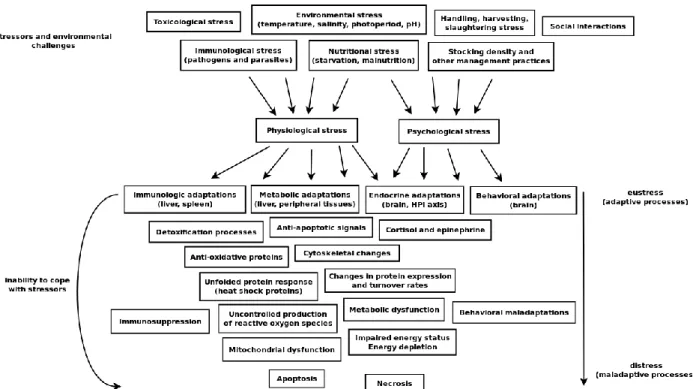
Currently, the scientific view on the biological adaptability within a changing environment has shifted from the classic ‗homeostatic‘ model, where organisms are seen as continuously striving towards a static (conceptually optimal) state, to an ‗allostatic‘ model, that more accurately accounts for the adaptive and dynamic nature of biological systems88-89. This model assumes that understimulation (due to lack of signals and challenges from the environment) can be as detrimental to fish welfare and development as overstimulation. Also, it distinguishes adaptive changes (‗eustress‘) from maladaptive changes (‗distress‘), where the latter usually occur when the intensity or duration of the challenges overcome the organism‘s coping capacities. An overview of the relationship between stressors and biological responses within the context of finfish aquaculture can be seen in Figure 1.3.
21
Figure 1.3 – Global overview of the relationship between stressors and physiological/psychological/cellular
stress, within an ―allostatic‖ framework.
As already mentioned, the assessment of situations of impaired fish welfare are often based on (besides the immediately obvious secondary and tertiary effects of the response to stress) the measurements of the plasma levels of metabolites associated with stress response, namely cortisol, glucose and lactate. Despite the usefulness of cortisol measurements in the detection of hypothalamic-pituitary-interrenal axis activation, it is clear that this information is not sufficient by itself to assess fish welfare, for several reasons: first, the estimated absolute cortisol levels in plasma should be biased, as blood sampling itself constitutes a source of stress; second, although most fish display a common pattern of increased cortisol levels while exposed to a source of stress, followed by a return to basal levels within hours when the stressor is removed, the basal cortisol level itself is very context-dependent (being affected by factors such as feeding, season, maturation, photoperiod and unknown stressors); and third, both the basal levels of cortisol and the degree of cortisol induction during stressful events are very much species-dependent, displaying a high degree of inter-individual variation (which is somewhat explained through the ―bold vs. shy‖ paradigm) and, again, a high degree of context-dependence (the magnitude of cortisol induction depends on factors such as the type and duration of the stressor, as well as whether the source of stress is predictable and/or avoidable)76, 88, 90-95. The same type of problems also applies to the plasma levels of glucose
22 and lactate, being impossible to define reliable reference or threshold values for ―stress vs. welfare‖, again, very much due to the allostatic nature of biological organisms. This underlines the importance of context when interpreting these haematological parameters and the general need for integrated multidisciplinary approaches towards fish welfare that not only take into account all the different known indicators of well-being, but also explore eventual unexpected or yet unknown signs of impaired fish welfare (through the use of, e.g., high-throughput ―omics‖ technologies). In fact, proteomics is increasingly being used as a method to obtain unbiased information regarding the impact of stressors on both plasma and organs/tissues, with a significant focus being given to the liver (due to its central role in most key metabolic processes), but with studies also being performed on skeletal muscle, brain, osmorregulatory and immune-related organs and tissues96.
1.3. The concept and importance of fish quality
Fish quality is an important aspect of aquaculture production and research that pertains to the value-determining attributes of fish products and consumers‘ expectations regarding these attributes. It usually refers specifically to the assessment of the organoleptic properties of fish products (both through sensory and instrumental approaches), as well as to the study of the impact of different factors on these organoleptic properties. This concept and field of study, when taken in its wider definition, also encompasses issues related to food safety (e.g. 50, 52, 97-101
), nutritional value (e.g. 102), food certification/traceability (e.g. 103) and management of post-harvest product stability and shelf-life (e.g. 104-110), as all these aspects are also highly determining to the products‘ ultimate quality and value, from the consumers‘ point-of-view 111-112
.
Although, in general terms, consumers tend to expect organoleptic attributes of cultured fish to be as close as possible to wild fish, the typical (i.e. in the wild) values of the different attributes (along with their respective weight in the determination of fish quality) are very much species-dependent (and sometimes even population-dependent). Furthermore, it is important to take into account that consumers‘ expectations are inherently subjective and even prone to change over time, which implies that it might not always be possible to define universally optimal organoleptic attributes, even within a particular species.
23 Given that the edible part of fish is usually the fillet, which is mostly composed by skeletal muscle (along with variable amounts of connective and adipose tissue), factors such as muscle cellularity, composition and macrostructure are highly determining of the products‘ ultimate quality. Within this context, the assessment of fish meat quality appears to be more challenging than for land animals, as fish myosystem types are more diverse and their idiosyncrasies less well characterized113. In addition to the fillets, the properties of skin, eyes, gills and mucus can affect the product‘s desirability, and fish quality measurements also take these into account.
Regarding the specific organoleptic properties that are relevant to the definition of fish quality, the main focus has been given to concepts such as freshness, flavour, taste, aroma, texture and visual appearance. ―Freshness‖ is a special type of attribute that encompasses the other attributes, reflecting the apparent elapsed time since slaughter. Similarly, the concept of ―flavour‖ should also be seen as a meta-attribute (resulting of the interaction between ―taste‖, ―aroma‖ and ―texture‖, along with temperature and chemesthetic factors). The other attributes (―taste‖, ―aroma‖, ―texture‖ and ―visual appearance‖) can be seen as distinct aspects, thought not necessarily independent, as there are common underlying factors to these distinct organoleptic properties.
The concept of ―taste‖ refers to the sensory information mediated through the gustative receptors of taste buds, which can be classified according to five known types (with distinct activation triggers): salty (alkali cations), sour (protons), sweet (saccharides and analogs), umami (L-glutamate, IMP, GMP) and bitter (hundreds of different substances) 114-115
. As expected, the subjective experience of taste can be mostly associated to the different free concentrations of gustative triggers present in the edible parts of fish, although there are also (human) genetic factors that might be determining to the ultimate perception of taste (particularly in the case of sweet and bitterness)116-118.
Regarding ―aroma‖, it basically concerns the olfactory perception elicited by volatile substances that are released both before and during mastication119. Like with ―taste‖, it results from a form of chemoreception, but mediated by olfactory receptor cells located inside the nasal cavity, along the olfactory epithelium. On the other hand, olfactory information is much richer than gustative information, as there is a wider range of different olfactory receptors than gustative receptors. Another difference between the two systems is that gustation requires direct physical contact of the reception organ (i.e. tongue) with the subject, unlike olfaction. The specific olfactory triggers in fish products include alcohols, aldehydes, ketones, esters, sulfides, mercaptans and amines. In the case of marine teleosts, the aroma of fresh fish
24 is relatively simple and mostly composed of alcohols, aldehydes and ketones, which result from the activity of endogenous lipoxygenases on polyunsaturated fatty acids120-123. As time post-mortem elapses and spoilage begins, other types of more pungent volatiles start being produced mostly as a result of further oxidative processes and bacterial metabolism, namely dimethylamine, trimethylamine, sulfides, mercaptans, among others110, 124-126.
Regardless of these differences, both types of chemoreceptive perception within the context of fish products are obviously highly dependent on body composition, but also post-mortem degradative processes, bacterial proliferation, lipid oxidation or any other processes that affect the composition of volatiles, fatty acids, small ions, nucleotides, free amino acids, saccharides and other substances. Even structural factors (i.e. ―texture‖) can have an influence on how taste and aroma develop, by modulating the release of these compounds before and during mastication, which is why it is often appropriate to consider a ―flavour‖ meta-attribute that results from and encompasses all these different inter-dependent aspects.
Another very important quality-defining attribute in fish products is ―texture‖, which is related to the mechanical perception of food in the mouth and therefore, in this particular case, to the structural and physical properties of the edible parts of fish (mostly skeletal muscle, but also connective and adipose tissue). Descriptions of the textural properties of fish meat usually employ subjective organoleptic terms, such as firmness, chewiness, tenderness, juiciness and pastiness, that seem to be correlated to objective structural characteristics of meat, both in terms of initial apparent hardness and resilience in response to deformation forces, as in terms of secondary properties which only become apparent throughout the mastication process (e.g. springiness, cohesiveness, adhesiveness)127. In the specific case of fish, as already stated, there is a wide variability between species in terms of myotome organization and specific structural properties, although they generally display softer texture than land animals, due to their relatively sparse extracellular collagen matrix. Another general trend is that cultured fish also display generally softer texture than wild fish, which is seen as a negative attribute. In part, this is usually attributed to the fact that cultured fish are often constrained to a more sedentary lifestyle, which affects the development of their muscular system113. As such, the study of muscle physical properties and their relation to the subjective perception of texture, in the context of aquaculture, is given high importance.
Finally, ―visual appearance‖ is also an essential criterion in the assessment of fish quality, both in terms of a fish‘s external appearance (regarding, e.g., body shape, eye attributes, gill coloration and the presence of species-specific marks) as in terms of fillet colour128. Although appearance might seem like an attribute of lesser importance (in the sense
25 that it generally doesn‘t affect much the flavour perception of fish products), it constitutes one of the main criteria consumers use to gauge product freshness and significant deviations from consumers‘ expectations (e.g. in terms of body shape or flesh coloration) can prevent the marketability of fish, even if they display no spoilage or other compromised organoleptic traits. For some species (e.g. salmon), it might be important to supplement their diets with specific crustacean or algae-derived pigments (in the case of salmonids, astaxanthin and other carotenoid pigments) which are usually present in their diet (in the wild), not only due to eventual nutritional/heath-related issues, but to enable the development of expected visual traits (e.g. meat coloration or specific external marks) that depend on the dietary availability of these pigments129-132.
Given the dependence of all these organoleptic traits on the physical and chemical properties of fish products, it should not be surprising that fish quality traits can be affected by a wide range of different factors, in a heavily species-dependent way. These factors can be classified according to whether they affect the pre-mortem or intrinsic attributes of fish (which would reflect in measured quality parameters immediately post-mortem) and/or the post-mortem temporal evolution of these traits (which would reflect on the rate of spoilage and deterioration of freshness-related attributes, in terms of quality traits measured several hours/days post-mortem). In the first case, we have factors related to nutrition, health, development and environment (e.g. temperature, photoperiod, salinity, pH, water depth, O2 levels, CO2 levels, stocking density), which have been shown, in particular cases, to have a direct impact on fillet composition and physical properties and, therefore, on downstream quality attributes113, 133-135. In the second case, it is important to take into account that, when fish are slaughtered, peripheral tissues (like skeletal muscle) begin to experience energy depletion and anoxia, as the circulatory system stops to provide oxygen and fuel. This leads to a cascade of tightly-related processes and events which are characteristic of muscle-meat conversion and meat degradation (Figure 1.4) and that can ultimately lead to changes in quality criteria, depending on how intensive and extensive these processes are128, 136. At this level, several pre- and post-mortem factors are known to interact and influence the development of these processes: on one hand, as explained in the preceding section, we have factors related to fish nutrition and welfare (such as pre-mortem energetic/metabolic/oxidative state and the type of harvesting/slaughtering methods used)136-141 and, on the other hand, we have factors which are related to the type of post-processing and conditioning used to manage post-mortem spoilage processes142-143. It is relevant to note that, while these post-mortem conditioning processes generally tend to slow down spoilage (both in terms of autolytical
26 processes, as in terms of microbiological proliferation) and increase shelf-life, they often also entail changes in terms of organoleptic properties (particularly in the case of salting, smoking, freezing, drying or freeze-drying), which obviously have to be taken into account.
Regarding the assessment of fish quality itself, there are several possible complementary approaches, though the use of trained sensory panels is highly important (and generally seen as the ―golden standard‖), regardless of other instrumental methods applied, since the latter generally fail to capture the whole range of information provided by human sensorial organs. Furthermore, the subjective perception of organoleptic traits (as it relates to consumers) is more readily aprehended through a sensory analysis performed by trained individuals than by instruments, as humans instinctively generate an integrated perception (e.g. flavour) from very differing type of stimuli (e.g. chemical, thermal, mechanical), which is something that purely instrument-based approaches might have difficulties with.
Figure 1.4 – Diagram showing the different endogenous processes that occur in skeletal muscle post-slaughter,
due to the onset of energy depletion and anoxia, which can ultimately affect the different organoleptic properties of fish products.
Given the difficulty of quantitatively assessing something which is inherently subjective, methods have been devised in an attempt to standardize species-specific quality evaluations, like the QIM (Quality Index Method) schemes144-150. Other approaches, as already mentioned, rely on instrumental information to obtain objective measurements which can then be interpreted using both human knowledge-based and/or machine learning-based approaches. A specific example would be the use of data fusion methods on
multi-27 instrumental datasets to achieve an objective index which possesses properties consistent with the QIM indicator151-153.
Looking at the specific instrumentation that can be used to assess quality-related parameters in meat products (Figure 1.5), including fish products, it becomes clear there is a wide range of complementary approaches possible to evaluate their physical and chemical properties (and, therefore, associated organoleptic attributes). Regarding physical properties, they are classically assessed using Texture Profile Analysis or similar approaches that consist in measuring deformation behaviour as a function of (repeated) applied pressure, in an attempt to directly replicate the dynamics of mastication154. Besides directly mechanical methods, other ways of assessing structural and physical properties are possible, from microwave imaging155-157 to impedance158-160 and calorimetric109, 161 measurements. There is also a great wealth of techniques (fluorescence anisotropy, circular dichroism and birefringence measurements) that exploit the fact that muscle tissue is optically active, due to its anisotropic nature, and the fact that some metabolites (like tryptophan) can act as intrinsic fluorophores, providing essential structural information159. Unsurprisingly, many of the methods adopted by chemometrics/analytical chemistry are also used in the context of food quality assessment (e.g. mass spectrometry, nuclear magnetic ressonance and FTIR spectroscopy-based methods), since these are the most straightforward and comprehensive ways of obtaining thorough information on tissue and volatile chemical composition162-167. Apart from these, other indirect methods of assessing tissue composition can also be used (e.g. ultrasonic, X-ray and microwave imaging), as changes in tissue composition often entail predictable changes in measurable physical properties as well159. Characterization of volatile composition is also increasingly being studied through the use of specialized arrays of sensors (generically dubbed ―electronic noses‖)152, 168-170
. Besides all of these, several types of biochemical and microbiological assays are also employed, particularly in the assessment of fish freshness and safety.
In recent years, it became increasingly clear that the use of state-of-the-art ―omics‖ technologies (e.g. genomics, transcriptomics, metabolomics, proteomics) can provide useful information on the impact of pre-mortem factors (e.g. genetic, nutrition, welfare, development) on both the intrinsic (pre-mortem) properties of skeletal muscle and its post-mortem degradation dynamics171-176. Also, there are signs that it might be possible to directly correlate quality traits with particular genes, transcripts or proteins177, providing essential clues for a better understanding of the emergence of macroscopic organoleptic features from
28 microscopic physico-chemical properties. The next section therefore explores their relevance in aquaculture research, particularly in the study of issues related to fish welfare and quality.
Figure 1.5 – Diagram detailing the different kinds of methods and techniques used in the context of fish quality,
explicitly detailing the type of properties normally assessed and their relation with ultimate quality traits. Microbiological assays, also used in the context of food safety, were omitted.
29
1.4. Proteomic (and other –omic) technologies
Modern biological sciences are increasingly adopting state-of-the-art high-throughput instrumentation which allows for thorough characterization of broad classes of molecules, enabling approaches towards knowledge discovery which are less hypothesis-driven and more data-driven. These approaches are commonly known as ―omic‖ or ―omics‖ approaches, with the best known examples being metabolomics, genomics, transcriptomics and proteomics (where the object of study of each are the complete characterization of metabolites, genes, RNA transcripts and proteins in living organisms, respectively). They rely on a wide array of technologies that allow the separation and characterization of all these different classes of biomolecules.
Metabolomics (or ―metabonomics‖) usually focuses on small molecules, requiring analytical methods which are compatible with complex mixtures of very distinct substances (in terms of chemical behaviour). Most approaches in these field are based on either MS (mass spectrometry), (1H) NMR (nuclear magnetic ressonance) or IR (infrared) spectroscopy, all of these classically used in the field of chemometrics/analytical chemistry178. Particularly in the case of MS, detection methods are often coupled to separation methods like capillary electrophoresis, gas or liquid chromatography. While some authors make the distinction between ―metabolomics‖ (to refer to more targeted, usually MS-based approaches) and ―metabonomics‖ (to refer to more holistic, usually NMR or IR spectroscopy-based approaches), the object of study is, in any case, either the metabolome or a specific subset of the metabolome (e.g. lipidome, glycome). The overlap between metabolomic techniques and many of the techniques used in the context of fish quality (particularly in the assessment of taste and aroma) should not be surprising, as organoleptic properties often depend on the concentration of small metabolites179.
Genomics and transcriptomics are both concerned with nucleic acids (DNA and RNA, respectively), so most techniques are common between the two fields, as it is trivial to convert RNA to the (much more stable) corresponding cDNA. These fields have mostly started with the use of Sanger sequencing, cDNA microarrays and assorted technology, but these are increasingly being replaced by cheaper, higher-throughput, next-generation genome sequencing platforms (based on, e.g., pyrosequencing, DNA nanoballs, SOLiD sequencing and nanopore technologies)180-185.
30 Proteomics is concerned with proteins and peptides in particular, which are a broader group of molecules than nucleic acids (in terms of possible chemical behaviour). It usually relies on electrophoretic and/or chromatographic methods for separations, while using mass spectrometry for thorough characterization of peptides (or digested proteins). These methods often rely on genomic and transcriptomic data to infer protein identity186.
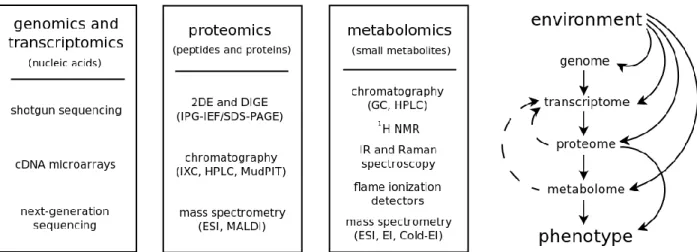
Looking at living organisms from a systems point of view, we can see that the information provided by these different ―omics‖ is complementary (Figure 1.6). Most (if not all) phenotypic traits can be modeled, in a first-order approximation, as an interaction between proteome and metabolome, as these contain the fractions of biomolecules with direct structural function (and therefore responsible for most macroscopic features). We know, from chemical kinetics, that (again, as first-order approximation) metabolic fluxes can be modeled as systems of differential equations, which depend on both the current metabolomic state and the current proteomic state. For larger time-scales it is important to take into account that the proteome is not exactly static, and higher-order terms, like the transcriptome and protein turnover processes, become important to accurately model metabolic fluxes and the emergence of macroscopic features. This is further complicated by the fact that both metabolome and proteome affect transcriptomic activity by feedback mechanisms (e.g. ligand-regulated transcriptional factors). Despite the complexity of the metabolome-proteome-transcriptome relations, a useful car analogy can be established: if the metabolome represents a car‘s position, the proteome would represent the car‘s instant velocity and the transcriptome would represent the car‘s acceleration. This simple analogy, of course, breaks down once we take into account other things like protein turnover regulation processes, alternative splicing, post-translational modifications, ligand-(in)dependent transcription factors, non-enzymatic reactions, protein signaling cascades and the influence of environmental factors on both genome, transcriptome, proteome and metabolome. These imply the acceleration (transcriptome) in the metabolic phase space of a cell also depends on both velocity (proteome) and position (metabolome). In a way, more like a self-driving car.
So, in order to truly understand ―how the car drives itself‖ (i.e. the underlying chemical dynamics of living systems), it is increasingly clear that a thorough and quantitative understanding of genome, transcriptome, proteome and metabolome (as well as how environmental factors affect these) is required. One of the challenges for ―omics‖ approaches in the near future will be precisely to improve instrumentation and methodologies in order to transition from current ―relative quantitation‖ methods (mostly of a comparative nature) to
31 ―absolute quantification‖ methods, enabling the development and validation of quantitative in
silico modeling approaches and high-confidence phenotype prediction methods187-188.
Figure 1.6 – Diagram showing the major technologies underlying the main ―omics‖ (on the left), along with a
scheme depicting the information flows from genotype to phenotype (on the right).
This dissertation focuses mostly on gel-based comparative proteomics and attempts to provide some examples demonstrating the usefulness of these technologies in aquaculture and fish science, particularly regarding fish nutrition, welfare and quality issues. The use of proteomics to study teleosts and invertebrates is a booming field which has already shown many results in several areas, as described by recent reviews96, 189-190. The importance of proteomics in this context is, as stated above, linked with the role of proteins as catalysts and direct effectors of most biological functions: knowing how a stimulus affects the proteome allows one to infer how and which cellular functions and metabolic processes are directly affected by that stimulus.
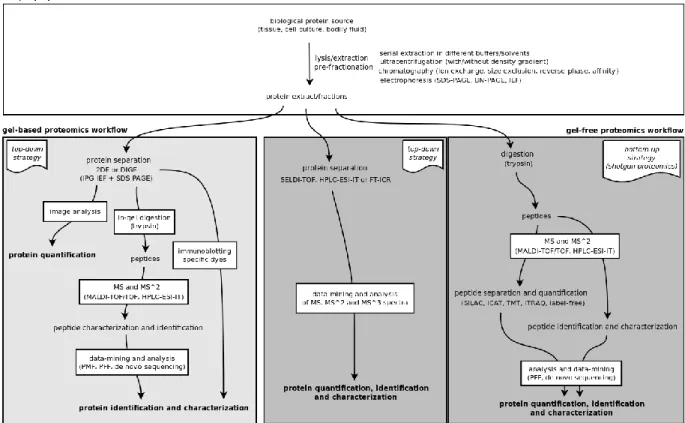
In technical terms, most proteomic workflows (both gel-based and gel-free) include a common set of steps: sample preparation; peptide/protein separation and quantification; peptide/protein identification and characterization. This is schematically depicted in Figure 1.7.
32
Figure 1.7 – Schematic depiction of the typical gel-based and gel-free proteomic workflows.
1.4.1. Gel-based proteomics
Sample preparation
The first step is usually protein extraction, since most analytical techniques used in proteomics require prior solubilization of proteins in an appropriate solvent (aqueous buffers, organic solvents). This makes sample preparation a critical step in the analytical workflow186, 191
. The purpose of this step is to attempt thorough solubilization of all (or a specific subset of) the proteins present in a given bodily fluid, organ, tissue or cell extract. Commonly used aqueous extraction buffers often contain (besides buffering agents) detergents, chaotropes, reducing agents and protease inhibitors, ensuring that enzymatic activity is halted during extraction and that intra and inter-molecular interactions between proteins are minimized, preventing aggregation. Although standard extraction buffer formulations work reasonably well for a broad range of samples (eukaryotic cell cultures, bodily fluids and soft tissues of animals), some types of organisms (algae, bacteria) or protein sub-populations (membrane proteins, proteins embedded in a calcified matrix) often require different types of extraction buffers for optimal results191.
33 To improve protein separation and identification, several procedures can be considered. Sample fractionation is often a choice for sample pre-processing prior to proteome analysis, simplifying protein extracts and/or improving the dynamic range of a protein mixture. Fractionation methods are usually based on chromatography, electrophoresis, differential solubility and/or (ultra) centrifugation and the most popular are usually aimed at isolation of organelles and sub-cellular compartments (nuclei, mitochondria), enrichment in particular sub-populations of proteins (phosphorylated, glycosylated, secreted, membranar) and depletion of highly abundant proteins (like albumin and immunoglobulins in blood plasma, or actin/myosin/tropomyosin in muscle).
Protein separation and quantification
The two most important analytical techniques in proteomics are two-dimensional gel electrophoresis (2-DE) and mass spectrometry (MS). Due to the central role that these two methods have in proteomic studies, most experiments are broadly classified as either ―gel-based proteomics‖ or ―gel-free proteomics‖, depending on whether 2-DE is used for protein separation and quantification or not.
Currently, 2-DE is still, by far, the most common strategy for protein separation and quantification, enabling the separation, detection and quantification of hundreds (and sometimes thousands) of different proteins from a single extract, taking advantage of the fact that the isoelectric point of a protein is mostly uncorrelated to its molecular weight. On the other hand, issues like gel-to-gel variation, limited linear dynamic range, limited throughput, and protein co-migration still pose challenges to gel-based proteomics186. Although most software geared toward the analysis of 2-DE gels, like Progenesis SameSpots (Nonlinear Dynamics), PDQuest (Bio-Rad Laboratories) and DeCyder (GE Healthcare), try to overcome some of these issues with a simplified, semi-automated analysis workflow, they still cannot achieve totally unambiguous results without significant human intervention and visual inspection.
Nevertheless, there are also some advantages of gel-based approaches: first of all, they are generally less expensive than purely MS-based approaches. Besides that, information on small post-translational modifications (PMTs) and highly-homologous isoforms can often be obtained directly, since these tend to shift the isoelectric point of a protein without extensively changing its molecular weight.
Classically, detection and quantification methods for 2-DE are usually based on Coomassie Brilliant Blue (CBB) or silver staining, which enable estimation of protein
34 quantity by scanning 2-DE gels in the visible range192. Recently, the development of multiplex 2-DE (dubbed ―difference gel electrophoresis‖ or DIGE), which instead involves tagging the protein samples with different fluorophores prior to 2-DE, not only allows several samples to be run on a single gel, but also significantly improves gel-to-gel variability, by providing a common reference channel across all gels of an experiment193. This recent improvement of the 2-DE method has been increasing in popularity in aquaculture-related proteome studies with successful results in several species194-198.
Protein identification and characterization
Although immunostaining methods are a valid choice for protein identification after 2-DE, the overwhelming majority of gel-based proteomic studies rely on digestion of detected proteins and analysis of the resulting peptides by MS for their identification and characterization, since it does not rely on having specific antibodies against every single protein to be identified. Given the accuracy of current MS instruments and the low number of proteins usually present on a single 2-DE spot, the results obtained can be quite reliable. Instruments currently employed for this purpose include ESI-Ion Trap, MALDI-TOF/TOF and ESI-QTOF mass spectrometers to a lesser extent. Identification of proteins can be assessed either directly through its peptide mass fingerprint (PMF), for the case of organisms with fully sequenced genome, or by analysis of the fragmentation spectra of such peptides (PFF, peptide fragment fingerprinting or even de novo sequencing) obtained through tandem MS.
1.4.2. Gel-free proteomics
Due to the above-mentioned issues associated with 2-DE and the continuous improvement and cost reduction of MS-based methods, gel-free strategies are becoming increasingly popular, since they generally allow higher analytical throughput and deeper proteome coverage than gel-based methods. In a way, 2-DE can be seen as an elaborate pre-fractionation step that precedes MS analysis in a typical proteomic workflow and, as such, some researchers prefer to omit this step and apply different strategies which scale much better.
In contrast to the usual ―top-down‖ approach of gel-based proteomic studies, where proteins are separated and quantified before being digested and identified, most gel-free studies employ a ―bottom-up‖ approach. Here, proteins are digested from the start and
35 analyses (separation, quantification, characterization) are done at the peptide level. Since digestion of a complex protein mixture dramatically increases its complexity, gel-free methods are usually combined with fractionation methods to reduce the number of different peptides entering the mass spectrometer at any given moment, maximizing the total number of distinct peptides detected over the course of a sample run. By far, the most common pre-fractionation methods used in gel-free proteomics are based on liquid-phase chromatography procedures, which can readily be coupled to ESI-based mass spectrometers. Even multidimensional chromatographic separations are commonly used, as in the case of MudPIT, where peptides are separated by charge (SCX-HPLC) and hydrophobicity (RP-HPLC) prior to MS analysis. Despite the fact that label-free methods exist, most gel-free workflows rely on stable isotope labeling for peptide quantification, either by metabolic incorporation of radioactive amino acids in proteins (SILAC) or by post-extraction chemical modification (ICAT, TMT, iTRAQ). With stable isotope labeling, several samples can be analyzed in parallel on the same MS run (with identical peptides from distinct samples separated by a small mass shift) and relative abundance can be estimated from the ratio of peak areas of identical peptides. At the end of a ―bottom-up‖ analysis, information on protein abundance/identity is inferred from the obtained information on peptide abundance/identit y, using computational tools. This is, in itself, a challenging part of ―bottom-up‖ approach and still a matter of research in the field of mass spectrometry.
Although a direct ―top-down‖ approach is intrinsically more challenging, due to the difficulty of ionizing whole proteins, the higher resolution of MS instruments using FT-ICR or Orbitrap technologies make ―top-down‖ approaches increasingly practical, beyond the more common ―bottom-up‖ approaches.
1.4.3. Identifying proteins from peptides
Most proteomic studies (both gel-based and gel-free) attempt to identify proteins by looking at peptides, as large proteins still constitute a challenge for MS-based methods. The classical method used (dubbed "peptide mass fingerprinting" or PMF) is based on in silico digestion of genomic/EST sequences following the pattern of a predictable endonuclease (usually trypsin) to obtain a list of peptide masses (or "mass fingerprint") for each database entry. Identification is performed by comparing experimentally-obtained MS mass lists with those generated in silico, and choosing significantly similar matches. Of course, this only works reliably when working with a model species (like zebrafish), for which there is full
36 genome data, and for simple digests (like 2DE spot digests). On the other hand, by using tandem MS instruments, one obtains not only a peptide mass list, but also information on the fragmentation mass spectra of those peptides, providing a fingerprint for each peptide that directly reflects its sequence. The most common strategy here ("peptide fragment fingerprinting" or PFF) also involves starting with a genomic/EST database and performing in
silico digestion with a standard endonuclease. Then, for each peptide, the masses of all likely
fragments are deduced from prior models. Identification of peptides is then performed by comparison of experimentally obtained MS/MS spectra against all possible fragmentation spectra in the database. Since a fragmentation spectrum (unlike mass) is usually very specific for a certain peptide sequence, identification of proteins can often be attained from a single high-quality peptide match. Nevertheless, unless one works with species for which there is a great wealth of genomic/EST data available, this strategy only works for highly-conserved peptides.
It is therefore important to underline that protein identifications depend not only on the quality of spectra, but also on the quality of the sequence database used. Generally, a good approach is to start by searching genomic databases (since they tend to be smaller and therefore fast to query) and then EST databases. The results obtained are often different, since genomic databases reflect genomic DNA sequences while EST databases reflect mRNA sequences (which are closer to the actually translated amino acid sequences). Observations on the frequency of alternative splicing events in teleosts suggests that this difference is particularly important for species with a compact genome (like Takifugu rubripes, for which ~43% of mapped genes seem to be affected by alternative splicing) and less so for species with a high level of gene duplication (like zebrafish, for which only ~17% of mapped genes seem to be affected by alternative splicing)199. Also, given current developments in DNA sequencing technology180, it is expected that the coverage of genome/EST information on commercially-relevant species will be greatly expanded, certainly improving the quality of MS-based peptide/protein identification methods.
1.4.4. Challenges and new technologies
Looking at the results of proteomic experiments, we observe that there are several issues that prevent perfect consistency of results across experiments on a single topic, despite the fact that there is usually significant overlap in terms of affected pathways. Some of these
37 differences can be attributed to technical limitations, like the influence of sample preparation methods, the ―user‖ factor, the difficulty of ionizing certain peptides, as well as other instrumental and analytical limitations. Most of these can hopefully be overcome by increased automation, improvements in instrument quality and a decrease in user intervention throughout the workflow. On the other hand, the dynamic and complex nature of the proteome provides several intrinsic challenges during interpretation of proteomic results. This can be seen, for example, in experiments coupling transcriptome and proteome observations, which often show a weak correlation between the two profiles (when sampled at the same time)200-201. This dynamism and the sensitivity of the proteome towards environmental signals and subtle changes in physiological state justifies the necessity of obtaining and using as much contextual information as possible (including both classical and/or –omics observations) to support proteomic observations and having into account the importance of time and locality on the proteome.
The fact that most proteins display post-translational modifications (PTMs) further adds to the proteomes‘ complexities and is increasingly seen as essential aspect of proteome research, given the biologically important roles some of these PTMs are known to have. Although gel-based approaches can use either specific dyes (like Pro-Q Diamond, for detection of phosphorylated proteins) or immunoblotting for detection of PTMs, the real workhorse of PTM analysis is mass spectrometry202-204. Specific detection methods are often combined with protein/peptide enrichment steps, to target for some specifically modified proteins (like affinity chromatography with lectins, to enrich for glycoproteins, or with TiO2, to enrich for phosphopeptides).
As technology continuously develops, the future of proteome research is still uncertain, but there are already novel approaches which have good potential to become invaluable tools in aquaculture research (and marine biology in general). One of them is MS imaging. This technology involves the direct digestion of histological samples fixed to a suitable support, followed by direct MS/MS analysis (for example, by applying a matrix solution on the sample and performing MALDI-MS all over the surface, point by point), which is the equivalent of using immunocytochemistry methods, but in a non-specific way, providing proteomic information on a key variable: location205-207. This is very important because, unless cell sorting or microdissection techniques are applied prior to proteomic analysis of a given tissue, the profiles obtained are very likely to represent an ―average profile‖ of a heterogeneous population of cells, since most organs and tissues are heterogeneous. Most importantly, this heterogeneity is often location-dependent, which
38 implies that MS imaging can provide a type of deep morpho-proteomic information that would not be accessible otherwise. It is interesting to note that MS imaging does not necessarily require protein identification: using computational methods (dimensionality reduction methods, tree classifiers, neural networks and similar machine learning tools) it is possible to map all the MS and MS/MS information obtained for each point in space as a pixel, where color information is defined so that it reflects the similarity relations between proteomes. This means that MS imaging can provide useful information on proteome distributions over any tissue (regardless of source), distinguish between sub-populations of cells with different proteome profiles and pinpoint exactly where proteome changes occur. The size of matrix crystals are a limiting factor preventing increased resolution in MALDI imaging, so there is still a lot of research on alternative matrices or ionization methods for MS imaging, like SIMS and DESI208-210. New breakthroughs in this field will certainly revolutionize proteomics and greatly increase our understanding of biological processes which are intrinsically morphological in nature and relevant for aquaculture research (like larval development or muscle growth).
Another interesting technology is the development of protein array/protein chip approaches211. These allow for very high throughput at the expense of high specificity, which currently makes the development of such tools relatively expensive and challenging, particularly for non-model or non sequenced organisms. Nevertheless, as these types of technologies develop, the potential for very large scale studies regarding major issues in aquaculture suddenly becomes feasible, opening the doors to new, more in-depth approaches for comparative proteome studies.
1.5. Analytical approaches for an integrative biology
While the technical aspects of proteomics, as seen in the previous section, are an active field of study of a great importance, the analytical treatment of proteomic data is also a big concern for many scientists, as classical statistical tools can be somewhat lacking in their ability to extract all potential information from high-dimensional datasets such as the ones produced through both gel-based and gel-free proteomic approaches212-278. Although this section is mostly centered on gel-based proteomic methodologies, many of these points also apply (mutatis mutandis) to other ―small n, high p‖ datasets279, such as the ones generated by other –omics, and even more classical situations involving co-measurement of several parameters.