A COTS Selection Approach with a Decision Support System
CAPSI’2011
Ricardo Lopes 1, Carlos J. Costa 2
1) ISCTE-IUL, Lisboa, Portugal [email protected]
2) ISCTE-IUL, Lisboa, Portugal [email protected]
Abstract
There is a growing interest in the notion of software development through the planned integration of Commercial Off-The-Shelf (COTS) products. In COTS-based development, selecting appropriate COTS is one of the most crucial phases. This paper explores a COTS selection approach combined with a decision support system called COTS-3S. In order to define the approach we explored the evolution of COTS selection practices and surveyed some of the most significant approaches. Finally we conclude with a discussion of possible future work related with the proposed approach and COTS-3S.
Key words: Software selection, COTS selection, Decision support system, software selection
support system.
1. Introduction
Software system procurement based on COTS is becoming a central task in software engineering. Performing a good COTS selection plays a critical role in the success of the final system [Maiden & Ncube 1998]. COTS selection is the process of determining the fitness-of-use of COTS products in a new context, and then selecting one or more products with the highest fitness [SEI].
The vast offer of COTS available in the market forces to choose the most suitable for each project. This selection has a high risk of failure owing to the lack of accurate and complete information and the existence of ill-defined user requirements. In order to minimize this risk, several software engineering practices can be applied. In the last years, some approaches have been proposed for dealing with COTS selection [Kontio 1996, Maiden & Ncube 1998, Maiden & Kim 2002, Burgués et al. 2002]. In all of them, a critical point is the comparison of the user requirements that drive the selection process with the features of the evaluated COTS.
In this paper we propose a COTS selection approach along with a decision support system called COTS-3S. The proposed approach was the base for COTS-3S development and the
system respects all the approach’s phases, rules and characteristics. The system has a very user friendly interface making the selection process quicker, intuitive, transparent and more understandable for the end user allowing him to select the best-fit COTS product only with the knowledge of some basic steps and rules.
The paper is organized as follows. Section 2 introduces COTS selection. It starts by giving a brief introduction about COTS selection. It also fits COTS selection into the Multi-Criteria Decision Making context. Further we discuss the most significant COTS selection approaches. Section 3 describes a COTS selection approach. Section 4 presents a system to support the approach, its most important characteristics and a comparison with other related COTS selection support systems. Finally, conclusions and future work are presented in section 5. This paper includes one appendix which describes the types of measurements used in proposed approach.
2. COTS Selection
Most of today’s software systems include one or more COTS products. COTS are pieces of software that can be reused by software projects to build new systems [Firesmith 2005, Vigder et al. 1996]. COTS include word processors, email packages, etc [Boehm et al. 2003].
COTS selection involves many challenges such as the high complexity of the process [Ruhe 2003]. In order to overcome these challenges several efforts were made to model the COTS selection process during the last two decades. However, none of these methods can be considered as the solution to solving the COTS selection problem. Different approaches have different levels of effectiveness and might be suitable for different contexts [Mohamed et al. 2007a].
2.1. COTS Selection in the Multi-Criteria Decision Making Context
Carney and Wallnau [1998] argue that the evaluation and selection of COTS products is a form of decision making. Ruhe [2003] agrees with them and praises the importance of COTS selection decisions, due to the tremendous impact such decisions have on the subsequent processes of system development and evolution.
Decision making in the COTS selection process is a multi-criteria decision making (MCDM) problem [Ncube & Dean 2002]. The basic activities of MCDM include [Triantaphyllou et al. 1998]:
Establishing a set of criteria that the selected product should meet;
Assigning a weight to each criterion that represents its importance to the success of the system under development;
Assessing the fitness of each product against criteria representing users’ requirements;
Ranking the products based on how well they fit the criteria.
Because the MCDM process uses evaluators’ judgment, it might be biased by their beliefs. Figure 1 depicts one method used for COTS selection, namely the Analytic Hierarchy Process (AHP) [Saaty 1990a]. The first level shows the goal of the decision making process, which is to select the most suitable COTS product. The second level includes the evaluation criteria, such as cost, functionality, performance and ease of use. The third level includes the actual product alternatives being evaluated against the above criteria.
Figure 1 - Overview of decision making process using AHP
The two most commonly used approaches are the Weighted Score Method (WSM) and the AHP [Saaty 1990a].
2.2. The General COTS Selection Method
Although there is no commonly accepted method for COTS selection [Ruhe 2003], all share some key steps that can be iterative and overlapping. These steps formulate what Mohamed et al. [2007a] refer to as the General COTS Selection (GCS) method, described as follows:
Step 1: Define evaluation criteria based on system requirements and constraints.
Step 2: Search COTS products.
Step 3: Filter search results based on a set of key requirements defining a short list of COTS
candidates to be evaluated in detail.
Step 4: Evaluate COTS candidates on the short list.
Step 5: Analyze the evaluation data (i.e. Step 4 output) and select the COTS product that best
fits the criteria. Usually, either AHP or WSM is used for making the selection decision. Select a suitable product
C1 Product 1 C2 C3 Cn Product 2 Product n Goal Criteria Alternatives . . . . . .
2.3. COTS Evaluation
COTS evaluation is the core of the COTS selection process. It determines the fitness of COTS products providing necessary information for decision makers to make an appropriate decision to select a COTS product from a group of alternatives [Carney 1998a, Carney 1998b].
COTS are evaluated against a set of criteria that represent the system requirements, goals and constraints. Kontio et al. [1996] suggest defining the evaluation criteria in a hierarchical manner, where a set of abstract goals are gradually refined, based on such factors as software application requirements, application architecture, and existing products capabilities. Maiden and Ncube [1998] agree with Kontio, and further suggest progressively defining more discriminating criteria while at the same time evaluating existing COTS products. Generally, three strategies can be followed to evaluate COTS products [Kunda & Brooks 2000, Oberndorf et al. 1997]:
Progressive filtering, which starts with a large group of COTS products, and then progressively defines discriminating criteria through successive iterations of products’ evaluation cycles, where less fit products are eliminated. This strategy requires running Steps 1 to 4 in the GCS process iteratively until a small number of the most promising COTS products is identified from which one or more can be selected;
Keystone identification, which starts by identifying a key requirement (e.g. type of technology), and then searches for products that satisfy it. This allows quick elimination of a large number of products that do not satisfy the key requirement;
Puzzle assembly, which assumes that a COTS-based system requires fitting various components together as pieces of puzzles. This implies that a product that fits in isolation might not be acceptable when combined with other products. This strategy suggests simultaneously considering the requirements of all products in the puzzle.
More than one of the above strategies may be used in the same project [Oberndorf et al. 1997].
2.4. Surveying COTS selection approaches
This section presents a survey and comparison of the current COTS selection approaches made by Mohamed et al. [2007a]. Table 1 compares these approaches in terms of the following criteria:
1. GCS: Conformance to the GCS method; 2. EVL: Evaluation strategy used;
3. SNG: Suitability for single COTS selection; 4. MLT: Suitability for multiple COTS selection;
5. TAIL: Tailorability of the process based on experts’ knowledge. Satisfying this criterion does not necessarily imply the existence of any systematic tailoring techniques;
6. TS: Availability of tool support.
Approach Comparison Factors
Name Year References GCS EVL SNG MLT TAIL TS
OTSO 1995/
1996
[Kontio 1995, Kontio & Tesoriero 1995,
Kontio 1996 and Kontio et al. 1996] PF
IusWare 1997 [Morisio & Tsoukis 1997] Any
PRISM 1997 [Lichota et al. 1997] PF
CISD 1997 [Tran & Liu 1997] PF/PZ ~
PORE 1998 [Maiden & Ncube 1998, Ncube & Maiden
1999a and Ncube & Maiden 1999b] PF
CEP 1999 [Phillips & Polen 2002] PF
STACE 1999 [Kunda & Brooks 1999, Kunda & Brooks
2000 and Kunda 2001] KZ/PF
CRE 1999 [Alves & Castro 2001] PF
CAP 2000 [Ochs et al. 2000] PF
CARE 2001
[Chung & Cooper 2001, Chung & Cooper 2002, Chung & Cooper 2004a and Chung & Cooper 2004b]
PF
PECA 2002 [Dorda et al. 2002 and
Comella-Dorda et al. 2004] Any
BAREMO 2002 [Lozano-Tello & Gomez-Pérez 2002] Step 5 -
Storyboard 2002 [Gregor et al. 2002] KZ/PF ~
CS 2002 [Burgués et al. 2002] * - ~
WinWin 2003 [Boehm et al. 2003 and Yang et al. 2003] PF ~
Erol’s 2003 [Erol & Ferrel-Jr. 2003] -
DesCOTS 2004 [Grau et al. 2004] PF
MiHOS 2005 [Mohamed et al. 2007b] KZ/PF
PF: Progressive filtering Fully satisfies the criterion
KZ: Keystone Does not satisfy the criterion
PZ: Puzzle assembly ~ Partially, informally, or implicitly satisfies the
criterion
*The Combined-Selection (CS) approach provides guidelines on selecting a set of collaborative COTS products. CS suggests using other approaches (e.g. OTSO) for selecting individual COTS products.
Table 1 – COTS selection approaches comparison [Mohamed et al. 2007a]
3. Conceptual Proposal
After studying the software selection approaches described in section 2.4, the one that will be used as a base for our conceptual proposal is MiHOS. The reason is that it relies on various ideas, concepts and techniques that were presented by other COTS selection approaches, such as adopting the concept of progressively defining the requirements while the COTS products are evaluated, using the same general GCS method, or using WSM and AHP in decision-making. Another reason is that it has a tool prototype called MiHOS-PT to support it which gives us a
solid example for COTS-3S construction. However, that prototype isn’t available for use and it’s missing some characteristics to make it more efficient, understandable and user friendly.
3.1. Background
MiHOS uses the concept of hierarchical criteria definition to represent the requirements. This concept was proposed by Kontio [1996] and used by several other COTS evaluation approaches. The main idea is the definition of a set of evaluation attributes based on the decomposition of high level goals. A goal is defined in [Lamsweerde 2001] as “An objective
that the system under consideration should achieve. Goals may be formulated at different levels of abstraction, ranging from high-level, strategic concerns to low-level, technical concerns”.
This said there are two types of goals:
Strategic goals are high-level requirements that cannot be directly measured in a COTS
product. Strategic goals are decomposed into less abstract ones until reaching a point at which goals are at the same level of granularity of COTS features and which satisfaction can be directly measured in a COTS product. Goals at this level are called technical goals.
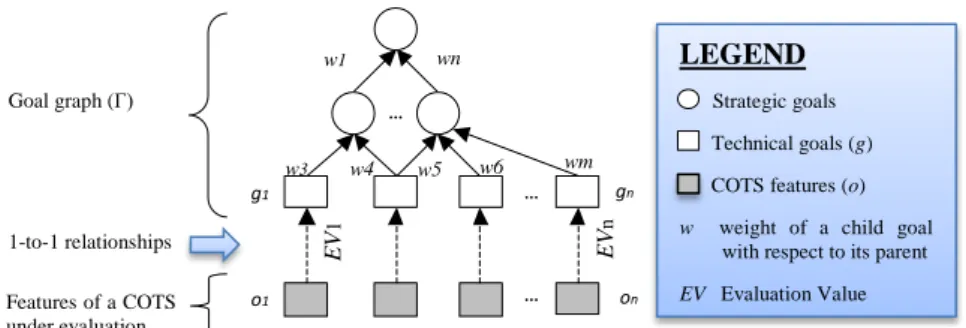
The result of this hierarchical criteria definition is a goal graph Γ that links strategic and technical goals (Figure 2 – upper part).
...
...
...
g1 gn
o1 on
Figure 2 - Hierarchical criteria definition
It is important to note that the definition of Γ should be performed in parallel with COTS exploration and evaluation [Maiden & Ncube 1998, Ncube & Maiden 1999a]. Anyone using this approach to select COTS should be aware of the COTS features and constraints in order to be able to define strategic goals in terms of stakeholders’ strategic needs and technical goals in terms of COTS features to satisfy these needs.
MiHOS assumes the definition of Γ results in technical goals that could be used to evaluate COTS based on one-to-one comparison between these technical goals and COTS features (Figure 2 – lower part).
Goal graph (Γ) Relationships (1-to-1) Features of a COTS being evaluated LEGEND Strategic goals Technical goals (g) COTS features (o)
Although technical goals are defined in terms of COTS features, they are not necessarily fully satisfied by all COTS candidate. For example, a technical goal: “ability to save documents in .pdf and .docx file formats” may be partially satisfied when a COTS supports only .docx format, or it may be not satisfied at all by other COTS.
3.2. The Proposed Approach
This COTS selection approach (Figure 3), like most others, starts by defining a set of evaluation criteria. It adopts the concept of hierarchical criteria definition described in Section 3.1. A goal graph Γ is progressively defined parallel to searching, filtering and evaluating COTS products as suggested in [Maiden & Ncube 1998, Ncube & Maiden 1999b, Boehm et al. 2003].
1. Identify Evaluation Criteria
1a. Define hierarchical evaluation criteria
1b. Define weights 1c. Define measures 1d. Define thresholds 2. Search COTS 3. Filter COTS 4. Evaluate COTS
5. Select the best-fit COTS product
Figure 3 – The proposed approach based on MiHOS [Mohamed 2007] represented by a UML activity diagram
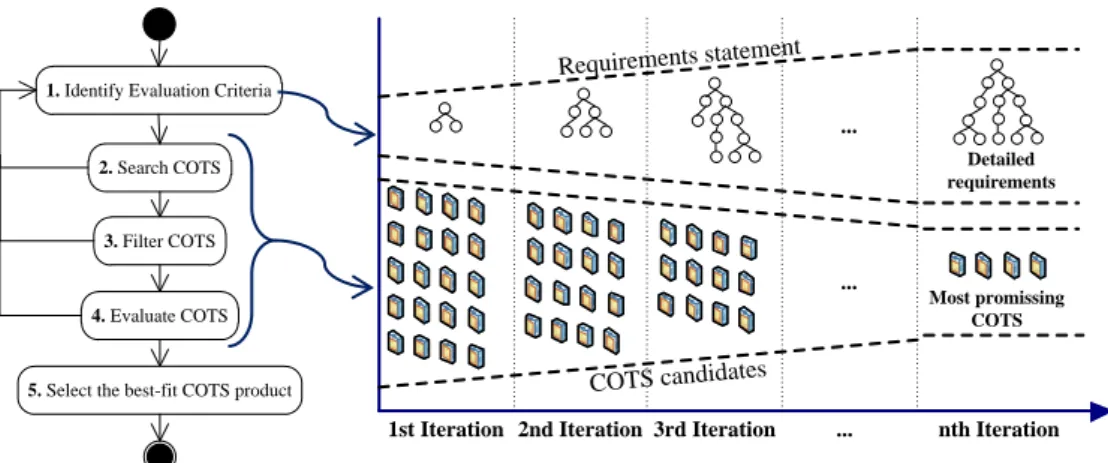
Figure 4 shows how the definition of Γ evolves during an iterative process of exploring existing COTS and refining our requirements. This approach starts by using keystone identification and then uses a progressive filtering technique [Kunda & Brooks 2000, Oberndorf et al. 1997].
1. Identify Evaluation Criteria
2. Search COTS
3. Filter COTS
4. Evaluate COTS
5. Select the best-fit COTS product
Requirements statement
COTS candidates
1st Iteration 2nd Iteration 3rd Iteration ... nth Iteration
Most promissing COTS ... ... Detailed requirements
Figure 4 - An illustration of the different iterations during COTS selection process
3.2.1. Step 1 - Define the Evaluation Criteria
This approach uses hierarchical evaluation criteria which are characterized by Γ, W, M and T:
Γ – Goal graph representing the structure of the hierarchical criteria definition;
W – Set of weights of the goals in Γ;
M – Set of measures used to evaluate COTS features against Γ;
T – Thresholds which represents the minimum acceptable satisfaction-levels of specific goals.
Step1 includes four tasks for the definition of these 4 characteristics (Figure 5). This section describes these tasks.
1. Identify Evaluation Criteria
2. Search COTS
3. Filter COTS
4. Evaluate COTS
5. Select the best-fit COTS product
Figure 5 - Four steps to define the evaluation criteria
Activity 1.a - Defining hierarchical criteria (Γ)
This approach uses a goal-driven approach to define hierarchical criteria. This results in a hierarchical goal graph Γ which has two types of nodes: strategic goals (G) and technical goals (g), and a set of arcs connecting these nodes (Figure 6). An arc connecting two goals indicates
Define thresholds Define measures Define weights
Define hierarchical evaluation criteria
1.d 1.c 1.b 1.a
that the child goal at the arc’s tail is contributing to achieving the parent goal at the arc’s head. The number of hierarchical levels depends on the type system being evaluated, but should be kept small to reduce complexity. The COTS features are evaluated against the technical goals in Γ (Figure 6). ... ... ... g1 gn o1 on
Figure 6 - Hierarchical definition for the evaluation criteria
Activity 1.b - Defining goals’ weights (W)
As you are defining the goal graph Γ, weights can be defined on each Γ’s arc to represent the importance of child-goals to achieving their parent-goals (Figure 6). These weights are used when evaluating the fitness of COTS candidates using WSM.
The AHP [Saaty 1990a] may be used to estimate these weights. This involves comparing all possible pairs of goals attached to the same parent goal. The advantage of using AHP is that it results in some redundancy which allows a consistency check so as to reduce judgmental errors [Berander & Andrews 2005].
Besides using AHP, MiHOS suggests identifying a subset of must-have technical goals (screening rules) that helps reducing the search scope to fewer products using the progressive filtering technique [Kunda & Brooks 2000, Oberndorf et al. 1997].
Activity 1.c - Definition of measures (M)
It is important to define the scales used to measure the satisfaction of technical goals in Γ by COTS features. Different scales should be used to measure different types of data. Based on this, the proposed approach uses several types of measures defined on different scales in order to evaluate different types of COTS functionalities.
On the other hand, Comella-Dorda et al. [2004] suggest that when selecting COTS products, a consistent scale must be eventually used to represent results in order to understand the big picture when comparing different COTS products. We use conversion rules to map the resulting evaluation values (EV) to a ratio scale from 0 to 1. We call equivalence levels (EL) to the resulting normalized values.
Goal graph (Γ) 1-to-1 relationships Features of a COTS under evaluation LEGEND Strategic goals Technical goals (g) COTS features (o) w weight of a child goal
with respect to its parent EV Evaluation Value EV 1 w1 EV n wn w3 w4 w5 w6 wm
It is relevant to mention that a similar measurement process has been previously introduced in [Carvallo 2005]. The full details about the types of measures the proposed approach uses based on MiHOS are described in Appendix A.
Activity 1.d - Defining threshold values (T)
In this activity, thresholds for acceptable values should be defined for selected technical goals, where a technical goal gis considered satisfied or partially satisfied by a COTS feature oif o satisfies at least the value of g’s threshold.
3.2.2. Steps 2 and 3 - Search and filter COTS products
The second and third step is to search for COTS and filter less fit ones. The main purpose is to identify a short list of the most promising COTS candidates. This short list is identified using two strategies: keystone identification and progressive filtering [Kunda & Brooks 2000, Oberndorf et al. 1997] which were described in section 2.3. Usually, the products in this short list are evaluated in more depth in Step 4.
3.2.3. Step 4 - Evaluate COTS Products
COTS evaluation is the most important activity of the COTS selection process. The evaluation is done by estimating ELs for the COTS features against technical goals, using the method described in Appendix A. The collected data (i.e. ELs) is then aggregated in Step 5 so as to allow the decision maker to select the best-fit COTS.
Comella-Dorda et al. [2004] and Ochs et al. [2001] suggest that different data collection techniques should be used to evaluate the fulfillment of different goals based on their criticality. The more critical a goal is, the more rigorous the technique should be because rigorous techniques usually yield more reliable and accurate data. Maiden & Ncube [1998] gives some examples of data collection techniques which include (from the most to least rigorous): prototyping, vendor-led demonstration and products’ documents examination.
3.2.4. The benefits of using goals, weights and
thresholds
during COTS evaluationMohamed et al. [2007a] describes some benefits of using goals, weights and thresholds:
Benefits of using goals:
Strategic goals are very stable as they represent stakeholders’ real needs [
Alves &
Finkelstein 2003
]. On the other hand, technical goals represent the means by which strategic goals are achieved in terms of COTS features. As strategic goals are decomposed, different refinements are possible to reflect alternative COTS features; Goals provide a better understanding of the evaluation criteria because they show the rationale behind each technical goal.
Benefit of using goal weights:
Weighing the goals allows the acceptance of COTS products that fail to satisfy less important goals.
Benefit of using thresholds:
Defining thresholds allows the acceptance of COTS features o that do not fully satisfy technical goals g.
4. COTS-3S
In order to validate our conceptual proposal, we developed a COTS selection support system called COTS-3S. In this section, we describe its architecture and main features.
4.1. COTS-3S architecture
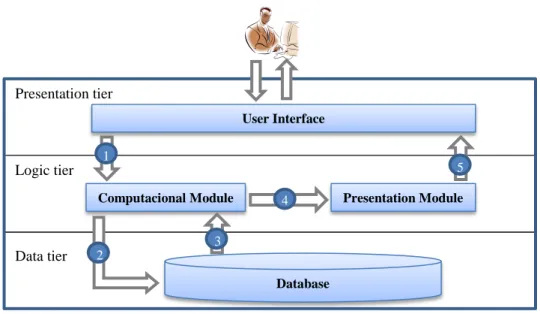
COTS-3S was built with Microsoft Excel and Visual Basic for Applications 7.0 (VBA 7.0) under Windows 7. Its architecture is based on a client-only 3-layer model [Ramirez 2000]. The system’s components and data-flow are shown in Figure 7:
User interface through which users interact with the system’s components;
A presentation module that presents generated solutions in a way that increases transparency for the end user;
A computational module that performs the necessary calculations;
A database that stores:
o Data about all system goals, i.e. goals hierarchy and goal’s type (technical or strategic), textual description and weight;
o Data about the measures associated with technical goals, i.e. ID, type and textual description;
o Data about COTS candidates, i.e. ID, name, version and manufacturer; o Evaluation data of COTS candidates, i.e. fitness against technical goals.
Figure 7 – COTS-3S architecture
1. User’s input data which includes goals, importance levels, measures data, products data and evaluation data;
2. Input data after being computed to suit the database data format and organization; 3. Database data retrieved as it is originally stored;
4. Data after being computed to a format that the Presentation Module can read; 5. Data in a suitable format for user consumption.
4.2. Goals definition
When COTS-3S is initialized 3 options are given to the user. The first is to create a new COTS selection project from the scratch. The second is to select a pre-built project and the last one is to choose a previously saved project.
After the project selection, the “Goals definition” screen is loaded (Figure 8). In this screen it is possible to define most of the evaluation criteria, starting with the construction of the hierarchical structure of criteria with strategic and technical goals. It’s important to note that the approaches’ Step 1.a and Step 1.b are performed in this screen.
Through this screen the user can also assign the importance level that each goal has over another with respect to his parent-goal. This effort involves comparing all possible pairs of goals attached to the same parent goal. The proposed approach refers to AHP [Saaty 1990a] in Activity 1.b (Section 3.2.1.) as one method to estimate weights based on the importance given by the user and it is the method implemented in COTS-3S. This eliminates the need to manually calculate the weights or even to use an external tool for this purpose. This also reduces the need to define the goal graph Γ twice (one in our system and another in the AHP external tool). The weights are represented in percentage through a pie chart.
Presentation tier Logic tier Data tier User Interface Computacional Module Database Presentation Module 3 5 4 1 2
For Saaty [1990b] when the user is assigning the importance levels he must answer two questions: which of the two elements is more important with respect to a higher level criterion, and how strongly, using the 1-9 scale shown in Table 2 for the element on the left over the element on the right. To make things simpler and reduce the effort needed to compare all possible pairs of goals we use a scale from [-9 to 0[ and ]0 to 9]. This scale was built to avoid comparing A with B and B with A because it’s enough to compare A with B being B with A reciprocal. In this example a value greater than 1 is used to say that A is more important than B and a value lesser then -1 is used to say that B is more important than A. The reciprocal value is automatically calculated by COTS-3S.
However, this kind of judgments may not be consistent. For example, the users’ evaluation isn’t consistent if he says that A > B, B > C and A < C, because in this case A should be more important than C. Redundancy gives rise to multiple comparisons of an element with other elements and hence to numerical inconsistencies. When the judgments are inconsistent, the decision maker may not know where the greatest inconsistency is.
COTS-3S can show one by one which judgments are the most inconsistent, and that suggests the value that best improves consistency. For Saaty [1990b] inconsistency may be considered a tolerable error in measurement only when it is of a lower order of magnitude (10%) than the actual measurement itself. Therefore, a consistency ratio (CR) of 10% or less is a positive evidence for informed judgment. The CR calculation is explained in detail by Saaty [1990b]. Last but not least the user can also access Measures Manager, Evaluation Manager and help menu through this screen. The help menu was built to clarify any doubts the user might have about COTS-3S functionalities or even concepts about the whole selection process.
Importance level
Definition Explanation
1 Equal Importance Two activities contribute equally to the objective
3 Moderate importance Experience and judgment slightly favor one activity over another
5 Strong importance Experience and judgment strongly favor one activity over another
7 Very strong importance An activity is favored very strongly over another; its dominance demonstrated in practice
9 Extreme importance The evidence favoring one activity over another is of the highest possible order of affirmation
2, 4, 6, 8 For compromise between the above values
Sometimes one needs to interpolate a compromise judgment numerically because there is no good word to describe it
Reciprocals If activity i has one of the above nonzero numbers assigned to it when compared with activity j, then j has the reciprocal value when compared with i
A comparison mandated by choosing the smaller element as the unit to estimate the larger one as a multiple of that unit
Figure 8 – “Goals definition” snapshot
4.3. Measures Manager
COTS-3S allows assigning the measures for every technical goal. This is accomplished in the Measures Manager (Figure 9). After completing this task, the first Step 1 iteration cycle is completed. Note that the full details about the types of measures defined by the approach and implemented in this system as well as normalization rules are described in Appendix A.
Figure 9 – Measures Manager snapshot
Graphic that shows the weight percentage of each goal child of the selected goal parent in the hierarchical tree. This percentage is calculated through AHP [Saaty 1990b] based on the importance levels Consistency Ratio of user’s
judgment Importance level assignation Strategic and technical
goals defined and organized in a hierarchical tree
Buttons to access the Measures Manager, Evaluation Manager
The technical goals are listed here. By right- -clicking on them it’s possible to assign, edit or remove a measure
This hierarchical tree only shows the superior nodes of the selected technical goal
This area shows all data related with the measure assigned to the selected technical goal
4.4. Evaluation Manager
The Evaluation Manager supports the approach’s Step 2 and 3 by allowing the user to add, remove and edit COTS products (Figure 10). In this screen the user can see the most important information about the products: name, version and manufacturer.
Figure 10 – Evaluation Manager snapshot
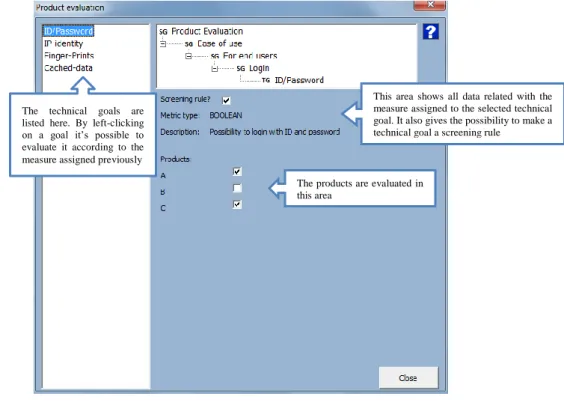
After all measures are assigned it is possible to evaluate the products. In the product evaluation screen (Figure 11) the user evaluates the products’ COTS features as they satisfy (fully or partially) or not the associated technical goal. The user can also define which technical goals will act as screening rules (explained at section 3.2.1) eliminating the products from evaluation that do not fulfill them. This evaluation functionality speeds up the approach’s Step 4.
Figure 11 – Product evaluation snapshot
Finally, by navigating through the goals hierarchical tree the user can see the products overall score (Figure 12) and the score that each product has in a specific goal. The products scores are represented through a clustered bar chart.
This area contains the product identification, name, version and manufacturer. It also indicates if the product is fully evaluated or not
It’s possible to add, remove or edit a product. “Evaluate” button is used to open the products evaluation screen and the “Product scores” is used to see the final product scores and is only enabled when all products are fully evaluated
The technical goals are listed here. By left-clicking on a goal it’s possible to evaluate it according to the measure assigned previously
The products are evaluated in this area
This area shows all data related with the measure assigned to the selected technical goal. It also gives the possibility to make a technical goal a screening rule
If any product is excluded by a screening rule a button will appear allowing the user to check which products have been excluded and why.
Figure 12 – “Final scores” snapshot
Note that many of the above activities are done iteratively. The user provides information and the computer illustrates the results allowing him to adjust the problem settings as needed.
4.5. Export to word processor
At the “Final Scores” screen it is possible to export the most important information to a word processor. We considered that this functionality was a key-requirement for our system because it allows the user to create a report very easily. The data available to export is: goals weight graphs, goals weight tables, final score graphs, final score tables, AHP weights matrix, excluded product log and product data. With all this information the user can build a complete report with the most important information in order to justify the whole selection process. That said this functionality automates the after-COTS-3S usage and saves a lot of work if the user needs to build a document.
4.6. Related systems
In addition to COTS-3S there are some other systems that can be used to support COTS selection: OPAL [Krystkowiak et al. 2003], DesCOTS [Grau et al. 2004] and MiHOS-PT [Mohamed 2007].
The first analyzed system is OPAL, which offers and supports the construction of a hierarchical structure to organize user requirements. This structure can be used as a requirements model and its items are customizable, so it is possible to include the information needed. This
By clicking on this button a detailed list will appear with all the excluded products and the screening rules that lead to their exclusion
It’s possible to export data to a word processor Goals hierarchical tree. By
left-clicking on a goal the user can see the products score for that specific goal
customization allows defining the elements in the hierarchy as goals, metrics, requirements or all of them.
Next we analyzed DesCOTS, which is a software system for supporting COTS selection processes based on the use of software quality models. It embraces several tools that interact to support the different activities of its process.
Finally the last system we surveyed was MiHOS-PT. It is a prototype tool that demonstrates the feasibility of tool support for the MiHOS approach in order to help the selection of COTS products according to it.
Table 3 presents the comparison of COTS-3S and these systems with respect to seven relevant criteria. With this analysis we observe that COTS-3S is a more comprehensive system than the others, embracing the activities defined in the proposed approach as crucial in COTS selection. The most salient features of COTS-3S with respect the others are:
Organizes the COTS domains into a list of projects;
Metrics are bound to particular technical goal but stored in a repository making them possible to be reused in any other evaluation project;
Requirements are transposed to strategic and technical goals which are arranged into a hierarchy;
There is selection system support for assisting the selection process which represents data in a very user friendly way through graphics and textual descriptions;
Exports data to a word processor;
Has a help menu.
Comparison
criteria COTS-3S OPAL DesCOTS MiHOS-PT
Domain organization
List of projects List of projects Taxonomy of COTS domains
None
Metrics definition
Choose from the provided types which
some are customizable Customizable templates, units in terms of intervals User-definable catalogue usable in various quality models
Choose from the provided types
Evaluation support
Assignment of evaluation values to COTS features which are linked to technical goals
Supported Assignment of values to quality factors
Assignment of matching level values
between COTS
features and technical goals Requirements integration Requirements represented through goals by hierarchical criteria definition Supported Requirements management and requirements bound to quality factors Requirements represented through goals by hierarchical criteria definition Selection support Matching technical goals with COTS components and graphical Matrix with evaluations of the products Matching requirements-COTS components Matching technical goals with COTS components and graphical
Comparison
criteria COTS-3S OPAL DesCOTS MiHOS-PT
representation of products evaluation representation of products evaluation External interface
Yes, to export data to a word processor
None None None
Help menu Yes Yes, through a
glossary
Yes No
Table 3 – Comparision between COTS3-S and other COTS selection systems
5. Conclusions and future work
In this paper, we presented a software selection approach and a selection support system. In order to define this proposal we explored the evolution of COTS selection practices and studied 18 COTS selection approaches. This research was done with the objective of selecting one of those approaches as a base for our conceptual proposal and consequently for our system. MiHOS was the chosen approach, because it is the most flexible and general approach and it already has a tool prototype (MiHOS-PT) giving us some very good groundwork to start with. The limitation of this paper had to do with the impossibility of applying the proposed approach along with COTS-3S to a real case in order to validate its results. Therefore we suggest applying it to a real case. COTS-3S was developed aiming the comparison of COTS products. However, we also tried to do it in a way that it could be used in other kind of matters and we believe that it can be used in several different contexts, even with non-software products.
6. References
Alves, C. and Castro, J., "CRE: A Systematic Method for COTS Components Selection", In
SBES'01, Rio de Janeiro, Brazil, 2001.
Alves, C. and Finkelstein, A., "Investigating Conflicts in COTS Decision-Making",
International Journal of Software Engineering and Knowledge Engineering (IJSEKE),
vol. 13, no. 5, 2003, pp. 473-493.
Berander, P. and Andrews, A., Requirements Prioritization, In Aurum, A. and Wohlin, C. (eds.), Engineering and managing software requirements, Heidelberg, Berlin, New York: Springer-Verlag, 2005, pp. 69-94.
Boehm, B., Port, D. and Yang, Y., “WinWin Spiral Approach to Developing COTS-Based Applications”, In EDSER-5, Oregon, 2003.
Burgués, X., Estay, C., Franch, X., Pastor, J. and Quer, C., “Combined Selection of COTS Components”, In ICCBSS’02, LNCS 2255, February 2002, pp. 54-64.
Carney, D. and Wallnau, K., “A basis for Evaluation of Commercial Software”, Information
and Software Technology, vol. 40, 1998, pp. 851-860.
Carney, D., “COTS Evaluation in the Real World”, SEI Interactive, Carnegie Mellon University, December 1998a.
Carney, D., “Evaluation of COTS Products: Some Thoughts on the Process”, SEI Interactive, Carnegie Mellon University, September 1998b.
Carvallo, J. P., Systematic Construction Of Quality Models for COTS-Based Systems, PhD Thesis, Universitat Politècnica de Catalunya, June 2005
Chung, L. and Cooper, K., "A COTS-Aware Requirements Engineering (CARE) Process: Defining System Level Agents, Goals, and Requirements", Department of Computer Science, The University of Texas, Dallas, TR UTDCS-23-01, December 2001.
Chung, L. and Cooper, K., "Knowledge-based COTS-aware requirements engineering approach", In SEKE'02, Ischia, Italy, 2002, pp. 175-182.
Chung, L. and Cooper, K., "Defining Goals in a COTS-Aware Requirements Engineering Approach", Systems Engineering journal, vol. 7, no. 1, 2004a, pp. 61-83.
Chung, L. and Cooper, K., "Matching, Ranking, and Selecting COTS Components: A COTS-Aware Requirements Engineering Approach", In MPEC'04, Scotland, UK, 2004b.
Comella-Dorda, S., Dean, J. C., Morris, E. and Oberndorf, P., "A Process for COTS Software Product Evaluation", In ICCBSS'02, Orlando, Florida, 2002, pp. 86–96.
Comella-Dorda, S., Dean, J. C., Lewis, G., Morris, E., Oberndorf, P. and Harper, E., A Process
for COTS Software Product Evaluation, Carnegie Mellon University, Software
Engineering Institute, CMU/SEI-2003-TR-017, July 2004.
Erol, I. and Ferrell-Jr, W. G., "A methodology for selection problems with multiple, conflicting objectives and both qualitative and quantitative criteria", International Journal of
Production Economics, vol. 86, no. 3, Dec 2003, pp. 187-199.
Fenton, N. and Pfleeger, S. L., Software Metrics: A Rigorous and Practical Approach, 2nd ed. London, UK: International Thomson Computer Press, 1997.
Firesmith, D. G., "Achieving Quality Requirements with Reused Software Components: Challenges to Successful Reuse", In MPEC'05, St. Louis, Missouri, 2005.
Grau, G., Carvallo, J. P., Franch, X. and Quer, C., "DesCOTS: A Software System for Selecting COTS Components", In EUROMICRO'04, Rennes, France, 2004, pp. 118-126.
Gregor, S., Hutson, J. and Oresky, C., "Storyboard Process to Assist in Requirements Verification and Adaptation to Capabilities Inherent in COTS", In ICCBSS'02, Florida, 2002, pp. 132-141.
Krystkowiak, M., Bucciarelli, B., Dubois E., “COTS Selection for SMEs: a report on a case study and on a supporting tool”, In Proceedings of the 1st International Workshop on COTS and Product Software: Why Requirements are so Important (RECOTS), September 2003. Available from: http://www.lsi.upc.es/events/recots/papers/Krystkowiak.pdf. Kontio, J. and Tesoriero, R., "A COTS selection method and experiences of its use", In The
Twentieth Annual Software Engineering Workshop, Greenbelt, Maryland, 1995.
Kontio, J., "OTSO: A Systematic Process for Reusable Software Component Selection", University of Maryland, Maryland, CSTR-3478, December 1995.
Kontio, J., "A Case Study in Applying a Systematic Method for COTS Selection", In ICSE'96, Berlin, Germany, 1996, pp. 201-209.
Kontio, J., Caldiera, G., and Basili, V. R., "Defining factors, goals and criteria for reusable component evaluation", In CASCON'96, Toronto, Ontario, Canada: IBM Press, 1996. Kunda, D. and Brooks, L., "Applying social technical approach for COTS selection", In
UKAIS'99, University of York, McGraw Hill, 1999.
Kunda, D. and Brooks, L., "Identifying and Classifying Processes (traditional and soft factors) that Support COTS Component Selection: A Case Study", In European Journal of
Information Systems, vol. 9, no. 4, December 2000, pp. 226-234.
Kunda, D., A social-technical approach to selecting software supporting COTS-Based Systems, PhD Thesis, Department of Computer Science, University of York, October 2001.
Lamsweerde, A. V., "Goal-Oriented Requirements Engineering: A Guided Tour", In 5th IEEE
International Symposium on Requirements Engineering, 2001, pp. 249-263.
Lichota, R. W., Vesprini, R. L. and Swanson, B., "PRISM: Product Examination Process for Component Based Development", In SAST '97, USA, 1997, pp. 61-69.
Lozano-Tello, A. and Gomez-Pérez, A., "BAREMO: how to choose the appropriate software component using the analytic hierarchy process", In SEKE'02, Italy, 2002, pp. 781-788. Maiden, N. A. and Ncube, C., "Acquiring COTS Software Selection Requirements", IEEE
Maiden, N. A. and Kim, H., “SCARLET: Light-Weight Component Selection in BANKSEC”, In Barbie, F. (ed.), Business Computerbased Software Engineering, Boston, USA: Kluwer Academic Publishers, vol. 705, 2002.
Mohamed, A., Ruhe, G. and Eberlein, A., “COTS Selection: Past, Present, and Future”, In
ECBS’07, Arizona, USA, 2007a, pp. 103-114.
Mohamed, A., Ruhe, G. and Eberlein, A., "Decision Support for Handling Mismatches between COTS Products and System Requirements", In ICCBSS'07, Banff, Canada, 2007b.
Mohamed, A., Decision Support for Selecting COTS Software Products Based on
Comprehensive Mismatch Handling, PhD Thesis, Department of Electrical and Computer
Engineering, Calgary, April 2007.
Morisio, M. and Tsoukis, A., "IusWare: a methodology for the evaluation and selection of software products", IEE Software Engineering, vol. 144, no. 3, June 1997, pp. 162 - 174. Ncube, C. and Maiden, N. A., "PORE: Procurement-Oriented Requirements Engineering
Method for the Component Based Systems Engineering Development Paradigm", In
International Workshop on Component Based Software Engineering (in conjunction with ICSE’99), Los Angeles, California, USA, 1999a. pp. 1-12.
Ncube, C. and Maiden, N., "Guiding parallel requirements acquisition and COTS software selection", In IEEE International Symposium on Requirements Engineering (RE'99), University of Limerick, Ireland, 1999b, pp. 133-140.
Ncube, C. and Dean, J. C., "The Limitations of Current Decision-Making Techniques in the Procurement of COTS Software Components", In ICCBSS’02, Florida, USA, 2002, pp. 176-187.
Ochs, M., Pfahl, D., Chrobok-Diening, G. and Nothhelfer-Kolb, B., "A COTS Acquisition Process: Definition and Application Experience", In ESCOM'00, Munich, Germany, 2000, pp. 335-343.
Ochs, M., Pfahl, D., Chrobok-Diening, G. and Nothhelfer-Kolb, B., "A Method for Efficient Measurement-based COTS Assessment ad Selection – Method Description and Evaluation Results", In IEEE 7th International Software Metrics Symposium, London, UK, 2001, pp. 285-296.
Oberndorf, P. A., Brownsword, L., Morris, E. and Sledge, C., "Workshop on COTS-Based Systems", SEI Institute, CMU, Special Report CMU/SEI-97-SR-019, November 1997.
Phillips B. C. and Polen S. M., "Add Decision Analysis to Your COTS Selection Process", The
Journal of Defense Software Engineering, April 2002, pp. 21-25.
Ramirez A., “Three-tier architecture”, Linux Journal, vol. 2000, no. 75, July 2000. Available from: http://www.linuxjournal.com/article/3508
Ruhe, G., "Intelligent Support for Selection of COTS Products", LNCS, Springer, vol. 2593, 2003, pp. 34-45.
Ruhe, G. and Saliu, M. O., "The Art and Science of Software Release Planning", IEEE
Software, vol. 22, no. 6, November/December 2005, pp. 47-53.
Saaty, T. L., The analytic hierarchy process, New York: McGraw-Hill, 1990a.
Saaty, T. L., “How to make a decision: the analytic hierarchy process”, European journal of
operational research, vol. 48, no. 1, 1990b, pp. 9-26.
SEI: Software Engineering Institute in Carnegie Mellon University, at http://www.sei.cmu.edu. Tran, V. and Liu, D., "A Procurement-centric Model for Engineering Component-based
Software Systems", In SAST '97, 1997, pp.70-80.
Triantaphyllou, E., Shu, B., Sanchez, S. N. and Ray, T., "Multi-Criteria Decision Making: An Operations Research Approach", In J.G. Webster (ed.), Encyclopedia of Electrical and Electronics Engineering, vol. 15, New York, NY: John Wiley & Sons, 1998, pp. 175-186. Vigder, M. R., Gentleman, W. M. and Dean, J., "COTS Software Integration: State of the art",
NRC, no. 39198, January 1996.
Yang, Y., Bhuta, J., Boehm, B., Port, D. and Abts, C., "Composable Process Elements for Developing COTS-Based Applications", In EDSER-5, Portland, Oregon, 2003.
APPENDIX A: TYPES OF MEASUREMENT
This appendix describes the types of measures the proposed approach and COTS-3S uses and their normalization rules.
A.1. Measurement Scales
Fenton and Pfleeger [1997] define five scales to be used in any measurement process:
Nominal, in which categories are defined and attributes are characterized by these categories. The values of a nominal scale have no numeric meaning. For example, “color” might be measured on a nominal scale {“red”, “blue”, “green”};
Ordinal, in which a set of ordered values is used to measure an entity. Usually, the intervals between adjacent values are undetermined. For example, “ease of use” might be
measured on an ordinal scale {“excellent”, “fair”, “horrible”}, where we know that “excellent” is better than “fair”, but the distance between them is unknown;
Interval, which preserves the order (just like an ordinal scale) as well as the differences meaning that the intervals between adjacent values are meaningful. However, the zero point on the scale is arbitrary, which means ratios are meaningless. For example, year 2010 is not as twice as much as year 1005, but the difference between year 2010 and 2000 is the same as the difference between year 1010 and 1000;
Ratio, which is similar to interval scales except they have true zero point. It preserves the ratios between scale values. For example, a 20 year-old tree is twice as old as a 10-year old one;
Absolute, which simply counts the number of occurrences of an element in an entity.
A.2. Measures Used
As the proposed approach and COTS-3S is based in MiHOS it uses some of its measures. MiHOS defines several types of measures that should be assigned to technical goals, and used when evaluating COTS products. For each type, MiHOS defines a rule for mapping the resulting evaluation values (EV) to the equivalence value (EL) range from 0 to 1. COTS-3S was built with the same logic.
A.2.1. Basic Measures
A basic measure is used when the satisfaction of a technical-goal can be estimated by evaluating only one attribute of a COTS product. The simple measures include:
1. Boolean-based measures (BOOLEAN) are the simplest, but the most common type of measures used in COTS evaluation. BOOLEAN measures are used to indicate the presence or absence of a COTS attribute. A measure x that is BOOLEAN-based is estimated on a nominal scale, so x ∈ {True, False}. The rule used to map x to the EL’s range is easy and predictable:
1 if x = “True” 0 if x = “False”
2. Soft-based measures (SOFT) are used for qualitative measurement. A measure x that is SOFT-based is estimated based on a set of discrete ordinal values, so x ∈{v1,...,vn}. For example, the “user friendliness” can be measured using SOFT measures {Horrible, Bad, Fair, Good, Excellent}. Like other approaches (e.g. [
Ruhe & Saliu 2005]
), MiHOS assumes equal distances between different values v1,…,vn and so does COTS-3S. Based onthis assumption, these values are mapped to real numbers ∈ [0,1] that are separated by equal intervals. For example:
0.00 if x = "Horrible" 0.25 if x = "Bad" 0.50 if x = "Fair" 0.75 if x = "Good" 1.00 if x = "Excellent"
3. Number-based measures (NUMBER) are positive real numbers that can be of any type,
e.g. “seconds”, “lines-of-code”, etc. A measure x that is NUMBER-based is estimated on a ratio scale, x ∈R+. Comella-Dorda et al. [2004] define two types of mapping for NUMBER-based measurements: discrete and continuous. COTS-3S only uses continuous and we will explain why further in this appendix.
a. Discrete interval mapping: A straightforward way to map a measure x by defining a mapping rule to each interval. For example, the “response time” can be mapped to the range [0,1] as (see Figure A.1)
1.0 if Response time (seconds) < 1 sec
0.5 if Response time (seconds) ≥1 and Response time (seconds) ≤ 3 sec
0.0 if Response time (seconds) > 3 sec
Figure A.1 – Example of a discrete interval mapping
However, this means that products that perform at 2 sec and 2.5 sec have identical EL and for this reason COTS-3S doesn’t use this type of mapping.
b. Continuous value mapping: this approach maps each value in the acceptable range to a single value ∈ [0,1]. Figure A.2(a) for example shows a continuous relationship between the measured value in “seconds” and the EL ∈ [0,1]. Therefore, a product that has a response time equal to 2 sec is better one with a response time 2.5 second. All values above 3 sec have the same EL=0, and all values below 1 sec map to EL=1.
0 1
0 1 2 3
EV
(a) (b)
(c) (d)
Figure A.2 – Examples of a continuous interval mapping
There are four possibilities for mapping NUMBER-based measures:
Figure A.2 (a): the threshold value (T) (i.e. the value beyond which EL = 0) is higher than the optimum value (Optimum) (i.e. the value at which EL = 1). For example, the higher the “response time”, the worse the product is performing, and hence the less EL it gets;
Figure A.2 (b): similar to (a) except that T < Optimum. For example, the less the “transfer rate”, the worse the product is performing, and hence the less EL it gets;
Figure A.2 (c) and (d): similar to (a) and (b), except that the EL at T equals to a value ε ≥ 0. For example, an analyst might want to assign EL = 0.25 when the “response time” is just below 3 sec, and once it exceeds the 3 sec threshold, then EL should be equal to zero.
A general mapping rule that is used with all the above cases can be derived by assuming a linear mapping function EL = a * x + b and finding the constants a and b by substituting with the conditions: at x = T then EL = ε, and at x = T then EL = 1:
(
) (
)
Where: x is the measure value, Optimum is the optimum value at which EL = 1,
T is a threshold beyond which EL = 0, ε is the EL at T. 0
1
0 1 2 3
EV
Response time (seconds)
0 1
0 1 2 3 4 5
EV
Transfer rate (Megabyte/sec)
0 1
0 1 2 3
EV
Response time (seconds)
0 1
0 1 2 3 4 5
EV
Transfer rate (Megabyte/sec)
![Figure 1 depicts one method used for COTS selection, namely the Analytic Hierarchy Process (AHP) [Saaty 1990a]](https://thumb-eu.123doks.com/thumbv2/123dok_br/17031430.766752/3.892.143.724.386.550/figure-depicts-method-selection-analytic-hierarchy-process-saaty.webp)
![Table 1 – COTS selection approaches comparison [Mohamed et al. 2007a]](https://thumb-eu.123doks.com/thumbv2/123dok_br/17031430.766752/5.892.115.795.240.830/table-cots-selection-approaches-comparison-mohamed-et-al.webp)

![Figure 3 – The proposed approach based on MiHOS [Mohamed 2007] represented by a UML activity diagram](https://thumb-eu.123doks.com/thumbv2/123dok_br/17031430.766752/7.892.291.578.419.841/figure-proposed-approach-mihos-mohamed-represented-activity-diagram.webp)
![Table 2 - The fundamental scale by Saaty [1990b]](https://thumb-eu.123doks.com/thumbv2/123dok_br/17031430.766752/13.892.120.766.777.1113/table-fundamental-scale-saaty-b.webp)