the 31st International Business Information Management Association Conference
(IBIMA)
25-26April2018
Milan, Italy
ISBN: 978-0-9998551-0-2
Innovation Management and Education Excellence through Vision 2020
Editor
Khalid S. Soliman
International Business Information Management Association (IBIMA)
Conference Chair
Khalid S. Soliman
International Business Information Management Association, USA
Special Track Chair
Beata Slusarczyk
Czestochowa University of Technology, Faculty of Management, Poland
North-West University, Faculty of Economic Sciences and IT, South África
Conference Advisory Committee
John F. Affisco, Hofstra University, USA
Abdul Rahman Ahmad, Universiti Tun Hussein Onn Malaysia, Malaysia Ornar AI-Azzam, University of Minnesota Crookston, USA
Hesham H. Ali, University ofNebraska at Omaha, USA AhmedAzam. DeVry University, USA
Najiba Benabess, Millikin University, USA
Az-Eddine Bennani, Reims Management School, France Em// Boasson, Central Michigan University, USA Regina Connolly, Dublin City University, Ireland
fíene Leveaux, University of Technology, Sydney, Austrália Susana de Juana Espinosa, Universidad de Alicante, Spain Xiuzhen Feng, Beijing University of Technology, China MohammadAyub Khan, Technologico de Monterrey, México Sherif Kamel, The American University in Cairo, Egypt Najib Saylani, Florida State College at Jacksonville, USA Magdy Serour, InContext Solutions, Austrália
Amine Nehari Talet, King Fahd University of Petroleum & Mineral, KSA Abraham G. van der Vyver, Monash University, South África
Program Committee
Vladimír Bures, University of Hradec Kràlové, Czech Hepublic Khadijah Mohamed, Universiti Utara Malaysia, Malaysia
Carmen Balan, The Bucharest University of Economic Studies, Romania Roziah Mohd Rasdi, Universiti Putra Malaysia, Malaysia
Irína Bilan, Alexandru loan Cuza University of /as/, Romania Nuruihasanah Abdul Rahman, Universiti Sains Malaysia, Malaysia Nur Amalina Mohamad Zakí, Universiti Malaysia Terengganu, Malaysia Stefanita SUSU, Stefan ce/ Maré University, Romania
Igor Klyuchnikov, International Banking Institute (St. Petersburg), Rússia
Miroslav Tomek, Tomas Bata University in Zlín, Faculty of Logistics and Crisis Management, Czech Republic Stepan Kavan, Faculty of Health ana Social Science, University of South Bohemia in Ceske Budejovice, Czech Republic
Arkadiusz Kowalski, Wroclaw University ofScience and Technology, Poland Tatiana Pekarskaia Dauxert, University of Paris 1 Panthéon-Sorbonne, France Constantin-Marius Apostoaie, Alexandru loan Cuza University of la§i, Romania
Victoría Abosede Akinjare, Covenant University, Nigeria
Elena Hlaciuc, Stefan cel Maré of Suceava, RomaniaAlexandra loanid. University Politehnica ofBucharest, Romania
Muhammad Ibrar, Harbin Institute of Technology, China
Zulkhairi Md Dahalin, Universiti Utara Malaysia, Malaysia
Syed Ahmed Salman, Internatíonal Islamic University Malaysia, Malaysia
Muhammad Rafiq, Harbin Institute of Technology, China
Iwona Pisz, Opole University, Poland
Beatrice Um Fui Yee, Universiti Malaysia Sabah, Malaysia
M. Eulalia Torras Virgili, OBS Business School, Spain
Elewechi Okike, International Centre for Research in Accountability & Governance, UK
Gabriela Tigu, Bucharest University of Economic Studies, Homania
Doina l. Popescu, The Bucharest University of Economic Studies, Romania
Stefan-Alexandru Catana, The Bucharest University of Economic Studies, Romania
Alexandra França, University of Vigo, SpainLukasevich Igor, Financiai University under the Government of HF, Rússia Jan Tluchor, University of West Bohemia, Czech Republic
Gordana Kordic, Uníversity of Zagreb, Faculty of Economics and Business, Zagreb, Croatia
PetrÕech, Institute of Hospitality Management in Prague, Czech Republic
Ummu Kolsome Farouk, Universiti Tunku Abdul Rahman, Malaysia
Adebanji W. Ayeni, Landmark University, Omu-Aran, Kwara State, Nigeria
AitAtmsne Braham, UniversityA. Mira. Bejaia, Algeria
Cristina lovu, Bucharest Academy of Economic Studies, Romania
Radu D. Stanciu, University "Politehnica" of Bucharest, RomaniaAdelaida Cristina Hontuç, University ofAgronomic Sciences and Veterinary Medicine ofBucharest, Faculty of
Management, Economic Engineering in Agrículture and Rural Development, Romania
Helena Sajgalíková, University of Economics in Bratislava, Slovakia
Aida Matri Ben Jemaa, ISG-Tunis, Tunisia Anna Zarkada, AUEB, Greece
Maria José Angélico Gonçalves, PP/ISCAP, Portugal
Margareta llie, Ovidius University of Constanta, Romania
Neculita Mihaela, Dunarea De Jos University of Galati, Romania
Cristina Leovaridis, National University ofPolitical Studies and Public Administration, Romania Laura Maríana Cismas, West University of Tímisoara, Romania
Adela Coman, University of Bucharest, Romania
Elena Stoian, University ofAgronomic Sciences and Veterinary Medicine ofBucharest, Romania
Aura Emanuela Domil, West Uníversíty of Timisoara, RomaniaCristina-Claudia Osman, Babes-Bolyaí University, Business Informatics Research Center, Romania
Frantisek Hortai, Brno University of Technology, Czech Republic
Monica Boldea, West University of Timisoara, Romania
loana Ceausu, The Bucharest University of Economic Studies, Romania Adeel Waheed Khan, University of Bradford, UK
Victoria A. Degtereva, SPbPU, Rússia
Teresa Maria Leitão Dieguez, ISCAP-IPP, Portugal
Jaya Ganesan, Multimedia University, MalaysiaPavelJurica, Bmo University of Technology, Czech Hepublic
Oleg Nikolaevich Petukhov, National Hesearch Tomsk Polytechnic University, Tomsk State University of
Contrai Systems and Radioetectronics, RússiaAbir Mchergui, Sfax University, Tunisia
Gabriel Etim Umoren, Covenant University, Nigeria
Muhammad Usman, University of International Business and Economics, Beijing, China
Peter Fred, Covenant University, Nsgeria
Blanka Bazsova, VSB-TU Ostrava, Czech Republic
Tung-Liang Chen, Chung-Hua University, Taiwan, R. O. C. Samina Riaz, IQHA University, PakistanLaurentiu Gabriel Talaghir, Dunarea de Jos University ofGalati, Homania
Cometia Neagu, Centre for Industry and Services Economics, Romania Galina Badicu, Academy ofEconomic Studies of Moldava, MoldavaDana Corina Deselnicu, University Politehnica of Bucharest, Fiomania Grace O. Evbuomwan, Covenant University, Nigeria
Nader Naifar, Al Imam University (IMSIU), KSA Nasreen Khan, Multimedia University, Malaysia
J. Fernando Larios Meono, Universidad San Ignacio de Loyola, Peru José Martins, University of Trás-os-Montes e Alto Douro, Portugal
Ogunrinola Ifeoluwa Israel, Covenant University, Nigeria
Jaroslava Gburová, University of Presov, Faculty of Management, Slovakia
Gavrila Simona Petrina, University"Dunarea de Jos" of Galati, Homania Virlanuta Florina Oana, Dunarea de Jos University of Galati, Homania Liwen Chen, Chung-Hua University, Taiwan, Fi. O. C.João Paulo Pereira de Sousa, Polytechnic Instiïute of Bragança (IPB), Portugal
Davydova Olesia, Plekhanov Russian University of Economics, Rússia
Irina-Adriana Chiurciu, USAMV Bucharest, fíomania
Jakub Trojan, Tomas Bata University, Czech Fiepublic
Violeta Chiriloaie / Stanciu, U. S. A. M. V, Romania
Mohd Saiful Izwaan bin Saadon, Universiti Malaysia Terengganu, Malaysia
Ciprian-Octavian Truica, Computei Science and Engineering Department, Faculty ofAutomatic Control and
Computers, University Politehnica of Bucharest, Romania
Jessica Sze Yin Ho, Sunway University Business School, Malaysia
Yong Chen Chen, University of Malaya, Malaysia
Daniela Lívia Tra§ca, The Bucharest University of Economic Studies, Romania
Sn Fatiany Abdul Kader Jailani, Universiti Teknologi MAFIA, Malaysia
Bãcanu Çerban Constanta, University Dunarea de Jos, Galati, Romanis
Mirela Panait, Petroleum Gás University of Ploiesti, RomaniaAminah Md Yusof, Universiti Teknologi Malaysia, Malaysia
Lídia Alexa, "Gheorghe Asachi" Technical University of /as/, Romania
Klara Anílova, Technical University of Liberec, Czech Republic
Nermin Khalifa, AAST, EgyptIntan Nwbaizura Zainuddin, Universiti Teknologi MARA, Malaysia Tan Choo Peng, Multimedia University, Malaysia
Mihai Caramihai, University Politehnica Bucharest, Romania Anca Monica Ardeleanu, University of Bucharest, Romania
Mohammad AI-Khasawneh, The World Islamic Sciences and Education University (WISE), Jordan
Ivica Linderová, College of Polytechnics Jihlava, Czech Republic
loana Pop, University "Lucian Blaga" of Sibiu, Romania
Pilasluck Choomta, Bucharest University of Economic Studies, Romania Bulan Prabawani, Diponegoro University, Indonésia
Syuhaida Ismail, Universiti Teknologi Malaysia, Malaysia
Fiadu Alin Paunescu, Bucharest University o f Ecobnomic Studies, Romania
Ding Hooi Ting, Universiti Teknologi PETRONAS, Malaysia
Constantin lonut, University of Bucharest, Romania
Ingríd Majerova, Silesian University in Opava, Czech Republic
Lukás Smerek, Matej Bei University, SlovakiaTijani Amara, University of Gafsa, Tunisia
Frederico Branco, University of Trás-os-Montes e Alto Douro, Portugal
Mohd Fadil Mohd Yusof, Universiti Malaysia Kelantan, Malaysia Asmiza Abdul San/, University of Malaya, MalaysiaOlga Loyko, Polytechnic University Tomsk, Rússia
Lê Hieu Hoc, Hanoi University ofScience and Technology, Vietnam AbirZouari, University of Sfax, Tunisia
Ihna V. Kablashova, Voronezh State Technical University, Rússia
Amalia Venera Todorut, ,, Constantin Brancusi" University of Targu-Jiu, Romania Cezar Toader, Technical University of Cluj-Napoca, Romania
Simona Nicolae, University Politehnica of Bucharest, Homania
Elena Agamagomedova, Belgorod State Technological University named after V. G. Shukhov, Rússia
Cristisna Tindeche, University of Agricultural Sciences and Veterinary Medicine Bucharest, Romania
Kamla AI-Busaidi, SOU, Oman
Elena Lacatus, Polytechnic University of Bucharest, Homania
Girjanauth Boodraj, University of Technology, Jamaica, Jamaica
Ma Mana Bandeira, ISCAP - P. Porto, Portugal
T. G. Vasista, Mizan-Tepi Universify (on contract)/(King Saud Uníversity-Guest), Ethiopia, KSA
Andreea Elena Matic, University "Dunarea de Jos"of Galati, Ftomania
Adina Moise-Titei Ovidius University of Constanta, Faculty of Economic Sciences, Romania
R. Gy
Hashim, Universiti Teknologi MARA, Malaysia
Aurelia Bëlan, University ofAgronomic Sciences and Veterinary Medicine ofBucharest, Romania
Ovidiu Blajina, University Politehnica ofBucharest, Romania
Mohamed Cherchem, University of Oran 2 Algería, Algeria
Martina Hedvicakova, University of Hradec Kralove, Czech Republic
Angela Roman, "Alexandra loan Cuza" University of lasi, Romania
Dawuda Alhassan, University of Warsaw, Poland
George-Adrian Muntean, Politehnica University of Timisoara, Romania
Aslina Baharum, Universiti Malaysia Sabah, Malaysia
Husam Rjoub. Cyprus International University, North Cyprus Turkey
Georgiy Greyz, South Urals State University. Rússia
Irina Lychagina, South Ural State University (National Research University), Rússia
Noor Hafizah Hassan, Universiti Teknologi Malaysia, Malaysia
HaykelBen Khelil, FSEGT, TunisiaElena Sira, University of Preëov, Slovakia
Dalia Susniene, Kaunas University of Technology, Lithuania
Camille Salinesi, University Paris 1 Panthéon - Sorbonne, France
Atina Marcuta, University of Agricultural Sciences and Veterinary Medicine Bucharest, Romania
Bogdan Tiganoaia, University Politehnica Bucharest, RomaniaSanaullah Ansan, ShaheedZulfikar Ali Bhutto Institute ofScience and Technology (SZABIST), Pakistan
Cristian Eparu, Petroleum Gás University of Ploiesti, Fiomania
Yulia A. Dubolazova, Graduate School of Economics and Engineeríng, Peter the Great Saint-Petersburg
Polytechnic University, Rússia
Camélia Delcea, Bucharest University ofEconomic Studies, Romanis
Sanaa Boukhari, Université Mohammed V de Rabat, Morocco
Ana lolanda Voda, Alexandru loan Cuza University, Romania
Michal Paták, University of Pardubice, Czech Republic
Pasquale Dei Vecchio, University of Salento, Italy
Islem Khefacha, FSEG Mahdia; University of Monastir, Tunisia
David Ullrich, University of Defence, Czech Republic
Adrian Moise, Petroleum-Gas University of Ploiesti, Homania
Elia Georgiana Dragomir, Petroleum - Gás University from Ploiesti, Romania
Piotr Wittbrodt, Opole University of Technology, Poland
Elena ladrennikova, Federal University named after the first President of Rússia B. N. Yeltsin (UrFU), Rússia
Marina Fados. Comenius University in Bratislava, Slovakia
Citra Sukmadilaga, Universitas Padjadjaran, Indonésia
Noor Azlinna Azizan, Prince Sultan University, KSA
Ahlem Soualhia, Faculte dês Sciences Economiques et de Gestion de Sfax, Tunisia
Antranig Tangoukian, NDU, LebanonZelenskaya Jeanne, South Ural State University (National Research University), Rússia
Valentina N. Rodionova, Voronezh State Technical University, Rússia
Lew Sook Ling, Multímedia University, Malaysia
Dhafer Thabet, Mannouba University, TunísiaIrina Aleksandrovna Dokukina, Central Russian Institute of Management, Branch ofRANEPA, Rússia
Babajide Abiola Ayopo, Covenant Uníversity, Nigería
Alin Moldoveanu, University POLITEHNICA ofBucharest, Romania
Pãrean Mihai Olimpiu. West University of Timisoara, Romania
Khalid Rouggani, Hassan l University, Morocco
Diana-lrinel BãílS, University Politehnica ofBucharest, Romania Agnieszka Komor, University of Life Sciences in Lublin, Poland
lonelaMituko Vlad, UASVM of Bucharest, Romania
Dmitrii Tikhonov, Peter the Great Saint-Petersburg Polytechnic University, Rússia
Olga Osipova, Financiai University under the Government of the Russian Federation, Rússia
Elisabeta loanas, The Bucharest University ofEconomic Studies. RomaniaNatalia L. Goncharova, Peter the Great St. Petersburg Polytechnic University, Rússia
Eme Suzila Kassim, Universiti Teknologi MARA, MalaysiaDiana Dumitrescu, West University of Tim/soara, Homania
Laura Martínez-Buelvas, Universidad Tecnológica de Bolivar, Colômbia
Ugochukwu Moses Urim, Covenant University, Nigeria
Elvira Taipova, South Ural State University, Rússia
Beata Sofrankova, University of Presov in Presov, Faculty of Management, Slovakia
Eva Malichova, University of Zilina, SlovakiaOrnar Bin Musa, Unitar International University, Malaysia Hiadh Bouslimi, University of Tunis, Tunisia
Normalini Md Kassim, Universiti Sains Malaysia, Malaysia
Bogdan Ówik, Military University of Technology, Poland
Corina Pelau, Bucharest University of Economic Studies, Homania
Iveta Kmecová, ITB in Ceské Budëjovice, Czech Hepublic
Suparschii (Bondar!) V. Valentina, University Dunârea de Jos, Romania
Stefania Cristina Miríca, University "Dunarea de Jos" of Galati, RomaniaWided Ragmoun, CBE- Qassim University, KSA
Zdenëk Caha, Institute of Technology and Business in Ôeské Budëjovice, Czech Republic
Guanyan Fan, Renmin University of China, China
Petr V Nikitin, Mari State University, fíuss/a Choo-Kim Tan, Multimedia University, Malaysia
Ignasheva Tatyana Andreevna, Man State University, Rússia
Janusz Wielki, Opole University of Technology, Poland
Balázs Kotosz, University of Szeged, HungaryLamyaa El Bassiti, ENSIAS, Mohammed V University in Habat, Morocco
Simona CStãlina Çtefan, The Bucharest University of Economic Studies, Romania
AnaNovak, University of Zagreb, CrpatiaEmese Tokarõíková, University of Zilina, Slovakia
Irina Avdeeva, Central Russian Institute of Management, Branch of RANEPA, Rússia
Tatyana Golovina, Central Russian Institute of Management, Branch of RANEPA, Rússia
Andrei Jean Vasile, Petroleum-Gas University of Ploiesti, RomaniaConsuela-Mãdãlina Gheorghe, "Caro/ Davila" University of Medicine and Pharmacy, Romania
Andreea
Emanuela Dragai, Institute for World Economy, Romanian Academy, Romania
Mazni Alias, Multimedia University Cyberjaya, Malaysia
Cristian Marinas, The Bucharest University of Economic Studies, Romania
Tatiana Maximova, ITMO University, RússiaAdam Pawliczek, Moravian University College Olomouc, Czech Republic
Felix Sadyrbaev, Daugavpils Universily, LatviaInna Babenko, Southwest Staïe University, Rússia
Valery Maslennikov, PRUE (Moscow), Rússia
Sandrina Francisca Teixeira, University Polytechnic of Porto. Porto Accounting and Business School, Portugal
Eduard Gabriel Ceptureanu, The Bucharest University ofEconomic Studies, fíomania
Bogdan Cimpan, Bucharest University of Economic Studies, Homania
Bogdan Florin Filip, ""AI.I.Cuza" Universityofla§i, Romania
Jan Chromy, The Institute of Hospitality Management in Prague, Czech Republic
Enrique Rosales-Asensio, Universidad de La Laguna, Spain
Fitra Lestari, UIN Sultan Syarif Kasim, Indonésia
Ciprían-Octavian Truicà, Computei Science and Engineering Department, Faculty ofAutomatic Control and
Computers, University Politehnica ofBucharest, RomaniaNg Kim Soon, Universiti Tun Hussein Onn Malaysia (UTHM), Malaysia
Alia Bobyleva, Lomonosov Moscow State University, Hussia
Tâmara V Mescheryakova, Tomsk State Pedagogical University, Siberían State Medicai University, Rússia
Yu. B. Rzhavina, Man State University, RússiaSyed Asim Ali, University of Karachi, Pakistan
Amparo Maset-Llaudes, Universitat Jaume l, Spain
Armenita Arghiroiu, UASVM Bucharest, HomaniaAbdul Kadir Othman, Universiti Teknologi MARA, Shah Alam, Malaysia
Md. Shamim Hossain, Hajee Mohammad Danesh Science and Technology University, Bangladesh
Azura Abdullah Ef fendi, Universiti Sains Malaysia (USM), Malaysia
Liubov Silakova, ITMO Uníversity, Rússia
Ana Ursu, Research Institute for Agricultural Economics and Rural Development, Romania
Laurencia S. Krísmadewi, University of Economias, Praha, Czech Republic
Azizan Abdullah, Universiti Teknologi MAHA, Malaysia
Safarik Zdenek, Tomas Bata University in Zlin, Czech Republic
Maria A. Plakhotnikova, South West state University, Rússia
Muhammad Hafiz Abd Rashid, Universiti Teknologi MARA, Malaysia
Agnieszka Janik, Silesian University of Technology, Poland
Andreea Claudia Serban, Bucharest University of Economic Studies, Romania
Antonello Cammarano, University of Salerno, Italy
Yana Radyukova, Tambov State Universíty. G. R. Derzhavin, Rússia
Barbara Scozzi. University Politécnico di Bar/, Italy
Irína Prosvirina, South Ural State University (National Research University), Rússia
Shirshikova Liudmila, South Ural State University (National Research University), Rússia
Dorin Maier, Technical University of Cluj-Napoca, Romania Diana-Eugenia Panait-loncicã, BUES, Romania
Oana Coca, Alexandru loan Cuza Universíty oflasi, Romania
AbiolaE. Ogunmokun, Bucharest University of Economia Studies, Romania
Sabina Irimie, University of Petrosani, Romania
Feliz Gouveia, University Fernando Pessoa, Portugal
Alissa Dubgorn, Peter the Great Si. Petersburg Polytechnic University, Rússia
Mariana Burcea, USAMV Bucharest, FtomaniaEva Lukásková, Tomas Bata University in Zlín, Czech Hepublic Siti Fiohaida Mohamed, USM, Malaysia
loan-Bogdan Robu, Alexandru loan Cuza University of /as/, Flomania Agnieszka Tfuczak, Opole University, Poland
Chinonye Love Moses, Covenant University, Nigeria
Lucie Severová, CULS in Prague, Czech Republic
Katarína Rentková, Comenius Universily in Bratislava, Faculíy of Management, Slovafáa
Lourdes Daza Aramayo, University of Economics, Prague, Czech Republic
Arij Lahmar, Faculty of Sfax, Tunisia
Marek Vokoun, Instituto of Technology and Business in Ceske Budejovice, Czech Republic
Nicoleta Daniela Ignat, University Politehnica cf Bucharest, Romania
Aurelia-loana Chereji, University of Oradea, Faculty of Environmental Protection, Romania
Susana Silva, School of Hospitality and Tourism - Institute Polytechnic of Porto, Portugal
Nik Hazimah Nik Mat, Universiti Malaysia Terengganu, Malaysia
Aleksandr Lepekhin, Peter the Great St. Petersburg Polytechnic University, Rússia
Irina Severín, University Politehnica of Bucharest, Romania
Agatha Popescu, University of Agricultural Sciences and Veterinary Medicine Bucharest, Romania
Ivona Stoica, "Dimitrie Cantemir" Christian University, Romania
Mohd-Nazri Muhayiddin, Universiti Malaysia Kelantan, Malaysia
Svetlana Mihaila, Academy of Economic Studies, Moldava
Ha f ida Bouziane-Chouarfia, University ofScíences and Technology o f Oran Mohamed Boudiaf (USTO-MB),
Algeria
loana - Ruxandra Lie, University "Politehnica" of Bucharest, Romania
Dumitru Goldbach, Valahia University o f Targoviste, Romania Eva Juriôková, Tomas Bata University in Zlín, Czech Ftepublic
H. Hosney Zurub, The Bucharest Universíty of Economic Studies, Romania Mihaela Muntean, West University of Timisoara, Romania
Kamal Abou El Jaouad, National School of Business and Management of Casablanca Hassan II University,
MoroccoDmitrijs Finaskins, University of Economics and Culture, Latvia Amai Trifa, National School of Computei Sciences, Tunisia Sase/ M. AI-Eideh, Kuwait University, Kuwait
fíene Leveaux, UTS, Austrália
Nicoleta Radneantu, Romanian-American University, Romania
Marina V. Ryzhkova, Tomsk Polytechnic University, Tomsk State University, Rússia
Nouha Taifi, Université Mohammed V, Morocco
Ariana Nefat, Juraj Dobrila University of Pula, Faculty ofEconomics and Touhsm "Dr. Mijo Mirkovió", Croatia
A. Omoíayo Osibanjo, Covenant University, NigeriaMarlita Mat Yusof, Universiti Teknologi MARA Selangor, Malaysia Hugo Rehesaar, Griffith University, Austrália
Tomás Sadílek, University of Economics, Czech Republic Blazenka Knezevic, University of Zagreb, Croatia Judit Oláh, University of Debrecen, Hungary
Manuela Tvaronavicienè, Vilnius Gediminas Technical University, Lithuania Klauda Smolqg, Czestochowa University of Technology, Poland
Miroslav Frankovsky, Presov Univeristy, Faculty of Management, Slovakia
Beata Slusarczyk, Czestochowa University of Technology, Poland
Sebastian Kot, North-West University, South ÁfricaKalubi R. D. M, Peterthe Great, St. Petersburg Polytechnic University, Rússia
Marius Bulearca, Center for Industry and Services Economics, Romanian Academy, Bucharest, Romania
Fadoua Laghzaoui, Universíté Abdelmalek Essaâdi, MoroccoAnita Talaja, University of Split, Croatia
Bogdan Oancea, University of Bucharest, Romania
Andrea Valachová, University of Economics in Bratislava, Faculty of National Economy, Slovakia
Iwona Lapunka, Opole University of Technology, PolandAizzat Mohd Nasurdin, Universiti Sains Malaysia, Malaysia Anushia Chelvarayan, Multimedia University, Malaysia Sock Lee Ching, Universiti Sains Malaysia, Malaysia
Anastasia Levina, Peter the Greal Saint-Petersburg Polytechnic University, Rússia Gabriela-Mariana lonescu, SCOSAAR - Romanian Academy, Flomania
José/ Botlík, SU in Opava, Czech Fiepublic
loana Balan, (Ex- Phd. Student at Doctoral School of Economics, "Al. l. Cuza" University, lasi), Romania
Daiva Zostautiene, Kaunas University of Technology, LithuaniaMarinela Mircea, The Bucharest University of Economic Studies, Romania Vladimír Bolek, University ofEconomics in Bratislava, Slovakia
Patrik Pucer, University of Primorska, Slovenia
Kulachinskaya Anastasia Urievna, Peter the Great St. Petersburg Polytechnic University, Rússia
Ekaterina Malevskaia-Malevich, Peter the Great Saint-Petersburg Polytechnic University, Rússia Octavian Dospinescu, Alexandru loan Cuza University of /as/, FiomaniaMaher Toukabri, Northern Border University, KSA
Veronika A. Malanina, National Research Tomsk Polytechnic University, Ftussia Alexandra loanid, University Politehnica of Bucharest, Romania
Stanislav Martinat, School of Geography and Planning, Cardiff University, UK
Mafgorzata Jasiulewicz-Kaczmarek, Poznan University of Technology, Poland
Andrea Székely, University of Szeged, HungaryMichat Sqsiadek, University of Zielona Gora, Poland
Jan Strohmandl, Tomas Bata University in Zlín, Czech Hepublic
Ivana Blahunkovâ, Comenius University in Bratislava, Faculty of Management, Slovakia
Alexandra França, University of Vigo, SpainDorian-Laurentiu Florea, Universidad Anáhuac México, México
Oldrich Horák, Un/versity of Pardubice, Czech Republic
Beatrice Leusfean, University "Politehnica" of Bucharest, Romania
Irina Danilo va, South Ural State University, RússiaOlga A. Lvova, Lomonosov Moscow State University, Rússia
Camélia Delcea, Bucharest University of Economic Studies, RomaniaEtena Kolesnichenko, TambovState University named after G. R. Derzhavin, Hussia T. Ramayah, Universiti Sains Malaysia, Malaysia
Raden Aswin Rahadi, School of Business and Management, Institui Teknologi Bandung (SBM-ITB), Indonésia
Stanislaw Wrycza, University of Gdansk, Department of Business Informatics, Poland
Ju//us Golej, Slovak University of Technology in Bratislava, Slovakia
Lev Kazakovtsev, Reshetnev University, RússiaIvanov Maxím Vladimirovich, Peter the Great St. Petersburg Polytechnic University, Rússia
Irina Zaychenko, Peter ïhe Great Saint-Petersburg Polytechnic University, Rússia
Rossazana Ab Rahim, Universiti Malaysia Sarawak, Malaysia
Falsai Alkhateeb, Southern University at New Orleans, USA
Corina - lonela Dumitrescu, University Politehnica of Bucharest, Faculty of Entrepre/ieurship, Business
Engineering and Management, Economics Department, Romania
Olga S. Nadezhina, Peter the Great St. Petersburg Polytechnic University, Rússia
Uturestantix, Cenderawasih University, Indonésia
Magdalena Turek Rahoveanu, University Dunarea de Jos of Galati, Romania
Anna Hnydiuk-Stefan, Opole University of Technology, Poland
Libuëe Svobodová, University ofHradec Králové, Czech fíepublic
Katarína Krpálková Krelová, University ofEconomics, Prague, Czech Republic
NorAzlina Ab Rahman International Islamic College, International Islamic University Malaysia, Malaysia
Radica lanole-Calin, University of Bucharest, Romanía
Darina Saxunova, Faculty of Management, Comeníus Universityin Bratislava, Slovakia
Ruxandra Bejinaru, "Stefan ce/ Maré" Uníversity of Suceava, Romania
Dagmar Weberova, Tomas Bata University in Zlin, Czech Republic
Silvius Stanciu, Dunàrea de Jos of Galati, Romania
Abdullah Al Mamun Sarwar, Multimedia University, Cyberjaya, Malaysia
Nicoleta Sírghi, West University of Timi§oara, fíomania
Konstantin Shvetsov, Peterthe Great St. Petersburg Polytechnic University, Hussia
Jaroslav Skrabal, Silesian Uníversity in Opava, School ofBusiness Administration in Karviná, Czech Republic
Elena Yuricheva, Man State University, Rússia
Aceleanu Mirela lonela, The Bucharest University of Economic Studies, Romania
Mihai-Bogdan Afrãsinei, Alexandru loan Cuza University of lasi, Romania
Ecaterina Daniela Zeca, "Dunarea de Jos" University of Galati. fíomania
Tatiana Sokolova, National Research University Higher School of Economics, Rússia
Olga Kalimullina, ITMO University, Rússia
Armand Kasztelan, University of Life Sciences, Poland
Natalya Alexandrovna Sokolitsyna, Peter the Great St. Petersburg Polytechnic University, Rússia
V. V. Kravchenko, Peter the Great St. Petersburg Polytechnic University (SPbPU), Rússia
Maurice Abi Raad, Flabdan Academy, UAE
Nacim Yanes, Manouba University, Tunisia
Sihem Ben Sassi, Manouba University, Tunisia
Raquel Reis Soares, Universidade Europeia, Portugal
Arkadiusz Piwowar, Wrocfaw University of Economics, Poland
Domínio Azuh, Covenant University, Nigeria
Fethi Saidi, Qatar University, Qatar
Paulus Insap Santosa, Universitas Gadjah Mada, Indonésia
Robert Jeyakumar, Multimedia University, Malaysia
Olga Kalinina, Peter the Great St. Petersburg Polytechnic University, Rússia
Silviu Beciu, University ofAgronomic Sciences and Veterinary Medicine from Bucharest, Romania
Nadezhda A. Lvova, Saint Petersburg State University, Rússia
Ana Cláudia Rodrigues, ISCAP-Porto Polytechnic, Portugal
Khalifa Ahsina, Ibn Tofail University, Morocco
Jaishree Asarpota, Higher Colleges of Technology, UAE
Otilia P. Manta, Romanian Academy - CCFM, Romania
Gheorghe Donca, University ofOradea, Romania Isibor Areghan, Covenant University, Nigeria
Síawomir Dorocki, The Pedagogical University ofKraków, Poland
Ceptureanu Sebastian lon, The Bucharest University of Economic Studies, Roman/a
Tereza Semerádová, Technical University of Liberec, Czech Republic
Marta Ferreira Dias, University of Aveiro, Portugal
Mouna Damak Turki, Faculte dês Sciences de Sfax, Tunisia
V. Y. Kuporov, Peter the Great St. Petersburg Polytechnic University (SPbPU), Rússia
Wee Yu Ghee, Universiti Malaysia Kelantan, Malaysia
Latifah Binti Abd Latib, Universiti Selangor, Malaysia
Apetri An/soatra Niculina, Çlefan cel Maré University of Suceava, Romania
Derek Ong Lai Teik, Sunway University Business School, Malaysia
Alena Oulehlová, University of Defence, Czech FtepublicZarina Abdul Munir, Universiti Teknologi MAHA, Malaysia Natalia Pokrovskaia, St Petersburg State University, Rússia
Agnieszka Tamowska, Wroclaw University of Economics, Poland
Martha Claudia Hodríguez Villalobos, Universidad de Monterrey, México
Larisa Mihoreanu, Buchaest University ofEconomic Studies, Romania Laura Vasilescu, University of Craiova, RomaniaAnton Sorín Gabriel, Alexandru loan Cuza University of /as/, Romania
Mafgorzata Okrçglicka, Czestochowa University of Technology, Poland
Yosra Essid Mamas, Effat University, KSAGeorgiana Marin, PTC Eastern Europe, Romania
Maja Pervan, University of Split, Faculty of Economics, Croatia
Haslindar Ibrahim, Universiti Sains Malaysia (USM), Malaysia Noraina Mazuin, National Energy University, MalaysiaElena Shkarupeta, Voronezh State Technical University, Rússia
Goh Choon Yih, Mulíimedia University, MalaysiaAmiruddin Ahamat, Universiti Teknikal Malaysia Melaka (UTeM), Malaysia
AlexanderN. Litvinenko, Saint-Petersburg University of Internai Affairs of Rússia, Rússia
Lukas Valek, University of Hradec Kralove, Czech RepublicCristian Bucur, Petroleum-Gas University of Ploiesti, Romania /// Salsabila Abd fíazak, Univeristi Utara Malaysia, Malaysia Ivan Darushin, St. Petersburg Sïate University, Rússia
Anita Romanová, University of Economics in Bratislava, Slovakia
Lúcia Morosan-Danila, "Stefan Cel Maré" of Suceava, Romania
Marínela Vríncianu, Bucharest University of Economic Studies, Romania
Arsen Tleppayev, German-Kazakh University, Kazakhstan
Natalia Manea, University Politehnica of Bucharest, Homania
Zugravu Gheorghe Adrian, University "Dunarea de Jos" of Galati, Romania
Athanasios Podaras, Technical University of Liberec, Czech Republic Benedicta Drobota, Independent Researcher, RomaniaAdrian Turek Rahoveanu, USAMV Bucharest, Ftomania
Liliia Matraeva, Russian State Social University, Rússia
Alexandra Borremans, Peter the Great St. Petersburg Polytechnic University, Hussia
Olga Sinenko, Far Eastern Federal University, Rússia
Kamal Amarouche, Mohammed V University, Morocco Atina Ginghinã, University of Bucharest, Romania Hsu Kuan Liu, 1-Shou University, Taiwan
Ewa Stanczyk - Hugiet, Wrociaw University of Economics, Poland
Anastasiya A. Peshkova, Ural Federal University, HussiaVladislav Spitsin, Tomsk Polytechnic University, Hussia
Paula Odeie Fernandes, Polytechnic Institute of Bragança (IPB), Portugal
A/e^ceyA. Golovin, South WestState University, Rússialuliana Fialuca Gheorghe, Carol Davila University of Medicine and Pharmacy, Romania
Oana Balan, University Politehnica of Bucharest, HomaniaM-SaidOukil, University Alger-3, Algeria
Yulia Vertakova, Southwest State Un/versity, fíussia
Jana Matosková, Tomas Bata University in Zlín, Czech Republic Irina Maltseva, Southwest State University, Rússia
Doina Fotache, Alexandru loan Cuza University, Romania
Arkady Trachuk, The Financiai University Under the Government of lhe Russian Federation, fíussia
Aleksandra Zygmunt, Opole University of Technology, Poland
Abd Halim Mohd Noor, Universiti Teknologi MARA, Malaysia
Suganthi Hamasamy, Multimedia University (Melaka), Malaysia
Zuzana Kirchmayer, Comenius University in Bratislava, Slovakia
Violeta Sima, Petroleum-Gas University of Ploiesti, HomaniaJustyna Zygmunt, Opole University of Technology, Poland
Sergey Klevtsov, Belgorod University of Cooperation, Economics & Law, Rússia
Monika Hodinková, STING Academy, Czech Republic
Ekaterina V. Plotnikova, Pefer the Great St. Petersburg Polytechnic Uníversity, Rússia
luliana Petronela Gârdan, Spiru Haret University, Romania
Oskar G. Turovets, Voronezh Staíe Technical University, Rússia
Tan Booi Chen, Multimedia Uníversity, Malaysia
Sn Mulyani, Universitas Padjadjaran, Indonésia
Càtãlina Hadu, The Bucharest University of Economic Studies, Homania
Larisa Ivascu, Politehnica Universíty of Timisoara, Romania
Mi Yoke Cheng, ÍCOOP College, Malaysia
Jolanta Baran, Silesian University of Technology, Poland
LarysaNovak-Kalyayeva, Lviv Regional Institute for Public Administratíon ofthe National Academy forPublic
Administration under the President of Ukraine, Ukraine
Daisy Kee Mui Hung, Universiti Sains Malaysia, Malaysia
Miroslaw Moroz, Wroclaw University of Economics, Poland
Dragos Smedescu, University ofAgronomic Sciences ana Veterinary Medicine of Bucharest, Romania
Costea-Dunãrintu Anca, ,,Dimitrie Cantemir" Christian University, Romanía
Muntazir Haider Ali, Institute of Business Management, Pakistan
Egle Vaiciukynaite, Kaunas University of Technology, Lithuania
Rozalia Kicsi, "Stefan cel Maré" University of Suceava, Romania
Muhammad Hasmi Abu Hassan Asaari, Universiti Sains Malaysia, Malaysia
Natalia Sokolova, Saint-Petersburg State University, Rússia
Semeh Ben Safem, Polytechnic Tunisian School, Tunisia
Marina Ivanova, St. Petersburg State University ofEconomics, Rússia
Anna Dolinsksa, South Ural Stale Universíty, Rússia
Zygmunt Kruczek, University School Of Physical Education in Krakow, Poland
lonela Carmen Pirnea, Bucharest University of Economic Studies, Romania
Azizah Ornar, Universiti Sains Malaysia, Malaysia
Takács lldikó-Csilla, Bucharest University of Economic Studies, Romania
Alaa Abdul Saiam Al Yamani, University ofMosul, Iraq
Kateryna Tiulkina. Odessa State Academy of Civil Engineeríng and Architecture, Odessa State Environmental
University, Ukraine
Cássia Bômer Galvão, Texas A&M Uni versity, USA
Adam Ryszko, Silesian University of Technology, Poland
Natalia Pokrovskaia, St Petersburg State University, Rússia
Cari Osunde, Onitsha Business School, Nígeria
Chantal Souaid Mchantaf, Notre Dame University, Lebanon
Alzbeta Kucharõíková, University of Zilina, Slovakia
Akhmetshin Elvir Munirovich, Kazan Federal University, Elabuga Institute ofKFU, Elabuga
Rohail Hassan, Universiti Teknologi Petronas (UTP), Malaysia
Achugamonu Bede Uzoma, Covenant University, Nigeria
Aleksandra Krajnovió, Universily of Zadar, Croatia
Camélia Hategan, West University of Timisoars, Romania
Piotr Bebenek, Opole University of Technology, Poland
Ibidunni Oyebisi M., Bells University, Nigeria
M Muzamil Naqshbandi, University of Dubai, UAE
lacovoiu Viorela Beatrice, Oil and Gás University of Ploiesti. Homania
Pavla Ríhová, Universily of West Bohemia in PÍIsen, Czech Hepublic
Sergey l. Shanygin, St. Petersburg State University, Rússia
AdelBéjaoui, University of Jendouba, Tunisia
Liliana Manes, Athenaeum University, Romania
Liudmila Nikolova, Peterthe Great St. Petersburg Polytechnic University, Rússia
Srimannarayana Grandhi, Central Queensland University, Austrália
LenkaLízbetinová, Institute of Technology ana Business in Ôeské
Budëjovice, Czech Republic
Viktoriia Koretskaia-Garmash, Ural Federal University named after the first President o f Rússia B. N. Yeltsin,
RússiaDenisa Florentina Burcea (Fulgeanu), USAMV Bucharest, Romania
Cristina Raluca Gh. Popescu, The Bucharest University ofEconomic Studies, Romania
Artyom A. Golovin, South West State University, Rússia
Natalia V. Gorodnova, Ural Federal University, Rússia
Mihail Busu, The Bucharest University of Economic Studies, Romania Rozalia Nistor, "Dunarea de Jos" University of Galati, Romania Joanna Radomska, Wrocfaw University ofEconomics, Poland Mihai Mieilã, Valahia University of Târgoviste, Romania
Ana Ivanisevic Hernaus, University of Zagreb, Faculty of Economics and Business, Croatia
Olawale David Johnson, Covenant University, Nigeria
Alen Stojanovic, University of Zagreb, Faculty of Economics and Business, Croatia
fíussayani Ismail, Un/versiti Utara Malaysia, Malaysia Afshan Raul, Instítute of Business Management, Pakistan
Anna Kowalska, University of Economics in Wroclaw, Poland
Saoussen Kouki, FSEG Elmanar, TunisiaCristina Burghelea, Hyperion University, Bucharest, Romania
Jolly Sahni, Prince Sultan University, KSA
Indrani Hazarika, Higher Colleges of Technolog, UAE
Ana Paula Preto Mendes Afonso, Oporto Polytechnic Institute/ ISCAP, Portugal
Anna Olszanska, Wrocfaw University of Economics, Poland
Liudmila A. Guzikova, Peter the Great Saint-Petersburg Polytechnic University, Rússia Emad Bataineh, Zayed University, UAE
Liliana Nicoleta Simionescu, The Bucharest University ofEconomic Study, Romania E. V. Vorontsova, Southwest State University, fíuss/a
Norzalíta Abd Aziz, Universiti Kebangsaan Malaysia, Malaysia /-/atem Ben Sta, University of Tunis El Manar, Tunisia
Jolanta Maj, Opole University of Technology, Poland
Mohamed Gharbi, Instituí Supérieur dês Etudes Technologiques de Bizerte, Tunisia
Sabina Kubiciel-Lodzinska, Opole University of Technology, Poland Thouraya Daouas, IHEC of Carthage, Tunisia
Isaiah Oluranti Oluhnola, Covenant University, Nigeria Areeba Khan, The Islamia University of Bahawalpur, Pakistan
Fi. Shashi Kumar, Bangalore University, Bangalore, índia
Alina Zaharia, The Bucharest University of Economic Studies, Homania Maríum Mateen Khan, Institute of Business Management (loBM), Pakistan
Mohammad AIShiab, Higher Colleges of Technology (HCT), UAE
NawazAhmad, Institute of Business Management (loBM), Pakistan
NorliAli, UiTM, Malaysia
Liviu-Adrian Coifas, The Bucharest University ofEconomic Studies, Homania
Eluyela Damilola Felix, Landmark University, Nigeria
Gorzen-Mitka Iwona, Czestochowa University of Technology, Poland Folasade Bosede Adegboye, Covenant University, Nigeria
Johnson Adewale Akomolafe, Ogun State Institute of Technology, Igbesa, Nigeria
Saoussen Aguir Bargaoui, School of Business IHE of Sousse, Tunisia
RahulA Kulkarni, S~M. Agrawal Institute of Management, Chalisgaon - North Maharashtra University, Jalgaon,
índiaWoo Kok Hoong, Universiti Tunku Abdul Rahman, Malaysia
Lawrence Uchenna Okoye, Covenant University Ota, Nigeria
Valentina Ndou, University of Salento, Italy
Nasina binti Mat Desa, Universiti Sains Malaysia, Malaysia Abdul Hadi Bin Zulkafli, Universiti Sains Malaysía, Malaysia
Tatiana Dyukina, St. Petersburg State Universíty, Rússia
Tatyana Bylkova, National Research Tomsk Polytechnic University, Tomsk University of Control System and
Radioelectronics, RússiaFilofteia Repez, "Caro/ /" National Defence University, Bucharest, Ftomania
Cheah Phaik Kin, Universiti Tunku Abdul Fiahman, Malaysia
Elizaveta A. Gromova, Peter the Great St. Pefersburg Polytechnic University, Rússia
loana Cristina Floresça, The Bucharest University of Economic Studies, Romanis
Mohd SyuhaidiAbu Bakar, Universiti Teknologi MAFÍA (UiTM), Malaysia
Jayanty Kuppusamy, Multimedia University, Malaysia
Anna Nowak. University of Life Sciences in Lublin, PolandStanciu Vasile Miltiade, Spiru Haret Universíty, Romania
Cristina Buturoaga, The Bucharest University ofEconomic Studies, Homania
Angi Erastievich Skhvediani, Peter the Great St. Petersburg Polytechnic University, Rússia
IVan Syahirah Binti Mohammad Zubir, Multimedia University, Malaysia
Lourdes Canós-Darós, Universitat Politécnica de Valência, Spain
Poorna Prabhat Sunkara, Andhra Loyola College, índia
Sabrina O. Sihombing. Universitas Pelita Harapan, Indonésia
Tove Engvall, Mid Sweden Uníversity, SwedenUmara Noreen, Prínce Sultan University, KSA
Claudiu Constantin Cicea, Bucharest University of Economic Studies, Homania
Vladimir Plotnikov, St. Petersburg State University of Economics, Rússia
Alexander Sergeevich Sokolitsyn, Graduate School of Public Administration and Financiai Management, Peter
the Great Saint-Petersburg Polytechnic University, Rússia
Lubov Spitsina, Tomsk Polytechnic University, RússiaDaniela Matusíková, University of Presov in Presov, Slovakia
Leonid Mylnikov, Perm National Research Polytechnic University, Hussia
Benish Chaudhry, University of Modern Sciences, UAEMaria Klevtsova, South-West State University, Rússia
Ari Warokka, Centro Internacional "Carlos V"- Universidad Autónoma de Madrid, Spain
It is IBIMA policy to make reasonable effort to send complete papers to two members of the program committee for
full blind peer review and to send a summary of review back to the author(s)Copyright@ 2018 International Business Information Management Association
Individual authors retain copyright on their authored papers. Please contact the authors directly for reprint permission
The Impact of Internai Auditing on Public Management:
The Case of Portuguese Local Authorities
Nuno Adriano Baptista Ribeiro, Management Applied Research Unit (UNIAG), Polytechnic Institute of Bragança, Bragança, Portugal, nunoa@ipb. pt
Rony Cleiten Cabral Dias Rirtado, Polytechnic Institute of Bragança, Bragança, Portugal,
ronyfurtado 15 ©ginail.comSônia Paula da Silva Nogueira, Research Centre in Political Science, EsACT- Polytechnic Institute of
Bragança, Bragança, Portugal, sonia@ipb. pt
Abstract
Research on Public Administration hás evolved significantly in recent Umes, but despite that evolution,
several questions remain unanswered. Study of the impact and imponance of internai auditing activity in
municipal management is one example. The main aim of this study is to understand the influence of
internai auditing on decision-making in local authorities' executive organs. Two questionnaire surveys
were applied, one to those in charge of internai auditing and the other to a member of the executive organ of the 278 local authorities in mainland Portugal. The results obtained allow the conclusion that the two groups of respondents ha vê the same understanding of the impact and imponance of internaiauditing activity on municipal management. There was statically evidence that the requesting internai
auditing services for internai consulting is associated with the executive organ's decision-making
process. The degree of imponance given to internai auditing acdvity as an instrument to assess the internai control system and fulfílment of norms and procedures was also found to contribute to theexecutive organ's decision-making.
Keywords: Internai auditing, Public management, Internai control. Local Administration, Portuguese
Local Authorities.
Introduction
The lack of true reform in how to treat the information that is produced, or that should be produced, by
the different departments or offices of public institutíons - about compliance with policies, plans,
procedures, laws and regulations - particularly those of local authorities, is the basis for these not yet
having taken a signifícant step towards true control of "public matters".Despite using disdnct strategies, various aspects unite the public and private sector. This makes it
possible for the public sector to absorb much of what is used as a management tool in the private sector.
The tendency towards new public management hás also been felt in auditing, above ali in internai
auditing (TA), particulariy the evolution of its paradigms in recent years, where the previous paradigm
was grounded on "conlrol", with the current one being based on "risk".IA is a pillar supporting governance, and in general, any action by the executive organ. It is considered
to be an important instrument in identifying risks and assessing the quality and functionality of public
enüties' internai control (Nedea, 2015). According to Raiborn el al. (2017), AI provides benefit to management and other stakeholders by performing assurance that help an organization achieve its compliance, financiai, operatíonal, and strategic objectives.According to Marcai and Marques (2011), IA is a management instrument that was only very recently
introduced in Portuguese public management, with it being more usual to turn to externai bodies. IAperforms an important role in supporting managcment decisions, sine the public sector aims to maximize
economy, efficiency and effectiveness.
There are various studies about municipal management, IA in municipal management, Public Adnünistration and siinilar domains, but concerning the impact of IA on management of Portuguese
local authorities, little research hás been carried out. Therefore, this study is justified by the dynamics
and relevance IA hás gained in recent years in public instítutions, particularly in local authorities.
The main aim of this research is to understand to what extent IA activity hás an impact on municipal
management. The intention is also to identify weaknesses in municipal management, in order to
contribute to its improvement in terms of preventing mistakes and the occurrence of irregularities,among others, consequentíy allowing more effícient and effective decision-making.
Highlighted as contributions of this study is the fact of allowing reflection, by professionals in the área,
about the real impact of IA on loca] authority management. Scientifícally, since this is an
under-researched topic, particularly in Portugal and applied to local authorities, the intention is to raise awareness of the importance of IA as an instrument to support management and its effectiveness inmunicipal management.
Following this introduction, the study is structured in four sections. The first presents the theoretical
framework about the relaüonship between internai auditing and management. The second presents theempirical study, namely the methodological treatment adopted in carrying out this research, the
data-collecting instrument, the aim of the study, the research hypotheses and data treatment. The third section
presents the results and the respective analysis. Finally, the main conclusions are presented.
Internai Auditing Versus Management
In a globalized economy IA hás become an instrument for assessing and supporting the management of
organisations, both public and private, irrespective of their nature or size. IA as part of institutional
governance, is an independent, objective assurance and consulting activity designed to add vai ue and
improve an organizatíon's operations (Asiedu & Deffor, 2017). IA and management are closely
connected, largely because of their common objectives. However, these are concepts existingper se, i.e.,the very existence of the organisation implies the existence of management, without the necessary
existence of IA. The latter is not limited to control of actions taken by management.
Not só long ago - the clássica] concept - IA in most cases highlighted what had happened, related the
facts, leaving management with the task of solving the problems identified, in an attitude of simple
assessment of the fulfilment of the principies of internai control.
In the modern concept of management, ali departments are expected to add value to the work performed
and contribute to improved performance and control procedures (Pinheiro, 2014).In continuous evolution, IA hás undergone various conceptual changes, cause by lhe changing economic
context and by changes in legislation (Costa, 2014 & Peculea, 2015). Initíally, IA was confined above
ali to functions of safeguarding organisations' asseis, confirming adherence to procedures established bythe management organ and confirming the credibility of financiai informatíon. There was also
considerable emphasis on detecling fraud. Costa (2014) states that the work done by internai auditorswas relatively limited, confined fundamentally to the domain of accounting and finance.
In a more simplistic way, Pinheiro (2014) sees IA as the control of controls, established in an
organisation aiming to contribute to promoting lhe economy, effectiveness and efficiency of the
operations carried out therein.Management can be seen as a synonym of administration, involving to a great extent the
decision-making process, which in the public sector corresponds to taking care of others' goods; not only
concerning the manager, but also the organisation or audited entity (Grateron, 1999). For Boynton,
Johnson and Kell (2001), the term management refers generally speaking to active planning, coordination and contrai of ali operations and transactions performed by the organisation, while in anauditing context, management refers to the managers, controllers and key personnel in supervision.
With the modernisatíon of management and markets, IA no longer hás the function of merely guaranteeing asseis, verifying compliance with procedures, giving credibility to financiai informatíon or fraud detection and is certainly not confined to the accounling-financial área. It hás come to assume a consultancy function within organisations, thereby allowing value creation and improvement of
operatíons, making them more economical, effective and efficient. For Enofe et al. (2013), the main aim
of IA ".. .is to improve organizational efficiency and effectiveness through constructive critícism, ".
The activities carried out in the scope of IA are extremely wide-ranging and cover the whole organisation, in ali aspects of its operations and at ali leveis of its organic structure. It can therefore be stated thal the main function of IA is to assess the management process (Magalhães, Amaral & Ahmad, 2009). According to Bednarek (2017) IA is expected to play a value-adding role that will improve
organisational processes.
For Benedek, Szenténé and Béres (2014), in truth, controlling is not only an auditing tool but a1so a management tool, since it allows performance assessment through comparison between forecasts and
fulfilment.
In general terms, what is seen is a new era for IA, justified by the relevance it hás gained in recent years. IA hás come to make a much more pro-active and participative contributíon to management, thereby adding value to the organisation. For Raiborn et al. (2017) IA increases organizational efficiency by helping reduce waste by identifying problems before they generate extreme cost.
Empirical study
Methodology and Data Collection
The empirical research carried out here is classifíed as being of an applied, hypothetical-deductive, exploratory and quandtative nature. Questionnaire surveys were applied, based on the study by Teixeira
(2006), to lhe 278 local authorities in mainland Portugal.
This study aims to provide knowledge, with practical application, directed to solving specific problems. From likely suppositíons, research hypotheses are formulated to express the difficulties of the problem. Subsequently, consequences will be deducted, to be proven or refuted. Specifically, the study aims to increase familiarity with the problem, só that the research can be conceived with greater understanding and precision, making it explicit or foriTiing hypotheses about it. It requires the use of statistical resources and techniques, seeking to represent in numbers the knowledge generated throughout lhe
research (Baranãno, 2004; Provdanov & Freitas, 2013).
In the empirical research, the questionnaire is fundamental to confirm the previously formulated
hypotheses. To this end, relatíonships were established between two or more variables constructed from the information obtained in different questions ofthe questionnaire (Baranãno, 2004).
Data collection was through two self-administered questionnaires with closed answers, applied to heads
of IA and politicians in charge of the financiai área - executive organ. The questionnaü'e includes a pre-established list of possible answers, from which respondents must indicate the one closest to their
opimon.
The quesüonnaires, which are broader than the subject matter used for this study, have on average 20 questions divided in two sub-groups. The first group of questions aims to gather information about lhe
local authority's organisational structure. The second group of questions aims to determine the
performance of auditing in municipal management. Although directed to two different groups, the questionnaires intentionally include common questions to allow triangulatíon of the questions answered
by each group surveyed, according to the study's objective.
The questionnaires were applied between January and May 2017. A total of41 responses were obtained from lhe group in charge of IA and 55 from members of the executíve organ, representing 12,59% and
19,78% of ali those surveyed. Of the 96 responses, it was only possible to validate 90, as six presented
irregularities in completion.
Objective, Research Hypotheses Ana Data Treatment
Based on the literature review, this study aims lo assess the impact of IA on Portuguese local authority management, pardcularly concerning the decision-making process, through the perception of politicians
in the executive organ and those in charge of IA.
To attain the objective defined, the following research hypotheses were fonnulated (Hl):
Hli - The number of people responsible for IA in lhe local aulhority is associated wiíh ílie
decision-making process.
Hli - Requesting IA servicesfor internai consultíng is associated with lhe decision-making process.
HI] - The degree offreedom and independence ofaction granted to the IA activity is associated with lhe
decision-inaking process.
HÍ4 - The degree of importance given to the IA acïivity as an itistrument to assess the internai contrai system (ICS) and compliance with nonns and procedures is associaíeà with lhe decision-inaking process.
To follow up the statistical tests, it was necessary to test the normality of the samples. Here, a confidence interval of 95% and a levei of signifícance of 5% were assumed, valia for ali the tests made in this study.
Considering that the sample does not follow a normal distribution, one of the groups presenting a sample size under 30 (n=22) and having opted for more conservative conclusions given respondents' participation, it was decided to apply non-parametric tests, as indicated in those cases according to Marôco (2003). Among the non-parametric tests that can be applied, the sample data are found to match the assumpúons of the Fisher test, which is used when the aim is to test the independence of the Chi-squared. In those cases, when one or more cells present values under 5, it is necessary to correct the
value ofthe Chi-squared test, through the Yates continuity correction.
Considering that the Fisher test consists of a 2x2 table, it was necessary lo transform the categories originally established in the questionnaires to a 2x2 matrix.
Presentation and Analysis of the Results
Concerning characterisation of the local authority respondents by district, the results indicate a higher response rate from the councils in Lisbon, Faro, Portalegre and Santarém. Most have more than 500 employees with only one having under 50. Considering staff numbers, in relation to local authority size, the data indicate a greater response from medium-sized councils and those situated on the left politically.
More than half lhe executive organs participating in the study said they did not have an IA department, largely due to the lack of human resources with appropriate training, and at the moment they were not considering its implementation. The majority of local authorities with AI have departments formed of
two to fíve collaborators assigned to IA actívity.
Hl i - The number ofauditors in the organisation is associated with the decision-making process.
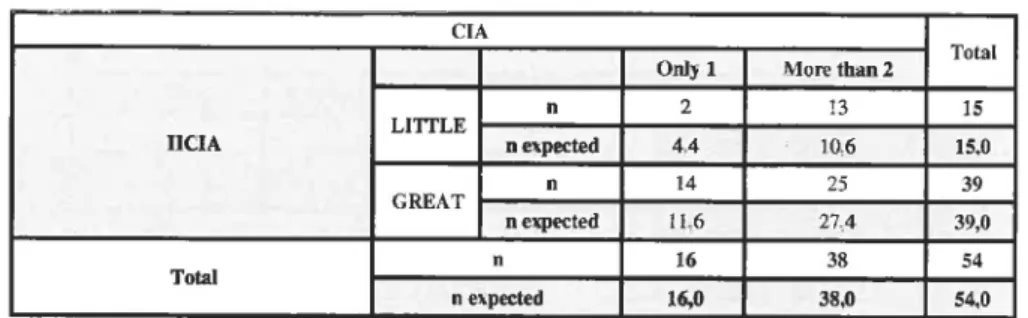
Ofthe total 100% (n=54), 27,7% (n=15) of respondents classify the number of collaborators assigned to IA activity as having 'little' influence on the information conveyed by IA activity and 72,3% (n=39) consider there is "great' influence on the informaüon conveyed by IA activity, regarding the executive
organ's decision-making process (Table l).
Table l: Number of collaborators involved in internai auditing (CIA) versus the influence ofthe information conveyed by internai auditing (IICIA).
CIA
IICIA LITTLE
GREAT
n expected
n expected
Oid}l
44 14 116
More than 2
!3 106
25 27,4
Total
15
15.0
39 39,0
Total 16 38 54
n expected 16,0 38,0 54,0
After calculating the test statistíc, Q 01,5= 1,674 and the p-value equal to 0, 182 (Table 2), HIi is not
corroborated, thereby concluding that there is no statistically significanl association between the CIA
and 1ICIA, with a levei of signifícance of a=0, 05 (5%). In the results obtained, lhe vslue of the
Q obs statistic is calculated with the Yates correction, as one of the cells (25%) hás a frequency no greater
than 5, as shown in Table l, where lhe minimum expected 'n' is 4,4.
Table 2: Chi-squared test of the number of collaborators involved in internai auditing
Pcitison Chi-squared
Continuity correctinn
Fnher'» exatt test
Teste
value
2. 645 1,674
Degree of
freedom Exactsig. (2sides)p-value
0182
0, 182
When raising this question, the intention was to check whether in fact the number of internai auditors, by local authority, varied according to their size, a situation confirmed by the results obtained, in both the descriptive and inferential statistic. This allowed the possibility of a direct relationship between the number of internai auditors assigned to a local authority and its size. Pinheiro (2013) strengthens the result observed for HI], when stating that lhe number of auditors in an organisation determines the size of the IA department, as well as its suitability for the organisation, allowing understanding of the reach of auditing work in the whole organisation.
fí/2 - Requesting internai auditiitg services for internai consulting is associated with lhe
decision-making process.
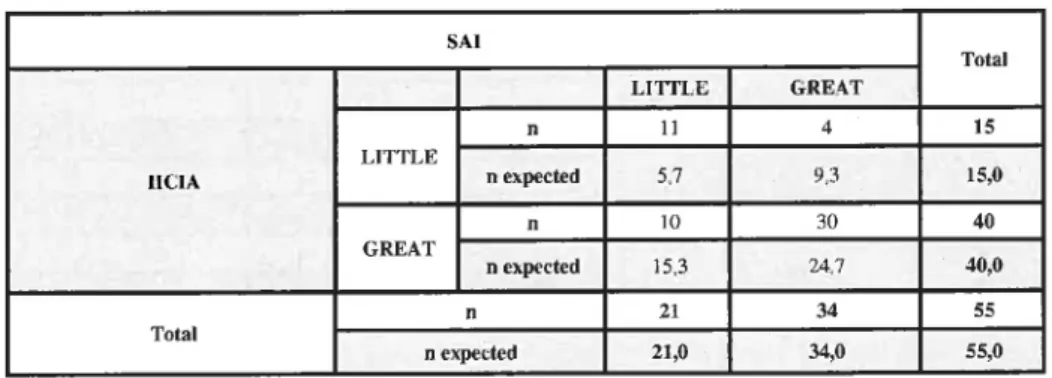
Of the 55 respondents (100%), 27,3% (n=15) classify that influence as 'little' and 72,7% (n=-10) consider there is 'great' influence of the information conveyed by IA activity on the executive organ's
decision-making process (Tab)e 3).
Table 3: Requesting internai auditing services (IAS) versas influence of the information conveyed
by internai auditing (UCIA)
SAI
1ICIA LITTLE
GREAT
n expected
n expected LITHE 5.7 10 15.3 &RE4T 9.3 30 24.7 Total 15 15,0 40 40,0
21 34 55
Total
n expected 21,0 34,0 55,0
The values obtained in the Q2obs=10,797 and p-value (0,002), seen in Table 4, allow to confirm of Hl; for
a levei of significance of 5%, concluding there is signifícant relationship between the independent variable of IAS and the dependent variable of IICIA. Given the results obtained, there was no need touse lhe value of the Q2obs statistic of the Yates correction, as none of the cells presented a frequency of 5
or under.
Table 4: Chi-squared test of requesting internai auditing services for an opinion in the área of
internai consulting
Peiii!>on chi-squared Continuity correction
Fiiiher's exact test
Teste value
10. 797 8, 847
Degree of
freedom
Exact sig. (2 sides)
p-valuc
0. 002
0. 002
The results allow to accepl Hl;, that requesting IA services would be associated with the decision-making process, corroborating the mentioned by IIA (2009), which states that IA can provide consultancy services that improve processes of decision-making and organisational control. However, it points out that the extent of this consultancy will depend greatly on other internai and externai resources
available and will probably vary over time.
HIj - lhe degree of freedom and independence of action granted to internai auditing activity is
associated with the decision-making process,
3,6% (n=2) of respondents classify that influence as 'low' and 96,4% (n=53) consider 'high' lhe influence of information conveyed by IA acüvity on the executive organ's decision-making process.
Table 5: Degree of freedom and independence of action granted to internai auditing activity
(DFIIA) versus influence of the information conveyed (IICIA)
DF1IA
IICIA LITTLE
GREAT
n expected
Total
n expected 2fl
53
53,0
55 55,0
Considering the test statistic, Q^s equal to 0, 005 and the p-value equal to 1, 000, Hl3 is rejected and só is no statistically significant association between DFIIA and IICIA, with a levei of signifícance of
a=0,05 (5%). The value of the Q obs statistic was calculated with the Yates correction, as two of the cells
(50%) were found to have a frequency of 5 or less.
Table 6: Chi-squared test of degree of freedom and independence
Peanon chi-çquared
Continuity correction
Iis]ier's evact test
Teste value
O "78 0,005
Degree of
freedom Exact sig. (2 sides)p-value
0596
1000
According to the IIA (2012), IA activityhas to be independent, and internai auditors have to be objective
in performing their work. Independence in carrying out IA in any organisation is a sine qua non condition for drawing up a trustworthy IA report free from any data manipulation. "As such, the help
provided to executíve orgaiis is better, só that they can set up processes to ensiire their decisions can be tracked' (Pinheiro, 2013, p. 56).
HI4 - The degree ofimportance given to internai audüing activity as an instrument to assess the ICS andfulfilment ofnorms andprocedwes is associated with the decision-making process.
Considering ali respondents, 21, 8% (n=12) are found to classify that influence as 'low' and 78, 2% (n=43) consider there is a 'high' influence of the information conveyed by IA activity on the executive organ's decision-making process.
Table 7: Degree of importance of Internai Auditing (DIIA) versus mfluence of the information
conveyed (HCIA)
DIIA
IICIA
LOW
LITTLE
GREAT
n expected
expected
33
87
HIGH
39 313
Total
15 15,0 40
40,0
Total 12 43 55
n expected 12,0 43,0 55,0
The results of the Q oi,8=28,070 test stadstic and the p-value < 0,001 allow confirm HL». In this context,
there seems to be significant association between DIIA and IICIA, for a a=0, 05 (5%) levei of significance. The value of the Q obs statistic was calculated with the Yates correction, as one of the cells (25%) presents a frequency no greater than 5.
Table 8: Chi-squared test of the degree of importance
Pearson chi-squaied
Continuity corrcction
Fisher'i> exact test
Teste
value
32. 088 28,070
Degree of freedom
Exact sig. (2 sides)
p-value
< 0. 001
< 0. 001
With the help of IA activity assessing lhe whole ICS and fulfilment of norms and procedures,
management bases its decision model on appropriate and reliable information collected and assessed on a daily basis, meaning its decision-making is as appropriate and timely as possible.
A summarized table of the results of the inferential statistics is presented below, in relation to the research hypotheses formulated (Table 9).
Table 9: Result of the research hypotheses
Independent
variables
Dependent variable - II CIA
Q2.i Degree ottreednm p-value Peai&on lïate^*
Mean
HeadsofIA Members of theexecutive organ
HIi-CI4 1.674 0. 182 1.69 1. 75
HIz-AIS 10, 797 0,002 2,63 3, 20
HI3-DFIIA 0,005 1. 000 269 271
HI4-DIIA 28,07 < 0,001 2,09 2,43
One of the principal competences required by administrators/managers is their decision-making capacity,
knowing there is no certainty that these are the most correct, but they must be taken, in the hope they
produce the desired effect. Sometimes, ihose decisions are made considering the information produced
by the departments forming the orgarúsation. The organisation's survival or the continuity of the
executíve organ may depend on the decision-making process, justifying the need to be supplied with the best tools and models for decisions.
Nowadays, among many management options, it hás become the practice in organisations, whatever
their structure, to be advised by an IA department.
Even when consolidated and with clear evidence of its contribution to organisational management, IA
still faces barriers to entry in some organisations, both public and private, with its contributions to
organisations' decision-making being undervalued.
Conclusion
IA includes analysis, appreciation, recommendation, suggestion and information about everything
related to the activities scrutinized by the internai auditor, adding to these functions the duty to promote effective, efficient and economically viable contrai. Ali that activity should be carried out according to previously defined norms, in order to give more credibility to audits themselves and uphold auditors' responsibility.
Analysis of the results leads to the condusion that as a whole the respondents attribute, to some extent, a
degree of importance to IA activity, considering this adds value to local authorities in general, with the
main perceptible benefits being the assurance that regulatory norms are adhered to and risks are controlled. However, dissatisfaction was demonstrated by both groups participating in the study in relation to the quality of IA services. On one hand, those in charge of IA demand more and better material and technical resources, and on the other, a significant number of those in charge of executive
organs do without IA acüvity, considering it is not necessary for their activities, meaning that só far IA