Leadership Competencies in the Requirement Capture and Analysis Phase
of IS/IT Projects
CAPSI’2011
Filipa Pires da Silva 1, António Palma dos Reis 2, Paulo Lopes Henriques 3. 1) ISEG-UTL, Lisbon, Portugal
[email protected] 2) ISEG-UTL, Lisbon, Portugal
[email protected] 3) ISEG-UTL, Lisbon, Portugal
Abstract
While Information Systems/ Information Technology (IS/IT) project’s success is widely recognized as a key research topic, recent surveys show significant failure rates. Requirement capture and analysis (RCA) has been considered one of the most critical phases of the IS/IT projects life cycle, especially software development projects. Moreover, a review of the literature suggests that the management leadership style has a great impact on the project's success. This article discusses an exploratory research that aims to identify relevant leadership competencies for leadership effectiveness in the RCA phase of IS/IT projects life cycle. Contingency factors are also considered, as well as their impact on the set of relevant competencies. This study aims to bring new insights into RCA and leadership research streams.
Keywords: IS/IT projects life cycle, requirement capture and analysis phase, leadership
competencies, leadership effectiveness
1 Introduction
In recent years Information Systems and Information Technology (IS/IT) has been a large market, which accounted for 40% of total capital invested by American organizations [Thorp 1999]. Nevertheless, a significant part of IS/IT projects fail. In 2004, CHAOS reports IS project success rate increased from 16% in 1994 to 34% in 2004. However, despite improvements there were two thirds of the projects that still failed in achieving success [Xu and He 2008].
Researchers and practitioners have been studying this phenomenon over the past years. Initially, their focus was on technical issues, however, they realized this is not a technology issue but a business one [Thite 2000, Thorp 1999]. Some studies claim that the high rate of failure on software development projects results from the fact that principles and methods are not applied, but also from inadequate
project management, which fails in recognizing and understanding what were the real problems of software development [Chatzoglou 1997, Chatzoglou and Macaulay 1997].
Analyzing the existing literature in project management, the relevance of an leadership effectiveness in order to obtain successful projects becomes evident, also in IS/IT research areas (see for instance, Bennett [2009], Eom [2006], Thite [2000] and Turner and Muller [2005]). On the other hand, the requirement capture and analysis phase is often considered as one of the most critical phases of the IS/IT projects life cycle, especially for software projects, since it defines the system that will be developed [Pressman 2005].
Thus, at the present phase, this study aims to develop a research model to study the relationship between leadership competencies and leadership effectiveness in the requirement capture and analysis stage of IS/IT projects life cycle, particularly on software development projects, considering also some of the most relevant contingency factors that can influence eventual variations. The rest of the paper is organized as follows: Section II and III review the literature, on IS/IT and leadership topics, towards the research questions formulation on Section IV; Section V describes the methodological approach, followed by a discussion on the preliminary results of the study on Section VI. Finally, the Section VII concludes with the limitations of this paper and some of the expected contributions, both practical and academic.
2 IS/IT projects
2.1 Project and Project Management
Despite the diversity of the project definitions proposed in the literature, in this paper projects are conceptualized as temporary organizations “to which resources are assigned to undertake a unique, novel and transient endeavor managing the inherent uncertainty and need for integration in order to deliver beneficial objectives of change” [Turner and Muller 2003, p. 7]. Projects are considered temporary because they have a definite start and ending date and use temporary management structures formed to carry out the project. They are also considered unique because the product or service produced is differentiated from any other [Turner and Muller 2003, Ng and Walker 2008, PMI 2000]. PMI [2000] adds that projects have a progressive elaboration where progressively means “proceeding in steps; continuing steadily by increments” and elaboration means “worked out with care and detail; developed thoroughly”, highlighting the process nature.
Pinto and Prescott [1988] argued that beyond projects, project management has been one of the most researched and theorized topics in management. PMI [2000] defines project management as “the application of knowledge, skills, tools, and techniques to project activities to meet project requirements […] accomplished through the use of the process (usually referred as project life cycle)
such as: initiating, planning, executing, controlling and closing”. Ward and Griffiths [2000] also refer to project management as a process for managing the activities and resources associated to a project, but they focus on achieving system’s contractual times and costs.
Wateridge [1997] suggests that often IS/IT projects have a large number of stakeholders to manage and satisfy and at the same time have to be implemented in order to deliver benefits to the client or the organization. Thite [2000] and Eom [2006] also suggest that IS/IT projects differ from other projects due to the characteristics of IT employees, which are frequently engaged in scientific or technical occupations, thus holding certain distinguishing personality and occupational related characteristics. These authors, among others, defend IS/IT projects as a particular case of generic projects, because these projects have very specific characteristics that make them quite complex to manage. That is why it makes sense to study this specific type of projects, instead of considering any generic ones.
When studying projects there are two other important aspects that should be addressed: one is the general categorization of projects, in order to consider different types of projects, and the other is the project cycle of activities, namely project life cycle.
2.2 Project Types
In general, projects can be categorized into different types, considering several factors. For instance, Wateridge [1997] grouped projects into concrete, occasional and open, considering how well the objectives, outputs, skills and methods for each project were defined.
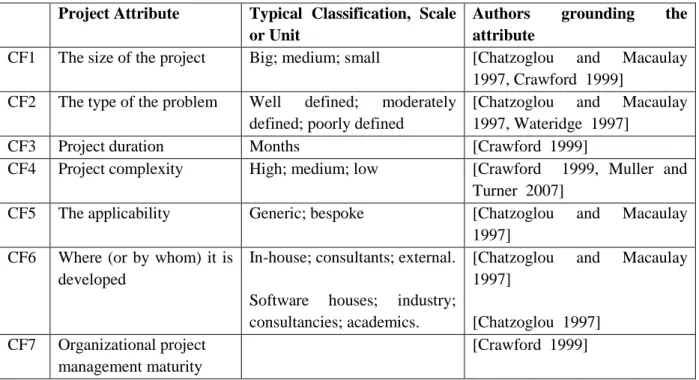
Table 1 summarizes some of the project characteristics proposed in the literature. Project Attribute Typical Classification, Scale
or Unit
Authors grounding the attribute
CF1 The size of the project Big; medium; small [Chatzoglou and Macaulay 1997, Crawford 1999]
CF2 The type of the problem Well defined; moderately defined; poorly defined
[Chatzoglou and Macaulay 1997, Wateridge 1997]
CF3 Project duration Months [Crawford 1999]
CF4 Project complexity High; medium; low [Crawford 1999, Muller and Turner 2007]
CF5 The applicability Generic; bespoke [Chatzoglou and Macaulay 1997]
CF6 Where (or by whom) it is developed
In-house; consultants; external.
Software houses; industry; consultancies; academics.
[Chatzoglou and Macaulay 1997]
[Chatzoglou 1997] CF7 Organizational project
management maturity
CF8 Application area (industry)
Engineering and construction; Information systems; Organization and business
[Crawford 1999, Muller and Turner 2007]
CF9 Contract type Fixed price; alliance [Muller and Turner 2007] Table 1 - Summarized factors that addressed different project types
2.3 Project Life Cycle
According to PMI [2000] a project can be perceived as a process considered to be “a series of actions bringing about a result”. Those processes are usually grouped into several phases, each aimed to produce a set of clearly defined outcomes to be concluded [PMI 2000].
PMI [2000] suggests that project activities can be organized into five groups (initiating; planning; executing; controlling; and closing processes) and that these can be linked to the general project phases shown in the Figure 1.
Figure 1 - Generic Project Life Cycle. Source: [PMI 2000]
A project phase is part of a logical sequence that aims the completion of the project objectives. The sequence of these stages is usually known as the project life cycle [PMI 2000].
IS/IT projects, particularly the ones related to software development, have their own specific characteristics which determine the adoption of a specific life cycle.
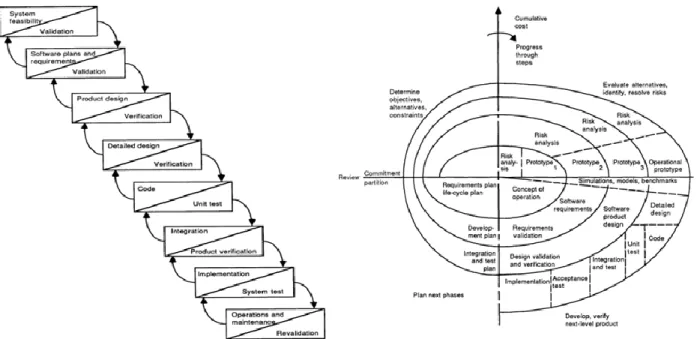
Figure 2 – Left: Waterfall Model of the software life cycle. Right: Spiral Model of the software life cycle. Source: [Boehm 1988]
The Waterfall model was firstly proposed in the 70’s by Winston Royce, and is frequently called the classical life cycle [Pressman 2005]. This presents a stepwise, systematic and sequential approach to software development [Boehm 1988] (Figure 2 - Left). Later, Barry Boehm [1988] proposed the evolutionary Spiral Model, which evolves based on experience with various refinements of the Waterfall (
Figure 2
- Right). The Agile movement took place in 2001 with the “Manifesto for Agile Software Development” [Pressman 2005, Alliance 2001]. Agile approaches emphasize the software development as a dynamic process, evolving through organic iterations, “rather than static, predefined, and mechanistic” [Lee and Xia 2010, p. 88], which represents radical change from traditional methodologies.Regardless the project life cycle, each phase aims at accomplishing a set of deliverables that comes as a result of the overall activities performed by the team members. The nature of these activities is very different among each stage and requires distinct skills. Russo et al. [2005] demonstrated that given the diversity of activities involved there is a need of a very versatile project manager in order to successfully carry out the project through all its phases. It is also important to point that, according to this approach, the overall success project comes from success in each and all of its phases. One of the phases that is often considered to be the most critical to achieve project success is the Requirement phase, due to the difficulty of understanding the requirements of a new system [Pressman 2005]. Thus, it seems appropriate to focus this study to this particular phase.
2.4 Requirement’s Capture and Analysis
One of the most commonly identified causes of an IS/IT project failure is the inadequate requirements [Bleistein et al. 2006]. A requirement is a condition or capability that must be met or possessed by a system or item of software [Nicolás and Toval 2009]. Requirements should be mostly identified and analyzed in the requirement’s phase of the project life cycle. This phase is commonly called as Requirement Engineering, because it is considered as a process where activities of problem analysis, product’s description and recommendation of a solution are performed [Eman et al. 1996]. However, other authors, like Chatzoglou [1997] also named this phase as Requirement Capture and Analysis (RCA).
With the purpose of understanding what the customer wants and needs; assessing feasibility; negotiating and specifying a reasonable solution; understanding how end users will interact with the system and what will be the impact in the business, Pressman [2005] recommends seven well defined functions (Inception, Elicitation, Elaboration, Negotiation, Specification, Validation and Management). Meanwhile, Chatzoglou and Macaulay [1997], confirmed from their study that RCA is an iterative process. Each iteration has a process itself, divided in three steps starting with information
collection, which is then examined and checked in the end. Whenever the information is not sufficient a new iteration is performed.
As of any other phases of project life cycle, requirement capture and analysis plays a critical role in achieving project success. This phase is often considered as a prerequisite for project success and crucial for the success of the whole development stage. In fact it bridges the design and the construction phases and involves communicating both with clients and system developers [Pressman 2005, Chatzoglou 1997, Eman et al. 1996, Nicolás and Toval 2009]. The criticality of this phase results from the requirement process serving the needs and providing the basis to ensure that the subsequent phases of the project life cycle will be successfully carried out [Eman et al. 1996].
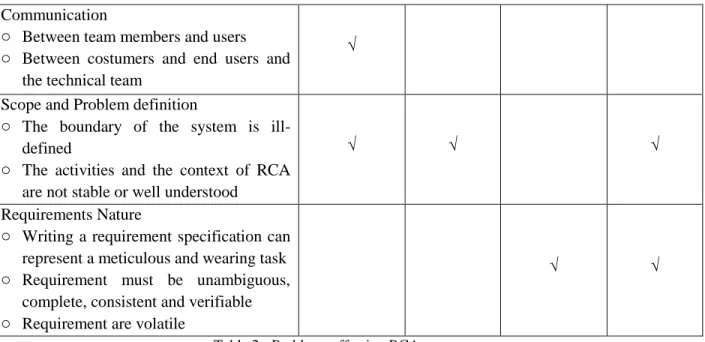
It has been recognized that problems affecting the success of this phase are not only technical issues but also managerial, organizational, economic and social [Chatzoglou 1997]. Table 2 summarizes some of the identified problems of this phase and theirs authors.
[Chatzoglou 1997] [Eman et al. 1996] [Nicolás and Toval 2009] [Pressman 2005] General Constrains o Time o Budget √
Client and User behavior
o They cannot tell clearly what their needs are
o They have a limited knowledge of the problem and possible solutions
√ √
Project Management o Inexperience o Style
o Lack of (the right) methodologies used
√ Project team o Attitude o Experience o Commitment to o Motivation
o Knowledge of problem domain
o Knowledge of the purpose of the project development
Communication
o Between team members and users o Between costumers and end users and
the technical team
√
Scope and Problem definition
o The boundary of the system is ill-defined
o The activities and the context of RCA are not stable or well understood
√ √ √
Requirements Nature
o Writing a requirement specification can represent a meticulous and wearing task o Requirement must be unambiguous,
complete, consistent and verifiable o Requirement are volatile
√ √
Table 2 - Problems affecting RCA success
According to the problems presented in the Table 2, project managers and project teams play an important role in achieving success in RCA phase [Chatzoglou 1997]. Almost all activities within a project are accomplished through teamwork. It is extremely important for an organization to obtain the necessary resources to achieve that success, and so, many authors believe that effective use of teams is a necessary ingredient for a project to be successful [Componation et al. 2008].
2.5 Effective Teams
Componation et al. [2008] have confirmed from theirs studies that issues related to project teams involved in the IS/IT project, specifically software development, are some of the most significant factors that influence productivity within the software development process [Chatzoglou and Macaulay 1997]. Often, in IS / IT projects several types of teams have to work in a coordinated manner (the technical team, the business team and cross-functional users [Peslak and Stanton 2007]), which implies that different types of people are involved in developing the project, such as end users, systems analysts, programmers, project managers, functional area managers and other stakeholders [Yang and Tang 2004]. Therefore, team building is a critical task, in order to accomplished the project success [Kerzner 2009].
According to Chatzoglou and Macaulay [1997] team members play a key role in the RCA phase. These authors identified that the experience, knowledge, commitment and persistence of the team members as well as user’s motivation, knowledge of the purpose of the project development and communication with the project team members were very important for the completion of the project
development and the RCA process (see for instance [Kerzner 2009, Chatzoglou and Macaulay 1997, Xu and He 2008]).
Indeed, some of these factors are frequently associated to leadership. According to PMI [2008] leaders are responsible for creating an environment that emphasizes teamwork and team building, fostering a spirit of cohesion, motivation and trust. They should also be able to establish and maintain the vision, strategy and communication, not only within the team but also outside, influencing, guiding, monitoring and evaluating the performance of the team and the project, and inspiring the project team to achieve high performance. Thus, it is not surprising that leadership is considered one of the most important factors in team, project and organizational effectiveness and therefore regard it as a vital factor in the IS development group analysis [Yang and Tang 2004].
3 Leadership and Management
Before further development on leadership it should be made a clear distinction from management and leadership. Kotter [1996] states that management is about coping with complexity while leadership is about coping with change. While managing is primarily concerned with consistently producing key results expected by stakeholders, leading involves establishing direction, aligning people, motivating and inspiring. Likewise, Schein [1992] defends that “leaders create and change cultures, while managers and administrators live within them”. PMI [2008] adds that leadership is also the “ability to get things done through others”, which involves the effort of a group of people toward a common goal and enabling them to work as a team. Still, leadership has also been defined in terms of individual traits, behaviors, influence over others, interaction patterns, role relationships, hierarchical position, among others [Kuruppuarachchi 2001].
The project manager is generally expected to be the project’s leader [PMI 2000]. However the leadership is not exclusive of project managers and can be exercised by different actors during the course of projects [Ng and Walker 2008]. Moreover we should expect to have several levels of leadership, for instance, within a project we have: project leadership, technical leadership, and team leadership [PMI 2000].
3.1 Leadership Effectiveness
Accordingly to Chen and Silverthorne [2005] leadership effectiveness is the use of the most appropriate leadership style to subordinates in order to lead to a higher level of subordinate satisfaction and performance. In analogy to team theories, Jiang et al [1997] reported that the team effectiveness is evaluated according to objective and subjective measures, like the ability to meet teams’ goals. Additionally they stressed that these measurements also depend on the hierarchical level
that assesses them. Since it is regarded as a subjective construct, leadership effectiveness is commonly assessed considering the participants opinion. For instance, Crawford [1999] measured project management effectiveness through superior assessment and self-rating on a number of dimensions such as the value to the client and to the organization, the use of recognized project management methodologies, the effectiveness of relationship with peers in achieving project goals, the ability to inspire and encourage the performance of others and the frequency with which the person completes projects on time, within budget and achieving project goals. Similarly, Cicero et al. [2010] evaluated the leadership effectiveness considering four items to which participants had to respond accordingly to their perception of leadership.
3.2 Leadership Styles
Over the last decades, practitioners and academics have developed a body of knowledge on leadership as a critical factor for success [Thite 2000, Turner and Muller 2005, Green 2004]. But given that project leadership is essential to project success, what makes a good project leader for an IS/IT project?
There is no simple answer to this question. Authors have suggested leadership styles and characteristics that aimed to characterized leaders to enable mapping them to most appropriate situations (see for instance [Turner and Muller 2005, Kuruppuarachchi 2001]). Some have made researches aimed to identify successful leadership styles for managers of IS/IT projects under which IS/IT subordinates perform the best [Bennett 2009, Thite 2000].
However, an appropriate leadership depends on the project itself (type, dimensions and complexity) [Muller and Turner 2007, Dulewicz and Higgs 2003], on organizational culture and organization context [Hofstede 1991], on the leader, subordinates and the situation [Kuruppuarachchi 2001]. Meanwhile, leadership style may depend on the organizational characteristics and context (internal and external), external forces, tasks related, the management level, and it should change according to the maturity of the employees, job related experience, willingness to accept job responsibility and the desire to achieve [Kuruppuarachchi 2001].
Regarding the purpose of this study, the leadership competence school perspective seems to be the most suitable one, given the emphasis on skills and characteristics that a leader may possess.
3.3 Leadership Competence School
The competence school emerged in the 2000’s and according to the literature review this school perspective is the currently most advanced understanding of leadership [Turner and Muller 2005].
Initially this approach seems to return to what was already proposed in the traits school, however for this school competencies can be developed, i.e. they are not only obtained at birth. In addition, different profiles of competencies can be used to create different leadership styles appropriate to different situations, as it was defended by the contingency school (see for instance [House 1971]). These different combinations of competencies can also create transactional leaders (see [Bass 1990]), suitable for low complex systems, as well as transformational leaders (see [Bass 1990]), suitable for highly complex systems, as suggested in visionary and charismatic school [Turner and Muller 2005]. Although this school encompasses all the earlier schools, the main emphasis is on identifying the competencies needed to achieve leadership effectiveness.
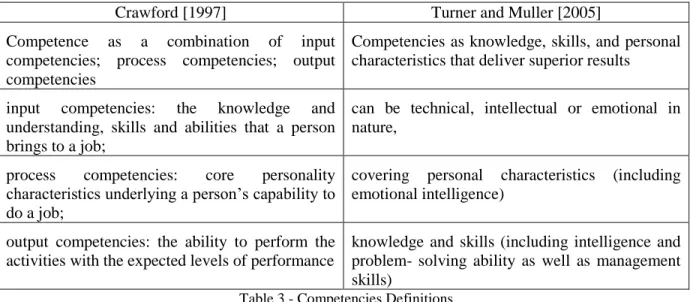
Crawford [2003] briefly defined competence as knowledge, skills and personal characteristics that lead to superior results or to meet defined performance standard. Stepping back to previous work on competencies the psychologist David McClelland in 1973 (as cited in [Garman and Johnson 2006]) saids that competencies are outcomes and relevant measures of knowledge, skills, abilities and traits and motives. In the context of the attribute based inference of competence, two main definitions are explored in the Table 3.
Crawford [1997] Turner and Muller [2005]
Competence as a combination of input competencies; process competencies; output competencies
Competencies as knowledge, skills, and personal characteristics that deliver superior results
input competencies: the knowledge and understanding, skills and abilities that a person brings to a job;
can be technical, intellectual or emotional in nature,
process competencies: core personality characteristics underlying a person’s capability to do a job;
covering personal characteristics (including emotional intelligence)
output competencies: the ability to perform the activities with the expected levels of performance
knowledge and skills (including intelligence and problem- solving ability as well as management skills)
Table 3 - Competencies Definitions
The first definition (Crawford [1997]) focuses competence’s variation as a process. The author suggests different types of competencies accordingly to the task process stage: input; process; and output. In the second definition Turner and Muller [2005] view competencies like attributes that someone may possess.
In this paper we are adopting the latter definition, since we are considering the skills and characteristics that the leader possesses, as illustrated in the Leadership Competencies Framework [Dulewicz and Higgs 2003]
From their review of the literature, Dulewicz and Higgs [2003], found that competencies were often categorized into four types: cognitive, emotional, behavioral and motivational. Additionally, they suggested that the cognitive type should be divided into intelligence (IQ) and managerial skills (MQ) in order to better capture the main dimensions of effective leadership. Furthermore, they also combined emotional, behavioral and motivational types into emotional competencies (EQ). With this competence framework, Dulewicz and Higgs [2003] have shown that EQ appear to be particularly important in explaining managerial success and top-management leadership, but IQ and MQ were also found important.
Within the three groups of competencies, authors identified 15 dimensions that influence the performance of leadership (see Table 4). In the intellectual type they found: critical analysis and judgment, vision and imagination and strategic perspective. In the managerial type they considered: resource management, engaging communication, empowering, developing and achieving. Emotional type includes; self-awareness, emotional resilience, intuitiveness, interpersonal sensitivity, influence, motivation and conscientiousness.
Competency Type
Competency
Intellectual (IQ)
1. Critical analysis and judgment 2. Vision and Imagination 3. Strategic PerspectiveManagerial (MQ)
4. Engaging Communication5. Managing Resources 6. Empowering 7. Developing 8. Achieving
Emotional (EQ)
9. Self-awareness10. Emotional Resilience 11. Motivation 12. Sensitivity 13. Influence 14. Intuitiveness 15. Conscientiousness
Table 4 - Leadership competencies framework. Source: [Dulewicz and Higgs 2003]
Dulewicz and Higgs [2003] showed that the leadership styles result better in different situations. For instance, they found that 31% of leaders had a predominantly Goal-oriented style, 28% had an Involving style and 41% had an Engaging style, and they go on to show that these styles perceived better results in low, medium and high complexity projects (respectively) [Dulewicz and Higgs 2003]. These variations in success of different styles according to different situations leads us to hypothesize
whether there will also exist variations in leadership competencies considered relevant during the various phases of the projects life cycle.
3.4 Leadership along project stages
Within a project life cycle, very different activities are performed by project team members [PMI 2000]. These different activities suggest that there is a need to have different professional skills to perform them [Russo et al. 2005]. Ng and Walker [2008] also suggest that on projects, the way managers and leaders use their power and influence may vary according to the project phases and team member’s level of commitment.
Frame (1987) (as cited in Turner and Muller [2005]) was the first to suggest that different leadership styles are appropriate at different stages of the project life cycle and then Turner [1999] suggested that different cultural styles lead to better performance at different stages of the project life cycle.
Competencies have also been considered along project life cycle. According to Skulmoski [2005] in each project phase different competencies can be considered important. In the same way, Russo et al. [2005] have shown how leadership competencies can influence in the project management phases. Indeed, PMI [2008] have also stated that leadership is important through all phases of the project life cycle, especially when it is important to communicate the vision and inspire the project team in order to achieve project success. Ng and Walter [2008], which also found this topic a relevant one, used an IS/IT project from a public organization in Hong Kong to illustrate how various types of power, and thus leadership styles, were used (by all participants) to influence team members across the identified project phases. To do so, they carried out a case study, directly observing and describing the progress of the project, drawing conclusions through their own (and possibly subjective) analysis of actors and their behaviors, attempting to characterize them with the existing literature.
4 Research Questions and Research Model
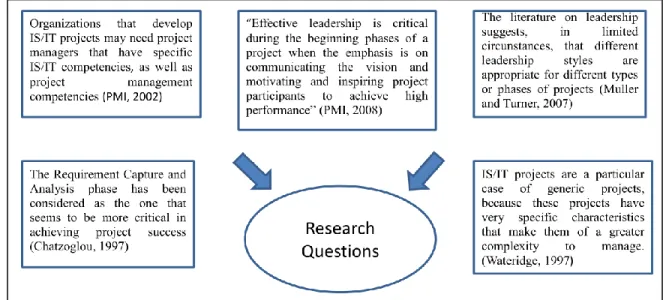
Through this paper, it is presented a literature review in the two distinct fields that, as far as authors know, have never been considered together. Figure 3 summarizes some of the criteria that have guided the research purpose.
An IS/IT project, particularly software development projects, can be considered a particular and complex one among all projects. Ng and Walter [2008] confirms that managing IS/IT projects is complex not only because they involve delivering systems but also because they involve a great deal of integration of skills and inputs of a diverse range of specialized skills and technical resources.
In addition, the literature on leadership suggests that different leadership styles are appropriate in different situations. Muller and Turner [2007] conducted a research on whether leadership styles influence project success and how these leadership styles are appropriate to different project types. During their research one interviewee, working on IS/IT projects, said:
“the feasibility and execution stages would be managed by somebody from the business, but the design stage by somebody from the information systems department. The reason is design requires technical knowledge, whereas other stages require business knowledge (…) during implementation the management of stakeholders is important” [Muller and Turner 2007]
Figure 3 - Research Questions Grounding
This statement confirms that this is a relevant topic that needs to be studied in greater depth, but it also gives some clues on how competencies may vary along the software development project life cycle. Furthermore, it has been well documented in the literature that from all phases of software project life cycle, the one that seems to be more critical in achieving success is the requirement capture and analyze phase (see for instance [Chatzoglou 1997, Chakraborty et al. 2010]).
While the contributions of the existing body of knowledge are significant to the discussed problems, none of the research (to our best knowledge) explicitly integrated all these elements within a unifying framework, and any author has focused their research on identifying which different set of leadership competencies are most appropriate for achieving success on IS/IT projects, specifically software projects, for each project phase separately.
Therefore, this study aims the exploration of leadership competencies relevant to achieve leadership effectiveness in the requirement capture and analysis stage of software development projects life
cycle. It also considers some of the most relevant factors that can influence eventual variations. This leads directly to our research questions:
(1)
Which leadership competencies are relevant to achieve leadership effectiveness on RCA phase?(2)
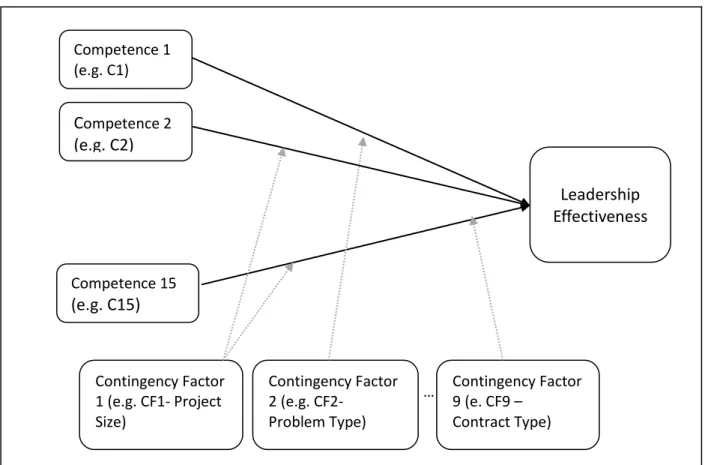
Which factors can influence the relevance of competencies for leadership effectiveness on the RCA phase?When developing the research model (see Figure 4), it was adopted the Leadership Competencies Framework proposed by Dulewicz and Higgs [2003], as the basis of the model. However, this study intends to check the relevance of these competencies for the context being studied as well as to identify new ones, whether they prove to be relevant.
Apart from leadership competencies, seven contingency variables were also added to the research model. These variables were drawn from the literature and correspond to those described on Table 1, with the exception of the application area and the organizational project management maturity. As suggested in the literature, it is expected that these contingent variables can somehow influence at least some of the competencies relevant to achieve leadership effectiveness. This is represented by the dotted arrows in the model which affect the relevance of the competencies for leadership effectiveness.
Figure 4 - Research Model for leadership competencies in the RCA phase of IS/IT project life cycle … Competence 1 (e.g. C1)
C
ompetence 2(e.g. C2)
Competence 15(e.g. C15)
Contingency Factor 1 (e.g. CF1- Project Size) Contingency Factor 9 (e. CF9 – Contract Type) Contingency Factor 2 (e.g. CF2- Problem Type)Leadership
Effectiveness
At this stage, all the dimensions represented in the model constitute just an example. Meanwhile, this research paper has the following main objectives:
(RO1) - Check the relevance of competencies proposed by Dulewicz and Higgs [2003] (RO2) - Identify any other leadership competencies relevant to IS/IT project management (RO3) - Assess how project participants perceive leadership effectiveness
(RO4) - Identify the contingency factors of the project that influence the competencies for leadership effectiveness
(RO5) - Assess how these factors lead to variations in the set of relevant competencies
5 Research Method (Methodology)
Given the focus of the presented research questions it was conducted an exploratory study. This methodological choice is consistent with Sekaran [2003] who states that an exploratory study should be undertaken when the aim of the study is (1) to better understand the nature of a specific problem for which few studies might have been conducted or (2) when some facts are known, but more information is needed for developing a viable theoretical framework.
In an exploratory study many research methods can be used, such as experimental, survey and case study. However, according to Yin [2009] case study method is preferable when research questions are based on what (in this case which) and why form and the research objective is to “investigate a contemporary phenomenon in depth and within its real-life context” (p.18).
Thus, it was conducted an exploratory case study, considering the pair project/leader as the unit of analysis. The case was selected according to the following criteria:
Project leader should belong to an IS/IT Portuguese software houses that demonstrates diversity in project profiles in terms of type, size, development methods and applicability organization
Project leader should have at least five years of experience in managing IS/IT projects;
Projects should consist in software development projects and should be actual (recently finished or still in progress);
Interviews are considered as the most common method used in qualitative studies [Cassel and Symon 2006]. Therefore, the research strategy involves conducting one hour semi-structured interview to IS/IT project managers. To ensure validity, a case study protocol were also developed and used as a guide during the data collection. Tables 1 and 4 were also added to the set of questions to be discussed with the participant. This protocol was firstly reviewed and discussed with a set of experts in the field. This strategy aims to enable study replication as well as to minimize eventual errors and biases [Yin 2009].
Although some criticism exists with this research method, mainly due to the concern of the lack of rigor and scientific generalization, the goal of this study is to expand the existing body of knowledge instead of establishing statistical generalization of the phenomena [Yin 2009]. In fact, doing multiple case studies is often considered more robust and compelling, which analytical conclusions tend to be more powerful from those of a single study [Yin 2009]. Yin [2009] also suggests this approach to theoretical replication purposes, “to see whether the findings could still be duplicated” (p.54). Thus, replication of the case study is being prepared, also considering that the use of a single case study is one major limitation of this paper. The adoption of other data collection methods, such as quantitative methods, is also being analyzed. Many researchers suggest the use of a multiple data gathering methods to address complex phenomena using different approaches, and to improve validity through data and theory triangulation [Cassel and Symon 2006].
6 Preliminary Results
It is important to note that data collection process has not been totally accomplished, nevertheless, preliminary results can be presented and discussed.
An exploratory data collection was performed in June, 2011, utilizing personal interview to collect data. The interview lasted almost one hour and a half and the participant was a senior project management, from a young Portuguese software house located in Lisbon. These project manager has more than twenty years of experience in IS/IT, mostly in the private sector, and he is actually performing as an IS/IT director and manager in the referred company.
The interview was recorded and transcribed in order to perform data analysis. The responses were then labeled and organized according to the questions raised in the Section IV, to complete the model. The following paragraphs briefly describe the results obtained.
Project Description
The participant described a project performed internally in a construction company, which consisted in the development of an ERP. The project was considered long (lasted about two years), which involved a lot of people and was considered fairly complex. The development was done by iterations and the methodology used was SSADM1.
Requirement Capture and Analysis Phase
Requirement analysis was done for each software module separately, and activities were performed as needed. There were two main analytical sources: the old systems still performing (“as is”) and the
users ("to be"). Although this phase was considered critical to project success, there were some commentaries about the process of documenting requirements that focused the main problems of this phase, which are not far from those described in the literature. Extensive documents that are not properly addressed by the clients, the availability of users to accomplish requirement activities and problems with communication between all stakeholders involved were some of the highlighted aspects.
Extracts from the interview
Inadequate
documentation
“Even if it is very complete, my experience from other projects say
that the user will rarely read the document or at least see it with the
proper attention. This is because the document is too long and the
person has their own job to do […], or because the language is too
technical and he will not read it. The typical is the user to sign
everything, “Yes, this is that I want”, and then it goes to development
phase, take six months to be produced and in the end the results are
far from what the user wants”.
Users availability
“I have never seen a project […] were the user is diverted from their
daily activities to work 100% in an analysis project (I think this never
happens) […] and then the requirements elicitation monitoring is
only slightly performed”.
Communication
problems
“[…] what the user wants, what the user says and what the analyst
understand…Somehow the communication [is lost] even because the
languages are quite different.”
However the respondent argued that what makes this phase critical has to do with factors such as the methodology used. He asserted that agile methodology is the best approach to software development, since it minimizes some of the main problems affecting this project phase.
“More important than making a long period of analysis with an extensive resulting document which is then delivered to the user to conform it [...] is to put things into production, to short development cycles and deliver components to use. Only then the user will be able to tell how it is correct.”(from the interview)
Leadership Relevance and Competencies
When asked about the relevance of the leadership in the project development, the respondent answered that the leader is a very “prominent” figure in the software development projects. He also emphasized that the relevance of the leader depends among several factors, like the nature of the project, the project life cycle and the methodology used.
Extracts from the interview
Project Nature
“[The leader is important]…especially if the project has several teams to
manage, which happens a lot”
Project phases
and
Methodology
“I think [the leader] is important throughout all stages, especially if the
development is iterative. If we think of a more traditional model, a
waterfall model […] then the leader is more important in the analysis
phase, the phase of requirements definition because in later phases (such
as programming) their role is less active. In the iterative or agile models,
the leader's role becomes more important because he has to […]
guarantee that at the end all components have to be properly integrated
[…]. I would say that in these models the leader’s role is most important”.
During the interview, several competencies were identified. The respondent highlighted that during the RCA phase the leader should understand the business, should be “creative” and should be a disciplined person, especially considering iterations of Agile Models. In a more focused question, the participant described social, emotional and managerial competences needed to project leader, which comes along with the Dulewicz and Higgs’s Leadership Framework [2003]. Surprisingly, he refused all the contingency factors suggested in the literature justifying that all phases have to be done no matter which project is related. Meanwhile, he also highlighted that the methodology used is the only factor that can influence and impact the set of needed leadership competencies.
Extracts from the interview
Business
Knowledge
“The better analyst […] is the one that knows the business very well.
[Normally he] can talk the user language, can understand what their
needs and constrains are”.
Discipline
“It takes great discipline because if not the projects could never end.
There are always more changes to perform...”
Creativity
“Should be creative”, due to the nature and specificity of IS /IT projects,
especially software projects.
Social
Competencies
“Relationship skills more than technical one, are very important”
Emotional
Competencies
“It has a lot of emotional intelligence”
Managerial
Competencies
“A person to manage IT projects […] must have some technical
knowledge and a lot of management knowledge”
Finally, in terms of how can leadership effectiveness be assessed, the results obtained were vague and inconclusive. The participant seems to be surprised with the question and his first answer was about project success.
"For any software project the success is the level of system usability. I can develop a perfect system, but if no one uses it, it serves no purpose" (from the interview)
When we insisted in the question, he answered quite ironically, emphasizing the subjectivity of the construct.
"I don’t know. Only by doing two projects, one with a bad leader and one with a good leader, however there are no two projects alike. [In addition] I can see the same thing in different ways”. (from the interview)
7 Conclusions, Limitations and Expected Contributions
So far, the results achieved are largely in line with the main findings of previous research on IS/IT projects and leadership competencies. However, it was surprisingly to found that any of the contingency factors, drawn from the literature review, has been considered by the interviewed to impact on the set of leadership competencies for the RCA phase. When asked to explain, he said that
all projects of all types performed the same kind of activities during the RCA process. Some in a more detailed and systematic way, but all group activities must be performed.
“Maybe this one (…) but it doesn’t vary” (from the interview)
So, the same set of competencies should exist anyway. Also interesting was to observed the relevance of methodological choices when assessing leadership relevance.
Despite the results obtained, not all the research questions could be properly addressed. This was the case of (RO3) that aimed to assess leadership effectiveness. The participant responses were all quite inconclusive, which suggests not only the difficulty of measuring the concept, but also strengthens the subjective nature of it.
“I can see the same thing in different ways” (from the interview)
7.1 Limitations and Expected Contributions
Just one interview was considered in the presented paper, which constitute one major limitation of the study. In addition, there are other limitations that arise from the methodological choice of conducting a single a case study, which were already discussed in the methodology section.
This research study is expected to have both theoretical and practical implications. Although not fully achieved, the aim is to illustrate how leadership competencies are related to RCA phase of software projects life cycle, considering different types of projects in terms of project complexity, size, and duration, among others. It is also important to consider that those leadership competencies should lead to leadership effectiveness and it should be stressed how leadership effectiveness is perceived by participants in this particular phase in comparison to the overall perceived performance from the project closure.
Other expected contribution is to provide an innovative approach for research in requirements field. It is expected that this study comes up with new avenues of research regarding the characteristics of leadership in the early stages of software projects, which may contribute to a better performance in this phase.
Additionally, it is expected that future research will allow managers to be aware of the need to consider or develop different skills and characteristics in the project leader, depending on which activities and context they must perform.
Future work can explore in more detail some of the findings of this paper, such as the relevance of the methodology on leadership competencies, as well as enhance the reliability and robustness of the results.
8 References
Alliance, A. 2001. Manifesto for Agile Software Development [Online]. Available:
www.agilemanifesto.org [Accessed].
Bass, B. M. 1990. From transactional to transformational leadership: learning to share the vision. Organizational Dynamics, 18, 19-31.
Bennett, T. M. 2009. A study of the management leadership style preferred by IT subordinates. Journal of Organizational Culture, Communications and Conflict, 13.
Bleistein, S. J., Cox, K., Verner, J. & Phalp, K. T. 2006. B-SCP: A requirement analysis framework for validating strategic alignment of organizational IT based on strategy, context, and process. Information and Software Technology, 48, 846-868.
Boehm, B. W. 1988. A Spiral Model of Software Development and Enhancement. IEEE.
Cassel, C. & Symon, G. 2006. Essencial Guide to Qualitative Methods in Organizational Research, SAGE Publications Ltd.
Chakraborty, S., Sarker, S. & Sarker, S. 2010. An Exploration into the Process of Requirements Elicitation: A Grounded Approach Journal of the Association for Information Systems, 11, 212-249.
Chatzoglou, P. D. 1997. Factors affecting completion of the requirements capture stage of projects with different characteristics. Information and Software Technology, 39, 627-640.
Chatzoglou, P. D. & Macaulay, L. A. 1997. The importance of human factors in planning the
requirement capture stage of a project. International Journal of Project Management, 15, 39-53.
Chen, J. & Silverthorne, C. 2005. Leadership effectiveness, leadership style and employee readiness. Leadership & Organization Development Journal, 26, 280-288.
Cicero, L., Pierro, A. & Van Knippenberg, D. 2010. Leadership uncertainty: how role ambiguity affects the relationship between leader group prototypicality and leadership effectiveness. British Journal of Management, 21, 411-421.
Componation, P. J., Youngblood, A. D., Utley, D. R. & Farrington, P. A. 2008. A preliminary assessment of the relationship between project success, system engineering, and team organization Engineering Management Journal, 2.
Crawford, L. 1999. PM competence: people and organisations. In: ARTTO, K. A., KAHKONEN, K. & KOSKINEN, K. (eds.) Proceedings for NORDNET'99: Managing Business by Projects. Helsinki, Finland: Project Management Association, Finland and NORDNET.
Crawford, L. H. 2003. Assessing and developing the project management competence of individuals. People in Project Management. Aldershot, UK: J. R. Turner.
Dulewicz, V. & Higgs, M. J. 2003. A new approach to assessing leadership dimensions, styles and context. Competency & Emotional Intelligence Quarterly.
Eman, K. E., Quintin, S. & Madhavji, N. H. 1996. User participation in the requirement engineering process: an empirical study. Requirement Eng, 1, 4-26.
Eom, M. T.-I. 2006. The impact of IS leadership on the IS unit´s effectiveness. Doctor, Graduate School of Binghamton University, State University of New York.
Garman, A. N. & Johnson, M. P. 2006. Leadership competencies: an introduction. Journal of Healthcare Management, 51.
Green, G. C. 2004. The impact of cognitive complexity on project leadership performance. Information and Software Technology 46, 165-172.
Hofstede, G. 1991. Cultures and organizations: Software on the mind, London, McGraw-Hill. House, R. J. 1971. A path-goal theory of leader effectiveness. Administrative Science Quarterly,
321-338.
Jiang, J., Motwani, J. & Stephen, T. 1997. IS team projects: IS professionals rate six criteria for assessing effectiveness. Team performance Management, 3.
Kerzner, H. 2009. Project Management: A Systems Approach to Planning, Scheduling, and Controlling, New Jersey, Wiley, John Wiley & Sons, Inc.
Kotter, J. P. 1996. Leading Change: An action plan from the world's foremost expert on business leadership., USA, Harvard Business School Press.
Kuruppuarachchi, P. R. 2001. How IT project managers are leading change. Management Services, ABI/INFORM Global, 42.
Lee, G. & Xia, W. 2010. Towards Agile: An integrated analysis of quantitative and qualitative field data on software development agility. MIS Quarterly 34, 87-114.
Muller, R. & Turner, J. R. 2007. Matching the project manager's leadership style to project type. International Journal of Project Management, 25, 21-32.
Ng, C. & Walker, D. 2008. A study of project management leadership styles across life cycle stages of an IT project in Hong Kong. International Journal of Managing Projects in Business, 1, 404-427.
Nicolás, J. & Toval, A. 2009. On the generation of requirements specification from software
engineering models: a systematic literature review. Information and Software Technology, 51, 1291-1307.
Peslak, A. & Stanton, M. 2007. Information technology team achievement - An analysis of success factors and development of a team success model. Team Performance Management, 13, 21-33.
Pinto, J. K. & Prescott, J. E. 1988. Variations in Critical Success Factors Over the Stages in the Project Life Cycle. Journal of Management, 14, 5-18.
Pmi, P. M. I.-. 2000. A guide to the project management body of knowledge. PMBOK Guide. Pennsylvania USA: Newtown Square, PA.
Pmi, P. M. I.-. 2008. A guide to the project management body of knowledge. PMBOK Guide - Fourth Edition. Pennsylvania, USA: Project Management Institute, Inc.
Pressman, R. S. 2005. Software Engineering: A Practitioner's Approach, McGraw-Hill.
Russo, R., Ruiz, J. & Cunha, R. 2005. Liderança e influência nas fases da gestão de projectos. Revista Produção.
Schein, E. H. 1992. Organizational culture and leadership, San Francisco, Jossey-Bass.
Sekaran, U. 2003. Research Methods for business. A Skill Building Approach., New York, USA, John Wiley & Sons, Inc.
Skulmoski, G. J. 2005. Project Participant Competence. Doctor, University of Calgary.
Thite, M. 2000. Leadership styles in information technology projects. International Journal of Project Management, 18, 235-241.
Thorp, J. 1999. Computing the payoff from IT. The Journal of Business Strategy, 20.
Turner, J. R. 1999. The handbook of project-based management: Improving the processes for achieving strategic objectives, McGraw-Hill.
Turner, J. R. & Muller, R. 2003. On the nature of the project as a temporary organization. International Journal of Project Management, 21, 1-8.
Turner, J. R. & Muller, R. 2005. The project manager's leadership style as a success factor on projects: A literature review. Project Management Journal, 36, 49-61.
Ward, J. & Griffiths, P. 2000. Strategic Planning for Information Systems, Ohio, USA, John Wiley & Sons.
Wateridge, J. 1997. Training for IS/IT project managers: a way forward. International Journal of Project Management, 15, 283-288.
Xu, X. & He, X. 2008. Impact of team attitude and behavior on IS project success. Communications of the IIMA, 8.
Yang, H. & Tang, J. 2004. Team structure and team performance in IS development: a social network perspective. Information & Management, 41, 335-349.
![Table 4 - Leadership competencies framework. Source: [Dulewicz and Higgs 2003]](https://thumb-eu.123doks.com/thumbv2/123dok_br/17031025.766702/11.918.120.782.513.862/table-leadership-competencies-framework-source-dulewicz-higgs.webp)