Dissertação de Mestrado
Engenharia Informática
Trabalho efectuado sob a orientação do
Professor Doutor João Luís Sobral
Nuno Filipe Monteiro Faria
Locality optimizations on irregular algorithms
and data structures
Acknowledgments
This dissertation would not have been possible without the aid of my parents and my sister, which have always endured and supported me through my life.
Second, I thank my advisor, Professor Jo˜ao Lu´ıs Sobral, for giving me the opportunity to join him and his team in research, for fostering my critical thinking, guiding me and sharing his experience and wisdom with me. I would also like to thank the professors I found along my master course for introducing me to the highly motivating theme of high performance comput-ing, Professor Jo˜ao Lu´ıs Sobral, Professor Alberto Proen¸ca, Professor Rui Ralha and Professor Ant´onio Pina.
Last but not least, thank you to all my friends and lab colleagues in university, Roberto Ribeiro, Rui Silva, Rui Gon¸calves, Diogo Mendes, Nuno Silva, for all the brainstorm-ish discus-sions and opinions that allowed me to improve and push myself further - a few themes presented in this dissertation were discussed in some of those brainstorms. To my colleagues/room-mates through my graduate years with whom I shared unforgettable experiences, Nuno Silva, Pedro Silva, Emanuel Gon¸calves, Andr´e F´elix, Samuel Moreira, Roberto Ribeiro and Pedro Miranda -I believe -I have made friends for life.
Nuno Filipe Monteiro Faria
The project that served as ground for this dissertation was funded under the agreement of the protocol between FCT and UTAustin
Otimiza¸c˜
oes de localidade em algoritmos e estruturas de dados
irregulares
Resumo
Estruturas de grafos baseadas em apontadores tˆem sido amplamente discutidas por v´arias co-munidades cient´ıficas que tencionam usar este tipo de estruturas. Muitas destas ´areas tˆem a necessidade de usar e implementar algoritmos complexos e sofisticados, como por exemplo, encontrar a ´arvore de expans˜ao de custo m´ınimo de um grafo. Estes algoritmos tˆem um com-portamento t´ıpicamente irregular no que toca aos padr˜oes de acesso `a mem´oria. Como tal, o objectivo ´e otimizar estas implementa¸c˜oes de estruturas de grafos visando aspetos que melhorem a localidade dos acessos `a mem´oria. O impacto da latˆencia de mem´oria tem sido continua-mente atenuado atrav´es do uso de mem´orias cache nas arquitecturas de computadores atuais - as t´ecnicas de otimiza¸c˜ao para estruturas regulares (ex., matrizes) s˜ao bem conhecidas neste ˆ
ambito, contudo estruturas irregulares inserem-se numa classe de problemas para os quais ainda n˜ao existem consolidadas representa¸c˜oes eficientes.
Nesta disserta¸c˜ao ´e efetuado um estudo sobre as optimiza¸c˜oes poss´ıveis em algoritmos como m´etodos de ordena¸c˜ao heap-sort : s˜ao apresentadas uma implementa¸c˜ao padr˜ao de um algoritmo
heap-sort e uma vers˜ao amig´avel da cache, originalmente apresentada por Emde Boas. Junta-mente com os problemas de esfor¸co de mem´oria, existem tamb´em os problemas de algoritmos intensivos em linguagens de alto n´ıvel. Frameworks orientadas a objectos s˜ao normalmente baseadas em conceitos, linguagens e mecanismos abstratos de alto-n´ıvel, o que pode criar incon-sistˆencias quando combinadas com aspetos habituais da computa¸c˜ao avan¸cada (contiguidade de elementos em mem´oria, localidade, eliminar a redundˆancia do c´odigo-fonte, etc.). Aspetos como a gest˜ao de objetos em mem´oria (introduzidos por pol´ıticas como type-erasure e auto-boxing) e conceitos abstratos relativamente ao encapsulamento (uso ineficiente de APIs, em conjunto com mecanismos de tipos gen´ericos) s˜ao identificados como sendo problem´aticos na resolu¸c˜ao de sobrecarga e introdu¸c˜ao de refinamentos nas implementa¸c˜oes. ´E notada uma clara incompatibil-idade entre aplica¸c˜oes irregulares intensivas e metodologias object-oriented, nomeadamente em
Java. Otimiza¸c˜oes e altera¸c˜oes ao c´odigo-fonte s˜ao propostas em aplica¸c˜oes que sofrem destas limita¸c˜oes de desempenho, com o intuito de diminuir a sobrecarga que a abstra¸c˜ao introduz nas implementa¸c˜oes. ´E feito um conjunto de experiˆencias com aplica¸c˜oes intensivas ao ordernar el-ementos com o heap-sort e com o algoritmo sobre grafos para encontrar a ´arvore de expans˜ao de custo m´ınimo, para que se possam introduzir otimiza¸c˜oes como novas distribui¸c˜oes de dados nas estruturas para melhorar os padr˜oes de acesso `a mem´oria, mais amig´aveis da cache. Padr˜oes eficientes de acesso `a mem´oria ´e o principal interesse tendo em considera¸c˜ao aspetos sobre a localidade, quer seja utilizando primitivas eficientes de distribui¸c˜oes de dados em mem´oria, ou diminuindo a complexidade do c´odigo-fonte dos algoritmos e estruturas. As otimiza¸c˜oes pro-postas melhoram o comportamento de cache verificado em vers˜oes iniciais, assim como o tempo de execu¸c˜ao. Aspetos baixo-n´ıvel como misses nas caches L1 e L2 salientam o car´acter amig´avel da cache das distribui¸c˜oes de dados e as melhorias no n´umero de misses; os menores misses na TLB mostram as melhorias na complexidade das implementa¸c˜oes.
Locality optimizations on irregular algorithms and data structures
Abstract
Pointer-based graph structures has been discussed by the scientific community that aims to use such structures on several areas. Many of these areas have the need to implement complex and, sometimes, extremely sophisticated algorithms, like finding the minimum spanning tree of a graph. These algorithms are well known for being hard to efficiently execute on current multi-core machines due to irregular patterns of memory accesses. Thus, the objective is optimizing the implementation of graph structures aiming for better memory locality. Memory latency problems have been attenuated by using cache memories in nowadays computer architectures -the memory optimization techniques for regular data-structures (e.g., matrices) are well known, as for irregular data-structures insert themselves in areas where efficient representations are not yet well known.
Optimization algorithms like sorting problems are studied through the use of heap-sort meth-ods: we present a standard implementation and an optimized version originally presented by van Emde Boas. Along with the problems of memory straining we refer also to the problems of in-tensive algorithms in modern high-level languages. Object-oriented frameworks usually operate with high-level concepts and abstract mechanisms that may not combine well with core features of high performance computing (element contiguity, locality, eliminating code redundancy, etc.). We identify aspects like inefficient object-memory management (introduced by type-erasure and auto-boxing) abstract concepts regarding encapsulation (inefficient API usage alongside with generic mechanisms) as being problematic issues in the resolution of overheads of data-intensive algorithms. A mismatch is clearly noticed between irregular data-intensive applications and
object-oriented in Java. We propose a series of optimizations and changes to the source code
of applications that suffer from bottlenecks related to these, in order to demean the setbacks imposed by abstractions. We perform tests on heap sorting and Prim’s minimal spanning tree algorithm in order to introduce the improvements made in data layouts optimizing irregular memory accesses. Efficient memory access patterns are the main concern in this thesis and good cache locality on modern memory architectures, whether by using efficient sorting techniques or improving pointer-chasing complexity in algorithms and data structures, are the main goals. The optimizations proposed are able to decrease the cache misses of applications and, most im-portant, execution time. We analyse the low-level instruction counts in order to accurately show that instruction complexity decreases; L1 and L2 cache miss lower counts prove the efficiency of cache-friendly layouts and show the miss behaviour improvement; TLB low miss counts verify the improvement in address and memory management.
Contents
Acknowledgments ii
Resumo iii
Abstract iv
List of Figures vii
List of Tables viii
1 Introduction 9
1.1 Data intensive and Irregular applications . . . 10
1.2 Locality of reference . . . 11
1.3 Optimizing data layouts . . . 12
1.3.1 Object-oriented and Memory management . . . 12
1.3.2 Parallelism motivations . . . 13
1.4 Main goals, Scope and Contributions . . . 13
1.5 Organization of the Dissertation . . . 14
2 Background 15 2.1 Cache-aware and cache-oblivious . . . 15
2.2 Memory models . . . 15
2.2.1 RAM model . . . 16
2.2.2 External memory model . . . 16
2.2.3 Hierarchical memory model . . . 17
2.2.4 Ideal-cache model . . . 17
2.2.5 Caches in multi-processor environments . . . 19
2.3 Cache-aware/oblivious sorting . . . 19
2.3.1 Efficient heap implementations . . . 19
2.3.2 Cache-efficient heap and priority-queues . . . 21
2.4 Locality optimizations . . . 23
2.4.1 Algorithmic locality optimizations . . . 23
2.4.2 Data layout locality optimizations . . . 25
2.4.3 JVM level optimizations . . . 27
2.5 Graphs . . . 28
2.5.1 Existing graph libraries and tools . . . 28
2.5.2 Development methodologies . . . 29
3 Optimizing data structures 34
3.1 Data containers in Object-Oriented frameworks . . . 34
3.1.1 Type erasure in Java collections . . . 35
3.1.2 Main reasons for overhead . . . 35
3.2 Sorting . . . 39
3.2.1 The heap sort problem . . . 40
3.2.2 Van Emde Boas data layout . . . 43
3.3 Graphs . . . 52
3.3.1 Formal graph description . . . 53
3.3.2 Graph representations . . . 53
3.3.3 Linked data structures . . . 54
3.3.4 Minimal Spanning Tree: Prim . . . 55
3.3.5 Data layout optimizations . . . 57
3.3.6 Graph pointer-based complexity analysis . . . 58
3.4 Composing implementations . . . 59
3.4.1 Benchmarks . . . 62
3.5 Benchmark methodology . . . 68
3.5.1 Benchmark environment . . . 68
3.5.2 Hardware performance counters . . . 68
3.5.3 Profiling with PAPI . . . 69
3.5.4 Benchmark decisions . . . 70
3.5.5 Measuring relevant parts of the program . . . 70
3.5.6 Performance measurement metrics model . . . 71
4 Conclusions and Future Work 73 4.1 Summary . . . 73
4.2 Future work . . . 74
Bibliography 76
A Sift optimizations in Van Emde Boas-based heap 81
List of Figures
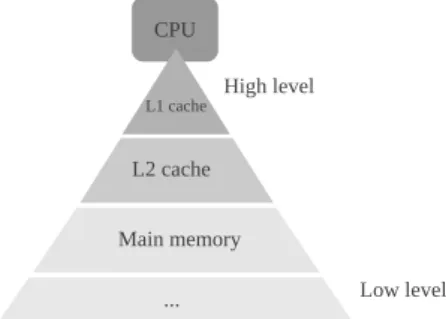
1.1 High and low memory levels in memory hierarchy . . . 10
2.1 Matrix loop-tiling scheme . . . 25
2.2 A Delaunay triangulation in the plane with circumcircles shown [55] . . . 33
2.3 Galois view of DMR problem [36] . . . 33
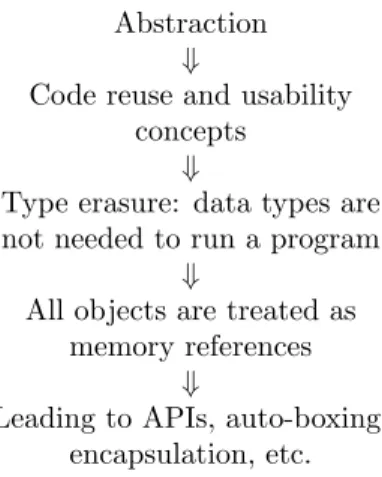
3.1 Concepts that led to problems of object-oriented in HPC. . . 36
3.2 Primitive and generic type array representations in memory . . . 36
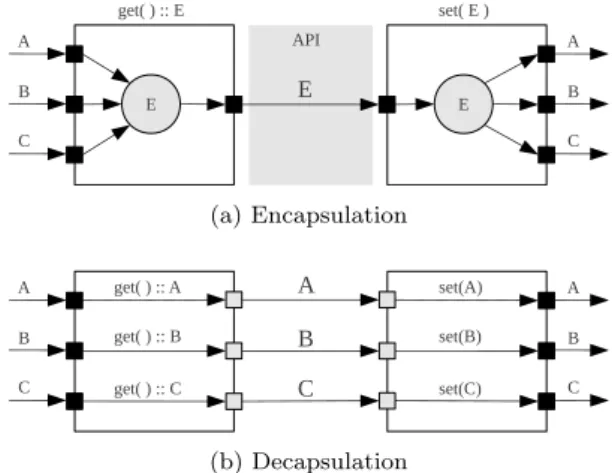
3.3 API encapsulation and decapsulation schematic . . . 37
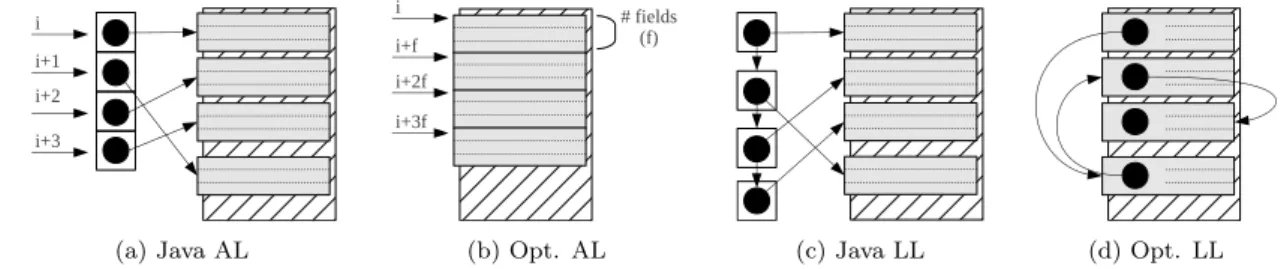
3.4 OO collections and pointer complexity. . . 38
3.5 A min-heap example . . . 40
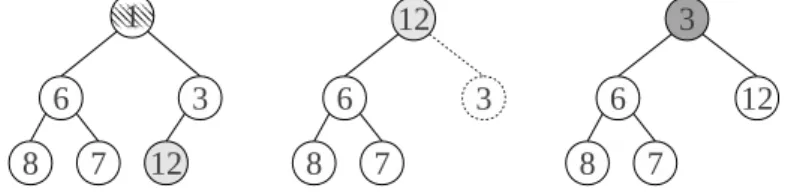
3.6 Inserting a new element (-2) and sifting up . . . 41
3.7 Removing smallest element (root) and sifting down . . . 41
3.8 A binary heap and its array representation . . . 42
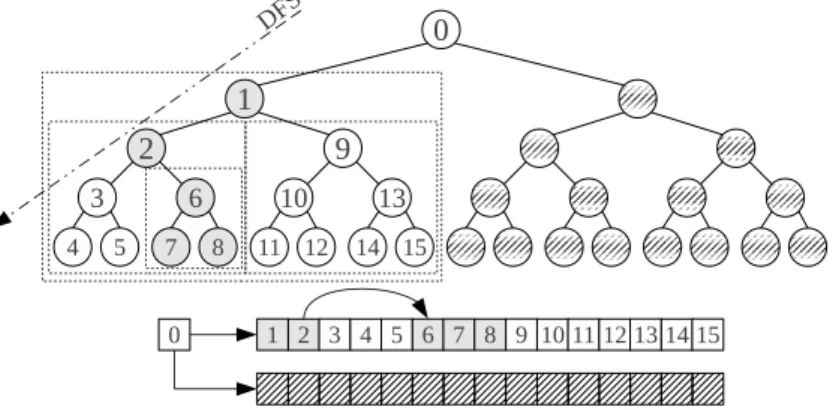
3.9 Van Emde Boas layout . . . 44
3.10 The VEB data layout - numbers correspond to array indices . . . 45
3.11 Schematic to explain the traversal details in a binary heap . . . 46
3.12 Schematic to explain the traversal details in a VEB heap with block size of 3 . . 47
3.13 AMAT and instruction counts for heaps . . . 52
3.14 Collections example . . . 55
3.15 Graph-Neighbour-Vertex AoP . . . 57
3.16 Optimized graph representations . . . 58
3.17 Priority-queue layout changes. . . 60
3.18 Neighbour API encapsulation and decapsulation schematic . . . 61
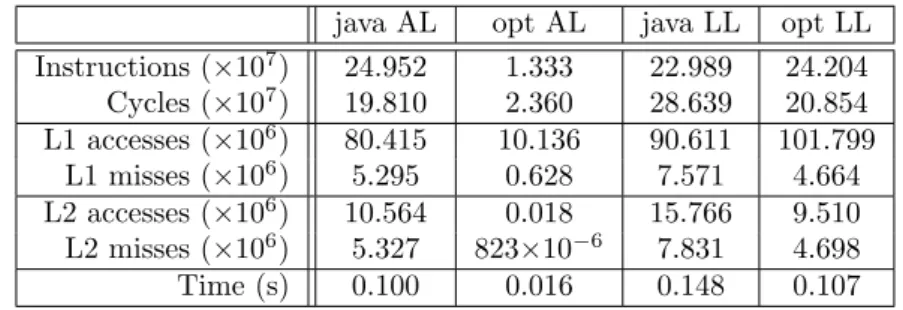
3.19 Summarized performance hardware counts of instructions, L1 and L2 access-es/misses and execution time (the average values for each API implementation are shown). . . 63
3.20 Discriminated performance hardware counts for instructions . . . 64
3.21 L1 and L2 cache miss and hit counts (note: logarithmic scale o y-axis). . . . 65
3.22 L1 and L2 miss ratios and rates. . . 65
3.23 Performance hardware counts of TLB data and instructions misses for all imple-mentations (note: logarithmic scale on y-axis). . . 66
3.24 Average memory access time metrics for all implementations. . . 67
List of Tables
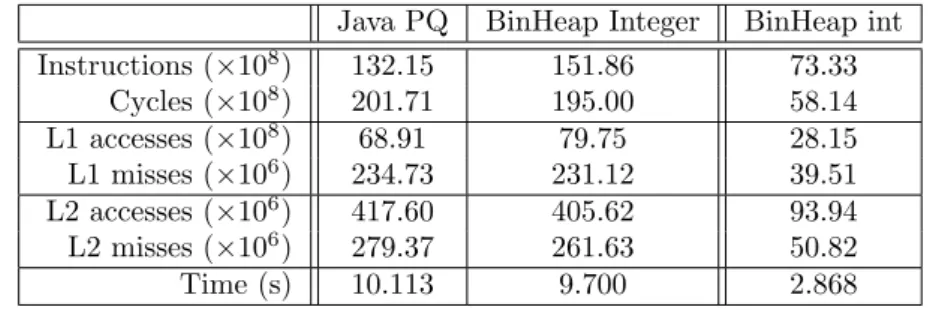
3.1 Benchmarks comparing Array-Lists, Linked-Lists and its variants . . . . 39 3.2 Benchmarks comparing priority-queues with boxed and unboxed types. . . 42 3.3 Benchmarks comparing a binary heap implementation to VEB-based heap . . . . 49 3.4 Benchmarks comparing binary heap and VEB 3 and 7 versions: no optimizations,
optimized sift-down and optimized sift-down and sift-up operations (d and u in VEB refer to sift-up and sift-down). . . 51 3.5 Non Commenting Source Statements average for each API version and average
increase in % for encapsulated and decapsulated APIs for all implementations of graphs and priority-queues. . . 62 3.6 Benchmark environment settings. . . 69 3.7 Considered hardware performance counters pre-set measurement events in PAPI 70 3.8 Average values for memory levels latency and miss penalties. . . 72 B.1 Hardware performance counters pre-set measurement events in PAPI . . . 87 B.2 Benchmarks combining graph and priority-queue versions (a =×108; b =×106) 88
Chapter 1
Introduction
We become what we behold. We shape our tools and then our tools shape us.
Marshall McLuhan Several strands in today’s computational science scene use and depend on large scale data such as molecular dynamics through the form of neighbourhood lists, computational biology, ge-ographic pin-pointing software (maps are basically processed graphs with pertinent data), etc.. These kinds of applications, holding massive data sets, require capable and large enough mem-ory systems able to attain a reasonable coefficient between processing phases and I/O phases. However, since larger memory levels are usually slower there is an inborn memory latency that impacts program execution. Which is why optimized software solutions that decrease latency times in I/O phases are extremely welcome. Due to today’s heterogeneity in devices (worksta-tions, clusters, laptops, phones, tablets, etc.), simply increasing memory characteristics may not be feasible - it may be expensive, or even physically challenging. Recently, the size of these devices has been decreasing making cache memories smaller and increasing the need of cache-efficient applications.
From an architectural point of view, the processor-memory gap has been increasing in modern architectures composed of efficient and high frequency processors. Processors in modern com-puter architectures are extremely powerful and can compute data at an intense rate. However data is not always readily available for processors to access, systems sometimes have to search for data in memory and this searching operation implies transferring data through a slow bus. Mod-ern memory architectures are usually a multi-level hierarchy, each level ranging from smallest and fastest to bigger and slower, in respect to the processing unit. The current memory architectures are extremely well prepared and the problems caused by memory stalls in an application, where the application needs to wait for data to be available to be read, are very well thought through. However, their throughput rate may not attend to current efficiency in processing units (CPUs,
1.1 Data intensive and Irregular applications Chapter 1: Introduction
Figure 1.1: High and low memory levels in memory hierarchy
GPUs, etc.) due to their limitations in memory size and bandwidth. Processor-in-memory is a concept that refers to a processing unit (such as a CPU) tightly coupled with memory modules in the same chip, in order to reduce memory latency. This has enabled the appearance of cache memories that are fast memories integrated with the processor to store data that the processor is likely to use - searching for data elements in higher level1memory is fast - see Figure 1.1. CPU
cache memories are much faster than, e.g., RAM memories, and when the processor searches for an element that is in cache this is called a cache-hit, on the other hand, if the element is not in cache and we have to fetch the data from the original memory device, we call this a cache-miss.
1.1
Data intensive and Irregular applications
A data-intensive application is, as the name implies, an application that needs to perform a large number of read/write operations from and onto memory in order to be able to proceed. When dealing with large chunks of data that do not fit into the small-fast memory levels (cache memory), data is stored in bigger and slower levels. Analysing in a finer grain how data-intensive applications perform in memory systems, memory stalls are caused by the lack of memory stor-age space and bandwidth responsible for bringing pertinent in-memory data chunks into close distance memory of the processing unit, and since pertinent data is not accessible the application must wait until it is loaded by the memory architecture from bigger-lower levels, stalling program execution.
Irregular applications are so due to the irregular access patterns performed over memory or, or due to a random factor that may condition and influence computations - let us focus in irreg-ular data structures. The irregirreg-ularity in data structures comes from the seemingly amorphous representation of data in memory - one cannot predict the memory access patterns as done in, for instance, a matrix multiplication problem where properties like cache alignment and tiling are easily predicted and managed to improve performance - the subject of data cache reuse and its positive impact in performance has been widely studied in [31]. Irregular data structures
1For clarity reasons, smaller/faster levels are considered high level and bigger/slower levels are considered lower
1.2 Locality of reference Chapter 1: Introduction
are usually featured by a pointer-chasing nature, which means a data chunk brought into cache memory (resultant from a load from a memory reference) may not be usable and the system has to perform a load from higher and more expensive levels. As a visual aid, the reader can imagine memory accesses jumping back and forth throughout a data structure taking no advantages from the data bulk loads made into cache memories.
Irregular applications often relate to data intensive applications because they both strain memory architectures due to their data-dependent nature - an algorithm cannot proceed until memory data dependencies are resolved and data is loaded by processing units.
1.2
Locality of reference
In this dissertation locality of reference (considered only locality for simplicity) is widely discussed as being one of the main issues to optimize - locality is related to the storage and loading processes in memory systems where load operations try to bring pertinent chunks of data into high-level memory, i.e., the relevant data to an application, thus minimizing the number of data fetches on slower memory levels. There are two kinds of locality: temporal locality and spatial locality. Good temporal locality consists of referencing data that will probably be referenced in the future (a good example of temporal locality is the caching system of browsers, by keeping the information of the most recent pages visited in memory); for instance, if the time interval in which the same memory region is accessed twice is a long time interval, it is very likely that the memory region has already been evicted from cache memory. Good spatial locality occurs when data is referenced and nearby memory sections become more likely to be referenced in the near future, avoiding loading memory that is off-chip, i.e., in lower memory levels - a good example of this are loop reordering optimizations in matrix multiplication problems, mentioned in Section 2.4.1.
The three C’s
Caches memories are defined by three main parameters that drive their basic functioning: total capacity, block size (or cache line size) and associativity (direct mapped, fully associative or set associative). An ideal combination of these parameters is hard to find because it deeply relies on the nature of applications being run. The authors in [22] performed an empirical study by benchmarking several different caches and distinguished three kinds of misses that might occur: i. compulsory misses, caused by first reference to a memory region - unavoidable regardless of
associativity and capacity.
ii. capacity misses, caused by the limited cache size solely - cache associativity is not considered. iii. conflict misses, misses that could be avoided, caused by earlier evictions of pertinent data. Two sub-types are also considered: mapping misses, cannot be avoided due to particular cache associativity level, and replacement misses originated by replacement policies.
1.3 Optimizing data layouts Chapter 1: Introduction
With the appearance of recent multiprocessor architectures has risen a new C, coherence
misses, where concurrent writes and reads may injure a program’s correctness and performance.
The class of misses studied in this dissertation does not fall directly into any of these categories, although it is related to each one: pointer-chasing misses can be caused by the first reference to a memory region (compulsory), that was not loaded due to the sparsity and size of the considered data (capacity); pointer-misses can also be conflicting in the way that data reuse is hard in irregular memory access due to the amorphous nature of irregular structures (conflict misses) -data reuse is hard to predict.
1.3
Optimizing data layouts
As a way of improving memory performance, improving data layout representations in memory is a good way to achieve better locality in cache memories. Data layouts have impact on cache performance because they directly affect the memory access patterns for a given dataset, improv-ing, for instance, cache-hit behaviour by reorganizing data elements for tighter adjacent memory addresses. Some of the most used data layouts consist in rearranging how elements and/or at-tributes in a data set are layed out in memory to achieve better alignment and spatial/temporal locality.
Of course, these optimizations sometimes strongly rely on the destined framework. Object-oriented frameworks show some possibly troublesome features in the scope of data intensive and irregular applications. Specifically auto-boxing and encapsulation can stand as a barrier to performance; some studies were made regarding the core features of data collections and their representation (layout) in memory in object-oriented environments.
1.3.1
Object-oriented and Memory management
Object-oriented (OO) frameworks appear as an undeniably useful resource providing software developers flexibility, abstraction and modularity. However, OO languages like Java and C#, implement virtual machines with their automatic memory management policies (garbage collec-tion, allocating and freeing allocated memory). The problem with (i) auto-boxing is that it does not guarantee memory element contiguity in datasets with abstract data types; the problem with (ii) encapsulation is that it may originate overhead in cross-structure optimizations.
In the specific case of Java, in the Java Virtual Machine (JVM) and its Garbage Collector (GC) the programmer has little or no control over memory allocation; when writing data intensive algorithms one must be careful and consider the overhead of generic type mechanisms and its underlying pointer-resolving overhead in generic collections.
1.4 Main goals, Scope and Contributions Chapter 1: Introduction
1.3.2
Parallelism motivations
Part of our interest in optimizing data layouts in irregular applications as also to do with the scalability problems of irregular data intensive algorithms in modern multi/many-core environ-ments, in which the problems of irregular accesses are aggravated. Conflict misses are common in this scope and can be avoided by rearranging the data space distribution for better use of memory accesses, however coherence problems are strongly related to multi-core environments, which can be a setback on optimization methodologies applied. Primitives which allow analysing the regions of data able to be processed in parallel have already began to be considered [36] -a d-at-a-centric view of irregul-ar -algorithms, inste-ad of looking -at comput-ation-al dependencies, is the main analysis. However, parallelism concepts are not considered in the presented work.
1.4
Main goals, Scope and Contributions
Goals
The main goal with this dissertation is to look at problems related to memory inefficiency in irreg-ular data intensive applications, perform a study on memory locality optimizations by changing data layout instead of using common loop reordering methodologies. Also, the aim is to study the impacts of high level object-oriented languages and show that despite the software development facilities, combining HPC with abstractions may generate undesired overhead. Layout optimiza-tions come as a suitable way to decrease cache miss counts and increase memory efficiency in modern multi-level memory architectures. Although abstractions may generate overheads there are possible solutions to demean them, for instance, improved virtual machine management or decreasing the complexity of the underlying abstraction layers in between optimized structures. We aim to present and study data layout arrangements that benefit performance through locality in overhead-prone environments of object-oriented.
Scope
The subjects in this dissertation are studied regarding locality optimizations, memory access patterns and pointer resolving complexity decrease. The main themes are:
• Object-oriented programming in scientific data intensive algorithms and related overheads. • Cache-friendly heap sorting algorithm.
• Linked data structures, which are typically irregular data structures being characterized
by a jump-pointer memory access pattern.
• Graph related algorithms, in the scope of irregular algorithms and data structures, namely
Prim’s Minimal Spanning Tree (MST) graph algorithm.
1.5 Organization of the Dissertation Chapter 1: Introduction
Contributions
In-depth analysis of low-level information gathered in a series of benchmarks to instruction counts, clock cycles, level 1 (L1) and level 2 (L2) cache-hits and misses in typically irregular algorithms and data structures is provided considering the main problems found in high-level languages. We point to important cares to take in high performance programming in these abstraction-based frameworks.
1.5
Organization of the Dissertation
This dissertation is composed of four chapters including the current Chapter 1 and the concluding Chapter 4. In Chapter 2 is discussed the current state of the art of the theories, methodologies and technologies applied in the scope of the dissertation.
Chapter 3, Optimizing data structures, embodies the studies made, taken considerations, work and results. Section 3.1 explains the problems of object-oriented frameworks. Benchmark and OO considerations have impact on how the case studies for priority-queues and graphs are contextualized, so these concepts are opportunely recalled in further sections (Sections 3.2 and 3.3). Layout optimizations and API refinement compositions are introduced in Section 3.4. The benchmarking methodology, so the reader can have a better understanding of the results presented are discussed and presented in Section 3.5, Benchmark methodology.
Chapter 2
Background
The goal of this chapter is to discuss the state of the art for models able to represent the I/O complexity of memories, introducing the concepts of cache aware and cache oblivious as perfor-mance improvement opportunities, optimizations at JVM level for object-oriented frameworks and finally a section dedicated to graph related data structures, algorithms and current method-ologies.
2.1
Cache-aware and cache-oblivious
Cache-aware algorithms are those that work optimally by regulating certain configurations that have direct impact on cache performance. These configurations must often be tuned for each platform since they perform better in some architectures than others. One simple example may be, the block size that many applications use in order to explicitly optimize cache alignment. As affirmed by Frigo in [20], cache-oblivious algorithms have no notion of specific cache parameters in order to make a given execution more scalable in a specific memory architecture. A cache-oblivious (COB) algorithm tends to perform well on any memory hierarchy model. Recent memory trends have deep variations of details such as the number of levels in its hierarchy or the memory size of each level, the data block size transferred between each level and associativity specifications. COB algorithms’ objective is then to ignore the memory specifications and adapt with some leeway to the memory model the algorithm is running on. Another big advantage is in its modelling aspect: if we model a COB algorithm according, for instance, to a two-level memory model, the COB nature will not be lost when applied to hierarchies with more levels.
2.2
Memory models
Computational models are an important mathematical tool used to express the implementation complexity of an algorithm in a relatively general way, and there are many models available to
2.2 Memory models Chapter 2: Background
express the complexity of modern memory systems [51]. Memory models are discussed in some depth by many authors that aim at cache conscious implementations of data-structures to help understand how we can consider in computational and abstract terms how to take advantage from cache memories to maximize cache efficiency (temporal and spatial locality) [47]. The memory models discussed in some depth are: random access machine model, external-memory
model, hierarchical memory model and the ideal-cache model.
2.2.1
RAM model
A Random Access Machine (RAM) is considered to be a hypothetical computer used to analyse and measure the running time of an application. The abstract computer considered in this model has following features : (i) each simple operation takes 1 time step (arithmetic, logical and jump operations); (ii) loops are not single-step operations given that the code inside a loop can influence the total program complexity - the complexity of loops depends on the number of iterations; and lastly, but most importantly, (iii) each memory access takes 1 time-step - the RAM model does not differentiate any level of memory hierarchy.
The main advantage in this model is its simplicity, however, this fact makes it most of the times unreliable in practical terms since it may ignore or violate important architecture features like: multiplication operations can take longer than sum operations; it does not represent modern memory systems properly not worrying about memory sizes, latencies or cache associativity.
2.2.2
External memory model
Typical external memory algorithms are a well known topic in problems in which data dimensions overcome the high level memory - the internal memory close to processing units which we consider to be internal when data is not transferred via slow BUS communication interfaces. External memory models are also known as disk access models or I/O models. According to Rønn et al. [47], this model can be seen as two consecutive memory layers communicating with each other: an internal and an external one. This model considers the following parameters:
• N, number of elements to process • M, size of internal memory
• B, number of elements that can be transferred in a block, 1 ≤ B ≤ M • P, number of blocks (B) transferred simultaneously, 1 ≤ P ≤ bM/Bc
One of the disadvantages of this model is that these parameters are specific of each architec-ture which makes code portability a burden, as most cache-aware implementations are.
2.2 Memory models Chapter 2: Background
2.2.3
Hierarchical memory model
The hierarchical model is different from the external memory because it considers several memory layers, each layer size increases in powers of 2 as it distances itself from the CPU. This model is not enough regarding some details between memory levels, for instance cache associativity. In this model each memory access does not take 1 time-step nor a constant time-step: each memory access depends on a certain function which defines the existing number of memory layers and the size of each layer, f (i).
2.2.4
Ideal-cache model
Algorithm analysis using this model considers, as in external model, the parameters B, M and N; the multiple transferring factor P is ignored. The underlying cache-obliviousness gender of algorithms sprays optimality in memory-bound algorithms considering any two contiguous memory levels, disregarding any specific architecture detail; also any portability problems raised by embedding architecture details in the code disappear, since cache-oblivious algorithms are unaware of B and M parameters.
The ideal-cache model is often referred by many authors as the model to consider for cache-oblivious algorithms and data structures. The ideal-cache model is a simplification of actual memory systems. With a number of assumptions made and justified by Frigo et al. [20] and mentioned in [47], this model can closely relate to modern memory hierarchies. An ideal cache considers the properties presented in the following assumptions.
Tall cache assumption
The tall cache assumption states that the block size is not greater than the number of blocks,
B ≤ M. A good visual aid for the reader is presented by Olsen et al. [39]: a tall cache is
the opposite of a wide cache, where the block size covers the size of the whole memory level. According to Brodal, the tall cache assumption is needed to achieve the optimal sorting bound with the Funnel-Sort algorithm [7]. The tall cache assumption is representative of most memory architectures in current computers, therefore memory models that assume a tall cache existence tend to present accurate analysis.
A common cache size assumed by most authors for modern architectures is M = Ω(Bγ+1),
where γ is a constant factor γ > 0, and is usually set to γ = 1 [10, 39, 7], therefore, cache size is defined by M = Ω(B2).
Optimal replacement assumption
A least-recently-used (LRU) replacement policy is used for cache data replacement, using a FIFO (first-in/first-out) strategy. According to Sleator, Tarjan [52] and Rønn [47], considering a cache size of M and a constant factor c > 0, any algorithm will incur in c times more cache misses than it would have when using an optimal cache with size 1− 1. According to [47], for a constant
2.2 Memory models Chapter 2: Background
c = 2, an algorithm that causes 2Q caches misses on an LRU cache (with cache size M, and
block size B), will cause a maximum of Q misses in an optimal cache of size M2.
Rønn et al. [47], presented a fairly interesting example for this replacement problem. Before hand lets clear some necessary concepts for understanding the next presented case:
• BS= block size
• M = memory size • M
BS = cache line size
Recurring to the same example in [47], consider a cyclic scan over an array divided in b blocks, and each block stores #elsb= BMS + 1 elements; an access to the first element of the first block
will bring into cache a block of BM
S elements, leaving the last block element out of the loaded
block. Since we consider an LRU policy, when accessing this last element, which is already out of the cache block, the first accessed element will be discarded (due to LRU eviction), however since this last element belongs to another block, a cache miss occurs and as a result another block is discarded - this will cause a cache miss per access until the algorithm is finished.
However, this worse case scenario rarely occurs when dealing with regular complexities, also, when compared with random data placement policies, the results are similar.
Two memory layers assumption
Since the ideal cache model considers only two memory layers, real and common memory sys-tems operate with up to five levels, we need to ensure that this model is applicable on such architectures. Rønn et al. discusses two alternatives to justify the optimality of a two memory layer:
(i) data in a given memory layer i is also present at layer i + 1, being layer i the closest to CPU - this is called the inclusion property.
(ii) the inclusion property is maintained in between any two consecutive memory layers for any
sequence of accesses; the data present in a given memory layer i is also present at memory
layer i + 1, given the same memory access patterns. In theory, it is as if layer i works as the highest level (closest to the CPU) in the memory hierarchy.
Auto-replacement and full associativity assumption
The underlying idea behind auto-replacement is to automatically replace cache blocks in case of occurrence of cache misses. This is a concept easily understood from a programmer perspec-tive: hardware processes high-level cache-misses and usually the operating system handles data transfers in lower levels like RAM or disk.
Full associativity allows for a memory system to choose freely where to store data loaded into cache levels - this property, although forcing programs to search in more cache memory addresses, can result in fewer cache misses.
2.3 Cache-aware/oblivious sorting Chapter 2: Background
2.2.5
Caches in multi-processor environments
Although we do not attend the problems of parallelism in this dissertation, it is important to note that cache systems in current parallel architectures may implement a series of features that may revolutionize more traditional approaches to cache efficiency: inclusive and exclusive caches. In inclusive cache environments if a chunk data is present in L1 cache it is forced to be present in deeper cache levels as well. This assumption is made for the ideal cache memory model presented in this chapter.
The appearance of exclusive caches goes against the assumptions made in the presented models - inclusion is expected for all considered memory levels. Multi-core processors like AMD OpteronTMmaintain the coherence of data between several cores by sharing a cache that serves all cores in the process of fetching data from non-cache levels [24, 1, 12]. L2 and L3 caches are exclusive to each core, in order to reduce the costs of synchronization between core-specific caches. In these cases, L2 and L3 caches work as victim-caches (holding data evicted from L1 cache), and all data fetches are directly aimed at L1 cache, skipping L2 and L3 that might have been causing coherence problems, or overhead-ish operations to avoid them.
Nevertheless, we initially assume for all models and analysis made in the dissertation, the inclusion property in multi-level cache systems.
2.3
Cache-aware/oblivious sorting
Sorting algorithms restrain memory architectures - we can look at different optimization scopes depending on its intended usage and data-type to sort: (i) optimization from a complexity optimization point-of-view or (ii) from a memory performance point-of-view.
Many authors provide several sorting primitives and alternatives to traditional sorting prim-itives, being the most popular cache-aware/oblivious variants of sorting primitives like heap-sort [49]: Distribution-Heap [3], Funnel-Heap [8], etc. One of the most interesting cache-oblivious implementations is the one proposed by van Emde Boas [15]. But before jumping into the cache oblivious/aware studies we study sorting implementations that do not concern about cache effi-ciency - some examples are: Fibonacci-Heap [19], Pairing-Heap [18], Violation-Heap [14].
In this section we provide an overview of the studies made around the efficient priority-queue (PQ) and heap implementations.
2.3.1
Efficient heap implementations
A sorting algorithm may apply various techniques, such as divide-and-conquer - let us focus on heap-sort techniques. A heap is a tree-based data structure that obeys the heap property (Definition 1). Many authors studied and developed efficient structures in this area, some of which are explained with some detail and discuss the main advantages/disadvantages between them.
2.3 Cache-aware/oblivious sorting Chapter 2: Background
Definition 1. Heap property - the key of a child node must be higher or equal than the key of
its parent (this can vary whether we consider a min-heap or a max-heap; in our case we consider a min-heap).
Fibonacci-Heap
A Fibonacci-heap, developed by [19] is a binomial heap that follows a specific set of rules. A binomial heap may be composed of several binomial trees. The order k of a binomial-tree1inside a binomial heap can vary; if it has order k = 0 the tree is composed of a single node; if not, the binomial tree with order k has a root with k children, each of order corresponding to the set represented in equation 2.1, i.e., the order of each child would be [k− 1, k − 2, . . . , k − k].
{k − i}, i ∈ [1, 2, . . . , k] (2.1) Binomial-heaps obey the heap property (Definition 1) and several other properties not con-sidered here.
The Fibonacci-Heap data structure is a linked-list where each node stores pointers to four other nodes: parent, left and right sibling, and one of its children - the structure does not need to point out all children because that is implicit by making the linked-list circular. The main aspect to take into account here is optimizing operational complexity. The most commonly found operations in heaps are: insert, find-min, delete, delete-min (a combination of find-min and delete) and update-key (with the variations increase-key or decrease-key). For the Fibonacci-Heap, having a full understanding of how these operations work may be complicated, so we first provide an explanation of the main intention grounded to this heap.
Underlying idea in Fibonacci-Heaps and Amortized analysis
The Fibonacci-Heap’s main feature is the amortized bound costs in operations delete and
decrease-key. Amortized analysis2is focused on analysing an algorithm basing judgements in not only the immediate results but also in longer-term results that are based in a sequence of operations. The underlying idea is to ”delay” work for later operations that will do it in less asymptotic time that it would if it had been done in a single operation. In this Fibonacci-Heap case, amortized analysis comes in, for instance, in delete-min operation: the work related to obeying the heap-property after each operation is successively delayed to later operations - even though we do not know the absolute correct position of every element in the heap, we know what is the minimum/maximum. The insert operation takes constant time O(1); decrease-key takes amortized cost O*(k), where
k is a constant therefore O*(1); delete-min takes O(log n).
1For clarity and simplicity we may sometimes refer to a binomial tree with order k has B
k
2.3 Cache-aware/oblivious sorting Chapter 2: Background
Pairing-Heap
Pairing-Heaps were introduced in [18], and studied further in [53, 17, 42]. This heap is a multi-way heap ordered tree which is based also in amortize-bounded operations and it has better practical results when compared to other heaps such as Fibonacci-Heaps. The data structure used for this implementation is in general terms a pair composed by a root element and a possibly empty list of pairing sub-heaps. The heap property presented in Definition 1 is also present: all sub-heap roots must not be smaller than the root element.
Underlying idea in Pairing-Heaps
The heap property is maintained with delete-min operation which consists in two phases im-plicitly made by recursive calls (first phase) and their corresponding backward steps (second phase):
(i) a left-to-right pass, merging pairs of sub-heaps together (thus its designation), (ii) and a right-to-left pass, merging the resulting list of sub-heaps.
Insert operation runs in asymptotic time of O(1); delete-min takes O(log n); and the merge
operation takes O(1).
2.3.2
Cache-efficient heap and priority-queues
From this scope we now take a look at the memory behaviour of cache-efficient heaps instead of just relying in complexity analysis and operational optimization. The heaps mentioned further also consider the memory models (see Section 2.2) and the analysis is done based on these.
The cache oblivious nature of algorithms in this section is crucial for the good results that have been achieved in most recent research material. Data structure engineering has a higher importance in cache-aware/oblivious - these may directly influence the performance of a given algorithm because memory issues such as cache alignment, cache replacement policies or size assumptions play an important role.
Funnel-Heap
The Funnel-heap, introduced as a priority-queue in [8], is based on binary-merging of values present in buffers existing in a queue. The data structure is simple and easily imagined as a binary tree of buffers and binary mergers, the two main elements for this priority-queue structure. This algorithm is a variant of merge-sort (divide-and-conquer paradigm) [11] and was based on
funnel-sort [20]. The data structure presented in [20] has a good memory behaviour for its operations;
the insert and delete-min consider a tall-cache (see Section 2.2.4) and have an amortized I/O cost per operation of O(B1logM/BNB).
2.3 Cache-aware/oblivious sorting Chapter 2: Background
Distribution-Heap
The cache-oblivious PQ implementation presented in [3, 39] is partitioned by levels, each of which has buffers with sizes depending on the level its in. The authors of [3] divided their structure explanation in three parts: levels, buffers and data layout.
This structure consists of Θ(log(log(N ))) levels that can extend from size N to a constant
c. The ithlevel has size N(2
3)i−1 therefore level sizes would be the following: N , N23, N49, ..., c.
Elements are stored in buffers from each level that do not only store elements but are also used to pass elements up and down the structure levels. The number and sizes of such buffers are, for level X :
• one up buffer uX, with a maximum size of X elements,
• and at most X1
3 down buffers, each with maximum size between 1
2X
2
3 and 2X23 elements.
There are invariants defined by the authors to ensure the correctness of this heap throughout these various levels:
Invariant 1. The down buffers in level X are sorted externally, but their internal elements may
not be sorted.
Invariant 2. At level X, the elements in down buffers have smaller keys in up buffers.
Invariant 3. The down-buffer elements of level X have smaller keys than down buffer elements
of the next higher level X32.
Up buffers store elements on their way up the heap; as for down buffers store elements on
their way down the heap. The single-element insert and delete-min operations are not directly
implemented. The operations that insert and remove elements from this heap are push and pull, which insert and remove a stream of elements (respectively) into/from a given level. In [39] the author implemented the single-element operations creating auxiliary insertion/extraction buffers.
Cache-oblivious B-Tree
A B-tree [5] with a block size B (according to memory parameters) gets to an optimal search
bound of O(1 + logB+1(N )) and allows insertions, removals, updates in amortized logarithmic
asymptotic time. It is basically a regular binary tree data structure with the possibility of storing several elements per node as well as having several children. The cache oblivious B-tree developed in [5] uses the van Emde Boas layout [15], not the data structure itself, only the data layout. The objective was to create a multi-level structure that behaved well in more than two memory levels as well as consider several sizes for transfer blocks. As explained in [15] the van Emde Boas layout is a recursive data layout that allows for spatial locality benefits, which allied to the characteristics of B-trees and good asymptotic times the authors proved to have near-optimal efficiency on any multi-level memory architecture.
2.4 Locality optimizations Chapter 2: Background
In order to maintain locality of reference, the authors in [5] developed the tree to be strongly weight-balanced and to do so they considered the following properties:
(i) Descendent amortization - under the assumption of whenever a node is rebalanced, their descendants are all touched ; the amortized number of elements per insertion is O(log N) (ii) Strong weight balance - for some constant d, every node at a given height h has Θ(dh).
One of the main concerns in this research was the inefficient usage of memory space due to the strong weight balance property: it makes the PQ waste array storage space creating unused wholes in the B-tree data structure, therefore a packed-memory array is considered in their work.
2.4
Locality optimizations
In a general way, applications have been optimized regarding locality of reference through the use of two methodologies: (i) changing the order of nested loops [34, 2, 21] and (ii) through the use of data space transformations (changing array layouts) [25, 2, 33, 9]. One of the main concerns in parallel computing is, precisely, locality of reference. Locality optimizations allow for multi-processor architecture to make better use of data distribution. As stated in the early research in [2], in order to increase locality, skilled programmers manually altered data structure and algorithm specifications. An effort is clearly made to make compilers automatically generate such optimizations, specially in multi-processor environments where the performance gains are scalable [2]. For instance, the data layout of a parallel application through several processors can be optimized by automatically assigning memory regions to specific processing units (or the opposite, processing units to memory regions) in order to increase memory coalescing and decrease inter-processor data communication and synchronization [25, 2] (which results in unwanted latency). This is broadly explored by reordering nested loops to alter the access patterns for each (possibly parallel) iteration, basically to assign to each iteration work that operates in contiguous or the same memory addresses. However, problems like legality and data correctness of algorithms may not always allow loop reordering techniques. Data space transformations do not interfere with the specifications of an algorithm, however they can limit an application: if a data structure is transformed, all accesses to that structure must be revised; as for loop reordering, only the loop in question is affected [2]. In modern object-oriented frameworks, accesses to structures can be abstracted, however such abstractions are prone to overheads.
2.4.1
Algorithmic locality optimizations
Optimizing locality can go through changing the access patterns of the computations. Since loop-based applications are more susceptible to locality optimizations, changing the order and the amount of accessed data at different iterations can greatly improve performance.
2.4 Locality optimizations Chapter 2: Background
Loop reordering
This optimization consists in inter-changing and interfering with the order of the loops to change the access patterns of the computations applied in the data structure. Another common consid-eration is to improve register usage, i.e., prevent unnecessary slow memory accesses if the value can be stored in fast memory, through the use of temporary variables [56]. Changing the order of loops can greatly improve the efficiency of memory accesses spatial locality is improved -see Listings 2.1 and 2.2, which show a matrix multiplication algorithm. The improvement is in the order of access to rows and columns: the optimized version iterates through the second (B) matrix in a raster manner (row-major), which for row-major languages3 means good cache
alignment and spatial locality improvement, since the loaded row from B will be used, instead of the column from B - this means that each resulting matrix (M) element is not fully computed at each iteration, instead it is successively computed to take advantage of row-major accesses in matrix B.
Listing 2.1: Regular matrix multiplication implementation
1 f o r i = 1 t o N
2 f o r j = 1 t o N
3 f o r k = 1 t o N
4 M[ i , k ] += A [ i , j ] ∗ B[ j , k ]
Listing 2.2: Matrix multiplication implementation with loop-reordering
1 f o r i = 1 t o N
2 f o r k = 1 t o N 3 f o r j = 1 t o N
4 M[ i , k ] += A [ i , j ] ∗ B[ j , k ]
Loop tiling
Loop tiling (or blocking) consists in considering blocked versions of a given loop-based application that uses nested loops, in order to improve aspects like cache alignment and data reuse (through the form of temporal locality) and loading of pertinent adjacent memory (spatial locality). This form of optimization has been studied also as a way to identify independent data chunks and uncover parallelism [57, 56]. Tiling reduces the number of loads from lower memory levels, by taking advantage of the data already present in cache.
Listing 2.3: Matrix multiplication implementation with loop-tiling
1 f o r i i = 1 t o N s t e p s 2 f o r j j = 1 t o N s t e p s 3 f o r i = 1 t o N 4 f o r j = i i t o min ( i i + s − 1 , N) 5 f o r k = j j t o min ( j j + s − 1 , N) 6 M[ i , k ] += A [ i , j ] ∗ B[ j , k ]
2.4 Locality optimizations Chapter 2: Background
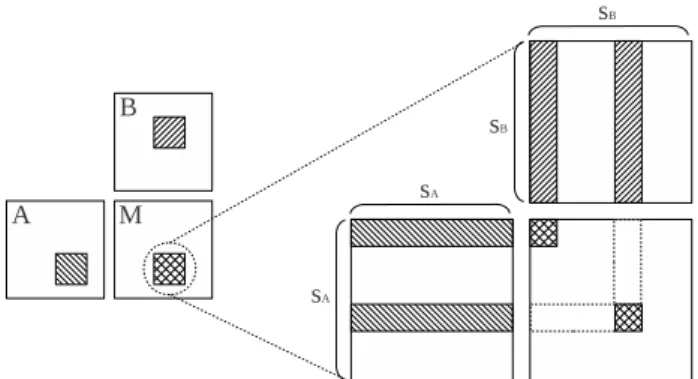
The main aspect optimized in tiled matrix multiplication algorithm in Listing 2.3 is temporal locality: the values that have already been accessed and computed, and will be needed for future computations are reused in inner loops. Ideally, the blocks implicitly created by partitioning computations correspond to blocks that fully fit in cache. A scheme of loop-tiling is shown in Figure 2.1 for multiplying matrices A and B, resulting in matrix M.
Figure 2.1: Matrix loop-tiling scheme
2.4.2
Data layout locality optimizations
The previous optimizations only interfere with the algorithmic part of a program - it is basically adapting an algorithm to the data structure by performing the necessary actions to better suit the algorithm to the data structure and hardware specifications. Data layout optimizations refer to an alternative concept which is interfering with the data layout of the considered structure and make the necessary data arrangements in memory in order to improve the access patterns performed by a given algorithm.
Tiling and recursive layouts
Tiling is a data rearrangement technique used to improve the cache efficiency by explicitly place elements in memory in such a way that cache accesses are maximized [45, 40, 15]. In [15] a recursive layout is defined for the tree in a heap-sort implementation: this layout consists in storing down-going children tree elements in adjacent memory regions so that memory accesses converge to the same memory regions. This kind of optimizations (data layout optimizations) relies mostly on the improvement of spatial locality - the arrangement of elements in contiguous memory addresses.
Inlining and marshalling layouts
Inline allocation of data structures consists in optimizing spatial locality by eliminating one level
2.4 Locality optimizations Chapter 2: Background
of the reference to avoid wholes in memory (preserving semantic order). This optimization is possible to be applied in compilers and object-oriented frameworks - where usually objects are considered memory references. This optimization gender has positive impact in data intensive applications where collections of objects are used. Many compilers and, in the case of object-oriented, garbage collectors, apply similar policies to eliminate some level of indirection between pointers and data, resulting in lower pointer dereference costs. For instance, object-online re-ordering in Jikes [23] increases spatial locality by performing compile-time analysis, adaptive sampling and object traversal in garbage collecting phases: it finds the hot spots (fields and methods) in an application and rearranges them in memory for improved spatial locality.
Marshalling may be perceived as the process of serialization, however backed by a different
concept: if data is present in a pointer-chasing collection is sparsely layed out in memory, the process of marshalling compacts data elements together, not considering any specific order except that of the original order of the elements - this concept is used for example in computer com-munication policies to decrease the storage space of structures, but can also be used to influence data layout and access patterns.
Studies on the latency impact of data-intensive applications on modern memory architectures have been made in [4] - the authors study three kinds of memory access patterns and offer some views over software pre-fetching and locality optimizations. Both sides are singly analysed warning to the value of latency tolerance and latency reduction for software pre-fetching and locality optimizations respectively. According to their study, locality optimizations show better latency behaviour than software pre-fetching in low memory bandwidths, and the opposite for high memory bandwidths. The work at [4] denotes three specific types of structures that provide different approaches on memory access patterns: affine array accesses, indexed array accesses and pointer-chasing accesses.
Affine array accesses
Memory accesses with a constant and well known behaviour such as accessing multidimensional arrays, common on applications like dense-matrix linear algebra and finite-difference PDE (par-tial differen(par-tial equations) solvers - no irregular data accesses.
Indexed array accesses
As seen further, this access pattern organizes data in an indexed manner so that less space is needed. However the cache performance on such patterns is poor due to irregular memory accesses. One does not know previously the data organization on memory. These irregular accesses on memory make an irregular algorithm, where the amount of computation is only uncovered at run-time.
2.4 Locality optimizations Chapter 2: Background
Pointer-chasing accesses
Structures based on pointers, like linked lists and n-ary trees, are part of this memory access class. It shares some characteristics with the indexed concept, because the access to a specific portion of data must be resolved (at run-time) to access the data itself. The main characteristic in this type of access is that an access to an additional part of the data-structure can only be resolved when the pointer to that portion of data is resolved.
Software pre-fetching consists in explicitly placing fetching instructions on memory that is
likely to be missing in cache. This has proved to be a good way to avoid memory stalls and some studies are made regarding this subject on memory access patterns (discussed earlier). The authors use pre-fetching for all three kinds of memory accesses to hide memory latency - locality optimizations are presented as a way to reduce latency by reordering computations and/or data layouts: (i ) for affine array accesses, tiling is given as a good choice; (ii ) for indexed accesses, data and data layout reordering can also be used to improve spatial locality at compile and run-time; (iii ) for pointer-chasing programs the used technique is dynamic memory allocation to improve spatial locality, for instance, dynamic locality-conscious placement of parent and children nodes of a tree at run-time - a cache-conscious heap is introduced.
2.4.3
JVM level optimizations
The Jikes RVM4(Research VM) project is a research aimed Java virtual machine that introduces several optimizations. Studying the topics of multi-threading, multi-core heterogeneity and, in our interest, garbage collection strategies for improved performance, namely in the field of locality optimizations. In [23] et al., the authors state that although explicit memory management in C offers benefits in allocation performance, it has a hidden setback: ”it cannot move objects
without violating language semantics”, like in Java’s GC. Online object reordering (OOR) is
introduced as a way to inject locality in Java applications, by using copying collectors, finding hot (frequently used) field accesses and storing objects in memory using heat information. The authors in [23] concluded that their framework optimizations improved locality aspects with a negligible overhead.
Regarding one of the problems studied in this dissertation - OO related overheads (Chapter 3.1) - the need of high-level low-level programming is enhanced in [16], where the authors explain that underlying abstractions commonly used in Java may represent a source of overhead in program performance. As such, an optimized framework is implemented addressing the problems of data representation (primitive, compound and unboxed types) - featuring, for instance, layout control of fields/attributes inside a class.
2.5 Graphs Chapter 2: Background
Object-online reordering in Jikes
In the interest of locality, object-online reordering (OOR) in Jikes virtual machine goes through three phases: static hot field access identification, dynamic hot field identification and garbage collection reordering [23].
(i) static analysis: at compile-time, the program code blocks are marked as cold or hot. This distinction is made through a series of heuristics mentioned in [23], like loop analysis and branch-prediction; for instance, loop code blocks are marked as hot since these are eligible to be run multiple times.
(ii) dynamic hot field identification: samples are periodically taken at run-time for methods and fields accesses - heat parameters are then redefined for each code block at each sample. (iii) garbage collection reordering: at GC-time, hot blocks are traversed first, and an array with all heat values is created to map hot fields; finally, hot fields are enqueued in memory according the order of the heat-array - the data layout is in agreement with the program’s memory access pattern.
When compared to the work presented in Jikes, although with the same concerns in mind, the approaches presented in this dissertation rely more on data structure optimization aspects - we do not aim at run-time analysis nor garbage collecting methodologies to improve locality, instead we study data layouts, optimization opportunities in memory access patterns and the problems of core features in object-oriented development.
2.5
Graphs
In this section we focus on graphs, a type of data structures with a seemingly amorphous rep-resentation in memory. Graph considerations in computer science can extend from development methodologies for generic purposes and usability [35] (such as Jung and JGraph libraries), to lower level considerations like memory usage and performance [29, 43, 50, 36].
2.5.1
Existing graph libraries and tools
Although serving different purposes, there are several libraries and tools that allow the use of graphs in the most distinct areas like social networking, flight travel map, statistical analysis or general optimization problems. Libraries like JUNG or JGraph implement generic graph data structures and algorithms that consider a wide range of concepts - directionality, weighed or unweighed, multi-graph (one edge connecting more than two nodes), etc. These general-purpose tools and data structure implementations are separated in several layers, distinguishing their formal specification from the implementation decisions, by applying APIs, generic data types and inheritance to represent multiple graphs variations. Graph data structures in this general context
2.5 Graphs Chapter 2: Background
are usually represented has maps between nodes and a corresponding list of edges representing the neighbouring nodes (and respective weights if applied).
2.5.2
Development methodologies
When it comes to develop a tool or library capable of efficiency and structural flexilibity there is a wide range of methodologies possible to apply. In this section we will focus on development methodologies applied in the field of software engineering and advanced computing more turned to our scope, graph based irregular applications. The use of generic ideals is the main goal when mentioning development issues, therefore generic programming is widelly cared for.
Product-line methodologies
A product-line (PL) is software product that results from using abstraction models and interfaces in order to compose a set of features an application should have thus making an application -where the idea is to define isolated members and building elements that are able to be articulated and combined with each other, thus creating an application with its own set of features. The purpose of PL methodologies comes from the convenience of building an application based on a group of features, rather than writing a whole application from scratch; PL is more practical and cheaper.
The authors of [35] show that the areas in which one should apply different kinds of
product-lines are still unclear in the scope of computer science. Different technologies, as well as different
design orientations (such as object-oriented) may have applied and may themselves apply different PL methodologies.
Graph product-line
Regarding implementation issues, the studies made in [35] provide a good insight in this subject. Graph product-line (GPL) is a family of classical graph applications where each application is built by combining graph-based features modelled as a common grammar. A central property of PL applications, is that some features may block the appliance of some other features. For instance, in order to implement an MST algorithm the graph must be weighted. In this thematic
GenVoca is introduced as a step-wise extension modelling view of building an application - the
underlying idea is ”programs are values [35]”.
The evolution of implementations presented in [35] is very important since it denotes the fact that the usage of different implementations in different applications may result in very different performance outcomes. The three different implementations presented are: (i) adjacency lists,
(ii) neighbour list and (iii) edge-neighbour representation. The differences between each one
of the representations came (as the authors imply) from a series of optimization attempts and improvements. One of the problems identified by the authors was conceptual shifts that might
2.5 Graphs Chapter 2: Background
have been occurring when evolving the implementation, and its effects on the final application/al-gorithmic results; the example given was the folding of conceptual objects into singled physical objects, i.e., premature optimizations can obstruct development.
The generic graph component library (GGCL)
GGCL is a framework developed in C++ that makes use of technologies like the Standard Template Library (STL). The goal is to produce a tool that follows object-oriented philosophies, providing functionality, reliability, usability, efficiency, maintainability and portability [37, 32]. The work presented at GGCL shows a generic graph programming framework, where the concepts and ideals of the generic programming paradigm are applied.
Algorithms implemented with GGCL don’t operate directly with data-structures, where usu-ally graph specific data like node and edge data is stored, unlike the majority of graph tools available (LEDA, Graph Template Library, etc.). Most existing graph tools are inefficient when it comes to flexibility - properties like the weight and color of an edge are often explicitly hard-coded on algorithms, which leaves little further usage on other possible contexts or algorithms. The GGCL framework makes use of the visitor pattern concept, applied with generic program-ming concepts in order to implement generic operations (a concept similar to functors). The interaction between data-structures and algorithms is made via abstract interfaces on the graph domain: vertex, edge, visitor and decorator. Generic data-structures may not be usable enough in graph domain problems, therefore, specific interaction interfaces were needed so that the authors define generic enough algorithms (using graph abstractions).
The graph, vertex and edge concepts are fairly easy to understand. On the other hand, visitor and decorator concepts are more complex, however interesting. A decorator is presented as a ”generic mechanism for accessing vertex and edge properties”; these properties are, for instance, weight or color. Visitors, much like functors, define the behaviour of generic operations. This proved to be an easy and efficient way of adding operations to an algorithm without changing the source code of the original implementation. These two features, allow for more flexibility when using graph structures or algorithms. Also, the programmer is able to extend and add new user-defined visitors and decorators. In terms of performance, the GGCL framework proved to be more efficient than other commercial and vendor-tuned libraries like LEDA.
2.5.3
Parallel Irregular applications
Irregular algorithms are mostly based in pointer-based data structures and are called so because one cannot assume or decide on the future operations it will do due to an external factor that is out of control of the programmer or algorithmic control. This factor can be influenced, for instance, by probability or the data itself, i.e., the fact that we do not previously know data values and layouts does not let us apply optimizations such as in matrix multiply with tiling or
![Figure 2.2: A Delaunay triangulation in the plane with circumcircles shown [55]](https://thumb-eu.123doks.com/thumbv2/123dok_br/17753735.834685/37.892.374.512.234.384/figure-delaunay-triangulation-plane-circumcircles-shown.webp)