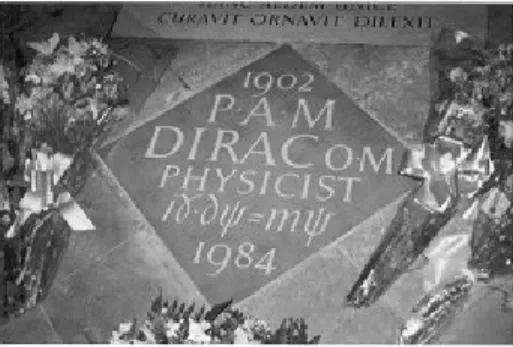
PAUL DIRAC AND HIS BEAUTIFUL MATHEMATICS
Shawnee L. McMurran California State University - USA
James J. Tattersall Providence College - USA
Introduction
In 1975 Paul Dirac wrote, “Again and again, when I have been at a loss how to proceed, I have just had to wait until I have felt the mathematics lead me by the hand” [17]. Renowned for his role as one of the architects of quantum mechanics, Dirac was the creator
of the relativistic equation for the electron, which tied Einstein’s relativity to Heisenberg and Schrödinger’s quantum theory, and the first scientist to predict the existence of the positron. Yet through his words we glimpse the heart of a mathematician. Dirac claims that mathematical elegance played a crucial role in directing the course of his research and he credits many of his discoveries to his search for beautiful equations. Indeed, the view that “a theory with mathematical beauty is more likely to be correct than an ugly one that fits some experimental results” [11, p.29] seems to imbue his lectures, articles, and memoirs. In this paper we examine some of the “beautiful mathematics” which may have helped shape the early work of this eminent theoretical physicist.
Especial n 1 – Festschrift Ubiratan D’Ambrosio – (dezembro/2007) Publicação Oficial da Sociedade Brasileira de História da Matemática
ISSN 1519-955X
From Bristol to Cambridge
Paul Adrien Maurice Dirac was born in a suburb of Bristol, England in 1902. His father, Charles Adrian Ladislas Dirac, was a native of Switzerland who had come to Bristol as a French tutor in the 1890s. The senior Dirac continued to teach until his death in 1936. Paul’s mother, Florence Hanna Holton, was a library clerk. Born in Cornwall, she had moved to Bristol when her father took up a post as master mariner on a Bristol ship. Paul had a younger sister, Béatrice Isabelle Marguerite, and an older brother, Réginald Charles Félix, who was a draughtsman until his untimely death by suicide [32, p.256].
Education played a fundamental role in the Dirac home. Paul’s mathematical ability was readily apparent when he was in primary school, and his father encouraged him toward mathematics [6, p.142]. However, in other aspects, his childhood was somewhat austere.
Paul recalls that his father insisted that his children speak to him in grammatically correct French thinking that would be a good way to learn the language. Paul, however, says, “Since I found that I couldn’t express myself in French, it was better for me to stay silent than to talk in English. So I became very silent at that time …” [34, p.93]. Paul also recalls that his father “did not appreciate the need for social contacts”, with the result that Paul became an introvert and spent his time thinking about problems in nature [34, p.94]. However, although Dirac’s nature was reticent throughout his life, friends and colleagues would often marvel at his ability to speak in very few, yet very well-chosen, words.
During the World War I years, Dirac had the opportunity to do his secondary schooling at the Merchant Venturers’ Technical College in Bristol where his father taught French. The upper classes were unusually small due to the war, so Dirac and some of the other brighter students had the opportunity to study higher mathematics, physics, and chemistry at an unusually early age. Classmates described the young Dirac as quiet and as being a “tall, un-English looking boy in knickerbockers, with curly hair” [6, p.142].
In 1918 Dirac went on to study electrical engineering at the University of Bristol. Concurrently he explored relativity theory, a subject that had captivated his attention and was then regarded as a branch of applied mathematics.
The turn of the century saw some revolutionary advances in mathematical thought. Mathematicians were reconsidering Euclid’s axiomatic method and exploring the consequences of altering the basic propositions. This exploration opened the door for the mathematics needed in the development of the theory of relativity and quantum theory. These theories, which, respectively, describe motion at very high speeds and the behavior of very tiny objects, required mathematics beyond that of Newtonian mechanics.
By 1919, fourteen years after its inception, Einstein's general theory of relativity had captured public interest, partly due to its confirmation by British astronomers Frank Dyson and Arthur Eddington. The theory fascinated Dirac. He pursued his interest by attending a course offered by the philosophy department at the University of Bristol and studying the material on his own. By the time he earned his Bachelor of Science degree in electrical engineering in 1921 - with first-class honors - he had a good grasp of the theory and its mathematics.
in part to the recession in England that followed the war and due in part to an unfavorable report from the British Thompson Houston Works at Rugby where he had worked to gain the practical experience for graduation [6, p.71]. The Mathematics Department at the University of Bristol, which had hoped that Dirac would study mathematics instead of engineering after leaving secondary school, offered him the opportunity to be an unofficial student so that he might go through their program without having to pay fees. He accepted this generous offer and completed the program with first class honors in 1923. He was subsequently awarded a research grant by the Department of Scientific and Industrial Research, which gave him the means to pursue his goal of continuing his studies at Cambridge University.
Dirac’s goal upon entering Cambridge was to study relativistic electrodynamics because of his deep interest in Einstein’s relativity theory. He was disappointed to learn that the customary tutor, Ebenezer Cunningham, had no more room for students. Ralph Fowler of St. John’s College, a theoretical physicist who was familiar with recent developments in quantum theory occurring in Germany and Denmark, agreed to supervise Dirac. Under Fowler’s tutelage, Dirac established a reputation as a promising physicist with a flair for complex theoretical problems and the use of mathematical methods. Dirac says that the weekly geometrical tea parties hosted by H.F. Baker also helped stimulate his interest in the beauty of mathematics [13, p.116].
The Problem of Noncommutativity
When Dirac began his studies of atomic theory in the early 1920s, the quantum theory of matter was still rather incomplete since it could not adequately describe any atomic structure except that of hydrogen using some ideas due to Niels Bohr, head of the Institute of Theoretical Physics in Copenhagen. Bohr had determined that electron energies were quantized, that is, electrons followed orbits with definite energies. Dirac asked himself, “How can one develop the idea of Bohr orbits to apply to more complicated atoms?” [18] He says that this was a question that many physicists were attempting to answer at the time.
Dirac had the opportunity to meet Bohr in the spring of 1925 when the latter lectured to the Kapitza Club, a forum at Cambridge University for discussions on modern physics. Dirac recalled that while he was impressed with Bohr, his arguments were of a quantitative nature and did not “stimulate one to think of new equations” [34, p.94]. The following fall Dirac read Werner Heisenberg’s first paper on quantum mechanics [35, p.66]. In his work Heisenberg had considered he considered the classical Fourier expansion
of an electron’s position coordinate, 2 ( , )
( ) ( , ) i n t
x n α∞ x n α eπ ν α = −∞
=
∑
, and noted that it wasnot directly observable [27]. Heisenberg believed that the physical theory should be constructed in terms of quantities that are closely related to observable quantities such as the velocities and momenta of the particles. However, these observable quantities were associated with two Bohr orbits rather than just one. It seemed natural that Heisenberg’s observable quantities could be represented in matrix form with the rows connected with one of the states and the columns connected with the other. The matrices in turn could correspond to the dynamical variables of classical Newtonian theory.
Figure 2: Neils Bohr (left) and Werner Heisenberg (right)
This proposal introduced a new problem. A matrix representation of the new dynamical variables implied that these variables would belong to a non-commutative algebra. Heisenberg found this development disturbing since, up to his time, physicists had been working with dynamical variables that had an ordinary algebra. To Heisenberg it seemed implausible to have dynamical variables for which the commutative property failed. On the other hand, Dirac’s concerns were of a different nature. Since electrons move very fast, Dirac believed that Newton’s laws of motion were insufficient and that one would have to use Einstein’s special theory of relativity to describe their behavior. So he was disturbed by the new quantum theory because it did not take relativity into account. He felt that non-commutativity might be the key to this problem. His thoughts were to somehow adapt Newton’s equations to fit with a non-commutative algebra. The big question was, how?
Dirac discovered the answer in the work of Sir William Rowan Hamilton, an Irish mathematician and polymath who had studied the equations of Newton during the previous century. The eighteenth century French mathematician Joseph-Louis Lagrange had introduced a general way of writing those equations, but Hamilton thought to rewrite the equations in a more elegant form. Dirac observed that there seemed to be no practical reason to do so since the Lagrangian form appeared perfectly acceptable. Dirac conjectured that the lure of mathematical beauty must have motivated Hamilton’s work. Dirac said, “Hamilton seemed to have some remarkable insight into what was important – one of the most remarkable insights, I suppose, which a mathematician has ever had. He found a form of writing the equations of mechanics whose importance would be realized only after a hundred years” [19].
For a single particle in one dimension, the Hamiltonian equations of motion are
given by
x
H
p
∂
=
∂
&
and p H x −∂ = ∂& where x and p respectively denote the position and
momentum of the particle and H is the total energy. The importance of the Hamiltonian form was that it could easily be generalized to incorporate the non-commutation aspect. Dirac observed that one could use the Poisson bracket defined by
{
,}
j j j j j u v u v u v q p p q ∂ ∂ ∂ ∂ = − ∂ ∂ ∂ ∂ ∑
to write the Hamiltonian equations in the form
x
&
=
{
x H
,
}
and p& ={
p H,}
, where thevariables pj and qj represent any two canonical variables for the system in question and the summation is over the number of degrees of freedom of the system. He correctly conjectured that the connection between Poisson brackets and Heisenberg products was given by
(
xy
−
yx
)
≡ h
i
{
x y
,
}
, where ħ is Planck’s constant, i = − , and x and y are 1 functions of pj andq
j, which denote the momentum and position coordinates,respectively. This formulation allowed physicists to transform the various models of dynamical systems from the Newtonian theory to the new mechanics of Heisenberg. Dirac described his work as a game, a very interesting game [15]. His revolutionary ideas formed the basis of his doctoral thesis “Quantum Mechanics” and he was awarded his Ph.D. in the spring of 1926. Soon after, he gave his first lecture course at Cambridge on this new subject of quantum mechanics.
During the Third Annual Science Award Dinner in 1964, Dirac claimed that he owed a great deal to luck for his successful research during the early development of quantum mechanics. In recalling Heisenberg’s breakthrough, Dirac remarked, “This breakthrough immediately opened up vast possibilities and any research student at that time could, without much trouble, do important work. If I had been born a few years later, it would have been a severe handicap. The research students nowadays have a much harder time, there are no longer these possibilities open to them and they have to struggle very hard to find something that is worth working on” [24].
A Relativistic Wave Equation for the Electron
In 1926, Dirac considered going to Göttingen, the birthplace of quantum mechanics and the home of Heisenberg. Fowler instead encouraged him to go to Copenhagen to work with Bohr and pursue the goal of establishing an algebra for quantum variables that do not satisfy the commutation law. This proved to be a timely move on Dirac’s part. He and Bohr became close friends. They went on long walks together with Bohr doing most, if not all, of the talking [13, p.134]. Dirac found Bohr not only interested in physics but in psychology, philosophy, and every-day life [10]. The work that grew out of Dirac’s collaboration with Bohr became known as transformation theory. Towards the end of his career Dirac declared that this piece of work pleased him most of all the works he had done in his life. His work was published as a purely mathematical theory, which the physicist Pascual Jordan described as a very beautiful paper. It was here that Dirac popularized the versatile δ-function, which has become a very powerful tool in physics [7, p.625].
Meanwhile, independently of Heisenberg, the Austrian physicist Erwin Schrödinger was developing his wave theory [36]. Schrödinger characterized the state of a quantum mechanical system by a wave function that could be written as a linear combination of functions that corresponded to states with definite energy values. Schrödinger’s equation is given by
(
)
2 2 2 8 0 pot m E E h π ∇ Ψ + − Ψ = .The development of his equation was based on some previous work of the French physicist Louis de Broglie. De Broglie had studied Einstein’s equations and was led to postulate waves associated with particles [25]. In the equation, the four variables of the wave function Ψ of the electron correspond to the space coordinates of the particle and time. De Broglie set up an equation to govern the waves described by Ψ, and this wave equation is such that if one takes plane waves moving in a definite direction with a definite frequency, they correspond to a particle with a definite momentum and definite energy.
Dirac observed that this relativistic correspondence was rather nice mathematically and that mathematical beauty must have played a role in leading de Broglie to his idea of connecting waves with particles. Schrödinger generalized the theory and worked with the American physicist Wolfgang Pauli to successfully prove a formal equivalence between wave and matrix mechanics. This roused Dirac’s interest since these developments provided a simple and general method to calculate the matrix elements of a general function of quantum variables.
Figure 3: Erwin Schrödinger (left) and Louis de Broglie (right)
At this point Dirac was concerned with the problem of fitting the equations in with the mechanics of Einstein’s theory. With respect to the energy of a particle, Newtonian
theory gives 1 2 1 2
2 2
E mv p
m
= = . However, in Einstein’s relativistic mechanics, when the
velocity is comparable to the velocity of light, the relation between the energy and momentum is given by 2 2 4 2 2
E =m c +p c . An important difference between the Einstein
formula and the Newtonian formula is that the Einstein formula allows for negative as well as positive values since, technically, 2 4 2 2
E= ± m c + p c . In the beginning, physicists
simply ignored the possibility of negative energies since, in practice, only positive energy for particles had been observed and experimental observations showed that if a particle started in a state of positive energy, the energy would remain positive. Moreover, the situation was not altered much when Einstein’s equation was generalized for a charged particle.
However, the situation changes in quantum mechanics since dynamical variables are able to make jumps from one value to another. In quantum theory, energy that starts off positive need not remain positive - it can jump to a state of negative energy. Hence, negative energy states could no longer be disregarded. Using de Broglie and Schrödinger’s wave functions one could set up a relativistic wave equation
2 2 2 2 2 2 2 2 2 2 2 2 1 2 3 1 0 m c c t x x x ∂ ∂ ∂ ∂ − − − + Ψ = ∂ ∂ ∂ ∂ h .
However, this wave equation was not consistent with the general Schrödinger theory involving the equation i H
t ∂Ψ
= Ψ
∂
h since the latter equation is linear in the partial
derivative with respect to t, whereas the former equation is not.
Dirac says he was not sure why, but this difficulty did not seem to bother other physicists. Dirac, however, was so impressed by the beauty and the power of the formalism based on Heisenberg’s equation of motion, and the corresponding equation of Schrödinger, that he felt he had to keep up the formalism and not settle for a different kind of equation that did not quite fit. Thus inspired, Dirac began working toward a relativistic theory of the electron.
Dirac considered Wolfgang Pauli’s two-component wave equation for the electron. Pauli acknowledged that the flaw in his equation was that it did not satisfy the requirements of relativity. In his equation Pauli described electron spin by the 2 × 2 Pauli matrices
1 2 and 3
0 1
0
1
0
,
1 0
0
0
1
i
i
σ
=
σ
=
−
σ
=
−
.Dirac proceeded to play with the equations with the goal of obtaining a relativistic wave equation that fit in with his transformation theory. Although the theoretical physicists Oskar Klein and Walter Gordon had recently formulated a relativistic wave equation [26],[30], Dirac disliked their formulation because it conflicted with his transformation theory. However, he did build on their ideas by starting with the part of the Klein-Gordon wave equation that was linear in the partial derivative with respect to t:
(
)
2 2 2 2 0 1 2 3i
c
m c
p
p
p
t
∂Ψ
=
+
+
+
Ψ
∂
h
.Dirac hoped to write the square root term in a form that was linear in the momentum operators j j i p x − ∂ = ∂
h . He found a clue to the solution when he recognized the fact that the
Pauli spin matrices satisfied the equation
2 2 2
1 2 3 1 1 2 2 3 3
p +p +p =
σ
p +σ
p +σ
p .Dirac then chose to abandon the physics of the problem and focus on pure mathematics. What would happen if the wave equation for the electron had four independent components rather than two? The use of 4 × 4 matrices would allow him to achieve his goal if he overlooked the fact that they seemed to include “unphysical terms”. Dirac discovered that if he took
4 for 1, 2, 3, and 1 0 0 0 0 0 1 0 0 0 0 0 1 0 0 0 0 1 j j j j
σ
α
α
σ
= = = − − , then(
)
2 2 2 2 0 1 2 3 1 1 2 2 3 3 4 0m c
+
p
+
p
+
p
=
α
p
+
α
p
+
α
p
+
α
m c
. He referred to this discovery as an example of the “pretty mathematics” that could be obtained by playing with quantities of a kind that physicists use and trying to fit them together in an interesting way [14].In 1928 Dirac was ready to announce his results and proposed his relativistic wave equation for the electron,
3 0 0 4 1 0 j j j j e e F p A p A mc c =
α
cα
Ψ ≡ + + + + Ψ = ∑
. Here 0 i p c t ∂ = ∂h denotes the energy operator,
e denotes the charge on the electron, m denotes
the mass of the electron, c is the speed of light, the Aj are the three components of the electromagnetic vector potential, and Ψ is the wave function of the electron, also known as a spinor. Dirac had succeeded in obtaining an equation that was linear in the partial with respect to t and so was in agreement with the basic laws of quantum theory. A compact
representation of Dirac’s equation,
i
g
׶ =
y
m
y
,has since become the first equation commemorated in Westminster Abbey. At the dedication ceremony Stephen Hawking proclaimed, “Dirac has done more than anyone this century, with the exception of Einstein, to advance physics and change our picture of the universe. He is surely worthy of the memorial in Westminster Abbey. It is just a scandal that it has taken so long” [34, p.xv].
In addition to explaining the results of the experiments of the time, Dirac’s formulation showed that the electron had a spin, or magnetic moment, of half a quantum, something Pauli’s equation had not done. Dirac remarked, “That was really an unexpected bonus for me, completely unexpected” [34, p.12]. Many would agree that his discovery ranks among the highest achievements of twentieth century science.
Rough Waters in the Dirac Sea
Smooth sailing did not follow Dirac’s breakthrough. A source of trouble lay in the fact that Dirac’s scheme still retained both positive and negative energy solutions. Heisenberg recalled: “Up till that time, I had the impression that, in quantum theory, we had come back into the harbor, into the port. Dirac’s paper threw us out into the sea again” [28]. Heisenberg’s comment was perhaps more literal than he knew. Dirac’s explanation of the negative energy solutions became known as the Dirac Sea theory in which he imagined a vacuum as a state in which all the negative-energy states and none of the positive-energy states are filled. Due to the exclusion principle, the occupation must be one electron per state. If a negative energy electron is excited into a positive–energy state, it leaves a hole in the “sea” of negative-energy states. This hole, or antiparticle, will behave like a particle with positive charge. Keep in mind that at the time that Dirac proposed his theory it was believed that the atomic nucleus was built only of protons and electrons. Hence, the choices for what this antiparticle could be appeared limited.
Dirac admits that he initially lacked the boldness to propose a new particle, so he proposed that the holes must correspond to the positively charged protons. However, American physicist Robert Oppenheimer and German mathematician Herman Weyl both objected to this hypothesis. Oppenheimer contended that since an electron and its hole were able to annihilate each other, that stable atoms would not exist if the holes were really protons. Meanwhile, Weyl pointed out that mathematical symmetry demanded that a hole should have the same mass as an electron, hence it could not correspond to the much heavier proton [12, p.55].
Dirac had to concede. He could not deny the mathematics. In 1931, he proposed the existence of an anti-electron, or positron. In the following year the American physicist Carl Anderson, a former student of Nobel laureate Robert Millikan, announced experimental evidence for this particle [1]. Anderson was awarded the Nobel Prize in 1936 for his experimental discovery and Dirac’s prediction appears to have marked the first time in history that a new particle was proposed purely on the basis of mathematical evidence. Dirac would later predict the existence of magnetic monopoles, but such objects have not yet been confirmed.
Dirac shared his “Story of the Positron” in an address at the Lincei Academy in 1975:
The Story of the Positron
This is a story of how physical ideas can be discovered by purely theoretical arguments.
Simply by thinking over physical ideas it is not possible to think up something new.
One must work from the mathematics.
One must have a mathematical formalism as the basis of one’s argument — some math equations that hang together with certain rules for their interpretation. One studies this formalism and one may find imperfection in it.
One proceeds to remove these imperfections – changing the equations. One then looks for the physical effects of the changes.
The physics comes after the maths.
The physical changes may be quite new – quite unexpected. [20]
This story indicates that Dirac’s theoretical discovery of the positron may have marked the genesis of his intrigue with the role played by hopes and fears in the establishment of new principles. In later addresses, he observed that the creator of a new idea was not always the best person to develop it. He supposed that young scientists would postulate a new theory with high hopes and then fail to take the last, and rather small, step to assure the logical outcome from fear that the theory would collapse if extended.
Quantum Electrodynamics
By 1931, with Dirac’s relativistic equation for the electron in hand, the time was ripe for physicists to develop a theory for quantum electrodynamics. In Schrödinger’s wave
equation i H
t ∂Ψ
= Ψ
∂
h , the Hamiltonian is an operator operating on the wave function Y.
Particles yielding a symmetrical wave function are called bosons. The theory developed for bosons is rather straightforward and related to harmonic oscillators. In the case of the electron, an anti-symmetrical wave function, or spinor, corresponds to a state of spin of half a quantum. Particles yielding this sort of anti-symmetrical wave function are called fermions. The four wave functions in Dirac’s equation for the electron are the components of a spinor in four-dimensional space. Now physicists needed the mathematics to deal with these anti-symmetrical wave functions.
Fortunately the groundwork had already been laid. About twenty years earlier the French mathematician Élie Cartan discovered an intriguing mathematical quantity that could be set up in space such that if it was rotated through one complete revolution the result was not the same as the original. However, if the original quantity was rotated through two complete revolutions the result was identical to the original. Cartan discovered these mathematical objects in his investigations on the linear representations of simple groups [4].
At the time it seemed as if these quantities had no natural application. In actuality, Cartan had essentially discovered spinors in their most general mathematical form. Several papers on the theory of spinors were forthcoming, including a fundamental paper in the theory of spinors written by Hermann Weyl and Richard Brauer [3]. Nearly all of the papers introduced spinors in a purely formal manner using classical techniques in Riemannian geometry.
During the 1930s, attempts to extend Dirac’s equations to general relativity were very complicated. In 1937 Cartan proposed a new approach using many results developed by Weyl and Brauer. Cartan published his notes on the Theory of Spinors emphasizing a geometric point of view [5]. He believed that it was the absence of geometrical meaning that had made attempts to extend Dirac’s equations to general relativity so complicated. Cartan’s aim was to develop the theory of spinors systematically by giving a purely geometrical definition of them. He showed how to derive the “Dirac” equation for any group and extended the equation to general relativity. He further showed that this geometrical origin made the introduction of spinors into Riemannian geometry very straightforward. Moreover, Cartan not only explained the difficulties encountered using classical techniques of Riemannian geometry, he showed that such difficulties were insurmountable using those methods because such techniques cannot be applied to spinors that have metric but not affine characteristics.
In the 1930s, the Dirac Sea theory fell out of favor since the development of quantum field theory allowed for a reformulation of Dirac’s equation that treated the positron as an actual particle rather than a hole. Yet the new theory shared a problem with the former. Both theories indicated that a vacuum possessed infinite negative electric charge. However, in the new theory physicists used renormalization to neglect infinite energies. Dirac contended that the mathematics of renormalization theory was ugly and reiterated his strong belief that any physical law must possess mathematical beauty [29]. Dirac observed that most physicists were content with renormalization theory because it gave results that agreed well with observations. But Dirac believed that getting results that were in agreement with observation did not prove that one’s theory was correct.
In 1979 Dirac said, “Modern physicists have been ingenious in turning a blind eye to the infinities which naturally appear when one goes ahead in a straightforward way, but I feel that this work is basically wrong. It is the kind of work which Einstein would not have liked at all” [25]. He argued that sensible mathematics involves “neglecting a quantity when it turns out to be small – not neglecting it just because it is infinitely great and you don’t want it” [21]. He could not tolerate departing from the standard rules of mathematics and disagreed with physicists who claimed that the theory of quantum electrodynamics was good enough. He maintained that physics should be elegant, claiming that if the equations are not simple and elegant, they are probably wrong [22]. He believed that the proper inference to make about quantum theory was that the basic equations were not correct and that some drastic change should be introduced into them, a change that would probably be as drastic as the passage from Bohr orbit theory to quantum mechanics. Unfortunately he was never able to discover a mathematically clean quantum theory.
Conclusion
Dirac received many honors and recognitions throughout his life, including several offers of honorary degrees, which he refused to accept, invitations to garden parties hosted by the Queen at Buckingham Palace, which he did accept, and an invitation from Pope John Paul II to give a speech on the futility of war. It is interesting to note that Dirac was reluctant to accept the latter until a friend advised, “You’d do a great service to most people if you accepted the invitation. There is no politician of sufficient integrity and stature to talk about
the consequences of war, without making everybody wonder why he is making that speech, what political aim he is trying to achieve” [16].
In 1927, Dirac was elected a Fellow of St John’s College, Cambridge. In 1929, while working on his classic book The Principles of Quantum Mechanics, he was appointed to a University Lectureship in Mathematics at Cambridge. He was elected to the Royal Society in March of 1930, the same year his book on quantum mechanics was published.
In 1932, he became the fifteenth Lucasian Professor of Mathematics. The following year, he was awarded the Nobel Prize for Physics, which he shared with Erwin Schrödinger. Because of his reserved nature, Dirac intended to refuse the prize in order to avoid publicity. He accepted after being advised by Ernest Rutherford, director of the Cavendish Laboratory, that “a refusal will get you more publicity” [6, p.150]. Among Dirac’s other prestigious awards are the Royal Society’s Royal Medal (1939) and Copley Medal (1952).
Dirac is also well known for his controversial Large Number Hypothesis which he proposed in 1937. The hypothesis conjectures that very large numbers such as the ratio between the electric and gravitational force between two atomic particles, were inter-related and may be functions of time with cosmological importance [8, p.323].
Dirac’s lifelong goal was a unified theory of quantum mechanics and he attached considerable importance to formal notation. A significant amount his book on quantum mechanics is devoted to his formalism, and it was in setting up this formalism in the third edition of his book that Dirac introduced his elegant bra and ket notation [9].
When Dirac retired from Cambridge University in 1969, he relinquished the Lucasian chair and migrated to Florida, near the home of his daughter Mary Elizabeth. He was Professor of Physics at Florida State University in Tallahassee from 1971 until his death in 1984. This must have seemed rather ironic to those who recalled a comment from early in his career when he felt that there were no physicists in America. However, when interviewed on his thoughts about working at Florida State, Dirac affirmed that the quality of the physics done at Cambridge and Florida State was comparable. A large collection of his professional papers are included in the Dirac archive located in the Dirac Library, which was opened in 1988.
After his remarkable contributions to physics in the 1930s, Dirac’s research tended to have less impact on the scientific community. He was distressed by the mathematical difficulties in quantum electrodynamics and perhaps even more disturbed that other eminent physicists were perfectly content with renormalization and did not feel the need to confront the inconsistencies. In a lecture on the future of atomic physics he asserted that the current theory involved infinite factors which were swept into a renormalization process. He claimed, “The result is a theory based not on strict maths, but a set of working rules… But this is not good enough. Physics must be based on strict maths. The basic ideas of the existing theory must be wrong” [23]. Dirac spent much of his later career trying to find the “right” theory. The late Nicholas Kemmer, theoretical physicist and former Tait Professor of Mathematical Physics at the University of Edinburgh, observed that although Dirac’s work as a Lucasian professor was usually removed from fashionable thought and did not attract the attention that it deserved, the unique feature of his work was that it tended to do the reverse of becoming dated, and instead grew topical with age [31, p.40]. Expositions by Welsh physicist David Olive on magnetic monopoles [33] and British mathematician Michael Atiyah on connections between the Dirac equation and Riemannian geometry [2] are two of the examples that illustrate how perceptive and applicable Dirac’s ideas were. Dirac summarized his views on the development of physical theories saying [22]:
One must not have too much confidence in any of the accepted ideas of physics. Any of them might have to be changed in the future. All that one can rely on is that the fundamental laws must have great mathematical beauty. One may contemplate changing any of the fundamental laws if one can find a new law with greater mathematical beauty to replace it. In that way one is lead to a continually evolving description of nature with steadily increasing mathematical beauty in the laws.
In conclusion we share three lessons in physics from Paul Dirac as related by Alan Krisch director of the Spin Physics Center at the University of Michigan [31, p.52]:
1. Physics should be elegant. If the equations are not simple and elegant, they are probably wrong.
2. Never say that anything is true, unless you are certain that it is true. 3. There are talkative people in the world who sometimes violate lesson 2
and do not understand lesson 1. Dedication
This article is dedicated to Ubi d’Ambrosio, who appreciates and has created “beautiful mathematics”.
References
1. Anderson, C., The apparent existence of easily deflectable positives, Science 76(1932),
238-239.
2. Atiyah, M.F., The Dirac equation and geometry, Paul Dirac: The Man and His Work,
108-124. Cambridge, 1998.
425-449.
4. Cartan, E., Les groupes projectifs qui ne laissentinvariante aucune multiplicité plane,
Bulletin de la Société Mathématique de France 41(1913), 53-96.
5. ______, The Theory of Spinors (English Translation), Hermann, Paris, 1966.
6. Dalitz, R. and Peierles, R., Biographical Memoirs of the Fellows of the Royal Society,
32 (1986).
7. Dirac, P.A.M., The physical interpretation of the quantum dynamics. Proceedings of
the Royal Society of London A113 (1927).
8. _______, The cosmological constants, Nature 139 (1937).
9. _______, The Principles of Quantum Mechanics, Oxford, 1947.
10. _______, The versatility of Neils Bohr. Neils Bohr: The Life and Work as Seen by His
Friends and Colleagues, Rozental, S. ed., North-Holland, Amsterdam, 1967, 306-309.
11. _______, Can equations of motion be used in high-energy physics?, Physics Today
23(1970).
12. _______, The Development of Quantum Theory, New York, Gordon and Breech, 1971.
13. _______, Recollections of an Exciting Era, Proceedings of the International School of
Physics “Enrico Fermi”, Course 57, History of Twentieth Century Physics, Academic Press, 1977.
14. _______, Pretty mathematics. International Journal of Theoretical Physics 21(1982),
603-605.
15. Dirac papers, Florida State University, Address to the United Nations Educational,
Scientific and Cultural Organization, Paris, May 9, 1979, Box 1, Folder 1.
16. _______, Correspondence from “PTO”, April 4, 1981, Box 6, Folder 4.
17. _______, Lectures: “Einstein and Bohr: the great controversy”, August 9, 1974, Box 2.
Folder 8.
18. _______, Lectures: “The relation between classical and quantum mechanics”,
Vancouver, September 6, 1949, Box1, Folder 22.
19. _______, Lectures: “The evolution of the physicist’s picture of nature”, Yeshiva
University, April, 1962. Box 3, Folder 9.
20. _______, Lectures: “Story of the Positron”, Lincei Academy, 1975, Box 2, Folder 31.
21. _______, Lectures: “The engineer and the physicist”, January 2, 1980, Box 1, Folder
25.
22. _______, Lectures: “Basic beliefs and theoretical research”, Miami, January 22, 1973,
Box 1, Folder 9.
23. _______, Lectures: “The future of atomic physics”, New Orleans, Box 2, Folder 5.
24. _______, Lectures: “Remarks by Professor P.A.M. Dirac”, Third Annual Science
Award dinner, Yeshiva University, November 15, 1964, Box 4, Folder 29.
25. _______, Lectures: “Address by Paul M. Dirac, F.R.S., on the occasion of the
commemoration of the one hundredth anniversary of the birth of Albert Einstein”, Paris, May 9, 1979, Box 1, Folder 1.,
26. Gordon, W., Der Comptoneffekt nach der Schrödingerschen Theorie, Zeitschrift für
Physik 40(1926), 117-133.
28. _______, Interview with T. Kuhn, July 12, 1963. Neils Bohr Library, American Institute of Physics, New York.
29. Kedrov, B.M., ed. Das Neutron, Berlin, Academie-Verlag, 1979.
30. Klein, O., Quantentheorie und fünfdimensionale Relativitätstheorie, Zeitscrift für
Physik 37(1926), 895-906.
31. Kursunoglu, B. and Wigner, E. eds., Reminiscences About a Great Physicist: Paul
Adrian Maurice Dirac, Cambridge, 1987.
32. Matthews, H.G.C., Oxford Dictionary of National Biography, Vol. 16, Oxford, 2004.
33. Olive, D.I., The monopole, Paul Dirac: The Man and His Work, Cambridge, 1998,
88-107.
34. Pais, A., Jacob, M., Olive, D., and Atiyah, M., Paul Dirac: The Man and His Work,
Cambridge, 1998.
35. Salaman, M. and Salaman, E., Remembering Dirac, Encounter 66 (1966).
36. Schrödinger, E., Über das Verhältnis der Heisenberg-Born-Jordanschen
Quanten-mechanik zu der Meinen, Annalen der Physik 79(1926), 734-756.
Shawnee L. McMurran
California State University - USA
e-mail: [email protected]
James J. Tattersall
Providence College - USA