accepted after revision
December 20 , 2012 Bibliography DOI http://dx.doi.org/ 10.1055/s-0033-1333695 Published online: April 2, 2013
Int J Sports Med 2013; 34: 888–896 © Georg Thieme Verlag KG Stuttgart · New York ISSN 0172-4622
Correspondence Dr. Mikel Izquierdo
Department of Health Sciences Public University of Navarre Campus de Tudela 31500 Tudela Spain Tel.: + 34/94/842 7876 Fax: + 34/948 42 7876 [email protected] Key words ● ▶ youth ● ▶ exercise school-based programs ● ▶ power ● ▶ endurance
Eff ects of Concurrent Training on Explosive Strength
and VO
2max
in Prepubescent Children
Because of the low aerobic capacity in children is associated with risk factors of cardiovascular dis-ease [ 4 ] , the majority of the research has focused on activities that enhance cardiorespiratory fi t-ness disregarding, for instance, neuromuscular fi tness conditions based on muscular strength [ 5 ] . However, it is recognized that youth strength training can be a safe and eff ective method of conditioning and should be an important compo-nent of youth fi tness programs, health promo-tion objectives, and injury prevenpromo-tion [ 12 ] . Increasing both aerobic and muscular fi tness is essential to promote health [ 2 ] and should be a desirable goal in a training program [ 45 ] . Due to various school constraints (i. e., reduced practice time per session, number of weekly ses-sions or lack of material resources and facilities), children and adolescents involved in physical education classes often concurrently perform strength and endurance training [ 42 ] in an attempt to reach diff erent physical fi tness goals [ 3 ] at the same time. However, over several dec-ades many studies have reported an interference
Introduction
▼
Nowadays, the eff orts to promote levels of physi-cal fi tness and physiphysi-cal activity in youth should be a priority. Physical fi tness and physical activ-ity are considered to be important supportive elements for the maintenance and enhancement of health and quality of life, and hence for the improvement of the holistic development of a child [ 26 , 36 ] . Unfortunately, evidence exists suggesting that physical fi tness and physical activity have declined worldwide in the last dec-ades among children and adolescents [ 33 ] . Many children and adolescents are only exposed to vigorous physical activity during school-based physical education classes [ 7 ] . Therefore, it is important to ensure that during these classes students are exposed to physical activities that promote health-related physical fi tness develop-ment and an active lifestyle [ 9 ] . School seems to provide an excellent setting to enhance and pro-mote physical activity and physical fi tness levels, by implementing training programs [ 32 , 44 ] .
Authors C. Marta 1 , D. A. Marinho 2 , T. M. Barbosa 3 , M. Izquierdo 4 , M. C. Marques 2 Affi liations 1 Department of Exercise Science, Polytechnic Institute of Guarda, Guarda, Portugal
2 Department of Sport Sciences, University of Beira Interior, Covilha, Portugal
3 Department of Sport Sciences, Polytechnic Institute of Bragança, Bragança, Portugal
4 Department of Health Sciences, Public University of Navarre, Tudela, Spain
Abstract
▼
The purpose of this study was to compare the eff ects of an 8-weeks training period of resist-ance training alone (GR), combined resistresist-ance and endurance training (GCON) and a control
group (GC) on explosive strength and VO 2max in
a large sample of prepubescent boys and girls. 125 healthy children (58 boys, 67 girls), aged 10–11 years old (10.8 ± 0.4 years) were assigned into 2 training groups to train twice a week for 8 weeks: GR (19 boys, 22 girls), GCON (21 boys, 24 girls) and a control group (GC: 18 boys, 21 girls; no training program). A signifi cant but medium-sized increase from pre- to the post-training in the vertical jump (Eff ect size = 0.22, F = 34.44,
p < 0.01) and VO 2max (Eff ect size = 0.19, F = 32.89,
p < 0.01) was observed. A signifi cant large
increase in the 1 kg (Eff ect size = 0.53, F = 202.17, p < 0.01) and 3 kg (Eff ect size = 0.48, F = 132.1,
p < 0.01) ball throwing, standing long jump
(Eff ect size = 0.53, F = 72.93, p < 0.01) and running speed (Eff ect size = 0.45, F = 122.21, p < 0.01) was also observed. The training group (GR and GCON) and sex factors did not signifi cantly infl uence the evolution of strength variables from pre- to the
post-training. The VO 2max increased signifi cantly
only in GCON. Concurrent training is equally eff ective on training-induced explosive strength,
and more effi cient than resistance training only
for VO 2max , in prepubescent boys and girls. This
should be taken into consideration in order to optimize strength training school-based pro-grams.
eff ect on muscle strength development when strength and endurance were trained concurrently [ 10 , 21 ] . The majority of these studies found that the magnitude of increase in strength was higher in the group that performed only strength training compared with the concurrent training group. This is commonly referred to as the “interference phenomenon” [ 16 ] . A small body of evidences exists about the eff ect of concurrent resistance and endurance training implemented in school environment [ 22 ] . Recent studies showed that performing resistance and endur-ance training in the same workout does not impair strength development in adolescent school boys [ 42 ] and girls [ 41 ] . How-ever, the eff ects of concurrent resistance and endurance training in prepubescent students, according to our best knowledge, have yet to be investigated.
On the other hand, physical education classes or extracurricular activities commonly include children of both sexes, and there-fore it is important to verify the applicability of a concurrent training program in school-age boys and girls. Although at pre-pubertal ages the boys still present a reduced muscle mass, because the eff ects of circulating androgens, particularly testo-sterone, only manifest themselves at puberty, the muscle mass which is statistically higher in boys allows a better muscular strength [ 30 ] . Furthermore, boys are superior to girls in aerobic fi tness because they have higher levels of physical activity, lower fat mass, and other advantages mainly linked to the cardiac size and oxygen-carrying capacity (i. e., left ventricular inner diasto-lic diameter, maximal heart rate and maximal stroke volume) [ 8 ] . If there is evidence in the literature that strength/endurance development is diff erent between prepubescent boys and girls then a diff erent trainability could be expected.
The purpose of the present study was to analyze the eff ects of power strength training alone and combined power strength and endurance training in the selected sample. It was hypothe-sized that performing resistance and endurance training in the same workout does not impair strength development in prepu-bescent children, just as described in the literature with pubes-cent children.
Material and Methods
▼
Subjects
The sample consisted of 125 prepubescent children, aged between 10 and 11 years, all of whom volunteered for this study. Before data collection and the start of the training, each participant reported any health problems, physical limitations, physical activity habits, and training experience for the last 6 months. The selected children were in the Tanner stages 1–2 (boys: GC,
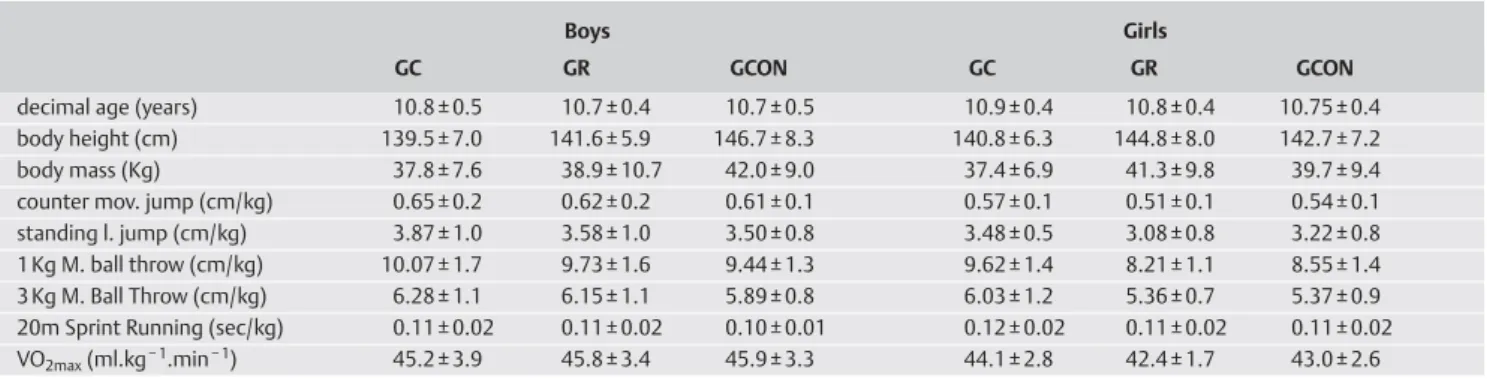
stage 1, 77.8 % and stage 2, 22.2 %; GR, stage 1, 73.7 % and stage 2, 26.3 %; GCON, stage 1, 90.5 % and stage 2, 9.5 %; girls: GC, stage 1, 47.6 % and stage 2, 52.4 %; GR, stage 1, 50 % and stage 2, 50 %; GCON, stage 1, 62.5 % and stage 2, 37.5 %). No subject had regu-larly participated in any form of strength training program prior to this experiment. Subjects were carefully informed about the design of the study and subsequently the children’s parents signed an informed consent document prior to the start of the study. The study was conducted according to the ethical stand-ards of the International Journal of Sports Medicine [ 19 ] and to the declaration of Helsinki, and was approved by the institu-tional review boards of the University of Beira Interior (UBI) and Research Centre in Sports, Health and Human Development (CIDESD), Portugal. Parameters of body dimensions and physical performance measures were evaluated for all subjects in a pre-test ( ● ▶ Table 1 ).
Experimental design and training program
This was a randomized controlled trial conducted at the Santa Clara School (Guarda, Portugal). Inclusion criteria were children
aged between 10 and 11.5 years (from 5 th and 6 th grade),
with-out a chronic pediatric disease or orthopedic limitation and without regular oriented extra-curricular physical activity (e. g. practice of some sport in a club). Subsequently, to minimize the eff ects of growth, only children who were self-assessed in Tan-ner stages 1–2 were selected for the sample. From the initial sample of 151 students, who volunteered to take part in this study and had the necessary requirements to join the study, and following a random distribution of the subjects in the investiga-tion groups, only 134 applied (GR = 44, GCON = 51 and GC = 39). The assigned groups were determined by a chance process (a random number generator on a computer) and could not be predicted. This procedure was established according to the “CONSORT” statement, which can be found at: http://www.con sort-statement.org/ . Participants were randomly assigned into 1 of 3 intervention arms. Randomization was done using R soft-ware version 2.14 (R Foundation for Statistical Computing). The rate of students who completed the training program was 93 % and 88 % (GR and GCON, respectively). In the control group the number remained unchanged. Thus, 125 children comprised the real sample of the study, divided into 2 training groups (8 weeks training program, twice a week) and one control group as fol-lows: one group performing power training only (GR: 19 boys, 22 girls); another group performing combined power strength and endurance training (GCON: 21 boys, 24 girls); and the third was the control group (GC: 18 boys, 21 girls; that followed the physical education classes curriculum, without a specifi c train-ing program).
Table 1 Descriptive data of the control (GC), resistance (GR) and concurrent (GCON) groups in pre-test condition: Boys and girls (Mean ± SD).
Boys Girls
GC GR GCON GC GR GCON
decimal age (years) 10.8 ± 0.5 10.7 ± 0.4 10.7 ± 0.5 10.9 ± 0.4 10.8 ± 0.4 10.75 ± 0.4
body height (cm) 139.5 ± 7.0 141.6 ± 5.9 146.7 ± 8.3 140.8 ± 6.3 144.8 ± 8.0 142.7 ± 7.2
body mass (Kg) 37.8 ± 7.6 38.9 ± 10.7 42.0 ± 9.0 37.4 ± 6.9 41.3 ± 9.8 39.7 ± 9.4
counter mov. jump (cm/kg) 0.65 ± 0.2 0.62 ± 0.2 0.61 ± 0.1 0.57 ± 0.1 0.51 ± 0.1 0.54 ± 0.1
standing l. jump (cm/kg) 3.87 ± 1.0 3.58 ± 1.0 3.50 ± 0.8 3.48 ± 0.5 3.08 ± 0.8 3.22 ± 0.8
1 Kg M. ball throw (cm/kg) 10.07 ± 1.7 9.73 ± 1.6 9.44 ± 1.3 9.62 ± 1.4 8.21 ± 1.1 8.55 ± 1.4
3 Kg M. Ball Throw (cm/kg) 6.28 ± 1.1 6.15 ± 1.1 5.89 ± 0.8 6.03 ± 1.2 5.36 ± 0.7 5.37 ± 0.9
20m Sprint Running (sec/kg) 0.11 ± 0.02 0.11 ± 0.02 0.10 ± 0.01 0.12 ± 0.02 0.11 ± 0.02 0.11 ± 0.02
VO 2max (ml.kg − 1 .min − 1 ) 45.2 ± 3.9 45.8 ± 3.4 45.9 ± 3.3 44.1 ± 2.8 42.4 ± 1.7 43.0 ± 2.6
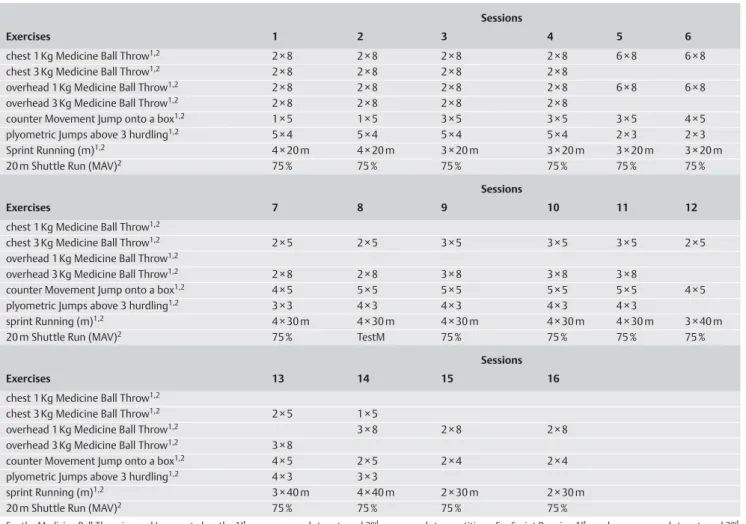
Prior to training, subjects warmed up for approximately 10 min with low to moderate intensity exercises (e. g., running, stretch-ing and joint specifi c warm-up). Joint-rotations included slow circular movements, both clockwise and counter-clockwise, until the entire joint seemed to move smoothly. Stretching exer-cises included back and chest, shoulders and side stretch, as well as quadriceps, calf, groin, and hamstring stretches. At the end of the training sessions, subjects performed 5 min of static stretch-ing exercises. After the warm-up period, both GR and GCON groups were submitted to a strength training program com-posed of: 1 and 3 kg medicine ball throws; jumps onto a box (from 0.3 m to 0.5 m); plyometric jumps over a hurdle of 0.3– 0.5 m in height and sets of 30–40 m speed running. After fi nish-ing strength trainnish-ing for both GR and GCON groups, the GCON group was further subjected to a 20 m shuttle run exercise. This endurance task, which occurred immediately after the strength training session, was developed based on an individual training volume – set to about 75 % of the established maximum aerobic volume achieved on a previous test. After 4 weeks of training, GCON subjects were reassessed using 20 m shuttle run tests in order to readjust the volume and intensity of the 20 m shuttle run exercise. Each training session lasted approximately between 45 min (resistance training) to 60 min (concurrent training). The rest period between sets was 1 min and between exercises 2 min. Before the start of the training, subjects completed 2 familiariza-tion sessions to practice the drill and routines they would
further perform during the training period (i. e., power training exercises and 20 m shuttle run test). During this time, the chil-dren were taught about the proper technique for each training exercise, and any of their questions were properly answered to clarify any doubts. In the course of training there was a constant
concern to ensure safety and maintain suffi cient hydration
lev-els, as well as to encourage all children to do their best to achieve the best results. Clear instructions about the importance of ade-quate nutrition were also provided. The same researcher con-ducted the training program and the anthropometric and physical fi tness assessments. The instructor-to-child ratio was 1–11, slightly above the limit recommended by Faigenbaum et al. [ 13 ] (1:10). However, free weights or weight/hydraulic machines were not used in the training, but only medicine balls and body weight exercises, which facilitated the supervision process. The instructions for each exercise were given in accord-ance with the description of each test presented below. For the 20-m shuttle run, the instructions were given with the aid of a
multi-stage fi tness test audio CD, of the FITNESSGRAM ® test
bat-tery. Throughout pre- and experimental periods, the subjects reported their non-involvement in additional regular exercise programs for developing or maintaining strength and endurance performance. There were no injuries resulting from the imple-mentation of the training programs. A more detailed analysis of
the program can be found in ● ▶ Table 2 .
Table 2 Training program design.
Sessions
Exercises 1 2 3 4 5 6
chest 1 Kg Medicine Ball Throw 1,2 2 × 8 2 × 8 2 × 8 2 × 8 6 × 8 6 × 8
chest 3 Kg Medicine Ball Throw 1,2 2 × 8 2 × 8 2 × 8 2 × 8
overhead 1 Kg Medicine Ball Throw 1,2 2 × 8 2 × 8 2 × 8 2 × 8 6 × 8 6 × 8
overhead 3 Kg Medicine Ball Throw 1,2 2 × 8 2 × 8 2 × 8 2 × 8
counter Movement Jump onto a box 1,2 1 × 5 1 × 5 3 × 5 3 × 5 3 × 5 4 × 5
plyometric Jumps above 3 hurdling 1,2 5 × 4 5 × 4 5 × 4 5 × 4 2 × 3 2 × 3
Sprint Running (m) 1,2 4 × 20 m 4 × 20 m 3 × 20 m 3 × 20 m 3 × 20 m 3 × 20 m
20 m Shuttle Run (MAV) 2 75 % 75 % 75 % 75 % 75 % 75 %
Sessions
Exercises 7 8 9 10 11 12
chest 1 Kg Medicine Ball Throw 1,2
chest 3 Kg Medicine Ball Throw 1,2 2 × 5 2 × 5 3 × 5 3 × 5 3 × 5 2 × 5
overhead 1 Kg Medicine Ball Throw 1,2
overhead 3 Kg Medicine Ball Throw 1,2 2 × 8 2 × 8 3 × 8 3 × 8 3 × 8
counter Movement Jump onto a box 1,2 4 × 5 5 × 5 5 × 5 5 × 5 5 × 5 4 × 5
plyometric Jumps above 3 hurdling 1,2 3 × 3 4 × 3 4 × 3 4 × 3 4 × 3
sprint Running (m) 1,2 4 × 30 m 4 × 30 m 4 × 30 m 4 × 30 m 4 × 30 m 3 × 40 m
20 m Shuttle Run (MAV) 2 75 % TestM 75 % 75 % 75 % 75 %
Sessions
Exercises 13 14 15 16
chest 1 Kg Medicine Ball Throw 1,2
chest 3 Kg Medicine Ball Throw 1,2 2 × 5 1 × 5
overhead 1 Kg Medicine Ball Throw 1,2 3 × 8 2 × 8 2 × 8
overhead 3 Kg Medicine Ball Throw 1,2 3 × 8
counter Movement Jump onto a box 1,2 4 × 5 2 × 5 2 × 4 2 × 4
plyometric Jumps above 3 hurdling 1,2 4 × 3 3 × 3
sprint Running (m) 1,2 3 × 40 m 4 × 40 m 2 × 30 m 2 × 30 m
20 m Shuttle Run (MAV) 2 75 % 75 % 75 % 75 %
For the Medicine Ball Throwing and Jump onto box the 1 st no. corresponds to sets and 2 nd corresponds to repetitions. For Sprint Running 1 st number corresponds to sets and 2 nd
corresponds to the distance to run. For 20 m Shuttle Run training each children ran each session (until testM) 75 % of maximum individual aerobic volume performed on pre-test and after this testM moment until program end, ran 75 % of maximum individual aerobic volume performed on testM. MAV – maximum individual aerobic volume. 1 = power strength training protocol (GR). 2 = concurrent resistance and endurance training (GCON)
Anthropometric measurements
All anthropometric measurements were assessed according to international standards for anthropometric assessment [ 31 ] and were carried out prior to any physical performance test. The participants were barefoot and wore only underwear. Body mass (in kg) was measured to the nearest 0.1 kg using a standard dig-ital fl oor scale (Seca, model 841, Germany). To evaluate body height (in cm) a precision stadiometer with a range scale of 0.10 cm was used (Seca, model 214, Germany). Maturity level based on Tanner stages was self-assessed [ 11 ] .
Testing procedures
Sample groups were assessed for upper and lower body explo-sive strength (medicine ball throwing and standing long jump and vertical jump, respectively), running speed (20-m sprint
run) and VO 2max (20-m multistage shuttle run test) before and
after 8-weeks of training. Each subject was familiarized with all tests. All data collection was performed by the same researcher.
Counter movement vertical jump
This test was conducted on a contact mat connected to an elec-tronic power timer, control box and handset (Globus Ergojump, Italy). From a standing position, with the feet shoulder-width apart and the hands placed on the pelvic girth, the subjects per-formed a counter movement with the legs before jumping. Such movement makes use of the stretch-shorten cycle, where the muscles are pre-stretched before shortening in the desired direction [ 29 ] . They were informed that they should try to jump vertically as high as possible. Each participant performed 3 jumps with a 1-min recovery between attempts. The highest jump (in cm) was recorded. The counter movement vertical
jump has shown an Intraclass Correlation Coeffi cient (ICC) of
0.94.
Standing long jump
This test was assessed using the EUROFIT test battery [ 1 ] . The participants stood with feet slightly apart (toes behind a starting line) and jumped as far forwards as possible. 3 trials were given and the furthest distance was measured (in cm) from the start-ing line to the heel of the foot nearest to this line. The standstart-ing long jump has shown an ICC of 0.94.
Medicine-ball throwing
This test was performed according to the protocol described by Mayhew et al. [ 34 ] . Subjects were seated with the backside of the trunk touching a wall. They were required to hold a medi-cine ball (Bhalla International – Vinex Sports, Meerut – India) weighing 1 kg (Vinex, model VMB-001R, perimeter 0.72 m) or 3 kg (Vinex, model VMB-003R, perimeter 0.78 m) with their hands (abreast of chest) and throw it forward over the maxi-mum distance possible. Hip infl ection was not allowed nor with-drawal of the trunk away from the wall. 3 trials were given and the furthest throw was measured (in cm) from the wall to the fi rst point at which the ball made contact with fl oor. 1-min of rest among 3 trials was given. The ICC of data for 1 kg and 3 kg medicine ball throwing was 0.94 and 0.97, respectively.
20-meter sprint running
Subjects were required to cover a 20 m distance on a track in the shortest possible time. Time (in sec) to run 20 m was obtained using photocells (Brower Timing System, Fairlee, Vermont, USA).
3 trials were performed and the best time scored (seconds and hundredth) was registered. The sprint running (time) has shown an ICC of 0.97.
20-meter multistage shuttle run
This test involved continuous running between 2 lines 20 m apart in time to recorded beeps. The subjects ran between the 2 lines, turning when signalled by the recorded beeps. After about 1 min, a sound indicates an increase in speed, and the beeps will be closer together. This continues each minute (level). The com-mon version with an initial running velocity of 8.5 km/h, and increments of 0.5 km/h each minute [ 27 ] was used. When the participants failed to reach the line on 2 consecutive occasions, they were stopped and the number of completed 20 m laps was
recorded. Estimated VO 2max (ml.kg − 1 .min − 1 ) was calculated by
Léger’s equation [ 27 ] , which is based on the level reached before boys were unable to keep up with the audio recording. The 20 m Shuttle Run test has shown an ICC of 0.97.
Statistical analyses
Standard statistical methods were used for the calculation of the means and standard deviations. The within-subject reliability of endurance and power tests was determined by the Intraclass
Correlation Coeffi cient (ICC). 2-way analysis of variance (ANOVA),
followed by Bonferroni’s post-hoc comparison tests, was used to
fi nd the diff erences in the explosive strength and VO 2max
meas-ures in the pre-test (group and sex). To analyze the diff erences between groups and sex in the post-test measures an analysis of covariance (ANCOVA) was estimated for each dependent varia-ble, followed by Bonferroni’s post-hoc comparison tests, having as factors sex and group, and the measures of pre-test as a cov-ariate. To determine the eff ect of sex and group on the evolution of strength/aerobic capacity from pre- to the post-training an ANOVA with repeated measures was performed for each depend-ent variable, with group as factor and sex as covariate. Partial eta squared as well as eff ect size was calculated. The normality of the residuals was validated by the Kolmogorov-Smirnov test. The assumption of sphericity was validated by the Mauchly’s Test of Sphericity. Data was analyzed using SPSS 15.0. The statis-tical signifi cance was set at p ≤ 0.05.
Results
▼
At baseline, there were no signifi cant diff erences between groups for age or Tanner ratings. There were statistically signifi -cant diff erences between groups only in the 1 kg medicine ball throwing (F (2, 122) = 4.45, p < 0.05). Through the post-hoc tests, it was found that the control group had signifi cantly higher val-ues than GR and GCON. There were no signifi cant diff erences between GR and GCON. Regarding sex diff erences in the pre-test, statistically signifi cant diff erences were found between boys and girls in the counter movement jump (F = 6.25, p < 0.05),
standing long jump (F = 5.97, p < 0.05), and 1 kg (F = 12.25,
p < 0.01) and 3 kg (F = 7.69, p < 0.01) medicine ball throwing. Boys performed better than girls.
In the post-training (baseline performance as a covariate), a sta-tistically signifi cant eff ect of group on the performance of the standing long jump (F(2, 118) = 7.20, p < 0.05), 1 kg (F(2, 118) = 27.41, p < 0.05) and 3 kg medicine ball throwing (F(2, 118) = 10.65,
p < 0.05), time-at-20 m (F(2, 118) = 33.33, p < 0.05) and VO 2max
(F(2, 118) = 10.66, p < 0.05) was observed. Through the post-hoc tests, it was found that the diff erences between groups in the post-test occurred between the control and experimental groups. There were no statistically signifi cant diff erences
between GR and GCON. Regarding the VO 2max , the GCON group
presented signifi cantly higher values in the post-test than GC and GR. There were no statistically signifi cant diff erences between GC and GR. The variable sex had no statistically signifi -cant infl uence on the post-test measures.
ANOVA with repeated measures showed a signifi cant, but medium-sized increase from pre- to the post-training in the counter movement vertical jump (F(1, 121) = 34.44, p < 0.01) and
VO 2max (F(1, 121) = 32.89, p < 0.01). There was a signifi cant and
high-sized increase in the 1 kg (F(1, 121) = 202.17, p < 0.01) and 3 kg (F(1, 121) = 132.10, p < 0.01) medicine ball throwing and standing long jump (F(1, 121) = 72.93, p < 0.01). Plus, there was a signifi cant and large decrease in time for the 20 m distance from
pre- to post-training (F(1, 121) = 122.21, p < 0.01) ( ● ▶ Table 3 ).
Regarding the eff ect of the group factor on the evolution of strength and aerobic capacity from pre- to the post-training, there was no statistically signifi cant infl uence of this factor on the evolution of the vertical jump (F(2, 121) = 0.54, p ≥ 0.05). A signifi cant, but small-sized eff ect, of the group on the evolution of the standing long jump (F(2, 121) = 3.16, p < 0.05), 3 kg
medi-cine-ball throwing (F(2, 121) = 11.14; p < 0.01) and VO 2max
(F(2, 121) = 6.22, p < 0.01) was observed. There was a signifi cant and medium-sized eff ect of the group on the evolution of the 1 kg medicine ball throwing (F(2, 121) = 28.21; p < 0.01) and
running velocity (F(2, 121) = 13.65; p < 0.01). However, the
ANOVA with repeated measures for each group showed that the positive infl uence of the group on the standing long jump, 1 kg and 3 kg medicine-ball throwing and running speed was due to signifi cant increases from pre- to the post-training in GR
and GCON. The VO 2max increased signifi cantly only in GCON.
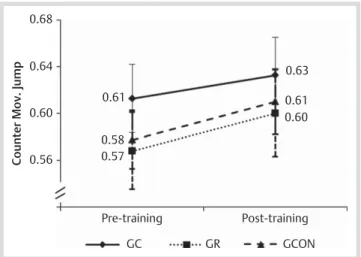
( ● ▶ Fig. 1 – 6 ).
Regarding sex factor, it did not signifi cantly infl uence the evolu-tion from pre- to the post-training of the vertical jump (F(1,
121) = 0.81, p ≥ 0.05), standing long jump (F(1, 121) = 0.20,
Fig. 1 Counter movement jump (cm/kg) by group.
0.68 0.64 0.60 0.56 0.57 0.58 Pre-training
Counter Mov. Jump
Post-training 0.63 0.61 0.60 GC GR GCON 0.61
Fig. 2 Standing long jump (cm/kg) by group. 4.00 3.80 3.60 3.40 3.20 Pre-training
Standing Long Jump
3.67 3.35 3.55 3.60 3.79 GC GR GCON 3.31 Post-training
Table 3 Evolution of the explosive strength and VO 2max from pre- to the post-training: ANOVA with repeated measures.
F df p Partial Eta Squared Eff ect size IC95 %
CM jump main eff ect of time 34.44 1 0.000** 0.224 0.221 0.096–0.346
interaction eff ect time by group 0.54 2 0.586 0.009 0.007 0–0.035
interaction eff ect time by sex 0.81 1 0.37 0.007 0.005 0–0.029
SL jump main eff ect of time 72.93 1 0.000** 0.376 0.535 0.419–0.651
interaction eff ect time by group 3.16 2 0.046* 0.040 0.037 0–0.1
interaction eff ect time by sex 0.2 1 0.659 0.002 0.001 0–0.012
1K ball throw main eff ect of time 202.17 1 0.000** 0.626 0.530 0.413–0.647
interaction eff ect time by group 28.21 2 0.000** 0.318 0.148 0.036–0.26
interaction eff ect time by sex 1.78 1 0.185 0.014 0.005 0–0.029
3K ball throw main eff ect of time 132.1 1 0.000** 0.522 0.480 0.357–0.603
interaction eff ect time by group 11.14 2 0.000** 0.156 0.081 0–0.17
interaction eff ect time by sex 0.06 1 0.801 0.001 0.000 0–0
20 m sprint main eff ect of time 122.21 1 0.000** 0.502 0.452 0.326–0.578
interaction eff ect time by group 13.65 2 0.000** 0.184 0.101 0.004–0.198
interaction eff ect time by sex 0.01 1 0.938 0.000 0.000 0–0
VO 2max main eff ect of time 32.89 1 0.000** 0.214 0.195 0.074–0.316
interaction eff ect time by group 6.22 2 0.003** 0.093 0.074 0–0.16
interaction eff ect time by sex 2.73 1 0.101 0.022 0.016 0–0.058
CM jump – counter movement jump; SL jump – standing long jump; 1K ball throw – 1 Kg medicine ball throwing; 3K ball throw – 3 Kg medicine ball throwing; 20 m sprint – 20 m sprint running; VO 2max – 20 m multistage shuttle run (ml.kg − 1 .min − 1 ); **p < 0.01
p ≥ 0.05), 1 kg (F(1, 121) = 1.78, p ≥ 0.05) and 3 kg (F(1, 121) = 0.06, p ≥ 0.05) medicine-ball throwing, running speed (F(1, 121) = 0.01, p ≥ 0.05), and VO 2max (F(1, 121) = 2.73, p ≥ 0.05). ( ● ▶ Fig. 7 – 12 ).
Discussion
▼
The purpose of the study was to analyze the eff ect of power strength training alone and combined power strength and endurance training in a large sample of prepubescent boys and girls. The main results suggested that concurrent training is an eff ective, well-rounded exercise program that can be performed to improve initial and/or general strength in healthy prepubes-cent boys and girls. Additionally, data suggest that sex does not have a signifi cant eff ect on training-induced explosive strength
and VO 2max of prepubescents. These results are of a high interest
to optimize all-round exercise programs in childhood.
The signifi cant increase observed in both training groups for explosive strength of upper and lower limbs (e. g. throwing of 1 kg and 3 kg medicine balls, standing long jump and counter movement vertical jump) as well as in 20-m sprint running indi-cates that both concurrent resistance and endurance training and resistance training alone may be a positive training stimulus to enhance explosive strength in healthy prepubescent children. These fi ndings are consistent with the results of previous studies
in this area conducted with young people [ 14 , 40 ] , who were also subjected to training programs using medicine balls and jumps (6 and 10 weeks training programs, respectively, twice per week on nonconsecutive days). Similar results were reported by Faigenbaum et al. [ 15 ] , using child-size exercise machines twice weekly over an 8-weeks period, while Dorgo et al. [ 9 ] con-ducted 9 and 18 weeks of manual resistance training, respec-tively. Additionally, no signifi cant diff erences were found in the post training between GR and GCON groups in any variable related to the explosive strength selected. This fact seems to sug-gest that endurance training does not positively aff ect strength development in school-age children, but also does not seem to impair strength development. There is a relative paucity of published reports focusing on the implementation of concurrent resistance and endurance training in school children [ 22 ] . The studies conducted by Santos et al. [ 41 , 42 ] are an exception, however they relate exclusively to the implementation of con-current training programs in pubertal school girls and boys, respectively. Using a very similar training program design (i. e., resistance training using medicine balls, endurance training using the 20-m multistage shuttle-run test, twice weekly for 8 weeks), the authors found signifi cant training-induced gains in ball throw, running speed and height-and-length of the jumps, in both strength training alone, and combined strength and Fig. 4 3 Kg medicine ball throwing (cm/kg) by group.
6.40 6.15 5.90 5.65 5.73 6.15 6.31 6.21 6.12 5.62 Pre-training 3Kg M. Ball Throwing Post-training GC GR GCON
Fig. 5 Time-at-20m (sec/kg) by group. 0.13 0.12 0.12 0.12 0.12 0.11 Time-at-20m Pre-training Post-training 0.11 0.11 0.11 GC GR GCON 0.11
Fig. 6 VO 2max (ml.kg − 1 .min − 1 ) by group.
47.00 46.00 44.62 44.37 44.06 Pre-training Post-training 44.42 GCON GR GC 44.91 45.83 45.00 44.00 VO 2max
Fig. 3 1 Kg medicine ball throwing (cm/kg) by group. 10.50 10.00 9.50 9.00 8.97 9.84 9.93 9.49 9.44 GC GR GCON 8.92 Pre-training 1Kg M. Ball Throwing Post-training
obic training. No signifi cant diff erences were found in the post training between these experimental training groups.
However, a training program design diff erent to that in this par-ticular study, or diff erent methods of organizing training work-outs, can lead to diff erent results, due to several factors that can infl uence the level or degree of interference generated by
con-current training [ 16 ] . These factors include the initial training status of the subjects [ 25 ] , exercise mode, volume, intensity and frequency of training [ 17 , 18 , 23 ] . For example, Sale et al. [ 39 ] observed that concurrent resistance and endurance training applied on separate days produced higher gains than those pro-duced by concurrent training on the same day. Strength and Fig. 7 Counter movement jump (cm/kg) by sex.
0.68 0.64 0.60 0.56
Counter Mov. Jump
0.55 0.63 0.57 0.66 Girls Boys Post -training Pre -training
Fig. 8 Standing long jump (cm/kg) by sex. 4.00 3.80 3.60 3.40 3.20 Standing L. Jump 3.26
Pre -training Post-training
3.64
3.44
Girls Boys
3.84
Fig. 9 1 Kg medicine ball throwing (cm/kg) by sex. 10.50 10.00 9.00 9.50 9.73 8.78 9.13 Boys Girls Post-training Pre-training 1Kg M. Ball Throwing 10.16
Fig. 10 3 Kg medicine ball throwing (cm/kg) by sex. 6.75 6.25 5.75 3Kg M. Ball Throwing 5.58 6.10 6.48 5.97 Girls Boys Post-training Pre-training
Fig. 11 Time-at-20 m (sec/kg) by sex. 0.13 0.12 0.12 0.12 0.12 0.11 Time -at-20m 0.11 0.11 Boys Post -training Pre -training Girls
Fig. 12 VO 2max (ml.kg − 1 .min − 1 ) by sex.
50.00 47.50 45.00 45.68 43.18 43.71 46.67 Boys Post-training Pre-training Girls 42.50 VO 2max
endurance training elicit distinct and often divergent adaptive physiological mechanisms. The concurrent development of both fi tness components in the same training regimen can lead to confl icting neuromuscular adaptations, such as reductions in the motor unit recruitment, decreases of rapid voluntary neural activations, chronic depletion of muscle glycogen stores, skeletal muscle fi bre type transformation, decreases in the cross-sec-tional area of muscle fi bres and in the rate of muscle force pro-duction due to the repro-duction in total protein synthesis [ 6 , 20 ] . Children have neuromuscular and endurance characteristics that distinguish them from adults. Those characteristics may help to explain the absence of the “interference phenomenon”, described in related studies done with adults. In the present study, with prepubescent children, as well as in studies con-ducted by Santos et al. [ 41 , 42 ] , with adolescents, no electro-physiological measures were included. Therefore, future investigations should include those measures when analyzing the eff ects of the implementation of the concurrent resistance and endurance training programs in the considered age groups. The current results also showed a signifi cant enhancement in
VO 2max only for GCON. In agreement with previous studies
[ 9 , 41 , 42 ] , these fi nding seems to indicate that the resistance training program component was not eff ective in improving aerobic fi tness in prepubescent school children. After 18-weeks of manual resistance training, Dorgo et al. [ 9 ] observed that only the subjects who were exposed to additional cardiovascular endurance training achieved signifi cant improvements for the 1-mile run performance. The subjects who performed only manual resistance training showed some improvement from pre- to midterm- and pre- to post-test. But these changes were not statistically signifi cant. Similarly, Santos et al. [ 41 , 42 ] found
that VO 2max increased signifi cantly only in the endurance
train-ing group, after 8 weeks. However, it is important to note that
the greater effi ciency of the concurrent training in the VO 2max
gains may have been conditioned by the diff erent duration of training sessions between the 2 intervention groups (approxi-mately 45′ and 60′ per session for GR and GCON, respectively). Regarding the gender gap, the results seem to suggest that there
is no signifi cant eff ect on training-induced strength and VO 2max
adaptations. These data corroborate the results of previous stud-ies conducted with children, reporting no signifi cant diff erences in aerobic training response related to sex. Rowland and Boya-jian [ 38 ] observed no signifi cant diff erences relative to sex in maximal oxygen uptake after an endurance training program (three 30-min sessions of aerobic activity weekly for 12 weeks at an intensity producing a mean heart rate of 166 beats per minute). Similarly, Obert et al. [ 35 ] found that sex did not aff ect training-induced cardiovascular response in prepubescent
chil-dren (13-week endurance training program, 3 × 1 h week − 1 ,
inten-sity: > 80 % heart rate maximum). Aerobic training increased VO 2max
in children, regardless of sex, mediated by an improvement in maximum stroke volume [ 35 ] . Similar mechanisms, including loading conditions and cardiac morphology, appear to be involved in both boys and girls in order to explain such an improvement [ 35 ] . According to Vinet et al. [ 46 ] during pre-ado-lescence there are no signifi cant sex diff erences in maximal heart rate and arteriovenous oxygen, and although the stroke volume is signifi cantly higher in boys than in girls, when expressed relative to lean body mass, the diff erence is no longer signifi cant.
The observed similarity between boys and girls in training-induced strength is also consistent with fi ndings of previous studies conducted with prepubescent children. After applying a
12-week progressive resistance program Lillegard et al. [ 28 ]
found signifi cant main eff ects favouring strength gains in males, only in lat pull and leg extension (3 sets of ten repetitions of 10RM on barbell curl, triceps extension, bench press, lat pull, leg extension and leg curl exercises, three 1-h session per week). There were no signifi cant post training sex diff erences in jump-ing and runnjump-ing speed. Siegel et al. [ 43 ] also observed that fol-lowing a similar training period, but using hand-held weights, stretch tubing, balls, and self-supported movements, training responses of boys and girls were similar, although signifi cant dif-ferences in favour of boys on all initial strength evaluations have been reported. Training-induced strength gains during and after puberty in males are associated with increases in fat-free mass, due to the eff ect of testosterone on muscle hypertrophy. In reverse, smaller amounts of testosterone in females (resulting from enzymatic conversion of androgenic precursors in the adrenal gland) seem to limit the magnitude of training-induced strength gains [ 24 ] . However, during preadolescence, beyond the small muscle mass of the girls, the boys still present a reduced muscle mass, because the eff ects of circulating andro-gens, particularly testosterone, only manifest themselves at puberty [ 37 ] .
In brief, our data suggest that a concurrent resistance and endur-ance school-based training program seems to be eff ective on both strength and endurance fi tness for school-age children. The results also indicate that sex does not aff ect explosive strength improvement, either in the resistance training alone, or com-bined resistance and endurance training. In this sense, and assuming various school constraints (i. e., reduced practice time per session, number of weekly sessions or lack of material resources and facilities) in order to increase the physical
educa-tion classes effi ciency, combined training programs of resistance
and endurance should be considered in school-based programs. There are some main limitations to be considered: i) the training period of 8 weeks is quite short; ii) diff erent training program design or diff erent methods of organizing training workouts can lead to diff erent training-induced outcomes; iii) diff erent meth-ods of evaluating pre- and post-training muscular strength and aerobic capacity may also lead to data bias; iv) diff erent training durations between strength training and concurrent training groups may have conditioned training-induced gains; v) due to the methodological approach (i. e., no electrophysiological meas-ures) it was not possible to clarify the underlying mechanisms responsible for the observed eff ects; (vi) the study population included normal-weight, physically active children. Therefore, care is needed when translating these fi ndings to overweight/ obese and/or less/more physically active children.
Acknowledgements
▼
The authors would like to thank all the pupils who participated in this research and their parents that allowed them to engage in it, and gratefully acknowledge Adalberto Carvalho (the school principal of the School Cluster Santa Clara) and the management team for allowing the use of the training equipment used in this study and school facilities.
25 Kraemer W J , Ratamess N A . Fundamentals of resistance training: pro-gression and exercise prescription . Med Sci Sports Exerc 2004 ; 36 : 674 – 688
26 Kvaavik E , Klepp K I , Tell G S , Meyer H E , Batty G D . Physical fi tness and physical activity at age 13 years as predictors of cardiovascular disease risk factors at ages 15, 25, 33, and 40 years: extended follow-up of the Oslo Youth Study . Pediatrics 2009 ; 123 : e80 – e86
27 Léger L A , Mercier D , Gadoury C , Lambert J . The multistage 20 meter shuttle run test for aerobic fi tness . J Sports Sci 1988 ; 6 : 93 – 101
28 Lillegard W A , Brown E W , Wilson D J , Henderson R , Lewis E . Effi cacy
of strength training in prepubescent to early postpubescent males and females: eff ects of gender and maturity . Pediatr Rehabil 1997 ; 1 : 147 – 157
29 Linthorne N P . Analysis of standing vertical jumps using a force plat-form . Am J Phys 2001 ; 11 : 1198 – 1204
30 Malina R M , Bouchard C . Growth Maturation and Physical Aactivity . Champaign, Illinois : Human Kinetics ; 1991
31 Marfell-Jones M , Olds T , Stewart A , Carter L . International Standards for Anthropometric Assessment . Potchefstroom, South Africa : ISAK , 2006
32 Marques M C , Zajac A , Pereira A , Costa A M . Strength training and detraining in diff erent populations: Case studies . J Hum Kinet 2011 ; (Special Issue): 7 – 14
33 Matton L , Duvigneeaud N , Wijndaele K , Philippaerts R , Duquet W , Beunen G , Claessens A , Thomis M , Lefevre J . Secular trends in anthropo-metric characteristics, physical fi tness, physical activity and biological maturation in Flemish adolescents between 1969 and 2005 . Am J Hum Biol 2007 ; 19 : 326 – 624
34 Mayhew J L , Ware J S , Johns R A , Bemben M G . Changes in upper body power following heavy-resistance strength training in college men . Int J Sports Med 1997 ; 18 : 516 – 520
35 Obert P , Mandigouts S , Nottin S , Vinet A , N’Guyen L D , Lecoq A M . Cardio-vascular responses to endurance training in children: eff ect of gender . Eur J Clin Invest 2003 ; 33 : 199 – 208
36 Ortega F B , Tresaco B , Ruiz J R , Moreno L A , Matillas M , Mesa J L ,
Warn-berg J , Bueno M , Tercedor P , Gutiérrez A , Castillo M J . Cardiorespiratory
fi tness and sedentary activities are associated with adiposity in ado-lescents . Obesity 2007 ; 15 : 1589 – 1599
37 Ramsay J , Blimkie C , Smith K , Garner S , Macdougall J , Sale D . Strength training eff ects in prepubescent boys . Med Sci Sports Exerc 1990 ; 22 : 605 – 614
38 Rowland T W , Boyajian A . Aerobic response to endurance exercise training in children . Pediatrics 1995 ; 96 : 654 – 658
39 Sale D G , McDougall J D , Jacobs I , Garner S . Interaction between con-current strength and endurance training . J Appl Physiol 1990 ; 68 : 260 – 270
40 Santos E , Janeira M . The eff ects of plyometric training followed by detraining and reduced training periods on explosive strength in adolescent male basketball players . J Strength Cond Res 2011 ; 25 : 441 – 452
41 Santos A , Marinho D A , Costa A M , Izquierdo M , Marques M C . The eff ects of concurrent resistance and endurance training follow a specifi c detraining cycle in young school girls . J Hum Kinet 2011 ; Special Issue: 93 – 103
42 Santos A , Marinho D A , Costa A M , Izquierdo M , Marques M C . The eff ects of concurrent resistance and endurance training follow a detraining period in elementary school students . J Strength Cond Res 2012 ; 26 : 1708 – 1716
43 Siegel J A , Camaione D N , Manfredi T G . The eff ects of upper body resist-ance training on prepubescent children . Pediatr Exerc Sci 1989 ; 1 : 145 – 154
44 Stenevi-Lundgren S , Daly R M , Lindén C , Gärdsell P , Karlsson M K . Eff ects of a daily school based physical activity intervention program on mus-cle development in prepubertal girls . Eur J Appl Physiol 2009 ; 105 : 533 – 541
45 Taanila H , Hemminki A , Suni J , Pihlajamäki H , Parkkari J . Low physical fi tness is a strong predictor of health problems among young men: a follow-up study of 1 411 male conscripts . BMC Public Health 2011 ; 11 : 590
46 Vinet A , Mandigout S , Nottin S , Nguyen L , Lecoq N , Courteix D , Obert P . Infl uence of body composition, hemoglobin concentration, and car-diac size and function of gender diff erences in maximal oxygen uptake in prepubertal children . Chest 2003 ; 124 : 1494 – 1499
References
1 Adam C , Klissouras V , Ravassolo M , Renson R , Tuxworth W , Kemper H , Vanmechelen W , Hlobil H , Beunen G , Levarlet-Joye H , Vanlierde A . Eurofi t: Handbook for the Eurofi t Test of Physical Fitness . Rome : Edi-graf Editoriale Gráfi ca : 1988
2 American College of Sports Medicine . Guidelines for Exercise
Test-ing and Prescription . 7 th ed. Philadelphia, PA : Lippincott Williams
& Wilkins , 2006
3 Anderson L B , Haraldsdottir J . Coronary heart disease risk factors, physi-cal activity, and fi tness in young Danes . Med Sci Sports Exerc 1995 ; 27 : 158 – 163
4 Anderssen S A , Cooper A R , Riddoch C , Sardinha L B , Harro M , Brage S , Andersen L B . Low cardiorespiratory fi tness is a strong predictor for clustering of cardiovascular disease risk factors in children independ-ent of country, age and sex . Eur J Cardiovasc Prev Rehabil 2007 ; 14 : 526 – 531
5 Cepero M R , López R , Suárez-Llorca C , Andreu-Cabrera E , Rojas F J . Fitness test profi les in children aged 8-12 years old in Granada (Spain) . J Hum Sport Exerc 2011 ; 6 : 135 – 146
6 Coff ey V G , Hawley J A . The molecular bases of training adaptation . Sports Med 2007 ; 37 : 737 – 763
7 Coleman K J , Heath E M , Alcala I S . Overweight and aerobic fi tness in children in the United States/Mexico border region . Rev Panam Salud Publica 2004 ; 15 : 262 – 271
8 Dencker M , Thorsson O , Karlsson M , Lindén C , Eiberg S , Wollmer P , Andersen B . Gender diff erences and determinants of aerobic fi tness in children aged 8–11 years . Eur J Appl Physiol 2007 ; 99 : 19 – 26 9 Dorgo S , King G A , Candelaria N G , Bader J O , Brickey G D , Adams C E .
Eff ects of manual resistance training on fi tness in adolescents . J Strength Cond Res 2009 ; 23 : 2287 – 2294
10 Dudley G A , Djamil R . Incompatibility of endurance- and strength train-ing modes of exercise . J Appl Physiol 1985 ; 59 : 1446 – 1451 11 Duke P M , Litt I R , Gross R T . Adolescents self-assessment of sexual
matu-ration . Pediatrics 1980 ; 66 : 918 – 920
12 Faigenbaum A D , Kraemer W J , Blimkie CJ R , Jeff reys I , Micheli L J , Nitka M , Rowland T W . Youth resistance training: Updated position statement paper from the National Strength and Conditioning Association . J Strength Cond Res 2009 ; 23 : S60 – S79
13 Faigenbaum A D , Kraemer W J , Cahill B , Chandler J , Dziados J , Elfrink L D , Forman E , Gaudiose M , Micheli L , Nitka M , Roberts S . Youth resistance training: position statement paper and literature review . Strength Cond J 1996 ; 18 : 62 – 75
14 Faigenbaum A , Mediate P . The eff ects of medicine ball training on physical fi tness in high school physical education students . Phys Educ 2006 ; 63 : 160 – 167
15 Faigenbaum A , Milliken L , Moulton L , Westcott W . Early muscular fi t-ness adaptations in children in response to two diff erent resistance training regimens . Pediatr Exerc Sci 2005 ; 17 : 237 – 248
16 García-Pallarés J , Izquierdo M . Strategies to optimize concurrent train-ing of strength and aerobic fi tness for rowtrain-ing and canoetrain-ing . Sports Med 2011 ; 41 : 329 – 343
17 García-Pallarés J , Sánchez-Medina L , Carrasco L , Diaz A , Izquierdo M . Endurance and neuromuscular changes in world-class level kayakers during a periodized training cycle . Eur J Appl Physiol 2009 ; 106 : 629 – 638
18 González-Badillo J J , Gorostiaga E M , Arellano R , Izquierdo M . Moderate resistance training volume produces more favorable strength gains than high or low volumes . J Strength Cond Res 2005 ; 19 : 689 – 697 19 Harriss D J , Atkinson G . Update – ethical standards in sport and exercise
science research . Int J Sports Med 2011 ; 32 : 819 – 821
20 Hawley J A . Molecular responses to strength and endurance training: are they incompatible? Appl Physiol Nutr Metab 2009 ; 34 : 355 – 361 21 Hickson R C . Interference of strength development by simultane-ously training strength and endurance . Eur J Appl Physiol 1980 ; 45 : 255 – 263
22 Izquierdo-Gabarren M , Exposito R , Garcia-Pallarés J , Sánchez-Medina L , De Villareal E S , Izquierdo M . Concurrent endurance and strength training not to failure optimizes performance gains . Med Sci Sports Exerc 2010 ; 42 : 1191 – 1199
23 Izquierdo M , Häkkinen K , Ibánez J , Kraemer W J , Gorostiaga E M . Eff ects of combined resistance and cardiovascular training on strength, power, muscle cross-sectional area, and endurance markers in middle-aged men . Eur J Appl Physiol 2005 ; 94 : 70 – 75
24 Kraemer W , Fry A , Frykman P , Conroy B , Hoff man J . Resistance training and youth . Pediatr Exerc Sci 1989 ; 1 : 336 – 350