MILAGE APP – MOBILE LEARNING OF MATHEMATICS
Mauro Figueiredo
1, Beata Godejord
2, José Rodrigues
1, Alicia González-Pérez
3 1Algarve University, ISE, CIMA, CIAC (PORTUGAL)
2
Nord University (NORWAY)
3University of Extremadura (SPAIN)
Abstract
This paper presents the novel app MILAGE Learn+ Launcher for smartphones and tablets where students can solve mathematical problems outside the classroom or at home and increase the time they spend learning and practicing mathematics. This app is a tool for learning mathematics that provides a set of problems organized according to the curriculum. It was designed for upper secondary schools but it can be used for other levels and subjects too. This tool is innovative in the introduction of self and peer evaluation for students of secondary schools in a gamification process of solving problems. With this app students solve mathematical problems and they have immediate feedback that is used for self-evaluation. After solving the problem and doing the self-evaluation the student can choose to watch a concise or detailed video to study the problem resolution. The concise video shows the steps need to solve the problem. The detailed video shows in more detail, including background information that may help low achiever students understand the resolution of that problem. In this way, the student can watch the video as many times as those needed to learn how to solve that problem. This is a step for the inclusion of low achiever students in the process of learning mathematics. This app also provides three levels of problems: beginners, intermediate and advanced to accommodate the low achievers and also motivate top performers students to use the app. The student can also at anytime evaluate his peers. In this way, the student can also study again problems of a certain topic when he is evaluating the resolution of a problem solved by another student. In this way, the teacher can also check the self and peer evaluation of his students and has feedback about students’ achievements.
Keywords: m-learning, mathematics, gamification, multimedia, mobile devices, self and peer evaluation.
1 INTRODUCTION
Learning mathematics is a difficult task for many students. With the availability of mobile devices that students carry with them we have a great opportunity to change this. Mobile devices give students flexibility and individualization of their learning experiences, as well as allow to expand outside the classroom the time spent learning.
It is also important to note that these students are the generation of digital games and social networks. We cannot ignore that they are no longer the same for whom the education system was designed a few decades ago. See, for example, the prospect of Heide and Stilborne [1], for whom "the technological revolution has produced a generation of students who grew up with multidimensional and interactive media sources. A generation whose expectations and world views are different from those that preceded it" (p. 27). According to Fernandes and Ferreira [2], the use of information technology made many changes in the way of teaching and learning. The use of mobile devices that are widely available is also giving the opportunity to students and teachers to change the teaching/learning process.
In this paper, we present the design and development of a mobile application for the teaching and learning of mathematics. Students can use this app in the classroom or outside the classroom in a blended learning model to solve problems. When students have difficulty in solving a problem they can watch the resolution of it. In this way, we want to provide the same opportunities to low-achieving students that may struggle to learn the materials covered in class. Students have also access to complex problems that may provide additional stimulation for top performer’s students. In this way, we can provide a platform that is capable of accommodating students with different mathematic skills. We also show the introduction of self and peer evaluation in a gamification process that help students understand important steps of the resolution and it is a way of revisiting the same subject to preserve the knowledge in the long term memory. This is a novel development for secondary school students.
2 MOTIVATION
Results from the 2012 Program for International Student Assessment (PISA), show that Norway, Portugal, Spain and Turkey are below the OECD average in mathematics, with a mean performance of 489, 487, 484 and 448 score points.
The countries that show significant improvement in PISA performance – Brazil, Germany, Greece, Italy, Mexico, Tunisia and Turkey – are those that manage to reduce the proportion of low-achieving students. In Norway, Portugal and Spain about one out of four students, in Turkey about one out of two students, still do not attain the baseline proficiency Level 2 in mathematics. This means that in the best of the cases, low achievers students can extract relevant information from a single source and can use basic algorithms, formulae or procedures to solve problems involving whole numbers.
The PISA report also concludes that “improvement in performance rarely comes at the expense of equity in education". There are exceptions to this. “Between 2003 and 2012, Poland and Portugal increased the proportion of high performers in mathematics as they simultaneously reduced the proportion of low performers. Improvements in mathematics performance in Mexico, Tunisia and Turkey, all of which scored well below average in their first PISA tests, are observed mainly among low-achieving students. This usually means greater equity of education opportunities in these countries too.” ([3]. pp.4).
Regardless the controversy over PISA tests results, this situation calls for actions aiming at improving instruction strategies for teaching and learning mathematics.
In this paper it is presented a mobile app that is designed for improving mathematical performance and achievements for all students including also those in the PISA share of low achievers and the top performers.
The development of this mobile application plans to extend traditional learning environment to a virtual classroom setting that will keep students connected for learning mathematics by the exploration of motivating math tools that will enable students to practice more. This application enables the exploration of video lectures and gamification in smartphones, phablets or tablets.
We want to take advantage of mobile devices for teaching and learning. The recent availability of smartphones and tablets with increased processing power and usability, accessible on a large scale, allow an exponential expansion of social and participative web technologies. However, in many countries teachers and students do not use mobile devices for teaching and learning purposes. It is also important to note that these students are the generation of digital games and social networks. In this context it is wise to consider the integration of digital media and mobile devices (iPad, iPod, tablets, smartphones), allowing students to set personal goals, to manage educational content and to communicate with others in the right context. However, according to the EU Commission initiative Opening Up Education (25 September 2013), between 50% and 80% of students in EU countries never use digital textbooks, exercise software, podcasts, simulations or learning games. Most teachers at primary and secondary level do not consider themselves as 'digitally confident' or able to teach digital skills effectively, and 70% would like more training in using ICTs.
This application will contribute to the implementation of a blended model for teaching and learning mathematics that will accommodate gaming mechanics that it is two-fold: complexity and detail. It has three different levels of problems complexity: beginners, intermediate and advanced. On the other hand, each problem has two levels of explanations/resolutions: detailed and concise.
In this way, all students are accommodated in a learning environment centred on the student. The low-achieving students that may struggle to learn the materials covered in class, can study and repeat the materials as many times as they may need to learn. Students will have access to complex problems and activities that may provide additional stimulation for top performers students. Teachers will also be more confident to give homework activities to their students. It is known that it is important to assign homework, to help struggling or underachieving students to learn the material covered in class, to ensure that the material is stored in students’ long-term memory, or to provide additional stimulation for high performers. But homework can be particularly burdensome for disadvantaged students. Their parents’ may not have the skills to help them, they may not have the resources to support them on private lessons. We aim at providing the same support for all the students so that we can contribute to weaker the relationship between students’ socio-economic background and mathematics performance.
3 MOBILE LEARNING: THEORETICAL FOUNDATION
Mobile-Social Revolution of the 2000s brought a growing interest in the relations between mobile technology and learning. It is argued that mobile learning is not about ‘mobile’ nor about ‘learning’. It is a part of a new mobile conception of society [4] Rapid development of mobile technologies has challenged the position of the print textbook-based education. “More and more young people are now deeply and permanently technologically enhanced, connected to their peers and the world in ways no generation has ever been before. […] More and more of what they need is available in their pocket on demand” ([5], p. 2). Access to information through mobile handheld devices has become everyday experience in personal, social and working lives. In this new landscape of mobile lifestyle, education has to respond to portable devices and invest in developing mobile learning resources. “Educational institutions must now appropriate personal technologies – the mobile phone […] partly due to student demand for mobile access and partly because these tools facilitate interactions that can support educational ends” ([6], p. 245).
Learning by means of pocketed devices allows learners to break free of the classroom. This introduces change in the mainstream schooling experience and provides opportunity for learning with other learners who are not gathered in the same location. By this attribute, learning with mobile devices allow to “blur the boundaries that neatly enclosed traditional classroom and learning institutions”. This quality builds one of the dimensions of the concept of New Learning” ([7], p. 9). Ability to work in virtual environments responds to the challenge of changing skills in the Knowledge Society.
Sociability enabled by smartphones supports the creation of mobile communities of practice ([8], 2013). Engagement in communities of practice embeds social participation into learning process. “We are social beings. Far from being trivially true, this fact is a central aspect of learning” ([9], p.4).
Researchers point to numerous benefits of mobile education for both learners and education systems nationally and internationally. Mobile technologies support flexible, accessible and personalized education. By using personal technologies learners can build knowledge whenever the need appears. This supports the development of a culture of lifelong learning. With mobile access to learning content, learning can happen in everyday and unconventional contexts, which promotes life-wide learning ([6], 2010). Due to the attributes of mobile devices, mobile learning can be ubiquitous, situated, and collaborative ([10], pp 224-47). Collaborative practice of learning contributes to collective advancement of knowledge placing mobile learning in the perspective of Knowledge Building theory [11]. Mobile computing devices enable access and interaction with media-rich resources, which places mobile learning in the framework of Multimedia Learning theory [12]. Through their functionalities, mobile computing technologies enable creation of digital resources. Through such engagement, learners become active participants in their learning process and creative producers of learning content. This is an obvious advantage over being a passive recipient of information.
The nature and possibilities of mobile learning has been explored for over a decade now. Yet the “design for mobile learning is still at the crossroads” ([6], p. 245). Increasing diversity of mobile devices makes m-Learning need resources within educational institutions. In the light of widespread use of mobile devices, mobile learning appears a serious option for education, not only within informal venues but also within formal educational establishments. For this, developing mobile-friendly content and creating mobile learning opportunities appears crucial to the development of educational approaches that meet standards of relevance to the contemporary socio-cultural landscape.
4 GAMING MECHANICS AND FEATURES INVOLVED IN E-ASSESSMENT
In recent years, gamification has become a hot topic for researching as an important element to promote motivation and engagement in the learning process. Hsu, Chang & Lee [13] defined gamification as the incorporation of game mechanics into nongame settings, which aims to increase users’ engagement of the product or service and facility certain behaviours. According with Attali & Arieli-Attali [14] gamification relies on the argument that many traditional activities (including schools’ activities and traditional learning) are not inherently interesting, that games, especially computer-games, are “fun”, and therefore introducing game-like features into these otherwise dull activities would make them more attractive [15].We also think that it is important to introduce e-assessment to students’ work. We should motivate students to do a self-assessment and self-learning using technology both inside and outside the classroom to promote autonomous work. Wood, Teräs, Reiners & Gregory [16] consider that coupled
with new approaches in education and particularly gamification technology presents opportunities for new forms of assessment that may provide a more accurate picture of students’ achievements. Indeed, traditional, one-off assessment activities no longer provide suitable structures for assessing student learning, and the game-based mechanisms not only provide improved engagement but also provide the opportunity for a range of new assessment of authentic learning tasks.
In general, literature identifies several dimensions or mechanism that game designer should consider. For example, the degree of linearity of problem-solving actions and strategies within a level and gameplay sequences across levels [17]. Also linearity and nonlinearity can be a factor involved in the level of interactivity between the students and the App/game. Chen [18] discusses the importance of allowing players to choose their own paths and levels of challenge in gameplay. According with Kim & Shute [17] players with different gaming abilities can experience different levels of difficulty at different times during gameplay, the availability of multiple gameplay paths based on ability is key to ensuring high levels of enjoyment for all levels of players. However, there is not clear evidence that linearity could be less enjoyment than nonlinearity.
Other attributes to consider are: If the player/student can play different roles, the presence of multiple methods to achieve goals, different levels, rules, context, quantifiable learning outcomes, player´s effort level, among others.
Hsu, Chang & Lee [13] attempt to construct a model, which try to represent a systematic structure of the gamification design and the mechanics to consider in it. They consider that all gamification factors can be dividing into three main components: achievement, interpersonal relationship and role-playing. Achievement means users are motivated by a need to achieve goals or accomplish something difficult through a difficult task and repeated efforts, including such design factors as rewards, goal setting, reputation and status. An interpersonal relationship refers to the process that facilitates the formation of social networks that connect users with whom the user interacts, including instruction, competition, and altruism. Role-playing refers users see the world though the viewpoint of their role, including such design factors as group identification, self-expression and time pressure [13].
However, Huang, Johnson & Han [19] identified an empirical framework where three game feature factors should be considered: Game structure that include rules, goals, tasks, provide information, give support, for example. Game involvement that situate player/student in a fantasy world or storying telling. And game appeal that enclose graphics-attractive, animations, audio and video elements, among others. At the same time game features have a relationship among perceived motivational support, cognitive learning levels and the final satisfaction toward the learning process, which add new insights to learning environments that are beyond to conventional online learning settings. Nonetheless, they pointed out that future research efforts have to prove the relationship between specific learning outcomes and game features.
For sure, the inclusion of game-based components or gamification mechanisms requires careful design to ensure an effective implementation. The challenge is to offer to players/students a wide range of problems that require them apply their knowledge and skills from real-world problems. For that, all gaming features have to be able to support assessment in learning, increase contexts to learn, and provide new opportunities to learn. The gamification elements proposed have been defined as an extension to the current understanding of the scope of gamification; in example, in the context of virtual environments where badges and leader boards uniquely cannot fail to exploit the full potential of the virtuality. The weakness that we can have with this model is that extrinsic rewards for performing task through points, records, leader boards, multiple lives and badges can be efficient at first. But it is highly recommended that during the process we also consider a battery of issues/activities that intrinsically can motivate students during learning process. Attali & Arieli-Attali [14] argue that rewarding students for performing well in an educational setting may be counterproductive in the long run. However, even in the short run, research on changing incentives (either by increasing personal stakes or providing external rewards) as a way to increase student performance is inconclusive.
To sum up, a complex matrix of elements are involved in the design and content of an app with an e-assessment system inside. For that, it is important to think how to transform into thoughtful engagement and productive learning the use of the app in mobile context. Some gaming mechanics and features were point out before. However, we should not forget to include in the design a formative, corrective feedback and provide interaction parameters matched to the learning characteristics of the target student group.
5 MILAGE LEARN+ LAUNCHER FOR TEACHERS AND STUDENTS
This section describes the MILAGE Learn+ Launcher platform where teachers upload activities that students use to study mathematics.
The application is powered by a web server and a relational database management system to store and query the data about users, worksheets of problems and relations between them (Figure 1). Each worksheet includes a set of questions of a selected theme, chapter and grade (year) of the mathematics curriculum. Information about users’ activities is also stored in the database such as solved worksheets and submitted answers.
Figure 1. Relational database structure to support the mobile application.
Teachers can use the MILAGE Learn+ Launcher for Teachers, which is a back office desktop application that runs on Windows and OSX operating systems (Figure 2). In an intuitive interface the teacher uploads for each question, the difficulty level, the year, the chapter, the theme and the worksheet of the problem. Then the different sub-questions are defined. For each sub-question the teacher chooses if it is a multiple choice or open sub-question, the number of points, the instructions for the evaluation and two videos, detailed and concise, with the resolution of the sub-question. In this way, the teacher creates the worksheets of problems that students have to do to practice the mathematic problems using the mobile device. These problems are uploaded to the server. This data is later available to the mobile app where students have access to the different questions and the videos with the problem resolutions.
This also enables teachers to produce the contents and make them available to their students. In this way, teachers can use their own produced materials to create their own activities targeted at the particular needs of each class and individual student. We believe that this can be very motivating for students and it also helps in delivering lectures, hands-on activities and customized study modules. This is a main advantage of this platform for education because teachers can tailor activities to each student. Learning content can also be generated by students themselves. This option enriches education process with an element of active participation on the learners’ part.
Figure 2. The teacher uploads worksheets of problems with instructions for evaluation and videos resolutions.
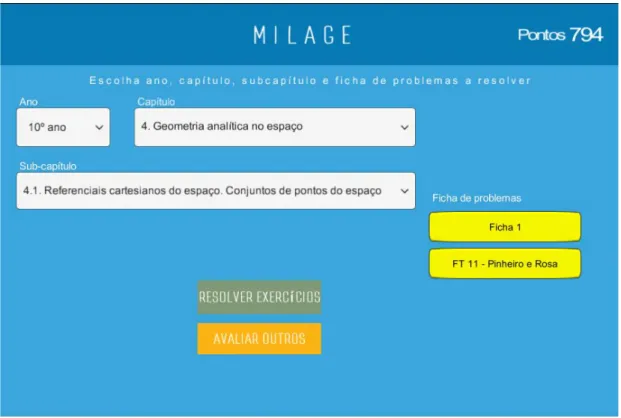
Students use the MILAGE Learn+ Launcher app in a smartphone or a tablet to solve the worksheets of problems that were made available by the mathematics teacher. After making the login the student has to choose the worksheet of problems that he wants to solve or evaluate one of his peers (Figure 3). In this way, the student can study by solving problems or by revisiting the subject when he is evaluating the work of another student. Inclusion of peer evaluation contributes to promoting formative learning, learners’ independence and taking responsibility for learning process.
Each worksheet of problems relates to the year, chapter and theme of the mathematic curriculum from the 10th to the 12th grade. After selecting the worksheet of problems the student starts solving questions (Figure 4). At this point it is shown a question at a time. If the question is a multiple choice, the student selects the right answer in a very straightforward way and the app can automatically identify if the answer if correct or wrong.
When the question is an open question then the student makes the resolution with pen and paper and takes a picture, using the mobile device, which is uploaded to the server (Figure 5). Next, the student receives the instructions for self-evaluation. When the student finds it difficult to solve the problem, he can access to the videos with the problem resolutions.
Figure 3. Students chooses the subject that they want to study. They study by solving worksheets of problems that are organized by year, chapter and sub-chapter. They can also study by revisiting
the subject when they evaluate their peers.
Figure 5. Students have immediate feedback of his achievements by means of a set of instructions for self-evaluation and access to a concise or a detailed video explaining the problem resolution, step by step. The video with the resolution of the problem is well suited for teaching problem solving. It allows students to learn at their own pace and according to their own learning style. The videos with the problems resolutions are well adapted for classes with students who have different levels of knowledge of the subject. There are students that can view the materials once and have a good understanding of the mathematical problem. Other students can view the videos several times to better understand the subject. This is an advantage over the traditional classroom where many times the students do not understand and do not ask to repeat the subject until they are able to understand. The use of videos for teaching and learning is effective for both visual and auditory learners as there is video and narration that is less complicated than written explanations [20].
With the number of students increasing in the class this is an important tool to enable students to work at home and leave classroom time to implement problem based learning methodologies together with virtual learning classrooms.
The use of this application also enables to register the student specific achievements in the user database. This data can be later used by the teacher to understand students’ achievements. The app presented in this paper let teachers extend the class into a virtual class in a form of blended learning in which students can view video lectures and solve problems outside the classroom. This can be especially interesting for learning mathematics. If students can learn at home from watching video lectures and solving problems, time in-class can be dedicated to explore more motivating problem solving. Math teachers have a difficult situation. Studying math is many times a cumbersome task. But this can be changed if the teacher takes advantage of the technology that is currently available in the classroom. Students are surrounded by multiple devices, such as smartphones and tablets, which give them access to multiple media that is easily available. This is an opportunity for the teacher. The technology related to teaching/learning will have a vital role in the coming years in the education field.
6 CONCLUSION
Math teachers have a difficult situation. Studying math is many times a cumbersome task. Low achievement in mathematics education has been an increasing problem in the recent years in several
countries has seen in the 2012 PISA results. The teachers’ role is one of the most important factors to involve students in their self-regulation learning. For that, the use of technology can be a recurrent demand to motivate and empower low achiever and top performers students.
The greater availability of mobile devices that students are carrying with them makes possible the use of these devices in educational contexts.
In this paper, we show a novel mobile app for students of upper secondary schools that introduces self and peer evaluation in a gamification process that includes game mechanics with different levels of difficulties to integrate low achiever and top performers students in the same platform. The MILAGE Learn+ Launcher makes available mathematic problems and the videos of problem resolutions enabling the expansion of the classroom into a virtual space where students can have more time practicing problem solving and learn more. We show that technology is accessible and easy to use by math teachers and students.
ACKNOWLEDGEMENT
This research has been supported by the “MILAGE: Interactive Mathematics by implementing a Blended-Learning model with Augmented Reality and Game Books” (Nº2015-1-PT01-KA201-012921), an Erasmus+ project, funded by the European Union.
REFERENCES
[1] Heide, A., & Stilborne, L. (2000). Guia do Professor para a Internet - Completo e fácil. Porto Alegre – Brasil, Artmed Editora.
[2] Fernandes, G., & Ferreira, C. (2012). Desenho de conteúdos e-learning: Quais teorias de aprendizagem podemos encontrar?. RIED: revista iberoamericana de educação à distancia, 15(1), pp. 79–102.
[3] OECD, PISA in Focus 2015/01.
[4] Traxler, J., 2007. Defining, Discussing, and Evaluating Mobile Learning: The moving fingerwrites and having writ… . In International Review of Research in Open and Distance
Learning, Vol. 8, No. 3
[5] Presky, M., 2010. Teaching Digital Natives. Partnering for Real Learning. Corwin A SAGE Company, Thousand Oaks, Ca, USA.
[6] Kukulska-Hulme, A. 2010. Mobile Learning for Quality Education and Social Inclusion. Policy Brief published by UNESCO Institute for Information Technologies in Education. Available at http://iite.unesco.org/policy_briefs/
[7] Kalantzis, M. and Cope, B., 2008. New Learning. Elements of a Science of Education. Cambridge University Press, New York, USA.
[8] Kietzmann, J., Plangger, K., Eaton, B., Heilgenberg, K., Pitt, L., Berthon, P. (2013). Mobility at work: A typology of mobile communities of practice and contextual ambidexterity. In Journal of Strategic Information Systems, 3(4).
[9] Wenger, E., 2008, Communities of Practice. Learning, Meaning, and Identity. Cambridge University Press, New York, USA.
[10] Sharples, M., Taylor, J., & Vavoula, G. 2007. A Theory of Learning for the Mobile Age. In R. Andrews and C. Haythornthwaite (eds.) The Sage Handbook of Elearning Research. Sage, London, UK.
[11] Bereiter, C. and Scardamalia, M., 2003. Learning to work creatively with knowledge. In E. De Corte, L. Verschaffel, N. Entwistle, & J. van Merriënboer (eds.), Powerful learning environments:
Unraveling basic components and dimensions. Elsevier Science, Oxford, UK.
[12] Mayer, R. E., 2009. Multimedia Learning. Cambridge University Press, New York, USA
[13] Hsu, S. H., Chang, J. W. & Lee, C. C. (2013). Designing attractive gamification features for collaborative storytelling websites. Cyberpsychology, Behavior, and Social Networking, 16(6), pp. 428-435.
[14] Attali, Y. & Arieli-Attali, M. (2015). Gamification in assessment: Do points affect test performance?. Computers & Education, 83, pp. 57-63.
[15] Zichermann, G., & Linder, J. (2010). Game-based marketing: Inspire customer loyalty through rewards, challenges, and contests. Hoboken, NJ: Wiley.
[16] Wood, L.C., Teräs, H., Reiners, T. & Gregory, S. (2013). The role of gamification and
game-based learning in authentic assessment within virtual environments. In Higher Education
Research and Development Society of Australasia (HERDSA), AUT University, Auckland, New Zealand.
[17] Kim, Y. J. & Shute, V. J. (2015). The interplay of game elements with psychometric qualities, learning, and enjoyment in game-based assessment. Computers & Education, 87, pp. 340-356. [18] Chen, J. (2007). Flow in games (and everything else). Communications of the ACM, 50(4), pp.
31-34.
[19] Huang, W. D., Johnson, T. E., & Han, S. H. C. (2013). Impact of online instructional game features on college students’ perceived motivational support and cognitive investment: A structural equation modeling study. The Internet and Higher Education, 17, pp. 58-68.
[20] Spilka, R. and Manenova , M. (2013). Screencasts as web-based learning method for math students on upper primary school, WSEAS Conference Proceedings, 4th Eu- ropean Conference of Computer Science, World Scientific and Engineering Academy and Society (WSEAS), 246–250.