Translation and cross-cultural adaptation of the Sexual
Function Questionnaire (SFQ) into Brazilian Portuguese
Tradução e adaptação transcultural do Questionário de Função Sexual (SFQ)
para o português do Brasil
Clara de Oliveira Lapa,
1Gibsi Possapp Rocha,
1,2Tiago Reis Marques,
3Oliver Howes,
3Shubulade Smith,
3Ricardo Tavares Monteiro,
4Roberta Zorzetti,
4Lucas Spanemberg
1,21 Núcleo de Formação Especíica em Psiquiatria, Pontifícia Universidade Católica do Rio Grande do Sul (PUCRS), Porto Alegre, RS, Brazil. 2 Hospital São Lucas,
PUCRS, Porto Alegre, RS, Brazil. 3 Kings College London, London, United Kingdom. 4 Faculdade de Medicina, PUCRS, Porto Alegre, RS, Brazil.
Submitted Dec 27 2016, accepted for publication Apr 07 2017.
Suggested citation: Lapa CO, Rocha GP, Marques TR, Howes O, Smith S, Monteiro RT, et al. Translation and cross-cultural adaptation of the Sexual Function
Questionnaire (SFQ) into Brazilian Portuguese. Trends Psychiatry Psychother. 2017;39(2):110-115. http://dx.doi.org/10.1590/2237-6089-2016-0089
Abstract
Introduction: Sexual dysfunction is common in patients with
psychotic illness. This article describes the translation and
cross-cultural adaptation of the Sexual Function Questionnaire (SFQ)
into Brazilian Portuguese.
Methods: The translation and cross-cultural adaptation followed
the guidelines for adapting self-report instruments proposed by the Task Force of the International Society for Pharmacoeconomics and Outcomes Research (ISPOR). Briely, ISPOR steps include: preparation, forward translation, reconciliation, back-translation, back-translation review, harmonization, cognitive debrieing, review of cognitive debrieing and inalization, before proofreading and inal version. The original authors authorized the translation
and participated in the study.
Results: There was good agreement between translations and
between the back-translation and the original English version
of the SFQ. The inal version was prepared with certiicated
evaluators in the original language and in Portuguese. Few changes were necessary to the new version in Portuguese.
Conclusion: The translated and adapted Brazilian Portuguese
version of the SFQ is reliable and semantically equivalent to
the original version. Studies on psychotropic-related sexual
dysfunction may now test the validity of the instrument and can investigate sexual dysfunction in Portuguese-speaking patients.
Keywords: Sexuality, psychopharmacology, adverse effect,
antipsychotics, sexual dysfunction.
Resumo
Introdução: A disfunção sexual é comum em pacientes com
doença psicótica. Este artigo descreve a tradução e adaptação
transcultural do Questionário de Função Sexual (SFQ) para o português do Brasil.
Métodos: A tradução e a adaptação transcultural seguiram
as diretrizes para a adaptação de instrumentos de autorrelato
propostas pela Força-Tarefa da Sociedade Internacional de Pesquisa Farmacológica e de Resultados (International Society for Pharmacoeconomics and Outcomes Research, ISPOR). As etapas da ISPOR incluem: preparação, primeiras traduções,
reconciliação, retrotradução, revisão da retrotradução,
harmonização, interrogatório cognitivo, revisão do interrogatório cognitivo e inalização, antes da revisão e versão inal. Os autores
originais autorizaram a tradução e participaram do estudo.
Resultados: Houve boa concordância entre as traduções e entre
a retrotradução e a versão original em inglês do SFQ. A versão
inal foi preparada com avaliadores certiicados na língua original e em português. Poucas mudanças foram necessárias para a
nova versão em português.
Conclusão: A versão brasileira traduzida e adaptada do SFQ
é coniável e semanticamente equivalente à versão original. Estudos sobre disfunção sexual relacionada a psicotrópicos
podem agora testar a validade do instrumento e investigar a
disfunção sexual em pacientes brasileiros.
Descritores: Sexualidade, psicofarmacologia, efeito adverso,
Introduction
Sexual dysfunction is common in patients with
psychotic illness,
1,2affecting up to 80% of patients.
3Besides sexual dysfunction caused by the disease
itself,
4,5the use of antipsychotics may have direct and
indirect impacts on sexual function, leading to loss of
desire, erectile dysfunction, anorgasmia and ejaculatory
dysfunction.
1,6Despite the importance of sexuality
in patients’ lives and its impact on quality of life and
treatment adherence, this topic is still neglected in the
literature.
7,8One of the limiting aspects in the evaluation and
study of antipsychotic-related sexual dysfunction is the
omission of spontaneous reports by patients and the
lack of investigation of the various dimensions of patient
sexuality by clinicians.
6,9Patients with schizophrenia also
often have neurocognitive deficits and comprehension
difficulties,
10which makes most research instruments
difficult to use. For those patients, smaller and simpler
questionnaires are preferred, with clear and objective
answers.
9Despite the existence of multiple specific
instruments to assess sexual dysfunction in patients
on antipsychotics and with mental illness,
7,9none have
been translated and adapted into Brazilian Portuguese.
The aim of this article was to create and present a
Portuguese version of the Sexual Function Questionnaire
(SFQ)
7– a tool especially developed to measure sexual
dysfunction in mentally ill populations. Our proposal
uses a standard procedure for the translation and
cross-cultural adaptation of the SFQ into Brazilian Portuguese.
Methods
Team selection and patients
We selected four translators with a certificate or
English proficiency test (TOEFL, Cambridge or IELTS)
who did not know the scale. A professor with expertise
in Portuguese language proofread the final version of
the instrument. We also enrolled five patients from
the psychiatric unit of Hospital São Lucas, Pontifícia
Universidade Católica do Rio Grande do Sul (PUCRS), to
perform cognitive debriefing with a translated version
of the instrument.
Instrument: Sexual Function
Questionnaire (SFQ)
The SFQ comprises 39 questions about libido, erection
in men, vaginal lubrication in women, masturbation,
orgasm, dyspareunia and ejaculation.
7The instrument
was designed for use in both men and women. It asks
the user to choose the best among a number of options
to describe their current conditions. The organization
of the SFQ allows patients who do not currently have
a partner to describe concrete aspects of their sexual
functioning even though they may not be having sexual
intercourse.
The SFQ has a good Cronbach alpha (0.90) and
Guttman metric (0.86). Although this instrument has
been used in some studies, few validation datasets are
available, even in the original language.
Procedures
The procedure used for translation and cross-cultural
adaptation followed guidelines for adapting self-report
instruments issued by the Task Force for Translation
and Cultural Adaptation of the International Society for
Pharmacoeconomics and Outcomes Research (ISPOR).
11Since 1999, ISPOR has stimulated discussions to create
guidelines and standards for the translation and cultural
adaptation of patient-reported outcomes. In clinical
practice, however, different methodologies have been
employed by consulting groups to perform similar tasks,
making consistency and comparison difficult. At the
same time, some instrument developers have issued
their own translation guidelines. Furthermore, the use
of different terminology to refer to the same aspects of
the translation process has caused misunderstandings
and impaired clarity, threatening the validity of research
data and the safe aggregation of global datasets.
The ISPOR methodology has been used to translate
and adapt other self-reporting instruments for
psychiatric patients, into both Portuguese
12,13and other
languages. Following this methodology, the next ten
steps were proposed:
1. Preparation: obtaining authorization from
original authors; selection of translators.
2. Forward translation: production of two
independent versions in Brazilian Portuguese
(Translations 1 and 2).
3. Reconciliation: synthesis of Translations 1 and 2.
4.
Back-translation: made by a translator who did
not have any contact with the other translators.
5. Back-translation review: comparison of the new
version with the original one.
6. Harmonization: comparison of back-translations
of multiple language versions with each other and
the original instrument to highlight discrepancies
between the original and its derivative translations
(consistent approach to translation problems).
7. Cognitive debrieing: instrument application to
8. Review of cognitive debrieing results and
inalization.
9. Proofreading.
10. Final version
According to ISPOR rules, after obtaining
authorization from the original authors (step 1), four
translators with English proficiency (TOEFL, Cambridge
or IELTS) were selected to make the forward translations
(step 2). After the selection, translators were divided in
two pairs. During this step, two independent versions
were created in Brazilian Portuguese.
Reconciliation (step 3) was then made, unifying the
two versions so that it could be back-translated (step
4) and compared with the original version (step 5). The
harmonization step (step 6) could not be done because
no other back-translated versions were available, i.e.,
this was the first time the SFQ was translated and
adapted to another language using the principles of
good practice suggested by ISPOR.
After compatibility verification, the Portuguese
version was applied to five psychotic patients on
antipsychotic treatment at the psychiatric unit of
Hospital São Lucas – PUCRS, to complete cognitive
debriefing (step 7). The intention here was to assess
the understanding of the scale. A semi-structured
questionnaire with questions about the scale and tips to
enhance the comprehension of the instrument was used
for this purpose (Table 1).
After a review of the results (step 8), the translated
instrument was proofread by an expert in Brazilian
Portuguese language (step 9). The last step (step 10)
consisted of the final version of the scale in Brazilian
Portuguese (see below).
Ethical considerations
This study was approved by the Research
Ethics
Committee
of
PUCRS
(protocol
no.
42720015.0.0000.5336).
Results
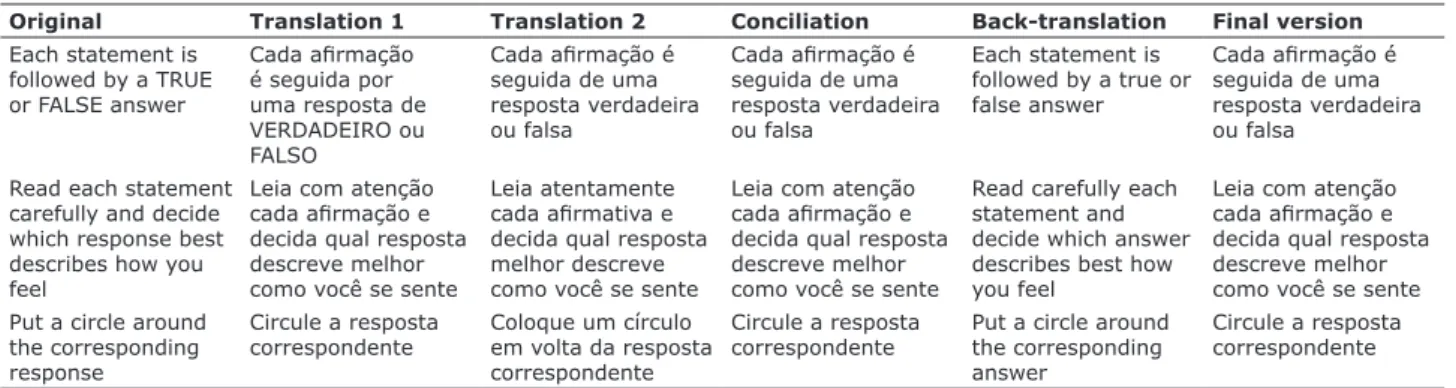
Table 2 presents examples of the original version, two
initial translations, conciliation, back-translation and final
version. The final version incorporated changes from the
back-translation process and is presented at Appendix 1.
During the reconciliation step, 20 items were easily
translated, with both pairs translating them identically;
the remaining items presented a few differences. All
these items were discussed by the authors to achieve
the maximum possible semantic equivalence with the
English version.
Table 1 - Semi-structured questionnaire used for cognitive debrieing.
For patients
- Do you understand this item/question? (If not, please explain the dificulty.) - If there are any dificulties, how would you rewrite this item/question?
- Can you explain what it means? (Please, ask patients what they think about the item/question.)
- Are the answer options consistent with this item? (If not, explain why and suggest how would you rewrite these options.)
For interviewers
- Please, comment on the patient’s suggestions and recommend any changes that you consider necessary.
Table 2 - Original version, translations, reconciliation, back-translation and inal version of the Sexual Function Questionnaire (brief format)
Original Translation 1 Translation 2 Conciliation Back-translation Final version
Each statement is
followed by a TRUE
or FALSE answer
Cada airmação é seguida por
uma resposta de
VERDADEIRO ou
FALSO
Cada airmação é
seguida de uma resposta verdadeira
ou falsa
Cada airmação é
seguida de uma resposta verdadeira
ou falsa
Each statement is
followed by a true or false answer
Cada airmação é
seguida de uma resposta verdadeira
ou falsa
Read each statement
carefully and decide
which response best describes how you
feel
Leia com atenção
cada airmação e
decida qual resposta descreve melhor como você se sente
Leia atentamente
cada airmativa e
decida qual resposta melhor descreve como você se sente
Leia com atenção
cada airmação e
decida qual resposta descreve melhor como você se sente
Read carefully each
statement and decide which answer describes best how
you feel
Leia com atenção
cada airmação e
decida qual resposta descreve melhor como você se sente Put a circle around
the corresponding response
Circule a resposta correspondente
Coloque um círculo em volta da resposta correspondente
Circule a resposta correspondente
Put a circle around the corresponding answer
During cognitive debriefing, two of the five patients
suggested changes to questions 31 and 34. The authors
discussed these suggestions and concluded that the
proposed changes were not relevant did not affect
semantic equivalence; therefore, no changes were
made as a result of this step.
Since this was the first SFQ translation providing a
back-translation of the instrument, it was not possible
to carry out the harmonization step. The final version of
the instrument was slightly edited to include brackets
by the options, with the intention of making it easier
to complete the answer and improve the layout. The
original authors read and approved the final version of
the instrument (Appendix 1).
Discussion
This study describes the procedure of translation and
cross-cultural adaptation of the original English version
of the SFQ into Brazilian Portuguese language, according
to ISPOR standards. To the best of our knowledge, this
is the first study to adopt standardized methods to
translate and adapt the SFQ cross-culturally.
Following the principles of good practice in the
translation and adaptation of self-reporting instruments
– including participation of the original authors – helps
guarantee equivalence of the new version with the
original one. A diversity of translations and adaptations
of different versions of the SFQ can be found,
14-16but the
methodology used in those reports are poorly described
and do not follow some important steps suggested by
ISPOR, including cognitive debriefing. The absence of
a standardized methodology for this process increases
the risk of terminological inconsistence, potentially
impairing the validity of the instruments.
11The main limitation of this study was the impossibility
to conduct the harmonization step. Although other
translations are available for the SFQ, it was not possible
to find other back-translations. This step can now be
undertaken in future translation studies using our
back-translation as a parameter.
Conclusion
The original version of the SFQ was translated and
cross-culturally adapted to Brazilian Portuguese following
rigid international standards. The resulting instrument
is a free-use version, currently undergoing validation by
the same authors. The scale is available as a free version
and is available for clinical use and for studies of sexual
dysfunction in Portuguese-speaking psychiatric patients.
Disclosure
Tiago Reis Marques has received personal fees from
Lundbeck and Pfizer. Oliver Howes has received
personal fees from Astra-Zeneca, Autifony, BMS, Eli Lilly,
Heptares, Janssen, Lundbeck, Lyden-Delta, Otsuka,
Servier, Sunovion, Rand and Roche; has received
grants from the Medical Research Council, Maudsley
Charity, National Institute for Health Research (NIHR)
Biomedical Research Centre at South London, Maudsley
NHS Foundation Trust and King’s College London. No
other conflicts of interest declared concerning the
publication of this article.
References
1. Montejo ÁL, Majadas S, Rico-Villademoros F, LLorca G, De La Gándara J, Franco M, et al. Frequency of sexual dysfunction in
patients with a psychotic disorder receiving antipsychotics. J Sex Med. 2010;7:3404-13.
2. Serretti A, Chiesa A. A meta-analysis of sexual dysfunction in psychiatric patients taking antipsychotics. Int Clin
Psychopharmacol. 2011;26:130-40.
3. Harley EW-Y, Boardman J, Craig T. Sexual problems in schizophrenia: prevalence and characteristics. A cross sectional survey. Soc Psychiatry Psychiatr Epidemiol. 2010;45:759-66.
4. Marques TR, Smith S, Bonaccorso S, Gaughran F, Kolliakou A,
Dazzan P, et al. Sexual dysfunction in people with prodromal or irst-episode psychosis. Br J Psychiatry. 2012;201:131-6.
5. de Boer MK, Castelein S, Wiersma D, Schoevers RA, Knegtering
H. The facts about sexual (dys) function in schizophrenia: an overview of clinically relevant indings. Schizophr Bull.
2015;41:674-86.
6. Cutler A. Sexual dysfunction and antipsychotic treatment.
Psychoneuroendocrinology. 2003;28:69-82.
7. Smith SM, O’Keane V, Murray R. Sexual dysfunction in patients
taking conventional antipsychotic medication. Br J Psychiatry. 2002;181:49-55.
8. Bebbington P, Angermeyer M, Azorin JM, Marwaha S, Marteau F,
Toumi M. Side-effects of antipsychotic medication and health-related quality of life in schizophrenia. Acta Psychiat Scand.
2009;119:22-8.
9. de Boer MK, Castelein S, Wiersma D, Schoevers RA, Knegtering
H. A systematic review of instruments to measure sexual functioning in patients using antipsychotics. J Sex Res.
2014;51:383-9.
10. Saperstein AM, Thysen J, Medalia A. The Measure of Insight into Cognition: Reliability and validity of clinician-rated and self-report scales of neurocognitive insight for schizophrenia.
Schizophr Res. 2012;134:54-8.
11. Wild D, Grove A, Martin M, Eremenco S, McElroy S, Verjee-Lorenz A, et al. Principles of Good Practice for the Translation and Cultural Adaptation Process for Patient-Reported Outcomes (PRO) Measures: report of the ISPOR Task Force for Translation and Cultural Adaptation. Value Health.
2005;8:94-104.
12. Spanemberg L, Parker G, Caldieraro MA, Vares EA, Costa F,
Costa MM, et al. Translation and cross-cultural adaptation of
the Temperament & Personality Questionnaire into Brazilian Portuguese. Trends Psychiatry Psychother. 2014;36:214-8. 13. Baeza FL, Caldieraro MA, Pinheiro DO, Fleck MP. Translation
and cross-cultural adaptation into Brazilian Portuguese of the Measure of Parental Style (MOPS)--a self-reported scale--according to the International Society for Pharmacoeconomics and Outcomes Research (ISPOR) recommendations. Rev Bras
Psiquiatr. 2010;32:159-63.
14. Krishna K, Avasthi A, Grover S. Validation of sexual functioning questionnaire in Indian patients. Indian J Psychol Med.
15. Khademi A, Alleyassin A, Agha-hosseini M, Dadras N, Asghari
Roodsari A, Tabatabaeefar L, et al. Psychometric properties of Sexual Function Questionnaire: evaluation of an Iranian sample. Int J Reprod Biomed. 2006;4:23-8.
16. Slaski S, Stefankiewicz M. Psychometric Validation of the Sexual
Function Questionnaire in Poland. Sex Disabil. 2012;30:103-8.
Correspondence:
Clara de Oliveira Lapa
Av. Cristóvão Colombo, 3084/203
90569-000 - Porto Alegre, RS - Brazil Tel.: +55 (51) 3508-3084
E-mail: [email protected]
Appendix 1
Questionário de Função Sexual (SFQ)
(Smith SM, O’Keane V, Murray R, 2002)
Cada afirmação é seguida de uma resposta
VERDADEIRA
ou
FALSA
. Leia com atenção cada afirmação e decida
qual resposta descreve melhor como você se sente. Assinale a resposta correspondente.
Se você não tem certeza absoluta sobre qual resposta é a mais precisa, escolha a que você sente ser mais
apropriada. Por favor, pergunte à pessoa que está lhe entrevistando se há alguma palavra que você não entenda.
Não demore muito tempo em cada afirmação. É importante que você responda a cada questão da forma mais
honesta possível.
Lembre-se de responder todas as questões.
Todas as informações vão ser tratadas com o mais absoluto sigilo.
No ultimo mês.
1. Eu pensei sobre sexo
a. Ao menos uma vez ao dia ... [ ]Verdadeiro/ [ ]Falso b. Três vezes por semana ... [ ]Verdadeiro/ [ ]Falso c. Menos de uma vez por semana... [ ]Verdadeiro/ [ ]Falso d. Menos de uma vez a cada duas semanas ... [ ]Verdadeiro/ [ ]Falso 2. Eu nunca penso em sexo ... [ ]Verdadeiro/ [ ]Falso
3. Eu achei outras pessoas desejáveis sexualmente ... [ ]Verdadeiro/ [ ]Falso
4. Eu não quis ter relações sexuais ... [ ]Verdadeiro/ [ ]Falso 5. Eu tive prazer com sexo ... [ ]Verdadeiro/ [ ]Falso 6. Eu não estive particularmente interessado em sexo ... [ ]Verdadeiro/ [ ]Falso
No ultimo mês.
7. Eu me excitei facilmente ... [ ]Verdadeiro/ [ ]Falso 8. Tem levado mais tempo que o usual para eu me excitar ... [ ]Verdadeiro/ [ ]Falso 9. Eu estive completamente incapaz de me excita ... [ ]Verdadeiro/ [ ]Falso
10. Embora eu tenha me excitado mentalmente, nada aconteceu isicamente ... [ ]Verdadeiro/ [ ]Falso
Mulheres - por favor pulem para a questão 18.
Homens - por favor continuem. No ultimo mês:
11. Eu tive ereções ...
a. Ao menos uma vez ao dia ... [ ]Verdadeiro/ [ ]Falso b. Três vezes por semana ... [ ]Verdadeiro/ [ ]Falso c. Menos de uma vez por semana... [ ]Verdadeiro/ [ ]Falso d. Menos de uma vez a cada duas semanas ... [ ]Verdadeiro/ [ ]Falso e. Menos de uma vez por mês ... [ ]Verdadeiro/ [ ]Falso
12. Eu não tenho ereções ... [ ]Verdadeiro/ [ ]Falso 13. Eu sempre sou capaz de ter uma ereção completa quando eu quero ... [ ]Verdadeiro/ [ ]Falso
14. Eu sinto que minhas ereções não são completas como eram antes... [ ]Verdadeiro/ [ ]Falso 15. Eu nunca sou capaz de atingir uma ereção completa ... [ ]Verdadeiro/ [ ]Falso
16. Eu raramente atinjo uma ereção completa ... [ ]Verdadeiro/ [ ]Falso
17. Por não atingir uma ereção completa, eu não sou capaz de ter relações sexuais ... [ ]Verdadeiro/ [ ]Falso
Mulheres - por favor continuem. No último mês:
22. Eu me masturbei ... [ ]Verdadeiro/ [ ]Falso a. Ao menos uma vez ao dia ... [ ]Verdadeiro/ [ ]Falso b. Três vezes por semana ... [ ]Verdadeiro/ [ ]Falso c. Menos de uma vez por semana... [ ]Verdadeiro/ [ ]Falso d. Menos de uma vez a cada duas semanas ... [ ]Verdadeiro/ [ ]Falso e. Menos de uma vez por mês ... [ ]Verdadeiro/ [ ]Falso
23. Eu sinto que masturbação é errado ... [ ]Verdadeiro/ [ ]Falso 24. Eu nunca me masturbo ... [ ]Verdadeiro/ [ ]Falso 25. Eu raramente me masturbo ... [ ]Verdadeiro/ [ ]Falso
26. Eu me masturbei com mais frequência do que normalmente faço ... [ ]Verdadeiro/ [ ]Falso
27. Eu me masturbei menos do que normalmente faço ... [ ]Verdadeiro/ [ ]Falso
No último mês:
28. Eu não atingi orgasmo/não ejaculei de forma alguma ... [ ]Verdadeiro/ [ ]Falso
29. Eu tive orgasmos/ejaculações sempre que quis ... [ ]Verdadeiro/ [ ]Falso
30. Nunca atingi um orgasmo/ejaculação ... [ ]Verdadeiro/ [ ]Falso
31. Orgasmo/ejaculação foi doloroso para mim ... [ ]Verdadeiro/ [ ]Falso
32. Meu orgasmo ou ejaculação foi diferente do que era antes ... [ ]Verdadeiro/ [ ]Falso
33. Eu tenho orgasmo/ejaculação toda vez que faço sexo / me masturbo... [ ]Verdadeiro/ [ ]Falso
Mulheres - por favor pulem para a questão 39.
Homens - por favor continuem. No último mês:
34. Eu ejaculo muito tempo depois de ter atingido o orgasmo ... [ ]Verdadeiro/ [ ]Falso
35. Minha ejaculação acontece muito rápido ... [ ]Verdadeiro/ [ ]Falso
36. A quantidade de luido que eu produzo quando ejaculo é menor do que eu costumava produzir antes ... [ ]Verdadeiro/ [ ]Falso
37. A quantidade de luido que eu produzo quando ejaculo é maior do que eu costumava produzir antes ... [ ]Verdadeiro/ [ ]Falso
38. A cor do luido que eu produzo quando eu ejaculo é diferente de antes ... [ ]Verdadeiro/ [ ]Falso
Homens e mulheres
39. Por favor, marquem na escala abaixo o nível de satisfação com a sua vida sexual no último mês:
Completamente Insatisfeito Completamente Satisfeito
0...1...2...3...4...5...6...7...8...9...10
Sexual Function Questionnaire (SFQ), traduzido e adaptado para o Português do Brasil como Questionário de Função Sexual após autorização dos autores
http://dx.doi.org/10.1590/2237-6089-2017-1002
The authors of the article entitled “Translation and cross-cultural adaptation of the Sexual Function Questionnaire
(SFQ) into Brazilian Portuguese” (doi: http://dx.doi.org/10.1590/2237-6089-2016-0089), published in Trends in
Psychiatry and Psychotherapy, 2017, volume 39, issue 2, pages 110-115, have identified an error in Appendix 1
(Brazilian Portuguese version of the Sexual Function Questionnaire), namely, that items 18 to 21 were missing. Below
we reproduce the final, correct version of the Appendix:
Appendix 1
Questionário de Função Sexual (SFQ)
(Smith SM, O’Keane V, Murray R, 2002)
Cada afirmação é seguida de uma resposta
VERDADEIRA
ou
FALSA
. Leia com atenção cada afirmação e decida
qual resposta descreve melhor como você se sente. Assinale a resposta correspondente.
Se você não tem certeza absoluta sobre qual resposta é a mais precisa, escolha a que você sente ser mais
apropriada. Por favor, pergunte à pessoa que está lhe entrevistando se há alguma palavra que você não entenda.
Não demore muito tempo em cada afirmação. É importante que você responda a cada questão da forma mais
honesta possível.
Lembre-se de responder todas as questões.
Todas as informações vão ser tratadas com o mais absoluto sigilo.
No último mês.
1. Eu pensei sobre sexo
a. Ao menos uma vez ao dia ... [ ]Verdadeiro/ [ ]Falso b. Três vezes por semana ... [ ]Verdadeiro/ [ ]Falso c. Menos de uma vez por semana... [ ]Verdadeiro/ [ ]Falso d. Menos de uma vez a cada duas semanas ... [ ]Verdadeiro/ [ ]Falso 2. Eu nunca penso em sexo ... [ ]Verdadeiro/ [ ]Falso 3. Eu achei outras pessoas desejáveis sexualmente ... [ ]Verdadeiro/ [ ]Falso 4. Eu não quis ter relações sexuais ... [ ]Verdadeiro/ [ ]Falso 5. Eu tive prazer com sexo ... [ ]Verdadeiro/ [ ]Falso 6. Eu não estive particularmente interessado em sexo ... [ ]Verdadeiro/ [ ]Falso
No último mês.
7. Eu me excitei facilmente ... [ ]Verdadeiro/ [ ]Falso 8. Tem levado mais tempo que o usual para eu me excitar ... [ ]Verdadeiro/ [ ]Falso 9. Eu estive completamente incapaz de me excita ... [ ]Verdadeiro/ [ ]Falso
10. Embora eu tenha me excitado mentalmente, nada aconteceu isicamente ... [ ]Verdadeiro/ [ ]Falso
Mulheres - por favor pulem para a questão 18.
Homens - por favor continuem. No último mês:
11. Eu tive ereções
13. Eu sempre sou capaz de ter uma ereção completa quando eu quero ... [ ]Verdadeiro/ [ ]Falso 14. Eu sinto que minhas ereções não são completas como eram antes... [ ]Verdadeiro/ [ ]Falso 15. Eu nunca sou capaz de atingir uma ereção completa ... [ ]Verdadeiro/ [ ]Falso 16. Eu raramente atinjo uma ereção completa ... [ ]Verdadeiro/ [ ]Falso 17. Por não atingir uma ereção completa, eu não sou capaz de ter relações sexuais ... [ ]Verdadeiro/ [ ]Falso
Homens - por favor pulem para a questão 22.
Mulheres - por favor continuem.
18. Sexo tem sido difícil para mim já que eu não respondo isicamente como deveria ... [ ]Verdadeiro/ [ ]Falso 19. Minha resposta física à estimulação sexual é diferente do que costumava ser ... [ ]Verdadeiro/ [ ]Falso 20. Minha resposta física à estimulação sexual é melhor agora do que costumava ser ... [ ]Verdadeiro/ [ ]Falso 21. Minha resposta física à estimulação sexual é pior do que era ... [ ]Verdadeiro/ [ ]Falso
No último mês:
22. Eu me masturbei [ ]Verdadeiro/ [ ]Falso
a. Ao menos uma vez ao dia ... [ ]Verdadeiro/ [ ]Falso b. Três vezes por semana ... [ ]Verdadeiro/ [ ]Falso c. Menos de uma vez por semana... [ ]Verdadeiro/ [ ]Falso d. Menos de uma vez a cada duas semanas ... [ ]Verdadeiro/ [ ]Falso e. Menos de uma vez por mês ... [ ]Verdadeiro/ [ ]Falso 23. Eu sinto que masturbação é errado ... [ ]Verdadeiro/ [ ]Falso 24. Eu nunca me masturbo ... [ ]Verdadeiro/ [ ]Falso 25. Eu raramente me masturbo ... [ ]Verdadeiro/ [ ]Falso 26. Eu me masturbei com mais frequência do que normalmente faço ... [ ]Verdadeiro/ [ ]Falso 27. Eu me masturbei menos do que normalmente faço ... [ ]Verdadeiro/ [ ]Falso
No último mês:
28. Eu não atingi orgasmo/não ejaculei de forma alguma ... [ ]Verdadeiro/ [ ]Falso 29. Eu tive orgasmos/ejaculações sempre que quis ... [ ]Verdadeiro/ [ ]Falso 30. Nunca atingi um orgasmo/ejaculação ... [ ]Verdadeiro/ [ ]Falso 31. Orgasmo/ejaculação foi doloroso para mim ... [ ]Verdadeiro/ [ ]Falso 32. Meu orgasmo ou ejaculação foi diferente do que era antes ... [ ]Verdadeiro/ [ ]Falso 33. Eu tenho orgasmo/ejaculação toda vez que faço sexo / me masturbo... [ ]Verdadeiro/ [ ]Falso
Mulheres - por favor pulem para a questão 39.
Homens - por favor continuem. No último mês:
34. Eu ejaculo muito tempo depois de ter atingido o orgasmo ... [ ]Verdadeiro/ [ ]Falso 35. Minha ejaculação acontece muito rápido ... [ ]Verdadeiro/ [ ]Falso
36. A quantidade de luido que eu produzo quando ejaculo é menor do que eu costumava produzir antes ... [ ]Verdadeiro/ [ ]Falso
37. A quantidade de luido que eu produzo quando ejaculo é maior do que eu costumava produzir antes ... [ ]Verdadeiro/ [ ]Falso
38. A cor do luido que eu produzo quando eu ejaculo é diferente de antes ... [ ]Verdadeiro/ [ ]Falso
Homens e mulheres
39. Por favor, marquem na escala abaixo o nível de satisfação com a sua vida sexual no último mês:
Completamente Insatisfeito Completamente Satisfeito
0...1...2...3...4...5...6...7...8...9...10
Sexual Function Questionnaire (SFQ), traduzido e adaptado para o Português do Brasil como Questionário de Função Sexual após autorização dos autores originais por Clara Lapa, Gibsi Possapp Rocha, Tiago Reis Marques, Shubulade Smith, Ricardo Tavares Monteiro, Roberta Zorzetti e Lucas Spanemberg (2016). Pode ser reproduzido e utilizado livremente sem autorização