Evaluation of the effects of a diabetes
educational program: a randomized
clinical trial
Heloísa de Carvalho TorresI, Ana Emília PaceII, Fernanda Figueredo ChavesIII, Gustavo
Velasquez-MelendezIV, Ilka Afonso ReisV
I Universidade Federal de Minas Gerais. Escola de Enfermagem. Departamento de Enfermagem Aplicada. Belo Horizonte, MG, Brasil
II Universidade de São Paulo. Escola de Enfermagem de Ribeirão Preto. Departamento de Enfermagem Geral e Especializada. Ribeirão Preto, SP, Brasil
III Universidade Federal de Minas Gerais. Escola de Enfermagem. Programa de Pós-Graduação em Enfermagem. Belo Horizonte, MG, Brasil
IV Universidade Federal de Minas Gerais. Escola de Enfermagem. Departamento de Enfermagem Materno-Infantil e Saúde Pública. Belo Horizonte, MG, Brasil
V Universidade Federal de Minas Gerais. Instituto de Ciências Exatas. Departamento de Estatística. Belo Horizonte, MG, Brasil
ABSTRACT
OBJECTIVE: Evaluate the efectiveness of a diabetes mellitus educational program in primary health care.
METHODS: his cluster randomized trial was conducted in a sample of 470 people with type 2 diabetes mellitus from eight health units, randomly assigned to two groups: intervention (n = 231) and control (n = 239). he intervention group participated in the educational program composed of three strategies: group education, home visit, and telephone intervention. Simultaneously, the control group was monitored individually. Group monitoring took place over nine months in the year 2012. Clinical evaluations were performed at the initial time (T0), three (T3), six (T6)
and nine (T9) months after the beginning of the intervention.
RESULTS: After nine months of follow-up, 341 users remained in the study, 171 in the control group and 170 in the intervention group. he average age of users was 60.6 years. In both groups, statistically signiicant diferences were observed in mean HbA1c levels over the follow-up time (p < 0.05). However, the mean HbA1c level at T3, T6 and T9 times were signiicantly lower among
the people in the intervention group (p < 0.05).
CONCLUSIONS: he educational program model developed was efective to improve the glycemic control of the intervention group participants.
DESCRIPTORS:Diabetes Mellitus, Type 2, prevention & control. Self Care. Health Education. Health Programs and Plans. Evaluation of the Eicacy-Efectiveness of Interventions. Outcome and Process Assessment (Health Care).
Correspondence:
Heloísa de Carvalho Torres Escola de Enfermagem – UFMG Av. Alfredo Balena, 190 Santa Efigênia
30130-100 Belo Horizonte, MG, Brasil
E-mail: [email protected]
Received: Apr 29, 2016
Approved: Jan 9, 2017
How to cite: Torres HC, Pace AE, Chaves FF, Velasquez-Melendez G, Reis IA. Evaluation of the effects of a diabetes educational program: a randomized clinical trial. Rev Saude Publica. 2018;52:8.
Copyright: This is an open-access article distributed under the terms of the Creative Commons Attribution License, which permits unrestricted use, distribution, and reproduction in any medium, provided that the original author and source are credited.
INTRODUCTION
Type 2 diabetes mellitus (DM) accounts for 90% to 95% of DM cases and can be attributed to the efects of population aging combined with an unhealthy lifestyle such as poor eating habits and sedentary lifestyle1. Brazil is the fourth country with the highest number of adults
between 20 and 79 years of age with diabetes, and the irst among South and Central America countries14,15. Diabetes mellitus care programs should involve behavioral, psychosocial, and
clinical aspects, and consider the values, opinions, and experiences of people in developing knowledge and skills for physical activity practices, following a food plan in the sociocultural context of the person’s life1,3,4,20,24,26,30.
he behavioral changes required to control the condition of diabetes, especially those related to non-pharmacological treatment, contribute to a low adherence to self-care, which is a challenge for both people with diabetes and professionals involved in health care10.
herefore, educational practices directed to self-care of the person with diabetes have been carried out in Brazil, mainly through lectures for awareness. However, these strategies have been shown to have a low impact on adherence to treatment and self-care2,37,40,42. Providing
program models in health care is important to instrumentalize the person in decision making and responsibility for their health care in controlling the condition and preventing their chronic complications10,38.
Primary Health Care is a favorable scenario for the implementation of the diabetes educational program, which, in partnership with the University, has sought to develop pedagogical practices based on the user’s approach, such as group education, home visit, and telephone intervention. Such measures create an environment conducive to dialogue and a process of relection aimed at self-care, and therefore, a possible increase in the efectiveness of programs of this nature inserted at the primary health care level13,16,27,39.
he purpose of this study was to evaluate the efects of an educational program in diabetes glycemic control in the Primary Health Care of Belo Horizonte, the capital of the state of Minas Gerais, Brazil.
METHODS
he study was a cluster-randomized clinical trial conducted in a sample of people with DM enrolled and clinically monitored at eight basic health units (BHU) in the city of Belo Horizonte, capital of the state of Minas Gerais, Brazil, and participants in the diabetes educational program started in the year 2012. he people were recruited through records in medical records of the Basic Health Units. In addition to having a diagnosis of type 2 DM, the inclusion criteria were age between 30 and 70 years and availability to attend the consultations performed throughout the study. he main exclusion criteria were illiteracy and chronic complications deined as renal failure, blindness, amputation of limbs, among others. To calculate the unadjusted sample size (m) in each conglomerate, the Campbell et al.2 (2004)
expression was used. To accommodate the cluster efect, the design efect was calculated as DE = 1 + (n - 1), where n is the mean cluster size and r is the intraclass correlation
coeicient. In order to achieve the adjusted sample size (n) in each cluster, the value of m
was multiplied by the design efect DE, whose efect is to increase the size of the sample to consider the possibility of lower variability among users within the same cluster than among users of diferent clusters. he values used in the calculation of the sample size were: signiicance level α = 0.05, test power ω = 0.90, standard efect size for glycohemoglobin
d = 1, n = 100 and r = 0.008 (obtained from previous design data and similar to the data of
Of the eight Basic Health Units, from which the study sample originated, four comprised the intervention group and four formed the control group. he allocation of each unit was done by lottery, using a computer program to generate random sequences with the numbers one to eight. he participants of the two groups were monitored through telephone contacts for nine months, following the program established by each unit and according to the type of strategy, which satisied the individual needs and availabilities. he users allocated to the control group participated in the educational practices developed in the routine of the respective health units and maintained the conventional follow-up, performed in the Basic Health Units, through clinical care, according to the Primary Care protocol23. Finally, these
users received two telephone calls, made by a nurse.
he program included the use of strategies: group education, home visit and telephone intervention, whose purpose was to insert users in the strategies that would give them better access to the teaching and learning process to strengthen self-care practices and goal setting. hese strategies occurred concomitantly at three times (cycles), every three months. Most users who had a telephone (landline or cell phone) were accompanied by phone calls, in which the objective was to reinforce practices and minimize barriers to adherence to self-care practices associated with following a healthy food plan and practicing physical activity. Group education consisted of activities in small groups that discussed the topics: healthy eating, physical activity, feelings that may impair adherence to self-care practices, as well as the planning of goals inserted in the user’s daily routine. Subjects were approached through playful and interactive dynamics, such as conversation maps “Understanding Diabetes”, “Healthy eating and physical activity” and “Glucose monitoring”5,24. hree meetings were
held with an interval of one week. Each meeting lasted an average of two hours. In all the meetings, two professionals were present, usually a nurse and a nutritionist, who conducted the educational process in an interdisciplinary way, contributing to the interaction and reinforcement of contents, leading the user to beneit from a change of behavior and to become aware that their actions make a diference in treatment. Group education was comprised of nine face-to-face meetings held at the respective health units.
Participants who did not attend the meetings were contacted via telephone or had a home visit scheduled to perform the uncompleted activity.
he home visit discussed the needs faced by the user in the day to day regarding their condition from the understanding of the life context, in addition to addressing the emotional complications experienced by the user. he systematization of care, in turn, aimed to contemplate the needs of the user, promote their autonomy during the teaching-learning process for health care and lead to a comprehensive and humanized care. Each service had an average duration of 45 minutes and each user received two appointments, which were previously scheduled through telephone calls, according to the users’ interest, and performed by health professionals (nurses, physiotherapist, and nutritionist).
In the telephone intervention, the issues related to the food plan, physical activity, feelings, barriers and meeting of goals were addressed. he calls were made by a health professional and had an average duration of 25 minutes. We observed that the user needed to talk about their diiculties regarding self-care practices and took advantage of the telephone call to express their feelings of anguish when performing physical activity practices and following the healthy eating plan.
he primary endpoint was improvement in A1C glycated hemoglobin levels (HBA1c, in %), evaluated at baseline (T0), and at three-month intervals (T3, T6, and T9), and improved levels
of total cholesterol (mg/dL), HDL cholesterol (mg/dL), LDL cholesterol (mg/dL), VLDL cholesterol (mg/dL) and triglycerides (), also monitored at the baseline and at T3, T6 and T9
he data were processed through the SPSS program (version 19.0), and double typed for data control and validation. Statistical analyses were carried out in the statistical programming environment R (version 3.0.1). To evaluate the efect of the intervention over time in each of the clinical variables, the Variance Analysis with repeated measures was used. To determine the need for more complex models of variance analysis, such as those that consider the efect of clusters, intra-class correlation coeicient values, considering the initial and inal data of the clinical indicators, were evaluated and values smaller than 0.05 were considered low. he normality assumption of the data was veriied by means of the Shapiro-Wilk test. In case of violation of the data variances homogeneity assumption in their original measurement scale, the Box-Cox transformation was used to correct the problem. Multiple comparisons were made by means of conidence intervals with the Bonferroni correction. To compare proportions, we used chi-square tests with Yates correction for independent samples and McNemar for dependent samples. To compare two means, the t-Student-Welch test was used, if the samples were independent, and the t-Student test was paired for dependent samples. In all analyses, a signiicance level of 5% was used.
his study was approved by the Research Ethics Committee of the Universidade Federal de Minas Gerais and the Municipal Secretary of Health of Belo Horizonte, state of Minas Gerais, through Report 0024.0.410.203-09.
RESULTS
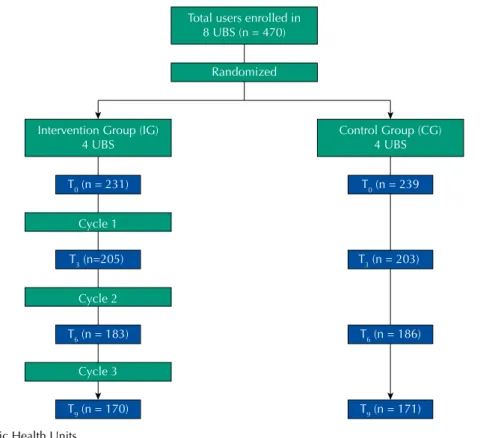
he number of participants who started the study was 470, from the eight basic health units, of which 239 (50.9%) were from the control group and 231 (49.1%) from the intervention group. he total loss after nine months of follow-up was 27.3%, remaining in the study 341 users, 171 in the control group and 170 in the intervention group (Figure 1). Among the reasons presented, most people did not participate due to lack of interest, change of address and others.
he control and intervention groups were considered comparable for clinical, anthropometric and sociodemographic variables, both at the baseline (T0) and at the end of the study (T9), except for the educational variable, for which the intervention group had a higher proportion of illiteracy than the control group (p < 0.020) (Table 1). hus, losses can be considered random, except for schooling level.
Regarding the clinical variables, the highest value obtained for the intra-class correlation coeicient was 0.038 (HDL variable at the baseline). hus, there was no need to consider the cluster efect in data analysis, making it simpler. Table 2 presents the means and respective standard deviations of HbA1c levels and other clinical variables in the control and intervention groups during the study, as well as the results of the variance analysis. Figure 2 shows the diference in mean HbA1c levels between the intervention group and the control group at the four study times and their respective 95% conidence intervals. he two groups were considered comparable at the baseline for the clinical variables (p > 0.05; Figure 2). Over the follow-up time, there were statistically signiicant diferences in mean HbA1c values in both the control and intervention groups. In the control group, mean hemoglobin A1c increased from initial time to T3 time and remained stable until the T9 time (p < 0.05; Table 2). In the intervention group, the mean hemoglobin A1c also increased between the initial time and T3, but at the T6 time, it returned to the mean value of
the initial time and remained stable until the inal time (T9) (p < 0.05). he mean value of HbA1c in the intervention group was considered statistically lower than the mean HbA1c value in the control group at T3, T6 and at the end of the study (T9) (p < 0.05) (Figure 2).
Table 1. Mean (standard deviation) or counting (percentage) of sociodemographic and clinical variables of the users in the intervention and control groups at the baseline and at the end of the study (impact assessment of the losses).
Variable Initial (T0) Final (T9)
Control Intervention pa Control Intervention pa
Gender (n = 239) (n = 231) (n = 171) (n = 170)
Female 161 (67.4%) 164 (71.0%)
0.452 118 (69.0%) 127 (74.7%) 0.294
Male 78 (32.6%) 67 (29.0%) 53 (31.0%) 43 (25.3%)
Occupation (n = 230) (n = 227) (n = 167) (n = 168)
Active 65 (28.3%) 55 (24.2%)
0.383 42 (25.1%) 39 (23.2%) 0.775
Inactive 165 (71.7%) 172 (75.8%) 125 (74.9%) 129 (76.8%)
Marital status (n = 230) (n = 226) (n = 167) (n = 167)
Had partner 127 (55.2%) 119 (52.7%)
0.649 93 (55.7%) 88 (52.7%) 0.660
Without partner 103 (44.8%) 107 (47.3%) 74 (44.3%) 79 (47.3%)
Educationb (n = 230) (n = 225) (n = 167) (n = 167)
Illiterate 13 (5.7%) 38 (16.9%)
0.0003 13 (7.8%) 28 (16.8%) 0.020
Literate 217 (94.3%) 187 (83.1%) 154 (92.2%) 139 (83.3%)
Age (years) (n = 230)
62.5 (10.5)
(n = 223)
62.1 (10.9) 0.682
(n = 167) 62.8 (10.5)
(n = 165)
63.4 (10.6) 0.475
Income (minimum wage) (n = 230)
1.8 (1.9)
(n = 214)
1.9 (1.8) 0.846
(n = 167) 1.7 (1.9)
(n = 157)
1.7 (1.4) 0.827
Disease duration (years) (n = 229)
9.8 (8.1)
(n = 221)
9.2 (8.1) 0.463
(n = 166) 9.9 (8.5)
(n = 163)
9.4 (8.3) 0.614
Body mass index (kg/m2) (n = 230)
28.6 (5.1)
(n = 224)
29.2 (5.6) 0.272
(n = 167) 29.2 (5.3)
(n = 165)
28.6 (5.3) 0.389
Abdominal circumference (cm) (n = 230)
101.5 (12.5)
(n = 222)
100.0 (13.7) 0.243
(n = 131) 101.5 (13.4)
(n = 143)
100.6 (12.9) 0.602
a T-Student-Welch for independent samples or chi-square test.
b The groups are statistically different in the percentage of illiterate people. UBS: Basic Health Units
Figure 1. Study flowchart.
Total users enrolled in 8 UBS (n = 470)
Intervention Group (IG) 4 UBS
T0 (n = 231) T0 (n = 239
Control Group (CG) 4 UBS
Cycle 1
T3 (n=205) T3 (n = 203)
Cycle 2
T6 (n = 183) T6 (n = 186)
Cycle 3
T9 (n = 170) T9 (n = 171)
he mean HDL cholesterol level of the intervention group increased statistically between T0 and T3 and remained stable until T9 (p < 0.05). In the control group, there were no statistically signiicant diferences in the mean level of HDL cholesterol between T0 and T9 (p > 0.05). For LDL cholesterol, there was a statistically signiicant increase in mean levels in both groups (p < 0.05). In both groups, there was a statistically signiicant decrease in the mean VLDL cholesterol level between T0 and T9 (p < 0.05). At the mean triglyceride rates, no statistically signiicant diferences were observed between follow-up times in any of the comparison groups (p > 0.05).
As for the percentage of users with altered hemoglobin A1c, the control and intervention groups were considered equal in the initial time (68.2% and 65.8%, respectively, p = 0.649) as well as in the inal time (76.0% and 74.1%, respectively, p = 0.778). In both groups, the percentage of people with altered hemoglobin A1c can be considered statistically larger in the inal time compared to the initial time (p values equal to 0.042 and 0.004 for the control and intervention groups, respectively).
Figure 2. Average difference in HbA1c levels of the two groups over time: intervention group (IG) minus control group (CG). The intervals in the middle of the bars represent the 95% confidence intervals.
-0.75 -0.50 -0.25 0.00 0,25 0.50 0.75
T0
T3 T6 T9
Difference between the mean HbA1c
lev
els of then IG and CG groups
Time
Table 2. Mean (standard deviation) of the biochemical variables along the follow-up of two study groups. P values refer to the F test of the variance analysis.
Variable Group Time
T0 T3 T6 T9
Intervention 7.88a (2.19) (n = 155) 8.31 (2.01) (n = 155) 7.95a (1.86) (n = 155) 7.93a (2.06) (n = 155)
HbA1c (%) p < 0.05
Control 7.83a (2.08) (n = 155) 8.59b (2.06) (n = 155) 8.53b (2.11) (n = 155) 8.29b (2.22) (n = 155) p < 0.05
Intervention 188.48a (55.41) (n = 155) 181.50a.b (42.21) (n = 155) 178.89b (38.95) (n = 155) 180.07a.b (41.39) (n = 155)
Total cholesterol (mg/dL) p < 0.05
Control 188.13a (45.11) (n = 155) 188.28a (46.13) (n = 155) 184.77a (43.87) (n = 155) 183.38a (39.84) (n = 155) p>0.05
Intervention 40.54 (31.87) (n = 155) 41.87b (12.51) (n = 155) 41.69b (10.48) (n = 155) 43.16b (10.52) (n = 155)
HDL-Cd (mg/dL) p < 0.05
Control 43.11a (36.59) (n = 155) 59.95b (35.50) (n = 155) 42.36c (12.09) (n = 155) 42.97c (10.86) (n = 155) p < 0.05
DISCUSSION
Education for self-care and the development of knowledge is a process with several challenges, especially in the presence of DM, a condition that afects people of all ages, with diferent levels of schooling and social and environmental bases6,17,21,25,26,29,41. One study9 aimed to
investigate whether a person with DM would be able to take care of and make the necessary decisions for better control of the condition. People who studied full-time were more likely to understand the outcome of the exam and the efectiveness of early treatment in preventing long-term problems.
It is necessary, therefore, to use a constructivist approach of continuous learning, able to contribute to awakening the relexive, critical and creative potential of both the professional and the person. his approach may be an option in the context of care for the person with the disease6,34,36.
Education based on dialogue favors the process of teaching-learning in the task of caring for oneself4. In this aspect, the educational practice following the process of co-responsibility
allows the person to become aware of their care, and responsible for their actions. he process leads the person to relect on their practice of care, allowing them to make their own choices8,18,22,23,37.
he results of this study suggest that the efects of the educational strategies used contributed to the maintenance of glycemic control throughout the study, as well as to its reduction when compared to the results of the control group. he efects of the intervention on reducing glycated hemoglobin levels (HbA1c) observed in the present study and during follow-up may have been underestimated, since users who had low educational level were mainly in the intervention group. People with DM who were part of the control group and who received conventional guidelines regarding medical consultation routines and information on healthy diet and physical activity showed increased levels of glycated hemoglobin from the sixth month of follow-up.
A second aspect of the results of this study is that, in the intervention group, there was a decrease in the values of the metabolic control variables. Because it was an educational intervention with three strategies (group education, home visit, and telephone intervention), it allowed greater lexibility for its conduction and may have favored this reduction, as found in other studies9,31,32,34,35. he idea of combining several educational strategies allows for greater
convenience and the option of user involvement, alternative contact out of hours, outside working hours and prevents the user from going to the Health Center. hus, associating diferent educational tools can reinforce the dialogue and bring cognitive gains to the issues that have been addressed.
In general, we observed that the expansion of educational and behavioral practices had the goal of involving and mobilizing the patient with diabetes, developing skills and strengthening educational activities for self-care required by the user. he patient proposed goals that contributed to help control the condition of diabetes, and most of them were able to comply with them in whole or in part. Efective communication through dialogue demonstrated the fulillment of goals by the patient, and may be a way for Health professionals to act in the practices oriented towards the autonomy of health care and favoring co-responsibility. In a systematic review, which included eleven clinical trials, the beneicial efects of intensive interventions directed at regular physical activities were shown in the results of HbA1c, lipids and blood pressure. he study emphasizes that intensive weight loss, regular physical activity and frequent contact with health professionals are required to achieve weight loss6,7,14,17.
It should be noted that the duration of contact time between health professionals and users was 14 hours in the intervention group and 4 hours in the control group. A study19 points out
that the time spent in the educational program is associated with obtaining new knowledge and improving the users’ self-care11,12,28,33,39.
Educational interventions with lexible strategies are presented as a viable alternative to raise awareness about diabetes care and to contribute to the maintenance or decrease of glycated hemoglobin levels and other indicators of metabolic function.
REFERENCES
1. American Diabetes Association. Executive summary: standards of medical care in diabetes-2011.
Diabetes Care. 2011;34 Suppl 1:S4-10. https://doi.org/10.2337/dc11-S004
2. Borhani M, Rastgarimehr B, Shafieyan Z, Mansourian M, Hoseini SM, Arzaghi SM, et al. Effects of predisposing, reinforcing and enabling factors on self-care behaviors of the patients with diabetes mellitus in the Minoodasht city, Iran. J Diabetes Metab Disord. 2015;14:27. https://doi.org/10.1186/s40200-015-0139-0
3. Campbell M, Thomson S, Ramsay CR, MacLennan GS, Grimshaw JM. Sample size calculator for cluster randomized trials. Comput Biol Med. 2004;34(2):113-25. https://doi.org/ 10.1016/S0010-4825(03)00039-8
4. Dyke ML, Cuffee YL, Halanych JH, McManus RH, Curtin C, Allison JJ. The relationship between coping styles in response to unfair treatment and understanding of diabetes self-care. Diabetes
Educ. 2013;39(6):848-55. https://doi.org/10.1177/0145721713507112
5. Endevelt R, Peled R, Azrad A, Kowen G, Valinsky L, Heymann AD. Diabetes prevention program in a Mediterranean environment: individual or group therapy? An effectiveness evaluation. Prim
Care Diabetes. 2015;9(2):89-95. https://doi.org/10.1016/j.pcd.2014.07.005
6. Ferguson S, Swan M, Smaldone A. Does diabetes self-management education in conjunction with primary care improve glycemic control in hispanic patients? A systematic review and meta-analysis. Diabetes Educ. 2015;41(4):472-84. https://doi.org/10.1177/0145721715584404
7. Franz MJ, Boucher JL, Rutten-Ramos S, VanWormer JJ. Lifestyle weight-loss intervention outcomes in overweight and obese adults with type 2 diabetes: a systematic review and meta-analysis of randomized clinical trials. J Acad Nutr Diet. 2015;115(9):1447-63. https://doi.org/10.1016/j.jand.2015.02.031
8. Gautam A, Bhatta DN, Aryal UR. Diabetes related health knowledge, attitude and practice among diabetic patients in Nepal. BMC Endocr Disord. 2015;15:25. https://doi.org/10.1186/s12902-015-0021-6
9. Genz J, Haastert B, Müller H, Verheyen F, Cole D, Rathmann W, et al. Socioeconomic factors and effect of evidence-based patient information about primary prevention of type 2 diabetes mellitus - are there interactions? BMC Res Notes. 2014;7:541. https://doi.org/10.1186/1756-0500-7-541
10. Gimenes HT, Zanetti ML, Haas VJ. Factors related to patient adherence to antidiabetic drug therapy. Rev Latino- Am Enfermagem. 2009;17(1):6-51. https://doi.org/10.1590/S0104-11692009000100008
11. Gomes-Villas Boas LC, Foss MC, Freitas MCF, Pace AE. Relação entre apoio social, adesão aos tratamentos e controle metabólico de pessoas com diabetes mellitus. Rev Latino-Am
Enfermagem. 2012;20(1):52-8. https://doi.org/10.1590/S0104-11692012000100008
12. Grillo MFF, Neumann CR, Scain SF, Rozeno RF, Gross JL, Leitão CB. Efeito de diferentes modalidades de educação para o autocuidado a pacientes com diabetes. Rev Assoc Med Bras. 2013;59(4):400-5. https://doi.org/10.1016/j.ramb.2013.02.006
13. Guariguata L, Whiting DR, Hambleton I, Beagley J, Shaw JE. Global estimates of diabetes prevalence for 2013 and projections for 2035. Diabetes Res Clin Pract. 2014;103(2):137-49. https://doi.org/10.1016/j.diabres.2013.11.002
15. International Diabetes Federation. Diabetes atlas. 6.ed. Brussels: IDF; 2013 [cited 2017 Aug 31]. Available from: http://www.diabetesatlas.org/
16. Joo JY. Effectiveness of culturally tailored diabetes interventions for Asian immigrants to the United States: a systematic review. Diabetes Educ. 2014;40(5):605-15. https://doi.org/10.1177/0145721714534994
17. Kellar I, Mason D. Social patterning in knowledge following an informed choice invitation for type 2 diabetes screening. Diabet Med. 2014;31(4):504-8. https://doi.org/10.1111/dme.12334
18. Kuijpers W, Groen WG, Aaronson NK, Harten WH. A systematic review of web-based interventions for patient empowerment and physical activity in chronic diseases: relevance for cancer survivors. J Med Internet Res. 2013;15(2):e37. https://doi.org/10.2196/jmir.2281
19. Maia MA, Reis IA, Torres HC. Relationship between the users’ contact time in educational programs on diabetes mellitus and self-care skills and knowledge. Rev Esc Enferm USP. 2016;50(1):59-64. https://doi.org/http://dx.doi.org/10.1590/S0080-623420160000100008
20. MakkiAwouda FO, Elmukashfi TA, Hag AL-Tom SA. Effects of health education of diabetic patient’s knowledge at Diabetic Health Centers, Khartoum State, Sudan: 2007- 2010. Glob J
Health Sci.2014;6(2):221-6. https://doi.org/10.5539/gjhs.v6n2p221
21. Mansyur CL, Rustveld LO, Nash SG, Jibaja-Weiss ML. Social factors and barriers to self-care adherence in Hispanic men and women with diabetes. Patient Educ Couns. 2015;98(6):805-10. https://doi.org/10.1016/j.pec.2015.03.001
22. Mendoza-Romo MA, Velasco-Chávez JF, Nieva de Jesús RN, Andrade-Rodríguez HJ, Rodríguez-Pérez CV, Palou-Fraga E. Impacto de un programa institucional educativo en el control del paciente diabético. Rev Med Inst Mex Seguro Soc. 2013 [cited 2017 Jul 30];51(3):254-9. Available from: http://www.medigraphic.com/pdfs/imss/im-2013/im133d.pdf
23. Ministério da Saúde (BR), Secretaria de Atenção à Saúde, Departamento de Atenção Básica. Estratégias para o cuidado da pessoa com doença crônica: diabetes mellitus. Brasília (DF): Ministério da Saúde; 2013 [cited 2017 Jul 31]. (Caderno de Atenção Básica, 36). Available from: http://bvsms. saude.gov.br/bvs/publicacoes/estrategias_cuidado_pessoa_diabetes_mellitus_cab36.pdf
24. Naccashian Z. The impact of diabetes self-management education on glucose management and empowerment in ethnic Armenians with type 2 diabetes. Diabetes Educ. 2014;40(5):638-47. https://doi.org/10.1177/0145721714535993
25. Penalba M, Moreno L, Cobo A, Reviriego J, Rodríguez A, Cleall S, et al. Impact of the «Conversation Map™» tools on understanding of diabetes by Spanish patients with type 2 diabetes mellitus: a randomized, comparative study. Endocrinol Nutr. 2014;61(10):505-15. https://doi.org/10.1016/j.endonu.2014.06.001
26. Rossi MC, Lucisano G, Funnell M, Pintaudi B, Bulotta A, Gentile S, et al. Interplay among patient empowerment and clinical and person-centered outcomes in type 2 diabetes. The BENCH-D study. Patient Educ Couns. 2015;98(9):1142-9. https://doi.org/10.1016/j.pec.2015.05.012.
27. Rodrigues FFL, Santos MA, Teixeira CRS, Gonela JT, Zanetti ML. Relação entre conhecimento, atitude, escolaridade e tempo de doença em indivíduos com diabetes mellitus. Acta Paul
Enferm. 2012;25(2):284-90. https://doi.org/10.1590/S0103-21002012000200020
28. Rygg LO, Rise MB, Grønning K, Steinsbekk A. Efficacy of ongoing group based diabetes self-management education for patients with type 2 diabetes mellitus: a randomised controlled trial. Patient Educ Couns. 2012;86(1):98-105. https://doi.org/10.1016/j.pec.2011.04.008
29. Rushakoff RJ, Sullivan MM, Seley JJ, Sadhu A, O’Malley CW, Manchester C, et al. Using a mentoring approach to implement an inpatient glycemic control program in United States hospitals. Healthc (Amst). 2014;2(3):205-10. https://doi.org/10.1016/j.hjdsi.2014.06.004
30. Sakane N, Kotani K, Takahashi K, Sano Y, Tsuzaki K, Okazaki K, et al. Effects of telephone-delivered lifestyle support on the development of diabetes in participants at high risk of type 2 diabetes: J-DOIT1, a pragmatic cluster randomised trial. BMJ Open. 2015;5(8):e007316. https://doi.org/10.1136/bmjopen-2014-007316
31. Small N, Bower P, Chew-Graham CA, Whalley D, Protheroe J. Patient empowerment in
long-term conditions: development and preliminary testing of a new measure. BMC Health Serv Res. 2013;13:263. https://doi.org/10.1186/1472-6963-13-263
32. Steinsbekk A, Rygg LØ, Lisulo M, Rise MB, Fretheim A. Group based diabetes
33. Sugiyama T, Steers WN, Wenger NS, Duru OK, Mangione CM. Effect of a community-based diabetes self-management empowerment program on mental health-related quality of life: a causal mediation analysis from a randomized controlled trial. BMC Health Serv Res. 2015;15:115. https://doi.org/10.1186/s12913-015-0779-2
34. Tan CC, Cheng KK, Wang W. Self-care management programme for older adults with diabetes: an integrative literature review. Int J Nurs Pract. 2015;21 Suppl 2:115-24. https://doi.org/10.1111/ijn.12388
35. Tang TS, Funnell MM, Noorulla S, Oh M, Brown MB. Sustaining short-term improvements over the long-term: results from a 2-year diabetes self-management support (DSMS) intervention.
Diabetes Res Clin Pract. 2012;95(1):85-92. https://doi.org/10.1016/j.diabres.2011.04.003
36. Torres HC, Franco LJ, Stradioto MA, Hortale VA, Schall VT. Avaliação estratégica de educação em grupo e individual no programa educativo em diabetes. Rev Saude Publica. 2009;43(2):291-8. https://doi.org/10.1590/S0034-89102009005000001
37. Torres HC, Souza ER, Lima MHM, Bodstein RC. Intervenção educativa para o
autocuidado de indíviduos com diabetes mellitus. Acta Paul Enferm. 2011;24(4):514-9. https://doi.org/10.1590/S0103-21002011000400011
38. Utz SW, Williams IC, Jones R, Hinton I, Alexander G, Yan G, et al. Culturally tailored
intervention for rural African Americans with type 2 diabetes. Diabetes Educ. 2008;34(5):854-65. https://doi.org/10.1177/0145721708323642
39. Van der Wulp I, Leeuw JR, Gorter KJ, Rutten GE. Effectiveness of peer-led
self-management coaching for patients recently diagnosed with type 2 diabetes mellitus in primary care: a randomized controlled trial. Diabet Med. 2012;29(10):390-7. https://doi.org/10.1111/j.1464-5491.2012.03629.x
40. Walker RJ, Gebregziabher M, Martin-Harris B, Egede LE. Understanding the influence of psychological and socioeconomic factors on diabetes self-care using structured equation modeling. Patient Educ Couns. 2015;98(1):34-40. https://doi.org/10.1016/j.pec.2014.10.002
41. Watts SA, Roush L, Julius M, Sood A. Improved glycemic control in veterans with poorly controlled diabetes mellitus using a Specialty Care Access Network-Extension for Community Healthcare Outcomes model at primary care clinics. J Telemed Telecare. 2016;22(4):221-4. https://doi.org/10.1177/1357633X15598052
42. White RO, Eden S, Wallston KA, Kripalani S, Barto S, Shintani A, et al. Health communication, self-care, and treatment satisfaction among low-income diabetes patients in a public health setting. Patient Educ Couns. 2015;98(2):144-9. https://doi.org/10.1016/j.pec.2014.10.019
Funding: Fundação de Apoio à Pesquisa de Minas Gerais (FAPEMIG – Process APQ-01056-10) and BRIDGES (International Diabetes Federation), with an educational grant from Lilly Diabetes and the Conselho Nacional de Desenvolvimento Cientíico e Tecnológico (CNPq – Process 306873/2016-8).
Authors’ Contribution: Study conception and planning: HCT, IAR. Data collection, analysis and interpretation: HCT, IAR, FFC. Preparation and review of the manuscript: HCT, IAR, GVM, AEP. Approval of the inal version: HCT, IAR, GVM, AEP. Public responsibility for the article’s content: HCT.