Cop
yright
© ABE&M t
odos os dir
eit
os r
eser
vados
.
Treating primary hypothyroidism
with weekly doses of
levothyroxine: a randomized,
single-blind, crossover study
Tratamento de hipotiroidismo primário com doses semanais de levotiroxina: um estudo randomizado, unicego, crossover
Andressa Bornschein1, Gilberto Paz-Filho2, Hans Graf1, Gisah A. de Carvalho1
ABSTRACT
Objective: Compliance to levothyroxine treatment in hypothyroidism is compromised by daily schedule, and a weekly dose may be an alternative. Subjects and methods: This was a ran-domized, crossover study. Fourteen females were assigned to daily or weekly doses of LT4. After six weeks, they switched regimens. Thyroid parameters were measured at baseline, and after 42 and 84 days. Echocardiogram and hyperthyroidism symptoms were evaluated before and four hours after LT4 intake. Results: In the weekly dose treatment, fT4 levels were higher after taking LT4, and lower seven days after the last dose; by the 6th week there was a small
de-crease in T3 levels. TSH remained unchanged and there were no hyperthyroidism symptoms or echocardiographic manifestations. Conclusion: Weekly dose leads to transient increases in fT4, without hyperthyroidism or cardiac symptoms. That approach seems to be a safe alternative for the treatment of hypothyroidism. Arq Bras Endocrinol Metab. 2012;56(4):250-8
Keywords
Adhesion; dosing; thyroid; treatment
RESUMO
Objetivo: Aderência ao tratamento do hipotiroidismo é comprometido pelo uso diário de levoti-roxina, e doses semanais poderiam ser uma alternativa. Sujeitos e métodos: Este é um estudo randomizado, crossover. Quatorze mulheres foram selecionadas para receber LT4 diariamente ou semanalmente. Após seis semanas, houve inversão do regime de tratamento. Avaliações tireoideanas foram realizadas antes, após 42 e 84 dias. Avaliação de sintomas de hipertireoidis-mo e ecocardiograma foi realizada antes e após quatro horas de LT4. Resultados: Com dose semanal, os níveis de fT4 foram mais elevados logo após a dose de LT4, e menores após sete dias; após seis semanas, houve diminuição de T3. TSH permaneceu inalterado e não houve manifestações ecocardiográicas ou de hipertireodismo. Conclusão: Dose semanal de LT4 leva à elevação de fT4, sem manifestações de hipertireoidismo, e parece ser uma alternativa segura para o tratamento do hipotireoidismo. Arq Bras Endocrinol Metab. 2012;56(4):250-8
Descritores
Adesão; dose; tireoide; tratamento 1 Serviço de Endocrinologia
e Metabologia, Hospital de Clínicas, Universidade Federal do Paraná (SEMPR/HC-UFPR), Curitiba, PR, Brazil 2 The John Curtin School of Medical Research, Australian National University, Canberra, ACT, Australia
Correspondence to:
Gisah A. de Carvalho Av. Agostinho Leão Junior, 285 80030-110 – Curitiba, PR, Brazil [email protected]
Received on Dec/16/2011 Accepted on Mar/22/2012
INTRODUCTION
H
ypothyroidism is the most common thyroid disor der, affects women more frequently, and incidence increases with age. Its clinical presentationranges from asymptomatic to severe, with myxedema coma as a severe complication (1,2).
Cop
yright
© ABE&M t
odos os dir
eit
os r
eser
vados
.
roid due to malabsorption syndromes, pancreatic and liver disorders, drug interactions, autoimmune gastri tis, polymorphisms in type 2 deiodinase, high iber diet and, more frequently, noncompliance to LT4 therapy. Many studies have shown that up to 40% of patients are undertreated, and also up to 40% may be overtreated, especially in the elderly (16). A study evaluating 339 hypothyroid patients aged 65 and over showed that more than 40% had low and 16% had high TSH levels, possibly correlated with lower weight (6).
An interesting study performed in Brazil involving decompensated hypothyroid patients showed that more than 80% of the subjects said they did not follow physi cian instructions due to prescription misunderstanding or forgetfulness (3). Noncompliance is attributed to the limitations and inconveniences imposed by therapy: 1) the need to take the medication while fasting; 2) the need to wait approximately 30 minutes for the next meal; 3) the need to take the medication on a daily basis; and 4) the need to avoid other medications that may in terfere with absorption, such as ferrous sulfate, calcium carbonate, bile acid sequestrants, aluminum hydroxide antacids, sucralfate, sodium polystyrene sulfonate and raloxifene. Moreover, other drugs may interfere with LT4 metabolism, such as the anticonvulsants carbama zepine, phenytoin, and phenobarbital (7,8).
In adults, noncompliance can lead to metabolic and cardiovascular risk disturbances, as observed in classic hypothyroidism, such as increased levels of serum C reactive protein (CRP), Lipoprotein “a” [Lp(a)], total cholesterol (TC), and low density lipoprotein choleste rol (LDLC) (9,10). Cardiovascular system alterations are not uncommon and include decreased output, increased peripheral resistance and reduced blood vo lume, leading to pulse pressure narrowing, increased circulation time, and decreased blood low to the tis sues, which can be well exempliied by the coolness and pallor of the skin (11). Affective disorders, such as para noid and depressive behavior and impairment of quality of life, may also be found (12,13).
Many attempts to improve therapy compliance in chronic diseases have been unsuccessful. Speciically in the case of hypothyroidism, new therapeutic alternati ves have been suggested; weekly and intermittent admi nistration of LT4 is one of them (1422).
A study conducted by BachHuynh and cols. (14), evaluating alternative schedules for LT4 dosing, sho wed that administration while fasting remains the best option. Nevertheless, bedtime or breakfast schedules
also showed satisfactory results and could be attempted in noncompliant patients.
Some recent series evaluating hypothyroid patients with poor control have shown that adequate thyroid hormone levels were obtained after introducing weekly LT4 (17,19,20,22). However, cardiovascular side effects were not thoroughly investigated in these reports.
The halflife of endogenous thyroxine is approxima tely seven days, but its biological activity may be sustai ned for a longer period. Given orally, the effects of LT4 are observed within three to ive days, with a halflife that varies according to the thyroid state: nine to ten days for hypothyroid, six to seven days for euthyroid and three to four days for hyperthyroid patients (23,24). Gi ven this prolonged halflife, it is feasible to hypothesize that LT4 given in higher doses and at longer intervals may be a feasible approach for treating hypothyroid pa tients. This could increase compliance, without com promising hormonal balance. The LT4 dose to be used in these situations remains a dilemma. Grebe and cols. (16), in their evaluation, used a 7fold higher dose, with satisfactory results. Rivkees and cols. (25) used a small LT4 dose in an 11month old child, without initial ade quate effects on thyroid hormones levels, but reaching satisfactory thyroid hormones levels after correcting the dose by weight. In another study (19), it was also necessa ry to increase the dose for adequate control. It seems that the most adequate weekly dose is 7fold higher than the daily one. However, higher doses of LT4 could lead to intermittent iatrogenic hyperthyroidism (26).
The heart is the main organ affected by hyper thyroidism, which could lead to the development of ar rhythmias, decrease in cardiac output and contractility, changes in blood pressure, valvular regurgitation, and increase in heart size (27,28). The only randomized crossover study showed that weekly administration of LT4 was welltolerated, without evidence of treatment toxicity, including cardiac effects (16). In this new ran domized study, we sought to evaluate the safety and eficacy of a weekly dose regimen of LT4 in hypo thyroid patients, with a more comprehensive descrip tion of the cardiac effects.
SUBJECTS AND METHODS
Patients
Cop
yright
© ABE&M t
odos os dir
eit
os r
eser
vados
.
the Hospital de Clínicas da Universidade Federal do Paraná, Curitiba, Brazil. All patients had primary hy pothyroidism (eleven patients with hypothyroidism caused by Hashimoto’s thyroiditis, two with hypo thyroidism after surgery to treat multinodular goiter, and one with hypothyroidism after radioactive abla tion for Graves’ disease). Only euthyroid patients un der treatment with daily stable LT4 doses (mean dose 79.5 ± 28.9 μg/day) and TSH and free T4 (fT4) le vels within normal range in the previous three months were recruited. None had coronary diseases, arrhyth mias, malabsorptive disorders, or severe systemic ill nesses. In addition, we excluded patients with conco mitant use of drugs that have been shown to interfere with LT4 absorption (7,8).
Methods
This was a randomized, crossover study. It was also singleblinded, since the two physicians who perfor med the echocardiogram were not aware of treatment status.
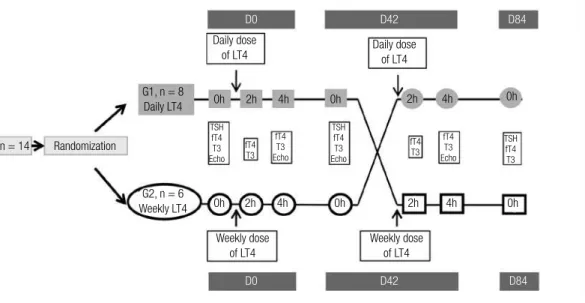
Patients were randomized in two groups. On day 0 (D0), participants in group 1 (G1, n = 8) were advised to keep the usual daily dose of LT4. In group 2 (G2, n = 6), patients were advised to stop their usual daily dose and start taking a weekly dose of LT4, seven ti mes higher than their usual dose. In both groups, LT4 brand was not changed. All patients maintained this treatment for six weeks. In the seventh week (day 42), patients were advised to shift their therapeutic regimen: patients in G1 started taking LT4 once a week, in a dose seven times higher than usual; patients in G2 were advised to go back to taking LT4 every day, in their usual dose. This treatment was maintained for other six weeks. Consequently, the study lasted 12 weeks, en ding on day 84. Doses were not altered during the daily or weekly therapeutic regimens.
On day 0 (D0), 24 hours after their last dose of LT4, all patients were submitted to blood testing. On day 42 (D42), G1 patients had received their last dose of LT4 on the previous day (D41), while for G2 pa tients, it had been 7 days earlier. On day 84 (D84), G1 patients had received their last dose 7 days earlier and G2 patients, the day before (D83).
On D0 and D42, after blood testing, patients recei ved LT4; 60 minutes afterwards, breakfast was offered. New blood samples were drawn 2 and 4 hours after the administration of LT4 on those days. On D84, only
fasting blood samples were obtained. Doppler echo cardiograms were performed before and 4 hours after LT4 administration, on days 0 and 42. TSH (Thyroid Stimulating Hormone – Abbott Diagnostics, Abbott Park, IL, reference values 0.494.67 mU/L); fT4 (free Thyroxine – Abbott Diagnostics, reference values 0.71 1.85 ng/dL, sensitivity 0.40 ng/dL, CV ≤ 10%); and TT3 (Total Triiodothyronine – microparticle enzyme immunoassay, AxSYM T3, Abbott Diagnostics, referen ce values 79.0149.0 ng/dL, sensitivity 30.0 ng/dL, CV ≤ 16%) were measured on days 0, 42 and 84, before LT4 administration; fT4 and TT3 (but not TSH) were also measured 2 and 4 hours after LT4 administration. Transthoracic Doppler echocardiogram was performed with a dual Mmode system (HP 77020AC, Hewlett Packard, Andover, Massachusetts, USA). Uni and bi dimensional measurements were obtained by two blin ded investigators. The subsequent exams were repea ted by the same investigator, for each patient they had previously examined. Systolic function was analyzed by the following variables: preejection period (PEP), aor tic ejection time (ET), isovolumetric contraction time (ICT), and heart rate (HR). The study design is illus trated in igure 1.
Clinical changes were evaluated by the hyperthyroi dism symptom scale (HSS) (29) at baseline as well as 4 hours after LT4. Results were expressed as mean ± SD or median (range). The KolmogorovSmirnov test was used to assess normality of distributions. Groups were compared by ANOVA for repeated measures or by KruskalWallis test. The time effect was analyzed by Student’s paired ttest or Wilcoxon test, accordingly. Twosided tests were used with P < 0.05 being consi dered signiicant. Analyses were performed using SPSS software, Version 15 (SPSS Inc., Chicago, IL, USA).
The study was reviewed and approved by the Ethics Committee of the Hospital de Clínicas da Universidade Federal do Paraná, and written informed consent was obtained from all patients.
RESULTS
Baseline characteristics
Cop
yright
© ABE&M t
odos os dir
eit
os r
eser
vados
.
Table 1. Baseline characteristics in the study groups
G1 G2 p value
Age 41.2 ± 8.41 42.5 ± 7.48 0.95
LT4 dose 1.11 ± 0.14 (1.02-1.20)
1.22 ± 0.08 (1.16-1.28)
0.27
TSH 2.39 ± 1.19 (1.57-3.21)
2.38 ± 1.37 (1.29-3.47)
0.99
fT4 1.12 ± 0.17 (1.01-1.23)
1.13 ± 0.15 (1.01-1.25)
0.92
TT3 94.9 ± 6.2 (82.8-107.2)
93.7 ± 14.6 (82.0-105.4)
0.88
PEP 90.0 ± 16.0 (79.9-101.1)
91.6 ± 9.8 (83.7-99.5)
0.82
AET 315.0 ± 20.7 (300-329.3)
320.0 ± 29.6 (196.6-343.7)
0.71
ICT 55.0 ± 13.3 (45.7-64.4)
75.0 ± 29.6 (51.4-98.6)
0.11
PEP/AET 0.292 ± 0.05 (0.258-0.326)
0.286 ± 0.04 (0.285-0.289)
0.96
HR 79.2 ± 11.1 (71.5-86.9)
87.5 ± 7.3 (81.7-93.3)
0.14
Values shown as means ± SD (conidence interval); NS: not signiicant; LT4: levothyroxine dose (μg/kg/day); TSH: thyroid stimulating hormone (mUI/L); fT4: free thyroxine (ng/dL); TT3: total triiodothyronine (ng/dL); AET: aortic ejection time (ms); ICT: isovolumetric contraction time (ms); AET/PEP – relation between aortic ejection time and pre-ejection period; HR: heart rate (beats per minute).
D0, D42 and D84: day 0, 42 and 84; Echo: echocardiogram; fT4: free thyroxine; LT4: levothyroxine. Squares: patients of group 1; circles: patients of group 2.
Figure 1. Study design.
Changes in thyroid hormones – G1
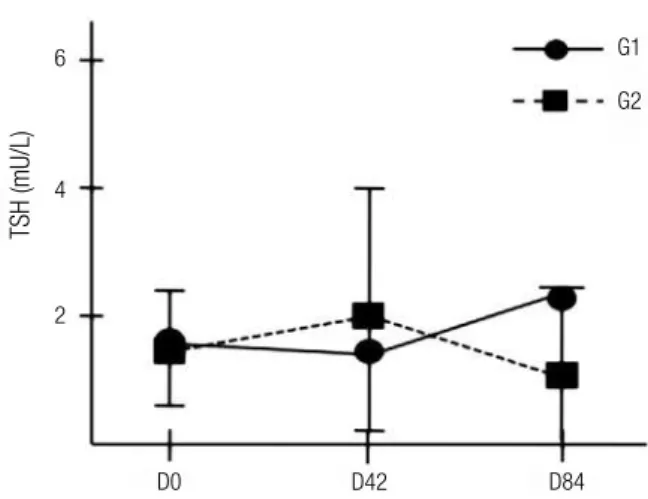
Fasting TSH levels were not signiicantly different while on daily (2.39 ± 1.19 mU/L on D0) or weekly
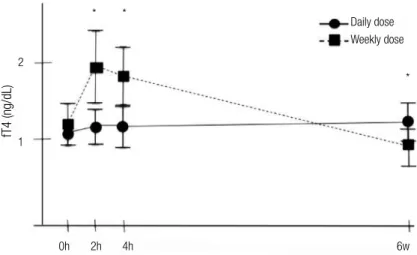
(2.03 ± 1.40 mU/L on D42) regimens (p > 0.05;Fi gure 2). Fasting fT4 levels were 1.12 ± 0.17 ng/dL for the daily and 1.22 ± 0.45 for the weekly schedule. Peak levels of fT4 were greater 2 hours after taking a weekly dose of LT4 (1.91 ± 0.42 ng/dL), as opposed to peak levels that were observed 2 hours after taking the daily dose (1.19 ± 0.26 ng/dL; p = 0.0006). Si milarly, peak levels of fT4 were greater 4 hours after taking the weekly dose of LT4 (1.78 ± 0.35 ng/dL), as opposed to peak levels that were observed 4 hours after taking the daily dose (1.16 ± 0.24 ng/dL; p = 0.001;Figure 3).
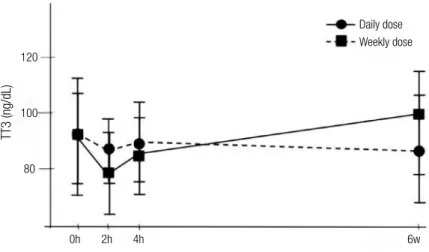
While fasting, TT3 levels were similar on D0 before taking the daily (94.9 ± 17.59 ng/dL) or the weekly dose of LT4 (97.3 ± 12.79 ng/dL) on D42 (p > 0.05). Peak levels of TT3 were similar 2 hours after taking the daily (93.4 ± 18.04 ng/dL) or the weekly dose of LT4 (92.6 ± 12.91 ng/dL; p > 0.05). Likewise, peak levels of TT3 were similar 4 hours after taking the daily (93.6 ± 20.38 ng/dL) or the weekly dose of LT4 (93.9 ± 11.12 ng/dL; p > 0.05; Figure 4).
After 6 weeks of each treatment, fT4 and TT3 levels dropped while on the weekly regimen. Before starting treatment, fT4 values were 1.22 ± 0.45 ng/dL, drop ping to 0.92 ± 0.22 ng/dL (p = 0.036). TT3 levels also decreased from 97.3 ± 12.79 ng/dL to 84.8 ± 14.07 ng/dL, when comparing the moment before weekly D0 D0 Daily dose of LT4 fT4 T3 fT4 T3 TSH fT4 T3 Echo TSH fT4 T3 Echo fT4 T3 Echo TSH fT4 T3 fT4 T3 Echo 0h 0h 0h 0h 0h 0h 2h 2h 2h 2h 4h 4h 4h 4h G1, n = 8
Daily LT4
G2, n = 6 Weekly LT4 n = 14 Randomization
Cop
yright
© ABE&M t
odos os dir
eit
os r
eser
vados
.
treatment and after 6 weeks of treatment (p > 0.05). At the same time, but while on daily doses, there were slight increases in FT4 and TT3 (p > 0.05). Comparing daily and weekly regimens, fT4 values were higher on daily than on weekly regimen (1.22 ± 0.17 vs. 0.92 ± 0.22, p = 0.036), and TT3 levels were also higher after 6 weeks under daily treatment (97.3 ± 12.79 vs. 84.81 ± 14.07, p > 0.05; Figures 3 and 4).
Changes in thyroid hormones – G2
While fasting, TSH levels on D0 were not signiicantly different while on weekly (2.38 ± 1.37 mU/L) or daily LT4 (3.32 ± 3.10 mU/L) on D42 (p > 0.05; Figure 2). Similarly, while fasting, fT4 levels were not signiicantly different while on the weekly (1.13 ± 0.15 ng/dL), or daily regimen (1.04 ± 0.45 ng/dL; p > 0.05). Peak le vels of fT4 were greater 2 hours after taking the weekly dose of LT4 (1.91 ± 0.66 ng/dL), as opposed to peak levels that were observed 2 hours after taking the daily dose (1.13 ± 0.26 ng/dL; p = 0.02). Similarly, peak levels of fT4 were greater 4 hours after taking a weekly dose of LT4 (1.91 ± 0.49 ng/dL), as opposed to peak levels that were observed 4 hours after taking the daily dose (1.13 ± 0.25 ng/dL; p = 0.006;Figure 5).
While fasting, TT3 levels were similar at all times: 93.7 ± 14.65 vs. 89.9 ± 14.07 ng/dL on D0 and D42, weekly and daily, respectively (p > 0.05). Peak levels of TT3 were similar 2 hours after taking the weekly (88.9 ± 8.47 ng/dL) or the daily dose of LT4 (78,7 ± 12,88 ng/dL; p > 0.05). Likewise, peak levels of TT3 were similar 4 hours after taking the weekly (91.5 ± 10.19 ng/dL), or a daily dose of LT4 (84.4 ± 11.88 ng/dL; p > 0.05; Figure 6).
Similar to what was seen in G1, after 6 weeks of treat ment, fT4 dropped from 1.04 ± 0.45 ng/dL to 1.16 ± 0.21 ng/dL while on the weekly regimen (com paring the values before starting the regimen and af ter 6 weeks of treatment, respectively), but no statis tical signiicance was observed (p > 0.05). The same changes were observed in TT3 proile, which dropped from 93.7 ± 14.65 ng/dL to 89.8 ± 14.07 ng/dL (p > 0.05). While on daily treatment, there was an increa se in fT4 and TT3 levels (p > 0.05). When comparing the daily and the weekly values after 6 weeks, fT4 daily values were higher than weekly results (1.16 ± 0.21 vs. 1.04 ± 0.45 ng/dL, p > 0.05), and TT3 daily values were also higher than weekly values (95.1 ± 15.59 vs. 89.8 ± 14.07 ng/dL, p > 0.54; Figures 5 and 6).
Changes in thyroid hormones – Daily versus Weekly Doses
On D0, while fasting, all patients were still taking LT4 daily, and there were no signiicant differences in TSH, fT4 and TT3 levels between both groups (Table 1). After taking LT4, fT4 was higher in patients taking the weekly dose, both two hours (1.91 ± 0.51 vs. 1.16 ± 0.21 ng/dL, p < 0.01) and four hours after LT4 (1.84 ± 0.40 vs. 1.15 ± 0.24 ng/dL; p < 0.01). No signiicant differences were observed in TT3 levels after two hours (87.1 ± 17.21 in daily and 91.02 ± 11.00 ng/dL in weekly regimen, p > 0.05), and after four hours of the LT4 dose (89.8 ± 17.33 in the daily and 92.9 ± 10.40 ng/dL in the we ekly dose, p > 0.05). After 6 weeks, fasting TSH levels of both groups were similar (1.87 ± 1.60 and 3.45 ± 2.67 mU/L, p > 0.05). At the same time, fT4 levels were hi gher in patients taking daily than in patients on weekly LT4 (1.19 ± 0.21 vs. 0.97 ± 2.50 ng/dL, p < 0.01), with no difference for TT3 (96.4 ± 13.5 in the daily vs. 86.9 ± 3.53 ng/dL in the weekly dose, p > 0.05).
Changes in echocardiographic parameters
At baseline (D0), before taking LT4, echocardiogra phic parameters were similar in both groups (Table 1). Four hours after LT4, those parameters were still com parable. Similar behavior was observed on D42: no differences were seen between groups, either before or four hours after taking LT4. When comparing the results before and four hours after LT4 within each group, all echocardiographic parameters were similar, both on days 0 and 42 (all p > 0.05; Table 2).
p > 0.05 for all comparisons between groups and within the same group; Bars: means ± SD.
Figure 2. Changes in serum TSH levels.
G1
G2 6
4
2
D84 D42
D0
Cop
yright
© ABE&M t
odos os dir
eit
os r
eser
vados
.
* p < 0.05 for comparisons within the same group, daily vs. weekly; Bars: means ± SD.
0h, 2h and 4h: before, after 2 and 4 hours of LT4; 6w: before LT4 on D42 for daily, and D84 for weekly dose.
Figure 3. Changes in serum fT4 levels in G1.
p > 0.05 for all comparisons within the same group, daily vs. weekly; Bars: means ± SD.
0h, 2h and 4h: before, after 2 and 4 hours of LT4; 6w: before LT4 on D42 for daily, and D84 for weekly dose.
Figure 4. Changes in serum TT3 levels in G1.
* p < 0.05 for comparisons within the same group, daily vs. weekly; Bars: means ± SD.
0h, 2h and 4h: before, after 2 and 4 hours of LT4; 6w: before LT4 on D42 for weekly, and D84 for daily dose.
Figure 5. Changes in serum fT4 levels in G2.
Daily dose Weekly dose * *
* 2
1
0h 2h 4h 6w
fT4 (ng/dL)
Daily dose Weekly dose 120
100
80
0h 2h 4h 6w
TT3 (ng/dL)
Daily dose Weekly dose * *
2
1
0h 2h 4h 6w
Cop
yright
© ABE&M t
odos os dir
eit
os r
eser
vados
.
Table 2. Echocardiographic parameters in groups 1 and 2
D0 D42
Fasting 4 hours after LT4 p value Fasting 4 hours after LT4 p value
G1 AET 315 ± 20.70 311 ± 21.00 0.28 299 ± 37.41 288.7 ± 21.00 0.76
ICT 55 ± 14.39 56.8 ± 13.34 0.50 53.1 ± 13.34 56.8 ± 18.71 0.19
AET/PEP 0.283 ± 0.05 0.280 ± 0.07 0.67 0.292 ± 0.07 0.288 ± 0.07 0.68
HR 79.25 ± 11.10 80.1 ± 8.30 0.75 76 ± 9.60 78.2 ± 9.39 0.21
G2 AET 320 ± 29.66 315 ± 25.09 0.41 300 ± 24.49 290 ± 17.51 0.23
ICT 75 ± 29.66 74.16 ± 20.10 0.84 69.16 ± 13.06 70.8 ± 22.45 0.69
AET/PEP 0.286 ± 0.04 0.285 ± 0.04 0.53 0.286 ± 0.03 0.303 ± 0.03 0.24
HR 87.5 ± 7.28 84.8 ± 5.07 0.18 81.5 ± 9.18 80.6 ± 7.42 0.65
D0: before treatment started; D42: after 42 days of the treatment; G1: group 1; G2: group 2; AET: aortic ejection time (ms); ICT: isovolumetric contraction time (ms); AET/PEP: relation between aortic ejection time and pre-ejection period; HR: heart rate (beats per minute).
p > 0.05 for all comparisons within the same group, daily vs. weekly; Bars: means ± SD.
0h, 2h and 4h: before, after 2 and 4 hours of LT4; 6w: before LT4 on D42 for weekly, and D84 for daily dose.
Figure 6. Changes in serum TT3 levels in G2.
Clinical evaluation – G1 and G2
HSS scores were similar in both groups, at all times (all p > 0.05).
In G1, while on the daily regimen, the score was 5.5 before LT4 and 6.00 afterwards (p > 0.05). While on the weekly regimen, it was 5.75 before and 5.75 after LT4 (p > 0.05).
In G2, the score changed from 5.33 to 5.50 (p > 0.05) while on the daily schedule, and from 5.5 to 5.33 on the weekly schedule (p > 0.05).
DISCUSSION
Our study showed that treatment of hypothyroidism with weekly doses of LT4 leads to an increase in fT4
levels two and four hours after LT4, and a decrease in fT4 immediately before the weekly dose. In addition, weekly administration of LT4 did not cause signii cant alterations in the hyperthyroidism symptom scale and in echocardiographic parameters, either acutely or chronically.
It has been demonstrated that the use of weekly LT4 is scientiically plausible, but few studies have shown that the weekly administration of LT4 is wellto lerated and leads to normal levels of thyroid hormones. In a smaller randomized crossover study, Grebe and cols. showed that a weekly dose of LT4 was safe, and determined slightly higher levels of fT4 after LT4, and mild hypothyroidism before the following dose (16). In our study, no signs of hypothyroidism were obser
Daily dose Weekly dose 120
100
80
0h 2h 4h 6w
Cop
yright
© ABE&M t
odos os dir
eit
os r
eser
vados
.
ved. Biochemically, mean levels of thyroid hormones were within normal range at all times. It is possible that the peripheral conversion of serum T4 to T3 was more eficient in our group of patients than in the patients evaluated by Grebe and cols. (16).
In another study, treatment with LT4 twice a week showed no statistically signiicant differences in thyroid hormones and in systolic time intervals, when compa red to daily treatment (22), as observed in our study.
It is possible that weekly doses of LT4 determined some degree of subclinical hypothyroidism, relected only on slightly elevated TSH, since its levels tended to be higher in patients taking weekly LT4, although not statistically different in comparison to patients taking LT4 daily.
As expected, a weekly dose of LT4, 7fold higher than the usual dose, determined signiicantly higher T4 levels right after intake, but T3 levels did not change acutely, thus reinforcing the concept that deiodinase conversion of T4 to T3 is taking place. T4 changes in the absence of signiicant increases in TT3, therefore, have no clinical relevance (3034). We chose to mea sure fT4 and T3 as early as 2 and 4 hours in order to identify their peak values, which occur 120 minutes af ter the LT4 administration (17).
In addition, the weekly administration of LT4 did not cause signiicant acute alterations in echocardio graphic parameters, as shown in the comparison of the results of several echocardiographic parameters before and four hours after LT4. This is the irst study to ap ply a more comprehensive analysis of heart function, by assessing the three different echocardiographic mea sures that are the most reliable relection of cardiac pa rameters. We chose systolic intervals, which could be affected by transient hyperthyroidism (35). The lack of cardiac effect in this study strongly supports the hypo thesis that the weekly administration of LT4 is a safe and practical manner of delivering LT4 replacement therapy. We chose to evaluate acute echocardiographic parameters because small acute luctuations in thyroid hormones levels could lead to major cardiac repercus sions. However, it is possible that changes in heart function could have been observed if the followup was longer.
We observed no signiicant clinical indings asses sed by echocardiography and the HSS, thus reinforcing the role played by deiodinases in peripheral hormonal control. However, different results could have been ob served if acute cardiovascular alterations were assessed
by 24houreletrocardiographic monitoring, which can detect asymptomatic arrhythmia. Furthermore, we had a small sample size and a short followup. If we had evaluated a larger sample size, with a longer followup, tendencies might have become statistically signiicant.
A positive feature of our study lies on the fact that the crossover design allowed us to analyze results not only between groups, but also within the groups, com paring every patient with him/herself, thus minimizing possible confounding factors. In addition, it enabled us not only to evaluate the possible hyperthyroid effects immediately after the administration of weekly LT4, but also to assess any possible changes in thyroid hor mones towards hypothyroidism.
In conclusion, a weekly dose of LT4 determines transient increases in fT4. Moreover, slight decreases in fT4 and TT3 may be observed seven days after LT4. More importantly, weekly doses of LT4 determined no acute changes in heart function or any symptoms. Treat ment of hypothyroidism with a weekly dose of LT4 is an alternative for selected patients, and future studies should evaluate longterm outcomes.
Disclosure: Andressa Bornschein – none; Gilberto PazFilho – none; Hans Graf – collaborator of the following laboratories: MerckSerono, Abbott and SanoiAventis; Gisah Amaral de Car valho – Abbot and SanoiAventis advisory Board; sponsored by Merck.
REFERENCES
1. Golden SH, Robinson KA, Saldanha I, Anton B, Ladenson PW. Cli-nical review: prevalence and incidence of endocrine and metabo-lic disorders in the United States: a comprehensive review. J Clin Endocrinol Metab. 2009;94(6):1853-78.
2. Roberts CG, Ladenson PW. Hypothyroidism. Lancet. 2004; 363(9411):793-803.
3. Bagattoli RM, Vaisman M, Lima JS, Ward LS. Estudo de adesão ao tratamento do hipotiroidismo. Arq Bras Endocrinol Metab. 2000;44(6):483-7.
4. Mandel SJ, Brent GA, Larsen PR. Levothyroxine therapy in pa-tients with thyroid disease. Ann Intern Med. 1993;119(6):492-502. 5. Canaris GJ, Manowitz NR, Mayor GM, Ridgway EC. The Co-lorado thyroid disease prevalence study. Arch Intern Med. 2000;160(4):526-34.
6. Somwaru LL, Arnold AM, Joshi N, Fried LP, Cappola AR. High frequency of and factors associated with thyroid hormone over--replacement and underover--replacement in men and women aged 65 and over. J Clin Endocrinol Metab. 2009;94(4):1342-5.
7. John-Kalarickal J, Pearlman G, Carlson HE. New medications which decrease levothyroxine absorption. Thyroid. 2007;17(8):763-5. 8. Wiersinga WM. Thyroid hormone replacement therapy. Horm
Res. 2001;56(1):74-81.
Cop
yright
© ABE&M t
odos os dir
eit
os r
eser
vados
.
10. Sharma R, Sharma TK, Kaushik GG, Sharma S, Vardey SK, Sinha M. Subclinical hypothyroidism and its association with cardio-vascular risk factors. Clin Lab. 2011;57(9-10):719-24.
11. Biondi B, Palmieri EA, Lombardi G, Fazio S. Effects of sub-clinical thyroid dysfunction on the heart. Ann Intern Med. 2002;137(11):904.
12. Brent GA, Larsen PR, Davies TF. Hypothyroidism and thyroidites. In: Kronenberg HM, Melmed S, Polonsky KS, Larsen PR, editors. Williams Textbook of Endocrinology. 11th ed. Canada: Saunders; 2008. p. 377-409.
13. Watt T, Groenvold M, Rasmussen AK, Bonnema SJ, Hegedüs L, Bjorner JB, et al. Quality of life in patients with benign thyroid disorders. Eur J Endocrinol. 2006;154(4):501-10.
14. Bach-Huynh T, Nayak B, Loh J, Soldin S, Jonklaas J. Timing of le-vothyroxine administration affects serum thyrotropin concentra-tion. J Clin Endocrinol Metab. 2009;94(10):3095-912.
15. Bernstein RS, Robbins J. Intermitent therapy with L-levothyroxi-ne. N Engl J Med. 1969;281(26):1444-8.
16. Grebe SKG, Cooke RR, Ford HC, Fagerström JN, Cordwell DP, Lever NA, et al. Treatment of hypothyroidism with once weekly thyroxine. J Clin Endocrinol Metab. 1997;82(3):870-5.
17. Lips DJ, Van Reisen MT, Voigt V, Venekamp W. Diagnosis and treatment of levothyroxine pseudomalabsorption. Neth J Med. 2004;62(4):114-8.
18. Morris JC. How do you approach the problem of TSH elevation in a patient on high-dose thyroid hormone replacement? Clin Endo-crinol. 2009;70(5):671-3.
19. Rangan S, Tahrani AA, Macleod AF, Moulik PK. Once weekly thyro-xine treatment as a strategy to treat non-compliance. Postgrad Med J. 2007;83(984):e3.
20. Sekadde CB, Slaunwhite WRJ, Aceto TJ, Murray K. Adminis-tration of thyroxine once a week. J Clin Endocrinol Metab. 1974;39(4):759-64.
21. Sethi MJ, Parr M, Bhatia B. Managenment strategies for hypo-thyroidism in non compliant patients: a case report and review of literature. S D Med. 2008;61(10):368-9.
22. Taylor J, Williams BO, Frater J, Stott DJ, Connell J. Twice-weekly dosing for thyroxine replacement in elderly patients with primary hypothyroidism. J Int Med Res. 1994;22(5):273-7.
23. Fish LH, Schwartz HL, Cavanaugh J, Steffes MW, Bantle JP, Oppe-nheimer JH. Replacement dose, metabolism, and bioavailabili-ty of levothyroxine in the treatment of hypothyroidism: role of triiodothyronine in pituitary feedback in humans. N Engl J Med. 1987;316(13):764-70.
24. Wallack MS, Adelberg HM, Nicoloff JT. A thyroid supression test using a single dose of L-thyroxine. N Engl J Med. 1970;283(8):402-5. 25. Rivkees SA, Hardin DS. Cretinism after weekly dosing with levo-thyroxine for treatment of congenital hypothyroidism. J Pediatr. 1994;125(1):147-9.
26. Banovac K, Papic M, Bilsker MS, Zakarija M, McKenzie JM. Evi-dence of hyperthyroidism in apparently euthyroid patients reated with levothyroxine. Ann Intern Med. 1989;149(4):809-12.
27. Klein I, Danzi S. Thyroid disease and the heart. Circulation. 2007;116(15):1725-35.
28. Klein I, Ojama K. Thyroid hormone and the cardiovascular sys-tem. N Engl J Med. 2001;344(7):501-9.
29. Klein I, Trzepacz PT, Roberts M, Levey GS. Symptom rating scale for assessing hyperthyroidism. Arch Intern Med. 1988;148(2):387-90. 30. Bianco AC, Salvatore D, Gereben B, Berry MJ, Larsen PR. Cellular
and molecular biology, and physiological roles of the iodothyro-nine selenodeiodinases. Endocr Rev. 2002;23(1):38-89.
31. Gereben B, Zavacki AM, Ribich S, Kim BK, Huang SA, Simonides WS, et al. Cellular and molecular basis of deiodinase-regulated thyroid hormone signaling. Endocr Rev. 2008;29(7):898-938. 32. Kester MHA, Kuiper GGJM, Versteeg R, Visser TJ. Regulation of
type III iodothyronine deiodinase expression in human cell lines. Endocrinology. 2006;147(12):5845-54.
33. Larsen PR. Type 2 iodothyronine deiodinase in human skeletal muscle: new insights into its physiological role and regulation. J Clin Endocrinol Metab. 2007;94(6):1893-5.
34. Kohrle J. The deiodinase family: selenoenzymes regulating thyroid hormone availability and action. Cell Mol Life Sci. 2000;57(13-14):1853-63.