Cop
yright
© ABE&M t
odos os dir
eit
os r
eser
vados
.
Study of the histological
proile of papillary thyroid
carcinomas associated with
Hashimoto’s thyroiditis
Estudo do peril histológico de carcinomas papilíferos de tireoide associados à tireoidite de Hashimoto
Maria Isabel Cunha Vieira Cordioli1, Adriano Namo Cury1, Adriana Oliveira
Nascimento2, Ana Karine de Oliveira2,Murilo Mello3, Mauro Ajaj Saieg2
ABSTRACT
Objective: To investigate the association between the histological parameters of papillary thyroid cancer (PTC) and the presence of Hashimoto’s thyroiditis (HT). Materials and metho-ds: Histological samples from patients with PTC were reviewed by an endocrine pathologist. The following parameters were analyzed: presence of concomitant HT, multifocality, presence of nodal metastasis, tumor size, vascular invasion, perineural iniltration, histological variant, and pathological staging. Clinical data included gender and age at the time of the diagnosis. Results: A total of 94 cases of PTC were reviewed. There was a predominance of women (85.1%
vs. 14.9%) and median age at presentation was 45.13 years. The presence of HT was signiican-tly associated with greater occurrence of multifocal tumors (p = 0.004), early pathological stage (p= 0.02), and smaller tumor size (p = 0.025). Conclusions: Patients with PTC associated with HT had signiicantly smaller tumors, more often multifocal and in an earlier stage than their counterparts without HT. A better understanding of the immune response involved in these tumors may be useful for future strategies on the prevention and for the development of new therapeutic approaches for this group of neoplasms. Arq Bras Endocrinol Metab. 2013;57(6):445-9
Keywords
Thyroid cancer; Hashimoto disease; prognosis
RESUMO
Objetivo: Investigar a associação entre parâmetros histológicos do carcinoma papilífero da ti-reoide (CPT) e a presença de tireoidite de Hashimoto (TH). Materiais e métodos: Amostra de te-cidos de CPT foi revista por um médico patologista. Os seguintes parâmetros foram avaliados: presença de TH concomitante, multicentricidade, metástase linfonodal, tamanho tumoral, inva-são vascular, iniltração perineural, variante histológica e estadiamento patológico. Os dados clínicos incluíam gênero e idade ao diagnóstico. Resultados: Um total de 94 casos de CPT foi revisto. Houve predomínio do sexo feminino (85,1% vs. 14,9%) e a idade média de apresentação foi de 45,13 anos. A presença de TH foi associada a maior ocorrência de tumores multifocais (p= 0,004), estágios iniciais de estadiamento (p= 0,02) e tumores menores (p = 0,025). Conclusão: O CPT associado a TH apresentou-se com menor dimensão, maior ocorrência de multifocalidade e em estadiamentos mais iniciais do que os casos de CPT sem TH associada. Um melhor en-tendimento da resposta imune envolvida nesses tumores pode ser útil para estratégias futuras de prevenção e para o desenvolvimento de novas abordagens terapêuticas para esse tipo de neoplasia. Arq Bras Endocrinol Metab. 2013;57(6):445-9
Descritores
Câncer de tireoide; doença de Hashimoto; prognóstico
1 Endocrine Division, Santa Casa
Medical School, São Paulo, SP, Brazil
2 Pathology Division, Santa Casa
Medical School, São Paulo, SP, Brazil
3 Physiology Division, Santa Casa
Medical School, São Paulo, SP, Brazil
Correspondence to:
Maria Isabel Cunha Vieira Cordioli Rua Pedro de Toledo, 669, 11º andar 04039-032 – São Paulo, SP, Brazil [email protected]
Cop
yright
© ABE&M t
odos os dir
eit
os r
eser
vados
.
INTRODUCTION
H
ashimoto’s thyroiditis (HT), also known as chro nic lymphocytic thyroiditis, is the most common autoimmune thyroid disease and the main cause of hy pothyroidism in the world (1). The relationship bet ween HT and papillary thyroid cancer (PTC), the most common type of thyroid neoplasm, was irst shown by Dailey and cols. in 1955 (2), but still remains a contro versial issue (1,36).The reported rate of coexistence of HT in patients with PTC ranges from 0.3% to 38% (78). The mo lecular pathways involved in this association have not yet been fully clariied, and the possibility that HT is a premalignant lesion also remains controversial (9). The RET/PTC1 and RET/PTC3 rearrangements, clas sically seen in PTC, have also been described in patients with HT (10,11), together with a higher prevalence of
p63 expression (10). On the other hand, the prevalence of the BRAFV600E mutation, which is associated with a
poor prognosis in PTC, was detected in a higher fre quency in patients without associated HT (11). Other proposed markers of thyroid malignancies include the HBME1 (12), GAL3 (13), and speciic cytokeratins, such as CK19 (10). However, the relevance of these markers in HT is still under debate, since their occur rence was also observed in others benign lesions, al though with a lower prevalence than in PTC (14).
Another controversial issue with conlicting results in the literature is the prognosis of PTCassociated HT (6 7,11). A metaanalysis by Singh and cols. showed an im proved diseasefree survival rate in patients with coexistent HT. However, when reporting their own series, the au thors did not ind any statistical difference in diseasefree survival of 388 PTC patients when associated with the co existence of HT (5). In addition, recent studies reporting the association of histological parameters in PTC with the presence of HT also show controversial results (67).
The aim of the current study was to assess the rate of PTCassociated HT in our institution and to clarify whether the presence of HT in these cases of surgically treated PTC were signiicantly associated with histo logical and/or clinical parameters and disease staging.
MATERIALS AND METHODS
Selection of patients
A computerized search was performed in the elec tronic iles of the Department of Pathology at Santa
Casa de São Paulo Hospital for cases of surgically ex cised thyroid glands with a diagnosis of PTC in a seven year period (20032009). Clinicopathological param eters were also retrieved from the reports and included gender, age at the time of the diagnosis, size of the tumor, multifocality, pathological staging (TNM) (15), and presence of nodal metastasis.
This study was submitted to and approved by the Ethics Committee in Research of Santa Casa de São Paulo Hospital.
Histopathological review
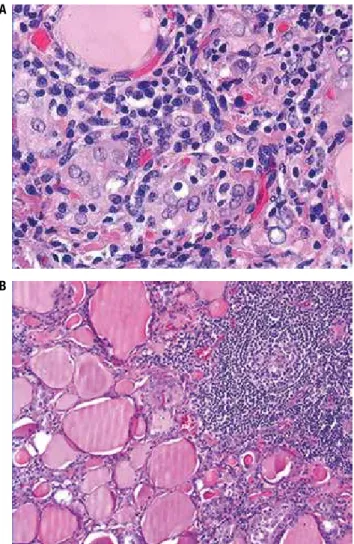
Cases were reviewed by an endocrine pathologist and the following histological features were analyzed: presence of concomitant HT, vascular invasion, perineural inil tration, and histological variant of PTC. HT was deined by a diffuse lymphocytic and plasma cell iniltrate with the presence of lymphoid follicles with reactive germinal centers, as well as occasional Hürthle cells (Figure 1) (6).
Figure 1 (A and B). H&E section of HT. Note the lymphocyte iniltrate assuming a follicular architecture and lymphoepithelial lesions.
A
Cop
yright
© ABE&M t
odos os dir
eit
os r
eser
vados
.
Statistical analysis
Statistical analysis were performed using chi squaretest and Fisher’s exact test for a single variable, with stepwise regression for multivariate analysis. Only variables with p ≤ 0.200 at the univariate analysis were included in the multivariate model. All potential confounding variables were considered. The level of signiicance was set to 5%. Statistical analysis was performed with the aid of the SPSS v19.0 statistical package (SPSS Inc, Chicago, IL, USA).
RESULTS
A total of 94 cases of PTC from 94 patients were re viewed. There were 80 females (85.10%) and 14 males (14.89%). Median age at presentation was 45.13 years (range from 875 years). When subtyped by histology, 54 cases were exclusively classic PTC, 16 were repre sented by the follicular variant of PTC, 14 cases were mixed types (classic PTC and areas of follicular pattern), 4 were oncocytic, and 6 cases comprised of other rare subtypes of PTC (2 tall cell, 2 columnar cell, 1 diffuse sclerosing, and 1 macrofollicular). The median tumor size was 2.19 cm (range from 0.110 cm). Eighteen cases (19.14%) had multifocal tumors and metastases to lymph nodes were present in 25 cases (26.59%). Vascu lar invasion and perineural iniltration were detected in 54 (57.44%) and 23 (24.46%) of the cases, respectively.
Tumors were also classiied in two groups according to their pathological staging (pTNM): early stage (T1/ T2) and late stage (T3/T4). According to this criteria, 49
(52.12%) of the cases were early stage tumors and the re maining 45 (47.87%) were classiied as late stage disease.
Association of HT with clinical and pathological parameters
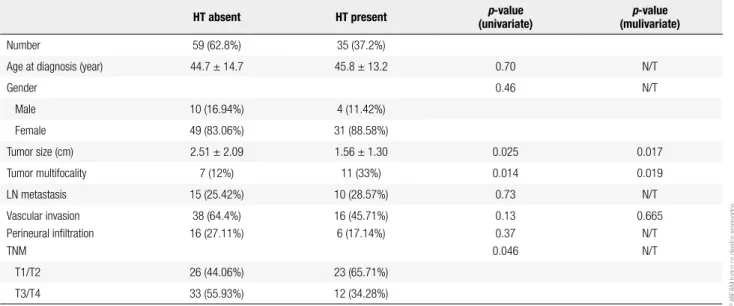
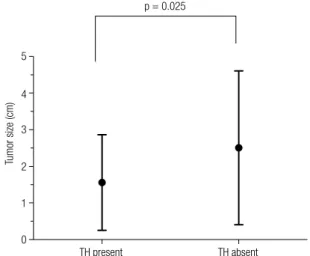
The summary of results of the association between the presence of HT and PTC is shown in Table 1. HT was present in 35 (37.2%) of the cases and absent in the remai ning 59 (62.8%). Age at the initial diagnosis was not sig niicantly different between the two groups (44.7 for HT absent vs. 45.8 for HT present, p = 0.70). There was no gender predisposition for the presence of PTCassociated HT. Females were predominant in both groups (83.06% in HT absent vs. 88.58% in HT present, respectively) and males corresponded to 16.94% of the cases in the HT ab sent and 11.42% of the cases in the HT present group, with no statistical difference (p = 0.46). Furthermore, no statistical association was seen between the presence of HT and vascular invasion (p = 0.13), perineural iniltration (p = 0.43) or lymph node metastasis (p = 0.73) (Table 1). Univariate analysis showed that tumor size was sig niicantly smaller in patients with concomitant HT than in patients without HT (1.56 ± 1.30 vs. 2.51 ± 2.09) (p = 0.025) (Figure 2). Multifocal tumors were also sig niicantly more common in patients with concomitant HT (33% vs. 12%) (p = 0.014) (Figure 3), and these pa tients were also more frequently classiied as having early stage tumors (T1/T2) (65.71% vs. 44.06%) (p = 0.046). Multivariate statistical analysis conirmed this associa tion for all of the three parameters (Table 1).
Table 1. PTC clinicopathological parameters according to the presence or absence of HT
HT absent HT present p-value
(univariate)
p-value (mulivariate)
Number 59 (62.8%) 35 (37.2%)
Age at diagnosis (year) 44.7 ± 14.7 45.8 ± 13.2 0.70 N/T
Gender 0.46 N/T
Male 10 (16.94%) 4 (11.42%)
Female 49 (83.06%) 31 (88.58%)
Tumor size (cm) 2.51 ± 2.09 1.56 ± 1.30 0.025 0.017
Tumor multifocality 7 (12%) 11 (33%) 0.014 0.019
LN metastasis 15 (25.42%) 10 (28.57%) 0.73 N/T
Vascular invasion Perineural iniltration TNM
38 (64.4%) 16 (27.11%)
16 (45.71%) 6 (17.14%)
0.13 0.37 0.046
0.665 N/T N/T
T1/T2 26 (44.06%) 23 (65.71%)
T3/T4 33 (55.93%) 12 (34.28%)
Cop
yright
© ABE&M t
odos os dir
eit
os r
eser
vados
.
DISCUSSION
Our current study shows that HT was seen in a great part of the PTCs and that it was statistically associated with tumor multifocality, early pathological staging, and small tumor size. The present results indicate the exis tence of a distinct group of neoplasms associated with HT, what may corroborate the hypothesis that immune response plays a major role in the onset of malignant neoplasms of the thyroid.
HT was a common inding in the event of PTC (37.2%) in our study, which is in agreement with current literature (1,56). In a metaanalysis by Singh and cols. (5) it has been demonstrated that HT incidence is 2.77 higher in surgical specimens removed due to PTC than in cases of benign disease. Also, the association with HT was 1.89 times greater in patients with PTC than in patients with other thyroid neoplastic conditions. Women with HT have also been shown to be 30% more likely to have coex isting PTC in comparison with patients without HT (1).
The relationship between PTC and HT remains a mat ter of controversy despite being investigated over the past several decades. It is unclear if the presence of HT is second
arily induced by thyroid cancer as a host immune response, or whether HT predisposes the development of PTC (7). It has also been debated in the literature if the presence of HT is associated with certain PTC features of prognostic value.
The occurrence of multifocal tumors in our study was signiicantly higher among patients with concomitant HT, a similar result to that described by Asanuma and cols. (9). Several hypotheses could explain this associa tion, such as a change in the environment of the whole gland due to the inlammation, which might contribute to cancer progression (16), or a protective action of au toimmunity against PTC.
The inding of multifocality among our HTasso ciated PTC is especially relevant since the occurrence of multicentricity is one of the features associated with a poor prognosis in patients with PTC in the clinical practice (17). The inding of a feature associated with poor prognosis in the occurrence of PTC concomitant with HT contrasts with previous studies that suggested better prognosis of this type of cancer in association with lymphocytic thyroiditis. Previous studies have sug gested a relationship between lymphocytic iniltration (LI) and tumor features, leading to low frequency of recurrence (18) and an improvement in diseasefree survival (19). Similar indings were also observed when considering diffuse and peritumoral iniltration sepa rately (20). On the other hand, Del Rio and cols. have showed in a recent study that the association of PTC with HT did not modify the aggressiveness of the tu mor (21).
These conlicting results about the inluence of HT in prognostic features of PTC may be explained by the fact that different immune responses can be associated with PTC. A recent study considered the existence of two types of such immune response: lymphocytic thy roiditis and tumor associated lymphocytes (TAL) in the absence of thyroiditis. The occurrence of TAL is deined by the presence of lymphocyte iniltration (LI) aggregate to the tumor (intratumoral or peritumoral) (22). Besides, different lymphocytes cells can be found associated with the tumors. The CD4+ T cells play a
central role in immune protection, and naive CD4+ T
cells can be differentiated into four distinct effector cells: Th1, Th2, Th17, and Tregs (22). These types of cells have different mechanisms of action, and the prev alence of one of them may be the responsible for the conlicting results related to the effect of LI in PTC that were found in the literature. Previous studies have also shown that an increased frequency of regulatory T cells (Tregs) in LI is associated with poor prognosis of dif Figure 2. Tumor size according to the presence of Hashimoto’s thyroiditis.
5
4
p = 0.025
3
TH present TH absent 2
1
0
Tumor size (cm)
100
80
60
40
20
0
p = 0.014
Multifocality Without multifocality
%
TH present TH absent
Cop
yright
© ABE&M t
odos os dir
eit
os r
eser
vados
.
ferent types of cancer (23,24) and, recently, this associa tion was also found in PTC. French and cols. suggest that Treg frequency may be a useful diagnostic marker in determining PTC prognosis, and it may also be a tar get for future therapies (22). Further studies that aim to qualify the type of predominant response in cases with HTassociated PTC may be able to clarify this matter.
The results of a better pathological stage among HTassociated PTC patients is in agreement with Huang Bie Yu and cols. (7) as well, who have observed a higher percentage of patients in stage IV in nonHT PTC. Once more, different results in the literature re garding LI and PTC prognosis may also be explained by the existence of different immune responses associ ated with PTC, as previously mentioned.
Our present study did not ind any signiicant dif ference between patients with or without HT regarding vascular invasion, perineural iniltration or lymph node metastasis, which may be due to a small number of pa tients with these features, perhaps the main limitation of our study. In order to conirm or discard these indings, future studies with a greater number of tumor samples should be carried out.
The current indings of speciic histological char acteristics present in HTassociated PTC signalize a potential subset of thyroid papillary neoplasms, which can beneit from immunebased therapies. A better un derstanding of the role of the immune system in the pathophysiology of PTC can be of great value to the development of future strategies for the prevention of tumor onset and to the application of alternative forms of targeted therapies for this type of cancer.
Acknowledgments: we would like to thank Dr. Manuel Sobrinho Simões and Paula Soares for the useful discussion in the begin ning of this work.
Disclosure: no potential conlict of interest relevant to this article was reported.
REFERENCES
1. Repplinger D, Bargren A, Zhang YW, Adler JT, Haymart M, Chen H. Is Hashimoto’s thyroiditis a risk factor for papillary thyroid can-cer? J Surg Res. 2008;150(1):49-52.
2. Dailey ME, Lindsay S, Skahen R. Relation of thyroid neoplas-ms to Hashimoto disease of the thyroid gland. AMA Arch Surg. 1955;70(2):291-7.
3. Anil C, Goksel S, Gursoy A. Hashimoto’s thyroiditis is not as-sociated with increased risk of thyroid cancer in patients with thyroid nodules: a single-center prospective study. Thyroid. 2010;20(6):601-6.
4. Mazokopakis EE, Tzortzinis AA, Dalieraki-Ott EI, Tsartsalis AN, Syros PK, Kareilakis CM, et al. Coexistence of Hashimoto’s thyroiditis with papillary thyroid carcinoma. A retrospective stu-dy. Hormones (Athens). 2010;9(4):312-7.
5. Singh B, Shaha AR, Trivedi H, Carew JF, Poluri A, Shah JP. Coe-xistent Hashimoto’s thyroiditis with papillary thyroid carcinoma: impact on presentation, management, and outcome. Surgery. 1999;126(6):1070-6; discussion 6-7.
6. Gul K, Dirikoc A, Kiyak G, Ersoy PE, Ugras NS, Ersoy R, et al. The association between thyroid carcinoma and Hashimoto’s thyroi-ditis: the ultrasonographic and histopathologic characteristics of malignant nodules. Thyroid. 2010;20(8):873-8.
7. Huang BY, Hseuh C, Chao TC, Lin KJ, Lin JD. Well-differentiated thyroid carcinoma with concomitant Hashimoto’s thyroiditis pre-sent with less aggressive clinical stage and low recurrence. En-docr Pathol. 2011;22(3):144-9.
8. Kim HS, Choi YJ, Yun JS. Features of papillary thyroid microcar-cinoma in the presence and absence of lymphocytic thyroiditis. Endocr Pathol. 2010;21(3):149-53.
9. Asanuma K, Sugenoya A, Kasuga Y, Itoh N, Kobayashi S, Amano J. The relationship between multiple intrathyroidal involvement in papillary thyroid carcinoma and chronic non-speciic thyroidi-tis. Cancer Lett. 1998;122(1-2):177-80.
10. Nasser SM, Pitman MB, Pilch BZ, Faquin WC. Fine-needle aspi-ration biopsy of papillary thyroid carcinoma: diagnostic utility of cytokeratin 19 immunostaining. Cancer. 2000;90(5):307-11. 11. Kim SK, Song KH, Lim SD, Lim YC, Yoo YB, Kim JS, et al. Clinical
and pathological features and the BRAF(V600E) mutation in pa-tients with papillary thyroid carcinoma with and without concur-rent Hashimoto thyroiditis. Thyroid. 2009;19(2):137-41.
12. Sack MJ, Astengo-Osuna C, Lin BT, Battifora H, LiVolsi VA. HBME-1 immunostaining in thyroid ine-needle aspirations: a useful ma-rker in the diagnosis of carcinoma. Mod Pathol. 1997;10(7):668-74. 13. Prasad ML, Pellegata NS, Huang Y, Nagaraja HN, de la Chapelle A, Kloos RT. Galectin-3, ibronectin-1, CITED-1, HBME1 and cytoke-ratin-19 immunohistochemistry is useful for the differential diag-nosis of thyroid tumors. Mod Pathol. 2005;18(1):48-57.
14. Nasr MR, Mukhopadhyay S, Zhang S, Katzenstein AL. Absence of the BRAF mutation in HBME1+ and CK19+ atypical cell clusters in Hashimoto thyroiditis: supportive evidence against preneoplastic change. Am J Clin Pathol. 2009;132(6):906-12.
15. Greene FL. AJCC cancer staging manual. 6th ed./editors: Frederick L. Greene, et al. (ed.) New York; London: Springer; 2002. 16. Muzza M, Degl’Innocenti D, Colombo C, Perrino M, Ravasi E,
Ros-si S, et al. The tight relationship between papillary thyroid cancer, autoimmunity and inlammation: clinical and molecular studies. Clin Endocrinol (Oxf). 2010;72(5):702-8.
17. Cooper DS, Doherty GM, Haugen BR, Kloos RT, Lee SL, Mandel SJ, et al. Revised American Thyroid Association management guidelines for patients with thyroid nodules and differentiated thyroid cancer. Thyroid. 2009;19(11):1167-214.
18. Matsubayashi S, Kawai K, Matsumoto Y, Mukuta T, Morita T, Hirai K, et al. The correlation between papillary thyroid carcinoma and lymphocytic iniltration in the thyroid gland. J Clin Endocrinol Metab. 1995;80(12):3421-4.
19. Gupta S, Patel A, Folstad A, Fenton C, Dinauer CA, Tuttle RM, et al. Iniltration of differentiated thyroid carcinoma by proliferating lym-phocytes is associated with improved disease-free survival for chil-dren and young adults. J Clin Endocrinol Metab. 2001;86(3):1346-54. 20. Villagelin DG, Santos RB, Romaldini JH. Is diffuse and peritumo-ral lymphocyte iniltration in papillary thyroid cancer a marker of good prognosis? J Endocrinol Invest. 2011;34(11):e403-8. 21. Del Rio P, Cataldo S, Sommaruga L, Concione L, Arcuri MF,
Sia-nesi M. The association between papillary carcinoma and chronic lymphocytic thyroiditis: does it modify the prognosis of cancer? Minerva Endocrinol. 2008;33(1):1-5.
22. French JD, Weber ZJ, Fretwell DL, Said S, Klopper JP, Haugen BR. Tumor-associated lymphocytes and increased FoxP3+ regulatory T cell frequency correlate with more aggressive papillary thyroid cancer. J Clin Endocrinol Metab. 2010;95(5):2325-33.
23. Bates GJ, Fox SB, Han C, Leek RD, Garcia JF, Harris AL, et al. Quantiication of regulatory T cells enables the identiication of high-risk breast cancer patients and those at risk of late relapse. J Clin Oncol. 2006;24(34):5373-80.