Heart failure as a predictor of functional dependence in hospitalized elderly
1 Universidade de São Paulo, Escola de
Enfermagem, Programa de Residência em Enfermagem em Cardiopneumologia de Alta Complexidade, São Paulo, SP, Brazil.
2 Universidade de São Paulo, Escola de
Enfermagem, Departamento de Enfermagem Médico-Cirúrgica, São Paulo, SP, Brazil.
3 Universidade de São Paulo, Faculdade de
Medicina, Hospital das Clínicas, Instituto do Coração, São Paulo, SP, Brazil.
4 Instituto do Câncer do Estado de São Paulo, São
Paulo, SP, Brazil.
5 Universidade de São Paulo, Faculdade de
Medicina, Hospital das Clínicas, Instituto de Psiquiatria, São Paulo, Brazil.
ABSTRACT
Objective: Identify whether Heart Failure (HF) is a predictor of functional dependence for Basic Activities of Daily Living (BADL) in hospitalized elderly. Methods: We investigated medical records and assessed dependence to BADL (by the Katz Index) of 100 elderly admitted to a geriatric ward of a university hospital. In order to verify if HF is a predictor of functional dependence, linear regression analyzes were performed. Results: he prevalence of HF was 21%; 95% of them were dependent for BADLs. Bathing was
the most committed ADL. HF is a predictor of dependence in hospitalized elderlies, increasing the chance of functional decline by 5 times (95% CI, 0.94-94.48), the chance of functional deterioration by 3.5 times (95% CI, 1.28-11.66; p <0.02) and reducing 0.79 points in the Katz Index score (p <0.05). Conclusion: HF is a dependency predictor of ADL in hospitalized elderly, who tend to be more dependent, especially for bathing.
DESCRIPTORS
Heart Failure; Aged; Hospitalization; Activities of Daily Living; Baths.
Heart failure as a predictor of functional
dependence in hospitalized elderly
Insuficiência cardíaca como preditor de dependência funcional em idosos hospitalizados Insuficiencia cardiaca como pronosticador de dependencia
funcional en ancianos hospitalizados
Sara de Oliveira Xavier1, Renata Eloah de Lucena Ferretti-Rebustini2, Eduesley Santana-Santos3, Paola Alves de Oliveira
Lucchesi4, Karine Generoso Hohl5
Received: 03/18/2015 Approved: 06/10/2015
ORIGINAL ARTICLE DOI: 10.1590/S0080-623420150000500012
Corresponding author:
Renata Eloah de Lucena Ferretti-Rebustini Escola de Enfermagem da Universidade de São Paulo
Av. Dr. Enéas de Carvalho Aguiar, 419 – Cerqueira Cesar
INTRODUCTION
Heart Failure (HF) is an increasingly common con-dition among the elderly, as its prevalence increases with age(1). It is estimated that an increase in the incidence and
prevalence of HF in individuals aged between 60 and 80 years will occur in the coming years, causing the number of new cases to double and the number of cases to be about 10 times higher(1). In addition to representing one of the major
causes of morbidity and mortality among the elderly, HF is a major cause of hospitalization and demand for emer-gency services among the elderly in Brazil and throughout the world(2-3).
Clinical manifestations of HF in the elderly may be diferent from those observed in adults, depending on the speciic aging characteristics(4). Still, its presence is
associ-ated with states of greater dependence due to the clinical and functional repercussions of HF (5-6).
Functional dependence in elderly with HF may be due to the disease itself, but it can also be associated with the hospitalization. It is known that fully independent elderly may need aid for one or more basic activities of daily living during hospitalization(6).
Hospitalization is associated with the patient having an increase in dependence, causing the identiication of individuals with increased risk of functional loss to be a routine action in nursing care practice. Early identiica-tion of elderly at higher risk of dependence can help to minimize the adverse consequences of hospitalization and therefore individualized nursing actions will be able to meet care demands compatible with the functional performance of the elderly. HF was previously identiied as a risk factor for greater dependence in elderly(6-7).
here were no national studies that could identify whether HF is a dependence predictor in hospitalized el-derly. Also, no studies were found indicating the impact of HF in functional loss of hospitalized elderly. hus, the present study aims to identify the functional proile of hos-pitalized elderly with HF and verify whether HF is a de-pendence predictor for ADL in hospitalized elderly.
METHOD
his is an epidemiologic, observational cross-section-al study approved by the Loccross-section-al Ethics Committee (No
603527-0) performed according to national research re-quirements involving human subjects.
In the period from April to August 2014, all seniors who were admitted to the geriatric ward of a large university hos-pital in São Paulo were investigated. All individuals older than or equal to 60 years and who consented to participate in the study by signing the Informed Consent Form were included in the study. In cases of illiteracy, consent was for-malized by a legal representative.
Admission records contained in the participant’s medi-cal iles were analyzed and a functional bedside evaluation of the elderly was conducted. Demographics (sex and age) and Clinical data (admission diagnosis, previous diagnosis of HF, history of morbidities, amount of prescription drugs
and Left Ventricular Ejection Fraction) were extracted from medical records.
Clinical characterization of HF cases was made by the
New York Heart Association Functional Class (NYHA-FC)
and by the Left Ventricular Ejection Fraction (LVEF%), estimated by Teicholz method (LVEF% ≤ 55%; LVEF% > 55%) obtained from a Transthoracic Echocardiogram per-formed in the last six months prior to admission. As there was no record of the NYHA-FC in the medical records, it was estimated at the time of the evaluation. hus, par-ticpants were classiied on a scale ranging from I to IV, as follows: I) absence of dyspnea in activities of daily living; II) symptoms triggered by routine activities; III) symptoms triggered with minimal exertion or lower intensity activities; and IV) symptoms at rest(8).
Functional evaluations were performed at bedside by the investigator through the application of the Katz Index(9).
he application time was approximately 10 minutes. Katz Index assesses the functional independence for six activities of daily living: bathing, dressing, feeding, toileting, transferring and continence. For the present study, elderly received 1 point when they could perform the activity inde-pendently (without supervision, direction or assistance) and received score zero when they presented dependence for such activity (needed supervision, direction or assistance). he total score of the scale ranges from zero to six points.
Katz index score was obtained by the sum of points ob-tained in each of the activities. For classifying the level of dependency, the elderly were categorized into: independent (six points), partially dependent (three to ive points) and totally dependent (zero to two points)(10).
Data were analyzed using descriptive (indicating mea-sures of central tendency and dispersion), and analytic sta-tistics. For analysis we used the Student’s T-test (for
com-parison of means) and Fisher’s Exact Test (for analysis of
associations between nominal variables). To verify whether HF is a predictor of functional dependence for ADLs in elderly, linear regression analyzes were performed, taking the score on the Katz index as the dependent variable and HF as an independent variable. P value was set at 0.05
and all tests were two-tailed. he software used was SPSS version 21.
RESULTS
We invited 111 elderlies admitted into the geriatric ward during the study period to participate in the study, and of these 11 refused. hus, the sample consisted of 100 elderly, mostly women (n = 56). he mean age of partici-pants was 79.2±7.5 years (60-96 years). he mean age was 80.4±7.6 years for women and 77.7±7.1 years for men. Women were on average almost three years older than men, but this diference was not statistically signiicant (p <0.70). he general characteristics of the sample due to the pres-ence of heart failure are shown in Table 1.
Heart failure as a predictor of functional dependence in hospitalized elderly
he mean number of comorbidities was 4.0±1.8, where ifteen elderly presented from four to seven diseases. Among the comorbidities, the main cardiovascular risk factors were systemic hypertension (70%), diabetes mellitus (61%), dys-lipidemia (52%), obesity (24%) and smoking (22%). In 23% of cases, a diagnosis of depression was also observed. Nine-teen participants had up to 15 drugs in prescription, with a mean of 10.4±3.5 prescribed drugs.
We found that 21% of the elderlies had HF in their medical personal history. Most of the them were classiied as NYHA-FC II and III with LVEF% lower than or equal to 55%. Table 1 shows the distribution of individuals ac-cording to NYHA-FC and LVEF%.
he mean score of Katz index was 2.6±2.2 points lower among women (2.3±2.0) than among men (3.0±2.5). It was observed that 54 of the elderly were totally dependent, 29
Table 1 – Characterization of the sample according to demographic and clinical variables, according to the presence of heart failure (HF) - São Paulo, SP, Brazil, 2015.
Total No HF With HF p-value* General characteristics of the sample (n=100)
Sex [n(%)] 100 (100.0) 79 (79.0%) 21 (21.0%)
Age (mean±SD) 79.2±7.5 78.9±7.6 80.7±7.0 0.317
Comorbidities 4.0±1.8 3.8±1.7 4.9±1.7 0.008
Prescribed medication 10.4±3.5 10.1±3.2 11.4±4.3 0.131
Katz index (mean±SD) 2.6±2.2 2.9±2.3 1.5±1.9 0.007
Characterization of HF cases (n=21)
Personal history of HF [n (%)]† 21 (21)
NYHA Functional Class [n (%)]††
FCI FCII FCIII FCIV
3 (15) 9 (42) 6 (28) 3 (15) LVEF% [n (%)]††
≤55% 13 (61.9)
> 55% 8; (38.1)
* Student’s t-test; † in relation to total; †† in relation to HF group.
Table 2 – Association between level of dependence, previous diagnosis of heart failure and sex in hospitalized elderly - São Paulo, SP, Brazil, 2015.
Sex
Total p-value*
Men Women
No previous diagnosis of HF
Dependency Level
Totally dependent n(%) 13(16.5%) 25(31.6%) 38(48.1%)
0.000 Partially dependent n(%) 7(8.9%) 18(22.8%) 25(31.6%)
Independent n(%) 14(17.7%) 2(2.5%) 16(20.3%) Total n(%) 34(43.0%) 45(57.0%) 79(100%)
With previous diagnosis of HF
Dependency Level
Totally dependent n(%) 7(33.3%) 9(42.9%) 16(76.2%)
0.441 Partially dependent n(%) 3(14.3%) 1(4.8%) 4(19.0%)
Independent n(%) 0(0%) 1(4.8%) 1(4.8%)
Total n(%) 10(47.6%) 11(52.4%) 21(100%)
* Fisher’s exact test.
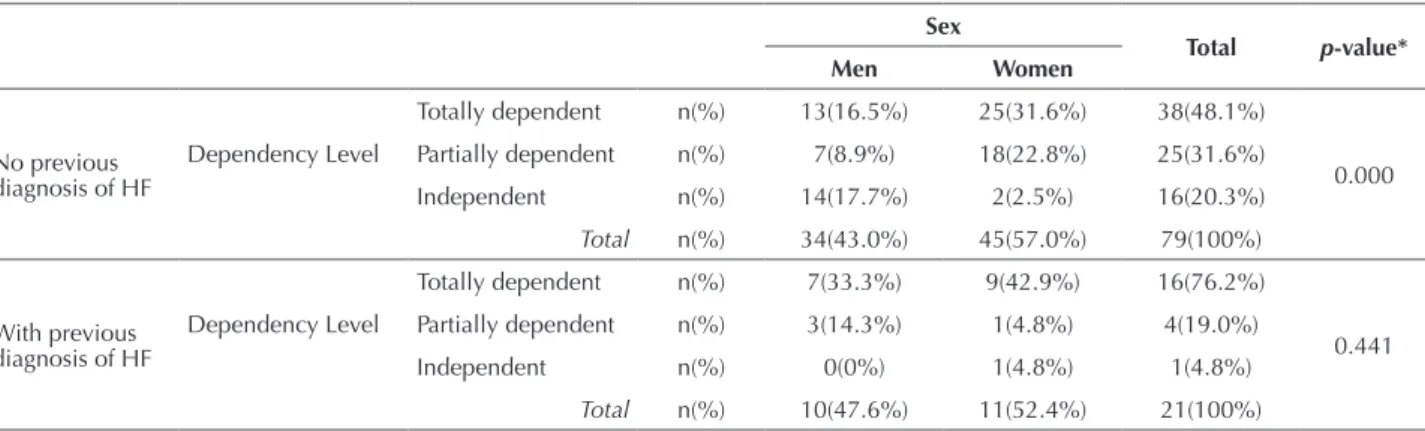
from statistical analysis due to a clinical complexity
evalua-tion similar to the whole sample. Weight loss and dyspnea were the most associated admission symptoms, accounting for 4% and 3% of cases, respectively.
of the elderly presented partial dependence, and 17 were independent for ADL. herefore, 83 participants had some level of dependence.
In general, elderly patients with HF had more comor-bidities and were more dependent than those who had no personal history of HF (Table 1). When evaluating the as-sociation between level of dependence and the sex of the elderly without previous diagnosis of HF, it was observed that only two (2.5%) women were independent, while 43 had some level of dependency. Older women were more dependent for ADL than men (p <0.000). here was no sta-tistically signiicant diference between the level of depen-dence and sex of elderly patients with a previous diagnosis of HF (p <0.441), as shown in Table 2.
and 4 were partially dependent, while only one (4.8%) was independent for ADL. Almost all elderly with HF were dependent for ADL (n = 20; 95%).
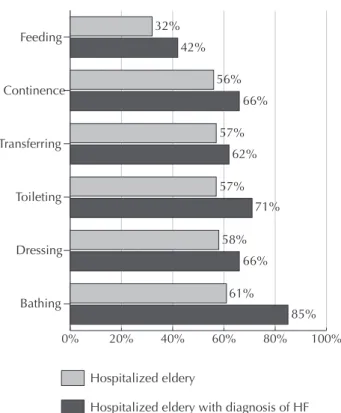
It was found that older people were more dependent for bathing (61%), dressing (58%), toileting (57%), trans-ference (57%), continence (56%) and feeding (32%). Simi-larly, those with a previous diagnosis of HF had higher dependence for bathing (85%) and dressing (66%), as shown in Figure 1.
DISCUSSION
It was shown in this study that HF is a dependence predictor in hospitalized elderly, increasing the chance of functional loss by ive times. Still, the elderly with HF considered independent for ADL is 3.5 times more likely to become partially dependent, and in turn they have the same chance of becoming totally dependent. Similarly, having a previous diagnosis of HF reduces the Katz index score by 0.79 points.
Similar results have been previously observed. In a study conducted in 2014, it was observed that hospitalization for HF increased the odds of ADL dependency by 40%, present-ing itself as an independent predictor of this condition(6). In
a prospective observational cohort study designed to evaluate clinical outcomes, functional outcome, quality of life and use of social resources in elderly hospitalized for HF, among the 450 participants it was observed that 118 (26%) had some degree of dependence for ADLs and only 76 (16.2%) had no trouble walking 400 meters(11). Hospitalized elderly with HF tend to
be more dependent.
It can be said that in a comprehensive manner, HF pa-tients experience changes in their lifestyle due to the in-ability generated by the signs and symptoms of the disease. In most forms of HF, the reduction in cardiac output is responsible for inadequate tissue perfusion. However, not all seniors will present low ejection fraction(12-13).
Unlike the presentation of HF in young adults, a condi-tion where the systolic dysfunccondi-tion is the cause of signii-cant pathology in the elderly clinical manifestations often occurs with preserved systolic function of the left ventricle, corroborating indings of this study, and there is therefore higher expressiveness of low LVEF(14). hus, other
contrib-uting factors should be considered.
here are many reasons that cause these elderly to be-come more dependent. First, one has to consider that de-spite the HF, the elderly body undergoes anatomical and physiological changes that culminate in decreased systemic functional reserve and ability to maintain homeostatic bal-ance in adverse situations. hese changes, associated with multiple pathologies and polypharmacy potentiate the chance of disability and dependence in the elderly(15-16). his,
coupled with the presence of HF, can further increase the risk of morbidity and death of these individuals.
Table 3 – Generalized linear regression models of HF as a predictor for dependency in hospitalized elderly - São Paulo, SP, Brazil, in 2015.
HF
p-value* B p-value** OR 95% CI
No n(%)
Yes n(%)
Dependence Dependent n(%) 63(63%) 20(20%) 0.11 1.62 0.12 5.08 0.94 - 94.48
Independent n(%) 16(16%) 1(1%)
Dependence Level
Totally dependent n(%) 38(38%) 16(16%)
0.07 1.27 0.02 3.57 1.28 – 11.66 Partially dependent n(%) 25(25%) 4(4%)
Independent n(%) 16(16%) 1(1%)
* Fisher’s exact test; ** Generalized linear regression analysis.
0% 20% 40% 60% 80% 100%
Feeding
Continence
Transferring
Toileting
Dressing
Bathing
32% 42%
56% 66%
85% 61%
58% 66% 57%
71% 57%
62%
Hospitalized eldery
Hospitalized eldery with diagnosis of HF
Figure 1 – Dependency on Basic Activities of Daily Living in hos-pitalized elderly - São Paulo, SP, Brazil, 2015.
Heart failure as a predictor of functional dependence in hospitalized elderly
Another important factor to consider is the presence of comorbidities, associated or not associated to HF, as half of the hospitalizations of the elderly are related to the high number of comorbidities and polypharmacy(17). he mean
number of comorbidities associated with the diagnosis of HF in this study (4.0) was similar to that found in previous studies(6). However, the prevalence of HF as a cause of
ad-mission to the study was lower than that found previously. he low number of cases admitted for HF in our sample (2%) may be due to the existence of a cardiology reference service in the same hospital complex of the study, where patients with HF may have been forwarded. he historically found prevalence of HF (21%) was also lower than other studies. In a study conducted with 51 elderly, with a mean age of 78 years, 16 (31%) had a previous diagnosis of HF(18).
In addition, in a study of 4.795 elderly, the propor-tion of individuals with hospitalizapropor-tion for HF increased by 8% in individuals aged up to 69 years and 13% in those who were older. he hospitalized individuals were older, used more drugs, had more comorbidities and more func-tional limitations(6).
Cardiovascular factors and non-cardiovascular condi-tions may precipitate the development or worsening of signs and symptoms of HF patients, thus leading to acute episodes requiring hospitalization(19). he prevention of risk
factors for cardiovascular disease is critical for patients with HF. he presence of hypertension, an increase of systolic levels, diabetes, and worsening of functional class, etiology of the disease, anemia, obesity and chronic renal failure are risk factors in cardiovascular mortality(8,19).
A relevant inding in the study sample was the high number of diagnoses of depression, afecting 23% of the participants. Depression, also associated with greater de-pendence, is a risk factor for developing cardiovascular dis-ease and is common in people with HF, and the association of these two diseases is an evolutionary worsening factor(20).
Studies have been conducted to assess the impact of the as-sociation between HF and depression symptoms. A survey of 348 participants with a mean age of 68 years, recruited from urban medical centers, revealed that the Body Mass Index (BMI) is closely related to depressive symptoms in patients with HF, especially among women(21). In patients
with HF, depression can represent an independent risk fac-tor for mortality and hospitalization, and is associated with higher cognitive impairment(21-22).
Polypharmacy in the elderly is a large risk factor for complications and adverse events. In a cohort study per-formed with 4.979 individuals with a mean age of 73.8 years, it was found that individuals diagnosed with HF used more drugs and were characterized by a higher prevalence of comorbid and functional dependence(6). he trend toward
polypharmacy was observed in the studied sample, which noted a mean of 10 medications prescribed for the elderly. Polypharmacy can be a contributing factor to greater func-tional dependence in the studied sample.
Hospitalization itself may be a factor associated to in-creased dependence of the elderly with HF(23). During
hos-pitalization, the functional capacity of the elderly can be
compromised and lead to functional dependence, culminat-ing in an often irreversible reduced quality of life, especially in the elderly with HF(6). It has also been shown that older
adults diagnosed with HF and who had permanent bed rest had worse evolutionary results, evidenced by worse prog-noses.
Another study showed that the elderly, in the two weeks preceding the period of hospitalization, were totally inde-pendent(24). However, after hospitalization, 44% were unable
to walk a block, and 58% required assistance for one or more Activities of Daily Living (ADL). Still, after admis-sion, 64% of elderly developed dependence on one or more ADL, and about a quarter were dependent for 4-5 ADL(24).
In a multicenter study of 942 elderly patients diagnosed with HF in ten Spanish hospitals, it was found that the functional deterioration of ADL was advanced, showing that 20.8% of the elderly had some functional impairment and less than 40% were fully independent(2).
he number of elderly patients with HF in hospitals is increasing, so that the care for these patients needs to be standardized in nursing care practice in Brazil and world-wide. he elderly with HF have unique characteristics that can distinguish them from other hospitalized elderly pa-tients in terms of care needs. Demographically, it is ob-served that they are older, aged more than 70 years and there is a higher frequency of women, which is compatible with the feminization of old age(6,16,25).
Age seems to be a major independent determinant of heart failure(25). he results showed a predominantly elderly
female proile, with multiple comorbidities, using several medicines and mostly dependent. When comparing HF and functional dependence, there was evidence that HF en-hances the chance of dependence of the hospitalized elderly, and this is mainly related to the female gender.
hey are individuals dependent on nursing for self-care. As in other studies(26), the results showed that a large
number of requests are to carry out activities related to hygiene and comfort, especially bathing. he elderly have diminished physiological reserve, making them vulnerable to situations of functional dependence, which can last be-yond hospital discharge. he prevention of dependence or its deterioration should be one of the foci of nursing actions.
he nurse should consider that functional decline is not an inevitable event and not inherent part of senescence. he functional assessment to determine the degree of depen-dence of the elderly at hospital admission enables a strategic plan for assistance, with improving service for individual care. In the elderly, evaluating the functional capacity and the existence of functional loss predictors, such as HF, is a mandatory part of the systematization of nursing care. Understanding the performance for ADL allows for not only a broad vision of functional impairment for adequate care planning, but also risk prevention and health problems. In addition, the functional loss when this occurs may be indicative of poor quality of life in these individuals.
was no record of the functional class of the elderly in their chart, and it was estimated at the time of evaluation based on the New York Heart Association. Despite functional class
being a subjective indicator of HF associated with classi-ication and interpretation bias, it is widely used both in clinical practice and in research(27). Added to the low
num-ber of admission cases for HF, these are limitations that must be observed in future studies.
Nevertheless, through this study it was possible to un-derstand the complexity of factors associated with depen-dence in hospitalized elderly with regard to the presence of HF. Functional decline is common in the lives of this population, and carries with it several limitations. However, it is believed that if they are well taken care of and directed, elderly diagnosed with HF may be able to manage their life
and perform ADL with the maximum possible indepen-dence. he evaluation of dependency is still a challenge in health care and the impact of associated factors is not sui-ciently known. herefore, assessing the level of dependence during the hospitalization of elderly patients with HF is mandatory for good nursing practices.
CONCLUSION
he prevalence of functional dependence in elderly hospitalized with HF was 95%, with the more compro-mised ADL being bathing. HF is a predictor for depen-dency in hospitalized elderly, increasing the chance of functional loss by ive times, the chance of functional de-terioration by 3.5 times, and reducing the score of the Katz Index by 0.794 points.
RESUMO
Objetivo: Identiicar se a Insuiciência Cardíaca (IC) é um preditor de dependência funcional para as Atividades Básicas de Vida Diária (AbVD) em idosos hospitalizados. Método: Estudo epidemiológico, observacional em corte transversal. Foram analisados os prontuários e feita avaliação funcional através do Índice de Katz de 100 idosos em uma enfermaria geriátrica de um hospital universitário. Para veriicar se a IC é um preditor de dependência funcional, foram feitas análises de regressão linear. Resultados: A prevalência de IC foi de 21%, sendo que 95% destes, eram dependentes para as AbVDs. Banho foi a AbVD mais comprometida. A IC aumenta em 5 vezes a
chance de perda funcional (IC 95% 0,94-94,48), em 3,5 vezes a chance de piora funcional (IC95% 1,28-11,66; p < 0,02) e reduz em 0,79 pontos o escore do Índice de Katz (p < 0,05). Conclusão: A IC é um preditor de dependência para AbVDs em idosos hospitalizados, que tendem a ser mais dependentes, principalmente para o banho.
DESCRITORES
Insuiciência Cardíaca; Idoso; Hospitalização; Atividades Cotidianas; Banho.
RESUMEN
Objetivo: Identiicar si la Insuiciencia Cardiaca (IC) es un pronosticador de dependencia funcional para las Actividades Básicas de Vida Diaria (AbVD) en ancianos hospitalizados. Método: Estudio epidemiológico, observacional en corte transversal. Fueron analizadas las ichas y hecha la evaluación funcional mediante el Índice de Katz de 100 ancianos en una enfermería geriátrica de un hospital universitario. Para veriicar si la IC es un pronosticador de dependencia funcional, se hicieron análisis de regresión lineal. Resultados: La prevalencia de IC fue del 21%, siendo que el 95% de estos eran dependientes para las AbVDs. El baño fue la AbVD más comprometida. La IC aumenta 5 veces la probabilidad de pérdida funcional (IC 95% 0,94-94,48) y 3,5 veces la probabilidad de empeoramiento funcional (IC95% 1,28-11,66; p < 0,02); y reduce en 0,79 puntos el puntaje del Índice de Katz (p < 0,05). Conclusión: La IC es un pronosticador de dependencia para AbVDs en ancianos hospitalizados, quienes tienden a ser más dependientes, especialmente para bañarse.
DESCRIPTORES
Insuiciencia Cardíaca; Anciano; Hospitalización; Actividades Cotidianas; Baños.
REFERENCES
1. Azad N, Lemay G. Management of chronic heart failure in the older population. J Geriatr Cardiol. 2014;11(4):329-37.
2. Herrero-Puente P, Martín-Sánchez FJ, Fernández-Fernandez M, Jacob J, Llorens P, Miró Ò, et al. Differential clinical characteristics and outcome predictors of acute heart failure in elderly patients. Int J Cardiol. 2012;155(1):81-6.
3. Montero-Perez-Barquero M, Manzano L, Formiga F, Roughton M, Coats A, Rodríguez-Artalejo F, et al. Utility of the SENIORS elderly heart failure risk model applied to the RICA registry of acute heart failure. Int J Cardiol. 2015;182:449-53.
4. Zachariah D, Taylor J, Rowell N, Spooner C, Kalra PR. Drug therapy for heart failure in older patients-what do they want? J Geriatr Cardiol. 2015;12(2):165-73.
5. Norberg EB, Boman K, Löfgren B, Brännström M. Occupational performance and strategies for managing daily life among the elderly with heart failure. Scand J Occup Ther. 2014;21(5):392-9.
6. Skalska A, Wizner B, Więcek A, Zdrojewski T, Chudek J, Klich-Rączka A, et al. Reduced functionality in everyday activities of patients with self-reported heart failure hospitalization: population-based study results. Int J Cardiol. 2014;176(2):423-9.
Heart failure as a predictor of functional dependence in hospitalized elderly
8. Bocchi EA, Marcondes-Braga FG, Bacal F, Ferraz AS, Albuquerque D, Rodrigues D, et al.; Sociedade Brasileira de Cardiologia. Atualização da Diretriz Brasileira de Insuiciência Cardíaca Crônica - 2012. Arq Bras Cardiol. 2012;98(1 Supl. 1):1-33.
9. Katz S, Ford AB, Moskowitz RW, Jackson BA, Jaffe MW. Studies oh illness in the aged. The index of ADL: a standardized measure of biological and psychosocial functions. JAMA. 1963;185(12):914-9.
10. Shelkey M, Wallace M. Katz Index of Independence in Activities of Daily Living (ADL) [Internet]. New York: Hartford Institute for Geriatric Nursing, New York University, College of Nursing; 2012 [cited 2015 Jan 27]. Available from: http://consultgerirn.org/uploads/File/trythis/ try_this_2.pdf
11. Vidán MT, Sánchez E, Fernández-Avilés F, Serra-Rexach JA, Ortiz J. FRAIL-HF: a study to evaluate the clinical complexity of heart failure in nondependent older patients: rationale, methods and baseline characteristics. Clin Cardiol. 2014;37(12):725-32.
12. Andersson C, Vasan RS. Epidemiology of heart failure with preserved ejection fraction. Heart Fail Clin. 2014;10(3):377-88.
13. Rose-Jones LJ, Rommel JJ, Chang PP. Heart failure with preserved ejection fraction: an ongoing enigma. Cardiol Clin. 2014;32(1):151-61. 14. Satomura H, Wada H, Sakakura K, Kubo N, Ikeda N, Sugawara Y,et al. Congestive heart failure in the elderly: comparison between reduced
ejection fraction and preserved ejection fraction. J Cardiol. 2012;59(2):215-9.
15. Barceló M, Torres O, Ruiz D, Casademont J. Appropriateness of medications prescribed to elderly patients with advanced heart failure and limited life expectancy who died during hospitalization. Drugs Aging. 2014;31(7):541-6.
16. Gyalai-Korpos I, Ancusa O, Dragomir T, Tomescu MC, Marincu I. Factors associated with prolonged hospitalization, readmission, and death in elderly heart failure patients in western Romania. Clin Interv Aging. 2015;10:561-8.
17. Stein GY, Kremer A, Shochat T, Bental T, Korenfeld R, Abramson E,et al. The diversity of heart failure in a hospitalized population: the role of age. J Card Fail. 2012;18(8):645-53.
18. Stoutjesdijk E, Barents M, Brouns RM, DeJongste MJ, Besselink HJ, Cheng JD, et al. Underestimated prevalence of chronic heart failure among the elderly residing in Care Homes in Aruba. West Indian Med J. 2014;63(6). [Epub ahead of print]
19. Farmakis D, Parissis J, Lekakis J, Filippatos G. Acute heart failure: epidemiology, risk factors, and prevention. Rev Esp Cardiol. 2015;68(3):245-8.
20. Gouweleeuw L, Naudé PJ, DeJongste MJ, Eisel UL, Schoemaker RG. The role of neutrophil gelatinase associated lipocalin (NGAL) as biological constituent linking depression and cardiovascular disease. Brain Behav Immun. 2015;46:23-32.
21. Hawkins MA, Dolansky MA, Schaefer JT, Fulcher MJ, Gunstad J, Redle JD, et al. Cognitive function in heart failure is associated with nonsomatic symptoms of depression but not somatic symptoms. J Cardiovasc Nurs. 2014 Jul 22. [Epub ahead of print].
22. Xu SD, Su GH, Lu YX, Shuai XX, Tao XF, Meng YD, et al. Elevated soluble ST2 and depression increased the risk of all-cause mortality and hospitalization in patients with heart failure. Int Heart J. 2014;55(5):445-50.
23. Liu MH, Wang CH, Huang YY, Cherng WJ, Wang KW. A correlational study of illness knowledge, self-care behaviors, and quality of life in elderly patients with heart failure. J Nurs Res. 2014;22(2):136-45.
24. Deborah E, Barnes, Mehta KM, Fortinsky RH, Palmer RM, Kirby KA, et al. Prediction of recovery, dependence or death in elders who become disable during hospitalization. J Gen Intern Med. 2012;28(2):261-8.
25. Metra M, Cotter G, El-Khorazaty J, Davison BA, Milo O, Carubelli V, et al. Acute heart failure in the elderly: differences in clinical characteristics, outcomes, and prognostic factors in the VERITAS study. J Cardiac Fail. 2014;21(3):179-88.
26. Rocha LS, Souza LMS, Rozendo CA. Necessidades humanas básicas e dependência de cuidados de enfermagem de idosos institucionalizados. Rev Eletr Enf [Internet]. 2013 [citado 2015 jan. 27];15(3):722-30. Disponível em: https://www.fen.ufg.br/fen_revista/ v15/n3/pdf/v15n3a14.pdf