Indicators for evaluation of processing
dental-medical-hospital supplies:
elaboration and validation
INDICADORES DE AVALIAÇÃO DO PROCESSAMENTO DE ARTIGOS
ODONTO-MÉDICO-HOSPITALARES: ELABORAÇÃO E VALIDAÇÃO
INDICADORES PARA LA EVALUACIÓN DEL REPROCESAMIENTO DEL PRODUCTOS
MEDICOS DEL HOSPITAL: CONSTRUCCIÓN Y VALIDACIÓN
* Extracted from project “Indicadores de Avaliação de Práticas de Controle de Infecção Hospitalar”, School of Nursing at University of São Paulo, 2006. 1 Full Professor of Medical-Surgery Nursing Department at School of Nursing at University of São Paulo. São Paulo, SP, Brazil. kugrazia@usp 2 Associate Professor of Medical-Surgery Nursing Department at School of Nursing at University of São Paulo. São Paulo, SP, Brazil. [email protected] 3 Doctorate Professor of Medical-Surgery Nursing Department at School of Nursing at University of São Paulo. São Paulo, SP, Brazil. [email protected] 4 Student. Post-Graduation Program PROESA at School of Nursing at University of São Paulo. São Paulo, SP, Brazil. [email protected] 5 Student. Post-Graduation Program PROESA at School of Nursing at University of São Paulo. São Paulo, SP, Brazil. [email protected] 6 Student. Post-Graduation Program PROESA at School of Nursing at University of São Paulo. São Paulo, SP, Brazil. [email protected] 7 Student. Post-Graduation Program PROESA at School of Nursing at University of São Paulo. São Paulo, SP, Brazil. [email protected] 8 Student. Post-Graduation Program PROESA at
O
RIGINAL
A
R
TICLE
RESUMO
Estudo de desenvolvimento metodológico de elaboração e validação de medidas de avaliação em saúde, com a finalidade de contribuir com sistemas de avaliação de práticas de controle e prevenção de infec-ção hospitalar, pela elaborainfec-ção e validainfec-ção de oito indicadores para avaliação do processamento de artigos odonto-médico-hospitalares. A partir de fundamentação te-órico-científica e contemplando avaliações de estrutura, processo e resultado, tais indicadores permitem elaboração de índi-ces de conformidade com relação às me-lhores práticas esperadas (padrão-ouro). A validação referiu-se à validade de conteú-do, pela técnica de consenso de especia-listas para julgamento de representativi-dade e aplicabilirepresentativi-dade. Todos os indicado-res foram aprovados. Os julgamentos efetuados, incluindo comentários e suges-tões, demonstraram a importância de se realizar validação de processos de avalia-ção, independentemente da existência de critérios padrão-ouro e/ou relevância na prática assistencial.
DESCRITORES
Avaliação em saúde.Almoxarifado Central Hospitalar. Controle de infecção.
Kazuko Uchikawa Graziano
1, Rúbia Aparecida Lacerda
2, Ruth Teresa Natália Turrini
3, Camila Quartim de
Moraes Bruna
4, Cristiane
Pavanello Rodrigues Silva
5, Cristiane Schmitt
6, Giovana Abrahão de Araújo
Moriya
7, Lílian Machado Torres
8ABSTRACT
Methodological study to elaborate and validate measures of evaluation in health contributing to an evaluation system of practices related to the control and preven-tion of hospital infecpreven-tion. It was elaborated eight dental-medical-hospital supply repro-cessing conformity indicators. Indicators are described using items of the structure, process and outcomes that permitted the elaboration of conformity indicators re-lated to the best practices (gold pattern). It was performed the content validity of the attributes of applicability and representa-tiveness by a consensus expert judgment process using a psychometric scale. All the indicators showed to have content validity. Expert judgments, including comments and suggestions, evidenced the importance of perform validity of the evaluation pro-cesses, independently of the existence of golden pattern criteria and/or relevancies to the nursing practice.
KEY WORDS
Health evaluation. Central Supply, Hospital. Infection control.RESUMEN
Estudio de desenvolvimiento metodológico para la elaboración y validación de medidas de evaluación en salud, con la finalidad de contribuir con los sistemas de evaluación de prácticas para el control y prevención de las infecciones hospitalarias, por la elabora-ción y validaelabora-ción de ocho indicadores de evaluación del procesamiento de instru-mentos odonto-médico-hospitalarios. A partir de la fundamentación teórico científi-co, tales indicadores contemplan evaluacio-nes de estructura, proceso y resultado así como permiten la elaboración de índices de conformidad con relación a las mejores prácticas esperadas (padrón-oro). La evalua-ción se refirió a la validez del contenido, por la técnica de consenso de especialistas para el juzgamiento de representatividad y aplicabilidad. Todos los indicadores fueron aprobados. Los juzgamientos efectuados, incluyendo comentarios y sugestiones, de-mostraron la importancia de realizar la vali-dación de procesos de evaluación, indepen-diente da existencia de criterios padrón-oro y/o a la relevancia de su repercusión en la práctica asistencial.
DESCRIPTORES
Evaluación en salud.INTRODUCTION
State health agencies have recognized the problem of
infections acquired in health services (IASS) and have been
developing policies either to orientate or to supervise its
control and prevention
(1). The increasing demand for
evalu-ation systems of control and prevention practices of IASS
requires the use of indicators, defined as measures of
vari-ables or attributes, which identify desirable or
non-desir-able results of a certain practice and establish
confor-mity indexes
(2-6). They can incorporate three dimensions of
quality evaluation
(7): structure, process and results, and
the advantage of one evaluation over the other is in the
appropriation of use.
Structure refers to the capacity of human and material
resources to render assistance to health care quality. The
processes refer to the way the practice is performed, and
how it objectifies its dynamics. Results show how
fre-quently an event happens, identifying desirable or
non-desirable effects resultant from actions, efficiency and
efficacy within acceptable limits, risk factors that
deter-mine good or bad quality, among others
(7).
The reprocessing quality of dental-medical-hospital
(DMH) supplies represents one of the pillars of the control
and prevention of IASS and is related either to guarantee
its submission to processes of microbial reduction or
de-struction, or to its functionality and integrity, in order to
prevent damages to the organism while using it. The
con-cern with appropriate practices is the research theme,
scientific events, as well as public consultations and
leg-islation by the Brazilian National Agency for Sanitary
Sur-veillance
(8).
Since the end of the 20
thcentury, evaluations of
struc-ture, process and results have been developed in the health
care area, however incipient regarding both in controlling
and preventing IASS and in methods for its validation. The
system developed and validated in this study is
unprec-edented, not being found, even in the scientific literature,
national and international production that favors similar
comparison of results, as well as its discussion.
OBJECTIVE
Elaboration and validation of indicators for assessing
the processing of articles DMH.
METHOD
It is a methodological study of construction and
vali-dation of measures for health evaluation
(9)by
indica-tors. Considering the theoretical-scientific fundaments,
eight indicators were constructed which consider the
DMH supply processing stages (cleaning, preparation/
packing, sterilization/storage/distribution) and
encom-pass evaluations of structure, processing and results.
Each indicator presents compounds to be evaluated, a
way of obtaining information and a calculation formula
for conformity measures. Validation refers to content
validity
(10), by judging attributes of representativeness
(capacity to access the phenomenon) and applicability
(if it is applicable and measurable). The consensual
tech-nique
(10-11)used the psychometric scale: (1) attribute not
considered; (2) incapable of considering attribute
with-out review; (3) attribute considered, but with minimal
alteration; (4) attribute considered. The instrument also
took into account comments and suggestions. To reach a
consensus, it was taken into consideration minimal
av-erage for Content Validity Index (CVI) of 0.75 of
scale-values 3 and or 4, similar to the Index verified in
litera-ture which ranges from 0.5 to 0.8 0
(10,11,12). In accordance
with literature for specialist composition
(10-12), six nurses
with experience in the Material and Sterilization Center
(MSC) area judged the instrument.
The formula to indicate the conformity of each
pro-cessing stage is:
Number compounds of conformity and applicable indicators Total compounds of applicable indicators at MSC under evaluation
x 100
RESULTS
The following bibliography was used for a
theoreti-cal-scientific fundament of compounds: (1) Brazilian
Na-tional Agency for Sanitary Surveillance. Public
Consulta-tion number 34, June 3
rd2009. Technical regulation
es-tablishing requirements for processing health products,
including surgery instruments. D.O.U. – Official Daily
Gov-ernment Newspaper; 2009. Available at: http://
www4.anvisa.gov.br/base/visadoc/CP/CP%5B26720-1-0%5D.PDF; (2) Brazilian National Agency for Sanitary
Sur-veillance. Resolution RDC 50 online. Available at Internet
site : httpp//www.
anvisa.gov.br/legis/resol200250-02rdc.pdf; (3)
American National Standard. Sterilization
of health care products – chemical indicators. Part 1:
gen-eral requirements. Arlington(US): Association for the
Ad-vancement of Medical Instrumentation
(AAMI); 2005; (4)
Association of Operating Room Nurses. Standards,
Recom-mended Practices, and Guidelines. AORN Inc, Denver, 2004
;
(5) Graziano KU et al. Cleaning, disinfection,
steriliza-tion of supplies and antisepsis. In: Fernandes AT.
Hospi-tal Infection and interfaces in the health area. São Paulo:
Atheneu, 2000; (6) Rutala WA et al.
Guideline for
Disinfec-tion and SterilizaDisinfec-tion in Healthcare Facilities.
CDC
/
HICPAC
.
2008. Available: www. cdc.gov/ncidod/hip/dsguide.htm;
(7)
Guide elaborated by Brazilian nurses. Practical
of Technical Standards) used to pack medical-hospital
supplies at humid heat sterilization. [Essay] São Paulo:
Nursing School/USP; 2000; (9) Brazilian Association of
Technical Standards. NBR 14028: Hospital apparel – double
drape confection. Rio de Janeiro; 1997; (10) Brazilian
As-sociation for Technical Standards. NBR ISO 11134:
Steril-ization of hospital supplies for validity and control of
humid heat sterilization routine. Rio de Janeiro;2001.
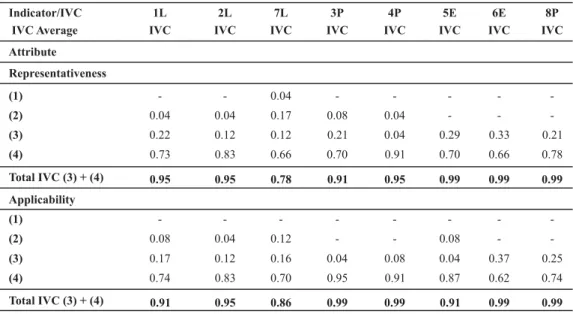
During the judgment process, all indicators had
favor-able consensus (IVC minimal > a 0,75) for
representative-ness and applicability (Table 1). The most problematic
indicator was the Result for Cleaning
Dental-Medical-Hos-pital Supplies (7L); the judges only disagreed with
instru-mental evaluation, considering that other supplies are
equally important or even more important. The average of
IVC values obtained at judgment is present on Table 1.
Table 1
- Average of IVC values at representativeness and applicability judgments of Processing Indicators of DMH supplies - São
Paulo - 2006
Indicator/IVC 1L 2L 7L 3P 4P 5E 6E 8P
IVC Average IVC IVC IVC IVC IVC IVC IVC IVC
Attribute
Representativeness
(1) - - 0.04 - - - -
-(2) 0.04 0.04 0.17 0.08 0.04 - -
-(3) 0.22 0.12 0.12 0.21 0.04 0.29 0.33 0.21
(4) 0.73 0.83 0.66 0.70 0.91 0.70 0.66 0.78
Total IVC (3) + (4) 0.95 0.95 0.78 0.91 0.95 0.99 0.99 0.99
Applicability
(1) - - -
-(2) 0.08 0.04 0.12 - - 0.08 -
-(3) 0.17 0.12 0.16 0.04 0.08 0.04 0.37 0.25
(4) 0.74 0.83 0.70 0.95 0.91 0.87 0.62 0.74
Total IVC (3) + (4) 0.91 0.95 0.86 0.99 0.99 0.91 0.99 0.99
Indicators approved and revised according to the
judges’ suggestion are presented herein. The
informa-tion obtained for each compound was described as (E)
interview, (I) inspection e (R) register. They were also
numbered as follows: 1L, 2L and 7L for supply cleaning
indicators; 3P, 4P and 8P for supply preparation and
packing indicators; 5E and 6E for sterilization process
indicators.
Chart 1 -
Compounds of Indicators for evaluation of processing dental-medical-hospital supplies: elaboration and validation
(I) Liquid toilet soap dispenser and paper towel and 70% alcohol gel dispenser for hand sanitation. hand sanitation due to frequent manipulation of contaminated material.
(I) Racks or tables with wheels, recipients for perforating-cutting instruments and for residues of biological materials. : worker safety and comfort.
(I) Area large enough to locate washbasin(s) with cabinet, equipment thermo-disinfecting/ultra-sonic washer(s), area to circulate materials and specific places for keeping PPE and cleaning inputs. cleaning requires proper area and equipment infrastructure.
(I) Area physically isolated from other areas. : prevents cross-contamination and free-transit of people providing one-direction flow from contaminated area to cleaning area.
(I) Good lighting, resistant and washable construction finishing material. : provide inspection of material cleaning. Area requires frequent competitive and terminal cleaning.
(I) Deep washbasin(s) with cabinets and hot and cold taps. : deep washbasin decreases sparkling water to environment. Warm water help removing greasy residue from materials.
(I) Taps with special spout for cannulated articles. : help to remove dirt and rinsing.
(I) Water/air guns for cleaning and drying cannulated and complex configuration articles. : help removing dirty and effective drying. (I) Soft bristle brush for manual cleaning. indispensable for effective cleaning and better than using sponges.
(I) Brushes with proper diameter for cannulated materials. indispensable for effective cleaning of material to remove dirt and biofilm.
Reason:
Reason
Reason:
Reason
Reason
Reason
Reason
Reason
Reason:
Reason:
1L: Indicator for evaluation of technical-operational resources for cleaning DHM supplies
Compounds
...Continuation
(I) a) Natural ventilation: window screens. : avoid insects from entering.
(I) b) Artificial ventilation: air conditioned environment. : comfort for workers who use PPE. There are no scientific evidences of the negative pressure impact in this environment once cross-contamination occurs primarily by contact and not by air.
(I) Water treatment for removal of microorganisms, heavy metals and chlorine. : microorganisms Gram (-) at material can be a source of endotoxins. Surgical instruments are affected for deposition and reaction with chemical pollutants, which cause stains, oxidation and make the material more friable.
(I) Obligatory PPE: coverall, impermeable long gloves or forearm protectors, safety glasses, mask, long impermeable surgical gown, cap, impermeable shoe cover. : control/prevention of occupational accidents through contact with organic contaminated or toxic substances.
(R) Follow-up polices for perforating-cutting accidents. : legal requirements.
(R) Easy-accessible and annually revised norms and routines. : revised document-material is source of consulting and guarantees qualified standardization of procedures.
(R) Description of nursing professionals' qualification.
: MSC must count on qualified professionals to guarantee service excellence
(I, E) Use of neutral/enzymatic/alkaline detergents or incrustation removal solutions with defined criteria, according to manufacturer instructions, for hospital and officially authorized use.
cleaning input must be adequate to dirty levels in order to optimize removal.
(I, E) Replacements of enzymatic detergent solution meet defined criteria for solution saturation. : efficiency of enzymatic detergent depends on quantity of organic material submerse in solution.
(I, E) There is no previous submersion of dirty materials in disinfecting chemical solution. : disinfecting chemical solutions do not guarantee decontamination and eventually the result can be organic material fixation on article.
(I) Dry the articles manually processed piece by piece : complete removal of all dirt.
(I) Use of complete PPE. : evidence of highly transmissible occupational diseases (HIV, HBV e HCV) through contact with biological material.
(I) Do not use abrasive materials such as steel-sponges for manual cleaning of supplies. medium and long-term damage to instrument surface.
(I,E) Supply disassembling according to manufacturers' protocols and instructions. : Do not sterilize dirty material with low-temperature method.
(I, E) Cleaning of complex and cannulated articles with brushes of proper diameter, swabs and complementary with ultra-sonic washer. : Biofilms and accumulation of organic material over surfaces with no mechanical action, constituting a mechanical barrier to action of chemical disinfectants and low-temperature sterilization methods.
(I) Loading automatic washers at standardized and validated quantity and disposition. : efficiency at article mechanical cleaning depends on contact pressure of a gush of water over the material.
(E) MSC nurse participate in the decision to buy cleaning equipment, products and used inputs. : direct users select with more objectiveness and with defined criteria.
(I,E) Materials washed and dried with thermal fount, airflow and clean absorbing woven fabric. humid material propitiates bacteria and fungus growth in addition to interfering in the sterilization process through ethylene oxide and hydrogen peroxide plasma.
(R) Preventive maintenance of equipment used for documented automatic cleaning. : preventive maintenance guarantees equipment functioning and production continuation.
(R) Periodic evaluation of automatic equipment for cleaning with specific tests and evidential reports. : guarantees previous detection of water flows and leaks.
(R) Thermal-disinfection periodic validation. : control of disinfection efficacy.
(R) Program of permanent education for MSC employees. education is essential for a qualified work.
(I) Located between expurgation and sterilization area, large enough to hold furniture related to these activities. : area properly dimensioned optimizes time and movement for employees to perform their tasks.
(I) Well-lighted area. : material inspection and preparation requires good illumination.
(I) Lenses for image intensification and compressed air guns. : better quality evaluation of material cleaning. Air under pressure can reveal residue dirty not identified in cannulated and complex articles.
(R) Maintenance of package sealing equipment. : guaranty of material sealing quality, which interferes in sterility maintenance during transportation and storage.
(I) Resources for hand hygiene with alcohol-gel 70%. : materials must be manipulated with cleaned hands so they are not re-contaminated.
(I) Description of professional qualification of the nursing team. MSC must account with qualified professionals to guarantee service excellence.
Reason
Reason
Reason
Reason
Reason
Reason
Reason
2L: Indicator for evaluation of DHM supply cleaning process
Compounds
Reason:
Reason
Reason
Reason Reason
Reason:
Reason
Reason
Reason
Reason
Reason:
Reason
Reason
Reason
Reason:
3P: Indicator of technical-operational evaluation for DMH supplies preparation and packing
Compounds
Reason
Reason
Reason
Reason
Reason
Reason:
...Continuation
Continues... 4P: Indicator of process evaluation for DHM articles preparation and packing
Reason:
Reason:
Reason:
Reason
Reason
Reason
Reason
Reason
Reason
Reason
Reason
Reason
Reason
5E: Indicator of technical-operational structure evaluation for Sterilization, Keeping and Distribution of DMH Supplies
Compounds
Reason:
Reason
Reason
Reason:
Reason
Reason
Reason
Reason:
Reason
Reason
Reason:
Reason
6E: Evaluation indicator of sterilization, keeping and distribution process of DHM supplies
Compounds
Reason
Reason: Compounds
(I) Inspection with magnifying glasses of cleaning conditions and material conservation. Material cleaning, functionality and integrality must be assured in this stage of processing.
(I) Use of surgical/film non-woven wrapping paper or crepe paper registered at Ministry of Health as articles processed under steam or pressure, ETO, formaldehyde autoclave.
verify microbial barrier. Woven fabric (controlled) can only be used for under-pressure steam.
(I) Use of Tyvek® wrap and polypropylene cover registered at the Ministry of Health as articles processed with hydrogen peroxide plasma. cellulose-free and microbial barrier guaranteed.
(E) Cotton-woven wrap must be of serge T1 or T2 for steam. : NBR14028/1997
(I) Control of number of reutilizations of cotton-woven surgical wrappings. : number of reutilization (washing and autoclaving) must be controlled, not exceeding 65 times. Cotton-woven surgical wrappings must not be repaired with patches or knitted up.
(I) Autoclave packages must not exceed 25 x 25 x 40 cm or 5 Kg weight. : sterilization guaranty and package drying. (I) Monitoring articles with exposition chemical indicator (class I).
: useful marker to distinguish processed and non-processed articles.
(I,E) Routine for rational use of chemical integrators or emulators/simulators (respectively class 5 and 6). : immediate response of occasional failures in article sterilization process.
(R) Operational norms and routines of preparation and packaging sectors, which must be easily accessed and annually revised. : qualified consultation and standardization of procedures guaranteed.
(I) Semi-critical thermal-disinfected material completely dried before packing in clean packaging. : dampness propitiates growing of fungus and bacteria.
(I) Legible identification of articles with lot number, method and date of sterilization, as well as indication of storage time. : Enables material tracking. Sterilization validity term depends on safety of microbiological barrier of packaging, sealing, and controlled keeping and handling. Control of storage time of material minimizes related events (package damaging, material palpating, keeping material in tight drawers, use of rubber bands and threads, etc.).
(I) Use of cap in preparation and keeping area for critical and semi-critical articles. : prevent hair and annexes from falling over materials.
(E) MSC nurse participate in decision of buying packages, sealing machines, and performing chemical and biological tests. : direct users select with more objectiveness and defined criteria products and inputs to their specific finalitiy.
(I) Dimensions compatible with number and size of equipment for sterilization. safety.
(I) Location between areas of preparation and of keeping and distribution. : it prevents cross-contamination and provides one-direction flow of materials.
(I) Wired screens if natural ventilation. : prevent insects from entering.
(I) Pre-vacuum steam autoclave. residual air removal from chamber and packages guaranteed.
(R) Evidential reports of thermal qualification of autoclave (s). : all autoclaves require annual thermal qualification of performance according to norm ISO/NBR 11134.
(R) Evidential reports on effectiveness of water treatment system of steam autoclaves regarding heavy metal and chemical contaminants removal. : packages and surgical instruments are negatively affected by deposition and reaction to chemical contaminants, resulting on stains and oxidations.
(R) Document preventive maintenance of equipment used for sterilization. : preventive maintenance guarantees quality of equipment functioning.
(I) Room layout/architecture: (I) Limit transit; (I) Provide item identification; (I) Provide cleaning. provide control of related events to guarantee sterilization preservation.
(I) Shelves must present a minimum distance of 20 cm from the floor, 5 cm from the walls and 45 cm from the ceiling. They must be of stainless steel, treated formica, stainless steel wired baskets, or hard plastic. Wooden shelves are not advisable.
: Maximal protection of sterilized material.
(I) The place must not have water fountains, open windows, exposed tubulations, and siphoned and hidden drains. : prevent dust deposition, dampness penetration and entrance of insects and rodents.
(I) No gross accumulation of dust, garbage, and presence of rodents or insects. risk of contamination. (R) Permanent education for employees. : education is essential for a qualified work.
(R) Bowie & Dick test at pre-vacuum autoclaves before the first cycle of the day.
: efficiency guarantee of vacuum bomb and sealing system and, consequently, no air bubbles at cycles.
...Continuation
(I) Vertical material disposal in autoclave (not pilled), with gaps (25 to 50 mm) between packages. : to guarantee steam circulation. Use of wired baskets prevents excessive loading of autoclave, packages from touching walls of internal chamber, hot material handling, and unnecessary manipulation.
(I) Vertical or inclined disposal of concave-convex configuration articles; articles as jars, buckets and flasks disposed upside down; and packages disposed at inferior position. : the suggested disposal guarantees drying of material; larger packages under smaller packages allow steam to circulate through materials.
(I) Packages leave autoclave dried. : humid packages are vulnerable to environmental contamination.
(I) No transfer of hot packages to storage area, except when wired-basket sterilized. : steam condensation humidifies packages through thermal shock and can compromise microbial barrier.
(I) Hand hygiene before unloading material from autoclave. : good practices when handling recently sterilized material.
(I) At storage, earlier-dated packages are in front of later-dated packages. : It decreases the possibility of long-term storage of sterilized packages, which increases the risk of related events.
(I,E,R) Frequent sterilization control of autoclaves performed by chemical indicator classes 5 or 6 and biological: weekly or daily minimal frequency, and always after preventive or corrective maintenance, and in situations suspicious of autoclave mal-functioning. : consensually biological control is still indispensable to prove sterilization, despite AAMI, ANSI and ISO 2005 recognition of response equivalence of biological indicator and indicators classes 5 and 6.
(E,R) Sterilization control of autoclave performed by biological indicator whenever there is implant and/or prosthesis material, releasing them only after results. : Implant and prosthesis material needs lower microbial inoculum to cause hospital infection.
(E,R) Results of biological indicators must be filed for 5 years. : Document proof in case of audit.
(E) MSC nurse participate in decision of buying equipment and input with register at the Ministry of Health authorized by Brazilian National Agency for Sanitary Surveillance to use in sterilization and storage sector. : direct users select with more objectiveness, safety and defined criteria products and inputs to their specific finality.
(I) Use of caps in environments for sterilization, storage and distribution of articles. : prevents hair and annexes from falling over materials.
(R) Frequent material recall in cases of positive results of biological indicator, or when indicator class 5 or 6 presents failure. : responsibility to control infection.
(R) Norms and routines of sterilization and storage sector are easy accessible and annually revised. revised document material is source of consult and enables qualified standardization of procedures.
Sample of inspected articles: ___________________________________ Relation of inspected articles:____________________________________ Indicator formula:
Sample of evaluated packages: _____________________________________________________________________________________________ Indicator formula:
Reason
Reason
Reason
Reason
Reason
Reason
Reason
Reason
Reason
Reason
Reason
Reason
Reason:
7L: Indicator of result evaluation of cleaning condition of DMH
8P: Indicator of result evaluation of DHM package conservation
Articles found dirty after cleaning (visual inspection + chemical tests) Total of articles evaluated x 100
Total packages of sterilized articles with conservation problems
Total of inspected packages x 100