Arthropods, 2014, 3(3): 127-137
IAEES www.iaees.org Article
Sublethal effects of some botanical and chemical insecticides on the
cotton whitefly,
Bemisia tabaci
(Hem: Aleyrodidae)
Fatemeh Jafarbeigi1, Mohammad Amin Samih1, Mahdi Zarabi2, Saeideh Esmaeily1
1
Department of Plant Protection, Faculty of Agriculture, Vali-e-Asr University of Rafsanjan, Rafsanjan, Iran
2
Department of Life Sciences Engineering, Faculty of New Sciences and Technologies, University of Tehran, Tehran, Iran E-mail: [email protected]
Received 7 May 2014; Accepted 10 June 2014; Published online 1 September 2014
Abstract
In addition to direct mortalities caused by acute concentrations of insecticides, some biological traits of target pests may be also affected by sublethal doses. The cotton whitefly, Bemisia tabaci (Hem: Aleyrodidae) is an important pest of a wide variety of agricultural crops across the world. The control of B. tabaci largely relies on wide application of chemical insecticides. In this study, we analyzed the life table parameters to evaluate the sublethal effect of three plant-derived insecticides (Fumaria parviflora (Fumariaceae), Teucrium polium (Lamiaceae), and Thymus vulgaris (Lamiaceae)) and two chemical insecticides (pymetrozin and neemarin) on B. tabaci. The whiteflies were allowed to oviposit on plants infected with each of the five insecticides using leaf-dip method. The data were analyzed using the age-stage two-sex life table. We found significant differences in the gross reproductive rate (GRR), the net reproductive rat (R0), the intrinsic rate of increase (r)
and the finite rate of increase (λ) of treated whiteflies compared to control. Our results showed that some biological traits of B. tabaci are affected by sub-lethal doses of the plant-derived extracts and that these effects are comparable to those of chemical insecticides. Given the detrimental effects of chemical insecticides on human, environment and non-target organisms, plant-derived insecticides may provide valuable environmentally friendly tools for pest management programs.
Keywords Bemisia tabaci; life table; population parameters; sublethal effects; plant extract; insecticide.
1 Introduction
The cotton whitefly, Bemisia tabaci (Hem: Aleyrodidae), is one of the most serious pests of agriculture attacking a wide range of plant species across the world (Oliveira et al., 2001; DAFGWA, 2008; De Barro et al., 2011). Economic damages occur only by direct feeding on plant phloem, (Malumphy, 2003) but also by producing high amounts of honeydew (Perumal and Marimutha, 2009) as well as transmission of more than 111 plant pathogenic viruses (Jones, 2003; Antony et al., 2009). At least 24 different biotypes of B. tabaci
Arthropods
ISSN 22244255
URL: http://www.iaees.org/publications/journals/arthropods/onlineversion.asp
RSS: http://www.iaees.org/publications/journals/arthropods/rss.xml
Email: [email protected]
EditorinChief: WenJun Zhang
Arthropods, 2014, 3(3): 127-137
IAEES www.iaees.org have been identified worldwide with the biotype B (also known as Bemisia argentifolii Bellows and Perring) is the most serious and widely distributed biotype (Perring, 2001).
During the two recent decades, B. tabaci has spread rapidly around the world to become a major pest of fruits, vegetables, fiber, and ornamental crops in tropical and subtropical regions (Brown et al., 1995; Oliveira et al., 2001). The control of B. tabaci has largely depended on wide application of chemical insecticides, which has caused many environmental and health problems (Ren et al., 2001; Lu et al., 2012). In addition to these problems, the satisfactory control of B. tabaci has proven to be difficult because of its wide range of hosts, rapid rate of development and reproduction and, more importantly, its high resistance to many commercially available insecticides (De Barro and Driver, 1997). Resistance to different classes of insecticides including organophosphates, carbamates, pyrethroids, neonicotinoids, and insect growth regulators has been frequently reported for populations collected from different geographic areas of the world (Nauen and Rauch, 2003). Therefore, it is necessary to search for alternative methods for effective control of this pest besides reducing the detrimental effects of chemical insecticides on human, environment and non-target organisms. Recently, the use of plant-derived insecticides (known also as botanicals) as potential safe weapons alternative to synthetic pesticides has been received increasing attention (Pascual-Villalobos and Robledo, 1998; Dimetry, 2012).
Recent studies have revealed that the acute mortality of insect pests is not the only determinant of insecticide efficiency. On the other word, in addition to direct mortality caused by insecticides, some biological traits of insect pests may be also affected by sublethal doses. Here, a question arises: whether or not the biological properties of resistant populations are still affected by sublethal doses of insecticides even when they do not suffer any direct mortality. To explore this question, in the current study, we used the life table parameters to evaluate the sublethal effects of some chemical and plant-derived insecticides on B. tabaci. The life table demonstrates a perfect description of survival, development, stage differentiation, and reproduction of a population (Hu et al., 2010). The traditional age-specific life table (Lewis, 1942; Leslie, 1945) considers only the survival and fecundity of females, and ignores male population as well as the stage differences and overlapping. As the economic damages of many important pests, including B. tabaci, occurs by both sexes, ignoring the male population may lead to miscalculation of survival and fecundity curves (Chi, 1988; Chi and Yang, 2003; Chi and Su, 2006). Therefore, in this study, we used the age- stage, two- sex life table, developed by Chi and Liu (1985), to take into account the male populations as well as the variable developmental rate occurring among individuals.
2 Material and Methods 2.1 Host plants
Seeds of cotton, Gossypium hirsutum (Var. Varamin) and tomato, Lycopersicon esculentum (Var. Bakker brothers) were planted in transplant trays in greenhouse conditions (25 - 27 ºC, 50 - 65% RH, and 16:8 L:D). Cotton plants were used as the main host for mass rearing of B. tabaci, while tomato plants were used as experimental host plant. The tomato stalks were transferred into plastic pots which had been filled with a commercial sterile plant growth media (BAGA, Bastare Amade Giah Arganic, manufactured by Dashte Sabz Atie Co., Iran). All glasses were kept in wooden cages (60 × 50 × 80 cm) covered by fine cloth mesh to avoid the entrance of wild B. tabaci. Old glasses were monthly replaced by new one to prevent the over-crowding. 2.2 Study insects
Adults of B. tabaci were collected from cotton fields (Rafsanjan, Kerman province, Southeastern Iran) by aspirator and released on cotton plants grown in greenhouses of College of Agriculture (Vali-e-Asr University of Rafsanjan, Iran). Several puparia belonging to B. tabaci (biotype A) were selected from these colonies and
Arthropods, 2014, 3(3): 127-137
IAEES www.iaees.org
used to establish a stock colony in greenhouse conditions.
Young fully-grown tomato leaves, cut from end of shoots, were put in small plastic glasses (10 cm diameter, height: 15 cm) which were filled by distilled water. Each glass was covered by a similar transparent one to make a glass cages. Adult whiteflies were released into the cage via a small pore provisioned on middle parts of the upper glass. The rearing method was taken from Biondi et al. (2010) with slight modifications. To provide coetaneous 24-h old adults, the eye-red puparia on tomato leaves were checked daily and the newborn adults were collected and released in to prepared glass cages.
2.3 Chemical insecticides
Commercial formulations of the two synthetic insecticides, pymetrozin (Chess®25% WP, Singenata Company), and azadirachtin (Neemarin EC1500), were used. These formulations are among the most widely used insecticides for B. tabaci control in Iran.
2.4 Preparation of plant extract
Four medicinally important plants belonging to different families were used as botanical insecticides (Table 1). The aerial parts of these plants (leaves and flowers) were collected in their flowering stage from their natural habitats located at different parts of the Kerman province during May and June 2010. Plant materials were air-dried for 4-5 days and ground by an auto-mixer. Twenty grams of air-dried materials were placed on filter paper and steeped in ethanol (90 ml) and water (210 ml) for 12 hours. The plant extracts were prepared according to the Soxhlet extraction method (Pascual-Villalobos and Robledo, 1998). After extract preparation, rotation was used to reach an extract amount of one third.
Table 1 Plant species extracts evaluated on adult Bemisia tabaci.
2.5 Dose-mortality response
The effects of five concentrations of the abovementioned botanical and synthetic insecticides on adult B. tabaci were assayed using the leaf-dip method. The concentrations include 106, 150, 210, 298, 420, and 593 µg/ml for pymetrozin, 0.060, 0.135, 0.330, 0.780, and 1.860 mg/ml for neemarin, 44, 58, 76, 100, 132, 173, and 228 mg/ml for Th. vulgaris, 58, 76, 100, 132, 173, 223, 300, and 395 mg/ml for T. polium, and 100, 153, 234, 359, 550, and 842 mg/ml for F. parviflora. Briefly, two-leaves tomatoes stalks were dipped in the prepared dilutions for 5 s (Heydari et al., 2003), then put separately in glass cages. After drying the treated leaflets, 50 coetaneous adults were released into each cage. Cages were maintained under controlled environmental conditions (27±2 °C, 50±5% RH, and a photoperiod of 16:8 h L:D). The total numbers of dead adults were counted after 24 h. Adults were considered dead when they were not able to move properly when stimulated with a fine brush. A solution of 3% ethanol/water was used as control. The mortality percentage was corrected using Abbott (1925) method and the lethal dose of 25% (LD25) was calculated for each
insecticide. Three replicates were considered for each of the studied insecticides and concentrations.
2.6 Sublethal effects
The sublethal effects of the selected insecticides were evaluated by analysis of life table parameters of B. tabaci eggs treated with the lethal dose of 25% (LD25). Tomato leaflets were dipped in 25% lethal
Scientific name Common name Family name The used parts of plant
Fumaria parviflora Fumitory Fumariaceae Leaves and stem
Teucrium polium Germander Lamiaceae Leaves
Thymus vulgaris Thyme Lamiaceae Leaves
Arthropods, 2014, 3(3): 127-137
IAEES www.iaees.org
concentration of each insecticide for 5 s (Heydari et al., 2003) and transferred to the glass cages. Thirty new emerged adults were randomly captured from the stock colony and released into cages. After 24 h, all adults were removed from the cages and their laid eggs were incubated for life table studies. The plants containing eggs were checked daily and any change in population parameters were recorded. After adult emergence, the whiteflies were individually transferred to new cages daily. The longevity of adult female and male whiteflies was determined and the number of eggs laid by each female was recorded daily until all females died. All experiments were carried out in controlled conditions (27±2 ̊C, 50%±5 relative humidity (RH) and 16: 8 h L:D).
2.7 Data analysis
Probit analysis was used to estimate the LC50 and LC25 by the Polo-Plus 2.00 software. The population parameters data were analyzed using SPSS software (version 16) followed by one-way ANOVA and Duncan’s multiple range tests. The raw life table data were analyzed based on the age- stage, two- sex life table theory (Chi and Liu, 1985; Chi, 1988). The means and standard errors of the life table parameters were estimated using Jackknife method (Sokal and Rohlf 1995). Processing of raw data was facilitated through TWOSEX- MSChart computer program (Chi, 2005) available at http://140.120.197.173/Ecology/ prod02.htm (Chung Hsing University, Taichung, Taiwan) and http://nhsbig.inhs.uiuc.edu.tw/www/chi.html (Illinois Natural History Survey, Champaign, IL). To format age- stage, two- sex life table, daily history of all individuals from birth to death, including daily female’s fecundity, was inscribed. The developmental stages were listed as egg, larva, pupa, and adult.
According to Chi and Liu (1985), the total population dimensions (Nt) and the total number of individuals
in stage j (Nj) are calculated using the following folmula. So in simulation based on the age-stage, two-sex life
table, the curves for every stages and for the total population can be produced (Chi, 1988).
Other life table parameters including the age- stage specific survival rate (Sxj), the age- specific survival rate
(lx), the age- stage specific fecundity (fxj), the age- specific fecundity (mx), the age-specific maternity (lxmx), the
age- stage reproductive value (vxj), the mean fecundity (F), the intrinsic rate of increase (r), the finite rate of
increase (λ), the net reproductive rate (R0), and the mean generation time (T) were calculated using the
following formula (Chi and Liu, 1985; Chi, 1988):
∑
∑ ∑
where β is the number of stages.
′
where n is the number of age, m is the number of stage and śijis the probability of individual survival from age x and stage y to age i and stage j (Chi, 1988). Difference in developmental rate and overlapping of stage
Arthropods, 2014, 3(3): 127-137
IAEES www.iaees.org
growth are common phenomenon frequently reported in many populations of insects. Therefore, individuals with the same age but different stage growth may possess different life expectancies. The two-sex life table method, however, accounts for individual life expectancy with age x and stage y (Istok, 1981; Chi and Su, 2006; Yang and Chi, 2006).
The intrinsic rate of increase (r) was calculated through the iterative bisection method using the Euler-Lotka formula with age indexed from 0 (Goodman, 1982):
∑∞ 1
The finite rate of increase (λ), the mean generation time (T), the gross reproductive rate (GRR) and the net reproduction rate (R0) were calculated as:
r
e
⁄
In the two-sex life table which starts with N eggs, the survival number of each age-stage is N.Sij, thus the
total number of eggs laid by adults emerged from this original N eggs would be:
The mean fecundity (F) per females was calculated as:
/
where Nf is the number of females emerged from N eggs.
3 Results and Discussion
In this study, we used the age-stage two-sex life table parameters to evaluate the sublethal effects of three plant-derived insecticides and two synthetic chemical insecticides on B. tabaci, a key devastating pest of agriculture across the world. The rationale behind selection of these insecticides was that their efficiency for control of different species of whiteflies had been repeatedly approved in previous studies (Pascual-Villalobos and Robledo, 1998; Hummelbrunner and Isman, 2001; Bi et al., 2002; El-Shazly and Hussein, 2004; Mahdavi Arab et al., 2008; Wang et al., 2008).
We did a preliminary bioassay test using five different concentrations of each selected insecticide to estimate the lethal dose of 25% (LD25). The LC25 values calculated using these assays were 89.95 µg/ml, 0.070
µg/ml, 69 mg/ml, 90.9 mg/ml, and 314 mg/ml for pymetrozin, neemarin, Th. vulgaris, T. polium, and F. parviflora, respectively.
The age- stage survival rate (Sxj) of B. tabaci, shows the probability that a recently born will survive to age
x and stage j. This curve shows the survival, stages difference, stages overlapping and the variable developmental rate between individuals (Chi, 1988; Yang and Chi, 2006; Hu et al., 2010). We found that the
Sxj values in pymetrozin and F. parviflora treatments decreased compared to other insecticides. The survival
rate of male whiteflies in F. parviflora was more than that of females. Additionally, a significant overlapping
IAEES
was obse individua The a
tabaci tr newborn of both s
tabaci (fr observed The a and stage curve (Y pymetroz respectiv T. polium Fig. (egg erved among als (Chi and S age- stage sur eated by the n whitefly wil sexes and tho from birth to d d in whiteflies age- stage fec e j per day, h Yang and Ch zin, neemarin vely. The low
m extract. In c
. 1 Effects of bo
gs/female), and
g different st Su, 2006; Yan
rvival rate (lx
six insectici ll survive to a ose died durin
death) ranged s treated with cundity (fxj),
has been show hi, 2006; Hu
n, T. polium
west survival r contrast, the w
otanical and che age-specific m
Arthro
tages, which ng and Chi, 2
x), the age- sp
des have bee age x. The su ng the pre-adu d between 31 h Th. vulgaris
which shows wn in Fig. 1.
et al., 2010)
m, Th. vulgar
rate and the sh whiteflies trea
emical insectici
maternity (lxmx)
opods, 2014, 3(3
is attributab 2006; Hu et a pecific fecund
en shown in urvival rate i ult stages. Th and 43 days
s, and T. poliu
s the mean nu Since, only ). The surviv
ris and F. p
hortest ovipo ated by Th. v
ides on age-spe of Bemisia taba
3): 127-137
ble to the dif al., 2010).
dity (mx), and
Fig. 1. The l
s estimated b he results sho with the high
um and contro umber of offs
females prod val of female
parviflora, we osition period
ulgaris extrac
ecific survival ra aci.
fferential dev
d the age- spe
lxindex prese
by combining owed that the hest and the l olrespectivel spring produc duce offspring e B. tabaci f
ere 15, 22, were observe ct had the hig
ate (lx), female
w
velopmental
cific maternit ents the prob g all surviving e survival rate
lowest surviv ly.
ced by individ g, there was for treatment 16, 22, 26 a ed in whitefli ghest survival
age-specific fe
www.iaees.org
rates among
ty (lxmx) of B
ability that a g individuals es of adult B.
val rates were
dual of age x only a single ts of control, and 14 days ies treated by l rate.
cundity (Fx4)
IAEES Fi The expectan death. T parviflor 2.64, 4.6 table sho and Chi, The a next pop control, p 36.54), 2 respectiv
ig. 2 Effects of
life expectan ncy (exj) was
he life expec
ra treatments 64, 4.15, and ows the differ 2006; Hu et age-stage rep ulation, has b pymetrozin, 24 d (v24= 1
vely. The re
botanical and c
ncy (exj) of
calculated a ctancy of B.
were calcula 3.48 days fo rence among
al., 2010). productive va been illustrate neemarin, T.
14.91), 28 d productive v
Arthro
chemical insecti
each age- st s the life dur
tabaci in c ated as 8.83, 6 or males, resp
individuals o
alue (vxj) of B
ed in Fig. 3. T
polium, Th.
(v28= 4.70),
value signifi
opods, 2014, 3(3
icides on age-st
tage group o ration of adu ontrol, pyme 6.03, 5.35, 3. pectively. The of the same ag
B. tabaci, wh The main pea
vulgaris and 20 d (v20=
cantly increa
3): 127-137
tage specific lif
of B. tabaci
ult female an etrozin, neem
.76, 6.16, and e life expecta ge, but of diff
hich shows th ak in reprodu
d F. parviflo
8.87), 35 d ased when r
fe expectancy (e
has been sh nd male whit marin, T. poli
d 5.58 days fo ancy based on ference stage
he contributio ctive capabili
ora, occurred (v35= 40.64
reproduction
w
exj) of Bemisia
hown in Fig. eflies from e
ium, Th. vulg
or females an n age- stage s or different
on of an indi ity of female at the age o 4), and 29 d
was maxim
www.iaees.org tabaci.
. 2. The life emergence to
garis and F.
nd 5.12, 4.36, two- sex life t sexes (Yang
ividual to the whiteflies in of 21 d (v21=
(v29= 9.85),
IAEES findings contribut If an age onw example, treatmen have bee and Chi, varied am by Liu an
are in accor te much more adult female ard, although , the reprodu nt, although th en previously , 2012). Our mong differen nd Stansly (1
Fig. 3 Effect
rdance to pr e than a recen e produce no h, it may still uctive capabi hey lived by y reported for results also nt developme
995).
ts of botanical a
Arthro
revious studi ntly born indi offspring fro l survive for ility of white 36th day (see r whiteflies a
showed that ental stages o
and chemical in
opods, 2014, 3(3
ies, which re viduals (Yan om a given a the following eflies treated e Fig. 3). Su and other inse t the suscepti
f B. tabaci, a
nsecticides on a
3): 127-137
eported that ng and Chi, 20
age, its reprod g days (Yang d by F. parv
ch asynchron ects (Yang an ibility to both a phenomenon
ge–stage reprod
individuals a 006; Hu et al. ductive value g and Chi, 20
iflora extract nies in surviv nd Chi, 2006 h botanical a n that has bee
ductive value (v
w
at the reprod ., 2010) (Fig. e would be ze 006; Hu et al
t ended at 3 val and repro 6; Hu et al., 2 and chemical en previously
vxj) of Bemisia
www.iaees.org
duction peak 3).
Arthropods, 2014, 3(3): 127-137
IAEES www.iaees.org
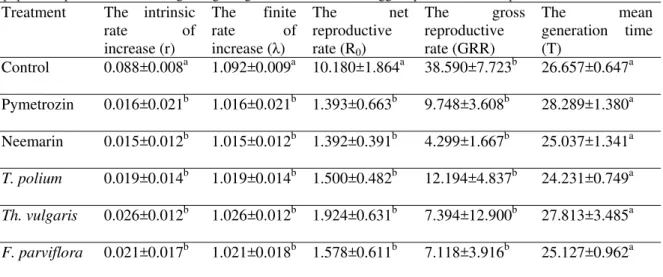
The population parameters including the intrinsic rate of increase (r), the finite rate of increase (λ), the gross reproductive rate (GRR), the net reproductive rate (R0), and the mean generation time (T) were also
calculated using age-stage two-sex life table (Table 2). Analyses of variances revealed significant differences in effects of both botanical and chemical insecticides on the net reproductive rate (One way ANOVA: F6,754=12.489 P<0.001), the intrinsic rate of increase (One way ANOVA: F6,754=2.946, P<0.01), and the finite
rate of increase (One way ANOVA: F6,754=3.192 P<0.01) compared to control. However, there was no
significant difference in these parameters among whiteflies treated by different insecticides. These findings show the efficiency of the botanical insecticides in control of B. tabaci comparable to the commonly used chemical insecticides. The gross reproductive rate (One way ANOVA: F6,754=1.044, P=0.28) and the mean
generation time (One way ANOVA: F6,754=1.098 P=0.362), in contrast, were not statistically different among
whiteflies treated by different insecticides.
Table 2 Comparison of means related to the effect of different herbal compounds in comparison with pesticides on
population parameters with using the age-stage two-sex life table of eggs exposed to infected plant of Bemisia tabaci.
The mean generation time (T)
The gross reproductive
rate (GRR) The net reproductive
rate (R0)
The finite rate of increase (λ)
The intrinsic rate of increase (r)
Treatment
26.657±0.647a 38.590±7.723b
10.180±1.864a 1.092±0.009a
0.088±0.008a Control
28.289±1.380a 9.748±3.608b
1.393±0.663b 1.016±0.021b
0.016±0.021b Pymetrozin
25.037±1.341a 4.299±1.667b
1.392±0.391b 1.015±0.012b
0.015±0.012b Neemarin
24.231±0.749a 12.194±4.837b
1.500±0.482b 1.019±0.014b
0.019±0.014b
T. polium
27.813±3.485a 7.394±12.900b
1.924±0.631b 1.026±0.012b
0.026±0.012b
Th. vulgaris
25.127±0.962a 7.118±3.916b
1.578±0.611b 1.021±0.018b
0.021±0.017b
F. parviflora
Different letters show significant differences at 0.05 level.
In our study, the total number of offspring produced by all females was nearly equal to the net reproductive rate × the cohort size, and the minor difference was probably due to rounding-off. This relationship highlights the accuracy of the age-stage two-sex life table. These findings were in accordance to results obtained by other authors (Chi, 1988; Chi and Young, 2003; Yang and Chi, 2006). Yang and Chi (2006) found that the net reproductive rate was lower than the mean female fecundity (R0≤F). This inequality may be explained by the
presence of pre-adult mortality, a condition that was also demonstrated in our study.
Given the increasing knowledge on the importance of sustainable agriculture during the two last decades, efforts for detection and elaborate use of environmentally friendly agents for pest management has received growing attention. In this context, life table methods are valuable tools to evaluate and compare the sublethal effects of these agents on both target pests and non-target organisms such as natural enemies. This study showed that some biological aspects of B. tabaci are significantly affected at sublethal concentrations of the botanical insecticides and that these effects are comparable to those achieved from application of those chemical insecticides that are widely used for control of whiteflies. According to our current data, and our previous findings (Esmaeily et al., 2014), the extracts taken from C. procera and T. polium as well as the synthetic insecticide, pymetrozin, gave the best results in B. tabaci control. Given the safety of plant-derived
Arthropods, 2014, 3(3): 127-137
IAEES www.iaees.org
insecticides for human and the environment, the two former insecticides may be considered as appropriate agents for use in integrated pest management of whiteflies. Although, both sublethal and lethal effects of these agents on non-target organisms, especially natural enemies, remain to be cleared in future studies.
References
Abbott WS. 1925. A method of comparing the effectiveness of an insecticide. Journal of Economic Entomology, 18: 265-267
Antony B, Lisha VS, Palaniswami MS. 2009. Evidences for transmission of Indian cassava mosaic virus through Bemisia tabaci – cassava biotype. Archives of Phytopathology and Plant Protection, 42: 922-929 Bi JL, Toscano NC, Ballmer GR. 2002. Greenhouse and field evalution of six novel insecticides against the
greenhouse whitefly, Trialeurodesvaporariorum on strawberries. Crop Protection, 21: 49-55
Biondi A, Desneux N, Siscaro G, et al. 2010. Using organic-certified rather than synthetic pesticides may not be safer for biological control agents: selectivity and side effects of 14 pesticides on the predator Orius laevigatus. Chemosphere, 87: 803-812
Chi H. 1988. Life table analysis incorporating both sexes and variable development rates among individuals. Environmental Entomology, 17: 26-34
Chi H. 2005. TWOSEX-MSChart: a computer program for the age-stage, two-sex life table analysis. http://140.120.197.173/Ecology/Downlod/Twosex-MSChart.zip.
Chi H, Liu H. 1985. Two new method for the study of insect population ecology. Bulletin of Institute of Zoology of Academia Sinica, 24: 225-240
Chi H, Su HY. 2006. Age-stage, two-sex life tables of Aphidius gifuensis (Ashmead) (Hymenoptera: Braconidae) and its host Muzus persicae (Sulzer) (Homoptera: Aphididae) with mathematical proof of the relationship between female fecundity and the net reproductive rate. Environmental Entomology, 35: 10-21 Chi H, Yang TC. 2003. Two-sex life table and predation rate of Propylaea japonica Thunberg (Coleoptera:
Coccinellidae) fed on Myzus persicae (Sulzer) (Homoptera: Aphididae). Environmental Entomology, 32: 327-333
DAFGWA (Department of Agriculture and Food, Goverment of Western Australia). 2008. A list of recorded host plants of Bemisia tabaci including silver leaf whitefly. Available at: http://www.agric.wa.gov.au/objtwr/imported_assets/content/pw/ins/slwfhostlist.pdf.
De Barro PJ, Driver JF. 1997. Use of RAPD PCR to distinguish the B biotype from other biotypes of Bemisia tabaci (Gennadius) (Homoptera: Aleyrodidae). Australian Journal of Entomology, 36: 149-152
De Barro PJ, Liu SS, Boykin LM, et al. 2011. Bemisia tabaci: a statement of species status. Annual Review of Entomology, 56: 1-19
Andargae YE, Tagele SB, Girsil TS, et al. 2013. Evaluation of different botanical for the management of cowpea bruchid (Callosobruchus maculatus) in north-eastern Ethiopia. Archives of Phytopathology and Plant Protection, 46: 1331-1337
Dimetry NZ. 2012. Prospects of botanical pesticides for the future in integrated pest management programme (IPM) with special reference to neem uses in Egypt. Archives of Phytopathology and Plant Protection, 45: 1138-1161
El-Shazly AM, Hussein KT. 2004. Chemical analysis and biological of the essential oil of Teucrium leucocladum Boiss.(Lamiaceae). Biochemical Systematics and Ecology, 32: 665-674
Esmaeily S, Samih MA, Zarabi M, et al. 2014. Comparative demographic analysis of sub-lethal effects of
Calotropis procera extract and some insecticides on Bemisia tabaci (Genn.). Archives of Phytopathology
Arthropods, 2014, 3(3): 127-137
IAEES www.iaees.org
and Plant Protection (in press). doi:10.1080/03235408.2014.880573.
Goodman D. 1982. Optimal life histories, Optimal notation, and the value of reproductive value. American Naturalist, 119: 803-823
Heydari A, Moharrami Pour S, Pour Mirza AA, et al. 2003. Effects of buprofezin, pymetrozin and fenpropathrin on reproductive parameters of Trialeurodes vaporariorum Westwood 9Hom: Aleyrodidae). Applied Entomology and Phytopathology, 7: 29-46
Hu LX, Chi H, Zhang J, et al. 2010. Life table analysis of the performance of Nilaparvata lugens (Hemiptera: Delphacidae) on two wild rice species. Journal of Economic Entomology, 103(5): 1628-1635
Huang Y, Chi H. 2012. Age-stage, two-sex life tables of Bactrocera cucurbitae (Coquillett) (Diptera: Tephritidae) with a discussion on the problem of applying female age-spesific life tables to insect populations. Insect Science, 19: 263-273
Hummelbrunner LA, Isman MB. 2001. Acute, sublethal, antifeedant and synergic effects of monoterpenoid essential oil compounds on the tobbaco cutworm, Spodoptera litura (Lep., Noctuidae). Journal of Agricultural and Food Chemistry, 49: 715-720
Jones DR. 2003. Plant viruses transmitted by whiteflies. European Journal of Plant Pathology, 109: 195-219 Leslie PH. 1945. On the use of matrices in certain population mathematics. Biometrika, 33: 183-212
Lewis EG. 1942. On the generation and growth on the population. Sankhya, 6: 93-96
Liu TX, Stansly PA. 1995. Toxicity of biorational insecticides to Bemisia argentifolii (Homoptera: Aleyrodidae) on tomato leaves. Journal of Economic Entomology, 88: 564-568
Lu Y, Wu K, Jiang Y, et al. 2012. Widespread adoption of Bt cotton and insecticide decrease promotes biocontrol services. Nature, 487: 362-365
Mahdavi Arab N, Ebadi R, Hatami B, et al. 2008. Insecticidal effects of some plant extracts on Callosobruchus maculatus F. under laboratory condition and Laphigmaexigua H. in greenhouse. JWSS Isfahan University of Technology, 11: 221-234
Malumphy CP. 2003. The status of Bemisia afer (Priesner and Hosny) in Britain (Homoptera: Aleyrodidae). Entomologist's Gazette, 54: 191-196
Nauen R, Rauch N. 2003. Biochemical investigations of neonicotinoid cross-resistance in Q-and B-type
Bemisia tabaci (Hemiptera: Aleyrodidae). 3rd International Bemisia Workshop, Barcelona, Spain
Oliveira MRV, Henneberry TJ, Anderson P. 2001. History, current status, and collaborative research projects for Bemisiatabaci. Crop Protection,20: 709-723
Pascual-Villalobos MS, Robledo A. 1998. Screening for anti-insect activity in Mediteranean plants. Industrial Crops and Products, 8: 183-194
Perring TM. 2001. The Bemisia tabaci species complex. Crop Protection, 20: 725-737
Perumal Y, Marimuthu M. 2009. Host plant mediated population variations of cotton whitefly Bemisia tabaci
Gennadius (Aleyrodidae: Homoptera) characterized with random DNA markers. American Journal of Biochemistry and Biotechnology, 5: 40-46
Ren SX, Wang ZZ, Qiu BL, et al. 2001. The pest status of Bemisia tabaci in China and non-chemical control strategies. Entomologica Sinica, 8(3): 279-288
Sokal RR, Rohlf FJ. 1995.Biometry: the Principles and Practice of Statistics in Biological Research (3rd ed). WH Freeman, New York, USA
Wang SQ, Guo YL, Pang ST, et al. 2008. Toxicities of different pesticides to B biotype Bemisia tabaci. Acta Agriculturae Zhejiangensis, 20: 367-371
Yang T, Chi H. 2006. Life table and development of Bemisia argentifolii (Homoptera: Aleyrodidae) at different temperatures. Journal of Economic Entomology, 99: 691-698