AR
TICLE
1 Escola Paulista de Enfermagem, Universidade Federal de São Paulo. R. Napoleão de Barros 754, Vila Clementino. 04024-002 São Paulo SP Brasil. ufesmila_enfer@ yahoo.com.br 2 Programa de Pós-Graduação em Atenção à Saúde Coletiva, Universidade Federal do Espírito Santo.
Breast cancer: diagnosis-to-treatment waiting times
for elderly women at a reference hospital of São Paulo, Brazil
Abstract This study compares waiting time from diagnosis of breast cancer to start of treatment with patients’ social-demographic and clinical profiles in women aged 60 or more at the Péro-laByington Hospital, São Paulo, over the years 2001–2006.It is a descriptive study based on sec-ondary data in a sample of 1,299 cases. Social-de-mographic, clinical and temporal variables were collected. Patients were divided into two groups: those with period between diagnosis and start of treatment less than 60 days, and greater than 60 days. The average time between diagnosis and start of treatment was 74.7 days (SD = 212.6), and the median time was 45 days. This waiting time was lower for subjects without diagnosis and without prior treatment (p = 0.001), and also for those with tumors at Stage 0, in situ or Stage I(p = 0.001). Time was significant for the outcomes of relapse (p = 0.004) and metastasis (p = 0.038). Having established diagnosis and treatment also resulted in lower time to start of the required care. Improvement to the structuring and function-ing of the health service is an essential need, for dealing with the cases of the disease in an efficient manner, an important challenge for Brazil’s Uni-fied Health System.
Key words Breast cancer, Mammary neoplasia,
Elderly women, Treatment, Diagnosis, Delay
Camila Brandão Souza 1
Suzete Maria Fustinoni 1
Maria Helena Costa Amorim 2
Eliana Zandonade 2
Jéssica Carvalho Matos 1
S
ouza CB
Introduction
Breast cancer is the most common cause of death among women and, with the exception of non-melanoma skin cancer, is the most frequent-ly occurring type of cancer in 140 countries1. In
Brazil, a total of 57,120 new cases were estimated for the years 2014 and 2015, with an estimated risk of 56.09 cases for each 100,000 women2. For
the same period the forecast is 30,740 new cases in Brazil’s Southeastern region alone1.
The increase in the occurrence of cancer is not only due to increased life expectancy, but is also related to the improvement in diagnostic technology, and the expansion of surveillance programs3. In the developed countries its
fre-quency is greater, and could also be related to more advanced records, and sedentary and re-productive habits4. The mortality coefficients are
higher in the developing countries1, a reflection
of inequalities in health5.
Breast cancer progresses slowly and, if diag-nosed early, the possibility of cure or prolonga-tion of survival is considerably increased6. It is
rare before the age of 35, but above this age group its incidence is rapid, growing and progressive7.
Almost four out of every five cases takes place af-ter the age of 502.
In the United States, in 2005, half of the pa-tients diagnosed with breast cancer were over 65; and in 2015 it is estimated that this percentage will increase by 30%8. Populations with
high-er life expectancy, such as Switzhigh-erland, have the highest prevalence of this type of cancer in Eu-rope, with old people representing 12% of that country’s total cases9.
Studies on the interval between diagnosis and start of treatment are important for deciding res-olution measures. In Brazil there are tools, such as the Registro de Câncer de Base Populacional
(RCBP) and the Registro Hospitalar de Câncer
(RHC), which help in monitoring and evaluation of action for control and research on cancer, as well as helping indecisions on evaluation of the effects of treatments and control of the variables recorded for each tumor10,11. Information in the
RHCs has provided input for several studies12-14,
and analyses of time trends of the phenomena associated with the disease11.
The delay between diagnosis and start of treatment worsens breast cancer, making it pro-gressive and irreversible15. Responding to this,
Law 12732, enacted in November 2012, gave can-cer patients a legal right to start of treatment in
a period of 60 days or less after confirmation of diagnosis16.
There are three components of delay in treat-ment of breast cancer: From the motreat-ment when the woman presents symptoms until her arrival at the health service; between attended by a doc-tor and her first access to specialized care for con-firmation of the diagnosis; and finally between that access/diagnosis and the start of treatment17.
Any individual patient may suffer delays in vari-ous phases of her diagnosis and treatment15.
Access, and the time for diagnosis and treat-ment of this type of cancer vary, depending on geographical and socio-economic factors15.
De-lay can adversely affect prognosis, reducing the chances of cure, due to the growth of the tu-mor15,18-20. There is an association between delay
from diagnosis to treatment and shorter progres-sion-free survival, lymph node metastasis, the size of the tumor, and its staging21. On the other
hand early detection is related to higher rates of cure21,22.
The law guaranteeing cancer patients treat-ment in up to 60 days after diagnosis is recent16,
while networks to promote control of cancer have existed for longer23. The consolidation of the
concept of Network as a strategy for managing oncological care in Brazil emerged in 2003. Bra-zil’s National Cancer Institute – INCA (the In-stituto Nacional de Câncer José Alencar Gomes da Silva), in partnership with the Health Ministry, planned a common agenda for actions to con-trol cancer, involving various spheres of society, aiming to reduce cancer incidence and mortality in the population and assure quality of life for patients and their families. One of its aims was to strengthen planning and assessment of actions for oncological care, stimulating integration of this care in the health system and optimization of resources23. The Network possibly improves the
effectiveness of breast cancer treatment in Bra-zil, helping in early diagnosis, and reduction of delays between diagnosis and treatment, because it is an indicator of efficacy and of the efficiency of the Service in all the phases of treatment of breast cancer.
e C
ole
tiv
a,
20(12):3805-3816,
2015
Methodology
This is a descriptive study, with secondary data. The population was constituted as all the cas-es occurring of elderly women with diagnosis of breast cancer who received treatment at the Pérola Byington Hospital, Women’s Health Ref-erence Center, in the municipality of São Paulo, over the period January 2001 to December 2006, registered in the Health Information System of the Cancer Hospital Registry (SIS-RHC) – a total of 1,299 cases.
The Women’s Health Reference Center of the Pérola Byington Hospital, in the municipality of São Paulo, has the mission of providing out-patient and medical-hospital care, of reference quality, for the population of greater São Paulo, in the areas of human reproduction, and genital and mammary gynecology and oncology24.
This hospital’s level of therapy in mammary and gynecological cancer, among other activities, is gaining increasing recognition. It also main-tains partnership activities with teaching institu-tions, and organizations in research, technology and community health education24.
Cases with incomplete records of the vari-ables related to time were excluded (case records were examined to understand reasons for this non-completeness). In women with more than one diagnosis of primary breast cancer, only the first case was considered.
The age of 60 was adopted as a characteristic of being elderly, in accordance with the defini-tion used by the Brazilian Geography and Statis-tic Institute (IBGE)25 and the National Policy for
the Health of the Elderly26.
13 variables were analyzed, all taken from the Tumor Record File and from the RHC of the Hospital, with information on age at diagnosis, year of diagnosis, prior diagnosis and treatment, primary location of the tumor, histological type of the tumor, clinical stage of the tumor at diag-nosis, treatment carried out and combinations, relapse, metastasis, location of the metastasis, time between first consultation and start of ment, time between diagnosis and start of treat-ment, and time between first consultation and diagnosis. Data on the variables relapse and me-tastasis were followed for a period of five years.
The software used for statistical treatment of the data was: (i) Microsoft Office Excel 2007 for
Windows, and (ii) the IBM statistical package
SPSS Statistics 20.0. Univariate descriptive anal-ysis was carried out on the data obtained to es-tablish the pattern of distribution of women who
sought treatment for breast cancer. The results were analyzed using calculations of frequency, mean, median and standard deviation. For the association between time and the variables of the study the chi-squared test of association was used.
Two groups of women were formed based on the variable time between diagnosis and start of treatment – divided into ‘up to 60 days’ and ‘more than 60 days’. A significance level of p ≤ 0.05 was adopted.
There are no financial and/or political con-flicts of interest.
Results
In the years 2001–2006, 1,318 new cases of el-derly women with breast cancer were attended at the Pérola Byington Hospital. A total of 19 cases were excluded because no type of treatment was carried out after the diagnosis, thus presenting non-completion of the time variable. This result-ed in a total of 1,299 women.
In Table 1 it is seen that more than 50% of the women were in the 60–69 age group. The average age of the women was 70.1 years (standard devi-ation 7.3 years) and the median was 69 years. The highest frequency of diagnoses was in 2006, 22% of the universe of subjects. More than 90% ar-rived at the service without diagnosis and with-out prior treatment. In 98% of the cases the pri-mary location of the breast tumor was imprecise. As to the histological type, 78% were infiltrating ductal carcinoma. Stage II was present in 44% of the subjects, and Stage III in 28%.
The association of surgery, chemotherapy, ra-diotherapy and hormone therapy was the most used by the institution in the treatments, at 26% of the total, followed by surgery, radiotherapy and hormone therapy, with 22%.
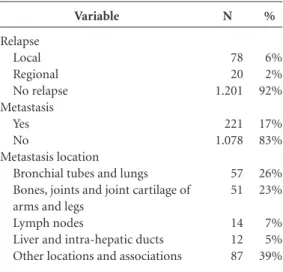
Table 2 shows that in the great majority of cases (92%), there was no relapse. There was me-tastasis in 17% of the women, the most frequent location being isolated in the bronchial tubes and lungs (26%), followed by bones, joints and joint cartilage of the arms or legs (23%).
S
ouza CB
the date of the first consultation. On average the elderly person waited 95.7 days (SD = 193.0 days) between the first consultation at the service and the start of treatment. The average time was 60 days.
Table 3 shows that more than 80% of the women attended had an interval of up to two
months between the diagnosis and treatment, the majority waited one or two months, and approx-imately 36% were attended in up to one month.
Table 4 shows that the most elderly women, aged 80 or more, had a lower time between di-agnosis and treatment than women of age up to 69, but this variable did not show statistical sig-nificance.
In the last period of two years studied, there was a significant improvement (p = 0.001) in the time between diagnosis and treatment, compared to the pair of years 2002–3. In 2003, the majority of the elderly women received treatment after 60 days of diagnosis, and the contrary was true in the years 2005 and 2006.
Patients in the study who arrived at the hos-pital without diagnosis and without treatment took less time to start treatment than those that arrived with the diagnosis (p = 0.001). Receiving the diagnosis within the service itself favored ac-cess to the treatment.
Women with tumors at Stage 0 (in situ) or Stage I began treatment faster than those with the most advanced stage (III), p = 0.001.
Table 5 shows that time was significant for the outcomes of relapse and metastasis, with p = 0.004 and p = 0.038, respectively. Of the wom-en who received care in up to 60 days, 6% had relapsed and 16% had metastases; among those who received care in more than 60 days, 12% had relapsed and 21% had metastases.
Variable
Age group 60-69 70-79 80 and over Year of diagnosis
2001 2002 2003 2004 2005 2006
Prior diagnosis and treatment
Without diagnosis / Without treatment With diagnosis / With treatment With diagnosis / Without treatment Primary location of the tumor
Breast, NOS (not otherwise specified) Breast, UOQ (upper outer quadrant) Other locations
Histological type of the tumor Infiltrating Ductal Carcinoma Lobular carcinoma
Other locations Initial Stage of the tumor
In situ 1 2 (A, B) 3 (A, B, C) 4
Treatments given and combinations Surgery only
Chemotherapy only Radiotherapy only Hormone therapy only Surgery + Chemotherapy + Radiotherapy + Hormone therapy Surgery + Radiotherapy + Hormone therapy
Surgery + Chemotherapy + Radiotherapy
Surgery + Hormone therapy Other combinations
Table 1. Clinical and epidemiological profile of elderly women with breast cancer attended by the Pérola Byington Hospital. São Paulo, 2014.
N 697 443 159 167 193 245 186 223 285 1200 11 88 1272 13 14 1011 97 195 81 229 555 354 37 107 11 2 8 350 291 203 136 191 % 54% 34% 12% 13% 15% 19% 14% 17% 22% 92% 1% 7% 98% 1% 1% 78% 7% 15% 7% 18% 44% 28% 3% 8% 1% 0% 1% 27% 22% 16% 10% 15% Variable Relapse Local Regional No relapse Metastasis Yes No Metastasis location Bronchial tubes and lungs Bones, joints and joint cartilage of arms and legs
Lymph nodes
Liver and intra-hepatic ducts Other locations and associations
Table 2. Profile of the variables relapse and metastasis in elderly people with breast cancer attended by the Pérola Byington Hospital. São Paulo, 2014.
e C
ole
tiv
a,
20(12):3805-3816,
2015
Discussion
The average time between diagnosis and start of treatment was 74.7 days, and median time was 45 days. Arriving at the service without diagno-sis and with no previous treatment, and being at an initial stage, favored access to treatment. The time interval between diagnosis and start of treatment was significant for the outcomes of re-lapse and metastasis.
In this study there were 19 women who did not start the treatment. Reasons given included some commonly described in their medical re-cords such as: ‘Belief in religion and that a mira-cle would happen’; ‘Lack of hope for a cure when at an advanced stage’; ‘Fear of confronting the ill-ness and being mutilated’, and, ‘Patient returned to place of origin due to inability to pay the high cost of living in São Paulo’.
A study in Campinas found that abandon-ment of the treatabandon-ment while it is in progress is common, and that the risk of abandoning the treatment is three times higher in elderly women with breast cancer than in women under age 5527.
Another study showed that for hormone therapy,
women below the age of 35 have a greater pro-pensity to abandon treatment28.
There is a scarcity of work dealing only with elderly women, and some even opt to exclude them from the sample29,30, often due to the fact
that they have factors concomitant with the basic illness, which can interfere in outcomes. A work on the profile of women with breast cancer, in the State of Espírito Santo, which included elder-ly women, also found a higher prevalence at age 60 to 69, among a group of only elderly people29.
This group tended to respond well to the treat-ments, but after the age of 75 the prognosis was adverse for the cancer in question31.
The number of diagnoses in 2006 was almost twice that of 2001. This phenomenon may be due, not to the increase in the existence of cas-es but due to the improvement in diagnosis and the guarantee of accessibility to the service. The creation of the consensus document for moni-toring of breast cancer3, in 2004, presented
rec-ommendations ranging from prevention of risk factors to palliative care, and was important for standardization of actions.
Women would usually arrive at the Service, on referral from the Primary Healthcare Unit, without confirmation of diagnosis, and without prior treatment. This contrasts with the situation at a philanthropic hospital, in the city of Vitória, in which the majority of the women attended al-ready had the diagnosis and prior treatment32.
Imprecision in the recording of the primary location of the mammary tumor was an item of concern. Since it is necessary to the diagnosis, it should be filled in on the medical record and re-corded by the records of the RHC, but at some point there was a failure in this process. Since this concerns people diagnosed with cancer, and be-cause the process of becoming ill is one of long duration, which calls for an interaction between doctor and patient, appropriate filling in of the medical record should be facilitated33.
In developing countries recording the data is a complex task, due to the shortage of material and human resources. The risk of distortions is a fact10, and completeness is often at low
lev-els11,33. However, there is availability of training
and updating of professionals11,34, with a view to
improvement in the quality of this recording. As for the type of tumor, infiltrating
carcinoma, or invasive ductal carcinoma, not otherwise specified (NOS), is the largest group of invasive carcinomas of the breast. It is a diagno-sis of exclusion, which represents 75-80% of the invasive carcinomas35. These tumors offer a less
Time
Time (days) between first consultation and start of treatment
Less than 30 days 30 to 60 days 61 to 180 days 181 days or more
Time (days) between diagnosis and start of treatment
Less than 30 days 30 to 60 days 61 to 180 days 181 days or more
Time (days) between first consultation and diagnosis
Less than 30 days 30 to 60 days 61 to 180 days 181 days or more
Diagnosis prior to first consultation*
N
196 718 303 82
466 581 203 49
850 218 103 29 99 Table 3. Statistics on time between diagnosis, first consultation and treatment of elderly women with breast cancer attended at the Pérola Byington hospital. São Paulo, 2014.
%
15.1% 55.3% 23.4% 6.3%
35.9% 44.7% 15.6% 3.8%
65.4% 16.9% 7.9% 2.2% 7.6%
S
ouza CB
favorable prognosis, when compared to the other invasive carcinomas35,36. Normally they present
necrosis, areas of infarction and a characteristic central acellular area35.
Other surveys indicate similar results to the above, and to the present study, with predomi-nance of infiltrating ductal carcinoma among the histological types studied37-40. It is important to
note that patients with similar ages and tumors of the same histological type do not behave uni-formly, and their developments are different38.
The histological type of a tumor is not a pre-requisite for assessing Stage of the tumor which, when well defined, gives a correct direction to therapy, and is closely correlated with outcome41.
If diagnosed and treated rapidly, breast cancer has a very significant cure rate21,22. Arrival at the
health service while still in the initial phase of the illness is the great challenge for Brazil. As Silva32
also found, there was significant relation between illness first attended at Stages II or III and the variables ‘low level of schooling’ and ‘origin of referral: SUS’ – in the case of this study, respec-tively 4.3 and 1.9 times greater than chance. Cin-tra et al.39 found a similar result when evaluating
women of the city of Juiz de Fora (in the Brazil-ian State of Minas Gerais), and concluded from this that the focus should be on monitoring and Variable
Age group 60-69 70-79 80-89 ≥ 90
Year of diagnosis 2001 2002 2003 2004 2005 2006
Prior diagnosis and treatment
Without diagnosis & Without treatment With diagnosis & With treatment With diagnosis & Without treatment Stage of the tumor
0 I II (A, B) III (A, B, C) IV N 548 361 122 16 142 155 162 143 189 256 999 3 45 76 201 454 267 29
Table 4. Association between time and epidemiological variables of elderly people with breast cancer attended by the Pérola Byington Hospital. São Paulo, 2014.
% 52,3 34,5 11,7 1,5 14 15 15 14 18 24 95,4 0,3 4,3 7 20 44 26 3 N 149 82 20 1 25 38 83 43 34 29 201 8 43 5 28 101 87 8 p-value 0.089 0.001 0.001 0.001 60 days or less
% 59.1 32.5 8 0.4 10 15 33 17 13 12 80 3 17 2.2 12.2 44.1 38 3.5 60 days or more Time between diagnosis and start of treatment
Variable Relapse Yes No Metastasis Yes No N 68 979 167 880
Table 5. Association between time and the variables relapse and metastasis in elderly people with breast cancer attended by the Pérola Byington Hospital. São Paulo, 2014. % 6 94 16 84 N 30 222 54 198 p-value 0.004 0.038 Up to 60 days
%
12 88
21 79 60 days or more Time between diagnosis
e C
ole
tiv
a,
20(12):3805-3816,
2015
surveillance of breast cancer, as well as guarantee of treatment when diagnosed. Srur-Rivero and Cartin-Brenes42 also found a similar distribution.
Evolution of breast cancer in elderly women seems to have a behavior similar to that of young women, however, with age, the same woman be-gins to have less access to monitoring programs, methods of diagnosis and more modern and complex treatments29.
The INCA, based on epidemiological data, proposes monitoring by clinical examination for all women over 40, independently of age group, and by mammography for women between 50 and 6943. It is observed that there is no consensus
on checking for breast cancer in women under 50 and over 70. The U.S. Preventive Services Task
Force44 recommends mammography every other
year for women aged 50 to 74 – and that before age 50 it should be an individual decision, taking into account the cost-benefit of the procedure. There are no data that support its indication for women over the age of 75. For women of any age, self-examination of the breasts is not recom-mended, due to absence of evidence of its effica-cy, and this absence also is the case for clinical ex-amination of the breasts. According to the Amer-ican Cancer Society45, clinical examination of the
breasts should be carried out every three years in all women between 20 and 30, and every year in women above 40 – and after this age, there should be an annual mammography. The ACS also says that all women should know their breasts well, and clinical examination is important as from age 20. The Canadian Task Force46does not
rec-ommend routine tracking with mammography for women between 40 and 49. It is recommend-ed for each two to three years in women agrecommend-ed 50 to 69, and 70 to 74. As also argued by the U.S. Preventive Services Task Force, there is no con-firmation of its efficacy for women above 7544,46.
According to the European Guidelines, tracking by mammography should take place every two years, in the target group of women aged 50 to 6947. Authors argue that if the elderly woman has
a life expectancy of more than five years, does not have any co-morbidities that are significant risks and has preserved cognition, routine tracking by mammography should be considered29.
Elderly women have less possibility of early diagnosis48. Diagnosis in the initial phases calls
for less aggressive treatments, and mammogra-phy is the principal method of early detection that is within the reach of the population29.
The treatment of breast cancer in elder-ly women is harmed by innumerable mistakes,
often resulting in sub-treatment, due to a belief that they are more fragile to the existing treat-ments, and that their co-morbidities will have a direct influence on the outcome9,29. It is observed
in this present study that the majority of the el-derly women were treated with all the therapeu-tic modalities available in the service, such as: surgery, chemotherapy, radiotherapy and hor-mone therapy. It can be seen that these subjects were evaluated for a series of variables, including age, stage of the disease, absence or presence of metastases, the power of toxicity of the medi-cations, and their cost-benefit relationship. As to the therapeutic strategies, formulation of a single protocol for treatment is still distant, and the most coherent approach is discussion case by case in the context of a multidisciplinary team49.
The Brazilian Society of Mastology49 argues
that omission of radiotherapy, although it does not interfere in the survival time of the patient, increases the risk of occurrence of local relapse, but that the benefit of this treatment may be less for elderly women, since they are a population with low risk of this type of relapse. Some au-thors31 state that the size of the tumor is directly
linked to the risk of relapse, and is a predictive factor. Relapse was uncommon, presenting sim-ilar results to those found in the existing litera-ture40,42.
The principal characteristic of cancer is the capacity to metastasize. The genetics of the tumor are an important factor in metastatic disease; it is believed that the information for development of the metastases is already contained on the DNA of the tumor as from its emergence50.
Elderly women have a lower chance of devel-oping metastases than younger women49,51. The
percentage of this event varies between the stud-ies37,38,40, but it is clear that it is the principal cause
of deaths from cancer52. As in the present study,
the literature points to lungs and bones as fre-quent locations for occurrence of metastases38,39.
Even before Law 12732 was enacted, the av-erage time from diagnosis to start of treatment of the women studied was satisfactory – its insti-tution, years later, showed a desire for speed and commitment in public health. Authors15,53 argue
S
ouza CB
It is shown that older women were attended more rapidly; this result is in harmony with the study carried out in women over age 65 in the United States54. In the United Kingdom55, on the
other hand, women above this age group showed higher intervals of time between diagnosis and start of treatment.
At two health services in Florianópolis (Bra-zil), arrival at the service with a diagnosis and prior treatment conferred longer survival to women, while arrival without a diagnosis and without treatment doubled the risk of death56. In
the present study, receiving the diagnosis and all of the treatment in the service studied achieved longer times. Considering that the time elapsed between the diagnosis and the start of treatment is an important variable and that it influences the prognosis of the patient12, possibly, arriving at
the service without a diagnosis and with no prior treatment improves the patient’s prognosis, and can mean a longer survival time.
Since breast cancer has a much better prog-nosis when found at early stages37,39,41,56, there has
been a tendency to give priority to women with a higher chance of cure and/or survival time. The speed of the treatment in women with early stage disease and more delayed treatment in those with more advanced disease is seen in various other studies15,57-59. On the other hand, in a study in
Es-pírito Santo State12, the trend was to prioritize the
most serious cases, treating women with Stage III and IV more rapidly.
It is important to emphasize that the popula-tions studied have different characteristics, since the study referred to was carried out with women of all the age groups, and the present study in-volved only women over age 60. This could have affected the order of priority of attendance, since younger women (as from the third decade of life) have better prognoses than elderly women31,49 and
starting treatment more rapidly is a determining factor for increase of chances of cure/surviv-al time41. Older women usually have associated
co-morbidities, fragilities arising from age, less life expectancy, interfering in the choice9,29,60,61
and in the speed of the treatment, often errone-ously, due to unfounded beliefs49,60,61, since aging
is a multi-dimensional and totally individualized process and one that does not necessarily obey a pattern of physiological decline29.
There are divergences in the literature as to the intervals between diagnosis and treatment and the consequences for patients12,15,60,62. Studies
affirm that delay in the diagnosis does not harm the prognosis12,60,62 and the survival time of the
patient12,62. Others, on the other hand, conclude
that this interval does have a negative impact on the patient18-21. In the present study it was
ob-served that time does affect the outcome, and that faster care offers better conditions for treatment of the disease, with more satisfactory results. Ear-ly diagnosis and treatment of breast cancer are important factors in reduction of mortality21,43.
Strategies such as monitoring for early detection are of fundamental importance and underline the importance of the race against time22,43.
Authors consider that the earlier that treat-ment begins for initial tumors, the greater are the chances of cure15. Delay in diagnosis is related to
later stages of the disease63 and higher risks of
metastasis20. Occurrence of metastasis and
re-lapse is directly related to reduction of survival time and worse prognosis12,21.
The non-completeness of some variables, and the imprecision of the data record, with pos-sible loss of information due to incomplete fill-ing in of medical records64, were limitations of
this study. The involvement of managers, health professionals and record keepers of the RHCs is vitally essential for achieving completeness and precision of data so as to improve the quality of the information65.
Conclusion
Receiving of diagnosis, and all of the treatment, within the service that was the subject of this study, guaranteed better times. It is emphasized that the period studied preceded the ‘60-day Law’, and that even so the intervals of time found showed quality and resolvability in the service provided.
e C
ole
tiv
a,
20(12):3805-3816,
2015
Collaborations
CB Souza, SM Fustinoni, MH Amorim, E Zan-donade, JC Matos and J Schirmer participated in the conception, design, analysis and interpreta-tion of data; in the write-up of the article and rel-evant critical revision of intellectual content; and in final approval of the version for publication. They are responsible for all aspects of the study, and guaranteeing the accuracy and integrity of all elements of the research.
Acknowledgements
S
ouza CB
Figueiredo GPZ. Câncer em Crianças e Adolescentes no Hospital de Referência do Estado do Espírito Santo: Uma
Análise de 25 Anos [dissertação]. Vitória: Universidade
Federal do Espírito Santo; 2012.
Trufelli DC, Miranda VC, Santos MBB, Fraile NMP, Pecoroni PG, Gonzaga SFR, Riechelmann R, Kaliks R, Giglio A.Análise do atraso no diagnóstico e tratamento do câncer de mama em um hospital público. Rev Assoc
Med Bras 2008; 54(1):72-76.
Brasil.Presidência da República. Lei N°12.732, de no-vembro de 2012. Dispõe sobre o primeiro tratamento de pacientes com neoplasia maligna comprovada e es-tabelece prazo para seu início. Diário Oficial da União
2012; 23 nov.
Coates AS. Breast cancer: delays, dilemmas, and delu-sions. Lancet1999; 353(9158):1112-1113.
Cant PJ, Yu DSL. Impact of the ‘2 week wait’ directive for suspected cancer on service provision in a symp-tomatic breast clinic. Br J Surg 2000; 87(8):1082-1086. Ramirez AJ, Westcombe AM, Burgess CC. Factors pre-dicting delayed presentation of symptomatic breast cancer: a systematic review. Lancet 1999; 353(9159): 1127-1131.
Olivotto IA, Gomi A, Bancej C, Brisson J, Tonita J, Kan L, Zeva M, Harrison M, Shumak R. Influence of delay to diagnosis on prognostic indicators of screen-detect-ed breast carcinoma. Cancer 2002; 94(8):2143-2150. Huo Q, Cai C, Zhang Y, Kong X, Jiang L, Ma T, Zhang N, Yang Q. Delay in Diagnosis and Treatment of Symp-tomatic Breast Cancer in China. Ann Surg Oncol 2015; 22(3):883-888.
Brasil. Ministério da Saúde. Instituto Nacional do Cân-cer (INCA). Controle do CânCân-cer de Mama. Detecção
Precoce. [acessado 2014 ago 10]. Disponível em: http://
www2.inca.gov.br/wps/wcm/connect/acoes_progra-mas/site/home/nobrasil/programa_controle_cancer_ mama/deteccao_precoce
Rede Câncer. Entenda a Rede. [acessado 2014 ago 12]. Disponível em: http://www.redecancer.org.br/wps/wcm /connect/entendarede/site/home/o_que_e
Hospital Pérola Byington. Centro de Referência da Saúde da Mulher, no Município de São Paulo. O Hospi-tal. [acessado 2015 jul 26]. Disponível em: http://www. hospitalperola.com.br/o-hospital.php
Instituto Brasileiro de Geografia e Estatística (IBGE). Indicadores Sociodemográficos e de Saúde no Brasil 2009. Sobre a condição de saúde dos idosos: indicadores
selecionados.[acessado2015 maio 16]. Disponível em:
http://www.ibge.gov.br/home/estatistica/populacao/ indic_sociosaude/2009/com_sobre.pdf IBGE, 2009. Brasil. Ministério da Saúde. Portaria n° 1395, de 9 de dezembro de 1999. Aprova a Política Nacional de Saú-de do Idoso e dá outras providências. Diário Oficial da
União 1999; 13 dez.
Koseki NM. Fatores associados a não adesão ao trata-mento de mulheres com câncer ginecológico ou mamário
[dissertação]. Campinhas: Universidade Estadual de Campinas; 1997.
Brito C, Portela MC, Vasconcellos MTL.Fatores as-sociados à persistência à terapia hormonal em mu-lheres com câncer de mama. Rev Saude Publica 2014; 48(2):284-295.
14.
15.
16.
17. 18.
19.
20.
21.
22.
23.
24.
25.
26.
27.
28. References
World Health Organization. International Agency for Research on Cancer. Latest world cancer statistics.
Global cancer burden rises to 14.1 million new cases in 2012: Marked increase in breast cancers must be
ad-dressed. 2013. [acessado 2014 ago 8]. Disponível em:
http://www.iarc.fr/en/media-centre/pr/2013/pdfs/ pr223_E.pdf
Instituto Nacional de Câncer José Alencar Gomes da Silva. Coordenação de Prevenção e Vigilância. Estima-tiva 2014: Incidência de Câncer no Brasil / Instituto
Na-cional de Câncer. Rio de Janeiro: INCA; 2014. [acessado
2014 ago 9]. Disponível em: http://www.saude.sp.gov. br/resources/ses/perfil/gestor/homepage/outros-des- taques/estimativa-de-incidencia-de-cancer-2014/esti-mativa_cancer_24042014.pdf
Instituto Nacional do Câncer. Normas e Recomenda-ções do Ministério da Saúde Controle do câncer de mama. Controle do Câncer de Mama - Documen-to de Consenso. Rev Brasileira de Cancerologia 2004; 50(2):77-90.
Porter P. “Westernizing” women’s risks? Breast can-cer in lower-income countries. N Engl J Med 2008; 358(3):213-216.
World Health Organization. Global Health Inequalities and Breast Cancer: An Impending Public Health Problem
for Developing Countries. [acessado 2015 jun 2].
Dispo-nível em: http://onlinelibrary.wiley.com/doi/10.1111/j. 1524-4741.2008.00618.x/full
Instituto Nacional do Câncer (INCA). Atlas de
Mortali-dade por câncer. [acessado 2012 out 10]. Disponível em:
http://mortalidade.inca.gov.br/Mortalidade/preparar Modelo05.action
Brasil. Ministério da Saúde.Instituto Nacional do Cân-cer (INCA). Tipos de Câncer. Mama. [acessado 2012 out 25]. Disponível em: http://www2.inca.gov.br/wps/ wcm/connect/tiposdecancer/site/home/mama/cancer _mama+
Hurria A, Naeim A, Elkin E, Limaye S, Grover A, Hu-dis C, Pearce C, Robson M. Adjuvant treatment rec-ommendations in older woman with breast cancer: a survey of oncologists. Crit Rev Oncol Hematol 2007; 3(61):255-260.
Bouchardy C, Rapiti E, Fioretta G, Laissue P, Neyr-old-Caspar I, Schäfer P, Kurtz J, Sappino AP, Vlastos G. Undertreatment strongly decreases prognosis of breast cancer in elderly woman.J Clin Oncol 2003; 19(21):3580-3587.
Brasil. Ministério da Saúde.Manual de Rotinas e Pro-cedimentos para Registros de Câncer de Base
Popula-cional. Rio de Janeiro, INCA, 2006.[acessado 2012 out
26]. Disponível em:http://www.inca.gov.br/vigilancia/ download/manual_rotinas_procedimentos_rcbp.pdf Pinto IV, Ramos DN, Costa MCE, Ferreira CBT, Rebelo MS. Completude e consistência dos dados dos registros hospitalares de câncer no Brasil. Rio de Janeiro. Cad.
Saúde Colet 2012; 1(20):113-120.
Albrecht CAM. Análise de Sobrevida de Pacientes com Câncer de Mama Atendidas no Hospital Santa Rita de
Cássia, na Cidade de Vitória, Espírito Santo
[disserta-ção]. Vitória: Universidade Federal do Espírito Santo; 2011.
Edwards D, Bell J. Cancer registries: future develop-ment and uses in Britain. J Public Health Med 2000; 2(22):216-219.
1.
2.
3.
4.
5.
6.
7.
8.
9.
10.
11.
12.
e C
ole
tiv
a,
20(12):3805-3816,
2015
Silva LCR, Amorim WC, Castilho MS, Guimarães RC, Paixão TPMM, Pirfo, CBL. Câncer de mama em mulheres acima de 70 anos de idade: diretrizes para diagnóstico e tratamento. Rev Med Minas Gerais2013; 23(1):105-112.
Miranda TC, Kaliks RA, Jacob Filho W, Giglio A. Cân-cer de mama na mulher idosa – a visão do geriatra Bre-ast cancer in elderly women – perspective of geriatri-cians. Einstein. 2008; 1(6):90-92.
Abreu E, Koifman S. Fatores prognósticos no câncer de mama feminina. Rev Brasileira de Cancerologia 2002; 48(1):113-131.
Silva PF. Perfil de Mulheres com câncer de mama atendi-das em Vitória-ES: Influência atendi-das variáveis sociodemo-gráficas com o estadiamento clínico do tumor antes do
tratamento [dissertação]. Vitória: Universidade Federal
do Espírito Santo; 2009.
Felix JD, Castro DS, Amorim MHC, Zandonade E. Ten-dência da Mortalidade por Câncer de Mama em Mu-lheres no Estado do Espírito Santo, no Período de 1980 a 2007. Rev. bras. cancerol. 2011; 2(57):159-166. Kligerman J. O registro Hospitalar de Câncer no Brasil [editorial]. Rev. bras. cancerol. 2001; 4(47):357-359. Oliveira CF, Silva TS. Carcinoma ductal invasivo da mama: do diagnóstico ao tratamento cirúrgico. Manual de Ginecologia – Volume II. Capítulo 37. Pag 247-288.
Ed. Permanyer, 2011. [acessado 2014 ago 7]. Disponível
em: http://www.fspog.com/fotos/editor2/cap_37.pdf Adair F, Berg J, Joubert L, Robbins GF. Long term fol-low-up of breast cancer patients: the 30 years report.
Cancer 1974; 33(4):1145-1150.
Moraes AB, Zanini RR, Tuechiello MS, Riboldi J, Me-deiros LR. Estudo da sobrevida de pacientes com cân-cer de mama atendidas no hospital da Universidade Federal de Santa Maria, Rio Grande do Sul, Brasil. Cad
Saude Publica 2006; 22(10):2219-2228.
Crippa CA, Hallal ALC, Dellagiustina AR, Traebert EE, Gondin G, Pereira C. Perfil Clínico e Epidemiológico do Câncer de Mama em Mulheres Jovens. Arq Catarin Med 2003; 32(3):50-58.
Cintra JRD, Guerra MR, Bustamante-Teixeira MT. So-brevida específica de pacientes com câncer de mama não-metastático submetidas à quimioterapia adjuvan-te. Rev. Assoc. Med. Bras. 2008; 54(4):339-346. Cintra JRD, Bustamante-Teixeira MT, Diniz RW, Gon-çalves Júnior H, Florentino TM, Freitas GF, Oliveira, LRM, Neves MTR, Pereira T, Guerra MR .Perfil imuno -histoquímico e variáveis clinicopatológicas no câncer de mama. Rev Assoc Med Bras 2012; 58(2):178-187. Instituto Nacional do Câncer (Inca). Estadiamento.
[acessado 2014 ago 9]. Disponível em: http://www1. inca.gov.br/conteudo_view.asp?ID=54
Srur-Rivero N, Cartin-Brenes M. Breast cancer charac-teristics and survival in a Hispanic population of Costa Rica.Breast Cancer (Auckl)2014; 29(8):103-108. Instituto Nacional do Câncer (INCA). Ações de Con-trole. Rastreamento do Câncer de mama. [acessado 2014 ago 10]. Disponível em: http://www.inca.gov.br/situa-cao/arquivos/acoes_rastreamento_cancermama.pdf U.S. Preventive Services Task Force . Breast Cancer:
Screening. Release Date: November 2009. [acessado
2015 maio 31].Disponível em: http://www.uspreventi- veservicestaskforce.org/Page/Topic/recommendation-summary/breast-cancer-screening
American Cancer Society. The official Sponsor of Birthdays.American Cancer Society Guidelines for the
Early Detection of Cancer. 29 out 2014. [acessado 2015
maio 31]. Disponível em: http://www.cancer.org/heal- thy/findcancerearly/cancerscreeningguidelines/ameri-can-cancer-society-guidelines-for-the-early-detection -of-cancer
Canadian Task Force on Preventive Health Care.
Recommendations on screening for breast cancer in average-risk women aged 40–74 years. CMAJ 2011; 183(17):1991-2001.
International Agency for Research on Cancer. Work-ing Group on the Evaluation of Cancer Preventive Strategies. Breast Cancer Screening. IARC Handbooks
of Cancer Prevention. vol. 7. Lyon: IARC Press; 2002.
[acessado 2015 maio 31]. Disponível em: http://www. iarc.fr/en/publications/pdfs-online/prev/handbook7/ Handbook7_Breast.pdf
Molina L, Dalben I, de Luca LA. Análise das oportuni-dades de diagnóstico precoce para as neoplasias malig-nas de mama. Rev Assoc Med Bras 2003; 49(2):185-190. Boletim da Sociedade Brasileira de Mastologia. Re-gional São Paulo. Câncer de Mama na Mulher Idosa.
[acessado 2014 ago 12]. Disponível em: http://www. spmastologia.com.br/Boletins/2012/abril/MASTO -BOL-2012-(04)-ABR_14.pdf
Albrecht CAM, Amorim MHC, Zandonade E, Viana K, Calheiros JO. Mortalidade por câncer de mama em hospital de referência em oncologia, Vitória, ES. Rev. bras. epidemiol. 2013; 16(3):582-591.
Roundeau V, Mathoulin-Pélissier S, Tanneau L, Sas-co AJ, Macgrogan G, Debled M. Separate and com-bined analysis of successive dependent outcomes after breast-conservation surgery: recurrence, metastases, second cancer and death. BMC Cancer. 2010; 10:697. Brasileiro Filho G, Pereira FEL, Guimarães RC. Distúr-bios do crescimento e da diferenciação celular. In: Bra-sileiro Filho G, organizador. Bogliolo Patologia. 7ª ed. Rio de Janeiro: Guanabara Koogan; 2006. p. 188-191. Rezende MCR, Koch HA, Figueiredo JA, Thuler LCS. Causas do retardo na confirmação diagnóstica de le-sões mamárias em mulheres atendidas em um centro de referência do Sistema Único de Saúde no Rio de Ja-neiro. Rev. Bras. Ginecol. Obstet. 2009; 31(2):75-78. Gorin SS, Heck JE, Cheng B, Smith SJ. Delays in breast cancer diagnosis and treatment by racial/ethnic group.
Arch Intern Med 2006; 166(20):2244-2252.
Richards MA, Smith P, Ramirez AJ, Fentiman IS, Rubens RD. The influence on survival of delay in the presentation and treatment of symptomatic breast can-cer. Br J Cancer 1999; 79(5-6):858-864.
Schneider IJC, D’orsi E. Sobrevida em cinco anos e fa-tores prognósticos em mulheres com câncer de mama em Santa Catarina, Brasil. Cad Saude Publica 2009; 6(25):1285-1296.
Fedewa SA, Edge SB, Stewart AK, Halpern MT, Mar-low NM, Ward EM. Race and Ethnicity are Associated with Delays in Breast Cancer Treatment (2003–2006).
J Health Care Poor Underserved 2011; 22(1):127-140.
Ukwenya AY, Yusufu LM, Nmadu PT, Garba ES, Ahmed A. Delayed treatment of symptomatic breast cancer: the experience from Kaduna, Nigeria. S Afr J Surg 2008; 46(4):106-110.
29.
30.
31.
32.
33.
34. 35.
36.
37.
38.
39.
40.
41.
42.
43.
44.
45.
46.
47.
48.
49.
50.
51.
52.
53.
54.
55.
56.
57.
S
ouza CB
Ezeome ER. Delays in presentation and treatment of breast cancer in Enugu, Nigeria. Niger J Clin Pract 2010; 13(3):311-316.
Turner NJ, Haward RA, Mulley GP, Selby PJBMJ. Can-cer in old age - is it inadequately investigated and treat-ed? BMJ 1999; 319(7205):309-312.
Mottola Junior J. Câncer de Mama em Mulheres com mais de 70 anos. Centro de Referência da Saúde da Mu-lher e Hospital Geral V. N. IV Jornada Paulista de
Mas-tologia 2008. Sociedade Brasileira de Mastologia.
Ca-choeirinha Secretaria de Estado da Saúde – São Paulo. Comber H, Cronin DP, Deady S, Lorcain PO, Riordan P. Delays in treatment in the cancer services: impact on cancer stage and survival. Ir Med J 2005; 98(8):238-239. Richards MA, Westcombe AM, Love SB, Littlejohns P, Ramirez AJ. Influence of delay on survival in patients with breast cancer: a systematic review. Lancet 1999; 353(9159):1119-1126.
Höfelmann DA, Anjos JC, Ayala AL. Sobrevida em dez anos e fatores prognósticos em mulheres com câncer de mama em Joinville, Santa Catarina, Brasil. Cien Saude
Colet 2014; 19(6):1813-1824.
Felix JD, Zandonade E, Amorim MHC, Castro DS. Avaliação da completude das variáveis epidemiológi-cas do Sistema de Informação sobre Mortalidade em mulheres com óbitos por câncer de mama na Região Sudeste: Brasil (1998 a 2007). Cien Saude Colet 2012; 17(4):945-953.
Article submitted 09/03/2015 Approved 16/06/2015
Final version submitted 18/06/2015 59.
60.
61.
62.
63.
64.