Class II malocclusion treatment using Jasper Jumper
appliance associated to intermaxillary
elastics: A case report
Francyle Simões Herrera-Sanches1, José Fernando Castanha Henriques2, Guilherme Janson2, Leniana Santos Neves3, Karina Jerônimo Rodrigues Santiago de Lima4, Rafael Pinelli Henriques5, Lucelma Vilela Pieri5
Introduction: Skeletal, dental and proile discrepancies can be amended by using functional orthodontic appliances. Ob-jective: This study is a report of the treatment of a patient, 11 years and 4 months old, with Class II, division 1, malocclu-sion, convex proile, protrusion of upper incisors, pronounced overjet and overbite, and mild crowding. Methods: The patient was treated with a Jasper Jumper associated to ixed appliances for 6 months and Class II intermaxillary elastics (3/16-in) during the last 4 months. Ater debonding, a Hawley retainer was used during daytime and a modiied Bionator for night use during one year. In the lower dental arch a bonded lingual retainer was used. This treatment combination improved the proile, as well as the overjet, overbite and molar relation. Results: There was clockwise mandibular rotation and increase of lower anterior facial height. The lower incisors were protruded and extruded and the lower molars were extruded. The centric occlusal relation was checked and it was coincident to the maximum usual intercuspation. Conclusion: It was dem-onstrated that the Jasper Jumper is an eicient alternative to Class II malocclusion treatment, providing improvement in the facial proile, although the changes are more dentoalveolar than skeletal.
Keywords:Angle Class II malocclusion. Corrective orthodontics. Functional orthodontic appliances.
How to cite this article: Herrera-Sanches FS, Henriques JFC, Janson G, Neves LS, Lima KJRS, Henriques RP, Pieri LV. Class II malocclusion treatment using Jasper Jumper appliance associated to intermaxillary elastics: A case report. Dental Press J Orthod. 2013 Mar-Apr;18(2):22-9.
» The authors report no commercial, proprietary or financial interest in the products or companies described in this article.
Contact address: Francyle Simões Herrera-Sanches
Rua Mário Ranieri, 4-45, lote E-9 – Resid. Jardins do Sul – Bauru/SP, Brazil CEP: 17.053-902 – E-mail: [email protected]
1 MSc in Orthodontics, FOB-USP.
2 Full Professor, Department of Orthodontics, FOB-USP.
3 Professor of the Specialization Course in Orthodontics, Federal University of
Vale do Jequitinhonha and Mucuri.
4 Adjunct Professor, Federal University of Paraíba. 5 PhD in Orthodontics, FOB-USP.
Submitted: July 6, 2009 - Revised and accepted: November 30, 2010
» Patients displayed in this article previously approved the use of their facial and in-traoral photographs.
Introdução: discrepâncias esqueléticas, dentárias e de peril podem ser melhoradas com a utilização de aparelhos ortopédi-cos funcionais. Objetivo: esse artigo tem o objetivo de relatar o tratamento de um paciente de 11 anos e 4 meses de idade com má oclusão de Classe II divisão 1, ½ cúspide bilateral, alteração de peril, protrusão dos incisivos superiores, overjet e overbite acentuados e apinhamento suave. Métodos: o paciente foi tratado por meio do Jasper Jumper associado ao aparelho ixo por 6 meses e elásticos intermaxilares de Classe II (3/16”) nos últimos 4 meses. Após a remoção do aparelho ixo, foram utili-zadas as contenções, a placa de Hawley para uso diurno e o Bionator modiicado para uso noturno, por um ano. No arcada inferior, foi utilizada contenção 3x3 ixa colada de canino a canino. Essa combinação de tratamento melhorou o peril, bem como os trespasses horizontal e vertical, além da relação molar. Resultados: houve rotação mandibular no sentido horário e aumento da altura facial anteroinferior. Os incisivos inferiores foram protruídos e extruídos, e os molares inferiores sofre-ram extrusão. A relação cêntrica oclusal foi checada e era coincidente com a máxima intercuspidação habitual. Conclusão: comprovou-se que o Jasper Jumper é uma alternativa eiciente para o tratamento da Classe II, proporcionando melhoras no peril facial, embora as alterações sejam mais dentoalveolares do que esqueléticas.
original article
Herrera-Sanches FS, Henriques JFC, Janson G, Neves LS, Lima KJRS, Henriques RP, Pieri LV
INTRODUCTION
The Class II, division 1, malocclusion, is well studied in Orthodontics, being responsible for 12
to 49% of the occlusal problems.5,7 The most
com-mon feature in this type of malocclusion is the
mandibular retrusion.9 Therefore, the redirection of
the mandibular growth is the main objective of the Class II treatment. Another treatment goal is the re-duction of overjet and overbite and the achievement of molar Class I relationship in a one phase non-extraction treatment.
Besides the skeletal discrepancy, the facial profile can be improved with the use of functional appli-ances. Several protocols and appliances can be used for this type of treatment, depending on age,
sagit-tal discrepancy and patient cooperation.11 The
begin-ning of a Class II combined treatment uses mechanics with the purpose of increasing the efficiency of the conventional treatment for this malocclusion, besides it requires less patient cooperation. This technique combines orthodontic and orthopedic mechanics in
one phase treatment with fixed appliances.2
The Jasper Jumper is a ixed functional appliance considered as an efective option for Class II, division I
treatment.1,10,14 It is made of a lexible intraoral power
module, which is comparable to the Herbst appliance, with the advantage of lexibility, and is considered ex-cellent due to great toleration by patients. This appli-ance was developed to perform light and continuous forces for Class II correction, simulating the efects of
the headgear and the activator appliances.3,6
On its effects, this appliance corrects the maloc-clusion by dentoalveolar changes, being useful in
cases where growth has ended or is going to end.12
Another indication is for those patients that refuse orthognathic surgery. This appliance eliminates the
need for patient cooperation,11 but when it faces
con-stant breakage and repair, they can transfer the col-laboration to the professional.
Although a number of studies show the clinical efficiency of this appliance on the correction of the Class II, division 1 malocclusion, there are few clini-cal cases published in the literature.
HISTORY AND DIAGNOSIS
An 11,36 year old boy, with Class II, division 1, mal-occlusion, in the permanent dentition, with protruded
upper incisors, mild crowding of upper and lower inci-sors, 7 mm overjet, 5,2 mm overbite, convex proile and poor oral hygiene (Figs 1 and 2) sought treatment at the orthodontic clinic of FOB-USP.
TREATMENT OBJECTIVES
1. Correct the molar Class II relationship to a Class I with a mutually protected and maxi-mum intercuspated occlusion.
2. Retraction of upper incisors to correct the overjet and achieve an acceptable interincisal angle.
3. Improve the facial profile by correcting the overjet.
4. Achieve a nice smile providing vertical dimen-sion and reducing the overjet.
5. Ideally align the completely erupted perma-nent teeth and correct the upper midline dis-crepancy.
TREATMENT ALTERNATIVES
Three alternatives were ofered to the patient and his parents: (1) The use of a headgear, (2) Jasper Jump-er appliance associated to ixed appliances, (3) extrac-tion of two upper premolars. They chose the second option, which required less patient cooperation.
TREATMENT PROGRESS
The patient was instructed on oral hygiene be-fore appliance placement. Brackets of the straight arch
technique (Roth system, slot 0.022-in. Morelli®) were
Figure 1 - Extraoral and intraoral images before treatment.
original article
Herrera-Sanches FS, Henriques JFC, Janson G, Neves LS, Lima KJRS, Henriques RP, Pieri LV
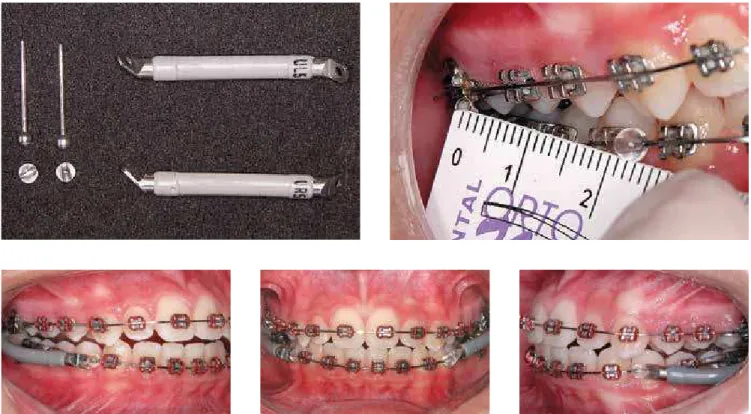
Figure 3 - After alignment and leveling with ixed appliances – Installation of Jasper Jumper and mandibular advancement. The patient was seen every four weeks and the Jasper
Jumper activated every eight weeks. The Jasper Jumper was removed when the molar and canines reached a Class I relationship or overcorrection (Figs 4 and 5). The treatment period with the Jasper Jumper was six months. Ater Jumpers removal, the teeth were re-tained with 3/16-in Class II elastics for a mean period of four months.
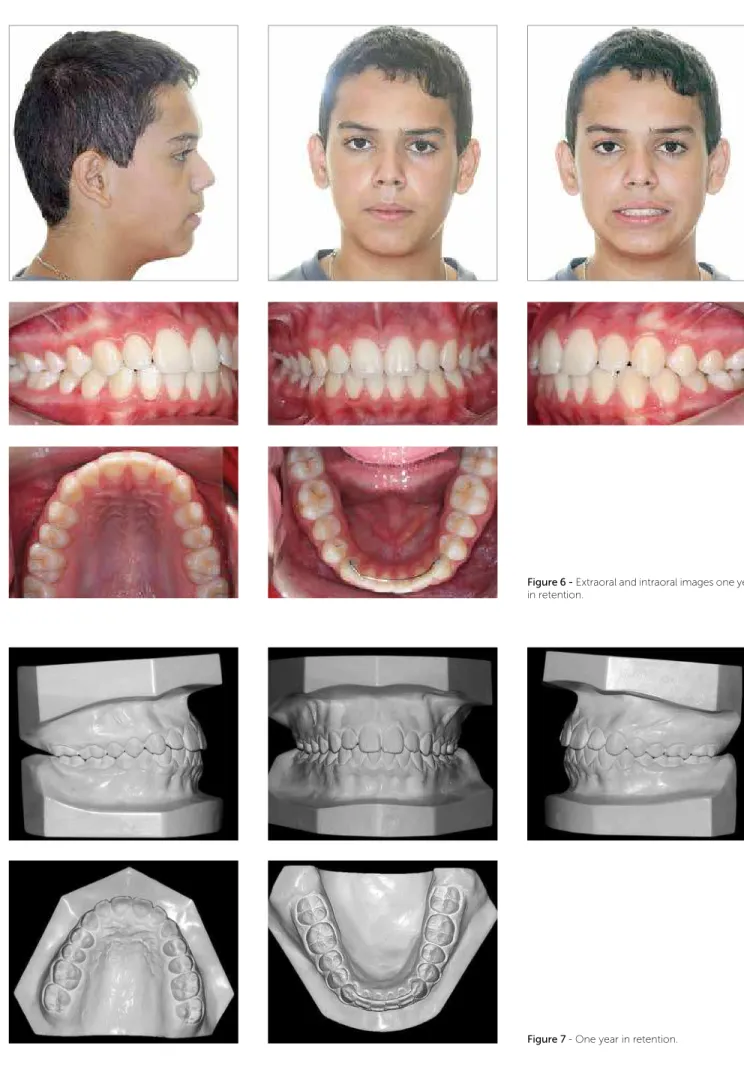
The centric occlusal relationship was checked and it was coincident to the centric occlusion. Af-ter debonding, a Hawley retainer was used during the day on the upper arch and a modified Bionator at night during one year. Also, a 3 x 3 lower fixed re-tainer was used until the end of craniofacial growth (Figs 5, 6 and 7)
RESULTS
The treatment with the Jasper Jumper improved the patient’s profile as well as the overjet, overbite and molar relationship. However, it caused clockwise mandibular rotation and increase of lower anterior facial height. The lower incisors were protruded and extruded and the lower molars were extruded.
DISCUSSION
A favorable improvement of the facial proile (Ta-ble 1), shows that the Jasper Jumper had a positive efect. As the upper incisors retruded, the upper lip retracted and ceased the interference of the lower lip with the up-per incisors. Apart from this, the laring of the lower inci-sors gave support to the lower lip. The lip length reduced favorably, due to the retrusion of the upper incisors.
Pre-vious studies showed similar sot tissue changes.8,13
The mechanism of the Jasper Jumper appliance con-sists in forward orthodontic force on the mandible and a backward mechanical loading on the maxilla. The ef-fect of the latter resulted in the reduction of the efec-tive length of the maxilla (Co-A). This was the only skeletal change caused by the appliance. This inding agrees with the results of other investigators that re-ported that the Jasper Jumper had a headgear efect on the maxilla. These efects were expected according to
previous studies,4 but as shown in several studies and
Figure 4 - Extraoral and intraoral images after treatment.
original article
Herrera-Sanches FS, Henriques JFC, Janson G, Neves LS, Lima KJRS, Henriques RP, Pieri LV
Figure 7 - One year in retention.
Skeletal variables
Maxillary
Pretreatment Post-treatment Retention
SNA 82.2 78.9 78.9
Co-A 81.4 80 80
A-NPerp 3.3 1.5 1.6
Mandibular
Pretreatment Post-treatment Retention
SNB 77.4 76.6 76.7
Co-Gn 106.9 109.1 109.6
P-NPerp -0.4 -5.7 -5.8
Maxillomandibular
Pretreatment Post-treatment Retention
ANB 4.8 2.2 2.2
NAP 8.2 2.9 2.9
Growing
Pretreatment Post-treatment Retention
SN.GoGn 38.1 39.2 39.1
Sn.PP 7.4 6.1 6.2
LAFH 62.9 67.9 68
Dentoalveolar variables
Maxillary
Pretreatment Post-treatment Retention
1.PP 114.6 118.4 118.5
1.NA 25 33.4 33.5
1-NA 5.4 8.9 9.0
1-ENAperp -2.4 -2.2 -2.2
1-PP 28.6 29.7 29.8
6-PP 20.9 22.3 22.6
6-ENAperp -28.6 -30.9 -30.8
Mandibular
Pretreatment Post-treatment Retention
1.NB 28.3 34.7 34.8
1-NB 5.3 8.8 8.8
1-Pogperp -11.4 -7.4 -7.5
1-GoMe 38.1 39.6 39.8
6-Pogperp -30.0 -28.9 -28.8
6-GoMe 26.4 29.4 29.5
Dental Relation
Pretreatment Post-treatment Retention
Molar relation -1.4 2.5 2.5
Overjet 6.0 2.9 3.0
Overbite 5.2 0.8 1.0
Soft tissues
Pretreatment Post-treatment Retention
NLA 105.0 108.2 110.0
UL-E 0.7 2.7 2.6
LL-E -1.6 -1.8 -1.6
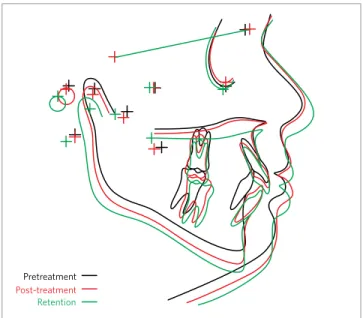
of the upper dentition. The intrusive force resulted in intrusion of mandibular incisors and upper irst molars (1-GoMe and 6-PP) on Table 1. The ANB angle re-duced 2.6 degrees. The intrusion of the upper molars and lower incisors caused the functional inclination of the occlusal plane. The lower anterior and total facial height increased from 62.9 to 67.9 mm when the Jasper Jumper was used and remained constant one year later. The smallest reduction on the anteroposterior man-dibular position in relation to the cranial base (SNB), -1.2 degrees during the treatment, can be attributed to the clockwise mandibular rotation, as found in
previ-ous studies.4 On the other hand, no skeletal efects were
found on mandibular growth. Our results agree with
the indings of Cope et al,4 Küçükkeles and Orgun,8
but it contradicts Weiland et al.13 There was a slight
mandibular posterior rotation due to extrusion of lower molars (SN.GoGn). In addition to the vertical move-ment, the lower molars also moved mesially and the up-per molars distally, assisting the dentoalveolar Class II correction. The upper incisors uprighted 12.4 degrees in relation to SN, although the lower incisors tended to lare. In this case, the lower incisor angle with line NB increased 6.4 degrees, when added to the upper incisor movement, contributed to most of the reduction of the excessive overjet. The patient was seen one year ater treatment and the results were very satisfying (Figs 6, 7 and 8). The overjet and overbite were correct and re-mained stable one year ater the treatment.
Table 1 - Changes in cephalometric variables during and after treatment.
Figure 8 - Cephalometric tracings superimposition: pretreatment (black); post-treatment (red); retention (green).
Pretreatment
original article
Herrera-Sanches FS, Henriques JFC, Janson G, Neves LS, Lima KJRS, Henriques RP, Pieri LV
1. Bishara SE, Ziaja RR. Functional appliances: a review. Am J Orthod Dentofacial Orthop. 1989;95(3):250-8.
2. Bowman SJ. One-stage versus two-stage treatment: are two really
necessary? Am J Orthod Dentofacial Orthop. 1998;113(1):111-6.
3. Champagne M. The Jasper Jumper technique. 1992;9(2):19-21, 24-5.
4. Cope JB, Buschang PH, Cope DD, Parker J, Blackwood HO. Quantitative
evaluation of craniofacial changes with Jasper Jumper therapy. Angle Orthod. 1994;64(2):113-22.
5. Ingervall B. Prevalence of dental and occlusal anomalies in Swedish conscripts. Acta Odontol Scand. 1974;32(2):83-92.
6. Jasper JJ. The Jasper Jumper: a ixed functional appliance. Sheboygan,
Wisconsin: American Orthodontics; 1987.
7. Kim YH. A comparative cephalometric study of Class II, Division 1 nonextraction and extraction cases. Angle Orthod. 1979;49(2):77-84.
8. Kuçükkles N, Orgun A. Correction of Class II malocclusions with a Jasper
Jumper in growing patients. Eur J Orthod. 1995;17(5):445.
9. McNamara JA Jr. Components of Class II malocclusion in children 8-10
years of age. Angle Orthod. 1981;51(3):177-202.
10. Quintão C, Helena I, Brunharo VP, Menezes RC, Almeida MA. Soft tissue facial proile changes following functional appliance therapy. Eur J Orthod. 2006;28(1):35-41.
11. Salzmann JA, editor. Practice of Orthodontics. Philadelphia: J. B. Lippincott; 1966.
12. Stucki N, Ingerval B. The use of the Jasper Jumper for the correction of Class II malocclusion in the young permanent dentition. Eur J Orthod. 1998;20(3):271-81.
13. Weiland FJ, Ingerval B, Bantleon HP, Droacht H. Initial efects of treatment of Class II malocclusion with the Herren activator, activator-headgear combination, and Jasper Jumper. Am J Orthod Dentofacial Orthop. 1997;12(1):19-27.
14. Woodside DG. Do functional appliances have an orthopedic efect? Am J Orthod Dentofacial Orthop. 1998;113(1):11-4.
REFERENCES
CONCLUSION