Advanced Pharmaceutical Bulletin, 2014, 4(2), 205-208 doi: http://dx.doi.org/10.5681/apb.2014.030
http://apb.tbzmed.ac.ir/
*Corresponding author: Moorthi Chidambaram, Department of Pharmacy, Annamalai University, Chidambaram, Tamil Nadu, India. Email: [email protected]
Copyright © 2014 by Tabriz University of Medical Sciences
Modifications to the Conventional Nanoprecipitation Technique: an
Approach to Fabricate Narrow Sized Polymeric Nanoparticles
Moorthi Chidambaram*, Kathiresan Krishnasamy
Department of Pharmacy, Annamalai University, Chidambaram, Tamil Nadu, India.
Introduction
Nanotechnology is a branch of science that deals with engineering particles on a near atomic scale with at least one dimension between 1-100 nanometer (nm). Manipulation of particle size below 100 nm significantly increases the particle surface area and alters the physicochemical properties of the size reduced compound, which offers significant improvement in various fields including automotive, construction, electronics, textiles, sports, military, energy, and medicine. Nanotherapeutics is a rapidly progressing area in the field of nanomedicine, which is being utilized to overcome several limitations of conventional drug including poor aqueous solubility, lack of site specific targeting, rapid systemic clearance, intestinal metabolism and systemic toxicities. Nanotherapeutics includes but not limited to solid-lipid nanoparticles, gold nanoparticles, silver nanoparticles, mesoporous silica nanoparticles, nanocrystals, magnetic nanoparticles, carbon nanotubes, nanosponges, albumin nanoparticles, fullerene nanoparticles and polymeric nanoparticles.1-4 However, polymeric nanoparticles offer potential advantages such as enhancement of solubility, protection of encapsulated drug, improvement in the bio-distribution, offer sustain release of the drug, reduces the number of required dose, reduces the systemic toxicities,
targets the drug to specific site, increases the intercellular concentration of drug by enhanced permeability and retention effect.5-7 Polymeric nanoparticles can be prepared using solvent evaporation method, salting-out method, nanoprecipitation method, emulsion diffusion method, dialysis method, double emulsification method, nano spray drying method, layer by layer method, desolvation method, supercritical fluid technology and ionic gelation method.8,9 Particle size of the prepared polymeric nanoparticles decides the performance such as solubility, dissolution, drug release, cellular uptake, circulation half-life, and bio-distribution. Similarly, uniformity of the prepared polymeric nanoparticles is the most significant parameter that decides the consistency of performance. Particles with broad distribution leads to difficulty in establishing the conclusion on which sized particles are responsible for the biological effects.6 Based on these two parameters, nanoprecipitation is the most convenient and widely used method to prepare polymeric nanoparticles around 170 nm but yield particles with broad distribution and requires additional filtration step to yield particles with narrow distribution.10 Hence, we intend to implement few modifications to the conventional nanoprecipitation method to reduce the mean particle size less than 150 nm A R T I C L E I N F O A B S T R A C T
Article Type:
Short communication
Article History:
Received: 26 June 2013 Revised: 27 September 2013 Accepted: 30 September 2013 ePublished: 24 December 2013
Keywords:
Nanoparticles
Polymeric Nanoparticles Nanoprecipitation Method Eudragit E 100
Purpose: Nanoprecipitation is the convenient and commonly used method for the preparation of polymeric nanoparticles around 170 nm but yield particles with broad distribution, which require filtration step to produce particles with narrow distribution. Hence, the primary aim of the present study was to implement few modifications to the conventional nanoprecipitation method to reduce the mean particle size less than 150 nm and to produce particles with narrow distribution without filtration step.
Methods: Eudragit E 100 nanoparticles were prepared using modified nanoprecipitation method 1 and 2. Prepared nanoparticles were characterized for the mean particle size, surface area and uniformity.
Results: Eudragit E 100 nanoparticles prepared using modified nanoprecipitation method 1 has shown a mean particle size of 196 nm with surface area of 50.9 m2g-1 and uniformity of 0.852 whereas, Eudragit E 100 nanoparticles prepared using modified nanoprecipitation method 2 has shown a mean particle size of 114 nm with surface area of 57.9 m2g-1 and uniformity of 0.259.
206 |Advanced Pharmaceutical Bulletin, 2014, 4(2), 205-208 Copyright © 2014 by Tabriz University of Medical Sciences
Chidambaram and Krishnasamy
and to produce particles with narrow distribution without filtration step.
Materials and Methods
Cationic copolymer Eudragit E 100 was obtained from Degussa (India). Poloxamer 188 was procured from Sigma Aldrich (India). Analytical grade ethanol was purchased from Brampton (Canada).
Fabrication of Eudragit E 100 nanoparticles using modified nanoprecipitation method
In conventional nanoprecipitation method, polymer was dissolved in acetone, which was poured in to distilled water containing poloxamer 188 with moderate stirring and the prepared nanosuspension was subjected to filtration to yield narrow sized particle.10 However, Eudragit E 100 nanoparticles were prepared using modified nanoprecipitation method 1 and modified nanoprecipitation method 2, which were described in subsequent section.
Modified nanoprecipitation method 1
Briefly, about 250 mg of cationic copolymer Eudragit E 100 wasdissolved in 6 mL of ethanol, which was diluted with 4 mL of distilled water under the influence of sonication (40 kHz, Lark, India). Prepared organic phase was loaded in to a syringe equipped with needle (with inner diameter of 0.30 x 8 mm). The loaded organic phase was injected at the rate of 2 mL per minute by inserting the needle (submerged position) in to 20 mL of aqueous phase containing 250 mg of poloxamer 188 under the influence of sonication (40 kHz, Lark, India). Subsequently, nanoparticles were formed and turned the aqueous phase slightly milky with bluish opalescence. However, sonication process was continued up to 60 minutes to aid size reduction and to evaporate residual solvent present in the nanoformulation.
Modified nanoprecipitation method 2
Briefly, about 250 mg of cationic copolymer Eudragit E 100 wasdissolved in 6 mL of ethanol, which was diluted with 4 mL of distilled water under the influence of sonication (40 kHz, Lark, India). Prepared organic phase was added at once in to 20 mL of aqueous phase containing 250 mg of poloxamer 188 under sonication (40 kHz, Lark, India). Subsequently, nanoparticles were formed and turned the aqueous phase slightly milky with bluish opalescence. However, sonication process was continued up to 60 minutes to aid size reduction and to evaporate residual solvent present in the nanoformulation.
Characterization of prepared Eudragit E 100 nanoparticles
Prepared Eudragit E 100 nanoparticles were characterized for mean particle size, surface area and uniformity using Mastersizer (Malvern Instruments, UK), which function based on Mie and Fraunhofer laser light scattering principle.
Statistical analysis
Student t test (GraphPad Prism V5.04) was used to evaluate the significance of difference between modified nanoprecipitation method 1 and 2. Any difference between method 1 and 2 were evaluated at confidence levels90%, 95% and 99%.
Results and Discussion
In nanoprecipitation method, addition of organic phase containing cationic copolymer Eudragit E 100 in to the aqueous phase containing poloxamer 188 results in rapid miscibility of ethanol in the distilled water leading to increase in the polarity of ethanol, which decreases the solubility of Eudragit E 100 and initiate the nucleation. Concurrently, sonication process produce bubble which oscillate non-linearly and finally collapse resulting in production of high temperature, pressure and shock waves, which not only inhibit the nucleation of Eudragit E 100 at the initial stage but also helps in evaporation of residual organic solvent present in nanosuspension. Cationic nature of Eudragit E 100 provides higher positive zeta potential to the prepared nanoparticles, which generates an electrostatic force and maintains the nanoparticles in Brownian motion. Additionally, particles in Brownian motion can effectively overcomes the Van der Waals force of attraction and gravitational force, which in turn prevent the aggregation and sedimentation of Eudragit E 100 nanoparticles.6,11,12 In conventional nanoprecipitation method, Poly(lactic-co-glycolic acid) (PLGA) nanoparticles were prepared as follows. 15 mg of PLGA was dissolved in 5 ml of acetone, which was poured in to 15 mL of distilled water containing 75 mg of poloxamer 188 with moderate stirring. Prepared PLGA nanosuspension was filtered using 1.0 µm cellulose nitrate membrane filter to yield narrow sized particle. Prepared PLGA nanoparticles were in the size range of 160 nm to 170 nm and uniformity were around 0.2 after filtration.10
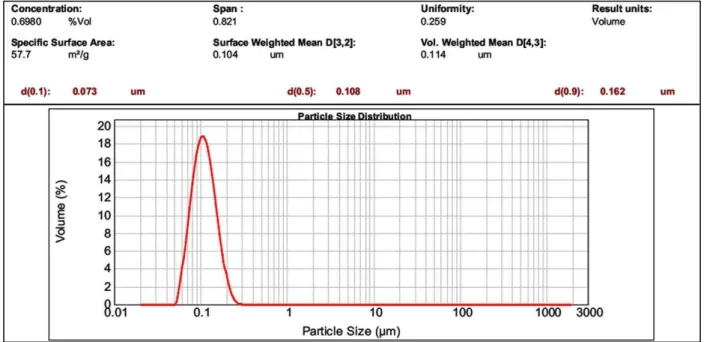
However, we have implemented few modifications to the conventional nanoprecipitation method (which has been described in modified nanoprecipitation method 1 and 2) and prepared Eudragit E 100 nanoparticles were characterized for particle size, surface area and uniformity (Table 1, Figure 1 and 2).
Out of two modified nanoprecipitation methods, Eudragit E 100 nanoparticles prepared using modified nanoprecipitation method 2 has shown significantly much lesser mean particle size (114 nm) and uniformity (0.259) than the modified nanoprecipitation method 1. Moreover, modified nanoprecipitation method 2 has produced much lesser mean particle size and comparable uniformity than the conventional nanoprecipitation method without filtration step.
Conclusion
| 207
Advanced Pharmaceutical Bulletin, 2014, 4(2), 205-208
Copyright © 2014 by Tabriz University of Medical Sciences
Fabrication of Narrow Sized Polymeric Nanoparticles
proposed modification (method 2) to the conventional nanoprecipitation method can be utilized to fabricate
least mean particle size and highly narrow sized polymeric nanoparticles.
Table 1. Characterization of Eudragit E 100 nanoparticles prepared using modified nanoprecipitation methods
Method Distribution Width (nm) Mean Particle Size
(nm)
Surface Area
(m²g-1) Uniformity
d 10 d 50 d 90
Method 1 74±1.0 123±2.0* 226±3.0* 196±2.0* 50.9±0.7* 0.852±0.011*
Method 2 73±0.0 108±0.0 162±0.0 114±0.0 57.7±0.0 0.259±0.000
* P<0.10, P<0.05, P<0.01as compared to Method 2
Figure 1. Characterization of Eudragit E 100 nanoparticles prepared using modified nanoprecipitation method 1.
Figure 2. Characterization of Eudragit E 100 nanoparticles prepared using modified nanoprecipitation method 2.
Conflict of Interest
The authors declare that they have no conflict of interest.
References
208 |Advanced Pharmaceutical Bulletin, 2014, 4(2), 205-208 Copyright © 2014 by Tabriz University of Medical Sciences
Chidambaram and Krishnasamy
chemotherapy limitations. J Pharm Pharm Sci 2011;14(1):67-77.
2. Moorthi C, Kathiresan K. Nanotoxicology:
Toxicity of engineered nanoparticles and
approaches to produce safer nanotherapeutics. Int J
Pharm Sci 2012;2(4):117-24.
3. Kesisoglou F, Panmai S, Wu Y. Nanosizing--oral formulation development and biopharmaceutical evaluation. Adv Drug Deliv Rev 2007;59(7):631-44.
4. Moorthi C, Kathiresan K. Curcumin– Piperine/Curcumin–Quercetin/Curcumin–Silibinin dual drug-loaded nanoparticulate combination therapy: A novel approach to target and treat multidrug-resistant cancers. J Med Hypotheses Ideas 2013;7(1):15-20.
5. Gelperina S, Kisich K, Iseman MD, Heifets L. The potential advantages of nanoparticle drug delivery systems in chemotherapy of tuberculosis. Am J Respir Crit Care Med 2005;172(12):1487-90. 6. Moorthi C, Kathiresan K. Application of
Plackett-Burman factorial design in the development of curcumin loaded Eudragit E 100 nanoparticles. Nano Biomed Eng 2013;5(1):28-33.
7. De Jong WH, Borm PJ. Drug delivery and nanoparticles:applications and hazards. Int J Nanomedicine 2008;3(2):133-49.
8. Moorthi C, Kathiresan K. Fabrication of dual drug loaded polymeric nanosuspension: Incorporating analytical hierarchy process and data envelopment analysis in the selection of a suitable method. Int J Pharm Pharm Sci 2013;5(2):499-504.
9. Mora-Huertas CE, Fessi H, Elaissari A. Polymer-based nanocapsules for drug delivery. Int J Pharm 2010;385(1-2):113-42.
10. Barichello JM, Morishita M, Takayama K, Nagai T. Encapsulation of hydrophilic and lipophilic drugs in PLGA nanoparticles by the nanoprecipitation method. Drug Dev Ind Pharm 1999;25(4):471-6.
11. Moorthi C, Kathiresan K. Fabrication of highly stable sonication assisted curcumin nanocrystals by nanoprecipitation method. Drug Invention Today 2013;5(1):66-9.