Submitted25 April 2016
Accepted 20 August 2016
Published20 September 2016
Corresponding author
Benjamin Gagl,
Academic editor
Steven Thompson
Additional Information and Declarations can be found on page 9
DOI10.7717/peerj.2467
Copyright
2016 Gagl
Distributed under
Creative Commons CC-BY 4.0
OPEN ACCESS
Blue hypertext is a good design decision:
no perceptual disadvantage in reading
and successful highlighting of relevant
information
Benjamin Gagl
Department of Psychology, Johann Wolfgang Goethe Universität Frankfurt am Main, Frankfurt am Main, Germany
Center for Individual Development and Adaptive Education of Children at Risk (IDeA), Frankfurt am Main, Germany
ABSTRACT
Background. Highlighted text in the Internet (i.e., hypertext) is predominantly blue and underlined. The perceptibility of these hypertext characteristics was heavily questioned by applied research and empirical tests resulted in inconclusive results. The ability to recognize blue text in foveal and parafoveal vision was identified as potentially constrained by the low number of foveally centered blue light sensitive retinal cells. The present study investigates if foveal and parafoveal perceptibility of blue hypertext is reduced in comparison to normal black text during reading.
Methods. A silent-sentence reading study with simultaneous eye movement recordings and the invisible boundary paradigm, which allows the investigation of foveal and parafoveal perceptibility, separately, was realized (comparing fixation times after degraded vs. un-degraded parafoveal previews). Target words in sentences were presented in either black or blue and either underlined or normal.
Results. No effect of color and underlining, but a preview benefit could be detected for first pass reading measures. Fixation time measures that included re-reading, e.g., total viewing times, showed, in addition to a preview effect, a reduced fixation time for not highlighted (black not underlined) in contrast to highlighted target words (either blue or underlined or both).
Discussion. The present pattern reflects no detectable perceptual disadvantage of hyperlink stimuli but increased attraction of attention resources, after first pass reading, through highlighting. Blue or underlined text allows readers to easily perceive hypertext and at the same time readers re-visited highlighted words longer. On the basis of the present evidence, blue hypertext can be safely recommended to web designers for future use.
SubjectsPsychiatry and Psychology, Human-Computer Interaction
Keywords Hypertext, Reading, Invisible boundary paradigm, Eye movements
INTRODUCTION
replacing referencing in printed text and eliminating effortful literature searches. The most common implementation of hypertext, embedded as blue underlined text, was prominently criticized (Nielsen, 1999). It was argued that choosing blue as text color is a poor choice as only about 2% of retinal cells are sensitive to light with short wave-lengths, which give rise to the perception of blue. As a consequence, blue hypertext might reduce reading speed due to hampered foveal processing. This would be unfortunate since it would limit the general increase of effectiveness of text processing introduced by hypertext. In addition, color sensitive retinal cells are most prominent in the fovea of the eye and their number decreases massively towards para- and extra-foveal regions of the retina. This massive reduction of color sensitive cells towards the para- and extra-foveal regions might also decrease the possibility to extract relevant parafoveal information from colored text in reading. In general, parafoveal preprocessing typically increases reading speed (for a review
seeSchotter, Angele & Rayner, 2012). Therefore, a decrease in reading speed resulting from
both reduced parafoveal preprocessing and foveal perception would be drastic when considering how often hypertext is perceived. Such a decrease in reading efficiency would indicate that the use of blue underlined hypertext could not be recommended.
Recently, Fitzsimmons, Weal & Drieghe (2013)investigated the influence of colored words on eye movement measures and found a reduced skipping probability (i.e., the probability of not fixating a word) of blue words, which were embedded in single line sentences. Their paradigm allows to examine both foveal and parafoveal processing combined during silent reading of sentences. They found a reduced reading speed, in contrast to black text, for words written in gray but not for words written in other colors (e.g., blue). This finding indicates that contrast (black vs. gray) but not color (e.g., black vs. blue) hampers reading speed. For words presented in saturated colors (e.g., blue) they found a reduced skipping probability in contrast to black-presented words. In their second experiment,Fitzsimmons, Weal & Drieghe (2013)did not find reduced skipping for blue colored words. In this experiment, the blue colored words were embedded in a paragraph, which was presented in a realistic online context (i.e., Wikipedia page). No effect of color on skipping was found but an interaction of a word frequency manipulation (seldom vs. common words) and the text color could be detected in late eye-movement measures of go-past-time (i.e., the sum of all fixations after the target word was fixated first and before the next word in the sentence is fixated; this includes fixations on words previous to the target word) and total viewing time (i.e., all fixation durations on the target word).
Therefore, highlighted words might attract additional attentional resources in contrast to un-highlighted words. The finding of the second experiment fromFitzsimmons, Weal &
Drieghe (2013)is in line with this highlighting hypothesis. There they found no skipping
effect difference between blue and black written text but showed that late eye movement measures were prolonged in case seldom, blue written words were fixated. Furthermore, this finding might indicate that such a top-down process would need time to evolve. This is consistent with previous findings showing that late eye-movement measures (e.g., total viewing time) are increased in case top-down processes like context demands or effortful reading instructions were manipulated (Radach, Huestegge & Reilly, 2008).
To differentiate between these hypotheses the present study realized an invisible boundary paradigm (Rayner, 1975; for a revised version of the paradigm see Gagl et
al., 2014). This paradigm allows researchers to estimate the parafoveal preview benefit by
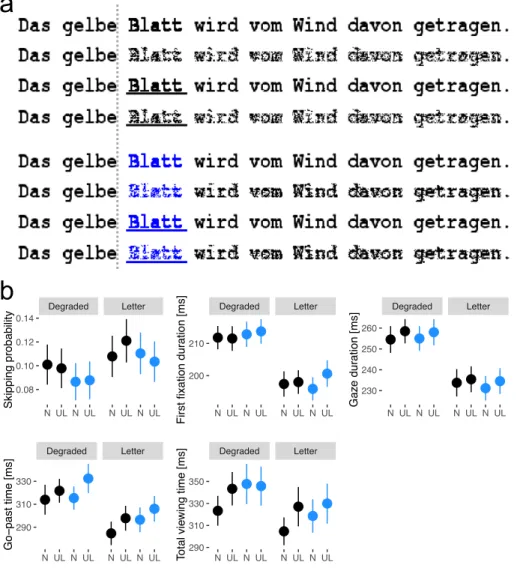
contrasting fixation times after perfect previews (no manipulation) in contrast to degraded previews, which limit parafoveal preprocessing benefits. The task of the participant is to read sentences silently as if they were reading a book or newspaper (i.e., as natural as possible). An invisible boundary is placed before a target word (see Fig. 1A). When the invisible boundary is crossed by an eye movement (i.e., saccade) the change from a degraded to an un-degraded target word presentation is realized during the eye movement. The increase of reading speed after the parafoveal presentation of a normal word compared to the condition with a degraded word is interpreted as the parafoveal preview benefit. In ourGagl et al.,
(2014)study we were the first to use degraded parafoveal previews and showed such a
degraded word before fixation elicited only less preprocessing benefit but no preprocessing costs. This is crucial as for parafoveal masks (e.g., different letter or X-masks), which were used originally instead of degradation, preview costs were described (see Hutzler et al.,
2013;Kliegl et al., 2013). These costs potentially magnify parafoveal-preprocessing effects
due to undesired processing of the mask. The boundary paradigm cannot be optimally implemented in case the skipping rate is expected to vary largely between conditions, as the estimation of the preview benefit relies on the fixation times on the target word. To realize high target word fixation rates, the predictability out of the sentence context was held low for the target words, which decreases skipping probabilities (Fitzsimmons &
Drieghe, 2013;Hawelka et al., 2015). Therefore, low skipping rates, at the best-case floor
effects, are expected to reduce the probability of finding differential effects in this measure. The effects of the present manipulations are expected in the fixation time measures of first fixation duration (i.e., the duration of the initial fixation), gaze duration (i.e., the summated fixation duration of all fixations during the first encounter), go-past time and total viewing time. In addition, two manipulations were implemented that allow to differentiate between the perceptual bottom-up (i.e., reduced reading speed for blue text) and the highlighting top-down hypothesis (i.e., more top-down attention is allocated to highlighted text). This was realized by manipulating color (blue vs. black) and underlining (underlined vs. not underlined) of the target words. The resulting design included the factors color, underlining and parafoveal degradation (seeFig. 1).
Degraded Letter
0.08 0.10 0.12 0.14
NULNUL NULNUL
Skipping probability
Degraded Letter
200 210
NULNUL NULNUL
First fixation dur
ation [ms]
Degraded Letter
230 240 250 260
NULNUL NULNUL
Gaz
e dur
ation [ms]
Degraded Letter
290 310 330
NULNUL NULNUL
Go
−
past time [ms]
Degraded Letter
290 310 330 350
NULNUL NULNUL
T
otal vie
wing time [ms]
a
b
Figure 1 Stimulus presentation and eye movement data.(A) Example sentence for all eight conditions (black not-underlined, black underlined, blue not-underlined, blue underlined in degraded and un-degraded versions) with the embedded target wordBlatt(English: leaf). Before each target the gray line indicated the invisible boundary, which triggered the display change from degraded to un-degraded presentations in case a saccade crossed the boundary. The effect of parafoveal degradation can be visualized by introspection. Compare the percept of the target word after fixating either on the pre-target word of a degraded or an un-degraded target word. (B) Means and standard errors (vertical bars) of skipping probability, first fixation duration, gaze duration, go-past time, and total viewing time. Blue dots indicated blue words and black dots black words.ULindicates underlined presentation andNindicates normal presentation.
black not-underlined targets) should receive less attention. In contrast, the highlighted words, blue not-underlined, blue underlined and black underlined targets, should receive additional attention reflected in longer fixation duration measures. If color or underlining results in independent highlighting effects (e.g., underlining effect when the target word is not colored), one can even recommend text underlining or coloring independently for hypertext use.
METHODS
ParticipantsForty native German–speaking students (24 female; mean age: 23:2 years:month; standard deviation: 2:0) with normal reading speed measured by the unpublished adult version of the Salzburger-Lese-Screening (SLS;Auer et al., 2004; for the current state of the adult version see Gagl, Hawelka & Hutzler, 2014and normal or corrected-to-normal vision participated. One additional participant was excluded due to very slow reading (Percentile < 16). Participants gave informed consent and the research was approved by the ethics board of the University of Salzburg (EK-GZ: 20/2014).
Apparatus
Movements of the right eye were recorded with a sampling rate of 2,000 Hz (EyeLink CL eye-tracker; SR-Research, Kanata, Ontario, Canada). Participants were seated about 52 cm in front of a CRT monitor (150-Hz refresh rate; screen resolution of 1024×768
pixels) and a forehead and chin rest stabilized their heads. The display change latency of the experimental setup was below 15 ms (for details seeRichlan et al., 2013).
Material
The manipulation of color and highlighting was realized with five letter target words embedded in sentences, which were matched on the most important word characteristics (e.g., orthographic similarity: OLD20 Yarkoni, Balota & Yap, 2008; word frequency: SUBTLEX database,Brysbaert et al., 2011; and predictability from sentence context, e.g.,
Kliegl et al., 2004). Furthermore, eight different versions of all sentences (N=320) allowed
the presentation of each sentence in one of the eight conditions (40 per condition;Fig. 1A). An equal number of participants (n=5) were assigned to each of the eight versions
of the sentences (Latin square design). The parafoveal preview manipulation was realized by randomly replacing 45% of the black or blue pixels of the presented letters (for details,
seeGagl et al., 2014). This procedure distorted the parafoveal percept of the target words
without inhibiting lexical processing. The sentences were presented in a mono-spaced font (single character width: 0.3◦
of visual angle) and target words were never at the first, second, or final position of the sentences (All stimuli are available athttps://osf.io/8c57w/).
Procedure
read silently for comprehension. Fixating an ‘x’ in the lower right corner of the screen terminated the trial and removed the sentence from the screen. After the presentation of about 50 randomly selected sentences, a question mark appeared on the screen and the experimenter orally presented comprehension questions, which the participants almost always answered correctly (M=98%).
All words after the target word were visually degraded to minimize potential influences of these words (i.e., particularly of n+2, with n+1 being the target word; seeKliegl,
Risse & Laubrock, 2007 andFig. 1A). After crossing the invisible boundary at the end of
the pre-target word, the target word and the remainder of the sentence were presented un-degraded (seeFig. 1A). Ten practice trials preceded the experiment. Recalibration was conducted after the practice trials, after a break halfway through the experiment, and when the fixation control at the start of a trial failed.
Data treatment and analyses
Skipping probabilities, first fixation durations, gaze durations, go-past times and total viewing time are reported. First fixation durations, gaze durations and total viewing times shorter than 80 ms were removed from the data (for each measure < 1% of the data). Data analysis was administered with linear mixed effect models (LMMs) for the
RESULTS AND DISCUSSION
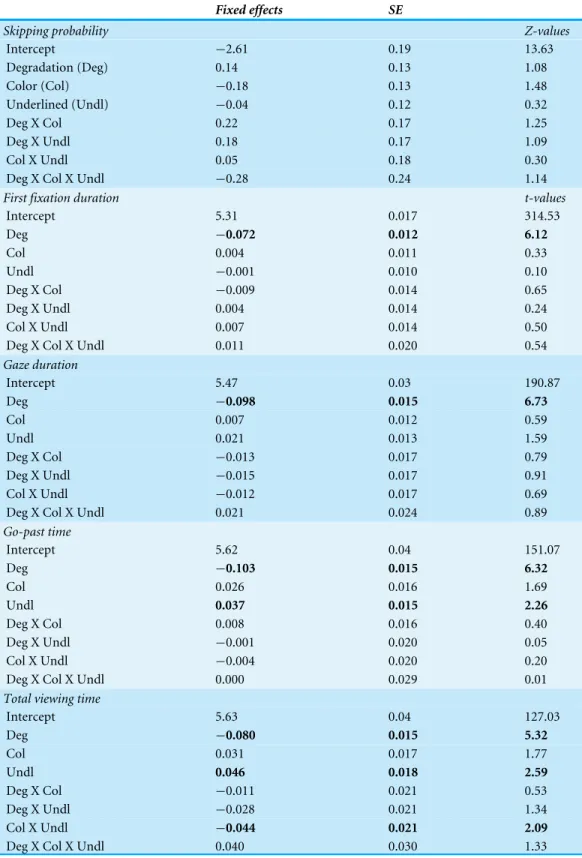
As expected skipping probability, presented in Fig. 1B, was not reliably affected by color, underlining or degradation (seeTable 1). The present study reports low skipping probabilities between 8 and 12%, when compared to the Fitzsimmons study with skipping probabilities up to 27%. Contrasting the differences of the two studies in the word frequency of the target words might explain the overall difference in skipping probability as in the present study words with low frequency were used and Fitzsimmons used words with higher frequencies. The result of the present study indicates that fixation rates of the target words are comparable indicating a floor effect for cognitive influences on word skipping.
In contrast, eye movement measures based on fixation durations during first pass reading indicated a strong preview benefit but no effect of color or highlighting. This was shown by the reliably lower first fixation durations and gaze durations for un-degraded parafoveal presentation in contrast to degraded previews (seeFig. 1B). No reliable effects and interactions of color or underlining were found (seeTable 1). This finding indicates that bottom-up perceptual processing preceding word recognition (i.e., in parafoveal vision) was only influenced by degraded parafoveal previews but not reliably by word color or underlining.
The total viewing times, including all re-fixation times after the first encounter (i.e., re-reading) and the go-past times (including all fixations up to the moment the next word in the sentence is fixated), showed, in addition to a reliable degradation effect, a reliable interaction of word color and underlining and a reliable effect of underlining, respectively.Figure 1Bclearly shows the origin of the interaction in total viewing times and the underlining effect in go-past times. The latter was indicated by lower go-past times for not underlined words in contrast to underlined words. The interaction for the total viewing times was reflected by the reduced fixation times for un-highlighted black-presented words in contrast to all other conditions including blue underlined, blue not-underlined and black underlined words (confirmed by post-hoc analysis: underlining effect for black targets; estimate =0.046; SE =0.020;t=2.29; no underlining effect for blue targets;
estimate=0.002; SE=0.016;t=0.12). Both the interaction in total viewing times and the
Table 1 Intercepts and fixed effects of G/LMM analyses for skipping probability, first fixation dura-tion, gaze duradura-tion, go-past times and total viewing time (all timing measures were log transformed).
Fixed effects SE
Skipping probability Z-values
Intercept −2.61 0.19 13.63
Degradation (Deg) 0.14 0.13 1.08
Color (Col) −0.18 0.13 1.48
Underlined (Undl) −0.04 0.12 0.32
Deg X Col 0.22 0.17 1.25
Deg X Undl 0.18 0.17 1.09
Col X Undl 0.05 0.18 0.30
Deg X Col X Undl −0.28 0.24 1.14
First fixation duration t-values
Intercept 5.31 0.017 314.53
Deg −0.072 0.012 6.12
Col 0.004 0.011 0.33
Undl −0.001 0.010 0.10
Deg X Col −0.009 0.014 0.65
Deg X Undl 0.004 0.014 0.24
Col X Undl 0.007 0.014 0.50
Deg X Col X Undl 0.011 0.020 0.54
Gaze duration
Intercept 5.47 0.03 190.87
Deg −0.098 0.015 6.73
Col 0.007 0.012 0.59
Undl 0.021 0.013 1.59
Deg X Col −0.013 0.017 0.79
Deg X Undl −0.015 0.017 0.91
Col X Undl −0.012 0.017 0.69
Deg X Col X Undl 0.021 0.024 0.89
Go-past time
Intercept 5.62 0.04 151.07
Deg −0.103 0.015 6.32
Col 0.026 0.016 1.69
Undl 0.037 0.015 2.26
Deg X Col 0.008 0.016 0.40
Deg X Undl −0.001 0.020 0.05
Col X Undl −0.004 0.020 0.20
Deg X Col X Undl 0.000 0.029 0.01
Total viewing time
Intercept 5.63 0.04 127.03
Deg −0.080 0.015 5.32
Col 0.031 0.017 1.77
Undl 0.046 0.018 2.59
Deg X Col −0.011 0.021 0.53
Deg X Undl −0.028 0.021 1.34
Col X Undl −0.044 0.021 2.09
Deg X Col X Undl 0.040 0.030 1.33
Notes.
In sum, the present study demonstrated that reading was not significantly hampered by blue text presentation. Thus, the current findings do not indicate a bottom-up perceptual disadvantage of blue underlined hypertext in foveal and parafoveal processing. In contrast, the increased total viewing time for highlighted stimuli indicates an additional allocation of attentional resources triggered by top-down processes. These processes might reflect the learned association of hypertext to informative snips of texts in the Internet. Using blue underlined stimuli effectively highlights hypertext without hindering parafoveal and foveal perceptual processes during reading. In addition, the present study shows that text underlining and color results in highlighting, which indicates that either could be used independently to optimally implement hypertext. In conclusion, blue underlined hypertext allows effective reading and, therefore, can be safely recommended to web designers for future use.
ACKNOWLEDGEMENTS
I want to thank Arturo Hernandez for helpful discussions and comments on an earlier version of the manuscript. I also want to thank Susanne Eisenhauer, Kirsten Hilger and Edvard Heikel for comments on an earlier version and Agnes Altmanninger, Pia Schweitzer and Eva Daspelgruber for helping with the data acquisition. Finally, I want to thank Florian Hutzler for letting me use his laboratory and Stefan Hawelka since part of the current software used in the project was scripted in collaboration for previous studies.
ADDITIONAL INFORMATION AND DECLARATIONS
Funding
This research was supported by the Goethe University Frankfurt ‘‘Nachwuchswissenschafter im Fokus –Förderlinie A’’. The funders had no role in study design, data collection and analysis, decision to publish, or preparation of the manuscript.
Grant Disclosures
The following grant information was disclosed by the author: Goethe University Frankfurt.
Competing Interests
The author declares there are no competing interests.
Author Contributions
• Benjamin Gagl conceived and designed the experiments, performed the experiments,
analyzed the data, contributed reagents/materials/analysis tools, wrote the paper, prepared figures and/or tables, reviewed drafts of the paper.
Human Ethics
The following information was supplied relating to ethical approvals (i.e., approving body and any reference numbers):
Data Availability
The following information was supplied regarding data availability:
Gagl, B. (2016, April 17). Reading Hypertext. Retrieved fromhttps://osf.io/8c57w/.
REFERENCES
Auer M, Gruber G, Mayringer H, Wimmer H. 2004.Salzburger Lesescreening 5–8. Handbook. Salzburg: Mimeo.
Bates D, Maechler M, Bolker B, Walker S. 2014.lme4: linear mixed-effects models using Eigen and S4. R package version, 1(7).
Brysbaert M, Buchmeier M, Conrad M, Jacobs AM, Bölte J, Böhl A. 2011.The word frequency effect: a review of recent developments and implications for the choice of frequency estimates in German.Experimental Psychology58:412–424
DOI 10.1027/1618-3169/a000123.
Fitzsimmons G, Drieghe D. 2013.How fast can predictability influence word skipping during reading?Journal of Experimental Psychology: Learning, Memory, and Cognition 39(4):1054–1063DOI 10.1037/a0030909.
Fitzsimmons G, Weal M, Drieghe D. 2013. On measuring the impact of hyperlinks on reading. In:Proceedings of the 5th Annual ACM Web Science Conference. New York: ACM, 65–74.
Gagl B, Hawelka S, Hutzler F. 2014.A similar correction mechanism in slow and fluent readers after suboptimal landing positions.Frontiers in Human Neuroscience8:355
DOI 10.3389/fnhum.2014.00355.
Gagl B, Hawelka S, Richlan F, Schuster S, Hutzler F. 2014.Parafoveal preprocessing in reading revisited: evidence from a novel preview manipulation.Journal of Experimental Psychology: Learning, Memory, and Cognition40(2):588–595
DOI 10.1037/a0034408.
Hawelka S, Schuster S, Gagl B, Hutzler F. 2015.On forward inferences of fast and slow readers. An eye movement study.Scientific Reports5:Article 8432
DOI 10.1038/srep08432.
Hutzler F, Fuchs I, Gagl B, Schuster S, Richlan F, Braun M, Hawelka S. 2013.Parafoveal X-masks interfere with foveal word recognition: evidence from fixation-related brain potentials.Frontiers in System Neuroscience7:33DOI 10.3389/fnsys.2013.00033.
Kliegl R, Grabner E, Rolfs M, Engbert R. 2004.Length, frequency, and predictability effects of words on eye movements in reading.European Journal of Cognitive Psychology16(1-2):262–284DOI 10.1080/09541440340000213.
Kliegl R, Hohenstein S, Yan M, McDonald SA. 2013.How preview space/time translates into preview cost/benefit for fixation du- rations during reading.Quarterly Journal of Experimental Psychology66:581–600DOI 10.1080/17470218.2012.658073.
Nielsen J. 1999.When bad design elements become the standard. Nielsen Norman Group.Available athttp:// www.nngroup.com/ articles/
when-bad-design-elements-become-the-standard/.
Radach R, Huestegge L, Reilly R. 2008.The role of global top-down factors in lo-cal eye-movement control in reading.Psychological Research72(6):675–688
DOI 10.1007/s00426-008-0173-3.
Rayner K. 1975.Perceptual span and peripheral cues in reading.Cognitive Psychology 7:65–81DOI 10.1016/0010-0285(75)90005-5.
Richlan F, Gagl B, Schuster S, Hawelka S, Humenberger J, Hutzler F. 2013.A new high-speed visual stimulation method for gaze-contingent eye movement and brain activ-ity studies.Frontiers in Systems Neuroscience7:33DOI 10.3389/fnsys.2013.00024.
Schotter ER, Angele B, Rayner K. 2012.Parafoveal processing in reading.Attention, Perception, and Psychophysics74(1):5–35DOI 10.3758/s13414-011-0219-2.
Yarkoni T, Balota D, Yap M. 2008.Moving beyond Coltheart’s N: a new measure of orthographic similarity.Psychonomic Bulletin and Review15(5):971–979