UDC: 3.33 ISSN: 0013-3264
* he University of Belgrade, Faculty of Economics. Address: Kamenička 6, 11000 Belgrade, Serbia. Email: [email protected].
JEL CLASSIFICATION: J31, P31
ABSTRACT: he paper explores the efect of large-scale privatisation of public sector activities on public-private sector pay diferential, for groups of workers according to educational qualiication on average and across the pay distribution in Serbia, from 2004 until 2008. he paper inds that both unskilled and skilled men and women in the public sector saw signiicant improvements in their inancial position relative to their private sector counterparts
with the progress of the economic transition. he results showed that the size of the public sector pay premium declines both with higher educational level and higher percentile of earnings distribution. his indicates, between and within groups, the inequality-reducing feature of the public sector pay determination.
KEY WORDS: Earnings, Transition, Quantile regression, Serbia
DOI:10.2298/EKA1292007L
Jelena Laušev*
1. INTRODUCTION
In Serbia between 2004 and 2008, the period analysed in this paper, the public sector was largely privatised. he transformation of ownership has a potential efect not only on employment composition but also on relative wages, and hence on the distribution of wages in the two sectors of employment.
he purpose of this paper is to analyse the evolution of earnings in the private and public sectors during the major period of economic transition in Serbia. his will be done by examining public-private wage diferentials, on average and across the percentiles of the wage distribution, for male and female employees by their educational qualiication, and controlling for other characteristics.
Previous studies of the public-private sector pay gap mainly considered the period before the launch of the large-scale privatisation programmes. hese studies provide evidence of a public sector pay penalty relative to the private sector at the early stages of economic transition.
In particular, Jovičić, Nojković and Paranos (2000) caried out an early study that estimated public/private pay diferentials in the Federal Republic of Yugoslavia. he OLS method was used to estimate the sectoral gap in 1998 from the Labour Force Survey (LFS). It was found that mostly men between 35 and 49 years of age (and in proportion to their education), who worked long hours and preferably ran their own businesses, collected the largest relative private sector mark-up.
Jovanović and Lokshin (2003) employed the same data source for both male and female employees from 15 to 64 years, but only examined the year 2000. his study attempted to correct for sector selection by using marital status and number of job holders in a household to obtain selectivity-corrected hourly earnings estimates. he average private sector premium was found to be 9.4% for males and 4% for females.
private sector efect on monthly pay, conditioned on human capital and other individual characteristics, by using the same data sample as in Reilly (2003) but extending the research period until 2003. his study suggests substantial average premia to private sector workers during the early period of the so-called ‘sluggish’ transition, which declined sharply from 2000 onwards (i.e., from 28.5% in 1996 to 8% in 2003).
his paper aims to complement the previous research by estimating the evolution of the public sector pay gap during the major period of economic transition, from 2004 until 2008. Large-scale privatisation and systematic structural reforms in Serbia were initiated ater 2000, and the private sector overtook the public sector share in employment in 2003. During the irst years of the 2000s the government wage policy aimed to adjust the disparities across wages in activities that employ a large portion of highly educated workers that had lagged behind the Republic’s average growth for years, such as public education, public health, and public services (Ognjenović, 2003). Hence, it seems highly likely that the outcome of empirical analysis for the more recent period would difer considerably from previous studies which reported public sector pay penalties for workers with similar characteristics. In order to analyse the efects of recent wage reforms, the public sector pay gap in this paper will be estimated for groups of workers by educational level.
he empirical analysis in this paper will be accomplished by using Labour Force Survey (LFS) data from 2004 to 2008. he analysis of distributional aspects of wages in Serbia will provide answers to four research questions. Firstly, the paper will show how the public sector workers at the selected percentiles of the earnings distribution fare in terms of earnings relative to their private sector counterparts during the major period of economic reform. Secondly, the paper will present various measures of pay variability or dispersion (the standard deviation of the log of hourly earnings, the decile ratios, and the Gini coeicients) to check if there is a diference between public and private sectors in terms of the magnitude of pay inequality. hirdly, the empirical evidence will indicate if there is a pay diferential between the public and private sectors for groups of workers with diferent educational attainments and, if so, how this pay diferential has changed during the period of large-scale privatisation. Finally, analyses of separate quantile regression estimates by gender and skill level will disclose if there are diferences in the shape of the conditional wage distribution between the public and private sectors.
he paper is organised as follows. he irst part explains the data. he following part presents the empirical results. he inal part concludes the paper with some policy implications.
2. DATA
his paper employs microdata from the Labour Force Survey (LFS) conducted in October over the period 2004 to 2008. he LFS data sets are based on a nationally representative random sample and use a two-staged stratiied sampling method. he total number of households in each survey is 6,500 (7,000 in 2008) and the number of individuals that were interviewed in each survey is around 20,000. Each of the annual data sets represents a cross-sectional view of the labour market.
Table 1: timing of surveys and number of observations used in analysis
Reference Year and Month
Number of Males Number of Females total
Public Private Public Private
Oct-04 1,472 935 1,091 721 4,219
Oct-05 1,314 1,123 1,002 729 4,168
Oct-06 1,186 1,186 966 797 4,135
Oct-07 1,059 1,261 881 894 4,095
Oct-08 959 1,423 832 958 4,172
Data Source: LFS successive years from 2004 to 2008
he earnings deinition relates to pay received for the reference month, and any arrears owed to the worker may be relected in the monthly pay measure. It is also important to point out that the diference between earnings and regular wage became insigniicant ater the iscal reform in June 2001, when all additional earnings payments, such as hot meal allowances and holiday cash grants, which were non-taxable before and thus comprised an important part of income in the public sector, were included in the regular wage. Furthermore, the earnings deinition excludes taxes, pensions, and any welfare payments. In the years before 2008 there is no information as to whether the employee has paid insurance for pension and health or not. In the LFS 2008 sample about 6.5% of individuals are not entitled to pension or health insurance (6.3% in the private sector and 0.2% in the public sector).
he greater share of workers in the private sector than in the public sector not entitled to pension or health insurance will tend to overestimate the public sector penalty and, conversely, underestimate the public sector premium. Although we acknowledge this problem there is no reasonable way to resolve it, due to data limitations. Another common problem for researchers using self-reported data is the possibility that individuals under-report their earnings. If this is more likely for private sector workers then this will afect the public sector pay gap in the opposite direction to the efect of social insurance entitlements.
the month in which the various surveys were conducted. he CPI is recalculated using October 2005 as the base.
Inspection of sample proportions reveals that public and private sector workers difer in a number of characteristics. Public sector workers are on average older with more labour force experience than private sector workers. Moreover, public sector workers are better educated with roughly 5-9% more men and 9-14% more women with university degrees than private sector workers. Workers with only secondary school qualiications are more likely to work in the private than in the public sector. Private sector workers are more likely to work longer hours per month and be single. From 2004 in particular, public sector workers are more likely to live in the cities and private sector workers in the rural areas.
3. EMPIRICAL RESULTS
3.1 Earnings Inequality Measures
his section illustrates trends in unconditional real hourly earnings by gender and ownership type at diferent points of the pay distribution. In addition, the magnitude of pay inequality in each sector is summarised.
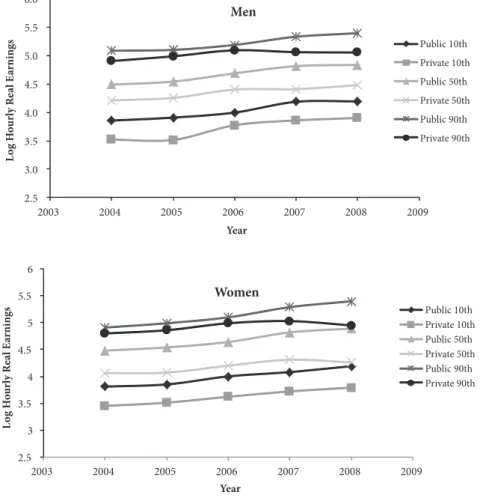
trends in the real hourly earnings by ownership type at diferent points of the log pay distribution are presented for male and female workers in Figures 1 and 2. he Figures disclose an upward trend during 2004-2008 in both public and private sectors at all percentiles. Yet public sector male and female workers at all the percentiles of unconditional hourly earnings distribution fared better than those in the private sector.
Figures 1 and 2: Real hourly earnings percentiles for male and female employees in public and private sectors in Serbia, 2004-2008
Notes to Figures 1 and 2: Hourly earnings percentiles are given in natural logarithm values. Earnings relate to total main job pay compensation net of taxes, pensions, and welfare beneits and expressed in October 2005 prices. Data Source: Labour Force Survey of the Republic of Serbia (LFS), 2004-2008
decile ratios that relate the pay at the diferent percentiles of the distribution, the Gini coeicient is a measure of inequality across the whole distribution, as it is inluenced by the shape of the distribution at all percentiles.1
Table 2: Earnings inequality by gender and ownership type in Serbia, 2004-2008
Year 90/10
th Decile Ratio Standard Deviation Gini Coeicient
Men Women Men Women Men Women
Public Private Public Private Public Private Public Private Public Private Public Private
2004 1.23 1.39 1.10 1.35 0.55 0.59 0.48 0.59 0.26 0.31 0.24 0.32
2005 1.20 1.48 1.14 1.35 0.50 0.60 0.49 0.56 0.26 0.31 0.25 0.32
2006 1.19 1.32 1.10 1.37 0.48 0.53 0.45 0.55 0.26 0.29 0.23 0.32
2007 1.15 1.20 1.20 1.31 0.49 0.56 0.48 0.52 0.25 0.30 0.25 0.30
2008 1.20 1.16 1.20 1.16 0.47 0.49 0.48 0.50 0.26 0.28 0.25 0.28 Notes to Table 2: Decile ratio 90/10th is calculated as the diference between the log earnings at
the 90th percentile and at the 10th percentile. he Gini coeicient estimates use earnings in the
unlogged form.
Data Source: Labour Force Survey of the Republic of Serbia (LFS) from 2004 until 2008
According to all measures of pay inequality presented in table 2 the private sector earnings distribution is wider than the public sector earnings distribution for both men and women over most of the years observed. he public sector pay inequality declines until 2006 and increases in the last two years. On the other hand, there was a private sector pay compression in the last two years. his period coincides with tax reform that allowed tax exemption for the irst 5,000 Serbian dinars of every wage from January 1, 20072, which is likely to have afected more private than public sector earnings given that minimum wage recipients or those receiving only slightly higher earnings are more concentrated in the private sector.
3.2 Annual Mean Estimates of Public Sector Pay Gap by Educational Qualification
Public-private sector earnings diferentials may be largely determined by the diferent nature of jobs and skills in the two sectors. In order to obtain conditional average public-private sector pay diferentials for each year for men and women,
1 If one randomly draws two people from the population then the expected wage diference between those two people as a proportion of the average wage is twice the Gini coeicient, so that Gini of 0.238 says that the expected wage gap between two men chosen at random is 47.6% of the average pay (Puhani, 1997).
separately, we pool both sectors’ data together in an ordinary least squares (OLS) earnings regression with a dummy variable Pi taking the value one if i th employee works in the public sector and zero otherwise. his model is given by:
for i = 1, ... , n (1)
where ln wi is the log of real hourly earnings for the i th individual which is explained by xi set of observed worker and job characteristics with the parameter vector β and ε s are error terms constructed to be uncorrelated with x. Hence, in this model is the ‘average’ estimate of the public sector pay gap equivalent to an intercept shit.
Acknowledging that the public sector efect may vary with a worker’s skill level we apply the model in (1) on groups of workers according to their educational qualiication and gender. he unskilled group includes workers with primary educational qualiication or less. he skilled group includes workers with high school qualiications and college degrees. he high-skilled group includes workers with a university degree and above.
Figure 3 plots the conditional average public sector pay gap3 across groups diferentiated by qualiications attained with a 95% conidence interval for men and women, respectively. Figure 3 shows that public sector unskilled men have experienced the greatest improvement in their inancial position when compared to their private sector counterparts. In particular, the public sector pay gap for unskilled men became statistically signiicantly diferent from zero from 2005. On average this group of workers collected around 14% mark-up over the period covered by the analysis. Unskilled women in the public sector experienced more cyclicality in pay relative to their private sector counterparts, but became statistically signiicantly better-of from 2007.
On the other hand, both public sector skilled men and women saw an increasing trend in average pay mark-up relative to their private sector counterparts i.e., about 13% for men and 5% for women on average during the period covered by the analysis. Finally, the public sector pay gap for male and female workers with university degrees and above was not statistically signiicantly diferent from zero in most of the years covered by the analysis.
Furthermore, it is important to point out that the highest increase in the public sector pay premium occured in 2007 for most of the public sector workers. his growth continued in 2008 only for skilled employees.
Summarising the results for male workers during the 2004-2008 period the public sector pay gap declined with higher educational qualiications. Among female workers those with high school qualiications and college degrees gained the most from having a public sector status. When compared to their private sector counterparts the public sector unskilled and skilled male workers appeared to gain more than female workers, while this is not the case for high skilled employees. However, the 95% conidence intervals of conditional estimates within each skill group intersect, suggesting that male and female estimates cannot be separated for every year.
3.3 Pooled Quantile Regressions Estimates by Educational Qualification
he previous analysis suggested a declining public sector pay premium with skill level. his indicates a compressed structure in the public sector earnings distribution relative to the private sector pay dispersion. Furthermore, public sector pay compression may difer within each skill group. In order to test both
between and within group public-private sector pay diferentials during the major period of economic transition the sector pay gap in this section is estimated across the pay distribution for each skill level and gender by pooling 2004-2008 data.
For this purpose, the quantile regression method is used to estimate the public/ private sector earnings diferentials at diferent points in the earnings distribution. While the conditional mean in the previous section is estimated by ordinary least squares (OLS) regression which predicts the average (mean) earnings by minimising the sum of squared errors, the quantile regressions predict the quantiles of the earnings distribution by minimising the absolute sums of the errors (i.e., the estimator is known as Least Absolute Deviations (LAD)).
Formally, this means that OLS (i.e., the conditional mean E(ln wi | xi)) solves:
(2)
and LAD (i.e., the conditional median Med(ln wi | xi)) solves:
(3)
where and
sgn(a) is the sign of a : 1 if a is positive and -1 if a is negative or zero.
Since the linear quantile regression model can also be estimated on quantiles other than median, the general model can be formulated as in Koenker and Basset (1978):
for i = 1, ... , n (4)
with and where ϑth is
the regression quantile, 0 < ϑ < 1, computed by:
(5)
If ϑ is positive, then public sector workers at ϑth conditional quantile of ln w i earn
a premium. If ϑ is negative, then public sector workers at ϑth conditional quantile
herefore, estimating (4) the public sector pay efect can be traced over the entire conditional distribution of ln w by increasing ϑ continuously from 0 to 1. In this context, the quantile regression estimates provide a richer insight into the public sector pay efects than the OLS estimates.
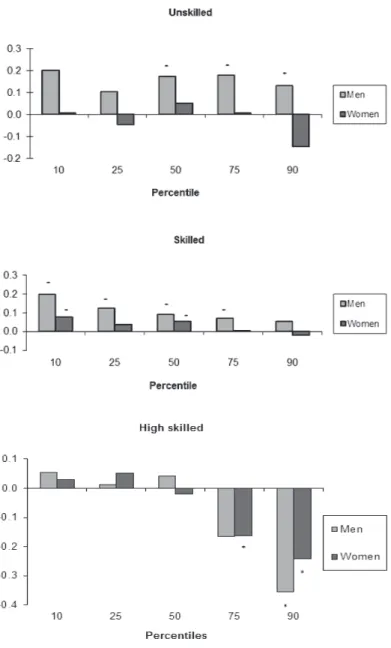
he public sector pay diferentials during the 2004-2008 period are estimated for six groups of workers according to educational qualiication and gender, controlling for the same set of explanatory variables as in the previous section and for the time efect. Standard errors are obtained by the bootstrapping procedure (Hahn, 1995) with 1000 replications in all cases. he results are plotted in Figure 4.
Figure 4: Public sector hourly pay premium/penalty by highest educational qualification across the pay distribution by gender in Serbia during 2004-2008
In particular, Figure 4 shows that working in the public sector reduces pay inequality among university, college, and high school graduates, relative to their private sector counterparts. University graduates below and at the median of the pay distribution fare similarly across sectors, but those at the 75th and 90th percentile obtain penalties by not working in the private sector. A similar pattern is repeated for skilled workers who gain a signiicant public sector premium, but this premium dissipates as one moves up the pay distribution. Yet this pattern is not repeated for male unskilled workers who collect a statistically signiicant public sector pay premium at and above the median. his premium is similar in size to the pay gap estimated for male skilled workers at the bottom of the earnings distribution. his inding suggests that male unskilled workers at the upper end and both male and female skilled workers at the lower end of the earnings distribution collect the largest mark-up to public sector status.
4. CONCLUSION
In Serbia systematic economic reforms and large-scale privatisation programmes were launched during the last decade. his paper has examined the public/private sector earning diferentials over the major period of economic transition by using Labour Force Survey microdata from 2004 until 2008. he sample has been divided into groups by highest educational qualiication and gender.
he paper found that the average conditional public sector pay gap grew from zero to premium for unskilled and skilled workers and luctuated around zero for high skilled workers. Moreover, the results suggested a declining public sector pay premium with skill level. his indicated greater pay compression in the public than in the private sector. Additionally, results from quantile regressions showed that both unskilled men at the upper part of the earnings distribution and skilled men and women at the lower part of the earnings distribution collected the largest mark-up to earnings relative to their private sector counterparts. University graduates at and below the median fared the same across sectors, while those above the median obtained penalties by having a public sector status. herefore the paper revealed, both between and within groups, an inequality-reducing efect resulting from public sector pay determination.
educational levels. he public sector would tend to attract better quality men and women with lower and middle educational qualiications.
Finally, if non-wage attributes such as insurance in the form of greater job security, lexible working hours, and social insurance were added to the current earnings of employees, the public sector pay premium for workers with lower and middle educational qualiications would be even higher. Moreover, holding a job in the public sector would likely become attractive for some workers with the highest educational levels.
herefore, the results presented in this paper raise a concern for policy makers regarding overpaid public sector workers relative to their private sector counterparts. In this context, the efect of the recently implemented measures of a general pay freeze within the public sector initiated by the Serbian government in 2009 and 2010 will require future research. Another striking feature of the data may be related to the public sector pay lexibility. In particular, the results indicated that public sector workers with university and college degrees and high school qualiications have greater equality in terms of pay compared to their private sector counterparts. he inequality-reducing feature of public sector pay determination implies more compressed pay distribution in the public than in the private sector. his suggests that public sector workers are either more similar in terms of ability and intrinsic incentives than their private sector counterparts, or that the private sector is more likely to pay a premium for these unobserved characteristics. In this context future reasearch would substantially beneit from panel data in order to account for individual-speciic efects.
Acknowledgements:
REFERENCES
Adamchik, V. & Bedi, A. (2000). Wage Diferentials between the Public and the Private sectors: Evidence from an Economy in transition. Labor Economics, 7, 203-224.
Adamchik, V., Hycak, t. & King, A. (2003). he wage structure and wage distribution in Poland, 1994-2001. International Journal of Manpower, 24 (8), 916-946.
Brainerd, E. (2002). Five Years Ater: he Impact of Mass Privatisation on Wages in Russia, 1993– 1998. Journal of Comparative Economics, 30, 160–190.
Center for Advanced Economic Studies (CEVES) (2007). Quarterly Monitor of Economic Trends and Policies in Serbia, 8. Faculty of Economics, University of Belgrade.
Flanagan, R. J. (1995). Labor Market Responses to a Change in Economic System. Proceedings from the World Bank Annual Conference on Development Economics 1994, 14438.
Hahn, J. (1995). Bootstrapping the quantile regression estimators. Econometric heory, 11, 105-121.
Hámori, Sz. (2007). Essays in Labour Economics and Economics of Education. PhD hesis,
Universität Mannheim.
Jovanović, B. & Lokshin, M. (2003). Wage Diferentials and State-Private Sector Employment Choice in the Federal Republic of Yugoslavia. he World Bank Policy Research Paper, 2959.
Jovanović, B. & Lokshin, M. (2004). Wage Diferentials between the state and private sectors in Moscow. Review of Income and Wealth, 50 (1), 107-123.
Jovičić, M., Nojković, A. & Paranos, A. (2000). Labour force survey data on wages and earnings in the private and social sectors in FR Yugoslavia. In: 10th Conference of the International Association
for the Economics of Participation(IAFEP), University of trento.
Krstić, G., Litchield, J. & Reilly, B. (2007). An anatomy of male labour market earnings inequality in Serbia, 1996–2003. Economic Systems, 31, 97–114.
Koenker, R. & Bassett, G. (1978). Regression Quantiles. Econometrica, 46 (1), 33–50.
Laušev, J. (2010). Public-Private Sector Earnings Diferentials in a transition Economy. PhD hesis, University of Nottingham.
Leping, O. (2006). Evolution of the Public-Private Sector Wage Diferential during transition in Estonia. Post-Communist Economies, 18 (4), 419-436.
Newell, A. (2001). he Distribution of Wages in transition Countries. IZA Discussion Paper, 267. Newell, A. & Socha, M. (1998). Wages distribution in Poland: he roles of privatisation and international trade, 1992-96. he Economics of Transition, 6(1), 47-65.
Newell, A. & Socha, M. W. (2007). he Polish Wage Inequality Explosion. IZADiscussion Paper, 2644.
Ognjenović K. (2002). Analysing Determinants of Wages and Wages Discrimination: he Example of Serbia. Global Development Research Competition Workshop, CERGE-EI, Prague.
Puhani, A. P. (1997). All Quiet on the Wage Front? Gender, Public-Private Sector Issues, and Rigidities in the Polish Wage Stucture, ZEW Discussion Paper, 97-03 E.
Reilly, B. (2003). he Private Sector Wage premium in Serbia (1995-2000): A Quantile Regression Approach. University of Sussex Discussion Papers in Economics, 98.
Statistical Oice of the Republic of Serbia (1996) (2004). Labor Force Survey Methodology, Belgrade, Republic of Serbia.
Statistical Oice of the Republic of Serbia (2008). Communications: Labor Force Survey, October, Belgrade, Republic of Serbia.
White, H. (1980). A Heteroskedasticity-Consistent Covariance Matrix Estimator and a Direct test for Heteroskedasticity. Econometrica, 48 (4), 817-838.