Adaptive changes in thyroid function
of female rats fed a high-fat and
low-protein diet during gestation
and lactation
1Departamento de Ciências Fisiológicas, 2Departamento de Anatomia,
Instituto de Biologia, 3Departamento de Nutrição Aplicada, Instituto de Nutrição,
Universidade do Estado do Rio de Janeiro, Rio de Janeiro, RJ, Brasil P.D. Brito1,
C.F. Ramos2,
M.C.F. Passos3
and E.G.Moura1
Abstract
The percent of lipids in the western diet has been continuously increasing in the last decades and is associated with a decrease in the proportion of protein intake. Recently, we demonstrated that protein malnutrition during lactation is associated with lower body weight and thyroid hypofunction in female rats and their offspring. Our objective in the present study was to determine if a high-fat and low-protein diet was associated with similar changes. Three-month-old female Wistar rats were randomly assigned to one of the following groups with 8 animals each: high-fat and low-protein (40% lipid, 5% protein, and 55% carbohydrate of the total energy content) from the 3rd week of gestation to the end of lactation; control group - standard diet (11% lipid, 23% protein, and 66% carbohydrate of the total energy content). Food consumption and body weight were monitored daily. Serum thyrotropin and thyroid hormone concentrations were determined by specific radioimmunoassay at the end of lactation. Animals receiving high-fat and low-protein diet had a significantly lower body weight (13.9% at weaning, P < 0.05) and serum albumin (25%, P < 0.05) and thyrotropin (26.2%, P < 0.01) concentrations, and a higher serum triiodothyronine concentration (74%, P < 0.005) and
131I-thyroid uptake (77%, P < 0.005). These data show that a high-fat
and low-protein diet can promote maternal thyroid hyperfunction that differs from the thyroid hypofunction observed in dams fed a low-protein diet, a phenomenon that can be of adaptive importance for pup nurturing.
Correspondence
E.G. Moura
Departamento de Ciências Fisiológicas
Instituto de Biologia, UERJ Av. 28 de setembro, 87, 5º andar 20550-030 Rio de Janeiro, RJ Brasil
Fax: +55-21-2587-6121
E-mail: [email protected] Research supported by CNPq, FAPERJ, and Pós-Graduação em Biologia (PGBN-UERJ). P.D. Brito was the recipient of a CAPES fellowship.
Received March 10, 2005 Accepted February 8, 2006
Key words
•High-lipid diet
•Low-protein diet
•Thyroid function
•Lactation •Gestation
Introduction
In recent years, attention has been fo-cused on the effects of diet on cardiovascular and metabolic diseases. Many experimental and epidemiological studies have implicated
pro-tein malnutrition to a gradual increase in dietary lipid content, also observed in the poorest populations (4,5). This dramatic in-crease in lipids in the westernized diet has not been properly studied regarding its physi-ological consequences during the perinatal period.
Some investigators have shown that the nutritional status of the mother during the gestational and lactational periods is essen-tial to normal growth and development in humans (6-8) and in experimental animals (9-15).
Many experimental studies with high-fat diets have been used to study the effects of their consumption during gestation and lac-tation on nutrient intake, growth and sur-vival of the pups. For the dams, the data are contradictory. The ingestion of a high-fat diet during gestation leads to a higher body weight gain by the mothers (14,16, 17). However, when this diet is given throughout gestation and lactation, the dams only maintain the body weight gained during pregnancy (14,17) or even suffer a large body weight loss (16). A high-fat diet seems to cause an increase in plasma triiodo-thyronine (T3) levels in adult animals,
sug-gesting that, through their actions on brown adipose tissue, thyroid hormones have an important thermogenic regulatory role that is essential for the maintenance of body weight (18-20).
We have recently shown that protein-restricted lactating dams present a loss of body weight gain (12), alterations in milk composition (11) and an important adaptive change in thyroid function by increasing the transfer of iodine and T3 through the milk to
their pups, probably preventing an eventual neonatal hypothyroidism (9,10,12).
In the present study, we determined if a high-fat and low-protein diet can cause changes in the body weight and thyroid func-tion of lactating rats and if these changes are similar to those observed in animals submit-ted to protein and energy restriction.
Material and Methods
Wistar rats were kept in a room with controlled temperature (25 ± 1ºC) and with an artificial dark-light cycle (lights on from 7:00 am to 7:00 pm). Two 3-month-old vir-gin female rats were caged with one male rat. The use and handling of experimental animals followed the principles described in the Guide for the Care and Use of Labora-tory Animals (21).
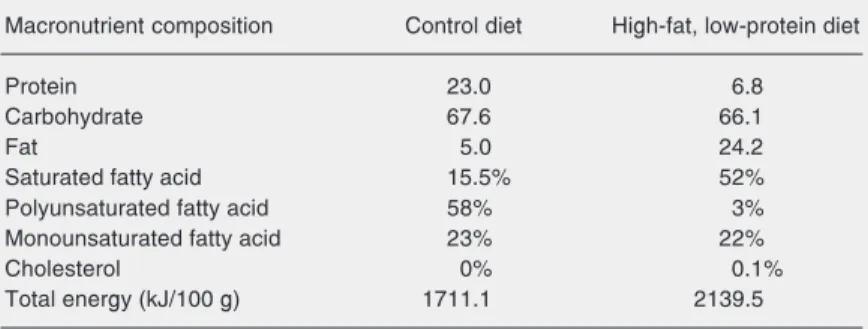
After mating, female rats were placed in individual cages and randomly assigned to one of the following groups with 8 animals each: high-fat and low-protein diet (HF/LP), with free access to a high-fat diet from the 3rd week of gestation to the end of lactation (40% lipid, 5% protein, and 55% carbohy-drate of the total energy content); control, with free access to a stock diet (11% lipid, 23% protein, and 66% carbohydrate of the total energy content). The diets were pre-pared based on a stock commercial diet (Nuvilab, Nuvital Nutrients Ltda., Curitiba, PR, Brazil). The composition of the diets is shown in Table 1 and is based on recom-mended standards (22). The high-fat and low-protein diet was adapted from previous studies (14,16,17). The amounts of stock and high-fat diet eaten were measured daily. Within 24 h of birth, excess pups were removed, so that only 6 male pups remained
Table 1. Macronutrient composition of the control and the high-fat, low-protein diets.
Macronutrient composition Control diet High-fat, low-protein diet
Protein 23.0 6.8
Carbohydrate 67.6 66.1
Fat 5.0 24.2
Saturated fatty acid 15.5% 52%
Polyunsaturated fatty acid 58% 3%
Monounsaturated fatty acid 23% 22%
Cholesterol 0% 0.1%
Total energy (kJ/100 g) 1711.1 2139.5
per dam because this procedure maximizes lactation performance (23).
Maternal body weight was monitored daily throughout the end of gestation and lactation. Serum albumin concentrations were measured at weaning (day 21).
On the day of sacrifice (day 21), the animals received a single intraperitoneal (ip) injection containing 2.22 x 10⁴ Bq of 131I
(IPEN, São Paulo, SP, Brazil). After 2 h, they were killed with a lethal dose of pento-barbital and blood was obtained by cardiac puncture. The thyroid gland was excised and weighed and thyroid 131I uptake was
evalu-ated with a gamma counter (Cobra Auto-gamma, Packard Instrument Co., Downers Grove, IL, USA).
T3 and tetraiodothyronine (T4) were
meas-ured by commercial RIA adapted for rat serum, as described previously (24). Thy-rotropin (TSH) was measured with a rat specific kit provided by the National Insti-tute of Diabetes and Digestive and Kidney Diseases (Bethesda, MD, USA) and results are reported in terms of the reference prepa-ration (RP3). All assays were done with the same lot of reagents and at the same time, and the intra-assay coefficients of variation were: 4.5% for T3, 4.0% for T4 and 6.8% for TSH.
Statistical analysis
Two-way ANOVA was used to analyze the changes in food ingestion and body weight, and to test the effects of diet and time, followed by the Bonferroni post-test when P < 0.05. The Student t-test was ap-plied to the data obtained on the 21st (last) day. The data are reported as means ± SEM and the level of significance was set at P < 0.05.
Results
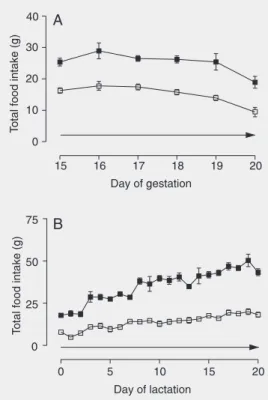
Mothers on a high-fat, low-protein diet (group HF/LP) presented lower food
con-sumption (40%, P < 0.001, Figure 1A), with a reduction of 82% in protein intake (P < 0.001, Figure 2B) and of 42% in carbohy-drate (P < 0.001, Figure 2D) intake soon after the beginning of diet ingestion. Energy intake was lower (P < 0.05, Figure 2A) in this group on days 19 and 20, reaching a 23% lower level at parturition. However, fat intake was three times higher (P < 0.001, Figure 2C) during gestation. At the end of lactation, those differences were 46% lower for energy (P < 0.001, Figure 3A), 65% for protein (P < 0.001, Figure 3B) and 60% for carbohydrate intake (P < 0.001, Figure 3D) and 44% higher for fat intake (P < 0.01, Figure 3C) compared to control. The rate of carbohydrate/lipid consumed during lacta-tion was lower for the HF/LP group (4.4 x 13.5).
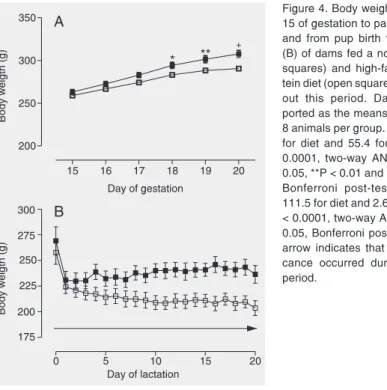
The body weight gains during pregnancy and lactation are shown in Figure 4. At the end of pregnancy, HF/LP mothers showed a lower body weight gain, but at the beginning and in the middle of lactation, the mean body weights of HF/LP mothers did not differ
15 16 17 18 19 20
0 10 20 30 40
Day of gestation
T
otal food intake (g)
0 5 10 15 20
0 25 50 75
Day of lactation
T
otal food intake (g)
A
B
Figure 1. Total food intake by control dams (filled squares) and dams receiving a high-fat and low-protein diet (open squares) from day 15 of gestation to par-turition (A) and from birth to weaning (B). The comparison was made for each day and the arrow indicates that the signifi-cance occurred during all the period. Data are reported as means ± SEM for 8 animals per
group. A, F = 133 for diet and
8.8 for time (P < 0.0001, two-way ANOVA; P < 0.001,
Bonfer-roni post-test). B, F = 1400 for
15 16 17 18 19 20 0
100 200 300 400 500
600 A
Day of gestation
15 16 17 18 19 20
0.0 2.5 5.0 7.5 10.0
B
Day of gestation
0 1 2 3 4 5
15 16 17 18 19 20
C
Day of gestation
15 16 17 18 19 20
0 5 10 15 20
25 D
Day of gestation
Kilojoules (kj)
Lipids (g)
Protein (g)
Carbohydrate (g)
Figure 2. Energy (A), protein (B), lipid (C), and carbohydrate (D) intake by control dams (filled squares) and dams receiving a high-fat and low-protein diet (open squares) during gestation. The comparison was made for each day and the arrow indi-cates that the significance oc-curred during all the period. Data are reported as means ± SEM
for 8 animals per group. A, F =
32.3 for diet and 8.3 for time (P < 0.0001, two-way ANOVA; P <
0.05, Bonferroni post-test). B, F
= 718.5 for diet (P < 0.0001) and 4.9 for time (P = 0.0006; two-way ANOVA; P < 0.001,
Bonfer-roni post-test). C, F = 423.3 for
diet and 10.3 for time (P < 0.0001, two-way ANOVA; P <
0.001, Bonferroni post-test). D,
F = 146 for diet and 8.8 for time (P < 0.0001, two-way ANOVA; P < 0.001, Bonferroni post-test).
0 5 10 15 20
0 250 500 750
1000 A
Day of lactation
0 5 10 15 20
0.0 2.5 5.0 7.5 10.0
12.5 B
Day of lactation
0 5 10 15 20
0 1 2 3 4 5
* * *
0 5 10 15 20
0 10 20 30 40
C D
Day of lactation Day of lactation
Kilojoules (kj)
Lipids (g)
Protein (g)
Carbohydrate (g)
+ +
Figure 3. Energy (A), protein (B), lipid (C), and carbohydrate (D) intake of control dams (filled squares) and dams receiving a high-fat and low-protein diet (open squares), during lactation. The comparison was made for each day and the arrow indi-cates that the significance oc-curred during all the period. Data are reported as means ± SEM
for 8 animals per group. A, F =
952.5 for diet and 36.7 for time (P < 0.0001, two-way ANOVA; P
< 0.001, Bonferroni post-test). B,
F = 1574 for diet and 23.7 for time (P < 0.0001, two-way ANOVA; P < 0.001, Bonferroni
post-test). C, F = 126.5 for diet
and 10.1 for time (P < 0.0001, two-way ANOVA; *P < 0.05 and
+P < 0.01, Bonferroni post-test).
D, F = 988.5 for diet and 24.1 for
from controls. At the end of lactation, body weight was 14% lower (P < 0.05) compared to control.
At the end of lactation, HF/LP mothers had lower (25%, P < 0.05) serum albumin concentrations, confirming the low protein status of the dams.
Table 2 shows that thyroid radioiodine uptake was higher (77%, P < 0.005) in the HF/LP group. Serum TSH concentration was lower (26%, P < 0.01), serum T3 was higher
(74%, P < 0.005) but no changes were found in serum T4 concentration.
Discussion
The high-fat and low-protein diet used in the present study was based on several mod-els (14,16,25-27). In all of these studies, a low-protein, high-fat and high-calorie diet was used.
The dams that received the high-fat and low-protein diet presented a decrease in total food intake. The same alteration was also described in animals that received a cafete-ria diet (14,16) or protein- and energy-re-stricted diets (12,28,29). Furthermore, since the high-fat diet is instituted abruptly during the third week of gestation, the novelty of the diet could create a food avoidance be-havior that could explain the early reduction of food ingestion.
Some investigators have reported that the consumption of diets with high levels of carbohydrates could reduce the total food intake. This could be explained by the higher serotonin production with the ingestion of these diets (30,31). In protein-restricted di-ets, in which the protein is replaced with corn starch to maintain the energy content of the diet (12), the reduction in food intake could be explained by the higher proportion of carbohydrate in the diet. However, the diet used in the present experiment con-tained essentially the same amount of carbo-hydrate as the control diet, suggesting that other nutrients, perhaps protein, lipid, or
200 250 300 350
*
+ A
Day of gestation
175 200 225 250 275
300 B
Body weigth (g)
15 16 17 18 19 20
0 5 10 15 20
Day of lactation
Body weigth (g)
**
Figure 4. Body weight from day 15 of gestation to parturition (A) and from pup birth to weaning (B) of dams fed a normal (filled squares) and high-fat, low-pro-tein diet (open squares) through-out this period. Data are re-ported as the means ± SEM for
8 animals per group. A, F = 37.6
for diet and 55.4 for time (P < 0.0001, two-way ANOVA; *P <
0.05, **P < 0.01 and +P < 0.001,
Bonferroni post-test). B, F =
111.5 for diet and 2.6 for time (P < 0.0001, two-way ANOVA; P < 0.05, Bonferroni post-test). The arrow indicates that the signifi-cance occurred during all the period.
Table 2. Two-hour 131I thyroid uptake and serum T
3, T4 and TSH concentrations on
day 21 of dams receiving the control and the high-fat, low-protein diets.
Control diet group High-fat, low-protein diet group
131I thyroid uptake 0.079 ± 0.0138 0.140 ± 0.0123**
Serum T3 (ng/dL) 28.17 ± 3.82 49.05 ± 17.43**
Serum T4 (ng/dL) 2.90 ± 0.13 2.54 ± 0.15
Serum TSH (µg/mL) 1.22 ± 0.1 0.90 ± 0.04*
Data are reported as means ± SEM for 8 animals in each group. *P < 0.01 and **P <
0.005 compared to control diet (Student t-test).
both, could be responsible for the reduction in food intake observed.
The reduction of energy intake may ex-plain the lower body weight in the HF/LP group that was also found in another study during pregnancy (16). However, we cannot rule out the possibility that the higher lipid content of the diet might lead to a disabsorp-tive process, thus contributing to the lower body weight.
protein catabolism in the dams in the attempt to maintain adequate milk energy content. It seems that adaptive mechanisms play an important role by guaranteeing a normal milk supply to the pups at the expense of several maternal metabolic and hormonal changes.
We have shown that protein-restricted diets lead to a decrease in 131I thyroid uptake
and to higher serum TSH and lower T4
con-centrations, but surprisingly the animals in that study (12) had higher serum T3
concen-trations due in part to a higher thyroid T4 to
T3 conversion (33). In contrast,
energy-re-stricted mothers had no change in thyroid radioiodine uptake and lower serum TSH, T4
and T3 concentrations. In the
protein-re-stricted mothers, this could be of adaptive relevance, since these animals secreted more T3 in the milk for their progeny (10). In
contrast, in the present study we observed a completely different pattern of thyroid dys-function, with higher thyroid radioiodine uptake, higher serum T3 concentration and
lower serum TSH differing from both the protein- and energy-restricted diet. Thus, in the model used in the present study, the combination of energy and protein restric-tion with a high-fat diet causes thyroid hor-mone dysfunction that could provide more T3 through the milk, without compromising
thyroid function, as in the protein and en-ergy restriction models, since there was higher thyroid uptake and serum T4
concen-tration was normal. We do not know why the differences in diet composition preserve or impairs thyroid function.
The higher 131I thyroid uptake could be
consequent to a lower iodine supply caused by a decrease in its absorption. However, there is no report associating a high-fat diet with impairment of iodine absorption. An-other important result that weakens the hy-pothesis of low iodine absorption was the lower serum TSH concentration, which in such situation was expected to be higher. Another possibility is a real increase in
io-dine uptake caused by changes in the so-dium/iodide symporter (NIS) or in the iodolipids in the thyroid. Chazenbalk et al. (34) have demonstrated that the iodine thy-roid uptake could be regulated by iodolipids formed in the thyroid cell. Thus, it is pos-sible that the high lipid intake could change the synthesis of these putative iodolipids and be responsible for the increase in 131I thyroid
uptake observed in the HF/LP group, even with low TSH. Rats fed a cholesterol-rich diet showed higher 131I thyroid uptake, but,
contrary to our study, they showed also higher serum TSH and lower T3 concentrations (35).
There are few studies about high-fat diets and thyroid regulation, and they also showed elevated plasma T3 levels, normal T4, and no
report of TSH levels in adult non-pregnant and non-lactating animals (19,20). We also showed a higher serum T3 concentration that
could be the result of changes in iodine supply. In fact, iodine deficiency is associ-ated with preferential T3 production by the
thyroid (36), but, as stated before, the occur-rence of iodine deficiency was unlikely in this situation. Thus, our main hypothesis is that this diet induces thyroid hyperfunction, with stimulation of both iodine uptake and thyroid hormone synthesis. In this case, we would expect an increase in serum T4
con-centration, which, however, was not ob-served.
It is possible that this diet could increase T4 deiodination; however, further studies are
necessary to confirm this hypothesis. In fact, hyperthyroid states are associated with an increase in type 1 deiodinase activity (37). A high-fat diet can also increase the rate of T4
uptake by target cells (38). It was demon-strated that fatty acids can regulate differ-ently pituitary T3 and T4 uptake (39). Thus, it
is possible that a higher T4 uptake caused by
the high-fat diet results in a normal serum T4
concentration, but in higher serum T3 levels
and a higher thyroid hormone action. The higher T3 could suppress serum TSH
pituitary thyroid hormone receptor binding come from circulating T3 (40). Another
pos-sibility is an increase in pituitary T4
deiodi-nation. The higher-lipid and/or low-protein diet could have a direct effect on TSH secre-tion or influence pituitary T4 uptake or
deio-dination.
In the present paper, we showed for the first time that the lipid content of the diet can alter the thyroid function of lactating dams. This could be important for maternal adap-tive changes and therefore for the pup’s hormonal and nutritional status.
References
1. Barker DJ. In utero programming of cardiovascular disease.
Therio-genology 2000; 53: 555-574.
2. Slattery ML, Randall DE. Trends in coronary heart disease mortality and food consumption in the United States between 1909 and 1980. Am J Clin Nutr 1988; 47: 1060-1067.
3. Willett WC. Diet and health: what should we eat? Science 1994;
264: 532-537.
4. Sichieri R, Siqueira KS, Moura AS. Obesity and abdominal fatness associated with undernutrition early in life in a survey in Rio de
Janeiro. Int J Obes Relat Metab Disord 2000; 24: 614-618.
5. Popkin BM, Lu B, Zhai F. Understanding the nutrition transition:
measuring rapid dietary changes in transitional countries. Public
Health Nutr 2002; 5: 947-953.
6. Godfrey KM, Barker DJ. Fetal nutrition and adult disease. Am J Clin
Nutr 2000; 71: 1344S-1352S.
7. Phillips DI, Barker DJ, Osmond C. Infant feeding, fetal growth and
adult thyroid function. Acta Endocrinol 1993; 129: 134-138.
8. Read WW, Lutz PG, Tashjian A. Human milk lipids. 3. Short-term
effects of dietary carbohydrate and fat. Am J Clin Nutr 1965; 17:
184-187.
9. Passos MC, Ramos CF, Potente Dutra SC, Moura EG. Transfer of
iodine through the milk in protein-restricted lactating rats. J Nutr
Biochem 2001; 12: 300-303.
10. Passos MCF, Ramos FC, Mouco T, Moura EG. Increase of T3
secreted through the milk in protein restricted lactating rats. Nutr
Res 2001; 21: 917-924.
11. Passos MCF, Ramos CF, Moura EG. Short and long term effects of malnutrition in rats during lactation on the body weight of offspring. Nutr Res 2000; 20: 1603-1612.
12. Ramos CF, Teixeira CV, Passos MC, Pazos-Moura CC, Lisboa PC, Curty FH, et al. Low-protein diet changes thyroid function in lactating
rats. Proc Soc Exp Biol Med 2000; 224: 256-263.
13. Rolls BA, Gurr MI, van Duijvenvoorde PM, Rolls BJ, Rowe EA. Lactation in lean and obese rats: effect of cafeteria feeding and of
dietary obesity on milk composition. Physiol Behav 1986; 38:
185-190.
14. Rolls BJ, van Duijvenvoorde PM, Rowe EA. Effects of diet and obesity on body weight regulation during pregnancy and lactation in
the rat. Physiol Behav 1984; 32: 161-168.
15. Naismith DJ, Richardson DP, Pritchard AE. The utilization of protein and energy during lactation in the rat, with particular regard to the
use of fat accumulated in pregnancy. Br J Nutr 1982; 48: 433-441.
16. Rothwell NJ, Stock MJ. Body weight and brown fat activity in
hyper-phagic cafeteria-fed female rats and their offspring. Biol Neonate
1986; 49: 284-291.
17. Castella J, Alemany M. Thermogenic effects of a “cafeteria” diet on
the rat during its reproductive cycle. Comp Biochem Physiol A 1986;
85: 203-206.
18. Ribeiro MO, Lebrun FL, Christoffolete MA, Branco M, Crescenzi A, Carvalho SD, et al. Evidence of UCP1-independent regulation of
norepinephrine-induced thermogenesis in brown fat. Am J Physiol
Endocrinol Metab 2000; 279: E314-E322.
19. LeBlanc J, Dussault J, Lupien D, Richard D. Effect of diet and exercise on norepinephrine-induced thermogenesis in male and
female rats. J Appl Physiol 1982; 52: 556-561.
20. Tulp OL, Gregory MH, Danforth Jr E. Characteristics of diet-induced
brown adipose tissue growth and thermogenesis in rats. Life Sci
1982; 30: 1525-1530.
21. Bayne K. Revised guide for the care and use of laboratory animals
available. American Physiological Society. Physiologist 1996; 39:
208-211.
22. Reeves PG, Nielsen FH, Fahey Jr GC. AIN-93 purified diets for laboratory rodents: final report of the American Institute of Nutrition ad hoc writing committee on the reformulation of the AIN-76A rodent
diet. J Nutr 1993; 123: 1939-1951.
23. Fischbeck KL, Rasmussen KM. Effect of repeated reproductive cycles on maternal nutritional status, lactational performance and
litter growth in ad libitum-fed and chronically food-restricted rats. J
Nutr 1987; 117: 1967-1975.
24. Ramos CF, Lima AP, Teixeira CV, Brito PD, Moura EG. Thyroid function in post-weaning rats whose dams were fed a low-protein
diet during suckling. Braz J Med Biol Res 1997; 30: 133-137.
25. Berraondo B, Marti A, Duncan JS, Trayhurn P, Martinez JA. Up-regulation of muscle UCP2 gene expression by a new beta3-adreno-ceptor agonist, trecadrine, in obese (cafeteria) rodents, but
down-regulation in lean animals. Int J Obes Relat Metab Disord 2000; 24:
156-163.
26. Roca P, Rodriguez AM, Oliver P, Bonet ML, Quevedo S, Pico C, et al. Brown adipose tissue response to cafeteria diet-feeding involves induction of the UCP2 gene and is impaired in female rats as
compared to males. Pflugers Arch 1999; 438: 628-634.
27. Zhou X, De Schepper J, De Craemer D, Delhase M, Gys G, Smitz J, et al. Pituitary growth hormone release and gene expression in
cafeteria-diet-induced obese rats. J Endocrinol 1998; 159: 165-172.
28. Pine AP, Jessop NS, Oldham JD. Maternal protein reserves and their influence on lactational performance in rats. 3. The effects of dietary protein restriction and stage of lactation on milk composition. Br J Nutr 1994; 72: 815-830.
29. de Mello MA, Oliveira-Filho RM, Cury L, Valle LB. Circulating thyroid hormone levels in young pregnant rats and their fetuses: effect of
malnutrition. Ann Nutr Metab 1989; 33: 181-187.
30. Anderson GH, Li ET, Glanville NT. Brain mechanisms and the
quantitative and qualitative aspects of food intake. Brain Res Bull
31. Wurtman RJ. Behavioural effects of nutrients. Lancet 1983; 1: 1145-1147.
32. Tyzbir RS. Altered brown adipose tissue mitochondrial function in
neonates born to rats overfed foods of various protein content. J
Nutr 1984; 114: 234-237.
33. Lisboa PC, Passos MC, Dutra SC, Santos RS, Bonomo IT, Cabanelas AP, et al. Increased 5'-iodothyronine deiodinase activity is a maternal adaptive mechanism in response to protein restriction
during lactation. J Endocrinol 2003; 177: 261-267.
34. Chazenbalk GD, Pisarev MA, Juvenal GJ, Kleiman de Pisarev DL, Mercuri H, De Tomas M. Biosynthesis and regulation of iodolipids in
calf thyroid. Acta Endocrinol 1985; 108: 72-78.
35. Bianco AC, Nunes MT, Martins Jr O, Roesner I, Douglas RA, Pereira RC, et al. Possible mechanism of action of cholesterol enriched diet
on the thyroid. Endocrinol Exp 1981; 15: 277-285.
36. Taurog A, Dorris ML. A reexamination of the proposed inactivation
of thyroid peroxidase in the rat thyroid by propylthiouracil.
Endocri-nology 1989; 124: 3038-3042.
37. Bianco AC, Salvatore D, Gereben B, Berry MJ, Larsen PR. Bio-chemistry, cellular and molecular biology, and physiological roles of
the iodothyronine selenodeiodinases. Endocr Rev 2002; 23: 38-89.
38. Benvenga S, Robbins J. Thyroid hormone efflux from monolayer cultures of human fibroblasts and hepatocytes. Effect of lipoproteins
and other thyroxinetransport proteins. J Endocrinol 1998; 139:
4311-4318.
39. Everts ME, Lim CF, Moerings EP, Docter R, Visser TJ, de Jong M, et al. Effects of a furan fatty acid and indoxyl sulfate on thyroid
hor-mone uptake in cultured anterior pituitary cells. Am J Physiol 1995;
268: E974-E979.
40. Larsen PR, Silva JE, Kaplan MM. Relationships between circulating and intracellular thyroid hormones: physiological and clinical