Tuberculosis prevalence in renal transplant recipients:
syste-matic review and meta-analysis
Authors
Barbara Reis-Santos1
Teresa Gomes2
Bernardo Lessa Horta3
Ethel Leonor Noia Maciel2
1 Federal University of
Espírito Santo; Federal University of Pelotas.
2 Federal University of Espírito
Santo.
3 Federal University of Pelotas.
Submitted on: 02/11/2013. Approved on: 05/30/2013.
Correspondence to: Bárbara Reis-Santos.
Lab-Epi UFES: Epidemiology Laboratory of the Federal Uni-versity of Espírito Santo. Av. Maruípe, S/N, Santos Dumont, Vitória, ES, Brazil. CEP: 29040-091.
E-mail: reissantos.barbara@ gmail.com
Call from MCT/CNPq/MS--SCTIE - DECIT - neglected diseases; National institute of Health on the ICHORTA grant # 5 U2R TW006883-02.
Intruduction: Tuberculosis (TB) preva-lence in subjects with kidney transplanta-tion (KTX) is greater than in general pop-ulation. We aimed to realize a systematic review and meta-analysis of prevalence of TB in KTX (TB-KTX). Methods: We searched by the texts in electronic databas-es and referencdatabas-es were reviewed. We databas- esti-mated the pooled prevalence of TB-KTX subjects and we also conducted analysis by meta-regression. TB prevalence in general population (0.18%; 95% IC = 0.16-0.20) was reference to comparison. Results: We screened 253 papers, which 41 studies entered in analysis. The pooled preva-lence of TB-KTX was 2.51% (95% CI = 2.17-2.85). In the meta-regression sample size > 2.501 subjects and high prevalence of TB in general population remained as-sociated with TB-KTX. Conclusion: TB prevalence in KTX was 14 times greater than in general population. Thus, we highlighted the necessity that planning of measures for prevention and control of TB for this population should be agenda in discussions of health sector.
ABSTRACT
Keywords: kidney transplantation; meta-analysis; prevalence; tuberculosis.
INTRODUCTION
In the last decades, chronic diseases have gained the attention of the scien-tific community and society in gene-ral. Technological development has helped elucidate the pathophysiolo-gy and the risk factors connected to many chronic ailments, in addition to allowing the introduction of diag-nostic methods, treatment modes, and prevention strategies. However, reductions on the number of new
cases of disease did not occur at the same pace of such developments.1,2
This fact, when considered in con-junction with increases in life expec-tancy, brings about a new context in which two or more diseases coexist in one individual.3
Tuberculosis (TB) is an infectious disease described in humans since classical antiquity, whose detection and treatment are subjects of the interest of health care workers. Yet, it remains today as a public heal-th issue, particularly in developing countries.4-6
Additionally, in the specific case of subjects with AIDS, problems wi-th alcohol abuse, malignant disea-ses, and on immunosuppressants - as organ transplant patients, the risk of developing TB is increased.5 Thus,
the prevalence of TB among indi-viduals submitted to organ trans-plants is higher than in the general population.7 The prevalence of TB is
determined mainly by the epidemio-logical risk of each country, and has been estimated to be 37 times higher among kidney transplant patients than in the general population living in endemic areas.7-9 This systematic review and meta-analysis aimed to assess the prevalence of tuberculosis in renal transplant patients.
METHOD
The following search strategy was adopted to find studies on the pre-valence of TB in individuals submit-ted to kidney transplant: databases
MedLine and LILACS were searched for pa-pers published between January of 2000 and December of 2011 with the following string: tuberculosis AND kidney transplantation (term “Medical Subject Headings” (MESH) and free text) for MedLine; and ‘tuberculose E transplante renal’ (term ‘Descritores em
Ciências da Saúde’ (DeCS) and words) on
LILACS. No restrictions were applied to the languages in which the studies were written.
The references of the selected papers were also reviewed.
Studies including only individuals un-der the age of 18 years, patients managed with renal replacement therapies (RRT) other than kidney transplantation, and sub-jects who had other organ transplants were excluded.
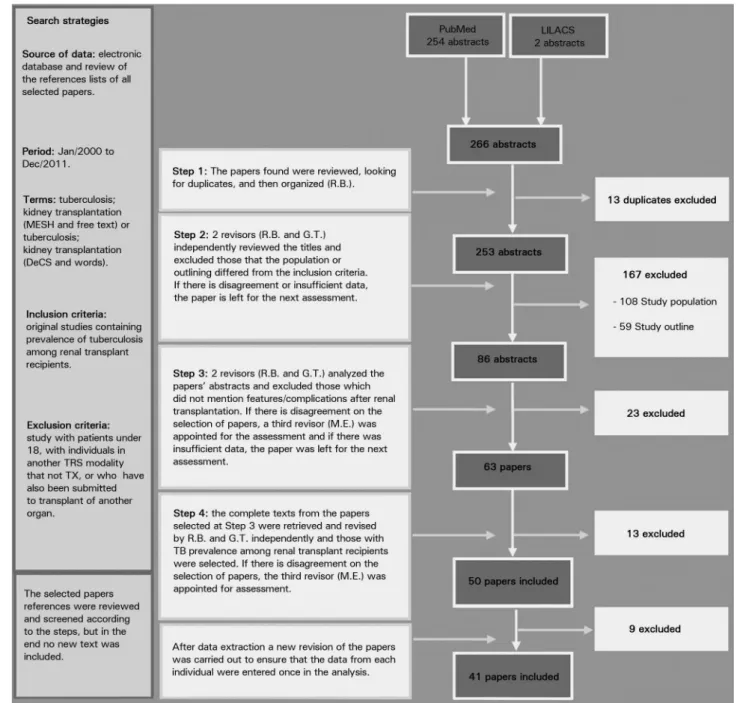
The search and selection of papers was carried out by two reviewers and differences of opinion were resolved by a third reviewer. Figure 1 describes the number of included papers in each step of the selection process:
• 1st step: papers listed in search results
we-re we-reviewed for duplicates and organi-zed by a reviewer (R.B.);
• 2nd step: two reviewers (R.B. and G.T.)
independently analyzed the titles of the papers and excluded the studies meeting the exclusion criteria described above (non-original papers or studies enrolling only subjects under the age of 18 years, individuals on RRT other than kidney transplant, and subjects who had other organ transplants);
• 3rd step: two reviewers (R.B. and G.T.)
independently analyzed the abstracts of the papers selected after the second step and excluded the ones not men-tioning descriptions of characteristics/ adverse events experienced by the stu-died population after kidney transplan-tation. Disagreements between the two reviewers were resolved by a third re-viewer (M.E.);
• 4th step: the papers selected on the third
submitted to kidney transplants and studies reporting data that allowed the calculation of prevalence rates were se-lected. Disagreements between the two reviewers were resolved by a third re-viewer (M.E.).
The references of the papers selected on the fourth step were reviewed, and studies fe-aturing keywords tuberculosis, kidney trans-plantation, tuberculosis, renal transplant were screened based on the steps described above.
A protocol was defined to extract data from the full texts of the papers. Data extraction was performed by two reviewers (R.B. and G.T.) and disagreements were resolved by a third reviewer (M.E.). The following data were extracted: ye-ar of publication; period of data collection; site where study was carried out; study design; da-ta sources; number of centers included; sample size; number of cases of TB and/or prevalence of TB. The prevalence of tuberculosis in the po-pulation in general of each country represented in the review was obtained from the registers of the World Health Organization (WHO).4 The
authors of the selected studies did not have to be contacted for additional information.
Studies using the following criteria to diag-nose TB were included: demonstration of alco-hol-acid resistant bacilli (AARB) in individu-als with suspected disease; growth of bacilli in culture samples; histopathology tests showing AARB or granulomatous inflammation; satis-factory response to treatment in patients with typical findings in imaging or fever of unkno-wn origin with negative results in other tests. No distinctions were made between the clinical manifestations of TB in the studies. Individuals with pulmonary, extra pulmonary, and conco-mitant pulmonary and extra pulmonary tuber-culosis were included.
Figure 1. Paper selection flowchart.
After data extraction, another review was carried out on the selected papers to make su-re the data for each individual was included only once in the analysis.
The estimated global prevalence of TB was calculated using a fixed and a random model. When heterogeneity was statistically significant, the random model was used. Meta-regression was used to identify possi-ble sources of heterogeneity between studies.
Initially, univariate analysis was performed and all variables associated with TB preva-lence rates in individuals submitted to kidney transplantation (p≤ 0.2) in univariate analy-sis were included in the final multivariate me-ta-regression model. Level of significance of was set at 5%.
prevalence countries (> 40/100,000), medium prevalence countries (20-40/100,000), and low prevalence countries (< 20/100,000).4 The combined TB prevalence rates in individuals submitted to renal transplant was also deter-mined for each group of countries.
References were managed with the aid of software EndNote X4 and statistical analyses were carried out on STATA 11.0 (Stata Corp, College Station, Tex.).
This study was carried out as per the re-commendations of the Meta-analysis Of Observational Studies in Epidemiology (MOOSE) group.11
There were no conflicts of interest from the authors of this study. Permits from the Research Ethics Committee were not needed for this study, as it used data from previously published papers.
RESULTS
A total of 253 papers published since 2000 we-re scwe-reened. Although the databases allowed searches for older papers, the authors opted to select papers published since 2000 because immunosuppressants still in use today were in-troduced then. After the initial assessment, 86 abstracts were analyzed, 63 full papers were read, and 41 were included in this systematic review, representing a population of 73,808 individuals (Figure 1). Ten other studies listed in the references of the selected papers were analyzed, but none was included in the review.
Chart 1 lists the papers selected in this meta-analysis.
Table 1 summarizes the main characteris-tics of the studies included in this review.
The combined prevalence of TB among in-dividuals submitted to renal transplant was 2.51% (95% CI = 2.17-2.85) in the random model and heterogeneity between studies was statistically significant (p≤ 0.001).
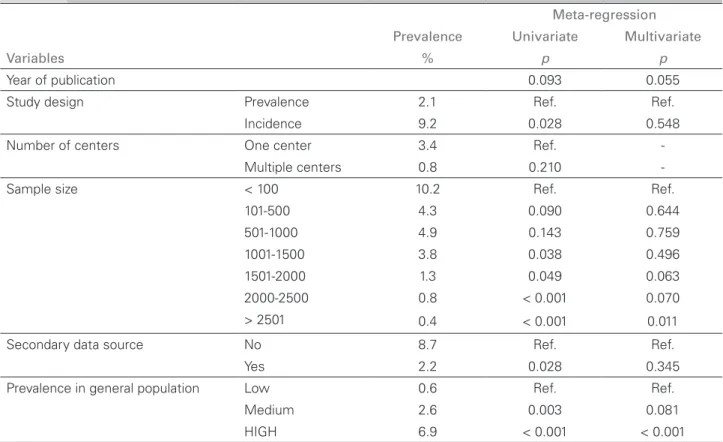
Univariate analysis showed that the varia-bles significantly correlated with differences in TB prevalence rates in individuals submit-ted to kidney transplants (p < 0.2) were year
of publication, study design, sample size, use of secondary data source, and prevalence of TB in the general population. Therefore, the-se variables were included in the final meta--regression model, in which sample size > 2501 (p = 0.011) and high prevalence of TB in the general population (p < 0.001) sustai-ned the association (Table 2).
Figure 2 shows the combined TB prevalence rates for individuals submitted to renal trans-plants based on the categorization of countries by prevalence of TB. This figure shows that in low prevalence countries the TB prevalen-ce rate was 0.56% (95% CI = 0.40-0.73), in medium prevalence countries it was 2.61% (95% CI = 1.75-3.46), and in high prevalen-ce countries the rate was 6.88% (95% CI = 5.11-8.65).
DISCUSSION
This systematic review included observational studies on the prevalence of TB in individuals submitted to kidney transplants. Papers from different geographic areas were identified, including countries with high, medium, and low TB prevalence rates. Despite the grea-ter number of studies conducted in high pre-valence countries, possibly due to the higher risks of disease dissemination, there has been equal concern with describing the prevalence of TB in individuals submitted to renal trans-plants in countries with low and medium TB prevalence.10,12-51
The combined prevalence of TB in indivi-duals submitted to kidney transplant of 2.51% (95% CI = 2.17-2.85) is 14 times greater than the prevalence rate of 0.18% (95% CI = 0.16-0.20)4 seen in the general population.
However, the analysis of countries with high TB prevalence rates revealed that the prevalen-ce of TB in kidney transplant patients was 43 times greater than in the general population (6.88% vs. 0.16%,4 respectively); in medium
CHART 1 LISTOFPAPERSSELECTEDFORMETA-ANALYSIS
Year Authors Country Design Sample TB cases PR
2009 Rizvi SA, et al.10 Pakistan Prevalence 306 20 6.5%
2004 Agarwal SK, et al.12 India Incidence 85 18 21.2%
2000 Apaydin S, et al.13 Turkey Prevalence 274 16 5.8%
2005 Atasever A, et al.14 Turkey Prevalence 443 20 4.5%
2008 Basiri A, et al.15 Iran Prevalence 12820 44 0.3%
2000 Biz E, et al.16 Brazil Prevalence 1264 30 2.4%
2011 Canet E, et al.17 France Prevalence 16146 74 0.5%
2011 Rodrigo C, et al.18 Sri Lanka Prevalence 43 5 11.6%
2006 Chen CH, et al.19 China Prevalence 756 29 3.8%
2008 Chen SY, et al.20 China Prevalence 2333 41 1.8%
2003 Dridi A, et al.21 Tunisia Prevalence 368 5 1.3%
2003 el-Agroudy AE, et al.22 Egypt Prevalence 1200 45 3.8%
2006 Ergun I, et al.23 Turkey Prevalence 283 10 3.5%
2011 Ersan S, et al.24 Turkey Prevalence 320 9 2.8%
2009 Garcia-Goez JF, et al.25 Spain Prevalence 2766 13 0.5%
2009 Guida JP, et al.26 Brazil Prevalence 1342 23 1.7%
2007 Hsu MS, et al.27 China Prevalence 404 6 1.5%
2001 John GT, et al.28 India Incidence 1251 166 13.3%
2004 Klote MM, et al.29 USA Prevalence 15870 66 0.4%
2000 Koselj M, et al.30 Slovenia Prevalence 273 8 2.9%
2001 Koseoglu F, et al.31 Turkey Prevalence 935 19 2%
2001 Lezaic V, et al.32 Servia Prevalence 511 16 3.1%
2004 Lui SL, et al.33 China Prevalence 440 23 5.2%
2004 Matuck TA, et al.34 Brazil Prevalence 982 44 4.5%
2002 Melchor JL, et al.35 Mexico Prevalence 545 10 1.8%
2001 Naqvi A, et al.36 Pakistan Prevalence 850 130 15.2%
2010 Naqvi R, et al.37 Pakistan Incidence 388 17 4.4%
2002 Niewczas M, et al.38 Poland Prevalence 1289 15 1.2%
2005 Prokopenko E, et al.39 Russia Incidence 94 3 3.2%
2003 Queipo JA, et al.40 Spain Prevalence 1261 20 1.6%
2007 Ram R, et al.41 India Prevalence 202 27 13.4%
2008 Ruangkanchanasetr P, et al.42 Thailand Prevalence 151 5 3.3%
2008 Rungruanghiranya S, et al.43 Thailand Prevalence 270 9 3.8%
2007 Saber LT, et al.44 Brazil Prevalence 103 2 1.9%
2000 Sharma AK, et al.45 India Prevalence 163 21 13%
2008 Torres J, et al.46 Spain Prevalence 2012 16 0.8%
2007 Tsai MK, et al.47 China Incidence 30 2 6.7%
2000 Vachharajani T, et al.48 India Prevalence 109 16 14.7%
2003 Vandermarliere A, et al.49 Belgium Prevalence 2502 9 0.4%
2008 Zhang XF, et al.50 China Prevalence 1947 25 1.3%
TABLE 1 DISTRIBUTIONOFTHEMAINSTUDY CHARACTERISTICS
Variables Number of studies
Year of publication (N = 41)
2000-2005 21
2006-2011 20
Study period (N = 38)
1970s, 1980s, 1990s, 2000s 1
1970s, 1980s, 1990s 1 1980s, 1990s, 2000s 12
1980s, 1990s 8
1990s, 2000s 8
1990s 4
2000s 4
Study design (N = 41)
Prevalence study 36
Incidence study 5
Number of centers (N = 41)
One center 35
Multiple centers 6
Sample size (N = 41)
< 100 4
101-500 17
501-1000 6
1001-1500 6
1501-2000 1
2000-2500 4
> 2501 3
Secondary data source (41)
No 8
Yes 33
Prevalence of TB in general population (N = 41)
Low 9
Medium 14
High 18
respectively); in low prevalence countries, transplant patients had TB prevalence rates 56 greater than the general population (0.56% vs. 0.01%,4 respectively). These findings were in
agreement with previous population studies, but no papers were found to have carried out such global analysis.7,8,52
In meta-regression analysis, the prevalence of TB in individuals submitted to renal trans-plant was correlated with high TB prevalen-ce rates in the general population (p < 0.001). Countries with high TB prevalence rates were found to have higher rates of infected indivi-duals and indiviindivi-duals with disease. This corre-lation was expected, as transplant patients are given immunosuppressants and are thus at in-creased risk of infection by Mycobacterium tu-berculosis.5,36,53 Yet, the exponential growth of
prevalences seen in transplant patients against the general population indicates management strategies must be tailored to specifically address the needs of each population group.6
However, the analysis of findings must con-sider the limitations inherent to this study. An important factor - TB prophylactic care - was not included in the meta-regression analysis, as only a few studies looked into this parame-ter.13,26,35,37,42 Another limitation pertains to the
adopted method - database search - which may have left out non-indexed, yet possibly eligible studies.
Despite the study’s limitations, significant variability was seen in the prevalence rates of TB among individuals submitted to renal trans-plant, and there appears to be a strong corre-lation between general popucorre-lation and kidney transplant patient population TB prevalence rates. Additionally, the lack of a specific pro-tocol to assess the quality of the studies was overcome by the stratification of the analyzed variables and the adopted regression model, in a way not to affect our results.
The growing number of transplants pushed by the chronic kidney disease pandemic, and consequently of individuals on immunosup-pressants at a greater risk of contracting disea-ses such as TB,54-56 combined with the less than
TABLE 2 CORRELATIONBETWEENSTUDYVARIABLESANDESTIMATEDPREVALENCEOFTUBERCULOSISININDIVIDUALS
SUBMITTEDTOKIDNEYTRANSPLANT
Meta-regression
Prevalence Univariate Multivariate
Variables % p p
Year of publication 0.093 0.055
Study design Prevalence 2.1 Ref. Ref.
Incidence 9.2 0.028 0.548
Number of centers One center 3.4 Ref.
-Multiple centers 0.8 0.210
-Sample size < 100 10.2 Ref. Ref.
101-500 4.3 0.090 0.644
501-1000 4.9 0.143 0.759
1001-1500 3.8 0.038 0.496
1501-2000 1.3 0.049 0.063
2000-2500 0.8 < 0.001 0.070
> 2501 0.4 < 0.001 0.011
Secondary data source No 8.7 Ref. Ref.
Yes 2.2 0.028 0.345
Prevalence in general population Low 0.6 Ref. Ref.
Medium 2.6 0.003 0.081
HIGH 6.9 < 0.001 < 0.001
Figure 2. Combined prevalence of tuberculosis in renal transplant patients according to country categorization per levels of TB prevalence in the general population.
REFERENCES
1. Puska P. Non-communicable diseases--neglected diseases in global health work? Eur J Public Health 2011;21:269.
2. Barros MB, Francisco PM, Zanchetta LM, César CL. Trends in social and demographic inequalities in the prevalence of chro-nic diseases in Brazil. PNAD: 2003- 2008. Cien Saude Colet 2011;16:3755-68.
3. Eggers PW. The aging pandemic: demographic changes in the general and end-stage renal disease populations. Semin Nephrol 2009;29:551-4.
4. World Health Organization. Global Tuberculosis Programme: Global tuberculosis control 2011. Geneva: World Health Orga-nization; 2011.
5. Lawn SD, Zumla AI. Tuberculosis. Lancet 2011;378:57-72. PMID: 21420161
6. Raviglione M, Marais B, Floyd K, Lönnroth K, Getahun H, Migliori GB, et al. Scaling up interventions to achieve global tuberculosis control: progress and new developments. Lancet
7. Torre-Cisneros J, Doblas A, Aguado JM, San Juan R, Blanes M, Montejo M, et al.; Spanish Network for Research in Infectious Diseases. Tuberculosis after solid-organ transplant: incidence, risk factors, and clinical characteristics in the RESITRA (Spa-nish Network of Infection in Transplantation) cohort. Clin In-fect Dis 2009;48:1657-65. PMID: 19445585
8. Singh N, Paterson DL. Mycobacterium tuberculosis infection in solid-organ transplant recipients: impact and implications for management. Clin Infect Dis 1998;27:1266-77.
9. British Thoracic Society Standards of Care Committee and Joint Tuberculosis Committee.; Milburn H, Ashman N, Davies P, Doffman S, Drobniewski F, Khoo S, et al. Guidelines for the prevention and management of Mycobacterium tuberculosis infection and disease in adult patients with chronic kidney di-sease. Thorax 2010;65:557-70. PMID: 20522863
10. Rizvi SA, Naqvi SA, Zafar MN, Mazhar F, Muzaffar R, Naqvi R, et al. Commercial transplants in local Pakistanis from vended kidneys: a socio-economic and outcome study. Transpl Int 2009;22:615-21.
11. Stroup DF, Berlin JA, Morton SC, Olkin I, Williamson GD, Rennie D, et al. Meta-analysis of observational studies in epi-demiology: a proposal for reporting. Meta-analysis Of Ob-servational Studies in Epidemiology (MOOSE) group. JAMA 2000;283:2008-12. PMID: 10789670
12. Agarwal SK, Gupta S, Dash SC, Bhowmik D, Tiwari SC. Prospective randomised trial of isoniazid prophylaxis in re-nal transplant recipient. Int Urol Nephrol 2004;36:425-31. PMID: 15783119
13. Apaydin S, Altiparmak MR, Serdengeçti K, Ataman R, Oztürk R, Erek E. Mycobacterium tuberculosis infections af-ter renal transplantation. Scand J Infect Dis 2000;32:501-5. PMID: 11055654
14. Atasever A, Bacakoglu F, Toz H, Basoglu OK, Duman S, Basak K, et al. Tuberculosis in renal transplant recipients on various immunosuppressive regimens. Nephrol Dial Transplant 2005;20:797-802.
16. Biz E, Pereira CA, Moura LA, Sesso R, Vaz ML, Silva Filho AP, et al. The use of cyclosporine modifies the clinical and histo-pathological presentation of tuberculosis after renal trans-plantation. Rev Inst Med Trop São Paulo 2000;42:225-30. PMID: 10968886
17. Canet E, Dantal J, Blancho G, Hourmant M, Coupel S. Tuber-culosis following kidney transplantation: clinical features and outcome. A French multicentre experience in the last 20 years. Nephrol Dial Transplant 2011;26:3773-8.
18. Rodrigo C, Sheriff R, Rajapakse S, Lanerolle RD, Sheriff R. A two-year retrospective analysis of renal transplant patients in Sri Lanka. Saudi J Kidney Dis Transpl 2011;22:174-8. 19. Chen CH, Lian JD, Cheng CH, Wu MJ, Lee WC, Shu KH.
My-cobacterium tuberculosis infection following renal transplanta-tion in Taiwan. Transpl Infect Dis 2006;8:148-56.
20. Chen SY, Wang CX, Chen LZ, Fei JG, Deng SX, Qiu J, et al. Tuberculosis in southern Chinese renal-transplant recipients. Clin Transplant 2008;22:780-4.
21. Dridi A, Kaaroud H, Boubaker K, Abdallah TB, El-Younsi F, Moussa FB, et al. Tuberculosis in renal transplant recipients. Transplant Proc 2003;35:2682-3.
22. el-Agroudy AE, Refaie AF, Moussa OM, Ghoneim MA. Tuber-culosis in Egyptian kidney transplant recipients: study of clini-cal course and outcome. J Nephrol 2003;16:404-11.
23. Ergun I, Ekmekci Y, Sengul S, Kutlay S, Dede F, Canbakan B, et al. Mycobacterium tuberculosis infection in renal transplant recipients. Transplant Proc 2006;38:1344-5. PMID: 16797298 24. Ersan S, Celik A, Atila K, Aykut Sifil A, Cavdar C, Soylu A,
et al. Tuberculosis in renal transplant recipients. Ren Fail 2011;33:753-7.
25. García-Goez JF, Linares L, Benito N, Cervera C, Cofán F, Ricart MJ, et al. Tuberculosis in solid organ transplant reci-pients at a tertiary hospital in the last 20 years in Barcelona, Spain. Transplant Proc 2009;41:2268-70.
26. Guida JP, Bignotto Rosane D, Urbini-Santos C, Alves-Filho G, Ribeiro Resende M, Mazzali M. Tuberculosis in renal trans-plant recipients: a Brazilian center registry. Transtrans-plant Proc 2009;41:883-4. PMID: 19376379
27. Hsu MS, Wang JL, Ko WJ, Lee PH, Chou NK, Wang SS, et al. Clinical features and outcome of tuberculosis in solid or-gan transplant recipients. Am J Med Sci 2007;334:106-10. PMID: 17700199
28. John GT, Shankar V, Abraham AM, Mukundan U, Thomas PP, Jacob CK. Risk factors for post-transplant tuberculosis. Kidney Int 2001;60:1148-53. PMID: 11532111
29. Klote MM, Agodoa LY, Abbott K. Mycobacterium tuberculosis infection incidence in hospitalized renal transplant patients in the United States, 1998-2000. Am J Transplant 2004;4:1523-8. 30. Koselj M, Kandus A, Ales A, Bren AF. Mycobacterial infection
in renal transplant recipients. Transplant Proc 2000;32:152-4. PMID: 10701003
31. Köseoğlu F, Emiroğlu R, Karakayali H, Bilgin N, Haberal M. Prevalence of mycobacterial infection in solid organ transplant recipients. Transplant Proc 2001;33:1782-4. PMID: 11267510 32. Lezaic V, Radivojevic R, Radosavljevic G, Blagojevic R, Djuka-novic L, Simic S, et al. Does tuberculosis after kidney transplan-tation follow the trend of tuberculosis in general population? Ren Fail 2001;23:97-106.
33. Lui SL, Tang S, Li FK, Choy BY, Chan TM, Lo WK, et al. Tuberculous infection in southern Chinese renal transplant re-cipients. Clin Transplant 2004;18:666-71.
34. Matuck TA, Brasil P, Alvarenga Mde F, Morgado L, Rels MD, da Costa AC, et al. Tuberculosis in renal transplants in Rio de Janeiro. Transplant Proc 2004;36:905-6. PMID: 15194311 35. Melchor JL, Gracida C, Ibarra A. Increased frequency of
tuber-culosis in Mexican renal transplant recipients: a single-center experience. Transplant Proc 2002;34:78-9. PMID: 11959194 36. Naqvi A, Rizvi A, Hussain Z, Hafeez S, Hashmi A, Akhtar F, et
al. Developing world perspective of posttransplant tuberculo-sis: morbidity, mortality, and cost implications. Transplant Proc 2001;33:1787-8. PMID: 11267512
37. Naqvi R, Naqvi A, Akhtar S, Ahmed E, Noor H, Saeed T, et al. Use of isoniazid chemoprophylaxis in renal transplant reci-pients. Nephrol Dial Transplant 2010;25:634-7.
38. Niewczas M, Ziółkowski J, Rancewicz Z, Szymanska K, Kwiatkowski A, Gałazka T, et al. Tuberculosis in patients after
renal transplantation remains still a clinical problem. Trans-plant Proc 2002;34:677-9.
39. Prokopenko E, Scherbakova E, Vatazin A, Pasov S, Budnikova N, Agafonova S. Does mycophenolate mofetil in-crease the incidence of infections in renal transplant recipients? Drugs Exp Clin Res 2005;31:199-205.
40. Queipo JA, Broseta E, Santos M, Sánchez-Plumed J, Budía A, Jiménez-Cruz F. Mycobacterial infection in a series of 1261 re-nal transplant recipients. Clin Microbiol Infect 2003;9:518-25. 41. Ram R, Swarnalatha G, Prasad N, Dakshinamurty KV. Tu-berculosis in renal transplant recipients. Transpl Infect Dis 2007;9:97-101.
42. Ruangkanchanasetr P, Natejumnong C, Kitpanich S, Chaiprasert A, Luesutthiviboon L, Supaporn T. Prevalence and manifestations of tuberculosis in renal transplant reci-pients: a single-center experience in Thailand. Transplant Proc 2008;40:2380-1. PMID: 18790240
43. Rungruanghiranya S, Ekpanyaskul C, Jirasiritum S, Nilthong C, Pipatpanawong K, Mavichak V. Tuberculosis in Thai renal transplant recipients: a 15-year experience. Transplant Proc 2008;40:2376-9. PMID: 18790239
44. Saber LT, Ikeda MY, Almeida JM. Posttransplantation con-version to sirolimus-based immunosuppression: a single center experience. Transplant Proc 2007;39:3098-100.
45. Sharma AK, Tolani SL, Rathi GL, Gupta HP, Gupta R. Tu-berculosis after renal transplantation. Transplant Proc 2000;32:1959. PMID: 11120019
46. Torres J, Aguado JM, San Juan R, Andrés A, Sierra P, López-Medrano F, et al. Hepatitis C virus, an important risk factor for tuberculosis in immunocompromised: experience with kidney transplantation. Transpl Int 2008;21:873-8. 47. Tsai MK, Lee CY, Hu RH, Lee PH. Conversion to combined
therapy with sirolimus and mycophenolate mofetil improved renal function in stable renal transplant recipients. J Formos Med Assoc 2007;106:372-9. PMID: 17561472
48. Vachharajani T, Abreo K, Phadke A, Oza U, Kirpalani A. Diag-nosis and treatment of tuberculosis in hemodialysis and renal transplant patients. Am J Nephrol 2000;20:273-7.
49. Vandermarliere A, Van Audenhove A, Peetermans WE, Vanrenterghem Y, Maes B. Mycobacterial infection after re-nal transplantation in a Western population. Transpl Infect Dis 2003;5:9-15.
50. Zhang XF, Lv Y, Xue WJ, Wang B, Liu C, Tian PX, et al. My-cobacterium tuberculosis infection in solid organ transplant re-cipients: experience from a single center in China. Transplant Proc 2008;40:1382-5. PMID: 18589112
51. Walsh R, Ortiz J, Foster P, Palma-Vargas J, Rosenblatt S, Wright F. Fungal and mycobacterial infections after Campath (alemtuzumab) induction for renal transplantation. Transpl In-fect Dis 2008;10:236-9.
52. Currie AC, Knight SR, Morris PJ. Tuberculosis in renal trans-plant recipients: the evidence for prophylaxis. Transtrans-plantation 2010;90:695-704.
53. Rizvi SA, Naqvi SA, Hussain Z, Hashmi A, Akhtar F, Hussain M, et al. Renal transplantation in developing coun-tries. Kidney Int Suppl 2003;(83):S96-100.
54. Schieppati A, Remuzzi G. Chronic renal diseases as a public health problem: epidemiology, social, and economic implica-tions. Kidney Int Suppl 2005;(98):S7-S10.
55. Bello AK, Nwankwo E, El Nahas AM. Prevention of chro-nic kidney disease: a global challenge. Kidney Int Suppl 2005;(98):S11-7.