Brazilian recommendations of mechanical ventilation 2013. Part 2
Recomendações brasileiras de ventilação mecânica 2013. Parte 2The present recommendations are a joint initiative of the Mechanical Ventilation Committee of the Brazilian Intensive Care Medicine Association (
Associação de
Medicina Intensiva Brasileira
- AMIB) and the Commission of Intensive Therapy of theBrazilian Thoracic Society (
Sociedade Brasileira de Pneumologia e Tisiologia
- SBPT).Abstract
Perspectives on invasive and noninvasive ventilatory support for critically ill patients are evolving, as much evidence indicates that ventilation may have positive effects on patient survival and the quality of the care provided in intensive care units in Brazil. For those reasons, the Brazilian Association of Intensive Care Medicine (Associação de Medicina Intensiva Brasileira - AMIB) and the Brazilian Thoracic Society (Sociedade Brasileira de Pneumologia e Tisiologia - SBPT), represented by the Mechanical Ventilation Committee and the Commission of Intensive Therapy, respectively, decided to review the literature and draft recommendations for mechanical ventilation with the goal of creating a document for bedside guidance as to the best practices on mechanical ventilation available to their members. The document was based on the available evidence regarding 29 subtopics selected as the most relevant for the subject of interest. The project was developed in several stages, during which the selected topics were distributed among experts recommended by both societies with recent publications on the subject of interest and/or significant teaching and research activity in the field of mechanical ventilation in Brazil. The experts were divided into pairs that were charged with performing a thorough review of the international literature on each topic. All the experts met at the Forum on Mechanical Ventilation, which was held at the headquarters of AMIB in São Paulo on August 3 and 4, 2013, to collaboratively draft the final text corresponding to each sub-topic, which was presented to, appraised, discussed and approved in a plenary session that included all 58 participants and aimed to create the final document.
Keywords: Recommendations; Mechanical Ventilation; Respiratory Insufficiency.
Resumo
O suporte ventilatório artificial invasivo e não invasivo ao paciente grave tem evoluído e inúmeras evidências têm surgido, podendo ter impacto na melhora da sobrevida e da qualidade do atendimento oferecido nas unidades de terapia intensiva no Brasil. Isto posto, a Associação de Medicina Intensiva Brasileira (AMIB) e a Sociedade Brasileira de Pneumologia e Tisiologia (SBPT) - representadas por seu Comitê de Ventilação Mecânica e sua Comissão de Terapia Intensiva, respectivamente, decidiram revisar a literatura e preparar recomendações sobre ventilação mecânica, objetivando oferecer aos associados um documento orientador das melhores práticas da ventilação mecânica na beira do leito, com base nas evidências existentes, sobre os 29 subtemas selecionados como mais relevantes no assunto. O projeto envolveu etapas que visaram distribuir os subtemas relevantes ao assunto entre experts indicados por ambas as sociedades, que tivessem publicações recentes no assunto e/ ou atividades relevantes em ensino e pesquisa no Brasil, na área de ventilação mecânica. Esses profissionais, divididos por subtemas em duplas, responsabilizaram-se por fazer uma extensa revisão da literatura mundial. Reuniram-se todos no Fórum de Ventilação Mecânica, na sede da AMIB, na cidade de São Paulo (SP), em 3 e 4 de agosto de 2013, para finalização conjunta do texto de cada subtema e apresentação, apreciação, discussão e aprovação em plenária pelos 58 participantes, permitindo a elaboração de um documento final.
Descritores: Recomendações; Ventilação Mecânica; Insuficiência Respiratória.
Completion of the drafting of the document: October 20, 2013
Conflicts of interest: With the help of the Brazilian Thoracic Society, the AMIB Division of Scientific Issues procured financial support from industrial companies and laboratories, distributed as sponsorship quotas, to cover part of the event costs (participants’ air tickets, food and lodging). None of those companies participated in the drafting of the present document, nor had access to its content until it was disclosed (after its final format was approved) as brochures distributed at the Brazilian Congress of Intensive Care Medicine in Rio de Janeiro in 2013. The companies that collaborated with the present project are: Air Liquide, Covidien, GE, Intermed, Magnamed, Mindray and Philips.
Corresponding author: Carmen Silvia Valente Barbas, Disicplina de Pneumologia, Hospital das Clínicas da Faculdade de Medicina da Universidade de São Paulo, Avenida Dr. Eneas de Carvalho Aguiar, 44, Zip code- 05403-900 - São Paulo (SP), Brazil E-mail: [email protected]
Introduction
Invasive or non-invasive mechanical ventilation (MV) must be performed in an adequate and safe
principles, evidence collected in laboratory experiments, and randomized clinical or observational studies involving actual patients that were available in the literature, current MV recommendations indicate that ventilatory support should be performed at a tidal volume (Vt) of 6 mL/kg predicted body weight, with a delta between plateau pressure and positive end-expiratory pressure (PEEP) not greater than 15 cmH2O, and end-expiratory pressure levels sufficient to avoid airway and alveolar collapse and ensure adequate gas exchange. Other recommendations include positioning the patient to guarantee adequate and harmless ventilation (such as prone positioning in cases of severe acute respiratory distress syndrome - ARDS) and the use of advanced support techniques (such as extracorporeal carbon dioxide (CO2) removal) in cases of refractory ARDS. The development of increasingly more sophisticated ventilators allow for fine adjustment of sensitivity and include several trigger mechanisms, different inspiratory flow speeds, acceleration, mechanisms for ending inspiratory time, and monitoring options, which enable adjustment of the patient-ventilator synchrony and MV as a function of the patient’s disease. In this regard, the possibility of providing differential ventilatory support for restrictive and obstructive conditions stands out.
For that reason, joint analysis of the available evidence on ventilatory support by Brazilian experts who deal with mechanical ventilation like anesthesiologists, intensivists, pulmonolo-gists, physical therapists, nurses, nutritionists and speech therapists was necessary. Such evidence, taken together with experience gathered by the various specialties, may provide guidance to health care professionals in Brazilian intensive care units (ICU) on how to provide safe and effective respiratory support for patients with respiratory failure, based on the best evidence available, in order to avoid the occurrence of ventilator-associated lung injury.
Therefore, the aim of the present study was to review the available literature on 29 subtopics related to ventilatory support for individuals with respiratory failure, and following presentation, discussion, and approval at a plenary session including all 58 participating specialists, to present the results in the form of recommendations and suggestions.
Methods
Literature available from Medline (2003-2013) and the Cochrane Central Register of Controlled Trials (CENTRAL) was reviewed by specialists with a higher education (intensivists, anesthetists, pulmonary specialists, physical therapists, and nurses) who were distributed in pairs for review of each of the 29 selected subtopics related to non-invasive and invasive ventilatory support for patients with respiratory failure.
After reviewing the articles available in the literature, each pair answered the questions formulated by the organizing commission (composed by Carmen Silvia Valente Barbas, President of the Committee of Respiratory Failure and Mechanical Ventilation of AMIB, Alexandre Marini Isola, National Coordinator of the Course of MV in ICU - VENUTI, and Augusto Manoel de Carvalho Farias, Coordinator of the Department of Intensive Care of the SBPT) according to criteria previously suggested by other authors.(1-4) Thus, the term recommendation was used when the level of evidence was high, i.e., derived from randomized studies conducted with more than 100 participants, meta-analyses, all-or-nothing effect, or patient safety. The term suggestion was used when the available evidence was weak, i.e., based on observational or case-control studies, case series, or on the experience of specialists to provide guidance for efficient and safe ventilatory support in Brazil. We therefore hoped that these evidence-based recommendations would help to avoid potential deleterious effects associated with inadequate ventilatory support in our patients.
The 58 participating specialists were requested to answer the proposed questions during an eight-hour session conducted at the Brazilian Intensive Care Medicine Association (Associação de Medicina Intensiva Brasileira - AMIB) on August 3, 2013. The answers were formulated based on the evidence available in the literature and on the experience of the specialists and were then presented at a plenary session that included all 58 participating specialists, which was held on August 4, 2013 at AMIB headquarters. During that session, the answers were discussed, modified when needed, voted on, and approved in accordance with the suggestions and observations of the specialists who attended the meeting.
min, and a fraction of inspired oxygen (FiO2) that is sufficient to maintain an SpO2 > 92% and a PEEP of 5-10 cmH2O. In cases of ARDS, follow the instructions in the related section of the present Recommendations.
Recommendation - In cases of high output bronchopleural fistula, use the PCV mode, which will compensate for the leak. Another option is the use of high frequency oscillatory ventilation, only in centers with this capability and specialized personnel. In cases that are more severe, asynchronous independent lung ventilation can be either used or not, and the lung with the fistula is ventilated in the PCV mode with a distending pressure of < 15 cmH2O and low PEEP levels (< 10cmH2O).
Pain control
Suggestion - Thoracic epidural analgesia,
as part of a multimodal strategy, is recom-mended. If epidural analgesia cannot be used or is contraindicated, patient-controlled i.v. analgesia or intercostal nerve blockade can be used.(11)
Suggestion - Administration of intermittent analgesia can be used in cases of less severe pain.
Mechanical ventilation during
surgical procedures
Comment - Postoperative pulmonary complications (PPC) contribute to a substantial proportion of the risks associated with surgery and anesthesia, being the major cause of morbidity and mortality in the postoperative period. (12) PPC, which include respiratory infections, respiratory failure, pleural effusion, atelectasis, pneumothorax, bronchospasm, and aspiration pneumonitis, affect approximately 5% of patients undergoing surgery.(12,13)
Specific care before intubation
Preoperative risk stratification
Recommendation - All patients should be
assessed for risk of PPC by using a specific scale. The American Society of Anesthesiology (ASA) classification is a scale that is subjective and imprecise. Among the scales suggested for stratifying patient risk for PPC are the European Surgical Outcomes Study (EuSOS) scoring system and the Assess Respiratory Risk in Surgical Patients in Catalonia (ARISCAT).(13)
drafted the final document, following the authors’ revisions. The document was then printed in the form of a bedside manual of recommendations to be distributed to ICUs all across Brazil, and it was also sent for publication in the Brazilian Journal of Intensive Care (Revista Brasileira de Terapia Intensiva - RBTI) and the Brazilian Journal of Pulmonology (Jornal Brasileiro de Pneumologia).
Mechanical ventilation in chest
trauma
Noninvasive mechanical ventilation
Recommendation - Noninvasive ventilation (NIV) is contraindicated in patients with upper airway injury, in the presence of hemodynamic instability, and in severe craniocerebral trauma.(5-10)
Recommendation - In patients with isolated chest trauma, early application of NIV can improve gas exchange, prevent orotracheal intubation (OTI), and reduce complications and ICU length of stay.(5-10)
Recommendation - The use of NIV should
be monitored at the bedside by a healthcare professional within 30 minutes to 2 hours. For NIV to be considered successful, the following criteria should be met: reduction of the respiratory rate (f), increase in the tidal volume (Vt), improvement of the level of consciousness, reduction or cessation of the use of accessory muscles, increase in the partial pressure of oxygen (PaO2) and/or the peripheral oxygen saturation (SpO2), and reduction of the partial pressure of carbon dioxide (PaCO2) without significant abdominal distension. In unsuccessful cases, OTI and invasive MV should be performed immediately.
Invasive mechanical ventilation
(11)Recommendation - Patients with severe chest trauma, respiratory failure, and specific contraindications to NIV should be promptly intubated and ventilated.
Recommendation - Initially, use an assist-control mode of ventilation, i.e., volume-cycled ventilation (VCV) or pressure-control ventilation (PCV), in chest trauma with severe respiratory failure.
Recommendation - Regardless of the mode
studies assessing conventional MV strategies versus protective strategies in patients undergoing surgery considered using a low Vt and a high PEEP in the protective strategies. In general, the use of a high PEEP results in better oxygenation and a lower incidence of PPC.(17,20)
Alveolar recruitment maneuvers
Suggestion - Use alveolar recruitment
maneu-vers (RM) during the intraoperative period to remaneu-verse alveolar collapse and improve oxygenation. The use of RM, in association with maintenance of high PEEP levels, reduces the amount of collapsed lung and improves patient oxygenation during surgery.(17,20) Among the RM most often cited in the literature is maximum recruitment strategy (MRS), which seeks to maintain a high plateau pressure (Pplat) in the airway (approximately 40-45 cmH2O) for 60 seconds (as described in Part 1 of the present Recommendations).
Fraction of inspired oxygen
Suggestion - The lowest FiO2 level that can maintain SpO2 at approximately 96-98% should be used. The combination of an FiO2 of approximately 30-40% and high PEEP levels can maintain adequate oxygenation and reduce lung atelectasis. The role of high levels of oxygen in preventing surgical wound infection remains controversial.(14)
Respiratory rate
Recommendation - Use f to maintain PaCO2 at 38-43 mmHg (end-tidal CO2 [CO2 at end-expiration] of approximately 35-40 mmHg). The trend to use a low Vt during surgery requires the adoption of a high f.(17,19)
Discontinuation of mechanical ventilation
Recommendation - Discontinue MV in the
postoperative period as early and as quickly as possible, as soon as the patient is hemodynamically stable, is under adequate analgesia, has no electrolyte disturbances, and has regained a sufficient level of consciousness to ensure maintenance of ventilatory drive and airway protection. Extubation can be performed in the operating room, in the post-anesthesia care unit, or in the ICU.(21)
Pre-oxygenation during induction of
anesthesia
Recommendation - Pre-oxygenation with an FiO2 of approximately 100% for all patients aims at increasing reserve and reducing the risk of hypoxemia.(14)
Use of noninvasive ventilation during
induction of anesthesia
Suggestion - Use NIV during induction of
anesthesia for elective surgery in patients with decreased abdominal compliance and in those in whom it is necessary to use an FiO2 of 100% for pre-oxygenation. The use of NIV can prevent the development of atelectasis in patients with decreased abdominal compliance and in those undergoing pre-oxygenation with an FiO2 of 100%.(14)
Use of positive end-expiratory pressure and alveolar recruitment maneuvers during induction of anesthesia
Suggestion - Use recruitment maneuvers and a
PEEP of approximately 5-8 cmH2O after induction of anesthesia in patients with decreased abdominal compliance or in those who develop hypoxemia.(14)
Specific care during the intraoperative
period
Mode of ventilation
Suggestion - Use PCV to improve pulmonary
mechanics in patients undergoing video-assisted laparoscopic surgery. Observe appropriate expired Vt values.(15,16) In the remaining scenarios, there is no benefit of a mode of ventilation over another, provided that respiratory mechanics are respected.
Tidal volume
Recommendation - The use of MV with a Vt of 6 mL/kg predicted body weight should be considered in all patients. Various studies in various scenarios (abdominal, thoracic, and cardiac surgery) have demonstrated the benefit of using low Vt during surgery.(17-19)
Positive end-expiratory pressure
Suggestion - In invasive MV, no mode is superior to another mode. It is suggested that the assist-control mode (AC) as either PCV or VCV be initially used.(28)
Suggestion - Monitor respiratory mechanics.
Monitoring of IAP should be considered in cases of increased PaCO2 levels and/or increased airway pressures that cannot be explained by pulmo-nary causes.
Recommendation - Use a Vt of 6mL/kg
predicted body weight;(26-29) for FiO
2, it is suggested that the lowest level that can maintain oxygen saturation (SatO2) ≥ 92% be used.
Suggestion - For PEEP/recruitment
maneu-vers,(30,31) the goal is to increase FRC, prevent the development of atelectasis, and reduce the risk of ventilation-induced lung injury. In addi-tion, it is suggested that MRS be performed in cases of hypoxemia, decreased Vt, or increased PaCO2 levels.
Suggestion - Use PEEP levels ≥ 10 cmH2O.
Recommendation - Maintain Pplat at ≤ 35
cmH2O.(32)
Suggestion - In cases of moderate and severe
ARDS, a Pplat of up to 40 cmH2O may be toler-able, provided that the distending pressure is maintained at ≤ 15 cmH2O.
Recommendation - Extubate patients as soon as their clinical status allows, and NIV can be used to facilitate it.
Mechanical ventilation in patients
with central nervous system
involvement
Gas exchange - oxygen
Recommendation - Avoid hypoxemia in patients with acute neurological injury, because it leads to increased morbidity and mortality.(33,34)
Suggestion - Avoid hyperoxia in cases of
anoxic-ischemic encephalopathy.(35)
Gas exchange - carbon dioxide
Recommendation - Do not use prophylactic
or prolonged hyperventilation, and maintain PaCO2 between 35 and 40 mmHg during the acute phase of injury.(36-38)
Recommendation - Acute hyperventilation is indicated as rescue therapy in cases of cerebral herniation.(36-38)
Noninvasive ventilation after extubation
Suggestion - The use of NIV should be consid-ered in patients undergoing cardiac, thoracic, bariatric, or upper abdominal surgery, because it is associated with better oxygenation and a lower incidence of atelectasis. It should be performed with low pressure levels in upper abdominal and esophageal surgery. NIV should not delay reintubation.
Recommendation - NIV should not be used following the onset of an acute respiratory failure episode after extubation.(22)
Mechanical ventilation in obese
patients
Comment - Patients with a body mass index (BMI) ≥ 30 kg/m2 are considered obese. This condition is characterized by a series of physiological changes, such as decreased lung compliance, which is caused by the direct mechanical effect of fat distribution and an abnormal position of the diaphragm, because of increased intra-abdominal pressure (IAP), reduced functional residual capacity (FRC), and reduced total lung capacity (TLC), and by the increased work of breathing, because of increased airway resistance (Raw) and increased chest wall resistance, as well as a need for high minute volumes, leading to an increase in PaCO2.(23,24)
Recommendation - Consider every obese
patient as potentially difficult airway. In obese patients with a Malampatti score ≥ 3 and a Cormack score of 3-4, as well as increased neck circumference, consider difficult airway and prepare the necessary infrastructure to manage this condition.(25)
Suggestion - Use the reverse Trendelenburg position during ventilation.(26) The goal is to improve PaO2, static respiratory system compliance (Crs), and cardiac output, as well as reducing the development of atelectasis.
Suggestion - Avoid the supine position,
because of reduced FRC, cardiac output, and increased work of breathing. If it is possible to use it, the beach chair position is suggested.(27)
Suggestion - Use NIV in cases of hypercapnic
lation strategies such as recruitment maneuvers, prone positioning, arteriovenous extracorporeal membrane CO2 removal (AV-ECCO2R), and extracor-poreal membrane oxygenation (ECMO), assessing risk versus benefit on a case-by-case basis.(45-47)
Head of the bed between 30º and 45º
Recommendation - Maintain the head of the
bed between 30º and 45º because this improves cerebral venous return and reduces the effect of PEEP on ICP.(48)
Mechanical ventilation in patients
with neuromuscular diseases
Comment - In respiratory failure from neuromuscular disease, ventilatory support depends on the location of the injuries (from spinal cord injuries to direct muscle involvement) (Chart 1).
Acute polyradiculoneuritis
(Guillain-Barré syndrome)
Comment - One third of patients with acute
polyradiculoneuritis (Guillain-Barré syndrome) require MV during the course of the disease. Generalized weakness, rapid progression, and bulbar involvement are associated with the need for MV in such patients.(49-52)
Suggestion - Patients with acute
polyra-diculoneuritis should be periodically assessed by measuring maximum inspiratory pressure (PImax) from residual volume, maximum expiratory pres-sure (PEmax) from TLC, and vital capacity (VC). Patients with PImax < −30 cmH2O, PEmax < 40 cmH2O, and VC < 20 mL/kg or a reduction of more than 30% in VC should be electively intubated to prevent emergency OTI.(49-52)
Recommendation - NIV should be used with care because of the instability of acute polyradiculoneuritis. Therefore, OTI and invasive MV should not be delayed when there is deterioration of lung function.(49-52)
Suggestion - The decision to tracheostomize patients with Guillain-Barré syndrome may be postponed for 2 weeks. If, after 2 weeks, lung function test results do no improve significantly, tracheostomy should be considered. If lung func-tion test results are improving, tracheostomy may be postponed until weaning is achieved.(49-52)
Recommendation - Monitor CO2 by capnography. When this tool is unavailable, assess PaCO2 levels through blood gas sampling, more frequently during the acute phase.
Suggestion - In patients with acute ischemic
stroke, avoid PaCO2 < 35 mmHg because of risk of ischemia in the penumbra region.
Acute respiratory distress syndrome
Recommendation - Use a protective ventilation strategy for the treatment of ARDS in patients with neurological injury, accompanied by intracranial pressure (ICP) and cerebral perfusion pressure monitoring.(29,39) More details are provided in the related section of the present Recommendations.
Suggestion - In cases of severe ARDS, the
use of a high PEEP should be individualized and ICP should be monitored, because increased ICP can occur when there is a concomitant decrease in lung and brain compliance.(40,41)
Modes of ventilation
Suggestion - Use the VCV mode for patients with severe neurological injury during the acute phase,(42) to avoid oscillations in Vt.
Recommendation - Patients with severe neurological injury, with intracranial hypertension (ICH) during the acute phase, should not be maintained on a spontaneous mode of ventilation. (43)
Airway approach
Recommendation - Intubate patients with
a Glasgow Coma Scale score ≤ 8 and in whom the cough reflex is absent.(44)
Suggestion - Use rapid sequence intubation
in patients with ICH or with suspected ICH, mini-mizing the risk of secondary brain injury due to increased intracranial pressure. This technique uses a combination of sedatives that have minimal cardiodepressant effects, such as ketamine (1-2 mg/kg i.v.) or etomidate (0.3 mg/kg i.v.), particu-larly in patients with hypotension or at risk of hypotension, and short-acting neuromuscular blocking agents (succinylcholine, 1.5 mg/kg i.v.) so that, within 45 to 60 seconds, the goal of paralysis and sedation is achieved.
Unconventional ventilation strategies
venti-support. Most patients develop cardiomyopathy. Forced VC (FVC) < 1L and the onset of nocturnal hypoventilation are signs of poor prognosis, and NIV can be used to improve survival and quality of life outcomes.(56-58)
Suggestion - Use NIV in cases of nocturnal hypoventilation and/or decreased VC (< 1L).
Suggestion - Invasive ventilation via elective tracheostomy is indicated for patients who do not tolerate NIV or who have been intubated for an acute event.(56-58)
Amyotrophic lateral sclerosis
Comment - Amyotrophic lateral sclerosis
(ALS) is a degenerative motor neuron disease, during the course of which respiratory failure due to muscle failure may occur. Chronic aspiration due to bulbar muscle dysfunction and ineffective cough are additional complications. Most patients die from respiratory complications that vary in course.(59,60)
Recommendation - Use NIV in patients with ALS, except in the subgroup of patients with severe bulbar dysfunction.
Recommendation - Invasive MV via
tracheostomy is indicated in patients with impaired airway protection and severe bulbar dysfunction, and it should only be instituted after its complications, as well as its social and logistical implications, are discussed in detail with the patients and their families.
Recommendation - Indications for ventilatory support include VC < 50% of predicted, PImax < −30 cmH2O or < 60% of predicted, peak expiratory flow (PEF) < 270 L/min, PCO2 > 45 mmHg, and nocturnal hypoventilation.(59,60)
Suggestion - The parameters for invasive and NIV are as follows. An oral or nasal mask can be used provided that it is properly fitted. BiPAP should be used. Invasive MV via tracheostomy is usually carried out in the ventilation mode that is most suitable for the type of demand, if there is associated lung disease. Patients should be monitored for episodes of atelectasis, accumula-tion of secreaccumula-tions, and pneumonias.(61)
Mechanical ventilation in patients
with cardiovascular disease
Comment - The goal of MV in patients with cardiovascular disease is to adjust oxygenation and ventilation and to ensure cardiac output.
Myasthenia gravis
Comment - Acute respiratory failure results from a myasthenic crisis precipitated by neuromuscular junction failure, usually accompanied by bulbar weakness. Myasthenic-specific treatment with immunoglobulin or plasmapheresis should be initiated early.(53-55)
Suggestion - Consider using NIV (bilevel positive airway pressure [BiPAP]) in patients with myasthenic crisis in an attempt to prevent OTI, with PCO2 > 50mmHg being a predictor of BiPAP failure; the use of NIV can be considered in persistent or recurrent weakness following extubation.(53-55)
Suggestion - Periodically assess patients with myasthenic crisis by measuring PImax, PEmax, and VC. Patients with VC < 20 mL/kg, PImax < −30 cmH2O, and PEmax > 40 cmH2O can undergo a trial treatment with NIV (BiPAP) and, if there is failure, they should be electively intubated to prevent emergency OTI.(53-55)
Suggestion - Conduct an intensive respiratory
program, including sighs, use of PEEP, frequent aspiration of the bronchial tree, respiratory therapy, body position change, and administration of antibiotic therapy (in cases of documented infec-tion), in patients placed on MV for a myasthenic crisis.(53-55)
Duchenne muscular dystrophy
Comment - Duchenne muscular dystrophy (DMD) is a recessive X-linked disease that affects 1:3,000 male births. It is characterized by progressive loss of muscle strength, with VC decreasing progressively until the onset of respiratory failure, usually between 18 and 20 years of age, with a consequent need for ventilatory Chart 1 - Location of the neuromuscular injuries and examples.
Location Examples
Spinal cord Transverse myelitis, trauma, and
extrinsic compression
Motor neuron Amyotrophic lateral sclerosis and poliomyelitis
Peripheral nerves Acute polyradiculoneuritis and critical illness polyneuropathy
Neuromuscular junction
Myasthenia gravis, botulism, and organophosphate intoxication
Recommendation - No mode of ventilation is recommended over another in patients with cardiovascular disease.(70)
Suggestion - In patients on inotropic support, this support may be continued until after extu-bation.(70)
Mechanical ventilation in patients with
cardiovascular disease undergoing
surgery
Tidal volume
Recommendation - The use of a Vt of 6 mL/
kg predicted body weight, in the volume-control mode or peak/plateau inspiratory pressure, is sufficient to maintain this same volume in PCV.(70)
Positive end-expiratory pressure
Recommendation - Apply PEEP during general anesthesia, because it is associated with improved oxygenation and prevention of atelectasis.(70)
Alveolar recruitment maneuvers
Suggestion - RM can be used intraoperatively
to prevent alveolar collapse.(69)
Fraction of inspired oxygen
Recommendation - At induction of
anesthesia, use an FiO2 of 100% to ensure adequate oxygenation for intubation. Fractions of oxygen needed to maintain SpO2 > 94% are recommended.(70)
Discontinuation of mechanical ventilation
Recommendation - Discontinuation of MV should be gradual, and pressure support ventilation (PSV) can be used. NIV is an important resource, which should be used immediately after extubation.(62-70)
Postoperative analgesia
Recommendation - Achieving adequate postoperative analgesia is associated with optimization of postoperative pulmonary function.
Mechanical ventilation in interstitial
lung diseases
Comment - Interstitial lung diseases (ILDs) are a heterogeneous group of diseases that
Recommendation - Achieve an SpO2≥ 94% by using the lowest possible FiO2.
Recommendation - Noninvasive MV with
either continuous positive airway pressure (CPAP) or BiPAP is safe, and both modes have similar effects and are effective in preventing OTI. They should be applied as a form of ventilatory support during acute pulmonary edema.(62-68)
Recommendation - Apply the protective
strategy to MV patients with cardiovascular disease.(69,70)
Recommendation - Applying recruitment
maneuvers is safe in patients with cardiovascular disease provided that there is proper monitoring and appropriate care.(69,70)
Suggestion - Monitoring of cardiac output
and measurement of extravascular lung water are suggested in MV patients with cardiovas-cular disease and ARDS, with the aim of volume adjustment and hemodynamic optimization.(71)
Suggestion - Monitoring of cardiac output, in patients with cardiovascular disease, can be performed with a pulmonary artery catheter (PAC) or noninvasively, by means of pulse contour analysis.(69,70)
Suggestion - Transthoracic
echocardiog-raphy can be performed in MV patients with cardiovascular disease who are hemodynamically unstable.(70)
Suggestion - Perform transthoracic
echocar-diography in patients who exhibit hemodynamic instability after undergoing RM, in order to assess them for volume status and right ventricular (RV) dysfunction.(69,70)
Recommendation - Discontinuation of MV in patients with cardiovascular disease follows the recommendations for patients with no cardiovascular disease. The use of NIV should be prioritized to facilitate the process of discontinuation of MV, and NIV should be applied immediately after extubation.(62-70)
Suggestion - Increased brain natriuretic peptide (BNP) levels during weaning from venti-lation in patients with cardiovascular disease show accuracy in predicting weaning failure.(70,72)
Recommendation - A positive fluid balance
should be avoided in MV patients with cardiovascular disease who are hemodynamically stable.(70)
Recommendation - Inhaled nitric oxide
ously expressed the desire not to be intubated. Either CPAP or bilevel NIV can be used and should be applied early.
Recommendation - The use of NIV should be monitored at the bedside by a healthcare professional within thirty minutes to two hours. For NIV to be considered successful, the following criteria should be met: reduction of f, increase in Vt, improvement of the level of consciousness, reduction or cessation of the use of accessory muscles, increase in PaO2 and/or SpO2, and reduction of PaCO2 without significant abdominal distension. In unsuccessful cases, OTI and invasive MV should be performed immediately. Success is expected in 50% of this population.(80)
Noninvasive mechanical ventilation
Comment - Since the histological finding in AEs is diffuse alveolar damage (DAD), similar to that observed in patients with ARDS, and given the lack of prospective studies, some authors have suggested that strategies used for ARDS could be extrapolated to patients with AEs of ILD. Therefore, some experts advocate the use of protective ventilation, with a low Vt, set at approximately 6 mL/kg ideal body weight, and a Pplat ≤ 30 cmH2O.(80-84) The use of a high PEEP in patients with ILD has not been investigated in any study. Two retrospective studies found an association between PEEP and the outcome of patients with ILD who underwent MV: Suh et al. reported low mortality in a group of patients with acute interstitial pneumonia who received an early intervention strategy, which involved a series of measures, including MV with a low Vt and a moderate PEEP, with a median of 11 cmH2O.(79) In contrast, in a more heterogeneous group of patients with ILD who underwent MV, Fernandez-Perez et al. observed that a PEEP > 10 cmH2O on the first day of MV was associated with high mortality, but they themselves comment that a high PEEP may be a marker of greater respiratory failure severity.(76)
Suggestion - Patients with ILD who require MV should be ventilated with a low Vt, set at approximately 6 mL/kg ideal body weight, and a Pplat < 30 cmH2O; a high f (> 30 breaths/ min) and a short inspiratory time can be used to prevent hypercapnia. Use a PEEP between 5 and 10 cmH2O.
Suggestion - The use of a high PEEP can be attempted with caution and should be indi-predominantly affect the lung interstitium, with
varying degrees of inflammation and fibrosis,(73,74) and that can progress with varying degrees of hypoxemia and gradual reduction in lung volumes. Patients with ILD may require MV because of a number of factors, including the anesthesia process in surgical procedures, such as open lung biopsy and other elective or emergency operations, respiratory infections leading to respiratory failure, and acute exacerbations (AEs - noninfectious) of the underlying interstitial disease.(75,76)
Indications for mechanical ventilation
Comment - Respiratory failure in patients with ILD should be divided into two groups: progression of the underlying disease and AEs. AEs are characterized by acute, unexplained worsening of clinical symptoms of ILD, especially dyspnea and cough, usually in the last 30 days, accompanied by radiological worsening, often in the form of ground-glass changes superimposed on previous changes. AEs were initially described in patients with idiopathic pulmonary fibrosis (IPF), but they can occur in other forms of ILD.(76-79) The onset of AEs seems to occur at some point in the course of IPF in 5 to 10% of patients, and mortality in those requiring MV is nearly 100%.
Recommendation - Before diagnosing an AE,
it is necessary to exclude infections, pulmonary thromboembolism, cardiac dysfunction, drug-induced pulmonary toxicity, etc.(76-80)
Acute complication
Suggestion - In AEs of ILD, the patient’s previous status should be assessed. Invasive MV is indicated if the cause of acute respiratory failure is diagnosed as not being due to progression of the underlying disease.
Progression of the underlying disease
Recommendation - ICU admission and invasive
MV should be avoided, and any decision in this regard should be discussed with the patients or their families.
Noninvasive mechanical ventilation
previ-They should only be calculated in situation in which the decision is difficult and must NOT be used as the sole tool in the decision-making process regarding the SBT.(97-99)
Autonomous breathing trial
(spontaneous breathing trial)
Recommendation - In the SBT, patients
should be placed on T-tube or ventilated with PSV of 5-7 cmH2O for 30-120 minutes. During the SBT, patients should be monitored for signs of failure.(85-94) Successful SBTs are defined as those in which patients maintain an adequate breathing pattern, as well as adequate gas exchange, hemodynamic stability, and comfort (Chart 4).(85-94,100-102)
Recommendation - After a successful SBT, determine whether the airways are patent and whether the patient is able to protect them.
How to determine the timing of
extubation
Assessment of airway protection
Recommendation - Determine whether the patient has the required level of consciousness (a Glasgow coma scale score > 8), an effective cough (a positive white card test result and a peak flow > 60 lpm), and a small amount of secretions (with no need for suctioning every 1 or 2 hours).(103)
Assessment of airway patency
Suggestion - Test airway patency in patients
at higher risk for laryngeal stridor and airway obstruction (prolonged ventilation and trauma); to that end, a qualitative or quantitative approach can be used. Perform thorough suctioning of the mouth and larynx before deflating the tube cuff for the test, in order to prevent unwanted material from entering the lower airways iatro-genically (Chart 5).(104)
Use of corticosteroids
Recommendation - In patients at high risk for laryngeal stridor and laryngeal edema, as identified by the cuff leak test, the preventive use of corticosteroids may be beneficial. The prescribed doses range from 20 to 40 mg of i.v. methylprednisolone every 4 to vidualized for each patient. Rescue therapies for
refractory hypoxemia, such as prone positioning, RM, and nitric oxide, can be used in referral centers with expertise in these therapies.
Discontinuation of mechanical
ventilation
Identifying patients who are ready to
wean
Recommendation - Discontinue patients from
invasive MV as soon as it is clinically possible.(85,86)
Recommendation - The definitions of terms related to discontinuation of MV must be made clear in ICU guidelines. The concept of “successful weaning” refers to a patient successfully completing the spontaneous breathing trial (SBT) while still connected to the ventilator. “Successful extubation” refers to a patient having the endolaryngeal tube removed (extubation) after passing the SBT and not being reintubated in the following 48 hours. In tracheostomized patients, successful extubation means tolerating being disconnected from the ventilator after passing the SBT and not needing to be reconnected to the ventilator in the following 48 hours.(87-89)
Recommendation - Assess and identify patients
daily (active surveillance by means of internal guidelines established by a multidisciplinary team) with a view to the possibility of discontinuing ventilation, in order to reduce duration of MV and decrease costs.(90-94)
Sedation
Recommendation - Sedation should be interrupted daily to assess the patient’s ability to maintain spontaneous ventilation(95) (see the “Sedation and Analgesia” section in Part 1 of the present Recommendations).
Criteria required for assessment of
readiness to wean
Recommendation - Perform active surveillance,
including the topics in Chart 2.(88,90-96)
Predictive indices
Recommendation - The most accurate
disease (COPD), even in those who fail the SBT, provided that their clinical status is adequate. The patient should be managed in centers with experience in the use of NIV (Figure 1).(106)
Use of noninvasive ventilation to prevent extubation failure (noninvasive ventilation as a preventive technique)
Recommendation - NIV should be used immediately after extubation, in a preventive manner, in patients identified as high risk, especially in hypercapnic patients (Figure 1 and Chart 6).(107-111)
Use of noninvasive ventilation in respiratory failure after extubation (noninvasive ventilation as a curative technique)
Recommendation - Avoid the use of NIV in
extubated patients who again develop respiratory failure within 48 hours. Do not delay reintubation in this situation, except in surgical patients who develop respiratory failure in the postoperative period (Figure 1).(112)
How to manage patients with weaning failure (patients who fail their first spontaneous breathing trial)
Recommendation - Reinstate ventilatory support that provides patients with comfort and adequate gas exchange, maintaining it for 24 hours, so that the SBT can be repeated. Try to identify the causes of failure(86) (for difficult-to-wean patients and those requiring long-term weaning, see the related section of the present Recommendations).
Gradual weaning methods
Recommendation - Avoid the use of synchronized inspiratory mandatory ventilation, because it can increase the time to discontinuation of invasive MV.(113)
6 hours, started at least 4 hours, more commonly 12 to 24 hours, before extubation.(105)
Use of noninvasive ventilation in the
discontinuation of mechanical ventilation
Use of noninvasive ventilation to
facilitate discontinuation of mechanical
ventilation - early weaning (noninvasive
ventilation as a facilitation technique)
Recommendation - It is recommended that NIV be used to facilitate early discontinuation of MV in patients with chronic obstructive pulmonary Chart 2 - Topics that are to be routinely assessed during active surveillance in mechanically ventilated patients.
PaO2 ≥ 60mmHg on FIO2 ≤ 0.4 and PEEP ≤ 5 to 8 cmH2O Hemodynamic stability, with good tissue perfusion, with or without low doses of vasopressors, and absence of decompensated coronary artery disease or arrhythmias with hemodynamic effects
Resolution or control of the cause of respiratory failure Capability to initiate an inspiratory effort
Zero or negative fluid balance in the last 24 hours Normal acid-base and electrolyte balance
Delay extubation when patients are scheduled to be taken to tests or surgery requiring general anesthesia in the next 24 hours
PaO2: partial pressure of oxygen; FIO2: fraction of inspired oxygen; and PEEP: positive end-expiratory pressure.
Chart 3 - Significant parameters for predicting successful weaning.
Parameter Number
of studies
Threshold value
Measured in the ventilator
Minute volume 20 < 10-15 L/min
Negative inspiratory force
10 < −20 to −30 cmH2O
PImax 16 < −15 to −30 cmH2O
Airway occlusion pressure (P0.1) / PImax
4 < 0.30
CROP index 2 < 13
Measured during spontaneous ventilation (1-2 min)
f 24 < 30-38
Vt 18 > 325-408 mL (4-6 mL/kg)
f/Vt index 20 < 105 breaths/min./L
Integrative weaning index
2 > 25 mL/cmH2O breaths/min./L
CROP: compliance, respiratory rate, oxygenation, and pressure; PImax: maximum inspiratory pressure; f: respiratory rate; and Vt: tidal volume.
Chart 4 - Signs of intolerance to the spontaneous breathing trial.
Respiratory rate > 35 breaths/min Arterial de O2 saturation< 90%
Heart rate > 140 bpm
Systolic blood pressure > 180 mmHg or < 90 mmHg
finally, prolonged weaning (when patients fail more than three consecutive SBTs or require >7 days of MV following the first SBT).
Suggestion - Use the concept of prolonged MV defined as MV that is needed for ≥ 21 consecu-tive days for 6 hours daily.
Recommendation - Identify causes of failure to discontinue MV (Chart 7).(88,114-130)
Muscle disorders
Suggestion - Assess the possibility of
crit-ical illness polyneuropathy and of phosphorus, magnesium, calcium, and potassium disorders.
Endocrine and metabolic diseases
Recommendation - Adequately control
diabetes, hypothyroidism, and adrenal failure.
How to manage patients with
extubation failure
Recommendation - Reintubate patients as soon
as possible; identify and treat the causes of failure; and, as soon as possible, restart the discontinuation process (exception: noninvasive ventilation as a curative technique may be tried in surgical patients).
Patients with prolonged weaning
Suggestion - Use classification definitions for
the duration of the weaning process to categorize your patients as undergoing simple weaning(114) (when patients successfully complete their first SBT), difficult weaning (when patients fail their first SBT and require up to three SBTs or up to seven days of MV following the first SBT), and,
Patients undergoing the SBT
Failure of
the SBT facilitation techniqueNIV as a
Recommended in COPD PaCO2 > 45mmHg
Successful SBT NIV as a preventive technique
Recommended in patients with risk factors for
respiratory failure RF
Successful weaning after 48 h
NIV as a
curative technique No evidence of benefit, except in surgical patients
Figure 1 - Use of noninvasive ventilation for discontinuation of mechanical ventilation. SBT - spontaneous breathing trial; NIV - noninvasive ventilation; COPD - chronic obstructive pulmonary disease; RF - acute or exacerbated respiratory failure.
Chart 5 - How to perform the endotracheal tube cuff-leak test in mechanically ventilated patients.
1. Before performing the cuff-leak test, perform suctioning of tracheal and oral secretions and set the ventilator to assist-control mode (VCV). 2. With the cuff inflated, record Vti and Vte and
observe whether they are similar. 3. Deflate the cuff.
4. Record Vte during six consecutive breaths; observe that Vte will reach a plateau after the first breaths. 5. With the cuff deflated, Vte is expected to be <
90% of (the preset) Vti, situation in which the test is considered adequate.
VCV: volume-cycled ventilation; Vte: expired tidal volume; and Vti: inspired tidal volume.
Chart 6 - Noninvasive ventilation as a preventive technique: risk factors for respiratory failure.
Hypercapnia after extubation (> 45 mmHg)
Heart failure
Ineffective cough
Copious secretions
More than one consecutive failed weaning trial
More than one comorbidity
Upper airway obstruction
Age greater than 65 years
Heart failure as the cause of intubation
APACHE score > 12 on the day of extubation
Patients on IMV for more than 72 hours
Specific care for discontinuation of
mechanical ventilation
Suggestion - Transfer patients undergoing prolonged weaning to a unit specializing in discontinuation of MV, if available.
Recommendation - Tracheostomy is
indicated in patients who repeatedly fail SBTs, from the tenth day of MV onward, as part of a discontinuation protocol and in accordance with specifications in the related section of the present Recommendations.
Suggestion - Perform SBTs daily, using a
tracheostomy collar or T-piece. In cases of toler-ance (f < 35 breaths/minute or over 35 breaths/ minute for less than 5 consecutive minutes; SaO2 > 90%; HR < 140 beats/minute or a sustained change of 20% in any direction; 90 mmHg > blood pressure < 180 mmHg with no anxiety or diaphoresis), gradually increase the duration of T-piece use and rest the patient overnight on assist-control ventilation. In cases of failure, return the patient to an assist-control mode for rest, in order to make a second attempt within 24 hours.(123)
Suggestion - Long-term MV is characterized when there is failure of the entire discontinua-tion process, especially in patients with spinal trauma, end-stage COPD, advanced dementia, pulmonary fibrosis, and irreversible neuromus-cular disease. In these situations, explain the concept of futile treatment and palliative care to patients and families in order to arrive at a joint decision regarding the best approach.(114)
Recommendation - Early physical therapy
and passive mobilization should be performed during MV and also during the discontinuation process. These activities are considered safe and are associated with better functional results and shorter duration of MV(121,130) (see the related section of the present Recommendations).
Suggestion - Inspiratory muscle training can be considered in patients who fail to wean, in order to increase PImax and facilitate discon-tinuation of ventilatory support.(130,131)
Hemodynamic changes and
hemodynamic care in patients on
invasive mechancial ventilation
Comment - The cardiovascular effects of positive pressure MV are described in Chart 8.
Comment - Obesity can be an additional factor for prolonged weaning, because it is characterized by an increase in O2 consumption (VO2) and CO2 production(VCO2), a decrease in static compliance, VC, and TLC, and a possible increase in IAP and Raw.
Electrolyte and acid-base disturbances
Recommendation - Monitor, diagnose, and
treat states of hyperhydration, which are associated with increased morbidity, mortality, and ICU length of stay. Identify and treat cases of metabolic alkalosis, the most common causes of which are chronic respiratory acidosis and use of diuretics. Metabolic alkalosis is associated with increased mortality, decreased respiratory drive, decreased O2 delivery (DO2), shift of the oxyhemoglobin curve to the left, ventilation/perfusion (V/Q) mismatch, and systemic vasoconstriction. Provide an adequate means of nutrition (see the related section of the present Recommendations) to prevent malnutrition, increased protein catabolism, reduced body muscle mass and decreased effectiveness of the thoracic pump mechanism, with reduced strength and endurance and increased VO2, and perpetual dependence on the ventilator. Decreased albumin is associated with prolonged weaning and should be monitored.(114-130)
Rehabilitation strategies and strategies
to facilitate discontinuation from
mechanical ventilation
Reassessment of the underlying disease
and comorbidities
Recommendation - Treat cardiac, pulmonary,
psychiatric, and infectious underlying diseases as much as possible, and maintain clinically adequate nutrition.
Chart 7 - Causes of failure to discontinue mechanical ventilation.(89,115-131)
Age ≥ 65 years
Decreased diaphragmatic function Presence of comorbidities
Presence de delirium, depression, anxiety Persistent infection/inflammatory states
echocardiography, which should show ejection fraction, velocity-time integral, as well as assess diastolic function [E/A, E/E’, global end-diastolic volume].(143) If you use a PAC, a pulmonary artery occlusion pressure >18 mmHg and a cardiac index < 2.2 L/min/m2 characterize LV failure.(143)
Recommendation - Use inotropes, vasopressors if necessary, diuretics, and vasodilators when possible. In selected cases, use mechanical circulatory support.(143)
Suggestion - Favor the use of high PEEP (because of decreased LV preload and afterload). If there is concomitant RV failure, increase PEEP carefully (monitor the RV and RV flow).(144) Prevent severe hypercapnia (pH < 7.15 or PaCO2 > 80 mmHg).(145) Consider kidney ultrafiltration for achieving a negative fluid balance in situations of refractoriness to diuretics.(146)
Mechanical ventilation in patients with
right ventricular failure
Recommendation - Regarding diagnosis, use Doppler echocardiography (RV diastolic diameter > 3.5 cm, RV/LV ratio > 1, intraventricular septal flattening or paradoxical interventricular septal motion, pulmonary artery systolic pressure > 35 mmHg, tricuspid annular plane systolic excursion < 1.8 cm)(147) or a PAC (a volumetric PAC, if available): central venous pressure > pulmonary artery occlusion pressure; mean pulmonary artery pressure > 25 mmHg; systolic index < 30 mL.min-1.m-2; RV end-diastolic volume index > 140 mL.m-2.(137)
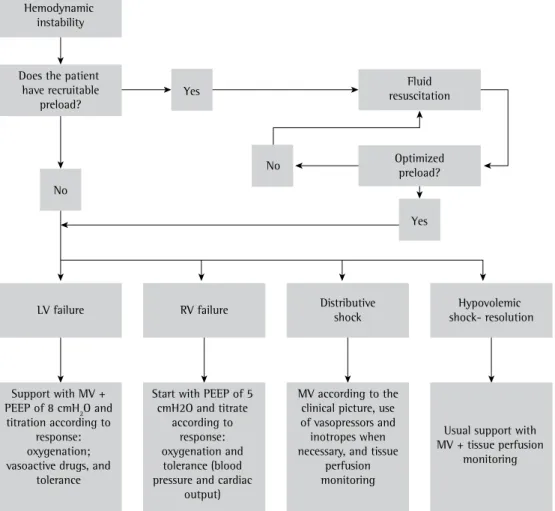
Suggestion - Details regarding monitoring, treatment, and specific care are shown in Chart 9 and Figure 2.
Resources available for hemodynamic
monitoring in mechanically ventilated
patients
Suggestion - Suggested methods of hemo-dynamic monitoring in MV patients include predicting the response to fluid loading (a > 15% increase in the cardiac index) in patients with the following characteristics: PEEP < 10 cmH2O; Vt of 8-10 mL.kg-1 ideal body weight; f < 30 min-1; respiratory compliance > 30 mL.cmH2O; no arrhythmias; no respiratory effort; no cor pulmonale; delta pulse pressure > 13%; systolic volume variation > 10%; delta velocity time integral > 15%; superior vena cava collapsibility
Hemodynamic care in mechanically
ventilated patients
Recommendation - Resuscitation aimed at
restoration of tissue perfusion begins in the early acute phase, in which resuscitation should be performed as soon as possible to achieve mixed venous O2 saturation (SvO2) > 65% or central venous saturation (SvcO2) > 70%, blood lactate concentration < 2 mmol/L (18 mg/dL), and adequacy of DO2/VO2.(132-135) The process should continue in the post-resuscitation phase (when adequate tissue perfusion is achieved), and fluid restriction should be performed to maintain a zero or negative fluid balance.(136)
Suggestion - In ARDS patients receiving
PEEP ≥ 15 cmH2O and < 20 cmH2O, perform echocardiography at least once and, if necessary, monitor cardiac output.(137,138) In ARDS patients receiving PEEP ≥ 20 cmH2O or experiencing hemodynamic instability, perform monitoring with serial echocardiography and/or with a volumetric PAC, if available.(137,138)
Suggestion - During MRS with decremental
PEEP titration, use invasive blood pressure moni-toring; perform echocardiography after 6 hours, or earlier if the patient exhibits hemodynamic instability, to assess RV dysfunction. (137,138)
Suggestion - In moderate/severe ARDS,
consider extravascular lung water monitoring (if available).(139,140)
Suggestion - Avoid systemic systemic
vaso-dilators in refractory hypoxemia (they inhibit hypoxic vasoconstriction).(141)
Suggestion - Interpret SvO2 by considering
PaO2. High PaO2 values can increase SvO2.(142)
Mechanical ventilation in patients with
left ventricular failure
Recommendation - For the diagnosis of left ventricular (LV) failure, use Doppler
Chart 8 - Cardiovascular effects of positive pressure mechanical ventilation.
Hemodynamic effect of positive pressure
ventilation
Likely effect on cardiac output Preload
dependent dependentAfterload
RV Decreases preload
↓
↓
Increases afterload
LV Decreases preload
↓
↑
Decreases afterload
> 36%; and inferior vena cava distensibility > 18%. (153,154) Also perform the expiratory port occlusion maneuver – in spontaneously breathing patients receiving PEEP ≤ 10 cmH2O,(155) with a delta central venous pressure > 1 mmHg (1.36 cmH2O).(156) In patients receiving high PEEP and/or low Vt, passive leg raising maneuver,(157) fluid challenge with small aliquots of fluid (250 mL), and cardiac index monitoring can be used (Figure 2).(158)
Speech-language pathology care in
the rehabilitation of patients after
mechanical ventilation
comment - The role of speech-language
pathologists in the ICU is endorsed by Resolution-RDC 07/2010 of the Brazilian Agência Nacional de Vigilância Sanitária (ANVISA, National Health Oversight Agency). In dysphagia, the role of speech-language pathologists in the ICU is
Hemodynamic instability Does the patient
have recruitable preload?
No
No Yes
Yes
RV failure
LV failure Distributiveshock
Fluid resuscitation
Hypovolemic shock- resolution Optimized
preload?
Support with MV + PEEP of 8 cmH2O and titration according to
response: oxygenation; vasoactive drugs, and
tolerance
Start with PEEP of 5 cmH2O and titrate
according to response: oxygenation and tolerance (blood pressure and cardiac
output)
MV according to the clinical picture, use of vasopressors and inotropes when necessary, and tissue
perfusion monitoring
Usual support with MV + tissue perfusion
monitoring
Figure 2 - Hemodynamic management algorithm in mechanically ventilated patients. LV: left ventricular; RV: right ventricular; MV: mechanical ventilation; PEEP: positive end-expiratory pressure.
Chart 9 - Suggestions for monitoring, treatment, and specific care in patients with right ventricular failure.(146,148-152)
Perform monitoring with a PAC (a volumetric PAC, if available).(148)
Prevent hypervolemia (reverse Bernheim effect), promote a negative fluid balance.(149)
Favor the use of a low PEEP (< 10cmH2O) and a Vt of 6 mL/kg predicted weight or lower.(149)
Prevent hypoxemia (it increases pulmonary vascular resistance caused by hypoxic vasoconstriction).(149)
Prevent severe hypercapnia (it increases RV afterload).(150)
Consider using dobutamine at low doses (to prevent tachycardia) or milrinone.(149)
Use nitric oxide/sildenafil testing associated with monitoring with a PAC or transthoracic echocardiography. In centers where nitric oxide is unavailable, a therapeutic trial of sildenafil can be used.(151)
Avoid abrupt withdrawal of inhaled nitric oxide.(152)
Consider kidney ultrafiltration for achieving a negative fluid balance in situations of refractoriness to diuretics.(146)
and/or in the saliva swallowing test, to evaluate the occurrence of discharge of blue saliva and/or secretions through the tracheostomy, character-izing an aspiration event.(176-178)
Suggestion - Assess for signs and symptoms
of dysphagia during the delivery of oral nutrition, especially those that may be associated with bronchial aspiration, such as choking, cough, and wet voice.(179-181)
Suggestion - Discuss with the medical team the use of xerostomic medications in patients on MV and/or with tracheostomy who do not tolerate cuff deflation or who experience signifi-cant aspiration of saliva.(182)
Suggestion - Perform direct and indirect
swal-lowing therapy in patients who have dysphagia and/or are at risk for aspiration.(183)
Nursing care in patients receiving
invasive or noninvasive ventilatory
support
Comment - The nursing team, as part of the multidisciplinary ICU team, actively participates in the administrative and healthcare activities involving invasive and noninvasive support in MV patients.
Care of circuits, filters, and humidifiers
Recommendation - Maintain the lower airways warm and moist during MV.
Recommendation - Replace (hygroscopic
and hydrophobic) heat and moisture exchangers every 7 days, provided that appropriate height and positioning of the devices relative to the endotracheal tube are maintained (the devices should be connected vertically to the tube and the circuit so that they are not flooded with droplets and dirt). If there is dirt, condensation, or damage, the filter should be replaced.(184)
Recommendation - Do not replace the
mechanical ventilator circuit routinely; replace it only when there is dirt visible to the naked eye, when there is damage, or in cases of prolonged ventilation (> 30 days).(185,186)
Cleaning and maintenance of the
equipment
Recommendation - Mechanical ventilator
circuits require high-level disinfection (5% sodium regulated by Resolution 356 of the Brazilian
Federal Speech-Language Pathology Council, passed on December 6, 2008, and published in the Diário Oficial da União (Official Federal Government Gazette) on December 9, 2008. In a multidisciplinary team, the speech-language pathologist evaluates the safety of oral feeding/ swallowing and manages swallowing difficulties, thereby contributing to the prevention of aspiration pneumonia and to the tracheostomy weaning process.
Suggestion - Request a speech-language pathology evaluation(159-165) for all patients who required OTI ≥ 48 hours, for patients who underwent repeated OTI, and for those with tracheostomy (whether or not they are mechani-cally ventilated).
Recommendation - Regarding the timing for speech-language pathology evaluations after extubation, it is recommended that patients be evaluated 24(166) to 48 hours after extubation and that those who have dysphagia and are at risk for aspiration be started on speech therapy.(167-171)
Suggestion - Do NOT perform speech-language therapy in orotracheally intubated patients, because there is a lack of clinical evidence regarding its benefits to the swallowing function; however, early identification of patients who, even during OTI, have several associated risk factors that may compromise swallowing dynamics (patients with cardiovascular disease, patients with Parkinson’s disease, post-stroke patients, and patients with dementia) is indicated.
Suggestion - Perform clinical speech-language evaluations (structural and functional) at the bedside(163,172) and determine the need for instru-mental examination of swallowing (functional nasal fiberoptic endoscopy and modified barium swallow test).(173)
Suggestion - The speech-language
patholo-gist should define the type of food consistency and the need for the use of thickeners for the administration of fluids, in collaboration with the Nutrition Service, when the patient is ready to initiate oral intake.
Suggestion - Fit a speaking valve into the
mechanical ventilator circuit or directly into the tracheostomy, with the aid of a physical therapist and/or a physician, provided that cuff deflation is feasible and patient tolerance is assessed.(174,175)
homogeneously distributed in the trachea. Pay attention to lesions in the oral cavity, in the corners of the lips, and on the face.(194)
Recommendation - The precautions to be followed during patient repositioning and while tilting the patient laterally in a bed bath are described in Chart 10.(195)
Recommendation - In patients being placed
in the prone position, it is recommended that the procedure be performed in the presence of at least five members of the ICU team, including at least one physician and one nurse. The skin of the frontal region, nose, knees, iliac crest, genitalia, and nipples should be protected. Patient rotation should be performed in two steps, with total attention being paid to the invasive devices. The dorsal electrocardiogram should be monitored, and the reverse Trendelenburg position may be used to decrease facial edema.(194,195)
Recommendation - Use a closed suctioning
system to perform tracheal suctioning in hemodynamically unstable patients, in order to prevent desaturation in at-risk patients (i.e., patients with cardiovascular disease) and to maintain alveolar recruitment and prevent atelectasis in ARDS patients receiving PEEP ≥ 10 cmH2O. The system should be changed every 7 days. Closed suctioning systems have not been shown to reduce the occurrence of ventilator-associated pneumonia, mortality, or ICU length of stay, when compared with open systems.(196)
Specific instructions for oral hygiene,
oral feeding, and enteral feeding
Recommendation - It is recommended that oral hygiene with brushing be performed every 12 hours, with an aqueous solution containing 0.12% chlorhexidine gluconate. In the intervals, oral hygiene should be performed with distilled or filtered water and/or alcohol-free mouthwash four times/day.(196-198)
Recommendation - Check the cuff pressure
of the endotracheal tube or tracheostomy before performing oral hygiene.(189)
Recommendation - The gastric and
post-pyloric routes can be used for enteral feeding in MV patients, with post-pyloric tube placement being reserved for patients with gastric intolerance and/or contraindication.(200)
Recommendation - Secure the nasogastric tube with a securing device (a commercially available nasal bridle or an adhesive device) in hypochlorite and a contact time of 60 minutes)
or sterilization.(187)
Precautions during bed bath and
patient repositioning
Recommendation - Assess the vital signs,
analyze and record the MV parameters (ventilation mode, peak pressure, PEEP, f, Vt, and FIO2), and check the alarms and clinical parameters before a bed bath and before patient repositioning. Continue cardiac monitoring and SatO2 monitoring during the bed bath and during patient repositioning. Allow a 5- to 10-minute equilibrium period before determining hemodynamic intolerance/ instability due to patient repositioning and/or a bed bath.(188,189)
Recommendation - Work with the
multidisciplinary team to determine the most appropriate time to perform a bed bath in critically ill, clinically unstable patients. The nurse should assess the patient before allowing the bath, postponing it in cases of severity that can compromise patient safety.
Recommendation - Perform patient repositioning every 2 hours, with a lift sheet and at least two nursing professionals.(190)
Suggestion - Perform continuous lateral rotation therapy with the use of a bed for kinetic therapy, when available.(191)
Recommendation - Maintain the head of
the bed between 30º and 45º in MV patients. The evidence is conflicting as to aspiration of gastric content (45º) and pressure ulcers (30º). Positioning at 30° is preferred as long as it does not pose risks to or cause conflict with medical and nursing procedures.(192)
Suggestion - Use the beach chair position 2 to 4 times/day; it requires less personnel than do other interventions and therefore allows early mobility of ICU patients and improvement in pulmonary function.(193)
Recommendation - Maintain the cuff pressure
of the endotracheal tube between 18 and 22 mmHg or between 25 and 30 cmH2O (cuff meter) in order to prevent air leaks without excessive compression of the tracheal mucosa. Avoid cuff pressures > 22 mmHg or 30 cmH2O. Check the cuff pressure at least 4 times/day and before performing oral hygiene.