TÍTULO
Nome completo do Candidato
Subtítulo
Dissertação / Trabalho de Projeto / Relatório de
Estágio apresentada(o) como requisito parcial para
obtenção do grau de Mestre em Estatística e Gestão
de Informação
PROCESS VIRTUALIZATION THEORY (PVT)
AND INSTITUTIONAL THEORY (INT) TO
EXPLAIN SAAS ADOPTION
Sara Cristina dos Santos Tomás
ii
Instituto Superior de Estatística e Gestão de Informação Universidade Nova de Lisboa
PROCESS VIRTUALIZATION THEORY (PVT) AND INSTITUTIONAL
THEORY (INT) TO EXPLAIN SAAS ADOPTION
por
Sara Cristina dos Santos Tomás
Dissertação apresentada como requisito parcial para a obtenção do grau de Mestre em Gestão de Informação, Especialização em Gestão de Sistemas e Tecnologias de Informacão
Orientador: Prof. Doutor Tiago André Gonçalves Félix de Oliveira
Novembro de 2014
iii
ACKNOWLEDGEMENTS
The conclusion of this dissertation was only possible with the help, from the people around me, to whom I would like to thank.
First of all I would like to express my foremost and sincere thanks to Professor Tiago Oliveira for his regular feedback, never-ending availability, continuous encouragement and valuable guidance, which have been essential in the development of this project successfully.
I am also grateful to Professor Manoj Thomas for his valuable comments and precious help.
I express my thanks to ISEGI for providing me necessary conditions to conduct my research and all my professors for valuable teaching, which inspired me to explore new themes.
To all my friends, thanks for your supportive attitudes, not only during this work, but also during other life stages.
I would like to thank my parents and brother for their endless support throughout this journey, with all the love and comprehension. A special thanks to my mum who always emphasized the importance of education and encouraged me to achieve my goals.
iv
SUBMISSION
SUBMISSION RESULTING FROM THIS DISSERTATION
PAPERS:
v
ABSTRACT
Software as a service (SaaS) is a service model in which the applications are accessible from various client devices through internet. Several studies report possible factors driving the adoption of SaaS but none have considered the perception of the SaaS features and the pressures existing in the organization’s environment. We propose an integrated research model that combines the process virtualization theory (PVT) and the institutional theory (INT). PVT seeks to explain whether SaaS processes are suitable for migration into virtual environments via an information technology-based mechanism. INT seeks to explain the effects of the institutionalized environment on the structure and actions of the organization. The research makes three contributions. First, it addresses a gap in the SaaS adoption literature by studying the internal perception of the technical features of SaaS and external coercive, normative, and mimetic pressures faced by an organization. Second, it empirically tests many of the propositions of PVT and INT in the SaaS context, thereby helping to determine how the theory operates in practice. Third, the integration of PVT and INT contributes to the information system (IS) discipline, deepening the applicability and strengths of these theories.
KEYWORDS
vi
RESUMO
Software as a service (SaaS) é um modelo de serviço onde as aplicações são acedidas a partir de diversos dispositivos cliente através da internet. Vários estudos reportam possíveis fatores que influenciam a adoção do SaaS mas nenhum considerou a percepção das características de SaaS e as pressões existentes no ambiente da organização. Neste trabalho propomos um modelo de pesquisa integrado que combina a teoria de virtualização de processos (PVT) e a teoria institucional (INT). A PVT procura explicar se os processos são propícios de migrarem para ambientes virtuais através de um mecanismo baseado em tecnologia de informação. A INT procura explicar os efeitos de um ambiente institucionalizado sobre a estrutura e as acções da organização. A nossa pesquisa faz três contribuições. Em primeiro lugar, aborda uma lacuna na literatura sobre a adopção do SaaS, ao estudar a influência das características técnicas do SaaS e a presença das pressões coercivas, normativas e miméticas no meio ambiente da organização. Em segundo lugar, representa o primeiro estudo empírico de muitas das proposições da PVT e INT no contexto do SaaS, contribuindo assim a determinar como a teoria funciona na prática. Em terceiro lugar, a integração da PVT e INT contribui para a disciplina de sistema de informação (SI) ao aprofundar a aplicabilidade e os pontos fortes destas teorias.
PALAVRAS-CHAVE
vii
TABLE OF CONTENTS
1. Introduction ... 1
2. Theoretical Background ... 3
2.1 Software as a service... 3
2.2 Process Virtualization Theory ... 6
2.3 Institutional Theory ... 7
3. Research model and hypotheses ... 9
3.1 PVT Constructs ... 9
3.2 INT Constructs ... 10
3.3 Adoption Stages ... 12
3.4 Control Variables ... 12
4. Research methodology ... 13
4.1 Measurement ... 13
4.2 Data ... 13
5. Results and discussion... 15
5.1 Results ... 15
5.1.1 Measurement Model ... 15
5.1.2 Structural Model ... 17
5.2 Discussion ... 18
5.2.1 Practical implications ... 21
5.2.2 Theoretical implications ... 22
6. Conclusion ... 24
7. Limitations and future research ... 25
8. References ... 26
9. Appendix ... 32
viii
LIST OF FIGURES
ix
LIST OF TABLES
Table 2.1 - Benefits and obstacles of SaaS adoption ... 4 Table 2.2 - SaaS adoption studies published in peer reviewed journals ... 6 Table 4.1 - Sample characteristics (N=259) ... 14 Table 5.1 - Correlation matrix, means, standard deviations square root of AVE (shown
x
ABBREVIATIONS AND ACRONYMS LIST
AHP Analytic Hierarchy Process
AVE Average Variance Extracted
CBSEM Covariance-Based Structural Equation Modeling
CP Coercive Pressures
CR Composite Reliability
CRM Customer Relationship Management
DEMATEL Decision Making Trial and Evaluation Laboratory
DOI Diffusion of Innovation
DTM Diffusion Theory Model
ERM Enterprise-Resource Management
FEDI Financial Electronic Data Interchange
FS Firm Size
IdM Identity Management
INT Institutional Theory
IS Information Systems
IT Information Technology
K–S Kolmogorov–Smirnov
Monit Monitoring
MP Mimetic Pressures
NP Normative Pressures
PLS Partial Least Squares
PVT Process Virtualization Theory
RBV Resource-Based View
Rep Representation
RST Rough Set Theory
SaaS Software as a service
SEM Structural Equation Modeling
TAM Technology Acceptance Model
TCT Transaction Cost Theory
TPB Theory of Planned Behavior
1
1.
INTRODUCTION
Software as a service (SaaS) represents a service model in which software applications are hosted centrally and made accessible via internet through various client devices. Adoption of SaaS continues to grow, with an estimated compound annual growth rate of 11% through 2016 (Gartner, 2012b) and are projected to reach 22.1 billion USD by the end of 2015 (Gartner, 2012a). The SaaS phenomenon has attracted the attention of information systems (IS) researchers, information technology (IT) professionals, and practioners (Benlian & Hess, 2011).
Within the last decade, some empirical studies have sought to determine what it is that influences firms to adopt SaaS. However, the studies mainly focus on the internal factors of an organization and do not consider the internal perception of the SaaS’ features, and the external pressures felt by the organization. We propose an integrated model that combines the process virtualization theory (PVT) and institutional theory (INT) to fill this gap. The PVT helps to understand how SaaS could increase the ability for organizations to collaborate virtually, i.e., processes that were delivered face-to-face could be conducted virtually via Internet (Overby, 2008). The INT helps us to analyze the impact of institutional forces on organizational actions related to the use of SaaS (Scott, 2001; Teo, Wei, & Benbasat, 2003).
2
3
2.
THEORETICAL BACKGROUND
2.1SOFTWARE AS A SERVICE
Software as a service (SaaS) is one of the three service models of cloud computing (Marston et al., 2011) characterized as a type of software delivery in which the software is hosted off-premises (Susarla et al., 2010), developed by service providers, accessed by customers over the Internet, and follows a subscription model (Espadas et al., 2013). From an economic viewpoint, SaaS essentially bundles software delivery with service (Fan et al., 2009). There is a wide range of SaaS applications, from productivity applications (e.g., word processing) to programs such as customer relationship management (CRM) and enterprise-resource management (ERM) (Sultan, 2011). SaaS is an evolution of the application service provider (ASP) model. ASP is based on a single-tenant architecture, in which software vendors are limited in their ability to share infrastructure and application code efficiently across their customers. Unlike ASP, SaaS is based on a multi-tenant architecture in which there is only a single instance of the common code and data definitions (Benlian and Hess, 2011; Kim et al., 2012). The interest in SaaS has been driven by several benefits, but the acknowledged risks still leave firms and researchers doubtful about whether to adopt it or not (Benlian and Hess, 2011; Wu et al., 2003; Wu, 2011a). The main benefits and obstacles regarding SaaS adoption are summarized in Table 2.1.
Benefits
Theme Description Source
Good user adaptation
It is easy to access, easy to use, and feature rich. It is not necessary to install and run the applications on the computer of the user and to
carry out the maintenance and support tasks.
(Zorrilla and García-Saiz, 2013)
Flexibility End user can access data and services via smartphones, laptops, and netbooks from
anywhere.
(Lin and Chen, 2012) Scalability Allows easily upscaling or downscaling as
required.
(Lin and Chen, 2012; Marston et
al., 2011) Cost
savings
Reducing or eliminating cost associated with “in
-house” provision (e.g., hardware, software, and
licensing fee) and the company pays for only the
(Benlian and Hess, 2011; Marston et
4
actual usage. Rohitratana and
Altmann, 2012) Business
opportuniti es
Low cost of entry represents an opportunity for small firms and third-world countries benefiting
from information technology.
(Marston et al., 2011) Sustainabili
ty
Improved resource utilization, more efficient systems, and carbon neutrality.
(Li et al., 2012; Sultan, 2010)
Obstacles
Theme Description Source
Latency Lack of constant and high-speed internet connections.
(Sultan, 2010) Lock-in Lack of standardization of application program
interfaces and platform technologies means that interoperability among platforms is poor and firms will not be able to transfer easily from one
cloud provider to another.
(Armbrust et al., 2010)
Lack of reliability
Unstable access to services. (Benlian and Hess, 2011; Sultan,
2010); Lack of
control
IT performance is controlled not by firm staff but off-premises cloud providers and may not be able
to make necessary changes in application features easily.
(Sultan, 2010)
Security Possible security breaches and improper protection of firm data.
(Armbrust et al., 2010; Benlian and
Hess, 2011) Table 2.1 - Benefits and obstacles of SaaS adoption
5
(technology acceptance model (TAM), unified theory of acceptance and use of technology (UTAUT), and theory of planned behavior (TPB)) that pertain to an individual level analysis and not to the firm level. Wu (2011a, b) suggests that (1) expert opinions about SaaS, (2) the need to improve their effectiveness and performance, and (3) security and data backups, are the most important determinants of SaaS use. Du et al. (2013) found that improvements in ease of use, reliability and responsiveness have more impact on user acceptance than improvements in security. Benlian, Hess, and Buxmann (2009) found that patterns of decisions on SaaS adoption vary between application types, and that IT user firms are influenced by expert opinions and peer pressure. In our research we develop a new integrative research model that combines variables from other theories used at the firm level and test the model with a representative sample.
Model theory Constructs (independent
variables) Methods
Data, and
context Source
Transaction cost theory (TCT), resource-based view (RBV), and theory of planned
behavior (TPB)
Attitude toward SaaS-adoption, subjective norm, application specificity, perceived uncertainty, strategic value, application inimitability Partial least squares (PLS)
297 IT executives in German firms (Benlian, Hess, & Buxman n, 2009) Opportunity-risk framework; Theory of reasoned action
Perceived risk of SaaS adoption, Perceived opportunities of SaaS adoption, performance
risks, economic risks, strategic risks, security risks, managerial risks, cost advantage, strategic
flexibility, focus on core competencies, access to specialized resources, quality improvements
PLS 349 IT
executives in German firms (Benlian & Hess, 2011) Technology acceptance model (TAM) and diffusion theory model (DTM)
Marketing efforts, social influence, perceived benefits, attitude toward
technology innovations, security and trust, perceived usefulness,
6
perceived ease of use, behavioral intention TAM and DTM Social influence, perceived
benefits, attitude toward technology innovations
security and trust, perceived usefulness, perceived ease of use, behavioral intention Rough set theory (RST) 246 IT/MIS managers in Taiwan firms (W.-W. Wu, 2011b) Decision making trial and evaluation laboratory (DEMATEL)
Case study Case study One company in Taiwan (Wei-Wen Wu, Lan, & Lee, 2011) TAM and unified
theory of acceptance and use of technology
(UTAUT)
Ease of use, security, reliability, responsiveness, social influence, perceived
usefulness, behavioral intention to use
covarianc e-based structural equation modeling (CBSEM) 2931 responden
ts from a single
SaaS provider
(Du, Lu, Wu, Li, &
Li, 2013)
Analytic hierarchy process (AHP) –
matrix analysis
16 drivers and 16 inhibitors
PEST analysis
24 IT consultant s in Korean firms (Lee, Chae, & Cho, 2013) Table 2.2 - SaaS adoption studies published in peer reviewed journals
2.2PROCESS VIRTUALIZATION THEORY
The PVT was designed with the aim of explaining what factors affect the virtualization of a process. The dependent variable of this theory is process virtualization, which represents how suitable a process is to conduct in a virtual
environment. Overby (2008) defined a process as “a set of activities to achieve an objective”, a physical process as “a process that involves physical interaction between people or between people and objects,” and a virtual process as “a process in which
physical interaction between people and/or objects has been removed.” The definition of “virtual” can be confused with the term virtualization used in system architecture
7
PVT proposes three IT characteristics related to the virtualization mechanism: representation, reach, and monitoring capability. The key premise of this theory is that IT can be used to make a process more amenable to virtualization by helping to satisfy the requirements, i.e., IT may moderate the relationship between the variables that characterize a process and the dependent variable. Representation refers to IT capacity to simulate the sensory elements of the physical world by providing information with which process participants can interact. Reach is the IT capacity to (1) allow the participation of people located around the world in the process and (2) help join people with similar or complementary interests, and in this way, help to develop the relationship between them. Monitoring specifies the IT capacity to authenticate the process participations, each with a unique identity, and track their actions (Overby, 2008, 2012). In addition to these variables, the theory proposes four variables about process characteristics (sensory requirements, relationship requirements, synchronism requirements, and identification and control requirements). These were not considered in this study as the research question we address is the evaluation of factors that guide the adoption of SaaS. We therefore focus on technological characteristics in order to evaluate whether SaaS is a good virtualizable mechanism independent of the effect of process characteristics.
2.3INSTITUTIONAL THEORY
The institutional theory (INT) addresses the central question of why all organizations in a given area are similar. INT suggests that they become more similar due to isomorphic and legimiticy pressures (Dimaggio and Powell, 1983). The core concept of institutional theory is the manner in which organizations adopt structures, procedures, or ideas based not only on rational goals of efficiency, but also on social and cultural factors, and concerns for legitimacy (Dimaggio and Powell, 1983). For example, rather than making a purely internally driven decision to adopt SaaS, organizations are likely to be induced to adopt and use SaaS by external isomorphic pressures from government, competitors, trading partners, and customers (Oliveira and Martins, 2011).
8
9
3.
RESEARCH MODEL AND HYPOTHESES
The integrative research model that we propose brings together two theoretical perspectives - the PVT and the INT. The constructs of PVT theory are incorporated to assess SaaS as a virtualization mechanism to explain its adoption. PVT theory suggests that IT plays a key role in making the SaaS process more suitable for virtualization, and may influence the intention for adoption. In earlier studies, similar variables were used to explain behavioral intention to adopt new technology (Dua et al., 2013; Wu, 2011a, b). The constructs from the INT theory are used to evaluate whether the intention to
adopt SaaS is influenced by the pressures in the organization’s environment. It is also
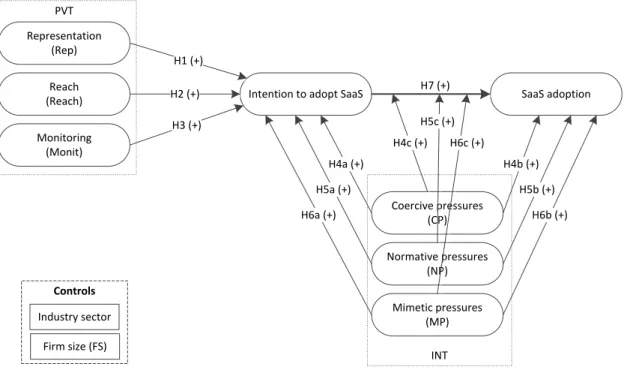
used to assess how they impact the different stages of adoption, and determine if they are a moderator between intention and adoption. The INT theory is also used to evaluate if the intention to adopt SaaS is stronger among firms with higher levels of these pressures. The research model is shown in Figure 3.1.
Intention to adopt SaaS H7 (+) SaaS adoption PVT
INT Coercive pressures
(CP)
Normative pressures (NP)
Mimetic pressures (MP) Representation
(Rep)
Reach (Reach)
Monitoring (Monit)
H1 (+)
H2 (+)
H3 (+)
H4a (+) H5a (+)
H6a (+) H6b (+)
H5b (+) H4b (+) H4c (+)
H5c (+) H6c (+)
Controls Industry sector
Firm size (FS)
Figure 3.1 - The research model
3.1PVTCONSTRUCTS
10
characteristics that process participants would otherwise learn through physical process inspection. Representation capability of SaaS simulates sensory elements of the physical world, especially the senses of sight and sound. This suggests that when firms perceive a high fit between their requirements and representation capability of SaaS, their intention to adopt SaaS will increase. Thus,
H1: The representation capability of SaaS positively influences the intention to adopt SaaS.
Reach refers to IT capacity to allow process participation across time and space (Overby, 2008). SaaS enables participation of many individuals anywhere in the world to collaborate virtually at the same time, and provides additional opportunities for relationship development that otherwise would not exist. Therefore, firms have the possibility to manage their process more efficiently, even if their SaaS service provider is physically distant. This suggests that if firms perceive a high fit between their requirements and reach capability of SaaS, their intention to adopt SaaS will increase. Hence,
H2: The reach capability of SaaS positively influences the intention to adopt SaaS. Monitoring refers to the IT capacity to allow authentication and activity tracking (Overby, 2008). SaaS contains features related to (1) authentication that facilitates the identification of credentials on the system; (2) access rights management that controls which tasks participants are authorized to conduct, and (3) recording of participant activity, which facilitates audit trails. Thus, SaaS provides tools to firms to effectively
control their users’ access and activity. This suggests that if firms perceive a high fit
between their requirements and monitoring capability of SaaS, their intention to adopt SaaS will increase. Therefore,
H3: The monitoring capability of SaaS positively influences the intention to adopt SaaS.
3.2INTCONSTRUCTS
11
when key organizations that they depend on already use it or stimulate its use, they are more likely to adopt SaaS. This suggests that if firms face a high level of coercive pressures, their intention to adopt SaaS and the adoption of SaaS will increase. Thus,
H4a: Coercive pressures positively influence the intention to adopt SaaS. H4b: Coercive pressures positively influence the adoption of SaaS.
H4c: Coercive pressures moderate the intention to adopt SaaS and SaaS adoption, such that the effect will be stronger among firms with higher levels of coercive pressures.
Normative pressures are derived from dyadic relationships in which organizations share information, rules, and norms. Sharing these norms will be create patterns of actions for similar situations, facilitate consensus, and increase the strength of these norms and their potential influence on organizational behavior (Dimaggio and Powell, 1983). Attitudes, behaviors, and long standing practices by organizations in the same
social context become legitimized as the ‘right’ way, and often as the ‘only’ way to do
things (Harcourt et al., 2005; Johnson et al., 2006). The main vehicles of definition and promulgation of normative rules are education, and professional and trace association (Dimaggio and Powell, 1983). This suggests that if firms face a high level of normative pressures, their intention to adopt SaaS and the adoption of SaaS will increase. Therefore,
H5a: Normative pressures positively influence the intention to adopt SaaS. H5b: Normative pressures positively influence the adoption of SaaS.
H5c: Normative pressures moderate the intention to adopt SaaS and SaaS adoption, such that the effect will be stronger among firms with higher levels of normative pressures.
Mimetic pressures occur when organizations voluntarily and consciously copy practices of other successful organizations (Dimaggio and Powell, 1983) in the belief that actions taken by successful organizations will be more likely to result in positive outcomes. In addition, through imitating, organizations minimize search costs and experimentation costs (Teo et al., 2003), and reduce risks inherent to being the first-movers (Lieberman and Montgomery, 1988). If firms perceive better results from organizations that have already adopted SaaS, they are more likely to adopt SaaS. This suggests that if firms face a high level of mimetic pressures, their intention to adopt SaaS and the adoption of SaaS will increase. Hence,
12
H6c: Mimetic pressures moderate the intention to adopt SaaS and SaaS adoption, such that the effect will be stronger among firms with higher levels of mimetic pressures.
3.3ADOPTION STAGES
Intention to adopt SaaS is the first stage of the diffusion model. In this stage a firm evaluates the potential benefits of the new technology and signals the intention of using it prior to actual adoption (Chan and Chong, 2013). According to diffusion of innovation (DOI) theory, the diffusion of technology occurs in stages (Rogers, 1995). It represents the decision making process that may lead to the routine use of the technology within the firm. The intention to adopt stage is followed by the actual adoption, when a firm decides to use the new technology and allocate resources to acquire it. This stage of adoption is influenced by the pre-stage of intention to adopt. Thus,
H7: Intention to adopt SaaS positively influences the adoption of SaaS.
3.4CONTROL VARIABLES
13
4.
RESEARCH METHODOLOGY
4.1MEASUREMENT
To test the theoretical constructs we conducted a survey in Portugal. Survey items and scales were adapted from Overby (2008), Liang, Saraf, Hu, and Xue (2007) and Chang and Chong (2013). The constructs were measured using a seven-point Likert scale on an interval level ranging from "disagree" to "agree" for PVT constructs, and "strongly disagree or very low" to "strongly agree or very high" for INT constructs. The items of constructs are presented in Appendix A. Since the survey was administered in Portugal, the English version of the instrument was translated to Portuguese and then back to English to ensure the translation equivalence. A group of five established academic IS researchers and two language experts reviewed the instrument for content validity (Brislin, 1970). To test the instrument, a pilot study was conducted among 30 firms that were not included in the main survey. The results of the pilot study provided evidence of the reliability and validity of the scales, and helped to determine whether the respondents had difficulty in answering the survey.
4.2DATA
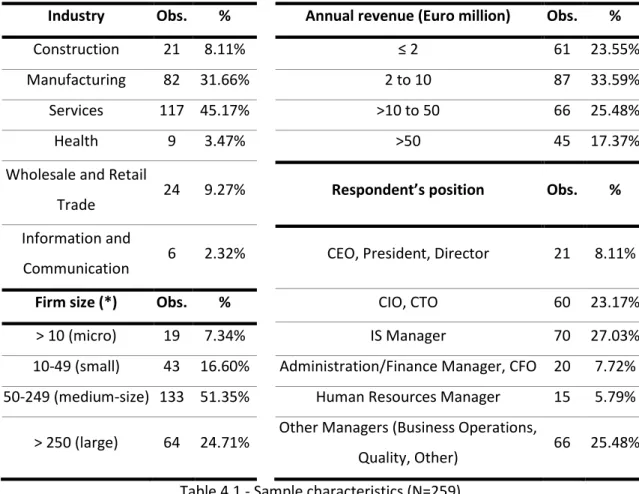
An online version of the survey was emailed to 2000 firms in Portugal. We use the company and contact data provided by Dun & Bradstreet, the world's leading source of commercial information and insight on businesses. The respondents were qualified individuals (e.g. CEO, CIO, and business managers) who are most involved and knowledgeable about SaaS. To help the respondents understand the survey, we provided a clear description of SaaS and gave examples. To encourage participation and reduce self-reporting bias, we gave all participants the opportunity to receive findings of the study, as well as a report comparing their firm to other firms of similar profile. A follow up email was sent to non-respondents after two weeks. Data were collected in early 2014. A total of 259 usable responses (168 early respondents and 91 late respondents) were obtained at the end of eight weeks, yielding a response rate of 13.0%. The sample covered varying types of business and represented micro, small, medium, and large companies. The largest sub-section of respondents were from medium-size companies of the services sector with an annual revenue from 2 - 10 Mn
14
Industry Obs. % Annual revenue (Euro million) Obs. %
Construction 21 8.11% ≤ 2 61 23.55%
Manufacturing 82 31.66% 2 to 10 87 33.59%
Services 117 45.17% >10 to 50 66 25.48%
Health 9 3.47% >50 45 17.37%
Wholesale and Retail
Trade 24 9.27% Respondent’s position
Obs. %
Information and
Communication 6 2.32% CEO, President, Director 21 8.11%
Firm size (*) Obs. % CIO, CTO 60 23.17%
> 10 (micro) 19 7.34% IS Manager 70 27.03%
10-49 (small) 43 16.60% Administration/Finance Manager, CFO 20 7.72%
50-249 (medium-size) 133 51.35% Human Resources Manager 15 5.79%
> 250 (large) 64 24.71% Other Managers (Business Operations, Quality, Other)
66 25.48%
Table 4.1 - Sample characteristics (N=259)
To test for non-response bias, we compare the sample distribution of the early and late respondent groups by using the Kolmogorov–Smirnov (K–S) test (Ryans, 1974). The sample distributions of the two independent groups did not differ statistically (Ryans, 1974). This demonstrates an absence of non-response bias.
15
5.
RESULTS AND DISCUSSION
5.1RESULTS
Structural equation modeling (SEM) was used to empirically assess the research model. There are two families of SEM techniques: covariance-based techniques, as represented by LISREL, and variance-based techniques, of which partial least squares (PLS) path modeling is the most representative (Henseler et al., 2009). As all measurement items are not distributed normally (p<0.001) based on the Kolmogorov–
Smirnov’s test, and the research model is in an early stage of development and has not
been tested before, PLS is the most adequate method (Hair et al., 2011; Hair et al., 2012). For PLS estimation the minimum sample size needs to be ten times the largest number of formative indicators used to measure one construct; or ten times the largest number of structural paths directed at a particular latent construct in the structural model (Hair et al., 2011; Wu, 2011b). The sample in our study involved 259 firms, thus meeting the necessary conditions for using PLS. Smart-PLS software (Ringle et al., 2005) with a two-step modeling approach is used to evaluate the research model. We assess the reliability and validity of the measurement model, and then analyze the structural model to evaluate the research model (Anderson and Gerbing, 1988).
5.1.1 Measurement Model
16
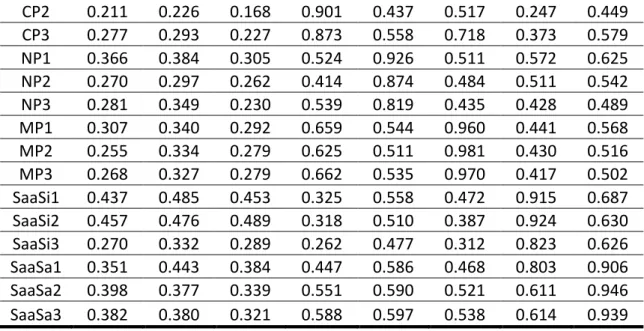
than the correlation between each of the pair factors, satisfying this criterion. The second measure requires that the loading of each indicator should be greater than all cross-loadings. As can be seen in Table 5.2, this criterion is also satisfied. The evaluation of constructs reliability, indicator reliability, convergent validity, and discriminant validity are satisfactory, indicating that the constructs can be used to test the research model.
Mea
n SD AVE CR Rep Reach Mon
it CP NP MP
SaaS i
SaaS a
Rep 4.306 1.413 0.78 5
0.93 6
0.8 86
Reach 4.614 1.352 0.83 4
0.93 8
0.60
2 0.913 Monit 4.751 1.387 0.85
8
0.96 0
0.74
9 0.661
0.92 6
CP 2.584 1.478 0.80 1
0.92 4
0.26
8 0.299 0.21 6
0.8 95
NP 3.035 1.297 0.76 4
0.90 6
0.35
2 0.393 0.30 6
0.56
1 0.874 MP 2.960 1.421 0.94
1
0.98 0
0.28
6 0.344 0.29 3
0.66
9 0.547
0.97 0
SaaSi 3.605 1.570 0.79 0
0.91 8
0.44
1 0.489 0.46 6
0.34
1 0.581 0.44 3
0.88 9
SaaSa 2.934 1.695 0.86 6
0.95 1
0.40
5 0.431 0.37 5
0.56
7 0.636 0.54 7 0.73 0 0.93 1
Table 5.1 - Correlation matrix, means, standard deviations square root of AVE (shown in bold at diagonal), and CR
Rep Reach Monit CP NP MP SaaSi SaaSa
17
CP2 0.211 0.226 0.168 0.901 0.437 0.517 0.247 0.449 CP3 0.277 0.293 0.227 0.873 0.558 0.718 0.373 0.579 NP1 0.366 0.384 0.305 0.524 0.926 0.511 0.572 0.625 NP2 0.270 0.297 0.262 0.414 0.874 0.484 0.511 0.542 NP3 0.281 0.349 0.230 0.539 0.819 0.435 0.428 0.489 MP1 0.307 0.340 0.292 0.659 0.544 0.960 0.441 0.568 MP2 0.255 0.334 0.279 0.625 0.511 0.981 0.430 0.516 MP3 0.268 0.327 0.279 0.662 0.535 0.970 0.417 0.502 SaaSi1 0.437 0.485 0.453 0.325 0.558 0.472 0.915 0.687 SaaSi2 0.457 0.476 0.489 0.318 0.510 0.387 0.924 0.630 SaaSi3 0.270 0.332 0.289 0.262 0.477 0.312 0.823 0.626 SaaSa1 0.351 0.443 0.384 0.447 0.586 0.468 0.803 0.906 SaaSa2 0.398 0.377 0.339 0.551 0.590 0.521 0.611 0.946 SaaSa3 0.382 0.380 0.321 0.588 0.597 0.538 0.614 0.939
Table 5.2 - Loadings and cross-loadings for the measurement model
5.1.2 Structural Model
The structure model was evaluated using R2 measures and the level of significance of the path coefficients. The results of the analysis are shown in Figure 5.1. The path significance level was assessed by bootstrapping method (Hair, Ringle, & Sarstedt, 2011; Henseler, Ringle, & Sinkovics, 2009) with 500 resamples (Chin, 1998).
Intention to adopt SaaS R2=48.4%
SaaS adoption R2=69.7% H7 (0.545***) PVT INT Coercive pressures (CP) Normative pressures (NP) Mimetic pressures (MP) Representation (Rep) Reach (Reach) Monitoring (Monit) H1 (0.095) H2 (0.132*) H3 (0.144*) H4a (-0.110) H5a (0.410***)
H6a (0.174**) H6b (0.029)
H5b (0.164***) H4b (0.258***) H4c (-0.015) H5c (0.102**) H6c (0.085*) Controls Industry sector
Firm size (FS)
Figure 5.1 - Results of research model 1
1
18
The research model explains 48.4% of variation in the intention to adopt SaaS. Hypotheses for reach (H2) (p<0.10), monitoring (H3) (p<0.10), normative pressures (H5a) (p<0.01), and mimetic pressures (H6a) (p<0.05) are confirmed to explain the intention to adopt SaaS. Representation (H1) and coercive pressures (H4a) hypotheses are not confirmed.
The research model explains 69.7% of variation in SaaS adoption. Hypotheses for coercive pressures (H4b) (p<0.01), normative pressures (H5b) (p<0.01), and intention to adopt SaaS (H7) (p<0.01) are statistically significant to explain SaaS adoption. The moderation effects of normative pressures (H5c) (p<0.05) is also statistically significant, indicating that normative pressures not only explain SaaS adoption directly, but also moderate the intention to adopt SaaS and SaaS adoption, i.e., intention to adopt SaaS leading to SaaS adoption is stronger among firms with higher level of normative pressures. Mimetic pressures (H6b) are not statistically significant to explain SaaS adoption directly, but the moderating effect of mimetic pressures (H6c) (p<010) is statistically significant, i.e., intention to adopt SaaS leading to SaaS adoption is stronger among firms with high level of mimetic pressures. The moderating effect of coercive pressures (H4c) is found to be not statistically significant. Overall, of the 13 hypotheses formulated, nine are confirmed by the data. We therefore conclude that the research model has good explanatory power.
5.2DISCUSSION
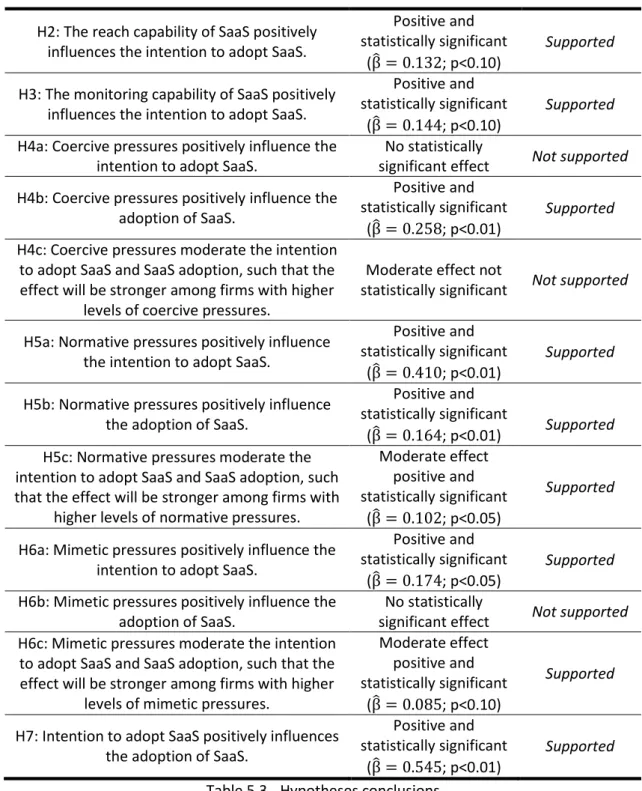
The goal of this study is to assess the determinants of SaaS adoption by using an integrative research model that combines the characteristics of the virtualization mechanism of SaaS and the pressures in the organization's environment. The results indicate that the intention to adopt SaaS is influenced by four factors: reach and monitoring capability of SaaS, and normative and mimetic pressures felt by the organization. The results also show that three factors influence the adoption of SaaS: intention to adopt SaaS, coercive pressures, and normative pressures (see Figure 5.1). Additionally, the intention to adopt SaaS leads to SaaS adoption among firms with higher normative and mimetic pressures (see Figure 5.1). Table 6.1 shows the outcomes of hypotheses tested.
Hypothesis Findings Conclusion
H1: The representation capability of SaaS positively influences the intention to adopt SaaS.
No statistically
19
H2: The reach capability of SaaS positively influences the intention to adopt SaaS.
Positive and statistically significant
( ; p<0.10)
Supported
H3: The monitoring capability of SaaS positively influences the intention to adopt SaaS.
Positive and statistically significant
( ; p<0.10)
Supported
H4a: Coercive pressures positively influence the intention to adopt SaaS.
No statistically
significant effect Not supported
H4b: Coercive pressures positively influence the adoption of SaaS.
Positive and statistically significant
( ; p<0.01)
Supported
H4c: Coercive pressures moderate the intention to adopt SaaS and SaaS adoption, such that the effect will be stronger among firms with higher
levels of coercive pressures.
Moderate effect not
statistically significant Not supported
H5a: Normative pressures positively influence the intention to adopt SaaS.
Positive and statistically significant
( ; p<0.01)
Supported
H5b: Normative pressures positively influence the adoption of SaaS.
Positive and statistically significant
( ; p<0.01) Supported H5c: Normative pressures moderate the
intention to adopt SaaS and SaaS adoption, such that the effect will be stronger among firms with
higher levels of normative pressures.
Moderate effect positive and statistically significant
( ; p<0.05)
Supported
H6a: Mimetic pressures positively influence the intention to adopt SaaS.
Positive and statistically significant
( ; p<0.05)
Supported
H6b: Mimetic pressures positively influence the adoption of SaaS.
No statistically
significant effect Not supported H6c: Mimetic pressures moderate the intention
to adopt SaaS and SaaS adoption, such that the effect will be stronger among firms with higher
levels of mimetic pressures.
Moderate effect positive and statistically significant
( ; p<0.10)
Supported
H7: Intention to adopt SaaS positively influences the adoption of SaaS.
Positive and statistically significant
( ; p<0.01)
Supported
Table 5.3 - Hypotheses conclusions
20
The analysis of results indicates that reach has a positive influence on the intention to adopt SaaS, suggesting that the capability of SaaS to allow the interaction between people, and facilitate collaboration and partnerships, positively influence the intention to adopt SaaS. Although no other studies have evaluated the reach capability of SaaS, earlier studies on cloud computing have found comparable results (Brown, 2013; Li et al., 2011; Stevenson and Hedberg, 2013). Gupta et al. (2013) found that small and medium enterprises prefer conventional methods for sharing and collaboration (e.g. face to face meetings, phone calls) instead of cloud based solutions. However, compared to other observations on technologies with virtualizable characteristics, we can conclude that reach is a facilitator for the intention to adopt SaaS.
Monitoring is also found to be a facilitator for the intention to adopt SaaS. The results of the study indicate that the ability to manage security issues related to authentication and activity tracking has a positive influence on the intention to adopt SaaS. The finding reported in literature regarding monitoring capability is mixed with regard to studies on other technologies with virtualizable characteristics. For instance, Oliveira et al. (2014) found that security does not inhibit the adoption of cloud computing. Dua et al. (2013) found that security has only an indirect positive impact on the behavioral intention to use SaaS due to perceived usefulness, (i.e., perception of SaaS as a secure service does not change user acceptance until they perceive its usefulness). A possible explanation for the concern regarding authentication and authorization is the recent advances in identity management (IdM) and sign-on processes, which are supported via independent IdM stack, credential synchronization, or federated IdM (Subashini and Kavitha, 2011). Additional research is needed to determine the impact of monitoring capability on the adoption of virtualizable technologies.
Coercive pressures have a positive influence on the adoption of SaaS. This type of pressure does not have an impact on the intention to adopt SaaS, nor does it moderate the transition from intention to adoption. This observation is similar to the findings reported in studies on the importance of coercive pressures on technological innovation adoption behavior (Jan et al., 2012). An explanation for the impact of coercive pressure on SaaS adoption may be that this type of pressure is mandatory, forcing firms to act, and not just disclosing the intention to do so.
21
intention to adoption of SaaS. This suggests that the intention to adopt SaaS and adoption of SaaS are greater in an environment with higher normative pressures and the effect of intention to adopt SaaS on SaaS adoption is stronger. All related hypotheses were confirmed. Despite the importance of normative pressures on IT adoption, few empirical studies have considered this construct. Our findings are consistent with studies that have reported them in the literature. For example, normative pressures were found to influence the e-business adoption (Wu et al., 2003), as well as the intention to adopt FEDI (financial electronic data interchange) (Teo et al., 2003). Our study thus highlights the importance of considering the role of normative pressures in future adoption studies.
Mimetic pressures have a positive influence on the intention to adopt SaaS, and
a positive moderating effect on the firm’s transition from intention to adoption of SaaS. However, they were not found to have a direct influence on the SaaS adoption stage. A plausible explanation is that this type of pressure, based on practice of imitating actions of other organizations, encourages firms to want to adopt, thus increasing their intention to adopt. Yet, as adoption is not mandatory, the organization does not continue to the next stage, which is the adoption of SaaS for routine use in the value chain activities. The finding confirms that intention to adopt SaaS is greater in an environment with higher mimetic pressures. The effect of intention to adopt SaaS on SaaS adoption is also greater in the presence of mimetic pressures. This observation is similar to the findings reported in the literature on IT adoption, in which mimetic pressures have a significant influence on the organizational intention to adopt FEDI (Teo et al., 2003), and positively affect top management beliefs, which then positively affect ERP assimilation (Liang et al. (2007).
The intention to adopt SaaS has a positive influence on the SaaS adoption. The findings confirm the link between the adoption stages of SaaS, i.e. the formal stage of adoption is influenced by their pre-stage of adoption, which is similar to other studies on technology adoption (Bose and Luo, 2011; Zhu et al., 2006b).
The implications of the study to practice and theory are summarized below.
5.2.1 Practical implications
22
SaaS and their external context that managers should consider prior to making informed SaaS decisions.
The findings indicate that SaaS features such as enabling interactions between processes participants, global reach, and monitoring capabilities make firms more amenable to support SaaS solutions and increase the intention to adopt SaaS. For SaaS providers, developing enhancements focused on these types of functionalities will make SaaS solutions more attractive as a good virtualizable mechanism, and therefore increase their potential market. Recent technological advances in the security domain (Mohammed, 2011; Ryan, 2013; Zissis and Lekkas, 2012) are promising developments that may be beneficial to both SaaS providers, as well as to firms considering SaaS solutions.
Coercive pressures and normative pressures play key roles in the firm’s adoption
of SaaS initiatives, while normative and mimetic pressures moderate the transition from intention to adoption of SaaS. For the successful adoption of SaaS, managers need to analyze and understand the effect of institutional pressures on the firm’s environment. With a better understanding of how these pressures may influence the behaviors or performances of competitors, firms can predict or understand their future market competition better and identify more market opportunities. Forces of the local government, industry association, and competitive conditions (coercive pressures) are important determinants of SaaS adoption. Thus, policy makers can play a vital role in developing adequate regulations and a legal base to assist organizations in the adoption of SaaS. Such regulations can instill the sense of confidence necessary for firms to consider the perceived benefits of SaaS over the risks, and to convert SaaS into global business opportunities. The extent of SaaS adoption by firm’s suppliers,
firm’s customers, and government’s promotion of IT (normative pressure) are
important considerations in the intention stage, adoption stage, and during the transition from intention to adoption. The perceived advantage that competitors gain from SaaS (mimetic pressures) may influence the intention, and the transition from intention to adoption. Thus, managers should pay careful attention to understanding how these kinds of pressures impact their organization and formulate appropriate strategies to stimulate SaaS adoption.
5.2.2 Theoretical implications
23
recommendations of earlier researchers to consider other theories for better understanding SaaS adoption, and include constructs beyond those already studied in earlier research (Benlian and Hess, 2011; Benlian et al., 2009; Chan and Chong, 2013; Lee et al., 2013). We integrate two theoretical perspectives (the PVT and the INT) to develop the research model. The model combines the virtualization features of SaaS and the coercive, normative, and mimetic pressures in the organization's environment that underlie the adoption of SaaS. To the best of our knowledge, no earlier study has empirically validated the propositions of PVT and INT in the SaaS context, and tested the integrative model with these two theories.
Additionally, we added institutional pressures as moderators between the SaaS adoption stages. Compared to earlier studies that have analyzed the moderating effect of institutional pressures (Li et al., 2014; Shou et al., 2014; Zhang et al., 2012), our research is more comprehensive in that we analyze the moderating effect of all institutional factors of INT. Our research thus provides the basis for the comprehensive assessment of institutional factors in future adoption studies.
24
6.
CONCLUSION
SaaS is an important trend in the IS sector. It boasts attractive properties such as good user adaptation, flexibility, scalability, and cost savings. This study empirically evaluated the determinants of SaaS adoption based on the SaaS characteristics as a
virtualized mechanism and the pressures existing in the organization’s environment. A
research model was developed that integrates PVT and INT. The model was evaluated based on a sample of 259 firms from Portugal.
25
7.
LIMITATIONS AND FUTURE RESEARCH
26
8.
REFERENCES
Anderson, J. C., & Gerbing, D. W. (1988). Structural equation modeling in practice: A review and recommended two-step approach. Psychological Bulletin, 103(3), 411-423.
Armbrust, M., Fox, A., Griffith, R., Joseph, A. D., Katz, R., Konwinski, A., . . . Zaharia, M. (2010). A view of cloud computing. Commun. ACM, 53(4), 50-58.
Benlian, A., & Hess, T. (2011). Opportunities and risks of software-as-a-service: Findings from a survey of IT executives. Decision Support Systems, 52(1), 232-246.
Benlian, A., Hess, T., & Buxmann, P. (2009). Drivers of SaaS-Adoption – An empirical study of different application types. Business & Information Systems Engineering 1(5), 357-369.
Bose, R., & Luo, X. (2011). Integrative framework for assessing firms’ potential to undertake Green IT initiatives via virtualization – A theoretical perspective. The Journal of Strategic Information Systems, 20(1), 38-54.
Bresnahan, T. F., Brynjolfsson, E., & Hitt, L. M. (2002). Information technology, workplace organization, and the demand for skilled labor: firm-level evidence. Quarterly Journal of Economics 117, 339-376.
Brislin, R. W. (1970). Back-translation for cross-cultural research. Journal of Cross-Cultural Psychology, 1(3), 185-216.
Brown, J. (2013). Cloud computing helps improve virtual communication, collaboration. Managed Healthcare Executive, 23(12), 50-51.
Chan, F. T. S., & Chong, A. Y.-l. (2013). Determinants of mobile supply chain management system diffusion : a structural equation analysis of manufacturing firms. International Journal of Production Research, 51(4), 1196-1213.
Chin, W. W. (1998). Issues and opinion on structural equation modeling. MIS Quarterly, 22(1), vii-xvi.
Churchill Jr, G. A. (1979). A Paradigm for Developing Better Measures of MarketingConstructs. Journal of Marketing Research, 16, 64-73.
Commission Recommendation 2003/361/EC of 6 May 2003 concerning the definition of micro, small and medium-sized enterprises (2003).
27
Du, J., Lu, J., Wu, D., Li, H., & Li, J. (2013). User acceptance of software as a service: Evidence from customers of China's leading e-commerce company, Alibaba. Journal of Systems and Software, 86(8), 2034-2044.
Dua, J., Lua, J., Wua, D., Lib, H., & Lic, J. (2013). User acceptance of software as a service: Evidence from customers of China's leading e-commerce company, Alibaba. The Journal of Systems and Software, 86(8), 2034– 2044.
Espadas, J., Molina, A., Jiménez, G., Molina, M., Ramírez, R., & Concha, D. (2013). A tenant-based resource allocation model for scaling Software-as-a-Service applications over cloud computing infrastructures. Future Generation Computer Systems, 29(1), 273–286.
Fan, M., Kumar, S., & Whinston, A. B. (2009). Short-term and long-term competition between providers of shrink-wrap software and software as a service. European Journal of Operational Research, 196(2), 661-671.
Fornell, C., & Larcker, D. F. (1981). Structural equation models with unobservable variables and measurement error: algebra and statistics. Journal of Marketing Research, 18(1), 39-50.
Gartner. (2012a). Gartner says worldwide software-as-a-service revenue to reach $14.5 billion in 2012. Retrieved 08-12-2013, from http://www.gartner.com/newsroom/id/1963815
Gartner. (2012b). Market trends: SaaS's varied levels of cannibalization to on-premises
applications. Retrieved 08-12-2013, from
https://www.gartner.com/doc/2217217
Gupta, P., Seetharaman, A., & Raj, J. R. (2013). The usage and adoption of cloud computing by small and medium businesses. International Journal of Information Management, 33(5), 861-874.
Hair, J. F., Ringle, C. M., & Sarstedt, M. (2011). PLS-SEM: Indeed a silver bullet. Journal of Marketing Theory & Practice. 19(2), 139-152.
Hair, J. F., Sarstedt, M., Ringle, C. M., & Mena, J. A. (2012). An assessment of the use of partial least squares structural equation modeling in marketing research. Journal of the Academy of Marketing Science, 40(3), 414-433.
28
Henseler, J., Ringle, C. M., & Sinkovics, R. R. (2009). The use of partial least squares path modeling in international marketing. Advances in International Marketing, 20, 277-319.
Jan, P.-T., Lu, H.-P., & Chou, T.-C. (2012). The adoption of e-learning: an institutional theory perspective. Turkish Online Journal of Educational Technology, 11(3). Johnson, C., Dowd, T. J., & Ridgeway, C. L. (2006). Legitimacy as a social process.
Annual Review of Sociology 32(53-78).
Kim, W., Lee, J. H., Hong, C., Han, C., Lee, H., & Jang, B. (2012). An innovative method for data and software integration in SaaS. Computers & Mathematics with Applications, 64(5), 1252-1258.
Lee, S.-G., Chae, S. H., & Cho, K. M. (2013). Drivers and inhibitors of SaaS adoption in Korea. International Journal of Information Management, 33(3), 429-440. Li, J., Li, B., Wo, T., Hu, C., Huai, J., Liu, L., & Lam, K. P. (2012). CyberGuarder: A
virtualization security assurance architecture for green cloud computing. Future Generation Computer Systems, 28(2), 379-390.
Li, Q., Wang, C., Wu, J., Li, J., & Wang, Z.-Y. (2011). Towards the business–information technology alignment in cloud computing environment: anapproach based on collaboration points and agents. International Journal of Computer Integrated Manufacturing, 24(11), 1038-1057.
Li, Y., Li, J., & Cai, Z. (2014). The timing of market entry and firm performance: A perspective of institutional theory. Industrial Marketing Management, 43(5), 754-759.
Liang, H., Saraf, N., Hu, Q., & Xue, Y. (2007). Assimilation of enterprise systems: The effect of institutional pressures and the mediating role of top management. MIS Quarterly, 31(1), 59-87.
Lieberman, M. B., & Montgomery, D. B. (1988). First-mover advantages. Strategic Management Journal, 9(S1), 41-58.
Lin, A., & Chen, N.-C. (2012). Cloud computing as an innovation: Percepetion, attitude, and adoption. International Journal of Information Management, 32(6), 533-540.
Marston, S., Li, Z., Bandyopadhyay, S., Zhang, J., & Ghalsasi, A. (2011). Cloud computing - The business perspective. Decision Support Systems, 51(1), 176-189.
29
Oliveira, T., & Martins, M. F. (2010). Understanding e‐business adoption across industries in European countries. Industrial Management & Data Systems, 110(9), 1337-1354.
Oliveira, T., & Martins, M. F. (2011). Literature review of information technology adoption models at firm level. The Electronic Journal Information Systems Evaluation, 14(1), 110-121.
Oliveira, T., Thomas, M., & Espadanal, M. (2014). Assessing the determinants of cloud computing adoption: An analysis of the manufacturing and services sectors. Information & Management, 51(5), 497–510.
Overby, E. (2008). Process virtualization theory and the impact of information technology. Organization Science, 19(2), 277-291.
Overby, E. (2012). Migrating processes from physical to virtual environments: process virtualization theory Integrated Series in Information Systems (pp. 107-124): Springer New York.
Podsakoff, P. M., MacKenzie, S. B., Lee, J.-Y., & Podsakoff, N. P. (2003). Common method biases in behavioral research: A critical review of the literature and recommended remedies. Journal of Applied Psychology, 88(5), 879-903.
Ringle, C. M., Wende, S., & Will, A. (2005). SmartPLS 2.0. .
Rogers, E. M. (1995). Diffusion of innovations (4th edition ed.). New York: The Free Press.
Rohitratana, J., & Altmann, J. (2012). Impact of pricing schemes on a market for Software-as-a-Service and perpetual software. Future Generation Computer Systems, 28(8), 1328-1339.
Ryan, M. D. (2013). Cloud computing security: The scientific challenge, and a survey of solutions. Journal of Systems and Software, 86(9), 2263-2268.
Ryans, A. B. (1974). Estimating consumer preferences for a new durable brand in an established product class. Journal of Marketing Research, 11(4), 434-443. Scott, W. R. (2001). Institutions and organizations (2 ed. ed.). Thousand Oaks, CA: Sage
Publications.
Shou, Z., Chen, J., Zhu, W., & Yang, L. (2014). Firm capability and performance in China: The moderating role of guanxi and institutional forces in domestic and foreign contexts. Journal of Business Research, 67(2), 77-82.
Soares-Aguiar, A., & Palma-Dos-Reis, A. (2008). Why do firms adopt e-procurement
30
Stevenson, M., & Hedberg, J. G. (2013). Learning and design with online real-time collaboration. Educational Media International, 50(2), 120-134.
Straub, D. W. (1989). Validating instruments in MIS research. MIS Quartely, 13(2), 147-169.
Subashini, S., & Kavitha, V. (2011). A survey on security issues in service delivery models of cloud computing. Journal of Network and Computer Applications, 34(1), 1-11.
Sultan, N. (2010). Cloud computing for education: A new dawn? International Journal of Information Management, 30(2), 109-116.
Sultan, N. (2011). Reaching for the “cloud”: How SMEs can manage. International Journal of Information Management, 31(3), 272-278.
Susarla, A., Barua, A., & Whinston, A. B. (2010). Multitask agency, modular architecture, and task disaggregation in SaaS. Journal of Management Information Systems, 26(4), 87–117.
Teo, H. H., Wei, K. K., & Benbasat, I. (2003). Predicting intention to adopt interorganizational linkages: An institutional perspective. MIS Quarterly, 27(1), 19-49.
Wu, F., Mahajan, V., & Balasubramanian, S. (2003). An analysis of e-business adoption and its impact on business performance. Journal of the Academy of Marketing Science, 31(4), 425-447.
Wu, W.-W. (2011a). Developing an explorative model for SaaS adoption. Expert Systems with Applications, 38(12), 15057–15064.
Wu, W.-W. (2011b). Mining significant factors affecting the adoption of SaaS using the rough set approach. Journal of Systems and Software, 84(3), 435-441.
Wu, W.-W., Lan, L. W., & Lee, Y.-T. (2011). Exploring decisive factors affecting an organization's SaaS adoption: A case study. International Journal of Information Management, 31(6), 556-563.
Zhang, L., Zhu, J., & Liu, Q. (2012). A meta-analysis of mobile commerce adoption and the moderating effect of culture. Computers in Human Behavior, 28(5), 1902-1911.
31
Zhu, K., Kraemer, K., & Xu, S. (2003). Electronic business adoption by European firms: a cross-country assessment of the facilitators and inhibitors. European Journal of Information Systems 12, 251-268.
Zhu, K., Kraemer, K. L., & Xu, S. (2006). The process of innovation assimilation by firms in different countries: A technology diffusion perspective on e-business. Management Science, 52(10), 1557-1576.
Zissis, D., & Lekkas, D. (2012). Addressing cloud computing security issues. Future Generation Computer Systems, 28(3), 583-592.
32
9.
APPENDIX
9.1APPENDIX A:MEASUREMENTS ITEMS
Constructs Authors
Representation
Please indicate your level of agreement with the following statement, on a scale 1 – 7, 1 is disagree and 7 is agree.
Rep1: SaaS can provide online reports on everything I need to know about the process.
Rep2: I can get all the information needed about the process when I use SaaS.
Rep3: I don´t need face-to-face interaction with others to manage the process because I can access enough information using SaaS.
Rep4: SaaS can provide all information needed to know about my business process.
(Overby, 2008)
Reach
Please indicate your level of agreement with the following statement, on a scale 1 – 7, 1 is disagree and 7 is agree.
Reach1: SaaS can facilitate partnerships that otherwise would not exist.
Reach2: SaaS can enable new opportunities through collaboration with the supplier of this service.
Reach3: SaaS can help process participants from around the world to interact.
(Overby, 2008)
Monitoring capability
Please indicate your level of agreement with the following statement, on a scale 1 – 7, 1 is disagree and 7 is agree.
Monit1: Authentication requirements in SaaS will enable the identification of the participants if necessary.
Monit2: SaaS allows that all participants are registered with a unique identification.
Monit3: Activities in SaaS can be tracked systematically and analyzed in detail.
Monit4: SaaS allows strict control over their privileges.
(Overby, 2008)
Coercive pressures
Please indicate your level of agreement with the following statement, on a scale 1 – 7, 1 is strongly disagree and 7 is strongly agree.
Cp1: The local government requires our firm to use SaaS
Cp2: The industry association requires our firm to use SaaS
(Liang, Saraf, Hu,
33
Cp3: The competitive conditions require our firm to use SaaS
Normative pressures
Please indicate on a scale 1-7, 1 is very low, 7 is very high.
NP1: The extent of SaaS adoption by your firm’s suppliers NP2: The extent of SaaS adoption by your firm’s customers
NP3: The extent to which the Government’s promotion of Information Technology influences your firm to use SaaS
(Liang et al., 2007)
Mimetic pressures
Please indicate your level of agreement with the following statement on a scale 1 – 7, 1 is strongly disagree and 7 is strongly agree.
Our main competitors who have adopted SaaS:
MP1: Have greatly benefitted
MP2: Are favorably perceived by others in the same industry
MP3: Are favorably perceived by their suppliers and customers
(Liang et al., 2007)
Intention to adopt SaaS
Please indicate your level of agreement with the following statement on a scale 1-7, 1 is strongly disagree and 7 is strongly agree.
SaaSi1: My company intends to use SaaS if possible.
SaaSi2: My company collects information about SaaS with the possible intention of using it.
SaaSi3: My company has conducted a pilot test to evaluate SaaS.
(Chan & Chong,
2013)
SaaS adoption
Please indicate your level of agreement with the following statement on a scale 1-7, 1 is strongly disagree and 7 is strongly agree.
SaaSa1: My company invests resources to adopt SaaS.
SaaSa2: Business activities in our company require the use of SaaS.
SaaSa3: Functional areas in my company require the use of SaaS.
(Chan & Chong,