Introduction
The hero’s myth: an analysis from the newspaper Folha de S.Paulo
discourse about Ronaldo’s case in the 2009 Brazil’s Cup
CDD. 20.ed. 796.011 796.33
http://dx.doi.org/10.1590/1807-55092016000300619
Everton de Albuquerque CAVALCANTI* André Mendes CAPRARO*
*Setor de Ciências Biológicas, Universidade Federal do Paraná, Curitiba, PR, Brasil.
Th e constant changes that permeate football throughout history place it currently in the context called sport spectacle1. Its reference as part of the
national identity , which was divulged for years as a typical Brazilian characteristic, allowed for consolidating the sports area in its relation to the economic, political and social areas2.
Such structural changes in the way football is managed reworked the sporting culture, managed by marketing practices that we call cultural entertainment industry3. The identifying idea
historically constructed from the “football country” nostalgic ideology is apparently used today as way to reach the imagination of the supporter who is permeated with passion for the club4.
In that sense, the sports press is established as the connection between the agents that are actually involved in the football practice, and the public that consumes the sport. It is through the media that information is disseminated and, together with the ideology implicit in each person, it infl uences how the society in which it is present forms its opinion5.
In a contemporary perspective, football as a product of cultural redefi nition fi nds a behavior benchmark in the athlete, which brings the supporter closer to a reality he identifi es himself
with and which he can begin to admire6. Th is is
a result of the path that the hero goes through, overcoming obstacles, overcoming challenges and achieving objectives7.
The modern sports hero is then a social representation guided by the complex relations that rule football8-9. Allowing for the discourse
to be elaborated (and re-elaborated) in order to infl uence how the sports consuming public forms their opinion10.
From an initial understanding of establishing the relationship between the heroism, media and football, we set the following problem: how did the newspaper Folha de São Paulo portrayed Ronaldo’s image in articles published during the dispute and after winning the Brazil Cup 2009?
Football also assumed an important role as a scientific phenomenon, especially at a national level, with numerous power and social control relations, besides providing social representations that can infl uence diff erent groups linked to sports7.
Th erefore, it is agreed that football collaborates in the understanding of Brazilian society in a broader context.
Given Ronaldo’s representation in international football and his history permeated with achievements and failures, the purpose of this article is to analyze
Abstract
This article’s purpose is to analyze and discuss how the newspaper Folha de S.Paulo portrayed Ronaldo’s image in articles published during the contest and after winning 2009 Brazil’s Cup. Methodologically, this study is characterized as a historical research guided by the procedures of the history of the present time. The analysis material was constituted by the Folha de S.Paulo newspaper’s sports section. We note that the paper elaborates its discourse through a protagonist role implicit in the athlete’s history of achievements and failures, demonstrating Ronaldo as an established subject in the sports fi eld and associating his image to a model for social representation.
and discuss how the newspaper Folha de S.Paulo portrayed the image of the hitherto athlete in articles
Method
published during the dispute and after winning the 2009 Brazil Cup.
Methodologically, the present study is characterized as a historical research, based on the history of present time procedures, which is defi ned as an open history in which the author lives the time of his own study object11.
Th e analysis material (historical sources) was constituted by the sports section in a national impact newspaper, Folha de S.Paulo, considered to be one of largest circulation print and online media. Th is journal is available daily in newsagents, and also through monthly subscription and / or on the Internet at UOL news portal12.
Th e time frame for the study was set between the beginning of May, when the Sport Club Corinthians Paulista began the round of 16 phase of the competition against the Atlético Paranaense club, and the beginning of July, shortly after Corinthians won the championship, totaling 10 articles among cover stories, stories and
In the ideal of the Hellenic Olympic Games, victory was related to overcoming their own limits, and not to defeating an opponent. However, with the development of modern sport, value shifted to the performance that wins the fi rst place. Th us, overcoming the opponent has become more important than overcoming personal limits6. The protagonist representation:
some notes
Results and discussion
images. Th is choice of time frame was because Ronaldo’s performance impact intensifi ed during this period. We chose not to address the full competition period due to the need for a thorough analysis of the selected material, trying to eliminate the risk of superfi cial refl ection. Finally we reiterate that the issue raised here is related to a larger research and is a byproduct of our master’s dissertation concluded in 2013.
To mark the analysis of historical sources, we used the theoretical premises of Campbell13 regarding the hero myth theory, defi ned by the author as a cycle in which the hero candidate goes through the adventure threshold, facing challenges, overcoming obstacles and returning to the threshold, bringing his people the “elixir” of victory. We subdivided the analysis in two stages: we fi rst analyzed the competition between the round of 16 stage to the semifi nals, and later, the fi nals.
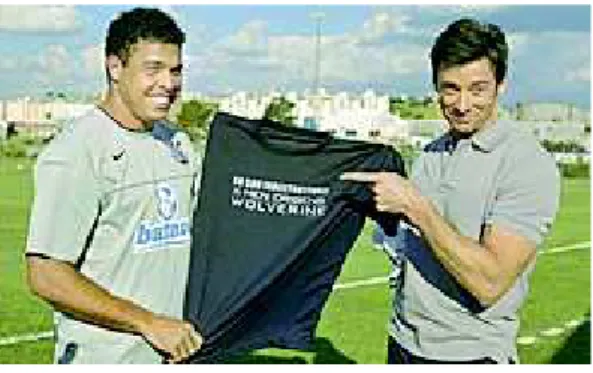
In the news article “Corinthians tests power of reaction “ of May 6, 2009, Paulo Galdieri14 from Folha de S.Paulo presented an illustration picturing Ronaldo in a meeting with actor Hugh Jackman - Wolverine - in which both are holding a T-shirt that reads, “I am indestructible.” Th e meeting took place when Ronaldo had already overcome the uncertainties of his “new” recovery as an athlete, then portraying him as Corinthian’s hope in the Brazil Cup’s round of 16 match against Atlético Paranaense club team. Th is news article, along with the image, implicitly addresses the representation of such a national competition for the Corinthian’s calendar and the athlete’s responsibility facing the challenge, since the paper appears to be based on Ronaldo’s image as the club’s main reference in the fi ght for this national achievement.
Th e association of image and text assigns the sportsman the responsibility for success15. Th is
strategy is justifi ed because of the athlete’s symbolic capital to the media, the fans and the sports fi eld in general. Th e illustration prepares the discourse through the correlation of the “indestructible” hero and his own characteristics, revealing not only the ability to win, but also the ability to not to give up and rise again, building the social identity via the feeling of overcoming challenges through the sport7.
Th is reference that the athlete has become, in Corinthians sporting context, can be one of the reasons that justify the newspaper’s choice to use Ronaldo as the protagonist of the news about the club. However, it is necessary to understand that
the relation between history and memory aff ect Ronaldo’s exposure by the newspaper, since his fi gure infl uences the notion of national identity, built16 through a football culture focused on consumption, i.e. conveying the athlete’s image aims to reach the reader that identifi es itself with the guy who overcomes obstacles and who will represent the club in a considerably relevant challenge2.
In the article entitled “Ronaldo scores 2 and qualifi es the Corinthians team” published by Folha
de S.Paulo on May 7, 200917, the paper emphasized
that with the accomplishment of Corinthians
qualifi cation over Atlético Paranaense club in the round of 16 of the Brazil Cup, the lineman’s had the main responsibility in this victory, because he had scored two goals and qualifi ed the Corinthians team to the next stage in the competition.
In victory, the hero’s mythicizing process appears to be natural, as the responsibility before accomplishing the feat was already resting with the one in which everyone focuses their expectations. The context in which the fact lies is exploited by the newspaper, in order to assign discourse representation18. Th is results in the development
of the narrative through the sentimentality that football shows in a historical process, permeated by the beginning of sports journalism with chronicles until the present time characterized by the contemporary sporting spectacle8.
The attempt to assign representation to the discourse is a strategy that constantly uses Ronaldo’s image to prepare the match scenario. With
success or failure, the fi gure of the athlete that is consolidated in the sports fi eld permeates the newspaper’s analysis, due to the interest that media culture takes in adjusting itself to the consumption practices of the sport spectacle19.
Paulo Galdieri17 highlights in the news article:
“Phenomenon shows himself to Brazil again”, in Folha de S.Paulo on May 7, 2009, and this logic is confi rmed in other instances, when the journal uses a nickname created by fans as homage to the
club - “the almighty” - to describe the athlete. Portrayed as the “phenomenon” who returned to Brazil, the sportsman scored both goals who
qualifi ed Corinthians to the quarterfi nals of the Brazil Cup, which was the team’s priority in 2009, demonstrating how the sportsman’s image can be used to benefi t the newspaper sales from that ideal of sporting spectacle, using the athlete as protagonist in the cultural entertainment industry.
Th e expressions used in the news article to describe the event start from a strategy interconnected with the need to maintain this context of the Brazilian footballing identity through the show. Th e paper makes use of terms that aff ect the fan’s imaginary through their passion, an exacerbated feeling of social identifi cation that the heroic scenario prepared by the media creates when elaborating the discourse.
We understand that the newspaper builds the narrative from the context and from the ideology implicit in the discourse elaboration. Such an analysis makes it possible to understand that a fact’s transmission through the media is drawn up according to each institution’s interest20. Because of this, the sports journalism is characterized as means conducive to local ideological interests, presenting the addressed topic in diff erent areas5.
Th e elaboration of the narrative that praises the heroic feat is well known according to the opportunities presented by social reality. The entertainment purpose is to take advantage of the context, using the facts to propagate information through the typical football sentimentality.
Affecting everyday sports, established from the media culture, has an impact on the football economy2. Th is being the newspaper’s interest,
Ronaldo’s image will always be linked to the facts related to the club. When that is not enough, the media make use of the athlete’s privacy to achieve the readers’ attention through the hero’s identifying
fi gure and, at times, the villain’s21 fi gure.
Still on the news piece titled “Phenomenon shows himself up to Brazil again” Paulo Galdieri17 said
in Folha de S.Paulo on May 7, 2009, that Ronaldo saved the team in another match by scoring two
does not establish a conceptual preference about the theory. Its interest is guided by praising Ronaldo’s achievements, seeking to reach the public so that the cultural industry3 fulfi lls the commercial needs
of the sports area from identifying the individuals who are involved with the passion for football5.
It is in this sense that we understand why the construction of the news article is not based exclusively in the competitiveness levels of a dispute. Th e commercial need established by the football spectacle development requires the newspaper to create mechanisms to involve the supporters in the consumerism governing contemporary sports practices. In this sense, the athlete as an individual highlight collaborates in identifying the persons that are passionate for the club26.
Strengthening Ronaldo’s positive image did not only mean comparing his achievements at that time with those in the past; but to also understanding the uniqueness of each fact in this neoliberal logic imposed by the commodifi cation of sport, which takes advantage of the opportunities presented by the sports fi eld when developing their narratives.
After the fi rst of the Brazil Cup quarterfi nals match which was against Fluminense, Paulo Galdieri27 in Folha de S.Paulo on May 14, 2009,
said: “In the most relevant competition for the team in the year it returns to the elite and when Ronaldo spent a rare night sleepless.”
The symbolic capital and the representation in the national scene permeate a diff erentiating narrative, in the development of news pieces about the athlete19. When toning down the defeats and
emphasizing the victories, the newspaper discourse is tied to politics issues that are implicit in the sports fi eld and media culture8 interests.
For the newspaper, maintaining the athlete’s positive image in the sports fi eld is valid, considering the fact that his symbolic capital ensures that his representativeness to the sports scene would not be aff ected by the performance analysis of a match.
The sportsman representation in football is consolidated, while the newspaper needs subjects crystallized in the contemporary sports scene, so that the readers take interest in the accounts presented by the media. Performance is important in the sense of praising, but it is not identifi ed as the newspaper’s only discursive strategy in using the athlete’s image for developing the news pieces28.
We understand that, in football, maintaining a regular performance contributes to a positive context in which the sportsman is a protagonist. However, newspaper defi ned the next possible opponents in
the competition as candidates to stop the athlete and the team or candidates to become victims of the “phenomenon”, demonstrating thus the sportsman representativeness in the competitive process in which the club is.
In football narratives, the stories relate to disputes format. For example, the Brazil Cup is a competition characterized by direct confrontations, notable for the representation of confrontation, battle and challenge22 - situations that permeate the heroic
way and facilitate the development of a mythical scenario9, favoring the newspaper discourse from
the facts development5.
In addition, the competition format allows for the construction of the narrative to take place primarily from overcoming or failing in a dispute. Th is organization further favors the creation of a scenario in which the story protagonist is the hero10. However, we should not consider the
development of discourse strategies framed only by the characterization of the championship as direct battle, since the heroism seems to be also implicit in other manners in the narratives presented by the newspaper8.
We note the ongoing development of a narrative made spectacular, which is built from the context, reinforcing the praise for the athlete’s feats. Paulo Galdieri23 in news piece titled: “Corinthians feels
the star’s weight”, on Folha de S.Paulo on May 13, 2009, said that before the match in the quarterfi nals of the Brazil Cup against Fluminense team, eight out of the ten goals scored by Ronaldo for Corinthians changed the matches results, seeming to be looking again for reasons to establish the sportsman as a representative subject in the dispute.
Th e recognition of the athlete, who has the gift to play football, recalls the discussion about the talented hero who holds the technical resources in order to win the challenges20. However, it also blends
with heroism characteristics with respect to courage at decisive moments, defi ning the athlete also as one who overcomes insurmountable obstacles13.
The newspaper strategy is not to assume a crystallized hero concept, because such discursive features are implicit in how facts are narrated. However, the construction of stories are elaborated and re-elaborated according to the ideology that is applied in that particular context where the facts happen24-25.
According to Muller22 this hero’s ability to present defi nitive solutions guides the trust imposed by the surround subjects. Thus, Corinthians supposed dependence on the athlete does not appear to be strictly technical, but it also relates to the representation built by Ronaldo’s sports career.
Carolina Araujo and Paulo Galdieri31 highlight in the article: “Ronaldo overcomes fl u, shines in the nick of time time and settles” in Folha de S.Paulo on June 18, 2009, that after recovering from the calf injury and overcoming weak performances in the quarterfi nals and in the second semi-fi nal match, the athlete was again praised by the newspaper for scoring a goal in the fi rst match of the fi nals against Sport Club Internacional, thus demonstrating how narratives are permeated by emerging facts.
As the newspaper is considered a breeding ground for the development of a mythical scene - which aff ects the supporter’s imagination through identifi cation with the victory, with the feeling of struggle, dedication and courage9 - the possibility of making use of the opportunities that the context presents is crystallized. Th is narrative establishes a discourse based on praising the overcoming of obstacles, which diff ers from other forms of approach according to which a re-elaboration of the discourse is necessary, in accordance with the moment in focus5.
So, the paper follows the logic of using the myth’s symbolism to impact contemporary society, using narratives that match sporting victory to the subjects’ social reality. Th us there is a continuing process in which the sports fi eld becomes dependent on the media culture, which, through spreading the protagonist’ image, benefi ts other national economy sectors, strengthening the logic of the sport spectacle based on consumerism32.
In the same news piece, Carolina Araujo and Paulo Galdieri31 also said that the athlete did not play a brilliant match, that he had little participation and did not show his genius plays. However, also according to the newspaper, Ronaldo was decisive and took Corinthians closer to the Brazil Cup title.
Th e narrative exposes heroism permeated by the athlete’s decisive potential. In this case, the technical quality, the talent and the gift for the sport practice do not matter. What is interesting is the angle of overcoming, courage and persistence13, 22, since these characteristics were shown to be compatible with as a historically recognized athlete, Ronaldo is
portrayed even when he did not play. Folha de S.Paulo highlighted in the news piece: “Without Ronaldo, Corinthians replaces quality with force” on May 27, 200929, that the lineman’s absence in the fi rst semifi nal match due to a calf injury meant the team was below strength, which surprised the team’s technical staff and, consequently, even changed the way the team played, changing the idea of a ‘technical’ football for a ‘rougher’ style.
After the match at Maracana stadium, Paulo Galdieri and Sergio Rangel30 once again covered the athlete’s absence in a news article titled: “Without Ronaldo, Corinthians misses the mark and ties” in Folha de S.Paulo on May 28, 2009, which state that, without the lineman’s presence, Corinthians wasted chances and drew the fi rst match against Regatas Vasco da Gama club. Th e story also portrayed that Corinthians team went to Rio de Janeiro trying to prove its decisive power without Ronaldo, but failed.
Ronaldo’s inability to play plus the fact that even without playing the player’s image is portrayed in the news reveals how the newspaper is able to switch discursive strategies in developing the narrative. How this scenario is built, explaining the idea of a correlation between the athlete‘s absence and fact that Corinthians failed in the off ensive part, demonstrates the intention of bringing the supporter closer to the sportsman, keeping in view the explanation that the hero was what was missing for the match outcome to be diff erent.
Th e narrative relates, once again, to the issue of the gift for the football practice20. In portraying that Corinthians lacked eff ectiveness in the absence of Ronaldo, we realize that the talent needed for the team to succeed in the off ensive plays was awarded to the lineman. Th e hero, as the one responsible for taking the team to victory13, can also be identifi ed in the article at issue, since, according to the newspaper, Corinthians club could not be decisive in the absence of the sportsman, raising questions as to what is the possible team’s effi ciency when Ronaldo is not in the fi eld.
Th is logic that matches and compares allows us to understand how the newspaper tries to justify the result through building a narrative that consolidates the hero to the public and the sports fi eld15. Th is context demonstrates the constant search for resources to re-elaborate the discursive strategies and maintain the process of news shaping through the image of sportspeople recognized by contemporary society10.
Ronaldo’s image to be portrayed in that moment by the newspaper itself.
Th is analysis corroborates what we had previously refl ected. Th e strategies for the news development are linked to the context presented by the situation as well as to the media culture ideology. Such features functionally correlate to the implicit commercial interests in the entertainment industry logic33.
In the news article: “Ronaldo tries to fi ll the gap
in his résumé,” published in Folha de S.Paulo on July 1, 2009, Paulo Galdieri34 refl ects on the possibility of Ronaldo winning the fi rst national championship in Brazil, stating that the athlete would try for his fi rst title in his homeland, accomplishing something unprecedented in his football career. Th is headline shows the mythical character that a possible achievement would impact in the athlete’s image, consolidating himself even more the Brazilian sports scene.
Th e heroic path is permeated by challenges that aim to prove that the candidate for the position can really perform it. Such battles consist in demonstrating if the athlete is up to the task, if he can withstand the dangers and if he will have knowledge, courage and ability to overcome the unknown, making the journey an important part of life9.
Th e news piece shows the symbolic signifi cance for a possible achievement by the athlete. Expressions such as “seek”, “conquer” and “try” are terms that enable an analysis from the use of the player’s image as a protagonist in building journalistic context10.
Th e narrative was drawn from the opportunity to use the fact that the athlete has not won a national competition, in order to acclaim the hero’s fi gure for accomplishing a so far unprecedented feat. Such a strategy would provide an even greater public identifi cation with the athlete, reaching business objectives proposed by the media culture32.
Th erefore the hero embodies the fi gure with which many subjects identify, and he is considered an ideal human being, who is not only accepted, for example, by a majority, but also appears as a defender of our own cause. We sympathize with his battles, his fears and suff erings; with his victories and defeats; and fi nally, with his struggle for survival22.
According to Folha de S.Paulo35, in the news titled “Ronaldo ‘fi lls gap in résumé’ and wins fi rst national title in Brazil”, published on 1 July 2009, after winning the Brazil Cup the athlete completed the curriculum with an unprecedented title in his career, confi rming the hypothesis launched in the previous day news.
Th e athlete’s image linked to the heroic fi gure that overcame personal challenges and returned to football at a competitive level is the typical narrative used by the media to praise and consolidate a sportsman28. Keeping the mythical fi gure in evidence in a moment that is celebrating the victory became the traditional discourse strategy that permeates the information transmission, combining with the media interests that are in line with the sports fi eld15.
Victory is then considered an important component in building stories that focus on a heroic scenario. Feelings such as grief and passion lead to the supporter’s identifi cation with athletes acclaimed by consolidated careers in spectacle football, which is guided by the consumption practice of the entertainment cultural industry.
According to the initial goal to analyze and discuss how the Folha de S.Paulo portrayed Ronaldo in the dispute period and after winning the Brazil Cup, we note that due to the sportsman representation in the international sports scene, the newspaper elaborates the discourse of prominence implicit in the athlete’s history of achievements and failures.
In an attempt to lay the ground for the news shown, they use the athlete’s image to build the matches narrative. Demonstrating that Ronaldo is characterized as a consolidated subject in the sports fi eld because his career displays heroic characteristics, recalling the victories, defeats, overcoming adverse times and return to the achievements.
Such features fi tted in the athlete’s profi le allow the newspaper to associate his image as a social representation model of an individual who does not give up the challenges, overcomes his own limits and wins battles in sport and in life. Th is identifi cation brings the hero closer to the other subjects’ reality, as they start to admire him for the symbolic understanding that they are rising above the same cycle of struggles, diffi culties, achievements and failures, in other words, for empathy.
It is possible to notice that the news building allows for an analysis from the heroic battle victories and defeats, however, the relation of the facts to the mythical cycle does not occur intentionally. Th e athlete’s image is associated to the facts linked to the club, making himself the protagonist because his symbolic capital allows the speech to be directed.
References
1. Proni MW. Esporte-espetáculo e futebol-empresa [tese]. Campinas (SP): Universidade Estadual de Campinas, Faculdade de Educação Física; 1998.
2. Gastaldo EL. “Os campeões do século”: notas sobre a defi nição da realidade no futebol-espetáculo. Rev Bras Ciênc Esporte. 2000;22:105-24.
3. Damo AS. Dom, amor e dinheiro no futebol espetáculo. Rev Bras Ciênc Soc. 2008;23:139-209. 4. Ribeiro LC. O futebol no campo afetivo da história. Movimento. 2004;10:99-111.
5. Costa LM. Futebol folhetinizado: a imprensa esportiva e os recursos narrativos usados na construção da notícia. Rev Logos. 2010;17:65-77. (Comunicação e Esporte; 33).
6. Rubio K. O imaginário da derrota no esporte contemporâneo. Psicol Soc. 2006;18:86-91.
7. Rubio K. O trabalho do atleta e a produção do espetáculo esportivo. Rev Eletrônica Geogr Ciênc Soc. 2002;6. Available from: http://www.ub.edu/geocrit/sn/sn119-95.htm.
8. Helal R, Soares AJ, Lovisolo H. A invenção do país futebol: mídia, raça e idolatria. Rio de Janeiro: Mauad; 2001. 9. Rubio K. O atleta e o mito do herói: o imaginário esportivo contemporâneo. São Paulo: Casa do Psicológo; 2001. 10. Costa LM. Notícias esportivas: entre o jornalismo e a literatura. Anais do Silel. 2011;2:1-16. Available from: http://
www.ileel.ufu.br/anaisdosilel/pt/arquivos/silel2011/1516.pdf.
11. Ferreira MM, Amado J. Uso e abusos da história oral. Rio de Janeiro: Fundação Getúlio Vargas; 1998.
12. Moreira TS, Marchi Junior W. Mídia impressa: construção de uma preferência nacional esportiva em questão. I Semi-nário Nacional Sociologia e Política; 2009; Curitiba, PR. Curitiba: UFPR; 2009.
13. Campbell J. O herói de mil faces. São Paulo: Pensamento; 1997.
14. Galdieri P. Corinthians testa poder de reação. Folha de S.Paulo. 6 Mai. 2009; Esporte; D4.
15. Capraro AM, Scheliga G, Cavicchioli F, Mezzadri, F. A imagem do atleta: publicidade em ano de Copa do Mundo de Futebol (Alemanha - 2006). Rev Bras Educ Fís Esporte. 2011;25:163-71.
16. Helal R Santoro MA, Soares AJ. Futebol, imprensa e memória. Rev Front. 2004;6:61-78.
17. Galdieri P. Fenômeno se reapresenta ao Brasil: Ronaldo faz 2 no Atlético-PR e classifi ca Corinthians para as quartas de fi nal da competião que é a sua prioridade para o ano. Folha de S.Paulo. 7 Mai. 2009; Esporte; D1.
is immediate, that is, at times it praises Ronaldo, other times it criticizes him, however, whenever possible it describes the facts using this sportsman representation.
Finally, we emphasize that the narratives development are linked to political issues such as
the ideological conception of the newspaper and of the writers. Th e account of the facts is in accordance with what the author’s subjectivity can reveal to the reader, infl uencing opinion building and developing narratives typically linked to the historical context of the cultural entertainment industry.
Resumo
O mito do herói: uma análise a partir do discurso da Folha de S.Paulo acerca do caso Ronaldo na Copa do Brasil de 2009
O objetivo deste artigo consiste em analisar e discutir como o jornal Folha de S.Paulo retratou a imagem de Ronaldo nas matérias publicadas durante a disputa e após a conquista da Copa do Brasil de 2009. Metodologicamente, o presente estudo é caracterizado como uma pesquisa histórica, pautada pelos pro-cedimentos da história do tempo presente e o material de análise foi constituído pelo caderno de esportes da Folha de S.Paulo. Notamos que o jornal elabora o discurso através de um protagonismo implícito no histórico de conquistas e fracassos do atleta, demonstrando Ronaldo como um sujeito consolidado no campo esportivo e associando sua imagem como modelo de representação social.
18. Da Costa FR, Ferreira Neto A, Soares AJG. Crônica esportiva brasileira: histórico, construção e cronista. Pensar Prát. 2007;10:15-31.
19. Costa LM. A trajetória da queda: as narrativas da derrota e os principais vilões da seleção brasileira em Copas do Mundo [tese]. Rio de Janeiro (RJ): Universidade do Estado do Rio de Janeiro; 2008.
20. Giglio S. Futebol: mitos, ídolos e heróis [dissertação]. Campinas (SP): Universidade Estadual de Campinas; 2007. 21. Helal R. A construção de narrativas de idolatria no futebol brasileiro. Rev Alceu. 2003;7:19-36.
22. Muller L. O herói: todos nascemos para ser heróis. São Paulo: Cultrix; 1987.
23. Galdieri P. Corinthians sente o peso do astro. Folha de S.Paulo. 13 Mai. 2009; Esporte; D4. 24. Orlandi EP. Discurso, imaginário social e conhecimento. Em Aberto. 1994;14:53-9. 25. Orlandi EP. Exterioridade e ideologia. Cade Est Linguíst. 1996;30:27-33.
26. Gastaldo EL. “O país do futebol” mediatizado: mídia e Copa do Mundo no Brasil. Sociologias. 2009;11:352-69. 27. Galdieri P. Rebaixados dão triunfo ao Corinthians: Felipe segura o ataque Fluminense e Dentinho assinala o gol da
vitória em que Ronaldo passa em branco. Folha de S.Paulo. 14 Mai. 2009; Esporte; D1.
28. Cavalcanti EA, Capraro AM, Souza DL. “Cai o pano”: uma análise do encerramento da carreira de Ronaldo “fenômeno” a partir de duas mídias digitais esportivas. Movimento. 2011;17:175-92.
29. Galdieri P, Rangel S. Sem ter Ronaldo, Corinthians troca qualidade por força. Folha de S.Paulo. 27 Mai. 2009; Esporte; D2. 30. Galdieri P, Rangel S. Sem Ronaldo, Corinthians erra o alvo e empata. Folha de S.Paulo. 28 Mai. 2009; Esporte; D3. 31. Araújo C, Galdieri P. Ronaldo supera gripe, brilha na hora agá e decide. Folha de S.Paulo. 18 Jun. 2009; Esporte; D2. 32. Pieper MA. O retorno do herói: Ronaldo fenômeno no cerne da constituição mítica e do comportamento midiático
[dissertação]. São Paulo (SP): Universidade de São Paulo, Escola de Comunicação e Artes; 2010. 33. Gurgel A. Desafi os do jornalismo na era dos megaeventos esportivos. Motrivivência. 2009;21:193-210. 34. Galdieri P. Ronaldo tenta preencher lacuna em seu currículo. Folha de S.Paulo. 1 Jul. 2009; Esporte; D1.
35. Folha Online. Ronaldo “preenche currículo” e obtém primeiro título nacional no Brasil. Folha de S.Paulo. 1 Jul. 2009; Esporte. Available from: http://www1.folha.uol.com.br/esporte/2009/07/589215-ronaldo-preenche-curriculo-e-obtem--primeiro-titulo-nacional-no-brasil.shtml.
ADDRESS Everton de Albuquerque Cavalcanti Departamento de Educação Física Setor de Ciências Biológicas Universidade Federal do Paraná R. Coração de Maria, 92 82590-400 - Curitiba - PR - BRASIL e-mail: [email protected]
Submitted: 01/06/2014 1a. Review: 11/17/2014 2a. Review: 12/04/2014 Accepted: 06/23/2015