Printed in Brazil - ©2005 Sociedade Brasileira de Química 0103 - 5053 $6.00+0.00
Article
* e-mail: [email protected]
Rapid Spectrophotometric Determination of Trace Amounts of Chromium Using Variamine
Blue as a Chromogenic Reagent
B. Narayana* and Tom Cherian
Department of Studies and Research in Chemistry, Mangalore University. Mangalagangothri-574199, India
Um método espectrofotométrico simples, rápido e sensível foi desenvolvido para a determinação traço de cromo usando azul de Variamina como reagente cromogenico. O método proposto consiste na reação de cromo(VI) com iodeto de potássio, em meio ácido, liberando iodeto que então oxida o azul de Variamina formando um composto de cor violeta com o máximo de absorção em 556 nm. A lei de Beer é obedecida na faixa de 2-12 µg mL-1 para Cr(VI). A absortividade molar, a sensibilidade de Sandell, o limite de detecção e de quantificação do método foram encontrados como sendo 0,911×104 L mol-1 cm-1, 1,14×10⁻²µg cm-2, 0,02 µg mL-1 e 0,07 µg mL-1 respectivamente. As condições analíticas e ótimas da reação foram avaliadas. O efeito de íons interferentes na determinação é descrita. O cromo(III) pode ser determinado depois da oxidação à cromo (VI), com brometo em solução aquosa alcalina. O método desenvolvido foi aplicado com sucesso na análise de cromo em ligas de aço, efluentes industrias, águas naturais e amostras de solo.
A simple, rapid and sensitive spectrophotometric method has been developed for the determination of trace amounts of chromium using variamine blue as a chromogenic reagent. The proposed method is based on the reaction of chromium(VI) with potassium iodide in acid medium to liberate iodine, which oxidizes variamine blue to form a violet colored species having an absorption maximum 556 nm. Beer’s law is obeyed in the range 2-12 µg mL-1 of Cr(VI). The molar absorptivity, Sandell’s sensitivity, detection limit and quantitation limit of the method were found to be 0.911×10⁴ L mol-1 cm-1, 1.14×10⁻²µg cm-2, 0.02 µg mL-1 and 0.07 µg mL-1 respectively. The optimum reaction conditions and other analytical conditions were evaluated. The effect of interfering ions on the determination is described. The chromium(III) can be determined after it is oxidized with bromine water in alkaline medium to chromium(VI). The developed method has been successfully applied to the analysis of the chromium in alloy steels, industrial effluents, natural water samples and soil samples.
Keywords : chromium determination, spectrophotometry, variamine blue
Introduction
Chromium is one of the most widely distributed heavy metals in the earth’s crust. It is normally found in two oxidation states ie Cr(III) and Cr(VI). Chromium is required in small quantities as an essential trace metal, nutrient and its deficiency may result in several physiological disorders. Most of the biological tissues contain Cr(III) which is usually nontoxic, where as Cr(VI) is a highly toxic form of the metal to the organisms. It is known that an increase in the content of this element in soils makes them infertile and that the toxic effect depends to some extent on the oxidation state of chromium. On the other hand, the introduction of chromium salts into soils have some positive effects due to activation of some biochemical
processes.1Cr(III) is an essential nutrient for maintaining
normal physiological function,2where as Cr(VI) is toxic.3
The determination of chromium by spectrophotometric method based on oxidation of organic compounds4-6 and
on formation of ion associates7 has the disadvantage of a
high blank value. The most widely used reagent for chromium(VI) determination is diphenylcarbazide,8,9 but
it suffers serious interference from Fe(III), Mo(VI), Cu(II) and Hg(II)10 and also the formed complex is stable for 30
minutes in the presence of a phosphate buffer.11 Other
reagents have been suggested for spectrophotometric determination of chromium using 4-(2-pyridylazo) resorcinol,12 phenylarsenazo,13 gallacetophenone oxime, 14 citrazinic acid,15 trifluoroperazine hydrochloride,16 and
leuco xylene cyanol FF.17 Of these reagent, some have been
J. Braz. Chem. Soc.
simple reliable method for the determination of chromium is therefore clearly recognized.
In the present investigation, a facile , sensitive and selective method has been reported for the determination of chromium(VI) with a new reagent Variamine Blue(VB). Chromium(III) is determined after it is oxidized to chromium(VI) by bromine water. The proposed method has been used to determine chromium in alloy steels, industrial effluents, natural water samples and soil samples.
Experimental
Apparatus
A secomam Anthelie NUA 002 UV-Visible spectropho-tometer with 1 cm quartz cell was used for the absorbance measurements and a WTW pH 330, pH meter was used.
Reagents
All chemicals used were of analytical grade and distilled water was used for dilution of reagents and samples. Standard chromium(VI) stock solution (1000 µg mL-1) was prepared by dissolving 0.2829 g of K
2Cr2O7 in
100 mL of water. The stock solution was further diluted as needed. Standard chromium(III) stock solution(1000 µg mL-1) was prepared by dissolving 0.2829 g of K
2Cr2O7 in
50mL of water, adding 1mL saturated sodium sulfite solution, acidifying with 1mL of 2.5 mol L-1 sulfuric acid,
and then boiling for 2 min to remove excess SO2 and
diluting with water to 100 mL. Suitable volume of this solution was diluted to obtain the working standard. HCl 2 mol L-1, KI 2%, sodium acetate 2 mol L-1 and bromine
water (saturated) were used. A 0.05% solution of variamine blue was prepared by dissolving 0.05 g of variamine blue in 25 mL of ethanol and made up to 100 mL with distilled water and stored in an amber bottle
Determination of chromium(VI)
An aliquot of a sample solution containing 2-12 µg mL-1 of chromium(VI) was transferred in to a series of 10
mL calibrated flasks. Potassium iodide (2%, 1 mL) then hydrochloric acid (2 mol L-1 ,1 mL) were added and mixture
was gently shaken until the appearance of yellow color indicating the liberation of iodine. Then variamine blue (0.05% , 0.5 mL) was added to it, followed by the addition of 2 mL of 2 mol L-1 sodium acetate solution. The contents
were diluted to the mark with distilled water and mixed well. The absorbance of the colored species was measured at 556 nm against the corresponding reagent blank.
Determination of chromium(III)
An aliquot of a sample solution containing 2-12 µg mL-1 of chromium(III) was transferred in to a series of 10
mL calibrated flasks. A volume of 0.5 mL saturated bromine water and 0.5 mL of 4.5 mol L-1 KOH solution were added
to each flask and allowed to stand for 5 min. Then 0.5 mL of 2.5 mol L-1 sulfuric acid and 0.5 mL of 5% sulfosalicylic
acid were added and then above procedure for chromium(VI) was followed. The absorbance of the resulting solution was measured at 556 nm against reagent blank.
Analysis of mixture containing chromium(III) and chromium(VI)
Separately, an aliquot (2 µg mL-1) of a mixture according
to the procedure for chromium(VI) and established the concentration of chromium(VI), was analysed. Another aliquot (2 µg mL-1) according to the procedure described
for chromium(III) to establish the concentration of total chromium[ Cr(III) + Cr(VI) ], was analysed. The difference between the two values is the concentration of chromium(III) in the mixture.
Analysis of chromium steels
Alloy steels were dissolved in approximately 8 mL of aqua regia. It was evaporated nearly to dryness on a sand bath , sulfuric acid (1-2 mL, 1:1 ) was added and evaporated until salts crystallized, to this 10 mL of water was added. The solution was warmed, filtered and treated with 10 mL of HCl and 10 mL of methyl isobutyl ketone to extract iron.1,18 The aqueous layer was separated and diluted to a
known volume with water. Suitable aliquots of sample solutions were analysed according to the procedure for chromium(III).
Analysis of industrial effluents
Tannery effluent was diluted 50 times and chromium plating effluent was diluted to 10 times before analysis. Suitable aliquot of sample solutions were analyzed according to the procedure for determining chromium(III) and chromium (VI). Solutions were also analysed according to the standard diphenylcarbazide method.
Determination of chromium in natural water samples
1 mol L-1 NaOH and 0.5 mL 0.2 mol L-1 EDTA. Any
precipitate formed was centrifuged off. The solution was transferred into a 10 mL standard flask and the chromium content determined as per the method discussed above (Table 1). Solution were also analysed according to the standard diphenylcarbazide method.
Determination of chromium in soil samples
A known amount of (1g) air dried homogenized soil samples, spiked with known amounts of chromium(VI) was taken and then fused with 5g anhydrous sodium carbonate in a nickel crucible and evaporated to dryness after the addition of 25 mL of water. The dried material was dissolved in water, filtered through whatman No. 40 filter paper in to 25 mL calibrated flask and neutralized with dilute ammonia. It was then diluted to a known volume with water. An aliquot of this sample solution was analysed for chromium(VI). Solution were also analysed according to the standard diphenylcarbazide method.
Results and Discussion
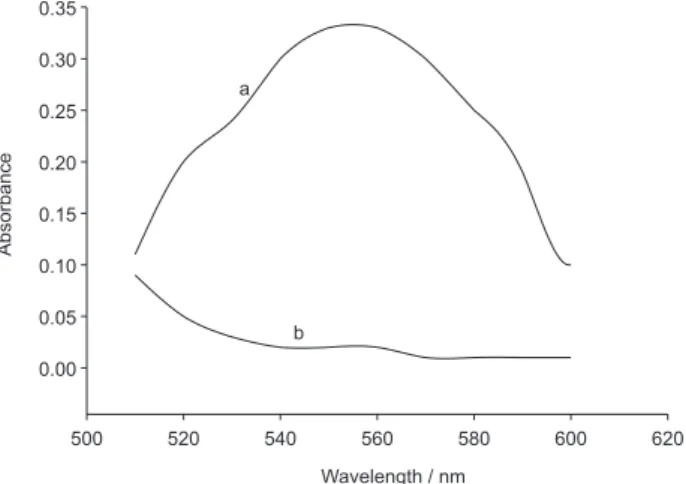
This method involves the liberation of iodine by the reaction of chromium with potassium iodide in an acidic medium. The liberated iodine selectively oxidizes variamine blue in the presence of sodium acetate to form a violet colored species, which shows a maximum absorbance at 556nm. The reagent blank had negligible absorbance at this wavelength. The absorbance spectra of the colored species are presented in Figure 1, and the reaction system is represented in Scheme 1.
Effect of iodide concentration and acidity
The oxidation of iodide to iodine was effective in the pH range 1.0 to 1.5, which could be maintained by adding 1 mL of 2 mol L-1 HCl in a final volume of 10 mL. The
liberation of iodine from KI in an acid medium was quantitative. The appearance of yellow color indicates the liberation of iodine. Although any excess of iodine in the solution will not interfere. It was found that 1 mL of each 2% KI and 2 mol L-1 HCl were sufficient for the liberation
of iodine from iodide by chromium(VI) and 0.5 mL of 0.05 % variamine blue was used for subsequent oxidation of variamine blue for the full color development.
Effect of the reagent concentration
Constant and maximum absorbance values were obtained in the pH range 4.0-5.0. This could be achieved
by the addition of 2 mL of 1 mol L-1 sodium acetate solution
in a total volume of 10 mL. An increase in the pH above 5 affected the stability of the colored species, whereas color development did not take place below pH 3, The optimum concentration of variamine blue leading to maximum color stability was found to be 0.5 mL of 0.05 % reagent per 10 mL of reaction mixture. A 2 mL portion of 1 mol L-1 sodium
acetate solution was found to be sufficient for complete and maximum color development. The maximum absorbance was obtained instantaneously and required no heating under reaction conditions. Under the optimum reaction conditions, the color system was stable for a period of 4hr.
Choice of oxidizing agent
Chromium(III) was determined after it was oxidized to chromium (VI). Various oxidizing agents19 were used,
persulfate in the presence of a silver ion as the catalyst in an acid solution, permanganate in an acid medium, and hydrogen peroxide and bromine in an alkaline medium. For all these methods, excess oxidizing agent must be destroyed before the determination of Cr(VI) to avoid the interference with the determination. Usually, excess persulfate and peroxide were removed by boiling, and permanganate was destroyed by adding sodium azide. In the present investigation, bromine water in an alkaline Figure 1. Absorption spectra of colored species (Cr, 1 mg mL-1 ) vs.
reagent blank (a) and reagent blank vs. distilled water(b).
J. Braz. Chem. Soc.
medium was used to oxidize Cr(III) to Cr(VI) and the excess oxidizer was removed by the addition of sulfosalicylic acid (5 %).
Analytical data
Beer’s law was obeyed in the range of 2-12 µg mL-1.
The molar absorptivity and Sandell’s sensitivity for the colored system was found to be 0.911×10⁴ L mol-1cm-1,
1.14 ×10⁻² µg cm-2 respectively. The detection limit(D L =3.3
s/S) and quantitation limit (QL=10 σ/S) (where s is the standard deviation of the reagent blank (n=5) and S is the slope of the calibration curve) for the chromium determination were found to be 0.02 µg mL-1 and 0.07 µg
mL-1 respectively.
Effect of interfering ions
The effect of various ions at ¼g mL-1 levels on the
determination of chromium(VI) was examined. The tolerance limits of interfering species were established at those concentrations that do not cause more than 2% error in absorbance values of chromium(VI) at 2 µg mL-1 (Table
4). The results indicated that Cu(II), Fe(III), Ce(IV) interfere severely. However, the tolerance level for these ions may be increased by the addition of 1 mL of 1% EDTA.
Application
The proposed method was applied to the quantitative determination of chromium in natural water samples, soil Table 1.Determination of chromium in natural water and soil samples
Proposed method Reference method
Sample Cr in Cr Relative Std bt-test cF-test Cr Relative Std bt-test cF-test
µg mL-1 µg mL-1 error deviation mg mL-1 error deviation
addeda found in % found in %
Naturalwater 4.00 4.01 0.25 0.02 1.12 1.67 4.02 0.50 0.02 1.12 1.54
samples 6.00 5.99 -0.17 0.02 1.11 1.82 6.02 0.50 0.03 1.49 1.87
Soil 4.00 3.99 -0.25 0.02 1.57 2.00 4.01 0.15 0.03 1.49 1.76
samples 6.00 6.02 0.33 0.05 0.89 1.92 6.03 0.83 0.04 1.12 2.10
a Chromium concentration expressed in µg mL-1 ;b Tabulalated t-value for four degree of freedom at P 0.95) is 2.78; c Tabulated F-value for (4,4)
degree of freedom at P (0.95) is 6.39.
Table 2. Determination of chromium in alloy steels
Samples Chromium Amount of Standard % of t-testd F-teste
certified Chromium deviation recovery in % found in %
GKW Steel,India(0.05g/100ml);C 0.54, 1.02 1.013 0.01 99.30 0.67 1.90
Mn 0.89, S 0.018,P 0.034,Si 0.33, V 0.13a
Stainless steel no.394(0.05g/100ml); 18.0 17.94 0.03 99.70 0.75 1.50
Ni 8.12,Fe 70-71b
FerrochromeCr 65,Fe 35 65.0 64.54 0.04 99.30 1.27 1.40
a Diluted to 10 times before analysis; b Diluted to 20 times before analysis; c diluted to 40 times before analysis;d .Tabulated t-value for four
degree of freedom at P (0.95) is 2.78; e. Tabulated F-value for (4,4) degree of freedom at P (0.95) is 6.39.
Table 3.Determination of chromium in industrial effluents
Chromium found in mg mL-1
Proposed method Reference method
Samples Cr(III)a Cr(VI) t-teste F-testf Cr(III)a Cr(VI) t-teste F-testf
Cr(III) Cr(VI) Cr(III)) Cr(VI) Cr(III) Cr(VI) Cr(III) Cr(VI)
Tannery 318.56 NDb 1.78 NDb 1.82 — 317.74 — 1.49 — 1.62 —
Effluentc ±0.20 ± 0.21
Chromium 32.22 69.22 1.41 1.90 1.94 1.40 32.54 69.40 1.73 1.39 1.94 1.33
Plating ±0.35 ±0.14 ±0.31 ±0.16
effluentd
a. Mean ± standard deviation; b ND ,not detected;c Solution diluted 50 times before analysis; d Solution diluted 10 times before analysis; e.
samples, standard alloy steels and industrial effluents samples, the results are presented in Table 1, 2 and 3 respectively. Statistical analysis of the results by F and t-tests showed no significant difference in accuracy and precision of the proposed and reference method.8 The
precision of the proposed was evaluated by replicate analysis of samples containing chromium at three different concentrations.
Conclusions
The proposed method for determining chromium(VI) is facile, rapid, sensitive and has a wide analytical range without the need for extraction or heating. The developed method does not involve any stringent reaction conditions and offers the advantages of high color stability (4 hr) compared to the standard diphenylcarbazide method (30 min). The methods has the added advantage of determining individual amounts of Cr(VI) and Cr(III). The proposed method has been successfully applied to the determination of trace amounts of chromium in alloy steels ,industrial effluents, natural water samples and soil samples.
Acknowledgment
Authors thank the Microtron Centre of Mangalore University, Mangalore for the technical help.
References
1. Kamburova, M.; Talanta1993, 40, 713.
2. Versiek, J.; Cornelis, R.; Anal. Chim. Acta 1980, 116, 217. 3. Eckert, J. M.; Judd, R. J.; Lay, P. A.; Symons, A. D.; Anal.
Chim. Acta1991, 255, 31.
4. Buscarons Artigas, J.; Anal. Chim. Acta 1957, 16, 452. 5. Jacobsen, E.; Land, W.; Anal. Chim. Acta1996, 36, 135. 6. Raj, J. B.; Gowda, H. S.; Analyst(Cambridge,U.K ) 1995, 120,
1815.
7. Kamburova, M.; Talanta 1993, 40, 707. 8. Luke, C. L.; Anal. Chem. 1958, 30, 2050. 9. Marchart, H.; Anal. Chim. Acta 1964, 30, 11. 10. Urone, P. E.; Anal. Chem. 1955, 27, 1355. 11. Saltzman, B. E.; Anal. Chim. Acta1952, 24, 1016.
12. Nagarkar, S. G.; Eshwar, M. C.; Indian. J. Technol. 1975, 13, 377.
13. Sun, Fu –Sh.; Talanta 1983, 30, 446.
14. Rao, P. N.; Reddy, K. A.; J. Indian. Chem. Soc. 1980, 57, 402. 15. Revanasiddappa, H. D.; Kiran Kumar, T. N.; J. Anal. Chem.
2001, 56, 1084.
16. Revanasiddappa, H. D.; Kiran Kumar, T. N.; Chem. Anal. (Warsaw) 2002, 47, 311.
17. Revanasiddappa, H. D.; Kiran Kumar, T. N.; Talanta 2003, 60, 1.
18. Snell, F. D.; Photometric and Fluorimetric Methods of Analysis, Wiley: New York, 1978, Vol.1.
19. Marczenko, Z.; Separation and Spectrophotometric Determination of Elements, Ellis Horwood: Chichester, 1986, p. 238.
Received: April 30, 2004
Published on the web: February 18, 2005 Table 4 .Effect of interfering ions on the determinations of 2 µg mL-1
Chromium(VI)
Ions Tolerance limit Ions Tolerance limit (µg mL-1) (µg mL-1)
Fe3+ 1 0 Ce4+ 2 0
Na+ 1000 MoO
4
2- 750
Pb2+ 500 F- 1000
Ni2+ 7 5 CO
3
2- 1500
Cu2+ 1 0 PO
4
3- 1000
Cd2+ 500 AsO
3
3- 750
Hg2+ 100 Citrate 1000
Ba2+ 1000 Tartarate 1500
Bi3+ 1500 Oxalate 1500
Mn2+ 500 Sulfate 1000
Al3+ 500 Chloride 1000
Ca2+ 100 Nitrate 750
Co2+ 7 5 Acetate 1000