‘Academic Literacies approaches to
Genre’?*
Abordagens de gênero para letramentos
acadêmicos’?
Brian Street**
King’s College London
ABSTRACT:I provide an overview of approaches to writing referred to as ‘academic literacies’ building on broader traditions, such as New Literacy Studies, and I draw out the relevance of such traditions for the ways in which lecturers provide support to their students with regard to the writing requirements of the University. I offer three case studies of the application of academic literacies approaches to programmes concerned with supporting student writing, in the UK and the USA. I briefly conclude by asking how far these accounts and this work can be seen to bring together many of the themes raised at SIGET conferences - including academic literacies and its relation to genre theories - and express the hope that it opens up trajectories for future research and collaboration of the kind they were founded to develop.
KEYWORDS: Academic literacies; student writing; genre theories.
RESUMO: Neste trabalho, eu apresento uma visão geral de abordagens para a escrita conhecida como ‘letramentos acadêmicos’, construídas sob a luz de tradições mais amplas, como os Novos Estudos de Letramento; também aponto a importância dessas tradições nos modos pelos quais professores dão apoio aos seus alunos no que diz respeito às exigências da escrita acadêmica. Ilustro o trabalho com três estudos de caso de aplicação de abordagens de letramento acadêmico em programas que dão apoio à escrita, no Reino Unido e nos Estados Unidos. Concluo perguntando como essas questões e este trabalho podem ser usados para reunir e colocar em prática muitos dos temas abordados nas conferências do SIGET -incluindo letramentos acadêmicos e sua relação com as teorias de gêneros - e expressar o desejo de que isso abra caminhos para futuras pesquisas e colaboração do tipo a que eles foram fundados para desenvolver.
PALAVRAS-CHAVE: Letramento acadêmico; escrita de estudantes, teorias de gênero.
* Paper originally presented at Fifth International Symposium on Textual Genre Studies (V SIGET), August 11-14, 2009.
Academic Literacies approaches
I will briefly review the recent academic literacies tradition in the UK as a frame from which to consider three case studies of the application of these approaches to practical programmes pf teaching in the UK and USA Higher Education systems. The notion of ‘academic literacies’ developed from the area of ‘new literacy studies’ (GEE, 1996; STREET, 1984) as an attempt to draw out the implications of this approach for our understanding of issues of student learning.
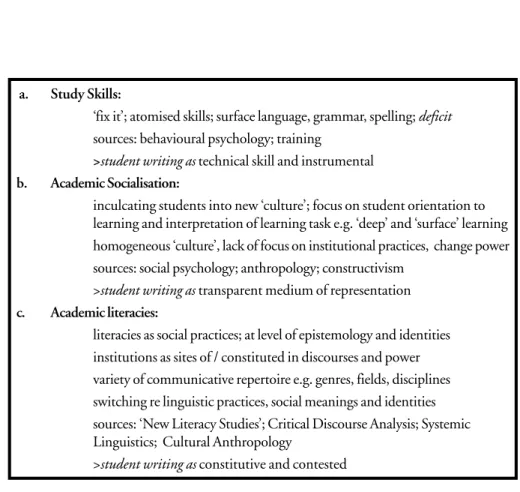
Lea & Street, (1997) argued that educational research into student learning in higher education has fallen into three main perspectives: Study Skills; Academic Socialisation; and Academic Literacies (see FIG. 1).The study skills approach has assumed that literacy is a set of atomised skills which students have to learn and which are then transferable to other contexts. The focus is on attempts to ‘fix’ problems with student learning, which are treated as a kind of pathology. The theory of language on which it is based emphasises surface features, grammar and spelling. Its sources lie in behavioural psychology and training programmes and it conceptualises student writing as technical and instrumental.
In recent years the crudity and insensitivity of this approach has led to refinement of the meaning of ‘skills’ involved and attention to broader issues of learning and social context, what we (LEA & STREET, 1998) have termed the academic socialization approach. From an academic socialisation perspective, the task of the tutor / advisor is to inculcate students into a new ‘culture’, that of the academy. The focus is on student orientation to learning and interpretation of learning tasks, through conceptualisation for instance of a distinction between ‘deep’ and ‘surface’ learning (HOUNSELL, 1988). The sources of this perspective lie in social psychology, in anthropology; and in constructivist education. Although more sensitive to both the student as learner and to the cultural context, the approach could nevertheless be criticised on a number of grounds: it appears to assume that the academy is a relatively homogenous culture, whose norms and practices have simply to be learnt to provide access to the whole institution. Even though at some level disciplinary and departmental difference may be acknowledged, institutional practices, including processes of change and the exercise of power do not seem to be
to address the deep language, literacy and discourse issues involved in the institutional production and representation of meaning.
a. Study Skills:
‘fix it’; atomised skills; surface language, grammar, spelling; deficit
sources: behavioural psychology; training
>student writing as technical skill and instrumental b. Academic Socialisation:
inculcating students into new ‘culture’; focus on student orientation to learning and interpretation of learning task e.g. ‘deep’ and ‘surface’ learning homogeneous ‘culture’, lack of focus on institutional practices, change power sources: social psychology; anthropology; constructivism
>student writing as transparent medium of representation c. Academic literacies:
literacies as social practices; at level of epistemology and identities institutions as sites of / constituted in discourses and power variety of communicative repertoire e.g. genres, fields, disciplines switching re linguistic practices, social meanings and identities sources: ‘New Literacy Studies’; Critical Discourse Analysis; Systemic Linguistics; Cultural Anthropology
>student writing as constitutive and contested
FIGURE 1 – Models of Student Writing in Higher Education
The explication of the three models proposed by Lea and Street has been drawn upon very widely in the literature on teaching and learning across a range of HE contexts (see, e.g., Thesen and van Pletzen, 2006, on South Africa) and calls for a more in depth understanding of student writing and its relationship to learning across the academy, thus offering an alternative to deficit models of learning and writing based on autonomous models of literacy.
Increasingly, practitioners in the UK are beginning to draw on the general framing offered by the academic literacies perspective, although not always explicitly. A regular Academic Literacies (AcLits) conference draws together those working across settings in the field of writing support, who are adopting a social practice model of writing. A number of institutions have pursued schemes for supporting students and their teachers, often in relation to widening participation. These developments are frequently initiated by educational development departments and supported by some form of student learning centres; although both these generally have a broad brief of which writing is only a part, taken together they are generally the most important institutional sites for writing development in the UK. Whilst educational development departments work directly supporting faculty with issues of teaching and learning, including student writing, the brief of most student learning centres is to work only with students. Coupled with the fact that the latter is often low status, hourly paid work and the academic credibility of the former is continually under threat as universities are increasingly reluctant to employ educational developers on academic contracts, the kinds of approaches suggested by Lillis and Lea not very extensive. One successful exception is the Thinking Writing scheme at Queen Mary (inspired by Cornell’s WID program) (SWALES, 1990) and indeed the most recent AcLits conference was held at Queen Mary in the summer of 2009. At this conference the link between theory and practice was explicitly addressed and I will report on this approach and some of these debates below, along with brief descriptions of another programme in the UK - the Widening Participation Academic Language Development Programme at King’s College London; and a Course at the Graduate School of Education at the University of Pennsylvania that made use of academic literacies perspectives in characterising ‘Hidden Features’ of academic paper writing.
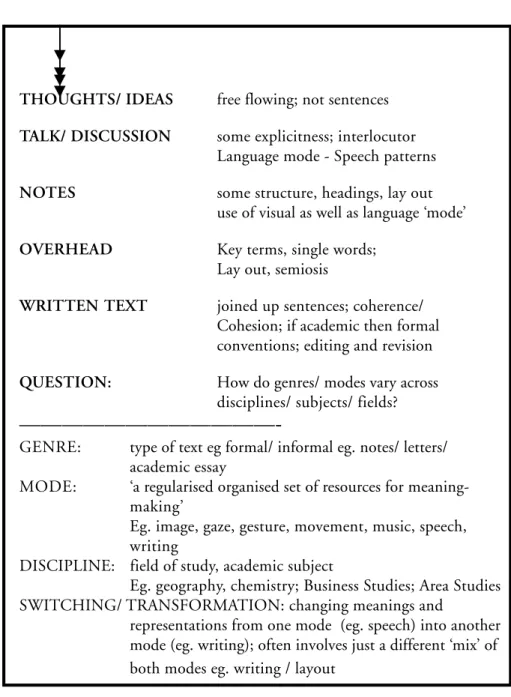
discussions, written notes, letters, academic essays etc. We wanted to help students be more aware of the different language - and more broadly semiotic - practices associated with different genres.
THOUGHTS/ IDEAS free flowing; not sentences
TALK/ DISCUSSION some explicitness; interlocutor Language mode - Speech patterns
NOTES some structure, headings, lay out use of visual as well as language ‘mode’
OVERHEAD Key terms, single words; Lay out, semiosis
WRITTEN TEXT joined up sentences; coherence/ Cohesion; if academic then formal conventions; editing and revision
QUESTION: How do genres/ modes vary across disciplines/ subjects/ fields?
————————————-GENRE: type of text eg formal/ informal eg. notes/ letters/ academic essay
MODE: ‘a regularised organised set of resources for meaning-making’
Eg. image, gaze, gesture, movement, music, speech, writing
DISCIPLINE: field of study, academic subject
Eg. geography, chemistry; Business Studies; Area Studies SWITCHING/ TRANSFORMATION: changing meanings and
representations from one mode (eg. speech) into another mode (eg. writing); often involves just a different ‘mix’ of both modes eg. writing / layout
The teachers asked, for instance, how do genres and modes vary across disciplines, subjects and fields? Students from science disciplines appeared less familiar with extended prose but adept at structured lay out and use of signs, whilst social science students had had more written work to do in their school practice but had not necessarily differentiated its features from those of talk and visual layout as explicitly as we were doing in these sessions. In some cases they reported that teachers would follow a discussion by asking them to ‘write it up’ without necessarily making explicit the different requirements as they switched genre. Explicit attention to switching, transformation and the changing meanings and representations from one genre to another and that this often involves a different ‘mix’ of two or more genres, such as the notion that writing always creates meaning through layout as well as the use of words, was a basic premise of our pedagogy in the course. It might appear that we used the concept of genre in perhaps a broader sense than that evident in some linguistic traditions called upon at SIGET and it will be interesting to compare the example given here with those provided by others who have attended the SIGET conferences.
The original aim of the Thinking Writing initiative at Queen Mary University London was:
To enhance the development of student writing through supporting staff and departments in the piloting of new discipline-based writing-intensive courses and through the dissemination of good practice.
late 1970s in the USA and the TW programme builds strongly on the WAC tradition. Similarly, Bazerman’s early work in the USA (1988), in particular his claim that writing matters because the different choices around what and how we write results in different meanings, underpinned the framing for both research and practice with student writers.
Whilst the TW approach, building upon such work of colleagues in the USA, recognises that responses to ‘problems’ with student writing depend on how the relationship between writing and ‘content’ knowledge is conceptualised, for many academics in the UK writing is still seen as a set of generic skills separate from the thinking and conceptualising required in a particular discipline, akin to Lea and Street’s notion of ‘study skills’. The outcome of a recent Review of the QM programme was that both members of the TW team and members of disciplines working with them, felt that there is a need for HEIs in general to recognise that the ‘students can’t write’ view is misleading. The perspective put forward to counter this dominant view was that the act of writing, for all disciplines, requires an ability to conceptualise, to “see with new eyes” both the processes and purposes of writing. How this might be achieved may still be uncertain but the TW approach has helped set this process in motion and is being closely observed by staff in other universities. Indeed the most recent AcLits conference was held at Queen Mary in the summer of 2009 and there the link between theory and practice and between generic and specific writing support was explicitly addressed. A major theme there was what Lillis and Scott (2008) refer to as the distinction between normative and transformative approaches to academic literacies. Referring to their account in a paper that attempted to sum up the current position in the academic literacies field, they signal many of the traditions cited above concerning approaches to academic writing, seeing the ideological model of literacy as a source for this particular distinction:
The ideological stance towards the object of study in what we are calling ‘academic literacies’ research can be described as explicitly
exploring how students might be taught to become proficient or ‘expert’ and developing materials on that basis. A transformative approach in contrast involves an interest in such questions but in addition is concerned with: a) locating such conventions in relation to specific and contested traditions of knowledge making; b) eliciting the perspectives of writers (whether students or professionals) on the ways in which such conventions impinge on their meaning making; c) exploring alternative ways of meaning making in academia, not least by considering the resources that (student) writers bring to the academy as legitimate tools for meaning making (examples of pedagogy informed by the latter approach are to be found in CLARK; IVANIc,, 1991; IVANIc, 1998, 2004; LEU, 2006; LILLIS, 2006).
Interestingly for our present discussion, Lillis and Scott also locate this discussion in the broader comparisons of UK and US traditions with which this paper has been concerned:
It is important at this point to signal two key differences between the significant strand of US based literature which adopts a transformative interest in academic writing and the way in which ‘academic literacies’ as a field has developed in the UK and other national contexts such as South Africa. The first difference is the institutional context: in the UK – in contrast for example with the US – questions about literacy practices are being played out within the everyday business of disciplinary study, not within a specified ‘writing’ designated spaces (such as composition, or basic writing, writing centres, TESOL classes). The second is that in US writings, transformative discussions tend to be forged out of the disciplinary traditions of literary studies and cultural theory and to remain at a theoretical level, with detailed empirical observation often lacking. In attempting to clarify what constitutes an ‘academic literacies’ field of inquiry internationally, we argue that it is a transformative interest in meaning making set alongside a critical ethnographic gaze focusing on situated text production and practice. This involves a commitment to staying rooted in people’s lived experiences and an attempt to explore what may be at stake for them in specific contexts (LILLIS; SCOTT, 2008, p. 13).
The ‘features’ I describe here call upon many of the recent theoretical turns described above, in the fields of Writing in the Disciplines (WiD), Genre Studies and Academic Literacies and I consider whether and how such theory can be adapted to practice. Whereas dominant models of student writing (ESP; ESL), as we have seen, have tended to emphasise formulaic lists of things to be covered, usually in terms of the structure of the essay (e.g., Introduction; Theory; Methods; Data), this approach focuses on the more ‘hidden’ features that are called upon in judgments of academic writing that often remain implicit. The paper describes how, during a literacy course at the Graduate School of Education at the University of Pennsylvania, a table of terms was drawn up for making explicit the criteria used for assessing and reviewing academic papers. In the first instance this framework (see below) was applied to the chapters of an edited book with particular respect to the opening sections, using a typology of ‘vignettes, personal, declarative’. The terms in the ‘hidden features’ table as a whole were then used to review drafts of students’ assignments for the course. The paper concludes with some student responses and the implications for wider applications in support of academic writing are considered. In terms of the present discussion, we might ask whether Street’s approach here, applying academic literacies theory in practice, can be seen as ‘transformative’ in the sense indicated by Lillis and Scott. It seems appropriate to end this account with the comment of one of the students on the course as a way of opening up such discussion and locating this particular practice in the larger context indicated above and indeed in the SIGET Conference as a whole:
Framing Genre Audience Contribution/ “So what?”
To knowledge To field
To future directions/ research Voice
Blommaert, 2005; cf. p. 222; “Voice refers to the capacity to make oneself understood as a situated subject... Bourdieu’s concept of habitus can be useful… provided we see habitus as ethnographically grounded, i.e., as allowing for the situated, performed subjectivities... this addresses”
Ivanic, 1998; cf. Preface p. 1; “Who am I as I write this book? I am not a neutral, objective scribe conveying the objective results of my research impersonally in my writing. I am bringing to it a variety of commitments based on my own interests, values, beliefs which are built up from my own history…”
Stance
Person/ Agency Reflexivity
Hyland, 1999; cf. pp. 99/ 101; ‘… in presenting informational content, writers also adopt interactional and evaluative positions. … Stance refers to the ways that writers project themselves into their texts to communicate their integrity, credibility, involvement, and a relationship to the subject matter and their readers.
Signalling
Brief references to setting/ theory/ method (to be fleshed out in other parts of the text)
Structure Opening:
Vignette Personal Declarative Indicative Setting
Theory Methods Data Conclusions
FIGURE 3 – ‘Hidden’ Features of Academic Paper Writing (fromStreet, B 2009 “‘Hidden’ Features of Academic Paper Writing”
Conclusion
As the Russell et al. paper, arising from a previous SIGET conference, concludes: ‘at a time when UK and European university policy makers, research funding and assessment bodies seem to be demanding generic and normalised academic writing, ACLITS research illuminates both the pragmatics and problematics of genre and / in academic writing. Such discussions of pedagogy and genre between ACLITS and WAC approaches seem a fertile ground for producing new strains of pedagogical thought and action’. I hope, like them, that this mapping will open up a discussion, not only within the US and UK, but also within other countries where the ACLITS and / or WAC research and practice have been taken up. My own position, as indicated above in the discussion of both ACLITS theory and of practical programmes, leans perhaps towards the more critical stance indicated by Lillis and Scott and the activity and social practice approach signaled by recent work in the US and the UK. In any case such a discussion has brought together many of the themes raised at SIGET conferences and I hope that it opens up trajectories for future research, practice and collaboration of the kind they were founded to develop.
References
BAZERMAN, C. Shaping Written Knowledge: the genre and activity of the experimental article in science. Madison: University of Wisconsin Press, 1988. BLOMMAERT, J. ‘Bourdieu the Ethnographer: the ethnographic grounding of habitus and voice’. The Translator, v. 11, n. 2, p. 219-236, 2005.
CLARK, R.; IVANIc, R. Consciousness-raising about the writing process. In: JAMES, C.; GARRETT, P. (Ed.). Language Awareness in the Classroom. London: Longman, 1991. p. 168-185.
GEE, J. P. Social Linguistics and Literacies: Ideology in Discourse. London: Falmer Press, 1996.
HOUNSELL, D. Towards an Anatomy of Academic Discourse: Meaning and Context in the Undergraduate Essay. In: SALJO, R. The Written World. Studies in Literate Thought and Action. Berlin: Springer-Verlag, 1988.
HYLAND, K. Disciplinary Discourses: writer stance in research articles. In: CANDLIN, C.; HYLAND, K. (Ed.). Writing Texts, Processes and Practices.
Longman, 1999. p. 99-121.
IVANIc, Ros; LEA, Mary R. New contexts, new challenges: the teaching of writing in UK higher education. In: GANOBCSIK-WILLIAMS, Lisa (Ed.).
Teaching academic writing in UK higher education. Houndmills: Palgrave Macmillan, 2006. p. 6-15.
JONES, C.; TURNER, J.; STREET, B. (Ed.). Student Writing in the University: cultural and epistemological issues. John Benjamins, 1999.
LEA, M. Academic Literacies: a pedagogy for course design. Studies in Higher Education, v. 29, n. 6, p. 739-756, dec. 2004.
LEA, M. R.; STREET, B.V. Student writing in higher education: an academic literacies approach. Studies in Higher Education, v. 23, n. 2, p. 157-172, 1998. LEA, M.; STREET, B. Student Writing and Faculty Feedback in Higher Education: an Academic Literacies Approach. Studies in Higher Education, v. 23, n. 2, 1998. LEA. M. R.; STREET, B. V. The “Academic Literacies” Model: Theory and Applications. Theory into Practice Fall, v. 45, n. 4, p. 368-377(e), 2006. LEU, D. New Literacies, reading Research and the Challenges of Change; a deictic perspective. 55th Yearbook of the National Reading Conference, 2006. p. 1-20. LEUNG, Constant; SAFFORD, Kimberly. Nontraditional Students in Higher Education in the United Kingdom: English as an Additional Language and Literacies. In: STREET, Brian V. (Ed.). Literacies Across Educational Contexts: Mediating Learning and Teaching . Philadelphia: Caslon Publishing, 2005. LILLIS, T.; SCOTT, M. Defining academic literacies research: Issues of epistemology, ideology and strategy. Journal of Applied Linguistics, v. 4, p. 5-32, 2008. LILLIS, T. Moving towards an ‘academic literacies’ pedagogy: dialogues of participation. In: GANOBCSIK-WILLIAMS, L. (Ed.). Teaching Academic Writing in UK Higher Education; theories, practices and models. Palgrave Macmillan: Basingstoke, 2006.
RUSSELL, D. Writing in the academic disciplines, 1870-1990: a curricular history. Carbondale: South Illinois University Press, 1991.
RUSSELL, David; LEA, Mary; PARKER, Jan; STREET, Brian; DONAHUE, Tiane. 2009. Exploring notions of genre in ‘academic literacies’ and ‘writing in the disciplines’: approaches across countries and contexts. In: BAZERMAN, Charles; BONINI, Adair; FIGUEIREDO, Débora (Ed.). Genre in a Changing World. Perspectives on Writing. Fort Collins, Colorado: The WAC Clearinghouse and Parlor Press. http://wac.colostate.edu/books/genre/
SCALONE, P.; STREET, B. An Academic Language Development Programme (Widening Participation). In: LEUNG, C.; JENKINS, J. (Ed.). Reconfiguring Europe: the contribution of applied linguistics. London: Equinox, 2006. p. 123-137.
STIERER, B. Mastering Education: a preliminary analysis of academic literacy practices within master-level courses in Education. Centre for Language & Communications, Open University; Milton Keynes, 1997
STREET, B. “Hidden” Features of Academic Paper Writing. Working Papers in Educational Linguistics, UPenn, 2009.
STREET, B. ‘Ethnography of writing and reading’. In: OLSON, David R.; TORRANCE, Nancy (Ed.). Cambridge Handbook of Literacy. CUP: Cambridge, 2008.
STREET, B. Literacy in Theory and Practice. Cambridge: CUP, 1984.
STREET, B. Social Literacies: Critical Approaches to Literacy in Education, Development and Ethnography. Longman; London, 1995. (Real Language series)
SWALES, J. Genre Analysis: English in Academic and Research Settings. Cambridge: CUP, 1990.