318
Rev Bras Ter Intensiva. 2008; 20(3):318-320
Intra-arterial pulmonary thrombolysis
at the postoperative period of brain
aneurysm clamping. Case report
Trombólise intra-arterial pulmonar no pós-operatório
de clipagem de aneurisma cerebral. Relato de caso
RELATO DE CASO
INTRODUCTION
Pulmonary thromboembolism (PT) is a leading cause of morbimortality in patients submitted to neurological procedures1,2. For cases of PT in patients in
recent postoperative of neurosurgery, thrombolytic therapy is contraindicated and only performed in selected cases2. he objective of this study was to report
a case of a patient that presented with a massive pulmonary tromboembolism in the seventh postoperative day of a cerebral aneurism clamping, submitted to intra-arterial thrombosis, with a good outcome.
CASE REPORT
Male, 36 year old patient with a diagnosis ofanterior communicating artery aneurysm, with indication for surgical treatment. As previous event he pre-sented with ischemic stroke in the occipital region.
He was admitted at the intensive care unit (ICU) at immediate postoperative period of anterior communicating artery aneurysm clamping without intercur-rence, and was discharged from the ICU on the second postoperative day.
On the seventh postoperative day he presented with precordial burning pain, together with tachycardia, cold sudoresis and hemodynamic instability, and was transfer to the ICU requiring administration of vasoactive drugs and oxygen.
he electrocardiogram disclosed dispersed alteration of ventricular repolar-ization. Transthoracic echocardiogram showed dilation of the right chamber
Salomón Soriano Ordinola Rojas1,
Viviane Cordeiro Veiga2, Júlio César
de Carvalho2, Luis Enrique Amaya
Campodônico2, Fabrizio Rodrigues
Assis2, Sandra Patrícia Shimizu3,
Olga Oliveira Cruz3, Elaine
Aparecida Morais3, Roberto Buesio4,
Andréia Maria Marchesini5, Ligia
Maria Coscrato Junqueira5, Carlos
Vanderlei Holanda6
1. Physician from the Neurological Intensive Care Units of the Hospital Beneicência Portuguesa de São Paulo, São Paulo (SP), Brazil.
2. Physician from the Neurological Intensive Care Units of the Hospital Beneicência Portuguesa de São Paulo, São Paulo (SP), Brazil.
3. Nurse from the Neurology Intensive Care Units of the Hospital Beneicência Portuguesa de São Paulo, São Paulo (SP), Brazil.
4. Physician from the Hospital Beneicência Portuguesa de São Paulo, São Paulo (SP), Brazil.
5. Physiotherapist from the Intensive Care Units of the Hospital Beneicência Portuguesa de São Paulo, São Paulo (SP), Brazil.
6. Physician from the Hospital Beneicência Portuguesa de São Paulo, São Paulo (SP), Brazil.
ABSTRACT
Pulmonary thromboembolism is a major cause of morbidity and mortal-ity of patients undergoing neurosurgical procedures. he purpose of this study was to present a case of intra-arterial pul-monary thrombolysis in recent neurosur-gery postoperative period.Male patient, undergoing neurosurgery, presented as a complication on the seventh day of post-operative massive pulmonary embolism with hemodynamic instability and intra-arterial pulmonary thrombolysis with
al-teplase was indicated. Evolution was sat-isfactory without bleeding complications and patient was discharged.Pulmonary thromboembolism is a high morbidity and mortality condition at neurosurgical postoperative period and thrombolysis should be an alternative therapy in cases refractory to clinical treatment.
Keywords: Intracranial aneurysm/ surgery; Intracranial aneurysm/com-plications; Pulmonary embolism/etiol-ogy; Postoperative period; hrombolytic therapy; Case reports
Received from the Neurology Intensive Care Units of the Hospital Beneicência Portuguesa, São Paulo, (SP), Brazil.
Submitted on June 24, 2008 Accepted on August 14, 2008
Address for correspondence:
Intra-arterial pulmonary thrombolysis and brain aneurysm clamping 319
Rev Bras Ter Intensiva. 2008; 20(3):318-320
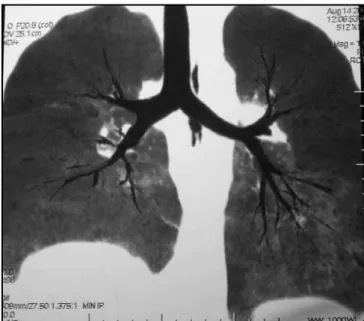
and dysfunction of the right ventricle without other sig-niicant alterations. A computed tomography angiography of the chest was requested showing illing defects in both pulmonary arteries and their segmentary branches, related to an extensive bilateral pulmonary thromboembolism (Figures 1 and 2).
hereupon invasive hemodynamic monitoring was chosen with a Swan-Ganz catheter, initially presenting with a cardiac index of 2 L/min and mean pulmonary artery pressure of 37 mmHg. Patient was hypotensive, receiving noradrenaline and dobutamine, without clini-cal improvement. During hematologiclini-cal investigation a protein C deiciency and resistance to activated protein C were detected.
Because of the condition’s severity, intravenous heparin was introduced in a 60 UI/kg dose and, later, intra-pulmonary arterial thrombolysis with maneuvers of mechanical fibrinolysis and injection of 20mg of al-teplase (rt-PA) in bolus. This was followed by 30 mg of the same substance intravenously, with improve-ment of the clinical, hemodynamic and angiographic parameters which allowed for reduction of vasoactive drugs.
Intravenous heparin was maintained in continuous infusion for 72 hours with control of activated par-tial thromboplastin time (APTT) between 1.5 – 2.0
times the normal values. Low molecular weight heparin (enoxaparin) 1 mg/kg subcutaneous every 12 hours was introduced, as from the fourth day of thrombolysis.
Patient remained stable, presenting as only post-thrombolysis intercurrence a discreet bleeding at the site of the vascular puncture. He did not present neu-rological deicits and was discharged from the ICU and later from the hospital.
DISCUSSION
Pulmonary thromboembolism is a severe condition afecting about 2.5% of hospitalized patients, with a mortality of over 30% in cases of massive PT3,4.
Included among predisposing factors are extensive surgical procedures, prolonged immobilization, stroke, chronic venous insuiciency of the lower limbs, in addition to disorders of the coagulation system such as antithrombin III, protein S and protein C3,5,
dei-ciency. In such cases diagnosis is mostly achieved after the thrombotic event. In this case the patient presented more than one predisposing factor for the condition, that is to say, the protein C deiciency and neurosurgi-cal procedure.
After diagnosis, risk stratification was required and patients who present hemodynamic instability,
respi-Figure 2 – Computed tomography angiography of the chest. Figure 1 – Computed tomography angiography of the chest
320 Rojas SSO, Veiga VC, Carvalho JC, Campodônico LEA, Assis FR, Shimizu SP et al.
Rev Bras Ter Intensiva. 2008; 20(3):318-320
ratory failure or right ventricle dysfunction at echocar-diogram, were considered of high risk. In these cases, anticoagulation and use of fibrinolysis (thrombolysis), in addition to oxygen supplement, were indicated for correction of hypoxia and administration of fluids to maintain preload of the right ventricle6,7. This patient
had hemodynamic instability and right ventricle dys-function. However, as he was at recent postoperative period (seventh day) from cerebral aneurism clamp-ing, there was a contraindication for use of a throm-bolític8-10. Nevertheless, because he was
hemodynami-cally unstable, requiring high concentrations of vaso-active drugs, intra-arterial thrombolysis was chosen, with rigorous observation of the clinical parameters essentially related to possible hemorrhagic complica-tions.
Pulmonary thromboembolism is a high morbidity and mortality condition at neurosurgical postopera-tive period and thrombolysis should be an alternapostopera-tive therapy in cases refractory to clinical treatment.
RESUMO
O tromboembolismo pulmonar (TEP) é uma importante causa de morbimortalidade nos pacientes submetidos a procedi-mentos neurocirúrgicos. O objetivo deste estudo foi apresentar um caso de trombólise intra-arterial pulmonar em pós-operató-rio recente de neurocirurgia.Paciente do sexo masculino, sendo submetido a pinçamento de aneurisma de artéria comunicante anterior, apresentou como complicação no sétimo dia de pós-operatório, tromboembolismo pulmonar maciço, apresentan-do instabilidade hemodinâmica, senapresentan-do optaapresentan-do pela trombólise intra-arterial pulmonar com alteplase. Apresentou evolução sa-tisfatória, sem complicações hemorrágicas, recebendo alta hos-pitalar. O tromboembolismo pulmonar é uma condição com alta morbi-mortalidade no pós-operatório de neurocirurgia, de-vendo ser a trombólise ser uma alternativa terapêutica nos casos refratários ao tratamento clínico.
Descritores: Aneurisma intracraniano/cirurgia; Aneurisma intracraniano/complicações; Embolia pulmonar/etiologia; Perí-odo pós-operatório; Terapia trombolítica; Relatos de casos
REFERENCES
01. Inci S, Erbengi A, Berker M. Pulmonary embolism in neu-rosurgical patients. Surg Neurol. 1995; 43(2):123-8; dis-cussion 128-9.
02. Kutlu R, Alkan A, Kocak A, Sarac K. hrombolysis and mechanical fragmentation to treat massive pulmonary em-bolism in a patient with an anterior communicating artery aneurysm. J Endovasc her. 2003; 10(2):332-5.
03. De Gregorio MA, Gimeno MJ, Mainar A, Herrera M, To-bio R, Alfonso R, et al. Mechanical and enzymatic throm-bolysis for massive pulmonary embolism. J Vasc Interv Radiol. 2002;13(2 Pt 1):163-9.
04. Sayeed RA, Nashef SA. Successful thrombolysis for mas-sive pulmonary embolism after pulmonary resection. Ann horac Surg. 1999; 67(6):1785-7.
05. Wood KE. Major pulmonary embolism: review of a pa-thophysiologic approach to the golden hour of hemody-namically signiicant pulmonary embolism. Chest. 2002; 121(3):877-905. Comment in: Chest. 2002; 122(6):2264;
author reply 2264-5.
06. Guidelines on diagnosis and management of acute pul-monary embolism. Task Force on Pulpul-monary Embolism, European Society of Cardiology. Eur Heart J. 2000; 21(16):1301-36. Review.
07. Goldhaber SZ, Visani L, De Rosa M. Acute pulmonary embolism: clinical outcomes in the International Coope-rative Pulmonary Embolism Registry (ICOPER). Lancet. 1999; 353(9162):1386-9. Comment in: Lancet. 1999; 353(9162):1375-6.
08. di Ricco G, Marini C, Rindi M, Ravelli V, Lutzemberger L, Tusini G, Giuntini C. Pulmonary embolism in neuro-surgical patients: diagnosis and treatment. J Neurosurg. 1984; 60(5):972-5.
09. Endo H, Kubota H, Sato M, Sudo K. Surgical treatment of pulmonary embolism with recent intracranial hemorrhage. Ann horac Cardiovasc Surg. 2005; 11(4):256-9.