65
ABSTRACT
BACKGROUND AND OBJECTIVES:Hemophilia is a con-genital, uncommon and chronic coagulopathy characterized by recurrent hemarthrosis outbreaks. It afects predominantly males and produces major musculoskeletal disorders, such as move-ment limitation, joint ibrosis, hemarthrosis and tissue hemor-rhages, muscle contractures, muscle strength deicit and hemo-philic arthritis, resulting in pain and impaired quality of life. his study aimed at evaluating the efects of a physiotherapeutic intervention program on pain and quality of life of a patient with hemophilic arthritis.
CASE REPORT:Male patient, 23 years old, with hemophilic arthritis. His major complaint was pain in diferent body sites, especially in ankles and right knee. Pain was evaluated with the visual analog scale and body pain map, and quality of life was evaluated with the Short-Form Health Survey questionnaire. Patient was submitted to eight physiotherapy sessions, once a week, with mean duration of 50 minutes, between May and June 2015. Adopted intervention protocol was based on conventional kinesiotherapy.
CONCLUSION: his study has shown that a physiotherapy program based on kinesiotherapy has decreased the number of tender points and pain intensity, as well as has improved quality of life of a patient with hemophilic arthritis.
Keywords: Hemophilia A, Hemophilia B, Pain, Physiotherapy, Quality of life.
Physiotherapeutic approach for pain and quality of life of a hemophilic
patient. Case report
Abordagem fisioterápica na dor e na qualidade de vida de um indivíduo com artrite hemofílica.
Relato de caso
Matheus Santos Gomes Jorge1, Igor Schreiner Moreira2, Gabriel Felimberti2, Lia Mara Wibelinger3
1. Universidade de Passo Fundo, School of Physiotherapy, Scholarship Probic/Fapergs, Sole-dade, RS, Brazil.
2.Universidade de Passo Fundo, Passo Fundo, RS, Brazil.
3. Universidade de Passo Fundo, School of Physiotherapy. Passo Fundo, RS, Brazil.
Submitted in November 26, 2015. Accepted for publication in January 27, 2016. Conlict of interests: none – Sponsoring sources: none.
Correspondence to: Matheus Santos Gomes Jorge BR 285 – Bairro São José 99052-900 Passo Fundo, RS, Brasil. E-mail: [email protected]
© Sociedade Brasileira para o Estudo da Dor
RESUMO
JUSTIFICATIVA E OBJETIVOS: A hemoilia é uma coagu-lopatia congênita, rara e crônica, caracterizada pelos surtos re-cidivantes de hemartroses. Predomina no gênero masculino e produz agravos osteomioarticulares importantes como restrição dos movimentos, ibrose articular, hemartroses e hemorragias tis-sulares, contraturas musculares, déicit de força muscular e artrite hemofílica, resultando em quadros de dor e piora na qualidade de vida. O objetivo deste estudo foi veriicar os efeitos de um programa isioterápico de intervenção na dor e na qualidade de vida de um indivíduo com artrite hemofílica.
RELATO DO CASO: Paciente do gênero masculino, 23 anos de idade, com diagnóstico de artrite hemofílica. Sua queixa prin-cipal era a dor em diversos pontos do corpo, especialmente em tornozelos e joelho direito. A dor foi avaliada através da escala analógica visual e do mapa de dor corporal, e a qualidade de vida por meio questionário Short-Form Health Survey. O paciente foi submetido a oito sessões de isioterapia, uma vez por semana, com duração média de 50 minutos, entre os meses de maio a junho de 2015. O protocolo de intervenção adotado baseou-se em cinesioterapia convencional.
CONCLUSÃO: O presente estudo demonstrou que um pro-grama de isioterapia baseado na cinesioterapia diminuiu o número de pontos dolorosos e a intensidade da dor, bem como melhorou os domínios da qualidade de vida em um indivíduo com artrite hemofílica.
Descritores: Dor, Fisioterapia, Hemoilia A, Hemoilia B, Qual-idade de vida.
INTRODUCTION
Hemophilia is a congenital disease caused by blood coagu-lation factor deiciency and characterized by recurrence of hermarthroses, especially in joints. It has two forms: type A (factor VIII deicit) or type B (factor IX deicit)1.
Males are more frequently affected, with its peak between 20 and 29 years of age, being that type A is the most fre-quent2. Worldwide, 6.9 million people have some hemor-rhagic disorder3 and in Brazil almost 11 thousand people had some type of hemophilia in 2012. In this same period, Rio Grande do Sul had slightly more than 600 cases of the disease2.
Hemophilic patients have persistent pain, which varies from moderate to severe. In this population, pain may induce
mus-Rev Dor. São Paulo, 2016 jan-mar;17(1):65-8 CASE REPORT
66
Jorge MS, Moreira IS, Felimberti G and Wibelinger LM
Rev Dor. São Paulo, 2016 jan-mar;17(1):65-8
culoskeletal complications4, such as joint movement limita-tion, joint ibrosis, contractures, gait and muscle strength changes, hemarthroses, tissue hemorrhage and hemophilic arthritis (HA)1,5. Due to coagulation process changes, hem-orrhages are the most frequent complications of hemophilic patients and may be spontaneous or secondary to trauma6. There is currently consensus among health care profession-als about the use of physiotherapy for hemophilic individu-als because it corrects motor deficits, improves functionality, decreases pain and improves quality of life (QL)1. Regular exercises aim at better psychosocial conditions, increase or maintenance of muscle strength and trophism, joint mobil-ity and stabilmobil-ity, flexibilmobil-ity, balance and functionalmobil-ity, thus improving daily life activities (DLA)7,8. Different physio-therapeutic modalities are welcome to treatment, especially kinesiotherapy7,8. However, literature still lacks sources dis-cussing and exploring the best physiotherapeutic treatment for hemophilic patients1,5,7.
In light of the above, this study aimed at observing the efects of a physiotherapeutic program on pain and QL of a hemo-philic arthritis patient.
CASE REPORT
This is a longitudinal, interventionist, case report study. It is part of an umbrella project called “Effects of physiotherapy on patients with rheumatic diseases”, approved by the Ethics Committee for Research with Human Beings of the Uni-versidade de Passo Fundo under protocol 348.381, accord-ing to Resolution 196/96 of the National Health Council (NHC).
Male patient, 23 years old, with HA, who participated in 8 physiotherapy sessions from May to June 2015, once a week lasting approximately one hour in the Physiotherapy Clin-ic of the School of PhysClin-ical Education and Physiotherapy, Universidade de Passo Fundo, Passo Fundo/RS after signing the Free and Informed Consent Term (FICT).
Baseline evaluation consisted in data collection (age, profes-sion, physical evaluation and others), QL evaluation by means of the quality of life questionnaire – Medical Outcomes Study 36 – Item Short-Form Health Survey (SF-36), translated and validated for the Portuguese language, and pain evalua-tion by means of the body map of pain and the visual analog scale (VAS), all carried out as interviews after previous ex-planation of the procedures and the answering of questions. SF-36 is a 36-item scale gathering physical (functional ca-pacity, physical aspects, pain and general health status) and mental (vitality, social aspects, emotional aspects and men-tal health) components. The higher the score, the better the health-related QL9.
Body map of pain is a representation of the human body where patients indicate specific site and distribution of pain at evaluation time10. VAS is a horizontal straight line with edges numbered from zero (no pain) to 10 (worst imagin-able pain). Patients should quantitatively indicate their pain at that moment11.
Intervention protocol was based on global conventional ki-nesiotherapy with emphasis on lower limbs, and aimed at muscle strengthening, mobility, balance, proprioception and gait training by means of weight bearing. The order of exercises was: initial and final blood pressure measure-ment; global active and/or passive stretching of major upper and lower limbs and trunk muscle groups (for 15 seconds); joint mobilization of ankles, bilateral metatarsi, feet phalan-ges, right knee, left hip, left elbow and lumbar and cervical spine; squeeze a proprioceptive ball with feet (3x10); sitting and standing holding 2 kg anklets (3x10); mini-squats in airex, progressing to discoball (3/x010); plantiflexion with 2 kg shin guards, progressing to 3 kg (3x10); kicking a futsal ball with 2 kg shin guards, progressing to 2.5 kg (10 kicks with each leg, in three series); going up and downstairs with 3 kg shin guards (3x15 steps); ergonomic bike with load 3, progressing to load 5 (during 10 minutes). Session was closed with ankles cryotherapy for 20 minutes. The num-ber of loads and repetitions was established according to patient’s physical conditions and has maintained the same value throughout the treatment. All parameters were revalu-ated after 8 physiotherapy sessions.
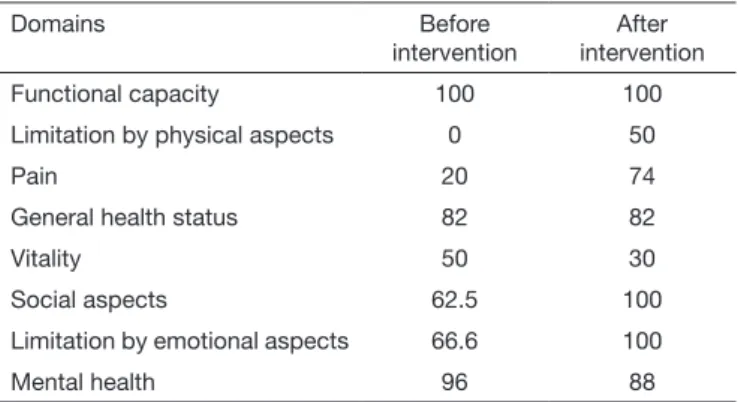
Table 1 shows data related to individual’s QL before and after physiotherapy, according to SF-36.
There has been considerable improvement in limitation by physical aspects, followed by pain, social aspects and limita-tion by emolimita-tional aspects, while remaining domains have maintained the same value or have not shown satisfactory results.
Table 2 shows data regarding patient’s pain, according to body map of pain and VAS.
Table 1. Quality of life before and after physiotherapeutic intervention, according to SF-36
Domains Before
intervention
After intervention
Functional capacity 100 100
Limitation by physical aspects 0 50
Pain 20 74
General health status 82 82
Vitality 50 30
Social aspects 62.5 100
Limitation by emotional aspects 66.6 100
Mental health 96 88
Table 2. Pain before and after physiotherapy, according to body map of pain and visual analog scale
Before intervention After intervention
Pain site Cervical region
Lumbar region Left elbow Right knee
Left thigh internal region Right and left ankles
Cervical region Left ankle
General pain intensity
67
Physiotherapeutic approach for pain and quality oflife of a hemophilic patient. Case report
Rev Dor. São Paulo, 2016 jan-mar;17(1):65-8
Pain has considerably improved after physiotherapy, accord-ing to patient’s report. Tender points, which initially were six, have decreased to just two, and general pain intensity has de-creased 6 points, according to VAS.
DISCUSSION
Pain contributes to incapacity of chronic disease patients12, since in static contraction the activity of the painful muscle is decreased and attenuates synergist muscle activity, thus wors-ening pain13. Around 86% of hemophilia cases are followed by pain and from these 92% report arthralgia14. his is in line with our study because patient had joint pain complaint, especially in ankles and knees, which leads to incapacity and muscle un-balance, thus contributing to worsening pain.
In HA, recurrent hemarthroses lead to joint degeneration, joint deformities, severe functional deiciency, and consequently generating pain as described in this report15. HA patients have complications such as strength deicits and muscle atrophies, joint instability, hypomobility, proprioceptive decrease and limitation of biomechanical movements, thus making diicult pain relief16. Patient has reported using factor VIII concentrate and has maintained this therapy during physiotherapeutic treatment. his strategy associated to physiotherapy may de-crease the duration of hemorrhages, generating better results and lower public expenditures17.
Some studies suggest that exercises increase the level of circu-lating factor VIII18 and when early performed provide positive results, such as decreased joint bleedings, pain relief, increased muscle strength and resistance and prevention of possible mioarticular deformities, assuring better QL and itness to pa-tients16. his is why we have chosen physical exercises as the intervention modality for this study.
Literature states that kinesiotherapy uses movement to provide mobility, lexibility, muscle coordination, to increase muscle strength and resistance to fatigue19. Due to joint instabilities it is necessary to encourage proprioceptive exercises aiming at joint balance and repositioning7, assuring a good development of muscles and protection of joints against new hemorrhagic events1. his is why exercises were performed with weight bearing, aiming at preventing the recurrence of hemarthroses, which are reasons for pain and impact on QL of HA patients. Evidences recommend that physiotherapy should be applied two to three times a week with minimum duration of three months20, which is in line with current study which has ad-opted a shorter intervention time and patient improved or maintained pain and QL.
A diferent study has evaluated the eicacy of two physiothera-peutic interventions in nine ankle HA patients. hey were randomized in mobilization and stretching group (G1) and manual therapy group (G2).
At the end of 12 sessions, both groups have improved all ankle movements, being that G1 had better results regarding pain perception and QL21. In our study, patient has followed a pro-tocol of exercises based on kinesiotherapy and has improved QL, especially limitation by physical aspects and pain. So, it is
understood that physiotherapy may be an efective alternative to maintain or rehabilitate pain and QL of hemophilic patients, in addition to decreasing the inancial impact of pharmacologi-cal therapies. So, as for the general population, hemophilic pa-tients beneit from physical activity5. In our study, using similar techniques, such as joint mobilization and stretching, patient has improved QV and pain.
A case study with HA patient who performed 20 physiother-apy sessions, has involved global stretching, joint mobiliza-tion, strengthening exercises with load (resisted and isometric), weight transfer exercises, posture re-education and gait train-ing. At the end, it was observed that QL had signiicantly im-proved1, what is in line with current study because our patient has performed a protocol of kinesiotherapy-based exercises and has improved QL, especially in limitation by physical aspects and pain.
A diferent study has evaluated the eicacy of two physiothera-peutic interventions in nine ankle HA patients. hey were ran-domized in mobilization and stretching group (G1) and man-ual therapy group (G2). At the end of 12 sessions, both groups have improved all ankle movements, being that G1 had better results regarding pain perception and QL21. In our study, using similar techniques, such as joint mobilization and stretching, patient has improved QL and pain.
A study has divided 31 ankle HA individuals in groups: manual therapy consisting in joint traction, passive stretching of gatroc-nemius muscles, muscle strength and proprioception exercises (G1), educational and home exercises group (G2) and control group (G3). Study has lasted 12 weeks and G1 was better than G2 and G3 because it has improved muscle trophism and has decreased ankle pain22, which conirms our study because ad-opted intervention was efective for pain relief, especially ankle pain, according to patient’s report, and has improved QL. A case study with a male patient with knee and ankle HA, has performed physiotherapy for 8 weeks. Resources were Neu-romuscular Proprioceptive Facilitation (NPF) techniques. Results have shown improved movement amplitude and de-creased involved joint pain according to VAS23. In our study, kinesiotherapy was efective to improve pain of our patient.
CONCLUSION
A physiotherapeutic protocol based on kinesiotherapy was ef-fective to decrease the number of tender points, to relieve pain and to improve quality of life of an individual with hemophilic arthritis.
REFERENCES
1. Bortolon AP, Sachetti A, Wibelinger LM. Análise da qualidade de vida de um indiví-duo portador de artrite hemofílica: um estudo de caso. EFDeportes. 2012;17(169), Disponível em:<http://www.efdeportes.com/efd169/individuo-portador-de-artrite--hemoilica.htm>. Acesso em 10 de novembro de 2015.
2. Brasil. Ministério da Saúde. Secretaria de Atenção à Saúde. Coordenação-Geral de Sangue e Hemoderivados. Peril das coagulopatias hereditárias no Brasil: 2011–2012 / Ministério da Saúde, Secretaria de Atenção à Saúde, Coordenação-Geral de Sangue e Hemoderivados. – Brasília: Ministério da Saúde, 2014.
68
Jorge MS, Moreira IS, Felimberti G and Wibelinger LM
Rev Dor. São Paulo, 2016 jan-mar;17(1):65-8
4. Lambing A, Kohn-Converse B, Hanagavadi S, Varma V. Use of acupuncture in the management of chronic haemophilia pain. Haemophilia. 2012;18(4):613-17 5. Querol F, Pérez-Alenda S, Gallach JE, Devís-Devís J, Valencia-Peris A, Moreno LM.
Haemophilia: exercise and sport. Apunts Med Esport. 2011;46(169):29-39. 6. Gidaris D, Economou M, Valeri R, Gombakis N, Athanasiou-Metaxa M. Successful
treatment of a spontaneous haemothorax with recombinant factor VIIa in a haemo-philic child with inhibitors. Hippokratia. 2010;14(4):289-90.
7. Melo CC, Pereira CA, Formiga CK, Sandoval RA, Viana FP. Tratamento isioterapêu-tico das alterações musculoesqueléticas em pacientes com Hemoilia. Estudos, Goiâ-nia. 2010;37(1/2):113-24.
8. Negrier C, Seuser A, Forsyth A, Lobet S, Llinas A, Rosas M, Heijnen L.he beneits of exercise for patients with haemophilia and recommendations for safe and efective physicalactivity. Haemophilia. 2013;19(4):487-98.
9. Burille A, Cervinski T, Vidmar MF, Wibelinger LM. Qualidade de vida de portadores de espondilite anquilosante submetidos a um programa de hidrocinesioterapia. EFDepor-tes. 2012;17(169). Disponível em: <http://www.efdeporEFDepor-tes.com/efd169/espondilite- <http://www.efdeportes.com/efd169/espondilite--anquilosante-a-hidrocinesioterapia.htm>. Acesso em: 11 de novembro de 2015. 10. Wenngren A, Stalnacke BM. Computerized assessment of pain drawing area: a pilot
study. Neuropsychiatr Dis Treat. 2009;5:451-56.
11. Martinez JE, Grassi DC, Marques LG. Análise da aplicabilidade de três instrumentos de avaliação de dor em distintas unidades de atendimento: ambulatório, enfermaria e urgência. Rev Bras Reumatol. 2011;51(4):304-8
12. Simões AS. A dor irruptiva na doença oncológica avançada. Rev Dor. 2011;12(2):166-71. 13. Falla D, Farina D, Dahl MK, Graven-Nielsen T. Muscle pain induces task-dependent
changes in cervical agonist/antagonist activity. J Appl Physiol. 2007;102(2):601-9. 14. Kalnins W, Schelle G, Jost K, Eberl W, Tiede A. Pain therapy in haemophilia in
Ger-many. Patient survey (BESTH study). Hamostaseologie. 2014;21(1):35.
15. Brasil. Ministério da Saúde. Secretaria de Atenção à Saúde. Departamento de Atenção Especializada. Manual de reabilitação na hemoilia / Ministério da Saúde. Secretaria de Atenção à Saúde. Departamento de Atenção Especializada. Coordenação-Geral de Sangue e Hemoderivados. – Brasília : Ministério da Saúde, 2011.
16. Gomis M1, Querol F, Gallach JE, González LM, Aznar JA. Exercise and sport in the treatment of haemophilic patients: a systematic review. Haemophilia. 2009;15(1):43-54.
17. Júnior NS, Vieira WH. Meios físicos na reabilitação do paciente portador de hemoi-lia. Uma revisão de literatura. Rev da FARN. 2010;9(1/2):197-210.
18. Andery SCA, Galatti LR, Alves MLT, Duarte E. Exercício físico e hemoilia: conceitos e intervenção. Revista Mackenzie de Educação Física e Esporte. 2005;11(2):96-109. 19. Florentino DM, De Sousa FR, Maiworn AI, Carvalho AC, Silva KM. A isioterapia no
alívio da dor: uma visão reabilitadora em cuidados paliativos. Rev Hosp. Univ Pedro Ernesto. 2012;11(2):50-7.
20. Stephensen D, Rodriguez-Merchan EC. Orthopaedic co-morbidities in the elderly haemophilia population: a review. Haemophilia. 2013;19(2):166-73.
21. Cuesta-Barriuso R, Gómez-Conesa A, López-Pina JA. Manual therapy in the treat-ment of ankle hemophilic arthropathy. A randomized pilot study. Physiother heory Pract. 2014;30(8):534-9.
22. Cuesta-Barriuso R, Gómez-Conesa A, López-Pina JA. Efectiveness of two modalities of physiotherapy in the treatment of haemophilic arthropathy of the ankle: a rando-mized pilot study. Haemophilia. 2014;20(1):71-8.