Copyright © 2015 Revista Latino-Americana de Enfermagem This is an Open Access article distributed under the terms of the Creative Commons Attribution Non-Commercial License (CC BY-NC).
This license lets others distribute, remix, tweak, and build upon your work non-commercially, and although their new works must also acknowledge you and be non-commercial, they don’t have to license their derivative works on the same terms.
Corresponding Author: Alessandra Mazzo
Universidade de São Paulo. Escola de Enfermagem de Ribeirão Preto Departamento de Enfermagem Geral e Especializada
Av. Bandeirantes, 3900 Bairro: Monte Alegre
CEP: 14040-902, Ribeirão Preto, SP, Brasil E-mail: [email protected]
1 PhD, Professor, Escola de Enfermagem de Ribeirão Preto, Universidade de São Paulo, PAHO/WHO Collaborating Centre for Nursing Research Development, Ribeirão Preto, SP, Brazil.
2 PhD, Professor, Escola Superior de Enfermagem de Coimbra, Coimbra, Portugal.
3 Doctoral student, Escola de Enfermagem de Ribeirão Preto, Universidade de São Paulo, PAHO/WHO Collaborating Centre for Nursing Research Development, Ribeirão Preto, SP, Brazil.
4 PhD, Adjunct Professor, Escola Superior de Enfermagem de Coimbra, Coimbra, Portugal. 5 MSc, Professor, Escola Superior de Enfermagem de Coimbra, Coimbra, Portugal.
6 PhD, Full Professor, Escola de Enfermagem de Ribeirão Preto, Universidade de São Paulo, PAHO/WHO Collaborating Centre for Nursing Research Development, Ribeirão Preto, SP, Brazil.
Validation of the self-confidence scale of nursing care in urinary
retention
Alessandra Mazzo
1José Carlos Amado Martins
2Beatriz Maria Jorge
3Rui Carlos Negrão Batista
4Rodrigo Guimarães dos Santos Almeida
3Fernando Manuel Dias Henriques
5Verónica Rita Dias Coutinho
4Isabel Amélia Costa Mendes
6Objective: to validate an instrument to measure self-confidence of nursing care in urinary
retention. Methods: methodological research study, carried out after ethical approval. A
Likert-like scale of 32 items related to nursing care in urinary retention was applied to students of the
graduate nursing course. For instrument validation, analysis of the sample adequacy and main
components, Varimax orthogonal rotation and internal consistency analyses were developed.
Results: in a sample of 305 students, there was high correlation of all items with the total scale
and Cronbach’s alpha of 0.949. The scale items were divided into five factors with internal
consistency: Factor 1 (0.890), Factor 2 (0.874), Factor 3 (0.868), Factor 4 (0.814) and Factor
5 (0.773), respectively. Conclusion: the scale meets the validity requirements, demonstrating
potential for use in evaluation and research.
Descriptors: Urinary Retention; Nursing; Trust; Urinary Catheterization.
Rev. Latino-Am. Enfermagem
2015 Sept.-Oct.;23(5):814-20
DOI: 10.1590/0104-1169.0256.2619
www.eerp.usp.br/rlae
Introduction
Urinary Retention (UR) is deined as the accumulation
of urine in the bladder that occurs due to the inability of
this organ to void. The triggering factors of this problem
may be related to obstruction of the urethra, motor
and sensory changes, anxiety, drug effects, among
others, often leading to the development of feelings of
discomfort, increased sensitivity of the pubic symphysis
and restlessness. In severe cases of UR, the patient
collects more than 2,000ml of urine in the bladder
due to the loss of secondary bladder tone or excessive
stretching of the detrusor muscle ibers, which can lead
to hypertonicity of the bladder, Urinary Tract Infections
(UTI) and even the formation of kidney stones(1-2).
The different aspects that involve nursing care
in UR are part of the nurse and patient’s daily clinical
reality. In this matter, there are various possibilities
for interventions, among which the most common are
highlighted, such as the human and material resources;
clinical evaluation measures, comfort, hygiene and
performing of urinary catheterization, although
not always carried out based on the best scientiic
evidence(3-4).
In the procedures related to clinical assessment of
the patient with UR, the clinical history data collection
and physical examination of the patient’s bladder are
emphasized.
The physical examination of the bladder is based on
inspection, palpation and percussion, which are intended
to identify texture changes, thickness, consistency,
sensitivity, volume and hardness of the organ(5). It is
a simple procedure, which may be characterized as
extremely complex, since it involves subjectivity of
the examiner, changes in the operational and clinical
conditions of the patient (for example, changes due to
the use of drugs and patient age)(6). Therefore, the use
of portable bladder ultrasound is required, to be carried
out with greater safety and precision.
The portable bladder ultrasound is a noninvasive
method that allows the professional to diagnose the
UR, evaluate the volume of urine in the bladder (pre-
and/or post-voiding) and safely and with good level
of conidence, opt for performing or not the urinary
catheterization(7-8). However, the equipment is not widely
used in clinical practice.
Urinary catheterization is one of the most common
procedures of nursing care in urinary retention. It should
be performed by nurses, with accuracy and scientiic
knowledge, transposing myths and practical rituals.
When performed improperly or because it is an invasive
intervention, it can lead to several complications, among
which stand out the Urinary Tract Infection (UTI),
urethral trauma, pain and wrong urinary path(3-4,9).
In this complex context, as in many other aspects
of nursing care to the patient, capable and conident
professionals are necessary so that nursing care in UR is
performed with quality and safety to the patient.
Self-conidence is the possibility that an individual
has to demonstrate belief in the success, capabilities
and skills, in a given context(10). It must be achieved
with wisdom, experience, success, support and training
and, to be maintained, persistence, self-awareness and
positive thinking are needed. As a result, it leads to
stability of autonomy and positive results(11).
Self-conidence is related to self-eficacy. It is
the degree of conviction and success for achieving
a result, acting decisively in the mode of action,
behavior, organization, thought patterns and emotional
reactions(12-13). It is a measure of self-perception and
belief in one’s own abilities(14).
In nursing care for UR, nurses need to feel
secure and conident regarding to their activities, generating a level of conidence for the patient and
the health team, which positively compromises
care(15). Therefore, it is essential to invest in personal qualiication programs to develop the necessary
attributes, focusing on knowledge weaknesses and
professional training. Therefore, it is necessary to use
instruments that aim for the evaluation procedures and
target these actions.
In this context, this study aims to validate a
self-conidence scale of nursing care in urinary retention.
Method
This is a methodological research study, carried out
with students from the 4th and inal year of the graduate
nursing course of a public university of Portugal.
The Ethics Committee of the Unit of Research
in Health-Nursing Sciences of the Nursing School of
Coimbra (P 129-12/2012) and the National Research
Ethics Commission in Brazil (CONEP 505.722/2013)
approved the study. The students were invited to
participate in the study. The anonymity and voluntary
participation were maintained. A Free Informed Consent
Form (IC) was used.
All 305 students invited were part of the sample,
establishing a relation of 9.5 participants per item of the
For the development of the instrument, previous
studies addressing nursing care in urinary eliminations(3-4,17)
were used and a theoretical framework that deals with
self-conidence(10-15). Based on this material, a list of items was constructed called Self-Conidence Scale of Nursing
Care in Urinary Retention (EAAERU).
The EAAERU consists of a list of 32 statements
for which the respondent expresses his/her opinion
in a Likert-like questionnaire of 5 points, in which
(1) represents not conident, (2) little conident, (3) conident, (4) very conident and (5) completely conident. The list was constructed and validated,
regarding its appearance and content, by researchers
from Brazil and Portugal, according to the new
Portuguese orthography and spelling rules. An
inter-rater agreement index of 70.0% was considered. There
was no disagreement among the participants on any
item of the instrument in this process.
After obtaining the data, a database was developed
using SPSS, version 22.
To determine the validity and reliability of the
construct, descriptive statistics with central trend and
dispersion (mean, mode, median, percentiles, variance,
standard deviation) measures were used to characterize
the sample and statistical inference (factor analysis and
estimate of internal consistency). For the evaluation of the
results, p <0.05 was assumed as statistically signiicant.
Results
Among the 305 respondents, 268 (87.9%) started
the graduation course in 2009. The mean age was 22.1
years, ranging between 21 and 40 years. Most students
(77.7%) were between 21 and 22 years old, with a
standard deviation of 2.40. As to gender, 42 (13.8%)
were men and 263 (86.2%) were women.
With regard to previous experiences of students
with the subject addressed, 270 (88.5%) reported to
have already performed evaluation of patients with
urinary retention, 34 (11.1%) never performed and
one (0.3%) did not answer. As for performing urinary
catheterization, 301 (98.7%) reported that they had
performed the procedure, three (1.0%) had never
performed it and one (0.3%) did not answer.
The EAAERU scale
The scale showed a good suitability database, with
a ratio of 9.5:1, with respect to the number of cases and
its relationship with the quantity of variables.
Good linear association among the variables (with
68.0% of the correlations above 0.30) was observed by
the use of the correlation matrix.
The Kaiser-Meyer-Olkin measure of sampling
adequacy test showed good adequacy of the sample
for analysis(18), with a value of 0.936. Bartlett’s test of sphericity achieved statistically signiicant values
with X2=5690.762 and p<0.001, which indicated the
existence of relations among the variables that were
expected to be included.
The anti-image matrix corroborates the sample
suitability of each variable for using factor analysis, by
presenting high values on the diagonal that range from
0.884 (“estimate by palpation the volume of urine in the
bladder”) to 0.967 (“ix the catheter as needed”), which
suggests the inclusion of all variables for factor analysis.
To achieve the factors of the EAAERU, a factor
analysis of the main components was carried out among
the 32 items of the instrument, using the method of
main components and Varimax orthogonal rotation.
After analysis and observation of the Scree Plot,
it was possible to identify the proposed division of the
items in four or ive factors. Taking into account the
construct, the sample size, the factor analysis, the Scree
Plot convergence and the scale interval of ive factors
explained 61.0% of the variance. Therefore, it was
decided to maintain the division of the scale into ive factors, in the inal analysis.
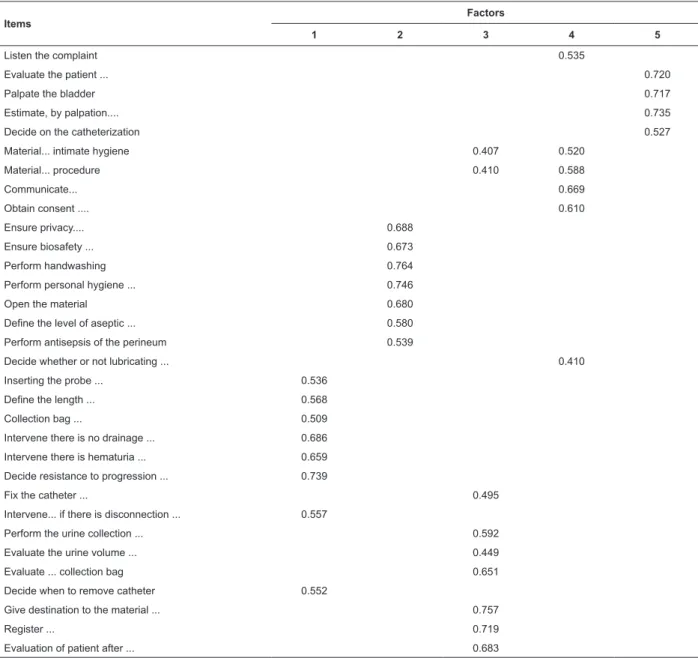
As shown in Table 1, after deining the ive factors, the proportion of variance of each variable was veriied,
which were explained by the extracted components
(commonalities) and factor loadings of each item. Due
to the sample size, it was decided to keep the items with
factor loading superior to 0.40(19).
After carrying out the rotation and in view of a
satisfactory factor solution, meanings were attributed
to factors(20-21). Thus, the EAAERU was divided into ive
factors, with the factor (composed by the 8 items 18,
19, 20, 21, 22, 23, 25, 29) being called “interventions
performed during urinary catheterization and/or in
iatrogenic situations, “the factor 2 (composed by seven
items: 10, 11, 12, 13, 14, 15, 16) and being called “Prior
interventions to performing urinary catheterization”, the
factor 3 (composed by seven items: 24 26, 27, 28, 30,
31, 32) and called “Interventions performed for urinary
catheters”, the factor 4 (composed by six items: 1, 6,
7, 8, 9 and 17) and called “Communication, consent
and preparation of materials for performing urinary
catheterization” and the factor 5 (composed by four items:
Regarding the analysis of the set of items that compose
the EAAERU and its relationship with the construct, through
the alpha Cronbach’s test (Table 2), thereby testing
the proposed items and their mutual correlation, high
correlation of all items with the full scale was achieved,
resulting in a high alpha value (0.949). It was found
that all items contributed to the good alpha coeficient,
undermining the scale if either of them is eliminated.
After analysis of the global coeficient, the coeficients of the EAAERU with each dimension
remained high, indicating good consistency. Cronbach’s
alpha values were: Factor 1 (0.890), Factor 2 (0.874),
Factor 3 (0.868), Factor 4 (0.814) and Factor 5 (0.773).
Due to the impossibility of applying the EAAERU in
an entirely new sample, dividing the sample into two
sub-samples (sample A and sample B) was considered,
which were obtained by randomization feature of
the samples, provided by SPSS. In all subsamples
analyzed, the tests performed on this sample were
replicated and similar results were found with regard
to the reliability of the scale (Cronbach’s alpha of
subsample A was of 0.944 and of 0.951 for subsample
B), considered a good correlation and division of the
scale into ive factors.
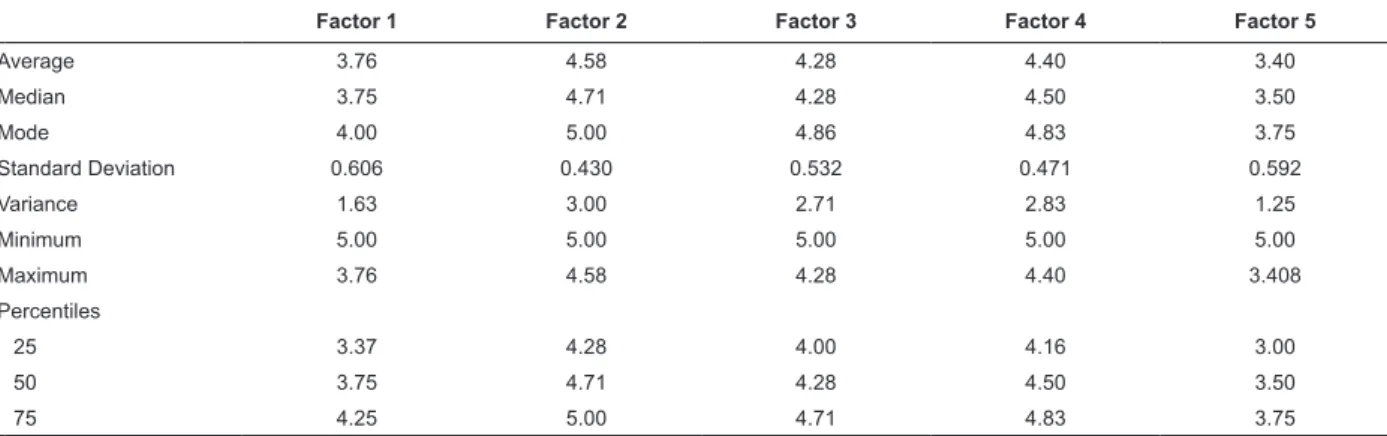
The descriptive results of the EAAERU are shown
in Table 3.
Table 1 - Correlation matrix of the items of the factors rotated by Varimax, with Keiser normalization for ive factors
(N = 305). Coimbra, Portugal, 2014
Items
Factors
1 2 3 4 5
Listen the complaint 0.535
Evaluate the patient ... 0.720
Palpate the bladder 0.717
Estimate, by palpation.... 0.735
Decide on the catheterization 0.527
Material... intimate hygiene 0.407 0.520
Material... procedure 0.410 0.588
Communicate... 0.669
Obtain consent .... 0.610
Ensure privacy.... 0.688
Ensure biosafety ... 0.673
Perform handwashing 0.764
Perform personal hygiene ... 0.746
Open the material 0.680
Define the level of aseptic ... 0.580
Perform antisepsis of the perineum 0.539
Decide whether or not lubricating ... 0.410
Inserting the probe ... 0.536
Define the length ... 0.568
Collection bag ... 0.509
Intervene there is no drainage ... 0.686
Intervene there is hematuria ... 0.659
Decide resistance to progression ... 0.739
Fix the catheter ... 0.495
Intervene... if there is disconnection ... 0.557
Perform the urine collection ... 0.592
Evaluate the urine volume ... 0.449
Evaluate ... collection bag 0.651
Decide when to remove catheter 0.552
Give destination to the material ... 0.757
Register ... 0.719
Table 2 – Statistics of homogeneity of the items and Cronbach’s internal consistency coeficient of the EAAERU in its
entirety (N=305). Coimbra, Portugal, 2014
Items Average Standard Deviation Correlation with the Total (adjusted) Alpha if the item is removed
1 4.42 0.662 0.456 0.949
2 3.62 0.645 0.482 0.949
3 3.84 0.760 0.508 0.949
4 2.77 0.878 0.399 0.950
5 3.39 0.771 0.610 0.948
6 4.52 0.598 0.596 0.948
7 4.54 0.590 0.658 0.947
8 4.28 0.657 0.565 0.948
9 4.30 0.667 0.526 0.948
10 4.71 0.487 0.472 0.949
11 4.45 0.602 0.547 0.948
12 4.83 0.397 0.518 0.949
13 4.65 0.535 0.589 0.948
14 4.60 0.599 0.660 0.947
15 4.43 0.638 0.613 0.948
16 4.40 0.670 0.682 0.947
17 4.40 0.736 0.610 0.948
18 4.18 0.731 0.709 0.947
19 3.96 0.789 0.639 0.947
20 4.15 0.770 0.639 0.947
21 3.41 0.871 0.626 0.948
22 3.31 0.839 0.663 0.947
23 3.29 0.816 0.618 0.948
24 4.23 0.707 0.656 0.947
25 3.97 0.787 0.658 0.947
26 4.05 0.755 0.577 0.948
27 3.96 0.866 0.528 0.949
28 4.33 0.710 0.674 0.947
29 3.80 0.835 0.691 0.947
30 4.55 0.628 0.639 0.947
31 4.49 0.615 0.639 0.947
32 4.34 0.654 0.703 0.947
Table 3 - Descriptive statistics for each dimension and the total scale. Coimbra, Portugal, 2014
Factor 1 Factor 2 Factor 3 Factor 4 Factor 5
Average 3.76 4.58 4.28 4.40 3.40
Median 3.75 4.71 4.28 4.50 3.50
Mode 4.00 5.00 4.86 4.83 3.75
Standard Deviation 0.606 0.430 0.532 0.471 0.592
Variance 1.63 3.00 2.71 2.83 1.25
Minimum 5.00 5.00 5.00 5.00 5.00
Maximum 3.76 4.58 4.28 4.40 3.408
Percentiles
25 3.37 4.28 4.00 4.16 3.00
50 3.75 4.71 4.28 4.50 3.50
75 4.25 5.00 4.71 4.83 3.75
Discussion
Urinary elimination is one of the basic needs of
individuals(22), often affected in the processes of health/
disease, which makes it one of the focuses of nursing
interventions. In the proceedings on urinary elimination
problems, one of the nursing diagnoses commonly found
is the Urinary Retention.
In many nursing work contexts(23), which includes
be performed with quality, safety and comfort, both
for the patient and the professional. It is achieved
by incorporating updated scientiic and technical knowledge and the best scientiic evidence into clinical
practice, which leads to the constant need for training of
professionals as well as scientiic update of educational
institutions focused on their training.
Well-trained professionals will be more conident and eficient, better performing their functions, with less
stress, greater motivation, persistence and expectation
of success(24). The failure can cause discouragement
and obstacles to achieve objectives. In this sense, it is
necessary to know the possibilities and limitations for
the development of new skills and new achievements(25).
In this context, due to the need and the lack of an
instrument to investigate and evaluate the conidence of
nurses in nursing care of Urinary Retention, the EAAERU
was proposed. After the construct validation, a high
correlation of all items with the total scale was observed
with a good reliability index (alpha=0.949), indicating
that the scale measures the self-conidence of nursing
care in urinary retention.
By means of factor analysis and statistical support,
it was possible to identify the division of the scale into
ive factors, represented by 1) “Interventions performed
during urinary catheterization and/or iatrogenic
situations”, 2) “Previous interventions to performing
urinary catheterization” 3) “Interventions performed
after urinary catheterization”; 4) “Communication,
consent and preparation of materials for performing
urinary catheterization” and 5) “Objective evaluation of
UR”, which showed good reliability indices, contributing
to internal consistency. The factor that showed the lowest
reliability index is composed of few items (2, 3, 4 and
5) and had an objective assessment of UR (Cronbach’s
alpha of 0.773).
The descriptive values of the sample showed that
students were more conident in carrying out measures
related to communication, consent, preparation of the
material, patient and professional (factor 2, factor 4)
and after catheter removal (factor 3) and less conident
regarding the problem situations and in the objective
assessment of UR (factor 1 and factor 5). These results
corroborate the studies of several authors, which points
out the dificulties of the objective assessment of UR
and problem factors related to trauma to catheter
insertion for delayed urinary catheterization as the
main dificulties presented by the professionals(22). These indings stimulate the incorporation of scientiic
evidence into clinical practice and use of existing and
little disseminated technological resources, such as the
portable ultrasound of bladder.
The fact that the validation of EAAERU initially
has been accomplished in one Portuguese-speaking
country only can be mentioned as a limiting factor,
although it has been developed according to the
new orthography and spelling rules, and adopted by
professionals from Portuguese-speaking countries. It
is considered that the developed instrument can be
applied to professionals. However, it is recommended
that statistical tests be repeated during the process,
since the validation process occurred with the
inal-year students of the nursing graduate course, mostly
with experience in the subject.
Conclusion
The use of consistent instruments that enable the
assessment of nursing professionals, aiming at the better
targeting of training processes, is extremely important
in the clinical practice of nurses, since they stimulate
and incorporate scientiic evidence into the professional
training process, providing greater safety, quality and
comfort to the patients and professionals.
The process of care for the patient with urinary
retention is part of the clinical everyday. In this sense,
the validation for the Portuguese language of the EAAERU
scale was proposed, to assess the conidence on this
subject, according to the new spelling rules. In the study
population, the EAAERU showed good psychometric
properties, which indicates its use for teaching activities
and for professional training throughout life, as well as
for research.
References
1. Peng CW, Chen JJ, Cheng CL, Grill WM. Improved
bladder emptying in urinary retention by electrical
stimulation of pudendal afferents. J Neural Eng. 2008
Jun;5(2):144-54.
2. Fernandes MCBC, Costa VV, Saraiva RA. Postoperative
urinary retention: evaluation of patients using opioids
analgesic. Rev. Latino-Am. Enfermagem. 2007 Apr;
15(2):318-22.
3. Mazzo A, Gaspar AACS, Mendes IAC, Trevizan MA,
Godoy S, Martins JCA. Urinary catheter: Myths and
rituals present in preparation of patients. Acta Paul
Enferm. 2012;25(6):889-94.
4. Mazzo A, Godoy S, Alves LM, Mendes IAC, Trevizan
difficulties related to its standardization. Texto Contexto
Enferm. 2011 Jun; 20(2):333-9.
5. Bickley LS, Szilagyi PG. Bates’ Guide to Physical
Examination and History Taking. Philadelphia: Lippincott
Williams & Wilkins; 2012.
6. Palese A, Buchini S, Deroma L, Barbone F. The
effectiveness of the ultrasound bladder scanner in
reducing urinary tract infections: a meta- analysis. J Clin
Nurs. 2010;19(21-22):2970-9.
7. Gould CV, Umscheid CA, Agarwal RK, Kuntz G, Pegues
DA; Healthcare Infection Control Practices Advisory
Committee. Guideline for prevention of
catheter-associated urinary tract infections 2009. Infect Control
Hosp Epidemiol. 2010 Apr;31(4):319-26.
8. Balderi T, Mistraletti G, D’Angelo E, Carli F. Incidence
of postoperative urinary retention (POUR) after joint
arthroplasty and management using
ultrasound-guided bladder catheterization. Minerva Anestesiol.
2011;77(11):1050-7.
9. Ministério da Saúde (BR). Conselho Federal de
Enfermagem. Resolução COFEN n.450, de 11 de
dezembro de 2013. Normatiza o procedimento de
Sondagem Vesical no âmbito do Sistema Cofen /
Conselhos Regionais de Enfermagem. Diário Oficial da
União, Brasília (DF); 27 dez 2013; Seção 1:305.
10. Perry P. Concept analysis: confidence/self-
confidence. Nurs Forum. 2011 Oct-Dec;46(4):218-30.
11. White KA. Self-conidence: A concept analysis. Nurs
Forum. 2009 Apr-Jun;44(2):103-14.
12. Bandura A. Perceived self-efficacy in cognitive
development and functioning. Educ Psychol.
1993;28(2):117-48.
13. Bandura A. Self-eficacy in changing societies. New
York: Cambridge University Press; 1995.
14. Bandura A. Social foundations of thought and action: A social
cognitive theory. Englewood Cliffs (NJ): Prentice Hall; 1986.
15. Kröner S, Biermann A. The relationship between
confidence and self- concept- Towards a model
of response confidence. Intelligence. 2007
Nov-Dec;35(6):580-90.
16. Hair JF Jr, Anderson RE, Tatham RL, Black WC.
Análise multivariada de dados. 5ed. Bookman: Porto
Alegre; 2005.
17. Mazzo A, Beltreschi CB, Jorge BM, Souza VD
Jr, Fumincelli L, Mendes IAC. Cateterismo urinário
permanente: práctica clínica. Enferm Global.
Forthcoming. 2015
18. Pestana MH, Gageiro JN. Análise de Dados para
Ciências Sociais: A complementaridade do SPSS. 3ed.
Lisboa: Sílabo; 2005.
19. Hair Jr JF, Black WC, Babin BJ, Anderson RE.
Multivariate Data Analysis. 7th ed. Upper Saddle River:
Prentice Hall; 2010.
20. Field A. Discovering Statistics Using SPSS. 3rd ed.
Londres: Sage; 2009.
21. Laros JA. O uso da análise fatorial: algumas
diretrizes para pesquisadores. In: Pasquali L, editor.
Análise fatorial para pesquisadores. Brasília: LabPAM;
2005. p. 163-84.
22. Mundy AR, Andrich DE. Urethral trauma. Part I:
Introduction, history, anatomy, pathology, assessment
and emergency management. BJU Int. 2011
Aug;108(3):310-27.
23. Horta WA. Processo de enfermagem. São Paulo
(SP): EPU; 1979.
24. Bandura A. Human agency in social cognitive theory.
Am Psychol. 1989;44(9):1175-84.
25. Barreira DD, Nakamura AP. Resiliência e a
auto-eficácia percebida: articulação entre conceitos. Aletheia.
2006 Jun;(23):75-80.
Received: July 3rd 2014