
(1) Universidade Federal de Santa Maria – UFSM, Santa Maria, RS, Brazil. .
(2) Universidade Federal de Santa Maria – UFSM, Santa Maria, RS, Brazil.
(3) Universidade Federal de Santa Maria – UFSM, Santa Maria, RS, Brazil.
(4) Universidade Federal de Santa Maria – UFSM, Santa Maria, RS, Brazil.
(5) Université de Paris III, Paris, France.
(6) Universidade Federal de Santa Maria – UFSM, Santa Maria, RS, Brazil.
Conlict of interest: non-existent
phonological system consistent with the adult target
of the target language1.
As regards the stop phonemes, its complete
acquisition of the phonological system occurs around the age of two1-3.
During the production of these segments, in a irst moment, the phonoarticulatory organs form
a total obstruction to the air passage, being the
acoustic register an interval of silence, which can be illed by a prevoicing bar caused by the vibration of the vocal folds, as in the case of voiced stops ([b], [d] and [g]), which, distinctively, it is not observed for the voiceless stops ([p], [t] and [k]). After that, due
to an increased intraoral pressure generated during
the occlusion phase, there is a sudden release of the air stream, identiied in the spectrogram as a brief transient noise, called burst 4.
ACOUSTIC CHARACTERIZATION OF THE VOICING
OF STOP PHONES IN BRAZILIAN PORTUGUESE
Caracterização acústica da sonoridade dos fones plosivos
do português brasileiro
Roberta Michelon Melo(1), Helena Bolli Mota(2), Carolina Lisbôa Mezzomo(3),
Brunah de Castro Brasil(4), Liane Lovatto(5), Leonardo Arzeno(6)
ABSTRACT
Purpose: to investigate and compare the acoustic characteristics of voiceless and voiced plosives in the speech of children with typical phonological development and adults with typical language speech
patterns. Method: the study’s sample is arranged in two groups – 17 adults and 11 children with typical phonological development. Through words/pseudowords ([‘papa], [‘baba], [‘tata], [‘dada], [‘kaka] and [‘gaga]) inserted into carrier phrases (“Say ___ papa again”), the voice onset time, the length of the
vowel, and we measured the burst amplitude and the length of the occlusion. The acoustic records of voiceless and voiced plosives intragroup and intergroup were compared through statistical tests
(p<0.05). Results: in general, the results suggest that: (1) the voice onset time was longer for voiced plosives when compared to the voiceless plosives; (2) the vowel length when followed or preceded by a voiced plosive was longer than in front of a voiceless plosive; (3) the burst amplitude was slightly superior during the production of voiced segments and; (4) the length of the occlusion was superior in the context of voiceless plosives. Furthermore, the adults and children showed many similarities related to the production of these parameters. Conclusion: the investigated acoustic cues present themselves
as strong parameters involved in the characterization of plosives voicing contrasts. Furthermore, the
results also indicate many similarities among adults and children with typical phonological patterns.
However, when some differences are evident, they occur on medial and unstressed syllables.
KEYWORDS: Speech Acoustics; Adult; Child; Sound Spectrography/analysis; Speech
INTRODUCTION
The typical phonological acquisition is a non-linear, gradual and intrinsic to the individual
contrast close to the same approximate character
-istics of adult subjects, marking so the contrast of voicing not only at the level of perceptual hearing analysis, but also by means of acoustic analysis.
It is believed that the acoustic description of the parameters responsible for the distinction between voiced and voiceless stops based on the speech of subjects with no speech disorders, besides providing knowledge of linguistic, articulatory and acoustic patterns of the language in case, still provides the support for the interpretation of phonological errors on the feature [voice], present in the speech clinic.
Thus, the aim of this study is to investigate and compare the acoustic characteristics of voiced and voiceless stops in the speech of children with TPD and also of adults with speech typical patterns of the
language.
METHOD
This is an experimental, quantitative and cross-sectional study. Two groups were part of it, one group of adults (GA) and another group of children with TPD (GTPD). To make part of the GA, some undergraduate students of the irst year of the Speech, Hearing and Languages major and other majors of the institution where the research was
developed were invited to participate. On the other
hand, the subjects of the GTPD were selected from two schools of the public system located in the same city the institution of higher education.
In order that the subjects would make part of the GA, the following criteria were considered:
consenting to participate in the study by signing
the informed consent; having full phonetic and
phonological inventories, with all the PB phonemes acquired and stabilized in spontaneous speech; being aged between 19 and 44 years old, have not received any anterior speech therapy; being a native
speaker of PB - gaucho dialect, and no history of bilingualism.
The exclusion criteria were: the presence of
vocal, auditory and language alterations, apparent losses in neurological, cognitive, psychological and/ or emotional aspects and alterations in the articulatory organs that were related to the phono-logical system.
For GTPD, the same inclusion and exclusion
criteria were adopted, however, this group should
present be aged from four to eight years and 11 From the acoustic point of view, some cues
are described as responsible for the contrast in voicing of stops, such as voice onset time
(VOT) 4,5, the length of the vowel adjacent to stop 4,6,7, the amplitude of the burst 4,5, the length of the previous occlusion release 6,8, among others.
Able to relect the reinement and the coordi
-nation of glottic and supraglottic gestures involved in the production of stop phonemes, and also responsible for the contrast between the segments [+ voice], the VOT has been widely investigated in
the literature 4,5,9. An acoustic register is known as a measurement of length, which corresponds to the time interval between the release of the occlusion and the beginning of voicing (anterior, concurrent or
posterior to burst) 4.
In the presence of voicing posterior to the release of the occlusion, the value of VOT is positive, characteristic of voiceless stop sounds. On the
contrary, when the voicing is anterior or concomitant to burst, the VOT value is, respectively, negative or
zero, characteristic of voiced stops 4.
Correlações acerca da duração da vogal no
contexto de plosiva surda e sonora são também
relatadas na literatura. Diante de um segmento plosivo sonoro, as vogais tendem a apresentar valores de duração superior àquelas vogais em
contexto surdo 4, 6,7,9.
Correlations about the length of the vowel in the context of voiceless and voiced stop are also
reported in the literature. Front to a stop sound segment, vowels tend to present higher length
values if compared to those vowels in voiceless context 4, 6,7,9.
Another parameter used for the contrast identii
-cation of voicing of stops seems to be the amplitude of the burst. Authors state that this is more intense
in voiceless consonant sounds in comparison to the voiced matching part.
Besides the acoustic registers which were
already mentioned, the length of occlusion anterior to burst may be also responsible for the distinction of voiced and voiceless stops. However, its inluence has been little investigated. In a research with speakers of European Portuguese, the authors mention, in general, the length of occlusion of the
voiceless phones is higher than the same measure
of the voiced phones 9.
pseudowords were inserted in a vehicle sentence (“Fala _____ de novo” – “Say _____ again”). Each
stop had two series of three replications arranged in a random sequence, a total of 36 sentences for each subject.
The vehicle sentence and its repetitions were presented by using headphones, Sennheiser brand HD280 PRO. There was a silence interval between
the presentation of a sentence and the other, in this meantime, the subjects were asked to repeat
in normal vocal intensity the all heard phrase, not being controlled the speech rate.
For the procedure of sample recording, it was
used an acoustically isolated booth, an omnidirec-tional microphone (Behringer EMC8000), placed
on a pedestal, approximately 4 cm from the mouth of the subject and an external sound card (brand
M-AUDIO, model FW 410) connected to a laptop computer (Windows XP SP3). The speech registers
were written directly in MATLAB V7.1 SP3 (Simulink Signal Processing Toolbox V6.4) software in Wave ile and high resolution (24 bits and 96 KHz).
The data were subsequently analyzed in audio
processing software Praat - version 5.1.29 (available at www.praat.org), by observing the waveform and
spectrogram broadband. The sampling rate used in
the program was 96 KHz and 16 bits.
With the spectrograph, in initial and medial
onset, the values of VOT, the length of the vowel after the stop, the amplitude of the burst and the length of occlusion were analyzed, being the length of occlusion only extracted in medial onset.
For extraction of VOT it was considered the burst as the reference point, then, it was researched the
prevoicing. The VOT values (in milliseconds - ms)
were obtained from spectrogram as follows:
• For the voiceless stops, it was collected the
measurement of the length of the segment between the register of burst of the stop to the irst pulse of the vowel [a] of the same syllable;
• For voiced stops it was collected the
measu-rement of the segment between the beginning of pre-voicing to the registration of the burst. However, it is noted that the VOT values of
voiced segments in what pre-voicing bar anterior
to burst was absent were extracted from the
spectrogram as in the voiceless stops.
To measure the length (in millisecond - ms) of
the vowel present in the target word, it was adopted
the criterion of irst and last regular adjacent cycle to stop for the determination of the limits of the vowels.
The amplitude (in decibel - dB) of the burst was extracted from the central measurement of the total length of burst. In the presence of multiple bursts, the same procedure was performed for each burst, case of children. It consisted of a few questions,
such as: date and place of birth; if he/she had already lived in another city/state; if he/she spoke another language (bilingual?); If he/she
had done speech therapy or had any
pathophy-siological background;
• Assessment of stomatognathic system: with
emphasis on observation of the aspect, posture, muscle tension and mobility of the phonoarticu
-latory organs (tongue, lips, cheeks, soft palate, hard palate and teeth) and their functions (breathing, sucking, chewing and swallowing);
• Assessments of language, speech and voice:
for adults, such aspects were observed
through speech and spontaneous naming while
conducting an interview and naming the igures. For children, these assessments were performed through a logical sequence of four facts. Then, it was asked to the child to organize the sequence of igures and tell a story. Thus, by means of the
speech and spontaneous naming some aspects
of receptive and expressive, possible phonetic,
phonological and oral language, besides vocal quality disorders were observed.
• Hearing screening: from the testing of hearing
thresholds by air from 500 to 4000 Hz at 20
dB HL tested (scan mode). It was used the Interacoustics Screening Audiometer AS208, properly calibrated.
During the progression of the assessments, some suggestive aspects of neurological, cognitive,
psychological and/or emotional were observed,
such as the presence of inconsistency, inadequacy or dificulties in responding, dificulty in articulation of neurological origin (dysarthria or dyspraxia), motor impairment, excessive lack of concentration, attention, or lack of cooperation from the child.
In the presence of alterations, the parents and/or guardians, as well the school, were informed about the need for further assessments and referrals to other professionals necessary for each case.
Based on the assessments and on the criteria for inclusion and exclusion considered, this research consists of speech data of 17 adults, aged between 19 and 29 years (mean age = 23 years and six months, SD = 39.1 months), ive males and 12 females, and 11 children with TPD, aged between ive and eight years (mean age = seven years and ive months, SD = 9.9 months). From these ones, six were male and ive were female.
To obtain the speech sample that was subjected to acoustic analysis, it was created a list of words/ pseudowords of the same linguistic context, with all
The computer program used for the analysis was the SAS System for Windows (Statistical Analysis System), version 8.02, and the signiicance level
was 5% (p <0.05).
RESULTS
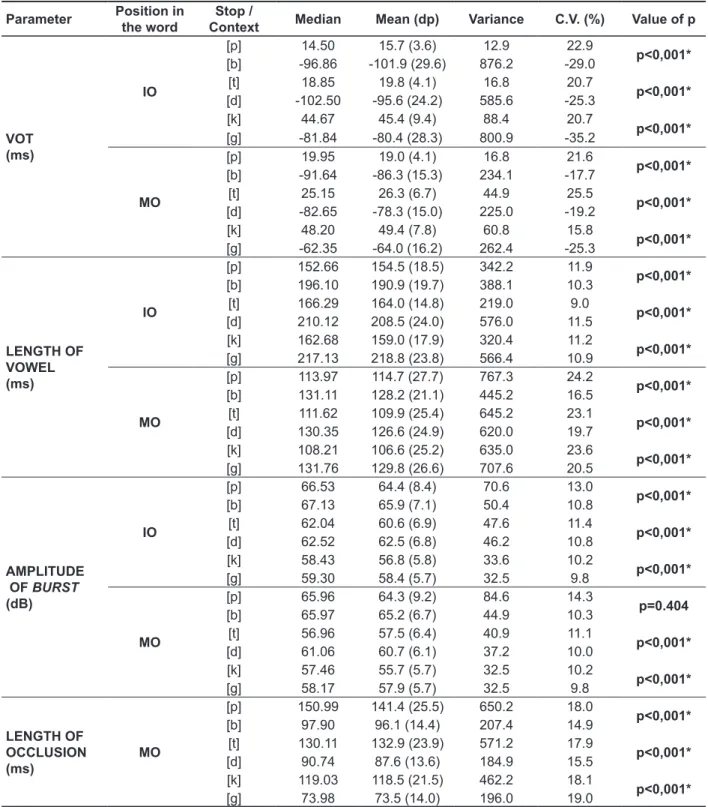
In Table 1, the comparisons between the voiced
and voiceless acoustic registers of stops are present, in initial and medial onset, in GA.
For this group, it was found that the length of VOT values were higher for the voiced stops and, most of them had a previous voicing anterior to the release of occlusion when compared to the same VOT values of voiceless stops, with statistically signiicant results.
Longer lengths of the vowel were found [a], they
were present in the target word, when preceded
or followed by a stop sound, than when front to a voiceless stop, with statistically signiicant differences
In relation to the amplitude of burst, it was
observed that this is slightly higher during the
production of the voiced phones in comparison to voiceless phones. Only the comparison, of the amplitude of burst between [p] and [b] in medial onset, was not statistically signiicant.
The length of occlusion, acoustic parameter
investigated in medial onset, was superior in the
context of voiceless stops when compared to the context of voiced stops, also with statistically signif -icant results.
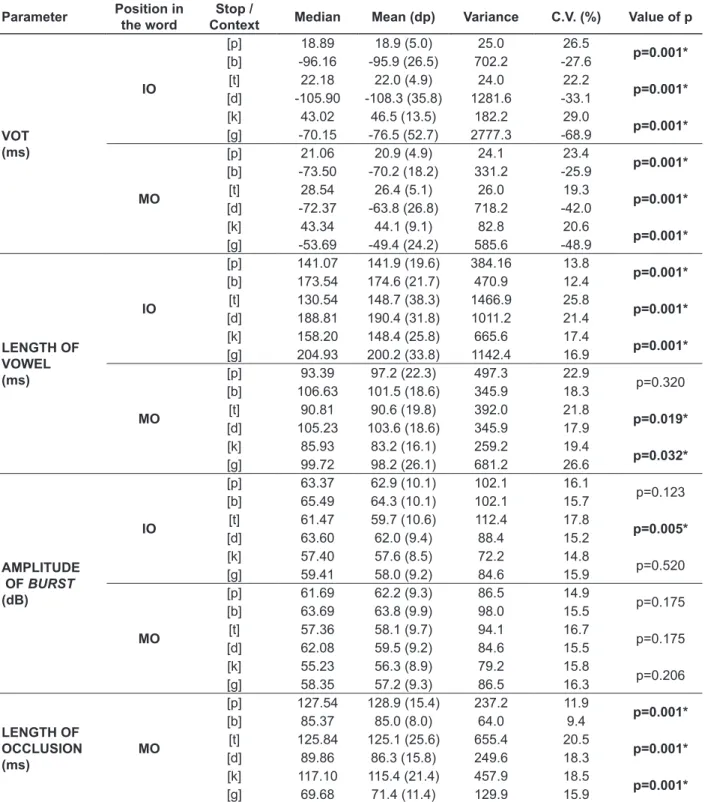
Table 2 shows the comparisons between
acoustic registers of voiced and voiceless stops in initial and medial onset in GTPD.
In this group, it was noticed the distribution of VOT between stops [+ voice] similar to GA, with statistical signiicance.
On the other hand, in relation to the length of the vowel [a], it was also observed for this group, that it was superior in the context of voiced stop, with statistically signiicant results.
It was also noted a minor increase in the
amplitude of burst during the production of the voiced phones. However, only a signiicant relationship was
established.
and after it was carried out an arithmetic mean of the values which were found.
The length (in millisecond - ms) of the occlusion of the target word was measured from the end of the vowel of the stressed syllable (last regular cycle of the vowel) until the beginning of the burst of the next
stop, in medial onset. In cases which the stressed
vowel was followed by a portion with spectral characteristics of noise (breathy vowel), this one was also considered within the interval of occlusion.
It was veriied that before the data were subjected
to statistical analysis, the words/pseudowords that
presented omission of segments or inaccurate production of any of the analyzed parameters were excluded from the sample. And also, anterior to the application of statistical tests, it was performed for each subject the mean values of each acoustic parameter which was considered in all repetitions of
each target word.
This study was approved by the Ethics
and Research Committee of the institution
in which was carried out, under the number
23081.008886/2009-29. All subjects were invited to participate and informed about it. The authorization of participation in the study was obtained by signing the Consent Form by the research subjects, or parents/guardians, in case of children.
First of all, every single acoustic register of
voiced and voiceless stops were registered and
tabulated individually, by subject and in each separately group (GA and GTPD). After, the voiced and voiceless acoustic registers of the stops of each group were statistically faced by using the Wilcoxon
test. Then, the acoustic registers were statistically
compared between the GA and the GTPD, through
the Mann-Whitney test.
The irst selected test is used for analysis of related samples and the second one to test two independent groups, being one of the most powerful non-parametric tests. These tests were chosen because of non-normal distribution and the
Table 1 - Comparison between the acoustic parameters of voiced and voiceless stops in initial and medial onset, in the group of adults (GA)
Parameter Position in the word
Stop /
Context Median Mean (dp) Variance C.V. (%) Value of p
VOT (ms)
IO
[p] 14.50 15.7 (3.6) 12.9 22.9
p<0,001*
[b] -96.86 -101.9 (29.6) 876.2 -29.0
[t] 18.85 19.8 (4.1) 16.8 20.7
p<0,001*
[d] -102.50 -95.6 (24.2) 585.6 -25.3
[k] 44.67 45.4 (9.4) 88.4 20.7
p<0,001*
[g] -81.84 -80.4 (28.3) 800.9 -35.2
MO
[p] 19.95 19.0 (4.1) 16.8 21.6
p<0,001*
[b] -91.64 -86.3 (15.3) 234.1 -17.7
[t] 25.15 26.3 (6.7) 44.9 25.5
p<0,001*
[d] -82.65 -78.3 (15.0) 225.0 -19.2
[k] 48.20 49.4 (7.8) 60.8 15.8
p<0,001*
[g] -62.35 -64.0 (16.2) 262.4 -25.3
LENGTH OF VOWEL (ms)
IO
[p] 152.66 154.5 (18.5) 342.2 11.9
p<0,001*
[b] 196.10 190.9 (19.7) 388.1 10.3
[t] 166.29 164.0 (14.8) 219.0 9.0
p<0,001*
[d] 210.12 208.5 (24.0) 576.0 11.5
[k] 162.68 159.0 (17.9) 320.4 11.2
p<0,001*
[g] 217.13 218.8 (23.8) 566.4 10.9
MO
[p] 113.97 114.7 (27.7) 767.3 24.2
p<0,001*
[b] 131.11 128.2 (21.1) 445.2 16.5
[t] 111.62 109.9 (25.4) 645.2 23.1
p<0,001*
[d] 130.35 126.6 (24.9) 620.0 19.7
[k] 108.21 106.6 (25.2) 635.0 23.6
p<0,001*
[g] 131.76 129.8 (26.6) 707.6 20.5
AMPLITUDE
OF BURST
(dB)
IO
[p] 66.53 64.4 (8.4) 70.6 13.0
p<0,001*
[b] 67.13 65.9 (7.1) 50.4 10.8
[t] 62.04 60.6 (6.9) 47.6 11.4
p<0,001*
[d] 62.52 62.5 (6.8) 46.2 10.8
[k] 58.43 56.8 (5.8) 33.6 10.2
p<0,001*
[g] 59.30 58.4 (5.7) 32.5 9.8
MO
[p] 65.96 64.3 (9.2) 84.6 14.3
p=0.404
[b] 65.97 65.2 (6.7) 44.9 10.3
[t] 56.96 57.5 (6.4) 40.9 11.1
p<0,001*
[d] 61.06 60.7 (6.1) 37.2 10.0
[k] 57.46 55.7 (5.7) 32.5 10.2
p<0,001*
[g] 58.17 57.9 (5.7) 32.5 9.8
LENGTH OF OCCLUSION (ms)
MO
[p] 150.99 141.4 (25.5) 650.2 18.0
p<0,001*
[b] 97.90 96.1 (14.4) 207.4 14.9
[t] 130.11 132.9 (23.9) 571.2 17.9
p<0,001*
[d] 90.74 87.6 (13.6) 184.9 15.5
[k] 119.03 118.5 (21.5) 462.2 18.1
p<0,001*
[g] 73.98 73.5 (14.0) 196.0 19.0
Caption 1: sd – standard deviation;C.V. – coeiciente of variation; VOT – voice onset time; IO – initial onset; MO – medial onset;
Table 2 - Comparison between the acoustic parameters of voiced and voiceless stops in initial and medial onset in the group of children with typical phonological development (GTPD)
Parameter Position in the word
Stop /
Context Median Mean (dp) Variance C.V. (%) Value of p
VOT (ms)
IO
[p] 18.89 18.9 (5.0) 25.0 26.5
p=0.001*
[b] -96.16 -95.9 (26.5) 702.2 -27.6
[t] 22.18 22.0 (4.9) 24.0 22.2
p=0.001*
[d] -105.90 -108.3 (35.8) 1281.6 -33.1
[k] 43.02 46.5 (13.5) 182.2 29.0
p=0.001*
[g] -70.15 -76.5 (52.7) 2777.3 -68.9
MO
[p] 21.06 20.9 (4.9) 24.1 23.4
p=0.001*
[b] -73.50 -70.2 (18.2) 331.2 -25.9
[t] 28.54 26.4 (5.1) 26.0 19.3
p=0.001*
[d] -72.37 -63.8 (26.8) 718.2 -42.0
[k] 43.34 44.1 (9.1) 82.8 20.6
p=0.001*
[g] -53.69 -49.4 (24.2) 585.6 -48.9
LENGTH OF VOWEL (ms)
IO
[p] 141.07 141.9 (19.6) 384.16 13.8
p=0.001*
[b] 173.54 174.6 (21.7) 470.9 12.4
[t] 130.54 148.7 (38.3) 1466.9 25.8
p=0.001*
[d] 188.81 190.4 (31.8) 1011.2 21.4
[k] 158.20 148.4 (25.8) 665.6 17.4
p=0.001*
[g] 204.93 200.2 (33.8) 1142.4 16.9
MO
[p] 93.39 97.2 (22.3) 497.3 22.9
p=0.320
[b] 106.63 101.5 (18.6) 345.9 18.3
[t] 90.81 90.6 (19.8) 392.0 21.8
p=0.019*
[d] 105.23 103.6 (18.6) 345.9 17.9
[k] 85.93 83.2 (16.1) 259.2 19.4
p=0.032*
[g] 99.72 98.2 (26.1) 681.2 26.6
AMPLITUDE
OF BURST
(dB)
IO
[p] 63.37 62.9 (10.1) 102.1 16.1
p=0.123
[b] 65.49 64.3 (10.1) 102.1 15.7
[t] 61.47 59.7 (10.6) 112.4 17.8
p=0.005*
[d] 63.60 62.0 (9.4) 88.4 15.2
[k] 57.40 57.6 (8.5) 72.2 14.8
p=0.520
[g] 59.41 58.0 (9.2) 84.6 15.9
MO
[p] 61.69 62.2 (9.3) 86.5 14.9
p=0.175
[b] 63.69 63.8 (9.9) 98.0 15.5
[t] 57.36 58.1 (9.7) 94.1 16.7
p=0.175
[d] 62.08 59.5 (9.2) 84.6 15.5
[k] 55.23 56.3 (8.9) 79.2 15.8
p=0.206
[g] 58.35 57.2 (9.3) 86.5 16.3
LENGTH OF OCCLUSION (ms)
MO
[p] 127.54 128.9 (15.4) 237.2 11.9
p=0.001*
[b] 85.37 85.0 (8.0) 64.0 9.4
[t] 125.84 125.1 (25.6) 655.4 20.5
p=0.001*
[d] 89.86 86.3 (15.8) 249.6 18.3
[k] 117.10 115.4 (21.4) 457.9 18.5
p=0.001*
[g] 69.68 71.4 (11.4) 129.9 15.9
Caption 2: sd – standard deviation;C.V. – coeiciente of variation; VOT – voice onset time; IO – initial onset; MO – medial onset;
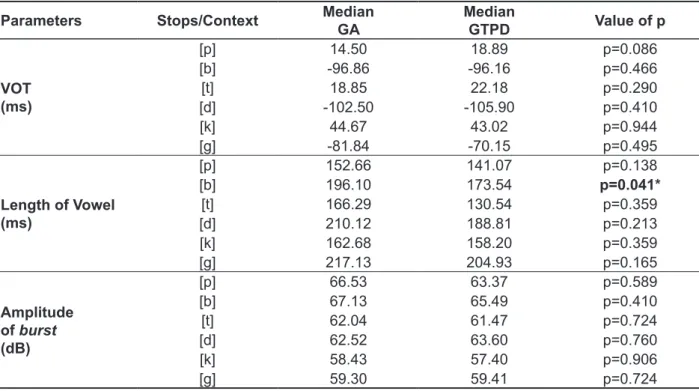
were observed for the parameters of vowel length in the context of the stop [b], in initial onset and, medial onset, for the parameters of VOT of [b], vowel length in the context of the stops [b], [e], [d], [k] and [g] and length of occlusion [b]. Analyzing the results, there were few signiicant differences between the
groups. However, when considered present, they were mostly in medial onset and unstressed syllable.
The results also showed longer length of occlusion of the phonoarticulatory organs during the production of voiceless stops, with statistically signiicant results.
Tables 3 and 4 present comparisons of acoustic parameters between the GA and GTPD groups, for each phoneme and in initial and medial onset. Statistically signiicant differences between groups
Table 3 - Comparison of acoustic parameters in initial onset between the two groups - adults (GA) and children with typical phonological development (GTPD)
Parameters Stops/Context Median
GA
Median
GTPD Value of p
VOT (ms)
[p] 14.50 18.89 p=0.086
[b] -96.86 -96.16 p=0.466
[t] 18.85 22.18 p=0.290
[d] -102.50 -105.90 p=0.410
[k] 44.67 43.02 p=0.944
[g] -81.84 -70.15 p=0.495
Length of Vowel (ms)
[p] 152.66 141.07 p=0.138
[b] 196.10 173.54 p=0.041*
[t] 166.29 130.54 p=0.359
[d] 210.12 188.81 p=0.213
[k] 162.68 158.20 p=0.359
[g] 217.13 204.93 p=0.165
Amplitude
of burst
(dB)
[p] 66.53 63.37 p=0.589
[b] 67.13 65.49 p=0.410
[t] 62.04 61.47 p=0.724
[d] 62.52 63.60 p=0.760
[k] 58.43 57.40 p=0.906
[g] 59.30 59.41 p=0.724
Caption 3: GA – group of adults; GTPD – group of children with typical phonological development; VOT – voice onset time; ms –
milli-seconds; dB – decibels; * - statistically signiicant results.
• Production of a portion with spectral charac
-teristics of noise (breathy vowel) post to the
stressed vowel (Figure 1);
• Presence of aspiration during the production
of voiceless stops, especially in relation to the dorsal [k] (Figure 2).
Furthermore, when analyzing the spectrogram
trace of stops produced by the subjects of the two
groups, some not common characteristics to all emissions were observed, such as:
• Absence of voicing during some productions of
voiced stops (Figure 1);
• Presence of multiple bursts during the production
of voiced and voiceless stops (Figure 1);
Table 4 - Comparison of acoustic parameters in medial onset between groups - adults (GA) and children with typical phonological development (GTPD)
Parameters Stops/Context Median
GA
Median
GTPD Value of p
VOT (ms)
[p] 19.95 21.06 p=0.196
[b] -91.64 -73.50 p=0.023*
[t] 25.15 28.54 p=0.724
[d] -82.65 -72.37 p=0.126
[k] 48.20 43.34 p=0.051
[g] -62.35 -53.69 p=0.063
Length of Vowel (ms)
[p] 113.97 93.39 p=0.126
[b] 131.11 106.63 p=0.002*
[t] 111.62 90.81 p=0.041*
[d] 130.35 105.23 p=0.023*
[k] 108.21 85.93 p=0.006*
[g] 131.76 99.72 p=0.006*
Amplitude
of burst
(dB)
[p] 65.96 61.69 p=0.495
[b] 65.97 63.69 p=0.410
[t] 56.96 57.36 p=0.869
[d] 61.06 62.08 p=0.724
[k] 57.46 55.23 p=0.906
[g] 58.17 58.35 p=0.589
Length da Occlusion (ms)
[p] 150.99 127.54 p=0.078
[b] 97.90 85.37 p=0.041*
[t] 130.11 125.84 p=0.557
[d] 90.74 89.86 p=0.906
[k] 119.03 117.10 p=0.724
[g] 73.98 69.69 p=0.760
Caption 4: GA - group of adults; GTPD - group of children with typical phonological development; VOT - Voice Onset Time, ms - milli
-seconds; dB - decibels; * - statistically signiicant results.
Caption: A = breathy vowel; B = absence of pre-voicing bar; C1, C2 e C3 = multiple bursts
Figure 1 –Production of stop [g] in initial onset and visualization of breathy vowel, the absence of pre-voicing bar and multiple bursts - the production of a subject from the GA
Caption: A = aspirated stop VOT = 54.66 ms.
Figure 2 - Production of stop [k], initial onset, with aspiration - production of a subject from the GA
A
A B
C1
C2
acoustic properties, it seems that not all this infor
-mation is essential to the speaker during encoding process of linguistic segments 11.
In addition to this interpretation, this result also
refers to the fact that children with TPD are anchored, initially, in primary cues during the development of a
particular contrast. From these more robust cues, according to their neuromotor development, they
stabilize the contrast, also with the stabilization of
less robust cues.
With regard to the length of occlusion of the
phonoarticulatory organs with was carried out
during the production of stop phonemes, statistically signiicant results were also found, in the sense that
this acoustic register is greater in voiceless stops, in agreement with other authors 8.
The vast majority of the results showed that the investigated acoustic cues are responsible for the contrast in voicing of stops in both groups.
In the case of the comparison between the acoustic parameters between the GA and GTPD, as shown in Tables 3 and 4, it was found that the
studied groups had many similarities in relation to
the implementation of the acoustic cues that are responsible for the contrast of voicing in stop conso
-nants of BP. Thus, it was found that children with TPD, in the investigated age group of this study, have already demonstrated domain of the feature [voice]. This inding was reported by studies on
phonological acquisition1-3, and also enhanced by the use of acoustic analysis 7, instrument capable of showing with clarity and precision the articu
-latory and acoustic manipulations performed during
speech 4,7,13-15.
However, it is noteworthy that even in smaller
numbers, some differences were also found between
the groups, and these mostly in the unstressed syllable in medial onset. So, it is assumed that the
interaction of these linguistic variables (medial onset
more unstressed syllable) seems to provide an
unstable or unfavorable context for the production of
stop consonants 16, even though it is due to effects of co-articulation or also due to a lower perceptual salience of this syllabic position and tonicity. What is also reinforced by other authors, who state that
stops are generally more strongly articulated in
prosodically stronger locations (in the beginning of
the word and at the stressed syllable) 17. However, this inding differs from another study that aimed to describe the acquisition of the feature [voice] in
DISCUSSION
The results of this study indicate the VOT as a robust and highly reliable cue to mark the voicing contrast of stop segments, which corroborates
many researches in the literature, which also
mention the inluence of this temporal parameter in the identiication of a coordination between glottic and supraglottic settings that are responsible for the production of these consonants 7,9,11,12.
Statistically signiicant differences were observed between the VOT of voiced and voiceless stops, so the VOT of voiced phones was longer than the VOT of voiceless ones, in agreement with other
authors who investigated this acoustic parameter in
speakers of BP 4,7.
Not only the length of VOT values , but also the presence of anterior glottic activity to burst, observed during the production of voiced segments, and absent in voiceless segments, marks the contrast feature [voice] at this sound class 4,7,11, as conirmed by this study.
The length of the vowel also proved to be a decisive acoustic parameter for the differentiation of the production of voiced and voiceless consonants. From the observations in this study, the length of the vowel when in the context of voiced stop, presents longer when front to a voiceless stop, agreeing with
other studies 4,6,7,9.
In relation to the amplitude of burst, it was found
that it is slightly more intense during the production
of the voiced phones, with a greater number of statistically signiicant results in GA. This result is different from some studies 4,5, which mention that the amplitude of release of the occlusion is higher in
voiceless consonants.
A study 5 that investigated the speech of children who had a dificulty in stabilizing the feature [+ voice] of stops, showed that the increase in amplitude generated during the production of voiceless phones may be related to the increase of the
intraoral pressure. However, the authors also claim that this acoustic correlate does not always prove
as a strongly intervening factor in stop contrasting
voicing. This situation was also observed in this study, once children with TPD presented only a
statistically signiicant difference when comparing the amplitude of burst between the stops [+ voice].
the speech of an adult, native speaker of BP, being probably present due to the lack of maturation of the phonoarticulatory organs, once they were found
only in children aged three years 13. However, this proposition differs from that one found in this study, being both the GA as the GTPD, subjects with
typical phonological patterns, such records were evidenced.
Through some high values of VOT for voiceless stops, it was also evidenced the presence of aspiration, in its majority corresponding to the dorsal consonant [k]. According to a found research 24, one slightly voiceless aspirated stop is identiied when
the VOT values are close to 50 ms. It is noteworthy that in BP, as opposed to other languages, the
presence or absence of aspiration does not present
distinctive value 7.
The comparison of acoustic parameters in
children with TPD and in adults, should also be emphasized in other studies. Investigations
enhance the understanding of the implementation of contrast of voicing during the neuromuscular phono -logical development and maturation. Undoubtedly
the understanding of the contrast of stop sound
segments and its variation in the normal population,
provide a sustainable basis for understanding the distinction of voicing also in the various speech disorders found in clinical practice.
In order to obtain a standardization and a more
extensive description of these acoustic registers for BP, it is suggested to carry out further research that include a greater number of subjects, and that these registers relate to some linguistic and extralinguistic
variables, as gender, age, speech rate,
aerody-namic measures, different modes of enunciation
(repetition, reading, spontaneous speech, etc..),
different vowel contexts, among others.
CONCLUSION
From these results, it was possible to conclude that the investigated acoustic cues - VOT, vowel
length, amplitude of burst and length of occlusion
- are parameters that are involved in characterizing
the contrast of voicing of stop phones of BP.
Moreover, the results also indicate many
similar-ities in relation to the use of these acoustic param
-eters between the GA and children with typical
phonological patterns, agreeing with the hypothesis
which was initially formulated for this study. However, some differences are evident, these ones
occur, mostly, in the medial and unstressed syllable.
and voiceless stops from the comparison of the productions of adult speakers, with typical estab
-lished patterns of the target language, and children in the process of development of these patterns 7,19-22.
In a study which involved 19 children and adult
speakers of English, the author observed that both children, with an mean age of ive years, as adults, presented differences in VOT between the pairs - [p] versus [b] and [t] versus [d], as in the present study. When comparing both groups, no signiicant difference was also found for the mean and median of VOT, as well as for the length of vowels and
aerodynamic measures. However, in general, it was
observed a greater variability in terms of production in the group of children, which can be also conirmed by some measurements of dispersion in Tables 1
and 2.
The occurrence of a greater variability in relation to the production of VOT in the speech of children
was also quoted by another researcher 21. The decrease in variability of VOT suggests an increased
coordination between oral and glottal gestures through time, showing thus a relationship between gestural reorganization and language development in children 23.
Similarities in the VOT values between adults and children were not observed in another study 20. However, it should not be reliably compared and generalized to the indings of this study, once it refers only to the voiceless labial stop of VOT and also because they are the speech data of younger children, with a mean age of 19 months, who have not had totally established the contrast of voicing
In the case of stop phonemes of BP themselves,
a survey 7 while analyzing the speech of children from three to 12 years, found that the VOT and vowel length were adequate registers to identify the contrast of voicing of stop phonemes and also in the speech of children. These results are consistent
with the results that are presented here.
Other acoustic features, not commonly described in the literature, were also found in the present study. One would be the lack of pre-voicing in some voiced stops. Even though not so frequent, this fact can be explained by the presence of multiple bursts
and/or breathy vowel, which may have been used
in order to “mask” the absence of pre-voicing bar, and thus maintain the perception of these sounds
still appropriately.
The presence of alterations in pre-voicing bar,
multiple bursts and breathy vowel bar are mentioned
REFERENCES
1. Lamprecht RR, Bonilha GFG, Freitas GCM, Matzenauer CLB, Mezzomo CL, Oliveira CC et
al. Aquisição Fonológica do Português: peril de
desenvolvimento e subsídios para a terapia. Porto Alegre: Artmed, 2004.
2. Ferrante C, Borsel JV, Pereira MMB. Aquisição
fonológica de crianças de classe sócio econômica
alta. Rev CEFAC. 2008Out/Dez; 10(4): 154-60. 3. Toreti G, Ribas LP. Aquisição fonológica:
descrição longitudinal dos dados de fala de uma criança com desenvolvimento típico. Letrônica.
2010; 3(1): 42-61.
4. Levy IP. Uma nova face da nau dos insensatos:
a diiculdade de vozear obstruintes em crianças de idade escolar [tese]. Campinas (SP): Universidade
Federal de Campinas; 1993.
5. Forrest K, Rockman BK. Acoustic and perceptual
analysis of word-initial stop consonants in
phonologically disordered children. J Speech Hear Res. 1988 Set; 3: 449-59.
6. Snoerena ND, Halle PA, Seguia J. A voice for the
voiceless: Production and perception of assimilated
8. Barroco MAL, Domingues MTP, Pires MFMO, Lousada M, Jesus LMT. Análise temporal das oclusivas orais do Português Europeu: um estudo
de caso de normalidade e perturbação fonológica.
Rev CEFAC. 2007 Abr/Jun; 9(2): 154-63.
9. Gurgueira AL. Estudo acústico dos fonemas surdos e sonoros do Português do Brasil, em
crianças com distúrbio fonológico apresentando processo fonológico de ensurdecimento [tese]. São
Paulo (SP): Universidade Federal de São Paulo; 2006.
10. Siegel S, Castellan Jr NJ. Estatística não-paramétrica para ciências do comportamento. 2ª ed. Porto Alegre: Artmed, 2006.
11. Van Alphen PM, McQueen JM. The effect of
voice onset time differences on lexical access in Dutch. J Exp Psychol Hum Percept Perform. 2006
Feb; 32(1): 178-96.
12. Clayards M, Tanenhaus MK, Aslin RN, Jacobs
RA. Perception of speech relects optimal use of
probabilistic speech cues. Cognition. 2008 Sep; 108(3): 804-9.
13. Bonatto MTRL. A produção de plosivas por
RESUMO
Objetivo: investigar e comparar as características acústicas das plosivas surdas e sonoras na fala de crianças com desenvolvimento fonológico típico e, de adultos com padrões de fala típicos da língua. Método: a amostra do estudo é composta por dois grupos - 17 adultos e 11 crianças com
desenvolvi-mento fonológico típico. Por meio de palavras/pseudopalavras ([’papa], [’baba], [’tata], [’dada], [’kaka] e [’gaga]) inseridas em frases-veículo (“Fala ___ papa de novo”), mediu-se o voice onset time, a dura-ção da vogal, a amplitude do burst e a duração da oclusão. Foram comparados os registros acústicos de plosivas surdas e sonoras intra e intergrupo por meio de testes estatísticos (p<0,05). Resultados:
em geral, observou-se que: (1) o voice onset time foi maior para as plosivas sonoras em comparação
às surdas; (2) a duração da vogal quando seguida ou precedida por uma plosiva sonora foi mais longa
do que diante de uma plosiva surda; (3) a amplitude do burst foi levemente superior durante a produ
-ção dos segmentos sonoros e; (4) a dura-ção da oclusão se mostrou superior no contexto de plosivas
surdas. Também se observou que adultos e crianças apresentam muitas similaridades em relação à produção desses parâmetros. Conclusão: pode-se concluir que as pistas acústicas investigadas apresentam-se como fortes parâmetros envolvidos na caracterização do contraste de sonoridade das
plosivas. Além disso, os resultados também indicam muitas semelhanças entre adultos e crianças
com padrões fonológicos típicos. No entanto, quando algumas diferenças são evidentes, essas ocor -rem na posição de sílaba átona e medial.
5-year-olds. J Speech Lang Hear Res. 2000 Oct; 43(5): 1211-28.
20. Grigos MI, Saxman JH, Gordon AM. Speech
motor development during acquisition of the voicing
contrast. J Speech Lang Hear Res. 2005 Aug; 48(4): 739-52.
21. Grigos MI. Changes in articulator movement variability during phonemic development: a longitudinal study. J Speech Lang Hear Res. 2009 Feb; 52(1): 164-77.
22. Kim M, Stoel-Gammon C. The acquisition of
Korean word-initial stops. J Acoust Soc Am. 2009
Jun; 125(6): 3950-61.
23. Lowenstein JH, Nittrouer S. Patterns of
acquisition of native voice onset time in
english-learning children. J Acoust Soc Am. 2008 Aug; 124(2): 1180-91.
24. Cho T, Ladefoged P. Variation and universals
in VOT: evidence from 18 languages. J Phonetics.
1999; 27: 207-29. 15. Brasil BC, Melo RM, Mota HB, Dias RF,
Mezzomo CL, Giacchini V. O uso da estratégia de alongamento compensatório em diferentes gravidades do desvio fonológico. Rev Soc Bras
Fonoaudiol. 2010; 15(2): 231-7.
16. Lamprecht RR. Inluência de fatores fonéticos
e fonológicos na aquisição das obstruintes sonoras
do português. II Encontro Nacional sobre Aquisição da Linguagem. Porto Alegre: CEAAL/PUCRS; 1991. 17. Cho T, McQueen JM. Prosodic inluences on
consonant production in Dutch: effects of prosodic boundaries, phrasal accent and lexical stress. J
Phonetics. 2005 Apr; 33(2): 121-57.
18. Silva APS. Mudanças fonológicas no tratamento
dos desvios fonológicos com o modelo de oposições máximas modiicado utilizando ‘contraste’ e ‘reforço’ do traço [voz] [dissertação]. Santa Maria (RS):
Universidade Federal de Santa Maria; 2007.
19. Koenig LL. Laryngeal factors in voiceless consonant production in men, women, and
Received on: March 30, 2011 Accepted on: July 11, 2011 Mailing address:
Roberta Michelon Melo
Endereço: Tuiuti, nº 1850, Apto 501A, Centro Santa Maria – RS – Brasil

![Figure 2 - Production of stop [k], initial onset, with aspiration - production of a subject from the GA A](https://thumb-eu.123doks.com/thumbv2/123dok_br/19073480.491001/9.892.101.810.591.975/figure-production-stop-initial-onset-aspiration-production-subject.webp)
