Universidade da Madeira
Centro de Ciencias Exactas e da Engenharia
PhD THESIS
presented in fulfilment of the requirement for
the degree of Doctor of Philosophy
Major:
Software Engineering
Code Generation for Event-B
presented by
V´ICTOR ALFONSO RIVERA Z ´
U ˜
NIGA
supervised by
N´
ESTOR CATA ˜
NO COLLAZOS
June 2014
JURY
Timothy Wahls Dickinson College, USA
Reviewer
Camilo Rueda
Javeriana University, Colombia
Reviewer
Pedro Campos
University of Madeira, Portugal Reviewer
Jos´
e Carmo
University of Madeira, Portugal Rector
The fulfilment of this thesis would not have been possible without the con-tribution of N´estor Cata˜no, my thesis supervisor. I want to thank him for his guidance during all this process, his encouragement, and dedication. Specially thanks for his support and patience. I also want to thank Camilo Rueda and Tim Wahls for their ideas, and discussions. Thanks to Madeira Interactive Technologies Institute (M-ITI - Portugal) andDepartamento Administrativo de Ciencia, Tecnolog´ıa e Innovaci´on (Colciencias - Colombia) for funding my re-search over these years. Many thanks, from the bottom of my heart, to my mother Esperanza Z´u˜niga (R.I.P.) and my father Luis Rivera for their love and their enthusiasm that have carried me out this far.
I apologize to all those not mentioned that have helped me in one way or another. Even though I have unconsciously omitted their names, I am very grateful for the help they provided.
Contents
1 Introduction 15
1.1 Thesis overview . . . 18
2 Background 22 2.1 The B method . . . 22
2.2 The Event-B Method . . . 23
2.3 Tool support for Event-B . . . 25
2.3.1 Rodin Proof Obligations . . . 25
2.4 The Java Modeling Language (JML) . . . 27
2.4.1 Tool support for JML . . . 30
2.5 Dafny . . . 31
2.6 Software Design Patterns . . . 31
3 Translating B Machines to JML Specifications 34 3.1 The Translation from B to JML . . . 36
3.1.1 Translating Substitutions . . . 36
3.1.2 Beyond Substitutions . . . 39
3.2 The B2Jml Tool . . . 43
3.3 Using the B2Jml Tool . . . 43
3.3.1 An Example in B . . . 43
3.3.2 Generating JML-annotated Abstract Java Classes . . . . 45
3.4 Conclusion . . . 47
4 Translating Event-B Machines to JML Specifications 49 4.1 The Translation from Event-B to JML . . . 50
4.1.1 Additional Translation Operators . . . 55
4.1.2 A Java Framework for Event-B . . . 56
4.2 The EventB2Jml Tool . . . 56
4.3 Using the EventB2Jml Tool . . . 57
4.3.1 An Example in Event-B . . . 57
4.3.2 The JML-annotated Java abstract class . . . 59
5 Translation of Event-B Machines to JML-annotated Java Code 63 5.1 The translation from Event-B machines to JML-annotated Java
Code . . . 65
5.1.1 The Helper Operators . . . 74
5.1.2 The Translation of Event-B to Sequential Java Programs 76 5.1.3 Support for Event-B Model Decomposition . . . 76
5.1.4 Support for Code Customisation . . . 78
5.2 Proof of Soundness . . . 78
5.3 The EventB2Java Tool . . . 79
5.3.1 EventB2Java Rodin Plug-in Structure . . . 79
5.3.2 Java Implementation of Event-B Mathematical Notations in EventB2Java . . . 82
5.3.3 Decision on usingReentrantlock/unlock methods . . . 83
5.4 Using the EventB2Java tool . . . 85
5.4.1 An Example in Event-B . . . 85
5.4.2 The Generated JML-annotated Java code . . . 87
5.5 Software Development with EventB2Java . . . 91
5.5.1 Strategy on Software Development using MVC design pat-tern . . . 91
5.5.2 Strategy on Software Testing . . . 92
5.6 Conclusion . . . 93
6 Translating Event-B Machines Proof Obligations to Dafny 95 6.1 Rodin Proof Obligations . . . 96
6.2 Expressing Event-B Proof Obligations in Dafny . . . 106
6.2.1 Translating Event-B machines . . . 106
6.2.2 Translating Event-B proof obligations . . . 108
6.3 The EventB2Dafny Tool . . . 115
6.4 Conclusion . . . 117
7 Case Studies 118 7.1 The Social-Event Planner . . . 119
7.1.1 Requirement Document for the Social-Event Planner . . . 119
7.1.2 The Event-B Model of the Social-Event Planner . . . 121
7.1.3 Generating JML-annotated Java code for the Social-Event Planner Event-B model . . . 124
7.1.4 The View and Controller Parts of the Social-Event Planner125 7.2 Tokeneer . . . 129
7.2.1 TIS Components . . . 130
7.2.2 TIS Operations . . . 130
7.2.3 An example of User Entry Operation . . . 133
7.2.4 Conversion from Z to Event-B . . . 134
7.2.5 Modelling the Tokeneer ID Station (TIS) in Event-B . . . 137
7.2.6 Generating Java code for the TIS Event-B model . . . 141
7.2.7 Writing JUnit Tests . . . 141
CONTENTS 9
7.4 Conclusion . . . 149
8 Future Work 151
2.1 Substitutions in B . . . 23
2.2 General structure of Event-B machine (taken from [4]). . . 24
2.3 General structure of Event-B context (taken from [4]). . . 25
2.4 Events of an Event-B abstract and refinement machines . . . 26
2.5 A JML specification of a social networking class. . . 29
2.6 MVC design pattern. . . 33
3.1 A B-machine for social networking. . . 44
3.2 A JML specification of a social networking class. . . 46
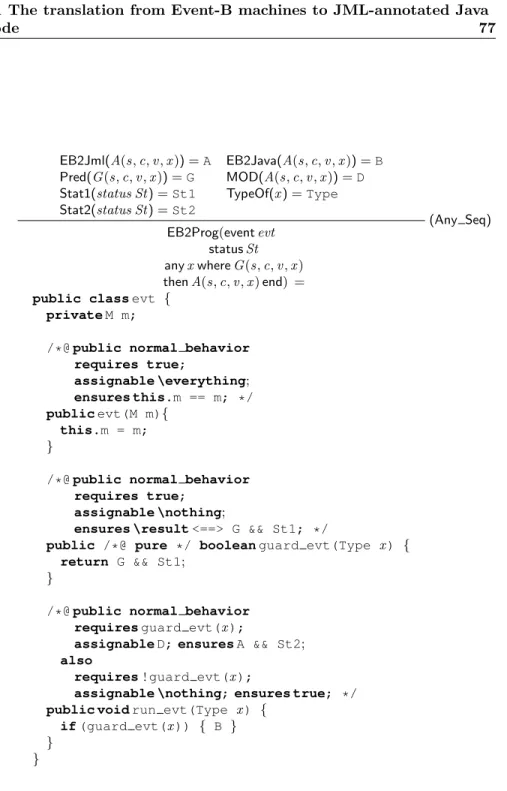
4.1 The translation of the Event-B machineM, and the context ctx thatM sees to JML-annotated Java abstract class. . . 51
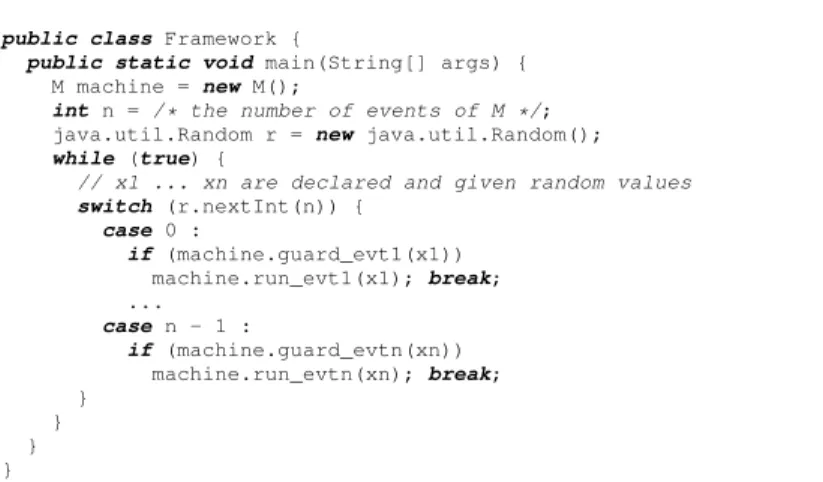
4.2 A framework for executing JML-annotated Java classes trans-lated from Event-B machines. . . 56
4.3 An excerpt of the abstract Event-B machine for MIO (left: ma-chineabstract. Right: contextctx1 thatM see). . . 58
4.4 Part of an Event-B machine for MIO (left: refinement 1 machine. Right: context). . . 59
4.5 A partial JML specification of the MIO Event-B model. . . 60
4.6 An implementation for the abstract Java class presented in Figure 4.5. . . 61
5.1 The translation of machineM, and the contextC that M sees. . 66
5.2 The translation of a standard Event-B event with local variables. 72 5.3 The translation of a standard event. . . 73
5.4 The translation of a standard Event-B event with local variables to a sequential Java program. . . 77
5.5 A framework for executing Java classes translated from Event-B machines in a sequential fashion. . . 78
5.6 General structure of EventB2Java Rodin plug-in. . . 79
5.7 Specific structure of EventB2Java Rodin plug-in . . . 80
5.8 EventB2Java: Contextual menu in Rodin . . . 82
LIST OF FIGURES 11
5.10 Exp 2: CPU usage ‘bakery’ vs ‘synchronized’ . . . 85
5.11 An extract of the Binary Search algorithm in Event-B . . . 86
5.12 JML-annotated Java code generated by EventB2Java from the bin m2 depicted in Figure 5.11. . . 88
5.13 Binary Search: code generated for theinc event . . . 89
5.14 Excerpt of the sequential JML-annotated Java code generated by EventB2Java from thebin m2 depicted in Figure 5.11. . . 90
5.15 Excerpt of the sequential Java code generated for theinc event . 90 5.16 Binary Search: Sequential Java code generated for theincevent 91 6.1 An abstract and context machine in Event-B . . . 97
6.2 Refinement machine in Event-B . . . 98
6.3 Formalising relation structures in Dafny. . . 106
6.4 Translation rule for an Event-B machine and its context to Dafny 107 6.5 Proof Obligation generated by Rodin . . . 115
6.6 Partial EventB2Dafny output . . . 116
7.1 Excerpt of theref6 socialevents (and the context itsees) Event-B machine for the Social-Event Planer model . . . 122
7.2 Excerpt of theref7 socialinvite Event-B machine for the Social-Event Planer model . . . 124
7.3 Excerpt of the ref8 socialpermission Event-B machine for the Social-Event Planer model . . . 125
7.4 Excerpt of the translation of machineref8 socialpermissions to Java . . . 126
7.5 Excerpt of the translation of eventcreate social event to Java . 127 7.6 Screenshots Social-Event Planner . . . 128
7.7 The Tokeneer System. . . 129
7.8 Hierarchy of certificate types. . . 131
7.9 Excerpt State Diagram User Entry to TIS. . . 134
7.10 Excerpt third refinement machine TIS Event-B model . . . 140
7.11 Partial translation of machineref3 entry L1 . . . 141
7.12 Partial translation of eventBioCheckRequired . . . 142
7.13 TheUserEntry1Test Case in JUnit . . . 144
Refinement Calculus and Design-by-Contract are two formal methods widely used in the development of systems. Both methods have (dis-)advantages: in Refinement Calculus a model starts with an abstraction of the system and more details are added through refinements. Each refinement is probably consistent with the previous one. Hence, the reasoning about abstract models is possi-ble. However, a high level of expertise is necessary in mathematics to have a good command of underlying languages, techniques and tools, making this methodology less popular; on the other hand, Design-by-Contract works on the program rather than the program model so developers in software industry are more likely to have expertise on it. However, the benefits of reasoning over more abstract models are lost.
A question arises, is it possible to combine both methods so users can use them together in the development of systems taking the best of both? This thesis solves this question by translating Refinement Calculus with Event-B to Design-by-Contract with Java and JML so users can take full advantage of both formal methods without losing their benefits. This thesis presents a set of syntactic rules that translates Event-B to JML-annotated Java code. It also presents the implementation of the syntactic rules as the EventB2Java tool. We used EventB2Java to translate several Event-B models. The tool generated JML-annotated Java code for all the considered Event-B models that serve as final implementation. We also used EventB2Java for the development of two software applications. Additionally, we compared EventB2Java against two other tools that also generate Java code from Event-B. EventB2Java enables users to start the development of software in Event-B where users can model the system and prove it consistently, to then transition to JML-annotated Java code using our tool, where users can continue the development.
Resumo Portuguˆ
es
Refinement Calculus eDesign-by-Contracts˜ao dois m´etodos formais utilizados no desenvolvimento de sistemas. Ambos tˆem (des-)vantagens: em Refinement Calculusum modelo come¸ca com uma abstra¸c˜ao do sistema e mais detalhes s˜ao adicionados atrav´es de refinamentos. Cada refinamento ´e provavelmente consis-tente com o anterior. Assim, o racioc´ınio sobre modelos abstratos ´e poss´ıvel. No entanto, um alto n´ıvel de conhecimento ´e necess´ario em matem´atica para ter um bom dom´ınio da sintaxe da linguagem, t´ecnicas e ferramentas tornando esta metodologia menos popular; Design-by-Contracttrabalha no programa, e n˜ao no modelo do programa de modo que os desenvolvedores na ind´ustria de software s˜ao mais predispostos a ter conhecimento sobre ele. No entanto, os benef´ıcios do racioc´ınio em rela¸c˜ao aos modelos mais abstratos s˜ao perdidos.
Surge uma quest˜ao, ´e poss´ıvel combinar ambos m´etodos para que os uti-lizadores possam utiliz´a-los conjuntamente no desenvolvimento de sistemas tomando o melhor dos dois? Esta tese resolve essa quest˜ao, traduzindo Refine-ment Calculuscom Event-B para oDesign-by-Contractcom Java e JML assim ´e poss´ıvel tirar o m´aximo proveito de ambos m´etodos formais. Apresenta-se aqui um conjunto de regras sint´aticas que traduz Event-B para o c´odigo Java com anota¸c˜oes JML. Apresenta tamb´em a implementa¸c˜ao das regras sint´aticas como a ferramenta EventB2Java. Usamos EventB2Java para traduzir v´arios modelos em Event-B. A ferramenta gerou c´odigo Java com anota¸c˜oes JML para todos os modelos considerados que servem de implementa¸c˜ao final. Tamb´em usamos EventB2Java para o desenvolvimento de duas aplica¸c˜oes de software. Al´em disso, comparamos EventB2Java com duas outras ferramentas que tamb´em geram c´odigo Java do Event-B. EventB2Java permite que os utilizadores ini-ciem o desenvolvimento de software em Event-B onde podem modelar o sistema, prov´a-lo de forma consistente e fazer a transi¸c˜ao para c´odigo Java com anota¸c˜oes JML utilizando a nossa ferramenta, onde os utilizadores podem continuar o de-senvolvimento.
Chapter 1
Introduction
Information systems have become essential to people. As an example of this, people use web systems to search for things to buy, and use bank transaction systems to make payments, and even trust their lives to critical software systems, such as control software used by airplanes. Often, people are unaware of the consequences that malfunctioning software can do to their lives. Hence, they must be built in a correct fashion.
Concepts such as robustness and reliability are important in software today: people expect software systems to work well. Several approaches to software reliability and robustness exist [53, 89], which might be supplemented with Software Testing [13, 14]. However, testing techniques alone are not adequate to ensure the correctness of a critical software (or any other software). As Edsger Dijkstra said “Testing shows the presence, not the absence of bugs”. Tests can only show the situations where a system will fail, but cannot say anything about the behaviour of the system outside the testing scenarios. While it is true that validating the code against certain properties, as in testing, makes software testing popular and important, it is also true that testing does not validate the system as a whole: system behaviours beyond the ones considered by the tests can produce casualties.
Refinement Calculus techniques [52, 80, 79, 9] are techniques to implement software systems based on formal methods. In Refinement Calculus, users write an abstract model of a system, and then transform the model into an imple-mentation via a series of refinement steps, where each refinement adds more detail to the system. The behaviour of each refinement is provably consistent with the behaviour of the previous step. The final refinement is the actual im-plementation of the system modelled. This technique is known as correctness-by-construction, as it allows to reasoning about the model ensuring that all functionality is correct. B [2] and Event-B [4] are examples of formal techniques based on Refinement Calculus: B is a method for specifying, designing and cod-ing software systems introduced by J.-R. Abrial. Atelier B [8] is an IDE that enables user to work with B method; Event-B models are complete developments of discrete transition systems. Event-B was also introduced by J.-R. Abrial and it is derived from the B method. Rodin [28] is an Eclipse IDE that provides support for Event-B. The correctness of models in B and Event-B is achieved by discharging proof obligations. Proof obligations are correctness conditions on the model of the system which need to be proven true. Several provers exist that help the process of discharging proof obligations. For instance, Atelier B (for working with B) comes with its own automatic prover. Rodin (for working with Event-B) comes also with its own automatic prover. Other provers could be used in the process of discharging proofs obligations. For example, Dafny [65] is an imperative object-based language with built-in specification constructs that comes with an automatic prover, Z3 [49], one could express proof obligations in the input language of Dafny and then use its automatic provers to discharge the proof obligations.
Limitations of Refinement Calculus techniques come from the level of ex-pertise in mathematics required to use the underlying languages and tools. As J. Bowen and V. Stavridou describe in [24], one of the principal issues of the wide adoption of formal methods is that they require mathematical expertise. For instance, when applying refinement techniques, making the behaviour con-sistent of a refinement with the behaviour of the previous step is heavy burden, particularly when the refinement is close to the implementation. Developers of software are not correctly educated (as states by J.-R. Abrial in [4]), since they have little or no mathematical background, making Refinement Calculus complex to use.
17
The main goal of this thesis is to bridge Refinement Calculus with Event-B to Design-by-Contract with Java and JML. Thus, software developers can benefit from both formal methods in the software development of applications. This thesis presents a code generator for Event-B that generates JML-annotated Java code. Thus, the software development of an application starts with a formal model in Event-B on which users can define properties on that can be proven correct by discharging proof obligations in Event-B. Then, the user translates the model to a JML-annotated Java code using our code generator. The user decides the level of model abstraction in Event-B. Once the code is generated, the user can continue the system development of the application in Java.
The work presented in this thesis allows users of different expertise to work together in the development of systems. For instance, a user expert in the notation underlying Event-B and expert in mathematics can work at early stages of the system development, then transition to JML-annotated Java code of the Event-B model using our code generator, where an expert software developer can continue with the final implementation of the system.
The code generator from Event-B to JML-annotated Java code is formally defined by means of translation rules. This thesis presents the translation rules and its implementation as the EventB2Java tool. EventB2Java automates the process of code generation from Event-B models. The code generator, addition-ally to generating Java code of Event-B models, also generates JML specifica-tions. Thus, users can customise the Java code and verify it against the JML specifications to make sure the customisation does not invalidate the initial Event-B model.
We have validated EventB2Java by using the tool in the process of generating JML-annotated Java code from an ample set of Event-B models. This thesis presents these Event-B models and the code generated by EventB2Java, and also presents a benchmark in which EventB2Java is compared against other tools for generating Java code from Event-B models. We used EventB2Java in the development of two case studies: the first case study is on the development of an Android [61] application that follows the MVC (Model-View-Controller) design pattern [60]; the second case study is on testing an Event-B model by translating it to Java and performing Java Unit (JUnit) testing of the generated Java code.
This thesis also introduces a tool that generates Dafny code from Event-B proof obligations (PO) to assist users in the process of proving the system cor-rect. The translation of Event-B POs to Dafny is defined by means of translation rules. Rules were implemented as the EventB2Dafny tool. EventB2Dafny helps users on discharging Event-B POs by translating them to the input language of Dafny where the user can use Z3, the Dafny automatic prover to prove the PO.
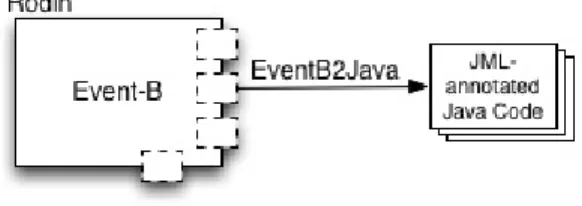
is proven to satisfy certain safety and security properties, and then transformed to code via a series of property preserving refinement steps. We proposed the B2Jml tool that generates JML specifications from B, where users can manually write Java code. Then we realised that Event-B method (an evolution of the B method) is a better starting candidate for the development of systems, so we proposed a translation from Event-B machines to JML specifications. Chapter 4 discusses how one can see Event-B method better than B, the chapter also discusses the translation and the implementation of the EventB2Jml tool. In modelling a system in Event-B, one needs to prove the soundness of the model. A series of proof obligations are generated and needed to be discharged to gain confidence of the model. Discharging proof obligation can be a difficult task, so we proposed a translation from Event-B proof obligations to the input language of Dafny, thus users can use Dafny as a prover. Our intention is to provide tools that help users in the process of proving an Event-B model sound. Chapter 6 describes this translation and presents the EventB2Dafny tool that automates the process of translation. Once we developed this tool and EventB2Jml, we used them to generate JML specifications from the Event-B model MIO. Then we manually generated Java code for those specifications. We then realised that is more useful to have a tool that automatically generates Java code and we saw the importance of embedded JML specifications into the code since users might want to customise the generated code without invalidating the initial model. We proposed and implemented (discussed it in Chapter 5) a translation from B models to JML-annotated Java code. We implemented it as the Event-B2Java tool. Having the JML specifications embedded into the Java code also gives a insight of documentation of the code that can be read easily.
1.1
Thesis overview
Chapter §1. Introduction This chapter describes the problem addressed by this thesis and describes the importance of using more-formal methods to build systems
Chapter§2. Background This chapter provides the background knowledge required to understand the work done in this thesis.
1.1 Thesis overview 19
Contributions. The main contributions of this chapter arei) the definition of a set of sound rules to translate B to JML,ii) the implementation of the rules as the B2Jml tool. Work done in this chapter have been published in [41, 36]. I participated in the design and testing of the syntactic rules and in the design of B2Jml and its integration to the ABTools suite.
Chapter §4. Translating Event-B Machines to JML Specifications. This chapter presents a translation from Event-B to JML. This work goes in the same direction as the work presented in Chapter 3 as they both generate JML specifications from a formal model. I decided to change the initial formal method from B to Event-B since Event-B presents a simpler notation than B, which is easier to learn, use, and translate. In addition to this, the B method is devoted to the development of correctness-by-construction software, while the purpose of Event-B is used to model full systems (including hardware, software and environment of operation). Chapter 4 presents a set of syntactic rules to generate JML specifications from Event-B. It presents the implementation of the rules as the EventB2Jml tool. EventB2Jml is implemented as a Rodin [28] plug-in. This chapter also shows the application of the tool to a model in Event-B.
Contributions. The main contributions of this chapter are the definition of a translation from Event-B models to JML specifications, and the implementation of the translation as the EventB2Jml tool. This translation allows experts in Event-B to work together with software developers usually expert in main stream programming languages like Java. For instance, an expert in the notation underlying Event-B starts the development of a system, then uses EventB2Jml to transition to JML where a software developer writes Java code from the JML specifications. I participated in the definition of the syntactic rules of the translation and I fully implemented the EventB2Jml tool.
Chapter §6. Translating Event-B Machines Proof Obligations to Dafny. This chapter presents a translation of Event-B proof obligations to the input language of Dafny by means of syntactic rules, Dafny [65] is an im-perative object-based language with built-in specification constructs. The rules were implemented as the EventB2Dafny Rodin plug-in. To prove an Event-B model consistent it is necessary to discharge a serie of proof obligations. Typi-cally, proof obligations are automatically discharged by Rodin provers. However, there are some proofs that need users’ assistance to be discharged. EventB2-Dafny assists users on the process of discharging proof obligations by translating them to Dafny. EventB2Dafny generates Dafny code that is correct if and only if the Event-B refinement-based proof obligations hold.
published in [35]. I participated in the definition of the translation from Event-B proof obligations to Dafny programming language and in the implementation of EventB2Dafny.
Chapter§5. Translation of Event-B Machines to JML-annotated Java Code. We decided to extend the work described in Chapter 4 to not just generate JML specifications, but also to generate Java code from Event-B mod-els. This chapter presents the core work of this Ph.D. thesis. It describes the translation of Event-B models to JML-annotated Java code. The translation is achieved through syntactic rules and it is implemented as the EventB2Java tool.
Contributions. The main contributions of this chapter arei) the definition of a set of sound rules to translate Event-B models to JML-annotated Java code, ii) the implementation of the rules as the EventB2Java tool. Users can benefit from the work accomplished in this chapter since the following reasons
• the EventB2Java tool generates both sequential and multithreaded Java code,
• EventB2Java can be applied to both abstract and refinement Event-B models, and
• the generation of JML specifications enable users to write customised code that replaces the code generated by EventB2Java, and then to use existing JML tools [40, 66] to verify that the customised code is correct.
Work done in this chapter have been published in [91] and in a book chapter [36], and submitted to a journal paper [92]. My participation was to define the sound rules for the translation of Event-B models to JML-annotated Java code, and to fully implement the EventB2Java tool.
1.1 Thesis overview 21
Background
2.1
The B method
The B method [2] is a strategy for software development in which an abstract model of a system is transformed into an implementation via a series of refine-ment steps, whereby the behaviour of each refinerefine-ment is provably consistent with respect to the behaviour of the previous step. A modelMi+1 of a system
at stage i+ 1 is said to refine the model Mi at stage i. The refined model must keep a palpable behavioural relation with its abstraction. This relation is modelled through a “gluing invariant” property. Refinement steps generate proof obligations to ensure that the system works correctly. Roughly speaking, a refinement model should be such that it can replace the refined model without the user of it noticing any change.
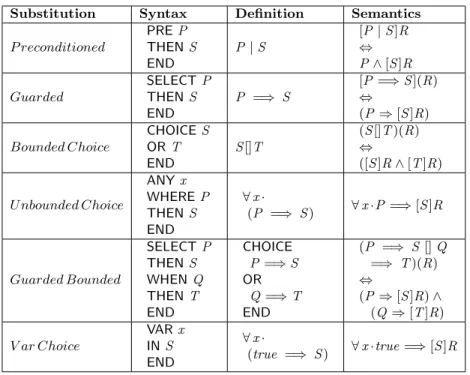
B models are called machines, composed of a static part: variables, constant, parameters and invariants; and a dynamic part: operations, which describe how the system evolves. B machines use predicate calculus (essentially predicate logic and set theory) to model properties. Machine operations are defined using various forms of substitutions. The following explains the different forms:
Figure 2.1 shows the syntax and the semantics of substitutions in B (taken from [2]). The semantics are to be valid for any predicate R. In Figure 2.1, P, Q, and R are predicates, and S and T are substitutions of variables by expressions. [S]R, withS equals x :=E, denotes the predicate resulting from the substitution of any free occurrence of variablex inR by expressionE.
A preconditioned substitution P | S denotes the substitution S under the operation pre-conditionP. Hence, the correct behaviour of the substitutionS is only ensured when it is activated in a state in whichP holds. WhenP does not hold, P |S is not guaranteed to verify any predicate R and a crash of the system occurs. AguardedsubstitutionP =⇒S executes a substitutionS under the assumptionP, hence ifP does not hold, the substitution is able to establish any predicateR.
sub-2.2 The Event-B Method 23
stitution amongS orT. The semantics of a bounded choice substitution ensures that either substitution is implemented it must satisfyR.
Anunbounded choice substitution ∀x·S generalises a bounded choice sub-stitution for any subsub-stitution S. Figure 2.1 presents a particular unbounded substitution that further requires x to make predicate P true. P and S both depend onxand the machine variables. Guarded boundedsubstitutions combine bounded choiceandguarded substitutions. Var Choiceis a syntactic extension to thebounded choicesubstitution.
Substitution Syntax Definition Semantics
P reconditioned
PREP THENS END
P |S
[P|S]R
⇔
P∧[S]R
Guarded
SELECTP THENS END
P =⇒ S
[P=⇒S](R)
⇔
(P ⇒[S]R)
Bounded Choice
CHOICES ORT END
S[]T
(S[]T)(R)
⇔
([S]R∧[T]R)
U nbounded Choice
ANYx WHEREP THENS END
∀x·
(P =⇒ S) ∀x·P=⇒[S]R
Guarded Bounded SELECTP THENS WHENQ THENT END CHOICE P =⇒S OR
Q=⇒T END
(P =⇒ S[]Q
=⇒ T)(R)
⇔
(P ⇒[S]R)∧
(Q⇒[T]R)
V ar Choice
VARx INS END
∀x·
(true =⇒ S) ∀x·true=⇒[S]R
Figure 2.1: Substitutions in B
2.2
The Event-B Method
Event-B [4] models are complete developments of discrete transition systems. Event-B was introduced by J-R. Abrial, and is derived from the B method. Event-B models are composed of machines and contexts. Three basic relation-ships are used to structure a model. A machinesees a context and canrefine another machine. And a context canextendanother context.
machines and contexts the machinerefines andsees. It also contains a list of variablesused in the machine, a list of invariants that restricts the possible values the variables can take, and avariantwhich is a numeric expression that has to be decreased by special events. The events of a machine determine the way the system evolve. The system evolves via a serie of substitutions of variables whenever an event is triggered. events contain a clause status that defines an event asordinary,convergent (the event has to decrease the variant), or anticipated (the event must not increase the variant). It also contain a list of local variables (they can be seen as parameter of the event) under the clauseany. Events contain a guard (under clausewhere) that needs to be true in order for the event to be triggered. If the guard is true, the event might perform its actions. Actions are under the clause thenand they define how the system evolves by means of substitutions. In Event-B there are two kind of substitutions: deterministic assignment, which takes the form of<variable identifier> := <expression>; and non-deterministic assignment, which takes the form of<variable identifier list> :| <before after predicate>, the before after predicate is the relationship that exists between the value of a variable just before and just after the assignment. It may contain machine variables. Non-deterministic assignments generalise deterministic assignments. For example, v :=v+w can be expressed as v :|v′ =v+w, where v′ is the value ofv after the assignment.
<machine identifier> refines
<machine identifier> sees
<context identifier list> variables
<variable identifier list> invariants
<label>:<predicate> variants
<variant> events
<event list>
Figure 2.2: General structure of Event-B machine (taken from [4]).
2.3 Tool support for Event-B 25
<context identifier> extends
<context identifier list> sets
<set identifier list> constants
<constant identifier list> axioms
<label>:<predicate>
Figure 2.3: General structure of Event-B context (taken from [4]).
2.3
Tool support for Event-B
The Rigorous Open Development Environment for Complex Systems (RODIN) [28] is an open-source Eclipse IDE that provides support for Event-B and that provides a set of tools for working with Event-B models, e.g. an editor, a proof generator, and provers. Existing Rodin plug-ins provide extended functionality such as model checking and animation [72].
Rodin come with an API that offers a series of Java interfaces for manipulat-ing Event-B components called the data model. It also comes with a persistence layer (called the Rodin database) that usesXMLfiles to store these components. It is intended to abstract the concrete persistence implementation from the data model. The database API is located in the org.rodinp.corepackage. Full source code for Rodin is available in [93].
2.3.1
Rodin Proof Obligations
In modelling in Event-B, users transform an abstract machine to code via a series of refinements. Refinements add new information to the system. Each refinement must be correct with the previous one. Hence a set of Proof Obliga-tions (PO) is generated. POs are axioms that need to be proven true in oder for the underlying system to be correct. Rodin automatically generates them. Rodin provides the tool proof generator, and several provers. The provers asso-ciated to Rodin help users to discharge PO, however sometimes it is necessary the assistance of the user to discharge them. Generated POs are describe in this section.
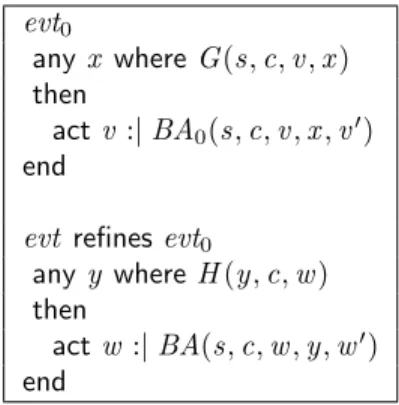
The Rodin proof-obligation generator automatically generates proof obliga-tions based on both the machine and the context. As explained above, there are three kind of relations between machines and contexts: i) a machine sees a context, ii) a concrete machine can refine an abstract machine, and iii) a context can extend another context. Given the abstract event evt0 and the
evt0
anyx whereG(s,c,v,x) then
actv :|BA0(s,c,v,x,v′)
end
evt refinesevt0
anyy whereH(y,c,w) then
actw :|BA(s,c,w,y,w′) end
Figure 2.4: Events of an Event-B abstract and refinement machines
ensure that the machines are models of the same system yet at a different level of abstraction. In Figure 2.4, s and c are the sets and constants seen by the abstract and concrete machines, v is the set of abstract variables, w, which includesv, is the set of concrete variables, predicatesG andH are the abstract and concrete guards, BA0 and BA are before-after predicates that relate the
state of variables before and after actions occur1.
In Event-B, the symbol :| represents non-deterministic assignment. Non-deterministic assignments generalise Non-deterministic assignments (formed with the aid of :=), e.g. the deterministic assignmentx :=x+z can be expressed as the non-deterministic assignmentx :|x′=x+z.
An abstract machine can declare an abstract invariantI and a concrete ma-chine can additionally declare an invariantJ (also called “gluing” invariant) that depends on the context and the local machine variables respectively. Contexts can further declare a set of theorems and axioms.
Rodin generates invariant preservation proof obligations (INV) for every ab-stract (concrete) event of the abab-stract (concrete) machine expressing that, given the axioms and theorems, the abstract (gluing) invariant, the guard of the event, and the before-after predicate, then the abstract (the concrete) invariant holds in the after state. Rodin generates a guard strengthening proof obligation (GRD) for every event expressing that the guard of the concrete event must be as least as strong as the guard of the abstract event. It generates a feasibility proof-obligation (FIS) for the action of every event stating that a solution to the before-after predicates exists. For every event merging two abstract events, Rodin generates a merging proof obligation (MRG) that ensures that the guard of the merging event is stronger than the disjunction of the guards of the ab-stract events. For every event, Rodin generates a simulation proof obligation (SIM) that ensures that abstract actions are correctly simulated by the concrete actions. That is, the result produced by the concrete action does not contra-dict the result produced by the abstract action. Rodin also generates numeric and finite proof obligations to ensure that variable declarations are well-defined
1
2.4 The Java Modeling Language (JML) 27
(WD) and sets are finite (FIN).
In Rodin, one can further declare a machinevariantpositive integer expres-sion n that must be decreased by specialised events to ensure that they do not monopolise the system (NAT). Machine events can be declared anticipated (convergent), and Rodin generates proof obligations expressing that the modi-fied variant (evaluated after executing the event action) should be (strictly) less than or equal to the variant evaluated before the event action occurs (VAR).
One can declare a witness of a refinement event with the aid of the with clause of Rodin. A witness expression relates bounded variables of an abstract event with bounded variables of the concrete event, e.g. one could have added the expression with x : x′ =y to the declaration of the concrete event evt in Figure 2.4, meaning that bounded variable x in the abstract event is renamed as bounded variable y in the concrete event. Rodin generates a witness proof obligation (WFIS) for every event witness expressing that a solution for the witness expression exists.
Theorems must be provable from contexts or machines (THM). In Event-B, Theorems are used to simplify complex proof-obligations.
2.4
The Java Modeling Language (JML)
JML [70, 25, 71] is an interface specification language for Java – it is designed for specifying the behaviour of Java classes, and is included directly in Java source files using special comment markers//@and /*@ */. JML’s type sys-tem includes all built-in Java types and additional types representing mathe-matical sets, sequences, functions and relations, which are represented as JML specified Java classes in theorg.jmlspecs.modelspackage. Similarly, JML expressions are a superset of Java expressions, with the addition of notations such as==>for logical implication,\existsfor existential quantification, and \forallfor universal quantification.
JML class specifications can include invariant clauses (assertions that must be satisfied in every visible state of the class), initiallyclauses (spec-ifying conditions that the post-state of every class constructor must satisfy), and history constraints (specified with the keyword constraint, which are similar to invariants, with the additional ability to relate pre- and post-states of a method). Concrete JML specifications can be written directly over fields of the Java class, while more abstract ones can use specification-only modeland ghost fields. ghost fields are not related to the concrete state of the class and can be declaredfinal, whilemodelfields are related to Java implemen-tation fields via arepresentsclause, which acts much like a gluing invariant in Event-B refinement.
modifies for frame conditions (lists of locations whose values may change from the pre-state to the post-state of a method). An assignable clause of \nothing prevents any location from being modified from the pre- to the post-state, and anassignableclause of\everythingallows any side- effect. Declaring a method aspure has the same effect asassignable\nothing. The pre-state is the state on method entry and the post-state is the state on method exit. A normal behavior method specification states that if the method pre-condition holds in the pre-state of the method, then it will always terminate in a normal state, and the normal post-condition will hold in this state. A JML exceptional behavior method specification states that if the method pre-condition holds in the pre-state of the method, then it will al-ways terminate in an exceptional state, throwing ajava.lang.Exception, and the corresponding exceptional post-condition will hold in this state. In an ensuresorsignalsclause, the keyword\oldis used to indicate expressions that must be evaluated in the pre-state of the method – all other expressions are evaluated in the post-state. The\oldkeyword can also be used in history constraints, providing a convenient way to specify (for example) that the post-state value of a field is always equal to the pre-post-state value, thus making the field a constant.
Figure 2.5 presents a simple example of a JML specified Java abstract class. This class defines an excerpt of a Social Network. In JML, modeland ghostfields are both specification-only. That is, they exist in JML but they do not exist in the Java code. A significant difference is that modelfields are an abstraction of the mutable part of an object’s state and should be related to an implementation field through the JMLrepresentsclause in any concrete class that inherits fromSOCIAL NETWORK. Whileghostfields can be used to rep-resent immutable data. Classes JMLEqualsSetand JMLEqualsToEquals-Relation(in theorg.jmlspecs.modelspackage) are built-in to JML and represent mathematical sets and relations, respectively. Theinvariantis an assertion that all instances of the class must satisfy in all visible states, and theinitiallyclause is an assertion that the initial values of the fields must satisfy.
The specification of the transmit rcmethod uses two specification cases (the keyword also) - the first specifying that content rc is transmitted to personpe if peand oware actually person of the network, rcbelongs to the content of the network, belongs to personow, andrchas not been transmitted yet to person pe. The second specifying that attempting to transmit rcto a personpewhen eitherpeor oware not actually people of the network, or rc
does not belong either to the content of the network or to person ow, or rc
2.4 The Java Modeling Language (JML) 29
//@ model import org.jmlspecs.models.JMLEqualsSet;
//@ model import org.jmlspecs.models.JMLEqualsToEqualsRelation;
public abstract class SOCIAL_NETWORK {
//@ public final ghost JMLEqualsSet<Integer> PERSON; //@ public final ghost JMLEqualsSet<Integer> RAWCONTENT; //@ public model JMLEqualsSet<Integer> person;
//@ public model JMLEqualsSet<Integer> rawcontent;
//@ public model JMLEqualsToEqualsRelation<Integer,Integer> content; /*@ public invariant person.isSubset(PERSON)
&& rawcontent.isSubset(RAWCONTENT)
&& (new Relation<Integer, Integer> (person, rawcontent)).has(content)
&& content.domain().equals(person) && content.range().equals(rawcontent);*/
/*@ public initially person.isEmpty() &&
rawcontent.isEmpty() && content.isEmpty();*/
/*@ public normal_behavior
requires rawcontent.has(rc) && person.has(ow) && person.has(pe) && !ow.equals(pe) && !content.has(ModelUtils.maplet(pe,rc));
assignable content;
ensures (\exists JMLEqualsSet<Integer> prs;\old(prs.isSubset(person));
content.equals(\old(ModelUtils.toRel(content.union(ModelUtils.
toRel(ModelUtils.maplet(pe,rc)))).union(ModelUtils.cartesian( prs, ModelUtils.toSet(rc))))));
also
public exceptional_behavior
requires !(rawcontent.has(rc) && person.has(ow) && person.has(pe) && !ow.equals(pe)
&& !content.has(ModelUtils.maplet(pe,rc)));
assignable \nothing; signals (Exception) true;*/
public abstract voidtransmit_rc(Integer rc, Integer ow, Integer pe);
}
2.4.1
Tool support for JML
There are different techniques that work with JML specifications along with the proper tooling to avoid error-prone. The most basic technique is parsing and type-checking the JML specifications as done by the JML checkerjml. Several tools have been developed to help users with the correct specification of JML clauses. For instance, the CHASE tool [31] checks the assignable clause of a JML-annotated Java program. It checks for every method its assignable clause by checking for every assignment and for every method call in the body, whether it agrees with the assignable clause of the method that is checked. The tool gives feed-back to the user on the forgetting variables that may be modified by a specific method. Another tool that helps users on specifying JML clauses is Daikon [57]. Daikon automatically infers invariants from JML-annotated Java programs.
Another more specialised technique that works with JML consists of check-ing the correctness of JML by run-time checkcheck-ing. In run-time checkcheck-ing one runs the Java code and tests some safety conditions. Such run-time checking is done by the JML compiler jmlc[43]. jmlc is an extension of the Java compiler that compiles JML-annotated Java programs into Java bytecode. The compiled bytecode contains the safety properties (assertions) as pre-conditions, normal and exceptional post-conditions, invariants, and history constraints. If an asser-tion is violated, an error message is arisen. Another tool for asserasser-tion checking during testing phase isjmlunit[105]. jmlunituses the JML specification as a test-ing oracle, automattest-ing the process of generattest-ing JUnit tests. The tests creattest-ing by this tool catches any assertion given by the JML run-time assertion, thus it checks if, for instance, a pre-condition or an invariant is violated, meaning the Java code does not meet the JML specification.
obli-2.5 Dafny 31
gation (property) that want to proof. The tool translates the program to the input language of B method, and translates the proof obligations to lemmas in B. Lemmas are proven using a prover developed within Atelier B [8]; jmle [67] translates JML specifications to Java programs that are executed using the Java Constraint Kit.
There are several more tools for checking the JML specification against the Java code. L. Burdy et. al. had made an overview of said tools in [25].
One limitation about these tools is no one has been developed to work with Java 7 that introduces generics types. A generic type is a generic class that is parameterised over types, so it is not possible to know the specific type in a static manner.
2.5
Dafny
Dafny [65] is an imperative object-based language with built-in specification constructs. The Dafny static program verifier can be used to verify the func-tional correctness of programs. Dafny runs under Microsoft Visual Studio, and from the command line, which requires a .NET virtual machine. Dafny provides support for the annotation of program as contracts: pre- and post-conditions. Also provides support for abstract specifications through the definition and use of ghost variables and methods, and for the definition and specification of mathematical functions. Functions are specification-only constructs; they exist for verification-only purposes and areghostby default. Therequires spec-ification of the function (which goes in the same direction of requiresJML clause) may be used to define its domain (partial functions). Post-conditions are written asensuresspecifications (which also goes in the same direction of ensures JML clause). It represents the post-state of the function and must hold for every possible invocation of the function. Pre- and post-conditions must be written at the beginning of the function. The assert clause can be written somewhere in the middle of the function. It tells that a particular ex-pression always holds when control reaches that part of the code. The reads part declares the function’s frame condition, which is all the memory locations that the function is allowed to read [65]. Finally, the decreasespart states the termination metrics of the function.
Program verification with Dafny works by translating the program written in Dafny to the Boogie 2 proving engine [11] in such a way that the correctness of the Boogie program implies the correctness of the Dafny program.
2.6
Software Design Patterns
Code patterns are common to many software solutions. According to [7], a software pattern “creates a common structure to help software developers to resolve recurring problems encountered throughout software development”.
is a reusable solution to a common problem within a given context. A Design Pattern is not an implementation of a solution but a template for how to address the problem. Gamma describes different kind of design patterns, some examples are the following:
Singleton: ensures that a class has one instance, provides a global point of access. For instance, in the development of a game that defines a board to be modified among the players. The board needs to be instantiated once since the players are going to be in the same game.
Facade: provides a unified interface to a set of interfaces in a subsystem. For instance, a common way to reduce complexity in the development of software is to implement the system into subsystems. However, that means the subsystems need to communicate each other. In order to minimize this communication burden, and dependencies between subsystems, one can use afacadeas a front-end.
Abstract Factory: provides an interface for creating families of related or dependent objects without specifying their concrete classes. For instance, it can be used when developing a framework that needs to be portable to different platforms.
Visitor: allows to define a new operation without changing the classes of the elements on which it operates. For instance, when defining a translation from languageAto language B, one normally creates an Abstract Syntax Tree (AST) for A and then the translation to B is attached to the nodes of that tree. Once the AST is built one can also think about another feature of the development like thepretty printoption. However, it will be messy to combine the translation with this new feature. The Visitor design pattern proposes a solution to add this new feature without changing the AST.
Model-View-Controller (MVC): models software as composed of three components: a model (M), a controller (C), and views (V). It separates the internal representation of the information from the way the users see it. All components interact with each other; the Controller is a bridge between the Model and the Views, sends commands to the Model for it to update its state. It also sends commands to the Views to change the presentation of the Model (this process is called rendering); the Model contains the logic of the system, sends information to the Controller and the Views every time the Model changes its state; the Views, which are the graphical representation of the information, request information from the Model necessary to update the information pre-sented to the user.
2.6 Software Design Patterns 33
Figure 2.6: MVC design pattern.
Translating B Machines to
JML Specifications
This chapter. This chapter presents a translation from B machines to JML specifications defined through syntactic rules. It also presents the implementa-tion of this translaimplementa-tion as the B2Jml tool. The tool enables B experts to use Refinement Calculus techniques to develop critical components in B, and then translate the result to JML for developers with less mathematical expertise to be able to implement code that respects the JML specification. B2Jml enables developers to use lightweight JML tools such as the jmle tool for executing JML specifications [66, 40], runtime assertion checkers and static analysers [25]. B2Jml fully supports the B syntax except for the B constructs for multiple in-cremental specification of machines, e.g. for including, importing, seeing, or extending other machines. We integrated B2Jml to the ABTools suite [18]. We have validated the tool by applying it to a moderately complex B model of a social networking site. We further executed the resulting JML specifications against a suite of test cases developed for a hand-translation of a B model. The full code of the implementation of the B2Jml tool is available at [20].
The work presented in this chapter inspired the work presented in the rest of this thesis. It has been published in [41, 36]. I participated in this work at the end of the implementation of the B2Jml tool.
The rest of this chapter is organised as follows. Section 3.1 describes the set of transition rules that translate B models to JML abstract class. These rules are implemented as the B2Jml tool and integrated into the ABTools suite. Section 3.2 presents the implementation. We have validated B2Jml by applying it to the B model presented in Section 3.3. The B model is a moderately complex model of a social networking site. That section also presents the resulting JML abstract Java class. Finally, Section 3.4 gives conclusions.
implemen-35
tation of this translation as B2Jml tool. Users might prefer to use JML since a) implementing a JML specification in Java is much more straightforward than implementing an equivalent B machine in Java. And b) the user may be more familiar with JML syntax than B notation.
Related work. Jin and Yang [62] outline an approach for translating VDM-SL to JML. Their motivations are similar to B2Jml tool in that they view VDM-SL as a better language for modelling at an abstract level (as in B), and JML as a better language for working closer to an implementation level. Their approach has not been automated – they describe only a strategy for translating specifications by hand.
Boulanger [19] describes partially automated translations between B and VHDL (in both directions). This approach permits co-design – verified B im-plementation machines can be translated to VHDL for realisation in hardware, and translations of VHDL libraries can be used by B machines. Hence, these translations allow designers to verify models of hardware components.
Bouquet et. al. have defined a translation from JML to B[22] and imple-mented their approach as the JML2B tool [23]. Although their translation goes in the opposite direction from the work presented here, their motivation is quite similar – they view translation as a way to gain access to more appropriate tools for the task at hand, which in this case is verifying the correctness of an abstract model without regard to code. JML verification tools are primarily concerned with verifying the correctness of code with respect to specifications, while B has much stronger tool support for verifying models.
3.1
The Translation from B to JML
The translation from B to JML is implemented with the aid of aB2Jmloperator. It is defined (via syntactic rules), it takes B syntax as input and returns the corresponding JML specification. To assist in this translation, we defined a MOD operator. It calculates the set of variables modified by an operation. The definition of MOD is inspired by the syntactic rules backing the analysis performed by the Chase tool in [31]. Further, aTypeOf operator is employed (without definition) to denote the inference of the type of a B variable and its translation into a corresponding JML type. Correspondence between B and JML types is briefly described at the end of section 3.1.2.
B2Jml translates a B abstract or refinement machine to a JML annotated abstract Java class. The machine variables becomemodelfields, and operations are translated to abstract methods with JML specifications. A preconditioned substitution in B generates JML (normal and exceptional) method specifica-tion cases. Addispecifica-tionally, although substituspecifica-tions in B have no explicit nospecifica-tion of post-condition,B2Jmltranslates other substitutions to JML post-conditions that relate the pre- and post-state values of the variables modified by the sub-stitution. The rules defining B2Jmlare deterministic so one cannot apply two different rules at the same time. In this sense, these rules define a calculus that computes the translation of B into JML.
Section 3.1.1 presents the translation of general substitutions, Section 3.1.2 presents the translation of other B syntax.
3.1.1
Translating Substitutions
RuleSeltranslates a guarded substitution to a JML implication (==>) in which the antecedent is obtained from the translation of the guard and the consequent is obtained from the translation of the nested substitution, this matches the def-inition of guarded substitution in B presented in Figure 2.1 where in a guarded substitution WHENP THENS END, substitution S is executed under the as-sumption ofP. RulesWhengeneralise ruleSel. The first ruleWhenis a synonym of rule Sel, in B, the construct for WHENin the form WHENP THENS END can be seen asSELECTP THENS END so it is translated in the same way as SELECT. The second ruleWhenconsiders two guards1.
Pred(P)=PB2Jml(S)=S
(Sel) B2Jml(SELECTP THENS END)
=
\old(P) ==> S
Pred(P)=PB2Jml(S)=S
(When) B2Jml(WHENP THENS END)
=
\old(P) ==> S
1
3.1 The Translation from B to JML 37
Pred(P)=P B2Jml(S)=S Pred(Q)=Q B2Jml(T)=T
(When) B2Jml(SELECTP THENS
WHENQTHENT END)
=
(\old(P) ==> S) && (\old(Q) ==> T)
RulesIfandIfElsetranslate theIFandIF ELSEsubstitutions to JML. Pred(P)=PB2Jml(S)=S
(If) B2Jml(IFP THENS END)
=
\old(P) ==> S
Pred(P)=PB2Jml(S)=SB2Jml(T)=T
(IfElse) B2Jml(IFP THENS ELSET END)
=
(\old(P) ==> S)∧(!\old(P) ==> T)
Rule Pre presents the translation of preconditioned substitutions. A pre-conditioned substitution is conceptually different from a guarded substitution. While a guarded substitution imposes a condition on the internal behaviour of the machine, a preconditioned substitution imposes a condition (the pre-condition) on the caller. Hence, a preconditioned substitution aborts if the pre-condition does not hold. This matches the definition of preconditioned sub-stitutions presented in Figure 2.1 where in order to execute the substitution S in a preconditioned substitution PREP THENS END one must prove P. In JML, this behaviour is modelled by throwing an exception.
Pred(P)=PMOD(S)=AB2Jml(S)=S
(Pre) B2Jml(PREP THENS END)=
/*@public normal behavior
requires P; assignable A;
ensures S;
also public exceptional behavior
requires !P; assignable\nothing;
signals(Exception) true; */
Rule Choice below introduces the translation for bounded choice substitu-tions, whose meaning is the meaning of any of the nested substitutions.
B2Jml(S)=SB2Jml(T)=T
Rule Any generalises rule When for unbounded choice substitutions. The type of the variablex is inferred from its usage in the predicateP and substi-tutionS. If at least one value of x satisfies P, any value can be chosen for use inS. If nox satisfiesP, the substitution is equivalent toskip.
Pred(P)=PB2Jml(S)=STypeOf(x)=Type (Any) B2Jml(ANYx WHEREP THENS END)=
(\exists Type x; \old(P) && S) ||
(\forall Type x; !\old(P))
TheVARconstruct in B introduces a local variablex in the scope of a sub-stitutionS, and so is equivalent to anANYsubstitution that does not constrain its bound variable [2].
(Loc) B2Jml(VARx INS END)
=
B2Jml(ANYx WHERE TRUE THENS END)
Rule Asg presents the translation of an assignment from an expression E to a variable v, the simplest nontrivial substitution in B. This substitution is mapped to a JML predicate in which the value of the variable in the post-state equals the value of the expression evaluated in the pre-state.
Pred(E)=E
(Asg) B2Jml(v := E) = v.equals(\old(E))
Rule Sim presents the rule for the simultaneous substitution S || SS, in whichSS could be another simultaneous substitution. As the name indicates, the nested substitutions occur simultaneously. Note that our rules translate x := y || y := x to x.equals(\old(y)) &&y.equals(\old(x)), which matches the B semantics. B does not allow simultaneous assignments to the same variable.
B2Jml(S)=S B2Jml(SS)=SS (Sim) B2Jml(S || SS)
=
S && SS
3.1 The Translation from B to JML 39
(ModAsg) MOD(v:=E) = {v}
MOD(S)=S
(ModSel) MOD(SELECTP THENS END)
=
S
MOD(S)=S MOD(T)=T
(ModGua) MOD(SELECTP THENS WHENQ THENT END)
=
S ∪ T MOD(S)=S
(ModAny) MOD(ANYx WHEREP THENSEND)
=
S
MOD(S)=S MOD(T)=T
(ModCho) MOD(CHOICES ORT END)
=
S ∪ T MOD(S)=S MOD(T)=T
(ModSim) MOD(S || T)
=
S ∪ T
As the variable introduced by aVARsubstitution is local to that substitution, it should not appear in an assignable clause and so is removed via rule ModVar.
MOD(S)=S
(ModVar) MOD(VARx INSEND)
=
S − {x}
3.1.2
Beyond Substitutions
presented here, the translation considers only a single carrier set, only a single variable and so on, but can easily be extended to multiple carrier sets, variables, etc.
B2Jml(SETSs)=S B2Jml(CONSTANTSc)=C B2Jml(VARIABLESv)=V B2Jml(PROPERTIESP)=P B2Jml(INVARIANTI)=I B2Jml(ASSERTIONSA)=A B2Jml(INITIALISATIONB)=B B2Jml(Q)=Q
(M) B2Jml(MACHINEM
SETSs CONSTANTSc PROPERTIESP VARIABLESv INVARIANTI ASSERTIONSA INITIALISATION B OPERATIONS op =Q
END) =
public abstract classM {
S C V P I A B
Q
public abstract voidop();
}
As there is not information about carrier sets, they are simply modelled as sets of integers as shown in Rule Set. All constants are being translated as final ghostvariables, using ghost variables because JML model vari-ables can not be declared final. Like modelvariables, ghost variables are specification only and so do not appear directly in implementations. Note that different instances of the class could use different carrier sets, so the field should not be static.
(Set) B2Jml(SETSs)
=
/*@ public final ghost
JMLEqualsSet<Integer> s; */
Rule Enum translates enumerated sets to sets of strings, where each string is the name of an enumeration constant.
(Enum) B2Jml(VARIABLESv = {s1, . . . ,sn}) =
/*@ public static final ghost
JMLEqualsSet<String> v
= JMLEqualsSet.convertFrom(
3.1 The Translation from B to JML 41
RuleConsusesTypeOfto infer the type of a constant from thePROPERTIES section of the machine.
TypeOf(c) = Type
(Cons) B2Jml(CONSTANTSc)
=
//@ public static final ghost Typec;
As BPROPERTIESclauses specify properties of constants, RuleProp trans-lates them asstatic invariants.
Pred(P) = P
(Prop) B2Jml(PROPERTIESP)
=
//@ public static invariant P;
Ordinary machine variable declarations are translated to JMLmodel vari-ables. The type of the variable is inferred from the machine invariant.
TypeOf(v) = Type
(Var) B2Jml(VARIABLESv)
=
//@ public model Typev;
Binvariantare translated to JMLinvariantsand B assertions are trans-lated as redundant invariants, as both assertions and redundant invariants are implied by ordinary invariants.
Pred(I) = I
(Inv) B2Jml(INVARIANTI) = //@ public invariant I;
Pred(I) =I
(Ass) B2Jml(ASSERTIONSI) = //@ public invariant redundantly I;
A BINITIALISATION clause is translated to a JML initiallyclause, as both provide initial values for variables. The assertion within theinitially clause uses==rather than calling theequalsmethod if the type of vis prim-itive.
Pred(E) = E
(Init) B2Jml(INITIALISATIONv := E) = //@ initially v.equals(E);
parameters. The return type of the corresponding method is either the trans-lated type of the single output parameter, orObject [] in order to contain the values of multiple output parameters.
The language used in B expressions is essentially predicate logic and set theory. In the translation, sets, binary relations and binary functions are being presented by the JML library model classesJMLEqualsSet, JMLEqualsTo-EqualsRelation, andJMLEqualsToEqualsMaprespectively. These classes test membership using theequalsmethod of the class that the elements belong to, rather than the Java==operator. Several examples of rules for translating B operators on these types are presented below, where si’s are sets andr is a relation.
Pred(s1) = s1 Pred(s2) = s2
(Subset) B2Jml(s1⊆s2) = s1.isSubset(s2)
Pred(x) = x Pred(s) = s (Has) B2Jml(x ∈s) = s.has(x)
Pred(r) = r Pred(s) =s
(Image) B2Jml(r[s]) = r.image(s)
TypeOf maps a B set type to the JML model class JMLEqualsSet, a re-lation type toJMLEqualsToEqualsRelation, and a function type to JML-EqualsToEqualsMap. As the types of B variables are specified implicitly (by stating membership in some possibly deferred set), the type must be inferred from its usage within the machine. This type inference was already implemented in ABTools (see Section 3.2), so in the implementation is translated from the representation of B types used by ABTools to the corresponding JML types. A library code to capture additional properties of B types is being used. For instance, given the B expression:
d ∈P(N) &r ∈P(N) &f ∈d→r
which states that f is a total function from d to r, the type of f is trans-lated asJMLEqualsToEqualsMap<Integer, Integer>and the following is generated as part of the class invariant:
(new Total<Integer, Integer>(d, r)).has(f)
Library class org.jmlspecs.b2jml.util.Total represents the set of all total functions from the specified domain to the specified range, so thehas
3.2 The B2Jml Tool 43
3.2
The B2Jml Tool
The B2Jml tool is integrated into ABTools [18], which is an open source en-vironment for developing B language processing tools. Full source code for ABTools and B2Jml is available in [20]. ABTools uses ANTLR [87] to gener-ate a parser for B. The parser constructs abstract syntax trees, which are then traversed (using an ANTLR tree walker) to infer and attach type information to each node. ABTools can currently generate refinement proof obligations and translate B machines to ASCII, LATEX, HTML and XML formats, and has some
initial support for generating C and Java implementations. This functionality is also implemented via ANTLR tree walkers.
The bulk of the B2Jml implementation is realised as an additional ANTLR tree walker, which implements theB2Jml,MOD, andTypeOfoperators presented previously. The tree walker traverses the syntax tree constructed by ABTools to generate the JML specification as indicated by the rules forB2Jml, collecting the variables that are modified by each operation as a side effect. Additional utility classes implement the B operators on functions, relations and sequences that do not directly correspond to methods of the JML model classes, as well as providing support for B typing via classes such as org.jmlspecs.b2jml.-util.Totalas previously described.
Installing the B2Jml tool: B2Jml is part of the ABTools distribution, so to use it one needs to install ABTools from eclipse. It can be installed in Eclipse downloading the sources from the SVN repository https://abtools.svn. sourceforge.net/svnroot/abtools. To run B2Jml one needs to add the argument-toJML. More detailed instructions on how to install and use the tool can be found at [33].
3.3
Using the B2Jml Tool
We have validated B2Jml tool by applying it to a moderate complex B model of a Social Networking. The model was taking from [38].
3.3.1
An Example in B
MACHINESOCIAL NETWORK SETS
PERSON;
RAWCONTENT
VARIABLES
person,rawcontent,content INVARIANT
persons⊆PERSON∧
rawcontent⊆RAWCONTENT∧
content∈person↔rawcontent∧
dom(content) =person∧
ran(content) =rawcontent INITIALISATION
person:=∅k rawcontent:=∅k content:=∅ OPERATIONS
transmit rc(ow,rc,pe) ˆ=
PRE
rc∈rawcontent∧
ow ∈person∧
pe∈person∧
ow 6=pe∧
pe7→rc6∈content THEN
ANYprs WHERE
prs⊆person THEN
content:=content∪ {pe7→rc} ∪prs× {rc}
END END END
![Figure 2.2: General structure of Event-B machine (taken from [4]).](https://thumb-eu.123doks.com/thumbv2/123dok_br/15682991.626001/24.918.389.612.607.848/figure-general-structure-event-b-machine-taken.webp)