ECOLOGY, BEHAVIOR AND BIONOMICS
Estimative of
Podisus nigrispinus
(Dallas)
(Heteroptera: Pentatomidae)
Development Time with Non Linear Models
R
ÔMULOS. M
EDEIROS1, F
RANCISCOS. R
AMALHO2, J
OSÉE. S
ERRÃO3ANDJ
OSÉC. Z
ANUNCIO11Depto. Biologia Animal, Universidade Federal de Viçosa, 36571-000, Viçosa, MG, e-mail: [email protected]
2Embrapa Algodão, Rua Osvaldo Cruz, 1143, Centenário, C. postal 174, 58107-720, Campina Grande, PB
e-mail: [email protected]
3Depto. Biologia Geral, Universidade Federal de Viçosa, 36571-000, Viçosa, MG, e-mail: [email protected]
Neotropical Entomology 33(2):141-148 (2004)
Estimativa do Tempo de Desenvolvimento de Podisus nigrispinus (Dallas) (Heteroptera: Pentatomidae)
Através de Modelos Não Lineares
RESUMO - O objetivo deste estudo foi avaliar a precisão dos modelos não lineares de Davidson (1942, 1944), Stinner et al. (1974), Sharpe & DeMichele (1977) e Lactin et al. (1995) no estudo da relação entre as
taxas de desenvolvimento das diferentes fases de Podisus nigrispinus (Dallas) e a temperatura. Os
menores valores de R2 para os modelos de Davidson (0,1593 a 0,2672, e de 0,1406 a 0,2804 para machos e
fêmeas, respectivamente) e de Stinner et al. (0,2136 a 0,6389, e de 0,1417 a 0,3045 para machos e fêmeas,
respectivamente), indicaram que esses modelos não são adequados para a estimativa do tempo de desenvolvimento de P. nigrispinus, em função da temperatura. Entretanto, os altos valores de R2 para os
modelos de Sharpe & DeMichele (0,9226 a 0,9893, e de 0,8818 a 0,9914 para machos e fêmeas, respectivamente), e de Lactin et al. (0,9485 a 0,9997, e de 0,8961 a 0,9997 para machos e fêmeas,
respectivamente), indicaram que esses modelos são adequados para a estimativa do tempo de desenvolvimento de P. nigrispinus, em função da temperatura. Fêmeas de P. nigrispinus, na fase imatura,
mostraram maior tolerância à alta temperatura, a qual é representada pelo parâmetro HH obtido do modelo
de Sharpe & DeMichele. De acordo com este modelo, fêmeas de P. nigrispinus na fase imatura apresentam
estresse térmico a 33,3°C, indicando que a estimativa da ação térmica máxima foi bastante realista.
PALAVRAS-CHAVE: Asopinae, controle biológico, Alabama argillacea, taxa de desenvolvimento, predador
ABSTRACT - The objective of this study was to evaluate the precision of the non linear models of Davidson (1942, 1944), Stinner et al. (1974), Sharpe & DeMichele (1977), and Lactin et al. (1995) to
describe relationship between developmental rate of different stages of Podisus nigrispinus (Dallas)
and temperature. Lower values of R2 for the models of Davidson (0.1593 to 0.2672, and 0.1406 to 0.2804
for males and females, respectively) and of Stinner et al. (0.2136 to 0.6389, and 0.1417 to 0.3045 for males
and females, respectively) showed that these models were not adequate to estimate developmental rate of P. nigrispinus as function of temperature. However, high values of R2 for the models of Sharpe &
DeMichele (0.9226 to 0.9893, and 0.8818 to 0.9914 for males and females, respectively), and of Lactin et al. (0.9485 to 0.9997, and 0.8961 to 0.9997 for males and females, respectively) showed that these models
are suitable to estimate developmental rate of P. nigrispinus as function of temperature. Females of P.
nigrispinus showed high tolerance to high temperature which is represented by high values of HH for
immature stage of this insect obtained with the Sharpe & DeMichele model. According to this model females of P. nigrispinus present thermal stress at 33.3oC, which indicates that maximum thermal estimated
by this model was close to the real one.
KEY WORDS: Asopinae, biological control, Alabama argillacea, developmental rate, predator
Podisus nigrispinus (Dallas) is a generalist predator
which occurs in many countries of Central and South America (Thomas 1992) as an important biological control agent in several crops. Michel (1994) emphasized the
importance of this predator against Alabama argillacea
(Lycopersicum esculentum Mill.) (Bergam et al. 1984),
soybean (Glycine max L.) (Panizzi et al. 1977), and cotton
(Gossypium hirsutum L.) (Medeiros et al. 1998). For this
reason, studies with this predator have been showing its potential to control populations of A. argillacea (Santos et al. 1995, 1996, Medeiros et al. 2000, 2003, Lemos et al. 2001).
The relationship between developmental rate of insects and temperature represents an important ecological tool to modelling population dynamics of these organisms (Uvarov 1931, Howe 1967). Several authors (Davidson 1942, 1944, Stinner et al. 1974, Sharpe & DeMichele 1977, Lactin et al.
1995) have formulated mathematical models to describe the relationship between developmental rate of insects and temperature. The knowledge of such relationships is important to determine seasonal occurrences of insect populations as strategies for integrated pest management (Marco et al. 1997).
Linear models were the first ones developed for insects (Howe 1967). However, the lack of linearity of the developmental rate of insects at low and high temperatures suggests that these models are inadequate to describe such parameters for these organisms. This has led to increasing development of non linear phenological models in programs of integrated pest management from the beginning of 1980 (Wagner et al. 1984, Worner 1992).
Non linear models (Logan et al. 1976, Hilbert & Logan
1983) have been developed for different species of insects submitted to certain circumstances. Davidson (1942, 1944) described developmental rate of insects as function of temperature through the use of logistic equations. Stinner et al. (1974) described the effect of temperature on
developmental rate as a modified sigmoid equation which results in a symmetrical curve at high temperatures. Sharpe & DeMichele (1977) formulated a complex biophysical model, later modified by Schoolfield et al. (1981), which describes a
non linear response of developmental rate of insects exposed to low and high temperatures as well as a linear response at intermediate temperatures. Lactin et al. (1995) modified the
non linear model of Logan et al. (1976) by eliminating the
parameter ψ, which is the direct measurable rate of the temperature-dependent physiological process at Tb, and introducing the parameter intercept λ which allowed the estimative of developmental threshold.
Linear models can not supply precise information on inhibition of development at extreme temperatures and, with a few exceptions, they have been applied to study such rates for insect pest species as function of temperature but not of their natural enemies (Gould & Elkinton 1990). For this reason, the purpose of this research was to determine which non linear model (Davidson, 1942, 1944, Stinner et al. 1974, Sharpe
& DeMichele 1977, Lactin et al. 1995) can better describe the
effect of temperature on P. nigrispinus development.
Material and Methods
The research was developed at the Biological Control Unit (BCU)/Embrapa Algodão, in Campina Grande, State of Paraíba, Brazil. Data used were obtained from Medeiros et al. (1998).
The developmental rate from egg to adult was studied under
the following constant temperatures: 17, 20, 23, 25, 28, 30, 33, and 35oC (60 ±10% RH, and a photoperiod of 14:10 [L:D] h).
Mean developmental rate of P. nigrispinus at different
temperatures was estimated with the formula:
( )
( ) ∑ == di n
n i e T r / ln 1 / 0 .
1 (1)
where r(T) is the mean developmental rate at temperature T
(°C), di, individual observations of developmental time in days,
and n, number of observations. This method is recommended
by Logan et al. (1976) to account for linearity in the
transformation from developmental time to developmental rate. Developmental rate is the reciprocal of developmental time in days and it is represented by values from 0 to 1. These rates are used in developmental models where data are added each day. The development of an organism is completed when the sum of their daily rate of development reaches value 1 (Curry & Feldman 1987). Therefore, the integral of the function of developmental rate along time (as the models of Davidson, 1942, 1944, Stinner et al. 1974, Sharpe & DeMichele 1977,
Lactin et al. 1995) can be used to simulate the development
of an organism submitted to changes in temperature. For this reason, descriptive non linear procedures have been used to analyse relationship between developmental rate of P.
nigrispinus and temperature as described:
Logistic equation of Davidson (1942, 1944):
( )
(
ea bTi)
k T
r −
+ =
1 (2)
where r(T) is the mean developmental rate at temperature T
(°C), a, value which defines the place of the regression line in
relation to the x axis, b, the slope of curve line, k, a constant
defining the upper limit of the sigmoid line, Ti, temperature in
environmental chamber. Parameters a, b and k were estimated
with regression of non linear model of Marquardt with the PROC NLIN (Sas Institute Inc. 2000). This method is used to determine the minimum square of the parameters estimated with this model.
Sigmoid equation of Stinner et al. (1974):
( )
(
1 k1 k2T')
e c T
r +
+
= (3)
where r(T) is the mean developmental rate at temperature T
(°C), c, (1/Tmax) x (ek1 + k2Tmax) (asymptote), k
1 and k2, empirical
constants and T’ = T, for T < Tmax and T’ = 2 x Tmax - T, for T > Tmax. The parameters c, k1 and k2were estimated by
Marquardt’s method using PROC NLIN (Sas Institute Inc. 2000).
Sharpe & DeMichele (1977) biophysical model, modified by Schoolfield et al. (1981):
( ) − + − + − = T T R H T T R H T R H T RHO T r H H L L A 1 1 exp 1 1 exp 1 1 15 . 298 1 exp 15 . 298 25 (4)
where r(T) is the mean developmental rate at temperature T
RHO25, the developmental rate at 25°C (298.15°K), assuming
no enzyme inativation, HA, the enthalpy of activation of the
reaction that is catalyzed by a rate-controlling enzyme, TL,
Kelvin temperature at which the rate-controlling enzyme is half active and half low-temperature inactive, HL, the change
in the enthalpy associated with low temperature inativation of the enzyme, TH, Kelvin temperature at which the
rate-controlling enzyme is half active and half high-temperature inactive, and HH, the change in the enthalpy associated with
high-temperature inactivation of the enzyme. The parameters
RHO25, HA, TH, and HH were estimated by Marquardt’s method
using PROC NLIN (Sas Institute Inc. 2000) with the procedure adopted by Wagner et al. (1984).
The numerator of the fourth equation explains the dependent developmental rates of the temperature in the absence of inactivation at low or high temperatures, while first and second exponential equations in the denominator explain respectively, the inhibition at low and high temperatures (Wagner et al. 1984). These authors developed a method to
determine if data are adjusted by a model constituted of six, four or two parameters. This method tests the non linearity of data to extreme temperatures (low and high), which would indicate inhibition at extreme temperatures. The model is constituted by six parameters and it is better adjusted to the data if both extreme temperatures have significant effect in the inhibition. When high temperatures have no significant effect in the inhibition, the parameters TH and HH will assume
constant values of 1,000 and 100,000,000, respectively. If low temperature has no significant effect in the inhibition, the parameters TL and HL will receive constant values of 100 and
–100,000,000, respectively. Therefore, in both cases, the model constituted of four parameters will be better adjusted to the data. When low and high temperatures have no effect in the inhibition, the model with two parameters will be better adjusted to the data; then, the four parameters TH, HH, TL and
HL will receive constant values of 1,000; 100,000,000; 100,
and –100,000,000, respectively.
Model of Lactin et al. (1995) resulted from the modification
of the non linear model of Logan et al. (1976):
( )
= ρ − ρ +λ
∆
− −
T L L
T T T T
e e T
r (5)
where r(T) is the mean developmental rate at temperature T
(°C), TL, lethal temperature (°C), r, rate of increase at optimal
temperature, DT, difference between lethal and optimal
temperature of development, and l, the parameter that makes the curve intercept the x-axis, allowing to estimate
developmental threshold. Parameters TL, r, DT and l were
estimated by Marquardt’s method using PROC NLIN (Sas Institute Inc. 2000).
R2 of these models were calculated as R2 = 1-(S2 y/S2td),
where S2
y is the variance of the residues of the model and S2td
is the variance of means of developmental rates.
Results
Except for some instars [2nd (30°C), 3rd (30°C and 33°C), 4th
(33°C) and 5th (28°C and 33oC) of P. nigrispinus that originated
males; and 1st (30°C), 4th (33°C) and 5th (28°C) instars for those
that originated females], developmental rates of this insect increased as the temperature rose (Table 1). On the other hand, developmental rates of eggs and nymphs of P.
nigrispinus increased as the temperature rose for both sexes
(Table 2). At the highest tested temperature (35oC) all the
predator eggs died before hatching and no evidence of development was observed. Therefore, the development time at 35oC was not feasible because of the deleterious effect this
constant high temperature had on the eggs of this predator. The lethality of this temperature was not instantaneous, and the predators probably died as a consequence of long time
Table 1. Mean developmental rates of each instar of P. nigrispinus fed with A. argillacea larvae, at temperatures from 17ºC
to 35°C, relative humidity of 60 ± 10%, and photoperiod of L:D 14:10.
1At 35ºC all the predator eggs died before hatching and no evidence of development was observed.
Temperature1 Instar
(°C) First Second Third Fourth Fifth
Male
17 0.1039 0.0909 0.0860 0.0897 0.0652
20 0.1779 0.1665 0.1897 0.1715 0.1039
23 0.2806 0.2179 0.2814 0.2449 0.1471
25 0.3288 0.2723 0.3199 0.2542 0.1692
28 0.4414 0.3260 0.4278 0.3239 0.1596
30 0.4811 0.3140 0.4125 0.3456 0.1699
33 0.5000 0.5000 0.3333 0.3333 0.1667
Female
17 0.0991 0.1006 0.1151 0.0736 0.0576
20 0.1732 0.1573 0.1813 0.1664 0.0980
23 0.2987 0.2224 0.2665 0.2346 0.1359
25 0.3292 0.2718 0.2854 0.2601 0.1409
28 0.4791 0.3236 0.3894 0.3017 0.1251
30 0.4673 0.3250 0.4299 0.3304 0.1320
Parameter Stage
c1 k12 k23
R2
Male
Egg 0.2136 8.7453 0.4558 0.2382
1st instar 0.3524 9.5228 0.4872 0.2669 2nd instar 0.2839 8.3819 0.4393 0.2136 3rd instar 0.2987 11.8677 0.6327 0.2391 4th instar 0.2526 10.5661 0.5785 0.2231 5th instar 0.1403 - 1626.6000 46.8227 0.6389 Nymph 0.0461 10.4605 0.5738 0.2219 Immature 0.0378 10.0613 0.5775 0.2263
Female
Egg 0.2136 8.7453 0.4558 0.2382
1st instar 0.3581 10.2533 0.5214 0.3045 2nd instar 0.2866 8.0084 0.4196 0.2079 3rd instar 0.3247 8.2116 0.4327 0.2215 4th instar 0.2101 12.7014 0.7091 0.1783 5th instar 0.1217 11.8817 0.6887 0.1417 Nymph 0.0440 10.1163 0.5571 0.2072 Immature 0.0364 9.7575 0.5327 0.2155 1(1/t
max) x (e
k1 + k2Tmax) (asymptote) 2Empirical constant
3Empirical constant
Table 4. Parameters estimated by Stinner et al.’s (1974)
model for developmental stages of P. nigrispinus fed with A. argillacea larvae, at temperatures from 17°C to 35°C, relative
humidity of 60 ± 10%, and photoperiod of L:D 14:10. exposure to high temperature stress. High mortality at extreme
constant temperatures may result from different mortality agents and inactivation of enzymes (Sharpe & DeMicele 1977). Low values of R2 of the logistic model of Davidson (1942,
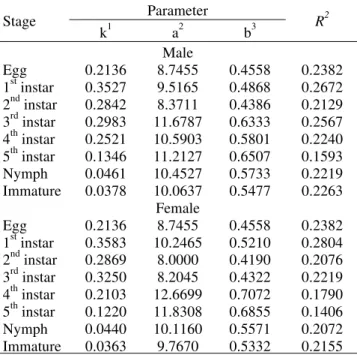
1944) (from 0.1593 to 0.2672, and 0.1406 to 0.2804 for males and females, respectively) (Table 3) and for the sigmoid model of Stinner et al. (1974) (from 0.2136 to 0.6389, and from 0.1417
to 0.3045 for males and females, respectively) (Table 4) indicate that these models are not adjusted for the data obtained for P.nigrispinus.
Inhibition of P.nigrispinus development occurred at the
highest temperature (35°C) while in the lowest temperature (17°C) this was not significant. Since the inhibition of developmental rate of this predator was only significant at higher temperature, we used the version of Sharpe & DeMichele (1977) model, with constants TL and HL assuming
the values of 100 and –100,000,000, respectively. Linear correlation between developmental rate and temperature up to 33°C was significant (as for instance, immature males: R2 =
0.95; F = 99.76; df = 1,5; P = 0.0002 and immature females: R2
= 0.97; F = 187.19; df = 1,5; P = 0.0001) with no deviation in linearity at lower temperatures.
High values of R2 for the biophysical model of Sharpe &
DeMichele (1977) (from 0.9226 to 0.9893, and from 0.8818 to 0.9914 for males and females, respectively) (Table 5) and for the model of Lactin et al. (1995) (from 0.9485 to 0.9997, and
from 0.8961 to 0.9997 for males and females, respectively) (Table 6) indicate good adjustment of these models for data of developmental rate of P.nigrispinus.
Females of P. nigrispinus showed great tolerance to high
temperature, which is represented by high value of HH for the
immature stage (Table 5) obtained with the model of Sharpe & DeMichele (1977).
1At 35ºC all the predator eggs died before hatching and no evidence
of development was observed.
Table 2. Mean developmental rates of P. nigrispinus males
and females fed with A. argillacea larvae at temperatures
from 17°C to 35°C, relative humidity of 60 ± 10%, and photoperiod of L:D 14:10.
Parameter Stage
k1 a2 b3 R
2
Male
Egg 0.2136 8.7455 0.4558 0.2382
1stinstar 0.3527 9.5165 0.4868 0.2672
2ndinstar 0.2842 8.3711 0.4386 0.2129
3rd instar 0.2983 11.6787 0.6333 0.2567 4th instar 0.2521 10.5903 0.5801 0.2240 5th instar 0.1346 11.2127 0.6507 0.1593
Nymph 0.0461 10.4527 0.5733 0.2219
Immature 0.0378 10.0637 0.5477 0.2263 Female
Egg 0.2136 8.7455 0.4558 0.2382
1st instar 0.3583 10.2465 0.5210 0.2804
2ndinstar 0.2869 8.0000 0.4190 0.2076
3rdinstar 0.3250 8.2045 0.4322 0.2219
4th instar 0.2103 12.6699 0.7072 0.1790 5th instar 0.1220 11.8308 0.6855 0.1406
Nymph 0.0440 10.1160 0.5571 0.2072
Immature 0.0363 9.7670 0.5332 0.2155 1Constant defining the upper limit of the sigmoid line
2Value defining the place of the regression line in relation to the x axis 3Slope of the curve line
Table 3. Parameters estimated by Davidson’s (1942, 1944) model for developmental stages of P. nigrispinus fed with A. argillacea larvae, at temperatures from 17°C to 35°C, relative
humidity of 60 ± 10%, and photoperiod of L:D 14:10.
Stage Temperature1
(°C) Egg Nymph Immature
Male
17 0.0702 0.0170 0.0137
20 0.1154 0.0309 0.0244
23 0.1743 0.0439 0.0350
25 0.1972 0.0505 0.0402
28 0.2502 0.0582 0.0472
30 0.2816 0.0595 0.0490
33 0.3295 0.0625 0.0525
Female
17 0.0702 0.0167 0.0135
20 0.1154 0.0294 0.0234
23 0.1743 0.0427 0.0343
25 0.1972 0.0466 0.0377
28 0.2502 0.0517 0.0428
30 0.2816 0.0540 0.0452
The parameter TH of the model of Sharpe & DeMichele
(1977) represents the temperature (°K) in which the enzyme that controls developmental rate of the insect is partially inactivated. The values of the parameter TH were similar in all
developmental stages of the P. nigrispinus. The values of TH
for P.nigrispinus males and females were of 306.3°K and
306.4°K (Table 5). Therefore, this species will experience thermal stress at 33.3°C. This indicates that the estimate of the maximum thermal action for the model of Sharpe & DeMichele (1977) was quite realistic.
The parameter TL of the model of Lactin et al. (1995)
represents the temperature (°C) at which life can no longer be sustained. The value of this parameter is expressed in degree Celsius. The values of TL were similar in all developmental
stages of the predator. The estimated values of TL for males
and females of P. nigrispinus were 37.80 and 35.38°C,
respectively (Table 6). The model of Lactin et al. (1995)
showed that males of P. nigrispinus are more tolerant to high
temperatures than females of this species. Values of l were lower than zero, indicating that it can estimate the threshold for all developmental stages of P. nigrispinus. Therefore,
relationship between developmental rate and temperature for males and females of P. nigrispinus was appropriately
described by the models of Sharpe & DeMichele (1977) and of Lactin et al. (1995) (Figs. 1 and 2).
Discussion
Medeiros et al. (1998) reported that P. nigrispinus
maintained its population in the cotton crop in the State of
Paraíba, Brazil, during all cotton season in conditions of prey scarcity (after outbreaks of A. argillacea) and at temperatures
that can reach 35°C. However, these authors reported that P.
nigrispinus presented low survival at 33°C in laboratory
conditions and no development at 35°C. It is probable that high mortality at extreme constant temperatures may be the result from different mortality agents and inactivation of enzymes (Sharpe & DeMichele 1977). Similar results were obtained by Didonet et al. (1995). It is possible that the
development of P. nigrispinus in areas where maximum
temperatures exceed the lethal one can be explained by oscillations of temperature during the day and to the microclimate produced by the agroecossistem of cotton plants. High mortality in experiments with insect maintained at extreme and constant temperatures may not reflect its real response to natural conditions of temperature fluctuation (Logan et al. 1985, Torres et al. 1998) because the insect can
receive strong radiation during the day and mild temperatures at night (Worner 1992). Besides, the lethal effect of extreme temperatures depends on length of the period of maintainance of the insect in those temperatures (Howe 1967).
The non linear logistic model of Davidson (1942, 1944) and the sigmoid model of Stinner et al. (1974) have not appropriately
described the relationship between developmental rates of different stages of P. nigrispinus and the temperature. Wagner et al. (1984) stated that the models to describe the relationship
between developmental rate and temperature of different species of insects have the followings problems: (1) the model of Stinner et al. (1974) assumes symmetrical form on both sides
of the optimal temperature and for this reason does not describe,
1Developmental rate at 25°C (298.15°K), assuming no enzyme inativation.
2Enthalpy of activation of the reaction that is catalyzed by a rate-controlling enzyme.
3Kelvin temperature at which the rate-controlling enzyme is half active and half high-temperature inactive. 4Change in the enthalpy associated with high-temperature inactivation of the enzyme.
Table 5. Parameters estimated by Sharpe & DeMichele’s (1977) model for developmental stages of P. nigrispinus fed with
A. argillacea larvae, at temperatures from 17°C to 35°C, relative humidity of 60 ± 10%, and photoperiod of L:D 14:10.
Parameter Stage
RHO251 HA2 TH3 HH4
R2
Male
Egg 0.1883 15197.40 306.30 1866674.00 0.9893
1stinstar 0.3126 16819.20 306.30 1310962.00 0.9855
2ndinstar 0.2435 14727.50 307.50 4419068.00 0.9640
3rdinstar 0.2983 14847.90 306.20 680026.00 0.9461
4thinstar 0.2484 13256.30 306.30 1208193.00 0.9697
5thinstar 0.1415 8879.00 306.30 1249946.00 0.9226
Nymph 0.0452 12248.60 306.30 1313382.00 0.9393
Immature 0.0364 12756.60 306.30 1394342.00 0.9671
Female
Egg 0.1883 15197.40 306.30 1866674.00 0.9893
1stinstar 0.3192 16597.30 306.30 1169250.00 0.9639
2ndinstar 0.2452 14699.40 307.50 4282544.00 0.9741
3rdinstar 0.2882 15034.90 306.30 1880428.00 0.9914
4thinstar 0.2152 15057.90 306.20 1262034.00 0.8818
5thinstar 0.1222 8833.10 307.50 4203392.00 0.8902
Nymph 0.4200 11180.70 306.40 2095507.00 0.9598
appropriately, the development of insects at high temperatures; and (2) the model of Davidson (1942, 1944) has low descriptive precision at both final of the curves of the relationship between developmental rate and temperature. Harari et al. (1998) have
pointed out that the model of Davidson (1942, 1944) do not appropriately estimate the optimal temperature for development
of Maladera matrida Argaman (Coleoptera: Scarabaeidae)
because it estimated longer developmental rates at higher than at optimal temperatures.
The biophysical model of Sharpe & DeMichele (1977) describes a non linear response between developmental rates at low and high temperatures, as well as a linear response at intermediate temperatures. For this reason, Wagner et al.
(1984) and Fan et al. (1992) consider that this non linear model
better describes the effect of constant temperatures on insects development. This model was applied and evaluated by Gould & Elkinton (1990), Orr & Obrycki (1990), Fan et al. (1992),
Morales-Ramos & Cate (1993), Judd & McBrien (1994) and Harari et al. (1998) and it was appropriate for determination
of developmental rates studied.
Lactin et al. (1995), modified the non linear model of Logan
et al. (1976), by eliminating the parameter Y and introducing
the parameter l (intercept), which allowed to estimate developmental threshold of insects. This model was applied and evaluated by Briere & Pracros (1998) and it is appropriate to describe relationship between developmental rate of different stages of Lobesia botrana Dennis & Schiffermüller
(Lepidoptera: Tortricidae) and temperature.
The models of Sharpe & DeMichele (1977) and of Lactin
et al. (1995) described, appropriately, the relationship between Parameter Stage
ρ1 TL2 ∆T3 λ4
R2
Male
Egg 0.0122 35.7545 0.5327 - 1.1589 0.9997
1st instar 0.0193 36.1643 1.0723 - 1.2852 0.9983
2nd instar 0.0153 35.1515 0.1239 - 1.2059 0.9600
3rd instar 0.0204 37.6417 2.4067 - 1.3193 0.9930
4th instar 0.0143 36.6508 1.3153 - 1.1693 0.9896
5th instar 0.0073 37.4386 1.4257 - 1.0518 0.9485
Nymph 0.0032 37.9238 1.1182 - 1.0356 0.9969
Immature 0.0027 37.7986 0.9981 - 1.0303 0.9978
Female
Egg 0.0122 35.7545 0.5327 - 1.1589 0.9997
1st instar 0.0199 36.2738 1.1864 - 1.3010 0.9857
2nd instar 0.0154 35.1431 0.1175 - 1.2048 0.9682
3rd instar 0.0204 37.6417 2.4067 - 1.3193 0.9930
4th instar 0.0143 36.6508 1.3153 - 1.1693 0.9896
5th instar 0.0058 35.2014 0.1094 - 1.0309 0.8961
Nymph 0.0027 35.3631 0.1336 - 1.0259 0.9799
Immature 0.0023 35.3829 0.1326 - 1.0239 0.9862
Table 6. Parameters estimated by Lactin et al.’s (1995) model for developmental stages of P. nigrispinus fed with A.
argillacea larvae, at temperatures from 17°C to 35°C, relative humidity of 60 ± 10%, and photoperiod of L:D 14:10.
1Rate of increase at optimal temperature 2Lethal temperature (°C)
3Difference between the lethal and optimal temperature of development
4Parameter that makes the curve intercept the x-axis, allowing the estimation of a developmental threshold.
developmental rates of different stages of males and females of P. nigrispinus and the temperature (Figs. 1 and 2) because
both described an asymmetrical form around high temperature. Briere & Pracros (1998) stated that the relationship between developmental rate and temperature in insects is not linear, and it presents asymmetrical form being composed by three sections: the first is represented by low temperatures, where the increase on developmental rate is not linear from the point of development zero; second section is where the developmental rate becomes proportional to temperature increase; and the third begin from optimal until lethal temperature. Our results suggest that the models of Sharpe & DeMichele (1977) and of Lactin et al. (1995) are appropriate
to describe relationship between developmental rates of different instars and stages of P. nigrispinus and temperature.
Acknowledgments
To the Conselho Nacional de Desenvolvimento Científico e Tecnológico (CNPq), to the Fundação de Amparo à Pesquisa do Estado de Minas Gerais (FAPEMIG), to the Coordenação de Aperfeiçoamento de Pessoal de Nível Superior (CAPES) and to the staff of the Biological Control Unit/Embrapa Algodão.
Literature Cited
Bergam, E.C., S.O. Imenes, D. Hojo, T.B. Campos, A.P. Takemtsu & M.L.F.S. Macellaro. 1984. Levantamento da entomofauna na cultura do tomateiro (Lycopersicon
Briere, J.F. & P. Pracros. 1998. Comparison of
temperature-dependent growth models with the development of
Lobesia botrana (Lepidoptera: Tortricidae). Environ.
Entomol. 27: 94-101.
Curry, G.L. & R.M. Feldman. 1987. Mathematical
foundations of population dynamics. TEES Monograph Series, College Station, Texas. 249p.
Davidson, J. 1942. On the speed of development of insect
eggs at constant temperatures. Aust. J. Exp. Biol. Med. Sci. 20: 233-239.
Davidson, J. 1944. On the relationship between temperature
and rate of development of insects at constant temperatures. J. Anim. Ecol. 13: 26-38.
Didonet, J.C., J.C. Zanuncio, C.S. Sediyama M.C. Picanço.
1995. Desenvolvimento e sobrevivência ninfal de
Podisus nigrispinus (Dallas) e Supputius cincticeps
(Stal) (Heteroptera: Pentatomidae) em diferentes temperaturas. Rev. Bras. Zool. 12: 513-518.
Fan, Y., E. Groden & F.A. Drummond. 1992.
Temperature-dependent development of the Mexican bean beetle (Coleoptera: Coccinellidae) under constant and variable temperatures. J. Econ. Entomol. 85: 1762-1770.
Gould, J.R. & J.S. Elkinton. 1990. Temperature-dependent
growth of Cotesia melanoscela (Hymenoptera:
Braconidae), a parasitoid of the gypsy moth (Lepidoptera: Lymantriidae). Environ. Entomol. 19: 859-865.
Harari, A.R., D. Ben-Yakir, M. Chen & D. Rosen. 1998.
Temperature-dependent developmental models for predicting the phenology of Maladera matrida
(Coleoptera: Scarabaeidae). Environ. Entomol. 27: 1220-1228.
Hilbert, D.W. & J.A. Logan. 1983. Empirical model of
nymphal development for the migratory grasshopper,
Melanoplus sanguinipes (Orthoptera: Acrididae).
Environ. Entomol. 12: 1-5.
Howe, R.W. 1967. Temperature effects on embryonic
development in insects. Ann. Rev. Entomol. 10: 15-42. Figure 1. Relationship between developmental rate and
temperature for developmental stages of P. nigrispinus males
fed with A. argillacea larvae, at temperatures from 17°C to
35°C, relative humidity of 60 ± 10%, and photoperiod of L:D 14:10. Lactin et al. model (____); Sharpe & DeMichele model
(...); observed value ( ).
Figure 2. Relationship between developmental rate and temperature for developmental stages of P. nigrispinus
females fed with A. argillacea larvae, at temperatures from
17°C to 35°C, relative humidity of 60 ± 10%, and photoperiod of L:D 14:10. Lactin et al. model (____); Sharpe & DeMichele
model (...); observed value ( ).
0.0 0.1 0.2 0.3 0.4
Egg
0.00 0.02 0.04 0.06 0.08 0.10
Nymph
14 16 18 20 22 24 26 28 30 32 34 36 38 0.00
0.02 0.04 0.06 0.08 0.10
Immature
Developmental rate
Temperature (ºC)
0.0 0.1 0.2 0.3 0.4
Egg
0.00 0.02 0.04 0.06 0.08 0.10
Nymph
14 16 18 20 22 24 26 28 30 32 34 36 38 0.00
0.02 0.04 0.06 0.08 0.10
Immature
Developmental rate
Lactin, D.J., N.J. Holliday, D.L. Johnson & R. Craigen. 1995.
Improved rate model of temperature-dependent development by arthropods. Environ. Entomol. 24: 68-75.
Logan, J.A., D.J. Wollkind, S.C. Hoyt & L.K. Tanigoshi. 1976. An analytic model for description of temperature
dependent rate phenomena in arthropods. Environ. Entomol. 5: 1133-1140.
Logan, J.A., R.A. Casagrande, H.H. Faubert & F.A.
Drummond. 1985. Temperature-dependent development
and feeding of immature Colorado potato beetle,
Leptinotarsa decemlineata (Say) (Coleoptera:
Chrysomelidae). Environ. Entomol. 14: 275-283.
Judd, G.J.R. & H.L. McBrien. 1994. Modeling temperature-dependent development and hatch of overwintered eggs
of Campylomma verbasci (Heteroptera: Miridae).
Environ. Entomol. 23: 1224-1234.
Lemos, W.P., R.S. Medeiros, F.S. Ramalho & J.C. Zanuncio.
2001. Effects of plant feeding on the development,
survival, and reproduction of Podisus nigrispinus
(Dallas) (Heteroptera: Pentatomidae). Int. J. Pest Manag. 47: 89-93.
Marco, V., A. Taberner & P. Castañera. 1997. Development
and survival of immature Aubeonymus mariaefranciscae
(Coleoptera: Curculionidae) at constant temperatures. Ann. Entomol. Soc. Amer. 90: 169-176.
Medeiros, R.S., F.S. Ramalho, W.P. Lemos & J.C. Zanuncio. 2000. Age-dependent fecundity and life-fertility tables
for Podisus nigrispinus (Dallas) (Het., Pentatomidae). J.
Appl. Entomol. 124: 319-324.
Medeiros, R.S., F.S. Ramalho, J.C. Zanuncio & J.E. Serrão. 2003. Effect of temperature on life table parameters of
Podisus nigrispinus (Het., Pentatomidae) fed with
Alabama argillacea (Lep., Noctuidae) larvae. J. Appl.
Entomol. 127: 209-213.
Medeiros, R.S., W.P. Lemos & F.S. Ramalho. 1998. Efeitos
da temperatura no desenvolvimento de Podisus
nigrispinus (Dallas) (Heteroptera, Pentatomidae),
predador do curuquerê-do-algodoeiro (Lepidoptera, Noctuidae). Rev. Bras. Entomol. 42: 121-130.
Michel, B. 1994. Entomofauna de los algodonales
paraguayos: Hemiptera Heteroptera. Asuncion, Ministério de Agricultura y Ganadería, 132p.
Morales-Ramos, J.A. & J.R. Cate. 1993.
Temperature-dependent rates of Catolaccus grandis (Hymenoptera:
Pteromalidae). Environ. Entomol. 22: 226-233.
Orr, C.J. & J.J. Obrycki. 1990. Thermal and dietary
requirements for development of Hippodamia
parenthesis (Coleoptera: Coccinellidae). Environ.
Entomol. 19: 1523-1527.
Panizzi, A.R., B.S. Corrêa, D.L. Gazzoni, E.B. Oliveira, G.G. Newman & S.B. Turnipseed. 1977. Insetos da soja no Brasil. Londrina, Embrapa Soja, 20p. (Boletim Técnico).
Santos, T.M., E.N. Silva & F.S. Ramalho. 1995.
Desenvolvimento ninfal de Podisus connexivus Bergroth
(Hemiptera: Pentatomidae) alimentado com curuquerê-do-algodoeiro. Pesq. Agrop. Bras. 30: 163-167.
Santos, T.M., E.N. Silva & F.S. Ramalho. 1996. Consumo
alimentar e desenvolvimento de Podisus nigrispinus
(Dallas) sobre Alabama argillacea (Huebner) em
condições de laboratório. Pesq. Agrop. Bras.31: 699-707.
Sas Institute Inc. 2000. SAS user’s guide: statistics. Cary.
584p.
Schoolfield, R.M., P.J.H. Sharpe & C.E. Magnuson. 1981.
Non linear regression of biological temperature-dependent rate models based on absolute reaction-rate theory. J. Theor. Biol. 88: 719-731.
Sharpe, P.J.H. & D.W. DeMichele. 1977. Reaction kinetics
of poikilotherm development. J. Theor. Biol. 64: 649-670.
Stinner, R.E., A.P. Gutierrez & G.D. Butler Jr. 1974. An algorithm for temperature-dependent growth rate simulation. Can. Entomol. 106: 519-524.
Thomas, D.B. 1992. Taxonomic synopsis of the Asopinae
Pentatomidae (Heteroptera) of the Western Hemisphere. Lanham, Entomological Society of America, 156p.
Torres, J.B., J.C. Zanuncio & H.N. de Oliveira. 1998.
Nymphal development and adult reproduction of the stinkbug predator Podisus nigrispinus (Het.,
Pentatomidae) under fluctuating temperatures. J. Appl. Entomol. 122: 509-514.
Uvarov, B.P. 1931. Insects and climate. Trans. Entomol. Soc.
London 79: 1-247.
Wagner, T.L., H. Wu, P.J.H. Sharpe, R.M. Schoolfield & R.N. Coulson. 1984. Modeling insect development rates: a literature review and a application of a biophysical model. Ann. Entomol. Soc. Amer. 77: 208-225.
Worner, S.P. 1992. Performance of phenological models
under variable temperature regimes: consequences of the Kaufmann or rate summation effect. Environ. Entomol. 21: 689-699.