sep-dec. 2016, Vol. 26, No. 65, 283-289. doi:10.1590/1982-43272665201607
College Adjustment as a Mediator Between Attention Deficit/Hyperactivity Disorder
Symptoms and Work Self-Efficacy
1Article
Clarissa Tochetto de Oliveira2 Universidade Federal do
Rio Grande do Sul, Porto Alegre-RS, Brazil
Nelson Hauck-Filho Universidade São Francisco,
Itatiba-SP, Brazil
Ana Cristina Garcia Dias Universidade Federal do
Rio Grande do Sul, Porto Alegre-RS, Brazil
Abstract: Studies have addressed features of Attention Deficit/Hyperactivity Disorder (ADHD) in higher education, but the potential relationships between ADHD symptoms, dimensions of college adjustment and students’ work self-efficacy remain scarcely explored. The aim of this study was to test a theoretical model in which the dimensions of college adjustment mediate the relationship between ADHD symptoms and work self-efficacy. Participants were 509 college students from two Brazilian public universities. Data were collected using questionnaires and analyzed using a path analysis model. The ADHD symptoms affected work self-efficacy exclusively through college adjustment problems. Improving students’ well-being, social support networks, study habits, and feelings regarding their majors and the university may reduce the potential disadvantages in work self-efficacy caused by ADHD symptoms.
Keywords: attention deficit disorder with hyperactivity, adjustment, self-efficacy
Adaptação Acadêmica Como Mediadora Entre Sintomas do Transtorno do Déficit
de Atenção/Hiperatividade e Autoeficácia Profissional
Resumo: Pesquisas têm investigado aspectos do Transtorno do Déficit de Atenção/Hiperatividade (TDAH) no contexto universitário, mas permanecem pouco exploradas as relações entre os sintomas de TDAH, as dimensões da adaptação acadêmica e a autoeficácia profissional dos estudantes. O objetivo desse estudo foi testar um modelo teórico em que dimensões da adaptação acadêmica medeiam a relação entre sintomas do TDAH e autoeficácia profissional. Participaram do estudo 509 estudantes universitários de duas universidades públicas brasileiras. Os dados foram coletados por meio de questionários e analisados por meio de um modelo de path analysis. Os sintomas do TDAH interferiram na autoeficácia profissional exclusivamente por meio de problemas de adaptação acadêmica. O aumento do bem-estar, da rede de apoio social, dos hábitos de estudo e dos sentimentos frente ao curso e à universidade dos estudantes pode reduzir as potenciais desvantagens na autoeficácia profissional causadas pelos sintomas do TDAH.
Palavras-chave: transtorno da falta de atenção com hiperatividade, ajustamento, autoeficácia
Adaptación Académica Como Mediadora Entre Síntomas del Trastorno por Déficit
de Atención con Hiperactividad y Autoeficacia Profesional
Resumen: Estudios han abordado características del Trastorno por Déficit de Atención con Hiperactividad (TDAH) en el contexto universitario, pero siguen poco exploradas las posibles relaciones entre los síntomas del TDAH, dimensiones de ajuste académico y la autoeficacia profesional de los estudiantes. El objetivo de este estudio fue testar un modelo teórico en que dimensiones de la adaptación académica medían la relación entre síntomas del TDAH y autoeficacia profesional. Participaron del estudio 509 estudiantes universitarios de dos universidades públicas brasileñas. Los datos fueron recolectados a través de cuestionarios y analizados mediante un modelo de path analysis. Los síntomas del TDAH interfirieron en la autoeficacia profesional exclusivamente por medio de problemas de adaptación académica. El aumento del bienestar, la red de apoyo social, los hábitos de estudio y los sentimientos ante la carrera y la universidad de los estudiantes pueden disminuir las potenciales desventajas en la autoeficacia profesional, causadas por los síntomas del TDAH.
Palabras clave: trastorno por déficit de atención con hiperactividad, ajuste, autoeficacia
1 Paper derived from the first author’s master’s thesis under supervision of the third author, defended in 2014, at the Graduate Program in Psychology of the Universidade Federal de Santa Maria.
Support: Coordination for the Improvement of Higher Education Personnel (CAPES) and Research Support Foundation of the State of Rio Grande do Sul (Grant # 1878-2551/13-3).
2 Correspondence address:
Clarissa Tochetto de Oliveira. Rua Ramiro Barcelos 2600, sala 17. CEP 90035-003. Porto Alegre-RS, Brazil. E-mail: [email protected]
Attention Deficit/Hyperactivity Disorder (ADHD) is characterized by a persistent, frequent and severe pattern of
with the academic functioning of the students is still not entirely understood. In the present study, we expand the investigation concerning the impact of ADHD symptoms among college students by testing a causal model that connects such symptoms to lowered work self-efficacy via poor college adjustment.
ADHD symptoms can impair several facets of college adjustment. With respect to cognitive functioning, students who report ADHD symptoms have poor planning and study skills (Rabiner, Anastopoulos, Costello, Hoyle, & Swartzwelder, 2008); they have greater difficulty concentrating and avoiding distractions (Palmini, 2008; Rohde, Knapp, Lykowski, & Carim, 2004); and they tend to have lower Grade Point Averages (GPA) compared to other students (Advokat, Lane, & Luo, 2011). Interpersonally, college students with ADHD symptoms are more prone to become involved in arguments with professors and classmates (Souza, Mattos, Pina, & Fortes, 2008), possess fewer social skills and social adjustment strategies (Shaw-Zirt, Popali-Lehane, Chaplin, & Berman, 2005), and receive less support from friends (Wilmshurst, Peele, & Wilmshurst, 2011). With regard to the relationship with the university, students with ADHD symptoms tend to feel less attached and affiliated to their educational institutions (Shaw-Zirt et al., 2005), and they are more likely to engage in antisocial behavior (Gudjonsson, Sigurdsson, Adalsteinsson, & Young, 2013) and experience drinking-related problems (Mesman, 2015). Internal correlates of ADHD symptoms among college students include low self-esteem and emotional instability (Blase et al., 2009; Shaw-Zirt et al., 2005), procrastination (Souza et al., 2008), and depression (Norwalk, Norvilitis, & MacLean, 2009).
One negative correlate of ADHD symptoms that merits attention among college students is work self-efficacy, i.e., an individual’s perception of his/her capacity to perform well in the practice of his/her occupation (Ourique & Teixeira, 2012). In contrast with the general concept of self-efficacy as described by Bandura (2001), work self-efficacy comprises a specific set of beliefs about one’s work and career. Students who sustain such positive beliefs about their work performance have higher levels of positive college adjustment, persistence in university studies, and superior career planning (Ourique & Teixeira, 2012). Moreover, they engage more in extracurricular activities and have higher achievement motivation, which influences their aspirations, the transition from college to work, and their professional achievements (Bardagi & Boff, 2010). In sharp contrast, college students with ADHD symptoms are more likely to have negative beliefs about their performance (Shifrin, Proctor, & Prevatt, 2010) and experience high levels of anxiety when taking cognitive tests (Prevatt, Dehili, Taylor, & Marshall, 2015), even when they perform comparably to other students (Lewandowski, Gathje, Lovett, & Gordon, 2012). The inattentive symptoms of ADHD seem to be particularly associated with an undermined confidence in work and career planning and performance, possibly because these
symptoms imply more accentuated executive functioning deficits than hyperactivity alone (Norwalk et al., 2009).
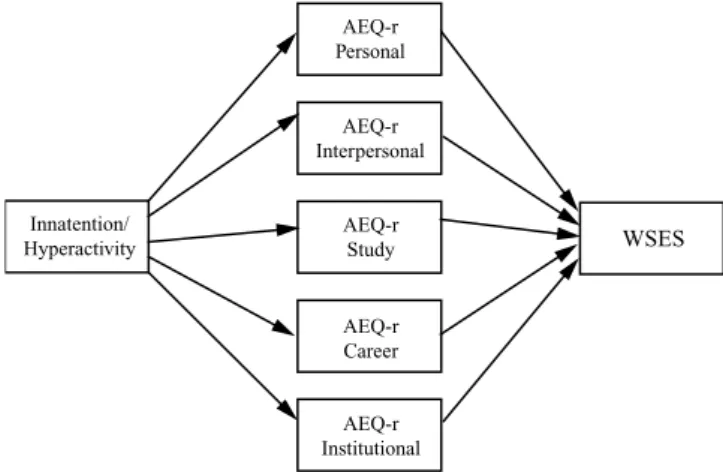
A hypothesis that we advance in the present study is that poor college adjustment mediates the negative association of ADHD symptoms with work self-efficacy in college students. Although no prior studies seem to have addressed this issue, one investigation reported evidence that adjustment, at least in children, fully mediates the negative relationship between ADHD symptoms and reading and math achievement (Volpe et al., 2006). This means that the connection between ADHD symptoms and the variables related to academic success can occur rather indirectly: ADHD symptoms influence college adjustment, which in turn affects career outcomes. As depicted in Figure 1, we similarly hypothesized that there is no direct connection between ADHD symptoms and low work self-efficacy but rather an indirect link in which ADHD symptoms lead to poor college adjustment and in which poor college adjustment causes low work self-efficacy. If true, this may indicate a potential causal mechanism by means of which students with ADHD symptoms come to develop a reduced confidence in their capacity to perform well at work and make decisions about their careers. A clear picture of the way in which the variables connect with one another represents the first step toward more effective interventions with college students (Shaw-Zirt et al., 2005).
Innatention/
Hyperactivity WSES
AEQ-r Personal
AEQ-r Interpersonal
AEQ-r Study
AEQ-r Career
AEQ-r Institutional
Figure 1. Diagram of the theoretical model. AEQ-r = Academic Experiences Questionnaire - reduced version, WSES = Work Self-Efficacy Scale.
Method
Participants
Participants were 509 college students (aged from 18 to 68; M = 23.54; SD = 5.77; 63.70% women, 58.70% freshmen and 41.30% senior) from two public universities in southern Brazil. With regard to their majors, 13.92% studied Veterinary Medicine, 12.94% Special Education, 12.55% Accounting, 10.00% Business Administration, 8.43% Speech Therapy, 6.67% Nursery, 6.67% Grain Production, 6.27% Information Systems, 6.08% Agrobusiness, 6.08% Biological Science, 5.49% Performing Arts, and 4.90% Math.
Instruments
Adult Self-Report Scale - ASRS (Kessler et al., 2005). The ASRS is a brief inventory developed by the World Health Organization with the purpose of assessing ADHD symptoms in adults. It contains 18 self-report items that identify symptoms of inattention (part A, 9 items; e.g., “How often do you make careless mistakes when you have to work on a boring or difficult project?”) and hyperactivity (part B, 9 items; e.g., “How often do you have difficulty unwinding and relaxing when you have time to yourself?”), all of which are rated on a five-point Likert scale, 0 = Never to 4 = Very often. The instrument has demonstrated acceptable test-retest reliability (.53 to .78) and internal consistency (Cronbach’s alpha range of .63 to .72; Kessler et al., 2007). In the present investigation, we employed the Portuguese version adapted by Mattos et al. (2006). The Cronbach’s alpha for this scale was .83 in the current study.
Academic Experiences Questionnaire - reduced version - AEQ-r (Granado, Santos, Almeida, Soares, & Guisande, 2005). This questionnaire assesses the process of adjustment and integration of college students into the university context. The items are rated on a five-point Likert scale, 1 = Does not relate to me at all to 5 = Completely relates to me. The questionnaire comprises 55 items that are organized in five dimensions: (a) Personal (physical and psychological well-being, emotional stability, optimism, decision making, and self-confidence); (b) Interpersonal (relationship with classmates, establishing friendships, and asking for help); (c) Career (career perspective, feelings regarding the undergraduate course, and perception of competences); (d) Study (study habits, use of learning resources, test preparation, and time management); and (e) Institutional (feelings regarding the university, knowledge and appreciation of the infrastructure). In the original study, the Cronbach’s alpha for Personal subscale was .84, .82 for Interpersonal, .78 for Study, .86 for Career, and .77 for the Institutional subscale (Granado et al., 2005). The Cronbach’s alpha for the Personal and Interpersonal subscales in the current study was .86; for the Career subscale, .89; for the Study subscale, .77; and for Institutional subscale, .68.
Work Self-Efficacy Scale - WSES (Teixeira, 2002). This brief scale assesses one’s perception of competence in performing his or her professional tasks. The instrument contains seven items, such as “I think I might have difficulty performing my professional role”. The items were rated on a five-point Likert scale, 1 = Totally agree to 5 = Strongly disagree. The Cronbach’s alpha for this scale in the original study was .82, and in the current study, it was .83.
Procedure
Data collection. From March to April 2013, 510
questionnaires were administered collectively in classrooms at scheduled times with professors, after the authorization of the coordinators of the courses, which were selected by convenience for this study. Students were informed about the objectives and procedures of this study and were invited to participate. Data collection began only after the signature of the consent form, which was separated from the questionnaire to guarantee the anonymity of the participants. Participants took approximately 40 minutes to complete the questionnaires.
Data analysis. We estimated the linear correlations
(Pearson) between the variables using SPSS 20.0 after averaging the items of each scale to compute the individual scores and recoding the negatively worded items. The path analysis model was tested using Mplus 6.12 (Muthén & Muthén, 2010). We used the Maximum Likelihood estimation method with robust standard errors (MLR) because of the ordinal nature of the variables and their eventual violation of the normality assumption. Mplus inserts missing data using the Full Information Maximum Likelihood procedure when the estimator = MLR. To assess the model, we relied on a chi-squared test (the p-value should be non-significant), the indices of the Root Mean Square Error of Approximation (RMSEA; this should be as close as possible to .0; values below .08 are acceptable); the Confirmatory Fit Index (CFI; this should be as close as possible to 1.00; values above .95 are desirable); and the Tuker-Lewis Index (TLI; this should be as close as possible to 1.00; values above .95 are desirable; Hu & Bentler, 1999).
Ethical Considerations
The research was previously approved by the Research Ethics Committee from Universidade Federal de Santa Maria (CAAE n. 12378213.9.0000.5346).
Results
Table 2
Bivariate Correlations
2 3 4 5 6 7
1. ASRS -.45** -.15** -.24** -.35** -.22** -.20**
2. AEQ-r Personal - .28** .35** .28** .30** .33**
3. AEQ-r Interpersonal - .28** .20** .39** .23**
4. AEQ-r Career - .34** .42** .52**
5. AEQ-r Study - .30** .35**
6. AEQ-r Institutional - .34**
7. WSES
-*p < .05. **p < .001. Table 1
Descriptive Information of Variables
Lower Higher M SD p
ASRS 7 60 28.42 9.14 < .001
AEQ-r Personal 1.07 4.93 3.62 .72 < .001
AEQ-r Interpersonal 1.17 5.00 3.80 .67 < .001
AEQ-r Career 1.08 5.00 3.90 .70 < .001
AEQ-r Study 1.67 5.00 3.59 .61 .002
AEQ-r Institutional 1.63 5.00 3.93 .60 < .001
WSES 1.57 5.00 4.07 .68 < .001
Note. AEQ-r = Academic Experiences Questionnaire - reduced version, ASRS = Adult Self-Report Scale, WSES = Work Self-Efficacy Scales. The last column presents results from the Shapiro-Wilk univariate normality tests (the null hypothesis is that the variable is normally distributed).
Next, we estimated bivariate correlations between the variables of this study. As observed in Table 2, the features of ADHD (ASRS) negatively correlated with all variables of college adjustment and with work self-efficacy. All
dimensions of college adjustment correlated positively with one other and with work self-efficacy, although they were all small to moderate in size.
Afterwards, we tested our theoretical model, in which the college adjustment variables mediate the ADHD symptoms and work self-efficacy. In the first step, we performed a bivariate regression of work self-efficacy on ADHD symptoms. Consistent with the negative correlation between the variables, as observed in Table 2 (r = -.20), the ADHD symptoms significantly and negatively predicted scores for work self-efficacy, F(1, 492) = 20.34, p < .001, R2 = .04, β = -.20, t = -4.51, p < .001. The next question ascertained whether the direct path between these variables remained significant in the full model containing the hypothesized college adjustment mediators.
Because of the positive correlations we found between the college adjustment variables, we specified these endogenous variables in our model to identify the correlated residuals. The first model we tested included a direct path from ADHD symptoms to work self-efficacy. To achieve model identification, we constrained a path coefficient that proved to be non-significant to zero: interpersonal dimension → work self-efficacy (standardized estimate = .01, p = .818). The model yielded a good fit to the data, χ² =.05, df = 1, p = .880, RMSEA = .000, 90% CI [.000, .073], TLI = 1.034, CFI = 1.000. Nevertheless, the standardized coefficient for the direct relationship between ADHD symptoms and work self-efficacy this time was near zero (.04) and was non-significant (p = .439). Therefore, we reran the model constraining this path coefficient to zero. The resulting model fit was excellent as well, χ² =.73, df = 2, p =
.693, RMSEA = .000, 90% CI [.000, .063], TLI = 1.023, CFI = 1.000. The Bayesian Information Criterion (BIC) – a measure of model parsimony that penalizes complex models – decreased from 18652.97 to 18647.51 when setting the direct path from ADHD symptoms to work self-efficacy to zero. This particular result confirmed our mediation hypothesis: a constrained model without the direct path from ADHD symptoms to work self-efficacy was deemed as a more adequate, simpler explanation of the data. Final model coefficients are displayed in Figure 2.
Innatention/
Hyperactivity WSES
AEQ-r Personal
AEQ-r Interpersonal
AEQ-r Study
AEQ-r Career
AEQ-r Institutional -.45**
-.15**
-.36**
-.24**
-.20**
.15**
.00ª
.16**
.36**
.11*
Figure 2. Estimated path analysis model. ªParameter constrained to zero.
Discussion
The aim of this study was to test a theoretical model in which ADHD symptoms influence specific dimensions of college adjustment and in which dimensions of college adjustment influence work self-efficacy in turn. Our hypotheses were strongly supported by the results. The main finding was that the relationship between ADHD symptoms and work self-efficacy was fully mediated by personal, study, career, and institutional domains of AEQ-r. This means that the detrimental effect of ADHD symptoms on work self-efficacy occur indirectly by means of a decreased college adjustment. Our results suggest that the potential impact of ADHD symptoms on work self-efficacy may be reduced by targeting an improvement in physical and psychological well-being as well as increasing the quality of study habits and the knowledge and appreciation of the university/faculty infrastructure. Clinical psychology interventions with students with ADHD symptoms may better succeed if they focus on developing skills to manage difficulties such as disorganization, forgetfulness, procrastination, chronic lateness, impulsivity, difficulty in time management, prioritizing tasks and planning for the future (Barkley, 2002; Dipeolu, 2011). Thus, the intervention should focus on providing structure and understanding of the nature of the symptoms, aside from clarifying coping versus cure options (Anastopoulos & King, 2014; Canu & Wymbs, 2015; Costello & Stone, 2012; Dipeolu, 2011; Eddy, Canu, Broman-Fulks, & Michael, 2015; LaCount, Hartung, Shelton, Clapp, & Clapp, 2015; Parker, Hoffman, Sawilowsky, & Rolands, 2013; Prevatt & Yelland, 2015; Richman, Rademacher, & Maitland, 2014).
Consistent with our predictions, correlational analyses and model parameters showed negative relations between ADHD symptoms and all dimensions of AEQ-r. This means that college students who experience ADHD symptoms tend to present lower physical and psychological well-being, lower skills for establishing friendships, poorer study skills, poorer perception of their competence, and poorer knowledge and appreciation of the university/faculty infrastructure. These findings agree with the results of previous investigations that revealed that college students with ADHD are more likely to have lower social skill levels and low self-esteem, coupled with more depressive symptoms and emotional instability (Blase et al., 2009; Green & Rabiner, 2012; Rabiner et al., 2008; Shaw-Zirt et al., 2005; Weyandt et al., 2013).
The negative linear relationship observed between ADHD symptoms and the interpersonal dimension of AEQ-r in the theoretical model of this study may be interpreted as reflecting a possible delay in the development of behavioral inhibition. The inability to inhibit impulsive reactions and consider the future to guide behavior may contribute to delay discounting (Shead & Hodgins, 2009). People with ADHD are less likely to inhibit their negative emotions and instead fail to regulate them in the context of interpersonal relationships, which may cause substantial interpersonal problems. Mood lability, disinhibition, and impulsive decision making – frequent features of individuals with ADHD (Conners, 2009) – may result in social hostility, punishment, rejection, friendship losses, and even acquiring a poor reputation among professors (Barkley, 2002).
The ASRS scores were negatively related to the study dimension of AEQ-r in our student sample. In other words,
ADHD symptoms may interfere with the study habits and time management skills of the participants. These findings disagree with results of a study performed with ADHD-afflicted college students, in which no differences were observed between students with or without ADHD with regard to the number of hours of study per week, the quality of the notes taken during classes, and the performance of assignments ahead of time (Advokat et al., 2011). Nevertheless, ADHD students need to be constantly vigilant to control inappropriate behavioral tendencies (Palmini, 2008) and restrain energy outbursts to finish assignments (Conners, 2009).
In this study, ADHD symptoms were not significantly related to the career dimension of AEQ-r. Satisfaction with their undergraduate studies, the perception of the competence to perform professional tasks, and career planning perspectives appear to be similar between students with and without frequent ADHD symptoms. Inattention/hyperactivity may not influence career perspectives and the perception of competences due to the strategies that students use to overcome the obstacles of these symptoms, such as taking notes, using alarm clocks, and obtaining assistance from friends and family to remember commitments (Palmini, 2008). New investigations should still address the implications of this particular finding.
All dimensions of AEQ-r were significantly related to PSES. This association has already been found in a previous study (Brady-Amoon & Fuertes, 2011). Feeling good physically and emotionally may help students perceive themselves as able to perform professional tasks. In turn, study habits and time management may contribute to increased knowledge and improvements in meeting deadlines. Appreciating what the course and university have to offer may also influence students’ academic engagement (Cole & Korkmaz, 2013) and add to their perception of obtaining a good education. Having friends on whom students can depend may make them confident in facing obstacles.
One limitation of this study must be acknowledged. First, we chose to perform this study based on the presence of symptoms instead of ADHD diagnoses. This choice was due to the impossibility of investigating all the diagnostic criteria recommended (the presence of symptoms at the moment and before the age of 12, strong impairment in two or more contexts, a differential diagnosis, and contact with other people) and the collection of data from more sources to define a more accurate diagnosis in the period in which we conducted this research. Our findings were based on the presence of inattention/hyperactivity symptoms in college students, regardless of the source of the symptoms. Notwithstanding, our study may be the first to suggest that a relationship between ADHD symptoms and work self-efficacy is caused by adjustment to college.
References
Advokat, C., Lane, S. M., & Luo, C. (2011). College students with and without ADHD: Comparison of self-report of medication usage, study habits, and academic achievement. Journal of Attention Disorders, 15(8), 656-666. doi:10.1177/1087054710371168
Arlington, VA: American Psychiatric Association.
Anastopoulos, A. D., & King, K. A. (2014). A cognitive-behavior therapy and mentoring program for college students with ADHD. Cognitive and Behavioral Practice, 22(2), 141-151. doi:10.1016/j.cbpra.2014.01.002
Bandura, A. (2001). Social cognitive theory: An agentic perspective. Annual Review of Psychology, 52, 1-26. doi:10.1146/annurev.psych.52.1.1
Bardagi, M. P., & Boff, R. M. (2010). Autoconceito, autoeficácia profissional e comportamento exploratório em universitários concluintes [Self-concept, professional self-effectiveness and exploratory behavior in university seniors]. Avaliação (Campinas), 15(1), 41-56. doi:10.1590/ S1414-40772010000100003
Barkley, R. A. (2002). Transtorno de déficit de atenção/ hiperatividade (TDAH): Guia completo e autorizado para os pais, professores e profissionais da saúde [Taking charge of ADHD: the complete, authoritative guide for parents] (L. S. Roizman, Trans.). Porto Alegre, RS: Artmed.
Blase, S. L., Gilbert, A. N., Anastopoulos, A. D., Costello, E. J., Hoyle, R. H., Swartzwelder, H. S., & Rabiner, D. L. (2009). Self-reported ADHD and adjustment in college: Cross-sectional and longitudinal findings. Journal of Attention Disorders, 13(3), 297-309. doi:10.1177/1087054709334446 Brady-Amoon, P., & Fuertes, J. N. (2011). Self-efficacy, self-rated abilities, adjustment, and academic performance. Journal of Counseling & Development, 89(4), 431-438. doi:10.1002/j.1556-6676.2011.tb02840.x
Canu, W. H., & Wymbs, B. T. (2015). Novel approaches to Cognitive-Behavioral Therapy for adult ADHD. Cognitive and Behavioral Practice, 22(2), 111-115. doi:10.1016/j. cbpra.2015.01.002
Cole, J. S., & Korkmaz, A. (2013). First-year students’ psychological well-being and need for cognition: Are they important predictors of academic engagement? Journal of College Student Development, 54(6), 557-569. doi:10.1353/ csd.2013.0082
Conners, C. K. (2009). Diagnóstico e avaliação do TDAH [Diagnosis and assessment of ADHD]. In C. K. Conners, Transtorno de déficit de atenção/hiperatividade: As mais recentes estratégias de avaliação e tratamento [Attention deficit hyperactivity disorder: The latest assessment and treatment strategies] ( M. Fodra Trans., 3rd ed., pp. 15-44). Porto Alegre, RS: Artmed.
Costello, C. A., & Stone, S. L. M. (2012). Positive psychology and self-efficacy: Potential benefits for college students with attention deficit hyperactivity disorder and Learning Disabilities. Journal of Postsecondary Education and Disability, 25(2), 119-129.
Dipeolu, A. O. (2011). College students with ADHD: Prescriptive concepts for best practices in career development. Journal of Career Development, 38(5), 408-427. doi:10.1177/0894845310378749
DuPaul, G. J., Weyandt, L. L., O’Dell, S. M., & Varejao, M. (2009). College students with ADHD: Current status and future directions. Journal of Attention Disorders, 13(3), 234-250. doi:10.1177/1087054709340650
Eddy, L. D., Canu, W. H., Broman-Fulks, J. J., & Michael, K.
D. (2015). Brief cognitive behavioral therapy for college students with ADHD: A case series report. Cognitive and Behavioral Practice, 22(2), 127-140. doi:10.1016/j. cbpra.2014.05.005
Granado, J. I. F., Santos, A. A. A., Almeida, L. S., Soares, A. P., & Guisande, M. A. (2005). Integração académica de estudantes universitários: Contributos para a adaptação e validação do QVA-r no Brasil [College students academic integration: Contributes for the adaptation and validation of QVA-r in Brazil]. Psicologia e Educação, 4(2), 33-41. Retrieved from http://repositorium.sdum.uminho.pt/handle/1822/12089 Green, A. L., & Rabiner, D. L. (2012). What do we really know
about ADHD in college students? Neurotherapeutics, 9(3), 559-568. doi:10.1007/s13311-012-0127-8.
Gudjonsson, G. H., Sigurdsson, J. F., Adalsteinsson, T. F., & Young, S. (2013). The relationship between ADHD symptoms, mood instability, and self-reported offending. Journal of Attention Disorders, 17(4), 339-346. doi:10.1177/1087054711429791
Haslam, N., Williams, B., Prior, M., Haslam, R., Graetz, B., & Sawyer, M. (2006). The latent structure of attention-deficit/ hyperactivity disorder: A taxometric analysis. The Australian and New Zealand Journal of Psychiatry, 40(8), 639-647. doi:10.1111/j.1440-1614.2006.01863.x
Hu, L., & Bentler, P. M. (1999). Cutoff criteria for fit indexes in covariance structure analysis: Conventional criteria versus new alternatives. Structural Equation Modeling: A Multidisciplinary Journal, 6(1), 1-55. doi:10.1080/10705519909540118
Kessler, R. C., Adler, L., Ames, M., Demler, O., Faraone, S., Hiripi, E., . . . Walters, E. E. (2005). The World Health Organization adult ADHD self-report scale (ASRS): A short screening scale for use in the general population. Psychological Medicine, 35(2), 245-256. doi:10.1017/ S0033291704002892
Kessler, R. C., Adler, L. A., Gruber, M. J., Sarawate, C. A., Spencer, T., & Van Brunt, D. L. (2007). Validity of the World Health Organization Adult ADHD Self-Report Scale (ASRS) screener in a representative sample of health plan members. International Journal of Methods in Psychiatric Research, 16(2), 52-65. doi:10.1002/mpr.208
LaCount, P. A., Hartung, C. M., Shelton, C. R., Clapp, J. D., & Clapp, T. K. W. (2015). Preliminary evaluation of a combined group and individual treatment for college students with attention-deficit/hyperactivity disorder. Cognitive and Behavioral Practice, 22(2), 152-160. doi:10.1016/j. cbpra.2014.07.004
Lewandowski, L., Gathje, R. A., Lovett, B. J., & Gordon, M. (2012). Test-taking skills in college students with and without ADHD. Journal of Psychoeducational Assessment, 31(1), 41-52. doi:10.1177/0734282912446304
120(2), 427-442. doi:10.1037/a0021405
Mattos, P., Segenreich, D., Saboya, E., Louzã, M., Dias, G., & Romano, M. (2006). Adaptação transcultural para o português da escala Adult Self-Report Scale para avaliação do transtorno de déficit de atenção/hiperatividade (TDAH) em adultos [Transcultural adaptation of the Adult Self-Report Scale into portuguese for evaluation of adult attention-deficit/hyperactivity disorder (ADHD)]. Revista de Psiquiatria Clínica, 33(4), 188-194. doi:10.1590/S0101-60832006000400004
Mesman, G. R. (2015). The relation between ADHD symptoms and alcohol use in college students. Journal of Attention Disorders, 19(8), 694-702. doi:10.1177/1087054713498931 Muthén, L. K., & Muthén, B. O. (2010). Mplus: Statistical
analysis with latent variables. User’s guide. Los Angeles, CA: Muthén & Muthén.
Norwalk, K., Norvilitis, J. M., & MacLean, M. G. (2009). ADHD symptomatology and its relationship to factors associated with college adjustment. Journal of Attention Disorders, 13(3), 251-258. doi:10.1177/1087054708320441
Ourique, L. R., & Teixeira, M. A. P. (2012). Autoeficácia e personalidade no planejamento de carreira de universitários [Self-efficacy and personality on university student’s career planning]. Psico-USF, 17(2), 311-321. doi:10.1590/S1413-82712012000200015
Palmini, A. (2008). Professionally successful adults with attention-deficit/hyperactivity disorder (ADHD): Strategies of compensation and subjective effects of pharmacological treatment. Dementia & Neuropsychologia, 2(1), 63-70. Parker, D. R., Hoffman, S. F., Sawilowsky, S., & Rolands, L.
(2013). Self-control in postsecondary settings: Students’ perceptions of ADHD college coaching. Journal of Attention Disorders, 17(3), 215-232. doi:10.1177/1087054711427561 Prevatt, F., Dehili, V., Taylor, N., & Marshall, D. (2015). Anxiety
in college students with ADHD: Relationship to cognitive functioning. Journal of Attention Disorders, 19(3), 222-230. doi:10.1177/1087054712457037
Prevatt, F., & Yelland, S. (2015). An empirical evaluation of ADHD coaching in college students. Journal of Attention Disorders, 19(8), 666-677. doi:10.1177/1087054713480036 Rabiner, D. L., Anastopoulos, A. D., Costello, J., Hoyle, R. H.,
& Swartzwelder, H. S. (2008). Adjustment to college in students with ADHD. Journal of Attention Disorders, 11(6), 689-699. doi:10.1177/1087054707305106
Richman, E. L., Rademacher, K. N., & Maitland, T. L. (2014). Coaching and college success. Journal of Postsecondary Education and Disability, 27(1), 33-50.
Rohde, L. A., Knapp, P., Lykowski, L., & Carim, D. (2004). Crianças e adolescentes com transtorno de déficit de atenção/hiperatividade [Children and adolescents with attention deficit/hyperactivity disorder]. In P. Knapp (Org.), Terapia cognitivo-comportamental na prática psiquiátrica [Cognitive Behavior Therapy in psychiatric practice] (pp. 358-373). São Paulo, SP: Artmed.
Shaw-Zirt, B., Popali-Lehane, L., Chaplin, W., & Berman, A. (2005). Adjustment, social skills, and self-esteem in college students with symptoms of ADHD. Journal of Attention Disorders, 8(3), 109-120. doi:10.1177/1087054705277775
Shead, N. W., & Hodgins, D. C. (2009). Probability discounting of gains and losses: Implications for risk attitudes and impulsivity. Journal of the Experimental Analysis of Behavior, 92(1), 1-16. doi:10.1901/jeab.2009.92-1
Shifrin, J. G., Proctor, B. E., & Prevatt, F. F. (2010). Work performance differences between college students with and without ADHD. Journal of Attention Disorders, 13(5), 489-496. doi:10.1177/1087054709332376
Souza, I., Mattos, P., Pina, C., & Fortes, D. (2008). ADHD: The impact when not diagnosed. Jornal Brasileiro de Psiquiatria, 57(2), 139-141. doi:10.1590/S0047-20852008000200010 Teixeira, M. A. P. (2002). A experiência de transição entre a
universidade e o mercado de trabalho na adultez jovem [The university-to-work transition experience in young adulthood] (Doctoral dissertation). Retrieved from http://www.lume. ufrgs.br/bitstream/handle/10183/4007/000346602.pdf Volpe, R. J., DuPaul, G. J., DiPerna, J. C., Jitendra, A. K., Lutz,
J. G., Tresco, K., & Junod, R. V. (2006). Attention deficit hyperactivity disorder and scholastic achievement: A model of mediation via academic enablers. School Psychology Review, 35(1), 47-61.
Weyandt, L. L., DuPaul, G. J., Verdi, G., Rossi, J. S., Swentosky, A. J., Vilardo, B. S., . . . Carson, K. S. (2013). The performance of college students with and without ADHD: Neuropsychological, academic, and psychological functioning. Journal of Psychopathology and Behavioral Assessment, 35(4), 421-435. doi:10.1007/s10862-013-9351-8 Wilmshurst, L., Peele, M., & Wilmshurst, L. (2011). Resilience
and well-being in college students with and without a diagnosis of ADHD. Journal of Attention Disorders, 15(1), 11-17. doi:10.1177/1087054709347261
Clarissa Tochetto de Oliveira is a Ph.D. candidate in the Graduate Program in Psychology at Universidade Federal do Rio Grande do Sul.
Nelson Hauck-Filho is an Assistant Professor at the Universidade São Francisco.
Ana Cristina Garcia Dias is a Professor at the Universidade Federal do Rio Grande do Sul.
Received: Mar. 9, 2015 1st Revision: Dec. 7, 2015 2nd Revision: Mar. 4, 2016 Approved: Mar. 9, 2016
How to cite this article: