regional committee
PAN AMERICAN
WORLD
i 13
HEALTH
HEALTH
ORGANIZATION
ORGANIZATION
XVII Meeting XIX Meeting
Port-of-Spain Trinidad and Tobago
October 1967
Provisional Agenda Item 31 CD17/16 (Eng.)
16 August 1967 ORIGINAL: 'ENGLISH
REPORT ON PROGRESS IN CONTINENTAL WATER SUPPLY AND SEWAGE DISPOSAL PROGRAM
The Director has the honor of submitting to the Directing Council this report reflecting the progress made on programs of community water supplies and sewerage services in the Region during the first half of the Alliance for Progress Decade (1961-1966), and future projections for the second half of the Decade (1967-1971).
* At the XIV Meeting of the Directing Council in Washington in Sep-tember 1963, a detailed report was submitted on the activities of the Or-ganization during the last five years in water supply and sewage disposal. At the XV Meeting of the Directing Council in Mexico City in September 1964, a comprehensive report was presented on activities of the Organization in
the water supply program in rural areas, with special emphasis on the efforts made to establish national revolving funds as a means of obtaining continu-ity in the programs in rural areas. Further detailed reports on the progress
of this program have been recorded in the Annual Report of the Director cor-responding to the years of 1965 and 1966*
Unprecedented accomplishments are being recorded in the total pro-gram of improving community water supplies in both urban and rural areas. The program and the progress involve much more than the mere installation of pipes and pumps and related physical facilities. To provide continuing and lasting benefits to the people, a national water supply program requires: sound institutions for planning, designing, constructing, operating, manag-ing and financmanag-ing such systems; provision for the education and trainmanag-ing of
essential professional and technical personnel; laboratories and related facilities for the control of water quality, and for research and planning to guide the improvement and expansion of systems to meet population and industrial growth. The success of the community water program in the Re-gion is reassured by the outstanding accomplishments in each of these in-terrelated segments.
The Organization responding to specific Resolutions of its Governing Bodies, has been cooperating with Member Governments in improving and ex-panding community water supply services; in strengthening their institutions
CD17/16
(Ege)
Page 2and administrative bodies responsible for such services; and in the train-ing and preparation of their professional and auxiliary personnel. These areas of action are becoming increasingly important as construction and ex-pansion of the services proceed at a higher rate of speed with financial assistance from international credit agencies and with the use of larger amounts of national funds.
The Meeting of American Chiefs of State, held in April of this year at Punta del Este, Uruguay, helped to accentuate further the necessity to achieve the goals set by the Charter of Punta del Este, and to increase the efforts of the Member Governments to provide adequate services of water supplies and sewage disposal systems to its people. It is significant that the Chiefs of State in their Declaration stated that:
nImprovement to health conditions is fundamental to the economic and social development of Latin America. Avail-able scientific knowledge makes it possible to obtain specific results, which, in accordance with the needs of each country and the provisions of the Charter of Punta del Este, should be utilized to attain the following ob-jectives:
"b, Acceleration of programs to providing drinking-water supplies, sewerage, and other services essential to envi-ronmental sanitation in rural and urban areas, giving pre-ference to lower income groups. On the basis of studies carried out and with the cooperation of international fi-nancing agencies national revolving fund systems shall be used to assure the continuity of such programs."
A. Status of the Program
As has been reported previously, the Member Governments and the in-ternational credit agencies have given favorable consideration and very high priority to the utilization of funds for the construction of new systems or
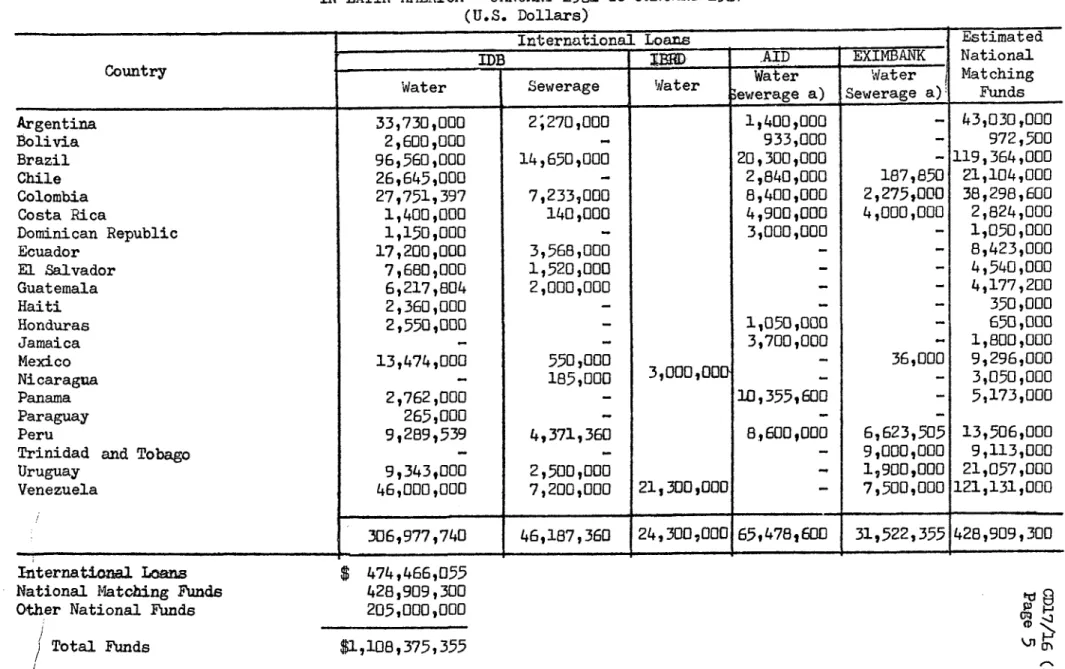
for the improvement and expansion of existing water supply and sewerage sys-tems. Tables I and II show the situation as of January 1967 with respect to total funds invested in water and sewerage and benefitted population. In the last report presented to the Directing Council (September 1964) the to-tal figure reported there for the international and national funds invested in this program was 500 million dollars; in this report the total figure is about 1,108 million dollars, which represents an increase of more than 100%
during the last 3 years.
CD17/16 (Eng,)
Page 3
latter amount, the sum of 353 million dollars has been provided by the In-ter-American Development Bank - the largest sum allocated by a single in-ternational credit agency - showing the high priority that the Bank assigns to a program vital for the health and well-being of the people of the
Ame-ricas. From Table II it can be seen that for sewerage systems, 46 million
dollars have been allocated by the Inter-American Development Bank, while the countries are contributing approximately a similar amount. Although it has been impossible to differentiate the loans for water and sewerage made by the bilateral agencies, it is estimated that a total of 171 million
dollars, including national funds, are being employed in the expansion and construction of sewerage systems and sewage treatment facilities.
Concerning the goals established by the Charter of Punta del Este, and referring to the urban areas (usually defined as localities with more than 2,000 inhabitants) the latest estimates show that, out of a total ur-ban population of 123 million people, more than 75 million - representing 61% - were served with adequate water supplies. However, tabulations be-ing made in two of the larger countries indicate that this figure of 61% will be increased to a much higher percentage (possible 69%) when such tabulations are completed.
Table III shows the situation at the end of 1965 for urban and ru-ral areas, Of the 19 countries participating in the Alliance for Progress program, 8 have achieved the goal of providing water to 70% of their urban
population, while 5 countries are relatively close (over 50% population
served) to the established goal. It has been estimated that in order to achieve the entire goal by 1971, it will be necessary to provide adequate water supply to an average of 6 million people per year from 1966 onward. The progress achieved in the urban areas so far suggests that the goal for this portion of the Region's population will be attained by most of the countries by 1971.
Steady progress is being achieved in the program designed to pro-vide the rural areas with adequate services of water supply and sewage
disposal. It is significant that 8 countries have obtained loans from
international sources, (all but one from the Inter-American Development Bank) for a total investment of 66 million dollars, of which approxi-mately 50% is provided by funds of each of the countries. It is also
es-timated that the Latin American countries have invested over 100 million dollars more in addition to the national funds to match foreign loans. By the end of 1966, the population in rural areas was approximately 112 million, of which nearly 17 million, or 15%, had adequate water supply.
It is estimated that by 1971, the rural population will be nearly 120 million of which only 14% had been provided with water services by the
CD17/16 (Eng.) Page 4
TABLE I WATER SUPPLIES
SUMMARY DATA ON THE COIMUNITY WATER SUPPLY PROGRAM IN LATIN AMERICA
Alliance Decade 1961 - 1971
Data as of 1 January 1967
International Loans From:
Inter-American Development Bank Agency for International Development International Development Association
(IDB)
$ 353,160,000
a )((AID) 65,500,000
(IBRD) 241300,000
Export-Import Bank (EXIMBANK)
Total International Loans
National Funds - Including Counterpart funds to support international loans and grants
Total
31,500,000
$
474,460,0004I
$
633,9001000 $1,108,360,000Number of people benefited (urban and rural)
(a)
NoteE
52,000,000
Includes loans which have been approved as well as those which have been signed.
s: 1) Of total funds (1,108,360,000), $939.76 million are for urban centers and $168.6 million are for rural areas.
2) Total figures include small percentage for sewerage works.
W
a
e
TABLE IIFUNDS ALLOCATED FOR CONSTRUCTION OF WATER SUPPLY AND SEWERAGE SYSTEMS IN LATIN AMERICA - JANUARY 1961 10TO JANUARY 1967
(U.S. Dollars)
International Loans Estimated
IDB ____- .AID EXIMBANK National
Country Wt Water Water i Matching
Wewerage a) Sewerage a): Funds
Argentina 33,730,000 2;270,000 1,400,000 - 43,030,000
Bolivia 2,600,000 - 933,000 - 972,500
Brazil 96,560,000 14,650,000 20,300,000 - 119,364,000
Chile 26,645,000 - 2,840,000 187,850 21,104,000
Colombia 27,751,397 7,233,000 8,400,000 2,275,000 38,298,600
Costa Rica 1,400,000 140,000 4,900,000 4,000,000 2,824,000
Dominican Republic 1,150,000 - 3,000,000 - 1,050,000
Ecuador 17,200,000 3,568,000 - - 81423,000
El Salvador 7,680,000 1,520,000 - - 4,540,000
Guatemala 6,217,804 2,000,000 - - 4,177,200
Haiti 2,360,000 - _ - 350,000
Honduras 2,550,000 - 1,050,000 - 650,000
Jamaica - - 3,700,000 - 1,800,000
Mexico 13,474,000 550,000 - 36,000 9,296,000
Nicaragua - 185,000 3,000,000 -_ 3,050,000
Panama 2 762,000 - 10,355,600 - 5,173,000
Paraguay 265,000 - -
-Peru 9,289,539 4,371,360 81600,000 6,623,505 13,506,000
Trinidad and Tobago - - 9,000,000 9,113,000
Uruguay 9,343t000 2,5001000 - 1,900,000 21,057,000
Venezuela 46,000t000 7,200,000 21,300,000 - 7,500,0001121,131,000
306,977,740 46,187,360 24,300,000 65,478,600 31,522,355 428,909,300
i -i .i i _i iii ,i,,
IEternational Loans National Matching Funds
Other National Funds
/
Total Funds
1IToaFnd
$ 474,466,055
428,909,300 205,000,000 $1,108,375,355/
I j) See section on Sewerage and Water Pollution for sewerage systems
estimates of funds allocated for construction of
0>
TABLE
III
Estimated population (in millions) in urban and rural areas, 'with number
and percentage of population served in 20 Latin American countries - 1965
TOTAL POPULATION
URBAN
II
RURAL1965
1971
- I
-1965
1971
1965
1965
1
1971
1971
-_ -. -. - - .- - -. 1- . - . .
Country U'
c-ON '-40DONr '0~ ON ri 0
o oH H H
:2 r4 0
0
a0
a% 0 EnO ot co 43 CP d Cd Co 4d O 4i 4 o C
P;~~~~~~~~~~~~~~~~~~~'
·r
-P
~~~~~.d-
C.g- W) p 4 tS,- fr C.I -P 'a) .-P -P -P0 00 -p
~~~~~~~~~~~~~~~~~~~~~~~~~~~~~~~~~~~~~P
) P 00 0-p +4 '-' - 4-3- 00
0
to
H 44 00 to Ji 0 P 0 00 tr44 -n a~~~~~~~~~~~~~~~~~~~~~~~~~~~~~~~~~~~~, H i, n
Argentina 21o71 13.11 60 24.07 55 16.1012'.22 76 17.90 68 98 5.61 0°89 16 6.17 14 29
Boii 7417 4.o 16 . 2 2.1 o.13 5 2.64 5 10
Brazil 82.30 23.60 29 98.57 24 40:5918.13 55.30 33 417 540040
0
Colombia 18.O8 8.35 46 21.78 38 9.61 6.80 71 12.80 53 76 8.47 1.55 18 8.98 17 34
Costa Rica 146 093 64 1.84 51 O .51 O.51 l 0. 65 77 109 0.95 0.42 44 1.19 35 70
Chile 8.67 4.5~ 50 10.03 45 5°96 4.20 70 7.65 55 79 2.71 0.35 13 2.38 15 29
Cuba
7.63
3.31
44
8.55 39
4.24 3.23
76
5.10
63
91 3.39 0.12
4
3.45
4
7
Dominican
BRepublic 3.56 O.7 22 4.36 20 1.19 0.46 39 1.60 29 41 2.37 0.33 14 2.76 12 124
Ecuador 4°80 1..5 32 6.05 25 1.83 1.18 64 2.35 50 72 2.97 0.34 11 3.70 9 18
E Salvador 2.80 1.1 47 30 40 1.10 0.72 66 1.34 54 77 170 0.59 1.796 35 30 60
Guatemala
4.43 1
.
30
5.31 25
1.562 0.83
55
2.04
41
58
2.91 0.50
17
327
15
30
Haiti 4.57 O.4 8 5.15 7 0.1 0.524 33 0.93 26 37 3.84 011 3 4.21 35 5
Honduras
2822
5
23
2.65
19
0.52 0.6 69
0.68
53
75
1.70 0.14
8
1.97 1
7
14
Mexico
403.7
1931
47
4981
39
22430 15.65
70 29.02
54
77 18.40 3-53
19
20.08
18
35
Nicaragua 1.64 0.7 22 1.36 18 1.68 0.32 47 0.87 36 52 0.96 .02 2 1.7 17 2
Panama 1.23 0.5 42 1. 35 0.50 0.42 84 0.60 70 100 7 0.7 3 10 14 0.88 1 23
Paraguay
1.95
0.
14
2.301
12
0.69 0.17
25
0.82
21
30
1.26
0.11
9
1.48
7 15
Peru
11.A5
3.1
28
13.3
24
5.25 2.90
55
6.65
44
62
6.00 0.28
5
6.70
4
8
Uruguay 2.72 1. 57 2.9 53 1.97 1.38 70 2.13 65 92 0.75 0.16 21 0.79 20 40
Venezuela 8.91 6.65 75 11.23 59 6.01 4.60 76 8.29 56 79 2.90 2.05 71 2.94 70 140 TOTAL 234.34 92.02 39 278.0~ 30 L22.60 74.83 61 58.14 47 68 111.74 17.19 15 119.90 14 29
CD17/16 (Eng.) Page
7
In regard to these programs of water supply services for rural areas, it is to be recalled that the Recommendation A.6 of the Task Force on Health at the Ministerial Level (Washington, D.C., April 1963) recommended that the Organization study the possibility of establishing a mechanism whereby in-ternational loans might be obtained for the creation of national revolving funds in the countries, to be used for the supplementary financing of potable water supply and other rural welfare projects in suitably-organized rural communities. This recommendation was confirmed by the Governing Bodies of PAHO in their meetings of the same year. This proposal received further approval by the Second Annual Meeting of the Inter-American Economic and So-cial Council in Sao Paulo, November 1963, by Resolution 19-M/63 at the Mi-nisterial Level, and suggested that the Inter-American Development Bank and PAHO undertake the necessary financial and technical assistance arrangements to establish revolving funds in the countries to promote rural activities,
Based on such mandates and in order to insure additional investments and continuity of the programs in the rural areas, with only initial inter-national type of loans, the Organization has continued its efforts to pro-mote the establishment of national revolving funds. Funds of this type have been established already in Argentina, Brazil (for larger communities than the usual rural ones), Costa Rica and Honduras. Legislation to such effect has been approved in Colombia, and a new program with the participation of
the Inter-American Development Bank will establish a national revolving fund for rural water supplies in the Dominican Republic in 1967. In addition, during the last three years, PAHO has been giving priority attention to ru-ral water supply problems in Latin America. The Organization has been work-ing in close collaboration with other international and bilateral agencies
such as IADB, AID, UNICEF and others, resulting in significant achievements. However, new approaches will be needed to meet the demands of the peoples and to approach the target of the Charter of Punta del Este. In this re-spect, the creation and successful operation of revolving funds is expected to be a practical solution - not only for the water supply programs, but for many other health related projects in the rural areas. This approach is explained in the document entitled "Proposal for Improving the Well-being of Rural Peoples - Community Water Supplies - A Discussion of Fi-nancing" (Doc. ES/CWS/67-1, Annex I). This document is a revision of
ES/RW-I, 18 March 1964, presented at the Council on its XV Meeting at Mexico City.
CD17/16 (Eng.) Page 8
countries, may be too expensive to handle rural communities (exclusively). However, the decision must be made in each country with respect to the type of mechanism to be employed and the coverage it is to provide.
B. Advisory Services of the Organization
Since the last report presented to the Directing Council in 1964, the Organization has continued to provide increasing advisory service to the Member Governments. This has been provided in almost every field of water supply and sewerage programs, such as planning, financing, manage-ment and administration, design, construction, operation and maintenance, and others.
A field of increasing importance is related to management and ad-ministration of water and sewerage services and agencies. The need for action in the management and administrative fields to strengthen and ra-tionalize the administration of water institutions in Latin America, has been felt in all the countries, as new sources of financing have been made available for the construction of improved water facilities. Since 1964, a new approach has been developed for providing such advisory services, requiring an integrated team effort to review and implement changes in the closely interrelated disciplines that make up the managerial and administra-tive fields. This team approach has been successfully utilized in providing services to the National Water Authority of Honduras (May 1965), Water . Authority of Managua, Nicaragua (June 1965), National Water Authority of El Salvador (March 1966), National Water Authority of Uruguay (October 1966), National Water Authority of the Dominican Republic (April 1967), and the Ministry of Development and Public Works of Peru (June 1967). Still pending for immediate and future action are 20 requests for national and local ser-vices to be provided with this type of cooperation.
Advisory services of the Organization have been provided during 1966, thru 55 permanent sanitary engineers and by more than 110 short-term con-sultant missions. The training and educational aspects of this assistance is shown in the organization and execution, during 1966, of 60 short in-tensive and specialized courses and 7 seminars, in 18 countries with the participation of 1,831 professionals and 343 national lecturers and 81
in-ternational consultants. Annex II appended to this document gives the list of the courses and seminars, with other details, held during 1966. In
CD17/16 (Eng.) Page 9
C. Future Projections
It is obvious that significant progress has been made in providing Latin American countries with water supply services during the first half of the Decade. If the present rate of construction is maintained, the
ob-jectives of the Charter of Punta del Este for urban areas should be attained by 1971. It is expected that urban water supply activities will be in-creased even more during the years ahead, and it is evident that the Orga-nization must increase its assistance in improvement of institutions and managerial structures, It will also be necessary to extend the benefit of water supply services to the fringe areas that surround the large urban
centers in Latin America. Usually a large proportion of the population of such fringe areas lack the basic services.
Reaching the goal established by the Charter of Punta del Este for the rural areas will require a truly impressive effort in the next five years. Administrative and financial mechanisms, utilizing the experience
in the urban areas, must be developed for the investment of the nearly 800 million dollars required to provide water services for approximately 40 million inhabitants, who must be served if the goal is to be reached. In line with the mandates of the Directing Council - now strongly supported in the Declaration of the Chiefs of State at the summit meeting at Punta del Este, April 1967 - the Director proposes an accelerated effort by the Or-ganization on rural water supplies. This effort should stimulate and support national rural water supply programs and will encourage efforts to strengthen community organization; to establish local cooperatives featur-ing the "self-help" concept; and, to develop national revolvfeatur-ing fund mecha-nisms to provide continuing financial support to local areas. The Orga-nization will continue its close collaboration with the international lend-ing agencies to encourage and stimulate these institutions strongly to support programs in rural areas with those characteristics, It is hoped that national and international technical assistance and lending agencies will increase their support and assistance to these programs. Hopefully, the fruits of this gigantic and arduous task, namely, the improvement of the health and well-being of the rural peoples of Latin America, will be harvested at an increasing rate during the five years ahead.
It is highly unlikely that the goals to be established in the Charter of Punta del Este for rural and urban sewerage services can be met in the Alliance Decade. However, the need for such services is
be-coming much more acute with expanding populations in greater concentra-tions in urban centers. The Director proposes, in the second half of the Alliance Decade, to increase the Organizationts resources for and atten-tion to this problem.
CD17/16 (Eng.) Page 10
figures do not take into consideration sewerage and industrial-waste treatment costs. In realistic terms, it must be expected that there will be some deterioration of surface waters as a result of inadequate
treatment of sewerage and industrial wastes. To prevent water pollu-tion below the major outfalls of urban areas would necessitate an addi-tional expenditure of more than $200 million per year over the next ten years.
In response to Resolutions XXI and XXII of the XV Meeting of the Directing Council in Mexico City in 1964, the Director is giving addi-tional attention and broader assistance to Member Governments on the pro-blems of air and water pollution. Thus far, this assistance - in response to official requests - has been focused on individual cities or in areas of pollution. For all countries, the Organization will attempt to cooperate with Governments in strengthening investigation and research activities to determine permissible levels that would not endanger the health, economic, and related values of surface waters.
Ann.exes
CD17/16 (Engo)
ANNEX I
CD17/16 (Engo) ANNEX I
PROPOSAL FOR
IMPROVINGC THIE ,LViL-BEING OF RTURAL PEOPLES
CO'3NI'TY WATE, SUPPLIES
A Discussion of Financing
PAN AIERtICAN HAiLTH ORGANIZATION
WashUington, D.C.
~,anuary, 1967
RURAL COlvIIUNITY WATER SUPPLIES
A Discussion of Financing
Domestic water supplies are essential to the health, social and economic well-being of peoples. Such supplies are basic to the program of reducing infant mortality and extending life expectancy.
The shape of the future rural habitat in Latin America can no more be:left to chance than can the urban habitat. The
satis-factory economic and social development of a country depends upon providing the same kind of attention to the more basic problems of man in his rural environment as we are now promoting for the more sophisticated problems of man in his cities. We have not been providing this kind of bal.anced attention. Consequently, a backlog of need has accumulated in the rural areas. This is clearly .true in the case of water supply for rural communities. To take care of the rural water-supply backlog and bring the situation into reason-able balance by the end of the Alliance-for-Progress Decade, special
new measures must be taken.
ThEllis document discusses background --including progress toward the rural water-supply goals established in the Charter of Punta del Este. It points out the need for a more concerted effort on the Rural Water Program, and it proposes a funding mechanism to support a system of national revolving funds. The latter funds will be used, first, for loans to qualifying communities to construct water systems and, subsequently (after becoming self-sustaining), for related community improvements.
The rural water proposal has three key objectives: First, to provide impetus to the program and accelerate construction over the second half of the Alliance Decade; second, to strengthen community organization and to develop more fully the self-help potential; and, third, to establish, in each country, a self-sustaining funding mechanism.
One of the most encouraging aspects of.the rural water-supply program is the enthusiasm and realism with which the com-munities have faced up to their responsibilities. The people have
Introduction
The Governments of Latin America established for themselves,
in the Charter of Punta del Este. .. highly commendable goal --water
services to 70% of the urban and 50% of the rural population. This
action indicates the firm determination of Governments to improve
the well-being of their peoples. Remarkable progress toward meeting
these goals has been made. At mid-decade, progress toward the goal
for urban areas is on schedule. The rural program, however, is less
advpelced.
In Latin America, the rural-urban migration is talking place
much faster than urban employment opportunities are being created.
This is unfortunate from the standpoint of both rural and urban
development. One of the ways in which this rural-urban population
flow may be diminished, and the agricultural economy thereby
strength-ened, is by providing more of the amenities of urban living for rural
communities. Foremost among such amenities are safe, convenient
water-supply services.
The conviction remains that water supplies car, be provided,
as set forth in the Charter. It has become apparent, nevertheless,
that the nature and magnitude of the effort must be changed
signifi-cantly --and soon-- if the goal for rural communities is to be
realized. There must be great willingness on the part of all concerned
to develop new administrative and financing arrangements; to revise
standards; to encourage innovation; and to make the hard choices
necessary to accelerate the present effort.
2-Background
In 1963, PAIO completed a study of rural water-supply, needs
in Latin America and developed a proposal for action --including the establishment of a special fund for rural well-being. The PAHO plan featured the creation of a national revolving fund in eachcountry which was to be used, first, for water-supply loans to com-munities, but which was also, in time,, to-assist in the financing
of other rural environmental improvements. Such loans to communities were to be conditioned on full community participation and self help. the establishment of local water co-ops with sound management; and
assured repayment to the national revolving fund. The program's objectives were to meet the goals established in the Charter of Punta del Este.
Support of the concepts advanced in the PAEO plan was given by its Governing Bodies (Directing Council Resolution XX,
23 September 1963). The PAIO proposal was also considered
Current Status of Rural Water Supply
The program of providing water services in small to'nls and villages lags far behind similar programs for metropolitan centers0
This disparity between urban and rural progress is not, of course, surprising. Logistics for providing materials and supplies, con-struction, management, and financing are considerably more involved in scattered rural communities. However, new techniques in community organization, new materials, improved methods of construction, better transportation --if properly applied-- should more than offset these obstacles.
Thus far in the Alliance Decade, the Governments have
com-mitted more than $1 billion for community water supply, of which
about $175 million is for systems in rural areas, where these improve-ments are benefiting 15,000,000 people in some 20,000 small towns and
villages° In general, communities with populations up to 2,000 are considered rural; in some countries, the figure is higher. In order to meet the goals of the Charter of Punta del Este (50% of the rural population served by 1971), water services must be provided for 40,000,000 people in some 50,000 communities within the next five years. This is an ambitious goal. It will take an ambitious effort, maximun use of our experience, and new developments to meet it.
During the past two years, PAHO has been promoting the concept of a mass, "assembly-line" method of approach to rural-community water supply --rather than the project-by-project approach formerly used.
4-In terms ot loans for financing rural water, this conicep is iLort being followed in eight countries. However, the concept is not followed in terms of survey, design, and construction practices.
Over the past three years, PAHO has been giving priority
attention to community water-supply problems in Latinr America. The Organization hao beein working in close collaboratiou riLtit W1i., AID, UNICEF, and other agencies assisting on rural-development programs. This composite effort --particularly the loan assistance by IADB-- has made possible the significantachievements. However, the expanding population and increasing needs of the people require more concerted effort over the second half of the Alliance-for-Progress Decade.
-£ropoed Progrxi
PA.HO proposes a more concerteJi effort to embrace tns. ili:ovi.. 1. The establishment of a special international fiuiding
mechanism, to improve the health, social, and economic conditions in rural communities --with primary focus onI providing community water supplies.
2. The international fund would be available to the Governments, on a matching basis, for the establi.sh-ment of national revolving funds.
Two specific conditions would be established with regard. first, to the creation of a national revolving fund (including inter-national funds); and, second, for making loans from the inter-national revolving fund to qualifying communities.
1. Conditions for eligibility for a loan from the inter-national f.and for setting up a inter-national revolving fund~ a. Establishment of a national revolving fund.
b. Existence of a duly authorized agency capable of administering the fund, and preferably with experience in the design, construction, operation, and maintenance of the facilities to be financed by the revolving fund. If the agency does not
have such experience, there should be a well-defined relationship with an organization which does.
c. Agreement by the national Government to match the money loaned by the international funding source. The national revolving fund would be comprised of both an international loan (or grant) and the national funds.
d. A plan of operation embracing the principle of construction by groups of communities --using "assembly-line" methods-- with types of systems and design capacities consistent with the eco-nomics of the areas served.
e. International loans to support the national
revolving funds should be at minimum interest
and maximumw years for repayment (with
an
appropriate grace period).
f. The national revolving fund to make loans to
qualifying communities to cover a percentage
of the cost of the individual system, such
percentage to be determined by the national
revolving-fund agency, in consultation with
the community concerned.
g. The national revolving fund to loan money
for a project on the basis that such loan
would be repaid, within a stipulated period
of time, at a determined rate of interest.
2. Criteria for the selection of communities eligible to
receive loans from the national revolving fund:
a. Existence of an appropriately constituted local
cooperative, or similar organization, suitably
organized to operate, maintain, and manage the
system efficiently and authorized to establish
water rates and collect charges.
b. Establishment of realistic water rates by the
community for the consumers to be served by the
system. Unless otherwise provided by the
Government, such rates must cover loan repayment
to the national revolving fund and costs for
operation and maintenance.
c. Demonstration of the community's ability to:
(1) Finance a percentage of the project cost,
such percentage to be agreed upon jointly
with the national revolving-fund agency;
(2) Repayment to the national revolving fund
of the loan (with interest) within a
stipulated time period.
-7-Discussi on of the Pla:
This proposal does not include a specific tmethod of
establishing the Special International Fund. General support
for establishing such a fund will depend largely on acceptance
of the plan by the Governments and their assurance of providing
the national financial and administrative resources to carry out
the plan. There are three possibilities for international funding:
a. Use of line credits for locauis from existing international
lending agencies (IADB, AID, etc.);
b. Quota contributions from the Governments on the formula basis established for regular budgets;
c. Voluntary contributions from Governments.
While the scope of the plan is to be continent-wide in its
ultimate application, it is unrealistic to anticipate that all
co.untries would start simultaneously. The status of the rural
water program, at present, is such that some 15 countries could
adjust quickly to this accelerated program and apply for loan fundec.
The program would concentrate on the self-help concept: on community
organization, and on sound management procedures.
As its name indicates, the proposed revolving fund would
be replenished primarily, or entirely, by payments from the
benefiting communities upon completion of project construction.
Prime emphasis would be placed on water revenues received as a
for local repayment would not be overlooked, if special conditions favored their use. The revolving fund is the key element of thb program, since it would, in effect, be an instrument of social policy, designed to mobilize community resources on a self-sustaining basis.
Contributions to the revolving funds, in the form of payments from provincial and national appropriations (in addition to such direct subsidization of construction as might be made), would not be ruled out; but, again, emphasis should be on making
the water systems self-sustaining enterprises. Under normal terms of international development-loan contracts, national Governments would assume responsibility for repayment. National Governments should consider repayment of the international loan from current revenues. This would leave intact the revolving-fund mechanism and would shorten the time for the fund to become self-sustaint-:...
Each participating country would have to make appropriate legal and administrative arrangements to establish the national
revolving fund. Financial administration could be entrusted to a national bank, an existing water authority, or a ministry; or an entirely new and separate administrative entity might be required by local conditions.
-9-The replenishmient of revolving funds --which, permits successive
series of rural welfare projects-- understandably will vary according
to the repayment schedules established by the respective countries.
Community repayment to the revolving fund normally will begin soon
after the system is installed. To be successful, the system should
have a high percentage of house connections. Accordingly, house
con-nections should be made as the system is installed, either as a part
of community participation or through the community loan. The interest
rate charged to the community on loans from the revolving fund is a key
factor in the growth of the fund. This rate is likely to vary among
countries and even within a country, to take into account widely
divergent economic conditions.
To compensate for inflation, water rates would be expressed as
a percentage of the local areats minimum-wage scale, or geared to
changes in consumer-price levels. Water rates for low-income customers
should be less than 5%2 of family income.
Notations on Revolving Fund
The revolving fund is a special fund established for specific
purposes. To ensure fulfillment of these purposes, provisions for
the protection of the fund should be made at the time the fund is
established.
Obviously, in order to succeed, the revolving fund must be
assured of loan repayments, plus interest. The period of repayment
of loans by communities, as well as the interest rate, must be in
balance with the economics of the communities. Where international
-loans are involved the amortization period, and the interest: rate
for such loans, must be based on terms which will support the
suc-cess of the revolving-fund system.
It is impractical to expect the revolving fund to be
imple-mented fully the first year. There will be delays in establishing
administrative procedures and policies; in developing construction
plans; and in mobilizing manpower and materials. Accordingly, in
the initial stages, the number of loans to communities will be fewer
than the full potential of the revolving fund. These delays will
affect the volume of repayments to the revolving fund in the early
years.
The concept of a national revolving-fund mechanism is not
new as a means of financing public improvements. However, the use
of such a mechanism for financing rural-water supplies will be new
to most countries in Latin America. Accordingly, it is impractical
to predict the volume of international-loan demand which might be
made by the Goverralents. During the first five years, such loan
requests --in total-- would, in all likelihood, average less than
$40 million per year.
To establish and administer a national revolving-fund
mechanism will be a major task for most countries. Should a
Government so request, it might be practical for an international
lending agency to assist in organizing and administering the
revolving fund --at least during the initial stages.
Table I and its accompanying notations provide an example of
how such a revolving fund might operate.
-_planatory _otes for Table I
1. Table I is included for purposes of illustration only. Over a five-year period annual increments of 2 million dollars
(national plus international) were chosen for ease of pre-sentation and should be varied to meet the actual situation and needs.
2. International funds shown in Column 2 may be either grants or loans. If they are loans, repayment may be made after
the agreed grace period from (a) national budget funds thus leaving intact the national revolving fund as tabulated in Columns 4 and 6; (b) income derived from repayments by com-munities to national revolving fund, in which case the re-volving fund would be depleted accordingly; (c) a combina-tion of (a) and (b).
3 National government funds (grants) shown in Column 3 include funds from the national government or a combination of funds from the national and state governments.
4. The funds available in the national revolving fund for loans to communities (Columns 4 and 6) are composed of funds from international sources (Column 2) national government (Column 3) and repayments from the communities to the national re-volving fund (Columns 5 and 7).
5. Repayments from the communities to the national revolving fund (Columns 5 and 7) are for the conditions shown in the column headings. These are based on the assumption that (a) the amounts available for loan in the national revolv-ing fund (Columns 4 and 6) are loaned each year, and (b) that the communities benefited will maintain on schedule their repayments to the national revolving fund. Obviously, this ideal situation will not prevail. There may be delays in establishing the fund; in making loans; in completing con-struction; in making house connections; and developing routine payment of water rates, etc. To the extent that these occur, the amounts shown in Columns 4, 5, 6 and 7 will be reduced accordingly.
6. The size and rapidity with which the revolving fund will de-velop depends basically on the following financial factors:
(a) the conditions under which the funds are obtained to es-tablish the national revolving fund; (b) the conditions under which this money is loaned to the communities, for example:
(a) With amortizaticn at 15 years-5% (Columns 4 and 5) $2,000,000 per year over a five year period will produce
-$46
million construction and provide a $3.2 million revolving fund after twenty years,(b) With amortization at 25 years-5% (Columns 6 and 7) $2,000,000 per year over a five year period will produce $32 million construction and provide a $2.1 million revolving fund after twenty years.
7. Amortization conditions used (15 and 25 years-5%) may be modified to fit local conditions.
-TABLE
I*
- NATIONAL ROEVOLVING UIND (NRF) - GENE1i FINAwpCiAL PLANBased on Increment of
$
trillion Progrna (eac!. year for five years)International Source Funds
to NRF
(2)
National
Govecrnment Funds to
NRF
(3)
Amortization of 100°% of Cost
15 years at 5%
Amount
Available in
NRF
for Loans to Communities
(2)+(3)+(5) (4) ii
,,i
Repayments from Communitiesto NRF
(5)
I
Amortization of 1Ci%
of Cost
25 years at 5%)
Amount Available in
NIF
for Loans to Communities
(2)+(3)+(7)
(6)
r
I- t r- - --- ' ' 1·-Z---f--.
1 1,000,000 1,000,0001
2
1,000,000
1,000,000
3
1,000,000
1,000,000
4
1,000,000
1,000,000
5 1,000,000 1,000,000
6
10 1112
13
14 15 16 17 18 2orotall
5:000,000
5,000,000
2,000,000
2,193,000
2,405,000
2,637,000
2,891,000
1,170,000O
1,283,000
1,407,000
1,543,000
1,692,000
1,855,000
2,034,000
2,230,0002,445,000
2,681,000
2,940,000
3,031,000
3,111,000
3,179,000
3,232,00045,959,000
193,000C
405,00o
637,000
891,000
1,170,000
1,283,000
1,407,000
1,543,oOO
1,692,000
1,855,000
2,034,000
2,230,000
2,445,000
2,681,000
2,940,000
3,031,000
3,111,000
3,179,000
3,232,000
35,959,000o
* Illustration of tle mechanics of a revolving fund under
Explanatory notes on preceeding page.
2,000,000
2,142,000
2,294,0002,457,000
2,631,000
818,000876,000
938,000
1,005,000
1,076,000
1,152,000
1,234,000
1,322,000 1,416,0001,517,000
1,6].5,000
1,730,000
1,853,000
1,980,0002,126,000
32,182,000
,epanymnents fromCommuni tie to N1JR
(7) 142,000 294,0Coo 457,000 631,000 818,ooo
876,0o00
938,000
1,005,000 1,076,000 1,152,000 1,274,000 1,322,000 1,416,00C 1,517,e001, 615,000 1 730, 000
1,853,000 1,980,000 2,126,000
22,182,000.)
two sets of conditions.
U()
Y-
r _ I_
-r--;----· ·--·1 ----·
-r-·D·-- -L
1*-·1---- ·--·-·I- I
---·-1----···--r ----
--
-I
-·
---
-- ·
II---I--
···-C^
l
~"
--_ -_ ___ _ _
~~~~I
S-
- ·
-·--- ·--- L--· ----FL---·--·-·---rj _
--
-RESOLUTION XIX-M/63 l/
CONTINEt<T-WIDE PROGZXI! OF RUEIL, 2l VIRObiCMENTAL HEAi ANJD 'vELL-3S;ii,
WHEREAS:
The document on the establishment of a continent-wide program of rural environmental health and well-being (OEA/Ser.H/X.4, CIES/341) has been examined;
Rural environmental health is important to the economic and social development of the rural population of the Americas;
One of the objectives set forth in the Charter of Punta del Este was to supply potable water and sewage-disposal services for at least 50 per cent of the rural population during the present decade;
Resolution A-11 of the First Annual Meeting of the Inter-American Economic and Social Countil at the Ministerial Level recog-nized the need to intensify efforts to improve living conditions in rural areas and to obtain international credits for the development
of programs for this purpose;
The program received firm support at the Meeting at the
Ministerial Level of the Task Force on Health (Washington, April 1963), the Eighth Meeting of Ministers of Health of Central America and
Panama (San Jose, July-August 1963) and the XIV Meeting of the Directing Council of the Pan American Health Organization
(Washington, September 1963); and
Due account has been taken of the recommendations contained in the Report of Special Committee VII (Health Group) of the Inter-American Economic and Social Council (San Jose, August 1963),
The second Amnual Meeting of the Inter-American Economic and Social Council at the Ministerial Level
RESOLVES:
1. To recognize the importance of the problem of supplying potable water in rural environments, within the context of over-all rural development, and to recommend to the member states that they assign high priority to programs aimed at solving these problems.
1/ Pages 32-33 of the Final Report of the Second Annual Meeting of the IA-ECOSOC at the Ministerial Level, Document OEA/Ser.H/X.4, CIES/580, Rev. of 6 Dec. 1963.
RESOLUTION XIX-M/63 (Cont'd)
2. To recognize the necessity of developing the Continent-wide Program of Rural Enviromnental Health and Well-being along the lines set out in Document OEA/Serd.I/X.4, CIES/341, based on the participation of the communities, the establishment of national revolving funds, and contributions of external funds, with a view to achieving the objectives set forth in Resolution A-2 appended to the Charter of Punta del Este.
5.
To suggest that, after consultation with the interested countries, the Inter-American Development Bank undertake theresponsibility for the administration of external financial re-sources, and, that the Pan American Sanitary Bureau undertake the responsibility for supplying technical advice to the governments at each stage of the program, and to suggest to both these organiza-tions, that, with the cooperation of other interested agencies they study and establish appropriate procedures and relations that will make it possible to begin the program, it being understood that
each government shall choose the appropriate time to begin the program, in accordance with the socioeconomic situation of the respective country, bearing in mind, in all cases, the social capacity for absorption of this type of investment of the commnu-nities that are to benefit.
4. To suggest to the Pan American Health Organization the appointment, in collaboration with the Inter-American Development Bank, of technical committees, to provide them with advisory services on financing, organization, community motivation, and other aspects of the program.
5. To reconmmend to the governments of the member states that they establish, and make proper legal and financial provision for,the most adequate and competent organization to administer the
program at the national level.
6. To recommend to the governments that they adopt the necessary financial measures that will enable them to select and
organize the communities for beginning this program as soon as possible.
RESOLUTION XX /
ESTABLISHMENT OF A RURAL WELFARE IFUND
THE DIRECTING COUNCIL,
Having examined the report of the Director on the estab-lishment of a rural welfare fund (Document CD14/23);
Bearing in mind the importance of environmental sanitation to the health and social and economic development of the rural population of the Americas and the target established in the Charter of Punta del Este of supplying water and sewage disposal services to at least fifty per cent of the rural population in the decade;
Mindful of Resolution A-11 of the First Annual Meeting of the Inter-American Economic and Social Council at the Minis-terial Level (Mexico City, November 1962) which recognized the need to intensify efforts to improve living conditions in rural areas and to obtain international credits to develop programs for that purpose, and
Noting the support for such programs expressed by the Task Force on Health at the Ministerial Level (Washington, D.C., April 1963), by Resolutions IV and XIII of the 48th Meeting of the Executive Committee (Washington, D.C., April 1963), by the VIII Meeting of Ministers of Health of Central America and Panama (San Jose, July-August 1963), and by Committee VI of the Inter-American Economic and Social Council (San Jose, August 1963), and in view of the favorable opinion and the unanimous approval of the Members of the Council at its XIV Meeting,
RESOLVES:
1. To approve the rural health program along the general lines described in Document CD14/23, and based on community participation, establishment of national revolving funds, and
the need for international capital contributions.
1/ XIV' eeting cof the Directing Council of PAHO, Document
CD14/+40 (Eng.) pp. 28 and 29. (Resolution approved at
the tenth plenary session, 23 September 1963)
RESOLUTIONl XX (Cont'd)
2. To urge the Director to seek aeaistance from ali
possible sources for implementation and financing the program, including the Governments and the international development and credit institutions.
3. To recommend that the Director appoint a Technical Committee to give advice on financing, community organization and motivation, and other aspects of the program,
4. To recommend that Member Countries establish competent organizations to take charge of the execution of the national
programs.
CD17/16 (Eng.)
ANNEX II
a
fs/l-
M SAI
SMK)RT COURSES, S*1-[INARS, AND SY1:POSIA IN SANITARY 1NGIN!!-:RING ..o IN COOPEAION 1*ITH UNIVERSITIES, 1966
/·I
j
Duration
Faculty
Persons
/
Place
Date
Subject
Hours
Nat.
Inter.-Nat. Trained
/
ARENsity of BueNAires
University of Buenos Aires
BOLIVIA
Universidad Mayor de San
Andres, La Paz
BRAZIL
Bahia University, Salvador
Geara
University, Fortaleza
Paraiba University, Campina
Grande
Paraiba University, Curitiba Recife University, Pernambuco Sao Paulo University, Sao
Paulo
Sanitary
Engineering Institute
(SURSAN) Rio de Janeiro
11-29 Oct.
13-23 Jul.
22 Aug.-3 Sept. 12-17 Sept.3-7 Oct.
28 Nov.-3 Dec.
12-21 Dec.
Rural Water Supply Water Pollution
Design of Rural Water Supplies Industrial Hygiene Part II Sanitary Aspects of Housing Municipal Refuse: Collection
and Disposal
Operation of Sewage Treatment Plants
23 May-5 June Design of Small Water Supplies 26 Sept.-15 Oct. Ground Water
11-22 Apr.
1-31 Aug.
11-16 Jul.
23 May-4 June
6-18 June
13-25 June22 Aug.-2 Sept.
28 Nov.-3 Dec.
16-20 May
13-24 June
22 Aug.-2 Sept.
21 Nov.-2 Dec.
Design and Construction of Water Supply Distribution Systems Ground Water Development
Seminar on Sanitary Engineering Education in the Northeast of Brazil
Water Quality
Water Rates and Accounting Pumps and Pumping Stations in
Water Supply
Seminar on Sanitation and the National Housing Program Air Pollution
Bacteriological Analysis of
Water and WastesAdministration and Operation of Water and Waste Systems Application of Statistical
Methods to Sanitary Engineering
Problems
Physical and Chemical Analysis of Water and Waste Water
101
62
73
39
35
44
51
50
102
60
156
3458
60
55
34 3435
72
70
9
8
8
5
9
4
8
8
7
6
5
7
4
1612
5
1
1
1
2
22
2
2
1
1
1
47
23
12 2235
31
26 2723
19
2539
16 1933
55
40
20 H o
H
26 T
17
10COLOMBIA: Los Andes
Bogota
Unive2
National Univer, Colombia,
Bogo-National Univeri Colombia, MedeZ
COSTA RICA: University
San Jose
sity,
ity of
ia
ity
lin
of
of C"sta Rica,
CIHmE:
University of C of Physical an
Sciences, Sant
file, Faculty
I Mathematical
Lago
Duration
Faculty
Persons
Place Date
L
~
~ ~ ~
~
I~
Subject~
Hours Nat. Inter.-Nat. . ...Trained5-16 Dec.
5-9 Dec.
18-29 Apr.
26 Septo-ll Oct. 21 Mar.-l Apr.
4-11 July
14-25 Nov.
29 Aug.-lO
Sept.11-23 July
25 May-5 June 7-16 July 17-27 Aug.
20-30 Sept.
20-29 Oct.
12-22 Dec.
Elements of Air Pollution
Control
Organization of Training Programs
Operation of Swimming Pools (2 courses) in Rio de Janeiro
and Brasilia
Seminar on Environmental Contaminants
Seminar on Industrial Waste
Use of Computers in Sanitary Engineering Problems
Manual Systems in Planning and
Control of Construction
Programming Methods as applied to Sanitary Engineering
Water Fluoridation
!Meters and House Connections
Multiple-Purpose River Usage
Pumps and pumping Stations
Use of Computers in Sanitary Engineering Problems
Treatment of Industrial Waste Design of Sewage Pumping Stations
Training Course for Operators of
Water and Sewage Treatment Plants apid Filters: Modern Systems round Water
A&
72 1265
66
65
65
66
5o
40
63
51
62
62
43
56
4
23
7
5
9
4
7
6
4
7
5
1 1 2 1 2 1 1 2 1 2 22 2051
35
8
15
1113
22 19 11 250 H24
40
O
36 V
*
a
la
Place
University of Chile, School
of Public Health, Santiago
CUBA:
Carlos Finley School of Public Health, Havana
ECUADOR:
Central University of Ecuador, Quito
EL SALVADOR:
Autonomous University of El Salvador, San Salvador
HONDURAS:
National Autonomous University of Honduras, Tegucigalpa
JAMAICA:
Ministry of Public Health, Kingston
EIMlCO:
National Autonomous University, Mexico, D. F.
Date
25 Jul.-6 Aug.
5-16 Dec.
19 Sept.-l Oct.
22 Aug,-2 Sept.
19 Sept.-l Oct.
19-30 Sept. 2-15 Oct.
18-30 12-24
July Sept.
18 July-30 Sept.
20 June-2 July 26 Sept.-7 Oct.
17 Oct.-5 Nov.
14-26 Nov.
Subject
Duration Faculty Per
1__ _ _
I.
_ - .1
Design of Water Supply and Sewage Disposal Systems for Rural Areas Urban Solid Waste: Collection
and Disposal
Treatment of Industrial and Domestic Wastes
Methods of Planning and Control of Sanitary Engineering
Projects
Design of Water Treatment Plants
for Small Communities
Radiation Protection
Industrial Hygiene and Safety
Pumps and Geophysics
Design of Water Treatment Plants
for Small Communities
lHealth Education, Administration,
and Supervision, and Sanitary Sciences for Sanitary Inspectors
Design and Operation of Stabilization Plants
Design of Water Supply Systems for Small Communities
Ground Water
Selection of Ptupps for Water Supply Systems Hours
U9
sons Lined 20 34 40 23 1047
1230
6148
69
60 5456
4265
62330
59
63
146
76
167
5
5
3
3
5
4
128
8
1
25
1 25
23
2 2 2 otq 316 32 24 H H er A/ 31 · A -- - -y. sx Tra Nat. Inter-Nat.Duration Faculty PersonE
P Lace Date Subject
Hours
Nat.
Inter.-Nat.
Trained4
niversity of Nuevo Leon, 25 July-6 Aug. Water Meters and Leakage Searches
Monterrey .in Distribution 5ystems 86 6 1 22
Department of Water Resources, 18-22 Apr.
Symposium on Water Supply and
D
oF.
Sewage
40
200
NICARAGUA:
ational University of
11
July-6 Aug.
Ground Water
117
5
3
27
Nicaragua, Managua
31 Oct.-12 Nov. Stabilization Ponds
27
2
1
22
P
NA4A:
Jniversity of Panama, Panama
4-23.
July
Well Drilling
85
7
2
32
4-16 July
Pumps and Pumping Stations
48
11
1
18
4ational Engineering University 11-16 July
Financing Aspects of Sanitary
Lima
Works
30
2
4
18
24 Oct.-4 Nov.
Computers in Sanitary Engineering
46
3
132
T
NIDAD AND TOBAGO:
Iniversity of the West Indies, 3-8
Oct.
a) Treatment of Water and Waste
Port-of-Spain
Water, b) Water and Sewage
10-15 Oct. Chemistry . 52 6
3
23U]GUAY:
IUniversity of the Republic,
24-29 Oct.
Plastic Pipes in Water Supply
Montevideo
S
ems
40
4
2
24
Systems : 1
40 4 2 24
V] EUELA:
entral University of
23 May-2 July
Operation of Water Treatment
Venezuela, Caracas
Plants
210
9
1
19
1 Oct.-17 Dec. esign and Operation of Pumping
l, Stations . 44 3 -32
O
_~~~~~~~~~~~~~~~~~~~~~~~~~~~~~~~~3
I
_
.(i
I&
50
short courses, 6 Seminars and
L Symposium
a)
4,155 31+3
81
1,831
a
H
,7a1
i; M Z'3
I-i>
oa
w