ISSN 0102-695X DOI: 10.1590/S0102-695X2013005000033 Received 28 Feb 2013 Accepted 15 Apr 2013 Available online 10 May 2013
quality of
Dipteryx alata
extracts
Frederico S. Martins,
*Leonardo L. Borges, José R. Paula,
Edemilson C. Conceição
Abstract: This study aimed to impact of different extraction methods on the quality of Dipteryx alata Vogel, Fabaceae, extracts from fruits. The major compounds found were the lipids 38.9% (w/w) and proteins 26.20% (w/w). The residual moisture was 7.20% (w/w), total i ber 14.50% (w/w), minerals 4.10% (w/w) and carbohydrate 9.10 % (w/w). The species studied has great potential in producing oil, but the content and type of fatty acids obtained is dependent on the method of extraction. The Blingh & Dyer method was more selective for unsaturated fatty acids and Shoxlet method was more selective for saturated fatty acids. The tannin extraction by ultrasound (33.70 % w/w) was 13.90% more efi cient than extraction by decoction (29 % w/w).
Keywords:
Box-Behnken natural products extractive process response surface methodology
Introduction
Medicinal plants are recognized as important sources of novel biomolecules and in recent years, there has been an increasing interest in its use for the prevention and treatment of various diseases (Heinrich & Gibbons, 2001). However, the lack of quality is a problem that is
overshadowing the potential benei ts of various herbal
products (Hinneburg & Neubert, 2005; Hui 2002; Wang et al., 2003).
Actually regulatory agencies as FDA (Food and Drug Administration) and Anvisa (Brazilian Health Surveillance Agency) require that herbal extracts are
standardized to ensure safety and efi cacy of medicines
(Brazilian Pharmacopoea, 2010; FDA, 2010).
The extraction is an important step because the choice of extraction conditions may determine the quality and the yield of the constituents (Hinneburg & Neubert, 2005). Selection of an appropriate extraction method will depend upon the kind of herb and also the compounds required (Wang et al., 2003).
The study of new herbal species may lead the inappropriate choice of extraction methods, which is responsible for many analysis mistakes. The use of more than one extraction method is required to determine the
phytochemical proi le of a plant. However, any extraction
methods have chemical or physical limitations. Thus, the choice of the appropriate extraction method for each kind compounds must be considered (Cechinel-Filho & Yunes, 1998).
Conventional extraction methods such as heating,
boiling or rel uxing can be made use for extraction of natural
products; the disadvantages are the loss of substances of interest due to hydrolysis, oxidation and ionization during the extractive process. In recent years, some new extraction methods have been employed for the extraction of natural products from herbals, including ultrasound-assisted extraction (Zhang et al., 2011) microwave-ultrasound-assisted
extraction (Hayat et al., 2009) supercritical l uid extraction
(Oliveira et al., 2009) and accelerate solvent extraction (Wang & Lan, 2011). Through shear forces created by ultrasonic cavitation, cell walls are broken mechanically, improving the material transfer. Besides, there is no chemical relationship in the ultrasound-assisted extraction, which can possible chemical degradation in metabolites of interest (Wang & Weller, 2006).
During the extraction of compounds of interest, several factors must be considered, such as particle size, solvent polarity, acidity of de medium, agitation system, method of extraction, temperature and contact time (Soares et al., 1998).
The evaluation of the inl uence of several
factors simultaneously is hard, when not using the correct techniques. Currently several statistical models have been employed to solve this problem, among them the Box-Behnken design and Response Surface Methodology (RSM), allow for the studies on factors and its multiple interactions, and is getting highlights for biological system studies (Freitas et al., 2012; Moreira et al., 2007; Wang & Lan, 2011; Weuster-Botz, 2000; Zafar et al., 2010).
In this sense, the present study aimed to evaluate
the inl uence of the extraction method over the quality
Article
of extracts of fruit pulp from Dipteryx alata Vogel, Fabaceae, extracts. D. alata, popularly known as “baru” or “combaru”, have great interest by the population, due many properties such as: cicatrizing, anti-rheumatic, tonic, regulating menstruation and antiophidian (Ferraz et al., 2012; Nazato et al., 2010; Puebla et al., 2010). Besides, the seeds are rich in saturated fatty acid and its pulp contains large amount of tannins (Almeida, 1998).
Material and Methods
Plant material
Fruits of Dipteryx alata Vogel, Fabaceae, were
collected in Caldazinha, Goiás, Brazil (16° 42' 50" S 49° 00' 07"). The species was identiied by Dr. José Realino de
Paula and a voucher was deposited in the Herbarium of the Universidade Federal de Goiás under code number 27.806. The pulp (obtained from the pericarp) and the almonds of baru were pulverized in a knife mill and stored in sealed vials.
Chemical characterization of almonds Dipteryx alata
Determinations of residual moisture, proteins,
lipids, total iber, ash and carbohydrate were performed in
triplicate samples according AOAC (1998). Extraction of fatty acids were carried out by two different methods: i) by Shoxlet, and ii) Bligh & Dyer (1959).
Fatty acids were analyzed on Gas chromatography (GC-MS) model Varian 3900 A, fitted with a capillary column CP WAX 30 m and was used under the following conditions: carrier gas, nitrogen with
a flow rate of 2.5 μL.min-1; column temperature, 5 μmin
hold for 90 °C, 90 to 250 °C at 5 °C.min-1, 30 μmin hold
at 280 °C; injector temperature, 240 °C; volume injected, 2 μL. The MS operating parameters were as follows: ionization potential, 70 μeV; ion source temperature, 280 °C; quadrupole 100 °C, speed 2000μ amu/s. All the
samples used for method development and validation were prepared volumetrically.
Extraction of tannins
Ultrasound-assisted extraction (UAE) was
performed in an ultrasonic cleaner (USC-4800, 50 kHz,
200 W Instrument Company, Brazil). All chemical reagents used in experiments were of analytical grade. The ethanol/water volume ratios used for extraction were 5, 50 and 95%. Dried and ground fruit pulp of baru was submitted to UAE from 5 to 15 min. Particle sizes of the powder were 150, 250 and 350 mesh.
Tannin contents were quantiied by protein
precipitation using the Hagerman & Butler (1978) adapted by Waterman & Mole (1987). This method uses Bovine
Serum Albumine (BSA) solution 1 mg/mL in 0.2 M
acetate buffer, and pH 4.9. After extraction, the resulting
solutions were complexed with BSA and centrifuged. The precipitate was then dissolved in a solution of sodium dodecyl sulfate/triethanolamine. The tannins reacted with ferric chloride (FeCl3), the absorbance was read at 510 nm. The calibration curve was prepared with tannic acid
(Vetec) at the dilutions: 0.1, 0.2, 0.3, 0.4 and 0.5 mg/mL. The correlation coeficient calculated for this curve was
0.9959.
The UEA was compared with the extraction method proposed in the Brazilian Pharmacopoeia (2010).
Experimental design
UEA of the tannin contents of the D. alata fruit pulp were performed as prescribed by the Box-Behnken design shown in Table 1. Three extraction characteristics (or factors, in statistical terminology) were investigated at three levels: i) extraction times of 5, 10, and 15 min, ii)
particle sizes of 150, 250, and 350 μm, and iii) ethanol/
water volume ratios of 5, 50, and 95% (v/v). As a result, seventeen runs were obtained by combinations of the three levels of these three factors. The experimental runs were randomized in order to satisfy the statistical requirement of independence of observations.
A second-order polynomial regression model was used to express the yield as a function of the independent variables as follows:
∑∑
∑
∑
+ ++ =
=
= ij i j
k
i i ii k
i i
ix x xx
y β β β β
1 2
1
0 (Eq 1)
Where y represents response variable (tannin content), β0 is a constant, βi, βii, and βij are the linear,
quadratic and interactive coeficients, respectively. The
terms xiand xj are the levels of the independent variables. These parameters were extraction time (x1), particle size (x2), and ethanol/water volume ratio (x3). Calculations were carried out using Design-Expert®version 8.0.7.1
(Stat-Ease, Inc. Minneapolis, MN, USA).
In order to verify the predictive capability of the model, optimum conditions were established by Response Surface Methodology (RSM) and comparisons between the predicted results and the practical values were carried out by experimental rechecking using those presumed optimal conditions.
Results and Discussion
In the almonds the majority compounds found were the lipids 38.90% (w/w), and proteins 26.20% (w/w).
The residual moisture was 7.20% (w/w), total iber 14.50% (w/w), minerals 4.10% (w/w) and carbohydrate 9.10 %
The lipids yield was inluence by extraction method, the
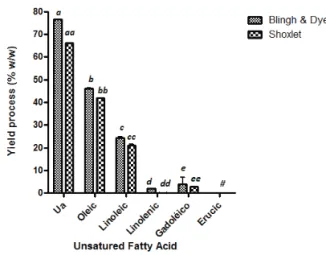
Bligh &Dyer (1959) method was able to extract 10.50% more lipids than Shoxlet method (Table 1). Tables 2 and 3 presents the extraction method Bligh &Dyer (1959) was able to enhance the extraction unsaturated fatty acids and decrease the presence of saturated fatty acid.
Table 1. Code and level of factors chosen for the trials.
Factor Levels
-1 0 +1
Extraction time, x1 (min) 5 10 15
Particle size, x2 (μm) 150 250 350
Ethanol/water, x3 %(v/v) 5 50 95
The chemical composition of the oil was also affected by the extraction method (Figures 1 and 2). The
majority unsaturated fatty acids were oleic (46.50%) and linoleic (24.20%), while the samples obtained by Blingh & Dyer contained 94.70% more linolenic acid than samples
obtained Shoxlet method.
The increase in eficiency extraction is due the
characteristics of the extractor solvents. The Shoxlet
method uses hexane, and this solvent is more eficient
to extraction of apolar acids, whereas methanol and chloroform used in Blingh & Dyer method extrais fatty acids neutral, polar and apolar (Shahidi & Wanasundara, 1998).
The lipids have a wide hydrophobicity range, it is practically impossible to use a single solvent for extracting fatty acids. The neutral lipids form covalently bond and it can be extracted by apolar solvents. The polar lipids form forces electrostatic and hydrogen bonds with proteins, and to breaking this kind of bonds is required polar solvents as methanol (Shahidi & Wanasundara, 1998).
Extraction methods involving heat as Soxhlet can increase the peroxidation and hydrolysis reactions, thus cold extraction methods with Bligh & Dyer are more
suited to preserve the lipid proile (Yehuda et al., 2002).
The baru oil like olive oil are rich in unsaturated fatty acids, mainly oleic, linoleic and linolenic acids. In humans, linoleic and linolenic are necessary to maintain the integrity of cell membranes, brain function, transmission of
nerve impulses, participate in the transfer of atmospheric oxygen, hemoglobin synthesis and division cell. They are called essential fatty acids because they are not synthesized naturally by human body, then it must be obtained by feed (Yehuda et al., 2002; Youdim et al., 2000).
Figure 1. Difference proile of unsaturated fatty acids extracted
by Blingh & Dyer and Shoxlet. The experiments were performed in triplicate, and the bars represent the mean±SD. The difference between the averages were calculated by t-test (a, b, c and d with p less than 0.05) (# t-test is not applicable because it was not possible to compare the two averages).
The UEA yield (UY %) values are summarized
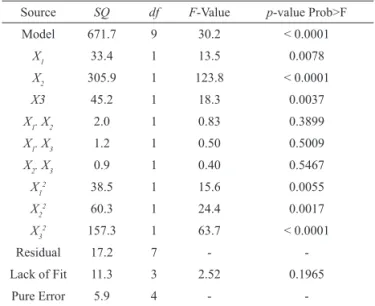
in Table 4 and analysis of variance (ANOVA) in Table 5.
This analysis showed that the primary effects X1, X2 ,X3 and second order interaction X12, X
2 2, X
3
2 are signiicant effect
on UY of tannins.
The theoretical optimized conditions calculated by RSM are, 10 min to extraction time, 150 µm to particle
size and 42 % of alcohol degree (Figure 1). The theoretical
content of tannins obtained in these conditions was 33.0 % (w/w). In rechecking extraction the tannins yield was
33.70±0.02 (% w/w), it conirmed the capacity prediction
of RSM (Eq 2). The UY % was 13.90% higher than the tannin content obtained by decoction 29±0.01 (% w/w) according to the Brazilian Pharmacopoeia (2010). This result proves the superiority capacity of tannins extraction by UEA.
Table 2. Proile of unsaturated fatty acids found in almonds Dipteryx alata.
EM Ua % w/w Oleic Linoleic Linolenic Gadoleic Erucic
B&D 76.5±0.04 46.5±0.30 24.2±0.70 1.9±0.07 3.9±0.03 0.02±0.001
Sh 66.2±0.01 42.0±0.20 21.1±0.40 0.1±0.06 2.8±0.05 0
EM: Extraction Method; B&D: Blingh & Dyer; Sh: Shoxlet; Ua: unsaturated fatty acids.
Table 3. Proile of saturated fatty acids found in almonds Dipteryx alata.
Figure 2. Difference proile of saturated acids (Sa) extracted by
Blingh & Dyer and Shoxlet. The experiments were performed in triplicate, and the bars represent the mean±SD. The difference between the averages were calculated by t-test (a, b, d, e, f and g with p less than 0.05).
The increasing in extraction by ultrasound-assisted method is attributed to effects of acoustic cavitations produced in the solvent
(Waksmundzka-Hajnos et al., 2004; Zhang et al., 2009). The ultrasonic
wave also exerts a mechanical effect, allowing greater penetration of solvent into herbal matrix, increasing the contact surface between solid and liquid phase, resulting the solute diffuses from solid phase to the solvent (Zhang
& Liu, 2008). Several authors have reported the eficiency
of ultrasound-assisted extraction of foods and bioactive compounds (Santos et al., 2010; Zhang & Liu, 2008).
Table 4. 33 Box-Behnken factorial design matrices and result of
UAE.
Run x1 (min) x2 (µm) x3 % (v/v) UY % (w/w)
1 10 350 95 13.44
2 15 250 95 21.6
3 5 250 5 22.6
4 10 250 50 32.64
5 10 250 50 29.59
6 10 250 50 30.76
7 15 350 50 19.9
8 10 250 50 29.71
9 15 150 50 30.45
10 10 150 95 25.19
11 5 350 50 15.85
12 15 250 5 27.06
13 5 250 95 14.91
14 10 350 5 15.38
15 10 250 50 30.71
16 5 150 50 29.28
17 10 150 5 29.12
Table 5. Summary of factor effects and signiicances (p)
ANOVA.
Source SQ df F-Value p-value Prob>F
Model 671.7 9 30.2 < 0.0001
X1 33.4 1 13.5 0.0078
X2 305.9 1 123.8 < 0.0001
X3 45.2 1 18.3 0.0037
X1. X2 2.0 1 0.83 0.3899
X1. X3 1.2 1 0.50 0.5009
X2. X3 0.9 1 0.40 0.5467
X1
2 38.5 1 15.6 0.0055
X2
2 60.3 1 24.4 0.0017
X32 157.3 1 63.7 < 0.0001
Residual 17.2 7 -
-Lack of Fit 11.3 3 2.52 0.1965
Pure Error 5.9 4 -
-SQ: Sum of Squares; df :Degrees of freedom.
In the extraction processes there are multiple independent variables interacting with responding factors. It is important optimization studies for cost reduction, process time, energy, raw materials and therefore environmental impacts. The results showed that in the tannin extraction from baru pulp is possible obtain increasing tannins yield and savings of 58% of ethanol (Figure 3).
Figure 3. Response surface for the UAE of tannins content from Dipteryx alata.
Acknowledgement
The authors are indebted to CNPq and CAPES.
Authors contributions
of tannins and interpretatiing the results; JRP in the
identiication of the plant material and the evaluation of the
chemical composition of almonds. ECC contributed in the interpretation of results and drafting of the manuscript.
References
Almeida SP 1998. Cerrado: Aproveitamento Alimentar. Planaltina: EMBRAPA-CPAC.
AOAC 1998. Oficial methods of analysis of the Association of Oficial Analytical Chemists. In: Association of Oficial Analytical Chemists. Arlington: AOAC.
Bligh EG, Dyer WJ 1959. A rapid method of total lipid extraction and puriication. J Biochem Physiol 37: 911-917. Brazilian Pharmacopoeia 2010. 5 ed. In: Part 1. Agência
Nacional de Vigilância sanitária, Brasilia-DF.
Cechinel-Filho V, Yunes RA 1998. Estratégias para a obtenção de compostos farmacologicamente ativos a partir de plantas medicinais: conceitos sobre modiicação estrutural para otimização da atividade. Quim Nova 21: 99-105. FDA 2010. US Food and Drug Administration. In: Drug Safety
and Availability. http://www.fda.gov/Drugs/DrugSafety/ default.htm, accessed Jan 2013.
Ferraz CM, Parrilha LAC, Moraes MSD, Amaral JF, Cogo JC, Santos MG, Franco MF, Groppo FC, Puebla P, San Feliciano A, Oshima-Franco Y 2012. The effect of lupane triterpenoids (Dipteryx alata Vogel) in the in vitro neuromuscular blockade and myotoxicity of two snake venoms. Curr Org Chem 16: 2717-2723.
Freitas FF, Marquez LDS, Ribeiro GP, Brandão GC, Cardoso VL, Ribeiro EJ 2012. Optimization of the immobilization process of β-galatosidade by combined entrapment-cross-linking and the kinetics of lactose hydrolysis. Braz J Chem Eng 29: 15-24.
Hagerman AE, Butler LG 1978. Protein precipitation method for the quantitative determination of tannins. J Agric Food Chem 26: 809-812.
Hayat K, Hussain S, Abbas S, Farooq U, Ding BM, Xia SQ 2009. Optimized microwave-assisted extraction of phenolic acids from citrus mandarin peels and evaluation of antioxidant activity in vitro. Sep Purif Technol 70: 63-70 Heinrich M, Gibbons S 2001. Ethnopharmacology in drug
discovery: an analysis of its role and potential contribution. J Pharm Pharmacol 53: 425-432 Hinneburg I, Neubert RHH 2005. Inluence of extraction
parameters on the phytochemical characteristics of extracts from buckwheat (Fagopyrum esculentum) Herb. J Agric Food Chem 53: 3-7.
Moreira GA, Michelouf GA, Beccaria AJ, Goicoechea HC 2007. Optimization of the Bacillus thuringiensis var. kurstaki HD-1δ-endotoxins production by using experimental mixture design and artiicial neural networks. Biochem Eng J 35: 48-55.
Nazato VS, Rubem-Mauro L, Vieira NA, Rocha-Junior Ddos S, Silva MG, Lopes PS, Dal-Belo CA, Cogo JC, dos Santos
MG, da Cruz-Holing MA, Oshima-Franco Y 2010. In vitro antiophidian properties of Dipteryx alata Vogel bark extracts. Molecules 15: 5956-5970.
Oliveira AL, Kamimura ES, Rabi JA 2009. Response surface analysis of extract yield and lavour intensity of Brazilian cherry (Eugenia unilora L.) obtained by supercritical carbon dioxide extraction. Innov Food Sci Emergs 10: 189-194.
Puebla P, Oshima-Franco Y, Franco LM, Santos MG, Silva RV, Rubem-Mauro L, Feliciano AS 2010. Chemical constituents of the bark of Dipteryx alata Vogel, an active species against Bothrops jararacussu venom. Molecules 15: 8193-8204.
Santos DT, Veggi PC, Meireles MAA 2010. Extraction of antioxidant compounds from jabuticaba (Myrciaria
caulilora) skins: yield, composition and economical
evaluation. J Food Eng 101: 23-31.
Shahidi F, Wanasundara JPD 1998. Food lipids: chemistry, nutrition and biotechnology. Vol. 5. New York: Marcel Dekker.
Soares LAL, Gonçalves ACA, Bassani VL, Petrovick PR 1998. Desenvolvimento tecnológico de solução extrativa aquosa de Phyllanthus niruri L. (quebra-pedra) empregando planejamento fatorial. Cad Farm 14: 21-26.
Waksmundzka-Hajnos M, Petruczynik A, Dragan A, Wianowska D, Dawidowicz AL, Sowa I 2004. Inluence of the extraction mode on the yield of some furanocoumarins from Pastinaca sativa fruits. J Chromatog B 8: 181-187. Wang B, Lan CQ 2011. Optimizing the lipid production of
the green alga Neochloris oleoabundans using Box-Behnken design. Can J Chem Eng 89: 932-939. Wang L, Weller CL 2006. Recent advances in extraction of
nutraceuticals from plants. Trends Food Sci Technol 17: 300-312.
Wang X, Kapoor V, Smythe GA 2003. Extraction and chromatography-mass spectrometric analysis of the active principles from selected chinese herbs and other medicinal plants. Am J Chin Med 31: 927-944.
Waterman PG, Mole S 1987. Critical analysis of techniques for measuring tannins in ecological studies II: techniques for chemically deining tannins. Oecologia 72: 148-156. Weuster-Botz D 2000. Experimental design for fermentation
media development: Statistical design of global random search? J Biosci Bioeng 90: 473-483.
Yehuda S, Rabinovitz S, Carasso RL, Mostofsky DI 2002. The role of polyunsaturated fatty acids in restoring the aging neuronal membrane. Neurobiol Aging 23: 843-853. Youdim KA, Martin A, Joseph JA 2000. Essential fatty acids
and the brain: possible health implications. Int J Dev Neurosci 18: 383-399.
extraction of lavonoids from Prunella vulgaris L. and evaluation of antioxidant activities in vitro. Innov Food Sci Emerg 12: 18-25.
Zhang HF, Yang XH, Zhao LD, Wang Y 2009. Ultrasonic-assisted extraction of epimedin C from fresh leaves of epimedium and extraction mechanism. Innov Food Sci Emerg 10: 54-60.
Zhang LF, Liu Zl 2008. Optimization and comparison of ultrasound/microwave assisted extraction (UMAE) and ultrasonic assisted extraction (UAE) of lycopene from tomatoes. Ultrason. Sonochem 15: 731-737
*Correspondence
Frederico Severino Martins
Laboratório de Pesquisa de Produtos Naturais, Faculdade de Farmácia, Universidade Federal de Goiás
C.P. 131, 74001-970 Goiânia-GO, Brazil [email protected]